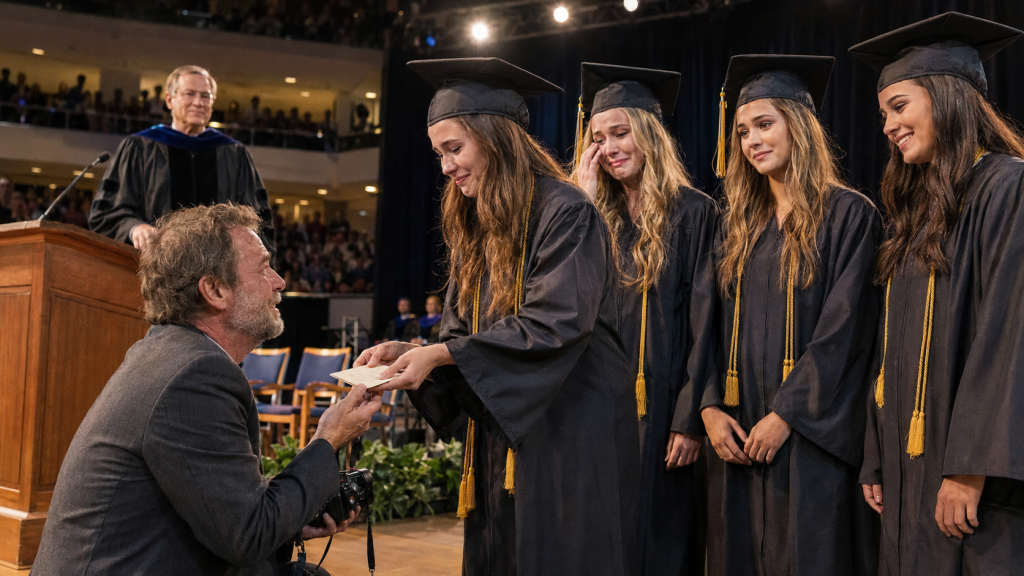
I Gave Up 22 Years Of My Life Raising My Triplet Nieces — What They Did At Their College Graduation Made Me Drop To My Knees.

The girls were only six months old when my brother left them on my doorstep.
Three car seats.
One diaper bag.
And a note scribbled on the back of a gas receipt.
“I’m sorry, Noah. I can’t do this.”
Their mother had died just eleven days earlier.
My brother lasted less than two weeks.
I was twenty-seven years old, single, living above the hardware store where I worked, with $312 in my bank account and no clue how to raise three babies.
“You can’t raise three babies alone,” my neighbor told me.
Maybe she was right.
But before I could call anyone, the smallest one wrapped her tiny hand around my finger.
So I stayed.
Somewhere along the way, Uncle Noah stopped feeling like a title.
It became Dad.
For the next twenty-two years, I packed lunches, learned how to braid hair badly, worked double shifts, sat through fevers, science fairs, heartbreaks, and the years when all three girls decided I was the worst person alive.
I missed weddings.
Vacations.
The chance to build a family of my own.
Not because they asked me to.
Because somebody had to stay.
By graduation day, my beard had turned gray, my knee hurt every morning, and I stood in the crowd holding a cheap camera with shaking hands.
One by one, they crossed the stage.
Ava.
Claire.
June.
Triplets, but completely different.
Ava cried before her name was called.
Claire waved at me like she was still eight years old.
Then June crossed the stage.
She looked serious.
After the final name was announced, the dean stepped back to the microphone.
“We have one more presentation before we close.”
The girls walked back onto the stage together.
June took the microphone.
“Our father couldn’t be here today,” she said.
The room got quiet.
Then Ava pulled a folded paper from inside her graduation gown.
“We found what he left behind,” June said.
I didn’t know what she meant.
I didn’t know there was anything left.
Then she looked down at the paper and read the first line.
And that was the moment my knees gave out.
Then June walked down the steps, held out the folded paper, and placed it in my shaking hands.
PART 2: THE LETTER HE NEVER MEANT ME TO READ
June placed the folded paper in my hands.
For a second, I just stared at it.
The entire auditorium had gone silent.
Thousands of people were still sitting in their seats.
Parents.
Grandparents.
Professors.
Friends.
But I could hear only one thing.
My own breathing.
Slow.
Uneven.
Afraid.
The paper was old.
Yellowed at the edges.
Creased down the middle so many times that the fold had nearly torn through.
On the front, written in handwriting I had not seen in twenty-two years, were two words.
For Noah.
My brother’s handwriting.
Eli.
My fingers started shaking.
I looked up at the girls.
Ava was crying.
Claire had both hands pressed against her mouth.
June stood closest to me.
Her face was composed, but I knew her too well.
Her lower lip trembled exactly the way it had when she was six and trying not to cry after falling off her bicycle.
“Where did you get this?”
My voice barely worked.
June crouched beside me.
“We’ll explain.”
“When?”
“Three months ago.”
I stared at her.
“Three months?”
Ava came down the steps.
Then Claire.
People in the audience were beginning to realize they were witnessing something private.
Something not rehearsed for applause.
The dean moved quietly away from the microphone.
No one interrupted.
I unfolded the letter.
The first line was enough.
Noah, if you’re reading this, then I failed them twice.
My knees gave out.
I did not even feel myself falling.
One second I was standing.
The next, I was on the polished floor beside the first row of chairs.
Ava cried out.
“Dad!”
Dad.
Not Uncle Noah.
Dad.
She dropped beside me.
Claire grabbed my shoulder.
June took the paper before I crushed it.
“You okay?”
I shook my head.
No.
There was no reason to lie.
“I don’t know.”
My chest hurt.
Not like a heart attack.
Like twenty-two years had suddenly been stacked on top of it.
Eli.
My little brother.
Three years younger than me.
Always reckless.
Always charming.
Always convinced life would forgive him one more mistake.
I had spent twenty-two years angry at him.
Not every day.
That would have required too much energy.
But the anger never disappeared completely.
It lived somewhere behind everything else.
Every fever at three in the morning.
Every unpaid bill.
Every parent-teacher conference.
Every Christmas morning when the girls asked why their father never came.
Every time I had to sign a school form and write guardian instead of father.
Eli had left them.
Three babies.
Six months old.
Eleven days after their mother died.
He put them on my doorstep.
Then vanished.
I had believed that was the whole story.
Apparently, it was not.
June helped me into an empty chair.
“Do you want me to read it?”
I looked at the paper.
Then at her.
“No.”
My voice shook.
“I need to.”
I took it back.
My hands were still trembling.
Then I started reading.
Noah, if you’re reading this, then I failed them twice.
The first time was the morning I left them with you.
The second was every day after when I stayed away.
I stopped.
The words blurred.
I blinked until they returned.
You are probably angry. You should be. I don’t have a defense that will make what I did acceptable. I was broken after Megan died. I was drinking. I wasn’t sleeping. I had three babies screaming in three different directions and I kept thinking one of them would stop breathing if I looked away.
My throat tightened.
Megan.
The girls’ mother.
She had died from a sudden brain hemorrhage.
No warning.
No long illness.
One morning she was alive.
That night she was gone.
I remembered the funeral.
Eli stood beside the casket holding Ava.
I held Claire.
Our mother held June.
He did not cry.
Not once.
At the time, I thought he was numb.
Maybe he was.
I kept reading.
I started having thoughts that scared me.
My breathing changed.
I would stand in the kitchen holding a bottle and think the girls deserved a father who wasn’t me. Then I would hate myself for thinking it.
One night, I woke up on the floor and realized I had no memory of how I got there. June was crying in the crib. Ava had a fever. Claire had been sick on herself.
That was when I knew I was dangerous to them.
I closed my eyes.
For twenty-two years, I had imagined my brother driving away because fatherhood became inconvenient.
Because he wanted freedom.
Because he was selfish.
I had never imagined fear.
Not this kind.
June whispered,
“Keep reading.”
I nodded.
I called Mom. She told me to pull myself together.
That sounded like our mother.
She had loved us.
But she came from a generation that thought pain could be insulted into disappearing.
I called a church counselor. He told me grief was natural and that God only gave us what we could handle.
I almost laughed bitterly.
I had heard that sentence more times than I could count.
Then I called you.
I stopped.
My memory shifted.
A phone call.
Two nights before the babies appeared.
Eli had called me after midnight.
I was half asleep.
He sounded strange.
I remembered asking if he needed money.
He said no.
I asked if the girls were okay.
He said yes.
Then he asked,
“You’d take care of them if something happened to me, right?”
I thought he was being dramatic.
I told him,
“Nothing’s going to happen to you.”
He asked again.
I said,
“Of course.”
Then I went back to sleep.
I had forgotten that call.
Completely.
Until now.
My hands began shaking again.
The letter continued.
You said yes.
I don’t think you understood what I was asking.
Maybe I didn’t either.
Two days later, I put them in the car.
I drove to your building before sunrise because if I saw your face, I knew I would lose my nerve.
I left the note because I was ashamed to write anything longer.
Then I drove away and threw up behind a gas station.
Ava began crying harder.
Claire sat down on the floor beside me.
June remained standing.
Rigid.
Angry.
I recognized the look.
She was not ready to forgive him either.
Neither was I.
I continued.
I told myself I would come back in a week.
Then two weeks.
Then a month.
By then, you had taken them to the doctor. Bought cribs. Learned their feeding schedules.
Mom told me you were exhausted but wouldn’t give them up.
I was relieved.
That relief became cowardice.
I swallowed hard.
There it was.
The truth I needed.
Not an excuse.
Cowardice.
He knew.
I left the state.
I worked construction under a friend’s crew.
I stopped drinking for six months. Started again. Stopped again.
Every birthday, I told myself this would be the year I came back.
Every year, I found another reason not to.
When they turned five, I saw a school picture Mom sent me.
Ava had missing front teeth. Claire was wearing glasses. June looked mad at the photographer.
I looked at June.
Despite everything, a laugh escaped me.
She wiped her face.
“I hated picture day.”
“I remember.”
“You made me wear that sweater.”
“It was a nice sweater.”
“It had ducks.”
“You liked ducks.”
“When I was three.”
The smallest laugh moved through the people nearest us.
Then silence returned.
I looked back at the letter.
That picture destroyed me.
Because they looked happy.
And I realized the worst truth of all.
They were happy without me.
My eyes burned.
You had become their father before I ever found the courage to become myself again.
I stopped reading.
That sentence hurt differently.
Not because it was cruel.
Because it was true.
I had never decided to become Dad.
There was no ceremony.
No moment.
No adoption paper that magically transformed me.
It happened slowly.
The first time Ava had nightmares and climbed into my bed.
The day Claire broke her arm and screamed for me in the emergency room.
The afternoon June punched a boy in third grade because he said they did not have a real father.
I had punished her.
Then cried in the car where she could not see me.
Dad had happened in thousands of ordinary moments.
I kept reading.
I started sending money.
My head snapped up.
“What?”
The girls looked at one another.
June nodded.
“Keep going.”
I read faster.
Not much. I was never good at keeping money. But when I could, I sent cash to Mom and asked her to give it to you without telling you where it came from.
My stomach dropped.
Our mother.
She had died eight years ago.
I thought back.
There had been money sometimes.
Five hundred dollars.
A thousand.
She would say,
“I sold some old furniture.”
Or,
“I had extra.”
I never questioned it because there was always another bill.
School shoes.
Dentist visits.
Car repairs.
Three children meant every expense arrived multiplied.
“Grandma knew?”
Claire asked quietly.
I nodded slowly.
“Apparently.”
The letter continued.
I told Mom not to tell you because I knew you would try to find me.
Damn right I would have.
I was not ready to be found.
That was selfish.
I know that now.
But I watched from far away.
I froze.
Watched?
I kept reading.
I went to Ava’s eighth-grade play.
Ava gasped.
“What?”
I looked at her.
She stared back.
“I played the tree.”
I almost smiled.
“You were the best tree.”
“I had one line.”
“Still.”
My eyes dropped back to the page.
I stood in the back near the exit.
You were in the third row holding flowers for all three girls even though only Ava was performing because you said nobody should go home empty-handed.
My chest broke.
I remembered those flowers.
Cheap carnations.
Three bundles.
One for each girl.
Because if I brought only Ava flowers, Claire would pretend not to care and June would definitely care while insisting she did not.
I had no idea Eli was there.
I saw Claire play soccer when she was fifteen.
Claire covered her mouth.
I saw June graduate high school.
June’s eyes widened.
“No.”
I looked at her.
She was crying now.
He had been there.
All those years.
Not present.
But not completely gone.
And somehow that made everything both better and worse.
I stood so far away you never noticed me.
You looked old, Noah.
I laughed through tears.
“Thanks, Eli.”
Ava gave a wet laugh.
I continued.
Older than you should have.
I knew why.
Every gray hair felt like evidence against me.
My vision blurred.
I watched you work two jobs when they started high school.
I knew because Mom told me.
I knew Ava wanted violin lessons.
I knew Claire needed braces.
I knew June had that emergency surgery when she was fourteen.
My hand went to my mouth.
June’s appendix.
It had ruptured.
I spent six nights sleeping in a hospital chair.
I remembered borrowing money from my boss.
Selling my motorcycle.
Telling the girls I never liked the motorcycle anyway.
That was a lie.
I loved that bike.
The letter continued.
I sent everything I had that month.
My heart stopped.
I remembered.
Our mother had shown up at the hospital.
She handed me an envelope with four thousand dollars.
I asked where she got it.
She said an old insurance policy finally paid.
I believed her.
I had been too tired not to.
Eli.
It had been Eli.
I lowered the letter.
“I didn’t know.”
Ava knelt beside me again.
“We didn’t either.”
“Then how did you find this?”
June looked at Claire.
Claire nodded.
Then June answered.
“Dad died.”
The word hit like a physical blow.
Not Dad referring to me.
Eli.
Their father.
Their biological father.
“When?”
I whispered.
“Seven months ago.”
My chest tightened.
“How?”
“Liver failure.”
Of course.
Alcohol.
Twenty-two years of running had apparently caught him anyway.
A strange grief moved through me.
I had imagined punching my brother if I ever saw him again.
Then imagined hugging him.
Then stopped imagining anything.
Now neither was possible.
“Who told you?”
“An attorney.”
Claire reached into her graduation gown and pulled out a card.
“His attorney contacted us.”
I stared.
“He had our names.”
June nodded.
“And yours.”
“What did he leave?”
Ava answered.
“Mostly letters.”
“Mostly?”
The girls exchanged another look.
I knew that look.
There was more.
Always more.
“What else?”
June swallowed.
“A storage unit.”
I frowned.
“What was in it?”
“Things.”
“What things?”
“Pictures.”
“Newspaper clippings.”
“School programs.”
“Copies of report cards Grandma sent.”
Ava’s voice broke.
“He kept everything.”
My heart hurt.
He had abandoned them.
Then built a museum of the life he refused to enter.
I did not know how to feel about that.
Maybe there was no correct feeling.
Claire reached into her gown again.
This time she pulled out a photograph.
She handed it to me.
Eli.
Older.
Thin.
Gray at the temples.
He was standing outside some diner.
I had not seen his face in twenty-two years.
But I knew him immediately.
My little brother.
His smile was gone.
His eyes looked tired.
On the back, he had written a date.
Three years earlier.
And one sentence.
Noah would hate what I became.
My throat closed.
“No.”
The word escaped without permission.
June looked at me.
“What?”
I touched the photograph.
“I would’ve hated what he did.”
I swallowed.
“That isn’t the same thing.”
The girls were silent.
I looked at my brother’s face.
Dead now.
No chance to explain.
No chance for me to tell him what an idiot he was.
No chance to ask why he could stand in the back of an auditorium but not walk down the aisle and say hello.
That made me angry.
Terribly angry.
“You should’ve come home, Eli.”
My voice broke.
“You should’ve come home.”
Ava touched my shoulder.
The dean quietly spoke into the microphone.
“Mr. Parker, take all the time you need.”
I had forgotten the auditorium.
The people.
The stage.
Everything.
I looked around.
Hundreds of strangers were wiping their eyes.
I wanted the floor to swallow me.
Then June held out her hand.
“There’s more.”
I laughed weakly.
“Of course there is.”
She helped me stand.
My knees still felt unreliable.
The girls guided me onto the stage.
I had spent twenty-two years showing up for them.
Now all three walked slowly enough for me.
That realization nearly made me cry again.
At center stage stood a small table.
On it was a wooden box.
Dark oak.
Scratched at the corners.
June placed her hand on top.
“This was in the storage unit.”
I stared at it.
“What is it?”
Ava smiled through tears.
“Open it.”
I lifted the lid.
Inside were three folders.
AVA.
CLAIRE.
JUNE.
And beneath those—
one labeled:
NOAH.
I looked at the girls.
“You read these?”
“Only ours,” Claire said.
June nodded toward mine.
“That one is yours.”
I lifted it.
The folder was thick.
Inside were letters.
Dozens.
All addressed to me.
Different years.
Different handwriting.
Some shaky.
Some clean.
None mailed.
The first was dated twenty-one years ago.
I opened it.
Noah, I drove past your building today. I almost stopped.
Another.
Noah, Mom says the girls started walking. All three. God help you.
Another.
Noah, I’m sober sixty-three days.
Another.
I screwed up again.
Another.
Ava looks like Megan. It hurt to see her.
Another.
Claire apparently bites when angry. That’s definitely you.
I laughed.
Claire looked offended.
“I did not bite.”
“You absolutely bit.”
“I was four.”
“Exactly.”
I opened another.
Dated eleven years earlier.
Noah, Mom says you turned down a promotion because it meant moving the girls to another school district.
I remembered.
Assistant manager.
Better salary.
Longer commute.
The girls were thirteen.
They had finally found friends.
I said no.
At the time I told myself another opportunity would come.
It never did.
You keep choosing them.
Eli had written.
I keep choosing fear.
My eyes filled.
I don’t know how to stand in front of you after that.
Then another.
Five years ago.
Noah, I have cirrhosis.
My stomach dropped.
I read silently now.
The doctor says I can improve things if I stop drinking completely.
I am trying.
Next letter.
Four years ago.
I failed again.
Next.
Three years ago.
I watched June graduate.
I almost walked up to you afterward.
You hugged all three girls at once and I realized there wasn’t room for me in that moment.
I shut my eyes.
Damn him.
There had been room.
There was always room for truth.
He just never trusted us enough to let us decide.
The final letter in the folder was dated nine months ago.
Two months before his death.
My hands shook as I opened it.
Noah, I don’t think I’m getting another year.
I inhaled slowly.
The girls are twenty-two now.
I know that because I have counted every birthday I missed.
You are forty-nine.
I know that because I counted what you gave up too.
My vision blurred.
There is no apology large enough for leaving three infants on your doorstep.
There is no check I can write to repay twenty-two years.
There is no explanation that turns cowardice into courage.
I swallowed.
But there is one thing I need you to know.
I kept reading.
You did not ruin your life for my daughters.
That sentence stopped me.
Because somewhere deep inside, in the ugliest moments, I had wondered.
Not often.
But sometimes.
When I was thirty-five and watched friends get married.
When I was forty and realized I had never left the state for a vacation.
When I was forty-five and my back started hurting from years at the hardware store.
Had I given too much?
Had I lost the life I was supposed to have?
I never blamed the girls.
Never.
But I had wondered who I might have become.
Eli continued.
I know you missed things.
I know there are lives you could have lived.
But when I watched those girls look at you, I understood something.
You did build a family.
My breathing broke.
It just didn’t arrive the way you expected.
I had to stop.
June took my arm.
“Dad.”
I looked at her.
All three were crying.
I continued.
They are my daughters by blood.
But they are your daughters by every choice that matters.
I lowered the page.
That did it.
I cried.
Not quietly.
I bent forward with one hand against the table and sobbed.
Twenty-two years.
All the school lunches.
All the bills.
The nights I was afraid.
The mornings I did not know whether rent would clear.
The teenage screaming matches.
The birthdays.
The hair braids that looked like knotted rope.
The first dates I hated.
The college acceptance letters.
All of it.
My daughters.
Not nieces.
Not children I temporarily saved.
Mine.
June wrapped her arms around me first.
Then Ava.
Then Claire.
Somebody in the audience started clapping.
Then someone else.
Within seconds, the entire auditorium was standing.
I hated public attention.
Always had.
But this time, I could not even lift my head.
The girls held me.
That was enough.
Eventually, the applause faded.
I wiped my face.
“There’s one last page,” Ava whispered.
I looked down.
Of course.
I picked it up.
The handwriting was worse.
Shaky.
Probably written near the end.
Noah, I left something else behind.
My stomach tightened.
I read.
I know money cannot fix what I did.
But I spent the last fourteen years saving what I could.
I frowned.
Saving?
I put every extra dollar into an account.
My head lifted.
The girls were watching me.
“What account?”
June smiled sadly.
“Keep reading.”
I wanted to leave it to the girls.
Then I realized that would be one more way of giving them something while ignoring the man who did the work.
My chest tightened.
So the account is yours.
I stopped.
“No.”
Claire laughed through tears.
“Dad.”
“No.”
I looked at them.
“I’m not taking money from your father.”
June folded her arms.
“There he is.”
“What?”
Ava wiped her nose.
“Exactly what the attorney said you’d do.”
“What attorney?”
“The one handling Dad’s estate.”
“Eli’s estate.”
June smiled.
“See?”
I sighed.
“How much?”
Nobody answered.
My stomach sank.
“Ava.”
She looked at Claire.
“Don’t look at her.”
Claire looked at June.
“Stop passing it around.”
June finally spoke.
“Two hundred and eighty-six thousand dollars.”
I stared.
“What?”
The room disappeared again.
“Two hundred and…”
“Eighty-six thousand.”
“That’s impossible.”
“No.”
Claire shook her head.
“He worked constantly near the end.”
“Construction.”
“Warehouse jobs.”
“Maintenance.”
“He lived cheap.”
June added,
“And apparently he invested some of it.”
I stared at the final lines.
I know you’ll try to refuse it.
I almost laughed.
He still knew me.
Don’t.
For once in your life, Noah, let somebody give something back to you.
That sentence hurt worse than the number.
Give something back.
I had spent twenty-two years giving.
Not heroically.
Not perfectly.
Sometimes angrily.
Sometimes resentfully.
Sometimes because there was simply no one else.
But giving became so normal that receiving felt embarrassing.
Almost wrong.
I kept reading.
Take a trip.
Fix your knee.
I laughed.
The girls laughed too.
“How did he know about my knee?”
“Grandma,” June said.
“Of course.”
I continued.
Buy something stupid.
Stop working double shifts.
And if there is still some part of you that believes you missed your chance to have a family, look around.
I did.
At Ava.
Claire.
June.
My girls.
Then I read the final line.
You were their father every day I wasn’t.
Thank you for staying.
That was the end.
No signature.
Just:
Your brother, Eli.
I folded the letter.
Carefully.
Then I looked at the girls.
June reached for the microphone.
She turned toward the audience.
“We wanted everyone here to know something.”
I immediately became nervous.
“Oh, no.”
Ava smiled.
“Oh, yes.”
Claire stepped beside her.
“For twenty-two years, Dad told people he was just doing what anybody would do.”
I shook my head.
“Do not—”
June ignored me.
“He worked at the same hardware store for twenty-seven years.”
Applause started.
I covered my face.
“He learned how to make three Halloween costumes in one night.”
More applause.
Ava added,
“They were terrible.”
“They were excellent.”
“You made me a potato.”
“You asked to be a potato.”
“I was seven!”
The audience laughed.
Claire took the microphone.
“He sold his motorcycle when I needed braces.”
I stared at her.
“How did you know that?”
Her eyes filled.
“I found the receipt last year.”
My throat tightened.
June continued.
“He never missed a school conference.”
Ava added,
“He taught us how to drive.”
Claire said,
“Badly.”
“I taught you perfectly.”
“You grabbed the dashboard every ten seconds.”
“That was survival.”
People laughed again.
Then June’s face became serious.
“He told us our biological father loved us even when he had every reason to teach us to hate him.”
That silenced me.
She looked directly at me.
“He protected us from his anger.”
My eyes filled.
“And when we asked why Dad left, Uncle Noah never called him a coward.”
She swallowed.
“He said, ‘Sometimes people get lost inside pain.’”
I remembered saying that.
I had forgotten.
June’s voice broke.
“You gave us a version of our father we could survive until we were old enough to learn the truth.”
I could not look at her.
Then Ava spoke.
“So today isn’t just our graduation.”
She smiled through tears.
“It’s his.”
I frowned.
“My what?”
Claire pointed toward the dean.
The dean returned to the microphone.
“Mr. Parker, would you please come forward?”
I stared.
“No.”
The girls laughed.
June took my arm.
“Yes.”
“What have you done?”
“You’ll see.”
They pulled me toward center stage.
The dean smiled.
“For many years, this university has recognized individuals whose service to their community represents the values we hope our graduates carry into the world.”
I looked at the girls.
They were grinning.
The dean continued.
“This year, three graduating students submitted an unusual nomination.”
My chest tightened.
“They wrote nearly forty pages.”
I looked at June.
“Forty?”
She shrugged.
“We had material.”
The audience laughed.
The dean held up a framed certificate.
“Mr. Noah Parker, for extraordinary service as a guardian, parent, community volunteer, and advocate for three young women who stand before us today, it is our privilege to recognize you with the university’s Medal of Family Service.”
I stared at him.
No.
This was too much.
“I didn’t—”
The dean stepped closer.
“You did.”
I looked at my girls.
Ava was crying openly.
Claire was crying while laughing.
June had finally abandoned any attempt to stay composed.
The dean placed the medal around my neck.
The auditorium stood again.
And for the second time that day, my knees nearly gave out.
But this time, three hands caught me.
One from each daughter.
That was the photograph everyone took.
Not me standing proudly.
Not the medal.
Not the diplomas.
Me halfway between laughing and crying while three women held me upright.
Ava on one side.
Claire on the other.
June behind me.
The same three girls I once carried two at a time because I only had two arms.
Twenty-two years earlier, my brother left three car seats outside my door.
That afternoon, those three babies stood on a university stage holding me up.
Life has a strange sense of balance.
After the ceremony, we sat beneath a maple tree near the campus library.
The girls had removed their graduation caps.
Mine—
yes, they had somehow found me one—
sat crooked on my head.
I hated it.
They loved it.
Ava leaned against my shoulder.
Claire stretched across the grass.
June held Eli’s letter.
I looked at them.
“So when were you planning to tell me about the money?”
“Today.”
“And if I said no?”
June smiled.
“We already signed the final paperwork.”
I stared.
“You what?”
“It’s legally yours.”
“June.”
“Dad.”
“I am still capable of grounding you.”
“You haven’t been able to ground me for four years.”
“Watch me.”
She laughed.
I took the letter from her.
For a while, nobody spoke.
Then Claire asked,
“Are you angry at him?”
I knew who she meant.
I looked at Eli’s handwriting.
“Yes.”
They waited.
“And sad.”
Ava nodded.
“And?”
I thought about it.
“And relieved.”
June frowned.
“Relieved?”
“Yes.”
“Why?”
“Because I spent twenty-two years thinking he forgot you.”
My voice softened.
“He didn’t.”
“That doesn’t excuse leaving.”
June said it sharply.
I looked at her.
“No.”
She wiped her eyes.
“I’m angry too.”
“You’re allowed.”
“He could have come back.”
“Yes.”
“We would have listened.”
“Probably.”
She looked down.
“Maybe.”
I smiled sadly.
“Eventually.”
Ava asked,
“Do you forgive him?”
That question sat between us.
I looked toward the graduation crowd.
Families taking photographs.
Parents fixing gowns.
Grandparents carrying flowers.
Then I thought of my brother standing in the back of school auditoriums.
Watching.
Wanting.
Afraid.
“No.”
The girls looked surprised.
“Not yet.”
I folded the letter.
“Forgiveness should not be rushed just because somebody died.”
June nodded slowly.
“Good.”
“What?”
“I was afraid you were going to say some beautiful Dad thing.”
I laughed.
“I’m not that emotionally evolved.”
Claire smiled.
“Clearly.”
I tossed a napkin at her.
Then Ava leaned against me again.
“Do you regret it?”
“What?”
“Us.”
Everything inside me stopped.
She must have seen something in my face because she immediately sat upright.
“I don’t mean—”
“No.”
I put the letter down.
“No.”
I looked at all three.
“Never ask me that like you were something that happened to me.”
Ava’s eyes filled.
“You were my life.”
All three went still.
“Not the life I planned.”
I smiled.
“Thank God.”
Claire laughed through tears.
“I was twenty-seven.”
“Broke.”
“Single.”
“Living over a hardware store.”
I pointed at them.
“And suddenly there were three of you.”
“Three.”
“Why couldn’t there have been one?”
Ava smiled.
“Bad luck.”
“Terrible luck.”
I continued.
“I thought I was losing everything.”
“Then one day, years later, I realized I had stopped imagining another life.”
My throat tightened.
“Because I liked mine.”
June started crying again.
I groaned.
“Please stop. We are dehydrating.”
She laughed.
Then hugged me.
Ava joined.
Claire pretended she would not.
She lasted three seconds.
I wrapped both arms around all of them.
Three babies.
Three girls.
Three women.
My family.
Not because Eli left.
Not because Megan died.
Not because I sacrificed.
Because we stayed.
All of us.
That should have been the end of graduation day.
It was not.
When we returned to my house that evening, there was a package waiting on the porch.
No return address.
Just my name.
I looked at the girls.
“Another surprise?”
All three shook their heads.
June frowned.
“Not us.”
I carried it inside.
The box was light.
Inside was a smaller envelope.
And a key.
I stared at it.
Claire picked up the envelope.
“What is this?”
On the front was a name.
Not mine.
Not Eli’s.
Megan Parker.
The girls’ mother.
My heart stopped.
Ava whispered,
“That’s Mom’s handwriting.”
I looked at her.
“How do you know?”
“The attorney showed us old documents.”
My hands went cold.
Megan had died eleven days before Eli abandoned the girls.
There was no possible reason a letter from her should be arriving now.
June carefully opened the envelope.
Inside was a note.
Short.
Only two sentences.
She read them aloud.
If the girls ever find Eli’s letters, they deserve to know why he was already afraid before I died.
Then she looked at the key.
And read the final line.
Noah knows where this belongs.
All three girls turned toward me.
I stared at the small brass key.
And suddenly, I did know.
There was only one place it could belong.
A locked metal box that had sat untouched in my mother’s attic for twenty-two years.
A box she once made me promise never to open.
And for the first time that day, I realized my brother’s abandonment might not have been the oldest secret our family buried.
PART 3: THE BOX MY MOTHER MADE ME PROMISE NEVER TO OPEN
For almost a full minute, I could not move.
The brass key sat in June’s palm.
Small.
Old.
Ordinary.
But I knew exactly what it opened.
My mother’s attic had been cleared after she died eight years earlier.
Almost everything was donated.
Old coats.
Christmas decorations.
Boxes of photographs.
My father’s tools.
But one metal case stayed with me.
Dark green.
Heavy.
Locked.
My mother had kept it beneath a stack of blankets.
I found it while cleaning out her house.
When I asked what was inside years earlier, she became strangely serious.
“Not yours.”
Then she made me promise never to force it open.
After she died, I brought it home anyway.
Not because I intended to break my promise.
Because throwing it away felt wrong.
For eight years, it had sat on the top shelf of my bedroom closet.
Untouched.
Until now.
Claire looked at me.
“You know where that key goes.”
It was not a question.
I nodded.
June’s expression tightened.
“Where?”
“My closet.”
Ava blinked.
“You’ve had something locked in your closet for eight years and never opened it?”
“Your grandmother asked me not to.”
June almost laughed.
“Dad.”
“What?”
“That is insane.”
“I made a promise.”
“To someone who was dead.”
“A promise doesn’t stop mattering because the person dies.”
The words came out automatically.
Then I stopped.
Because that sentence had described most of my life.
Promises.
To Eli.
To the girls.
To our mother.
To myself.
Some promises had saved us.
Others had kept truth buried long past the point of usefulness.
I looked at the key.
“Maybe this one lasted long enough.”
We went upstairs together.
I pulled a chair beneath the closet shelf.
Claire immediately grabbed my elbow.
“Your knee.”
“I’m fine.”
“You almost collapsed twice today.”
“I was emotional.”
“You are forty-nine, not ninety.”
“Then stop treating me like ninety.”
Ava rolled her eyes.
“Please don’t fall on graduation day.”
“Very supportive.”
June took the chair away from me.
“I’ll get it.”
Of course she would.
She climbed up and pulled down the box.
Dust covered the top.
I wiped it with my sleeve.
All three girls sat on the edge of my bed.
For a second, they looked twelve again.
Waiting for me to explain something scary.
Except this time I had no explanation.
June handed me the key.
I inserted it.
It fit.
My stomach tightened.
The lock clicked.
The girls stopped breathing.
I lifted the lid.
Inside were papers.
Photographs.
A bundle of old letters tied with string.
Three hospital bracelets.
One for each baby.
And beneath everything—
a cassette tape.
Ava touched one bracelet.
“That was mine?”
I checked the faded name.
“Ava Parker.”
She stared at it.
Tiny letters.
Tiny date.
The day she was born.
Claire found hers.
June found the third.
No one spoke.
Then I saw an envelope.
NOAH
My mother’s handwriting.
I sat down.
Apparently, everyone in my family had spent twenty-two years writing letters instead of having conversations.
I opened it.
The page shook between my hands.
Noah,
If you opened this, then either I changed my mind or I am no longer there to stop you.
“That’s encouraging,” I muttered.
Claire gave me a look.
I continued.
What I am about to tell you will make you angry with me.
You have every right.
My stomach sank.
June whispered,
“Keep going.”
I nodded.
Megan knew Eli was struggling before she died.
That was not surprising.
What came next was.
She also knew why.
I stopped.
Ava leaned forward.
“What does that mean?”
“I don’t know.”
I kept reading.
Three months before the girls were born, Eli discovered that the debt he believed was his was not his alone.
I frowned.
Debt?
I looked at the girls.
They looked equally confused.
Your father left behind more than tools and hospital bills when he died.
Our father.
My stomach tightened.
He died when Eli was nineteen and I was twenty-two.
Heart disease.
Or that was what we told people.
He had also left gambling debts.
That part was no secret.
I worked two jobs for almost three years helping Mom keep the house.
Eli helped sometimes.
But he was younger.
Less disciplined.
More angry.
My mother’s letter continued.
Your father borrowed money under Eli’s name.
I stared.
“No.”
June leaned closer.
“What?”
“He used Eli’s identity.”
All three girls went still.
I read faster.
He opened two accounts using Eli’s information after Eli turned eighteen.
When your father died, those debts remained.
I knew.
My chest tightened.
I was ashamed.
So I told Eli the debts were family obligations and asked him to help me pay them.
My breath became shallow.
I remembered.
Eli dropping out of community college.
Eli taking construction jobs.
Eli borrowing my truck.
Eli getting angry every time I talked about saving money.
I thought he was irresponsible.
Apparently, he had been drowning under debt our father created.
Eli did not tell you because I begged him not to.
I closed my eyes.
Of course.
Another secret wrapped in family loyalty.
Another burden one person carried so everyone else could pretend the family was fine.
When Megan became pregnant with the girls, Eli was already behind on payments.
He started borrowing again.
Not for drinking.
Not at first.
For rent. Medical bills. Baby supplies.
Ava covered her mouth.
Then Megan learned something worse.
My hands stopped.
There it was.
The thing the entire box had been built around.
I read the next line twice.
The lender collecting your father’s debt was not a bank.
June whispered,
“What was it?”
I swallowed.
“A private lender.”
The letter continued.
A man named Walter Sloane.
I knew the name.
Not well.
But enough.
He owned half a dozen businesses around town when we were young.
Used car lot.
Pawn shop.
Storage units.
People said he loaned money.
People also said you did not want to owe him.
I had not heard that name in decades.
Walter told Eli the debt would disappear if Eli did work for him.
My stomach twisted.
Collections. Deliveries. Intimidation.
Claire whispered,
“Oh my God.”
Eli refused at first.
Then the babies came early.
Megan needed time off.
Bills grew.
And Eli agreed.
I lowered the letter.
My little brother.
The one I remembered as reckless.
Maybe he had been.
But recklessness and desperation often wear the same coat from a distance.
I continued.
Megan found out two months before she died.
She came to me crying.
She said Eli had changed.
He was not sleeping.
He was drinking after doing work for Walter.
He was afraid someone would come to the house.
My eyes burned.
That explained the line in Megan’s note.
Why he was already afraid before I died.
He was not simply grieving after losing his wife.
He had already been scared.
Megan begged me to tell you.
I stopped.
My chest went cold.
No.
I knew what came next.
I did not want to read it.
June saw my face.
“Dad.”
I shook my head.
“She told Grandma to tell me.”
No one spoke.
I continued.
I said no.
My throat closed.
I told her you had already carried too much for this family.
I told her Eli needed to solve his own problems.
I told myself I was protecting you.
I laughed once.
Bitterly.
Protecting me.
That word had done a lot of damage in our family.
Megan disagreed.
She said, “Noah is the only person Eli still listens to.”
I had to put the paper down.
My eyes filled.
Because she had been right.
Eli did listen to me.
Not always.
Not easily.
But when we were young, I was the one who could get him home after a fight.
The one who could make him hand over his keys.
The one he called when he was scared but did not want to say he was scared.
And nobody told me.
Ava touched my arm.
“You didn’t know.”
I nodded.
“I know.”
But knowing did not stop the guilt from entering.
That was the terrible thing about guilt.
It does not need logic.
It only needs imagination.
What if I had known?
What if Megan called?
What if Mom had said something?
Would Eli have stayed?
Would Megan still have died?
No.
Her death was medical.
Nothing changed that.
But maybe Eli would not have been so alone afterward.
Maybe the girls would not have appeared on my doorstep.
Maybe—
June squeezed my hand.
“Dad.”
I looked at her.
“Don’t do that.”
“What?”
“The what-if thing.”
I almost laughed.
“You read minds now?”
“You taught us.”
That silenced me.
I picked the letter back up.
Eleven days after Megan died, Eli came to my house.
My breathing changed.
The girls were in the car.
He looked terrible.
He said Walter’s people had come by twice asking for money.
He said he had started drinking again.
He said he was afraid he might hurt himself.
Claire began crying.
Then he said something I will regret until I die.
I paused.
He said, “If I leave the girls with Noah, they’ll be safe.”
I closed my eyes.
That sentence went through me like a blade.
Not—
Noah will raise them.
Not—
Noah can afford them.
Safe.
That was why he chose me.
Not because I was convenient.
Because he believed I was safety.
I continued.
I told him he was being dramatic.
My mother’s words.
I could hear her voice.
Pull yourself together.
Stop behaving foolishly.
You are a father now.
He said he needed to disappear for a while.
I told him no.
I told him leaving would make him a coward.
June wiped her face.
He asked me to take the girls.
My hand froze.
Ava whispered,
“What?”
I stared at the page.
I refused.
The room went completely silent.
My mother had known.
Before Eli came to me.
She had been his first choice.
Or maybe just the first person he asked.
And she said no.
I said I was too old to raise three infants.
I said you were younger.
I said if he was determined to run, he should go to you.
My stomach turned.
So my mother had not merely known.
She had pointed him toward me.
Twenty-seven.
Three hundred and twelve dollars in the bank.
Working above a hardware store.
She knew exactly what he was going to do.
And she let me discover those babies on my doorstep like a natural disaster no one could have predicted.
I stood up.
The letter fell onto the bed.
“No.”
Claire looked up.
“Dad.”
“No.”
I started pacing.
My knee protested.
I ignored it.
“She knew.”
June stood.
“Yes.”
“She knew before they arrived.”
“Yes.”
“She could have called me.”
“Yes.”
“She could have warned me.”
June’s voice broke.
“Yes.”
I stared at the wall.
Twenty-two years.
All those times my mother praised me.
“You’re such a good uncle.”
“Those girls are lucky to have you.”
“I don’t know how you do it.”
She knew exactly how it began.
And never told me.
Ava whispered,
“Why?”
I looked back at the letter.
I did not know.
So I finished.
Noah, I was ashamed almost immediately.
I wanted to call you that morning.
Then Eli disappeared.
You kept the girls.
And every day I waited made the truth harder to tell.
I almost laughed.
There it was.
The same disease as Eli.
Waiting.
Shame.
Then more waiting.
When I saw how you loved them, I convinced myself telling you would only create anger.
That was selfish.
I let you believe Eli simply abandoned them because that story was easier than admitting I knew how frightened he was.
I also let Eli believe you hated him.
My chest stopped.
“What?”
June stepped closer.
I read the next lines aloud.
He called me for years asking about you.
I told him you never wanted to hear his name.
“No.”
My voice cracked.
“No.”
The girls were frozen.
That was not entirely true.
“Not entirely?”
I could barely breathe.
Yes, I was angry.
Yes, I cursed him.
Yes, I said if he ever came back I would knock him flat.
But I also asked Mom questions.
Where is he?
Has he called?
Is he alive?
She always said she did not know.
She lied.
I thought if Eli stayed away, your life with the girls would remain stable.
I sat down again.
Hard.
Claire whispered,
“She kept you apart.”
I stared at the letter.
“For years.”
My brother had been too afraid to come home.
I had been too proud to chase someone who abandoned three babies.
And our mother had been standing between us, feeding each side just enough silence to keep the distance alive.
My eyes filled.
“I could have talked to him.”
The words came out like a child’s.
Ava knelt in front of me.
“You couldn’t know.”
“I could’ve talked to him.”
My voice broke.
“Once.”
Just once.
That was all I wanted in that moment.
One conversation.
One chance to call him an idiot to his face.
One chance to say I was angry.
One chance to let him see the girls without hiding in the back of an auditorium.
One chance.
Dead people are cruel that way.
They leave you with every sentence you never got to say.
I forced myself to read the rest.
Megan left the key with me.
She told me that if Eli ever disappeared, I was to give you everything in this box.
I failed her too.
The cassette is hers.
All four of us looked at it.
A small black tape.
Ava whispered,
“Mom’s voice?”
I nodded.
Maybe.
My hands started trembling again.
We did not own a cassette player.
Of course we did not.
June immediately took out her phone.
“I know someone who has one.”
“Who?”
“The media lab.”
“June, it’s graduation night.”
“Exactly.”
Twenty-five minutes later, one of her classmates arrived carrying an old portable cassette player from the university archive.
I did not ask questions.
At that point, a stranger arriving with obsolete technology felt like the least strange part of my day.
We sat around the kitchen table.
The same table where the girls had done homework.
The same table where June once declared she was leaving forever because I would not let her go to a concert at fourteen.
Ava placed the tape inside.
Pressed play.
Static.
Then a woman’s voice.
Young.
Soft.
Tired.
“Okay.”
The girls stopped breathing.
Megan.
I remembered her voice.
Barely.
But I remembered.
She laughed nervously on the recording.
“I hate these things.”
Ava’s hand flew to her mouth.
Claire began crying immediately.
June did not.
She sat completely still.
Megan continued.
“Noah, if you’re hearing this, I’m probably being dramatic.”
A strange laugh escaped me.
She always had been able to joke when afraid.
“But Eli is in trouble.”
The tape crackled.
“He thinks he can fix everything alone.”
I whispered,
“Family trait.”
June squeezed my hand.
Megan continued.
“He loves the girls.”
All three cried then.
“He loves them so much it scares him.”
My throat closed.
“He thinks being afraid means he’s failing them.”
There was a pause.
Then her voice softened.
“If something happens to me, he’s going to fall apart.”
The recording had been made before her death.
Maybe days.
Maybe weeks.
She knew him that well.
“I need you to understand something.”
“He listens to you.”
“You think he doesn’t.”
“But he does.”
I covered my mouth.
“If he runs, go after him.”
That sentence destroyed me.
I bent forward.
The girls surrounded me.
Megan’s voice continued through the static.
“Not because you owe him.”
“Because he’s going to convince himself everyone is safer without him.”
She took a shaky breath.
“That’s what he does when he’s ashamed.”
Then she laughed softly.
“You two are impossible.”
For one second, I could see her again.
Standing in Mom’s kitchen.
Pregnant with three babies.
Calling Eli stubborn.
Calling me worse.
Then her voice changed.
“And Noah…”
I looked toward the player.
“If you end up taking care of the girls for a while…”
A while.
I laughed through tears.
Twenty-two years.
“…don’t let them feel abandoned.”
My daughters broke.
Ava buried her face in my shoulder.
Claire grabbed my hand.
June finally sobbed.
Megan continued.
“Tell them I loved them before they were born.”
“Tell them their dad is stupid when he’s scared.”
A wet laugh moved through us.
“And tell them Uncle Noah looks mean but is actually a giant marshmallow.”
I protested automatically.
“That is slander.”
Claire laughed while crying.
The tape kept playing.
“And Noah?”
A pause.
“Thank you.”
My eyes closed.
“For whatever part of this becomes yours.”
That was the end.
Click.
Static.
No music.
No final message.
Just a dead woman speaking across twenty-two years.
None of us moved.
Then June reached over and stopped the tape.
I stared at the table.
At my hands.
At three women who had once fit across my forearms.
For decades, I believed my life began changing the morning Eli left them at my door.
I was wrong.
The story began before that.
With debt.
Fear.
Shame.
A mother who hid truth.
A father who created damage he did not live long enough to repair.
A young widow who understood her husband better than anyone.
And two brothers who loved each other badly from a distance because neither knew how to say,
I’m scared.
Ava whispered,
“Does this change how you feel about Dad?”
I looked at Eli’s letter.
“Yes.”
June’s face tightened.
“In a good way?”
“Not exactly.”
I thought for a moment.
“I’m still angry.”
She nodded.
“He still left.”
“Yes.”
“He still stayed away.”
“Yes.”
“But?”
I looked at them.
“But now I understand what he was running from.”
Claire wiped her face.
“Does understanding mean forgiving?”
“No.”
I smiled sadly.
“But sometimes understanding is where forgiveness starts.”
That night, nobody went home.
The girls slept in their old rooms.
Ava complained her childhood bed was too small.
Claire stole my pillow.
June stayed awake with me in the kitchen until almost three.
At one point, she asked,
“Do you hate Grandma?”
I looked at the locked box sitting on the counter.
“No.”
“You should.”
“I’m angry.”
“That’s not the same thing.”
“No.”
I stared at my coffee.
“She made terrible choices.”
June waited.
“But she also helped me when you three had chickenpox at the same time.”
June smiled.
“I remember itching.”
“You were monsters.”
“I was six.”
“All three of you looked diseased.”
“That’s rude.”
“It’s medically accurate.”
She laughed.
Then I became serious.
“People can fail us terribly and still have loved us.”
June looked down.
“That’s complicated.”
“Most families are.”
She thought about it.
Then asked,
“Do you wish you knew all this earlier?”
“Yes.”
Immediate.
No hesitation.
“Even if it would’ve changed everything?”
I looked toward the hallway.
At the photos on the wall.
Three first-day-of-school pictures.
Three prom pictures.
Graduation photos from high school.
Birthdays.
Christmases.
A life.
“I wish I knew.”
I smiled.
“But I don’t wish you away.”
June’s eyes filled.
“That’s not what I meant.”
“I know.”
I reached across the table.
“Truth doesn’t erase what happened after the lie.”
She squeezed my hand.
I had spent twenty-two years thinking I was the emergency solution.
The temporary guardian who accidentally became permanent.
That night, I finally understood something better.
I had not been filling Eli’s place.
I had been building my own.
Two months after graduation, we drove three states away to the cemetery where Eli had been buried.
The girls had already gone once.
I had not.
Until then.
His grave was simple.
ELIAS PARKER
Dates.
Nothing else.
I stood there holding the letter he wrote me.
For several minutes, I said nothing.
Then,
“You absolute idiot.”
Ava laughed softly behind me.
I continued.
“You could’ve called.”
My voice broke.
“You could’ve shown up.”
Wind moved through the trees.
“You could’ve let me hate you in person.”
Claire started crying.
I wiped my face angrily.
“I would’ve yelled.”
“I probably would’ve punched you.”
June murmured,
“Dad.”
“Not hard.”
Then I laughed.
It turned into a sob.
“But I would’ve listened.”
That was the truth that hurt most.
I would have listened.
Eventually.
I knelt beside his grave.
My knee screamed.
I ignored it.
“You gave me the greatest thing in my life in the worst possible way.”
I looked back at the girls.
They stood together.
Triplets.
Different.
Strong.
Mine.
Then I turned back.
“I was angry you left me with three babies.”
My voice softened.
“Now I’m angry you missed them.”
Ava covered her mouth.
“You should’ve seen who they became.”
I touched the top of the stone.
“Claire is still bossy.”
“I am standing right here.”
“Ava still cries at commercials.”
She laughed through tears.
“And June still looks angry in photographs.”
“Because people keep making me take them.”
I smiled.
“You would’ve loved them.”
Then I whispered,
“And they would’ve made you earn it.”
June nodded.
“Definitely.”
I took Eli’s last letter from my pocket.
I had considered leaving it there.
Instead, I folded it and put it back.
“No.”
Ava frowned.
“What?”
“He doesn’t get it.”
I looked at them.
“I do.”
For the first time, saying that did not feel cruel.
The letters were part of our life now.
We kept them.
Megan’s tape was digitized.
Each girl got a copy.
The hospital bracelets went into three separate frames.
I kept my mother’s confession.
Not to punish her memory.
To remind myself how expensive silence can become.
And the money Eli left?
I took it.
All of it.
The girls celebrated like they had won an argument twenty-two years in the making.
The first thing I did was fix my knee.
June came to the appointment just to say,
“I told you so.”
I nearly disowned her.
Then I reduced my hours at the hardware store.
Not retired.
I would have gone insane.
But forty hours became twenty-five.
Then twenty.
I took my first real vacation.
The girls came.
Of course they did.
We rented a cabin near the coast.
On the second evening, I stood outside watching the three of them argue over how to light a grill.
Ava used too much lighter fluid.
Claire tried to read instructions.
June insisted instructions were for cowards.
I laughed so hard my side hurt.
Twenty-two years earlier, my neighbor told me I could not raise three babies alone.
She had been partly right.
I did not do it alone.
Teachers helped.
Neighbors helped.
My mother helped too, despite the terrible secret she carried.
Friends.
Coaches.
Doctors.
Bosses who let me leave early.
Strangers who held doors when I had three toddlers running in opposite directions.
And eventually—
the girls helped raise me too.
They taught me patience.
Humility.
How to apologize.
How to braid hair badly.
How to survive teenage sarcasm.
How to love people without needing them to belong to you.
One night at the cabin, we sat around a fire.
Ava asked,
“Dad?”
“Yes?”
“What are you going to do now?”
I frowned.
“What do you mean?”
“We graduated.”
“Yes.”
“We have jobs.”
“Hopefully.”
Claire rolled her eyes.
“We’re moving out.”
“Allegedly.”
June smiled.
“She means what are you going to do when you’re not taking care of us?”
That question would have frightened me once.
For years, my identity was built around three people needing me.
Lunches.
Rides.
Bills.
Problems.
Then slowly, they stopped needing those things.
That could have felt like loss.
Instead, it felt like success.
I looked at the fire.
“I don’t know.”
Ava smiled.
“That’s kind of exciting.”
I looked at her.
“Yes.”
It was.
For the first time since I was twenty-seven, not knowing what came next did not feel terrifying.
It felt open.
June raised her drink.
“To Dad finally getting a life.”
“Excuse me?”
Claire raised hers.
“To Uncle Noah.”
Ava frowned.
“No.”
She lifted her cup.
“To the man who never needed the word uncle.”
My throat tightened.
June smiled.
“To Dad.”
Claire joined.
“To Dad.”
I lifted my cup.
“To my expensive daughters.”
“We’re not expensive anymore.”
“You have student loans.”
They groaned.
I laughed.
Then we drank.
Years later, people still ask me whether I sacrificed my life raising my nieces.
I understand the question.
I used to ask it too.
I missed things.
That is true.
There were relationships I did not pursue.
Jobs I turned down.
Trips I never took.
Money I never saved.
Sleep I never recovered.
But sacrifice is a strange word.
It suggests you place something valuable on one side of a scale and lose it forever.
That is not what happened.
I traded one possible life for another.
And the life I got had Ava.
Claire.
June.
It had three bicycles lying in the driveway.
Three college acceptance letters taped to the refrigerator.
Three young women standing on a graduation stage telling a room full of strangers that I was their father.
Eli had been right about one thing.
I did build a family.
It just did not arrive the way I expected.
Years after that graduation, I finally took Megan’s cassette out again.
I listened alone.
Her voice was softer than I remembered.
At the end, she said,
“Thank you for whatever part of this becomes yours.”
I smiled.
Then looked around my house.
Photographs everywhere.
Weddings now.
Careers.
Grandchildren beginning to appear.
Ava had twins.
I laughed for twenty minutes when she called to tell me.
“Why are you laughing?”
“No reason.”
“Dad!”
“Karma.”
Claire eventually became a school counselor.
June became an attorney.
Of course she did.
The girl had been arguing since infancy.
And every Sunday, unless work or life interfered, somebody still came over for dinner.
Sometimes all three.
Sometimes one.
Sometimes none.
That was okay too.
People stay in your life differently when they grow.
I finally learned not to mistake independence for leaving.
One Sunday, June arrived early.
She found me sitting on the porch with Eli’s letter.
“You still read that?”
“Sometimes.”
“Do you forgive him now?”
I thought about it.
A long time.
Then nodded.
“Yes.”
She sat beside me.
“Completely?”
“No.”
She laughed.
“That sounds like you.”
“I forgive him enough.”
“What does that mean?”
I folded the paper.
“It means I can remember him without needing to punish him in my head.”
June looked toward the yard.
“That sounds pretty complete.”
“Don’t ruin it.”
She smiled.
After a moment, she asked,
“What about Grandma?”
Harder.
I stared at the old oak tree beside the sidewalk.
“I forgive her too.”
June looked surprised.
“Even after what she hid?”
“Yes.”
“Why?”
I thought about my mother.
Her fear.
Her terrible decisions.
Her belief that keeping secrets protected people.
Then I looked at June.
“Because I don’t want to inherit her habit.”
“What habit?”
“Keeping pain locked in boxes.”
June went quiet.
I smiled.
“Turns out that doesn’t work very well.”
“No.”
“It really doesn’t.”
We sat there until Ava’s car pulled up.
Then Claire arrived.
Doors slammed.
Voices filled the yard.
My family.
My loud, complicated, imperfect family.
Twenty-two years earlier, three babies arrived on my doorstep with one diaper bag and a note that said,
I can’t do this.
For a long time, I thought the most important words in that story belonged to Eli.
They did not.
Not anymore.
The important words came later.
They came through scraped knees.
Report cards.
Arguments.
Graduations.
And thousands of ordinary mornings.
The girls never had to say them.
Neither did I.
We lived them.
I can do this.
Then eventually:
We did.
And on the days when my knees ache and the house feels too quiet, I sometimes unfold Eli’s final letter.
I read the line that dropped me to my knees at their graduation.
They are my daughters by blood.
But they are your daughters by every choice that matters.
Then I look at the photographs on my wall.
And I understand something my brother spent his whole life learning too late.
Being a father is not about who brings a child into the world.
It is about who answers when they cry.
Who stays when staying is difficult.
Who says no when no is love.
Who celebrates when they no longer need you.
Who opens the door again and again.
And most of all—
who gives a child enough love that one day they can walk away into their own life without ever doubting they have a home to return to.
I spent twenty-two years believing I had given up my life for three little girls.
At their graduation, they finally showed me the truth.
I had not given my life away.
I had spent it exactly where it belonged.
THE END STORIES! THANK YOU FOR READING GOOD LUCK !❤️
Related Posts