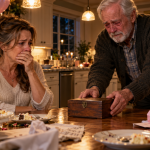
At my 6-year-old granddaughter’s funeral, I leaned over her casket to say a final goodbye. Then I heard a faint, desperate scrape from inside. “Daddy said if I woke up, I would ruin everything,” she whispered.

I froze.
My son Julian and his wife Victoria had told everyone Chloe died from a sudden respiratory illness. The house was filled with white lilies, candles, and flowers from people who believed they were mourning a child they had lost.
But Chloe wasn’t gone.
It was almost eleven at night inside Julian’s home outside Chicago. The living room had gone silent except for the soft hum of the house and the weight of the casket sitting in the middle of the room. Julian and Victoria had already gone upstairs. They said they were exhausted. They said they needed sleep before the funeral the next morning. They told me I should go home.
I couldn’t.
I stayed because I needed one final goodbye.
When I lifted the lid, I saw Chloe’s eyelids move.
I touched her cheek. I watched her chest. I felt the weakest breath against my hand.
She was alive.
Her face was pale and burning with fever. Her lips trembled as she looked at me beneath the soft living room light.
Then I saw something that made my hands shake.
She had been secured inside the casket so she couldn’t move freely.
“Grandma,” she whispered. “I was good. I stayed quiet.”
I could barely breathe.
I tried to free her, but whatever had been done to keep her in place would not release at first. That was when I understood this wasn’t a mistake. Someone had known Chloe was alive when they put her there.
I forced myself to stop pulling and searched instead. Beneath the padded lining, my fingers found something hard and cold.
A small metal key.
The key worked.
I released Chloe and lifted her into my arms. She wrapped her weak arms around my neck while every excuse Julian and Victoria had given me over the past months came rushing back.
“Chloe is sleeping.”
“The doctor says she needs privacy.”
“She gets anxious around visitors.”
“You need to respect our parenting choices.”
I had believed I was being the difficult mother-in-law. The worried grandmother who didn’t know when to back off.
I was wrong.
My granddaughter was trembling against me in the same room where everyone expected to mourn her the next morning.
I wrapped Chloe in my black wool shawl and carried her toward the back hallway. My handbag and phone were still near the living room, but the old telephone in the laundry room was closer.
“Please don’t let them take me,” Chloe whispered.
I locked the laundry-room door and called emergency services. I told the dispatcher my granddaughter had been declared dead but was alive, feverish, and found inside her casket. I said I believed she might have been given medication.
Before the dispatcher could finish answering, a bedroom door opened upstairs.
“Mom?”
Julian’s voice carried down the staircase.
I pulled Chloe tighter against me.
His footsteps came faster.
They crossed the hallway.
Then Julian rushed straight toward the locked laundry-room door.
PART 2: THE CHILD THEY BURIED TOO SOON
Julian hit the laundry-room door once with the flat of his hand.
“Mom?”
I pressed my back against the washing machine.
Chloe was trembling beneath my shawl.
The old telephone receiver was still against my ear.
The dispatcher’s voice came through quietly.
“Ma’am, officers and paramedics are on the way. Do not open the door.”
I looked at Chloe.
Her eyes were barely open.
Her cheeks were hot against my arm.
Outside, Julian tried the knob.
Locked.
“Mom, what are you doing?”
I said nothing.
He knocked harder.
“Mom.”
The sweetness disappeared from his voice.
That frightened me more than the knocking.
“Open the door.”
Chloe buried her face against my chest.
I felt her lips move against the wool.
“Don’t.”
My heart almost stopped.
I whispered:
“I won’t.”
Julian heard me.
There was silence on the other side of the door.
Then:
“Who are you talking to?”
I held the receiver tighter.
The dispatcher said:
“Do not answer if you don’t feel safe.”
Julian struck the door again.
“Mom.”
Another hit.
“What did you do?”
The question changed everything.
Not:
Are you all right?
Not:
What happened?
What did you do?
As though I were the one who had broken the rules.
I looked down at my granddaughter.
Six years old.
Pale.
Burning with fever.
Alive inside a house filled with funeral flowers.
I felt something in me harden.
“Chloe is with me.”
The hallway went completely silent.
Not even a breath.
Then Julian whispered:
“What?”
I closed my eyes.
He knew.
The way he said it told me he knew.
I repeated:
“Chloe is alive.”
The silence stretched.
Then I heard another pair of footsteps.
Victoria.
“What is happening?”
Julian hissed something too low for me to understand.
Then Victoria rushed toward the door.
Her voice broke instantly.
“Open it.”
I held Chloe tighter.
Victoria knocked.
“Please.”
Her voice had changed.
Now she sounded like the grieving mother everyone had been comforting for two days.
Soft.
Shattered.
Practiced.
“Please open the door.”
I looked at Chloe.
Her eyes opened slightly.
She shook her head.
Barely.
Victoria began crying outside.
“Mom, you don’t understand.”
I nearly laughed.
That sentence.
How many terrible things begin with those words?
You don’t understand.
As if understanding could transform cruelty into love.
“Then explain it through the door.”
Julian snapped:
“This is not the time.”
I stared at the white laundry-room wall.
“No.”
My voice came out surprisingly steady.
“I think this is exactly the time.”
The dispatcher interrupted quietly.
“Ma’am, officers are less than three minutes away.”
Three minutes.
I had never understood how long three minutes could be.
Julian lowered his voice.
“Mom, listen to me.”
I said nothing.
“Chloe is very sick.”
“I know.”
“She has episodes.”
“What episodes?”
Another pause.
“She becomes confused.”
Chloe stirred in my arms.
I looked down.
Her eyes opened.
She whispered:
“I’m not confused.”
My whole body went cold.
Julian must have heard.
His voice sharpened.
“She doesn’t know what she’s saying.”
Victoria cried:
“Please stop upsetting her.”
I stared at the door.
“Upsetting her?”
My voice cracked.
“She was inside a casket.”
Silence.
I could hear Victoria breathing.
Then she said:
“We thought she was gone.”
“No.”
I looked at Chloe.
“No, you didn’t.”
Julian slammed his palm against the door.
“You have no idea what happened.”
“I found a key under the lining.”
That stopped him.
Everything went still.
I continued.
“She was secured inside.”
No answer.
“Why was there a key hidden inside the casket?”
Nothing.
“Why couldn’t she move?”
Victoria began crying harder.
Julian said:
“Mom, unlock the door.”
“No.”
“Now.”
“No.”
His voice turned low.
The voice he used when he was a teenager and trying not to scream in front of other people.
The voice that meant anger had stopped being emotional and become deliberate.
“You are interfering with something you do not understand.”
I looked at Chloe.
She stared toward the door.
“Grandma.”
“Yes?”
“He’s mad.”
I nearly broke.
Even now.
Even feverish and frightened, she was monitoring his mood.
The way children do when adults have taught them anger is weather they must survive.
I kissed her hair.
“Let him be.”
She looked at me.
“He gets worse.”
The sentence was so small.
So practiced.
The dispatcher heard it too.
Her voice changed.
“Ma’am, stay where you are.”
Then Julian did something I did not expect.
He stopped knocking.
His footsteps moved away.
Victoria whispered:
“Julian?”
He did not answer.
I heard him moving quickly through the hallway.
A cabinet opened.
Then another door.
My pulse jumped.
“What is he doing?”
The dispatcher said:
“Do not leave the room.”
Then I heard the front door.
It opened.
Closed.
Victoria shouted:
“Julian!”
Running.
He was leaving.
My son was leaving.
While his daughter was alive.
While emergency services were coming.
While his mother stood locked in a laundry room holding the child everyone believed was dead.
That told me more than any confession could have.
Victoria returned to the laundry door.
Her crying sounded real now.
Not controlled.
Panicked.
“He’s gone.”
I said nothing.
“Please open the door.”
“No.”
“I’m her mother.”
“And she is afraid of you.”
Victoria stopped crying.
Completely.
I looked at Chloe.
“Are you afraid of Mommy?”
Her body stiffened.
She did not answer.
That was an answer.
Victoria whispered:
“Do not ask her things like that.”
I felt rage rise through me.
“I will ask her whatever keeps her safe.”
“She’s sick!”
“So sick children should be locked inside caskets?”
“That is not what happened!”
“Then tell me what happened.”
Silence.
The sirens reached us before she answered.
Distant at first.
Then louder.
Closer.
Blue and red light flashed through the tiny laundry-room window.
Chloe flinched.
I rocked her gently.
“They’re here.”
“No Daddy?”
“No.”
“Promise?”
My throat tightened.
“I promise he is not coming through this door.”
Heavy footsteps entered the house.
Voices.
“Police!”
Victoria began speaking all at once.
“Please, my daughter is ill, my mother-in-law is confused—”
I unlocked the laundry-room door.
An officer stood on the other side.
Then another.
Behind them, two paramedics carrying medical bags.
Victoria stared at Chloe.
The expression on her face is something I still cannot fully describe.
Horror.
Relief.
Fear.
And something else.
Something uglier.
Recognition.
As though the part of the night she had prayed would remain hidden had just stepped into the light.
One paramedic moved toward me.
“Ma’am, I need to take the child.”
Chloe clung to my neck.
“No!”
“It’s okay.”
“No!”
Her fingers dug into my coat.
“I’m staying.”
The paramedic crouched.
A woman.
Maybe thirty.
Kind eyes.
“You can keep holding Grandma’s hand.”
Chloe stared at her.
“Promise?”
“I promise.”
We moved to the kitchen.
Not the living room.
Nobody wanted to go near the casket.
They laid Chloe on a blanket-covered stretcher.
She refused to let go of my hand.
So I stood beside her while they checked her breathing.
Her pulse.
Her temperature.
One paramedic looked toward the other.
They exchanged the kind of glance professionals use when they do not want the family noticing they are alarmed.
I noticed.
Of course I noticed.
“What?”
The woman looked at me.
“Her temperature is high.”
“How high?”
She told me.
My stomach dropped.
“And she appears dehydrated.”
Victoria stepped forward.
“She was sick.”
One officer blocked her.
“Ma’am, stay where you are.”
Victoria looked offended.
“She is my daughter.”
The officer’s expression did not change.
“Stay there.”
For once, someone told Victoria no.
The paramedic asked Chloe:
“Sweetheart, do you know your name?”
“Chloe.”
“How old are you?”
“Six.”
“Do you know where you are?”
She looked around.
Then whispered:
“Home.”
“Do you know what day it is?”
Chloe frowned.
“No.”
“That’s okay.”
The paramedic smiled.
“Do you remember being put in the box?”
Victoria made a sharp sound.
“Do not question her!”
The officer turned.
“Ma’am.”
Victoria stopped.
Chloe squeezed my hand.
“Yes.”
The paramedic asked gently:
“Who put you there?”
My entire body stopped.
Chloe stared at the ceiling.
Then:
“Daddy.”
Victoria closed her eyes.
The room changed.
Every adult heard it.
The officer reached for his radio.
The paramedic continued carefully.
“Was Mommy there?”
Chloe looked toward Victoria.
Her face tightened.
Then she nodded.
Victoria started sobbing.
“No.”
Chloe flinched.
“I was good.”
The paramedic touched her shoulder.
“You did nothing wrong.”
“I stayed quiet.”
My eyes filled.
“Why did you stay quiet?”
Chloe looked at me.
Because she trusted me.
Or maybe because I was the only adult in the room who had not asked her to protect us from the truth.
“Daddy said if I woke up…”
Her voice became tiny.
“…I would ruin everything.”
The paramedic went still.
The officer did too.
I whispered:
“What would you ruin?”
Chloe’s eyes filled.
“The goodbye.”
Victoria collapsed into a chair.
I looked at her.
“What goodbye?”
She covered her face.
Nobody answered.
The police separated us.
Victoria was taken into the dining room.
I stayed with Chloe.
Officers began photographing the living room.
The casket.
The lining.
The straps.
The small key.
The flowers.
The condolence cards.
Every beautiful object suddenly looked obscene.
White lilies.
White candles.
White roses.
All arranged around a child who had been breathing beneath them.
One officer asked:
“Who declared her deceased?”
I looked toward Victoria.
She would not answer.
That was strange.
A child does not simply die and appear in a casket.
There are doctors.
Hospitals.
Certificates.
Procedures.
At least I thought so.
The officer asked again.
“Who pronounced Chloe dead?”
Victoria whispered:
“A private doctor.”
“What doctor?”
She stared at the floor.
“Dr. Harris.”
“First name?”
No answer.
The officer repeated:
“Mrs. Mercer—”
“He isn’t from here.”
The officer’s face tightened.
“Where is he from?”
Victoria whispered:
“Wisconsin.”
Something about the answer felt wrong immediately.
The officer asked:
“Hospital affiliation?”
She shook her head.
“He makes home visits.”
My stomach turned.
Chloe had supposedly developed a severe respiratory illness.
They told us she declined quickly.
That she died at home.
That they did not want people seeing her after because it had been “traumatic.”
I had accepted it because grief makes you stupid.
No.
Not stupid.
Trusting.
There is a difference.
The paramedics moved Chloe toward the ambulance.
I went with her.
An officer stopped me at the doorway.
“Ma’am.”
I turned.
“Your son left?”
“Yes.”
“Vehicle?”
I told him.
Make.
Color.
Plate.
He relayed it immediately.
Then he asked:
“Do you know where he might go?”
I thought.
My first instinct was no.
Then a memory surfaced.
Julian had an old cabin.
Not his.
A friend’s family place near Rockford.
He used it sometimes when he wanted to “get away.”
I gave them the information.
The officer nodded.
“We’ll handle it.”
I stepped into the ambulance.
The doors closed.
And for the first time that night, the house disappeared.
Chloe lay beneath a warm blanket.
Her little hand still held mine.
She looked exhausted.
“Grandma?”
“Yes?”
“Am I dead?”
I broke.
Not loudly.
I bent over her hand and cried.
“No.”
She watched me.
“No, sweetheart.”
I kissed her fingers.
“You are very, very alive.”
She looked relieved.
Then confused.
“Why did everyone say I died?”
I did not know what to say.
So I did the only thing left.
The truth.
“I don’t know yet.”
She nodded slowly.
Then whispered:
“I heard Mommy crying.”
My heart tightened.
“When?”
“When I was in bed.”
“Before the casket?”
She nodded.
“She said Daddy went too far.”
Every muscle in my body tensed.
“What did Daddy say?”
Chloe closed her eyes.
“He said it was too late.”
The paramedic looked at me sharply.
I did not ask more.
Not then.
She needed doctors.
Warmth.
Safety.
Not an interrogation from the grandmother who had already failed to see enough.
At the hospital, everything moved quickly.
Blood tests.
Fluids.
Monitors.
Questions.
A pediatric emergency physician named Dr. Levin spoke to me in the hallway.
“She has a significant fever and signs of dehydration.”
“Will she be okay?”
“We’re treating her aggressively.”
My legs almost gave out.
He continued:
“There also appears to be medication in her system.”
My chest went cold.
“What kind?”
“We’re confirming that.”
“Could it make someone look dead?”
His expression changed.
Careful.
“Some medications can depress responsiveness.”
I stared at him.
“Could they make a six-year-old look like she wasn’t breathing?”
“Rachel—”
Wrong name; need narrator unnamed, perhaps grandmother. We need not introduce wrong name. Let’s fix: He says “Ma’am”. Continue.
“Ma’am, I don’t want to speculate before results come back.”
I nodded.
Of course.
But my mind had already gone somewhere terrible.
Not poison.
Not exactly.
Something designed to make her sleep.
Something powerful enough that careless people might believe she was gone.
Or powerful enough that dishonest people could pretend.
I sat beside Chloe’s hospital bed.
She slept for nearly two hours.
This time, properly monitored.
This time, surrounded by people who wanted her to wake up.
I watched every rise and fall of her chest.
Every one.
At 2:17 in the morning, a detective entered.
Detective Lena Ortiz.
Dark hair.
Tired eyes.
Voice quiet.
She sat across from me.
“Your son has been located.”
My whole body tightened.
“Where?”
“About forty miles west.”
“Is he under arrest?”
“For now, he’s being detained while we determine what happened.”
I nodded.
“And Victoria?”
“Also being questioned.”
I looked through the glass toward Chloe.
“What did they do to her?”
Ortiz folded her hands.
“We’re still working that out.”
“Did they drug her?”
She hesitated.
“Preliminary screening suggests sedative medication.”
My stomach turned.
“Prescription?”
“We’re tracing it.”
“Did Julian give it to her?”
“We don’t know yet.”
I laughed bitterly.
“You keep saying that.”
“Because I would rather tell you ten incomplete truths than one complete lie.”
That made me stop.
Fair.
She continued.
“We also have questions about the reported death.”
“What questions?”
“A lot.”
I waited.
Ortiz leaned forward.
“There does not appear to be a normal hospital or county record corresponding with the death your family was told occurred.”
I stared at her.
“What does that mean?”
“It means we cannot currently verify that Chloe was ever legally declared deceased.”
My mouth went dry.
“But there was a casket.”
“Yes.”
“A funeral home.”
Ortiz looked at me.
“No licensed funeral home appears to have handled her.”
I stopped breathing.
“What?”
“The casket was delivered directly to the residence.”
“By who?”
“A private supplier.”
My stomach tightened.
“The funeral tomorrow?”
“There was no cemetery burial scheduled under Chloe’s name.”
I stared at her.
The flowers.
The family calls.
The obituary.
The mourners expected at the house the next morning.
“What were they planning?”
“We’re trying to determine that.”
Then Ortiz slid a clear evidence sleeve onto the table.
Inside was a printed document.
I recognized it.
The obituary.
Chloe’s picture at the top.
Below it, words Victoria had posted online.
Our beloved daughter passed peacefully at home surrounded by family.
I felt sick.
Ortiz pointed toward the bottom.
“Who wrote this?”
“Victoria.”
“You’re sure?”
“She sent it to everyone.”
Ortiz nodded.
“Do you know why the service was supposed to be private?”
“They said Chloe would have wanted that.”
My voice broke.
“She was six.”
Ortiz’s face softened.
“Yes.”
That sentence destroyed me.
She was six.
We had all accepted explanations supposedly based on the preferences of a dead six-year-old.
Because Julian and Victoria were grieving parents.
Nobody wanted to challenge grief.
Nobody wanted to be cruel.
So we let them control every detail.
No hospital visits.
No goodbye before the casket.
No questions.
No touching.
No opening the lid.
And if I had gone home when Julian told me to…
I stopped.
My breath caught.
Detective Ortiz noticed.
“What?”
“I wasn’t supposed to stay.”
She leaned closer.
“They told me to go.”
“When?”
“Tonight.”
“Why?”
“They said they were tired.”
My hands began shaking.
“They wanted the house empty.”
Ortiz made a note.
“And you stayed anyway.”
“Yes.”
“Why?”
I looked through the glass.
Chloe slept beneath a pale hospital blanket.
Because something in me refused to leave without touching her once more.
Because love is irrational sometimes.
Because grief can make a person disobedient.
“I needed to say goodbye.”
Ortiz nodded slowly.
Then said:
“That may have saved her life.”
I cried.
There was no dignified way to receive that sentence.
I covered my face.
Because if staying saved her, leaving would have killed her.
Maybe not immediately.
Maybe eventually.
But she had been weak.
Feverish.
Drugged.
Inside a closed casket.
I had been one obedient decision away from losing her.
Ortiz waited until I could breathe again.
Then she asked:
“Has anything unusual been happening in Julian and Victoria’s life recently?”
I wiped my eyes.
“What kind of unusual?”
“Financial problems.”
“Custody disputes.”
“Insurance.”
“Family conflict.”
My stomach tightened at the word insurance.
“What?”
Ortiz watched me.
“Did they have life insurance on Chloe?”
“I don’t know.”
Then I remembered.
Six months earlier.
Julian asked me for Chloe’s social security number.
He claimed he needed it for a school savings account Grandma—me—was contributing to.
I had given it.
Of course I had.
My blood turned cold.
“He asked me for her social security number.”
“When?”
I told her.
“Why?”
“He said education account.”
Ortiz wrote it down.
Then:
“Anything else?”
I thought.
Julian had called me three weeks earlier.
Asked whether my house was still going to him someday.
A strange question.
He joked about estate planning.
I laughed it off.
Victoria had recently stopped working.
Julian’s contracting business had been struggling.
I knew that.
Everyone knew that.
But enough to—
No.
I stopped myself.
I would not turn suspicion into fact.
Not yet.
“His business has had problems.”
Ortiz nodded.
“We’re already checking.”
Then she asked:
“Who is Dr. Harris?”
“I don’t know.”
“Have you ever heard the name before tonight?”
“No.”
She looked at her notes.
“Victoria claims he had been seeing Chloe privately for several months.”
“That’s impossible.”
Ortiz looked up.
“I took Chloe to her pediatrician two months ago.”
“For what?”
“Ear infection.”
“Did she have respiratory issues?”
“No.”
“Any serious chronic condition?”
“No.”
My heart started pounding.
“They said she was sick.”
“How long?”
“A little over a week.”
“And you never saw her?”
“No.”
My voice broke.
“They wouldn’t let me.”
Every excuse came back.
Chloe is sleeping.
Chloe needs quiet.
Chloe gets anxious around visitors.
Please respect our parenting.
I had stood outside that house twice.
Dropped groceries on the porch.
Left soup.
Left a stuffed rabbit.
Once I heard movement upstairs.
Victoria told me it was the television.
Now I wondered whether Chloe had heard my car.
Whether she had been upstairs listening while I drove away.
I whispered:
“She might have known I came.”
Ortiz said nothing.
That silence was kinder than reassurance.
At four in the morning, the doctor returned.
Chloe was stable.
Still sick.
But improving.
The sedative levels were concerning but treatable.
No irreversible damage was obvious.
I gripped the edge of the chair.
“Will she wake up normally?”
“She already has.”
I looked toward the room.
Chloe’s eyes were open.
She was staring through the glass at me.
I went inside immediately.
She smiled faintly.
“Grandma.”
I sat beside her.
“I’m here.”
“Did Daddy come?”
“No.”
She seemed relieved.
That broke me again.
Then she whispered:
“Can I tell you something?”
“Anything.”
Her fingers found mine.
“Daddy made a room.”
I frowned.
“What room?”
“The downstairs room.”
“The basement?”
She nodded.
“There was a bed.”
My stomach tightened.
“What happened there?”
She stared at the blanket.
“He said I had to stay there until people forgot.”
Every part of me went cold.
“Forgot what?”
Her eyes filled.
“That I was alive.”
I could not breathe.
I pressed the call button.
Dr. Levin entered.
Then a nurse.
I told them to get Detective Ortiz.
Minutes later, Chloe repeated it.
Slowly.
In pieces.
Julian had told her they were playing a “quiet game.”
She had been kept away from windows.
Away from school.
Away from everyone.
Victoria brought food.
Sometimes cried.
Sometimes whispered apologies.
Julian told Chloe she was sick and that people were frightened of her illness.
Then one day, they gave her medicine.
She became sleepy.
She woke briefly in a different room.
Then again inside the casket.
She remembered voices.
Flowers.
People crying.
She tried to move.
Could not.
Then Daddy’s voice near her ear.
“If you wake up now, you ruin everything.”
I left the room before I became sick.
Detective Ortiz followed.
I leaned against the hallway wall.
“What does that mean?”
My voice sounded unfamiliar.
“What were they doing?”
Ortiz did not answer immediately.
Then she said:
“We searched the house further.”
I looked at her.
“In the basement?”
“Yes.”
My stomach dropped.
“What did you find?”
“A furnished room.”
“A lock on the exterior side.”
I closed my eyes.
“And financial documents.”
My eyes opened.
“What financial documents?”
She hesitated.
Then:
“Insurance.”
The hallway disappeared.
“How much?”
“I’m not giving you a number yet.”
“How much?”
Her face told me it was not small.
I felt dizzy.
“No.”
Ortiz continued carefully.
“There were also communications concerning debt.”
“No.”
“And a second set of documents.”
“What?”
She looked toward Chloe’s room.
“Travel documents.”
I stared.
“For who?”
“Julian and Victoria.”
My blood went cold.
“Where were they going?”
“Mexico.”
“When?”
“Tomorrow afternoon.”
The funeral morning.
Then the airport.
I pressed a hand against my mouth.
“They were going to leave.”
Ortiz nodded slowly.
“That is one possibility we’re examining.”
“What about Chloe?”
The question came out broken.
Where was she supposed to be?
Inside the casket?
Inside the basement?
Somewhere else?
Ortiz did not answer.
Maybe she could not.
Maybe she would not.
I looked through the glass.
Chloe had fallen asleep again.
Alive.
Breathing.
Here.
And that was the only fact I could survive at that moment.
Two hours later, the sun began rising over Chicago.
Pale orange light entered the hospital windows.
The funeral was supposed to begin at ten.
Instead, by ten, the house on Linden Court was surrounded by police tape.
Family members arrived carrying flowers.
They found officers instead.
My sister called me sobbing.
My brother called.
Cousins.
Friends.
Everyone asking the same impossible question.
“Is Chloe alive?”
“Yes.”
Again.
And again.
“Yes.”
Every time I said it, I cried.
Alive.
What a beautiful word.
Alive.
Then came the other questions.
What happened?
Where is Julian?
Where is Victoria?
Did they know?
I answered only what I knew.
Which was not much.
But by noon, the story had already begun spreading.
The child everyone thought they were mourning had been found alive.
The parents were being questioned.
Authorities were investigating possible fraud, unlawful confinement, and child endangerment.
I turned the television off.
I did not want Chloe becoming a headline before she had even eaten breakfast.
At one o’clock, a social worker arrived.
She explained that Chloe could not return to her parents while the investigation continued.
I understood.
Then she asked:
“Is there another relative who could provide temporary placement?”
I looked at Chloe.
She had been coloring.
A dinosaur.
Purple.
She looked up immediately.
“Grandma.”
The social worker smiled gently.
“Would you like to stay with Grandma?”
Chloe nodded.
Then asked me:
“Can I?”
My heart broke open.
“Yes.”
I took her hand.
“Yes, sweetheart.”
She smiled.
Tiny.
Exhausted.
Real.
Then the social worker said:
“There will be assessments and home checks.”
“Whatever you need.”
“She may need trauma counseling.”
“Yes.”
“Medical follow-up.”
“Yes.”
“Structure.”
“Yes.”
“Patience.”
I looked at Chloe.
“Whatever she needs.”
The social worker nodded.
Then:
“There’s something else.”
Of course there was.
“What?”
“Detective Ortiz asked me to tell you they found a locked box in the basement.”
My stomach tightened.
“What was inside?”
“She wants to discuss it with you directly.”
I found Ortiz thirty minutes later.
She was standing near the nurses’ station holding a file.
“You found something.”
“Yes.”
“What?”
She led me into an empty consultation room.
Then closed the door.
Inside the file were photographs.
The basement room.
A small bed.
A child’s drawings.
A plastic cup.
A locked cabinet.
Then one photograph made me stop.
A calendar.
Several dates circled.
One was the day Chloe was declared “dead.”
Another was tomorrow.
The day Julian and Victoria had flights.
And another date, two weeks later, had one handwritten note beneath it:
CLAIM RELEASE
My stomach turned.
“The insurance.”
Ortiz nodded.
Then she slid another photograph toward me.
A notebook.
Julian’s handwriting.
I recognized it immediately.
Lists.
Expenses.
Debts.
Amounts.
Then a line near the bottom.
After Chloe — clear cards, settle contractors, sell house, restart.
I stopped breathing.
After Chloe.
Not after the funeral.
Not after grief.
After Chloe.
As though she were an event to survive.
An obstacle to pass.
I pushed the photograph away.
“I can’t.”
Ortiz nodded.
“There’s one more thing.”
“No.”
She waited.
I looked at her.
“What?”
She placed a final photograph on the table.
A letter.
Not written by Julian.
Not Victoria.
A child’s handwriting.
Large uneven letters.
GRANDMA
My heart stopped.
Ortiz said:
“We found it under the mattress in the basement room.”
I covered my mouth.
“Can I read it?”
She nodded.
The photograph showed one page torn from a coloring book.
Purple crayon.
Green crayon.
Pencil.
The words wandered across the paper.
GRANDMA I AM NOT SICK LIKE DADDY SAYS.
My eyes blurred.
I kept reading.
MOMMY CRIES WHEN HE GOES OUT.
My hands started shaking.
DADDY SAYS I HAVE TO BE QUIET UNTIL WE GET A NEW HOUSE.
Then:
IF YOU COME I WILL TAP ON THE WALL.
I made a sound I did not recognize.
Somewhere between a sob and a breath.
She had been waiting for me.
I had come twice.
Dropped food at the door.
And left.
Had she tapped?
I bent over the table.
Ortiz put a hand near me but did not touch.
I cried until my chest hurt.
Then I saw the last line.
PLEASE BELIEVE ME IF I SAY I AM HERE.
I stared at it for a long time.
Please believe me.
Six years old.
And already afraid the adults in her life had built a story stronger than her own voice.
I wiped my face.
Then I looked at Detective Ortiz.
“What happens now?”
She closed the file.
“Now we find out exactly who did what.”
“And Chloe?”
Ortiz glanced toward the hallway.
“Chloe heals.”
I nodded.
Then:
“And Julian?”
Her expression became unreadable.
“Your son is asking for a lawyer.”
That sentence hurt differently.
My son.
The baby I once held.
The boy who used to crawl into my bed during thunderstorms.
The teenager who cried when our dog died.
The father who apparently told his six-year-old daughter to lie still inside her own casket.
I could not fit those people into one body.
Maybe I never would.
“What did he say about Chloe?”
Ortiz looked at me.
“What do you mean?”
“When they found him.”
I swallowed.
“Did he ask whether she was alive?”
Ortiz went quiet.
My heart already knew.
“Did he?”
She answered carefully.
“No.”
I closed my eyes.
“What did he ask?”
Ortiz hesitated.
Then:
“He asked whether police had opened the basement safe.”
The room went still.
Not Chloe.
The safe.
I looked at the file.
“What is in the safe?”
“We have a warrant request underway.”
I stared at her.
A basement room.
A fake death.
Insurance.
Travel plans.
A child’s letter.
And now a safe my son cared about more than whether his daughter had survived.
Ortiz stood.
“When we open it, I’ll contact you.”
I nodded.
She reached the door.
Then stopped.
“There is something I think you should know.”
“What?”
“She survived because you opened the casket.”
I looked away.
Ortiz continued.
“Whatever else happens, remember that.”
I stared through the narrow window at Chloe’s room.
My granddaughter was awake.
Coloring again.
This time she had drawn two people holding hands.
One tall.
One small.
I already knew who they were.
Grandma.
Chloe.
I walked back inside.
She held up the picture.
“That’s us.”
“I know.”
“You’re wearing your black thing.”
“My shawl?”
“Yes.”
“And that’s you.”
“Obviously.”
I laughed through tears.
She smiled.
Then she asked:
“Can we go home soon?”
Home.
The word frightened me.
Her parents’ house was not home anymore.
Not for now.
Maybe never.
I touched her cheek.
“You’re coming home with me.”
Her eyes widened.
“To your house?”
“Yes.”
“With the yellow room?”
I smiled.
“You remember?”
“You said I could sleep there someday.”
“I did.”
She looked at the drawing.
“Can someday be now?”
My heart broke beautifully.
“Yes.”
I kissed her forehead.
“Someday can be now.”
She leaned against me.
And for the first time since I heard that tiny scrape from inside the casket, Chloe closed her eyes without fear.
I sat beside her.
Listening to every breath.
Alive.
Alive.
Alive.
Then my phone vibrated.
Detective Ortiz.
I answered quietly.
“Hello?”
Her voice was different.
Sharper.
“We opened the safe.”
I looked at Chloe.
“What did you find?”
There was a pause.
Then Ortiz said:
“Mrs. Mercer…”
Her next sentence made the room seem to disappear.
“There are documents in here showing Julian and Victoria were not planning this alone.”
My blood went cold.
“What?”
“We found payments.”
“To who?”
Another pause.
“A medical professional.”
My fingers tightened around the phone.
“The doctor?”
“Possibly.”
“And?”
“There’s also correspondence with someone else.”
“Who?”
Ortiz hesitated.
That hesitation scared me more than anything.
Then she said:
“Someone in your family.”
I stopped breathing.
“What family?”
“Yours.”
I looked at Chloe.
She was asleep again.
Still holding the purple crayon.
“Who?”
Ortiz took a breath.
And before she could answer, another call appeared on my screen.
My daughter.
Julian’s older sister.
Calling for the seventeenth time.
I stared at her name.
Then at Chloe.
Then back at the phone.
And suddenly I remembered something I had dismissed months earlier.
My daughter had been the first person to tell me to stop visiting Chloe so often.
“She needs space, Mom,” she had said.
“Julian and Victoria know what they’re doing.”
At the time, I thought she was defending her brother.
Now, for the first time, I wondered whether she had been doing something else entirely.
Detective Ortiz said my name.
“Are you still there?”
“Yes.”
My voice barely worked.
“Tell me who.”
Another pause.
Then:
“Come downstairs.”
“Why?”
“Because I don’t want to tell you this over the phone.”
I looked at my granddaughter.
The child my son had already tried to erase.
Then I stood.
And as I walked toward the hospital elevator, I realized the casket had never been the deepest secret in that house.
It had only been the thing that finally made enough noise for me to hear everything buried underneath it.
PART 3: THE PERSON WHO HELPED THEM HIDE HER
“Come downstairs.”
Detective Ortiz’s voice was quiet.
Too quiet.
I looked through the hospital-room window at Chloe.
She was asleep beneath a white blanket, one small hand curled beside her face.
The purple crayon was still trapped between two fingers.
For the first time since I had lifted the casket lid, she looked like what she was.
Six years old.
Not evidence.
Not a victim.
Not the center of an investigation.
A little girl.
My granddaughter.
Alive.
I followed Detective Ortiz toward the elevator.
Every step felt wrong.
My daughter’s name was still glowing on my phone.
Seventeen missed calls.
Rebecca.
Julian’s older sister.
My first child.
The girl who once followed her little brother everywhere.
The teenager who taught him to drive.
The woman who stood beside him when he married Victoria.
And the person who had told me, repeatedly, to stop visiting Chloe.
Give them space, Mom.
You’re making Victoria nervous.
Julian knows what he’s doing.
The elevator doors closed.
I looked at Ortiz.
“Is it Rebecca?”
She did not answer immediately.
That was enough.
My stomach dropped.
“How involved?”
“We’re still determining that.”
“What did you find?”
The elevator descended.
Ortiz kept her eyes on the numbers.
“Payments from Julian’s business account.”
“To Rebecca?”
“Yes.”
“How much?”
“Several transfers over the last eight months.”
My mouth went dry.
“For what?”
“They are labeled consulting.”
I almost laughed.
Rebecca was an elementary-school administrator.
She had never consulted for Julian’s contracting business in her life.
The elevator opened.
Ortiz led me into a small family consultation room.
She closed the door.
Then put a folder on the table.
I stayed standing.
“Tell me.”
Ortiz took a breath.
“We recovered messages between Julian and your daughter.”
My heart pounded.
“What kind of messages?”
“Some involve Chloe’s illness.”
“Some?”
“Yes.”
“What else?”
Ortiz looked at me.
“Your estate.”
I froze.
“My what?”
“Your will.”
For several seconds, I did not understand.
Then I remembered something.
Six months earlier, Rebecca had driven me to my attorney’s office after I sprained my wrist.
She had sat in the waiting room.
I updated my will that afternoon.
Nothing dramatic.
The house divided equally between Rebecca and Julian.
Savings split between them.
A separate education provision for Chloe.
I looked at Ortiz.
“How would Julian know about my will?”
“We found photographs.”
My stomach turned.
“What photographs?”
“Pages from a draft.”
I sat down.
My legs could no longer hold me.
“Rebecca took them?”
“We have not established that conclusively.”
But she had been there.
She had driven me.
She had carried my purse because of my wrist.
I whispered:
“Why would my will matter?”
Ortiz hesitated.
Then:
“Because the communications suggest Julian was in serious financial trouble.”
“I knew that.”
“It was worse than the family appears to have known.”
“How much worse?”
“Significant debt.”
I pressed my fingers to my forehead.
“And Chloe?”
“There was an insurance policy.”
My chest tightened.
“On her life.”
“Yes.”
“How much?”
Ortiz told me.
I stared at her.
I could not make the amount connect to Chloe.
No amount should.
Money belonged beside mortgages.
Cars.
College.
Not beside a six-year-old child’s name.
I whispered:
“And my will?”
“Based on the messages we found, Julian believed that if the insurance money cleared and he could stabilize the business temporarily, he would have time to address the rest.”
“What rest?”
Ortiz looked uncomfortable.
“He expected further family money later.”
My stomach turned.
“Mine.”
“Yes.”
I covered my mouth.
My own son had apparently been doing arithmetic around deaths.
His daughter’s.
Eventually mine.
Not necessarily causing mine.
But counting.
Planning.
Waiting.
The same child I once taught to save coins in a jar had grown into a man calculating what people were worth after they were gone.
I felt physically ill.
“And Rebecca?”
Ortiz opened the folder.
“She appears to have known Julian was trying to establish Chloe as severely ill.”
“Why?”
“Julian told her they needed documentation.”
“For insurance?”
“Partly.”
“And she helped?”
“We found messages where she told him which symptoms schools take seriously.”
I stared.
Rebecca worked around children.
That made it worse.
“She helped him invent an illness?”
Ortiz spoke carefully.
“She appears to have advised him on what explanations would reduce questions about Chloe’s absence.”
My whole body went cold.
The missing school days.
No visitors.
No playdates.
No grandparents.
Rebecca knew how systems worked.
She knew what words closed doors.
Respiratory illness.
Immunocompromised.
Anxiety.
Home recovery.
Private doctor.
Every phrase designed to make caring people back away.
I whispered:
“She helped them isolate her.”
Ortiz did not answer.
She did not have to.
I looked at my phone again.
Rebecca calling.
Again.
Eighteen.
I silenced it.
“What did she know about the casket?”
“That is one of the things we need to establish.”
I looked up sharply.
“So maybe she didn’t know.”
“Possibly.”
Hope came so quickly I hated myself for it.
A mother will reach for the smallest piece of innocence left in her child.
Even after learning terrible things.
Ortiz continued.
“We found one message from yesterday afternoon.”
She slid a photocopy toward me.
I read it.
Julian:
Mom keeps asking why she can’t see Chloe.
Rebecca:
Tell her V is too distraught. She won’t push if she thinks she’s hurting you.
My eyes blurred.
Rebecca knew me.
That was what made manipulation work.
She knew I would back away if I believed my presence caused pain.
Julian:
She said she wants one last goodbye tonight.
Rebecca:
Absolutely not. Keep the lid closed.
I stopped breathing.
Keep the lid closed.
I looked at Ortiz.
“What does that mean?”
“We don’t know what Rebecca believed was inside.”
I stared at the page.
“You know what it sounds like.”
“Yes.”
I kept reading.
Julian:
She won’t let it go.
Rebecca:
Then send her home. Tomorrow this is over.
Tomorrow this is over.
The fake funeral.
The flight.
The claim.
My granddaughter somewhere beneath all of it.
I pushed the paper away.
“I need to talk to her.”
Ortiz shook her head.
“Not yet.”
“She’s my daughter.”
“That is exactly why not yet.”
I stared at her.
“If she is involved, we do not want you unintentionally revealing what we recovered.”
My hands shook.
“So I just ignore her?”
“For now.”
I laughed bitterly.
“I have one child in custody and another who may have helped him lock my granddaughter away.”
Ortiz softened.
“I’m sorry.”
I looked toward the door.
“No.”
My voice broke.
“Save that for Chloe.”
Rebecca arrived at the hospital anyway.
Of course she did.
Twenty minutes later, I heard her voice outside the pediatric unit.
“Where is my mother?”
I stood.
Detective Ortiz did too.
Rebecca came around the corner.
Hair unbrushed.
Sweatshirt over pajama pants.
Face pale.
She saw me.
“Mom.”
I had never been afraid of my daughter before.
That morning, I was.
Not because she would hurt me.
Because I did not know who I was looking at anymore.
She rushed forward.
I stepped back.
She stopped instantly.
Her face changed.
“You know.”
Three words.
No confusion.
No question.
You know.
My heart shattered.
Ortiz stepped between us.
“Rebecca Mercer?”
Rebecca looked at her.
Then at me.
“Mom, please.”
I said nothing.
“Julian lied to me.”
Still nothing.
“I didn’t know what he was going to do.”
I finally spoke.
“What did you think he was doing?”
Rebecca began crying.
“I thought they were taking Chloe away for a while.”
My blood went cold.
“What does that mean?”
She wiped her face.
“He said Victoria couldn’t cope.”
“Cope with what?”
“With being a mother.”
I stared at her.
Rebecca continued quickly.
“He said they were drowning financially.”
“That explains locking a child in a basement?”
“No!”
Her voice cracked.
“I never knew about the basement.”
“Did you know she wasn’t sick?”
Rebecca closed her eyes.
That answer hurt.
“Did you?”
“Yes.”
The hallway disappeared.
I gripped the back of a chair.
“You knew.”
“She had been having normal colds.”
“Normal colds.”
Rebecca nodded through tears.
“Julian said they needed everyone to believe it was more serious.”
“Why?”
“He told me it was temporary.”
“Temporary what?”
She looked at Ortiz.
Ortiz said:
“You should stop speaking until you have counsel.”
Rebecca ignored her.
“I don’t care.”
She looked at me.
“I need Mom to know.”
I almost laughed.
Now.
Now truth mattered.
Rebecca continued.
“Julian said there was an insurance policy they needed to borrow against.”
Ortiz’s eyes sharpened.
Rebecca kept talking.
“He said the company would collapse if he couldn’t show liquidity.”
I frowned.
“You cannot borrow against a child being sick.”
“I know that now.”
“What did you think?”
“He told me there was a serious-illness rider.”
A desperate lie.
Or maybe part truth wrapped around fraud.
“And you helped him fake symptoms?”
Rebecca sobbed.
“I helped with school language.”
The phrase disgusted me.
School language.
She had converted deception into professionalism.
“I thought Chloe was staying home with Victoria.”
“She was locked downstairs.”
“I didn’t know.”
“You told him to keep the casket closed.”
Rebecca went completely still.
There.
She knew police had the messages.
She looked at Ortiz.
Then me.
“I knew they were staging something.”
My whole body chilled.
“What?”
“Julian called me yesterday.”
Her voice shook violently.
“He said Chloe had accidentally gotten too much medication.”
I stopped breathing.
“He said she was unconscious.”
“And?”
“He said if they called an ambulance, everything they had already done would come out.”
I pressed my hand against my chest.
“What did you tell him?”
Rebecca started crying so hard she could barely speak.
“I told him to call one anyway.”
“Then why the message?”
“He called me later and said she was awake.”
I stared.
“He told me he had a plan to make everyone believe she had died temporarily.”
My knees almost gave way.
“You heard that sentence…”
I whispered.
“…and did not call police?”
Rebecca covered her face.
“He said Chloe would be safe.”
I stared at my daughter.
“He said after the funeral, Victoria’s cousin was going to take her out of state.”
The room turned cold.
A hidden child.
New identity perhaps.
Somewhere no one would look because everyone believed she was dead.
“He said they needed twenty-four hours.”
Rebecca’s voice cracked.
“I thought if I interfered, Julian would run.”
“So you helped him.”
“I was trying to keep him calm.”
“No.”
I shook my head.
“You helped him.”
Rebecca sobbed.
“Yes.”
Finally.
One honest word.
Yes.
I looked at her.
“Why?”
She wiped her face with both hands.
“Because he’s my brother.”
That sentence destroyed whatever softness I had left.
I stepped closer.
“And Chloe is what?”
Rebecca looked at me.
“Your niece is six.”
My voice rose.
“She was drugged.”
“Hidden.”
“Terrified.”
“And you chose your adult brother because he was scared of consequences.”
Rebecca cried.
“I know.”
“No.”
“You know now.”
I pointed toward the pediatric room.
“She knew before you did.”
Rebecca’s face crumpled.
“She knew none of you were coming.”
My voice broke.
“She wrote me a letter under a mattress asking me to believe her if she said she was there.”
Rebecca folded inward.
I had never seen guilt physically change a person so quickly.
Ortiz stepped forward.
“Rebecca, we need to speak privately.”
Rebecca looked at me.
“Mom.”
I could not answer.
Not because I hated her.
Because I loved her.
And at that moment, loving her hurt so much I could barely stand.
The next weeks became a blur of hospital rooms, attorneys, social workers, detectives, and statements.
The man calling himself Dr. Harris was eventually identified.
His real name was Martin Heller.
He had once held a medical license in another state.
By the time Julian contacted him, he was no longer practicing lawfully in the way he represented himself.
He had accepted money to provide documents exaggerating Chloe’s condition.
He also supplied medication.
The exact sequence of what he knew and when became part of the criminal case.
I stopped trying to understand every procedural detail.
My job was Chloe.
That was enough.
Julian was charged.
Victoria too.
Martin Heller faced his own charges.
Rebecca was not treated the same as Julian and Victoria.
She had not physically confined Chloe.
Evidence did not show she had administered medication.
But she had helped create cover stories.
She had known the death was false before the family gathering.
And she had failed to alert anyone.
Eventually, she cooperated fully.
She turned over messages.
Financial records.
A second phone Julian had given her.
Her cooperation mattered.
It did not erase anything.
That became an important lesson in our family.
Doing the right thing late is still better than never doing it.
But late has a cost.
Chloe came home with me twelve days after I opened the casket.
The yellow bedroom was ready.
I had washed the bedding twice even though it was already clean.
Put a night-light near the door.
Removed the old cedar chest because I worried anything box-shaped might frighten her.
The social worker told me not to over-anticipate every trigger.
“Let Chloe tell you what she needs.”
That became my rule.
I had seen what happened when adults decided for her.
So I asked.
“Door open or closed?”
“Open.”
“Hall light on?”
“Yes.”
“Music?”
“No.”
“Do you want me to sit here?”
She thought.
“Until I sleep.”
So I sat.
The first night, she woke screaming.
Not words.
Just terror.
I ran in.
She was sitting upright, clawing at the blankets.
“Open it!”
I froze.
“It’s open.”
“The lid!”
There was no lid.
But her body did not know that.
I climbed onto the bed slowly.
“Chloe.”
She looked at me.
“You’re in the yellow room.”
Her breathing came fast.
“Look at me.”
She did.
“Window.”
I pointed.
“Door.”
She looked.
“Lamp.”
Her eyes followed.
“No lid.”
She began crying.
I held out my arms.
She came into them.
That became our ritual.
Window.
Door.
Lamp.
No lid.
For months.
Sometimes healing begins with four words repeated at two in the morning.
School waited.
No one rushed her.
When she returned, it was for two hours.
Then half-days.
The school counselor met her at the front door.
Her teacher kept everything ordinary.
No pitying speeches.
No classmates encouraged to ask questions.
Chloe hated people whispering.
So we gave her a life with less whispering.
She started drawing again.
At first, every house had no doors.
Then doors appeared.
Huge doors.
Bright red.
Purple.
Yellow.
Always open.
Her therapist noticed before I did.
One afternoon, Chloe drew our house.
Two windows.
A crooked chimney.
Three flowers.
Me standing beside her.
“What’s that?” I asked, pointing to a little black square in the yard.
She smiled.
“A mailbox.”
I laughed.
Not a casket.
A mailbox.
I went into the bathroom afterward and cried from relief.
The court cases moved slowly.
Eventually Julian pleaded guilty to serious offenses connected to confinement, fraud, and endangering Chloe.
Victoria accepted responsibility too.
I will not pretend that hearing those words gave me satisfaction.
Watching your own child face consequences for harming his child is not victory.
It is grief with paperwork.
At sentencing, Julian looked at me.
For the first time in nearly a year.
He had lost weight.
His hair had gone gray near the temples.
He looked more like his father than I had ever noticed.
He said:
“Mom.”
I did not respond.
He cried.
“I’m sorry.”
I believed he was.
That was not enough.
He continued.
“I kept thinking if I could fix the money first, I could fix everything.”
I stared at him.
“Chloe was not a bill.”
His face crumpled.
“I know.”
“No.”
My voice shook.
“You turned her into one.”
He covered his face.
“I loved her.”
I closed my eyes.
The hardest sentence.
Because I believed that too.
He had loved Chloe.
And harmed her.
Human beings want those facts to cancel each other.
They do not.
Love can exist inside a person who behaves monstrously.
That does not make the behavior less monstrous.
It makes responsibility more necessary.
I said:
“Then spend the rest of your life understanding why your love did not protect her from you.”
Julian sobbed.
I walked away.
Victoria wrote Chloe letters.
Every one went through professionals first.
For a long time, Chloe did not want them.
Then at nine, she asked.
Not for all.
One.
We gave her one selected with her therapist.
Victoria apologized.
No excuses.
No requests for forgiveness.
Chloe read it.
Folded it.
Then asked if she had to answer.
“No.”
She put it in a drawer.
Months later, it was gone.
I never asked where she put it.
Her story belonged to her.
Rebecca was harder for me.
Perhaps because she remained physically present.
She came to my door six months after Chloe moved in.
Alone.
No makeup.
No gifts.
She stood on the porch.
“I know I’m not entitled to come inside.”
I looked at her.
That sentence mattered.
“What do you want?”
“To apologize.”
“To me?”
“To both of you.”
“Chloe is not seeing you.”
Rebecca nodded.
“I know.”
“You do not get to ask.”
“I won’t.”
We stood there.
Then she said:
“I thought protecting Julian meant preventing him from panicking.”
I said nothing.
“I never asked who needed protection from him.”
My eyes filled.
Rebecca continued.
“I was more afraid of losing my brother than I was afraid of what my silence was doing to Chloe.”
She swallowed.
“That is something I have to live with.”
“Yes.”
She nodded.
“I know.”
I did not forgive her that day.
I did not invite her in.
But I said:
“Keep doing the work when nobody is watching.”
She cried.
“I will.”
And she did.
Therapy.
Community service.
She left school administration voluntarily because she said she could not ask parents to trust her with children while she had not yet rebuilt trust in herself.
Years later, she worked in adult education.
She never pressured Chloe.
Never sent birthday gifts directly.
Never asked me to carry messages.
When Chloe was eleven, she asked:
“Is Aunt Rebecca still sorry?”
“Yes.”
“Does she talk about me?”
“Not unless I bring you up.”
Chloe thought.
Then:
“Can she come to my soccer game?”
My heart tightened.
“Are you sure?”
“Yes.”
Rebecca came.
Sat three rows behind me.
Did not approach Chloe until Chloe approached her.
That was how their relationship began again.
Not with blood demanding access.
With permission.
Slowly.
Carefully.
Chloe grew into a remarkable person.
Not because trauma made her special.
I hate when people say suffering makes children stronger.
Children should not have to earn admiration by surviving adults.
She became remarkable because she was already herself.
Funny.
Stubborn.
Obsessed with astronomy.
Terrible at keeping her room clean.
She hated lilies.
Loved sunflowers.
Never slept with the closet door closed.
At fourteen, she painted over the yellow bedroom.
Dark blue.
Stars across the ceiling.
I watched from the doorway.
“You sure?”
She rolled her eyes.
“Grandma, I’m not six.”
I smiled.
“I know.”
That was beautiful too.
Not six.
Not frozen forever at the worst night of her life.
Moving.
Growing.
Becoming.
The black shawl stayed in my closet.
For years, I could not wear it.
Then one winter evening, Chloe found it.
“This one?”
My throat tightened.
“Yes.”
She ran her fingers over the wool.
“You wrapped me in this.”
“Yes.”
She put it around her shoulders.
I almost told her not to.
Then stopped.
Her memory.
Her choice.
She looked in the mirror.
“It’s warm.”
I laughed through tears.
“That was the idea.”
She wore it to school the next day.
Just because she liked it.
That felt like reclaiming something neither of us had planned.
The house where I found her was eventually sold.
I never returned.
The casket was evidence for a long time.
After the case ended, authorities asked what should happen to it.
I did not want it.
Chloe definitely did not.
It was disposed of.
Good.
Some objects do not deserve to become monuments.
Years later, on Chloe’s eighteenth birthday, we had a dinner in my backyard.
No lilies.
Sunflowers everywhere.
Rebecca came.
Friends.
Teachers.
The social worker who had once asked whether Chloe wanted to stay with Grandma.
Even Detective Ortiz came for an hour.
She had retired by then.
Chloe hugged her.
Ortiz cried before I did.
After cake, Chloe stood with a glass of lemonade.
“I want to say something.”
Everyone groaned jokingly because Chloe had inherited my tendency to make speeches emotional.
She smiled.
“I know everybody knows the story.”
The yard quieted.
“I used to hate that.”
She looked at me.
“I hated that people heard about the casket before they knew anything else about me.”
My eyes filled.
“So for the record…”
She lifted her glass.
“I also once won a regional science competition.”
People laughed.
“I can make lasagna better than Grandma.”
“Lie,” I said.
More laughter.
“I have been dumped twice.”
I pointed.
“Too much information.”
“And I got into Northwestern.”
Everyone cheered.
Chloe smiled.
Then her expression softened.
“And yes.”
Her voice became quieter.
“When I was six, my grandma found me alive when everyone thought I was dead.”
The yard went still.
“But that is not the most important thing she did.”
I stared at her.
Chloe looked directly at me.
“She believed me.”
My face collapsed.
“She believed me before she knew the whole story.”
Tears rolled down my cheeks.
“She did not tell me I was confused.”
“She did not tell me Daddy knew best.”
“She did not ask me to be quiet.”
Her voice shook.
“She opened the lid.”
Nobody moved.
Chloe continued.
“Then she kept opening doors.”
My heart broke beautifully.
“Hospital doors.”
“Her house.”
“Therapy.”
“School.”
“Life.”
She laughed through tears.
“So I think that’s what family is supposed to do.”
She looked toward Rebecca.
Then back at me.
“Not lock you inside the story that makes them comfortable.”
Her eyes met mine again.
“Open the door.”
I could not speak.
She raised her glass.
“To Grandma.”
Everyone joined.
I cried so hard Chloe had to come hug me.
“Ruined my makeup,” I whispered.
“You weren’t wearing makeup.”
“Exactly.”
She laughed.
That sound.
That laugh.
I would have opened a thousand caskets to hear it.
Years passed again.
Chloe became a pediatric nurse.
That surprised no one except me.
I worried.
“Are you sure you want to be around hospitals?”
She smiled.
“Grandma.”
“What?”
“Hospitals helped me.”
She was right.
Trauma had not owned that place either.
On her first day, she wore tiny sunflower earrings.
Not lilies.
Never lilies.
I asked once whether she remembered the whisper she gave me that night.
Daddy said if I woke up, I would ruin everything.
She became quiet.
Then nodded.
“Some.”
“I’m sorry.”
“For what?”
“For not seeing sooner.”
Chloe looked at me for a long time.
Then said:
“You came.”
My throat tightened.
“Late.”
“But you came.”
She touched my hand.
“And you opened it.”
That became enough.
Not because guilt disappeared.
Because she refused to let guilt become another box around me.
Julian remained part of her story, but not the center.
When he became eligible to communicate under carefully controlled circumstances years later, Chloe decided what she wanted.
At first, nothing.
Then letters.
Eventually one supervised conversation as an adult.
She never told me everything they discussed.
I never asked.
Again:
Her story.
Her choice.
Afterward, she came home.
Sat at my kitchen table.
I made tea.
“Okay?” I asked.
She thought.
“Sad.”
I nodded.
“Angry?”
“A little.”
“Relieved?”
“Maybe.”
I waited.
Then she said:
“He said he loves me.”
My chest tightened.
“What did you say?”
Chloe stared into her tea.
“I told him love is not the same thing as being safe.”
I closed my eyes.
My granddaughter had learned too young what many adults never understand.
Then she smiled faintly.
“I also told him Grandma taught me that.”
I laughed through tears.
“Poor man.”
She laughed too.
Today, Chloe is older than Julian was when he first became a father.
That fact still astonishes me.
I am older too.
My knees complain.
My hearing is not what it was.
Rebecca calls every Sunday.
Chloe calls whenever she remembers, which is usually at inconvenient times.
Life became ordinary.
That is the ending I value most.
Ordinary.
Laundry.
Birthdays.
Burned toast.
Arguments about holiday plans.
A drawer full of batteries nobody knows are good or dead.
A granddaughter complaining about parking.
For a child whose parents tried to erase her existence, ordinary adulthood is extraordinary.
I still think about that night sometimes.
Eleven o’clock.
White lilies.
The casket.
The scrape.
There are sounds you never forget.
That tiny desperate movement from inside.
If I had been crying louder, I might have missed it.
If I had obeyed Julian and gone home, I would have missed it.
If I had accepted that the lid should stay closed because opening it might be improper, I would have missed it.
Sometimes the difference between tragedy and survival is a person being willing to disobey the story everyone else has accepted.
I opened the lid.
But Chloe did the bravest thing.
She made the sound.
Weak.
Feverish.
Terrified.
She still moved.
She still tried.
She still told me the truth when the adults closest to her had taught her silence was safer.
Years later, I asked her why.
“Why did you scrape?”
She looked confused.
“What?”
“The casket.”
“Oh.”
She thought about it.
Then shrugged.
“I heard you crying.”
My heart stopped.
“You knew it was me?”
“Yeah.”
“How?”
She smiled.
“You say my name differently.”
I started crying immediately.
Chloe laughed.
“Grandma.”
“I’m old. Leave me alone.”
She hugged me.
Then said:
“I figured if anybody opened it, you would.”
That may be the greatest honor anyone ever gave me.
Not because I had always been brave.
I had not.
I had believed excuses.
Stayed away when told.
Accepted “privacy.”
Second-guessed myself because I did not want to become an interfering grandmother.
But when something finally sounded wrong enough, I opened the lid.
And after that, I never again confused respecting a parent with abandoning a child.
Julian once told Chloe waking up would ruin everything.
In one sense, he was right.
She woke up.
And everything he had built on lies collapsed.
The fake illness.
The insurance scheme.
The hidden room.
The false funeral.
The silence.
The family members protecting the wrong person.
All of it.
Ruined.
Good.
Some things deserve to be ruined.
The lie.
The plan.
The fear.
The silence.
Not Chloe.
Never Chloe.
She was the one thing that survived.
And years later, when she walks through my front door without knocking, drops her bag in the hallway, steals food from my refrigerator, and complains that I buy terrible coffee, I sometimes stop and simply look at her.
Alive.
Annoying.
Busy.
Beautifully ordinary.
Once, people gathered around flowers believing they had lost her.
Now she fills rooms with so much life that I occasionally ask her to lower her voice.
She never does.
And every time she laughs too loudly, I thank God for the noise.
Because once, she was told to stay quiet.
Never again.
THE END STORIES! THANK YOU FOR READING GOOD LUCK !❤️
Related Posts