I never got married because I spent the best years of my life raising my brother’s twin sons, though if you had asked me back then whether I considered it a sacrifice, I would have told you no without hesitation. I was twenty-six when my brother, Michael, and his wife, Rachel,

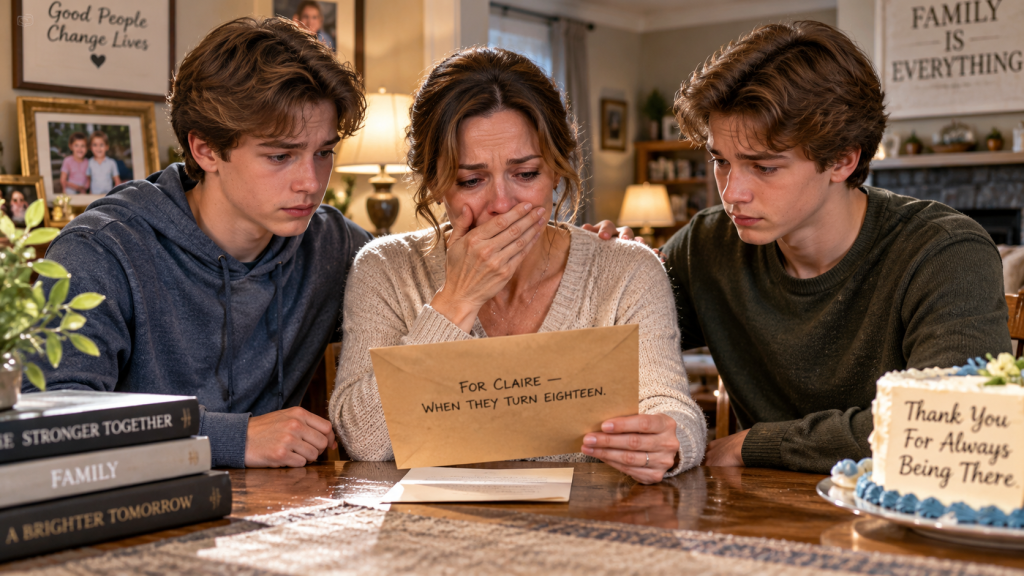
died in a car accident on a rain-soaked highway less than twenty miles from home. One phone call divided my life into before and after. Before, I had a small apartment, a job I was beginning to love, a man I had been dating for almost a year, and plans to travel someday. After, I had two frightened five-year-old boys sleeping in my bed because neither of them could close their eyes without seeing the police officer standing at the front door. Mason and Noah looked exactly alike to most people, but I could always tell them apart. Mason grew quiet when he was afraid. Noah asked questions until there were no questions left to ask. The week after the funeral, everyone promised I wouldn’t have to do it alone. My parents said they would take weekends. Rachel’s sister offered to help with school pickups. Cousins brought casseroles and envelopes of cash. Friends told me to call anytime, day or night. For a little while, the house was crowded with people who loved us. Then life did what life always does. It kept moving. My father’s health declined. Rachel’s sister moved across the country. Cousins became busy with their own children. Friends stopped checking in quite so often. The casseroles disappeared from the refrigerator, the sympathy cards stopped arriving, and eventually it was just the three of us standing in the kitchen each morning trying to figure out how to become a family none of us had planned for. I became their legal guardian six months later. Temporary, everyone said. Just until things settled down. But grief does not settle on a schedule, and children do not stop needing breakfast because adults are overwhelmed. Temporary became one year, then five, then thirteen. I worked extra shifts when money was tight. I learned how to stretch spaghetti across two dinners and how to repair school uniforms with thread that almost matched. I attended parent-teacher conferences, soccer games, Christmas concerts, science fairs, broken-heart conversations, and one absolutely disastrous middle-school talent show in which Noah forgot every word to his song and Mason climbed onto the stage to finish it with him. I sat beside hospital beds when they had appendicitis and held ice packs against bruised faces after playground fights. I taught them to shave. I taught them to drive. I stood in the driveway pretending not to panic the first time they pulled away without me. Somewhere along the way, my own life became smaller. The man I had been dating stayed for almost a year after the accident. He tried. I will always give him that. But eventually he admitted he wanted a life where dinner plans were not canceled because a child had a fever, where weekends did not revolve around soccer tournaments, where every decision did not begin with two boys who weren’t technically mine. I couldn’t blame him. I also couldn’t choose him. After that, dating simply stopped. There were invitations I declined, trips I couldn’t afford, promotions I didn’t pursue because they required travel. My friends married, bought houses, had babies, divorced, remarried, and moved away. I watched their lives unfold through Christmas cards while mine unfolded through school calendars taped to the refrigerator. And yet, I never regretted it. Not once. Every dream I postponed seemed small compared with hearing Mason yell, “Aunt Claire, I got in!” when his college acceptance arrived, or finding Noah asleep at the kitchen table after waiting up for me during a late shift. They called me Aunt Claire in public, but at home, when they were sick or frightened or half asleep, sometimes the word “Mom” slipped out. Neither of them ever acknowledged it afterward. Neither did I. Their eighteenth birthday arrived on a warm Saturday in June. I threw them the biggest party I could afford. The backyard was strung with lights, their friends crowded around folding tables, and for the first time in years, I allowed myself to stand back and simply look at them. Two little boys who had once clung to my hands at a funeral were now tall enough that I had to tilt my head to meet their eyes. Michael would have been so proud. Rachel too. I cried in the kitchen while cutting the cake, wiped my face before anyone noticed, and went back outside smiling. Around eleven, the final guests left. Paper plates covered the tables. Deflated balloons rolled across the grass. I began gathering cups when Mason said, “Aunt Claire, leave that for a minute.” Something in his voice made me stop. Noah was standing beside the dining table holding a thick brown envelope. They exchanged a glance. My heart warmed immediately. I thought they had written me a letter. Maybe they wanted to thank me. Perhaps that sounds vain, but after thirteen years, I imagined this was the moment when they would tell me that what I had done had mattered. I sat down across from them. “Why do you both look like you’re about to confess to a bank robbery?” I joked. Neither laughed. Mason pulled out a chair. Noah placed the envelope on the table between us. “We found something,” he said. My smile faded. “Found what?” Mason looked at his brother, then back at me. “Dad left instructions.” I stared at him. “Your dad?” “Our father,” Noah whispered. “Before the accident.” My chest tightened. “Where did you find them?” “Grandpa’s old safe.” Mason pushed the envelope toward me. Across the front, in my brother’s unmistakable handwriting, were five words: FOR CLAIRE — WHEN THEY TURN EIGHTEEN. My hands began to shake. I looked up at the boys. “Have you read this?” Noah nodded slowly. His eyes were wet. “That’s why we asked you to sit down.” Something cold moved through me. “What does it say?” Mason swallowed hard. “It says you were never supposed to raise us for free.”
PART 2 — WHAT MICHAEL LEFT BEHIND
“It says you were never supposed to raise us for free.”
For several seconds, I simply stared at Mason.
The sentence did not make sense.
Or perhaps it made too much sense, and my mind refused to let it in.
The kitchen was still warm from the birthday party.
Half a chocolate cake sat uncovered on the counter.
A string of yellow lights from the backyard glowed through the windows.
Somewhere outside, one of the deflated balloons scraped softly across the patio every time the wind moved.
Everything looked ordinary.
That was what made the moment feel so strange.
My entire life was about to change while dirty paper plates were still stacked beside the sink.
I looked at Noah.
His eyes were wet.
“What does that mean?”
Neither boy answered immediately.
My hands tightened around the edge of the table.
“Mason.”
He lowered his gaze.
“There’s money.”
I frowned.
“What money?”
He looked at his brother again.
That glance frightened me.
It was the same glance they used when they were little and one of them had broken something.
One would confess.
The other would prepare to defend him.
Noah slowly pulled a bundle of papers from the brown envelope.
“Dad set something up before he died.”
My chest tightened.
“A trust?”
Mason nodded.
I almost laughed.
Not because anything was funny.
Because Michael had been thirty-one years old when he died.
He was an electrician.
Rachel worked part-time at a dental office.
They were comfortable, but not wealthy.
They had a mortgage.
Two old cars.
A savings account that probably contained less money than the cost of the boys’ eighteenth birthday party.
“What kind of trust?”
Noah pushed the papers toward me.
“I don’t know how to explain it properly.”
“Try.”
He took a breath.
“Dad had life insurance.”
“I know.”
I did know.
Or at least, I thought I did.
After the accident, there had been insurance money.
Enough to pay funeral expenses.
Enough to settle part of the mortgage.
Enough to put some money aside for Mason and Noah.
My parents had handled most of it because I had been too overwhelmed.
At twenty-six, I had barely understood my own taxes.
Suddenly, I was signing guardianship paperwork and choosing grief counselors for two five-year-olds.
My mother told me not to worry about the finances.
“Your father and I will handle the grown-up side,” she said.
I remembered being grateful.
That memory suddenly felt different.
“There was more than one policy,” Mason said.
I looked at him.
“What?”
Noah turned one of the documents around.
Michael’s signature appeared near the bottom.
My brother’s handwriting.
My brother’s name.
It had been thirteen years, and still something inside me reacted to seeing it.
Michael David Harper.
There are names that stop belonging to ordinary life once the person dies.
For years, I could not hear Michael without also hearing rain against the windows and the police officer asking if I was Claire Harper.
I touched the page.
“How much?”
Mason answered quietly.
“Seven hundred and fifty thousand dollars.”
My hand stopped moving.
I stared at him.
“What did you say?”
“Dad had an additional policy through work.”
“That’s impossible.”
“It isn’t.”
“No.”
I shook my head.
“No, Michael would have told me.”
“He did.”
I looked up sharply.
Noah reached into the envelope and pulled out a folded letter.
“He tried to.”
My heart began pounding.
The paper was yellowed slightly along the edges.
On the front:
Claire.
Nothing else.
My fingers trembled when I took it.
I knew his handwriting.
I could have identified it anywhere.
Michael always wrote his C too large.
When we were kids, I used to tease him that his capital letters looked like they were shouting.
I unfolded the letter.
For a moment, I could not read.
My vision blurred.
I wiped my eyes quickly.
Then I began.
Claire,
If you are reading this, then something has happened to Rachel and me.
I stopped.
My throat closed.
Thirteen years.
Thirteen years of missing him.
And suddenly there he was.
Not alive.
Not really.
But speaking to me again.
I pressed the letter against the table.
“I can’t.”
Noah reached for my hand.
“You don’t have to read it tonight.”
“Yes.”
My voice cracked.
“Yes, I do.”
I breathed slowly and continued.
I hope these instructions never need to be used.
God, I hope they never need to be used.
But having children changes the kind of fear you carry.
You start thinking about car accidents, illness, bad luck, all the things you used to believe only happened to other families.
Rachel and I agreed that if anything happens to us, the boys should go to you.
I covered my mouth.
Mason looked away.
Noah’s grip tightened around my hand.
The letter continued.
I know that sounds unfair.
You are young.
You have your own life.
I know you want to travel.
I know you are probably going to marry that guy you keep pretending is not serious.
Despite myself, a broken laugh escaped me.
Michael had hated Daniel at first.
Then liked him.
Then pretended he still hated him because brothers apparently considered affection a loss of authority.
I kept reading.
But there is nobody else I trust with Mason and Noah the way I trust you.
Mom and Dad love them.
Rachel’s family loves them.
But love is not the same as knowing a child.
You know them.
You notice things.
You know Mason gets quiet when he is scared.
You know Noah asks questions when he needs reassurance.
You never laugh at those things.
You understand them.
My tears fell onto the page.
The boys were watching me now.
I continued.
But Claire, if this ever happens, there is one thing I need you to promise me.
Do not destroy your life to save theirs.
I stopped.
I read the sentence again.
Do not destroy your life to save theirs.
My chest hurt.
I closed my eyes.
Too late, Michael.
Far too late.
There is enough money to make sure you do not have to choose between them and yourself.
I have arranged a separate insurance policy and a guardian support trust.
It is not the boys’ inheritance.
It is for you.
For housing.
Childcare.
Education.
Loss of income.
Anything you need so raising them does not cost you your future.
My hands became cold.
I looked at Mason.
“No.”
He nodded slowly.
“Yes.”
I looked back at the letter.
I could barely see through my tears now.
The trustee is Dad.
I trust him to release the money as needed.
I have also written separate instructions for him.
When the boys turn eighteen, any remaining balance goes to Claire.
Not because I think she will need payment for loving my children.
Because love should never be used as an excuse to let one person carry everything alone.
My breathing became shallow.
My father.
The trustee was my father.
My father, who had watched me work extra shifts.
My father, who knew I canceled vacations.
My father, who saw me patch school uniforms at midnight because I could not afford new ones.
My father, who sat in my kitchen once when the refrigerator broke and said:
“I wish Michael had left you more.”
I pushed the letter away.
“No.”
Mason flinched.
I stood.
“No.”
“Aunt Claire—”
“No.”
I began pacing.
“This doesn’t make sense.”
Noah stood too.
“It does.”
“Your grandfather would have told me.”
Neither boy spoke.
I turned.
“He would have told me.”
The silence was unbearable.
Then Mason said softly:
“He didn’t.”
I stared at him.
“How much is left?”
They exchanged another glance.
I hated those glances now.
“How much?”
Noah whispered:
“More than one million.”
I laughed.
Actually laughed.
It sounded wrong in the kitchen.
“How can there be more than one million if the policy was seven hundred fifty thousand?”
“Investments.”
Mason pulled another page out.
“The money was invested.”
I stared at the statement.
Current balance:
$1,284,612.
I sat down again because my legs stopped cooperating.
One million, two hundred eighty-four thousand, six hundred twelve dollars.
I thought about every dollar I had worried over.
Every grocery receipt.
Every electric bill.
Every school trip I almost said no to.
I remembered the winter Mason needed braces and I picked up three extra shifts every week for two months.
I remembered sitting in my car outside the orthodontist’s office calculating whether we could afford groceries and the payment plan.
I remembered telling the boys I wasn’t hungry so they could finish the takeout pizza we bought after Noah’s championship game.
I remembered turning down a promotion because it required four overnight trips a month.
My boss had looked at me sadly.
“You’re good enough for this, Claire.”
I knew.
But childcare for two teenagers cost money.
And there was no one else.
All those years.
The money had existed.
The whole time.
“Grandpa knew?”
My voice sounded unfamiliar.
Mason nodded.
“How did you find this?”
Noah sat across from me.
“After Grandpa died last month, Mom’s—”
He stopped.
Then corrected himself.
“Grandma asked us to help clear out his office.”
My father had died six weeks earlier.
A stroke.
Sudden.
Not as sudden as Michael.
But sudden enough.
I had spent the past month handling my mother’s bills, arranging paperwork, making sure she ate.
Because apparently that was who I had become.
The person who handled things.
Noah continued.
“There was a locked drawer in the old safe.”
“We found the key in his desk.”
Mason added:
“Inside were three envelopes.”
“One for Grandma.”
“One for us.”
“And one from Dad.”
I looked at the letter.
“Why didn’t you show me immediately?”
Their faces changed.
Mason stared at the table.
Noah whispered:
“We needed to know what happened first.”
That frightened me.
“What do you mean?”
Mason pulled out another document.
A ledger.
My father’s handwriting.
Dates.
Withdrawals.
Notes.
I stared at the first page.
$25,000.
$40,000.
$18,500.
$60,000.
Money leaving the trust.
My heart began pounding again.
“What is this?”
Noah answered carefully.
“Grandpa withdrew money.”
“For what?”
Silence.
I looked at them.
“For what?”
Mason swallowed.
“Not for us.”
The room went cold.
I turned the page.
$35,000 — Home renovation.
$22,000 — Medical debt.
$80,000 — Investment opportunity.
$14,000 — vehicle.
I recognized the dates.
The home renovation had been my parents’ kitchen.
The medical debt?
Dad’s bypass surgery.
The vehicle?
His SUV.
I stared.
“No.”
I flipped another page.
$55,000.
$30,000.
$72,000.
My stomach twisted.
“He was using it.”
Noah nodded.
“The trust money.”
“Yes.”
“But it was supposed to be for raising you.”
Mason’s voice broke.
“We know.”
I looked at the boys.
They looked guilty.
My boys.
My nephews.
My children in every way that mattered.
“You didn’t do anything.”
Mason’s eyes filled.
“But it was our money.”
“No.”
I pointed at the letter.
“No, it wasn’t.”
My voice cracked.
“Your father made that very clear.”
“It was supposed to help because of us.”
Noah said it softly.
“We watched you struggle.”
I looked away.
“You were children.”
“We weren’t children forever.”
Mason’s voice suddenly sharpened.
“When I was sixteen, I knew you were skipping meals sometimes.”
My head snapped back.
“I wasn’t.”
“Yes, you were.”
“No.”
“Aunt Claire.”
His eyes filled.
“I knew.”
The certainty in his voice silenced me.
Noah looked down.
“I knew too.”
My throat tightened.
“Why didn’t you say anything?”
“Because we thought we were the reason.”
The sentence nearly broke me.
“What?”
Mason wiped his face.
“We thought you were poor because of us.”
“No.”
I reached across the table.
“No, no.”
“We knew how much things cost.”
Noah’s voice trembled.
“We heard you arguing with insurance companies.”
“We saw you counting money.”
“We saw you cry in the laundry room when the furnace broke.”
I closed my eyes.
I thought they had been asleep.
Children see more than adults want to believe.
Mason continued.
“I promised myself that once I got a job, I would pay you back.”
“You don’t owe me anything.”
“Yes, we do.”
“No.”
I stood again.
“No, you do not.”
They both stared at me.
“You were five.”
My voice broke.
“You lost your parents.”
Tears ran down my face.
“You did not put yourselves in my house.”
“You did not ask me to give anything up.”
“You were children who needed somebody.”
My hands trembled.
“And I was lucky enough to be that somebody.”
Noah cried then.
Quietly.
Mason looked away.
I went around the table and wrapped both of them in my arms.
For a moment, they were not eighteen.
They were five again.
Small bodies pressed against me after nightmares.
Sticky hands.
Missing teeth.
Little voices asking when Mom and Dad were coming back.
And I was twenty-six again.
Terrified.
Trying to pretend I knew what I was doing.
“We were never a burden.”
I whispered it into their hair.
“Not one day.”
“That doesn’t mean it was fair,” Mason said.
I pulled back.
“What?”
He looked at Michael’s letter.
“Dad knew that.”
His voice trembled.
“He loved you enough to know you would say yes.”
I stared at him.
“And he loved you enough to try to make sure saying yes didn’t destroy everything else.”
That sentence landed differently.
I looked at the letter again.
Do not destroy your life to save theirs.
I sat down slowly.
“But Dad…”
I could barely say it.
“My father stole it.”
Noah lowered his eyes.
“Most of it.”
“How much?”
They hesitated.
“How much did he take?”
Mason whispered:
“About four hundred and sixty thousand.”
I stopped breathing.
Almost half a million dollars.
My father had watched me struggle while taking almost half a million dollars from the very account created to make sure I did not have to.
Anger arrived slowly.
That surprised me.
I expected fire.
Instead, it felt like ice.
Memory after memory began changing shape.
Dad offering me $200 when the boys needed camp fees.
Dad telling me money was tight.
Dad saying:
“You chose to become their guardian, Claire. You can’t expect the rest of us to pay for that decision.”
I remembered that sentence.
God.
I remembered exactly where we were.
Mason had been nine.
Noah had broken his arm.
I needed help covering an emergency childcare bill because I had missed work.
Dad stood in my driveway.
Arms crossed.
“You made the choice.”
I stared at the ledger.
He knew.
The entire time.
He knew Michael had already made the choice too.
And funded it.
My hands began shaking.
“Why?”
Noah looked at me.
“We don’t know.”
“There’s more in Grandpa’s letter.”
I looked up.
“What letter?”
Mason reached back into the envelope.
Another folded page.
My father’s handwriting.
This one had been written shortly before he died.
Across the top:
For Mason and Noah.
I did not touch it.
“Read it.”
Mason hesitated.
“Read it.”
He unfolded the page.
“Boys,
If you found this, then I didn’t have the courage to tell Claire myself.”
My jaw tightened.
“I have done something I am ashamed of.”
Mason’s voice became quieter.
“When your father died, I became trustee of the guardian support fund.”
“I told myself Claire was young and irresponsible.”
My eyes narrowed.
Irresponsible.
I was twenty-six.
Not irresponsible.
Young.
There is a difference people sometimes erase when they want control.
Mason continued.
“I believed I knew better how to manage Michael’s money.”
“Then your grandmother and I began having financial problems.”
“Your father’s medical bills had taken more from us than Claire knew.”
“Then I made the first withdrawal.”
My throat tightened.
“Twenty-five thousand dollars.”
“I told myself I would repay it.”
“He never did,” Noah whispered.
I knew.
Mason kept reading.
“After that, taking the next amount became easier.”
“I used money for medical bills.”
“Then the house.”
“Then an investment that failed.”
“Then I began hiding what I had done.”
My stomach turned.
He knew.
Not one mistake.
Not one desperate withdrawal.
Years.
Choices.
“I watched Claire raise you.”
Mason’s voice broke.
“I watched her become exhausted.”
“I watched her give up pieces of her life.”
“Every year I told myself I would tell her.”
“Every year shame made me weaker.”
Tears filled my eyes.
Dad.
I could see him.
Older.
Tired.
Sitting in that little office with the ledger open.
Was he ashamed?
Probably.
Did it matter?
I didn’t know.
Mason continued.
“When you turn eighteen, the trust becomes discoverable to you.”
“I could no longer hide it.”
“I have arranged for my estate to repay everything I took, with interest.”
I looked up.
“What?”
Noah nodded.
“That’s why the balance is so high.”
I stared at him.
“Grandpa put it back?”
“Most of it.”
“How?”
“He changed his will.”
Mason pulled out another page.
“His share of the lake property.”
“The investment account.”
“Some life insurance.”
“All directed to the trust.”
I leaned back.
So that was the million.
Not just investment growth.
Repayment.
Dad had spent years stealing from Michael’s promise.
Then at the end, he tried to put the pieces back.
My emotions became tangled.
Anger.
Relief.
Grief.
Disgust.
Love.
That was the hardest thing about family betrayal.
If a stranger steals from you, anger is clean.
If someone you love does it, every good memory becomes evidence for both sides.
Dad taught me to ride a bicycle.
Dad sat beside me in the hospital when I had pneumonia.
Dad cried harder than anyone at Michael’s funeral.
Dad built Mason a treehouse.
Dad never missed Noah’s school concerts.
And Dad stole money meant to help me raise them.
Both things were true.
I hated that.
Mason finished reading.
“I do not ask Claire to forgive me.”
“I have no right.”
“But tell her one thing.”
His voice trembled.
“I knew, every day, what she had done for this family.”
“I was proud of her.”
“And I was ashamed that my own weakness made her road harder.”
My eyes closed.
Noah touched my shoulder.
I did not move.
“I loved my daughter.”
Mason’s voice cracked.
“But love without honesty became something selfish.”
“I hope she learns that before I did.”
The letter ended.
No one spoke.
Outside, the backyard lights still glowed.
A moth circled one bulb.
The birthday banner hung crooked across the fence.
EIGHTEEN.
I stared at it through the window.
Eighteen years old.
The age when people tell you childhood ends.
For Mason and Noah, childhood had ended at five.
Maybe mine had ended at twenty-six.
Now, somehow, Michael had reached across thirteen years and placed a question in front of me.
What would my life have been?
If I had known?
If the money had been available?
Would Daniel have stayed?
Maybe.
Would I have taken the promotion?
Maybe.
Would we have traveled?
Would I have bought a larger house?
Would I have slept more?
Worried less?
Would I have been a better guardian because I was not always exhausted?
That question hurt most.
Not what could I have owned.
Who could I have been?
Noah sat beside me.
“Aunt Claire.”
I looked at him.
“What do you want to do?”
I laughed weakly.
“About what?”
“The money.”
I stared at him.
“I don’t know.”
Mason frowned.
“It belongs to you.”
“No.”
“Yes.”
“Your dad set it aside because of you.”
“He specifically said the remaining balance goes to you.”
Noah pointed at the letter.
“You spent thirteen years doing exactly what it was created to support.”
I shook my head.
“I can’t take a million dollars for raising you.”
Mason’s expression changed.
“Why?”
“Because you’re family.”
“That’s exactly what Dad said you would say.”
I stopped.
Noah gave a tiny, tearful smile.
“There’s another page.”
I almost laughed.
“Of course there is.”
He pulled out a final sheet.
Michael’s handwriting again.
At the top:
Claire will refuse.
A real laugh escaped me this time.
Through tears.
“That idiot.”
The boys smiled.
I took the page myself.
Claire,
If you are refusing the money, stop being predictable.
I laughed harder.
Michael.
My ridiculous brother.
I could hear him.
You will tell yourself you did not raise the boys for money.
I know.
That is why you deserve it.
This was never payment for loving them.
You cannot buy that.
This was supposed to protect the life surrounding that love.
If Dad failed to use it properly, then anything remaining belongs to you.
Not Mason.
Not Noah.
You.
Go somewhere.
Buy something stupid.
Take the promotion.
Fall in love.
Sit still for six months if you want.
But please, Claire, do not spend the rest of your life believing sacrifice is the only proof that you loved my sons.
My tears fell freely now.
At the bottom:
You were their aunt.
You will probably become their mother in every way except the title.
But before any of that, you were my little sister.
You still deserve a life too.
Love,
Michael.
P.S. If the boys are eighteen when you read this, tell them I expect both of them to know how to do laundry.
I looked up.
Mason immediately said:
“I do.”
Noah pointed at him.
“He shrinks everything.”
I laughed.
Then I cried harder.
The three of us sat around that messy kitchen table laughing through tears while thirteen years of grief seemed to sit beside us.
Michael was gone.
Rachel was gone.
Dad was gone.
But for one impossible moment, none of them felt entirely absent.
I pressed the letter to my chest.
“I miss him.”
Mason whispered:
“We do too.”
I looked at the boys.
“You barely remember him.”
Noah shook his head.
“We remember pieces.”
“His laugh.”
Mason smiled.
“The smell of his jacket.”
“The way he used to make pancakes shaped like dinosaurs.”
“He was terrible at that.”
“They looked like roadkill.”
I laughed again.
Then Noah said quietly:
“But we remember him through you too.”
My smile faded.
“What?”
“You told stories.”
“All the time.”
Mason nodded.
“You never let him disappear.”
That sentence reached somewhere deep inside me.
All those years, I had worried that I failed to preserve enough.
Not enough photographs.
Not enough videos.
Not enough memories.
But maybe love preserved people differently.
In stories.
Habits.
Jokes.
The way Mason tilted his head when concentrating, exactly like Michael.
The way Noah hummed while fixing things.
The same tune Michael used to hum under his breath.
I had thought I was raising Michael’s sons.
Maybe part of him had been growing beside me the whole time.
The next morning, I did something I had not done in thirteen years.
I called in sick.
Not because anyone was ill.
Not because there was a school emergency.
Not because the car broke.
I simply did not go.
My manager sounded concerned.
“Claire, are you okay?”
I looked at Michael’s letter on the kitchen table.
“No.”
Then I smiled.
“But I think I’m going to be.”
After the call, I made coffee.
Real coffee.
Not the cheap brand I always bought.
Noah came downstairs wearing one sock.
Mason followed five minutes later.
They were eighteen.
Technically adults.
Still incapable of locating matching footwear before nine in the morning.
We sat outside.
The birthday decorations were still up.
Morning sunlight fell across the yard.
For the first time in years, I had nowhere I needed to be.
That frightened me more than I expected.
“What are you thinking?” Mason asked.
I looked at him.
“I don’t know what to do with myself.”
Noah smiled.
“Good.”
“Good?”
“You’ve been doing things for us since we were five.”
He leaned back.
“Maybe being confused is step one.”
I laughed.
“Since when did you become wise?”
“Yesterday.”
“Apparently eighteen fixed him,” Mason said.
We sat there for a while.
Then I asked:
“What about college?”
Their faces changed.
“What about it?”
“You both took loans.”
Mason shook his head immediately.
“No.”
“No what?”
“You’re not spending that money on us.”
I stared.
“That’s exactly what it’s for.”
“No.”
His voice was firm.
“Dad said the rest is yours.”
“You are his sons.”
“And you’re his sister.”
Noah added quietly:
“You already gave us thirteen years.”
Mason nodded.
“Let us carry something now.”
I looked away because my eyes filled again.
This was the strange cruelty and beauty of raising children.
You spend years holding their hands.
Then one day they become strong enough to reach back.
A week later, we met with the trust attorney.
Her name was Margaret Ellis.
Seventy.
Sharp.
The kind of woman who wore pearls with the seriousness of military decorations.
She had handled the account with my father but had never met me.
That fact alone made my anger rise.
She opened the file.
“Ms. Harper, I owe you an apology.”
I stared at her.
“You knew?”
“Not everything.”
“But you knew there was a trust.”
“Yes.”
“Why didn’t you contact me?”
“Your father was sole trustee with broad discretionary authority.”
“That doesn’t answer my question.”
She paused.
“No.”
Her expression softened.
“It doesn’t.”
I leaned forward.
“For thirteen years, I was the legal guardian.”
“Yes.”
“And nobody thought to tell me there was a guardian support fund?”
She looked ashamed.
“I should have questioned the structure more aggressively.”
I sat back.
At least she said it.
No excuses.
No legal language.
Just responsibility.
“What happens now?”
“The trust terminates now that Mason and Noah are eighteen.”
She turned the documents.
“The remaining balance transfers to you.”
“How much exactly?”
She looked at the statement.
“After final accounting, approximately one million, two hundred and twelve thousand dollars.”
I stared at the number.
Even after hearing it before, it still felt unreal.
Margaret continued.
“Your father’s estate restitution accounts for approximately five hundred thousand of that amount.”
“So he repaid everything?”
“Nearly.”
“What wasn’t repaid?”
“About thirty-eight thousand dollars remains disputed because of one investment loss.”
Mason frowned.
“Can we pursue the estate?”
Margaret nodded.
“Yes.”
I looked at him.
“No.”
He turned.
“Aunt Claire.”
“No.”
“But—”
“I’m done.”
The room went silent.
I looked at the ledger.
At Dad’s withdrawals.
At Michael’s letters.
“I’m done turning every family wound into another battle.”
Margaret watched me carefully.
“I want the estate accounting finished.”
“Of course.”
“I want everything documented.”
“Yes.”
“But I don’t want Mom losing her home over thirty-eight thousand dollars.”
The boys looked at me.
Noah spoke first.
“Grandma knew?”
That question had been waiting.
I felt it.
Margaret hesitated.
And in that hesitation, my stomach sank.
“What?”
She opened another file.
“Your mother signed several documents.”
I went cold.
“What documents?”
“Consent acknowledgments related to withdrawals.”
The room changed.
I stared at Margaret.
“Mom knew?”
“She appears to have known about some of the transfers.”
Some.
Not all.
But enough.
I thought about my mother.
The casseroles.
The weekends she promised.
The way she gradually stopped helping because Dad’s health became worse.
The way she hugged me and said:
“You’re such a wonderful mother to those boys.”
Had she known while saying it?
Had she known the money existed?
Had she watched me struggle too?
I looked at Mason.
Then Noah.
The anger that had been complicated with Dad became something else.
Because Dad was gone.
Mom was not.
Margaret slid one final document across the table.
A withdrawal authorization.
$80,000.
My mother’s signature sat beside my father’s.
Purpose:
Investment.
Date:
Nine years earlier.
Nine years.
The exact year I had declined the biggest promotion of my career because I could not afford dependable after-school care.
I stared at my mother’s signature.
And suddenly I understood.
This was not over.
Not even close.
Michael had left me money so I would not lose myself while raising his sons.
Dad had stolen from it.
But Mom had helped him.
And unlike Dad, she was still here.
Still living twenty minutes away.
Still calling me every morning to complain about the silence in her house.
Still telling everyone how lucky she was to have a daughter who always took care of family.
I folded the document carefully.
Mason watched me.
“What are you going to do?”
I stood.
For the first time in thirteen years, I did not feel tired.
I felt clear.
“I’m going to visit your grandmother.”
Noah rose.
“We’re coming.”
I shook my head.
“No.”
“Aunt Claire—”
“This part is mine.”
I picked up Michael’s letter.
Then Dad’s confession.
Then the withdrawal bearing Mom’s signature.
Three pieces of paper.
Three versions of my family.
One brother who tried to protect me.
One father who failed me and regretted it.
And one mother whose truth I had not yet heard.
I tucked them into the brown envelope.
Then I looked at the boys.
Mason.
Quiet when afraid.
Noah.
Full of questions when he needed certainty.
Michael had been right about them.
He had been right about me too.
I would have raised them even with nothing.
I would have sacrificed everything and called it love.
But maybe that was exactly the lesson he had been trying to leave behind.
Love should make room for sacrifice.
It should not demand that one person disappear.
I kissed both boys on the forehead.
They complained immediately.
“Seriously?”
“You’re eighteen, not eighty.”
“Still embarrassing.”
“Good.”
I picked up my purse.
At the door, Noah called after me.
“Aunt Claire?”
I turned.
His expression softened.
“No matter what Grandma says…”
He looked at Mason.
Then back at me.
“You didn’t waste your life.”
My throat tightened.
“I know.”
And for the first time, I meant it.
I had lost things.
Years.
Opportunities.
A relationship.
Versions of myself I would never meet.
But I had not lost my life.
My life was standing in that kitchen.
Two eighteen-year-old boys with Michael’s eyes.
A million dollars I had never expected.
A future I had stopped imagining.
And a brown envelope that was about to force my mother to answer one question she had avoided for thirteen years.
Why had she watched me give up everything…
when she knew I never had to?
PART 3 — THE LIFE CLAIRE FINALLY CHOSE
My mother opened the door before I had the chance to knock twice.
She was still wearing the pale blue cardigan she had lived in since Dad died.
For six weeks, grief had seemed to shrink her.
Her shoulders curved forward now.
Her gray hair was thinner.
The woman who had once managed Christmas dinners for thirty people with military precision looked suddenly small inside the doorway of a house that had become too quiet.
When she saw the brown envelope beneath my arm, something changed in her face.
Not confusion.
Recognition.
That was all I needed.
“Claire.”
Her voice dropped.
I looked at her for several seconds.
Then I said, “You knew.”
She did not ask what I meant.
That hurt more than denial would have.
Mom stepped aside.
“Come in.”
I stayed where I was.
“You knew about Michael’s trust.”
Her eyes filled instantly.
“Claire—”
“You knew.”
“Yes.”
The word landed softly.
And somehow still managed to break something.
I stepped into the house.
The smell hit me first.
Coffee.
Furniture polish.
Dad’s aftershave still faintly lingering near the hallway.
Home.
That was the cruelty of it.
Betrayal rarely occurs somewhere foreign.
It happens in kitchens where you once ate pancakes.
In living rooms where Christmas stockings hung.
In houses where people kissed your forehead and told you they loved you.
Mom closed the door.
“Sit down.”
“No.”
“Please.”
“I’ve been sitting down and understanding other people for thirteen years.”
My voice trembled.
“I’m done sitting down.”
She lowered her eyes.
I placed the brown envelope on the dining table.
Then I removed the first document.
Michael’s letter.
The second.
Dad’s confession.
The third.
The withdrawal carrying both my parents’ signatures.
Eighty thousand dollars.
Mom stared at it.
Her mouth trembled.
“I can explain.”
I almost laughed.
That sentence had ruined entire families since the beginning of time.
“I hope so.”
She reached toward the chair.
This time, I let her sit.
She looked older beneath the morning light.
I remained standing.
“Start at the beginning.”
Mom folded her hands.
“When Michael died, your father was terrified.”
“So was I.”
“I know.”
“No.”
I shook my head.
“I don’t think you do.”
Her eyes lifted.
“I was twenty-six.”
My voice cracked.
“I had two five-year-old boys asking me when their parents were coming back.”
“I know.”
“I slept on the floor between their beds because they woke screaming.”
“I know.”
“I was afraid to leave them with babysitters because Noah would throw up every time I walked out the door.”
Mom began crying.
I did not stop.
“And Dad had seven hundred and fifty thousand dollars specifically meant to help.”
She wiped her face.
“Yes.”
“Yet he told me money was tight.”
Silence.
“And you stood beside him.”
Her eyes closed.
“Yes.”
My anger sharpened.
“Why?”
Mom breathed slowly.
“Your father believed the trust would disappear too quickly if you had access.”
I stared at her.
“What does that mean?”
“He thought you would spend it.”
“On what?”
“The boys.”
I almost laughed.
“That was the point.”
“He knew.”
“Did he?”
“Yes.”
Her voice cracked.
“He knew.”
“Then what was he afraid of?”
She looked toward Dad’s empty chair.
And suddenly I understood before she said it.
Himself.
Mom whispered, “He had already borrowed from it.”
I went still.
“How soon?”
“Three months after Michael died.”
My stomach turned.
Three months.
I had still been filling out guardianship papers.
Still sleeping with lights on because Mason was afraid of darkness.
Still trying to understand how to pack lunches for children who sometimes refused to eat because grief made their stomachs hurt.
Three months.
Dad had already started taking money.
“How much?”
“Twenty-five thousand.”
“I know that.”
She flinched.
“What I want to know is why.”
Mom looked at her hands.
“His medical debt.”
I waited.
“That first withdrawal paid off bills from his surgery.”
“And the next?”
“House repairs.”
“The next?”
She said nothing.
“The investment?”
Her face changed.
There it was.
The deeper wound.
“What investment?”
Mom inhaled shakily.
“Your father believed he could replace everything.”
I stared.
“He put trust money into some business?”
“A property development.”
“How much?”
“Eighty thousand.”
The exact amount on the page.
“And you signed.”
“Yes.”
“You knew where the money came from.”
“Yes.”
My hands tightened.
“And you still signed.”
Her tears began falling faster.
“Yes.”
For several seconds, I could not speak.
I walked toward the window.
Outside, Dad’s yard was immaculate.
Even after his death, the hedges held their shape.
He had been that kind of man.
Everything trimmed.
Everything controlled.
Everything respectable from the street.
“How much did you know about the rest?”
Mom did not answer immediately.
I turned.
“How much?”
“Most.”
My breath stopped.
“Most?”
She nodded.
I laughed.
Not because anything was funny.
Because sometimes disbelief comes out sounding exactly like humor.
“You knew he was taking hundreds of thousands of dollars.”
“Yes.”
“You knew I was working nights.”
“Yes.”
“You knew I turned down the promotion.”
“Yes.”
“You knew I couldn’t afford after-school care.”
Her face crumpled.
“Yes.”
I stared at her.
Then whispered, “You watched me.”
She covered her mouth.
“Claire.”
“You watched me struggle.”
“I was ashamed.”
“That did not feed us.”
She sobbed.
“I know.”
“That did not pay the electric bill.”
“I know.”
“That did not give me back thirteen years.”
“I know.”
My voice broke.
“No, Mom.”
I shook my head.
“You don’t get to keep saying you know.”
She went silent.
I continued, quieter now.
“You had knowledge.”
“That’s different.”
“You did not know what it felt like.”
I pressed my fingers against my chest.
“You didn’t know what it felt like to stand in a grocery aisle putting things back because the boys needed new shoes.”
Mom cried harder.
“You didn’t know what it felt like to pretend I wasn’t hungry.”
Her eyes shut.
“You didn’t know what it felt like to sit in my car and scream into my hands because I was so tired I thought I might disappear.”
I wiped my face.
“And then come inside smiling because two little boys had already lost enough.”
The room became quiet.
For the first time, my mother had no answer.
Good.
Some pain deserved silence.
After a while, she whispered, “I thought your father would replace it.”
I laughed bitterly.
“Before what?”
She looked at me.
“Before you found out.”
There it was.
Not before I needed it.
Before I found out.
That difference mattered.
“You were protecting him.”
“Yes.”
“From me.”
“Yes.”
“Why?”
She looked toward Dad’s photograph on the mantel.
“Because I loved him.”
My anger changed shape.
It became sad.
Heavy.
“Then you loved him badly.”
Mom stared at me.
I had never spoken to her that way.
Not once.
But the truth had spent thirteen years waiting.
“I loved your father.”
Her voice trembled.
“I believed marriage meant standing beside him.”
“Standing beside someone does not mean helping them hurt other people.”
“I know that now.”
“Do you?”
She nodded.
I sat across from her.
For the first time since arriving.
“Tell me everything.”
So she did.
Not quickly.
Not cleanly.
Truth rarely arrives in one confession.
It comes in pieces.
My father had used the first withdrawal for medical debt.
The second for home repairs.
Then came the failed property investment.
He was certain it would double the money.
Instead, he lost almost all of it.
After that, panic replaced arrogance.
He began making more withdrawals to cover other obligations and convince himself he could rebuild the fund.
Sometimes he used money for legitimate family expenses.
Sometimes for himself.
Sometimes for investments.
Every withdrawal made the next easier.
Mom knew.
At first, she protested.
Then she signed.
Then she stopped asking questions.
Then she became part of the lie.
“Why didn’t you tell me after the investment failed?” I asked.
Mom stared at the table.
“Your father said you would take the boys and leave.”
I almost laughed.
“Where would I have gone?”
“I don’t know.”
“I had no money.”
She flinched.
Exactly.
Dad had not only stolen support.
He had made me more dependent on the family while convincing himself I would abandon them if I knew the truth.
It was almost elegant in its selfishness.
“He said you would hate him.”
Mom’s voice became smaller.
I looked at Dad’s empty chair.
“Maybe he was right.”
She nodded.
“I think he knew that.”
“And you?”
She looked at me.
“What?”
“Were you afraid I would hate you too?”
Her eyes filled.
“Yes.”
“Did that stop you?”
“No.”
There it was again.
Simple.
Ugly.
True.
I leaned back.
“For years, I thought you were proud of me.”
“I was.”
I laughed.
“While watching me do something you knew was harder because of you?”
Mom’s face crumpled.
“Both things were true.”
That sentence cut deeply.
Because maybe they were.
People love you and fail you.
People admire your strength while secretly benefiting from the fact that you have to be strong.
People call you extraordinary because praising your resilience is easier than removing the burden.
I hated how much sense it made.
“Dad wrote that he was ashamed.”
Mom nodded.
“He was.”
“Did he ever try to tell me?”
“Many times.”
I stared.
“When?”
“Once after Mason’s accident.”
I remembered.
Mason was fourteen.
A soccer injury.
A torn ligament.
Dad had taken me for coffee while Mason was in physical therapy.
He seemed unusually quiet.
Then he said:
“There are some things about Michael’s estate I should explain someday.”
I had been distracted.
Worried.
Exhausted.
I told him:
“Not now, Dad.”
And he had nodded.
Not now became never.
Mom continued.
“Another time after your promotion.”
I stared.
“The promotion I turned down?”
“Yes.”
Dad had taken me to dinner.
He kept asking whether I regretted it.
I said no.
I said the boys needed me.
He cried in the parking lot.
I thought he was proud.
Maybe he was ashamed.
Maybe both.
My anger weakened slightly.
Not because what he did was smaller.
Because he was dead.
And the dead become impossible opponents.
You can yell.
They do not defend themselves.
You can forgive.
They do not know.
You can refuse forgiveness.
They remain gone.
I hated that he had left the truth behind for me to carry after he escaped the conversation.
Mom whispered, “He tried to fix it before the stroke.”
“I know.”
“He changed everything.”
“I know.”
“He sold the lake property.”
“I know.”
“He wanted you to have what was left.”
“I know.”
Then Mom said something I had not expected.
“He also left you this house.”
I stared at her.
“What?”
She wiped her face.
“In his will.”
“No.”
“Yes.”
“You live here.”
“I have lifetime residency.”
My head shook automatically.
“I don’t want the house.”
“He knew you would say that.”
Apparently every dead man in my family had spent years predicting my refusals.
Mom gave a broken little smile.
“He wrote a letter for you too.”
I closed my eyes.
“Please don’t tell me there’s another envelope.”
“There is.”
Despite everything, I laughed.
Mom almost did.
Then her face collapsed again.
She walked into Dad’s study.
When she returned, she carried a white envelope.
Claire.
Dad’s handwriting.
I stared at it.
“I thought the boys found everything.”
“This one was with the will.”
“Why didn’t you give it to me?”
“I was afraid.”
“Of what?”
“That after reading it, you would never speak to me again.”
I looked at her.
“That was not your choice to make.”
“I know.”
“Stop.”
She flinched.
“Stop deciding when I get the truth.”
Mom lowered her head.
“You’re right.”
I took the envelope.
This time, opening it felt less like hearing from the dead.
More like entering a room I had avoided.
Claire,
There is no graceful way to tell your daughter that her father failed her.
So I will not try.
I stole from Michael’s trust.
I told myself borrowing was different from stealing because I intended to replace it.
That is a lie people tell themselves when they need to keep liking the person in the mirror.
I closed my eyes.
That sounded like Dad.
Blunt when it no longer mattered.
I continued.
Your mother knew.
But do not let me hide behind her involvement.
I began it.
I justified it.
I persuaded her to help me conceal it.
She should have stopped me.
But I made it easier for her not to.
My throat tightened.
You were twenty-six when Michael died.
I looked at you and still saw my little girl.
I decided you were too young to manage that much money.
Then I watched you do something far more difficult.
You raised two grieving children.
You worked.
You sacrificed.
You became the adult I had been pretending only I could be.
The cruelest part is that the more capable you became, the more ashamed I became.
So I said nothing.
I told myself silence protected the family.
It protected me.
There is a difference.
Tears blurred the page.
I kept reading.
I watched you give up opportunities because you could not afford help.
I knew what the money had been created for.
Every time I wanted to tell you, I remembered how much you would lose when you learned what I had done.
Then another year passed.
Then another.
Eventually, I was not protecting you from pain.
I was protecting myself from accountability.
Do not confuse my regret with innocence.
I made choices.
You paid for them.
I sat back.
Those words hurt because they were exactly what I had needed him to understand while alive.
Dad continued.
I have tried to restore what I took.
Money is easier to repay than time.
I cannot return the promotion.
I cannot give you Daniel.
I cannot give you the trips you canceled or the nights you worked.
I cannot give you the version of Claire who might have existed.
I am sorry for all of them.
But I need you to know something.
Do not turn your pain into another obligation.
You do not owe me forgiveness because I am dead.
You do not owe your mother forgiveness because she is grieving.
You do not owe anyone peace purchased with your silence.
My tears fell faster.
At the bottom:
I spent too much of my life believing love meant being forgiven.
You taught me something different.
Love means telling the truth while there is still time to live differently.
I waited too long.
Please do not.
I love you.
Dad.
I folded the letter.
My mother was crying quietly.
Neither of us spoke.
Then I asked:
“Why didn’t you tell me after he died?”
“I was ashamed.”
“Still?”
“Yes.”
“You had six weeks.”
“I know.”
I almost corrected her.
Then stopped.
She did know something now.
At least a little.
“What happens next?” she whispered.
I stared at her.
That question felt familiar.
For thirteen years, I had always been the one who knew what happened next.
Breakfast.
School.
Bills.
Doctor appointments.
College forms.
Funerals.
Birthdays.
Someone always looked at Claire and asked:
What now?
And Claire answered.
I was tired of being the answer.
“I don’t know.”
Mom looked surprised.
I let that surprise exist.
“I need time.”
Her eyes filled.
“Will you come back?”
“I don’t know.”
“Claire.”
“I love you.”
She broke at those words.
I continued.
“But I am very angry.”
She nodded.
“And I don’t know yet what loving you while being angry is going to look like.”
“I understand.”
This time, I let her say it.
I stood.
Mom rose too.
She reached toward me.
Then stopped.
That mattered.
For once, she did not assume she had the right to touch me.
I looked at her hand.
Then hugged her.
Not because everything was forgiven.
Because I needed to know I could leave without cruelty.
She held me carefully.
Like I was something breakable.
Maybe I was.
Maybe we both were.
When I stepped outside, the sun was higher.
The world looked offensively normal.
A neighbor was washing his car.
A dog barked across the street.
Someone was mowing a lawn.
I sat in my car for nearly twenty minutes.
Then I called Daniel.
I had not spoken to him in eleven years.
Not really.
We exchanged birthday messages sometimes.
He sent flowers when Dad died.
I knew he had married.
Then divorced.
No children.
That was information I possessed without meaning to.
I stared at his name in my contacts.
Then pressed call.
He answered after three rings.
“Claire?”
My heart almost stopped.
“Hi.”
“Are you okay?”
I laughed.
“You always ask that first.”
“You only call unexpectedly when someone is in the hospital.”
“That’s fair.”
A pause.
Then:
“Is someone in the hospital?”
“No.”
“Good.”
Silence.
I almost hung up.
Then I remembered Michael.
Do not spend the rest of your life believing sacrifice is the only proof that you loved my sons.
“I found something.”
“What?”
“A letter from Michael.”
Daniel went quiet.
“He wrote about you.”
“That sounds dangerous.”
I smiled.
“He called you the guy I pretended wasn’t serious.”
Daniel laughed.
The sound carried eleven years backward.
I closed my eyes.
“I thought about you.”
Silence.
Then softly:
“I thought about you too.”
My throat tightened.
I looked through the windshield.
“Would you like coffee sometime?”
The question terrified me.
More than funerals.
More than court documents.
More than money.
Because hope requires vulnerability in a way sacrifice never does.
Daniel answered:
“Yes.”
Just that.
Yes.
I cried after we hung up.
Not because I thought we would fall in love again.
Maybe we would not.
Because for the first time in thirteen years, I had made a decision that belonged only to Claire.
Not Aunt Claire.
Not guardian.
Not daughter.
Not sister.
Me.
When I got home, Mason and Noah were waiting on the porch.
One look at my face and both stood.
Mason asked, “How bad?”
I held up Dad’s letter.
“Complicated.”
Noah opened the door.
“Do you want food?”
I laughed.
“That is the most adult thing you have ever asked me.”
“I made grilled cheese.”
“Never mind.”
We sat in the kitchen.
I told them everything.
Not every painful detail.
But enough.
They listened.
Mason became quiet.
Noah asked questions.
Exactly as their father had predicted eighteen years earlier.
When I finished, Noah said:
“Are you going to forgive Grandma?”
“I don’t know.”
Mason nodded.
“That seems fair.”
Then I looked at them.
“I called Daniel.”
Both went silent.
Noah’s eyes widened.
“Daniel Daniel?”
“What does that mean?”
“Old boyfriend Daniel?”
“Yes.”
Mason grinned.
“You called him?”
“Why are you looking at me like that?”
“Because you haven’t dated since dial-up internet.”
“I am forty-four, not ninety.”
Noah leaned across the table.
“What did he say?”
“We’re getting coffee.”
Mason slapped the table.
“No.”
“Yes.”
“Is this what happens when you get a million dollars?”
I pointed at him.
“Do not make me regret raising you.”
He laughed.
God.
That laugh.
Michael again.
Always Michael.
Three months later, both boys left for college.
I thought I was prepared.
I was not.
Their rooms looked enormous after they left.
The refrigerator stayed full too long.
Laundry became strangely manageable.
Nobody yelled from upstairs asking where their keys were.
For the first week, I kept making dinner for three.
Then crying when I realized.
On the eighth day, Noah called.
“What are you doing?”
“Eating soup.”
“Why?”
“Because people eat soup.”
“You sound depressed.”
“I am eating soup, not writing poetry in a graveyard.”
He laughed.
Then he said:
“We miss you too.”
That helped.
Mason called two hours later because they had apparently coordinated.
I pretended not to notice.
The trust money transferred into my name.
I paid off my mortgage.
Then I did something reckless.
I quit my second job.
Not my career.
Just the extra shifts I had worked for twelve years.
The first Saturday I did not work, I woke at 5:30 out of habit.
I lay there staring at the ceiling.
No emergency.
No obligation.
No place I had to be.
It felt almost frightening.
Then I went back to sleep.
Until ten.
When I woke again, I laughed like someone had given me a secret.
Daniel and I kept having coffee.
Coffee became dinner.
Dinner became long walks.
Long walks became weekends.
We were not twenty-six anymore.
That mattered.
He had changed.
So had I.
There was no magical return to what we had been.
There was something better.
Two people meeting again without pretending the years in between had not happened.
One evening, he asked:
“Do you regret choosing the boys?”
“No.”
I answered immediately.
“Do you regret losing us?”
That answer took longer.
“Yes.”
He nodded.
Both things could be true.
That was another lesson.
Love did not become meaningless because it cost you something.
And sacrifice did not become beautiful simply because it was made for love.
A year later, Mom sold the house.
Not because I asked her to.
She said it had become too full of Dad.
She moved into a smaller place near me.
Our relationship changed.
Slowly.
There were weeks I did not call.
She learned not to guilt me.
She started therapy.
At seventy-one.
She joked that she was finally paying someone to tell her what I had been saying for twenty years.
I told her she deserved the invoice.
She laughed.
That was healing.
Not forgetting.
Not pretending.
Learning how to laugh without erasing what happened.
Two years after the twins turned eighteen, Noah graduated early.
Mason changed majors twice.
That felt more like him.
At Mason’s eventual graduation, both boys insisted I sit in the parent section.
I hesitated.
Noah rolled his eyes.
“You raised us.”
Mason added:
“Stop arguing with factual information.”
So I sat there.
Between mothers.
Fathers.
Grandparents.
I wore a blue dress I had bought simply because I liked it.
No sale rack.
No mental calculation involving grocery money.
When Mason’s name was called, he walked across the stage.
Then stopped.
Turned toward the audience.
Found me.
And pointed.
Everyone laughed.
I cried.
Afterward, he hugged me.
“Thanks, Mom.”
The word came clearly this time.
Not half asleep.
Not sick.
Not accidental.
Mom.
I froze.
Mason pulled back.
His eyes were wet.
“I know you’re Aunt Claire.”
He swallowed.
“But you’re also Mom.”
Noah stepped beside him.
“To both of us.”
I covered my face.
All those years, we had never talked about the word.
We treated it like something fragile.
Something that might betray Michael and Rachel if spoken too loudly.
But love is not a replacement.
Calling me Mom did not erase Rachel.
Calling me family did not erase Michael.
The heart has more rooms than grief teaches us to expect.
I hugged them both.
“I love you.”
Noah whispered, “We know.”
Five years after their eighteenth birthday, Daniel and I got married.
Small ceremony.
Forty people.
Mason stood beside Daniel.
Noah walked me down the aisle.
When we reached the front, Noah whispered:
“Uncle Michael would hate Daniel’s tie.”
I burst out laughing.
So did Daniel.
Everyone looked confused.
It was perfect.
Mom sat in the front row.
She cried through the entire ceremony.
Afterward, she hugged me.
“I’m glad you got some of your life back.”
I looked at her.
“No.”
Her face changed.
I smiled.
“I didn’t get my old life back.”
I looked toward Daniel.
Toward Mason.
Toward Noah.
“This is a new one.”
That mattered.
For years, I had imagined the unlived version of Claire like a ghost.
The woman who traveled.
Who married at thirty.
Who took the promotion.
Who had children of her own.
I used to wonder whether she would have been happier.
Maybe.
Maybe not.
Eventually, I stopped asking.
There are lives we choose.
Lives chosen for us.
Lives interrupted.
Lives rebuilt.
None of them come with comparisons.
On the tenth anniversary of the twins finding Michael’s envelope, the three of us returned to the old backyard.
The house belonged to another family now.
But the current owners knew our story and allowed us to stand near the fence for a few minutes.
Mason brought a copy of Michael’s letter.
Noah brought beer.
I brought nothing.
Apparently, I had finally learned.
We sat beneath the old maple tree.
No birthday lights.
No paper plates.
No balloons.
Just three adults.
Mason read Michael’s final lines aloud.
Do not spend the rest of your life believing sacrifice is the only proof that you loved my sons.
He folded the page.
Then looked at me.
“Did you listen?”
I thought about Daniel.
My work.
The trips we had taken.
Italy.
Vancouver.
One disastrous kayaking holiday where Daniel flipped the boat and blamed the weather.
I thought about Mom.
Forgiveness that arrived slowly.
Dad.
Love complicated by anger.
Michael.
Always Michael.
“I’m learning.”
Noah smiled.
“That’s very on-brand.”
I nudged him.
Then Mason said something quietly.
“Do you know what I remember most from when we were little?”
“What?”
“Not the money stuff.”
I looked at him.
“Not you working.”
He smiled.
“I remember pancakes.”
I laughed.
“I was terrible at pancakes.”
“You were.”
Noah added:
“And Saturday cartoons.”
“Soccer.”
“The blanket fort.”
“Christmas mornings.”
“Your terrible singing.”
“My singing is excellent.”
“It is a criminal offense.”
We laughed.
And suddenly I understood something that healed a place money never could.
Children do not remember sacrifice the way adults do.
I remembered bills.
They remembered breakfast.
I remembered exhaustion.
They remembered being picked up after school.
I remembered saying no to a promotion.
They remembered that someone showed up.
I remembered everything I lost.
They remembered being loved.
Maybe both memories were true.
Maybe that was enough.
Before leaving, Noah handed me the original brown envelope.
I had given it to him years earlier for safekeeping.
“For Claire — when they turn eighteen.”
Michael’s handwriting had faded slightly.
I held it against my chest.
For thirteen years, I thought my life had become smaller because I raised his sons.
But standing there beneath the maple tree, I realized small was the wrong word.
My life had become narrower for a while.
Focused.
Crowded.
Exhausting.
But never small.
Love had filled every corner.
Then, when the boys no longer needed me in the same way, life widened again.
That was the part nobody had taught me.
Sacrifice did not have to become a permanent identity.
You could give everything for a season.
And still someday choose yourself without betraying the people you once carried.
Years later, when people learned my story, they often said the same thing.
“You gave up the best years of your life.”
I stopped correcting them immediately.
Instead, I thought about two five-year-old boys sleeping in my bed because the world had suddenly become terrifying.
Two teenagers learning to drive.
Two eighteen-year-olds sitting across from me with a brown envelope.
Two grown men calling me Mom at graduation.
Then I thought about Daniel waiting beside me in airports.
My mother learning how to apologize without defending herself.
Quiet Saturdays.
Travel.
Work I loved.
A house filled with photographs from more than one version of my life.
And I finally knew how to answer.
“No.”
I would smile.
“I gave some years away.”
Then I would look at Mason and Noah.
“But they were still mine.”
And that was the truth.
Michael had tried to leave me money.
Dad had taken it.
Mom had helped hide it.
The boys found it.
Eventually, most of it came back.
But the money was never the real inheritance.
The real inheritance was written between Michael’s lines.
A lesson I had needed half my life to understand.
Love does not require disappearance.
Being needed is not the same as being alive.
And choosing yourself after years of choosing others is not selfish.
It is simply another way of continuing.
That night beneath the maple tree, I looked up at the fading sky.
For a second, I imagined Michael beside us.
Thirty-one forever.
Smirking.
Probably complaining that both boys still folded towels incorrectly.
I smiled.
“You were right,” I whispered.
Noah heard.
“About what?”
I looked at them.
“Laundry.”
Mason groaned.
I laughed.
And as we walked away together, I did not feel like a woman mourning the life she might have lived.
I felt like Claire.
Sister.
Daughter.
Aunt.
Mother.
Wife.
Woman.
Not one role replacing another.
All of them belonging to me.
And finally, after so many years of making sure everyone else had somewhere safe to land, I had learned how to give that same kindness to myself.
I had a life.
Not the one I planned at twenty-six.
Not the one Michael tried to preserve.
Not the one my parents complicated.
Something different.
Something scarred.
Something beautiful.
Something mine.
And for the first time, I did not need anyone to tell me I had earned it.
THE END STORIES! THANK YOU FOR READING GOOD LUCK !❤️
Related Posts