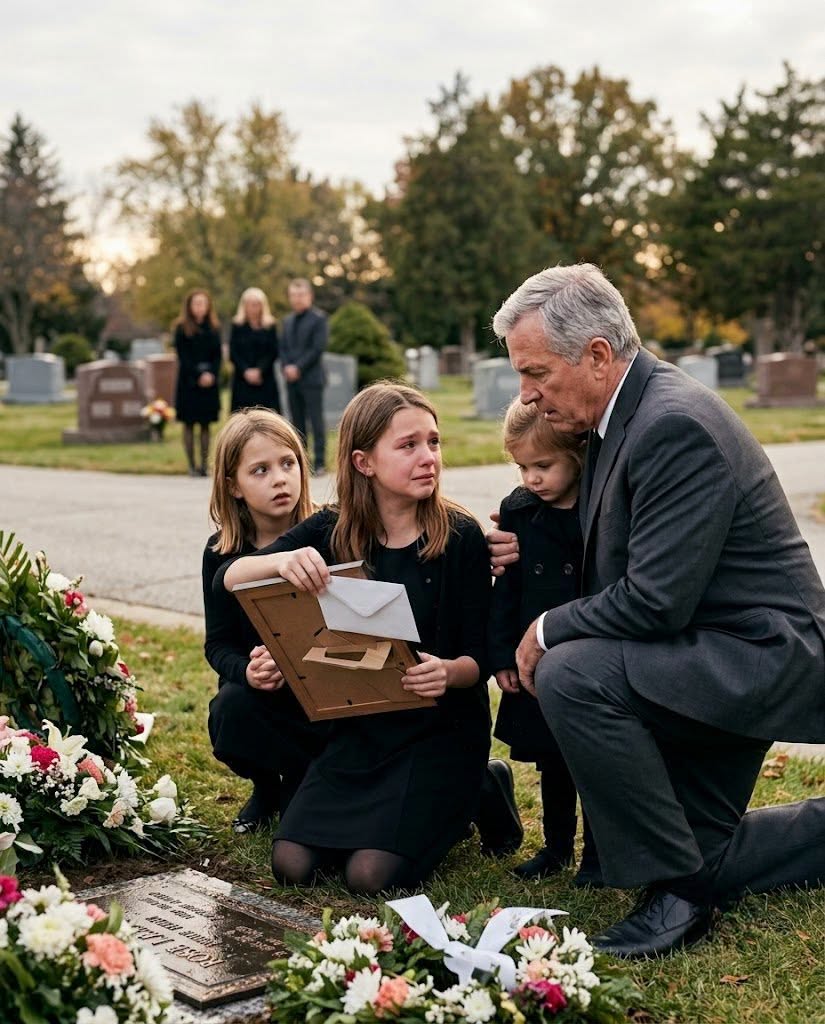
At My Daughter’s Funeral, My Son-In-Law Said, “They’re Going Into Foster Care. I Deserve A Fresh Start With My New Fiancée.” Then His Daughters Revealed The Secret Their Mother Left Behind. More than 200 mourners stood frozen beside my daughter Rose’s grave when my son-in-law Arthur looked at his three daughters and decided their future was an inconvenience.

Rose had been buried less than an hour earlier. She was only thirty-five. The flowers were still fresh, the ground was still damp, and her children were still trying to understand that their mother was gone.
Then Arthur said the words I will never forget.
“If nobody wants to take responsibility for those girls, I’ll hand them over to Child Protective Services on Monday. I’m not wasting my life raising children whose mother is already dead.”
Twelve-year-old Lucy held her mother’s framed photograph against her black dress so tightly her hands shook. Nine-year-old Rachel stared at the fresh dirt without saying a word. Six-year-old April buried herself against my coat, trembling as she listened to her own father talk about giving her away.
Arthur didn’t look heartbroken.
His gray suit was spotless. His expensive shoes were cleaner than the muddy ground around him. His watch flashed beneath his sleeve when he checked his phone.
Then he smiled.
Not because of the funeral.
Because of whatever message had appeared on that screen.
I stepped toward him. “What did you just say?”
He acted like I was the one creating a problem.
“Charles, don’t do this,” he said. “Rose is gone. I have every right to move on with my life.”
“And your daughters?” I asked.
He barely looked at them.
“My fiancée isn’t interested in raising three girls who barely respect me. You’re their grandfather. If they matter that much to you, then you take them.”
The cemetery went quiet.
Family members looked away. Someone covered their mouth. Even the priest seemed unable to find words.
For one moment, anger took over. I wanted to grab him and make him understand what he was doing to those girls.
Then April reached for my hand.
Her tiny fingers squeezed mine, and I saw what mattered more than my anger.
She had just lost her mother.
Now she was watching her father leave too.
I looked at Lucy and Rachel. Something about them felt different.
They weren’t begging Arthur to stay. They weren’t asking why he didn’t love them.
They were watching him like they already knew the truth.
The sisters exchanged one silent look.
Lucy looked at Rachel.
Rachel looked at April.
And April looked back at both of them.
They had a secret.
I knelt down and told them, “You’re coming home with me. All three of you.”
Arthur smiled like I had just solved a problem for him.
“Perfect,” he said.
He didn’t hug them.
He didn’t say goodbye.
He didn’t ask if they had clothes, medicine, or anything they needed.
He simply walked toward a white van waiting outside the cemetery.
A young woman sat inside wearing dark sunglasses. When Arthur opened the door, she smiled. He climbed in beside her, and the van drove away.
I stood beside Rose’s grave with my granddaughters beside me.
Then Lucy touched my sleeve.
“Grandpa,” she whispered, staring toward the cemetery gate, “Mom knew Dad was going to do this.”
I looked down at her. “What do you mean?”
She pulled Rose’s photograph closer.
“Mom left things for us,” Lucy said quietly. “A notebook, recordings, and an envelope.”
Rachel stepped closer.
April stopped shaking.
And Lucy whispered the one thing Arthur never expected to hear.
“Dad doesn’t know we hid them.”
I reached toward Lucy as she carefully pulled the hidden envelope from inside the frame of Rose’s photograph and placed it in my hand.
PART 2 — THE THINGS ROSE HID BEFORE SHE DIED
The envelope was warm from Lucy’s hands.
That is what I remember first.
Not the cemetery.
Not Arthur’s white van disappearing through the gate.
Not the two hundred people pretending not to stare at three little girls whose father had just discarded them beside their mother’s grave.
The envelope.
Warm.
Thin.
My daughter’s handwriting on the front.
DAD — ONLY IF ARTHUR LEAVES THE GIRLS.
For several seconds, I could not breathe.
Rose had known.
Not suspected.
Known.
I looked down at Lucy.
Her face was pale, but her eyes were dry.
Too dry.
Twelve-year-olds should not know how to look composed beside fresh graves.
“Where did this come from?”
I whispered.
“Mom put it behind the picture.”
She touched the wooden frame.
“She told me not to take it out unless Dad said we couldn’t stay with him.”
My chest tightened.
“When did she tell you that?”
“Three weeks ago.”
Three weeks.
Rose had been alive three weeks ago.
Talking.
Planning.
Protecting.
Dying.
And I had been sitting beside her hospital bed asking whether she wanted soup.
I closed my eyes.
I had known the cancer was bad.
We all had.
But Rose had spent those final weeks preparing for something I had not even imagined.
Arthur.
I did not open the envelope at the cemetery.
I wanted to.
God, I wanted to.
But April had begun shaking again.
Rachel stood so still she looked carved.
And Lucy was watching me with the terrible seriousness of a child who had already decided whether the adult in front of her was strong enough to carry what she knew.
So I put the envelope inside my coat.
Then I crouched.
“All three of you are coming home with me tonight.”
April asked immediately:
“For how long?”
I looked at her.
Six years old.
Her mother had just been buried.
Her father had driven away with another woman.
And she still needed a calendar.
“As long as you need.”
She swallowed.
“Forever?”
My throat closed.
“If that’s what becomes best.”
I would not promise something courts, Arthur, or life itself might complicate.
Children deserve reassurance.
Not lies.
April nodded.
Then slipped her hand into mine.
Rachel finally spoke.
“Can we get Mom’s things first?”
I looked toward the cemetery gate.
“You mean at your house?”
She nodded.
Lucy’s face changed.
“Not with Dad there.”
“He left.”
“For now.”
There was something in the way she said it.
I turned toward her.
“What aren’t you telling me?”
Lucy glanced at Rachel.
Rachel looked down.
April whispered:
“He gets mad when he can’t find stuff.”
My skin went cold.
“What stuff?”
Nobody answered.
Not yet.
Fine.
There would be time.
I hoped.
My house was forty minutes away.
A two-story brick place Rose had grown up in.
The girls had spent countless weekends there.
Still, that evening, it looked unfamiliar to them.
Grief changes rooms.
April stood in the hallway clutching her black shoes.
Rachel went straight upstairs without speaking.
Lucy remained near the front door.
Watching.
Waiting.
“For what?”
I asked.
She shrugged.
“Nothing.”
“Lucy.”
Her mouth trembled.
Then:
“I thought maybe Dad would come.”
My anger rose so fast I nearly tasted it.
I forced it down.
“For you?”
“I don’t know.”
She looked ashamed.
That broke me more than if she had cried.
“Sweetheart.”
I stepped closer.
“You do not have to be ashamed for hoping your father acts like your father.”
Her face collapsed.
For the first time all day, she cried.
Hard.
Not graceful.
Not silent.
She pressed her face against my chest and sobbed like something inside her had finally been given permission to break.
I held her.
Then Rachel came downstairs.
Saw us.
And started crying too.
April followed.
Within seconds, all three were against me.
Four people in the foyer.
One dead daughter between us.
One living father absent by choice.
I closed my eyes.
“You’re safe here.”
I said.
I hoped the sentence was legally true.
Emotionally, I would make it true myself.
That night, after the girls finally fell asleep, I opened Rose’s envelope.
I sat at the same kitchen table where she had done homework twenty-five years earlier.
My wife, Ellen, had died six years before Rose.
So there was no one across from me.
Only an empty chair.
I unfolded the first page.
Rose’s handwriting.
Steadier than I expected.
Dad,
If you are reading this, then Arthur did what I was afraid he would do.
I covered my mouth.
Then kept reading.
Please do not fight him in front of the girls. He wants anger because anger lets him tell people everyone else is unstable. He has been building that story for months.
I stopped.
There it was.
Not grief.
Preparation.
I am not asking you to hate him. I am asking you to believe the children before you believe his explanations.
My eyes burned.
Lucy knows more than I wanted her to know. Rachel has heard more than Arthur realizes. April understands less, but she feels everything. Please do not ask them to prove anything tonight. Let them sleep.
I looked toward the stairs.
My daughter had known exactly what I would want to do.
Questions.
Answers.
Control.
Rose continued.
There is a blue notebook in the old cedar chest in Lucy’s closet. There is a flash drive taped beneath the bottom drawer of my dresser. There are copies of bank statements and legal papers in the green folder behind the winter coats.
My pulse rose.
Do not take Arthur’s word about custody, money, or the house. Call a lawyer before you sign anything.
Then one line by itself.
And Dad — do not let him tell the girls I wanted them sent away.
I stopped breathing.
Why would he say that?
I kept reading.
He has already told them that my illness made me confused and that I agreed they would be better off “starting over” somewhere else. I never agreed to that.
My hands shook.
I had to put the letter down.
Arthur had not invented abandonment at the cemetery.
He had been rehearsing it.
Preparing the girls to believe their own mother had approved their removal.
That was not grief.
That was architecture.
The next morning, I called a family-law attorney named Evelyn Shaw.
Rose had written her name at the bottom of the letter.
Of course she had.
I called at 7:04.
She answered on the third ring.
“Mr. Bennett?”
I froze.
“You know who I am?”
“Yes.”
My chest tightened.
“How?”
“Rose retained me for limited estate and guardianship planning two months ago.”
I sat.
“What did she tell you?”
“That she was terminally ill.”
“That she was concerned about what would happen to the girls after her death.”
“And Arthur?”
A pause.
“She was concerned about him too.”
I closed my eyes.
“Did she think he would abandon them?”
“She thought there was a significant risk he would either relinquish primary care informally or attempt to pressure relatives into taking the children while retaining control of certain assets.”
That sentence was too professional for what it meant.
I translated.
“He wanted the money but not the girls.”
Evelyn did not answer immediately.
Then:
“Rose was afraid of that.”
My hand tightened around the phone.
“Can I keep them?”
“Right now?”
“Yes.”
“Did Arthur leave them with you voluntarily?”
“Yes.”
“In front of witnesses?”
“Two hundred.”
That almost made her laugh.
Almost.
“Then for the immediate moment, they are with a known relative and appear safe.”
“But that is not the same as a permanent custody order.”
“I know.”
“Good.”
She continued.
“Do not enroll them elsewhere yet.”
“Do not move them out of state.”
“Do not dispose of Arthur’s property.”
“Do not confront him about evidence until we preserve it properly.”
“I understand.”
“Rose told me you would.”
That hurt.
At ten, I took Lucy and Rachel back to their house.
Not April.
She stayed with my sister.
I did not want a six-year-old inside that place while we searched through the remains of her mother’s last plan.
Arthur was not there.
His car was gone.
The white van too.
The house looked obscenely normal.
A cereal bowl in the sink.
Rose’s slippers beside the couch.
A sweater hanging over the dining chair.
I stood in the doorway.
For one second, grief almost sent me backward.
Lucy touched my sleeve.
“Grandpa?”
“I’m okay.”
She gave me a look.
Rose’s look.
No, you’re not.
Fair.
We went upstairs.
The cedar chest sat inside Lucy’s closet.
I opened it.
Blankets.
Old school projects.
A Christmas sweater.
Then underneath, wrapped in one of Rose’s scarves, was the blue notebook.
Lucy saw it.
Her face changed.
“Mom wrote in that every night.”
“Did you read it?”
“No.”
Good.
I opened the first page.
Date.
Six months earlier.
Arthur came home after midnight. Said client dinner. Phone showed hotel parking charge. I asked. He said I was paranoid because of medication.
Next day.
Asked Dr. Patel whether chemo could cause “delusions.” He did this in front of me. Doctor corrected him: nothing in my current regimen indicates psychosis. Arthur laughed and said he was joking.
My stomach turned.
Page after page.
Not dramatic.
That made it stronger.
Specific.
Dates.
Amounts.
Words.
Arthur moved $14,000 from joint savings. Said medical bills. Hospital billing portal shows insurance covered most recent cycle.
Lucy heard Arthur tell someone on phone, “Once she’s gone, I’m not carrying three girls alone.” I told Lucy she should never have had to hear that.
Rachel asked why Dad said daughters are “expensive twice.” She would not explain what he meant.
I stopped.
“What did he mean?”
Lucy looked away.
Rachel answered quietly.
“He said girls cost money until they marry, then they leave your name anyway.”
My hands went cold.
I shut my eyes.
Then opened them again.
“Did he say that to you?”
“Not exactly.”
Rachel whispered.
“To Uncle Peter.”
“He thought we were upstairs.”
Of course.
Children hear what adults think walls will absorb.
The notebook changed three months before Rose died.
The entries became shorter.
More urgent.
Arthur asked me to sign updated will. Refused.
Arthur wants girls’ education accounts consolidated. Refused.
Found text from “M.” — not business. “After funeral, we can finally start.” Screenshot saved.
My breath stopped.
After funeral.
I turned the page.
Her name is Melissa Grant. Twenty-eight. Works for event company. Arthur told her he will be “free soon.”
The young woman in the white van.
Dark sunglasses.
Smiling outside my daughter’s funeral.
I had assumed fiancée because Arthur said so.
Rose had already known her name.
Already known she was waiting.
I felt sick.
Then another entry.
Arthur told Melissa the girls would “probably end up with Rose’s father or the state.”
I closed the notebook.
Not because I had finished.
Because I could not continue without becoming someone the girls could see.
I stood.
Walked to the window.
Breathed.
Lucy said:
“Mom cried when she wrote sometimes.”
I turned.
“You saw?”
“She hid it.”
Then Lucy whispered:
“She thought Dad wanted her to die faster.”
The room disappeared.
“What?”
Rachel started crying.
I looked at both girls.
“Why would you say that?”
Lucy’s voice shook.
“Because he got mad when Mom changed hospice.”
My pulse hammered.
“Changed what?”
“She wanted to stay home.”
“Dad wanted her to go somewhere.”
Rachel added:
“He said if she stayed here, everything would take longer.”
My entire body went cold.
Careful.
Careful.
Words matter.
“Did he ever hurt your mother physically?”
Both girls shook their heads.
“Did he ever stop her medicine?”
“No.”
“Stop anyone treating her?”
“No.”
Good.
Important.
Then Lucy said:
“He just acted like she was taking too long.”
That was enough to break my heart without inventing a crime.
We found the flash drive beneath Rose’s dresser.
Taped exactly where she said.
I did not open it there.
Evelyn had told me to preserve things first.
So I photographed it in place.
Called her.
Then removed it carefully.
The green folder was behind the winter coats.
Bank statements.
Insurance paperwork.
Trust documents.
A copy of Rose’s will.
I read the relevant section standing in the closet.
Arthur was not executor.
I was.
That surprised me.
Rose had changed it seven weeks before death.
She left certain personal assets directly for the girls in trust.
She named me as trustee.
Not because she thought I should control everything.
Because she wrote a letter explaining why.
Arthur has repeatedly asked me to merge the girls’ accounts into one household account. I do not want funds intended for them used for his new life after I die.
My throat tightened.
There was also life insurance.
$750,000.
Beneficiaries:
The girls’ trust.
Not Arthur.
I sat on the floor.
There it was.
The money.
Not everything.
But enough to explain at least part of the urgency.
Arthur had been counting on something he no longer controlled.
Did he know?
Probably not.
Rose had changed the beneficiary four months earlier.
Evelyn confirmed later that the change had been completed properly.
The policy was hers.
The designation was valid unless challenged successfully.
No magical instant transfer.
Claims.
Reviews.
Paperwork.
Still.
Arthur had assumed grief would leave him richer and freer.
Rose had quietly made sure the money followed the children.
The recordings were worse.
Not because they contained murder confessions.
They didn’t.
Real life rarely gives you villains narrating themselves perfectly.
Instead, there were conversations.
Arthur’s voice.
Rose’s voice.
Sometimes raised.
Sometimes cold.
One file began with Rose saying:
“Stop telling them I’m confused.”
Arthur:
“You are confused.”
“I’m sick.”
“That’s what I mean.”
“No.”
Then his voice:
“You’re making this harder than it needs to be.”
“What is ‘this’?”
“Everything after.”
Silence.
Rose:
“I’m not dead yet.”
Arthur:
“I know.”
Too fast.
Too impatient.
Then:
“But you need to accept reality.”
Another recording.
Arthur:
“I cannot raise three girls alone.”
Rose:
“You’re not alone.”
“I will be.”
“My father—”
“I don’t want your father in my life.”
“He’s their grandfather.”
“That doesn’t mean he runs things.”
Rose:
“No one said he would.”
Arthur:
“If your insurance goes to some trust Charles controls, I will contest it.”
I stopped the recording.
He knew.
At least near the end.
He knew she had changed things.
Maybe not details.
Enough.
Another file.
Arthur speaking to someone else.
Not Rose.
Recorded from a room nearby, likely accidentally while Rose left her phone running.
Arthur:
“I’m not spending the next twelve years playing single dad.”
Male voice:
“They’re your kids.”
Arthur:
“I know what biology says.”
Then laughter.
My hands shook.
The other man:
“What’s Melissa think?”
Arthur:
“She doesn’t want kids.”
Then:
“Maybe Charles takes them.”
“If not, there are programs.”
Programs.
My granddaughters reduced to programs.
Then:
“Either way, once Rose’s gone, I finally get to restart.”
I shut the laptop.
Enough.
I had heard enough.
Not because there was no more.
Because grief was becoming rage again.
And rage was not what the girls needed.
Arthur called me that afternoon.
First time since the cemetery.
I stared at the screen.
Then answered.
“Charles.”
His tone was almost cheerful.
“Where are the girls?”
“With me.”
“Good.”
That word.
Good.
As though I were dog-sitting.
“I need to come by tomorrow.”
“For what?”
“Paperwork.”
My stomach tightened.
“What paperwork?”
“School.”
“Insurance.”
“Some custody forms.”
I looked at Evelyn, sitting across from me.
She shook her head.
“Send them through your attorney.”
Silence.
Then Arthur laughed.
“You hired a lawyer?”
“Yes.”
“For what?”
I almost admired the arrogance.
“Arthur.”
“What?”
“You told two hundred people you planned to hand your children to CPS.”
“That was frustration.”
“Then left them.”
“I left them with family.”
“And now you’re surprised I have counsel?”
His voice hardened.
“Do not start making this difficult.”
There it was.
Rose’s notebook.
My daughter’s warning.
He liked anger because anger let him call other people unstable.
So I did not give him any.
“Have your attorney call mine.”
Then I hung up.
My hands were shaking anyway.
Calm is not the absence of rage.
Sometimes it is simply choosing not to hand someone the version of you they came prepared to use.
He arrived at my house anyway.
Next morning.
8:12.
No lawyer.
No warning.
I opened the door but did not invite him inside.
“Where are my daughters?”
he demanded.
“Safe.”
“I want to see them.”
“Then we can arrange that.”
His face changed.
“Arrange?”
“Yes.”
“They are my children.”
“Yes.”
“You don’t get to keep them from me.”
“I’m not.”
I looked at him.
“You left them at a cemetery yesterday.”
“Don’t exaggerate.”
I almost laughed.
“Two hundred witnesses.”
His jaw clenched.
Then:
“I was emotional.”
“No.”
I said.
“You were specific.”
That landed.
Then he lowered his voice.
“Charles, I know Rose left papers.”
My body went cold.
How?
He saw it.
Smiled.
“Lucy took something from the picture frame.”
There.
He had noticed.
He just had not stopped her.
Maybe because he thought it was sentimental.
“What did she leave?”
I said nothing.
Arthur stepped closer.
“That material belongs to my wife’s estate.”
“I’m executor.”
His face changed.
There.
He did not know.
“What?”
“Rose named me executor.”
“That’s impossible.”
“No.”
“She wouldn’t.”
“She did.”
He stared.
Then laughed.
Nervous.
“You think that gives you custody?”
“No.”
“Good.”
“I think custody will be decided according to law and the girls’ best interests.”
His expression darkened.
“You always wanted my family.”
My chest tightened.
“What?”
“You never liked me.”
“That is not relevant.”
“You think you’re better for them.”
“I think they deserve a father who does not discuss foster care beside their mother’s grave.”
Silence.
Then:
“I said something stupid.”
“Yes.”
“People say things in grief.”
“Yes.”
“Then stop acting like it defines me.”
I looked at him.
“It doesn’t.”
Hope flashed in his face.
Then I continued.
“The last six months may.”
His expression vanished.
“What did she leave?”
he asked again.
“Have your attorney call mine.”
His face changed.
Then:
“Did she record me?”
I said nothing.
Wrong move.
For him.
His eyes widened.
“She did.”
Then anger.
“That’s illegal.”
“Maybe.”
I genuinely did not know whether every recording was lawful under our state’s rules and circumstances.
That was for attorneys.
I was not going to bluff.
“You don’t even know.”
he snapped.
“No.”
I said.
“And unlike you, I’m comfortable admitting when I need professional advice.”
His jaw tightened.
Then the front door behind me creaked.
Lucy.
I turned.
She stood in the hallway.
Arthur saw her.
“Lucy.”
Her face emptied.
Not fear.
Something colder.
“What?”
he said.
“Come here.”
She did not move.
“Lucy.”
“No.”
Arthur stared.
I felt something shift.
Not because twelve-year-olds decide custody.
They don’t.
Because he was finally experiencing a child’s no without Rose there to soften it.
“I’m your father.”
“I know.”
“You need to come home.”
“No.”
His face flushed.
“Why are you acting like this?”
Lucy’s voice trembled.
“Because you said you didn’t want us.”
Silence.
Arthur looked at me.
Immediately.
“You told her that?”
I almost lost control.
Lucy said:
“You said it at Mom’s funeral.”
He froze.
Right.
No adult translator required.
Then Lucy whispered:
“And before.”
Arthur’s face changed.
“What do you mean?”
She began crying.
“I heard you tell Uncle Peter you weren’t wasting your life on us.”
His mouth opened.
Nothing came.
Then Rachel appeared behind Lucy.
“You said girls leave anyway.”
Arthur’s face went white.
April came too.
Of course.
All three.
My heart broke.
Arthur looked at them.
For the first time since the cemetery, he looked afraid.
Not of me.
Of being known.
“I didn’t mean—”
Lucy interrupted.
“Yes, you did.”
Children are brutal when adults teach them euphemism too late.
Arthur looked at me.
“This is exactly why they need to come home.”
Lucy laughed through tears.
“Home?”
That one word destroyed him.
Because the house no longer felt like home to her.
Maybe it could again someday.
Maybe not.
But titles do not control emotional geography.
Arthur’s voice softened.
“Lucy.”
She shook her head.
“No.”
Then stepped backward.
I closed the door.
Not slammed.
Closed.
A boundary does not need noise to hold.
The emergency custody hearing happened four days later.
Not because I “took” the girls.
Because lawyers moved quickly after Arthur demanded their return and I sought temporary protection of the existing arrangement while the court reviewed what had happened.
There was no cinematic courtroom.
No gasps.
No judge pounding a gavel.
Evelyn presented facts.
Arthur had voluntarily left the girls with me after the funeral.
Public statements suggested an intention to relinquish care.
Rose’s estate plan showed concern for the children’s stability.
There were preliminary materials documenting Arthur’s statements and conduct.
The girls were already familiar with my home.
Their schools could remain unchanged.
Arthur’s lawyer argued grief.
Misunderstanding.
A temporary emotional breakdown.
Fair.
Those were arguments he was entitled to make.
The judge did not terminate his rights.
Of course not.
Instead, temporary residential placement remained with me while a guardian ad litem and appropriate family services reviewed circumstances.
Arthur received structured visitation.
The children would be interviewed appropriately.
Not by me.
Not by Arthur.
Professionals.
Good.
The judge also made one point very clearly:
“No child in this matter is to be used as messenger, investigator, or emotional intermediary.”
I looked at Lucy.
She looked at me.
Rose had wanted exactly that.
Arthur hated supervised contact.
At first.
He called it humiliation.
I thought about what his daughters had felt at the cemetery.
I said nothing.
His first visit lasted forty minutes.
Lucy barely spoke.
Rachel drew.
April cried and asked me to wait outside the room.
I did.
Arthur brought gifts.
Too many.
Tablets.
Bracelets.
Stuffed animals.
The supervisor redirected him.
“Try talking.”
He looked offended.
But eventually he sat.
April showed him a drawing.
That was the first real moment.
Small.
Fragile.
Not redemption.
Contact.
The estate process uncovered more.
Not a secret fortune.
Something more ordinary.
Arthur had been moving money.
Approximately $68,000 over eight months from joint accounts and Rose’s business income into an account he controlled.
Some was legitimate household spending.
Some was not.
Payments to hotels.
Jewelry.
A lease deposit for an apartment Melissa had toured.
Furniture.
Travel.
No seven-figure theft.
No hidden criminal empire.
Enough.
Rose had noticed.
Documented.
Changed her life insurance beneficiary.
Changed executor.
Created trusts for the girls.
Not revenge.
Protection.
She also left Arthur his lawful share of marital property.
She did not try to erase him from existence.
That mattered to me.
Even dying, Rose had not turned planning into punishment.
She protected the girls.
That was all.
Melissa disappeared quickly.
Not literally.
She ended the engagement.
Three weeks after the funeral.
Arthur blamed me.
Of course.
Then I learned why.
She had believed something very different.
Arthur told her Rose and he had been separated “in every meaningful way” for nearly a year.
He said Rose wanted him to move on.
He said the girls were likely staying with me because Rose preferred it.
Melissa did know Rose was dying.
That part was ugly enough.
But she did not know Arthur was planning to abandon the children publicly.
When she learned what he said at the cemetery, she left.
She later provided messages.
One from Arthur:
Once funeral stuff is over, the girls are Charles’s problem. Then we can start clean.
Another:
Rose made sure I’m stuck with the kids financially even if I don’t keep them physically.
I stared at that line.
Financially.
Physically.
As though fatherhood were inventory.
I hated him then.
Fully.
For several months.
Then I learned hatred is exhausting when you are seventy-one and raising three grieving girls.
I had lunches to pack.
Hatred had to wait.
Life became practical.
That saved us.
Lucy needed braces adjusted.
Rachel hated her new math teacher.
April wet the bed twice a week for months.
The girls needed therapy.
School lunches.
Permission slips.
Hair ties.
So many hair ties.
I had raised one daughter.
Apparently I had forgotten everything.
The first time April asked me to do her hair, I produced something that looked like structural damage.
She stared in the mirror.
“Grandpa.”
“Yes?”
“I love you.”
“Thank you.”
“But this is bad.”
Fair.
We watched videos.
Improved.
Slowly.
Grief had to share space with ordinary incompetence.
That was healthy.
Rose left letters for each girl.
Not to be given all at once.
Evelyn held them according to Rose’s instructions.
Birthdays.
Milestones.
First period.
Graduation.
Wedding if applicable.
Some unlabeled.
For hard days.
Lucy received the first six months after the funeral.
Only one page.
My Lucy,
You are not the third parent.
She cried before reading further.
You are not responsible for Rachel and April because you are oldest. Help them because you love them, not because anybody makes you become me.
I had to leave the room.
Rose knew.
Even dying, she knew Lucy would try to become mother.
And she refused to let death promote her child into adulthood.
After that, when Lucy tried to pack April’s lunch, I said:
“Go be twelve.”
She hated the phrase.
Then loved it.
Eventually.
Rachel’s first letter came on her tenth birthday.
My sweet Rachel,
You notice everything and say almost nothing. Please do not mistake quiet for safety. Tell someone when something hurts.
Rachel cried.
Then began talking more in therapy.
About the nights Arthur fought with Rose.
About hearing Melissa’s name.
About believing if she behaved perfectly, maybe both parents would love being home.
That one nearly destroyed me.
Children believe they control weather.
We spent years teaching her she didn’t.
April’s first letter was mostly drawings.
Rose had traced her own hand.
Written:
Put your hand here when you miss me.
April did.
Every night for three months.
Then less.
Then sometimes.
Grief is not betrayal when it becomes quieter.
I had to learn that too.
Arthur’s custody position changed over time.
At first, he wanted the girls back.
All three.
Immediately.
I did not fully believe him.
Neither did professionals.
But something unexpected happened.
The visits continued.
He began showing up.
Not perfectly.
But consistently.
Gifts stopped.
He brought snacks.
Remembered Rachel’s science fair.
Learned April’s bedtime book.
Sat through Lucy’s silence without demanding she forgive him.
One day, almost a year after Rose died, he told the family therapist:
“I said I wanted a fresh start because I thought the girls were the part of my life keeping me tied to grief.”
I watched from across the room.
He continued.
“That was monstrous.”
No one rescued him from the word.
Good.
“I thought if I removed everything that reminded me of Rose, I wouldn’t have to feel what I lost.”
Lucy’s face hardened.
“So you removed us?”
Arthur cried.
“Yes.”
That answer hurt.
But it was true.
Then:
“I was so selfish I treated you like reminders instead of daughters.”
No excuse.
Just ownership.
That was the first apology Lucy believed enough to cry.
Not forgive.
Cry.
Different.
The girls did not return to live with him.
Not then.
Temporary placement with me became longer-term guardianship through proper proceedings.
Arthur retained parental rights and increasing contact as he demonstrated stability.
He paid support.
Participated in therapy.
Followed restrictions.
The process took time.
Years.
As it should.
No funeral speech alone decided the rest of childhood.
Behavior did.
At seventeen, Lucy chose to spend one weekend a month with Arthur.
Her choice.
Rachel more often.
April eventually reached something close to regular shared time.
Different children.
Different relationships.
I did not demand fairness by making them identical.
Rose had warned me.
Believe the girls.
So I did.
Arthur never married Melissa.
He never married anyone while the girls were young.
Not because he became saintly.
Because life changed.
He lost status among friends who had witnessed the cemetery.
His business suffered for a while after financial disputes in Rose’s estate became known privately within their circle.
Not ruined.
Changed.
He moved into a smaller home.
Entered therapy.
Eventually sold the ridiculous watch.
I noticed because April once said:
“Dad wears a normal watch now.”
Children measure reform strangely.
Years later, Arthur apologized to me.
We were sitting outside Lucy’s high-school graduation.
He looked toward the auditorium doors.
“You saved them.”
I shook my head.
“No.”
He frowned.
“I took them home.”
“Rose saved them before either of us knew they needed saving.”
His eyes filled.
Then:
“I hated her for changing the insurance.”
“I know.”
“I told myself she stole from me.”
I looked at him.
“She protected her children.”
“Yes.”
He swallowed.
“I know that now.”
Then:
“I’m sorry for what I said at the cemetery.”
I stared.
“That apology belongs to them.”
“I gave it.”
“Give it again when necessary.”
He nodded.
Then:
“And I’m sorry I made you become seventy-one and raise three girls.”
I almost laughed.
“That part has been educational.”
He smiled.
Then:
“You could’ve made them hate me.”
That sentence angered me unexpectedly.
“No.”
I said.
“They were already hurt enough.”
He looked down.
I continued.
“My job was not to protect your reputation.”
“It was also not to recruit them into my anger.”
“That difference matters.”
He nodded.
Good.
Lucy graduated.
Four chairs in the front row.
Me.
Arthur.
Rachel.
April.
When they called Lucy’s name, Arthur stood first.
Cheered too loudly.
I joined him.
For one second, I saw Rose between us.
Not literally.
Memory.
A mother who had written:
You are not the third parent.
Her daughter crossed the stage as a child allowed to become an adult on schedule.
That was victory enough.
Rachel became a social worker.
Of course.
She said it had nothing to do with childhood.
Nobody believed her.
April became an elementary-school teacher.
Lucy became an accountant.
That surprised everyone except me.
She had spent years watching adults mishandle money.
Apparently she wanted revenge through spreadsheets.
Good for her.
The life-insurance trust did what Rose wanted.
Education.
Therapy.
Health expenses.
First cars.
No yachts.
No fairy-tale wealth.
Enough to create stability.
I kept meticulous records.
Annual reports.
Statements.
Receipts.
Not because I expected accusations.
Because transparency is a form of care when money once represented betrayal.
At twenty-five, Lucy received control of her remaining share.
She signed the final acknowledgment.
Then looked at me.
“Grandpa?”
“Yes?”
“You never took anything?”
I stared.
“Of course not.”
She smiled.
“I know.”
“Then why ask?”
“Because Mom wrote that money makes people tell themselves weird stories.”
I laughed.
“That sounds like her.”
Then Lucy hugged me.
“Thank you.”
I cried.
Naturally.
Age had not improved that.
Arthur and I eventually became something neither of us deserved to call friends.
Co-grandparents, maybe.
Family through damage.
When Lucy married, Arthur and I both walked her partway.
Not together.
She designed it.
I walked her from the hotel room to the garden entrance.
Arthur walked from there to the aisle.
Then Lucy walked the final stretch alone.
People thought it was symbolic.
It was.
She told us:
“Grandpa got me through childhood.”
“Dad came back later.”
“And I’m doing the rest myself.”
Arthur cried.
I did too.
Rose would have applauded.
At the reception, Arthur approached me.
“Did you ever read all the recordings?”
“No.”
He looked surprised.
“Why?”
“Because I heard what I needed.”
There were files Evelyn had preserved that I never opened.
Arguments.
Conversations.
Evidence relevant once.
No longer necessary.
Arthur stared.
“You didn’t want to know everything?”
“No.”
I looked toward the dance floor.
“Rose was more than evidence.”
My throat tightened.
“I did not want the last version of my daughter in my head to become a case file.”
Arthur looked away.
Then:
“I wish I had understood that while she was alive.”
So did I.
We buried the blue notebook with me only metaphorically.
The actual notebook stayed in a family archive box with Rose’s letters.
The girls could read it as adults if they wanted.
Lucy did.
Rachel read half.
Stopped.
April never opened it.
All valid.
Truth belongs to people differently.
No one owes trauma full review simply because documentation exists.
On the tenth anniversary of Rose’s death, we gathered at the cemetery.
Smaller group.
Family.
Arthur came.
So did the girls.
Women now.
April brought flowers.
Rachel brought nothing.
Lucy brought the old framed photograph.
The same one.
The backing had been repaired.
No envelope inside.
She handed it to me.
“Remember?”
I touched the wood.
“Yes.”
Arthur saw it.
His face changed.
He knew exactly what it was.
For a moment, everyone was quiet.
Then Arthur knelt beside the grave.
No speech.
Good.
He simply said:
“I’m sorry, Rose.”
Wind moved through the trees.
Nothing supernatural happened.
No sign.
No forgiveness from beyond.
Just a man speaking to the ground because sometimes remorse needs somewhere to go even when it cannot be received.
Later, April asked:
“Grandpa, did Mom know everything that would happen?”
I smiled sadly.
“No.”
“She thought Dad would leave.”
“Yes.”
“Did she know you’d take us?”
I looked at her.
“I think she hoped.”
April nodded.
Then:
“She trusted you.”
My throat tightened.
“Yes.”
That trust had been heavy.
Beautiful.
Terrifying.
I did not always carry it well.
But I carried it.
When I think back to the funeral now, I no longer remember Arthur first.
That surprises me.
For years, his words were the loudest part.
I deserve a fresh start.
I’m not wasting my life.
If nobody wants them, CPS can take them.
Cruel sentences.
Memorable.
But time changed the sound.
What I hear now is Lucy.
Quiet.
Barely louder than the wind.
Mom knew Dad was going to do this.
Then:
Dad doesn’t know we hid them.
That was the moment Rose entered the story after death.
Not as a ghost.
As a mother who had spent the last strength of her life making sure her children would not become unprotected simply because she was gone.
The notebook mattered.
The recordings mattered.
The trust mattered.
The insurance mattered.
But the greatest thing Rose left behind was not evidence against Arthur.
It was evidence for the girls.
Evidence that their mother had seen them.
Thought about them.
Planned for them.
Refused to let someone else rewrite her love after she was buried.
That mattered more than money.
More than court orders.
More than anything Arthur lost.
And Arthur did lose something.
Not his daughters completely.
That would make this story simpler.
He lost the right to assume they would trust him merely because he was their father.
He spent years earning pieces of that trust back.
Some returned.
Some never did.
That was his consequence.
Not prison.
Not poverty.
Not some dramatic public ruin.
Three daughters who loved him carefully instead of automatically.
A father who had to ask.
Wait.
Show up.
Accept no.
Learn birthdays.
Apologize again.
That was harder than one punishment.
Probably more useful too.
As for me, I became a parent again when I thought that part of life was finished.
I learned how to braid hair badly.
How to attend middle-school concerts where every instrument sounds injured.
How to sit outside therapy rooms.
How to sign permission slips.
How to say:
“I don’t know.”
How to let girls miss a father I was furious with.
That last one was hardest.
Sometimes Lucy came home from visiting Arthur smiling.
My first instinct was betrayal.
Then shame.
Because her joy was not betrayal.
Children are allowed to love people who failed them.
They are also allowed not to.
My job was not to decide which feeling proved the truth.
My job was to make room for whichever one arrived.
Rose taught me that from a letter.
Near the end of my life, Lucy once asked what I thought Rose would say if she could see us.
We were sitting on my porch.
I was eighty-three.
She had gray beginning at her temples.
I laughed.
“She’d complain about my blood pressure.”
Lucy smiled.
“Seriously.”
I thought.
Then looked at the three women my granddaughters had become.
Rachel on the lawn with her son.
April arguing with Arthur about a school fundraiser.
Life.
Messy.
Ordinary.
“I think she’d be relieved.”
Lucy’s eyes filled.
“Relieved?”
“Yes.”
“That you all got to become people instead of evidence.”
She stared.
I continued.
“For a while, everything was about what happened.”
“What Arthur said.”
“What your mother left.”
“What court decided.”
“What money was where.”
“But none of that was supposed to become your identity.”
Lucy looked toward Rose’s old photograph on the shelf.
Then whispered:
“I think she’d like that.”
So do I.
The envelope from the cemetery is still in my desk.
Empty now.
The paper yellowed.
On the front:
DAD — ONLY IF ARTHUR LEAVES THE GIRLS.
I kept it all these years.
Not because I needed proof.
Because every time I saw it, I remembered the trust inside those words.
Rose did not write:
If Arthur leaves, destroy him.
She wrote instructions.
Protect the girls.
Call a lawyer.
Do not let anger become the story.
Believe the children.
That was my daughter at the end.
Dying.
Afraid.
Still thinking clearly enough to protect everyone she loved from the worst versions of themselves.
Including me.
People sometimes hear what Arthur said at the cemetery and ask:
“How could a father say that?”
I used to answer with anger.
Now I answer differently.
People can become astonishingly cruel when they begin treating responsibility as theft from the life they think they deserve.
Arthur looked at three daughters and saw years he would have to spend.
Rose looked at the same three girls and saw lives she wanted protected after she could no longer hold them.
That was the difference.
Not biology.
Not titles.
Choice.
Again and again.
Who do you choose when caring costs you something?
Rose chose them while dying.
I chose them when I was old and tired.
Arthur failed that choice spectacularly.
Then, over years, learned to make it differently.
Not perfectly.
Enough to matter.
And in the end, that is the secret Rose left behind.
Not that Arthur had a fiancée.
Not the money.
Not even the recordings.
Her real secret was that she had already imagined the moment when the girls might believe nobody wanted them.
So she left behind enough truth to make that lie impossible.
Three daughters.
One notebook.
A handful of recordings.
An envelope hidden behind a photograph.
And a grandfather who finally understood what he had been entrusted with.
Arthur said he deserved a fresh start.
Maybe he did.
We all do, sometimes.
But fresh starts do not require throwing children away to make room for them.
Rose knew that.
The girls learned it.
Eventually, even Arthur did.
And the three children he once called a burden grew into women who never again had to wonder whether their mother wanted them.
Because even from the edge of death, Rose had made sure the answer survived her.
Yes.
Always.
PART 3 — THE LIVES ROSE WANTED THEM TO HAVE
The first year after Rose died, I kept waiting for the emergency to end.
I thought there would be a point when the lawyers stopped calling.
When the girls stopped waking from nightmares.
When Arthur’s name could be spoken without changing the temperature in the room.
When Rose’s handwriting would stop appearing in drawers, envelopes, and old notebooks like she had somehow arranged to keep speaking after death.
I was wrong.
Grief does not end like a court case.
It changes jurisdiction.
At first, it ruled everything.
Then slowly, almost without our noticing, it became one part of a larger life.
That was what Rose had wanted.
I understood that later.
Much later.
Lucy was thirteen when she had her first real fight with me.
Not about Arthur.
Not about Rose.
About a school dance.
I said no.
She said everyone else was going.
I said she was too young.
She shouted:
“You’re not my dad!”
The sentence hit me like a thrown stone.
The second it left her mouth, she looked horrified.
I stood very still.
Rachel froze at the kitchen table.
April stopped coloring.
Lucy’s face crumpled.
“I didn’t mean—”
“Yes, you did.”
She stared at me.
I softened.
“You meant I’m not your father.”
“That’s true.”
Tears filled her eyes.
“But you thought saying it would hurt me.”
She nodded.
I sat.
“So let’s talk about that part.”
She began sobbing.
“I’m sorry.”
I opened my arms.
She came.
Then whispered into my shirt:
“I’m scared if I get mad at you, you’ll send me away too.”
There it was.
Not the dance.
Never the dance.
Arthur had left a ghost inside every argument.
A child who had once watched one parent die and another walk away did not experience conflict as ordinary disagreement.
Somewhere inside her, every slammed door still sounded like abandonment beginning.
I held her.
“You can be angry with me.”
She cried harder.
“You can tell me I’m wrong.”
“You can tell me I’m old.”
“That one is already obvious.”
She laughed through tears.
“But you do not have to earn staying here.”
She pulled back.
“Ever?”
“Ever.”
“Even if I’m horrible?”
“Especially then.”
I paused.
“Though I reserve the right to be extremely annoying about consequences.”
That earned a real laugh.
Good.
The dance remained a no.
She survived.
So did I.
That was one of the first times she learned a boundary could hold without the relationship breaking around it.
Rachel’s grief looked different.
She became useful.
Dangerously useful.
At eleven, she started noticing when I forgot things.
Trash night.
Medication refills.
April’s permission slips.
She began making lists.
At first, I thanked her.
Then one evening, I found her packing April’s school lunch at ten-thirty at night.
“Why are you doing that?”
She shrugged.
“You forgot.”
“I was going to do it.”
“You forget stuff.”
“That does not make it your job.”
She became angry.
“Somebody has to remember.”
I stared.
There it was.
Rose’s old fear.
The quiet child becoming infrastructure.
I sat beside her.
“Rachel.”
She would not look at me.
“You are allowed to notice.”
“You are allowed to remind me.”
“You are not responsible for holding this whole house together.”
Her eyes filled.
“Mom did.”
“Yes.”
“And it exhausted her.”
Rachel finally looked at me.
I continued.
“I am an adult.”
“I can forget a lunch and then fix it.”
“You do not have to become necessary in order to be loved.”
That sentence made her cry.
I cried too.
Because perhaps Rose had needed someone to tell her the same thing.
April’s grief arrived through questions.
At seven:
“Did Mom know she was dying?”
“Yes.”
“Was she scared?”
“Probably.”
“Did she cry?”
“Yes.”
“Did she want to leave?”
“No.”
That one I answered immediately.
At eight:
“Did Dad love Mom?”
“Yes.”
“Then why did he have Melissa?”
I hated that question.
Not because I did not have an answer.
Because every answer felt too large for her age.
So I said:
“Sometimes people love someone and still make selfish choices that hurt them.”
She frowned.
“That doesn’t sound like love.”
Children are brutal philosophers.
“No.”
I said.
“It doesn’t always look like it.”
At nine:
“If Dad didn’t want us, why does he want visits now?”
I thought.
“Because people can regret what they do.”
“Does regret fix it?”
“No.”
“Then what does?”
I looked at her.
“Nothing fixes everything.”
That disappointed her.
It disappointed me too.
“But people can repair parts.”
She nodded.
Then asked:
“Are we repaired?”
I smiled sadly.
“We’re becoming.”
That answer stayed with me.
Arthur changed slowly.
I wish I could say I trusted it immediately.
I did not.
The first year, I assumed every improvement was strategic.
Every therapy session.
Every support payment.
Every school concert.
Every careful apology.
I thought:
He wants custody back.
He wants the insurance dispute forgotten.
He wants people to think he is good again.
Maybe some of that was true.
Human motives rarely arrive one at a time.
But consistency eventually becomes harder to fake than regret.
Arthur began showing up even when nothing was gained.
Rachel had a science fair on a Wednesday night.
He came.
April had a fever during one of his weekends.
Instead of returning her early, he stayed up beside her, called the pediatrician, and sent me updates without turning it into proof of competence.
Lucy refused to see him for nearly three months after one argument.
He did not threaten court.
He kept writing her short notes.
I understand. I’m here when you’re ready.
No gifts.
No guilt.
That mattered.
Then came the hearing where he surprised everyone.
Not a custody battle.
A scheduled review.
The guardian ad litem had recommended continued placement with me, expanded parenting time for Arthur, and gradual reassessment as the girls grew older.
Arthur could have objected.
His lawyer had prepared one.
Instead, Arthur stood and said:
“I agree.”
The judge looked up.
“So you are not seeking immediate return of primary residence?”
“No.”
“Why?”
Arthur swallowed.
“Because I want what I lost back faster than they can safely give it.”
The room went silent.
He continued.
“I spent months thinking my rights were the main issue.”
“They’re not.”
“My daughters’ trust is.”
My throat tightened.
Then:
“I broke that.”
“I don’t get to order the repair schedule.”
Lucy stared at him.
Not forgiveness.
But something moved.
The judge nodded.
“Then we proceed under the recommended plan.”
No applause.
No miracle.
Just a man finally allowing the children’s pace to matter more than his discomfort.
That may have been the first truly fatherly decision he made after Rose died.
Rose’s letters kept arriving at milestones.
Not literally in the mail.
Evelyn had them.
At fourteen, Lucy received one before her first high-school dance.
I thought it would be sentimental.
It was not.
Rose wrote:
Please wear shoes you can actually walk in. Beauty is not worth losing circulation.
Lucy laughed so hard she cried.
Then another line:
If someone you like makes you feel embarrassed for having boundaries, that is not chemistry. That is information.
Lucy folded the letter carefully.
A month later, a boy pressured her to sneak out after a party.
She said no.
He called her uptight.
She came home furious.
Then she opened Rose’s letter again.
“Mom is annoying from beyond the grave.”
“Accurate.”
She smiled.
Then blocked him.
I said nothing.
Some lessons land better when the dead deliver them.
Rachel’s letter at sixteen was about money.
Of course.
Rose knew her daughters.
Do not stay with someone because leaving seems expensive.
I read that line only because Rachel showed me.
Then:
Money is important. It buys options. It does not buy worth. Save enough that your choices remain choices.
Rachel opened a savings account the next week.
Years later, she told me that one sentence had changed how she dated.
She never again confused financial dependence with devotion.
Rose was still parenting.
Not every day.
Not enough to replace herself.
Nothing could.
But in certain moments, her voice reached through time and put a hand on a shoulder.
April’s letter at thirteen said:
You were six when I died. That was much too young to remember me clearly. Please do not feel guilty if some memories disappear.
April cried for an hour.
Then said:
“I forgot her voice.”
I held her.
She whispered:
“I only know it from recordings.”
“That’s okay.”
“Is it?”
“Yes.”
She looked ashamed.
“Really?”
I touched her face.
“Memory fading is not betrayal.”
Rose had written the same thing.
I showed her.
Your life continuing is not evidence that you loved me less. It is evidence that I succeeded in loving you enough to keep going without me.
April slept with that letter beneath her pillow for weeks.
Then one day, she put it in a drawer.
That was healing too.
The trust Rose created paid for therapy first.
Then braces.
Glasses.
School trips.
College deposits.
Nothing glamorous.
That made me happy.
People romanticize inherited money.
Rose had understood it differently.
Money as stability.
Money as less fear.
Money as a way for three girls to arrive at adulthood without believing their father’s rejection had made them financially unwanted too.
I kept every receipt.
Every statement.
Every annual report.
Arthur once asked why I was so meticulous.
I looked at him.
“Because one day they may wonder whether adults used their mother’s death to make themselves comfortable.”
He flinched.
Then nodded.
“Fair.”
No anger.
Another change.
When Lucy was seventeen, she asked for the entire blue notebook.
I said no.
She became furious.
“It’s my mother.”
“Yes.”
“Then why can’t I read it?”
“Because some parts describe adult conflict in ways you may regret carrying.”
“I already know what happened.”
“No.”
I looked at her.
“You know enough.”
She slammed her hand on the table.
“You don’t get to decide what I can handle.”
That sentence stopped me.
She was right.
And not completely.
Parenting teenagers is mostly discovering how often both things are true.
So I called Evelyn.
We arranged for Lucy to review the notebook with her therapist.
Not alone.
Not censored completely.
Supported.
She read it over several sessions.
After the last one, she came home pale.
I asked:
“Do you wish you hadn’t?”
She thought.
“No.”
Then:
“But I understand why you waited.”
That was enough.
She also said something I never forgot.
“I thought Mom was only scared at the end.”
“What do you mean?”
“She was angry too.”
“Yes.”
“Like really angry.”
“Yes.”
Lucy smiled faintly.
“I like that.”
I stared.
“Why?”
“Because everyone talks about her like she was an angel.”
“She wasn’t.”
I almost laughed.
Lucy continued.
“She got mad.”
“She swore.”
“She wrote that Dad was a selfish coward.”
“Did she?”
“Several times.”
Good for Rose.
Lucy smiled.
“I needed her to be a person.”
That line changed how we remembered my daughter.
We stopped polishing her.
Rose had flaws.
She was impatient.
Bad at returning library books.
Held grudges longer than she should.
Hated mornings.
Argued loudly when tired.
Loved fiercely.
Feared dying.
Wanted to live.
That mattered.
Children deserve dead parents as humans, not saints they can never resemble.
Arthur eventually read parts of the notebook too.
Not because I handed it over.
The girls chose to share several entries with him as adults.
The first time, Lucy read one aloud.
Arthur told Melissa the girls will probably be Charles’s problem.
Arthur closed his eyes.
“Did you really say that?”
Rachel asked.
“Yes.”
No defense.
April looked at him.
“How could you?”
Arthur cried.
“I was thinking of you as responsibility before I thought of you as people.”
That answer was ugly.
True.
He continued.
“I was angry at your mother for dying.”
Silence.
That surprised all of us.
Even me.
He looked down.
“I know that makes no sense.”
“She didn’t choose it.”
“But I was angry.”
“She got sick.”
“Everything became hospitals.”
“The girls needed more.”
“Money got tighter.”
“Melissa made me feel like I had another life waiting.”
His voice broke.
“So instead of grieving honestly, I blamed all of you for being attached to the life I was losing.”
Lucy stared.
Then:
“That’s terrible.”
“Yes.”
Arthur nodded.
“It is.”
No neat absolution.
But for the first time, the girls heard the emotion underneath his cruelty without being asked to excuse it.
Understanding is not forgiveness.
But sometimes it removes the poison of believing:
He left because we were unlovable.
No.
He left because he was weak in the face of grief.
Those are not the same sentence.
That distinction may have saved them years of unnecessary shame.
Lucy left for college first.
The morning we packed the car, Arthur arrived early.
Too early.
Seven fifteen.
She was still in pajamas.
“What are you doing here?”
he asked.
“I wanted to help.”
She rolled her eyes.
“Fine.”
They carried boxes together.
At the dorm, Arthur kept talking.
Advice.
Parking permits.
Laundry.
Meal plans.
Finally Lucy said:
“Dad.”
He stopped.
“I know.”
“What?”
“I’m doing too much.”
“Yes.”
He smiled.
“Sorry.”
Then he stepped back.
That tiny exchange would have been impossible five years earlier.
At goodbye, Lucy hugged him.
Not long.
But fully.
Arthur closed his eyes.
When she pulled away, he whispered:
“Thank you.”
Lucy frowned.
“For what?”
“For letting me be here.”
She looked almost annoyed.
“Don’t make it weird.”
He laughed through tears.
Then she hugged me.
Longer.
I did not pretend not to notice.
Arthur did not either.
That was growth for both of us.
Rachel’s leaving was harder.
She stayed closer to home.
Social work program.
Commute first year.
Then an apartment with roommates.
The night before moving, she checked my medication organizer.
I stared.
“What are you doing?”
“You forget Tuesdays.”
“No.”
“I forget whether Tuesday exists.”
She laughed.
Then I took her hand.
“Go.”
Her smile faded.
“I’m going.”
“No.”
“I mean go.”
“Without checking whether I’m okay every six hours.”
She began crying.
“I worry.”
“I know.”
“I’m old.”
“That is not helpful.”
“I am also surrounded by neighbors who monitor my trash schedule like national security.”
She laughed.
Then:
“Who reminds you about appointments?”
“My phone.”
“You ignore your phone.”
“Then I suffer.”
Rachel shook her head.
I pulled her close.
“Your mother told you not to become indispensable.”
Her face crumpled.
“I know.”
“Believe her.”
She moved out.
Called every day for a month.
Then every other.
Then normal.
I survived.
So did she.
April was last.
By then, the house had become too quiet.
She left for teacher training at twenty.
After we packed her car, she stood in Rose’s old bedroom.
For years, I had kept some of Rose’s things in there.
Not a shrine.
A room with history.
April touched a sweater hanging behind the door.
“Can I take this?”
“Of course.”
She put it on.
Too large.
Then looked at herself in the mirror.
“I wish she could see me.”
My throat closed.
“Me too.”
Then April said:
“Do you think she would like who I am?”
I stared at her.
That question.
After all those years.
Still underneath everything.
“April.”
She turned.
“Your mother loved you before she knew who you would become.”
Her eyes filled.
“You never had to become someone worthy of that.”
She cried.
So did I.
Then she whispered:
“Dad loves me now too.”
I nodded.
“Yes.”
“That doesn’t undo what he did.”
“No.”
“Can both things be true?”
“Yes.”
She smiled through tears.
“I think that’s the hardest part.”
It was.
Life rarely gives us the courtesy of simple villains forever.
Arthur remarried when the girls were adults.
Not Melissa.
A woman named Joanne.
Widowed.
Two sons of her own.
Before proposing, Arthur told all three daughters.
Not asking permission.
Telling them before they heard elsewhere.
He said:
“I don’t expect you to call her anything.”
“I don’t expect you to feel anything.”
“I just want you to know before other people do.”
Lucy asked:
“Does she know everything?”
Arthur hesitated.
“Yes.”
“Everything everything?”
“Yes.”
“The cemetery?”
“Yes.”
“Mom?”
“Yes.”
“Melissa?”
“Yes.”
“Money?”
“Yes.”
Lucy stared.
Then:
“Okay.”
Arthur almost smiled.
“Is that approval?”
“No.”
He laughed.
Fair.
Later, Joanne met me.
Strange.
She shook my hand and said:
“I’ve heard a lot about you.”
“Hopefully not all.”
She smiled.
Then:
“Arthur told me you did what he should have done.”
I looked at him.
He looked away.
Good.
Shame without collapse.
That was healthier than denial.
Joanne never tried to become their mother.
That mattered.
She became Joanne.
Sometimes that is the kindest role.
Rose’s insurance trust terminated in stages as the girls reached the ages she specified.
Lucy received hers first.
She used part of it for graduate school.
Part for a down payment.
Nothing dramatic.
Rachel kept most invested.
Of course.
April used some to travel through Spain for a summer.
I almost objected.
Then read Rose’s letter.
Please spend some money on something that does not improve your résumé.
I laughed.
Apparently Rose had anticipated me too.
April sent photos from Madrid.
I printed one.
Put it beside Rose’s photograph.
Mother and daughter.
Different countries.
Different decades.
Same smile.
Arthur and I aged.
That was inconvenient.
At seventy-eight, I had a minor stroke.
Not severe.
Enough to scare everyone.
The girls converged on the hospital.
So did Arthur.
He stood near the doorway like he did not know whether he belonged.
Lucy noticed.
“Dad.”
He looked up.
“Come in.”
That one invitation meant more than ten years of arguments.
He sat.
Later, when the girls went to get food, Arthur and I were alone.
He said:
“You can’t die.”
I laughed weakly.
“Strong medical argument.”
“I’m serious.”
“So am I.”
He stared at his hands.
“They still need you.”
“No.”
I said.
“They need me because they love me.”
“They do not need me to survive anymore.”
Arthur looked at me.
“That’s what Rose wanted.”
“Yes.”
Silence.
Then he whispered:
“I used to think you took my place.”
My throat tightened.
“I know.”
“I was wrong.”
I waited.
“You kept the place from disappearing while I figured out whether I deserved to stand in it again.”
I looked away.
Old men crying in hospital rooms.
Undignified.
Necessary.
I recovered.
Slower than I wanted.
Rachel made spreadsheets.
Lucy bullied doctors politely.
April brought soup.
Arthur drove me to physical therapy twice when the girls could not.
That was the strangest part.
The man I once wanted to drag away from my daughter’s grave was helping me into a car.
Life has no respect for narrative purity.
During one drive, he said:
“Do you ever think Rose would hate that we can sit in the same car?”
I smiled.
“She would probably ask why you drive so slowly.”
He laughed.
“She hated my driving.”
“She hated everybody’s driving.”
True.
Then silence.
Peaceful.
Not friendship.
Something quieter.
We had stopped requiring the past to explain every present moment.
That is a form of mercy too.
When Lucy got married, she kept Rose’s photograph on a chair in the dressing room.
Not at the ceremony.
She said she did not want an empty chair staring at everyone all day.
Good.
Grief did not need reserved seating forever.
Before walking out, she opened one final letter.
Rose had labeled it:
IF YOU MARRY.
Lucy read silently.
Then handed it to me.
I read one paragraph.
Do not marry someone because they make you feel chosen. Marry someone who lets you remain a person after choosing you.
My throat tightened.
Then:
Love should not require constant gratitude for being tolerated.
Lucy looked at me.
“Sounds like Mom had thoughts.”
“She had many.”
Then she asked:
“Did she love Dad?”
I took a breath.
“Yes.”
“Even at the end?”
“I think so.”
Lucy nodded.
“Does that make her stupid?”
“No.”
“Why not?”
“Because loving someone is not the same as endorsing what they become.”
She looked at me.
Then smiled sadly.
“Good.”
Her husband, Thomas, was waiting outside.
Kind man.
Quiet.
Never impressed me theatrically.
I trusted that.
Lucy walked down the aisle alone.
By choice.
Arthur sat in the front row.
So did I.
No one walked her because she said:
“I’m not being transferred.”
Rose would have loved that.
Rachel married later.
April did not.
At least not for a long time.
No panic.
No one treated marriage as a finish line.
Rose had left one line in April’s adult letter:
A complete life does not require witnesses signing beside it.
April framed that.
Of course.
She eventually partnered with a man named Caleb in her late thirties.
No wedding for years.
Then one courthouse morning.
Simple.
Happy.
Arthur complained he missed giving another daughter away.
April said:
“You already learned that lesson.”
He laughed.
Good.
Family wounds can eventually become jokes only when nobody is using the joke to deny the wound.
Rose became a grandmother through photographs and stories.
Lucy had a daughter first.
Named Rose as middle name.
Not first.
I was grateful.
Children deserve their own names.
Arthur cried when he heard.
He asked:
“Did she choose that because of her mom?”
Lucy said:
“Obviously.”
Then:
“But don’t get dramatic.”
He got dramatic.
Naturally.
When baby Sophie was born, Arthur held her.
His hands shook.
He whispered:
“Hi.”
Then started crying.
Lucy watched him.
I watched her.
There was history in that room.
Not erased.
Transformed.
A man who once treated daughters as burdens held a great-granddaughter like she was made of light.
That did not repair Rose’s funeral.
It meant the harm had not become destiny.
That mattered.
Arthur died before me.
Heart failure.
Age seventy-nine.
Slow decline.
Enough time for goodbyes.
The girls each visited.
Different lengths.
Different emotions.
Lucy stayed an hour.
Rachel three.
April slept overnight in the chair.
All valid.
He asked to see me too.
I went.
His room smelled like antiseptic and peppermint.
He looked old.
Smaller than the gray-suited man at the cemetery.
He smiled.
“Charles.”
“Arthur.”
“Still hate me?”
I sat.
“No.”
“Disappointing.”
I laughed.
Then he became serious.
“I do.”
“What?”
“Hate who I was that day.”
I looked at him.
“That isn’t the same as accountability.”
“I know.”
He smiled weakly.
“You always were annoying.”
“Occupational hazard.”
Then he whispered:
“Did Rose know I could change?”
I stared.
Hard question.
“No.”
He closed his eyes.
I continued.
“She did not leave the girls to me because she believed in your future improvement.”
“That would have been unfair to them.”
His eyes opened.
“But?”
“She also did not leave instructions to keep them from you forever.”
Arthur began crying.
“She left evidence.”
“Protection.”
“Time.”
“The rest was yours.”
He nodded.
Then:
“I wish I had become better before she died.”
“So do I.”
No comfort.
Truth.
He deserved that too.
Before I left, Arthur reached for my hand.
Weak grip.
“Thank you.”
I hated those words.
Not because they were wrong.
Because they belonged to a life none of us should have needed.
“For what?”
“For not teaching them to hate me.”
I looked at him.
“I was too busy teaching them not to hate themselves.”
He closed his eyes.
That was the last meaningful conversation we had.
He died two days later.
His funeral was small.
Nothing like Rose’s.
No public cruelty.
No dramatic revelation.
The girls sat together.
I sat behind them.
Joanne beside me.
At the cemetery, Lucy held April’s hand.
Rachel read a short passage.
Then Lucy spoke.
Not planned.
She said:
“My father failed us terribly once.”
The air changed.
She continued.
“And then he spent many years learning that regret does not entitle you to forgiveness, access, or trust.”
Silence.
“He also learned that showing up after failure still matters.”
Her voice broke.
“I loved him.”
Then:
“I did not forget.”
“That became enough.”
She stepped away.
That was one of the most mature things I had ever heard.
Love without erasure.
Memory without permanent punishment.
Rose would have understood.
After Arthur died, I thought the story might finally be finished.
It wasn’t.
There was one more letter.
Evelyn had died years earlier, but her firm retained the final sealed envelope according to Rose’s instructions.
It was addressed:
TO ALL THREE OF MY GIRLS — AFTER YOUR FATHER DIES.
Lucy called me.
“Grandpa.”
“Yes?”
“We got something.”
We opened it together.
All four of us around my kitchen table.
Old table.
Scratched.
Different house now.
Same family.
Lucy read aloud.
My girls,
If you are reading this, then both your father and I are gone.
April started crying immediately.
Rachel reached for her.
Lucy continued.
I do not know what kind of man Arthur became after I died.
Silence.
That line stunned us.
Of course Rose did not know.
We had all spent years imagining she somehow had.
She continued.
I know only the man he was while I was sick, and I was angry with him. Very angry.
Lucy smiled through tears.
But I do not want my anger preserved as your inheritance.
My throat closed.
If he became better, you were allowed to notice.
Arthur.
Dead less than a month.
Words from Rose, written decades earlier, arriving exactly where they needed to.
If he did not change, you were allowed to protect yourselves.
If you loved him, that did not betray me.
April sobbed.
Rachel covered her mouth.
Lucy’s voice broke.
If you did not forgive him, that did not betray me either.
I closed my eyes.
Rose.
Always making room.
Even in death.
Please do not spend your lives asking what I would have wanted from him.
Ask what you needed.
Then:
I loved you before any of this happened.
Your father’s choices could never reduce that.
My death could never cancel it.
You do not need to be good girls for me anymore.
Be women.
Lucy stopped.
Could not continue.
Rachel took the page.
Her voice shook.
Make mistakes.
Change your minds.
Love people I never met.
Go places I never saw.
Spend money on foolish things sometimes.
Call Grandpa.
We all laughed through tears.
Of course.
Then:
And when you remember me, please do not only remember that I died.
That sentence broke the room open.
Rachel continued:
Remember that I danced badly.
I burned pancakes.
I hated folding laundry.
I loved thunderstorms.
I sang too loudly in the car.
I was here.
That is enough.
At the bottom:
Love, Mom. Always.
No evidence.
No warning.
No Arthur.
Just Rose.
Finally.
Not protecting.
Not documenting.
Living.
That was her last gift.
After that letter, something changed.
We stopped treating the funeral as the center of our family history.
It remained important.
Of course.
But stories widened.
The girls told their children about Rose burning pancakes.
About her dancing in the kitchen.
About the time she drove six miles with a coffee mug on the roof of her car.
About how she could not whistle.
The grandchildren knew Arthur too.
Not only as the man who abandoned three daughters at a grave.
As the old man who learned to braid Sophie’s doll’s hair badly.
Who cried at graduations.
Who made terrible chili.
People are more than their worst day.
But their worst day remains part of them.
Both.
Again.
Always both.
I lived long enough to become a great-grandfather.
That felt excessive.
Rose should have been there.
Ellen too.
Arthur, strangely.
Life kept giving me people and taking others.
At ninety, I moved into a small apartment near Lucy.
My choice.
No one forced me.
Important.
I gave away furniture.
Kept photographs.
The empty envelope from Rose.
Her handwriting still visible.
DAD — ONLY IF ARTHUR LEAVES THE GIRLS.
Lucy found it while helping me unpack.
“Still keeping this?”
“Yes.”
“Why?”
I thought.
Then:
“Because your mother trusted me before I knew how much I was about to be asked to carry.”
Lucy sat beside me.
“You carried it.”
“Badly sometimes.”
“Still.”
I smiled.
“Enough.”
She nodded.
Then leaned her head on my shoulder.
Just like when she was twelve.
For a second, time collapsed kindly.
I had one final conversation with all three girls on a Sunday afternoon.
Nothing dramatic.
Tea.
Cookies.
Old people like planned snacks.
I looked at them.
Lucy, fifty-two.
Rachel, forty-nine.
April, forty-six.
Women.
Exactly what Rose asked them to become.
I said:
“I need you to know something.”
Lucy groaned.
“Grandpa, if this is an estate speech, I already know where the documents are.”
“Lawyers ruin everything.”
She smiled.
I continued.
“When your mother died, I thought my job was to save you.”
Rachel’s face softened.
“It wasn’t.”
I looked at each of them.
“My job was to give you somewhere safe enough to save yourselves.”
April began crying.
I did too.
“Grandpa.”
“No.”
“Let an old man finish.”
They laughed.
“I made mistakes.”
“I held too tightly.”
“I worried too much.”
“I probably ruined several hairstyles permanently.”
April nodded emphatically.
“But I want you to understand something.”
“I never once thought you were a burden.”
All three went still.
Not because they still believed Arthur’s words.
Maybe because some wounds respond when contradicted even decades later.
I continued.
“You were not extra years I had to spend.”
“Not responsibility forced on me.”
“Not sacrifice.”
“You were my family.”
“My life got bigger when you came home.”
Not easier.
Bigger.
That was the truth.
Lucy cried openly.
Rachel held my hand.
April whispered:
“Mom knew.”
I looked at her.
“Knew what?”
“That you’d take us.”
I thought about Rose’s envelope.
Her instructions.
Her trust.
Then smiled.
“I hope so.”
There is a photograph from the funeral day.
Someone sent it to me years later.
I almost threw it away.
It shows Rose’s grave in the background.
Arthur walking toward the white van.
Me kneeling beside the girls.
Lucy holding the framed photograph.
Rachel standing close.
April’s hand in mine.
Four people inside one second before everything changed.
For years, I thought the photograph captured abandonment.
Now I see something else.
A beginning.
Not the beginning we wanted.
But a beginning.
Arthur walked away.
I knelt down.
Lucy reached into the frame.
And Rose, through the careful things she had hidden, handed us enough truth to survive the lie that followed.
That is what I see now.
Not a father leaving.
A mother still protecting.
Three girls still standing.
A grandfather choosing to stay.
People like simple stories.
Bad father.
Good grandfather.
Dead mother who predicted everything.
Secret evidence.
Justice.
Life was messier.
Arthur failed his daughters.
Then changed.
Rose protected them.
But she also could not control what came after.
I loved those girls.
And sometimes resented how tired I was.
The girls loved Arthur.
And sometimes hated him.
The courts helped.
Therapy helped.
Money helped.
Time helped.
None of them alone repaired the family.
We built repair slowly.
Conversation by conversation.
Boundary by boundary.
Visit by visit.
Birthday by birthday.
Apology by apology.
Some trust returned.
Some did not.
Still, life became beautiful.
Not because the damage disappeared.
Because the damage stopped deciding everything.
Rose’s secret was never really the recordings.
Or the notebook.
Or the insurance.
Those were protections.
Necessary ones.
Her deepest secret was simpler.
She knew there might come a day when her daughters would mistake abandonment for a verdict on their worth.
So she left behind enough love, evidence, money, words, and trusted adults to make sure that lie did not survive unchallenged.
Arthur’s sentence at the cemetery was cruel.
But it was not prophecy.
The girls did not go into foster care.
They did not become unwanted.
They did not spend their lives trying to prove they were worth staying for.
They grew.
They loved.
They argued.
They became mothers, wives, professionals, friends, and women with boundaries strong enough to survive other people’s disappointment.
Arthur eventually learned that a fresh start was not something you bought by discarding responsibility.
It was something you earned by facing the life you damaged and changing how you showed up inside it.
And I learned that raising them was not an interruption to my old age.
It was the final great chapter of my life.
If Rose could hear me now, I would tell her one thing.
You were right to prepare.
But you did not have to worry forever.
They made it.
Not untouched.
Not unchanged.
But whole enough.
Whole enough to love without disappearing.
Whole enough to forgive without forgetting.
Whole enough to say no without believing no meant abandonment.
Whole enough to remember you as more than a funeral.
That is what you wanted.
I know because you wrote it.
Be women.
They did.
And in the end, the most important thing hidden behind Rose’s photograph was not proof of Arthur’s failure.
It was proof that her daughters had never been unwanted.
Not for one second.
Not by her.
Not by me.
And eventually—
not even by the father who had once been foolish enough to walk away.
That was the truth we carried farther than the grief.
That was the secret that survived everybody.
THE END STORIES! THANK YOU FOR READING GOOD LUCK !❤️
Related Posts