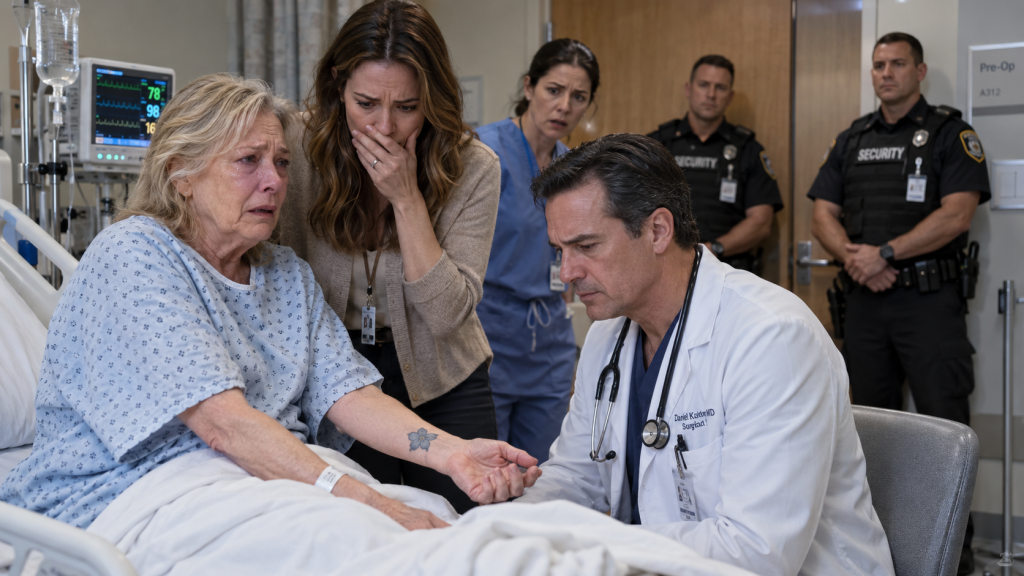
For my entire life, I believed the tiny blue flower tattooed on my mother’s wrist was nothing more than an old tattoo from her youth.

Then a hospital nurse noticed it—and immediately walked out to contact security.
Mom had carried that little blue flower for as long as I could remember.
It sat quietly on the inside of her wrist.
Small.
Faded.
Completely ordinary.
At least, that was what I had always assumed.
When I was young, I occasionally asked her about it.
“What does your flower mean?”
Her answer never changed.
“I got it when I was young.”
That was all she ever said.
No funny story about getting a tattoo with friends.
No explanation of why she chose a flower.
No memory she wanted to share.
Just those same few words.
Eventually, I stopped asking.
As I got older, the tattoo became such a normal part of Mom that I hardly noticed it.
Until last month.
Mom was scheduled to have a routine knee replacement, so I took the day off work and went to the hospital with her.
Nothing about that morning seemed unusual.
We checked in.
Completed the paperwork.
Answered the usual medical questions.
Spoke with several nurses.
Mom was nervous about the procedure, but that was understandable.
Everything seemed perfectly normal.
Then a nurse entered to prepare Mom’s IV.
She chatted casually with us while arranging the supplies.
Then she gently pushed up Mom’s sleeve.
And saw the flower.
Her entire demeanor changed.
Her hand stopped moving.
For several seconds, she simply stared at Mom’s wrist.
The reaction was subtle at first, but obvious enough that both of us noticed.
“Is something wrong?” I asked.
The nurse didn’t answer immediately.
Instead, she carefully pulled Mom’s sleeve back down over the tattoo.
Then she stood.
“Excuse me. I need to verify something.”
She left the room much faster than she had entered.
I looked at Mom.
“That was strange.”
Mom didn’t respond.
Her eyes remained fixed on the door.
And that was when I noticed something far more unsettling than the nurse’s reaction.
My mother looked terrified.
Not puzzled.
Not annoyed.
Terrified.
“Mom?”
“I’m fine.”
She clearly wasn’t.
About five minutes later, I heard several quiet voices outside.
Then two hospital security officers appeared in the hallway.
A doctor walked into the room behind them.
My stomach tightened.
He barely glanced at me.
He didn’t immediately reach for Mom’s medical chart either.
His attention went directly to her covered wrist.
“What’s going on?” I asked.
Nobody answered me.
The doctor stepped closer to Mom’s bed.
“Ma’am, would you mind showing me your wrist?”
Mom hesitated.
For the first time, I saw genuine fear cross her face.
Then, very slowly, she pulled back her sleeve.
The tiny blue flower appeared.
The doctor stared at it.
One second.
Two.
Three.
The room felt unnaturally quiet.
Finally, he asked:
“Where did you get this symbol?”
Mom’s face went completely pale.
She said nothing.
“Mom?”
Still nothing.
The doctor exchanged a glance with one of the security officers.
Then he looked back at her.
“Do you understand what this symbol represents?”
Mom’s fingers began trembling.
And suddenly, everything I had believed about that tattoo changed.
Maybe Mom hadn’t technically lied all those years when she said she got it while she was young.
But there was obviously an enormous part of the story she had never told me.
I stepped closer to her bed.
“Mom, what is going on?”
Her eyes filled with tears.
“What haven’t you told me?”
She looked at me.
Her lips parted.
For a moment, I thought I was finally going to hear the truth.
But before she could speak, the doctor turned toward the two security officers standing outside.
His expression had become completely serious.
Then he quietly said:
“Please close the door.”
One officer pulled it shut.
And as the click of the latch echoed through the room, I realized the tiny blue flower I had ignored my entire life wasn’t simply an old tattoo.
It was connected to something my mother had kept hidden for decades.
And whatever that secret was, someone at this hospital recognized it immediately.
PART 2 — THE GIRLS WITH THE BLUE FLOWERS
The security officer closed the door.
The click sounded louder than it should have.
My mother pulled her sleeve back over the tattoo as though covering it could somehow put the last thirty seconds back where they belonged.
It could not.
The doctor remained beside the bed.
The two security officers stayed near the door.
And I stood between them, looking at the woman who had raised me, wondering how a flower smaller than a quarter had managed to frighten an entire room.
“Someone needs to tell me what is happening.”
My voice came out sharper than I intended.
The doctor looked at Mom.
Not me.
That irritated me immediately.
“My name is Dr. Patel.”
he said.
“I’m one of the physicians covering preoperative medicine today.”
“I know who you are.”
I said.
“What I don’t know is why hospital security is standing outside my mother’s knee-replacement room because she has a tattoo.”
One of the officers shifted.
Dr. Patel remained calm.
“No one is accusing your mother of anything.”
“Then why are they here?”
He hesitated.
That frightened me more than an immediate answer would have.
Finally:
“Because the nurse who saw the tattoo believed it could indicate a history of coercion or trafficking.”
My mother shut her eyes.
The room went completely still.
I stared at him.
“Trafficking?”
Mom whispered:
“No.”
Dr. Patel looked at her.
“Ma’am?”
“It wasn’t trafficking.”
Her voice barely existed.
“It wasn’t called that then.”
Something moved through me.
Cold.
Slow.
I looked at her.
“Mom.”
She would not open her eyes.
“What does that mean?”
Dr. Patel raised one hand.
“I think we should slow down.”
“No.”
I turned toward him.
“I have spent my entire life looking at that flower.”
“My mother has spent my entire life refusing to explain it.”
“And now two security officers are standing at the door.”
“I am done slowing down.”
Mom’s eyes opened.
They were full of tears.
“Laura.”
My name sounded like an apology.
That terrified me.
The nurse who had first seen the tattoo was no longer in the room.
I asked where she had gone.
Dr. Patel said:
“She stepped away.”
“Why?”
Another hesitation.
Then:
“Because she had a personal reaction to what she saw.”
My mother went pale again.
“What kind of personal reaction?”
Dr. Patel looked toward the door.
Then at the officers.
“I think we may have handled the first few minutes more dramatically than necessary.”
That was not comforting.
One of the officers spoke for the first time.
“Ma’am, we’re here only to make sure everyone in the room is safe and that your privacy is protected until staff understand whether there’s any current concern.”
Current concern.
I latched onto those words.
“What current concern?”
The officer shook his head.
“We don’t know that there is one.”
Mom suddenly pulled at the blanket.
“I want to go home.”
Dr. Patel stepped closer.
“Mrs. Hale—”
“No.”
Her voice sharpened.
It was the strongest I had heard it all morning.
“I am not having surgery today.”
“Mom.”
“I said no.”
Then she looked at me.
“Get my clothes.”
The doctor nodded immediately.
“All right.”
That surprised me.
No argument.
No medical lecture.
No reminder about rescheduling.
“Your surgery can wait.”
he said.
Then, gently:
“But before you leave, I would like our social worker to speak with you.”
Mom’s face tightened.
“I don’t need a social worker.”
“Maybe not.”
Dr. Patel answered.
“But the nurse recognized something that clearly frightened both of you.”
“I would rather make sure we understand whether there is anything you need before you go.”
Mom laughed once.
Not happily.
“I needed something fifty-seven years ago.”
Nobody spoke.
My heart started pounding.
Fifty-seven years.
Mom was seventy-four.
Seventeen.
She had been seventeen.
I looked at the covered tattoo.
Then back at her face.
“Mom.”
She looked away.
“What happened when you were seventeen?”
Her lips trembled.
And for the first time in my life, my mother did not answer:
I got it when I was young.
Instead, she whispered:
“I was sent away.”
The security officers left after that.
Not because the situation had been solved.
Because Dr. Patel finally understood that whatever danger the tattoo represented belonged to the past.
At least physically.
A hospital social worker arrived ten minutes later.
Her name was Denise.
Late fifties.
Soft gray blouse.
No clipboard in her hands when she entered.
I noticed that.
She sat instead of standing over Mom.
“Mrs. Hale.”
Mom stared at the floor.
“Margaret is fine.”
“Margaret.”
Denise nodded.
“Nurse Morales recognized your tattoo.”
Mom flinched.
“Nurse Morales?”
“Yes.”
“The nurse who started your IV.”
“What did she say?”
Denise hesitated.
“She said the flower looked identical to a symbol she had seen connected to St. Brigid’s Home for Girls.”
My mother made a sound.
Not quite a gasp.
Not quite a sob.
But every part of her seemed to fold inward.
I had never heard of St. Brigid’s.
Apparently, I was the only person in the room who hadn’t.
I turned toward Denise.
“What was St. Brigid’s?”
Mom answered before she could.
“A place for bad girls.”
I looked at her.
Her voice had changed.
She sounded seventeen.
Denise said gently:
“That is what they called you?”
Mom gave a bitter little smile.
“That’s what everyone called us.”
Then she looked at me.
“Pregnant girls.”
The room disappeared.
Not literally.
But everything familiar fell out of place.
My mother had been pregnant at seventeen.
I had never known.
I was forty-six years old.
I thought I knew the major facts of the woman who raised me.
Her hometown.
Her first job.
How she met Dad.
The miscarriage she had before my brother.
The year she cared for Grandma after her stroke.
I knew which pie she overbaked every Thanksgiving.
I knew she hated birds flying indoors because one got trapped in her childhood kitchen.
But I had never known she had been pregnant at seventeen.
“Mom.”
She covered her face.
“I’m sorry.”
My anger arrived unexpectedly.
“For what?”
“For not telling you.”
“Why didn’t you?”
She started crying.
“I thought if I never said it out loud, maybe it belonged to another girl.”
That answer took the anger out of me.
Not all of it.
Enough.
St. Brigid’s Home for Girls had closed in 1981.
Denise knew more than I expected.
Not because every social worker studied obscure maternity homes.
Because six months earlier, the state had opened access to a set of sealed records recovered from a church archive.
Former residents.
Adoptions.
Birth records.
Deaths.
Transfers.
Some had been incomplete.
Some contradictory.
Some plainly altered.
A local paper had run stories.
Several hospitals had circulated information to social workers and nurses because elderly patients connected to St. Brigid’s had begun requesting medical records and trauma-informed care.
I stared.
“Why would hospital security be involved?”
Denise looked embarrassed.
“Nurse Morales saw your mother become frightened the moment the tattoo was exposed.”
“She initially thought there might be an active trafficking or coercion issue.”
“She followed a general safety protocol.”
“It was more than needed.”
“I’m sorry.”
Mom surprised me by saying:
“She did what she thought was right.”
I looked at her.
Of course she would defend the nurse.
She had been frightened out of her skin five minutes earlier and was already worried someone else might feel guilty.
That was Mom.
Then Denise said:
“The flower itself was not a mark given by St. Brigid’s.”
Mom looked at her sharply.
“No.”
Denise nodded.
“I know.”
I turned.
“What was it?”
My mother slowly pushed back her sleeve.
The faded blue flower appeared again.
Five uneven petals.
Tiny black dot at the center.
A stem barely visible now.
She touched it with one finger.
“We gave them to each other.”
My throat tightened.
“Who?”
“The girls.”
Mom told the story in pieces.
Not chronologically.
Trauma rarely has the manners to become a timeline on request.
She was born Margaret Evelyn Carter.
Everyone called her Evie.
That was the first secret.
I had never heard anyone call my mother Evie.
Her parents lived in a small town outside Springfield.
Her father sold farm equipment.
Her mother taught Sunday school.
Respectable family.
Strict church.
Neighbors who knew when your laundry stayed on the line too late.
At sixteen, Mom dated a boy named Paul Brennan.
High-school senior.
Football.
Choir.
The kind of boy grandparents approve of until something goes wrong.
Something went wrong.
Mom became pregnant.
She told her mother first.
Her mother slapped her.
Mom said that without drama.
Like reporting weather.
“What did Grandpa do?”
I asked.
“He didn’t look at me for three days.”
My chest hurt.
“Then?”
“They told people I was going to stay with an aunt.”
“There was no aunt.”
There was St. Brigid’s.
Two counties away.
Brick building.
Former convent.
Tall windows that opened only four inches.
Mom arrived at seventeen weeks pregnant.
Her parents signed forms.
She did too.
She did not read them.
“Did you know what you were signing?”
I asked.
“No.”
“Did anyone explain?”
“No.”
“What did they tell you?”
“That I would stay until I had the baby.”
“And then?”
She swallowed.
“Then I would come home and never discuss it again.”
There it was.
The family plan.
Erase the pregnancy.
Erase the child.
Restore the daughter.
As if bodies accepted editing.
There were thirty-one girls when Mom arrived.
Some fourteen.
Some nineteen.
Most unmarried.
A few had been assaulted.
One was married, but her husband had disappeared and her parents decided pregnancy without a husband visible was embarrassing enough.
The girls cleaned.
Cooked.
Did laundry.
Sewed linens for a commercial supplier.
They attended prayer twice a day.
Incoming letters were read.
Outgoing letters sometimes disappeared.
Phone calls were rare.
Birth fathers were discouraged from visiting.
Families were told distance helped the girls “detach.”
I felt sick.
“Were you prisoners?”
Mom shook her head.
“Not exactly.”
That mattered to her.
The doors were not locked all day.
No chains.
No guards.
Just no money.
No cars.
No one willing to take them home.
Shame can secure a building more effectively than steel.
“You could leave.”
Mom said.
“But where were you going to go?”
She looked at me.
“Your parents had brought you there.”
“The father of your baby was being told you didn’t want him.”
“You were seventeen.”
“So technically, yes.”
“We could leave.”
Her laugh was empty.
The flower began with a girl named June Keller.
Eighteen.
Red hair.
Pregnant with twins.
She had drawn forget-me-nots in the margins of everything.
Prayer sheets.
Napkins.
The inside of books.
One night, after one of the girls gave birth and came back from the hospital without her baby, June said:
“They can change the names on paper.”
“They can send babies anywhere.”
“But they don’t get to make us forget.”
Mom’s voice broke.
June took a sewing needle.
Blue fountain-pen ink.
Tapped five crude petals into the inside of her own wrist.
Not professional tattooing.
Barely a tattoo at all.
It became infected.
Of course.
Teenagers are terrible revolutionaries.
I almost laughed.
Mom did.
Then cried.
Other girls asked for one.
Not everyone.
Maybe fourteen over the years.
Mom got hers two weeks before giving birth.
“Why a forget-me-not?”
I asked.
She looked at the faded petals.
“Because we were afraid forgetting would be the only way people would call us healed.”
That sentence went through me.
Her baby was a girl.
Six pounds, three ounces.
Dark hair.
Born in January.
Mom held her for twenty-seven minutes.
Exactly.
She knew because she stared at the clock.
“What was her name?”
Mom’s face crumpled.
“I called her Grace.”
My throat closed.
“Was that her legal name?”
“I don’t know.”
The words barely came.
“The nurse asked if I had a name.”
“I said Grace.”
“Then Sister Helen told me not to make it harder.”
I covered my mouth.
Mom continued.
Grace was taken from the room.
Mom was told the adoptive family had been selected.
Good family.
Married.
Stable.
Could give the baby everything a seventeen-year-old could not.
“Did you consent?”
I asked.
Mom looked at Denise.
Then back at me.
“I signed.”
“That isn’t what I asked.”
Her eyes filled.
“No.”
There it was.
“I signed.”
“But I did not want to.”
I felt suddenly furious on behalf of a girl who had become my mother before I existed.
“Could you have refused?”
“Maybe.”
She swallowed.
“But they told me if I fought, my parents might not let me come home.”
“They said Paul had moved on.”
“They said unmarried mothers lost children in court all the time.”
“They said the adoptive parents had already prepared a nursery.”
Then:
“They told me wanting her was selfish.”
Mom started sobbing.
I reached for her.
This time she let me.
“What happened to Paul?”
I asked later.
“He came to St. Brigid’s once.”
My mother stared at the wall.
“I didn’t know until years later.”
“They told him I refused to see him.”
“Did you?”
“No.”
“He wrote?”
“Many letters.”
“I got three.”
My anger rose.
“Where did the others go?”
“I don’t know.”
“Did you ever see him again?”
“Yes.”
“When?”
“Twenty-six years later.”
That surprised me.
By then, Dad and Mom had been married more than two decades.
My brother and I were teenagers.
“What happened?”
“Nothing dramatic.”
Mom smiled sadly.
“He had a wife.”
“Two sons.”
“I had your father.”
“You and Michael.”
“We drank coffee.”
“He apologized for not fighting harder.”
“I apologized for believing he hadn’t tried.”
Then:
“We both understood there was no life waiting to be restarted.”
That was mature.
And devastating.
“Did Dad know?”
“Yes.”
Another shock.
“Dad knew about Paul?”
“He knew everything.”
I stared.
My father had died nine years earlier.
I suddenly resented him for taking Mom’s secret with him.
Then realized that was exactly what she had asked him to do.
“Why didn’t you tell us?”
Mom looked down.
“Because your father thought the story belonged to me.”
That softened something.
Then:
“And because I kept saying I would tell you when I was ready.”
I almost laughed through tears.
“How many years were you planning to use for readiness?”
“Apparently more than I had.”
Fair.
Denise quietly left to give us privacy.
Dr. Patel postponed the surgery.
Nobody argued.
A knee could wait.
A fifty-seven-year-old secret had apparently decided it was done waiting.
Mom and I remained in that little hospital room for nearly two hours.
Then I asked the question I had been avoiding.
“Did you ever look for Grace?”
Mom went still.
“Yes.”
My heart started pounding.
“When?”
“First time?”
“Yes.”
“The day I turned eighteen.”
Of course.
She wrote St. Brigid’s.
No answer.
Again at twenty-one.
Again at twenty-five.
She contacted the county.
Church.
State adoption office.
Every reply said records were sealed.
Or unavailable.
Or private.
Then, when laws changed, she tried again.
Nothing.
St. Brigid’s records had gaps.
Her own file said:
Infant female transferred.
Transferred where?
Blank.
Adoptive surname?
Blank.
Case number?
Partially illegible.
Mom hired a searcher when she was fifty-nine.
Found nothing conclusive.
Then commercial DNA testing became common.
“Did you do one?”
I asked.
“No.”
“Why?”
She looked ashamed.
“I bought three kits.”
I blinked.
“Three?”
“One ten years ago.”
“One six years ago.”
“One after your father died.”
“What happened?”
“I put them in the closet.”
I stared.
“Mom.”
“I know.”
“Why?”
Her voice cracked.
“Because searching is safe while the answer is still imaginary.”
That stopped me.
“If I tested, she could be dead.”
“Or she could hate me.”
“Or she could have spent her entire life thinking I gave her away easily.”
“Or…”
Mom swallowed.
“She could be happy.”
I frowned.
“Why would that scare you?”
“Because then I would have to decide whether finding her was for her or for me.”
That was the first moment I understood that fear can wear the clothing of consideration.
Not malicious.
Still fear.
I looked at the tattoo again.
“Did all the girls have the exact same flower?”
“Close.”
“Same location?”
“Mostly inside the wrist.”
“Why did Nurse Morales recognize it?”
Mom’s face changed.
“That is what I want to know.”
So did I.
We called Denise back.
She returned with Dr. Patel.
No security this time.
Good.
I asked:
“What exactly did Nurse Morales recognize?”
Denise took a breath.
“She asked us not to share personal information about her family without permission.”
“Fair.”
I said.
“But she also asked whether your mother would be willing to speak with her.”
Mom stiffened.
“Why?”
Denise looked at her.
“Because Nurse Morales’s mother was adopted through St. Brigid’s.”
The air disappeared.
My mother’s fingers went rigid around the blanket.
“What?”
Denise continued.
“Her mother opened her adoption records several years ago.”
“Some records were incomplete.”
“But there was a description of the birth mother.”
My heart started pounding.
“What description?”
Denise looked toward the door.
Then back at Mom.
“Seventeen years old.”
“Brown hair.”
“Approximately five foot four.”
“From Sangamon County.”
Mom stopped breathing.
So did I.
Then:
“And a small blue flower tattooed on the inside of her left wrist.”
My mother made a sound I had never heard before.
Not grief.
Not fear.
Recognition colliding with impossibility.
I grabbed her hand.
“Mom.”
She was staring at the door.
“Nurse Morales…”
I said slowly.
“How old is she?”
Denise answered:
“Fifty-six.”
I did the math.
Mom had given birth fifty-seven years earlier.
Close.
Very close.
Not proof.
Not even enough to make assumptions.
But the room had already changed.
Mom whispered:
“No.”
Not denial.
Protection.
“Mom?”
“There were other girls.”
“Yes.”
“Other flowers.”
“Yes.”
“It could be anyone.”
“Yes.”
I squeezed her hand.
“You’re right.”
We would not turn coincidence into a daughter.
Not yet.
Then Denise said:
“There is one more thing.”
Of course.
“What?”
“Nurse Morales brought something from her locker.”
My pulse jumped.
“She keeps it with her?”
“Apparently she has for years.”
Mom’s face drained of color.
“What is it?”
Denise did not answer.
She stepped toward the door.
Opened it.
And the nurse entered.
Her name tag read:
JENNA MORALES, RN.
I had seen it that morning.
Had not cared enough to remember.
Now every letter looked important.
Jenna stood just inside the room.
Without the IV tray, she looked older.
Early fifties.
Maybe mid.
Her eyes were red.
She had been crying.
Mom stared at her.
Jenna stared back.
Nobody moved.
Then Jenna said:
“I’m sorry I scared you earlier.”
Mom shook her head.
“You didn’t.”
She had.
That no longer mattered.
Jenna held a clear plastic sleeve.
Inside was a photocopied page.
Old.
Typed.
Faded.
She did not come closer yet.
“My mother died four years ago.”
she said.
Mom’s face fell.
I felt my own hope collapse before I had even given myself permission to have it.
Jenna continued.
“She was adopted as an infant.”
“She spent most of her life refusing to search.”
Then, when she was sixty-five, she changed her mind.
Mom stared.
“Why?”
Jenna smiled through tears.
“Her granddaughter was born.”
Something about that broke Mom.
Jenna continued.
“We petitioned for records.”
“We got pieces.”
“Not everything.”
“One intake card described her birth mother.”
She looked at Mom’s wrist.
“The flower was on it.”
Mom’s mouth trembled.
“What was your mother’s name?”
Jenna answered:
“Judith.”
Mom closed her eyes.
“I named her Grace.”
“I know.”
Silence.
Then Jenna took one step closer.
“How?”
Mom asked.
Jenna looked down at the plastic sleeve.
“There was a handwritten note on the back of the hospital transfer card.”
Her voice shook.
“It said…”
She swallowed.
Then read:
Birth mother referred to infant as Grace. Do not use. Adoptive placement name pending.
My mother sobbed.
Not cried.
Sobs tore out of her.
I caught her shoulders because for one second I thought she might fall out of the bed.
Jenna cried too.
Dr. Patel looked away.
Denise covered her mouth.
I stood in the center of a hospital room watching fifty-seven years collapse into one handwritten sentence.
Birth mother referred to infant as Grace.
Not proof by itself.
But no longer coincidence.
Jenna did not call Mom her grandmother.
Not then.
That mattered.
She remained a nurse who had discovered something extraordinary during an ordinary shift.
She said:
“We would need records.”
“And probably DNA if you wanted certainty.”
Mom nodded frantically.
“Yes.”
Then froze.
“What?”
Jenna’s voice softened.
“My mother left a DNA sample through one of the genealogy services before she died.”
Mom covered her mouth.
“She did?”
“Yes.”
“She wanted us to keep looking if she didn’t live long enough.”
My throat tightened.
The woman Mom had spent fifty-seven years afraid to search for had apparently spent her final years searching too.
They had moved toward each other from opposite sides of the same sealed record.
And missed by four years.
That felt unbearably unfair.
Then Jenna said:
“She found something before she died.”
Mom stared.
“What?”
“A name.”
My pulse jumped.
“What name?”
Jenna looked at the old page.
“Margaret Evelyn Carter.”
Mom stopped breathing.
That was her original name.
The one she had told me less than two hours earlier.
Jenna continued.
“She couldn’t locate you.”
“The records said you returned to your parents.”
“Then the trail disappeared after your marriage.”
“My mother tried.”
Her voice broke.
“She really tried.”
Mom began crying again.
“So did I.”
she whispered.
Jenna nodded.
“I know that now.”
Then Jenna did something that made the whole room change.
She reached into the plastic sleeve.
Pulled out a photograph.
Not old enough to be St. Brigid’s.
Maybe thirty years old.
A woman standing beside a Christmas tree.
Dark hair.
Round face.
Smile.
I stared.
My mother stared.
Then Mom reached toward the picture without touching it.
“Is that her?”
“Yes.”
Jenna handed it to her.
Mom held the photograph with both hands.
Her daughter.
Not baby Grace.
Judith.
A grown woman.
A life.
Mom traced the edge of the picture.
“She looks like my mother.”
I looked.
She did.
Grandma’s chin.
Mom’s eyes.
My hands began shaking.
This woman might have been my older sister.
No.
Not might.
If the records and later testing confirmed what the room already seemed to know—
she was my sister.
And she had died without meeting either of us.
I felt grief for someone I had never known.
That seemed ridiculous.
Still real.
Jenna wiped her face.
“There’s something else.”
Mom looked up.
I almost laughed from exhaustion.
Apparently there would always be something else.
“What?”
Jenna glanced at me.
Then at Mom.
“My mother left a letter.”
Mom’s entire body went still.
“To whom?”
“She didn’t have a name.”
Jenna answered.
“It’s addressed to ‘My Birth Mother, if my children ever find her.’”
No one moved.
“Do you have it?”
Mom whispered.
“Yes.”
Jenna reached into her pocket.
Not the plastic sleeve.
Her pocket.
A small folded envelope.
Worn at the edges.
Carried.
For years, apparently.
She held it but did not hand it over.
“Before you read it, there is something you need to know.”
My stomach tightened.
“What?”
Jenna looked directly at my mother.
“My mother did not believe she had simply been adopted.”
Mom’s face changed.
“What does that mean?”
Jenna swallowed.
“She found inconsistencies in her records.”
“What kind?”
“The consent date on one document was three days after you had already been discharged from St. Brigid’s.”
I froze.
Mom stared.
Jenna continued.
“One signature uses the name Margaret Carter.”
“Another uses Evelyn Carter.”
“A third is marked with an X.”
Mom whispered:
“I can write.”
“I know.”
Jenna’s eyes filled.
“My mother knew too.”
My heart started pounding.
This was no longer only about a coerced adoption.
Something in the paperwork itself was wrong.
Then Jenna said:
“She spent the last two years of her life trying to prove St. Brigid’s had transferred some babies without valid consent.”
Denise closed her eyes.
Dr. Patel looked at the floor.
Mom stared at the photograph in her hands.
Jenna continued:
“She believed she was one of them.”
Silence.
Then:
“And she believed there were others.”
Mom looked at the blue flower on her wrist.
“The girls.”
she whispered.
Jenna nodded.
“That symbol is why I recognized you.”
“Not because St. Brigid’s marked you.”
“Because my mother found a photograph in an archive.”
My pulse jumped.
“What photograph?”
Jenna reached into the sleeve one final time.
A black-and-white picture.
Fourteen pregnant girls standing beside a brick building.
Some looking at the camera.
Some away.
One girl near the back had her arms folded.
Her left wrist exposed.
Even in black and white, I could see the tiny dark flower.
My mother.
Seventeen.
Pregnant.
Beautiful.
Terrified.
I knew her face immediately.
Mom stared.
“Oh my God.”
Then her finger moved toward another girl beside her.
Red hair.
Sharp face.
June, perhaps.
Then another.
And another.
Several wrists showed the same tiny flower.
Jenna whispered:
“My mother spent years trying to identify every woman in this photograph.”
Mom looked up.
“Why?”
Jenna answered:
“Because she believed one of them had kept the original list.”
“What list?”
Jenna’s voice dropped.
“The list of babies St. Brigid’s sent out under changed records.”
Everything inside me went cold.
Mom stared at her.
“No.”
Jenna nodded slowly.
“My mother thought the flower girls made a copy before the home closed.”
Mom’s face drained.
Then something else crossed it.
Not fear.
Recognition.
I saw it.
Jenna saw it too.
“Margaret?”
Mom looked at the door.
Then at me.
Then down at the photograph.
“Mom.”
I whispered.
“What?”
She began trembling again.
“I thought it was gone.”
“What was gone?”
She looked at me.
And suddenly the hospital, the nurse, the security officers, Grace, St. Brigid’s—all of it seemed to narrow into the next sentence.
Mom whispered:
“The list.”
Jenna stopped breathing.
I stared.
“What are you saying?”
Mom closed her eyes.
Then:
“June gave it to me the night before I left.”
The room went silent.
“Where is it?”
I asked.
Mom opened her eyes.
Tears filled them.
“I hid it.”
“Where?”
Her voice broke.
“In your grandmother’s house.”
I stared.
Grandma’s house had been sold twenty-eight years ago.
Mom continued before I could speak.
“I never went back for it.”
Jenna looked devastated.
“Why?”
Mom covered her mouth.
“Because two weeks after I came home, June Keller disappeared.”
Every person in the room went still.
“What do you mean disappeared?”
I asked.
Mom whispered:
“Her mother said St. Brigid’s told them she ran away.”
“Did you believe that?”
“No.”
“Why not?”
Mom looked at the photograph of the fourteen girls.
Then at the tiny flower on her wrist.
And finally said:
“Because June had written me one last letter.”
“What did it say?”
Mom’s face went white.
Only six words.
They know we copied the names.
PART 3 — THE NAMES THEY REFUSED TO LET DISAPPEAR
My mother did not remember exactly where she had hidden the list.
That was the first problem.
The second was that Grandma’s house had belonged to three different families since she died.
The third was that whatever had been hidden there had been waiting fifty-seven years for someone to care enough to look.
Mom sat in the hospital bed with Judith’s photograph in one hand and the black-and-white picture of the St. Brigid’s girls in the other.
Nurse Jenna remained beside her.
Nobody talked about knee surgery anymore.
At some point, Dr. Patel quietly left.
Then Denise.
The hospital room became what it had accidentally turned into from the beginning.
Not a medical room.
A room where one family was being told it had always been larger than anyone knew.
“Where in Grandma’s house?”
I asked.
Mom closed her eyes.
“The attic.”
My heart sank.
Grandma’s attic had been enormous.
Low roof.
Insulation.
Cardboard boxes.
A hundred places where paper could have disappeared.
“Where in the attic?”
“I don’t know.”
“Mom.”
“I was seventeen.”
Her voice cracked.
“I had just come home without my baby.”
“I was bleeding.”
“My mother kept telling me to stop crying because neighbors might notice.”
She looked at me.
“I hid it somewhere I thought my father would never look.”
That narrowed almost nothing.
Then Mom frowned.
“There was an old vent cover.”
My pulse jumped.
“What vent?”
“Not connected to anything.”
“In the back wall.”
“My father had removed a coal furnace years earlier.”
“He never patched one of the old openings properly.”
I stared.
“You put it inside?”
“A tobacco tin.”
Of course.
Every old secret apparently requires metal.
“I wrapped the papers in wax paper.”
Then:
“And June’s letter.”
Jenna inhaled sharply.
“You still had the letter?”
Mom nodded.
“At least then.”
We did not go to Grandma’s house that afternoon.
That would have made a better story.
A dramatic drive from the hospital.
Old house.
Loose board.
Metal tin.
Truth waiting exactly where a frightened girl left it.
Real life gave us paperwork first.
The current owners had to be found.
Contacted.
Asked.
Nobody was breaking into a stranger’s attic because my mother suddenly remembered a tobacco tin from 1968.
I called the county property office.
Then the realtor who had handled Grandma’s old street for years.
Then, finally, the current owners.
Their names were Daniel and Beth Morgan.
They had lived there eleven years.
I expected suspicion.
Instead, Beth went quiet when I explained.
Then said:
“We found an old metal vent cover behind paneling in the attic when we renovated.”
My heart stopped.
“When?”
“Five years ago.”
“Was there anything behind it?”
A pause.
“I don’t remember.”
Then she called to someone in the background.
“Dan?”
Muffled conversation.
My mother gripped my hand.
Jenna stood frozen.
Then Beth returned.
“My husband says there was a tobacco tin.”
Nobody breathed.
“What happened to it?”
“I don’t know.”
My mother made a sound.
Beth continued quickly:
“Wait.”
More conversation.
Footsteps.
Then:
“He thinks he put it in the garage with old-house stuff because the tin was unusual.”
I closed my eyes.
Five years.
A garage.
Heat.
Cold.
Rodents.
Water.
Everything that destroys paper.
Still—
maybe.
Beth said:
“Can you come tomorrow?”
Mom answered before I could.
“Yes.”
Her knee replacement had vanished from the universe.
That night, Mom came home with me.
I did not want her alone.
She did not argue.
Jenna gave us her phone number before we left the hospital.
Not as a nurse.
As Judith’s daughter.
That distinction mattered.
Before we separated, Mom looked at her for a long time.
Then said:
“May I ask something?”
Jenna nodded.
“What was she like?”
My heart cracked.
Not:
Did she hate me?
Not:
Did she search?
What was she like?
Jenna smiled through tears.
“She laughed too loudly.”
Mom’s mouth trembled.
“She hated olives.”
“She loved mystery novels.”
“She could not keep a houseplant alive to save her life.”
I laughed.
Mom did too.
Then Jenna said:
“She was a good mother.”
Mom closed her eyes.
Relief moved across her face so visibly that I almost cried again.
“That matters.”
she whispered.
“Yes.”
Then Jenna added:
“She was angry sometimes.”
Mom’s eyes opened.
“At you?”
“At the adoption.”
“At the missing records.”
“At whoever made decisions for both of you.”
Mom nodded.
“She had every right.”
Jenna looked at her.
“She never said she hated you.”
Mom started crying.
That was the first gift Jenna gave her.
Not proof.
Permission to imagine her daughter’s anger without turning it into rejection.
At my house, Mom did something I had never seen her do.
She rolled up her sleeve and left it that way.
The flower remained visible.
All evening.
No tugging fabric down.
No turning her wrist inward.
Just five faded blue petals resting on the skin she had hidden in plain sight for my entire life.
I looked at it differently now.
Not as decoration.
Not even as a symbol.
As a sentence.
I remember.
That was what June had meant.
Maybe all of them.
I remember you.
I remember me.
I remember what they called us.
I remember what they took.
Mom slept badly.
So did I.
At two in the morning, I found her sitting at the kitchen table.
Judith’s photograph in front of her.
“Couldn’t sleep?”
She laughed softly.
“I’m seventy-four.”
“That is not an answer.”
“It usually is.”
I sat.
For a while, neither of us spoke.
Then she said:
“I don’t know how to grieve her.”
My throat tightened.
“Judith?”
She nodded.
“She was my daughter for twenty-seven minutes.”
“Then she was somebody else’s daughter for fifty-six years.”
“What am I supposed to do with that?”
I had no answer.
So I said:
“I don’t know.”
Mom looked relieved.
Maybe because no one was pretending there was a correct grief.
Then she whispered:
“I keep thinking about all the birthdays.”
I reached for her hand.
“Don’t.”
She looked at me.
“Why?”
“Because you’ll turn arithmetic into punishment.”
Her eyes filled.
I continued.
“You can count fifty-seven birthdays and make yourself suffer fifty-seven separate times.”
“It won’t give you one of them back.”
Mom nodded slowly.
Then:
“Your father used to say something like that.”
“What?”
“Don’t use facts as weapons against yourself.”
That sounded like Dad.
I missed him suddenly.
He had known this secret.
Loved Mom around it.
Never told me.
I was still angry with him too.
But softer.
Maybe privacy and secrecy are cousins, not twins.
He had been keeping a promise that belonged to her.
That was different.
The next morning, we drove to Grandma’s old house.
Jenna came too.
I worried that was too much.
Mom insisted.
“I don’t want to open it alone.”
So we went.
Beth Morgan met us at the door.
She was younger than me.
Maybe late thirties.
Kind face.
Nervous.
She had made coffee.
Of course.
People make coffee when history enters their house.
Her husband, Daniel, led us through the garage.
Old paint cans.
Garden tools.
Boxes labeled:
HOUSE ORIGINALS.
My pulse rose.
He pulled one down.
Inside:
Old hinges.
Glass doorknobs.
A rusted mailbox plate.
Then a rectangular tobacco tin.
Red once.
Now mostly brown.
Mom stopped walking.
“That’s it.”
Her voice had no doubt.
I looked at her.
Seventeen appeared behind her face.
For one second, I understood how memory can make time irrelevant.
Daniel handed it to her.
The lid resisted.
Of course.
Fifty-seven years of rust.
He offered a screwdriver.
Mom shook her head.
“Laura.”
So I did it.
Carefully.
The lid popped.
Nobody breathed.
Inside was wax paper.
Brown.
Brittle.
Still folded.
My hands shook.
Underneath was a smaller envelope.
And a little blue fountain-pen cartridge, dried to dust.
June.
Maybe.
Mom covered her mouth.
“I forgot that.”
“What?”
“The ink.”
She laughed through tears.
“June stole it from Sister Helen’s desk.”
Even terror had details.
We did not unfold everything in the garage.
Too fragile.
We called Denise.
She connected us with an archivist from the state records project.
By afternoon, the tin was being handled properly.
Gloves.
Humidity control.
Photographs before unfolding.
Everything that should have happened to those records decades earlier.
It felt almost ceremonial.
Not dramatic.
Careful.
Care itself had become the ceremony.
The list was four pages.
Carbon copies.
Typed names.
Handwritten notes.
Twenty-three infants.
Dates.
Birth mothers.
Hospital transfer numbers.
Destination agencies.
Some adoptive surnames.
Some blank.
Some crossed out.
Some replaced.
My mother’s entry was there.
Carter, Margaret Evelyn — infant female — 1/14 — Grace (mother’s name) — transferred 1/16.
Then another handwritten line:
To B-17 / Judith Ann.
Jenna cried when she saw it.
B-17 corresponded to an agency intake code in Judith’s adoption records.
It was the first direct documentary bridge between Mom and Judith.
Not DNA yet.
But close.
Enough that all of us had to sit down.
June’s letter was only one page.
The paper had survived better than anyone expected.
Her handwriting slanted hard to the right.
Evie,
Mom made a sound when the archivist read that.
Evie.
Her lost name.
The letter continued.
They know we copied the names. Sister Helen searched my room. She asked who else has them. I said nobody. That was a lie. Good.
Despite everything, I laughed.
Mom did too.
June had been funny.
Even frightened.
Then:
If they send me somewhere else, do not bring the list back here. Keep it until you are old enough that nobody can tell you what to do.
My throat tightened.
Mom whispered:
“I wasn’t old enough for a long time.”
The archivist continued.
If I disappear, it does not mean I forgot.
There it was.
The flower.
The promise.
Find the babies if you can. If you cannot, at least remember we wanted them.
Mom sobbed.
Jenna covered her face.
Then the last line:
They keep saying forgetting is mercy. I think that is because remembering would make them answer questions.
June Keller.
Eighteen years old.
Pregnant with twins.
More wisdom in one page than most institutions manage in a century.
The question became:
What happened to June?
The recovered records helped.
Not completely.
Her St. Brigid’s file said she “left placement without authorization.”
Three days after the letter.
No forwarding address.
No transfer record.
No police report.
Nothing.
For decades, Mom had believed disappear meant the worst.
Maybe St. Brigid’s had harmed her.
Maybe Raymond-style violence.
Maybe some secret removal.
The archive team searched.
Newspapers.
City directories.
Marriage records.
Birth records.
Social Security records.
Slowly, a different story emerged.
June Keller had not vanished.
Not permanently.
A woman matching her full name and birth date married a man named Robert Hayes in Michigan fourteen months later.
Then moved to Oregon.
Had two later children.
Died in 2009.
Sixty years old.
No evidence she had been murdered.
No evidence St. Brigid’s had secretly imprisoned her.
Nothing cinematic.
She had run.
Actually run.
And apparently survived.
Mom sat with that news for a long time.
Then started laughing.
“What?”
I asked.
“She did it.”
“Did what?”
“She got out.”
Tears ran down her face.
“She actually got out.”
The girl everyone said disappeared had made a life.
Not necessarily easy.
Not necessarily healed.
But hers.
Mom’s relief was enormous.
It almost made her look young.
June’s twins were harder.
Her St. Brigid’s records listed:
male infant / female infant.
Both transferred separately.
That horrified Mom.
“She had twins.”
“Yes.”
“They split them?”
The archivist nodded sadly.
“Apparently.”
For several months, that became one of the state project’s active searches.
And because the list existed now, not just incomplete institutional files, there were clues nobody had been able to connect before.
One twin had gone to Wisconsin.
One to Indiana.
Different names.
Different families.
No knowledge of each other.
By the time researchers found likely identities, both were in their late fifties.
Alive.
They agreed to testing.
They were siblings.
Twins.
Separated at birth.
They met in an airport between states because neither wanted the first meeting in someone’s home.
Mom saw a photograph later.
Two people.
Same nose.
Same chin.
Holding each other.
She touched June’s name on the photocopied list.
“She would have liked that.”
I think so too.
DNA confirmed what the paper already strongly suggested.
Jenna was Mom’s biological granddaughter.
Judith had been Grace.
My half-sister.
That language felt strange.
Half.
As though fractions had anything useful to say about loss.
Jenna and Mom got the results in the same hospital cafeteria where this had begun.
Not the same room.
Same building.
Mom read the report.
Then looked at Jenna.
Neither spoke.
Jenna finally said:
“So.”
Mom laughed through tears.
“So.”
Then:
“May I hug you?”
Jenna nodded.
They held each other.
Not as substitutes.
Not as if Judith had been returned.
Jenna was not Grace.
Mom did not ask her to become that.
That mattered.
She was Jenna.
A granddaughter Mom had never known existed.
A woman with her own mother to grieve.
Her own questions.
Her own anger.
Her own life.
They began there.
Exactly there.
Judith’s letter remained unopened until after the DNA result.
Jenna said she wanted certainty first.
Mom agreed.
Then one Sunday, we sat at my dining table.
Mom.
Jenna.
Me.
A letter addressed to:
My Birth Mother, if my children ever find her.
Mom held it but could not open it.
So Jenna did.
Then handed it back.
Mom read aloud.
Her voice shook.
I do not know your name.
She stopped.
Covered her mouth.
Then continued.
For most of my life, I told people I did not care. That was easier than explaining that I cared too much.
Mom cried silently.
I had good parents. I want you to know that first. They loved me. Whatever happened between you and me did not leave me unloved.
Mom closed her eyes.
I saw fifty-seven years of one particular fear loosen.
Her daughter had been loved.
Not enough to erase separation.
Enough to matter.
Then:
I have been angry at you sometimes. That is also true. I did not know whether you chose adoption freely. When I was younger, I assumed you did. Later, the records made me doubt that.
Mom whispered:
“You were right.”
The letter could not hear her.
Still, she said it.
If you were forced, I am sorry nobody protected you.
Mom bent forward and sobbed.
Jenna put a hand on her shoulder.
I put mine on the other.
Three generations connected around a woman who was missing from the table.
That is family sometimes.
People and absences arranged together.
Judith’s letter continued.
If you are alive and my children find you, please do not think you owe me an apology for surviving.
Mom had to stop.
She could not speak.
So I finished.
I hope you had a life.
My own voice broke.
I hope you married someone kind if you wanted marriage. I hope you had more children if you wanted children. I hope someone made you laugh. I hope there were mornings when you did not think about me.
Mom shook her head.
“I did think about you.”
Then smiled through tears.
“But not every morning.”
Good.
She could admit that now.
The letter ended:
If we never meet, then I want one thing.
Please know I existed beyond being taken from you.
I became a teacher. I had two children. I hated olives. I loved mysteries. I laughed too loudly.
Jenna smiled.
Mom did too.
Then:
My name was Judith Ann Morales.
I had a life.
At the bottom:
And if you ever wondered whether I would have wanted to know you—the answer is yes.
Mom pressed the letter against her chest.
No sound came out.
There are griefs too large even for crying.
The blue-flower list eventually became evidence in a broader historical review.
Not a criminal trial fifty-seven years too late.
Most administrators were dead.
Some institutions dissolved.
Records incomplete.
Statutes complicated.
Memory imperfect.
No dramatic handcuffs.
No secret order exposed on national television.
Something more useful happened.
The state formally acknowledged that coercive maternity practices had occurred.
Records were opened further.
Adoptees received help tracing original files.
Former residents could submit testimony without having to prove every memory against paperwork created by the same institution that controlled them.
Several corrected birth histories were issued.
Some people found relatives.
Some found graves.
Some found nothing.
That mattered too.
A list can open a door.
It cannot guarantee someone is standing behind it.
Mom became one of the women who spoke publicly.
That shocked me.
The woman who spent fifty-seven years hiding five blue petals under her sleeve stood at a state hearing with cameras pointed at her.
She wore short sleeves.
On purpose.
The flower fully visible.
Her hands shook at the microphone.
Then steadied.
She said:
“My name is Margaret Evelyn Hale.”
Pause.
Then:
“When I was seventeen, my name was Margaret Evelyn Carter, and I was sent to St. Brigid’s because I was pregnant.”
The room went still.
She continued.
“I was told forgetting would allow me to have a normal life.”
Then she looked at the committee.
“I did have a life.”
“A good one in many ways.”
“I married.”
“I had children.”
“I worked.”
“I laughed.”
“I paid taxes.”
“I complained about my knees.”
People smiled.
Then:
“But a life can be good and still contain something wrong that was never made right.”
That sentence traveled farther than anything else she said.
Newspapers quoted it.
People wrote to her.
Former St. Brigid’s girls found one another.
Not all.
Enough.
One of them was named Helen Marrow.
She had the same flower.
Faded almost invisible.
She called Mom after seeing the hearing.
They had lived at St. Brigid’s during overlapping months.
Mom did not remember her immediately.
Helen remembered June.
They talked for three hours.
Then met.
Then cried.
Then argued about whether the dining room curtains had been green or yellow.
I watched two elderly women debate institutional décor and realized something profound.
Trauma had not consumed every memory.
They remembered jokes.
Food.
Who snored.
Who stole sugar.
Which nun secretly gave extra blankets.
Who sang badly during chapel.
The girls had been more than what was done to them.
That mattered enormously.
The tattoo became less frightening after that.
Not ordinary.
Never ordinary again.
But no longer dangerous.
When nurses saw it later, most saw only a flower.
One younger nurse asked:
“Cute tattoo. When did you get it?”
Mom smiled.
“I got it when I was young.”
I nearly laughed.
Same answer.
But this time, after a second, she added:
“It has a story.”
That was the difference.
Not that she owed everyone the story.
That it was no longer unspeakable.
She eventually had the knee replacement.
Six months late.
Nurse Jenna arranged her schedule so she could be there.
Not as assigned staff.
As family.
Before surgery, Mom held out her wrist.
“Still makes you nervous?”
Jenna smiled.
“No.”
Then touched the flower gently.
“Not anymore.”
Mom said:
“Good.”
The operation went fine.
Recovery hurt.
Mom complained constantly.
That reassured all of us.
Jenna brought her children to meet Mom.
Judith’s grandchildren.
Mom’s great-grandchildren.
Two adults by then.
Elena and Marcus.
The first meeting was awkward.
Everyone tried too hard.
Too many questions.
Too much eye contact.
Then Marcus noticed Mom’s old recipe box.
“What’s that?”
“Recipes.”
“Anything good?”
“No.”
Mom said.
“My cooking is mediocre.”
Jenna laughed.
“Elena burns toast.”
“That’s hereditary then.”
Everyone relaxed.
Family began not with a revelation.
With bad cooking.
I liked that.
I struggled more than I expected.
That embarrassed me.
Mom had found a daughter she had lost.
A granddaughter.
Great-grandchildren.
I should have been only happy.
Instead, I felt displaced sometimes.
Not replaced.
I knew better.
Still.
For forty-six years, I thought I understood where I belonged in Mom’s history.
Then a whole branch appeared before me.
Judith older than me by eleven years.
Jenna almost my age.
People carrying genetic resemblance I had not known was missing.
I felt childish.
Then guilty for feeling childish.
Eventually I told Mom.
“I’m jealous.”
She stared.
Then laughed.
“Of a dead woman?”
“Partly.”
“That seems inefficient.”
I laughed despite myself.
Then cried.
“I thought I was your first daughter.”
Mom’s face changed.
She reached for me.
“Oh, Laura.”
“I know it’s stupid.”
“No.”
She took my hands.
“You were the first daughter I got to raise.”
That sentence helped.
Not better.
Different.
Then:
“Grace was not erased when you were born.”
“You were not diminished when I found her.”
Both.
Always both.
I was learning that family history expands more painfully than a family tree makes it look.
I also became angry at Grandma.
Dead thirty years.
Very convenient.
I wanted to ask how she could have slapped her pregnant daughter.
How she could send her away.
Why she never spoke Grace’s name.
Why she kept the attic vent hidden.
Then Mom told me something I had not expected.
“Your grandmother apologized.”
“When?”
“Before she died.”
I stared.
“You never told me.”
“I didn’t think it mattered to you.”
Everything mattered now.
“What did she say?”
Mom thought.
“She said, ‘We thought shame was something we could save you from by hiding what caused it.’”
My throat tightened.
Then:
“She said she had been wrong.”
“Did you forgive her?”
Mom looked out the window.
“Some days.”
That was honest.
“Other days?”
“I loved her and remained angry.”
There it was again.
The family skill nobody had taught us early enough.
Two truths.
One person.
The state eventually located records suggesting Sister Helen—the woman Mom remembered from St. Brigid’s—had quietly helped preserve some transfer documents before the home closed.
That surprised everyone.
Mom most.
“She was awful.”
Maybe.
People can participate in harmful systems and still perform individual acts of conscience.
A box in a diocesan archive contained copies of several birth-transfer logs.
Not the whole list.
Enough to confirm June and the girls had not imagined the record alterations.
Enough to show some consent forms were signed after separation.
Some by parents.
Some by administrators.
Some suspiciously inconsistent.
History became more complicated.
Again.
No single villain.
A system.
Social shame.
Church authority.
Family pressure.
Weak legal protections.
Adults telling girls that surrender was morality.
That was harder to hate cleanly.
Perhaps more important to understand.
Mom refused to let St. Brigid’s become her whole identity.
After the hearing invitations increased, she started saying no.
One nonprofit wanted her to speak at three events.
“No.”
A documentary producer wanted six hours of interviews.
“No.”
A university wanted her archive.
“Maybe later.”
I smiled.
For decades, adults had decided what happened to her story.
Now everyone needed permission.
That mattered.
When someone asked why she refused one interview, Mom said:
“I spent fifty-seven years having this story control when I could speak.”
“I’m not giving it control over my calendar now.”
That was my mother.
Back.
Or perhaps newly visible.
Jenna once asked if Mom wanted to visit Judith’s grave.
Mom said no.
Then changed her mind a year later.
No pressure.
We drove together.
Judith was buried beside her adoptive husband.
The marker read:
JUDITH ANN MORALES
BELOVED WIFE, MOTHER, TEACHER
Mom stood there for a long time.
No dramatic collapse.
She touched the stone.
Then said:
“Hello, Grace.”
Jenna cried.
I did too.
Mom continued:
“I know that isn’t the name you lived with.”
Then:
“Hello, Judith.”
That mattered.
She did not reclaim her daughter by erasing the woman Judith had become.
She honored both names.
Grace.
Judith.
The baby she lost.
The woman who lived.
Then Mom whispered:
“I’m sorry I was late.”
Jenna said:
“She knew you were trying.”
Mom looked at her.
“Do you believe that?”
“Yes.”
Mom nodded.
That was enough.
Before we left, Mom placed nothing on the grave.
No flowers.
No blue symbol.
Just her hand.
Then withdrew it.
Some love does not need objects.
Years passed.
The girls with the blue flowers became fewer.
Age.
Time.
Obituaries.
Mom and Helen stayed friends until Helen died.
Another former resident named Patricia sent Christmas cards.
One woman wanted nothing to do with the project after initial contact.
Fair.
Another found a son who declined contact.
Painful.
Fair too.
The movement became less about reunion and more about choice.
That was important.
Finding a biological relative does not create obligation.
Truth restores options.
It does not dictate relationships.
Mom understood that better than anyone.
She died at eighty-three.
Not dramatically.
Heart failure.
Home.
Me beside her.
Jenna there the day before.
Her great-grandchildren had visited that week.
At the end, she was not talking about St. Brigid’s.
Or Grace.
Or the list.
She complained that I had put too much salt in soup.
Perfect.
A few hours before she died, she opened her eyes and said:
“Laura.”
“I’m here.”
“Short sleeves.”
I frowned.
“What?”
“For the funeral.”
Of course.
I laughed and cried at the same time.
“You want short sleeves?”
“Yes.”
“So people can see the tattoo?”
She smiled faintly.
“So you don’t cover me back up.”
That destroyed me.
“I won’t.”
“Good.”
Then she closed her eyes.
Those were almost her last words.
Not quite.
The last were:
“Turn off that light.”
Also perfect.
At her funeral, she wore a blue blouse with sleeves ending above the wrist.
The tiny flower showed.
Faded.
Uneven.
Still there.
People came who knew the story.
Others did not.
That was fine.
No explanation card.
No speech about St. Brigid’s.
The tattoo did not need to perform.
Jenna sat beside me.
Her children behind us.
When the service ended, she took my hand.
We were not sisters.
Not exactly.
Aunt and niece biologically.
Near peers in age.
Family by revelation.
Something.
Enough.
After Mom died, I inherited the original blue-flower photograph and a certified copy of the list.
The actual originals went to a public archive under conditions Mom approved while alive.
She had been very specific.
Former residents’ privacy protected where requested.
Access for adoptees.
No sensational exhibits without context.
My mother, who had once signed papers without understanding them, spent three weeks reading the donation agreement.
Every page.
I teased her.
She said:
“Learned my lesson.”
We both knew she meant more than paperwork.
I kept June’s letter copy too.
Especially one sentence:
If I disappear, it does not mean I forgot.
For years, Mom believed June had vanished because speaking truth made her dangerous.
In reality, June disappeared because she ran toward a life.
The institution’s record—
left placement without authorization—
made it sound like misconduct.
Her own letter made it sound like survival.
That taught me something about records.
Official does not always mean complete.
A chart can say:
adopted.
transferred.
discharged.
runaway.
Words can be technically accurate and morally empty.
Truth sometimes lives in the notes people hide behind vents.
Years after Mom died, my granddaughter asked about the blue flower in a photograph.
She was nine.
“Why did Great-Grandma have that?”
I thought about giving the simple answer.
Old tattoo.
Young.
Nothing to worry about.
That was the inherited reflex.
Instead, I said:
“She got it with some girls she knew when she was young.”
“What did it mean?”
I smiled.
“It meant they promised to remember each other.”
That was enough for nine.
She nodded.
“Cute.”
I almost laughed.
Maybe someday the symbol becoming “cute” was its own kind of victory.
Not because the pain was small.
Because the next generation did not have to feel afraid when seeing it.
When she was sixteen, she asked again.
This time I told her more.
Not everything in one breath.
The maternity home.
Grace.
Judith.
June.
The records.
She listened.
Then said:
“That’s horrible.”
“Yes.”
“Did Great-Grandma hate them?”
“Who?”
“The people who sent her there.”
I thought.
“Some days.”
She nodded.
Then:
“Did she still love her parents?”
“Yes.”
She frowned.
“Both?”
“Both.”
Teenagers hate complexity.
Good.
They need practice.
The hospital where Nurse Jenna first noticed the tattoo eventually changed its training materials.
Not because blue flowers became a universal warning symbol.
They weren’t.
That would have turned a private history into something inaccurate.
Instead, the lesson became broader.
Ask before assuming.
Recognize trauma responses.
Do not turn recognition into accusation.
Protect privacy.
Let patients control disclosure when possible.
Jenna once showed me the training slide.
It said:
A visible mark may have personal, cultural, coercive, medical, or historical meaning. Do not presume. Ask safely.
I liked that.
The first day, everyone had presumed danger.
In the end, what the flower needed most was curiosity without ownership.
I think about Nurse Jenna often.
One ordinary morning.
One sleeve pushed up.
One tiny faded flower.
She could have ignored it.
Maybe that would have been easier.
Instead, she recognized a fragment from her mother’s records.
Then fear made the hospital overreact.
Security.
Closed door.
Questions.
Mistakes.
Yet even imperfect recognition opened something.
That is another truth I learned.
People do not always begin healing beautifully.
Sometimes somebody panics.
Calls the wrong department.
Asks the wrong question.
Then adjusts.
The important part is what happens after.
I used to think the story was about a tattoo.
Then I thought it was about adoption.
Then St. Brigid’s.
Then Grace.
Then the list.
I was wrong every time.
The story was about who gets to decide what another person is allowed to remember.
St. Brigid’s told girls forgetting would save them.
Their parents told them silence would restore respectability.
Records changed names.
Babies became placements.
Mothers became problems that had been resolved.
And fourteen frightened girls answered with a sewing needle and stolen blue ink.
Five petals.
Badly done.
Probably unsafe.
Completely beautiful.
We remember.
That was all.
June copied names because institutions can lose paper.
Mom hid the copy because frightened people sometimes become accidental archivists.
Judith searched because a missing origin can still ache inside a loved life.
Jenna recognized the flower because her mother refused to stop asking.
Mom finally spoke because a knee replacement put her in a room where hiding became harder than truth.
None of them solved everything.
That was never possible.
Judith died before meeting Mom.
Some adoptees never found families.
Some birth mothers refused contact.
Some records remained broken.
Some apologies came from institutions long after the people who needed them were dead.
That is history.
Incomplete.
Still worth correcting.
The tiny blue flower remained on Mom’s wrist until the end.
She never removed it.
Never covered it again intentionally after that hospital day.
Once, when I asked why, she said:
“For years I thought it marked what happened to me.”
Then she looked at it.
“Now I think it marks what they couldn’t make me forget.”
That is how I remember it too.
Not shame.
Not victimhood.
Not secret danger.
Memory.
Choice.
Witness.
A girl named Evie holding another girl’s hand while a stolen needle tapped blue ink beneath the skin.
A woman named Margaret carrying that promise for fifty-seven years.
A mother named Grace becoming Judith and living a whole life.
A granddaughter named Jenna recognizing what everyone else had overlooked.
And me—
standing in a hospital room thinking I knew my mother because I knew the stories she had chosen to tell.
I know better now.
Knowing someone is not possessing every room in their past.
Love does not entitle us to all secrets on demand.
But shame should never be the lock.
Fear should not decide forever.
And no institution should get the final word on whether a mother remembers her child.
The last photograph I have of Mom was taken at Jenna’s house.
She is eighty-one.
Short sleeves.
Blue flower visible.
Jenna beside her.
Elena and Marcus behind them.
All laughing because somebody had burned dinner.
Mom is looking away from the camera.
Mid-laugh.
Not posed.
Not a survivor giving testimony.
Not a birth mother reunited with descendants.
Just Margaret.
My mother.
A woman with an entire life.
That is the photograph I keep on my desk.
Beside it is a copy of June’s letter.
And sometimes, when the light hits the glass, I can see the five little petals on Mom’s wrist.
Faded almost to nothing.
Still there.
Exactly as they promised.
They remembered.
And in the end—
so did we.
THE END STORIES! THANK YOU FOR READING GOOD LUCK !❤️
Related Posts