
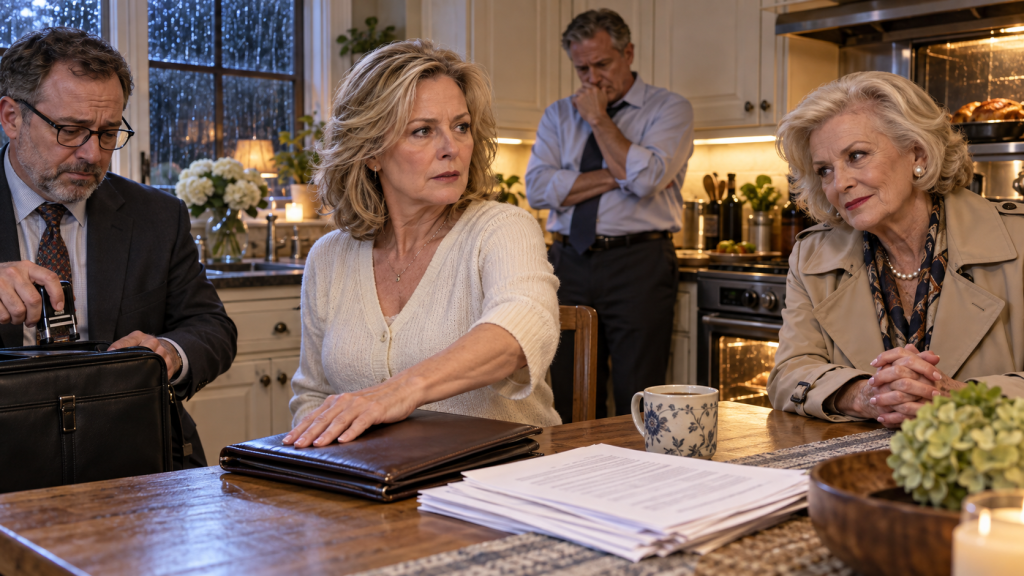
When I married at 58, I did not tell my husband that I owned six rental cottages in Georgia. I had planned to surprise him at Christmas. Instead, eight days after our wedding, his mother arrived at my house with a mobile notary and a stack of documents that would have given her son control over nearly everything I owned.

The notary looked more uncomfortable than I felt. That was the first thing I noticed when Beatrice Thorne opened a leather folder across my kitchen table.
Rain tapped against the windowpanes. A roast sat cooling in the oven. My coffee had gone cold beside my elbow. My husband, Marcus Thorne, stood near the counter with his tie loosened, behaving as though this were an ordinary Tuesday evening.
We had married in early November. We had been husband and wife for exactly eight days. And now, his mother was sitting in my kitchen with legal papers I had never seen and a complete stranger carrying an official notary stamp.
Beatrice smiled at me. “All you need to do is sign, Elaine,” she said. “This is simply responsible planning for people our age.”
I looked down at the pages.
The first referred to a durable financial power of attorney.
The second proposed placing certain inherited assets into a marital trust.
The third would make Marcus co-trustee and primary beneficiary.
Another page appeared to transfer ownership interests in a property-holding company directly into that trust.
I lifted my eyes slowly. “What inherited assets?”
Marcus rubbed the back of his neck. “You told me your grandfather left you investments.”
“I told you he left me savings.”
Beatrice leaned back in her chair. “Please. No woman works three days a week at an art gallery unless she has other income.”
There it was. Not concern. Calculation.
The notary, a middle-aged man named Warren Miller, shifted uncomfortably. “I should explain that I did not prepare these documents,” he said. “I was hired only to verify identity and witness signatures, assuming everyone understands the paperwork and is signing voluntarily.”
“Of course she understands,” Beatrice replied instantly.
Warren looked directly at me. “Do you?”
“No,” I said. “Because no one told me this meeting was happening.”
Marcus sighed deeply. “Elaine, nobody is pressuring you.”
“Your mother brought a notary into my kitchen without asking me.”
“She is just trying to protect us.”
“Then why didn’t she suggest that I have my own attorney review the documents first?”
Beatrice’s smile tightened into a thin line. “We are family now. Surely you do not need to involve outsiders in every private decision.”
An independent attorney was considered an outsider. But an unknown notary was welcome in my home.
I firmly closed the leather folder. “I’m not signing anything.”
Beatrice stared at me. Marcus’s jaw clenched. Warren immediately reached for his stamp and identification log.
“That settles it,” he said, packing his briefcase. “I cannot proceed.”
Beatrice turned on him. “She is not refusing. She is just nervous.”
“I said I’m not signing,” I repeated.
Warren stood up. “My role ends when a signer declines.” He handed me his business card before walking toward the door. “If you have concerns about anything I was asked to notarize today, call me.”
The Hidden Inheritance
The moment the front door shut, Beatrice dropped the sugary sweetness from her voice. “That was humiliating.”
“No,” I replied. “What you arranged was humiliating.”
Marcus stepped forward. “You embarrassed my mother.”
I looked at him. He didn’t ask whether I felt ambushed or frightened. He didn’t bother to explain the paperwork. He didn’t apologize. His first and only concern was Beatrice.
“I think dinner is over,” I said.
Beatrice snatched up the folder. “You are turning a highly practical matter into something ugly.”
“I did not bring binding legal documents into someone else’s home and order them to sign.”
She pulled on her trench coat and marched out. Marcus followed her onto the front porch. They spoke quietly beneath the awning while the rain fell around them. When Marcus finally returned, he wouldn’t meet my eyes.
That frightened me far more than his anger would have.
I had genuinely believed Marcus was my second chance. My first husband, Arthur, had passed away eleven years earlier after a prolonged illness. We had been married for twenty-nine years. Losing him had left my life painfully quiet. For years, I worked, volunteered, and came home to rooms that felt too still.
Then I met Marcus at a charity book drive. He was 61, divorced, thoughtful, and incredibly patient. He remembered that I strongly disliked lilies. He brought lemon pie instead of chocolate because I had once casually mentioned that chocolate triggered my migraines. He listened when I spoke about Arthur without ever becoming jealous.
For nearly two years, he felt entirely safe.
He sometimes asked about my retirement plans. He wanted to know whether Arthur had left me financially secure. He once asked whether I would ever consider relocating somewhere warmer. I told him I had inherited some savings and had enough to live a modest life.
That was entirely true. It just wasn’t the whole truth.
When I was 34, my grandfather left me six small rental cottages on Tybee Island, Georgia. They were not sprawling mansions. They were charming pastel houses with screened-in porches and tin roofs, tucked a few streets back from the Atlantic Ocean. Retired couples rented them out through the winter. Traveling nurses stayed for months at a time. Families returned religiously every summer.
The cottages were fully paid off. A local property management company handled the bookings, repairs, property taxes, and tenants. The passive income allowed me to live very comfortably, but I rarely ever mentioned it.
Money had severely changed the people around me in the past. After Arthur passed away, distant relatives who had ignored me for a decade suddenly wanted to “help.” A neighbor became uncomfortably curious about my estate planning. A widower from my church proposed after just four months of dating, but grew deeply offended the moment I brought up a prenuptial agreement.
So, with Marcus, I was exceptionally careful.
I had planned to tell him everything at Christmas, exactly six weeks after our wedding. I had already blocked out the largest Tybee cottage for us. I imagined driving him down to the Georgia coast, placing the keys in his hand, and saying, “This is part of the life I want to share with you.”
I thought I was protecting a wonderful surprise. I didn’t realize I was actually protecting myself.
The Missing File and the Debt
After the notary incident, Marcus became incredibly cautious. He took his phone calls out in the garage. He quickly slammed his laptop shut whenever I walked into the room. Beatrice called every single evening, and their hushed conversations abruptly ended if I came anywhere near.
When I asked what they were discussing, Marcus just brushed it off. “Family matters.”
Apparently, I was his wife, but still not family enough to be included.
Four days later, his smartphone lit up on the nightstand while he was taking a shower. I didn’t pick it up. I didn’t have to.
The message appeared on Marcus’s phone for perhaps four seconds.
That was enough.
I did not touch the device.
I did not need to.
The screen lit beside my lamp while the shower ran behind the bathroom door.
BEATRICE: Six cottages, Marcus. SIX. She lied about “savings.” Did you find the blue file? Bank deadline is Friday. Do not let her call anyone until—
Then the screen went dark.
I sat completely still.
For a moment, all I could hear was water striking tile.
Six cottages.
Not investments.
Not savings.
Cottages.
Beatrice knew.
Marcus knew.
And somewhere between our wedding eight days earlier and that Tuesday night, my husband and his mother had learned something I had deliberately chosen not to tell them yet.
The second part of the message frightened me more.
Did you find the blue file?
I knew exactly which file she meant.
It lived in the bottom drawer of the walnut cabinet in my study.
Blue linen folder.
Arthur had bought it years ago because I kept stuffing important papers into grocery envelopes and then complaining when I could not find them.
Inside were copies of the operating documents for Fenn Coastal Holdings.
Property-management statements.
Insurance schedules.
Recent appraisals.
Copies of the deeds.
Banking information with most account numbers redacted.
And the current management agreement covering all six Tybee cottages.
Enough paper to explain nearly everything I had planned to tell Marcus at Christmas.
I stood.
Walked down the hall.
Opened the study.
Pulled out the bottom drawer.
The blue file was gone.
There is a specific kind of fear that comes when your own home proves you have misunderstood what was happening inside it.
Nothing had been broken.
No drawer forced open.
No lock picked.
Marcus knew where I kept records because husbands learn where wives keep records.
I had shown him the cabinet once when we were discussing insurance after the wedding.
“If something happens to me,” I had said, “important household papers are here.”
I meant the homeowners policy.
Utility records.
My will contact.
I had not thought I was giving him a map.
Maybe I wasn’t.
Maybe he had found the file accidentally.
Fear hates maybe.
It turns every unknown into an accusation.
I closed the drawer.
Then opened it again, as if linen folders reproduce when checked twice.
Nothing.
I heard the shower stop.
My first instinct was to march into the bedroom and demand everything.
Instead, I took Warren Miller’s business card from my purse.
The notary.
The stranger who had been more concerned about my consent than either person calling themselves family.
I slipped on my coat.
Marcus called from the bedroom.
“Elaine?”
“I’m going for a drive.”
“At nine at night?”
“Yes.”
“Everything okay?”
I looked toward the bedroom door.
“No.”
Then I left before he could ask the question he should have asked four days earlier.
I called Warren from my car.
He answered cautiously.
“Miller Mobile Notary.”
“This is Elaine Mercer-Thorne.”
Silence.
Then:
“Mrs. Thorne.”
“I’m sorry to call so late.”
“You’re not.”
That surprised me.
“You expected me?”
“I hoped you might.”
I tightened my hands around the steering wheel.
“Who hired you?”
“Beatrice Thorne contacted me.”
“Did Marcus?”
“Not directly.”
“Who sent the documents?”
Warren hesitated.
“I can discuss the circumstances of the notarization request, but I cannot give legal opinions about the documents.”
“I’m not asking for one.”
“Good.”
He exhaled.
“The packet came to me electronically from Mrs. Thorne.”
“Did she prepare it?”
“She said a document-preparation service helped.”
“Law firm?”
“I was not told it was a law firm.”
That mattered.
“And what did she tell you about me?”
A longer silence.
Then Warren said:
“That you had agreed to sign estate-planning documents after your marriage.”
I almost laughed.
“Anything else?”
“She said you might be emotional because you were recently remarried.”
My stomach turned.
“Emotional.”
“Yes.”
“Did she say I had reviewed the papers?”
“She implied that.”
“That is why I asked you directly.”
I closed my eyes.
Thank God for uncomfortable strangers.
Then Warren said:
“Mrs. Thorne also asked me to keep the appointment efficient.”
“What does that mean?”
“She said too much explanation would make the signing unnecessarily stressful.”
I gripped the steering wheel harder.
There it was.
Not:
Make sure Elaine understands.
The opposite.
Get signatures before understanding creates resistance.
“Warren.”
“Yes?”
“Were there schedules attached to the documents?”
“Some were blank.”
My stomach dropped.
“What schedules?”
“Asset schedules.”
“Ownership interests.”
“Accounts.”
“Property.”
I looked through my windshield at the wet street.
Blank schedules could later be completed only lawfully under whatever execution terms applied, but even seeing them presented to me without explanation was enough.
The intention was obvious.
Create the container first.
Fill it later.
“Do you still have the electronic packet?”
“Yes.”
“Do not send it to me yet.”
He seemed surprised.
“I want my lawyer to contact you.”
“That is probably wise.”
Then he added:
“Mrs. Thorne was not happy when I left.”
I almost smiled.
“Neither was I.”
My lawyer was named Sylvia Grant.
Sixty-seven.
Silver hair cut short.
The disposition of a headmistress who had been forced into private practice because the world contained too many foolish adults.
She had handled Arthur’s estate.
She knew about the cottages.
She knew why I kept them separate.
And when I called at 9:42 p.m., she answered with:
“Who died?”
“No one.”
“Then this had better be interesting.”
I told her.
The notary.
The documents.
The cottages.
The notification.
The missing blue file.
When I finished, she did not react immediately.
Then:
“Are you safe?”
That was her first question.
Not:
How much are the cottages worth?
Not:
What did Marcus sign?
Safe.
“Yes.”
“Has Marcus ever threatened you physically?”
“No.”
“Controlled your access to money?”
“No.”
“Prevented you from leaving?”
“No.”
“Good.”
Then:
“Do not accuse him of theft tonight.”
I almost laughed.
“He took my file.”
“You believe he took your file.”
“Who else?”
“Elaine.”
“I know.”
“No, you know the file is missing.”
“Precision keeps anger from making you stupid.”
I hated when she was useful.
She told me to do four things.
Secure the originals of anything especially important.
Notify the Tybee property manager that no change in authority, beneficiary instructions, banking, ownership, or management should be accepted without direct confirmation through counsel.
Review access to my financial portals.
And sleep somewhere else if I did not feel comfortable sharing the house with Marcus.
“That’s it?”
“For tonight.”
“I want answers.”
“You want control.”
She corrected.
“Answers take longer.”
I stared at the rain.
Then:
“Did marriage give him rights to the cottages?”
“Marriage does not magically transfer your separately inherited property into his name.”
Relief moved through me even though I already mostly knew that.
“Those documents were designed to change the structure.”
“Yes.”
“If you signed them?”
“Potentially significantly.”
“How significantly?”
“We need the exact drafts.”
Then:
“But you did not sign.”
No.
I hadn’t.
One word at the kitchen table had protected thirty-nine years of property history.
No.
An underrated estate-planning tool.
I went home after midnight.
Marcus was sitting in the living room.
No television.
No laptop.
Just him.
He stood when I entered.
“Where were you?”
“Talking to someone.”
His face tightened.
“Who?”
I hung my coat.
“Why?”
He stared.
“What is happening?”
That question almost made me admire him.
Almost.
“You tell me.”
His expression changed.
Tiny.
Enough.
I continued.
“What is the blue file?”
Silence.
There it was.
No confusion.
No:
What blue file?
Marcus looked toward the hallway.
Then at me.
“Elaine.”
“Where is it?”
He rubbed both hands over his face.
“I can explain.”
“Interesting.”
“What?”
“That sentence has become very popular in this marriage.”
His eyes filled.
“Please.”
“Where is my file?”
Marcus whispered:
“At my mother’s.”
The room went cold.
Not misplaced.
Not accidentally moved.
His mother had it.
“Why?”
“She wanted to see how the properties were structured.”
I stared at him.
“You took confidential property records from my study and gave them to Beatrice.”
“I was going to bring them back.”
“You are answering a different question.”
His shoulders fell.
“Yes.”
“Why did she need them?”
Silence.
Then:
“Because I owe money.”
There it was.
The word beneath everything.
Debt.
“How much?”
Marcus looked away.
“Marcus.”
“Six hundred and eighty thousand.”
I thought I had misheard.
“How much?”
“Approximately.”
“Approximately six hundred eighty thousand dollars?”
“Yes.”
My husband of eight days sat down as if the number had weight.
I remained standing.
“What kind of debt?”
“A business guarantee.”
“You told me you sold your consulting firm cleanly five years ago.”
“I sold the operating business.”
“What does that mean?”
“There was a development partnership afterward.”
I laughed once.
No humor.
“Of course there was.”
He looked ashamed.
Maybe genuinely.
Maybe shame was another thing I had misread in him before.
He began.
Four years earlier, Marcus invested in the redevelopment of a small office complex outside Charlotte.
Nothing glamorous.
Old medical buildings.
Commercial units.
His friend Stephen Carrow managed the project.
Marcus provided some capital.
Then personally guaranteed part of the financing because Stephen needed stronger borrowers behind the loan.
The project ran over budget.
Then interest rates rose.
Two anchor tenants backed out.
The lender restructured once.
Then again.
Stephen eventually declared bankruptcy.
Marcus remained on a personal guarantee.
I stared.
“How much did you originally guarantee?”
“Eight hundred thousand.”
“And you still owe six eighty?”
“Roughly.”
“After four years?”
“I’ve paid interest and some principal.”
My stomach tightened.
“How?”
“My investments.”
“Consulting.”
“My mother.”
There.
Beatrice.
Of course.
“What did she do?”
Marcus closed his eyes.
“She pledged a brokerage account to support the last refinance.”
“How much?”
“Three hundred thousand.”
I sat slowly.
Suddenly Beatrice’s behavior acquired a shape beyond greed.
Fear.
Her own money was exposed.
Maybe her retirement.
Maybe the security of an older woman who believed her son’s marriage had created a solution.
That did not excuse her.
But it explained urgency.
“When does that refinance mature?”
“Friday.”
The message.
Bank deadline Friday.
Everything lined up.
“What happens Friday?”
I asked.
“We either extend again or the lender can start enforcing remedies under the loan documents.”
“Against you?”
“Yes.”
“And Beatrice?”
“Her pledged account could be at risk.”
“Your house?”
“I sold my condo two years ago.”
I stared.
“You told me you sold it because you wanted to simplify.”
“I did.”
“Where did the equity go?”
Silence.
“Debt?”
“Yes.”
My heart hurt.
Not because he had lost money.
Because every ordinary fact I thought I knew suddenly had a second explanation.
The condo.
His reluctance to travel certain months.
The questions about my retirement.
His repeated comments that couples our age should “simplify finances.”
Pieces rearranged themselves.
“How much are you worth?”
I asked.
Marcus looked at me.
“What?”
“You know enough about my supposed savings that your mother researched me.”
“How much are you worth?”
His face reddened.
“Elaine.”
“Negative?”
Silence.
Then:
“On paper, probably.”
I closed my eyes.
I had married a man with a negative net worth and a nearly seven-hundred-thousand-dollar personal guarantee.
He had married a woman who owned six debt-free cottages.
Neither knew the other’s complete financial life.
Except somehow only one side had arrived with documents.
“Did you marry me for money?”
The question came quieter than I expected.
Marcus looked devastated.
“No.”
Too fast.
I held up one hand.
“Think before you answer.”
He stopped.
Good.
Because this question deserved more than reflex.
He sat with it.
For almost a minute.
Then:
“No.”
He said again.
Slower.
“I did not marry you because I wanted your money.”
I watched him.
Then he added:
“But…”
There.
The useful word.
“But I knew you were financially secure.”
My chest tightened.
“I knew Arthur had left you comfortable.”
“I knew you owned this house.”
“I knew you had investments.”
“And when I thought about telling you about the guarantee…”
He swallowed.
“The fact that you were financially safe made me tell myself the debt would not matter as much once we were married.”
I stared.
There it was.
Not gold digging.
Something more human and perhaps more dangerous.
He loved me.
And he also allowed my stability to become the cushion beneath his dishonesty.
“Did you think I would pay it?”
“No.”
His face twisted.
“Not exactly.”
“What does that mean?”
“I thought we would combine some things eventually.”
“That maybe refinancing everything together would make sense.”
“Whose everything?”
Silence.
“You had no everything left.”
He flinched.
I regretted the cruelty.
Did not retract the truth.
“Did you know about the cottages before we married?”
Marcus looked at me.
“No.”
I searched his face.
He seemed sincere.
That no longer comforted me as much as it once would have.
“When did you learn?”
“Three days after the wedding.”
My stomach tightened.
“How?”
“My mother.”
“Of course.”
“She hired an asset-search firm.”
That made me laugh.
A real laugh this time.
Cold.
“She performed due diligence on your bride.”
“She was scared about the refinancing.”
“No.”
I shook my head.
“She was scared your bride might not be useful enough.”
“That’s not fair.”
“Isn’t it?”
Marcus looked down.
Maybe because it was at least partly fair.
The cottages were held through Fenn Coastal Holdings LLC.
My name appeared on older registration records.
Property deeds could be traced.
Tax records existed.
Nothing supernatural.
If someone spent enough time looking, they could find them.
I had relied on privacy.
Not invisibility.
Beatrice had looked.
“What did you do when she told you?”
I asked.
Marcus rubbed his forehead.
“I was shocked.”
“Then?”
“I was angry you hadn’t told me.”
There.
Interesting.
“You were angry.”
“Yes.”
“Three days into a marriage in which you had not told me about six hundred eighty thousand dollars in debt.”
He closed his eyes.
“When you say it like that—”
“How else should I say it?”
He did not answer.
Then:
“My mother said the cottages changed the refinancing.”
“Did they?”
“Potentially.”
I went still.
“Explain.”
“She said if we created a marital asset trust and contributed property interests, the lender might extend based on stronger combined assets.”
“There is no combined asset until I voluntarily put something into it.”
“I know.”
“Did you know then?”
A pause.
“Yes.”
There.
He had known.
My consent was not a technicality.
It was the whole plan.
“Were you ever going to ask me?”
“Yes.”
“When?”
“After we talked about finances.”
I stared.
“You brought a notary.”
“That was my mother.”
“You stood beside the counter.”
“I did not bring him.”
“You let him into the house.”
Silence.
“You knew what the documents did?”
“Some.”
“Some.”
“I had not reviewed every page.”
That was somehow worse.
“You were going to let me sign documents you had not fully read?”
His face collapsed.
“When you say it—”
“Stop saying that.”
I stood.
“The words are not hurting you.”
“The behavior is.”
Silence filled the room.
Then I asked about my blue file.
“Why did you take it?”
He whispered:
“Mom needed the LLC structure.”
“For what?”
“To give the lender’s counsel an idea of what might be available.”
My entire body went cold.
“Available.”
“That was her word.”
“You gave information about my separate property to people considering your debt without my permission.”
“Only preliminary information.”
“Marcus.”
“I know.”
“No.”
My voice broke for the first time.
“You keep acting like the word preliminary makes betrayal temporary.”
His eyes filled.
“I’m sorry.”
I looked at the man I had married eight days earlier.
The man who knew I disliked lilies.
The man who listened when I cried about Arthur.
The man who sat with me through a migraine in a dark room and whispered so the sound would not hurt.
Was that man fake?
I did not believe so.
That would have been easier.
He was real.
So was this one.
That was harder.
“Go to your mother’s tonight.”
Marcus stared.
“Elaine.”
“I need space.”
“This is my home too now.”
He stopped himself.
Good.
My eyebrow rose.
He looked ashamed.
“I mean…”
“I know what you meant.”
I took a breath.
“I am asking you, not ordering you.”
“Will you go voluntarily?”
He stared at me for a long time.
Then nodded.
“Yes.”
“Bring back my blue file tomorrow through Sylvia’s office.”
“Who is Sylvia?”
“My attorney.”
His face changed.
“You called a lawyer.”
“Yes.”
“Elaine…”
“No.”
I picked up his overnight bag from the hall closet.
“Your mother already introduced lawyers into my kitchen.”
“I’m simply choosing one who represents me.”
He had no answer to that.
Marcus left at 1:13 a.m.
I locked the door afterward.
Then hated myself for feeling relieved.
The bed looked enormous.
Eight days of marriage.
Two years of courtship.
Eleven years of widowhood before that.
I had thought the frightening part of marrying again at fifty-eight would be making space for another person’s habits.
How he folded towels.
Whether he snored.
Whose family got Thanksgiving.
I had not imagined I would spend the ninth night of marriage sitting alone with a legal pad writing:
$680,000 guarantee
Beatrice collateral
six cottages discovered after wedding?
blue file
Friday bank deadline
I cried until three.
Then slept for ninety minutes in the chair.
Grief and betrayal are cousins.
Both make furniture feel unfamiliar.
Sylvia had the blue file by noon.
Marcus delivered it unopened inside a courier envelope.
At least that was what he claimed.
Nothing appeared missing.
Sylvia still had me compare contents against scanned records.
All six property schedules present.
Management statements.
Operating agreement.
Appraisals.
Then she placed another folder on her desk.
“Now Marcus.”
I looked at her.
“What did you find?”
She had pulled public filings related to the failed development.
Loan documents available through litigation.
A complaint from one investor.
UCC filings.
Nothing that made Marcus a criminal.
Important.
He had made a terrible investment.
Guaranteed too much.
Hidden it from me.
But there was no evidence he had stolen anyone’s money.
I almost felt relieved.
Then Sylvia said:
“His mother is deeper in this than he suggested.”
“How?”
“Beatrice did not just pledge a brokerage account.”
My stomach tightened.
“What else?”
“She loaned Marcus two hundred twenty thousand dollars personally over three years.”
I closed my eyes.
No wonder she was desperate.
“She could lose most of her liquid retirement.”
“Possibly.”
Then Sylvia added:
“And Marcus has been making payments to her.”
“How much?”
“About two thousand a month recently.”
That explained why he always seemed financially comfortable but oddly constrained.
He had income.
It was already spoken for.
Everything in his life had been carrying a second story.
I asked:
“Could I save them?”
Sylvia looked at me.
I almost laughed.
“I know what that sounds like.”
“Do you?”
“Yes.”
“If I paid the debt.”
She leaned back.
“Could you?”
“Yes.”
The cottages had appreciated tremendously.
Their annual net income alone was more than enough to change Marcus’s problem if I chose.
Sylvia said:
“Technically, you could provide funds.”
“Or collateral.”
“Or purchase the note.”
“There are several ways someone with your balance sheet could intervene.”
I stared at the desk.
“Should I?”
“That is not a legal question.”
“I hate when lawyers say that.”
“We love saying it.”
Then she softened.
“Elaine.”
I looked up.
“You have known about the debt for less than twelve hours.”
“Do not turn financial capability into moral obligation.”
That sentence hit harder than expected.
Because that was exactly what had already happened in Marcus’s family.
They had discovered I could solve something.
Then allowed could to begin impersonating should.
Beatrice arrived at Sylvia’s office that afternoon.
Not invited by me.
Marcus told her we had counsel.
Beatrice apparently interpreted that as an emergency requiring her physical presence.
She marched into the reception area in a navy coat and demanded to speak with us.
Sylvia asked me:
“Do you want her in?”
I considered saying no.
Then:
“Yes.”
Beatrice entered with Marcus behind her.
He looked exhausted.
She looked furious.
Good.
At least someone had slept.
She sat without being invited.
“Elaine, this has gone far enough.”
Sylvia’s eyebrows rose.
I almost smiled.
“Beatrice.”
I said.
“You brought documents into my home that would have given your son control over property you knew I had not disclosed to him.”
“I was protecting his future.”
“With my property.”
“With marital property.”
“No.”
Sylvia said quietly.
Beatrice turned.
“Excuse me?”
“The cottages are not marital property simply because Elaine married your son.”
Silence.
Thank you, Sylvia.
Beatrice flushed.
“That is precisely why we proposed a marital trust.”
I looked at her.
“So you knew.”
“Of course I knew what the documents were.”
“Did Marcus?”
She glanced at him.
Wrong move.
Marcus’s face tightened.
“Mom.”
There it was.
A crack between them.
Beatrice continued.
“You have six properties producing substantial income.”
“You are nearly sixty.”
“My son is sixty-one.”
“It is entirely reasonable for a married couple to consolidate.”
I leaned forward.
“Did the trust documents give me equivalent authority over Marcus’s assets?”
Silence.
“What assets does Marcus have to consolidate?”
Her face hardened.
“That is cruel.”
“No.”
“It is accounting.”
I almost regretted the sentence.
Then decided I did not.
“Did the proposed power of attorney make me Marcus’s financial agent?”
“No.”
“Did the beneficiary structure give me primary rights to anything of his?”
“No.”
“Then what exactly was mutual?”
Beatrice’s mouth tightened.
“He had debt.”
“Yes.”
“You had assets.”
“Yes.”
“The plan was to stabilize the marriage.”
I stared.
“No.”
“The plan was to stabilize the debt.”
That was different.
Then Beatrice said something I did not expect.
“If Marcus defaults, I could lose almost everything.”
The room changed.
Her anger cracked.
Underneath it was an eighty-year-old mother—I had not realized she was eighty, actually—who had spent years bailing out her adult son.
Her voice trembled.
“I have already given him more than two hundred thousand dollars.”
“I pledged my portfolio.”
“I cannot rebuild at my age.”
For the first time, I saw fear instead of strategy.
It did not erase what she did.
But it made her human.
I asked:
“Why did you keep lending?”
She looked at Marcus.
He closed his eyes.
“Because he is my son.”
There it was.
The oldest reason for terrible financial boundaries.
“And when you learned I had cottages?”
Her answer came quieter.
“I thought God had finally given us a solution.”
My entire body recoiled.
“No.”
She flinched.
“I am not your solution.”
Silence.
“Marriage to your son did not turn my grandfather’s property into an answer to decisions I did not make.”
Her eyes filled.
“I know that now.”
“Do you?”
She looked down.
Maybe she did.
Maybe she was beginning.
Marcus finally spoke.
“Mom, stop.”
Beatrice turned.
“What?”
“This is my debt.”
She stared.
“You would have lost everything years ago without me.”
“I know.”
“You asked me to help.”
“I know.”
“And now suddenly I’m the problem?”
“No.”
Marcus’s voice shook.
“But I let you make Elaine responsible before she even knew there was something to be responsible for.”
That quieted everyone.
He looked at me.
“I should have told you before the wedding.”
“Yes.”
“I didn’t because I thought you would leave.”
My throat tightened.
There it was.
Honest.
“And?”
He looked down.
“And I wanted to marry you more than I wanted to give you a reason not to.”
That hurt because part of it sounded like love.
Love can become selfish when it uses ignorance to protect the outcome it wants.
Marcus continued.
“I told myself the debt was mine.”
“That I would handle it.”
“That marrying you had nothing to do with it.”
“Then Mom found the cottages.”
His voice broke.
“And suddenly I saw a way out.”
I looked at him.
“Did you plan the notary meeting?”
“No.”
“Did you know she was bringing documents?”
“Yes.”
“How long before?”
“Two hours.”
“Did you stop her?”
“No.”
There.
His responsibility.
Specific.
Enough.
I did not decide the marriage that day.
People expected me to later when the story came out.
They wanted a clean moment.
Woman discovers scheme.
Throws husband out.
Keeps cottages.
End.
Real life is inconsiderate.
I loved Marcus.
That was still true.
I no longer trusted him.
Also true.
Neither sentence canceled the other.
So I told him:
“We are not moving back in together right now.”
He nodded.
“I understand.”
“We are not combining money.”
“Yes.”
“You will sign nothing involving me.”
“Yes.”
“You will not access my study, companies, manager, accounts, estate records, or tax documents unless I specifically authorize it.”
“Yes.”
“And you will solve your debt without treating my assets as the answer.”
His eyes filled.
“Yes.”
Beatrice opened her mouth.
Sylvia looked at her.
Beatrice closed it.
Wonderful woman.
Then Sylvia said:
“There is another issue.”
I turned.
“What?”
She had received Warren Miller’s electronic records that morning.
The notary packet.
Booking email.
Attachments.
Metadata from the document-preparation service.
My stomach tightened.
“What issue?”
“The drafts were not created after the wedding.”
Silence.
Marcus frowned.
“What?”
Sylvia slid a printout across the table.
Creation date:
October 3.
More than a month earlier.
Five weeks before our November wedding.
I looked at Beatrice.
Her face changed.
Marcus looked genuinely confused.
“Mom?”
She said nothing.
I felt something cold settle under my ribs.
“The documents existed before we married.”
I said.
Beatrice’s lips parted.
Then closed.
“Why?”
No answer.
Marcus turned toward her fully.
“You told me you had them prepared after you found the cottages.”
Silence.
There.
A new fracture.
“You said you found the Georgia records three days after the wedding.”
Beatrice looked at him.
“I did.”
“Then what were these documents for in October?”
She glanced toward Sylvia.
Then me.
“I wanted us prepared.”
“For what?”
I asked.
She said nothing.
Sylvia pulled another document from the file.
“Warren’s packet was generated from an earlier client intake.”
I stared.
“What client intake?”
“The document service produced a questionnaire when Beatrice first requested planning forms.”
“Date?”
“September 28.”
Six weeks before my wedding.
My pulse pounded.
“Who filled it out?”
“Mostly Beatrice.”
“Mostly?”
“There are sections apparently completed by Marcus.”
Marcus went pale.
“No.”
Sylvia looked at him.
“You should see this.”
She handed him a copy.
He read.
His face changed slowly.
Then faster.
“What is it?”
I asked.
Marcus looked toward his mother.
“You sent them my financial statement.”
Beatrice said nothing.
“What financial statement?”
I asked.
Sylvia answered.
“A personal financial statement Marcus submitted to the lender during extension discussions.”
“When?”
“September.”
Before the wedding.
I looked at Marcus.
“Did you list me?”
“No.”
Too fast.
Then he read further.
His face drained.
“Oh my God.”
My stomach dropped.
“What?”
He handed the page to me.
Near the bottom was a section labeled:
Anticipated Additional Household / Marital Resources
Typed beneath it:
Prospective spouse: Elaine Mercer
My hands went cold.
Then another line:
Inherited investment assets; principal residence; potential coastal real-estate interests under review.
I stared.
Coastal.
Before the wedding.
Before Marcus claimed Beatrice discovered the cottages.
Before my surprise.
Before the notary.
Before I said I do.
“What does ‘potential coastal real-estate interests’ mean?”
Marcus looked stunned.
“I don’t know.”
I believed his shock.
That frightened me more.
Sylvia pointed to a note attached to the financial statement.
An email.
From Beatrice.
To Marcus’s loan adviser.
Dated nineteen days before our wedding.
Marcus’s future wife has substantially more assets than she discusses openly. I am confirming the extent. Once the marriage is complete, we expect to discuss moving appropriate assets into a joint planning structure that may strengthen the extension request.
The room disappeared.
I reread it.
Once the marriage is complete.
Not:
If Elaine agrees.
Not:
If the couple chooses.
Once the marriage is complete.
My eyes moved to Marcus.
He looked physically ill.
“Did you know she sent this?”
“No.”
I wanted to believe him.
Maybe I did.
Then Sylvia said quietly:
“There is one more attachment.”
Of course.
A report.
Private asset research.
Prepared for Beatrice.
Dated twelve days before my wedding.
My name.
My house.
Fenn Coastal Holdings.
Six Tybee Island property addresses.
Estimated combined value:
$3.84 million.
They had known.
Not three days after the wedding.
Before.
Beatrice had known exactly what I owned before I walked down the aisle.
And she had already been talking to Marcus’s lender about a future marital structure.
I looked at her.
Her face had lost every bit of color.
Marcus whispered:
“Mom…”
But I could barely hear him.
Because at the bottom of the report was a handwritten note.
Beatrice’s handwriting.
Three lines.
Elaine plans Christmas trip to Georgia.
Marcus still does not know.
Then:
Need signatures before she reveals why.
My hands began shaking.
The surprise I had planned for Christmas had not been private at all.
Beatrice had known.
She had known I intended to tell Marcus.
And instead of waiting for me to speak—
she had decided the safest moment to obtain control was before I did.
I looked at my husband.
He stared at his mother as though he no longer recognized her.
Then I looked at the woman who had walked into my kitchen with a notary eight days after my wedding.
For the first time, I understood.
The ambush had not begun at my kitchen table.
It had begun before I ever became Mrs. Marcus Thorne.
And somewhere between the asset report, the bank deadline, and the vows I had believed were about two people choosing one another, someone had already begun calculating what my marriage might be worth.
PART 3 — WHAT MARRIAGE WAS NOT ENTITLED TO TAKE
For a long time, nobody spoke.
The report sat between us on Sylvia’s conference table.
Six Tybee Island cottages.
Estimated value.
My home address.
My name.
My planned Christmas trip.
And Beatrice’s handwritten instruction:
Need signatures before she reveals why.
Marcus stared at his mother.
Not at me.
Not at Sylvia.
At Beatrice.
His face looked different.
Not angry yet.
That would have been easier.
He looked hurt.
There is a particular pain in discovering that a parent has done something terrible while believing she was doing it for you.
“Mom.”
Beatrice did not answer.
Marcus touched the paper.
“You knew about the cottages before the wedding.”
She looked toward the window.
“Yes.”
The word barely moved.
Marcus swallowed.
“You told me you found them three days afterward.”
“Yes.”
“Why?”
Beatrice’s jaw tightened.
“Because you would have behaved exactly like this.”
Marcus stared.
“Like what?”
“Guilty.”
Silence.
She continued.
“You were already terrified Elaine would learn about the debt.”
“You were talking about postponing the wedding.”
Marcus turned toward me.
My stomach tightened.
That was new.
“You were?”
He closed his eyes.
“Yes.”
That hurt.
Not because he considered postponing.
Because he had almost done the right thing and then chosen not to.
“When?”
I asked.
“September.”
“Why?”
“Because the lender denied the extension.”
He looked ashamed.
“I knew I should tell you.”
“Did you try?”
“Yes.”
“How?”
He almost laughed at himself.
“I took you to dinner.”
I remembered.
A French restaurant I hated.
Marcus barely ate.
I thought he was nervous about wedding seating.
He had asked:
“Do you ever worry we’re too old to start over?”
I said:
“No. I think we’re old enough to know better.”
God.
Life enjoys irony.
Marcus continued.
“I wanted to tell you that night.”
“What stopped you?”
“You were talking about Arthur.”
My throat tightened.
“He had died eleven years earlier.”
“I know.”
“You weren’t grieving in some fragile crisis.”
“I know.”
“Then what stopped you?”
Marcus looked directly at me.
“Cowardice.”
Good.
No decoration.
He continued.
“You said you were happy again.”
“That you never expected to feel that.”
“And I thought if I told you I could lose almost everything…”
His voice cracked.
“I thought you might decide loving me was too expensive.”
I sat back.
There it was.
Not greed.
Fear.
Still deception.
Beatrice interrupted.
“He was protecting you.”
Sylvia’s head turned slowly.
I almost pitied Beatrice.
Almost.
“No.”
I said.
“He was protecting the marriage he wanted from information that might have changed my decision.”
Marcus closed his eyes.
“Yes.”
That answer mattered.
Beatrice looked furious.
“You don’t understand what he was facing.”
“I understand six hundred eighty thousand dollars.”
“You understand a number.”
She snapped.
“You did not watch him stop sleeping.”
“You did not watch him sell his condo.”
“You did not watch him spend four years trying to pay down something that was destroying him.”
I looked at her.
“No.”
“Because he did not tell me.”
That silenced her.
For a moment, I saw the entire problem in one sentence.
They kept demanding that I understand suffering they had deliberately hidden.
Sylvia moved the asset report aside.
“There is still the question of who completed the pre-wedding lender paperwork.”
Marcus looked at her.
“I filled out a financial worksheet.”
“Which parts?”
“My income.”
“Debts.”
“Existing accounts.”
“Then a section asked whether I anticipated major household changes.”
“I put Elaine’s name and that she owned her home and had inherited savings.”
I leaned forward.
“Did you mention coastal property?”
“No.”
Sylvia nodded.
“We had the electronic file examined this morning.”
Every face turned toward her.
“The original form Marcus submitted did not include the phrase ‘potential coastal real-estate interests under review.’”
Marcus went still.
Beatrice’s face hardened.
Sylvia continued.
“That line was added later.”
“By whom?”
I asked.
“The lender’s copy came through an email account belonging to Beatrice.”
Silence.
Marcus looked at his mother.
She did not deny it.
“Mom.”
“I added information that had become relevant.”
Marcus actually laughed.
Cold.
“You researched my fiancée.”
“Yes.”
“Then modified my financial statement.”
“I supplemented it.”
“You put words into a document with my name on it.”
Beatrice flinched.
“It was not a signed sworn statement.”
“That is your defense?”
His voice rose.
“Marcus—”
“No.”
The word cracked through the room.
For the first time since I had met them, Marcus spoke to his mother like an adult who did not need permission to be angry.
“You do not get to do that.”
Beatrice stared.
“I was trying to save you.”
“I did not ask you to turn Elaine into collateral.”
“You would have lost everything.”
“Then I would have lost everything.”
She stopped.
Marcus looked almost surprised by his own sentence.
Then he said it again.
Quieter.
“That should have been allowed to happen if those were the consequences of my decisions.”
Beatrice’s face crumpled.
“You’re my son.”
“I know.”
“That does not make every disaster mine to prevent.”
No one spoke.
Maybe that was the first boundary in the Thorne family that had ever arrived before a crisis.
The lender issue became clear within days.
Beatrice had not successfully pledged my property.
She could not.
I had signed nothing.
Fenn Coastal Holdings remained mine.
The cottages remained separate.
No lender had a lien on them.
No bank had a right to their income.
No marital trust existed.
Nothing had been transferred by wishful thinking.
That was the good news.
The bad news belonged to Marcus.
The loan matured Friday.
No new collateral.
No extension on the terms Beatrice hoped for.
The lender began enforcing rights under the guarantee.
Marcus’s attorney negotiated.
There were assets in the development partnership.
Not enough.
A property sale covered some.
Insurance and remaining partnership reserves covered another portion.
Marcus still faced a large deficiency.
Beatrice’s pledged account remained exposed within the limits of the agreements she had signed.
I asked Sylvia:
“What happens if I do nothing?”
She looked at me.
“Marcus may need a structured settlement.”
“Possibly bankruptcy.”
“Beatrice may lose part of the pledged portfolio.”
My stomach tightened.
“Part?”
“Not necessarily all.”
“The loan documents are complicated.”
“Her lawyer is challenging some charges and negotiating.”
“And if I pay?”
Sylvia sighed.
“You could make the problem disappear.”
There it was.
The dangerous sentence.
Could.
Again.
I looked through her office window.
Rain had stopped.
The city looked washed.
“I’m not going to.”
Sylvia nodded.
No congratulations.
Good.
I did not feel brave.
I felt sick.
Marcus called me that evening.
He was staying at a long-term hotel now.
Not Beatrice’s house.
That was another boundary.
“Elaine.”
“Hi.”
“I wanted you to hear this from me.”
My chest tightened.
“What?”
“I’m filing a financial-disclosure package with my attorney.”
“Okay.”
“I’m giving you a complete copy.”
“You don’t have to.”
“Yes.”
His voice steadied.
“I do.”
Not legally.
Relationally.
“Every debt.”
“Every account.”
“Every payment from my mother.”
“Every guarantee.”
“Every pending claim.”
“All of it.”
I sat on the edge of my bed.
“Why?”
“Because I don’t want you deciding whether there is a marriage left while still discovering new rooms in the basement.”
I almost smiled.
Different metaphor.
Same truth.
“Marcus.”
“Yes?”
“I am not promising there is a marriage left.”
“I know.”
“Do you?”
“Yes.”
He took a breath.
“That is why I’m doing it before asking.”
There.
A small change.
Action without bargain.
The file arrived two days later.
Three inches thick.
I hated it on sight.
Numbers.
Statements.
Old partnership agreements.
Emails.
A complete history of four bad financial years.
I expected hidden horrors.
There were fewer than I feared.
Marcus had not gambled.
No secret mistress.
No luxury spending.
No second family.
No criminal fraud.
He had made one large, arrogant business decision.
Then refused to admit how badly it was failing.
He borrowed.
Guaranteed.
Refinanced.
Accepted his mother’s help.
Sold assets.
Kept working.
Paid.
Hid.
The deception was serious.
The underlying story was painfully ordinary.
A man who believed competence meant fixing mistakes privately.
Arthur had been like that sometimes.
So had I.
That comparison annoyed me.
Human beings are inconvenient when you want a clean verdict.
Then I found the first email Marcus had written to Beatrice after she discovered the cottages.
He did not know I would see it.
That mattered.
Dated three days after our wedding.
Mom, stop researching Elaine.
I stared.
Next:
She told me she had savings, and yes, I’m upset there’s more she didn’t tell me. But I have no right to treat property she inherited before we met as available for my debt. Do not contact the bank about her assets. I mean it.
My throat tightened.
Then Beatrice’s reply:
You are being sentimental. Marriage changes these things.
Marcus:
Not without her agreement.
Another reply from Beatrice:
Then get the agreement. You’re married now.
Marcus did not answer for eleven hours.
Then:
I need to tell her about the guarantee first.
I closed my eyes.
He knew.
He knew the proper order.
Truth.
Then consent.
Then perhaps planning.
And yet five days later, Beatrice brought a notary into my kitchen.
Marcus stood there.
He failed the moment that mattered.
Knowing better is not the same as doing better.
Still, the email mattered.
He had not masterminded the plan.
He had not married me after discovering the cottages.
But he had walked into marriage already hiding something large enough to threaten it.
That remained his.
The next document hurt more.
A note Marcus had written to himself the night before our wedding.
Not a diary.
A draft email saved but never sent.
Subject:
Elaine — before tomorrow
The body began:
There is something financial I should have told you before now.
I had to stop.
He had almost sent it.
Then:
I made a guarantee years ago that has become much worse than I expected. I am handling it, but I need you to know because marrying me means marrying someone under serious financial pressure. I do not expect you to pay it. I will understand if this changes what you want tomorrow.
My eyes blurred.
That would have changed everything.
Not necessarily the wedding.
Maybe only the trust.
Maybe we still would have married.
Maybe not.
That was what he stole from me.
Not six cottages.
The chance to decide with full information.
I cried for a long time over an email that had never been sent.
Sometimes the most painful documents are the correct choices people nearly made.
I met Marcus in a park two weeks later.
Neutral ground.
No lawyers.
No mothers.
No assets.
Just two people on a bench.
He looked thinner.
I hated that I still noticed.
“How are you?”
I asked.
He laughed.
“Poorer.”
“Marcus.”
“I know.”
Then:
“Bad.”
Honest.
The lender had accepted a structured resolution.
He would sell his remaining investment account.
Pay a portion over several years.
His consulting income would support the rest.
His credit would be damaged.
Retirement postponed.
Beatrice would lose part of her pledged assets but not her home.
Her attorney protected enough retirement income that she would remain secure, though less comfortable.
No homelessness.
No melodramatic ruin.
Consequences.
Finite.
“I’m sorry about Beatrice’s money.”
I said.
Marcus looked at me.
“I am too.”
Then:
“But I’m not asking you to fix it.”
Good.
“What happened between you two?”
I asked.
He looked toward the pond.
“I told her I need distance.”
My chest tightened.
“Because of me?”
“No.”
That answer came fast.
Then he corrected.
“Not only because of you.”
He folded his hands.
“I realized I have spent most of my adult life letting her turn rescue into authority.”
“She lends.”
“She advises.”
“She panics.”
“I obey because I feel guilty she sacrificed.”
“Then she sacrifices more.”
I listened.
He continued.
“I blamed her for the notary.”
“She deserved blame.”
“Yes.”
“But I was in the kitchen.”
There.
Again.
“I could have said, ‘Mom, leave.’”
“I didn’t.”
“Why?”
He smiled bitterly.
“Because part of me was still hoping you might sign.”
The truth landed hard.
I appreciated it anyway.
“Did you know exactly what the documents did?”
“No.”
“But I knew enough.”
My eyes filled.
He continued.
“I knew enough to know they would give us access to your assets.”
“Us?”
He winced.
“Me.”
Good correction.
“I told myself once you saw how bad the debt was, you might decide it was practical.”
“But you wanted the papers signed before telling me how bad it was.”
“Yes.”
He looked ashamed.
“That was manipulation.”
I said.
“Yes.”
No defense.
The bench between us felt wider.
Then Marcus asked:
“Why didn’t you tell me about the cottages?”
I looked at him.
There it was.
A fair question.
Not equivalent.
Still fair.
“Fear.”
“Of me?”
“Of what money does to people.”
He nodded slowly.
I told him more than I had before.
The relatives after Arthur.
The church widower who loved me until I mentioned a prenup.
The neighbor who became fascinated by my estate.
“I wanted six weeks.”
I said.
“To know the man I married before he knew the size of what I had.”
Marcus looked down.
“Was that fair?”
I thought.
“Not entirely.”
He looked up.
That surprised him.
“I should have told you before the wedding that there were significant separate assets.”
“I did not have to disclose every address.”
“But marriage should not begin with each person privately testing whether the other deserves important facts.”
His eyes filled.
“So we both hid money.”
“No.”
I said gently.
“Do not make them identical.”
He nodded.
Good.
“I hid assets that remained mine and did not create obligations for you.”
“You hid debt that could affect our married life and used my unknown financial security to reassure yourself that the consequences might be survivable.”
He absorbed that.
“Different.”
“Yes.”
“Both unhealthy.”
“Yes.”
That was the complexity.
We did not need false equivalence to admit I had contributed to the culture of secrecy.
Christmas came.
I had imagined that day for nearly a year.
Marcus in the passenger seat.
Tybee Island.
Keys in his hand.
Surprise.
Instead, I drove south alone.
Well—
not entirely alone.
Sylvia came for two days because she claimed she needed a vacation and then spent the first afternoon reviewing contracts on my porch.
Terrible traveler.
The largest cottage was pale blue.
White shutters.
Wide screened porch.
Atlantic wind.
I stood outside with the keys in my palm.
For a moment, grief arrived.
Not for Arthur.
Not exactly.
For the future I had invented with Marcus.
We mourn imagined lives too.
Nobody tells you that.
The Christmas morning that never happened.
The expression on his face I would never see.
The first sunset we would have shared there as husband and wife.
All gone.
I cried.
Then Sylvia opened the screen door.
“Are you planning to spend Christmas standing in the driveway?”
“Go away.”
“There’s pie.”
I went inside.
Life is often saved by practical women with pie.
I did something new that winter.
I reviewed every cottage.
Not because Marcus endangered them.
Because the entire experience taught me that protecting assets by refusing to look at them was another kind of avoidance.
I met the management company.
Updated trusts.
Clarified succession.
Changed backup agents.
No spouse automatically controlled anything.
No family member could move property without documented authority.
If I became incapacitated someday, professional co-fiduciaries and a person I personally chose would step in under clear standards.
I added medical evaluation requirements before any incapacity determination.
Not because I feared Marcus specifically.
Because good plans should not depend on everyone behaving well.
Arthur used to say locks are not insults to neighbors.
They are simply doors admitting humans are human.
He was right.
Beatrice wrote me a letter in January.
Four pages.
I almost threw it away.
Then read it.
She did not apologize immediately.
That irritated me.
She explained herself.
Childhood poverty.
A husband who died leaving debt.
Fear of becoming dependent.
Marcus’s failed partnership.
Her belief that if she did not rescue him, no one would.
Then the cottages.
She wrote:
When I found them, I felt relief before I felt shame.
That sentence was honest.
I saw six properties and thought there was enough.
Enough.
There it was.
Enough to solve Marcus.
Enough to protect Beatrice.
Enough that I should not mind.
She continued:
I told myself you were hiding them because you knew a marriage meant sharing and did not want to share.
My jaw tightened.
Then:
That allowed me to stop asking whether you were entitled to decide what sharing meant.
Better.
At the end:
I am sorry I treated your marriage as a financial event before I treated you as a person.
That reached me.
Then:
I am also sorry I taught my son that being rescued was easier than being accountable.
I closed my eyes.
No demand for forgiveness.
Good.
I sent one reply.
I received your letter. I believe your apology is sincere. I am not ready for a relationship with you. Please respect that.
She did.
That mattered more than another four pages.
Marcus and I lived separately for six months.
Then nine.
Then twelve.
People kept asking whether we were divorcing.
I got tired of saying:
“I don’t know.”
Apparently uncertainty makes observers itch.
They wanted a category.
Married.
Divorced.
Reconciled.
Betrayed.
Forgiven.
Life refused.
Marcus went to counseling.
Not because I demanded it.
That mattered.
He attended a financial recovery group for people with business debt and compulsive rescue patterns.
I laughed at the phrase.
Then realized it described him perfectly.
He rebuilt his consulting work.
Smaller apartment.
Used car.
No mother paying shortfalls.
No wife paying them either.
He sent me copies of quarterly debt statements for six months.
I eventually told him to stop.
“I believe you are paying it.”
He stared.
“You trust me?”
“In that area.”
Specific trust.
Better than vague absolution.
At fourteen months, we met again at Tybee.
His first visit.
Not Christmas.
March.
Windy.
Cold enough that the beach was nearly empty.
I handed him no keys.
We walked.
He looked at the cottages only from the road.
“Which one is yours?”
“All six.”
He laughed.
“Right.”
Then:
“They’re beautiful.”
“Thank you.”
He shoved his hands into his jacket.
“I understand why you were cautious.”
I looked at him.
“I understand why caution became secrecy too.”
He nodded.
We kept walking.
Then he asked:
“If you could go back, would you marry me?”
The question stopped me.
Not:
Do you forgive me?
Not:
Do you still love me?
Would you marry me if you knew?
I thought carefully.
“No.”
His face broke.
I continued before cruelty could settle.
“Not that day.”
He looked at me.
“If you had told me about the debt before the wedding, I would have postponed it.”
“How long?”
“I don’t know.”
“I would have wanted independent financial counseling.”
“Your debt plan.”
“A prenup.”
“Disclosure.”
“Maybe six months.”
“Maybe a year.”
He swallowed.
“And then?”
I looked toward the water.
“Maybe yes.”
His eyes filled.
That was the tragedy.
Not that truth would certainly have destroyed us.
That fear never gave truth the chance.
We divorced three months later.
Quietly.
People were shocked.
Even Sylvia.
“You two have been getting along better.”
she said.
“We have.”
“Then why divorce?”
“Because I do not want the marriage certificate to become the reason we keep trying.”
She looked impressed.
“Annoyingly healthy.”
“Thank you.”
Marcus understood.
That mattered.
We had married with incomplete consent.
Not legally invalid.
Emotionally compromised.
I wanted us to return to choice.
No shared status holding us together while we figured out whether love remained.
So we ended the marriage.
Fair property settlement.
Simple because finances had never combined deeply.
No claim on cottages.
No demand against his future income.
No dramatic courtroom.
We left together.
Outside, Marcus asked:
“Can I take you to lunch?”
I laughed.
“Are you asking your ex-wife on a date fifteen minutes after divorce?”
“Yes.”
“Terrible timing.”
“Historically my weakness.”
I said yes.
We dated for another year.
Slowly.
Ridiculously.
At sixty, I found myself telling a man he needed to call before coming over.
Wonderful.
He did.
We had separate homes.
Separate money.
He met me for dinner and paid sometimes.
I paid sometimes.
Nobody kept score.
When he finished paying the first major portion of his settlement, we celebrated with hamburgers.
Not because debt repayment made him worthy.
Because work deserves acknowledgment.
When I had a roof repair at one cottage, he did not offer financial advice unless I asked.
Progress.
When his mother called during dinner, he answered if it was urgent.
Not every time.
More progress.
Beatrice and I eventually had coffee.
One hour.
Public place.
No documents.
My condition.
She laughed.
Then cried.
We spoke about everything except money for the first forty minutes.
That was deliberate.
At the end, she said:
“I don’t expect you to ever trust me.”
I answered:
“I trust you to respect a no now.”
Her face changed.
“That is something.”
“Yes.”
Sometimes relationships return as smaller versions.
Smaller is not always failure.
Sometimes smaller fits reality better.
Marcus proposed again when I was sixty-one.
At Tybee.
Not inside a cottage.
On the beach.
No ring at first.
Smart man.
He said:
“I’m not asking you to rescue me.”
“I know.”
“I’m not asking for access to anything.”
“I know.”
“I’m not asking because we already did this once.”
“Good.”
Then:
“I’m asking because if you had known everything the first time, maybe you would have said not yet.”
He smiled nervously.
“So I am asking again now.”
My eyes filled.
“This time, you know everything about me that could reasonably change your answer.”
I laughed.
“Any hidden submarines?”
“No.”
“Secret children?”
“No.”
“Tax warrants?”
“No.”
“Mother with a notary in the bushes?”
He laughed.
“Absolutely not.”
Then he became serious.
“If the answer is no, I will still be grateful you gave me the chance to ask correctly.”
There.
That was why I said yes.
Not because love erased betrayal.
Because he had finally learned that consent is meaningful only when no is survivable.
We signed a prenuptial agreement.
Romantic?
Incredibly.
At our age, clarity can be very sexy.
Separate assets.
Separate existing debts.
No automatic interest in Fenn Coastal Holdings.
Defined rights regarding shared purchases.
Independent counsel for both of us.
Full financial disclosure.
Pages and pages.
I read every word.
Marcus did too.
Beatrice was not invited.
She sent flowers.
Not lilies.
Progress everywhere.
We married again at a courthouse.
Six people.
Sylvia attended and cried while denying it.
Beatrice came.
So did two of Marcus’s friends.
Afterward, we ate lemon pie.
No one brought a notary.
The cottages remained mine.
That detail matters.
People hear reconciliation stories and assume the happy ending requires a grand financial gesture.
It did not.
Marcus never became co-owner.
Never became co-trustee.
Never became beneficiary of all six simply because we remarried.
He received rights under our mutual estate plan that I chose after independent counsel.
Some personal property.
A defined lifetime right to use one cottage for limited periods if I died first, subject to the operating trust.
Not ownership.
Not control.
Enough for memory.
Not enough to confuse love with title.
He appreciated that.
If he did not, we would not have remarried.
His debt took five more years.
He paid it.
Not every original dollar—the settlement reduced some claims after asset sales and negotiated deficiencies.
But he fulfilled the agreement he signed.
Beatrice rebuilt some savings.
Less than before.
Enough.
She stopped lending Marcus money.
That was perhaps harder for her than losing the portfolio.
Rescue had been her language of love.
Without it, she had to learn conversation.
At eighty-six, she told me:
“I don’t know what to give people anymore.”
I said:
“Ask.”
She frowned.
“I hate your lessons.”
“I learned them from you.”
She laughed.
We became something resembling friends.
Not mother and daughter.
Not close confidantes.
Two older women who had once frightened each other and eventually learned to share a table without trying to manage the other one’s life.
Good enough.
Marcus died before me.
Years later.
Not tragically young.
Seventy-eight.
A stroke.
Quick.
I sat beside him in the hospital.
Beatrice had died four years earlier.
His debts were long resolved.
Our paperwork was boring.
Exactly as intended.
No surprise transfers.
No emergency control.
No family discovering hidden cottages.
When the doctor asked whether Marcus had an advance directive, I produced it.
Signed.
Witnessed.
Reviewed.
Clear.
He had chosen.
That was our final financial lesson transformed into something larger.
Choice before crisis.
After the funeral, I went to Tybee alone.
The blue cottage needed new paint.
The pink one had a plumbing problem.
The green one had tenants from Ohio who complained about a pelican stealing bait off the porch.
Life.
I sat on the screened porch holding the original Christmas key ring.
The keys I had once planned to place in Marcus’s hand six weeks after our first wedding.
I finally had given him a key years later.
One key.
To the cottage we used together.
Not because he had acquired rights through marriage.
Because I wanted him to enter.
That distinction became the foundation of our second marriage.
Access offered.
Not assumed.
I kept the first set of documents Beatrice brought into my kitchen.
Copies, anyway.
Sylvia wanted them destroyed after everything was resolved.
I said no.
They stayed in my files.
Sometimes I looked at them.
Durable power of attorney.
Marital trust.
Co-trustee.
Primary beneficiary.
Property interests.
Pages designed to make something look mutual before anyone had discussed whether it was.
They reminded me how close I had come to signing because everyone in the room except Warren behaved as though hesitation was impolite.
That frightened me more with age.
How many harmful choices begin because someone does not want to make the room awkward?
Warren Miller had done one simple thing.
He asked:
“Do you understand?”
Then believed me when I said no.
I sent him a Christmas card every year after that.
Nothing expensive.
That would have embarrassed both of us.
The first one said:
Thank you for remembering that a signature belongs to the person holding the pen.
He wrote back:
That is supposed to be the whole job.
Exactly.
At seventy-four, I sold two of the cottages.
Kept four.
Not because Marcus needed money.
He was gone.
Not because anyone pressured me.
Because managing six felt excessive by then.
The proceeds went into my trust.
Some to charity.
Some to nieces and nephews.
Some stayed invested.
I used part to fund a legal-aid program helping older adults obtain independent review before signing powers of attorney, property transfers, guarantees, and estate documents.
I did not name it after myself.
Marcus suggested the name years earlier.
The Second Signature Project.
Because every important document deserves a second set of eyes.
I liked that.
People sometimes ask whether I regret not telling Marcus about the cottages before the first wedding.
Yes.
Not because my secrecy justified his.
It did not.
Not because Beatrice was entitled to investigate me.
She was not.
I regret it because secrecy had already entered the marriage from both sides before either of us said vows.
Mine was defensive.
His was fearful.
Different consequences.
Different moral weight.
Still secrecy.
We each tried to preserve the outcome we wanted by withholding information that might alter the other person’s choice.
That is not what trust is.
Trust is not:
I know what you would decide, so I will spare you the burden of deciding.
Trust is:
Here is the truth.
Now I will survive whatever your answer is.
Marcus learned that.
So did I.
Beatrice, eventually, learned it too.
The first time we married, I thought love meant finding someone who felt safe.
The second time, I understood safety differently.
Safe was not a man who never frightened me.
Life does not promise that.
Safe was a man who could hear no without turning my refusal into betrayal.
A man who could disclose the ugly number before asking me to share the future.
A man who did not need my property to prove we belonged to each other.
A man who knew that marriage gave him intimacy—
not ownership.
That difference saved us the second time.
I still remember that rainy Tuesday.
Eight days after the wedding.
Cold coffee.
Roast cooling in the oven.
Beatrice opening the leather folder.
Marcus standing beside the counter.
Warren shifting in his chair.
And me saying:
“I’m not signing anything.”
At the time, I thought I was refusing paperwork.
I was doing more.
I was refusing the idea that becoming a wife had made my judgment communal property.
That family harmony mattered more than informed consent.
That love required immediate access.
That a woman approaching sixty should be grateful enough for second-chance romance to stop asking what the fine print said.
No.
Love can survive questions.
A marriage worth keeping can survive separate lawyers.
Trust does not fear a careful reader.
And anyone who needs your signature before you understand why—
needs the signature too much.
My name is Elaine Mercer-Thorne.
I married Marcus twice.
The first time, we loved each other and hid what we feared.
The second time, we knew enough to be frightened honestly.
That marriage lasted.
Not because we forgot the kitchen table.
Because we remembered it.
Every major decision afterward began with the same question Warren Miller had asked me that night:
Do you understand?
And if the answer was no—
we stopped.
We explained.
We waited.
We got advice.
We let no remain possible.
That turned out to be the most romantic promise either of us ever made.
Not:
What is mine is yours.
Not even:
Forever.
Something smaller.
Safer.
Truer.
Nothing that belongs to you becomes mine until you choose to share it.
And in the end, that was how we finally learned to share a life.
THE END STORIES! THANK YOU FOR READING GOOD LUCK !❤️
Related Posts


