
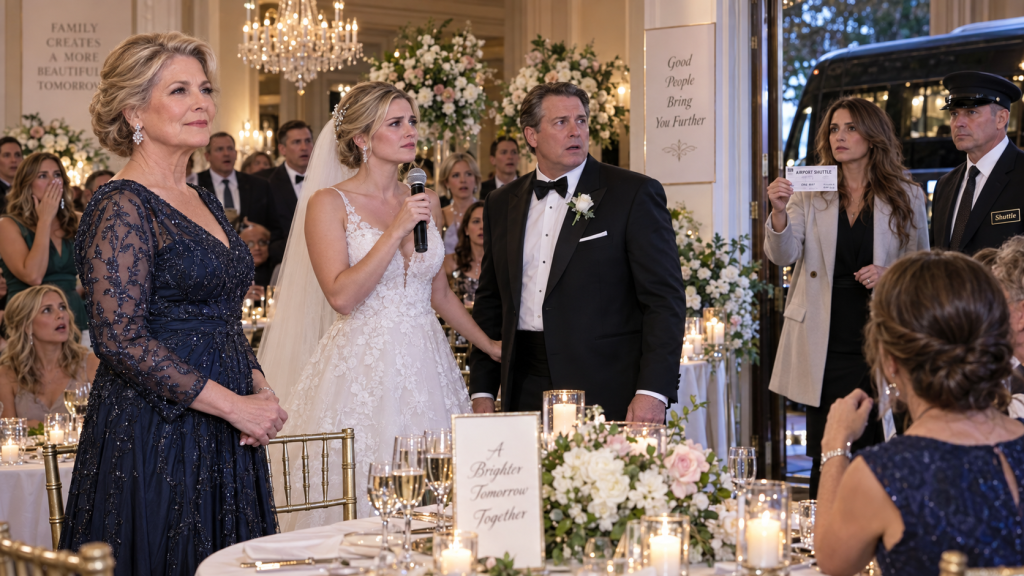
Yesterday my husband told the wedding shuttle driver to leave me behind at the hotel. I took the spare ticket back. Before the reception ends tonight, his family will hear why the driver has been told to keep one particular seat empty.

“You can get a cab. We’re already late,” my husband said.
He was standing beside a bus I had paid $860 to reserve for his daughter’s wedding.
His sister climbed aboard with my overnight bag.
My place card was in that bag. So was the speech his daughter had asked me to give.
I had raised her from eleven.
Paid for the braces. Driven to the practices. Sat outside the bedroom after the first broken heart.
Now my husband was counting heads as though I were a suitcase he could collect tomorrow.
The driver leaned down from his seat.
“Ma’am, are you the person who made the booking?”
“Yes.”
“Then I need to speak to you before I move.”
My husband slapped the bus door with his palm.
“She always turns a small thing into a production.”
I stepped out of the doorway so nobody could accuse me of holding up the wedding.
“Go ahead,” I told the driver. “Call me at the next stop.”
He looked toward the empty front seat, then shut the door.
I could have gone home.
But the bride had called that morning and asked whether I would still stand beside her when she read something during dinner.
She had sounded frightened.
I wasn’t leaving that girl alone with whatever had frightened her.
The hotel clerk watched the shuttle disappear.
“Did your husband tell you there’s another car?”
“Whose car?”
“The one he arranged for the woman arriving from the airport.”
My hands went cold.
For months he had called every late trip a wedding errand.
He had made me pay deposits from my savings while he complained that the wedding was draining him.
And now a woman I knew nothing about had a car, while I was supposed to stand outside and find my own way.
“Did she give a name?” I asked.
“I can’t give out a guest’s information. But this was left for you.”
She handed me an envelope marked with my first name, Susan.
Inside was my missing speech.
Across the top, the bride had written, PLEASE DON’T READ THE SECOND PAGE UNTIL I ASK.
There had only been one page when I emailed it.
I folded it without turning it over.
My phone rang.
“I’m at the church,” the driver said. “Your husband changed the return list after you approved it.”
“He removed me.”
“He removed someone else too. That person called our office asking whether you would be on the bus.”
“Who?”
“She asked to tell you herself. She says your stepdaughter knows she’s coming.”
The clerk pointed to a waiting taxi.
“Your room account has already been charged for that. The bride called.”
I got in.
At the church, my husband’s sister met me beside the doors with my bag.
“There you are. We thought you’d decided to sulk.”
“Who told you that?”
She shifted the bag between her hands.
“Your husband said you threatened to ruin dinner unless your name was on every program.”
I took out my place card.
It read FAMILY FRIEND.
I had corrected the printer’s spelling of my own name on that card three weeks earlier.
It had said STEP MOTHER then.
He hadn’t forgotten me. He had edited me.
The ceremony was already beginning, so I sat near the back instead of making the bride look for me in the doorway.
She found me anyway.
For one second, she stopped walking.
Then she touched the folded paper in her bouquet and kept going.
After the ceremony, she caught my wrist outside the dressing room.
“Don’t let him send you home.”
“I’m here.”
“Did you get my page?”
I touched my bag.
“Who is coming from the airport?”
Before she could answer, her father appeared with a drink in each hand.
“You need to stop upsetting her,” he told me. “This is her day.”
The bride stepped between us.
“Then let me decide who’s in it.”
At dinner, the microphone waited beside her plate.
If she read my speech, I would be the difficult woman he had described.
If she read what she had added, there might be no way back for him.
The driver appeared at the reception doors beside a woman carrying the unused shuttle ticket.
My husband started toward them.
His daughter lifted the microphone and said, “Before Dad explains why that seat had to stay empty, the woman standing beside our driver needs to tell you whose
PART 2 — THE SEAT HE NEEDED TO KEEP EMPTY
“Before Dad explains why that seat had to stay empty,” the bride said, “the woman standing beside our driver needs to tell you whose ticket she is holding.”
The room went quiet.
Not wedding quiet.
Not the happy hush before a toast.
The other kind.
The kind that arrives when fifty people suddenly realize they may have been invited into a story they do not understand.
My husband stopped halfway across the dance floor.
The woman beside the shuttle driver held a cream-colored ticket between two fingers.
I recognized it immediately.
Same gold border.
Same printed route.
Hotel.
Church.
Reception.
Return.
The tickets had been mailed to me three weeks earlier because the shuttle reservation was in my name.
I had handed one to every person Robert told me needed transportation.
And I had kept two extras in my purse.
One of those extras was now in the stranger’s hand.
The bride—my stepdaughter, Hannah—stood behind the microphone in her wedding gown.
Her new husband, Daniel, sat beside her.
His hand rested over hers.
She looked terrified.
But she did not look confused.
That mattered.
She knew exactly who the woman was.
Robert did too.
I could see it in his face.
“Put the microphone down.”
he said.
Hannah’s jaw tightened.
“No.”
“Hannah.”
“This is not the time.”
“You said that this morning.”
Robert lowered his voice.
“This is your wedding.”
“Yes.”
She looked straight at him.
“So please stop using that sentence every time I make a choice you don’t like.”
A few people shifted in their seats.
His sister, Elaine, stared at her plate.
I stood near the edge of the room with my overnight bag still at my feet.
My place card was inside it.
FAMILY FRIEND.
I had never felt farther from that description.
Or closer to understanding why somebody had put it there.
The woman from the airport stepped forward.
She was around my age.
Maybe a little younger.
Dark blond hair gone mostly silver at the temples.
Navy dress.
No jewelry except a small pearl necklace.
She looked toward Hannah first.
Not Robert.
Not me.
Hannah nodded.
The woman’s mouth trembled.
Then she looked at the room.
“My name is Marianne Keller.”
Someone near Robert’s table inhaled sharply.
I knew the name.
Of course I did.
Everybody in Robert’s family knew the name.
Marianne.
Hannah’s mother.
The woman who had left.
The woman who “couldn’t handle motherhood.”
The woman Robert said moved west with another man when Hannah was ten.
The woman who supposedly stopped calling after the divorce became difficult.
The woman Hannah had not seen in almost fourteen years.
I looked at Robert.
He would not look at me.
My hands went cold.
Marianne lifted the ticket.
“This was issued to me yesterday.”
she said.
“Robert arranged for me to be transported separately from the airport and separately from the family shuttle.”
Robert took another step forward.
“Marianne.”
She turned.
“No.”
One word.
Calm.
Strangely familiar.
Not because I had heard her say it before.
Because I knew what it sounded like when a woman had finally stopped explaining herself to the same man.
Hannah said:
“Mom, tell them why you called the shuttle company.”
Mom.
The word hit me harder than I expected.
Not because I resented it.
Because Hannah had called me Mom twice in her life.
Once at thirteen when she had the flu.
Once at nineteen after too much champagne.
Both times she corrected herself.
I had never asked her not to.
I had also never asked her to.
Her mother was alive.
Even when none of us spoke her name.
Marianne looked at the driver.
Then at me.
“I called because Robert told me Susan had changed her mind about attending the reception.”
My stomach dropped.
I looked at Robert.
He said nothing.
Marianne continued.
“He said she had become upset over the seating arrangement and was threatening to make the wedding about herself.”
That explained Elaine’s comment outside the church.
We thought you’d decided to sulk.
I almost laughed.
Not because it was funny.
Because lies become much easier to see once you realize how many people were handed matching pieces.
Marianne looked at me directly.
“He also told me you knew I was coming.”
“I didn’t.”
“I know that now.”
She swallowed.
“He said you thought it would be healthier if we didn’t speak tonight.”
My whole body went cold.
“Healthier for whom?”
She looked at Robert.
“Apparently for him.”
Robert finally spoke.
“This is ridiculous.”
Hannah turned toward him.
“Which part?”
“Dragging family history into dinner.”
“You brought family history into dinner when you changed Susan’s place card.”
His face changed.
A murmur went through the room.
I looked at Hannah.
She knew.
Of course she knew.
She had written on the second page.
My missing speech was not really missing.
She had taken it.
Added to it.
Then somehow gotten it back to me at the hotel.
I reached into my bag.
The folded pages were still there.
PLEASE DON’T READ THE SECOND PAGE UNTIL I ASK.
Now I understood why.
She had not been preparing me to give a speech.
She had been trying to put the truth in my hands without giving her father enough time to stop it.
Robert looked around the room.
“This is exactly what I was trying to avoid.”
Daniel, the groom, spoke for the first time.
“Then you probably shouldn’t have lied to three different women.”
Robert stared at him.
“This is none of your business.”
Daniel looked at Hannah.
Then back at Robert.
“I married into the business about forty minutes ago.”
That earned one startled laugh from somewhere near the back.
Robert did not appreciate it.
His face reddened.
Hannah squeezed Daniel’s hand.
Then looked at Marianne.
“Tell Susan.”
Marianne’s eyes moved to me.
There was apology there.
And something else.
Fear.
“You should sit down.”
I almost smiled.
“I’ve had enough people assigning me seats today.”
Her mouth trembled.
Fair.
So I stood.
Marianne reached into her handbag.
She pulled out a thin envelope.
Old.
Creased.
My name was written across the front.
SUSAN WHITAKER
Not my married name.
My maiden name.
The handwriting was unfamiliar.
“Do you recognize this?”
she asked.
“No.”
“I wrote it twelve years ago.”
My heart stopped.
Twelve years.
I had been married to Robert for eleven.
Hannah had been twelve when I entered her life.
“What does it say?”
Marianne’s eyes filled.
“I was asking to meet you.”
I stared at her.
“Why?”
“Because Robert told me you were going to be spending time with Hannah.”
My mouth went dry.
“He told me he was serious about you.”
“That you were helping with school pickups.”
“That Hannah liked you.”
“That you might eventually become part of her life.”
I thought back to those early months.
Hannah at eleven.
Quiet.
Suspicious.
Too old for bedtime stories and too young to carry what her parents had made of each other.
I had started with rides to soccer.
Then homework at my kitchen table.
Then orthodontist appointments because Robert’s work “ran late.”
I never knew Marianne had asked to meet me.
I had been told she had moved to Arizona and wanted distance.
Marianne continued.
“I wanted to tell you three things.”
Her voice broke.
“That I did not hate you.”
“That I did not want Hannah forced to choose.”
“And that if you were going to become the woman helping raise her, I wanted you to know I was still trying to be her mother.”
The room blurred.
“What happened to the letter?”
She looked at Robert.
“I mailed it to his house because I didn’t know your address.”
Of course.
Robert had been the bridge.
And apparently the gate.
I looked at my husband.
“Did you get it?”
Silence.
“Robert.”
His jaw tightened.
“Yes.”
One word.
Eleven years of marriage shifted around it.
“What did you do with it?”
“I didn’t think it was appropriate.”
I almost laughed.
“Appropriate?”
“You and I were just starting.”
“You didn’t need Marianne dragging you into the custody mess.”
Marianne whispered:
“There was no active custody fight then.”
Robert ignored her.
“You were good with Hannah.”
he said to me.
“She was settling.”
“I didn’t want confusion.”
I stared.
“You decided I didn’t need to know her mother wanted to speak to me.”
“Yes.”
“And you decided Marianne didn’t get to speak to the woman helping raise her daughter.”
He rubbed his forehead.
“It was complicated.”
There is that word.
Complicated.
The adult version of hiding something because the complete truth might inconvenience the arrangement you prefer.
Hannah had gone very still.
“Dad.”
He turned.
“What?”
“Did you tell Mom Susan refused to meet her?”
The room seemed to stop breathing.
Robert’s eyes flicked toward Marianne.
Too late.
Marianne’s face collapsed.
I looked between them.
“What?”
Hannah’s voice shook.
“Answer me.”
Robert said:
“I told Marianne that Susan didn’t want to get involved.”
My stomach turned.
Marianne closed her eyes.
There.
He had not merely hidden the letter from me.
He had answered it for me.
He had given Marianne my rejection.
Without me knowing she had asked.
And then built our future on the distance he created.
I sat down.
Not because he told me to.
Because my knees finally failed.
The chair belonged to a cousin named Peter.
He stood quickly.
“Take it.”
I barely heard him.
Marianne continued softly.
“I thought you didn’t want contact.”
“I thought perhaps Robert was right.”
“That a clean separation would be easier for Hannah.”
“I hated you for a while.”
Her honesty almost comforted me.
“Not because you did anything.”
“Because I believed you had chosen to help replace me while refusing to even speak to me.”
My eyes filled.
“I didn’t know.”
“I know.”
“How?”
“Hannah showed me emails last month.”
I looked at my stepdaughter.
She swallowed.
“Some of Dad’s old account backups were still on the family desktop.”
Robert’s face changed.
There.
Another thing he had not expected.
“I was looking for photos of Grandpa for the memorial table.”
she said.
“I found an old mail archive.”
Robert said sharply:
“You went through my private email?”
Hannah stared.
“I found messages about me in a family computer backup.”
“That isn’t the point.”
“It is absolutely the point.”
Daniel said quietly.
Hannah continued.
“There were emails from Mom.”
“Years of them.”
My heart began pounding.
Years.
Marianne looked at me.
“I wrote constantly at first.”
“Not daily.”
“Not harassing him.”
“But birthdays.”
“School.”
“Christmas.”
“I asked for calls.”
“Visits.”
“Pictures.”
“Sometimes Robert responded.”
“Sometimes he didn’t.”
I looked at Hannah.
She looked destroyed.
“I never got them.”
she whispered.
Marianne nodded.
“I know.”
Robert said:
“That is not fair.”
Everyone looked at him.
He stepped forward.
“Tell the whole story.”
Marianne’s face tightened.
“I am trying.”
“No.”
“You make it sound like I just stole your child.”
“I never said that.”
“You left.”
There it was.
The family story.
Marianne stood straighter.
“Yes.”
“I did.”
For the first time, she turned toward the room instead of only Hannah.
“I left the marital home.”
“I moved four hours away.”
“I was overwhelmed.”
“I was depressed.”
“I was not functioning well.”
Her voice shook.
“I accepted a job near my sister because I needed help.”
“I made choices I regret.”
Hannah cried silently.
Marianne continued.
“For almost a year, Robert did most of the daily parenting.”
“That is true.”
“I missed visits.”
“Also true.”
“I once went six weeks without calling because I was in treatment for depression and ashamed to tell anyone.”
Robert’s family shifted.
This was not the glamorous abandoned-mother story.
It was messier.
Human.
Marianne looked at Robert.
“But I did not disappear forever.”
“No.”
Robert said.
“You came and went.”
“Yes.”
“And that hurt her.”
“Yes.”
“I know.”
No defense.
Then:
“But after I stabilized, you kept telling Hannah I was unreliable even when I was asking for scheduled contact.”
Robert shook his head.
“You were inconsistent.”
“For a while.”
“Years.”
“No.”
Marianne reached into her bag again.
“I brought records.”
That phrase changed the room.
Not threats.
Not accusations.
Records.
A stack of old certified mail receipts.
Printed emails.
Money-order copies.
Bank transfers.
Court correspondence.
Therapy summaries with portions redacted.
I watched Robert’s face.
He had always hated paper when it belonged to someone else.
Marianne handed the stack to Hannah.
“I am not asking you to read these tonight.”
Hannah held them like they were heavier than paper.
“I brought them because I don’t want another version of your life depending only on whichever parent is speaking.”
That sentence cut through everything.
I admired her for it.
Even while part of me wanted to scream.
Because for eleven years, I had unknowingly lived inside whichever parent was speaking.
And Robert had been the only one I heard.
Hannah opened the first page anyway.
Robert said:
“Please don’t.”
She looked at him.
“Why?”
“Because it’s your wedding.”
“You keep saying that like today gives you immunity.”
She read.
Then another page.
Her hands started shaking.
“Mom sent birthday money?”
Marianne nodded.
“Every year.”
I looked at Robert.
He stared at the floor.
Hannah asked:
“Where did it go?”
Robert looked up.
“It went into the household.”
My stomach turned.
“What does that mean?”
I asked.
“Expenses.”
“What expenses?”
“Hannah’s expenses.”
Marianne whispered:
“I labeled them for her.”
“I know.”
Robert snapped.
“Food, camps, school clothes.”
Hannah stared.
“You told me Mom never sent anything.”
Silence.
Robert’s face changed.
“You were a child.”
“That is not an answer.”
“I didn’t want money becoming a substitute for parenting.”
Hannah’s eyes filled.
“So you took it.”
“No.”
“I used it on you.”
“And then told me she sent nothing.”
He had no answer.
I thought about braces.
Those braces.
Four thousand eight hundred dollars after insurance.
I had paid the remaining balance from my savings because Robert said money was tight.
He told me:
“Marianne hasn’t contributed anything in years.”
My stomach turned.
“Did she send money when Hannah got braces?”
Robert went still.
Marianne looked at me.
“Yes.”
“How much?”
“Three thousand.”
I stopped breathing.
Hannah covered her mouth.
I looked at Robert.
“You told me there was nothing.”
“I didn’t ask you to pay all of it.”
“You let me.”
“You offered.”
“Because you told me her mother contributed nothing.”
He rubbed his face.
“It all went toward the household.”
I stood.
This time my knees worked.
“You keep saying household as though the word makes money disappear.”
“It was for Hannah.”
“Then why lie about where it came from?”
No answer.
Because the money had not been the point.
The story had.
If Marianne contributed, then she was not fully gone.
If she wrote, she was not fully gone.
If she tried, however imperfectly, then Robert’s version of himself as the abandoned heroic father became less clean.
And if I knew any of that, I might have asked questions.
Maybe even called her.
Elaine finally spoke.
Robert’s sister.
The woman who had carried my overnight bag onto the shuttle while I stood on the pavement.
“Robert.”
He turned.
She looked pale.
“Mom knew some of this.”
Robert’s face went hard.
“Elaine.”
Hannah looked toward her aunt.
“What did Grandma know?”
Elaine started crying.
Robert said:
“Not tonight.”
Hannah said:
“Tonight.”
One word.
Her wedding.
Her choice.
Elaine wiped her face.
“Marianne came to the house once.”
“When?”
“Your thirteenth birthday.”
Hannah went completely still.
I remembered that birthday.
I had baked a cake.
Purple frosting.
Hannah had cried that evening for no reason she could explain.
Robert said adolescence was making her moody.
Elaine continued.
“She brought a gift.”
“A necklace.”
“Mom told her not to come inside.”
Hannah’s face drained.
“Grandma did?”
Elaine nodded.
“Dad knew?”
“Yes.”
“Did Susan?”
“No.”
I stared at Robert.
He had spent that entire afternoon beside me.
Laughing.
Cutting cake.
Telling Hannah:
“Your mom didn’t even call.”
Marianne had been outside the house.
With a gift.
Hannah sank into her chair.
Daniel moved beside her immediately.
Not speaking.
Just there.
Good man.
She whispered:
“What happened to the necklace?”
Elaine looked at Robert.
He closed his eyes.
Marianne answered.
“I still have it.”
Hannah started crying.
Not wedding tears.
Not graceful.
Her shoulders folded.
The microphone slipped from her hand and landed softly against the tablecloth.
Daniel pulled her into him.
The entire room seemed to understand at once that none of us mattered more than the bride in that moment.
No one spoke.
No one moved.
Robert took one step toward her.
“Hannah.”
She raised one hand.
He stopped.
That was perhaps the first boundary I had ever seen him obey immediately.
Several minutes passed before Hannah lifted her head.
She looked at me.
“Susan.”
I stepped closer.
Her makeup was streaked.
She looked twelve.
Then twenty-six.
Both at once.
“I’m sorry.”
My chest tightened.
“For what?”
“The place card.”
“You didn’t do it.”
“I knew Dad changed it yesterday.”
There.
Another truth.
“I told him to change it back.”
“He said the printer was already done.”
I looked at Robert.
Of course.
Hannah continued.
“I was going to fix it myself at the reception.”
“That’s why I took your speech.”
I touched the pages in my bag.
“What did you write?”
“Read it.”
I hesitated.
“Now?”
She nodded.
The room had already lost any illusion that dinner would return to normal.
So I unfolded the pages.
My original speech was on top.
I had written about Hannah at eleven.
About the first school concert.
About learning to braid hair badly.
About Samuel never meeting the adult she became.
About Daniel being wise enough to love the stubbornness in her instead of trying to smooth it away.
Then the second page.
Hannah’s handwriting across the top.
Susan, if Dad tries to erase you today, please read this instead.
My throat closed.
Below that:
My father did not raise me alone.
I stopped.
Could not continue.
Hannah said:
“Please.”
So I read aloud.
“My father did not raise me alone.”
My voice shook through the microphone.
“When I was eleven, Susan began showing up.”
“She did not arrive with a title.”
“She arrived with snacks in the car.”
“Extra hair ties.”
“Money for the field trip I forgot to mention.”
“She sat outside my door the first year because I would not let her come in.”
“She never told me I owed her the word Mom.”
“She never asked me to choose.”
The room blurred.
I kept reading.
“She paid for my braces.”
“Helped with my first car.”
“Taught me how to drive in an empty church parking lot.”
“She was the person I called at nineteen when I was too embarrassed to call Dad.”
“And she is the woman who paid for the shuttle that brought almost everyone to this wedding.”
A few people laughed softly through tears.
Then:
“So if her place card says family friend, please understand that the printer is wrong.”
I looked at Hannah.
She was crying.
I could barely see.
I continued.
“Susan is my family.”
The room disappeared.
“She did not replace my mother.”
“She never tried.”
“And now that I know more about how my mother was kept away, that matters to me more than I know how to explain.”
I stopped again.
Robert looked down.
Marianne cried silently.
The final lines were shorter.
“I have spent my whole life hearing that family is the people who stay.”
“I think that is incomplete.”
“Family is also the people who tell you the truth about who stayed, who left, who tried to return, and who was standing outside the door.”
I folded the page.
Nobody clapped.
Thank God.
Some things should not become performances.
Hannah reached for my hand.
Then Marianne’s.
For one strange moment, the three of us stood there.
Mother.
Step-mother.
Daughter.
Not rivals.
Not a replacement story.
Three women damaged differently by one man’s need to decide which relationships were convenient.
Robert looked at us.
He seemed genuinely devastated.
That mattered.
He was not smiling.
Not pretending.
Not indifferent.
People can love you and still manipulate the structure around that love.
That is what makes these stories harder.
Then the shuttle driver cleared his throat.
Everyone turned.
He looked uncomfortable being the only man in the room who had arrived with transportation paperwork and accidentally walked into fourteen years of family history.
“Mrs. Whitaker?”
“Yes?”
“I still have the passenger list.”
I almost laughed.
Of course he did.
“What about it?”
“You asked me to call at the next stop.”
“I did.”
He reached into a folder.
“Mr. Whitaker changed the return manifest yesterday afternoon.”
Robert’s face tightened.
The driver continued.
“Two names were removed.”
“Yours.”
He looked toward Marianne.
“And Ms. Keller’s.”
There.
Not one.
Two.
“The front row had originally been reserved for Susan and a guest at the booking holder’s discretion.”
he said.
“I was told yesterday that the front seat beside the driver had to remain empty.”
My skin prickled.
“Why?”
The driver looked at Robert.
“He said there was a family dispute and that if Mrs. Whitaker and Ms. Keller were seated near each other, there could be a scene.”
The room went cold.
Not protect the bride.
Not logistics.
Separate the women.
That empty seat was not about capacity.
It was space.
A deliberate gap between two people Robert could not afford to let compare notes.
Marianne looked at me.
“That’s why I called the company.”
“What did you ask?”
“Whether you were riding back.”
“Why?”
She hesitated.
Then:
“Because Robert told me you had refused to sit on the same shuttle with me.”
I closed my eyes.
Of course.
To Marianne:
Susan doesn’t want you.
To me:
Marianne disappeared.
To Hannah:
Your mother never calls.
To Elaine:
Susan is sulking.
To the wedding guests:
Family dispute.
Different stories.
One benefit.
Keep everyone separated enough that no one notices the contradictions.
Robert finally said:
“I was trying to get through one day.”
Hannah turned.
“You have been trying to ‘get through one day’ for fourteen years.”
His face collapsed.
“I made mistakes.”
Marianne laughed once.
Not kindly.
“No.”
She said.
“You made decisions.”
Silence.
That sentence landed harder than anything else.
Because mistakes are what happen when you forget a ticket.
Use the wrong place card.
Book the wrong car.
Decisions are what happen when you intercept letters.
Answer them for someone else.
Hide money.
Change passenger lists.
Tell one woman another rejected her.
Tell a daughter her mother did not call.
Robert looked at me.
“I never wanted to hurt you.”
I believed him.
That was almost worse.
“You wanted a life that was easier to manage.”
I said.
His eyes filled.
“Yes.”
Finally.
Truth.
Then Hannah asked:
“Why did you invite Mom at all?”
Robert looked at Marianne.
I had wondered the same thing.
If he wanted her gone, why arrange an airport car?
Why a ticket?
Why risk the wedding?
Marianne answered.
“Because I told him I was coming whether he invited me or not.”
Hannah stared.
“What?”
“I found Daniel online.”
Daniel raised one hand faintly.
“She contacted me in February.”
Robert turned toward his new son-in-law.
“You knew?”
Daniel nodded.
“Yes.”
Hannah squeezed his hand.
“I knew too.”
Robert looked from one to the other.
The control he thought he still had over the day vanished.
Hannah continued.
“I wanted Mom here.”
“So I asked her.”
“Dad found out in March.”
“He spent two months trying to convince me it would ruin the wedding.”
I stared.
The late errands.
The secret calls.
The tension.
Not an affair.
Not exactly.
Something different.
He had been managing the return of the woman he had spent years keeping outside.
Marianne said:
“He offered to pay my hotel.”
“Flight.”
“Car.”
“Everything.”
“Why?”
I asked.
She looked at Robert.
“Because he wanted me to agree to come to the ceremony and leave before dinner.”
Hannah’s face hardened.
“You never told me that.”
“I said no.”
Marianne continued.
“He then said if I insisted on attending dinner, I needed to stay away from Susan because ‘she has no idea what really happened and she’s fragile.’”
My eyebrows went up.
Fragile.
How thoughtful.
Robert looked at me.
“I was afraid this would destroy you.”
“No.”
I said.
“You were afraid the truth would change how I saw you.”
He stopped.
There.
The same sentence in a different marriage.
Protection often turns out to be fear of another person’s informed choice.
The reception never recovered.
That sounds terrible.
It wasn’t.
It changed.
The DJ quietly lowered the music.
Dinner resumed twenty minutes later.
People ate because food had already been paid for and human beings eventually become hungry even in scandal.
Hannah did not cancel her first dance.
She danced with Daniel.
Then with Robert.
That surprised everyone.
Especially Robert.
When he stood before her, he looked like he was afraid to touch her.
Hannah placed one hand on his shoulder.
They moved slowly.
No speeches.
No public forgiveness.
Just a daughter allowing her father three minutes inside a relationship he had badly damaged.
That was hers to choose.
No one clapped until the song ended.
I sat with Marianne.
The seating chart had no place for her.
Of course.
The banquet manager found a chair.
Placed it beside mine.
Nobody asked Robert.
That felt significant.
For the first few minutes, neither of us knew what to say.
Then Marianne looked at my plate.
“You hate mushrooms.”
I stared.
“How do you know?”
She smiled sadly.
“Hannah told me.”
“When?”
“Last month.”
I looked at my stepdaughter across the room.
She had been building a relationship with her mother quietly.
Not because she was ashamed.
Because she was afraid her father would stop it.
The cycle repeating.
Children hiding truth to survive adult reactions.
I hated that.
Then Marianne said:
“Thank you.”
I looked back.
“For what?”
“For loving her.”
My throat tightened.
“You don’t owe me gratitude for that.”
“I know.”
“Still.”
I nodded.
Then:
“I wish I had known you were trying.”
Her face folded.
“I wish I had tried harder.”
We sat with those two wishes.
Neither repaired the past.
Both deserved room.
Later, Craig—
No.
Wrong man.
Robert came toward me near the bar.
I had begun to think of him as Robert rather than my husband.
That frightened me.
He stopped several feet away.
“Susan.”
“What?”
“Can we talk outside?”
“No.”
His face tightened.
“Please.”
“Not tonight.”
“Then when?”
I looked at him.
“I don’t know.”
He swallowed.
“Are you leaving me?”
The question came quietly.
Not angry.
Finally frightened for the right reason.
I thought about eleven years.
The good ones.
There had been good ones.
Morning coffee.
Road trips.
His hand on my back at Samuel’s memorial service.
The way he brought soup when I had pneumonia.
The father he often was to Hannah.
The husband he sometimes was to me.
Truth does not erase all kindness.
It simply changes what kindness is allowed to excuse.
“I don’t know.”
I said.
He closed his eyes.
“For once, you are going to have to live without knowing what I decide before I decide it.”
He nodded.
Maybe because he finally understood the sentence.
At eleven fifteen, the shuttle driver came to find me.
“Mrs. Whitaker?”
“Yes?”
“We’re preparing the return trip.”
I almost laughed at the absurd normality.
“Of course.”
“Where would you like to sit?”
The question nearly broke me.
Where would I like to sit?
Not where Robert put me.
Not where the place card placed me.
Not where family tradition or convenience left room.
My choice.
I looked at Marianne.
Then Hannah.
Then at the empty front seat.
“Leave the front seat empty.”
The driver blinked.
Robert looked toward us.
I continued.
“Not because anyone is being separated.”
“Because I paid for it.”
“And tonight I would like one empty seat.”
He smiled slightly.
“Yes, ma’am.”
Hannah laughed through tears.
That became the spare ticket I took back.
Not to punish anyone.
To prove that an empty seat can mean two completely different things.
Robert had used one to keep truth apart.
I used one because I finally understood I did not have to fill every space simply because somebody else wanted it occupied.
Marianne sat beside Hannah.
I sat across the aisle.
Robert rode in another vehicle with Elaine.
No one planned that.
He chose it.
Maybe wisely.
On the ride back, Hannah leaned over.
“Susan?”
“Yes?”
“You never gave your speech.”
I smiled.
“I gave the important page.”
“No.”
She shook her head.
“I want yours too.”
“At midnight?”
“It’s my wedding.”
That excuse again.
This time I let her have it.
I pulled the original page from my bag.
Read quietly.
No microphone.
No fifty guests.
Just Hannah.
Daniel.
Marianne.
A driver who had heard far too much.
I told her she had been difficult at eleven.
She objected.
I told her Samuel would have loved Daniel.
She cried.
I told her the first time she trusted me enough to sleep while I sat beside her hospital bed after an appendectomy at thirteen—
she laughed and said:
“You snored.”
“I did not.”
“You absolutely did.”
Marianne smiled.
She had not been there for that memory.
I hated that.
But I did not apologize for having it.
Love is not theft merely because someone else was denied access.
We were all going to have to learn that.
At the hotel, Hannah hugged me before going upstairs.
Then Marianne.
Then both of us together.
Awkward.
Real.
Robert stood near the lobby doors.
Watching.
Not included.
For once, nobody rushed to make that easier for him.
I thought the worst truth of the wedding had already come out.
It had not.
At 1:07 in the morning, Hannah knocked on my hotel-room door.
Still in her wedding dress.
Barefoot.
Daniel behind her carrying her shoes.
Marianne stood farther down the hall.
I opened the door.
“What happened?”
Hannah held the old mail archive on a flash drive.
Her face was white.
“I found another folder.”
My stomach tightened.
“Tonight?”
“I knew it was there before.”
“Dad password-protected it.”
“Daniel guessed the password.”
Daniel looked embarrassed.
“It was her birthday.”
Hannah almost smiled.
Then did not.
The folder was named:
SCHOOL / HANNAH
I stared.
“What is it?”
Hannah handed me the laptop.
Inside were scanned checks.
Invoices.
Letters.
Custody documents.
And one spreadsheet.
Thirteen years old.
Robert had created it.
Columns:
MARIANNE PAYMENT
SUSAN PAYMENT
HOUSEHOLD
H CREDIT
Hannah whispered:
“I think Dad kept track of everything both of you paid.”
My skin went cold.
“What does H credit mean?”
“I don’t know.”
She opened the sheet.
Braces.
Summer camp.
Soccer fees.
Therapy.
School uniforms.
College application prep.
Line after line.
Marianne’s payments in one column.
Mine in another.
But beside many of them, another number appeared in the H CREDIT column.
Sometimes equal to Marianne’s payment.
Sometimes mine.
Sometimes both.
Daniel said quietly:
“I think he was representing those expenses somewhere else as his.”
My chest tightened.
“Where?”
Hannah opened a PDF from the same folder.
A financial disclosure from the divorce period.
Then later loan applications.
Then something newer.
A college financial-aid form from when Hannah was seventeen.
Robert had claimed he personally paid nearly all child-related expenses.
Marianne’s contributions were omitted.
Mine did not exist yet in the early records.
Later documents were different.
More troubling.
A tax-preparation worksheet from six years earlier contained a handwritten note:
Susan covers household extras — treat as spousal contribution.
That could be ordinary.
Then another file.
A personal loan application.
Robert had listed my savings account under:
Household liquid reserves available.
I stared.
“Did he have access to my savings?”
“I don’t know.”
Hannah whispered.
“But that isn’t the worst one.”
Of course.
She opened a recent PDF.
Dated three months before the wedding.
A private financial statement Robert had submitted to a lender connected to a business refinance.
Under Other Available Family Support, he had written:
Expected wedding reimbursement from Marianne Keller: $24,000.
Marianne made a sound behind us.
“What?”
I turned.
“You never promised him twenty-four thousand?”
“No.”
Hannah’s hands started shaking.
Then Daniel opened one final email.
Robert to Marianne.
Six months earlier.
If you want to be included in the wedding, you need to help cover what Susan isn’t. I’ve already told Hannah you offered.
Marianne stared.
“I never received that.”
Daniel looked closer.
“It bounced.”
Wrong address.
One letter missing.
One digit transposed.
Maybe accidental.
Maybe not.
Then Hannah whispered:
“Look at the next email.”
Robert to himself.
Subject:
Transportation / Seating
Body:
Keep Susan and Marianne separate until after dinner. If they compare numbers, everything gets complicated.
The room went silent.
There it was.
Not only letters.
Not only old hurt.
Numbers.
Money.
For years, Robert had told each woman a different story about who paid, who refused, who abandoned, who owed.
And the empty shuttle seat had not been only about emotional history.
He had been keeping two ledgers apart.
Two women apart.
Two versions of the same family apart.
Because if we ever sat beside each other long enough to compare what we had been told—
we might discover that Robert had been doing more than rewriting who loved Hannah.
He had also been rewriting who paid for her life.
And somewhere inside those files was the reason he had needed that seat empty until the reception was over.
PART 3 — THE SEAT HE COULD NO LONGER KEEP EMPTY
For several seconds, nobody moved.
The hotel room was too bright for one in the morning.
Hannah stood in her wedding dress with the train gathered over one arm.
Daniel held her shoes.
Marianne stood near the window.
And I sat on the edge of the bed with Robert’s spreadsheet glowing on the laptop between us.
Three women.
One daughter.
One man’s accounting.
I stared at the column again.
MARIANNE PAYMENT
SUSAN PAYMENT
HOUSEHOLD
H CREDIT
Line after line.
Braces.
Soccer.
Therapy.
School fees.
College applications.
Car insurance.
Medical deductibles.
Wedding deposits.
Even the shuttle.
Eight hundred sixty dollars.
My payment appeared in one column.
Then the exact same amount appeared again under H CREDIT.
I felt cold.
“Hannah.”
“Yes?”
“Do you know what H Credit means?”
She shook her head.
Daniel looked closer.
“Could be household credit.”
Marianne stepped toward us.
“Or Hannah credit.”
Neither answer helped.
I closed the laptop.
“Enough.”
Hannah stared at me.
“What?”
“You got married twelve hours ago.”
My voice shook.
“You are not spending your wedding night auditing your father.”
Her face crumpled.
“But—”
“No.”
I stood.
“Whatever is in here will still be ugly tomorrow.”
“You only get tonight once.”
Daniel looked relieved.
Hannah did not.
“What if he deletes everything?”
“The files are copied?”
Daniel lifted the flash drive.
“Yes.”
“Then stop.”
I touched Hannah’s cheek.
“Go upstairs.”
“Take off the dress.”
“Be married.”
Her eyes filled.
“Susan.”
“I’m not telling you to forget.”
“I’m telling you that your father has already taken enough of this day.”
That reached her.
She looked at Marianne.
Then at me.
Finally she nodded.
Before leaving, she hugged me.
Then Marianne.
Separately.
Not a symbolic three-person embrace.
Good.
Real relationships do not need choreography.
Marianne stayed.
I did not ask her to.
She simply sat in the chair by the window after the door closed.
For a long time, neither of us spoke.
Then she said:
“I think H Credit means household credit.”
I looked at her.
“Why?”
“Robert used that phrase during the divorce.”
My stomach tightened.
She continued.
“He would say, ‘I’m not receiving support from you. It all goes into the household.’”
There was that word again.
Household.
A word large enough to hide every hand that filled it.
“What did it mean legally?”
“I don’t know.”
Marianne smiled without humor.
“My lawyer understood the numbers.”
“I mostly understood that Robert always sounded certain.”
I knew that feeling.
She looked at the closed laptop.
“Do you think he stole from us?”
I thought before answering.
“No.”
Her eyebrows rose.
“You don’t?”
“I think he lied.”
“I think he hid things.”
“I think he may have misrepresented who paid what.”
“And I think we need an accountant and lawyers before calling anything theft.”
Marianne nodded slowly.
“You’re very calm.”
“No.”
I looked at her.
“I’m seventy dollars from ordering a hotel minibar bottle of whiskey, and I don’t drink whiskey.”
She laughed.
It was the first time we laughed together.
It felt wrong.
Then, strangely, not wrong at all.
At two in the morning, I opened my original wedding speech.
Not Hannah’s added page.
Mine.
I reread one line.
A good marriage should make the truth easier to tell, not harder.
I had written it about Hannah and Daniel.
I had thought it was advice.
Now it sounded like an indictment.
Marianne looked at the page.
“What did you write?”
“Apparently something I needed more than they did.”
I handed it to her.
She read quietly.
Then said:
“You loved him.”
I looked toward the carpet.
“Yes.”
“Do you still?”
That question hurt because it was not difficult.
“Yes.”
Marianne closed her eyes.
“I’m sorry.”
“Don’t be.”
“I know what people think.”
“What?”
“That if somebody lies this much, love must have been fake.”
I looked at her.
“It wasn’t.”
“No.”
She shook her head.
“That’s what makes it so hard.”
There it was.
Something only a woman who had once loved Robert might understand.
He had not been pretending every morning.
He had not spent twenty years planning a villain’s life.
He had loved Hannah.
Loved me.
Maybe, once, loved Marianne.
And still built lies around all of us because control felt safer to him than uncertainty.
Love had existed.
It had simply not made him honest.
I slept for forty minutes.
At seven, I called my brother’s accountant.
Not because he was a specialist in divorce.
Because he knew how to read numbers without becoming emotionally impressed by them.
He referred me to a forensic accountant named Carol Vance and told me to call a lawyer before I touched any shared financial records.
By nine thirty, I had done both.
The lawyer, Denise Holloway, asked the first question nobody in Robert’s family ever asked.
“Do you feel safe going home with him?”
I thought.
Physically?
Yes.
Emotionally?
No.
Financially?
I no longer knew.
So I answered:
“I don’t know enough.”
She said:
“Then don’t rush.”
Simple.
No dramatic advice.
No:
Leave him immediately.
No:
Save the marriage.
Just:
Do not make permanent decisions while facts are still moving.
I liked her immediately.
Robert called at ten.
I answered.
“Susan.”
“Yes.”
His voice sounded exhausted.
“Where are you?”
“Hotel.”
“Alone?”
I almost laughed.
“Why?”
“Because I need to talk to you.”
“No.”
“Susan.”
“We found the spreadsheet.”
Silence.
I listened to him breathe.
Then:
“Hannah had no right to go through my files.”
There it was.
The first concern.
Not the contents.
The access.
“Did you keep records of what Marianne and I paid?”
“Yes.”
“Why?”
“Because somebody had to keep track.”
“Of what?”
“Family expenses.”
“What is H Credit?”
Long pause.
Then:
“Household credit.”
Marianne had been right.
“What does that mean?”
“It’s just an internal note.”
“Meaning?”
“Susan, please.”
“No.”
I sat at the little hotel desk.
“If you want to speak to me, speak plainly.”
Another pause.
Then:
“It meant amounts I treated as household contributions when I calculated what I was covering.”
My hand tightened around the phone.
“You mean money other people paid.”
“Sometimes.”
“And you counted it as money you paid.”
“That’s not how I would phrase it.”
“Then phrase it.”
Silence.
Finally:
“I counted all money passing through the household as part of the household support I was responsible for.”
There it was.
A sentence so polished it almost deserved a frame.
“You were responsible for money Marianne sent.”
“Yes.”
“That does not mean it came from you.”
“No.”
“You were responsible for money I paid.”
“Yes.”
“That does not mean it came from you.”
“No.”
“Did you understand that when you built the spreadsheet?”
Long silence.
“Yes.”
Good.
At least we had reached earth.
“Did you use those numbers on loan applications?”
He exhaled.
“Some.”
“Did you claim my savings were yours?”
“No.”
“You listed them as household liquid reserves available.”
“That is not the same thing.”
“Were they available to you?”
“We were married.”
My body went cold.
“That is not an answer.”
“We had access to household resources.”
“Did you have access to my savings account?”
“No.”
“Could you withdraw from it?”
“No.”
“Had I promised to use it for your business?”
“No.”
“Then it was not available.”
He said nothing.
I continued.
“Did Marianne promise you twenty-four thousand dollars for the wedding?”
“No.”
“Then why did you put it on a financial statement?”
“I expected her to contribute.”
I laughed once.
There it was again.
Expected.
That dangerous little bridge between asking and taking.
“Did she agree?”
“No.”
“Then it was not available either.”
“Susan, the lender never advanced money based solely on that line.”
“That is not the point.”
“I know.”
“No.”
I said quietly.
“You are beginning to.”
I asked him to meet the next day.
Not alone.
With Denise, my lawyer, and an accountant available later if needed.
Robert resisted.
Then stopped.
Maybe because he realized resistance had finally become expensive.
Hannah and Daniel left for their short honeymoon that afternoon.
Three days at a lake.
Nothing extravagant.
Before she left, Hannah called me.
“Are you okay?”
“No.”
“Is Dad?”
“I don’t know.”
“Are you leaving him?”
The question came out in one terrified breath.
I closed my eyes.
“Hannah.”
“I’m sorry.”
“No.”
“You are allowed to wonder.”
“But you are not responsible for what I decide.”
Silence.
Then:
“I feel like this is my fault because I invited Mom.”
“No.”
“If Marianne had not come—”
“Then I would still be married inside a version of my life I did not fully understand.”
“That is not a favor.”
She cried quietly.
I continued.
“You invited your mother to your wedding.”
“That was your right.”
“Your father’s choices came before your invitation.”
“Do not reorder history to make yourself guilty.”
She breathed.
Then:
“Okay.”
I was learning how often women answer pain by volunteering for blame.
Maybe because blame feels like control.
If I caused it, perhaps I could have prevented it.
Sometimes we cannot.
The meeting with Robert lasted four hours.
Carol Vance joined for the financial portion.
She was sixty.
Short hair.
Glasses on a chain.
No patience for emotional accounting.
She reviewed the spreadsheet first.
Then bank records Robert agreed to provide.
Then the loan materials.
Her conclusion was less explosive than my fear had been.
And more damning emotionally.
Robert had not been secretly stealing all of Marianne’s payments.
Most of the money she sent had gone into accounts used for Hannah’s expenses.
Some went toward general household bills during periods when Robert was the custodial parent.
That could be legitimate depending on the arrangement.
Some of my contributions had similarly paid exactly what I intended.
Braces.
School.
Wedding deposits.
There was no hidden vault.
No second family.
No enormous theft.
I should have felt relief.
Instead I felt strangely sad.
Because evil would have been easier.
What Robert had built was not a criminal empire.
It was a reputation.
He had spent years making sure he remained the visible provider at the center of every room, even when other people were carrying the weight.
Carol pointed to H CREDIT.
“This is not an accounting term.”
Robert stared.
“I know.”
“What did you use it for?”
“Internal budgeting.”
She waited.
He looked at me.
Then Marianne’s records.
Finally:
“It represented household expenses I considered under my responsibility.”
Carol said:
“Even when someone else directly funded them.”
“Yes.”
“And then some of these amounts appear in lender and personal-financial worksheets under your household support contributions.”
“Yes.”
“Was that accurate?”
Robert hesitated.
“No.”
Carol nodded.
That was all.
No speech.
Numbers rarely need one.
The lender issue was more serious.
Robert had a small property-management business.
Nothing like a corporation.
Three commercial properties.
Two partners.
A refinance under review.
The private financial statement had included my savings as “household liquid reserves available.”
It had included an expected wedding reimbursement from Marianne.
Neither was committed.
Robert had also included several household-expense totals without clearly separating what had come from other contributors.
Carol did not call it fraud.
Neither did my lawyer.
They said the lender needed corrected information and independent counsel should advise Robert about any disclosure obligations.
That was enough.
Robert looked humiliated.
Good.
But I did not enjoy it.
I wanted truth corrected, not a spectacle.
Then Denise asked:
“Why?”
Robert looked at her.
“Why what?”
“You were not destitute.”
“No.”
“You did not need Susan’s savings to qualify for every obligation.”
“No.”
“You did not need to tell Hannah Marianne sent nothing.”
“No.”
“You did not need to tell Marianne Susan refused to meet.”
“No.”
“So why build all these versions?”
Robert looked at me.
Then at the table.
His voice changed.
Quieter.
“My father left when I was twelve.”
Nobody spoke.
I knew that story.
Or thought I did.
“He left bills.”
“My mother worked two jobs.”
“People brought groceries.”
“Church people paid utilities.”
“My aunt bought school clothes.”
“And every time somebody helped us, I heard my mother thank them.”
He rubbed his eyes.
“I hated it.”
I stared.
“I hated how small she looked when she said thank you.”
His voice broke.
“So when Hannah came to live mostly with me, I promised myself she would never grow up feeling like her father needed rescuing.”
There.
The old wound.
Not an excuse.
A map.
Marianne said:
“So you erased me.”
Robert nodded.
“Partly.”
“You took the money.”
“Yes.”
“And then made sure Hannah thought it came from you.”
“Yes.”
Her face crumpled.
“Why?”
“Because if you were contributing, then I needed you.”
Marianne stared.
“And you could not tolerate needing me.”
“No.”
The honesty was brutal.
Then he looked at me.
“When Susan came into our lives, she was stable.”
“Kind.”
“Generous.”
“I told myself accepting help from my wife was different.”
I almost laughed.
“But then I still hid how much you did.”
“Yes.”
“Because?”
His eyes filled.
“Because I wanted you to think I was carrying you too.”
There it was.
The whole man.
Robert needed to be the one carrying the heavy side.
Not because he was generous like Samuel.
Because being carried frightened him.
And eventually he became willing to falsify the balance just to keep standing in the heroic position.
I asked:
“Why keep Marianne and me apart?”
Robert covered his face.
“Because you would compare stories.”
“That is obvious.”
“I mean before the wedding.”
“Why twelve years ago?”
He looked at me.
“Because you liked facts.”
I almost smiled.
“What?”
“You always asked follow-up questions.”
“When we started dating, you asked why Hannah didn’t see her mother.”
“I gave you the simple version.”
“She left.”
“Yes.”
“You would have asked Marianne what happened.”
“Probably.”
“And I thought she would tell you things that made me look…”
He stopped.
“Human?”
Marianne said.
Robert almost laughed through tears.
“Maybe.”
Then:
“I had spent years telling my family I was the one who stayed.”
“That story had become how I understood myself.”
His eyes moved to Hannah’s empty chair.
“And if Marianne had become complicated instead of absent, then I would have had to explain things I had done too.”
The intercepted letters.
The withheld calls.
The money.
The birthday necklace.
I nodded slowly.
“So you protected your identity.”
“Yes.”
“By controlling ours.”
He closed his eyes.
“Yes.”
That was the moment something ended inside me.
Not love.
Something more structural.
The marriage I thought we had.
Because Robert had not merely lied about old history before I arrived.
He had used me as a character in that lie.
He had told Marianne I rejected her.
Told Hannah her mother abandoned her.
Told me Marianne contributed nothing.
Told lenders my resources were available.
Told his family I was sulking.
Changed my place card.
Removed my shuttle seat.
Each version had one thing in common.
Robert remained the person deciding what everybody else was allowed to know.
I could no longer live inside that.
I did not decide divorce that day.
I asked Robert to move out temporarily.
He cried.
Then said:
“Okay.”
No argument.
That surprised me.
Maybe he finally understood that trying to manage my answer would confirm every reason I needed space.
He moved into a furnished apartment near his office.
I stayed in the house.
For the first time in eleven years, I slept alone in our bedroom.
It was awful.
And peaceful.
Both.
I missed him.
That felt like betrayal too.
People expect clarity after discovery.
I had grief.
One night, I reached for my phone to send him a picture of the dog asleep with its head inside a laundry basket.
Then stopped.
Cried for ten minutes.
Because Robert would have found it funny.
Lies do not erase private jokes.
That is what makes leaving difficult.
Hannah returned from her honeymoon and began rebuilding with Marianne.
Slowly.
No miracle.
Their first lunch lasted forty minutes.
Their second ended in an argument.
Marianne apologized too much.
Hannah became angry at that.
“You keep saying sorry before I even tell you what hurt.”
Marianne cried.
Then stopped apologizing long enough to listen.
Progress.
Hannah learned the fuller story.
Marianne had truly been unreliable for several years.
She had missed things.
Broken promises.
Prioritized recovery and survival in ways a child experienced as abandonment.
Robert had not invented all of Hannah’s hurt.
He had weaponized it.
That distinction helped.
Hannah did not need a villain mother replaced by a saint mother.
She needed the whole woman.
She also came to see me every Thursday for a while.
Not because we scheduled a formal healing ritual.
Because Daniel worked late Thursdays and she liked my soup.
One evening she said:
“I feel like I have two mothers.”
I smiled.
“That sounds inconvenient.”
“It is.”
She laughed.
Then cried.
“I thought loving Mom would betray you.”
I put down my spoon.
“No.”
“Dad made it feel that way.”
“I know.”
“Does it hurt?”
I thought.
“Yes.”
She looked guilty.
I reached across the table.
“Listen carefully.”
“It can hurt me and still be right for you.”
Her eyes filled.
“You are allowed to have a relationship with your mother without protecting me from every complicated feeling I have about it.”
That sentence took effort.
It was also true.
Love should not require one woman to vanish so another can feel secure.
Robert had built a family around that false choice.
We would not.
The lender records were corrected.
Robert informed his partners.
The refinance was delayed while updated financial information was reviewed.
Embarrassing.
Expensive.
Not catastrophic.
The business survived.
Carol Vance found no evidence he had secretly pledged my separate account or borrowed directly against it.
That mattered.
I did not need to make Robert financially monstrous to justify my emotional conclusion.
He had represented access he did not have.
That was serious enough.
He corrected it.
Paid additional professional fees.
Took the reputational hit with his partners.
Consequences.
Not destruction.
Robert began therapy.
His idea.
At first, I distrusted that too.
Everything he did looked strategic after you discover someone has been managing perceptions for years.
Our marriage counselor eventually said:
“You cannot require him to prove sincerity before allowing him to behave sincerely.”
That irritated me.
Mostly because it was correct.
So I stopped grading his therapy.
He went.
He worked.
He began writing letters to Hannah that contained no instructions about how she should feel.
He apologized to Marianne without asking her to tell Hannah he had changed.
He apologized to Elaine for using her as a messenger.
And to me—
he stopped sending apologies after I said:
“I have enough words.”
That was perhaps the most respectful thing he did.
Six months into our separation, we met at the house.
Just us.
No lawyers.
No counselor.
The dog nearly lost his mind when Robert walked in.
Traitor.
Robert sat at the kitchen table.
The same table where we had planned Hannah’s wedding.
The same place I had written checks.
The same room where he had told me Marianne contributed nothing.
He looked older.
“Susan.”
“Yes.”
“I know you don’t owe me an answer.”
“Good.”
He nodded.
Then:
“Do you want to stay married?”
There.
Direct.
No story around it.
I thought for a long time.
Then said:
“No.”
Robert’s face collapsed.
I cried too.
“I am sorry.”
he whispered.
“I know.”
“I love you.”
“I know.”
“You love me.”
It was not a question.
“Yes.”
That made him cry harder.
“So why?”
I closed my eyes.
Then answered as honestly as I could.
“Because I can imagine forgiving almost everything you did.”
“I cannot imagine spending the rest of my life wondering whether I’m hearing the full version.”
He looked down.
“I would tell you.”
“I believe you mean that.”
“Then—”
“No.”
I reached across the table.
Touched his hand.
“This is not punishment.”
“I do not need you to remain my husband in order for your change to be real.”
His fingers tightened around mine.
“I wanted another chance.”
“I know.”
“You deserved the chance to become more honest.”
I said.
“You are taking it.”
“That does not mean I owe the marriage the same future.”
He cried quietly.
Then nodded.
“Okay.”
No bargaining.
No accusations.
No:
After everything I’ve done.
Just okay.
That helped me love him as I left.
Our divorce was quiet.
Fair.
No hidden assets emerged.
No courtroom revelation.
We divided what was marital.
Kept what was separate.
My savings remained mine according to the applicable arrangements and documentation.
Robert kept his business interests subject to the settlement.
The house was sold because neither of us wanted it alone.
That surprised Hannah.
“Why sell?”
I looked around the dining room.
“Too many ledgers.”
She laughed through tears.
I bought a smaller townhouse.
Robert bought a condominium.
Marianne remained four hours away.
Life became less centralized.
Appropriate.
At the first Christmas after the divorce, Hannah invited all three of us.
Me.
Robert.
Marianne.
I considered refusing.
Then went.
Not for Robert.
For Hannah.
Dinner was awkward for twenty minutes.
Then Marianne burned the rolls.
Robert laughed.
She glared at him.
I laughed too.
And somehow the world did not end.
We were not friends.
We were not one big healed family.
We were adults sitting at one table without requiring somebody to disappear.
That alone felt revolutionary.
At one point, Hannah looked around and started crying.
Daniel put his arm around her.
“What?”
he asked.
She wiped her face.
“There are enough chairs.”
Nobody said anything for a moment.
Then I looked at Robert.
He looked down.
He understood.
The spare shuttle ticket stayed in my desk drawer.
I had taken it back after the wedding.
Cream paper.
Gold border.
A seat number nobody used.
For years, Robert had treated empty space as a tool.
Keep Susan here.
Marianne there.
Hannah in between.
Fill every gap with the story that best preserved him.
I kept that ticket because I learned another use for empty space.
Sometimes a seat should remain empty because nobody gets to assign it before the person who owns it decides what she wants.
Sometimes distance is not punishment.
It is room.
Room to think.
Room to compare stories.
Room to hear yourself without somebody explaining what you meant.
Marianne eventually gave Hannah the necklace she had brought to her thirteenth birthday.
Small silver chain.
Blue stone.
Hannah wore it on her thirtieth birthday.
Then she came to my townhouse wearing the bracelet I had given her at sixteen.
One from each of us.
No symbolism intended, she claimed.
Liar.
I said nothing.
Some sentimental acts deserve privacy.
Robert and Hannah repaired slowly.
Not completely.
She loved him.
That never disappeared.
But she stopped letting him tell her what other people meant.
If he said:
“Your mother is upset with me,”
Hannah answered:
“I’ll ask her.”
If he said:
“Susan probably doesn’t want—”
she stopped him.
“She can tell me.”
That became the new family discipline.
Ask the person.
Simple enough for children.
Apparently difficult enough to require decades for adults.
Years later, Robert apologized to me again.
Not privately.
Not publicly.
Casually.
We were waiting outside the hospital when Hannah gave birth to her first child.
He sat beside me.
Marianne was inside with her.
Daniel had gone to get coffee.
Robert looked at the empty chair between us.
Then said:
“I used to think if everyone talked directly to each other, I would become unnecessary.”
I looked at him.
“And?”
He smiled sadly.
“It turns out being unnecessary sometimes is healthy.”
I laughed.
“Yes.”
Then he said:
“I’m sorry I made your kindness disappear so I could look necessary.”
That sentence reached me.
Not because I needed it anymore.
Because he finally understood what he had taken.
Not money.
Visibility.
Authorship.
The right to have my choices belong to me.
“I forgive you.”
I said.
He looked surprised.
“Really?”
“Yes.”
Then:
“Do not make it dramatic.”
He laughed.
“I’ll try.”
“See that you do.”
Hannah named the baby Rose.
Not after me.
Thank God.
After a flower.
Marianne bought the stroller.
Robert paid for a crib.
I started an education account.
Small.
In my name.
With written terms.
Everyone laughed when I announced that last part.
“I’ve become extremely fond of documentation.”
I said.
Hannah kissed my cheek.
“Fair.”
And this time, if anyone asked who had funded it, the answer would be boring and correct.
Susan.
Because she wanted to.
Looking back, the wedding shuttle seems almost absurdly small.
An eight-hundred-sixty-dollar bus.
One missing seat.
One woman told to find a cab.
One other woman arriving from an airport.
But that was how Robert’s entire system worked.
Small separations.
Tiny edits.
Nothing dramatic enough, alone, to expose the pattern.
A changed place card.
A letter never delivered.
A payment relabeled.
A phone call not mentioned.
A shuttle list updated.
A sentence:
She doesn’t want to see you.
Another:
She never sent anything.
Another:
Susan understands.
That is how a person can control a family without ever locking a door.
He simply becomes the hallway everyone is required to walk through.
Robert had been our hallway for years.
At Hannah’s wedding, we finally walked around him.
I do not regret raising her.
Not one orthodontist bill.
Not one soccer practice.
Not one night outside her bedroom.
Marianne’s existence did not make my years with Hannah false.
My love did not become theft because her mother had been unfairly kept away.
That was one of the hardest lessons.
Robert had taught us all to think love required exclusive credit.
It doesn’t.
Hannah could have been abandoned in some moments and still unfairly separated from her mother in others.
Marianne could have failed her and loved her.
I could have mothered her without replacing anyone.
Robert could have been a devoted father and still manipulated the story of that devotion.
Human beings are wide enough to contain contradiction.
Truth becomes cruel only when somebody starts cutting away the parts that complicate the version he prefers.
At Hannah and Daniel’s fifth anniversary, they rented a small lodge.
No buses.
I joked that I refused to attend if transportation was involved.
Hannah sent me a photograph of twelve chairs arranged around a table.
Under it:
Counted twice. Yours is the one by the window.
I laughed so hard I cried.
Then I went.
Marianne sat two seats away.
Robert across from me.
Nobody had to be hidden.
Nobody had to be labeled family friend.
Nobody had to be kept from comparing numbers.
At dinner, Hannah stood with a glass of wine.
I groaned.
“No speeches.”
She ignored me.
Inherited stubbornness.
“Five years ago,” she said, “I thought the worst thing that could happen at my wedding was my parents fighting.”
Robert looked down.
Marianne smiled sadly.
Hannah continued.
“I was wrong.”
“The worst thing would have been everybody staying polite enough to let the lies survive.”
The room grew quiet.
Then she looked at me.
“And the best thing that happened was somebody took back an empty seat.”
My throat tightened.
She lifted her glass.
“To enough chairs.”
We all laughed.
Even Robert.
Especially Robert.
I was sixty-three when I married him.
Seventy-four when I divorced him.
Some people treated that as tragic.
Starting over at seventy-four.
I did not.
Starting over would have meant becoming twenty again.
I had no interest.
I continued.
That is different.
I continued with my pension.
My terrible knees.
My stepdaughter.
A strange, cautious friendship with Marianne.
A former husband I eventually learned how to care about from the appropriate distance.
And a life in which nobody else decided who I was allowed to speak to.
That did not feel like losing everything.
It felt like putting the furniture back where I wanted it.
The spare shuttle ticket is still in my desk.
The ink has faded.
I should throw it away.
I probably won’t.
On the back, years after the wedding, I wrote one sentence.
Not for Robert.
For me.
An empty seat is not rejection when you are the one choosing the space.
That was the lesson.
Not that families should expose every secret during weddings.
God forbid.
Not that every lie requires divorce.
Not that every marriage can be reduced to one bad day.
Mine could not.
Robert and I had love.
History.
Kindness.
And damage.
I left because I no longer wanted intimacy that required me to wonder whether my reality had been edited before it reached me.
That was my line.
Someone else might have chosen differently.
They would not automatically be wrong.
What mattered most was that the choice finally belonged to me.
Just like the shuttle.
I had paid for the seat.
Robert gave it away.
Then told me I could get a cab.
For years, that had been the shape of our marriage in ways I had not understood.
I provided something.
He decided what it meant.
I loved Hannah.
He decided what title I should have.
Marianne reached out.
He decided whether I should know.
I contributed money.
He decided whose credit it became.
I had a voice.
He decided when it was convenient to hear it.
At the wedding, I took one small thing back.
A spare ticket.
Then, slowly, everything else followed.
My money.
My relationships.
My name.
My version of what happened.
My right to ask Marianne directly.
My right to hear Hannah without Robert translating.
My right to love him and still leave him.
My right to keep a seat empty until I knew who, if anyone, I wanted beside me.
That was never cruelty.
It was choice.
And once I learned the difference, no one ever seated me outside my own life again.
THE END STORIES! THANK YOU FOR READING GOOD LUCK !❤️
Related Posts


