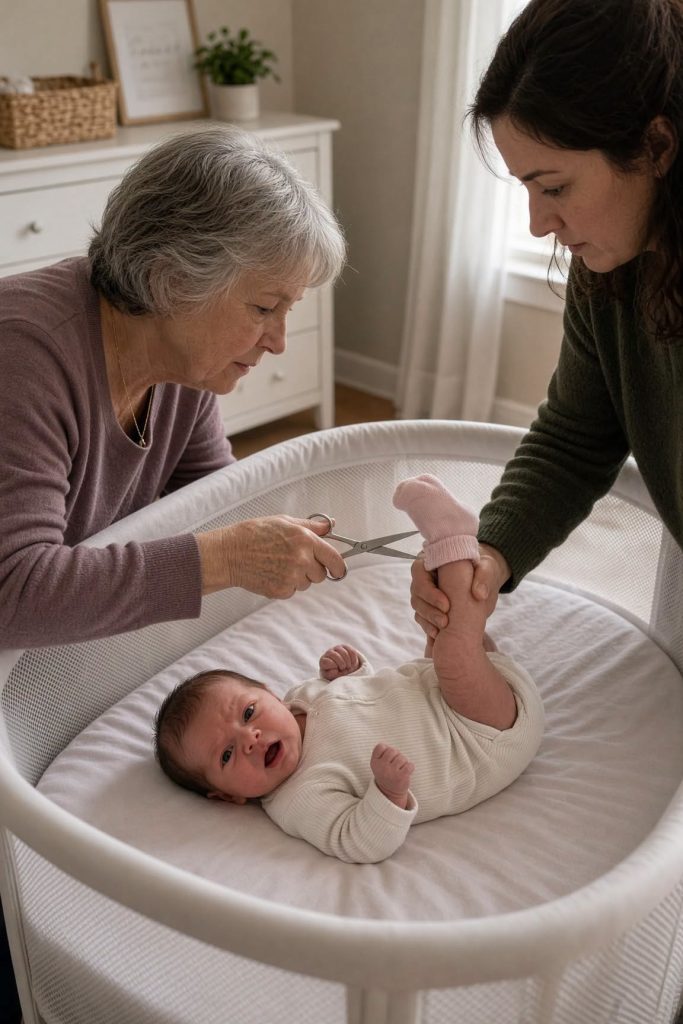
I found my newborn niece in her bassinet while her grandmother held small craft scissors against the edge of the baby’s sock and the baby’s aunt kept one hand wrapped around her ankle.

For one second, all I could see was the tiny sock, the metal blades beside it, and that hand around her ankle. There was no time to argue about what they thought they were doing. I reached in, grabbed the scissors before the blades could move any closer, and pulled the sock away.
Then I lifted my niece straight into my arms.
I barely had her against me when her grandmother hit me across the cheek. The blow opened the skin beneath my eye, and I felt the warm line of blood start running toward my jaw. I turned my face away from the baby and tightened my hold on her without letting go.
Her aunt came at me next.
She grabbed my hair and drove me sideways into the crib rail. My collarbone caught the edge hard enough that the pain flashed through my shoulder, and a dark bruise began forming across the spot almost immediately. Still, I kept my niece in my arms.
Everything around us seemed to break loose at once. Formula packets burst across the floor. Baby socks spilled from a basket and scattered around our feet. The craft scissors I had taken away clattered beneath the cabinet, finally out of anyone’s hand.
And blood kept sliding down my cheek.
I was trying to protect a newborn while two members of her own family were still coming at me. That was the part I couldn’t make sense of. Whatever argument existed before I walked into that room no longer mattered. The baby was in my arms, the scissors were under the cabinet, and they still hadn’t stopped.
Then my brother rushed in.
His eyes went first to his daughter. He saw her safe against me. Then he saw the blood beneath my eye, the bruise spreading across my collarbone, his mother beside me, and his sister still in the middle of the attack.
He moved immediately.
He struck his mother across the head, then grabbed his sister and dragged her away from me. His whole focus was on putting distance between them and his daughter. He ordered both women out while I stayed beside the crib, holding my niece and trying not to shift the shoulder that had just slammed into the rail.
The room looked like the struggle had been dumped across the floor: formula packets torn open, tiny socks everywhere, the scissors hidden beneath the cabinet, and the crib rail beside me.
My brother kept forcing his sister back.
Then the aunt’s handbag slipped from her and hit the floor, snapping open beside the crib.
PART 2 — WHAT FELL OUT OF BROOKE’S HANDBAG
Brooke’s handbag hit the hospital floor hard enough for the clasp to break open.
Everything inside spilled across the tile.
Lipstick.
Keys.
A phone charger.
Two granola bars.
A folded cardigan.
An envelope of cash.
And then a thick cream-colored folder slid beneath the bassinet.
At first, none of us paid attention to it.
There were more immediate problems.
My cheek was bleeding.
My collarbone felt as though someone had driven a nail through it.
Baby Lucy was screaming against my chest.
My brother Caleb had one arm extended between me and our mother, Diane, while using the other to keep Brooke several feet away.
“Get out.”
His voice shook.
Not loudly.
That made it worse.
“Both of you.”
Mom pressed one hand against the side of her head where Caleb had struck her while trying to stop the attack.
Her face was white with fury.
“You hit your own mother.”
Caleb stared at her.
“You were hitting my sister while she was holding my daughter.”
“I was trying to get Lucy back.”
“She wasn’t yours to take.”
“She is my granddaughter.”
“That does not make her yours.”
Brooke began crying.
Not quietly.
Not gently.
She pointed at me.
“She started this.”
I almost laughed.
Blood had reached my jaw.
My hair was half torn loose.
Lucy was pressed so tightly against me that I could feel every panicked breath leaving her tiny body.
And Brooke was still saying I had started it.
The door opened.
A nurse froze.
Her eyes moved quickly.
Baby.
Blood.
Scattered formula.
Brooke being restrained at a distance by Caleb.
Diane near the wall.
Scissors visible beneath the cabinet.
Then she hit the emergency button.
Everything changed at once.
Two nurses came in.
Then hospital security.
Someone took Lucy from me only after I heard Caleb say:
“That’s her nurse. Let her check the baby.”
Even then, my arms did not want to release.
My body had decided holding Lucy was the only task left in the world.
The nurse whispered:
“I’ve got her.”
I finally let go.
My hands were shaking.
Lucy was examined immediately.
No cut.
No visible injury around the ankle.
No problem with circulation.
No evidence that the scissors had touched skin.
The little white sock I had pulled away was on the floor.
Underneath it was what I had only glimpsed before the attack.
A narrow hospital security band around Lucy’s ankle.
That was what the scissors had been positioned beside.
Not her toes.
Not the sock itself.
The security band.
I stared.
My stomach turned.
“What were you doing?”
I asked.
Diane said nothing.
Brooke stopped crying.
Caleb saw it too.
His face changed.
The maternity unit used electronic infant-security bands.
Every baby received one.
Staff had explained it after Lucy was born.
The band was supposed to remain in place until discharge.
If someone attempted to remove Lucy from the protected area without authorization, alarms could activate.
I looked from the band to the scissors beneath the cabinet.
Then toward my mother.
“You were trying to cut it off.”
Diane’s jaw tightened.
“That thing was too tight.”
The nurse looked up immediately.
“It wasn’t.”
Mom ignored her.
“I told them yesterday it was irritating her ankle.”
The nurse checked the skin again.
“No irritation.”
Brooke snapped:
“You don’t know what we saw.”
The nurse stared at her.
“I know what I’m looking at now.”
Silence.
Caleb went pale.
He looked at Mom.
Then Brooke.
“Why would you remove the security band?”
Neither answered.
That was when I noticed the folder.
Half hidden beneath the bassinet.
Cream-colored.
My sister’s handwriting across the top.
LUCY — IMPORTANT
I pointed.
“Whose is that?”
Brooke moved first.
Too quickly.
She lunged toward the floor.
A security officer stepped between us.
“Don’t touch anything.”
Brooke stopped.
Her face changed.
And suddenly the folder mattered more than the scissors.
Hospital security contacted police.
Because there had been an assault.
Because someone had apparently interfered with infant security equipment.
Because nobody could yet explain why.
I was taken to the emergency department downstairs for my own injuries.
Four small stitches beneath my eye.
A deep contusion over my collarbone.
No fracture.
No concussion.
Painful.
Ugly.
Lucky.
I hated that word immediately.
Still, medically, I was.
Caleb stayed with Lucy.
His wife, Emily, was brought back from another part of the maternity floor forty minutes later.
She had delivered Lucy two days earlier by emergency cesarean section.
That morning, she developed worsening abdominal pain and dizziness, so staff had taken her for imaging.
Caleb had gone downstairs to move their car because they thought discharge might be delayed and he was parked in short-term parking.
For approximately fourteen minutes, Diane and Brooke were alone in the room with the baby.
Fourteen minutes.
That was apparently all they thought they needed.
Emily called me from the maternity floor while a nurse was cleaning dried blood from beneath my eye.
Her voice was weak.
“What happened?”
I closed my eyes.
“Lucy is safe.”
“I know.”
“Caleb told me.”
Then:
“What happened?”
There are truths that sound worse when repeated slowly.
I told her.
The scissors.
The ankle.
Mom hitting me.
Brooke grabbing my hair.
Caleb coming in.
The security band.
The folder.
Emily did not speak for several seconds.
Then whispered:
“They tried to take her.”
I opened my eyes.
“We don’t know that yet.”
“Yes.”
Her voice broke.
“We do.”
“Emily—”
“They’ve been talking about taking her for weeks.”
My stomach dropped.
“What?”
The nurse stopped moving.
I turned away slightly.
“What do you mean?”
Emily began crying.
Not loudly.
She sounded exhausted.
“Your mother kept saying I wasn’t ready.”
“For a baby?”
“For Lucy.”
My hands went cold.
“She said what?”
“She kept telling Caleb that I was too anxious.”
“That I’d had a difficult pregnancy.”
“That I’d probably get postpartum depression.”
“That the baby needed stability.”
I stared at the curtain beside my hospital bed.
“Why didn’t you tell me?”
“Because I thought she was being controlling.”
“She is controlling.”
“I didn’t think she was planning something.”
Then Emily whispered:
“Brooke asked me three weeks ago whether I would ever consider letting her keep Lucy for a few months.”
My heart stopped.
“Why would she ask that?”
“She said so I could recover.”
Brooke had always wanted children.
She was thirty-four.
Single.
No children.
That fact alone meant nothing.
Plenty of women without children adore nieces and nephews without trying to take them.
This was not a story about infertility turning someone dangerous.
It was about entitlement.
And Brooke had always been excellent at confusing wanting something with being wronged when she did not receive it.
“She told me Lucy would practically be hers anyway.”
Emily continued.
“Because she planned to help so much.”
My stomach tightened.
“Did Caleb know?”
“Some of it.”
“Not the worst parts.”
“Why?”
“Because every time I complained about Diane or Brooke, he said they were just excited.”
Of course.
Our family had been saying that for months.
Excited.
Concerned.
Helpful.
Protective.
Soft words wrapped around behavior nobody wanted to examine too closely.
Police recovered the folder.
They did not hand it to us immediately.
Good.
Chain of custody.
Evidence.
Reality had entered the room.
Later that afternoon, an officer asked Emily whether she recognized several documents.
That was when the story widened.
The first was a photocopy of Lucy’s hospital birth worksheet.
Full legal names.
Birth date.
Birth time.
Hospital record number.
Emily stared.
“I never gave that to Brooke.”
Caleb frowned.
“Did Mom have a copy?”
“No.”
The document had not even been finalized yet.
That mattered.
The second document was titled:
TEMPORARY CAREGIVER AUTHORIZATION
It named:
DIANE MERCER
and
BROOKE MERCER
as authorized caregivers for Lucy for ninety days.
Emily looked confused.
“I didn’t sign that.”
Then the officer turned the page around.
A signature appeared at the bottom.
Emily Mercer.
Emily started shaking.
“That’s not mine.”
Caleb took one step closer.
“You’re sure?”
She looked at him.
“I know my own signature.”
Of course she did.
But police did not treat certainty as forensic proof.
Good.
The document would be examined.
The signature would be compared.
The notary information would be checked.
No one announced forgery because a frightened mother said so.
Still, the color drained from Caleb’s face.
The supposed authorization said Emily was temporarily unable to care for Lucy because of “postoperative complications and emotional instability.”
My hands turned cold when Caleb read that part to me later.
Emotional instability.
Not postpartum depression.
Not a diagnosis.
Just broad enough to sound medical.
Specific enough to sound official.
Then came the third document.
A pediatric intake form for a clinic almost ninety miles away.
Patient:
Lucy Mercer.
Primary address:
Diane’s house.
Emergency contact:
Brooke.
Mother:
Emily.
Father:
Caleb.
Under Caregiver Relationship, someone had written:
Grandmother providing temporary full-time care during maternal recovery.
Emily had never authorized that.
The clinic appointment was scheduled for the following Monday.
Lucy was supposed to be home with her parents by then.
Then the envelope of cash.
Just over twenty-six hundred dollars.
Not proof of kidnapping.
People carry cash.
But Brooke rarely carried twenty dollars.
Caleb knew that.
So did I.
The officer documented it.
Then came a printed hotel reservation.
Two nights.
A town forty-five minutes from Diane’s house.
Reservation for two adults.
One infant.
Check-in:
That evening.
I felt sick.
“Maybe they were going there after discharge.”
a nurse suggested carefully.
Possible.
We needed to remain honest.
Then the officer found the hospital parking receipt in Brooke’s bag.
Her car was not in the main visitor garage.
It was in a small public structure three blocks away.
Why?
Brooke said she could not find hospital parking.
Possible.
Then security footage showed she had arrived carrying an empty infant car seat.
That was harder to explain.
The car seat was still in her vehicle.
When police questioned Diane and Brooke separately, their stories diverged.
Mom said they were only trying to loosen the ankle band because they thought Lucy looked uncomfortable.
Brooke said Mom told her the band could remain off temporarily if a nurse replaced it later.
Mom denied saying that.
Then Brooke said they planned to take Lucy downstairs for “fresh air.”
Hospitals do not generally allow newborns to be casually carried out of secured maternity units for fresh air.
Then she changed it.
They were going to move Lucy to a quieter family waiting room.
That explanation did not survive the packed car seat.
Or the hotel reservation.
Or the caregiver authorization.
Eventually, Mom asked for a lawyer.
Good.
Everyone was finally treating the situation with the seriousness it deserved.
Caleb came downstairs to see me around seven that evening.
His shirt had a streak of my blood across one sleeve.
He stared at it while sitting beside my emergency-room bed.
“I hit Mom.”
I looked at him.
“Yes.”
His face tightened.
“I don’t even remember deciding.”
“You walked in during an active attack.”
“I know.”
“I saw Brooke grabbing you.”
“She was pulling your hair while you were holding Lucy.”
His hands shook.
“I just moved.”
I studied him.
“You stopped when they were away from us.”
“Yes.”
“Then let the police evaluate what happened.”
He nodded.
That mattered too.
Protecting a baby did not give either of us permission to rewrite everything we did as automatically justified.
The whole event would be examined.
Mine.
His.
Theirs.
Evidence mattered even when we believed we had been right.
Then Caleb covered his face.
“I left them alone.”
My heart tightened.
“For fourteen minutes.”
“I knew Emily was uncomfortable with them.”
“That isn’t the same as knowing they would try to remove Lucy from the hospital.”
“I should’ve listened.”
“Yes.”
He looked up, surprised.
I did not soften it.
“You should have listened more carefully when Emily told you your mother and Brooke were making her uncomfortable.”
Tears filled his eyes.
“But you did not knowingly leave Lucy with people you believed were going to take her.”
Both things were true.
He had failed to take Emily seriously enough.
He had not caused what Diane and Brooke chose to do.
Responsibility had boundaries too.
Emily refused to let Mom or Brooke return to the room.
Hospital security placed visitor restrictions immediately.
Caleb agreed.
For once, there was no:
But she’s my mother.
No:
Brooke is just emotional.
No:
Let’s hear their side first.
Not because their side would never matter.
Because Lucy’s safety came before family comfort.
That was the order we should have used months earlier.
The hospital delayed discharge.
Partly because of Emily’s medical recovery.
Partly because staff wanted a safe discharge plan after the security incident.
A hospital social worker met with Caleb and Emily.
Police remained involved.
Child protective services was notified because allegations involved attempted unauthorized removal of a newborn and questions about caregiver safety.
That terrified Emily.
“They’re investigating us?”
she whispered.
The social worker corrected her.
“They’re assessing the situation.”
There is a difference.
Professionals wanted to know whether Lucy had a safe home to return to.
Whether Diane or Brooke had keys.
Whether they lived nearby.
Whether either had legal authority.
Whether Emily and Caleb could keep them away if necessary.
Uncomfortable questions.
Necessary ones.
They changed their house locks before bringing Lucy home.
Removed Mom from the emergency-contact list.
Removed Brooke from daycare information Lucy would not need for months.
Updated medical privacy preferences.
Not because they believed family members could magically access everything by knowing a birthday.
Because boundaries are strongest before you need them.
Then police found the text messages.
Brooke had voluntarily allowed a limited extraction of her phone after consulting counsel.
Maybe she believed the messages would help.
They did not.
Three weeks before Lucy’s birth:
Diane: Emily is going to keep that baby away from us the second she gets home.
Brooke: Caleb won’t let her.
Diane: Caleb does whatever keeps peace.
That sentence hurt him more than any insult.
Because it was true.
Another exchange:
Brooke: What if she won’t let Lucy stay with us?
Diane: She’ll need help after surgery.
Brooke: She says her sister is coming.
Diane: Her sister has a job. We’re family.
I read that later and thought about the arrogance of that final sentence.
We’re family.
As though Emily’s family somehow counted less.
As though biology on Caleb’s side created higher jurisdiction over a child.
Then, six days before Lucy was born:
Brooke: I found the caregiver form.
Diane: Bring it Saturday.
Brooke: Emily won’t sign.
Diane: We’ll deal with that if we have to. First get the information filled in.
My stomach turned.
Not explicit forgery yet.
But anticipation.
Then:
Brooke: Do you think Caleb would sign if we told him it’s just in case?
Diane: He’s too scared of upsetting her right now.
Again.
Caleb as the weak link.
The peacekeeper.
The child who could be moved by guilt.
Then one message from two days before the birth.
Diane: If Emily gets difficult after delivery, we may need to protect the baby before Caleb comes to his senses.
Brooke:
What does that mean?
Diane:
It means Lucy comes first.
That was the kind of sentence dangerous people love.
Impossible to argue with.
Of course Lucy came first.
The trick was Diane had appointed herself the person who got to decide what that required.
Brooke’s reply:
I don’t want to do anything crazy.
Diane:
Neither do I.
Then:
We are talking about family helping family.
Again.
Soft language.
Hard intentions.
Police also recovered an unsent draft on Brooke’s phone.
Addressed to Emily.
You need to stop acting like motherhood means you own Lucy.
I stared at that sentence.
Motherhood does not mean ownership.
True.
Children are people.
Not possessions.
But coming from someone preparing a false caregiver authorization, the sentence revealed something else.
Brooke did not want to free Lucy from ownership.
She wanted to redistribute it.
Toward herself.
Then came the security footage.
Hospital staff reconstructed the fourteen minutes while Caleb was away.
Diane closed the room door.
Brooke moved the bassinet away from the wall.
Diane opened a tote bag.
Brooke took out the craft scissors.
They pulled Lucy’s sock down.
Then I entered.
I had gone to bring Emily a phone charger.
Nothing heroic.
Nothing planned.
Just timing.
If I had stopped for coffee downstairs first, I might have missed it.
That thought kept me awake for several nights.
But footage could not show what they intended after removing the band.
The messages helped.
So did something discovered in Brooke’s car.
A printed hospital floor map.
One exit route circled.
Nothing detailed enough to be instructional.
Just enough to make my stomach turn.
The circled route ended near the public garage where Brooke had parked.
Her lawyer later argued she had printed the map because hospitals confused her.
Possible.
Then a text from Mom appeared.
Sent that morning:
Use the side elevator if the main desk gets busy.
The explanation became harder.
Mom’s phone was obtained later through proper legal process.
Her messages were worse.
Not because they contained:
We are kidnapping Lucy.
People rarely write crimes like screenplay dialogue.
Instead they contained dozens of small decisions.
Which clothes to pack.
Which pediatric clinic would see a newborn quickly.
Whether Caleb could be persuaded afterward.
Whether Emily’s parents would “make trouble.”
Whether the hotel had a refrigerator for formula.
Plans behaving like plans while everyone kept calling them concern.
One message from Diane to Brooke appeared at 6:13 the morning of the incident.
Once she’s with us, Caleb will calm down. He won’t call police on his own mother over his own daughter.
I read it twice.
There it was.
The assumption underneath everything.
Caleb would protect family peace.
Again.
Again.
Again.
Until peace required him to accept the disappearance of his child.
They had known exactly what part of him they were counting on.
Caleb changed after reading that.
Not suddenly.
Not dramatically.
But something closed.
He did not call Mom.
Did not scream.
Did not send messages.
He simply told his attorney:
“I want every contact going through counsel for now.”
That sentence probably hurt Diane more than rage would have.
Because rage is still engagement.
A boundary is quieter.
Brooke eventually gave a fuller statement.
She admitted they intended to take Lucy out of the hospital.
Not permanently.
According to her.
Just for “a few days.”
Until Emily recovered.
Until Caleb “thought clearly.”
Until everyone stopped being emotional.
That was how she described it.
A few days.
As though taking a newborn from recovering parents without consent becomes less serious if you plan to return her after everyone learns your lesson.
She said the caregiver authorization was meant to make doctors comfortable if Lucy needed care while staying with them.
When asked about Emily’s signature, Brooke initially said Emily had signed it earlier.
Then examination showed the signature image closely resembled one from a prenatal insurance form.
Not merely similar handwriting.
The same tiny scan artifact repeated.
A copied image.
The document examiner would later make a formal assessment.
At that stage, it was enough for investigators to treat the signature as highly suspect.
Brooke changed her story again.
She said Mom told her Emily had agreed verbally.
Mom denied that too.
Their alliance began breaking under questions.
Plans built on shared certainty often become very lonely once lawyers enter the room.
The notary stamp on the form created another problem.
Patricia Cole.
I knew the name.
So did Caleb.
Patricia was one of Mom’s longtime friends.
She had worked at the hospital for nearly twenty years.
Not as a nurse.
As an administrative coordinator in patient registration.
Caleb looked at me.
“Patricia notarized this?”
Apparently.
The stamp information matched her commission.
But whether she actually witnessed Emily sign was another question.
Emily said she had never met Patricia during the pregnancy.
That turned the forged-looking caregiver form into something bigger.
Patricia was interviewed.
At first, she said Diane had brought the document to her already signed.
“She told me Emily couldn’t travel.”
Patricia said.
“She said the signature was genuine.”
A notary is generally supposed to follow legal requirements for identity and execution rather than simply trust a friend’s assurance.
Her lawyer handled the rest.
But Patricia’s explanation raised another question.
How did Diane and Brooke obtain the information needed to fill in the form so completely?
Lucy’s full hospital record number.
Emily’s insurance member details.
Her cesarean date before the scheduled surgery had been publicly shared.
A physician’s name.
Specific medication information.
Not things contained in a social-media announcement.
The hospital opened an internal privacy review.
That frightened everyone.
Including me.
Especially Emily.
“I don’t want my whole medical history becoming evidence.”
she said.
It wouldn’t automatically.
Investigators needed relevance.
Privacy still existed even when something terrible had happened.
Hospital compliance staff could audit access without dumping an entire medical record into family hands.
That distinction mattered.
Emily eventually went home with Lucy four days later.
I was there.
So was Caleb.
No balloons.
No huge family gathering.
Just the three of us standing near the hospital exit while Caleb carried the car seat like it contained a live bomb.
Emily laughed for the first time in days.
“You can breathe.”
“I am breathing.”
“You are absolutely not.”
He exhaled.
Lucy slept through everything.
Newborns have terrible respect for dramatic endings.
At the house, Caleb installed the car seat.
Checked it.
Checked again.
Emily finally said:
“If you pull that strap one more time, she’s going to become part of the upholstery.”
I laughed.
Then cried.
Nobody mentioned Mom.
Nobody mentioned Brooke.
For an hour, the day belonged only to Lucy coming home.
It needed to.
I stayed for three nights.
My shoulder turned purple.
The stitches beneath my eye itched.
Every time Lucy cried, I woke.
Not because she was mine.
Because my body still remembered holding her while two people tried to reach past me.
On the second night, Emily found me standing beside the bassinet at three in the morning.
“She’s breathing.”
she whispered.
“I know.”
“Then why are you watching?”
I looked at her.
“I don’t know.”
Emily stood beside me.
Neither of us spoke.
Then she said:
“You got between them and her.”
I swallowed.
“So did Caleb.”
“I know.”
Then:
“I keep thinking what would’ve happened if you hadn’t walked in.”
“Don’t.”
“I can’t help it.”
“I know.”
I understood too well.
“What if they had gotten her out?”
Emily whispered.
“We would have gone after her.”
“What if Caleb believed them?”
“He wouldn’t.”
She looked at me.
I stopped.
Because months earlier, I might have said that with complete certainty.
Now accuracy demanded more.
“He would have had a choice.”
I said.
“And after what happened, I think he knows what choice he should have been making sooner.”
Emily started crying.
“Why didn’t he believe me before?”
That question was not mine to answer.
But I knew part of it.
Because believing his wife would have required disappointing his mother.
And Caleb had spent thirty-eight years treating Diane’s disappointment like an emergency.
Lucy finally made him understand that sometimes peace with one person is purchased with another person’s safety.
Too expensive.
Child protection assessed Caleb and Emily’s home.
Safe.
No concern about their care of Lucy.
Good.
The investigation remained focused on Diane and Brooke’s conduct, not some fantasy where authorities snatched Lucy because relatives caused trouble.
That fear had haunted Emily.
Reality was less dramatic.
Questions.
Plans.
Documentation.
Then life continued.
My own assault case moved separately.
Mom had struck me.
Brooke had pulled my hair and slammed me into the crib rail.
Hospital footage showed enough of the incident.
My injuries were documented.
Caleb’s intervention was reviewed too.
The security video showed him striking Mom once during the active struggle, then creating distance.
Police and prosecutors evaluated context rather than treating every blow as identical.
Good.
No one received a moral exemption because of family.
No one was automatically criminalized for trying to stop an immediate attack either.
Facts first.
I did not visit Mom.
For months.
Neither did Caleb.
That left Dad caught between everyone.
Our father, Richard, had not been present at the hospital.
He had been on a work trip.
When he returned and saw the footage, he sat at Caleb’s kitchen table for nearly ten minutes without speaking.
Then he whispered:
“I knew your mother was getting strange about Lucy.”
Caleb looked at him.
“What does that mean?”
“She kept saying Emily was shutting her out.”
“And?”
“I told her new mothers need space.”
“Anything else?”
Dad looked down.
“She said if Emily couldn’t handle motherhood, family would have to step in.”
Caleb’s jaw tightened.
“Did she say how?”
“No.”
“Did you ask?”
Silence.
“No.”
Another adult who had heard something unsettling and chosen the easier interpretation.
Our family was collecting those.
Dad cried.
“I should’ve paid attention.”
“Yes.”
Caleb said.
Then softened.
“So should I.”
No one comforted themselves by pretending.
That became new.
Brooke lost access first.
Through court orders and hospital restrictions.
Diane too.
No unsupervised contact.
No direct contact with Emily for a period.
No showing up at the house.
No “just dropping off gifts.”
Boundaries had to be boring enough to survive guilt.
They were.
Then, six weeks after Lucy came home, hospital compliance called Caleb and Emily into a meeting.
I went because Emily asked me to.
A privacy officer named Marcus Lee sat across from us.
Beside him was hospital counsel.
His expression told me immediately this was not going to be a reassuring conversation.
“We completed the initial access audit.”
he said.
Emily tightened her fingers around Caleb’s.
“What did you find?”
Marcus spoke carefully.
“Your record was accessed by staff involved in your care.”
“Expected.”
“Billing.”
“Expected.”
“Registration.”
“Expected.”
Then he paused.
“There were also several accesses we cannot connect to a treatment or administrative need.”
The room became still.
“How many?”
Caleb asked.
“Eleven.”
My stomach dropped.
The accesses began during Emily’s thirty-second week of pregnancy.
Not after Lucy was born.
Before.
Someone had been looking.
At appointment schedules.
Insurance information.
Delivery planning.
Emergency contacts.
Parts of Emily’s medical record.
Not necessarily every note.
But enough.
The account used belonged to Patricia Cole.
Mom’s friend.
The same woman whose notary stamp appeared on the caregiver authorization.
Emily went white.
“She looked at my chart?”
Marcus answered carefully.
“Her credentials were used.”
“Whether Patricia personally performed every access remains part of the investigation.”
Again.
Accuracy.
Important.
Then:
“Some accesses occurred during her scheduled shifts.”
“Others did not.”
Caleb stared.
“What do you mean, did not?”
“One happened at 11:48 p.m. on a Sunday.”
“Was she working?”
“No.”
“Then how?”
“Remote administrative access.”
The hospital was examining that.
Credentials could be misused.
Shared improperly.
Stolen.
We did not know yet.
Emily asked:
“What did whoever it was look at?”
Marcus turned to a summary.
“Delivery schedule.”
“Your emergency cesarean planning note.”
“Medication list.”
“Insurance demographic page.”
“Your newborn registration pre-admission record once it was created.”
My skin went cold.
That was how they filled in Lucy’s paperwork.
Maybe.
At least a possible source.
Then Marcus said:
“There is one access that concerns us particularly.”
Of course.
“What?”
Emily whispered.
He hesitated.
“Someone opened a social-work consultation from late pregnancy.”
Emily’s face changed instantly.
Caleb turned toward her.
“What social-work consultation?”
She looked down.
I felt the room shift.
Emily had not told him.
During her seventh month, Emily had asked privately to speak with a maternity social worker.
Not because Caleb hurt her.
Not because she wanted to leave him.
Because Diane and Brooke were overwhelming her.
Showing up uninvited.
Calling repeatedly.
Commenting on feeding.
Telling her they expected to be in the delivery room.
Diane once told Emily:
“If you have postpartum problems, Lucy can stay with me until you’re stable.”
Emily became frightened enough to ask how she could restrict visitors after delivery.
The social worker documented her concerns.
Including names.
Diane.
Brooke.
Patricia’s staff credentials accessed that note five days later.
Caleb closed his eyes.
“Mom knew Emily had complained.”
Maybe.
We still needed proof Patricia told her.
Then Marcus placed one final page on the table.
“We found something else during our review.”
My stomach tightened.
“What?”
“An internal message.”
Sent from Patricia’s hospital account.
To a personal email address.
Attachment:
a screenshot of part of Emily’s chart.
The email address belonged to Diane.
My mother.
The message above the attachment contained only one sentence.
She’s already trying to keep you out.
Emily began crying.
Caleb stopped breathing.
I stared at that sentence until the letters blurred.
Because now we knew the plan had not begun in the hospital room.
Not with the scissors.
Not with the security band.
Not even with the caregiver form.
It had begun months earlier—
when Emily quietly asked a hospital social worker how to keep herself and her unborn baby safe from family pressure,
and someone with access to her private medical record made sure the very people she was afraid of found out.
PART 3 — THE FAMILY THAT LEARNED LOVE WAS NOT PERMISSION
Emily stared at the printed email until her hands began to shake.
She’s already trying to keep you out.
One sentence.
A screenshot from her private medical chart.
Sent from Patricia’s hospital account.
To my mother.
Five days after Emily had quietly asked a social worker how to protect herself from the very people who received the warning.
Caleb stood beside her without moving.
I watched the color drain from his face.
For months, he had been telling himself our mother became more intrusive because she was excited about her first granddaughter.
Because she loved babies.
Because she had always been intense.
Because Emily was tired.
Because pregnancy made everything feel larger.
There had always been another explanation available.
Now there was an email.
Evidence is cruel that way.
It removes the softer version first.
Marcus Lee, the hospital privacy officer, did not speculate.
That helped.
He told us the access audit was still ongoing.
Patricia’s credentials had been used eleven times.
One access was clearly connected to the message sent to Diane.
Others had to be reviewed individually.
The hospital could prove that confidential information left its system improperly.
It could not yet prove every reason Patricia had accessed the chart.
That distinction mattered.
Even now.
Especially now.
Emily wiped her face.
“Did Patricia know I was scared of Diane?”
Marcus looked at the social-work note.
“The note identified your concerns directly.”
“So yes.”
He paused.
“She had access to language indicating you wanted visitor restrictions because you felt pressured by specific relatives.”
Emily closed her eyes.
“And then she told them.”
Marcus did not soften it.
“The email indicates she shared at least part of that information with Diane.”
Caleb whispered:
“My mother knew Emily was asking the hospital to protect her.”
No one answered.
There are moments when repeating the fact only makes the room smaller.
Hospital counsel explained what would happen next.
Patricia was placed on administrative leave while the internal investigation continued.
The hospital would notify the appropriate privacy and regulatory offices as required.
Emily would receive formal notice concerning the breach.
Access controls would be reviewed.
The hospital would determine whether Patricia had shared other information or whether anyone else’s credentials were involved.
No instant firing announced in a conference room.
No police bursting through a door because of one email.
Process.
Again.
But Patricia’s access had stopped.
Immediately.
That mattered.
When we left the meeting, Caleb made it halfway to the parking garage before he stopped.
Then he sat on the concrete barrier beside the elevator.
Emily stood several feet away.
Not beside him.
I noticed.
So did he.
“I did this.”
he whispered.
Emily’s face tightened.
“No.”
“I kept telling you she meant well.”
“That is not the same as sending my chart to your mother.”
“I know.”
“I told you I was uncomfortable.”
“I know.”
“I told you Brooke kept talking like Lucy belonged to all of you.”
“I know.”
“I asked you to tell your mother not to come to appointments without asking.”
His voice broke.
“I know.”
Emily’s eyes filled.
“And every time, you made me explain why it bothered me.”
That was the sentence that landed.
Not:
You chose them.
Not:
You caused this.
Something more precise.
He had made his wife repeatedly justify wanting ordinary privacy.
Caleb covered his face.
“I thought if I kept everyone calm, it would pass.”
Emily stared at him.
“You kept everyone calm except me.”
He looked up.
Her voice shook now.
“You let your mother be offended.”
“You let Brooke cry.”
“You let your father say we were overreacting.”
“But when I was uncomfortable, you asked me to be more understanding.”
Silence.
“Why was I always the person who had to absorb it?”
Caleb cried.
No answer came quickly.
Then:
“Because I knew you wouldn’t leave.”
Emily’s face changed.
So did mine.
He continued.
“I knew Mom would punish me if I challenged her.”
“She’d stop talking to me.”
“She’d call everyone.”
“She’d make Dad miserable.”
“She’d say I’d changed.”
He swallowed.
“You were safer to disappoint.”
There.
The truth was ugly.
But it was finally facing the correct direction.
Emily nodded slowly.
“I need time.”
“I know.”
“No.”
She wiped her face.
“I need you to hear what that means.”
Caleb became still.
“I love you.”
“I want our marriage.”
“But I am not going back to being the safe person you hurt because everyone else is harder.”
His eyes closed.
“Okay.”
“If your mother is angry, you handle it.”
“Okay.”
“If Brooke thinks I am cruel, you handle it.”
“Okay.”
“If your father wants peace, he can learn to tolerate conflict.”
A wet laugh escaped me before I could stop it.
Emily looked at me.
I lifted one hand.
“Sorry.”
She almost smiled.
Almost.
Then looked back at Caleb.
“No more making me prove that I deserve boundaries with my own child.”
His voice broke.
“Never again.”
That was the beginning.
Not the repair.
The beginning.
Patricia’s investigation took almost four months.
Longer than anyone wanted.
She initially said Diane had asked her casually whether Emily had requested visitor restrictions, and she had made a terrible lapse in judgment by checking.
Then the audit showed more.
Patricia had opened appointment notes unrelated to her registration duties.
Viewed delivery scheduling.
Opened the social-work consultation.
Viewed newborn pre-registration.
Then sent the screenshot to Diane.
No evidence emerged that she altered Emily’s medical record.
No evidence she changed clinical decisions.
That mattered.
But what she had done was serious enough without inventing more.
Her hospital employment ended after the internal review.
Her professional and privacy violations were referred through appropriate channels.
Her notary conduct was reviewed separately because the caregiver form carried her seal even though she had not personally witnessed Emily sign it.
Patricia eventually admitted she had notarized the document after Diane brought it to her already completed.
She told investigators:
“Diane said Emily was difficult and this was only temporary family paperwork.”
I remember reading that sentence.
Only temporary family paperwork.
A copied signature.
A mother’s medical privacy.
A newborn’s care.
Compressed into something casual enough to stamp.
That was how boundaries disappeared in our family.
Not always through hatred.
Sometimes through convenience.
Patricia faced professional discipline and a criminal case connected to the false certification and improper disclosure.
Her outcome was not enormous.
She cooperated.
She had no prior record.
The conduct was serious but specific.
She lost her hospital position, surrendered her notary commission, paid penalties, and received a sentence involving probation and other conditions after resolving charges supported by the evidence.
Diane stopped calling her.
Of course.
Once Patricia became part of the consequences instead of part of the plan, friendship apparently became less important.
That told me something too.
The cases against Mom and Brooke were more complicated.
There was the assault on me.
The attempt to remove Lucy from the maternity unit.
The false caregiver document.
The planning messages.
The car seat.
The hotel booking.
The security-band interference.
No single item told the entire story.
Together, they did.
Brooke eventually admitted she had intended to help Mom take Lucy from the hospital for several days without Emily’s agreement.
She still refused to call it kidnapping.
Maybe the legal label mattered to prosecutors.
Emotionally, I did not need it.
She intended to leave the hospital with a newborn whose parents had not agreed.
That was enough truth for me.
Mom held out longer.
Her first position was that she was trying to protect Lucy because Emily was “medically unstable.”
Then Emily’s physicians confirmed something obvious.
A difficult cesarean recovery did not make her incapable of being Lucy’s mother.
She needed help.
Rest.
Monitoring.
Normal postpartum support.
Not replacement.
Mom then argued that she believed Caleb had privately agreed.
Caleb denied it.
Their messages did not support it.
Then she said she believed he would agree once Lucy was safely with family.
That sentence hurt him deeply.
Because it meant Mom did not need his actual yes either.
She only needed confidence that resistance would eventually wear down.
Her lawyer eventually advised her to stop explaining intent as if benevolent intent erased method.
That helped.
Later, during a formal statement, Mom said:
“I thought Emily was isolating Caleb and the baby.”
Then:
“I thought if we had Lucy for a few days, everyone could calm down.”
And finally:
“I understood Emily would say no.”
There it was.
The same truth that sits beneath so much family control.
She knew the answer.
She simply believed her judgment outranked it.
The criminal cases resolved without a dramatic trial.
Brooke accepted responsibility for her part in the planned removal, document misuse, and assaultive conduct.
Mom resolved charges supported by her planning role, interference with hospital security, false-document involvement, and her assault on me.
The exact outcomes differed because their conduct differed.
Both received serious court supervision.
Both paid financial penalties and restitution for specific costs.
Both faced restrictions on contact with Lucy and Emily.
Brooke served a short custodial sentence connected to the more direct conduct in the nursery.
Mom’s sentence was structured differently, reflecting her record, conduct, age, and the plea terms the court accepted.
Neither walked away as though nothing happened.
Neither disappeared into prison forever.
Reality has more paperwork than revenge.
I gave a victim statement.
That surprised Mom.
Apparently some part of her still believed family would handle the assault privately.
I kept it short.
I did not call her a monster.
Did not demand maximum punishment.
I described holding Lucy.
The scissors.
The slap.
Brooke pulling my hair.
My shoulder hitting the crib rail.
Then I said:
“The hardest part was not being hit.”
Mom looked at me.
“The hardest part was realizing you still believed you had the right to reach past me for that baby after everyone in the room had told you no.”
Her face crumpled.
I continued.
“Lucy was two days old.”
“She did not belong to me.”
“She did not belong to you.”
“She belonged to herself, and her parents were responsible for protecting her.”
“You treated love like a higher form of permission.”
“That is what frightened me.”
Then I sat down.
I had nothing else to prove.
Brooke wrote me a letter from custody.
I almost threw it away.
Instead, I read it once.
She said she had spent years imagining motherhood.
She had experienced one pregnancy loss in her twenties that almost no one knew about.
She had never married.
Never had a child.
When Emily became pregnant with Lucy, Brooke began projecting an entire future onto being the aunt who was always there.
Then every boundary felt like rejection.
That explained grief.
Not entitlement.
To her credit, by the end of the letter she understood the difference.
She wrote:
I thought loving Lucy meant I deserved access to her. I did not understand that access is something parents decide while she is little, and Lucy herself will decide more as she grows. I kept calling my wanting love because that sounded better than admitting I was taking.
I sat with that sentence.
Then:
You did not take Lucy from me in the nursery. You stopped me from taking something that was never mine.
I cried.
Not because I forgave everything.
Because she had finally found the correct sentence.
I wrote back once.
Only once.
I hope you continue understanding that.
No promise of reconciliation.
No:
We’ll always be sisters.
Maybe we would.
Maybe not.
Forgiveness is not a scheduling obligation.
Dad struggled the most with Mom’s consequences.
Richard had been married to Diane for forty-one years.
He loved her.
That did not vanish because she had done something terrible.
For months, he swung between anger and defense.
One day he said:
“She lost her head.”
I replied:
“She planned for weeks.”
He never used that phrase again.
Another time:
“She thought she was helping.”
Caleb answered:
“Then she needs to learn that helping without consent can become harm.”
Dad went quiet.
Slowly, painfully, he did.
He stayed married to Mom.
Some relatives judged him for that.
I did not.
Marriage was his decision.
But he stopped asking the rest of us to make his marriage easier.
That mattered.
He visited her during the legal proceedings.
Supported her through court.
Also testified truthfully when required.
Did not pressure Emily.
Did not ask Caleb to bring Lucy.
Did not tell me to withdraw my statement.
That was new.
One afternoon he said:
“I used to think loyalty meant standing beside someone no matter what.”
I looked at him.
“And now?”
“It means not helping them lie about what they did.”
Good.
Late.
Still good.
Caleb and Emily went to marriage counseling.
Not because the court ordered it.
Because Emily required more than apology.
She needed to know whether she could trust Caleb the next time family pressure came wearing a softer face.
Counseling was uncomfortable.
Good counseling often is.
Caleb had to confront how deeply he had been trained to manage Diane’s emotions.
As a child, if Mom became upset, the entire house reorganized.
Dad withdrew.
Brooke cried.
Caleb apologized.
Peace returned.
He became excellent at preventing explosions.
Which meant, as an adult, he often asked the least explosive person to bend.
Emily had been the least explosive.
Until she became the person expected to surrender decisions about her own baby.
The counselor asked Caleb once:
“What would have happened if you had told Diane, ‘Emily does not want you in the delivery room, and that is final’?”
He answered immediately.
“She would have cried.”
“And then?”
“Called Dad.”
“And then?”
“Called Brooke.”
“And then?”
“Probably not spoken to me for a week.”
The counselor waited.
Caleb’s face changed.
“That’s it.”
“Yes.”
He started crying.
The catastrophe he had spent months avoiding was a grown woman being angry.
The catastrophe Emily endured was people planning to take her child.
Scale matters.
Caleb changed.
Not overnight.
But visibly.
He stopped explaining Emily’s boundaries.
That was one of the first things.
If Dad asked:
“Why can’t Diane see Lucy yet?”
Old Caleb would have said:
Emily is still nervous.
The case is fresh.
Maybe later.
New Caleb said:
“Because we said no.”
No defense.
No negotiation.
Two words.
I was proud of him.
Emily noticed too.
Lucy grew.
Babies are rude that way.
They refuse to remain symbols.
At six months, she had two teeth and hated peas.
At nine months, she crawled faster than anyone expected.
At one year, she threw birthday cake at Caleb and laughed so hard she hiccupped.
The first year of her life contained court dates, attorneys, privacy letters, therapy, and no-contact orders.
Lucy knew none of it.
Good.
Her job was drooling.
We protected that.
Emily struggled after the birth.
Not because Mom had predicted postpartum depression and therefore been “right.”
That distinction mattered deeply to her.
She experienced anxiety.
Some trauma symptoms.
Difficulty sleeping even when Lucy slept.
Images of the nursery attack came back unexpectedly.
She began therapy.
Her doctor monitored her.
Caleb took nighttime shifts.
Friends brought meals.
I came over when asked.
Not automatically.
Asked.
That small change mattered.
One afternoon Emily called:
“Can you watch Lucy for two hours?”
“Absolutely.”
Then she added:
“I hate asking.”
I smiled.
“Why?”
“Because everyone acted like needing help meant they should take over.”
My throat tightened.
“Help is not replacement.”
Silence.
Then:
“I know.”
That became one of our family’s most important sentences.
When Lucy was fourteen months old, hospital counsel contacted Emily with the final privacy findings.
The hospital had completed a broad review.
Patricia’s credentials had been improperly used for eleven accesses.
Evidence supported that Patricia herself made most of them.
Two accesses could not be conclusively attributed because credential-sharing practices on one unit had been too loose.
That became an institutional failure too.
The hospital tightened remote-access controls.
Expanded alerts for inappropriate record viewing.
Strengthened auditing around VIP/family-related access.
Retrained staff on confidential social-work notes.
And created clearer processes for patients to request restricted visitor information without that information being casually exposed inside unrelated workflows.
No reform could undo what happened.
But preventing repetition mattered.
Emily said:
“I don’t want my worst pregnancy memory to be the reason someone else’s stays private.”
The hospital administrator nodded.
That was enough.
The false caregiver document was formally invalidated wherever it had been submitted.
The pediatric clinic removed the unauthorized caregiver information.
Emily and Caleb placed verified contact instructions in Lucy’s medical records.
No one could guarantee another person would never attempt something inappropriate again.
But there were fewer doors left open.
That mattered.
Mom did not see Lucy for nearly three years.
Her legal restrictions ended earlier.
Our boundaries did not.
That distinction angered her at first.
She sent Caleb a letter:
The court says I can have contact now.
He replied:
The court ending a restriction does not create a family invitation.
I read that sentence twice.
Caleb had come a long way.
Mom eventually began therapy too.
Not because we demanded it as a ticket to Lucy.
There was no ticket.
She did it because Dad told her their marriage could not continue if she kept describing everything as something Emily “made necessary.”
That was his boundary.
Diane hated it.
Then complied.
Then, somewhere inside the process, apparently began changing for reasons beyond compliance.
Years later, she wrote Emily a letter.
Not me.
Emily.
The first paragraph said:
I spent a long time apologizing for frightening you when what I needed to apologize for was refusing to believe you were entitled to make decisions I disliked.
Emily cried.
Then kept reading.
I treated your motherhood as provisional because you were recovering, anxious, and asking for distance. I acted as though competence had to look like welcoming me. That was wrong.
Then:
You did not keep me from Lucy. My actions made me unsafe to include.
There.
Another correct sentence.
Late.
Still correct.
Emily did not answer for three months.
When she finally did, she wrote:
I believe you understand more than you did. That does not mean I am ready for contact. Please continue respecting that.
Mom did.
No surprise visits.
No gifts sent through relatives.
No birthday cards disguised as emergencies.
Respect without reward.
That was how we knew the change might be real.
Brooke’s path was different.
She moved away after completing her sentence and supervision.
Found work.
Continued therapy.
For years, she had no contact with Lucy.
Then, when Lucy was six, Brooke asked through Caleb whether she could send one letter to him—not Lucy.
It said:
If you ever decide she should know I exist, tell her I am her aunt and I made choices that meant I was not safe around her when she was a baby. Do not tell her I loved her as though love excuses that. Tell her I hope she has been loved well.
Caleb cried.
So did I.
He kept the letter.
No decision yet.
Appropriate.
Lucy was six.
Her childhood did not need adult redemption assignments.
Mom saw Lucy again when Lucy was seven.
Not alone.
Not immediately as Grandma.
First as Diane.
That had been Emily’s idea.
A family therapist helped plan the meeting.
Public park.
One hour.
No hugging unless Lucy initiated.
No explaining the old case.
No tears used as pressure.
Mom agreed.
Then spent the first ten minutes looking as though breathing might kill her.
Lucy was more interested in ducks.
Perfect.
Eventually Lucy asked:
“Are you Dad’s mom?”
Diane’s eyes filled.
“Yes.”
“Then you’re my grandma?”
Silence.
Mom looked at Emily.
Not Caleb.
Emily gave one small nod.
Diane answered:
“Yes.”
Lucy thought about that.
Then:
“Do you have snacks?”
Seven years of consequence collapsed into applesauce.
Children save adults from melodrama constantly.
Diane laughed.
“Yes.”
“Good.”
The relationship rebuilt from there.
Slowly.
Supervised at first.
Then longer visits.
Never assumed.
Never demanded.
Mom became a grandmother through repeated safe behavior rather than biology.
That distinction saved all of us.
She did not babysit for years.
Then one day, when Lucy was ten, Emily asked:
“Would you like to stay with Grandma Diane Saturday afternoon?”
Lucy shrugged.
“Sure.”
Diane went into the bathroom and cried privately when she heard.
Growth.
She had finally learned some emotions belonged to her.
Brooke did not return so quickly.
Lucy eventually learned she had an aunt.
At twelve.
Caleb and Emily told her the truth in age-appropriate language.
Brooke had tried to take her from the hospital when she was a baby.
There had been a fight.
Police became involved.
Brooke had worked for years to change.
Lucy sat very quietly.
Then:
“Did she want to hurt me?”
“No.”
Emily said.
“She believed she was entitled to decide what happened to you.”
Lucy frowned.
“That’s weird.”
“Yes.”
Very.
“Do I have to meet her?”
“No.”
Immediate.
Lucy looked relieved.
That mattered.
She chose to meet Brooke at fourteen.
Her choice.
Not ours.
Brooke arrived looking older.
Nervous.
No gifts.
Good.
Lucy stared at her.
Then at me.
I was there because she asked.
The first question she asked Brooke was:
“Why scissors?”
I stopped breathing.
Of course.
Children find the detail adults spend years walking around.
Brooke’s face crumpled.
“The hospital band.”
“I wanted to remove it.”
“Why?”
“Because I thought if I got you out of the hospital, your dad would eventually forgive me.”
Lucy stared.
“That was stupid.”
Brooke laughed through tears.
“Yes.”
“Very.”
“Yes.”
Then Lucy said:
“My mom says adults are allowed to be sad when I say no.”
Brooke covered her mouth.
I looked away.
Because there it was.
The entire story distilled by the child at its center.
Adults are allowed to be sad.
They are not allowed to turn sadness into permission.
Lucy did not call Brooke Aunt that day.
Or the next year.
Eventually she did.
Sometimes.
No one made it a test.
Brooke never became a major caregiver.
That was fine.
Family roles do not have to expand until everyone feels redeemed.
Sometimes a safe, limited relationship is enough.
My scar faded too.
The one beneath my eye became a thin white line.
My collarbone healed.
For months I flinched when someone reached suddenly toward a baby in my arms.
Then less.
Eventually not at all.
The craft scissors became evidence, then property in a closed case, then nothing I needed to think about.
Good.
Not every object needs symbolism forever.
Sometimes healing is when metal becomes metal again.
Caleb and Emily had another child five years later.
A boy.
Henry.
When Emily told us she was pregnant, the entire family reacted differently.
No one asked to be in the delivery room.
No one announced plans.
Dad said:
“Tell us what you need.”
Mom wrote:
“I’m happy for you. No response needed.”
Brooke sent nothing until invited to.
Boundaries had become boring.
Beautifully boring.
After Henry was born, Emily allowed me into the room for ten minutes.
I stood near the bassinet.
Tiny socks.
Hospital band.
My stomach tightened.
Memory.
Then Henry sneezed.
Twice.
Lucy, now five, whispered:
“He sounds like a mouse.”
Everyone laughed.
And just like that, the room became a nursery again.
Not a crime scene.
That mattered more than I could explain.
Caleb once told me that becoming a father a second time frightened him more than the first.
“Why?”
I asked.
“Because now I know love isn’t enough.”
I looked at him.
He continued.
“I loved Emily before Lucy.”
“I loved Lucy.”
“Mom loved Lucy.”
“Brooke probably did too.”
His voice softened.
“But love without respect gets dangerous.”
There it was.
The lesson none of us wanted.
“Love needs boundaries.”
“Listening.”
“Consent.”
“And the ability to tolerate somebody else being disappointed in you.”
I smiled.
“That last one took you awhile.”
“Terrible family trait.”
True.
Years later, after Dad died, Mom and I went through old photographs.
We found one of Caleb at five.
Diane holding him.
Brooke beside them.
Me behind.
Normal family.
No visible prophecy.
Mom stared at it.
“I keep wanting to find the moment I became the person who did what I did.”
I looked at her.
“You probably won’t.”
Her eyes filled.
“I think it was lots of little moments.”
“Probably.”
“Times people gave in.”
“Times I thought being needed meant being right.”
I nodded.
Then:
“Does that scare you?”
“Yes.”
“Good.”
She looked at me.
“Why good?”
“Because people who think harm begins only when they become monsters never notice themselves getting closer.”
Mom cried.
Then nodded.
No defense.
That was who she became eventually.
Not innocent.
More honest.
Lucy is eighteen now.
She leaves for college next month.
Caleb is unbearable about it.
Emily pretends she is calm.
She is not.
Mom has already purchased enough snacks to sustain a small country.
Brooke sent one book.
Asked first.
Progress.
Last week, Lucy found the little white sock from the hospital.
Not the original one from the floor.
That had disappeared into evidence chaos years ago.
A matching sock Emily had saved in her baby box.
Lucy held it between two fingers.
“Was I really this small?”
Caleb laughed.
“Smaller.”
“Impossible.”
“You screamed like someone ten times your size.”
She looked at me.
“Were you there?”
I smiled.
“Yes.”
She knows the broad story now.
All of it appropriate to her age.
Not every photograph.
Not every transcript.
She has never asked for those.
Maybe someday.
Maybe never.
Her history belongs to her.
She sat beside me on the floor.
“Were you scared?”
“Yes.”
“Did you think Grandma and Aunt Brooke were going to take me?”
“I didn’t know what they were trying to do at first.”
“What did you know?”
I looked at the sock.
Then at her.
“That you were a baby.”
“That scissors were near your ankle.”
“That you couldn’t protect yourself.”
“So I moved.”
Lucy smiled.
“Very dramatic.”
“Extremely.”
Then:
“Do you think you saved me?”
The question surprised me.
I thought about it.
“No.”
She frowned.
“No?”
“I protected you in one moment.”
“Your parents protected you after.”
“Doctors.”
“Nurses.”
Security.”
“Lawyers.”
“Therapists.”
“You grew.”
“You learned to speak.”
“Eventually you started making your own boundaries.”
I nudged her shoulder.
“Now you protect yourself pretty well.”
She grinned.
“True.”
Then:
“So nobody saved me?”
I smiled.
“Lots of people helped keep you safe.”
“That’s better than one hero.”
Lucy nodded.
“Good.”
She put the sock back in the box.
No reverence.
No fear.
Just an old baby sock.
Then she looked at me.
“Mom told me Grandma used to think being family meant she got a say in everything.”
“Yes.”
“Do you think she still does?”
I glanced through the window.
Diane was outside arguing with Caleb about how many towels a college freshman needed.
“Sometimes.”
Lucy laughed.
“But now?”
“Now she knows you can say no.”
Lucy smiled.
“I’m good at that.”
“Extremely.”
Best thing anyone in this family ever taught her.
If I could return to that hospital room, I would not tell myself how everything ends.
Not Patricia’s investigation.
Not Mom’s plea.
Not Brooke’s letter.
Not Lucy at eighteen holding that tiny sock.
I would tell myself only what I needed in the first ten seconds.
Take the scissors.
Move the baby.
Call for help.
Then stop trying to make sense of people while they are still harming someone.
Understanding can come later.
Safety first.
Always.
For a long time, I believed our family nearly broke because Diane and Brooke loved Lucy too much.
That was wrong.
Love was not the problem.
Entitlement was.
The belief that being a grandmother created automatic access.
That being an aunt created authority.
That being a son meant Caleb had to keep his mother comfortable.
That being a wife meant Emily had to justify every boundary.
That being family turned another person’s no into the opening round of negotiation.
It did not.
It never did.
Lucy grew up surrounded by people who learned that lesson the hard way.
When she says no, we listen.
When she says yes, we do not treat it as permanent.
When she changes her mind, we adjust.
When she wants space, nobody calls it rejection.
When she asks for help, we help without taking over.
Simple things.
Difficult family.
The last time we were all together before Lucy left for college, Diane hugged her at the door.
Then stepped back first.
Small thing.
Nobody else noticed.
I did.
Years earlier, she had tried to take a baby because she could not tolerate being excluded from that baby’s life.
Now she could let an eighteen-year-old walk away without making the leaving about herself.
Maybe that was the closest thing to redemption I ever needed to witness.
Not speeches.
Release.
Lucy picked up her bag.
Turned toward Emily.
“Love you.”
“Love you.”
Caleb:
“Text me when you get there.”
“I’m going twenty minutes away.”
“Still.”
Then she looked at me.
“You good?”
I smiled.
“I’m good.”
She narrowed her eyes.
“You look emotional.”
“Old injury.”
“What injury?”
“Your aunt hit me with a crib.”
“That is not medically how that works.”
Smart girl.
She left laughing.
The door closed.
Nobody chased her.
Nobody demanded one more hug.
Nobody interpreted departure as disloyalty.
We simply stood there, loving her while she moved farther away from us.
That was when I understood how much our family had changed.
Once, two women tried to cut off a security band because they believed removing the barrier would make the baby easier to keep.
Years later, the real measure of love was the opposite.
We learned to leave the barriers intact.
The doors.
The boundaries.
The choices.
Not because we loved Lucy less.
Because we finally loved her as a person, not a place in the family we were entitled to occupy.
And when I think back to that tiny bassinet, the scattered socks, the formula powder across the floor, the scissors beneath the cabinet, and the blood running down my cheek, I no longer remember only the violence.
I remember what came after.
A mother learning she never had to earn authority over her own child.
A father learning that keeping peace is not the same as protecting family.
A grandmother learning that love does not create ownership.
An aunt learning that grief does not create rights.
And a little girl growing up in the space all of us finally stopped trying to claim.
That was the safest thing we ever gave her.
Not a locked door.
Not a security band.
The certainty that her no would always belong to her.
THE END STORIES! THANK YOU FOR READING GOOD LUCK !❤️
Related Posts