
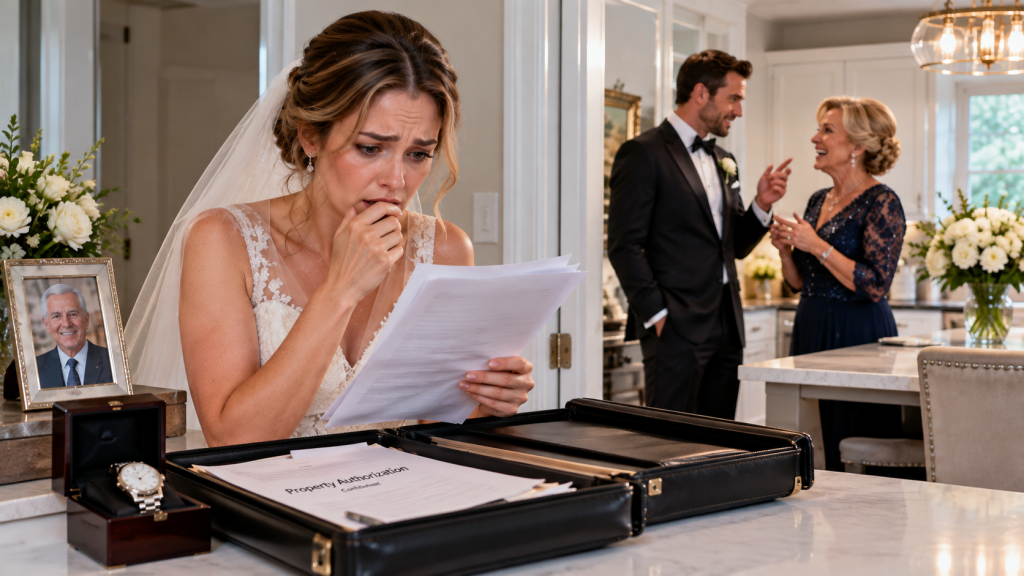
Three hours before the ceremony, I returned home for my late father’s watch. Near the front door, I heard my fiancé mention me. His mother laughed. “Just three more hours until it’s all official.” I stopped cold. Daniel and his mother should have been at the hotel. Within ten minutes, I called off the wedding. But the call I made next was what truly changed everything.
Part 1: The Conversation Before the Ceremony
Three hours before my wedding to Daniel Mercer, I returned home for my late father’s watch. I planned to tuck it beneath my bouquet so something of his would accompany me down the aisle.
Daniel and his mother, Patricia, should have been taking photographs at the Grand Ashford Hotel. Instead, her Mercedes sat two houses away, and her laughter drifted through my open kitchen window.
“Three more hours, and she can’t back out.”
Daniel replied that once the documents were signed, he would control the house and access to the company. I gripped the porch railing, remembering how dependable he had seemed after my father died eighteen months earlier.
Patricia asked about a property amendment. Daniel said it was in his briefcase; after the honeymoon, he would persuade me to appoint him as an authorized manager.
“She’ll stop asking so many questions once we’re married.”
Then Patricia mentioned Harbor Street, and Daniel called it the real prize. That building housed Ellison Maritime Analytics, the business my father had spent decades building.
For two years, Daniel had appeared uninterested in my work while asking remarkably specific questions about trusts, voting rights, and ownership. Suddenly, those conversations made sense.
I started recording on my phone. Patricia repeated her husband’s advice about marrying money, and Daniel laughed.
“Even better when she’s too emotional to protect it.”
I didn’t cry. I entered through the basement and quietly went upstairs to retrieve the watch from my safe.
Daniel’s briefcase lay open on my desk. Inside were unsigned property authorizations bearing our names and a copy of my father’s trust summary—something I had never shared with him.
Ten minutes later, I sat in my car and called the hotel. “This is Claire Ellison. The wedding is canceled.”
The employee asked whether I meant every arrangement. “Everything,” I confirmed.
Then I called Martin, my father’s longtime attorney, watching the house while.
PART 2 — THE CLAUSE MY FATHER LEFT BEHIND
Martin answered on the second ring.
“Claire?”
His voice was calm.
Too calm.
My father had trusted Martin Hayes with nearly every legal document he signed for twenty-seven years.
Estate papers.
Business transfers.
Insurance agreements.
Shareholder disputes.
When Dad died, Martin was the man who sat beside me in a black suit while I signed forms I could barely read through grief.
He had told me then:
“Do not make permanent decisions while you are still learning how to breathe without him.”
I had followed that advice about the company.
About the house.
About the trust.
Apparently not about Daniel.
“I canceled the wedding.”
Silence.
Not shock.
Not confusion.
Just silence.
Then:
“Where are you?”
“In my car.”
“Where exactly?”
“Outside my house.”
“Is Daniel inside?”
“Yes.”
“With Patricia.”
Another pause.
“Do not go back in.”
Something in his tone changed me immediately.
“What?”
“Claire, listen carefully.”
My hand tightened around the phone.
“Drive away.”
“Now.”
I looked toward the house.
The kitchen curtains moved.
Maybe wind.
Maybe someone walking past.
“I already went inside.”
Martin’s voice sharpened.
“You did what?”
“I used the basement.”
“I got Dad’s watch.”
“I also found Daniel’s briefcase.”
“What was in it?”
“Property authorizations.”
“Company documents.”
“A copy of Dad’s trust summary.”
Martin stopped breathing.
At least, that was what it sounded like.
“Which summary?”
“I don’t know.”
“The one with the Harbor Street building.”
“The voting restrictions.”
“The management succession notes.”
“Claire.”
His voice dropped.
“That document was never distributed outside my office.”
Cold moved through me.
“What do you mean?”
“I mean Daniel did not get it from you.”
“I know that.”
“And he did not get it from any public filing.”
I stared through the windshield.
“So where did he get it?”
Martin said nothing.
That frightened me more than anything else.
“Martin.”
“I need to check something.”
“No.”
My voice broke.
“I am done with people asking me to wait while they decide what I can handle.”
He went quiet.
Then:
“You’re right.”
I swallowed.
“Tell me.”
“I cannot tell you yet because I don’t know.”
“Then tell me what you suspect.”
Another pause.
Finally:
“Someone gave it to him.”
I drove.
I did not know where at first.
Away was enough.
The house disappeared in my rearview mirror.
Then the street.
Then the neighborhood.
I was still wearing leggings and an old sweatshirt.
My wedding dress hung at the hotel.
My makeup artist was probably calling.
My bridesmaids were probably wondering why no one could reach me.
Three hours earlier, I had expected to become a wife.
Now I was driving toward my dead father’s attorney carrying his watch and an audio recording of the man I had planned to marry laughing about how grief made me easy to control.
There are moments when a life changes loudly.
Hospitals.
Funerals.
Accidents.
And there are moments when everything changes with almost no sound at all.
A voice through an open kitchen window.
A briefcase left unzipped.
A copied document that should not exist.
I drove to Martin’s office.
He was waiting downstairs.
No jacket.
Tie loosened.
That alone frightened me.
Martin was the kind of man who dressed formally to sign a birthday card.
He opened my passenger door.
“Give me the briefcase.”
“I didn’t take it.”
His eyebrows rose.
“I photographed everything.”
He looked at me for a second.
“Good.”
That one word steadied me more than praise should have.
We went upstairs.
His receptionist had gone home early because it was Saturday.
The office was silent.
Martin locked the door behind us.
Then he handed me a legal pad.
“Write down exactly what you heard.”
“I recorded it.”
“Still write it down.”
“Why?”
“Because memory changes after shock.”
That sentence made me think of Dad.
Martin always talked like a lawyer.
Dad had joked that if Martin ever said “I love you,” he would probably attach an exhibit.
I almost laughed.
Almost.
Instead, I sat.
I wrote.
Patricia:
Three more hours, and she can’t back out.
Daniel:
Once the documents are signed, I control the house and company access.
The property amendment.
Harbor Street.
Authorized manager.
Trust.
Dad.
Emotional.
Money.
Each phrase looked uglier on paper.
Martin listened to the recording twice.
The first time, his face did not move.
The second time, when Daniel said:
“Even better when she’s too emotional to protect it,”
Martin removed his glasses.
That was all.
But I knew him.
He was furious.
“Do you recognize any of the forms?”
I asked.
“Yes.”
“Are they real?”
“Some.”
My stomach tightened.
“What does that mean?”
“The property authorization you photographed is a standard managerial consent form.”
“It could be legitimate if voluntarily executed.”
“And if I had signed it?”
“Depending on the final version, Daniel could have obtained substantial authority over the house and several LLC interests.”
I stared.
“But he said marriage would give him control.”
“It wouldn’t.”
“Not automatically.”
“Then he was lying to Patricia?”
“Maybe.”
Martin looked at the photos again.
“Or oversimplifying.”
“That does not make me feel better.”
“It shouldn’t.”
“What about the company?”
He zoomed in.
“The Ellison Maritime voting trust prevents a spouse from gaining voting control merely through marriage.”
“Dad made sure of that.”
“Yes.”
“He was very clear.”
I knew.
Dad believed marriage was love.
Business was governance.
He respected both too much to confuse them.
“So Daniel couldn’t take the company.”
“Not by marrying you.”
Martin looked at me.
“But he could influence you.”
There it was.
That was the real plan.
Not theft in one dramatic signature.
Access.
Proximity.
Gradual authority.
The kind of control that could be presented as help.
I felt sick.
“He kept asking whether I was overwhelmed.”
Martin looked up.
“When?”
“Since Dad died.”
“What did he say?”
“That I didn’t need to carry everything.”
“That I should delegate.”
“That I should stop treating the company like a shrine.”
Martin’s expression tightened.
“He asked once why you were still trustee?”
“Yes.”
“Twice.”
“Maybe more.”
I looked down.
“At the time it sounded caring.”
“Manipulation usually works better when it resembles something kind.”
That sentence hurt.
Because I had not fallen in love with a villain.
I had fallen in love with patience.
Reliability.
Coffee in bed.
Calls when meetings ran late.
A man who knew when grief anniversaries were coming before I did.
Now every kindness had a shadow.
That was the cruelty of betrayal.
It does not merely injure the present.
It vandalizes memory.
Martin turned his computer toward himself.
“I want to check access logs.”
“To what?”
“The trust repository.”
I frowned.
“Everything is digital?”
“Some of it.”
“And you can see who opened files?”
“Yes.”
“Then do it.”
He hesitated.
“What?”
“If this leads where I think it might—”
“Martin.”
He nodded.
Then typed.
For several minutes, the only sound was the keyboard.
I watched his face.
Nothing.
Then something.
A small change.
His jaw tightened.
“What?”
He did not answer.
“What?”
He turned the screen toward me.
A list of access dates.
Employee names.
Document references.
One entry had been opened three months earlier.
My father’s trust summary.
The same version in Daniel’s briefcase.
The user account belonged to:
EVELYN PRICE.
I stared.
“Who is that?”
Martin said nothing.
Then I remembered.
“Oh.”
My stomach dropped.
Evelyn Price had been my father’s executive assistant for seventeen years.
She had arranged his travel.
Managed his calendar.
Ordered flowers for my birthday when he forgot.
After Dad died, I kept her at the company.
Not because I needed a full-time executive assistant.
Because losing Dad and Evelyn in the same year had felt cruel.
She knew everything about the company.
And more than that—
She knew Daniel.
Too well, suddenly.
“She introduced us.”
My voice came out faint.
Martin looked at me.
“Yes.”
Eighteen months earlier.
A charity dinner.
I had not wanted to go.
Evelyn insisted.
“You need one evening where nobody asks you about estate administration.”
Daniel had been seated beside me.
Charming.
Understated.
Funny.
He said he worked in commercial acquisitions.
He listened more than he spoke.
At the end of the night, Evelyn smiled and said:
“I knew you two would get along.”
My skin went cold.
“No.”
Martin folded his hands.
“We don’t know yet.”
“I do.”
“Claire.”
“She opened Dad’s file.”
“Yes.”
“She introduced me to Daniel.”
“Yes.”
“Three months ago?”
“Yes.”
“That’s after we were engaged.”
“Yes.”
I stood.
My chair scraped against the floor.
“She gave him the trust.”
“Possibly.”
“She gave it to him.”
“We need evidence.”
“I don’t.”
Martin looked at me carefully.
“You do if you want consequences.”
That stopped me.
Consequences.
Not anger.
Not confrontation.
Evidence.
My father had raised me in a world where paper mattered because memory was easy to deny.
I sat again.
“What do we do?”
Martin’s voice changed.
Business now.
“First, we preserve everything.”
“The recording.”
“The photos.”
“The access log.”
“Second, we do not tell Daniel what we know.”
“I canceled the wedding.”
“That tells him enough.”
“My phone is exploding.”
“Do not answer.”
“Patricia?”
“No.”
“Daniel?”
“No.”
“Evelyn?”
“Especially no.”
I stared.
“Why?”
“Because right now, they don’t know what you heard.”
“They know the wedding is canceled.”
“They may think you panicked.”
“They may think you found one document.”
“If they believe you know less than you do, they may show us more.”
I hated how reasonable that sounded.
“Do I have to pretend?”
“No.”
“Silence is enough.”
He looked toward Dad’s watch in my lap.
“Your father once told me the hardest part of protecting an asset was resisting the urge to announce that you knew it was under attack.”
My eyes burned.
“Of course he did.”
Martin softened.
“He taught me that during the Carroway dispute.”
“I remember.”
“No, you remember him being gone for dinner for three months.”
Despite myself, I smiled.
“That too.”
Then I looked at the watch.
“I wish he were here.”
Martin’s face changed.
For a moment, he stopped being attorney.
“I do too.”
That nearly broke me.
My phone rang again.
Daniel.
Then Patricia.
Then Daniel.
Then one of my bridesmaids.
Then the hotel.
Then Daniel again.
Finally a text appeared.
PLEASE CALL ME. THERE HAS BEEN A MISUNDERSTANDING.
I laughed.
Martin looked at me.
“What?”
I turned the phone.
He read it.
“Classic.”
“Do lawyers have a category for this?”
“Yes.”
“What?”
“People who believe language can outrun evidence.”
I almost smiled.
Then another message.
I DON’T KNOW WHAT YOU THINK YOU HEARD.
I stared.
Not:
I love you.
Not:
Are you safe?
Not:
What happened?
What you think you heard.
The phrasing told me everything.
He knew.
Maybe not how much.
Enough.
Another message.
MY MOTHER WAS MAKING A JOKE.
Then:
PLEASE DON’T DESTROY OUR FUTURE OVER ONE CONVERSATION.
Our future.
The future he had been discussing as an acquisition.
I placed the phone face down.
“I want to answer.”
“I know.”
“I want to tell him I heard every word.”
“I know.”
“I want him to know I am not stupid.”
Martin leaned back.
“Claire.”
“What?”
“Do you think canceling a wedding three hours before the ceremony after quietly collecting evidence looks stupid?”
That silenced me.
“You were deceived.”
He continued.
“That is not the same as being foolish.”
My throat tightened.
“I should have seen it.”
“Maybe.”
I looked at him.
He surprised me.
“You’re supposed to say no.”
“I’m your lawyer.”
“Not your priest.”
Despite everything, I laughed.
Martin continued.
“There may have been things you could have noticed.”
“That does not make what Daniel did less deliberate.”
“You are allowed to learn without turning the lesson into self-contempt.”
I looked down.
That was something Dad would have said.
Not exactly.
But close.
At 2:07 p.m., my bridesmaid Anna called.
I answered.
“Claire?”
She sounded panicked.
“Yes.”
“Are you okay?”
“Yes.”
“Daniel is here.”
My whole body went still.
“At the hotel?”
“Yes.”
“When?”
“Five minutes ago.”
“What is he doing?”
“He’s telling people you had some kind of grief episode.”
My stomach turned.
Martin heard enough from my expression.
Anna continued.
“He says the wedding is postponed.”
“Not canceled.”
I stood.
“No.”
“Claire?”
“Put me on speaker.”
There was movement.
Whispering.
Then:
“Okay.”
I took a breath.
“Anyone who needs to hear this, listen carefully.”
Martin watched me.
“The wedding is canceled.”
“Not postponed.”
“I am safe.”
“I am not having a medical crisis.”
“I am not confused.”
“I made the decision myself.”
“If Daniel tells anyone otherwise, do not believe him.”
Anna was silent.
Then:
“Oh my God.”
I continued.
“I am sorry for everyone who traveled.”
“I will deal with the arrangements.”
“But there will be no ceremony today.”
A voice in the background:
“Claire, what happened?”
My aunt.
Another:
“Is he there with you?”
I closed my eyes.
“No.”
“And I’m not discussing details today.”
That was enough.
I hung up.
Martin nodded.
“Good.”
“I sounded cold.”
“You sounded clear.”
Sometimes those are mistaken for each other.
Ten minutes later, Daniel called again.
I declined.
Then a voicemail appeared.
I played it.
“Claire, I don’t know what you think happened, but my mom and I were talking about practical matters. You’re upset. I understand that. But canceling the wedding is extreme. You’re grieving your father all over again, and you’re not thinking clearly.”
I stopped the message.
My vision blurred.
There it was.
Exactly what I had heard through the window.
Too emotional to protect it.
Now used against me in real time.
Martin said quietly:
“Save that.”
I did.
Daniel continued on the voicemail.
“I’m trying to protect you. Please let me help you calm down before you make this worse.”
I laughed.
Then cried.
Not because he hurt me.
Because suddenly I saw the architecture.
Every time I disagreed with him about the company, I had been “overwhelmed.”
Every time I refused to delegate, I was “still grieving.”
Every time I asked why he cared about ownership structure, he was “just trying to understand my world.”
I had not been loved into dependence.
Not yet.
But he had been laying the language for it.
“He was going to make me doubt myself.”
I whispered.
Martin looked at me.
“Yes.”
The answer was brutal.
Better than comfort.
At 2:39 p.m., Martin received an email.
From Evelyn.
Subject:
Urgent — Claire
He looked at me before opening it.
“What?”
“She says Daniel called her.”
My stomach dropped.
“Read it.”
Martin did.
Then his expression hardened.
“What?”
He turned the screen.
Martin,
Daniel says Claire canceled the wedding abruptly and appears emotionally unstable. Given her recent grief history, I am concerned about decisions she may make regarding company governance. Should we consider temporary safeguards?
I read it twice.
Then a third time.
My hands went cold.
“She’s in it.”
Martin nodded slowly.
“Yes.”
No more maybe.
No more innocent file access.
Within minutes of the canceled wedding, she was trying to frame me as unstable in connection with company governance.
“That fast?”
I whispered.
Martin’s face darkened.
“Too fast.”
I stared at the email.
“They had a plan.”
“Yes.”
“For if I resisted.”
“It appears so.”
My stomach turned.
“What safeguards?”
“In theory, emergency trustee review.”
“Temporary management protections.”
“Medical evaluation if incapacity were credibly alleged.”
“Could they remove me?”
“Not easily.”
“Dad built barriers.”
“But if enough concern were manufactured…”
He stopped.
I understood.
Not one signature.
A narrative.
Claire is grieving.
Claire is fragile.
Claire is overwhelmed.
Claire needs help.
Daniel is practical.
Evelyn knows the business.
Patricia knows money.
Step by step, they would not steal control.
They would make surrender look responsible.
I felt something inside me harden.
Not rage.
Clarity.
“What did Dad put in the trust?”
Martin looked at me.
“Many things.”
“No.”
I pointed toward his screen.
“What did he put in it for this?”
Martin stared.
Then he understood.
He opened another file.
“Your father anticipated pressure.”
“From Daniel?”
“No.”
“From anyone.”
He scrolled.
“There is an independent control clause.”
“What does it do?”
“If a spouse, advisor, officer, or outside party attempts to obtain control through coercion, incapacity claims, concealed agreements, or unauthorized access…”
He stopped.
My pulse quickened.
“What?”
“The trustee can suspend all delegated management pathways pending review.”
“Who is the trustee?”
“You.”
I stared.
“And if they claim I’m unstable?”
“There is a backup review panel.”
“Who?”
“Me.”
“Two independent directors.”
“And Dr. Bennett.”
“My cousin James?”
“Yes.”
James was a neurologist.
Dad hated conflicts of interest.
Apparently he hated manufactured incapacity claims more.
“What else?”
Martin’s expression changed.
“There’s a removal mechanism for internal employees who disclose protected trust information.”
Evelyn.
I breathed in slowly.
“Dad planned for this.”
“He planned for the possibility.”
My eyes filled.
Eighteen months after he died, my father was still putting guardrails around me.
Not controlling my life.
Protecting my right to decide it.
That distinction broke me.
I looked down at his watch.
“Can we trigger it?”
“Yes.”
“How fast?”
“Immediately.”
“Do it.”
Martin hesitated.
“Claire.”
“What?”
“Once triggered, Evelyn will know the access log has been reviewed.”
“She’ll know the company is investigating.”
“Good.”
“She may destroy evidence.”
“Then preserve it first.”
A small smile touched Martin’s mouth.
“There you are.”
“What?”
“Your father.”
I shook my head.
“No.”
I looked at the watch.
“Me.”
Martin’s expression softened.
“Yes.”
“You.”
That mattered more.
By 3:15 p.m., the wedding should have been beginning preparations.
Instead, Martin and I were initiating a corporate access freeze.
Evelyn’s credentials were suspended.
All downloads archived.
Remote access disabled.
Daniel had never been an employee, so his company access had always been unofficial.
That now mattered.
Martin contacted the two independent directors.
Not with gossip.
With evidence.
They agreed to an emergency review.
At 3:42, Evelyn called me directly.
I did not answer.
Then a message.
Claire, I’m worried about you. Please don’t make business decisions while upset. We can talk when you’re calmer.
I stared.
The nerve of it almost impressed me.
Then another.
Your father trusted me to protect you.
That one hurt.
Not because I believed her.
Because Dad had trusted her.
Maybe.
Once.
People talk about betrayal as if trust were foolish.
It isn’t.
Trust is what makes betrayal possible.
That does not make trust the mistake.
At 4:00, my wedding ceremony would have started.
Instead, I sat in Martin’s conference room eating crackers from a vending machine.
My hair was in a messy knot.
Dad’s watch lay on the table.
Martin had ordered food.
I ignored it.
At exactly 4:03, Anna texted me a photograph.
The ballroom was emptying.
White flowers.
Candles.
Two hundred chairs.
No bride.
No groom.
At the altar stood the arch Daniel and I had chosen.
I stared for a long time.
Then turned the phone over.
Martin noticed.
“You okay?”
“No.”
“Good answer.”
I laughed softly.
Then I cried.
Finally.
Not elegantly.
Not quietly.
Everything arrived at once.
The wedding.
Dad.
Daniel.
The house.
The business.
The dress hanging useless in a hotel room.
The vows I had written.
The future I thought I was entering.
Martin moved a box of tissues toward me.
No speech.
I appreciated that.
“I loved him.”
I said.
“I know.”
“I really did.”
“I know.”
“What if some of it was real?”
Martin looked at me.
“It probably was.”
I stared.
That answer hurt.
“Why would you say that?”
“Because if every moment were fake, this would be easier.”
He leaned back.
“People can have genuine affection and still act greedily.”
“They can enjoy your company and still want your assets.”
“They can love parts of you while treating other parts as opportunities.”
“That does not make the betrayal smaller.”
“It makes the person more complicated.”
I wiped my face.
“I wanted him to be completely fake.”
“Of course.”
“Then I could throw everything away.”
“Yes.”
“And now?”
“Now you may have to accept that some memories were real and the relationship was still unsafe.”
That was worse.
And more useful.
At 4:21, Daniel showed up at Martin’s office.
We knew because the building security desk called.
My entire body went cold.
“Do not let him up.”
Martin said.
Then looked at me.
“Do you want to leave through the garage?”
I thought about it.
“No.”
“Claire.”
“I’m not talking to him.”
“That’s not what I asked.”
“I know.”
I breathed slowly.
“I don’t want to run out of another building because he is outside.”
Martin studied me.
Then nodded.
“Fine.”
Daniel stayed in the lobby.
He called seventeen times.
Then sent:
I JUST WANT FIVE MINUTES.
Then:
YOU OWE ME A CONVERSATION.
I stared.
Owe.
That word cured something.
I typed one message.
Martin watched.
I showed him before sending.
The wedding is canceled. Do not come to my home, workplace, or attorney’s office again. Future communication must be in writing.
Martin nodded.
“Send.”
I did.
Daniel responded immediately.
CLAIRE, THIS IS INSANE.
Then:
MY MOTHER WAS RIGHT. YOU ARE NOT THINKING CLEARLY.
I handed the phone to Martin.
He smiled without humor.
“Useful.”
“What?”
“Evidence.”
For the first time that day, Daniel’s cruelty felt less like injury.
More like documentation.
That shift mattered.
By evening, I checked into a hotel under a different name.
Not the Grand Ashford.
A smaller place across town.
Anna came.
So did my cousin James.
No one asked me to explain more than I wanted.
Anna brought my wedding dress in a garment bag.
I stared at it.
“Why?”
She looked horrified.
“I didn’t know what else to do with it.”
I started laughing.
Then she did.
Then we both cried.
Grief is indecent that way.
It will let laughter into the room without permission.
James sat on the edge of a chair.
“Martin told me enough.”
“About the trust?”
“Yes.”
“I need you to know something.”
“What?”
“No one can declare you incompetent because you canceled a wedding.”
“I know.”
“I mean legally and medically.”
“I know.”
He smiled faintly.
“Good.”
Then his face softened.
“Uncle Robert built that clause after Aunt Celia’s second husband tried something similar with her estate.”
I stared.
“What?”
James nodded.
“Family history.”
“Dad never told me.”
“He didn’t want you paranoid.”
I laughed bitterly.
“Mission accomplished.”
James continued.
“He believed safeguards should exist quietly.”
“You shouldn’t have to live suspiciously to be protected.”
That was Dad.
All the way through.
He had not told me:
Never trust anyone.
He had built structures that allowed trust without surrender.
I understood him differently that night.
The next morning, the company’s internal investigation found more.
Evelyn had opened protected files six times.
Downloaded three.
Printed two.
One print job matched the document in Daniel’s briefcase.
Security logs showed she had emailed herself one document from a company scanner.
Then deleted the message.
IT recovered it.
The receiving address was a personal account.
From there, investigators found forwarded correspondence to another address.
Daniel’s.
My stomach turned.
There it was.
The bridge.
Not suspicion.
Proof.
Martin called me at 8:12.
“We have enough to terminate Evelyn.”
I closed my eyes.
“Do it.”
“You don’t want to speak with her first?”
“No.”
A pause.
“Good.”
That surprised me.
“Why?”
“Because people often mistake confrontation for closure.”
“It usually just gives the other person one more chance to edit the truth.”
I looked out the hotel window.
“What happens next?”
“She’ll receive formal notice.”
“Company counsel preserves devices.”
“We assess whether civil claims are appropriate.”
“And Daniel?”
“The documents alone may support claims depending on use and intent.”
“But intent is harder.”
“Exactly.”
“What about the recording?”
“Helpful.”
“His statements about control matter.”
“Do we go to police?”
“Maybe.”
“I want the facts developed first.”
I nodded.
Then realized he could not see me.
“Okay.”
At 9:30, Evelyn called from a new number.
I answered.
Not because Martin advised it.
Because I needed one question answered.
“Claire.”
She sounded like she had been crying.
“You fired me.”
“Yes.”
“After seventeen years.”
“Yes.”
“Your father would be ashamed.”
That sentence almost worked.
Almost.
Then I remembered the access log.
“Why did you give Daniel the trust summary?”
Silence.
No denial.
That was enough.
“Why?”
Evelyn’s voice broke.
“I was trying to protect the company.”
I closed my eyes.
Of course.
Everyone who wants power eventually discovers the word protect.
“From me?”
“From instability.”
I laughed softly.
“Mine?”
“You weren’t yourself after Robert died.”
“My father died.”
“I know.”
“You barely came into the office for months.”
“I was grieving.”
“The company suffered.”
That hit me.
“Did it?”
Silence.
“No.”
I said.
“It didn’t.”
“Revenue increased.”
“Client retention held.”
“We hired a new COO.”
“The company did not suffer.”
“You just didn’t like that I stopped depending on you.”
Evelyn went quiet.
There it was.
For years, she had been Dad’s right hand.
After he died, I reorganized.
Not cruelly.
Efficiently.
Her role became smaller.
She resented it.
I had never realized how much identity she had attached to proximity to power.
She whispered:
“Daniel understood how vulnerable you were.”
My skin went cold.
“You introduced us because you thought he could influence me.”
“I thought he could help.”
“Help who?”
Silence.
“Evelyn.”
She started crying.
“He said the company needed stronger commercial leadership.”
“Meaning him.”
“He had experience.”
“Meaning him.”
“He said you trusted him.”
“Eventually.”
“Yes.”
The word slipped out.
Eventually.
Not at first.
My stomach turned.
“How long did you know him before you introduced us?”
Silence.
“Evelyn.”
“About seven months.”
My world shifted again.
I had thought they met that night.
They had known each other seven months.
“How?”
“Through Patricia.”
Of course.
“How do you know Patricia?”
“We served on the same foundation board.”
Everything connected.
Not by fate.
By planning.
“Did Patricia know who I was?”
“Yes.”
“Before Daniel met me?”
“Yes.”
“And Daniel?”
“Yes.”
I closed my eyes.
The charity dinner had not been chance.
It had been placement.
I felt physically ill.
“Did Dad’s trust come up before Daniel met me?”
Silence.
That was the answer.
I hung up.
For an hour, I could not stop shaking.
Anna sat beside me.
James paced.
Martin arrived.
I told them.
No one spoke for a while.
Finally, Anna whispered:
“So the whole thing was planned?”
I stared at the wall.
“At first.”
That phrase again.
The phrase that makes betrayal complicated.
Martin spoke carefully.
“We need to distinguish initial motive from the entire relationship.”
I looked at him.
“Why?”
“Because precision protects you.”
“I don’t want precision.”
“I know.”
“I want to hate him.”
“I know.”
“I want every Christmas to be fake.”
“I know.”
“Every vacation.”
“Every time he held me after Dad’s funeral.”
Martin’s voice softened.
“Maybe some of it was.”
I cried.
He continued.
“And maybe some wasn’t.”
“That is not mercy.”
“No.”
“It’s truth.”
I hated truth that morning.
But I was beginning to understand why Dad trusted it more than comfort.
Daniel sent an email that afternoon.
Not text.
Long.
Carefully written.
He admitted knowing Evelyn before meeting me.
He denied planning to marry me for money.
He said Patricia and Evelyn had encouraged the introduction because they believed we were “compatible.”
He claimed the trust information came later.
He insisted he loved me.
Then he wrote:
I will admit that I became increasingly concerned that your grief was preventing you from making rational business decisions.
I read that sentence three times.
Then laughed.
Martin looked at me.
“What?”
“He still cannot stop.”
“What?”
“Reframing control as concern.”
I forwarded the email to him.
No response to Daniel.
That became my answer.
Silence.
Not weakness.
Boundary.
The investigation continued for six weeks.
The wedding became gossip for about ten days.
Then the world moved on.
That was humbling.
A disaster can consume your entire life and still become someone else’s lunchtime story.
I returned to work.
People stared.
Then stopped.
I met with the board.
Explained only what mattered.
Unauthorized access.
Governance review.
No personal details.
The company kept moving.
That mattered.
Daniel had built part of his plan around the idea that I was fragile.
I discovered I was tired.
Hurt.
Sometimes furious.
Sometimes embarrassed.
But not fragile.
There is a difference.
Evelyn’s termination became final.
She signed a settlement agreement months later.
Returned documents.
Waived claims.
The company pursued no criminal charge after counsel determined the evidence supported civil misconduct more clearly than prosecutable theft.
Part of me wanted handcuffs.
Part of me wanted a courtroom.
Then I realized spectacle would not restore anything.
Consequences came anyway.
Career.
Reputation.
Trust.
Enough.
Patricia sent one letter.
Handwritten.
Three pages.
She said I misunderstood her humor.
Then said Daniel loved me.
Then said my father would not have wanted me to destroy a good man over “financial anxieties.”
I stopped reading.
I mailed it to Martin.
His reply:
No response recommended.
I wrote back:
Finally, legal advice I enjoy.
Daniel was harder.
Because he had loved me.
I became convinced of that eventually.
Not enough.
Not safely.
But some part of him had.
That made the grief worse.
His messages changed over time.
At first:
You are overreacting.
Then:
Please listen.
Then:
I made mistakes.
Then:
My mother influenced me.
Then:
Evelyn started this.
Then finally:
I knew who you were before I met you.
That message came eleven weeks after the canceled wedding.
I stared at it for a long time.
Then the rest:
I told myself it was only an introduction. I told myself wanting a relationship with someone successful wasn’t wrong. Somewhere along the way, I fell in love with you. But I never fully gave up the part of me that also saw what access to your life could mean. I kept both. I should have chosen.
That was the first honest thing he sent.
I cried when I read it.
Not because I wanted him back.
Because he had finally named the real betrayal.
He kept both.
Love.
Opportunity.
Tenderness.
Calculation.
And when forced to choose between protecting me and exploiting access, he had chosen the second.
Not all at once.
A little at a time.
That was enough.
I responded once.
Only once.
I believe you loved me in the way you knew how. I also believe you were willing to use me. Those truths can exist together. I will not marry someone who requires me to ignore one truth in order to honor the other. Do not contact me again.
I showed Martin before sending.
He read it.
Then looked at me.
“Your father would like that.”
I shook my head.
“I do.”
He smiled.
“Better.”
I sent it.
Daniel never contacted me again.
Not directly.
Six months after the canceled wedding, I opened Dad’s safe.
Not for legal documents.
Just because I had avoided it.
His watch box sat inside.
The same watch I had returned home for that day.
I wore it sometimes now.
Not beneath flowers.
Not as a symbol of absence.
Just on my wrist.
Inside the safe, beneath old insurance files, I found an envelope.
My name.
I froze.
After the last six months, handwritten envelopes had become suspicious objects.
I opened it anyway.
Dad’s handwriting.
Claire,
If Martin gives you this, I am dead and he is probably being unbearably careful.
I laughed immediately.
Then cried.
Dad continued.
You will inherit enough that some people will confuse access to you with affection for you.
Do not let that make you cynical.
Cynicism is just fear dressed up as wisdom.
My throat tightened.
I kept reading.
Trust slowly.
Use good documents.
Keep independent counsel.
And remember: anyone who is offended by reasonable boundaries is usually telling you why the boundary was necessary.
I sat down.
Of course.
Dad again.
Still arguing with me from paper.
Then:
But do not make the mistake of believing wealth makes every love suspect.
Let people love you.
Just do not hand them the keys to prove you love them back.
I covered my mouth.
That was exactly what Daniel had wanted.
Not the company at first.
The proof.
If you trust me, authorize me.
If you love me, let me help.
If we’re married, why keep things separate?
Dad had understood the trap.
Not Daniel.
Human nature.
The letter ended:
You are kinder than I am.
That is one of your strengths.
Do not turn it into carelessness.
And do not let someone else’s dishonesty punish the next honest person you meet.
Love,
Dad
I sat on the floor beside the safe and cried for almost an hour.
Then I called Martin.
“You knew about this?”
“What?”
“The letter.”
“No.”
“Liar.”
“I truly didn’t.”
I read part of it.
Martin was quiet.
Then:
“That sounds like Robert.”
“Yes.”
“Annoyingly.”
“Very.”
I looked at Dad’s watch on my wrist.
“He knew people might come for the money.”
“Of course.”
“But he still told me not to become cynical.”
“That also sounds like him.”
I smiled through tears.
For months, I had thought Dad’s final gift was the trust clause.
It wasn’t.
The clause protected the assets.
The letter protected me from becoming a prison around them.
That was more valuable.
A year after the canceled wedding, I sold the house.
People thought it was because of Daniel.
It wasn’t entirely.
The house had belonged to Dad first.
Then to me.
Then almost became the stage for someone else’s control.
I wanted somewhere chosen only by me.
I bought a smaller place.
Big windows.
No formal dining room.
A garden.
Anna said it looked more like me.
I realized I did not know what that meant.
Then slowly, I did.
I also changed company governance.
Not because I was afraid.
Because the near-miss exposed weaknesses.
No single executive assistant could access protected estate records.
Trust materials moved to outside custody.
Management authorizations required independent review.
Spousal and domestic-partner conflicts were formally disclosed.
Martin called it “institutional learning.”
I called it “making sure nobody else has to cancel a wedding to discover a security problem.”
He admitted mine was better.
On the first anniversary of the canceled ceremony, I went alone to the Grand Ashford.
Not to torture myself.
To finish something.
The ballroom was hosting a pharmaceutical conference.
No flowers.
No candles.
No arch.
Just projection screens and bad coffee.
I stood in the lobby where I should have been photographed in white.
Nothing happened.
That was comforting.
Places do not preserve our disasters the way we imagine.
The world repurposes rooms.
So can we.
I sat in the hotel bar and ordered the champagne Dad liked.
One glass.
I raised it slightly.
“To boundaries.”
The bartender looked confused.
I smiled.
“Long story.”
Then I checked my watch.
Dad’s watch.
Still running.
That mattered.
Two years after the wedding that never happened, Martin retired.
Badly.
He still called me weekly.
Still read contracts he had no business reading.
Still complained about his replacement.
At his retirement dinner, he gave me a small wooden box.
Inside was a copy of the clause Dad had written into the trust.
Framed.
I laughed.
“You give terrible gifts.”
“You’re welcome.”
He pointed at one sentence.
Any authority granted through coercion, concealed material interest, or exploitation of incapacity shall be presumptively void pending independent review.
I looked at him.
“Dad wrote this?”
“Mostly.”
“Mostly?”
“I made it grammatically tolerable.”
I smiled.
Martin continued:
“He added something else in his notes that never became legal language.”
“What?”
Martin handed me a photocopy.
Dad’s handwriting:
Claire is allowed to make bad decisions. Protect her right to make them herself.
I stared.
Then laughed through tears.
That was my father.
Not:
Protect Claire from life.
Not:
Stop Claire from trusting.
Protect her right to decide.
Even wrongly.
That was love without control.
I finally understood the difference.
Daniel married four years later.
I heard through mutual friends.
I felt almost nothing.
That surprised me.
Not joy.
Not jealousy.
A small ache.
Then peace.
I hoped he had learned something.
I did not need proof.
His growth, if it happened, no longer belonged to my story.
That was freedom.
I did eventually love again.
Not dramatically.
No charity dinner.
No elegant setup.
His name was Nathan Cole.
He was an engineer who argued with me at a city planning meeting about freight access near Harbor Street.
Our first interaction ended with me saying:
“You are confidently wrong.”
He replied:
“You are selectively listening.”
I disliked him immediately.
That helped.
He knew who I was professionally.
Of course.
But he did not know the trust.
The company structure.
The canceled wedding story.
Not at first.
When we began dating, I told him earlier than felt natural.
Not every detail.
Enough.
“I had a fiancé who tried to use marriage to gain business influence.”
Nathan stared.
“That is… substantial.”
“Yes.”
“What do you need from me?”
The question mattered.
Not:
How do I prove I’m different?
Not:
Do you trust me?
What do you need?
“Slow.”
I said.
He nodded.
“Okay.”
And then he actually went slow.
No offense.
No pressure.
No requests for access.
When I offered him a key to my house a year later, he said:
“Are you sure?”
I laughed.
“You’re supposed to seize power.”
“Can I start with the garage?”
That was how trust returned.
Not because Nathan was perfect.
Because he respected the existence of doors.
I did not marry him for six years.
Martin teased me mercilessly.
Nathan did not.
When he eventually proposed, he did something that made me cry.
He handed me two envelopes.
One held the ring.
The other held a prenuptial agreement drafted by his own lawyer.
I stared.
“You brought paperwork?”
“I know my audience.”
I started laughing.
He continued:
“My attorney says you should take this to independent counsel.”
I looked at him.
“You already signed it?”
“Yes.”
“What does it say?”
“That your company stays yours.”
“Your inherited property stays yours.”
“My assets stay mine.”
“And anything we build together is handled separately.”
My eyes filled.
Nathan’s face softened.
“I don’t need access to prove we’re married.”
That sentence healed something old.
Not all at once.
But enough.
I said yes.
To him.
Not to the paper.
But I signed that too.
After Martin reviewed it twice and complained about formatting.
On our wedding day, I wore Dad’s watch.
This time, I did not forget it.
I fastened it myself in the morning.
Anna stood beside me.
She looked at my wrist.
“You okay?”
“Yes.”
“Really?”
I smiled.
“Really.”
The ceremony was small.
No Grand Ashford.
No two hundred guests.
Garden.
Family.
Company friends.
Martin in the front row pretending not to cry.
Nathan waiting at the end of the aisle.
I walked toward him without wondering what he knew about my assets.
Without wondering what documents were in a briefcase somewhere.
Not because I had become incapable of betrayal.
Because trust is never certainty.
It is informed choice.
Dad had protected my right to choose.
Daniel had tried to replace it.
I finally understood why the difference mattered so much.
Years later, people still occasionally asked about the wedding I canceled.
Usually they expected drama.
“Did you really cancel three hours before?”
“Yes.”
“Were all the guests there?”
“Most.”
“What did you do with the dress?”
“Donated it.”
“Did you get your deposits back?”
“Some.”
They always asked about the money.
Deposits.
Company.
House.
Trust.
But that was never the part that mattered most.
The real thing I nearly lost was authority over my own perception.
Daniel’s plan depended on something more dangerous than greed.
He needed me to believe that his judgment was steadier than mine.
That concern belonged to him.
Emotion belonged to me.
That if I objected, I was grieving.
If I hesitated, I was unstable.
If I questioned, I was paranoid.
That is how people surrender power without realizing anything has been taken.
One interpretation at a time.
Dad’s documents stopped the legal part.
Hearing Daniel through that window stopped the rest.
Patricia died years later.
I learned from an obituary.
I stared at her photograph.
Older.
Elegant.
The woman who had laughed:
“Three more hours, and she can’t back out.”
For a moment, anger returned.
Then left.
She had been wrong about one thing.
Three hours was plenty of time.
Sometimes three minutes is enough.
Enough to hear.
Enough to understand.
Enough to walk away.
Harbor Street remained mine.
Not personally in the childish sense.
The company owned it.
The trust protected it.
But I stopped thinking of it as Dad’s building.
I renovated part of the upper floor.
Created an employee innovation lab.
Opened a scholarship program for young women entering maritime data science.
Named nothing after myself.
Nothing after Dad.
He would have approved.
Probably complained about the renovation budget.
When I was fifty-eight, Martin died.
His daughter called me.
I cried harder than I expected.
At the funeral, she handed me an envelope.
I laughed through tears.
“Apparently every important man in my life leaves paperwork.”
She smiled.
Inside was a note.
Claire,
If you are reading this, I finally escaped committee meetings.
I laughed immediately.
Then:
Your father spent years worrying that wealth would make you suspicious of love.
Ironically, it almost did.
I am glad you did not let Daniel take more from you than he already tried to.
Remember this:
Good boundaries do not make love smaller.
They make it voluntary.
Martin
I folded the note carefully.
That became the final lesson.
Voluntary.
Real love does not require financial surrender.
It does not need ignorance.
It does not ask someone to become smaller so the other person can feel secure.
It does not call control protection.
It leaves room for no.
No to access.
No to authority.
No to urgency.
No to a wedding three hours before it begins.
And then, after the no, whatever remains is real.
Nathan and I grew old well.
Not perfectly.
Well.
We argued.
About work.
About travel.
About his inability to close cabinet doors.
He called me controlling once.
I told him he had confused “correct” with “controlling.”
He laughed so hard he had to leave the room.
We kept separate professional accounts.
Shared household expenses.
Updated our agreements every few years.
Never as threats.
Just clarity.
Clarity is romantic in a way young people rarely understand.
It lets affection stay affection.
No hidden leverage.
No unspoken assumptions.
No briefcase beside a desk.
At seventy-one, I gave company voting control to a professional succession trust.
Not to a husband.
Not to a child automatically.
To a structure based on competence and accountability.
Some relatives disliked it.
I did not care.
Dad had taught me something without ever saying it directly:
Inheritance should not become entitlement simply because love exists nearby.
I kept the watch.
Of course.
That one was personal.
One afternoon, my granddaughter Lily asked about it.
We were sitting in the garden.
She was twelve.
She traced the worn leather strap.
“Was this Great-Grandpa Robert’s?”
“Yes.”
“Is it expensive?”
“Probably less than people assume.”
“Then why do you always wear it?”
I smiled.
“Because once I went back for it and found out something I needed to know.”
She looked interested immediately.
“Like treasure?”
“Almost the opposite.”
I told her a simplified version.
Not every legal detail.
Enough.
A fiancé.
A conversation.
A canceled wedding.
A decision.
Lily’s eyes widened.
“You canceled it three hours before?”
“Yes.”
“Weren’t you embarrassed?”
That question surprised me.
“Yes.”
“Then how did you do it?”
I thought.
“Because embarrassment lasts shorter than the wrong marriage.”
She nodded seriously.
Then asked:
“Did Great-Grandpa save you?”
I looked down at the watch.
For a moment, I wanted to say yes.
It would have been beautiful.
Easy.
Then I remembered Dad’s note:
Claire is allowed to make bad decisions. Protect her right to make them herself.
“No.”
I said.
“He helped.”
“But I saved myself.”
Lily smiled.
“Good.”
That word mattered.
I am seventy-eight now.
The same age Dad would have been when he died, had life been kinder.
The company no longer needs me.
That is a strange kind of success.
Harbor Street still stands.
Different tenants now.
Different technology.
The building outlived the drama that once made it feel like the center of the world.
Most things do.
The canceled wedding is now one chapter.
Not my identity.
Daniel is an old name.
Patricia is gone.
Evelyn moved out of state.
Martin is buried near his wife.
Nathan is asleep in the next room as I write this because he claims retirement requires a daily nap.
Dad’s watch still ticks.
Slower than it once did.
Needs servicing more often.
Like me.
Sometimes I think about the exact moment I heard Patricia laugh.
“Three more hours, and she can’t back out.”
What a strange sentence.
Because there is always a moment before surrender becomes permanent.
Maybe not in every situation.
Maybe not easily.
But in mine there was.
And I heard it.
Then acted.
That was the part that changed my life.
Not catching Daniel.
Not protecting the company.
Not triggering Dad’s trust clause.
Choosing to believe what I had heard over the version someone else would soon tell me.
That was the real inheritance my father left me.
Judgment.
Not infallibility.
The right to use my own mind.
I have replayed that day often.
What if I had remembered the watch earlier?
What if I had not returned home?
What if Molly from the florist had called sooner?
What if Daniel and Patricia had closed the window?
Would I have married him?
Probably.
That answer used to terrify me.
Now it humbles me.
People want to believe we always sense betrayal.
We do not.
Sometimes we miss it because deception is skillful.
Sometimes because love is hopeful.
Sometimes because nothing has happened yet that requires suspicion.
That is why systems matter.
Documents matter.
Independent advice matters.
Boundaries matter.
Not because love is foolish.
Because love should not have to perform the work of due diligence.
Dad understood that.
Eventually, so did I.
The watch is on my desk now.
I no longer wear it every day.
The leather is fragile.
But sometimes, before difficult decisions, I wind it.
Not because I think Dad is speaking through it.
He would laugh at that.
Because it reminds me of the woman I was at 12:50 on a Saturday afternoon.
Hair unstyled.
Wedding dress at a hotel.
Three hours from vows.
Standing outside her own house listening to people discuss her like a transaction.
She could have walked in screaming.
She didn’t.
She could have demanded an explanation.
She didn’t.
She could have let embarrassment push her forward because two hundred guests were waiting.
She didn’t.
She went upstairs.
Got the watch.
Photographed the documents.
Walked out.
Made one call to cancel the wedding.
Then another to protect everything that came after.
For years, people praised me for being strong that day.
I don’t think strength was the important part.
Clarity was.
The willingness to disappoint an entire ballroom rather than betray myself.
That was what saved me.
If there is one thing I would tell the younger woman standing on that porch, it is this:
Do not waste years being ashamed that you loved someone who deceived you.
Love was not the embarrassing part.
His deception was.
Your trust did not make you weak.
His willingness to exploit it made him unsafe.
And canceling the wedding did not mean the relationship had contained nothing real.
It meant what was real was not enough to build a marriage on.
There is no shame in learning that late.
There is only danger in learning it and walking down the aisle anyway.
I did not.
That is why this story has the ending it does.
Dad’s watch never walked me down the aisle that day.
It did something better.
It brought me home three hours early.
And because I went back for one thing I thought I had forgotten, I discovered everything I needed to remember:
My father had left me a company.
A house.
A trust.
A building on Harbor Street.
But none of those was his greatest inheritance.
The greatest thing he left me was the belief that my life should still belong to me after he was gone.
Daniel almost convinced me love required surrendering that.
He was wrong.
Real love never asks for the keys to your life as proof that the door is open.
It knocks.
It waits.
And when you say no, it still knows how to love you.
That is the difference I spent years learning.
And it began three hours before a wedding that never happened, with my father’s watch ticking quietly upstairs while two people below believed I had already run out of time.
I hadn’t.
I was just in time.
PART 3 — THE LIFE I CHOSE AFTER I WALKED AWAY
For a long time after the canceled wedding, people told the story wrong.
They said I had caught Daniel plotting to steal my company.
That was the version people liked because it was clean.
A greedy fiancé.
A wealthy bride.
A dramatic escape three hours before the vows.
It had all the pieces people expect from a cautionary story.
But that was never the whole truth.
Daniel had not planned to walk into my office on Monday morning and announce that Ellison Maritime belonged to him.
He had planned something far more dangerous.
He planned to make control look like care.
That distinction followed me for years.
Because theft is easier to recognize when someone reaches for something with both hands.
It is harder when they say:
Let me help.
You look tired.
You’ve been carrying too much.
Why don’t you sign this?
Why don’t you let me handle that?
You know I only want what’s best for you.
For months after the wedding that never happened, I heard those sentences differently.
Even when other people said them innocently.
That was one of the last things Daniel took from me.
Not money.
Not property.
Ease.
And ease took longer to recover than anything a lawyer could return.
The first year after the canceled wedding, I became suspicious of kindness.
I wish that sounded wiser than it was.
It wasn’t wisdom.
It was exhaustion wearing armor.
If someone offered to carry a box, I wondered what they wanted.
If a man complimented my work, I wondered whether he had looked up the company valuation.
If someone asked about my father, I searched their face for hidden curiosity.
Daniel had taught me to inspect generosity for fingerprints.
I hated him for that.
I hated myself for allowing it.
Then one afternoon, Martin came into my office without knocking.
He was retired by then.
Which apparently meant he had more time to ignore boundaries.
He set a paper bag on my desk.
“What’s this?”
“Lunch.”
“I didn’t ask for lunch.”
“I know.”
I stared at the bag.
“Why?”
Martin sat down.
“Because it’s one thirty and your assistant says you’ve had coffee.”
“I’ve eaten.”
“No, you’ve ingested caffeine.”
“That is not the same thing.”
I leaned back.
“What do you want?”
He stared at me.
“Nothing.”
I didn’t believe him.
He saw that.
His expression softened.
“Claire.”
“What?”
“You’re doing it again.”
“Doing what?”
“Making everyone prove they don’t have a motive.”
My jaw tightened.
“That sounds reasonable.”
“No.”
He shook his head.
“Caution is reasonable.”
“Suspicion as a permanent state is just injury that learned professional language.”
I looked away.
Of course he had to say it beautifully.
Lawyers become insufferable in retirement.
“I’m fine.”
“Your father used to say that when he was one bad email away from throwing a stapler.”
“That sounds like him.”
Martin pushed the bag toward me.
“Eat.”
I opened it.
Turkey sandwich.
Apple.
Chips.
Nothing symbolic.
No hidden paperwork.
No agenda.
Just lunch.
And I remember that moment because healing sometimes begins with things too small to look important.
A sandwich.
A friend who asks for nothing.
A door held open.
A favor that does not send an invoice.
I had to relearn that not every kindness was a contract waiting to happen.
Daniel disappeared from my daily life.
Legally, there was never a spectacular criminal case.
That disappointed some people.
They wanted handcuffs.
Headlines.
A judge.
Real consequences often look less cinematic.
His consulting firm terminated him after the internal investigation surfaced emails in which he discussed my company with Patricia and Evelyn as though my marriage were part of a commercial strategy.
He lost clients.
Not all.
Enough.
A civil agreement prevented him from using or retaining any confidential Ellison material.
He returned every copy his attorneys identified.
He paid legal costs related to the document recovery.
He did not go to prison.
He did not become destitute.
He remained a man with a profession, a mortgage, and the ability to rebuild if he chose.
At first, that infuriated me.
Then I understood something.
Justice and annihilation are not the same thing.
I did not need Daniel destroyed.
I needed him unable to use me again.
That happened.
The rest belonged to him.
Patricia handled everything less gracefully.
She told people I had misunderstood a private family conversation.
Then she told people I had always been emotionally unstable after Dad died.
Then she said Daniel had escaped a controlling woman who cared more about corporate power than marriage.
By the time she reached that version, even people who disliked me had begun rolling their eyes.
Lies eventually become clumsy when they have to carry too much.
I never answered publicly.
That was difficult.
Silence can feel like surrender when someone is rewriting you.
But Martin reminded me:
“You do not have to attend every trial held in someone else’s imagination.”
I wrote that down.
Not because it was legal advice.
Because it saved me months of pointless defense.
Evelyn sent me a letter one year after her dismissal.
I did not open it for six days.
When I finally did, I expected excuses.
There were some.
But not all.
She wrote:
I spent so many years being important to your father that after he died, I did not know who I was if I was no longer important to you.
That sentence hurt.
Because it was honest.
She continued:
Daniel made me feel useful again.
Patricia made me feel as though I was protecting what Robert built.
I wanted to believe them because their version of events made me necessary.
Then:
I told myself you were too inexperienced.
Then too emotional.
Then too independent.
The truth is that independence was what I resented most.
I stopped reading for a while.
Then continued.
You did not betray me by learning to run your own company.
I betrayed you because I could not accept becoming less central to it.
I cried.
Not because I wanted her back.
I didn’t.
But remorse changes the shape of anger.
Not always into forgiveness.
Sometimes simply into understanding.
At the bottom, she had written:
I do not expect an answer.
That was the first respectful thing she had done in a long time.
So I did not send one.
That, too, was respect.
Years later, I learned Evelyn had become a bookkeeper for a small nonprofit.
Nothing glamorous.
No executive suite.
No access to family trusts.
Part of me was relieved.
Part of me hoped she was happy.
Those emotions surprised me.
For a long time, I thought compassion toward people who hurt me would weaken my boundaries.
It didn’t.
You can wish someone peace from very far away.
Distance and hatred are not the same thing.
That was another lesson I learned slowly.
The first major company crisis after Dad died came eighteen months after the canceled wedding.
A shipping client representing almost fourteen percent of annual revenue threatened to leave.
Their complaint was legitimate.
Our new analytics platform had failed during a peak reporting week.
Daniel would have loved that moment.
Claire overwhelmed.
Claire emotional.
Claire needs someone stronger.
I thought about that as I sat in the conference room at six in the morning with department heads.
For half a second, I wanted Dad.
Then I wanted Martin.
Then I wanted anyone who could make the decision for me.
I almost laughed.
Because that was the exact thing I had spent years defending.
My right to choose.
Unfortunately, choice remains difficult even after you fight to keep it.
I listened.
Asked questions.
Rejected the first proposal.
Approved the second.
Called the client myself.
We kept the account.
Barely.
At eight that night, after everyone went home, I sat alone in Dad’s old office and cried.
Not because we had almost failed.
Because we hadn’t.
There is a grief inside competence nobody talks about.
The first time you manage something your parent used to manage, success can hurt because it proves you are becoming someone who no longer needs them in the same way.
I looked at Dad’s watch.
“You could have at least left better software instructions.”
No answer.
I smiled anyway.
That was when the company became mine.
Not legally.
That had happened long before.
Emotionally.
Until then, I had still been caretaking Dad’s creation.
Preserving.
Protecting.
Trying not to drop anything he had carried.
After that crisis, I began changing things.
Not because Daniel had almost taken them.
Because Dad had never intended me to spend my life embalming his decisions.
We expanded into climate-risk modeling.
Exited two contracts Dad had loved but that no longer made financial sense.
Hired younger directors.
Closed one office.
Opened another.
The first time I voted against something I knew Dad would have supported, I felt guilty for three days.
Then Martin said:
“Your father did not leave you a museum.”
That ended the guilt.
Mostly.
Nathan entered my life much later than people assume.
There was no immediate romantic redemption.
I spent almost four years alone.
Not lonely every day.
Not healed every day either.
I learned to travel by myself.
Eat in restaurants alone without pretending to read email.
Go home on Friday night and feel peaceful instead of abandoned.
That mattered.
Because when Nathan eventually arrived, I did not need him to rescue me from solitude.
He had to compete with a life I already liked.
That was healthier for both of us.
Our first date almost did not happen.
After the city planning argument, he emailed me:
For the record, I remain selectively correct.
I stared at the message.
Then laughed.
He added:
Coffee? Public place. No trusts discussed.
I almost declined.
Then accepted.
At the café, he asked about work.
I said:
“You’re allowed one company question.”
He held up both hands.
“Understood.”
“What do you do for fun?”
The question caught me off guard.
“What?”
“Fun.”
“Things you do badly without strategic value.”
I laughed.
“I garden.”
“Are you good at it?”
“No.”
“Excellent.”
That was our first real conversation.
Tomatoes.
Travel.
Bad movies.
The fact that he had once tried to build a canoe and nearly sank it.
Nothing about voting rights.
Nothing about inheritance.
Nothing about Harbor Street.
I had forgotten how attractive ordinary curiosity could be.
When I eventually told him about Daniel, he listened without interrupting.
Afterward, he asked:
“What part still scares you?”
Not:
Are you over him?
Not:
Do you trust me?
The question went deeper.
“What part still scares you?”
I answered honestly.
“That I could be wrong again.”
Nathan nodded.
“You will be.”
I stared.
“What?”
“About something.”
He shrugged.
“So will I.”
“That is not comforting.”
“It isn’t supposed to be.”
He leaned forward.
“The goal cannot be never misjudging another person.”
“That would require not knowing anyone.”
I sat very still.
“What’s the goal, then?”
“To trust yourself if new information arrives.”
That stayed with me.
Daniel’s deepest damage had not been that I trusted him.
It was that he planned to make me distrust myself.
Nathan understood that without trying to fix it.
That was one of the first reasons I loved him.
The second was ridiculous.
He hated Dad’s watch.
Not emotionally.
Mechanically.
It ran two minutes slow every few days.
One morning, he said:
“This thing is held together by sentiment.”
I looked horrified.
“You take that back.”
“It has terrible accuracy.”
“It belonged to my father.”
“That does not improve the movement.”
I laughed.
Then realized something.
Nathan did not worship what mattered to me.
He respected it.
There was a difference.
He did not pretend Dad had been perfect.
Did not treat Ellison Maritime like sacred territory.
Did not flatter me by flattering the inheritance.
He could say:
“That policy is outdated.”
“That building needs work.”
“That watch is late.”
And still understand why I kept all three.
That kind of honesty felt safer than admiration.
Before we married, we spent three evenings reviewing the prenuptial agreement together.
Romantic?
Strangely.
Yes.
Because every page said:
You remain yourself.
I remain myself.
We choose what to share.
Nothing transfers simply because love exists.
Nathan joked:
“This is the least seductive document I’ve ever signed.”
Martin, already retired but incapable of staying away, said:
“That means it’s well drafted.”
I laughed so hard I spilled coffee.
At the bottom of the last page, after both attorneys had finished, Nathan wrote in tiny handwriting:
Still choosing you after Exhibit D.
I kept that copy.
Our wedding was small because I wanted no performance.
Thirty-eight guests.
No orchestra.
No hotel ballroom.
Anna stood beside me.
Martin sat with his wife.
James cried openly and denied it afterward.
Before walking down the garden path, I looked at Dad’s watch.
3:58.
Two minutes until the ceremony.
For a moment, the old memory returned.
Three more hours, and she can’t back out.
I smiled.
Then took a breath.
Because this time, I could back out.
That was exactly why I wanted to go forward.
Nathan was not waiting for a signature that would give him access.
He was waiting because I had said I would come.
Voluntary.
Martin’s word.
The most romantic word I knew by then.
Halfway through the vows, Nathan forgot one line.
He looked at the officiant.
Then at me.
“Apparently I’m overwhelmed.”
I stared.
Then burst out laughing.
So did everyone who knew the old story.
Nathan had asked beforehand whether the joke was too much.
I said yes.
He did it anyway.
I married him despite this character flaw.
Years later, Daniel and I crossed paths once.
Only once.
Airport lounge.
Different cities.
Different lives.
I recognized him immediately.
Age had softened his face.
He saw me.
For a moment, neither moved.
Then he approached.
Not too close.
“Claire.”
“Daniel.”
He glanced at Nathan, who was several yards away buying coffee.
“Your husband?”
“Yes.”
Daniel nodded.
“I heard.”
Silence.
Then:
“You look well.”
“So do you.”
That could have been the end.
Maybe it should have been.
Then he said:
“I owe you an apology I never managed properly.”
My body tightened.
Old reflex.
He noticed.
“I won’t keep you.”
He took a breath.
“I loved you.”
My chest barely moved.
He continued.
“But I thought loving you entitled me to benefit from being close to you.”
“That was the part I refused to see.”
He looked down.
“I kept telling myself everyone marries into each other’s lives.”
“Finances.”
“Families.”
“Opportunities.”
“And that was true.”
“But I used the truth to hide what I was actually doing.”
I said nothing.
He looked at me.
“I was willing to make you smaller so I could become larger.”
That sentence landed quietly.
After all those years, he finally had language for it.
“I’m sorry.”
I studied him.
Then said:
“Thank you.”
His face changed.
Maybe he expected forgiveness.
Maybe not.
I continued:
“I hope you built a good life.”
He nodded.
“I’m trying.”
Nathan returned with coffee.
Daniel stepped back.
“Take care, Claire.”
“You too.”
And that was it.
No rage.
No closure music.
No renewed wound.
He walked away.
I watched for maybe three seconds.
Then Nathan handed me coffee.
“Who was that?”
I smiled.
“Someone I used to know.”
He looked toward Daniel.
Then back at me.
“Do I need context?”
“No.”
Nathan nodded.
“Great.”
And changed the subject.
That was closure.
Not the apology.
The fact that my afternoon did not belong to it.
Dad’s watch stopped when I was sixty-six.
Completely.
No winding helped.
The repair shop said a replacement movement was possible.
I hesitated.
Original mechanism versus function.
The watchmaker asked:
“Do you want it preserved or do you want it to keep time?”
The question felt larger than the watch.
I laughed.
“Keep time.”
So he replaced what needed replacing.
Some collectors would object.
I did not care.
Objects do not honor the dead by becoming unusable.
Neither do lives.
The watch came back ticking.
Different inside.
Still Dad’s.
I wore it home.
Nathan glanced at it.
“Accurate now?”
“Yes.”
“Miracles happen.”
I kissed him.
Ellison Maritime changed too.
At seventy-one, when I stepped away from day-to-day leadership, the CEO was a woman named Priya Shah.
Brilliant.
Tough.
Better at several parts of the job than I had ever been.
At the board meeting where we approved her succession plan, she asked:
“Are you sure you’re ready?”
I smiled.
“No.”
That surprised her.
Then I added:
“Ready is overrated.”
Dad had once held authority too long because he worried no one else would protect the company as fiercely.
I understood that temptation.
Then refused it.
Control can become addictive even when you acquired it legitimately.
Maybe especially then.
I gave up my chair.
Kept a limited advisory role.
Went home.
Cried.
Then slept better than I had in years.
The Harbor Street building remained the sentimental part.
Dad bought it when the neighborhood was still rough.
Everyone told him it was too large.
Too expensive.
Bad location.
He said:
“Good buildings are like good people. Sometimes they need the future to catch up.”
Terrible investment philosophy.
Strangely accurate in that case.
When I was seventy-four, the company proposed selling it.
The offer was enormous.
I resisted immediately.
Then realized why.
Dad.
Again.
Nathan asked:
“If Robert were alive, what would he do?”
“Demand three competing bids.”
“After that?”
“Sell if the numbers made sense.”
“So?”
I hated him.
We sold.
I kept the brass plaque from Dad’s original office.
Nothing else.
The company moved.
Harbor Street became apartments, restaurants, offices.
Life repurposed another room.
The sale funded several things.
Part of it went into the company’s next expansion.
Part into retirement obligations.
And part, at my insistence, created an independent legal-defense fund for employees facing financial abuse or coercive control at home.
Not because my story was the same as theirs.
It wasn’t.
But what happened to me taught me how quickly money can become a tool for shrinking someone’s choices.
The fund paid for consultations.
Temporary housing.
Financial planning.
Legal help.
Private.
No publicity.
No inspirational campaign with my photograph.
Martin would have approved.
Nathan said:
“You really hate naming things after yourself.”
“Yes.”
“Shame. The Claire Ellison Extremely Sensible Boundaries Fund has a ring to it.”
I nearly pushed him into the garden.
One recipient eventually wrote to me anonymously through the program.
I never knew her name.
She said:
I thought control only counted if someone took my money. I didn’t understand that having to ask permission for my own money was already control.
I read that sentence many times.
Daniel never got far enough to take anything from me.
That did not mean nothing had happened.
Intent matters.
Patterns matter.
The direction of a relationship matters before it reaches its worst possible destination.
You do not have to wait for the fire to consume the house before admitting you smell smoke.
I wished younger me had known that language.
Then remembered:
She had known enough.
She walked away.
That was sufficient.
As I grew older, people asked whether I regretted not confronting Daniel inside the house that day.
No.
Never.
There would have been satisfaction in seeing his face.
For about six minutes.
Then what?
Arguments.
Denials.
Patricia interrupting.
Maybe documents disappearing.
Maybe me doubting pieces of what I heard.
Instead, I left.
People sometimes mistake confrontation for power.
It can be.
So can refusing to enter the argument.
I already knew what I knew.
I did not require the person lying to validate my discovery.
That became one of the strongest habits of my later life.
Not silence.
Discernment.
Knowing which conversations are for understanding and which are only invitations to surrender clarity.
I still have my wedding dress.
That surprises people.
I did donate one eventually.
Just not that one.
The first dress remained packed in archival paper in a cedar chest.
For years, I considered giving it away.
Then one afternoon, my granddaughter Lily found it.
She was twenty-one.
“Can I see it?”
“Yes.”
We opened the box.
The fabric was still beautiful.
Ivory.
Simple.
A dress designed for a future that did not happen.
Lily touched the lace.
“Does this make you sad?”
“Not anymore.”
“Why keep it?”
I thought.
“Because not everything from a bad day has to be thrown away.”
She looked at me.
“Would you mind if I used part of it?”
“For what?”
“My graduation dress.”
I laughed.
“You want to cut up my failed wedding gown?”
“Recycling.”
I stared at her.
Then smiled.
“Absolutely.”
She used the lace on the sleeves.
When she walked across the graduation stage, I cried harder than anyone.
That dress finally attended a ceremony worth remembering.
Not marriage.
Becoming.
I liked that better.
Nathan died when I was seventy-six.
Cancer.
Fourteen months from diagnosis to goodbye.
Nothing about those months was fair.
We had time.
Not enough.
Never enough.
Toward the end, he asked:
“Did I pass the audit?”
I cried and laughed at once.
“Barely.”
“Figures.”
He squeezed my hand.
“Good marriage?”
“Yes.”
“Good prenup?”
“Excellent.”
“Good.”
Then quieter:
“Good life?”
I looked at him.
“Yes.”
His eyes filled.
“Me too.”
There was no secret letter afterward.
No hidden account.
No revelation.
That was a gift I did not fully appreciate until he was gone.
Grief without betrayal is still devastating.
But it is clean enough to hold.
I missed him.
I did not have to reorganize him after death.
I knew who he had been with me.
That was mercy.
After Nathan died, I read Dad’s old letter again.
Do not let someone else’s dishonesty punish the next honest person you meet.
Nathan had been the next honest person.
Not perfect.
Honest.
I had almost denied myself that life because of Daniel.
Almost.
That word matters.
The damage someone causes is real.
But eventually, there comes a point where continuing to organize your life around avoiding them gives them power they no longer deserve.
I had escaped Daniel once at thirty-something.
I refused to keep escaping him forever.
At seventy-eight, I finally gave Dad’s watch to Lily.
She looked horrified.
“No.”
“Yes.”
“Grandma, you wear this.”
“Not much anymore.”
“What if I lose it?”
“Then I’ll haunt you.”
She laughed.
“I’m serious.”
“So am I.”
I fastened it around her wrist.
Too loose.
She would need the strap adjusted.
“What am I supposed to do with it?”
“Use it.”
“Not lock it away?”
“No.”
She looked at the face.
“Tell me the real story again.”
So I did.
Not the simplified childhood version.
The whole thing.
Daniel.
Patricia.
Evelyn.
The trust.
The recording.
The briefcase.
The canceled wedding.
Dad’s clause.
Martin.
Nathan.
All of it.
When I finished, Lily sat quietly.
Then said:
“I always thought this story was about noticing red flags.”
I smiled.
“That’s what people say.”
“Was it?”
“Partly.”
“What was it really about?”
I looked at her.
“Believing yourself once the truth becomes clear.”
She nodded slowly.
“That’s harder.”
“Yes.”
Because warning signs are not always obvious.
Sometimes people lie well.
Sometimes we want to believe them.
Sometimes hindsight turns ordinary moments into clues and makes us feel foolish for not reading the future correctly.
I never wanted Lily to think wisdom meant never being deceived.
That is impossible.
Wisdom is what you do when reality changes.
Before she left, Lily asked:
“Were you scared when you canceled the wedding?”
“Yes.”
“More scared of marrying him?”
I thought.
“Not yet.”
She frowned.
I smiled.
“That was the strange part.”
“I was more embarrassed than scared.”
“Two hundred people were waiting.”
“The flowers were paid for.”
“The dress.”
“The hotel.”
“The invitations.”
“I kept thinking about everyone I would disappoint.”
Lily stared.
“That’s crazy.”
“Yes.”
“It was.”
“Then why did you cancel?”
“Because sometimes your body understands danger before your social manners do.”
She laughed.
I continued.
“And because one terrible afternoon taught me something useful.”
“What?”
“Embarrassment is survivable.”
“A life built against your own judgment may not be.”
She grew quiet.
Then hugged me.
I live alone now.
By choice and by age.
The house is quiet.
Not lonely every day.
Some days, yes.
I have photographs everywhere.
Dad.
Nathan.
Anna.
Martin.
Company dinners.
Grandchildren.
No Daniel.
Not because I erased him.
Because photographs are for what I want nearby.
Memory does not require display.
Sometimes, when rain hits the windows in the afternoon, I think about the old house.
The porch railing under my hands.
Patricia’s laughter through the kitchen window.
Daniel’s voice.
Three hours.
That strange countdown.
They believed time was closing around me.
In reality, those three hours opened the rest of my life.
That is what I understand now.
A decision can feel like destruction while you are making it.
Then years pass.
And you realize it was construction.
I lost money canceling that wedding.
Deposits.
Travel arrangements.
Nonrefundable vendors.
People love asking whether the hotel refunded the ballroom.
Some.
Not all.
It cost a lot.
Still cheaper than the marriage.
That usually ends the question.
But even that answer is too simple.
The true cost of staying would not have been measured only in money.
It would have been mornings.
Years.
Confidence.
Small surrendered decisions.
Documents signed because saying no felt like mistrust.
Meetings where Daniel spoke for me because he was “better with conflict.”
Company roles adjusted because I was “too close emotionally.”
Maybe children watching and learning that care meant control.
Maybe me becoming someone I no longer recognized.
That is the danger with the wrong relationship.
You rarely lose yourself in one dramatic transaction.
You lease yourself out a room at a time.
I stopped before the first key changed hands.
People also ask whether Dad somehow saved me by making me forget his watch.
That sounds romantic.
I don’t believe it.
Dad did not send me back.
I forgot the watch because I was distracted.
Chance took me home.
What happened next was mine.
That distinction matters.
We sometimes give fate too much credit because it makes our stories beautiful.
I prefer responsibility.
Chance opened the window.
I listened.
I recorded.
I left.
I called.
I chose.
Dad helped from the past.
Martin helped in the present.
Anna helped.
James helped.
Later Nathan helped.
But no one made the decision for me.
That is why it healed what Daniel had tried to take.
The last time I visited Harbor Street before the sale, I went alone.
The building was mostly empty.
Boxes everywhere.
A few employees packing.
I walked into Dad’s old office.
My office after him.
Then Priya’s.
Three lives in one room.
The wall where Dad kept charts was bare.
You could see lighter rectangles where frames had hung.
I stood by the window.
For years, that building had represented inheritance.
Then threat.
Then responsibility.
Then choice.
Finally, it was only a building.
That felt good.
I touched the window frame.
“Okay, Dad.”
No answer.
“What?”
I laughed at myself.
Then said:
“I think I got it.”
Maybe I did.
Not everything.
Enough.
Before leaving, I checked the time.
Dad’s watch was already with Lily.
So I looked at my phone.
4:00 p.m.
Exactly.
I smiled.
Once, four o’clock had been the hour I was supposed to walk down an aisle toward Daniel.
Instead, it became the hour I learned there are ceremonies more important than weddings.
Leaving.
Choosing.
Beginning again.
Saying no where everyone expected yes.
Saying yes years later because no was still available.
Those are ceremonies too.
They simply do not come with flowers.
When I tell this story now, I never say I escaped a marriage because my fiancé wanted my money.
That is true.
Not enough.
I say I escaped a marriage because the man I loved believed my independence was an obstacle to manage.
That is the deeper danger.
Money merely revealed it.
If I had owned nothing, maybe he would have found something else to control.
Time.
Friends.
Decisions.
Confidence.
People who treat autonomy as a problem rarely stop at bank accounts.
That is why the property documents mattered.
And why the words mattered more.
She’ll stop asking so many questions once we’re married.
That sentence outlived every trust document.
Because it told me exactly what kind of wife Daniel wanted.
Not Claire.
A quieter version.
A more compliant version.
A woman easier to manage.
I never met her.
I hope no one does.
There is one more thing Dad wrote that I did not understand until old age.
It was on the back of a note Martin gave me after the trust review.
Just one sentence.
Robert’s handwriting.
People who love you should make it safer to be fully yourself.
At thirty-something, I thought that meant encouragement.
Now I think it means something larger.
Safe to disagree.
Safe to say no.
Safe to ask questions.
Safe to own something separately.
Safe to change your mind.
Safe to need time.
Safe to be competent.
Safe to be emotional.
Safe to be wrong.
Safe to leave.
Real love does not depend on reducing those freedoms.
It grows inside them.
Nathan taught me that.
Dad tried to.
Daniel taught me by contrast.
Sometimes that is how we learn.
I keep no souvenirs from the canceled wedding now.
The dress became Lily’s graduation sleeves.
The invitation went with old papers during a move.
The flowers died before the week ended.
The hotel photos were never taken.
But I kept one thing.
The audio recording.
Not on my phone.
Archived on an encrypted drive with the old legal file.
I have not listened to it in decades.
I do not need to.
For years, I kept it because I feared memory might soften.
Then because it was evidence.
Now it remains simply because history happened.
I no longer need to hear Daniel’s voice to believe my own.
That may be the final measure of healing.
If I could speak to the woman I was that afternoon, I would not tell her to be strong.
I hate when people say that to frightened women.
Strength is too vague.
I would tell her something more practical.
Take the watch.
Photograph the papers.
Leave quietly.
Call the hotel.
Call Martin.
Eat something.
Sleep somewhere safe.
Do not answer Daniel tonight.
Do not decide your entire future by midnight.
Do not confuse grief with weakness.
Do not confuse love with obligation.
And tomorrow, do the next clear thing.
Then the next.
That is how I rebuilt my life.
Not with one great act of courage.
With a series of small decisions that refused to betray the first one.
Daniel once believed three hours was too late for me to change my future.
He was wrong by several decades.
Three hours was enough to cancel a wedding.
One phone call was enough to protect a company.
One clause was enough to stop a plan.
One letter from Dad was enough to keep me from becoming cynical.
One good man years later was enough to prove caution did not have to become loneliness.
One granddaughter wearing an old watch was enough to remind me that inheritance can become wisdom instead of fear.
That is what remains.
Not Daniel.
Not Patricia.
Not the scandal.
Choice.
Passed forward.
Lily wears Dad’s watch now.
She had the strap replaced.
Kept the old one in the box.
The movement still runs.
Sometimes fast.
Sometimes slow.
She sends it for servicing.
Uses it.
Scratches it.
Lives with it.
Exactly as I asked.
Last year, she called me before making a difficult decision.
A job offer.
More money.
Bad feeling about the manager.
She said:
“Grandma, I’m probably being ridiculous.”
I answered:
“Maybe.”
She laughed.
Then I said:
“But you don’t have to prove you’re reasonable by ignoring discomfort.”
She declined the job.
Maybe it would have been fine.
Maybe not.
That was never the point.
The point was that the decision remained hers.
Dad would have understood.
Martin too.
Nathan definitely.
After the call, I sat alone by the window.
Late afternoon sun across the floor.
I thought of Dad winding that watch every morning.
Of me placing it beneath a bouquet that never existed.
Of the porch.
The open window.
The sentence that stopped me.
Three more hours, and she can’t back out.
I smiled.
Because after everything, that is almost funny now.
I backed out.
Then I kept going.
Out of the wedding.
Out of the plan they had made for me.
Out of the version of myself that apologized for asking questions.
Out of the belief that being deceived made me foolish.
Out of fear that boundaries would leave me unloved.
And into a life that was not perfect.
Just mine.
That was enough.
More than enough.
Dad left me a watch so I would remember time.
Daniel accidentally taught me something Dad never could.
Time is not valuable because it runs out.
It is valuable because while some remains, we can still choose what happens next.
On that Saturday afternoon, with three hours until the ceremony, Daniel thought my choices were almost over.
They were only beginning.
And that, in the end, was the real thing I inherited.
Not the house.
Not Harbor Street.
Not the company.
Not even the watch.
The right to look at the life waiting in front of me and say:
No.
Not that one.
I choose another.
And then live long enough to make that choice beautiful.
THE END STORIES! THANK YOU FOR READING GOOD LUCK !❤️
Related Posts


