PART 3 — THE SON WHO CAME BACK ON HIS BIRTHDAY
“Mom?”
One word.
That was all it took.
My knees stopped holding me.
I sat down on the edge of the bed with the phone pressed against my ear and the letter trembling in my other hand.
For eighteen years, Rowan’s voice had existed only in my imagination.
Whenever Caleb laughed too loudly, I wondered whether Rowan would have laughed the same way.
Whenever Noah became angry and went quiet instead of shouting, I wondered whether his brother would have done that too.
Every birthday, I imagined a third voice joining theirs when they argued over who got the first piece of cake.
But imagined children never grow up properly.
In my mind, Rowan had remained a baby.
Three months old.
Soft cheeks.
Dark hair.
A fist barely large enough to close around my little finger.
Now there was a young man breathing at the other end of the phone.
A grown voice.
A whole childhood inside it.
Eighteen years I had not heard.
“Are you there?”
he asked.
I opened my mouth.
Nothing came out.
Then somehow:
“Yes.”
My voice broke.
“I’m here.”
He began crying.
Not loudly.
I heard him inhale, stop himself, inhale again.
“I didn’t know if you’d call.”
“I didn’t know you were alive.”
Silence.
Then:
“I know.”
Two words that held more grief than anything dramatic could have.
I pressed the heel of my hand against my mouth.
Outside my bedroom, music still played.
Someone in the backyard shouted for Caleb.
One of the boys’ friends laughed.
A screen door slammed.
Eighteen-year-olds were eating hamburgers and throwing ice at each other while my dead son spoke to me from somewhere in the same world.
“Where are you?”
I asked.
He hesitated.
“Not far.”
“How far?”
“About twenty minutes.”
I stood so quickly that the room tilted.
“You’re here?”
“My dad drove me.”
Dad.
The word entered me like cold air.
Not because it was wrong.
Because it was right.
Someone else had been his father.
I closed my eyes.
“What’s his name?”
“Paul.”
“Paul Bennett.”
“And your mother?”
Another hesitation.
“Janet.”
Mother.
Another word I had to learn not to fear.
“Are they with you?”
“My dad is.”
“Mom wanted to come, but she thought it might be too much.”
The instinctive part of me wanted to say:
I’m your mother.
But eighteen years of absence had not been his choice.
Nor Janet’s.
Biology gave me a truth.
It did not erase theirs.
So I swallowed the sentence.
“Rowan…”
My voice broke on the name.
He was quiet.
“That’s okay.”
he said.
“What?”
“Calling me Rowan.”
He breathed.
“My parents named me Eli.”
“I know.”
“I use Eli.”
“But…”
Another breath.
“I wanted you to know I knew the name you gave me.”
I covered my eyes.
“Thank you.”
“I don’t know which one I’m supposed to be.”
His voice sounded suddenly younger.
There he was.
Not my infant.
Not a mysterious stranger.
An eighteen-year-old boy who had just discovered his identity had been split before he was old enough to speak.
“You don’t have to choose.”
I whispered.
“Not today.”
“Maybe not ever.”
He said nothing.
Then:
“Okay.”
The bedroom door moved.
My mother was still outside.
I could see her shadow beneath it.
Waiting.
Listening, perhaps.
For eighteen years, she had decided what information I could survive.
She would not make another decision that day.
“Can you stay where you are?”
I asked Rowan.
“Yes.”
“Please don’t leave.”
“I won’t.”
“I need to tell your father.”
He became quiet.
“Your husband?”
“Yes.”
“Is he…”
He stopped.
“What?”
“Is he still my father?”
That question destroyed whatever was left of me.
“Yes.”
I said immediately.
“Yes, sweetheart.”
“His name is David.”
“He is still your father.”
“Nothing anyone did changes that.”
Rowan cried again.
So did I.
Then he whispered:
“Do he and the boys know?”
“No.”
“Okay.”
“Should I have told them before leaving the box?”
He sounded frightened now.
As though he had broken some family rule.
“No.”
I said.
“You have spent eighteen years living inside choices adults made before you could speak.”
“You do not need to apologize for putting one box on a porch.”
He laughed faintly through tears.
It was the first sound from him that resembled Caleb.
My heart almost stopped.
“I’ll call you back.”
I said.
“Promise?”
The word came out before he could hide the need inside it.
I closed my eyes.
“Yes.”
“I promise.”
Then I added:
“And Rowan?”
“Yeah?”
“Happy birthday.”
He made a sound between a laugh and a sob.
“Happy birthday to them too.”
“Your brothers.”
I said.
“Yes.”
he whispered.
“My brothers.”
I ended the call.
Then opened the door.
My mother stood in the hallway.
Her face was wet.
Behind her, the birthday music continued.
“Sarah.”
she whispered.
I held up one hand.
“No.”
She stopped.
“Not one more explanation until David is here.”
“I need you to understand—”
“No.”
I had never spoken to my mother like that.
Not when I was sixteen.
Not when I married someone she thought was too young for me.
Not when she told me how to feed the babies.
Not even when she had rearranged my kitchen cabinets because my system “made no sense.”
She had always been the woman who knew.
The one who handled things.
The one who stepped forward when I fell apart.
For eighteen years, gratitude had made authority look natural on her.
Now I saw something else.
She had used my most vulnerable moment to make herself the author of my life.
“Go into the guest room.”
I said.
Her face crumpled.
“What?”
“Please.”
“I need to tell you—”
“You will.”
“But not first.”
“David gets the truth before you explain it.”
“And my sons get their mother before they get your version.”
She stared at me.
Then slowly nodded.
For once, my mother obeyed a boundary she had not created.
I found David outside.
He was standing beside the grill wearing the ridiculous apron Caleb had bought him.
LICENSED TO GRILL
He had a spatula in one hand and a paper plate in the other.
Eighteen years had put gray into his beard.
A softness around his eyes.
We had survived infertility.
Triplets.
A funeral.
Two sons learning to drive.
A roof leak.
His father’s cancer.
My depression.
His terrible habit of leaving cabinets open.
We had built an ordinary marriage around an extraordinary absence.
He saw my face.
The plate lowered.
“Sarah?”
I walked toward him.
“Inside.”
He looked immediately toward the boys.
“What happened?”
“Not them.”
“Come inside.”
Something in my voice made him hand the spatula to a teenager without explanation.
We went into the laundry room because it was the nearest door that locked.
Not romantic.
Not cinematic.
Washing machine.
Dryer.
A basket of mismatched socks.
I gave him the photograph.
He looked.
Then frowned.
“What is this?”
“Read the writing.”
He did.
His face changed.
“Who did this?”
I handed him the hospital pages.
He read standing up.
Then sat on the closed washing machine.
“No.”
I knew.
“I know.”
“No.”
He turned pages too fast.
“Sarah, this is…”
“I called him.”
David froze.
My husband looked at me.
“Called who?”
I could barely say it.
“Rowan.”
The world left his face.
“No.”
he whispered.
“He answered.”
David stared.
“He’s alive.”
I nodded.
For a few seconds, my husband looked like someone had struck him.
Then he bent forward.
Both hands covering his face.
The sound he made was the same sound I remembered from eighteen years earlier.
At the hospital.
After we were told our son had died.
Some grief knows its own echo.
I knelt despite my shaking legs.
He grabbed my arms.
“Where?”
“Twenty minutes away.”
“How?”
“I don’t know all of it.”
“Who—”
He stopped.
Then looked toward the ceiling.
My mother was upstairs.
Understanding arrived.
“No.”
I nodded.
“She knew.”
David stood so fast the laundry basket fell.
Socks scattered across the floor.
“I’m going to—”
I stepped in front of him.
“No.”
He looked at me like he did not know me.
“She stole our child.”
“I know.”
“She watched us bury him.”
“I know.”
“She stayed in this house.”
“I know.”
“She held you while you—”
His voice broke.
“I know.”
He punched the wall.
Once.
Not hard enough to break it.
Hard enough to hurt.
“Don’t.”
I said.
He looked at his hand.
Then at me.
“Sorry.”
That mattered.
Even in rage.
He stopped when asked.
“What exactly did she do?”
he asked.
“I don’t know yet.”
“You said she knew.”
“She admitted she knew he survived.”
His knees seemed to weaken.
He sat again.
Then his eyes sharpened.
“Was she alone?”
“I don’t know.”
“Hospital?”
“I don’t know.”
“Adoption agency?”
“I don’t know.”
“Funeral home?”
“I don’t know.”
He slammed his fist into his thigh.
“Eighteen years and we don’t know anything.”
“No.”
I whispered.
“We know one thing.”
“What?”
“He is alive.”
David stopped breathing.
Then he cried again.
Different tears.
We sat on the laundry-room floor among clean socks.
Forty-seven and forty-nine years old.
Parents of three living sons.
We had entered the room believing we had two.
There are no ceremonies for that kind of number changing.
No form.
No music.
Just two people trying to reorganize their hearts without tearing them further.
“Do the boys know?”
David asked.
“No.”
“They need to.”
“Yes.”
“Tonight?”
“I think so.”
“What if this is somehow…”
He stopped.
A terrible hope protecting itself.
“What?”
“A scam.”
I had thought it too.
I showed him the records.
“DNA?”
“Rowan says he did an ancestry test.”
“With whom?”
“I don’t know.”
“We need proof.”
“Yes.”
I did not resent him for asking.
Hope after grief deserves verification.
We ended the birthday party early.
A plumbing emergency.
That was the lie David invented.
Apparently if your entire family reality collapses during a barbecue, plumbing is the most believable explanation.
Teenagers complained.
Then left with cake in paper plates.
Caleb and Noah remained outside stacking chairs.
They came in together.
Of course they did.
They had spent eighteen years moving like that.
Separate people.
Shared rhythm.
Caleb was louder.
Noah more careful.
Both had Rowan’s dark hair.
I had never noticed because I had spent eighteen years thinking the third version existed only in memory.
“Sit down.”
David said.
Caleb groaned.
“If this is about beer, I didn’t drink any.”
Noah punched his shoulder.
“This isn’t funny.”
Neither knew.
I stared at them.
Eighteen.
The age when the world expects you to become an adult while your mother still knows exactly what your face looked like at six minutes old.
“How do I say this?”
I whispered.
Caleb’s smile disappeared.
“Mom?”
I placed the box on the table.
The words faced them.
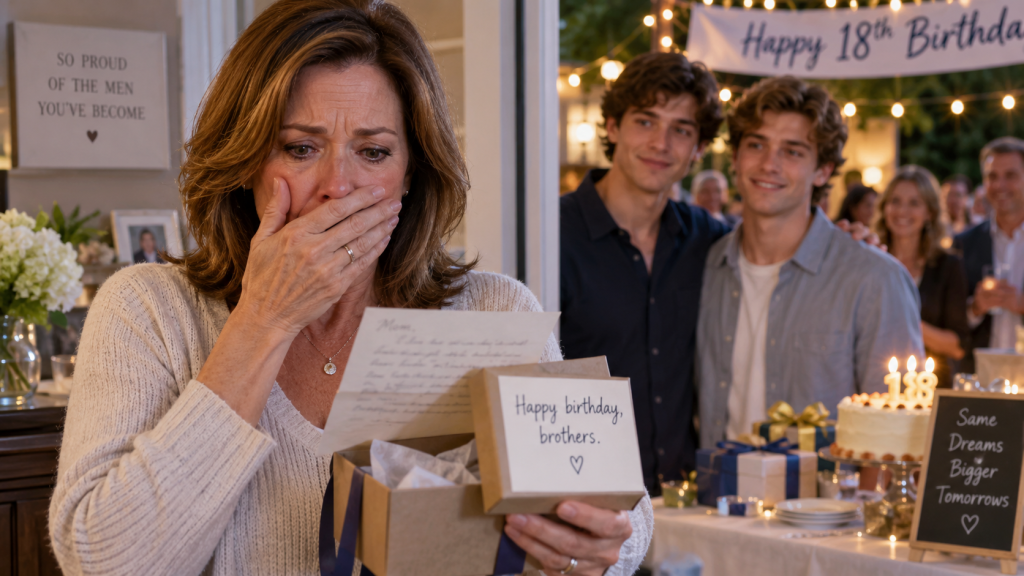
Happy birthday, brothers.
Noah read first.
His face tightened.
“That’s messed up.”
“I thought so too.”
Caleb looked at me.
“Who left it?”
I sat.
“A boy.”
“What boy?”
I tried.
Nothing.
David put his hand on my shoulder.
“Your brother.”
Silence.
Caleb laughed.
A reflex.
“What?”
Noah did not.
He had gone completely still.
David continued.
“Rowan.”
The name had existed in our house their entire lives.
A framed photograph in the hallway.
A candle every birthday.
A grave—or what we had believed was a grave—we visited each spring.
Their brother was not an abstract stranger.
He had been part of the family mythology.
Dead.
Untouchable.
Safe from complication because grief had frozen him.
Now he was alive.
“No.”
Caleb said.
Noah looked at me.
“Is this a joke?”
“No.”
“Who would do that?”
“I spoke to him.”
Caleb stood.
“You spoke to Rowan?”
“Yes.”
He backed away from the table.
“No.”
Then louder:
“No.”
I understood.
Some people cry when reality breaks.
Others become prosecutors.
Caleb pointed toward the box.
“DNA?”
“He says he has records.”
“That’s not DNA.”
“We’ll verify.”
“Then you don’t know.”
“No.”
I said.
“I know enough to take it seriously.”
Noah picked up the photograph.
His fingers started shaking.
“That’s us.”
“Yes.”
“How did he get this?”
“I don’t know.”
He studied the circled baby.
Then looked toward me.
“Grandma?”
I could not hide my face fast enough.
He understood.
“What did she do?”
Noah asked.
“She knew Rowan survived.”
Caleb stopped moving.
“What?”
“She knew.”
Noah’s face went white.
“She’s upstairs.”
It was not a question.
“Yes.”
Caleb ran toward the stairs.
David caught his arm.
“Not now.”
“Get off me.”
“Caleb.”
“She stole our brother!”
“We do not know the whole story.”
“She knew he was alive!”
“Yes.”
David’s voice cracked.
“That is enough to be furious.”
“But not enough to let fury decide what happens next.”
Caleb stared at his father.
Then ripped his arm free.
He did not go upstairs.
That was the first adult decision of his eighteenth year.
Noah looked back at the photograph.
“Where is he?”
“Twenty minutes away.”
Both boys looked at me.
Caleb said:
“Bring him here.”
Too fast.
I understood.
“No.”
His face hardened.
“Why?”
“Because he is not a lost backpack.”
“He is a person.”
“He has parents.”
“We’re his family.”
“Yes.”
“So are they.”
Caleb looked as though I had betrayed him.
Maybe I had disappointed the fantasy already forming.
That Rowan would walk through the door and everything missing for eighteen years would click into place.
But love must leave room for the life a lost person lived while you were missing them.
Otherwise reunion becomes another kind of theft.
“We ask what he wants.”
I said.
Noah nodded first.
Caleb looked away.
Then:
“Call him.”
So I did.
Rowan answered immediately.
“Hello?”
“It’s Sarah.”
There was a pause.
Not Mom this time.
Good.
Real.
“Hi.”
“Your brothers know.”
Silence.
Then a nervous laugh.
“That’s weird.”
“Yes.”
Caleb almost smiled.
I put the call on speaker after asking Rowan’s permission.
“Okay.”
I said.
“They’re here.”
No one spoke.
Three brothers.
One telephone.
Eighteen years.
Finally Caleb said:
“So…”
Noah shot him a look.
Caleb ignored it.
“Happy birthday?”
On the speaker, Rowan laughed.
The same crooked laugh I had heard before.
Noah covered his mouth.
Caleb’s eyes widened.
They heard it too.
“Happy birthday.”
Rowan answered.
Then:
“I guess.”
Noah leaned closer.
“You’re really him?”
Rowan breathed.
“I think so.”
“That’s not very reassuring.”
“I’ve had three months longer to be confused.”
Caleb laughed.
Then cried.
He turned away instantly.
Boys are taught strange things about tears.
Even after learning their dead brother is alive, apparently they still think crying requires privacy.
“Can we meet you?”
Noah asked.
Rowan hesitated.
“Yes.”
“Tonight?”
Another pause.
“My dad thinks maybe tomorrow would be better.”
Caleb opened his mouth.
I touched his arm.
Wait.
Rowan continued.
“I want to.”
“But I don’t want to walk into a birthday party.”
“It’s over.”
Noah said.
“Mom invented a plumbing disaster.”
Rowan laughed.
“Seriously?”
“Apparently emotional catastrophe wasn’t believable enough.”
Even David laughed.
For one minute, the impossible became ridiculous.
That helped.
We agreed to meet the next morning.
Neutral place.
A small conference room in my attorney’s building.
I called the only lawyer I knew personally at 10:30 that night.
She specialized in family law, not stolen children.
Still, she knew enough to say:
“Do not confront anyone further.”
“Preserve everything.”
“Photograph the box.”
“Keep the originals safe.”
“Do not post anything.”
“And get sleep.”
The last instruction was insulting.
Nobody slept.
My mother remained in the guest room.
At midnight, she texted me from upstairs.
May I come down?
The phrasing stopped me.
May I.
For the first time in my life, my mother asked permission before entering a family crisis.
I wrote:
No. Tomorrow.
She replied:
I understand.
I did not know whether she did.
The next morning, we met our son.
I had imagined this moment since the phone call.
My imagination got everything wrong.
He did not run toward me.
I did not recognize him instantly.
There was no music.
He was standing beside a vending machine holding a bottle of water.
Jeans.
Gray sweatshirt.
White sneakers.
Too tall.
That was my first thought.
Babies are not supposed to become six-foot-one without asking their mothers.
Then he turned.
And something inside me knew him.
Not mystically.
Not perfectly.
His eyes.
David’s eyes.
Caleb’s left eyebrow.
Noah’s habit of pressing his tongue against the inside of his cheek when nervous.
Pieces.
Family scattered across one face.
Beside him stood a man in his late fifties.
Paul Bennett.
His father.
I knew immediately because his hand rested near Rowan’s shoulder without touching.
Ready.
Not controlling.
The posture of someone who had spent eighteen years protecting this boy while also learning when protection required space.
I loved him a little before he spoke.
I resented him too.
Both feelings ashamed me.
Neither was his fault.
Rowan looked at me.
“Hi.”
I had practiced a hundred sentences.
None survived.
“Hi.”
That was all.
He looked at David.
Then Caleb.
Then Noah.
Nobody moved.
Finally Noah whispered:
“This is insane.”
Rowan nodded.
“Yep.”
Caleb walked forward.
Stopped two feet away.
“You look like me.”
Rowan smiled faintly.
“I was going to say you look like me.”
Caleb laughed.
Then suddenly hugged him.
Too quickly.
Rowan stiffened.
Caleb felt it and released him immediately.
“Sorry.”
“No.”
Rowan shook his head.
“I just…”
He swallowed.
“I don’t know how to do this.”
Caleb nodded.
“Me neither.”
That was their first honest moment as brothers.
Noah did not hug him.
He offered his hand.
Rowan looked at it.
Then shook.
“Happy birthday.”
Noah said.
“Again.”
“Thanks.”
Rowan answered.
“You too.”
There was something heartbreakingly formal about it.
I loved them for not pretending.
Then Rowan looked at me.
My whole body wanted to reach for him.
I did not.
“Can I hug you?”
I asked.
His eyes filled.
He nodded.
“Yes.”
So I did.
Carefully.
As if he were still fragile.
He was not.
He wrapped both arms around me.
My cheek pressed against his shoulder.
For eighteen years, I had remembered the weight of a baby.
Now my son held me up.
I began sobbing.
He did too.
“I’m sorry.”
I said.
He pulled back.
“For what?”
“I wasn’t there.”
His face twisted.
“You thought I was dead.”
“I should have—”
“No.”
His voice sharpened.
“Don’t do that.”
I stared.
He wiped his face.
“I spent three months thinking maybe you gave me away.”
“The records were confusing.”
“Then I found the requests you made after I was supposed to be dead.”
“The letters.”
“The calls.”
“You kept asking what happened.”
He swallowed.
“That’s when I knew something had been done to you too.”
I cried harder.
David waited.
I saw how hard that was.
A father watching another man stand closer to his son.
Eventually Rowan looked at him.
David’s voice broke immediately.
“I don’t know what you call me.”
Rowan looked toward Paul.
Then back.
“David?”
David nodded.
“That’s fine.”
“Anything is fine.”
Rowan stepped toward him.
Then, after a second:
“Can I hug you?”
David covered his mouth.
Nodded.
They held each other.
Paul turned away.
I saw him wipe his eyes.
There are moments when love is generous enough to hurt willingly.
That was one.
When David released Rowan, he walked straight toward Paul.
I did not know what would happen.
David extended his hand.
Paul took it.
Then David said:
“Thank you.”
Paul’s face collapsed.
“No.”
He shook his head.
“You shouldn’t have to thank me.”
“But I do.”
David’s voice trembled.
“You raised my son.”
Paul looked down.
“He’s my son too.”
Silence.
Then David nodded.
“I know.”
That sentence probably saved all of us years of unnecessary war.
Janet arrived twenty minutes later.
She had waited downstairs because she worried her presence would hurt me.
When I learned that, I insisted she come up.
The woman who entered was small, dark-haired, and crying before she reached the table.
She stopped three feet from me.
“I am so sorry.”
I shook my head.
“No.”
“I didn’t know.”
“I know.”
“If I had known—”
“I know.”
“I would never—”
“I know.”
Then I hugged her.
Not because I was ready.
Because suddenly I understood something.
My mother had stolen a choice from both of us.
Janet believed a child needed her.
I believed mine was dead.
Neither woman had consented to the arrangement that defined our lives.
We were not rivals.
We were two mothers injured by the same lie in opposite directions.
We spent four hours together.
Not enough.
Too much.
Rowan told us about his life.
He loved baseball until twelve.
Then quit because his coach was “an idiot.”
Caleb immediately agreed without meeting the man.
He played guitar.
Noah did too.
Terribly, according to Caleb.
Rowan wanted to study biomedical engineering.
That broke me.
Hospitals had begun his life and somehow he still wanted to build things that helped sick people.
He had a girlfriend named Maya.
A dog named Pepper.
He hated mushrooms.
So did David.
He loved cinnamon rolls.
So did I.
Every similarity felt like theft recovered.
Every difference reminded me genetics is not biography.
Janet knew how he liked eggs.
Paul knew which teacher changed his life.
I knew what lullaby I had sung when he was three weeks old.
All of us held different pieces.
None of us held the whole boy.
The DNA came back eleven days later.
There was no ambiguity.
Rowan was our son.
Caleb and Noah’s full biological brother.
David’s child.
Mine.
The report did not make me feel more certain.
It made certainty official.
Sometimes paper arrives after the heart.
Then came the records.
Hundreds of pages.
My attorney brought in specialists.
A lawyer experienced in adoption law.
Another familiar with medical negligence.
Investigators.
The hospital opened an internal review.
The adoption agency did too.
What emerged was not a grand conspiracy.
In some ways, that made it worse.
It was a chain.
One error.
One lie.
One failure to verify.
Then another lie built to protect the first.
Ordinary systems failing at exactly the places where ordinary trust should have stopped catastrophe.
The night Rowan was brought to the hospital, his heart stopped during respiratory collapse.
An emergency physician came to us after receiving a report that resuscitation had failed.
He told David and me Rowan had died.
Minutes later—minutes—the pediatric critical-care team regained a sustained heartbeat.
The communication should have been corrected immediately.
It was not.
The doctor believed another clinician had updated us.
The clinician believed social work had done it.
The social worker arrived to find my mother already saying:
“His mother cannot handle this.”
I had been sedated after a panic attack.
David had been sent home temporarily because Caleb and Noah were with a neighbor and one had developed a fever.
My mother became the adult standing closest to the paperwork.
And she used that position.
Rowan remained critically ill.
His prognosis was uncertain.
A transfer to a larger pediatric center was recommended.
My mother told the social worker that David and I had agreed she would act as temporary guardian because I was psychologically unstable and David could not manage three infants.
That was false.
She signed a temporary authorization using a copy of my signature she had access to from earlier medical paperwork.
Not a perfect legal guardianship.
A patchwork of consent forms and emergency representations that should never have survived basic verification.
But they did.
At the receiving hospital, she repeated the story.
Then expanded it.
She told staff we were considering relinquishment.
Told them I had said caring for Rowan would destroy my ability to mother the other two boys.
Told them David agreed.
When staff tried to call us, the number in the transfer packet belonged to my mother.
The home address listed for follow-up was hers.
She became the gate.
And systems trusted the person standing confidently inside them.
That lesson would haunt me.
How did adoption happen?
Not overnight.
That was another important truth.
Rowan first went into a specialized medical foster placement after discharge because of ongoing respiratory needs.
My mother signed documents she had no lawful authority to sign.
A private placement agency received a relinquishment packet containing forged consent pages.
The agency’s attorney failed to independently confirm our identities.
The court proceeding relied on affidavits containing false statements that we could not be located and had chosen not to participate.
The process took months.
We knew none of it existed.
By the time Rowan was formally adopted by Paul and Janet Bennett, my mother had constructed enough paperwork to make a lie look administrative.
Not flawless.
Just unchallenged.
And the funeral?
That question destroyed David.
He had spent eighteen years visiting a cemetery plot.
There was no body in it.
No ashes.
No remains.
The funeral home records described the service accurately:
Memorial service — no remains present.
My mother had signed.
She had told us the hospital recommended direct cremation because of Rowan’s condition after resuscitation attempts.
The small white casket was ceremonial.
Inside were his hospital blanket, knit cap, identification bracelet, and the stuffed lamb that had sat beside his crib.
We had buried objects.
We had buried a lie.
There had never been a valid state death certificate.
A preliminary hospital record had marked Rowan deceased during the failed-code communication.
That status was corrected later that night.
The correction notice went to the contact address my mother had provided.
She kept it.
David and I never asked to see an official death certificate.
That fact shamed me for exactly two days.
Then my lawyer said:
“You were parents burying an infant.”
“You relied on a hospital, a funeral home, and your mother.”
“Trusting people during catastrophic grief is not negligence.”
I wrote that sentence down.
Some truths need to be read repeatedly before guilt releases them.
The hospital’s review found serious failures.
The first erroneous death communication.
The failure to ensure we were personally updated when Rowan stabilized.
The lack of identity verification around transfer consent.
The receiving facility’s acceptance of temporary authority without direct confirmation from us.
The adoption process had its own failures.
No single institution had “stolen” Rowan.
But several had left doors unlocked.
My mother walked through every one.
When we confronted her formally, it happened in my attorney’s office.
Not our home.
Not a kitchen.
No birthday cake.
No children present.
My mother came with her own lawyer.
That was wise.
She looked smaller than she had a month earlier.
I hated myself for noticing.
Then stopped.
Compassion is not acquittal.
My lawyer asked the first question.
“Did you knowingly tell medical staff that Sarah and David had authorized you to make decisions for Rowan?”
My mother looked at me.
Her attorney said:
“Answer the question.”
“Yes.”
“Did they?”
“No.”
My chest tightened.
“Did you sign or cause Sarah’s name to appear on documents she did not sign?”
My mother cried.
“Yes.”
David gripped my hand.
“Did you tell Sarah and David that Rowan had died after you knew he had survived?”
Long silence.
Then:
“Yes.”
The room changed.
There are facts you can know for weeks and still hear for the first time when the person responsible says them aloud.
“Why?”
I asked.
My lawyer looked at me.
I continued.
“I need to hear it from her.”
My mother’s shoulders shook.
“You were sick.”
“Stop.”
She flinched.
“Do not start with what I was.”
“Start with what you did.”
Her face collapsed.
For the first time, she told the story without making herself the hero.
“I panicked.”
she whispered.
That was the beginning.
Not:
I saved you.
Not:
I knew best.
I panicked.
She had watched me struggle after the triplets’ birth.
She had seen postpartum depression.
Sleep deprivation.
Panic attacks.
She had watched David work long hours because bills were enormous.
Then Rowan became sick.
When staff mistakenly told us he had died, she watched something in me break.
Hours later, when she learned he had been revived, her first feeling had not been joy.
It had been terror.
“I thought if they told you he was alive but still very sick, you would go right back into that room and never leave.”
she said.
“I thought Caleb and Noah would lose you too.”
I stared.
“You thought I would die?”
“I thought you would collapse.”
“So you decided one child was expendable?”
“No!”
Her voice cracked.
“I thought temporary.”
There it was.
The word people use when they cannot imagine the permanent shape of a choice.
“I thought he would stay in care for a few weeks.”
“I thought you would get stronger.”
“Then I would tell you.”
“What happened?”
I asked.
She cried harder.
“Every day made telling harder.”
Rowan improved.
Then the foster parents bonded with him.
The agency began talking about permanent placement because the paperwork said his biological parents were unwilling or unable to care for him.
My mother could have stopped it.
She did not.
Why?
Because by then telling us the truth meant admitting the funeral had been false.
Admitting forged documents.
Admitting she had let us mourn a living child.
So she told herself another story.
Rowan had good care.
We had two healthy boys.
I was recovering.
David and I were functioning again.
Maybe this was best.
Maybe ripping Rowan from a stable foster home would be cruel.
Maybe truth would destroy everyone.
Every lie became evidence for continuing the lie.
“Did you know who adopted him?”
I asked.
She nodded.
Janet made a sound from beside me.
She and Paul had asked to attend this meeting.
Rowan did not.
His choice.
“I received updates through the agency for the first few years.”
my mother said.
Janet stared.
“You saw pictures?”
My mother nodded.
“Oh my God.”
Janet covered her mouth.
“You watched him grow?”
“Not every year.”
“How many?”
My mother cried.
“Until he was nine.”
I thought David might stand.
He did not.
He just closed his eyes.
She had photographs.
School picture.
First-grade smile.
Baseball uniform.
A birthday cake with 7 candles.
While I lit a memorial candle at home, my mother had known which color shirt Rowan wore to school.
That was the moment something inside me stopped considering quick forgiveness.
Explanation had reached its limit.
“Why did you stop getting updates?”
Paul asked.
My mother looked at him.
“The agency changed its policy.”
“Did you ever try to contact us?”
“No.”
“Why?”
“Because I was afraid.”
Paul’s face hardened.
“Of what?”
“Being discovered.”
There.
The secret.
Not the child.
By then she was protecting the secret.
Not me.
Not Rowan.
Not anyone else.
David finally spoke.
“You came to the cemetery with us.”
My mother began sobbing.
“I know.”
“Every year.”
“I know.”
“You watched Sarah kneel in front of an empty grave.”
“I know.”
“You brought flowers.”
She lowered her head.
“I know.”
David’s voice became almost inaudible.
“You held my hand.”
No one moved.
Then my mother whispered:
“I am sorry.”
David stood.
Not violently.
Slowly.
“I don’t know what to do with that.”
Then he left the room.
I let him.
My mother looked at me.
“Sarah.”
I stared at her.
For most of my life, her pain had been a command.
If Mom cried, I comforted.
If Mom worried, I reassured.
If Mom disapproved, I reconsidered.
That reflex rose.
I felt it.
Then let it pass.
“You don’t get to ask me for forgiveness today.”
I said.
“I know.”
“No.”
“You know because I am telling you now.”
“Do not turn understanding into something you possessed before I said it.”
She closed her eyes.
I continued.
“You decided I could not survive the truth.”
“Then you spent eighteen years making sure I never got the chance to prove you wrong.”
Her mouth trembled.
“Yes.”
“You loved me.”
I said.
She looked up.
“I did.”
“I do.”
“I believe you.”
That surprised her.
Then I said:
“That does not make what you did loving.”
Her face broke.
That was the sentence.
The one I needed.
Love can exist inside harmful choices.
Calling the feeling love does not sanctify the behavior.
I did not see my mother for eleven months.
Not once.
The boys made their own decisions.
Caleb refused all contact.
Noah read one letter she sent, then asked for space.
Rowan wanted nothing to do with her.
That mattered most.
People kept asking whether I would “let” the grandchildren see her.
Eighteen-year-olds do not require maternal permission to have feelings.
I gave them information.
Then respected their choices.
The exact thing my mother had denied me.
The legal consequences took longer.
Some possible offenses were too old to prosecute under applicable time limits.
Others were not.
I learned more about statutes of limitation than any mother should.
There were investigations into falsified documents, fraudulent statements in the guardianship and adoption process, and interference with parental rights.
My mother eventually entered a plea related to the documents she had falsified and the false statements she had made.
The sentence included a period of confinement shorter than some people thought she deserved, followed by supervision and restrictions.
Her age and the passage of time affected everything.
So did the fact that Rowan had been physically safe and well cared for.
None of that made the theft smaller.
Courts measure conduct differently from hearts.
I learned not to demand one system do the work of the other.
The hospital reached a confidential settlement with us after acknowledging serious failures in communication and verification.
So did the placement agency.
Money felt obscene at first.
How do you put a number on eighteen birthdays?
You don’t.
Money cannot price what happened.
It can fund therapy.
Education.
Travel between two families.
Legal costs.
Time off work.
The practical expenses created by harm.
We accepted that distinction.
A settlement is not a value assigned to a child.
It is one limited tool for responding to a failure no one can reverse.
Rowan refused money from us initially.
“I don’t want to be paid for being stolen.”
he said.
I understood.
Eventually, after counseling and independent advice, he accepted a trust created from part of the settlement for education and future needs.
No conditions.
No requirement that he call me Mom.
No requirement that he spend holidays with us.
No emotional interest rate.
If money was going to enter this family, it would not become another method of control.
The hardest part was not discovering Rowan.
It was learning how to know him.
Everyone assumes reunion is a finish line.
It is a starting point.
And starting at eighteen is awkward.
Painful.
Sometimes hilarious.
The first month, Caleb texted Rowan constantly.
Morning.
Night.
Memes.
Photographs.
Questions.
What music do you like?
Favorite movie?
Do you hate pickles?
Have you ever broken a bone?
Rowan answered at first.
Then less.
Then stopped for two days.
Caleb panicked.
“He’s pulling away.”
I said:
“He is breathing.”
“What?”
“Give him room.”
“He’s our brother.”
“Yes.”
“Exactly.”
“That does not mean he has been waiting eighteen years for fifty messages a day from you.”
Caleb looked wounded.
I softened.
“You had eighteen years to miss him.”
“He only had three months to learn you existed.”
Different clocks.
Another lesson.
Noah did the opposite.
He barely contacted Rowan.
Then felt guilty.
“I don’t know what to say.”
he admitted.
“You don’t have to manufacture intimacy.”
I told him.
“Ask him to do something.”
So Noah invited Rowan to a baseball game.
Just the two of them.
They came home six hours later insulting the same umpire.
Progress.
Rowan struggled too.
At first, every similarity fascinated him.
Then similarities began feeling threatening.
One day he told me:
“Everyone keeps saying I do things like them.”
He looked exhausted.
“Like if I hold a fork a certain way, it’s suddenly genetic.”
I winced.
We had been doing that.
All of us.
“I’m sorry.”
“I know you’re excited.”
“But sometimes I feel like everything about me is being claimed.”
That sentence humbled me.
From then on, I stopped saying:
You get that from me.
Even when I thought it.
Rowan had spent eighteen years becoming himself in another home.
Finding biological echoes did not make his life a prelude.
He kept calling me Sarah.
For almost two years.
Sometimes people asked whether that hurt.
Yes.
Of course.
But hurt is not the same as injustice.
Janet was Mom.
She had earned the word through eighteen years of ordinary repetition.
Bandages.
Bedtime.
School forms.
Driving lessons.
Arguments.
Cereal.
I had biology and grief.
Important.
Not interchangeable.
One night, about eight months after we met, Rowan called me at 1:07 a.m.
I answered terrified.
“What happened?”
“Nothing.”
My heart tried to kill me.
“Then why are you calling at one in the morning?”
He laughed.
“Sorry.”
“I couldn’t sleep.”
“Okay.”
Silence.
Then:
“Can I ask you something weird?”
“Yes.”
“What did you call me when I was a baby?”
The question pierced straight through eighteen years.
I lay down.
“Ro.”
He laughed.
“Seriously?”
“Yes.”
“Terrible.”
“You were three months old.”
“Your standards were low.”
“What else?”
I closed my eyes.
“Sweet pea.”
He groaned.
“Stop.”
“You asked.”
“Anything less humiliating?”
I smiled.
“When you couldn’t sleep, I called you my midnight boy.”
Silence.
Long.
Then:
“Why?”
“Because you were the one who always woke between midnight and one.”
He breathed.
“Guess that part stuck.”
We both laughed quietly.
Then he said:
“Goodnight, Sarah.”
“Goodnight, midnight boy.”
He pretended to hate it.
He called again the next week at 12:43.
David had his own complicated road.
At first he tried too hard.
Bought Rowan tools.
Invited him fishing.
Offered to teach him things Paul had already taught him.
One afternoon Rowan finally said:
“I have a dad.”
David came home devastated.
“I know that.”
he told me.
“But apparently I’m acting like I don’t.”
He went to therapy.
Not because our marriage was broken.
Because grief had returned wearing hope, and hope was proving just as difficult to manage.
Eventually David changed the question.
From:
What can I do as your father?
To:
What do you want to do with me?
Rowan chose woodworking.
Neither one was particularly good.
Perfect.
They built a bench for my garden that leaned slightly to the left.
David wanted to correct it.
Rowan said:
“If we fix it, Mom will think we know what we’re doing.”
He froze.
Mom.
The word had slipped.
Rowan froze too.
I was standing at the kitchen window.
I pretended not to hear.
Some gifts should not be grabbed the second they are offered accidentally.
Later that evening, Rowan found me.
“Did you hear?”
“What?”
He stared.
I smiled.
“Yes.”
His face reddened.
“Sorry.”
“Never apologize for a word you are still figuring out.”
He nodded.
Then:
“I don’t want Janet to think—”
“She won’t.”
“How do you know?”
“Because she loves you.”
He looked at me.
“That’s not an answer.”
“It’s enough for tonight.”
I told Janet later.
Not triumphantly.
Carefully.
She cried.
Then laughed.
“Good.”
I stared.
“You’re okay?”
“Sarah.”
she said.
“He has enough room.”
That sentence became another foundation.
Love with enough room.
The three boys celebrated their nineteenth birthday together.
Not as a replacement for the eighteenth.
We refused to make it symbolic.
No giant reunion banner.
No newspaper.
No matching shirts.
Caleb tried matching shirts.
We stopped him.
Instead, they went bowling.
Apparently all three were terrible.
Genetics, perhaps.
I kept that thought to myself.
At dinner, I brought one cake.
Three candles shaped like the number nineteen would have been absurd.
So just one cake.
Three names.
Caleb.
Noah.
Eli Rowan.
He asked for both.
That mattered.
He had decided he did not need to choose between the child Paul and Janet raised and the baby we named.
Identity could add.
Not only replace.
Before he blew out the candles, Caleb said:
“Wait.”
He disappeared.
Returned with a small box.
Black marker across the top.
Happy birthday, brothers.
Rowan stared.
Then started laughing.
Inside were three cheap key chains.
Each engraved with one word.
FOUND.
I cried so hard the boys accused me of ruining the frosting.
Good.
Mothers have rights.
My relationship with my own mother remained suspended.
She wrote.
Letters only.
My attorney screened the first few while proceedings were active.
Later, I read them myself.
At first, they were apologies mixed with justification.
I was trying to protect you.
I stopped reading those.
Months later, the tone changed.
I understand that saying I was protecting you still places me at the center of the story.
Better.
Then:
I was afraid, and I used fear as authority.
Better.
Then:
Every year I told myself telling you would cause too much damage. Every year I made the damage larger.
That sentence I kept.
Not because it excused anything.
Because it was true.
Three years after Rowan returned, he asked whether I would be angry if he saw her.
I was chopping onions.
I put down the knife.
“No.”
“You mean that?”
“Yes.”
“Why?”
“Because I refuse to repeat her mistake.”
He looked at me.
“I don’t get it.”
“She decided what relationship you were allowed to have with me.”
“I will not decide what relationship you are allowed to have with her.”
His eyes filled.
“Even after what she did?”
“Especially after.”
He chose one meeting.
Therapist’s office.
I did not attend.
Neither did Caleb or Noah.
His story.
His meeting.
Afterward he came to my house and sat at the kitchen table for almost an hour without speaking.
I made tea.
Eventually he said:
“I asked if she ever wondered whether I needed you.”
I stopped.
“What did she say?”
“Yes.”
“And?”
“She said she convinced herself I didn’t because the Bennetts loved me.”
I nodded.
He stared at the table.
“I told her being loved by them didn’t cancel losing you.”
My throat tightened.
“What did she say?”
“She cried.”
He shrugged.
“I thought it would make me feel better.”
“Did it?”
“No.”
I sat beside him.
“Sometimes answers are only answers.”
He leaned his head against my shoulder.
At twenty-one, he finally let me hold him without asking first.
He saw her twice more.
Then chose not to continue.
His decision.
Caleb never saw her again.
Noah exchanged occasional letters in her final years.
Different children.
Same harm.
Different boundaries.
Families become healthier when they stop demanding identical forgiveness.
My mother died seven years after Rowan returned.
Cancer.
I visited once near the end.
Not because I had restored our relationship.
Because I wanted to.
That distinction mattered.
She looked very small in the hospital bed.
Smaller than the woman who once controlled every room.
Age eventually reveals how temporary authority always was.
“Sarah.”
she whispered.
I sat beside her.
“I’m here.”
She cried.
“I ruined your life.”
“No.”
She stared.
“I changed it.”
I said.
“You harmed all of us.”
“You stole years we cannot recover.”
“But you did not ruin my life.”
That was true.
Rowan existed.
Caleb.
Noah.
David.
Janet.
Paul.
A strange extended family built out of catastrophe.
Pain had not won every room.
“Do you forgive me?”
she asked.
The question sat between us.
I had imagined answering it many times.
In some versions:
Never.
In others:
Yes.
The truth was less tidy.
“I don’t know what that word means anymore.”
She closed her eyes.
I continued.
“I don’t wake up every morning hating you.”
“I understand more than I did.”
“I also believe what you did was unforgivable in some ways.”
Tears slid toward her ears.
“Can both be true?”
she whispered.
“Yes.”
I had learned that from life.
Most important things live beside contradiction.
“I loved you.”
she said.
“I know.”
“I loved Rowan.”
“I know.”
“I was wrong.”
“Yes.”
No softening.
No punishment.
Just truth.
Then she whispered:
“I am sorry.”
“I know.”
I held her hand for ten minutes.
Not because the past was repaired.
Because I chose to.
Choice changes touch.
After she died, I found a box in her apartment.
My name on top.
Inside were the photographs.
Rowan at five.
Seven.
Nine.
The ones she had received through the agency.
I sat on the floor.
For a moment, rage returned so violently I thought I might tear them apart.
Then I looked at his seven-year-old face.
Missing front tooth.
Baseball cap crooked.
Not evidence of her power.
Evidence he had lived.
I kept them.
They belonged to Rowan.
When I gave them to him, he stared for a long time.
Then said:
“She got to see me.”
“Yes.”
“You didn’t.”
“No.”
He cried.
So did I.
Then he placed the pictures in his own album.
Not hers.
Not mine.
His.
That felt right.
Paul and Janet became family too.
Slowly.
Awkwardly.
What else could they become?
The first Thanksgiving we all attempted together was a disaster.
Too many mothers.
Too many mashed-potato opinions.
David and Paul both carved the turkey until Janet told them they looked ridiculous holding knives over one bird.
The boys loved it.
Of course.
At dinner, Paul raised a glass.
I tensed.
Toasts had begun feeling dangerous.
He said:
“To the strange privilege of getting more family than we expected.”
Janet added:
“And fewer secrets.”
We drank to that.
There were hard moments.
When Rowan graduated college, the school gave each student two family tickets for the front reserved section.
He had four parents.
He panicked.
I said:
“Give them to Janet and Paul.”
He stared.
“You sure?”
“Yes.”
“They raised you through school.”
David agreed.
We sat three rows behind.
Rowan cried when he realized.
After the ceremony, he hugged us.
Then said:
“I was going to rotate.”
I laughed.
“This is not shared custody of folding chairs.”
Humor saved us repeatedly.
When Rowan married Maya, he had another problem.
Who walked with whom?
His solution was perfect.
Nobody walked him down the aisle.
He walked himself.
Then stopped halfway.
Caleb and Noah joined from opposite sides.
Three brothers walked the rest together.
I almost stopped breathing.
The gift box.
The phone call.
The conference room.
Nineteen-year-old bowling.
All of it collapsed into that aisle.
At the reception, Rowan danced first with Janet.
Of course.
Then he found me.
“Your turn.”
I cried before the music began.
“You don’t have to.”
“I know.”
The same lesson coming back to me.
Choice.
He held out his hand.
“Want to?”
“Yes.”
So we danced.
Halfway through he leaned toward me.
“You know I call you Mom now when I talk about you?”
I looked at him.
“What do you call Janet?”
“Mom.”
I laughed through tears.
“That seems impractical.”
“I clarify.”
“Good.”
He smiled.
“Turns out the English language survives.”
Later that night, I watched my three sons together.
Caleb teasing Rowan about his tie.
Noah stealing cake from both plates.
Maya laughing.
The Bennetts talking with David.
No categories visible from across the room.
Just people.
That was the miracle.
Not that Rowan had returned to the family he was born into.
That would imply the Bennetts were temporary.
They were not.
The miracle was that we stopped demanding one family erase another.
People sometimes ask whether I wish we had fought for custody after finding him.
I stare at them.
Custody?
He was eighteen.
Not property.
That question reveals how easily reunion stories can become stories of possession.
I had already lost Rowan once because another adult treated his future as something she could allocate.
I would not repeat the logic simply because biology stood on my side.
What did I want?
Every birthday.
Every first.
His first word.
First step.
First fever.
First day of school.
The time he broke his arm jumping from a shed because Caleb later informed him that was “exactly something you would do.”
I wanted all of it.
I could not have it.
Grief remained.
Finding a lost child does not return the years.
It returns the person.
That has to be enough.
David understood that too.
Sometimes, late at night, we still talked about the alternate life.
Three cribs.
Three bicycles.
Three college applications arriving at once.
We laughed about the financial ruin.
Then cried.
Grief for an unlived life can exist beside gratitude for the life you have.
One does not insult the other.
The empty grave remained for years.
We did not know what to do with it.
Rowan refused to visit at first.
“I’m not going to my own grave.”
Reasonable.
Caleb thought we should remove the marker.
Noah wanted to leave it.
David wanted to smash it with a sledgehammer.
I understood all three.
Eventually Rowan decided.
At twenty-five, he came with us.
First time.
The cemetery was quiet.
His stone read:
ROWAN DAVID WARREN
BELOVED SON AND BROTHER
Dates separated by three months.
He stood staring at his own name carved above a death date from a life he had continued living.
No parent should see that.
No child either.
He touched the stone.
Then said:
“That kid did die.”
I looked at him.
“What?”
“The version of me you had.”
“The baby.”
He swallowed.
“You buried the life you thought I had.”
I started crying.
“So maybe the grave belongs to that.”
We left the stone.
But changed it.
The cemetery allowed an additional inscription beneath.
Rowan chose the words.
LOVED IN ABSENCE. FOUND IN LIFE.
No corrected death date.
No explanation.
Just truth.
Every year on the triplets’ birthday, we visited.
Not for mourning.
For remembrance.
Then we went somewhere loud.
Usually dinner.
Once a terrible escape room where three genetically related men proved they shared an inability to notice obvious clues.
I enjoyed that enormously.
At thirty, Rowan gave me a box.
Black marker.
Of course.
For Mom. Read Alone.
I threatened to disown him for the wording.
He laughed.
Inside were three letters.
One from each son.
Caleb wrote about the night of their eighteenth birthday.
How angry he had been when I refused to bring Rowan straight to the house.
I thought being his brother gave me a right to him. You taught me that loving someone means asking what they need before deciding what they owe you.
Noah wrote:
I used to think grief was something that ended when you found the person. Now I know some grief becomes part of love and stops needing to be cured.
Then Rowan.
I saved his for last.
Mom,
He used the word without hesitation now.
For years I thought my life had two versions: the one I was supposed to have with you, and the one I actually had with Mom and Dad. I kept trying to decide which one was real.
They both are.
I stopped reading because tears blurred everything.
Then continued.
I wish you had been there. I am glad they were there. Those statements used to feel disloyal to each other. They don’t anymore.
You never asked me to choose. That is the reason I was eventually able to choose all of you.
I covered my mouth.
Then:
Grandma took choice away from everyone because she believed love gave her the right to decide what truth other people could survive. You taught me the opposite.
Thank you for loving me without trying to reclaim me.
Happy birthday to us, always.
Rowan Eli
I held that letter against my chest for a long time.
Not because it repaired eighteen years.
Because it proved love can grow around an absence without pretending the absence was good.
I am sixty-five now.
The boys are thirty-six.
Calling them boys annoys their wives.
I do not care.
Mothers have privileges.
Caleb has two daughters.
Noah has a son.
Rowan and Maya have one little girl who has David’s eyes and Janet’s habit of laughing with her entire body.
Genetics and environment continuing their lifelong argument inside one child.
Wonderful.
Paul died last year.
Cancer.
Rowan asked David to stand beside him at the funeral.
Not replace.
Stand beside.
David did.
Janet sat in the front row holding Rowan’s hand.
I sat behind them.
Exactly where I belonged.
At the graveside, Rowan spoke.
He said:
“My father taught me that parenthood is the ordinary act of staying.”
Then he looked toward David.
“And life taught me there can be more than one way to stay.”
I cried into David’s coat.
Afterward, Janet found me.
We are old women now.
Older than we were when catastrophe introduced us.
She hugged me.
Then whispered:
“I used to be afraid you would hate me.”
“I used to be afraid I would.”
She laughed through tears.
“Fair.”
I held her tighter.
“You gave him a beautiful life.”
She shook her head.
“We gave him a life.”
Then:
“You gave him another family.”
I smiled.
“No.”
“He found one.”
Important.
Even now.
Give him ownership of his own story.
That is the lesson I return to most.
My mother thought loving me meant deciding for me.
Then she decided for Rowan.
Then for David.
Then for Paul and Janet.
Every person became a piece on a board she believed fear entitled her to move.
For a long time, I thought the opposite of control was abandonment.
It is not.
The opposite of control is respect.
You can stay.
Help.
Warn.
Advise.
Love fiercely.
And still leave another person’s choice inside their own hands.
That is harder than control.
It is also kinder.
I still have the original gift box.
The cardboard has softened.
The black marker has faded.
Happy birthday, brothers.
Sometimes I wonder what would have happened if I had thrown it away.
I almost did.
If grief had made me angrier that afternoon.
If the party had been louder.
If I had assumed cruelty and carried it straight to the trash.
Life can hinge on tiny acts of attention.
Open the box.
Read the letter.
Make the call.
Listen.
Ask.
Wait.
So much depends on not turning away too quickly.
I do not call Rowan my miracle.
He dislikes that.
“I’m not supernatural.”
he says.
“Debatable.”
I tell him.
But he is right.
Calling someone a miracle can flatten all the human failures around their survival.
Rowan lived because doctors revived him.
Nurses cared for him.
Foster parents protected him.
Paul and Janet raised him.
He searched.
Records survived.
DNA technology existed.
He took a risk.
Left a box.
Then answered the phone.
None of that needs magic.
Reality is astonishing enough.
And my mother?
I no longer tell the story as though she were a monster.
That surprises people.
She did something monstrous.
There is a difference.
She was also the woman who braided my hair before school.
Who sat beside me during fertility injections.
Who stocked my freezer when the triplets were born.
Who loved my children.
Who became frightened.
Then arrogant.
Then dishonest.
Then trapped inside the consequences of what she had chosen.
Human beings do not become simple because their actions are unforgivable.
Understanding that did not make me excuse her.
It kept hatred from simplifying me too.
When I think of her now, I remember the hospital near the end of her life.
Her hand inside mine.
Not because she earned the gesture.
Because I wanted to give it.
That distinction saved me.
A gift given freely does not become proof that harm never happened.
It simply remains a gift.
I used to believe the worst day of my life was the day a doctor told me Rowan died.
Then I thought it was the day I learned my mother had lied.
Now I resist ranking pain.
Some wounds change shape depending on the year.
The day Rowan “died” broke my heart.
The day he called me Mom broke open the story built around that heartbreak.
What came afterward was not restoration.
It was construction.
Slower.
More careful.
With consent.
My sons still tease one another about who was technically born first.
Caleb claims four minutes makes him “the eldest.”
Noah says only people without accomplishments brag about minutes.
Rowan was born last.
He says disappearing for eighteen years gave him seniority through hardship.
There is no logic.
Brothers rarely require it.
Last birthday, they came to my house.
All three.
No spouses for the first hour.
Their request.
They brought a small cake.
Three forks.
No plates.
Animals.
We sat on the porch.
The same porch where the box had waited eighteen years earlier.
Caleb looked at the step.
“Was it right there?”
“Yes.”
Noah said:
“You almost didn’t open it, didn’t you?”
I stared.
“How did you know?”
“Because you’re Mom.”
“What does that mean?”
“You hate unexpected packages.”
Fair.
Rowan laughed.
Then placed another small box on the step.
I groaned.
“Stop doing this.”
“Tradition.”
Inside was nothing dramatic.
Just a photograph.
Three men standing together at Paul’s funeral.
Arms around one another.
On the back:
BROTHERS. ALL ALONG.
I corrected it with a pen.
BROTHERS. ONCE WE GOT THE CHANCE.
Rowan read my correction.
Then nodded.
“Better.”
Because biology can make relatives.
Opportunity makes relationships.
Choice makes family.
Eighteen years ago, I buried a child I thought I had lost.
On his eighteenth birthday, I found a young man I had never been allowed to know.
For a long time, I wished I could erase everything between those two moments.
Now I know that would erase too much.
Paul.
Janet.
The childhood Rowan actually lived.
The person he became without me.
I do not want those things gone.
I only wish truth had been allowed to live beside them.
That is what was stolen from us.
Not Rowan’s entire life.
Truth.
Choice.
Time together.
Those things mattered.
They always will.
But what remained was still enough to build something.
Not the family we should have had.
The family we chose after discovering what had been taken.
There is grief in that sentence.
There is also freedom.
If Rowan had walked into my house that first night and called me Mom, hugged his brothers, rejected the Bennetts, and acted as though eighteen years had vanished, perhaps it would have made a cleaner story.
It would not have made a truer one.
Love does not erase biography.
DNA does not cancel memory.
Reunion does not rewind time.
What it can do is open a door.
Then everyone gets to decide how far they walk through.
Rowan walked slowly.
So did we.
That is why we are still together.
The note from the gift box is framed now.
Not publicly.
In my bedroom.
The handwriting still looks young.
Mom, please don’t show this to anyone until you finish reading it. Don’t trust Grandma. You won’t believe what happened 18 years ago.
He was right.
I did not believe it.
Then I did.
Then believing became the smallest part.
Living with the truth was harder.
Living beyond it was the work.
And that is what we did.
We lived beyond it.
Three sons.
Four parents.
One family born first through biology, another through adoption, and a larger one built later through the deliberate refusal to make love compete.
It is messy.
We have too many people at Thanksgiving.
Too many opinions.
Too many grandmothers.
Not enough chairs.
Perfect.
Sometimes the grandchildren ask why Uncle Rowan has two moms.
Lily—his daughter, not mine; yes, life likes repeating names—once asked when she was six.
Rowan smiled.
“Because I got lucky.”
I almost corrected him.
Luck had not caused all of this.
Then Janet caught my eye.
She shook her head.
Let him have the sentence.
So I did.
Another choice left where it belonged.
And every year, when the triplets’ birthday comes around, I still wake before sunrise.
For eighteen years, that morning contained a shadow.
Now it contains three text messages.
Usually within minutes.
Caleb:
FIRST. HAPPY BIRTHDAY LOSERS.
Noah:
You were born four minutes early, not elected king.
Rowan:
Some of us were busy making an entrance.
Then my phone rings.
Three grown men talking over one another.
Three voices.
The sound I once thought I would never hear.
I close my eyes.
Listen.
And never ask the universe for anything more.
THE END STORIES! THANK YOU FOR READING GOOD LUCK !❤️
Related Posts