➡️ PART 3 ENDING PART➡️
Greg stared at Emily as if she had struck him.
For the first time since he had moved into my house with a truck full of furniture and a wife full of opinions, my son had nothing to say.
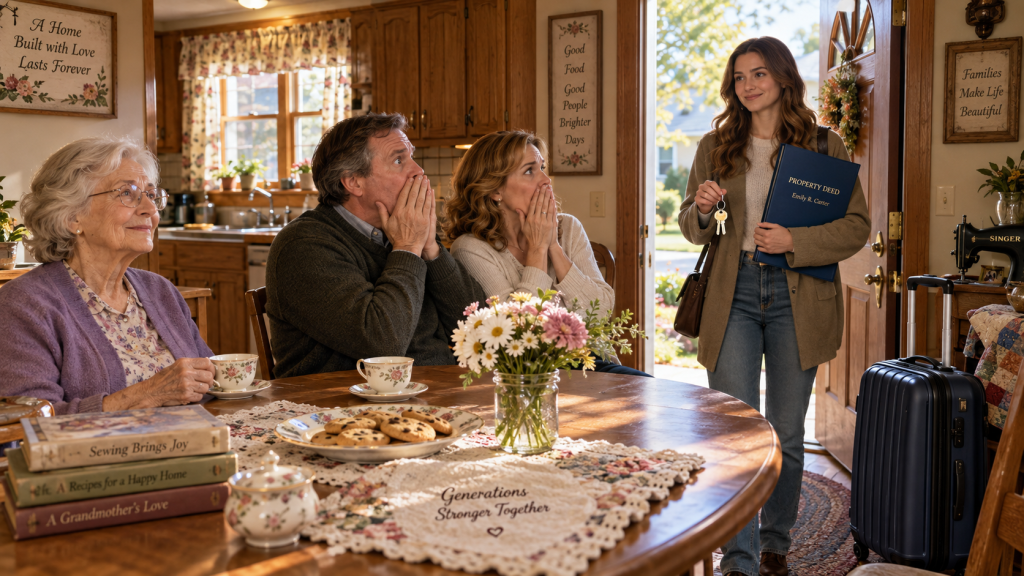
Emily stood at the end of my kitchen table with the blue folder tucked beneath one arm.
She looked like Walter when she was angry.
Not in the face.
In the stillness.
Walter had never been a shouting man.
When something truly mattered, he became quieter.
His shoulders settled.
His eyes sharpened.
And everyone around him somehow understood that the next few words should be listened to very carefully.
Emily had inherited that.
Greg had not.
Dana snatched the eviction notice from the table.
“Thirty days?” she said. “You cannot throw us out in thirty days.”
Emily looked at her.
“I can give you longer if Grandma asks me to.”
Dana’s eyes flew toward me.
For one ridiculous second, I almost laughed.
Six months earlier, she had told me nobody missed me in my own house.
Now suddenly my opinion mattered.
Greg recovered first.
“This is fraud.”
“No,” Emily said.
“You manipulated her.”
“No.”
“You took advantage of an eighty-one-year-old widow.”
Emily’s expression did not change.
“You were trying to put an eighty-one-year-old widow into a nursing home so you could sell property she owned.”
“That is completely different.”
I picked up my tea.
“No,” I said. “It really isn’t.”
Greg turned toward me.
“Mom, stay out of this.”
The words landed so absurdly that even Dana looked at him.
Stay out of this.
My house.
My deed.
My life.
My future.
And my son was still telling me to stay out of it.
I set the cup down.
“No.”
His jaw tightened.
“Mom.”
“No, Greg.”
I had spent two years saying yes because I was tired.
Yes, you can move in for a while.
Yes, take the bedroom.
Yes, three hundred dollars a month.
Yes, I can sleep in the sewing room.
Yes, Dana can rearrange the kitchen.
Yes, your boxes can stay in Walter’s workshop.
Yes, I understand.
Yes, I don’t mind.
Yes.
Yes.
Yes.
Until my yes had become so cheap that nobody bothered to ask for it anymore.
That morning, I discovered how much strength can fit inside one small word.
No.
Greg slapped the deed onto the table.
“You sold a four-hundred-thousand-dollar house for one dollar?”
“I did.”
“To her?”
“Yes.”
“You cannot be serious.”
“I am.”
“You cheated me.”
That sentence hurt.
Not because it was true.
Because it revealed something.
“You thought the house belonged to you already.”
Greg looked at me.
“It was going to.”
“When?”
“Eventually.”
“After I died?”
He did not answer.
The kitchen became very quiet.
Emily looked away.
Dana crossed her arms.
“You know what she means,” Dana said. “Parents leave property to their children.”
“Some do.”
“It’s normal.”
“Trying to hurry the parent out before she dies is less normal.”
Dana’s face hardened.
“I never hurried anyone.”
I looked toward the suitcase.
Still standing by the front door.
The nursing home form was still lying on top.
Bed number circled in red.
I did not need to say anything.
Dana followed my eyes.
So did Greg.
Emily walked over to the suitcase.
She picked up the nursing-home packet.
“What is this?”
“Nothing,” Greg said.
Emily opened it.
She read the first page.
Then the second.
Her eyes changed.
“Dad.”
Greg rubbed his forehead.
“We were looking at options.”
“You circled a bed.”
“Mom needs help.”
“With what?”
“She’s eighty-one.”
“That is an age, not a diagnosis.”
“She falls.”
I looked at him.
“I fell once.”
“You forget things.”
“I forgot where I put my glasses.”
“You left the stove on.”
“Dana left the stove on.”
Dana’s head jerked toward me.
“You cannot prove that.”
“I was sitting beside you when you smelled the pan.”
Emily closed the packet.
“Does Grandma have a doctor who says she cannot live independently?”
Greg said nothing.
“Dad?”
“No.”
“Has she been declared incompetent?”
“No.”
“Does she need assistance bathing?”
“No.”
“Dressing?”
“No.”
“Medication management?”
“No.”
“Has she asked to move into a nursing home?”
Greg slammed his hand onto the table.
“Why are you interrogating me?”
“Because you packed her suitcase.”
His face went red.
“You don’t know what it has been like living with her.”
That sentence finally made me angry.
Not wounded.
Angry.
“Living with me?”
Greg looked at me.
I stood.
“You came here.”
“Because you needed us.”
“You came three days after your father’s funeral.”
“You were alone.”
“I was grieving.”
“You could barely function.”
“I had buried my husband of fifty-four years.”
“Exactly.”
“And you took my bedroom.”
Dana rolled her eyes.
“Oh, please.”
I turned toward her.
“No. You please.”
She stared at me.
“You brought six boxes of clothes into my bedroom while Walter’s slippers were still beside the bed.”
Something moved across her face.
Not shame.
Annoyance.
I continued.
“You told me the stairs might be dangerous, so I slept in the sewing room. You put my dresser in the garage because it did not match your furniture.”
“Greg said—”
“I am not talking to Greg.”
Dana went silent.
“You removed Walter’s photograph from the mantel because you said it made the room depressing.”
“I put it in the hallway.”
“You put it inside a drawer.”
She looked away.
“You began calling this house yours before his first birthday after he died.”
Emily’s face tightened.
I had never told her that.
I had not told anyone.
Shame is strange.
Someone mistreats you, and somehow you become embarrassed for allowing it.
So you hide the evidence of your own humiliation.
That protects exactly the wrong person.
Greg stood.
“This is getting ridiculous.”
“No,” Emily said. “I think it’s finally getting accurate.”
He pointed at her.
“You stay out of this.”
Emily laughed once.
“You really love that sentence.”
“Do not talk to me like that.”
“How should I talk to you?”
“I am your father.”
“And she is your mother.”
Greg stopped.
Emily continued.
“Did that ever matter when you were taking her pension money?”
“I charged her rent.”
Emily looked around the kitchen.
“In her own house?”
“We paid utilities.”
“So?”
“She lives here.”
Emily stared at him.
Then looked at me.
“Grandma, how much?”
“Three hundred a month.”
“For how long?”
“About twenty-one months.”
Emily calculated.
“Six thousand three hundred dollars.”
Greg threw up his hands.
“You make it sound like robbery.”
“Did Grandma agree?”
“She paid.”
“That’s not the same question.”
“She never objected.”
I looked at him.
“You held out your hand.”
His face changed.
“What?”
“Every month.”
“I don’t remember that.”
“I do.”
Some memories become sharper because humiliation burns around the edges.
The first pension check after Walter died, Greg stood in my kitchen.
“Everybody pays their share, Mom.”
He held out his hand.
I laughed because I thought he was joking.
He kept his hand there.
So I wrote a check.
Three hundred dollars.
And afterward, I cried in the sewing room where nobody could hear me.
Not because of the money.
Because the house Walter had built had become a place where I needed permission to stay.
Emily sat beside me.
Her hand covered mine.
“You never told me.”
“I didn’t want you worrying.”
“That was not your job.”
I smiled sadly.
“It’s always a grandmother’s job.”
“No.”
She squeezed my hand.
“Not when you’re the one who needs someone.”
Greg looked disgusted.
“This is exactly how you manipulated her.”
Emily turned.
“By listening?”
“You knew she was vulnerable.”
“Yes.”
“And you bought her house for a dollar.”
“Yes.”
“Tell me how that isn’t exploitation.”
Emily opened the folder again.
She removed a second document.
“Because the purchase price wasn’t one dollar.”
Greg froze.
Dana leaned forward.
“What?”
Emily slid the page across the table.
Greg read.
His mouth opened.
I watched the numbers reach him.
The truth was that Emily had not paid me one dollar.
One dollar was the consideration printed on the deed because that was how the lawyer structured the transfer.
The actual agreement was different.
Emily had paid off the small home-equity balance Walter and I still carried.
She had placed one hundred twenty thousand dollars into an irrevocable trust for my living expenses and medical needs.
She had agreed to pay property taxes.
Insurance.
Major structural repairs.
And she had signed a life-estate lease granting me exclusive residential rights until my death.
There was also a clause Walter would have loved.
If Emily sold the house while I was alive, my lease survived the sale automatically.
Nobody could buy me out.
Nobody could evict me.
Nobody could make me leave unless I chose to.
Greg read slowly.
“Where did she get a hundred twenty thousand dollars?”
Emily’s voice was calm.
“My money.”
“You don’t have that kind of money.”
“You have not known much about my life for fifteen years.”
That one hit.
Greg looked at her.
Emily had built a career in software compliance.
She owned a small consulting company.
She had never been rich in the way television defines rich.
But she had done well.
Walter knew.
I knew.
Greg had never bothered to ask.
He preferred the story where his daughter was irresponsible.
That story excused him for abandoning her.
“She bought the house,” I said.
Greg looked at me.
“For less than it was worth.”
“Yes.”
“So you gave away my inheritance.”
The room went silent again.
My inheritance.
Not his father’s legacy.
Not my security.
His inheritance.
I stood straighter.
“No, Greg.”
He stared.
“I used my property to protect my life.”
“You could have left it to both of us.”
“Both?”
“You and Emily.”
“Why?”
His face twisted as if the question itself were offensive.
“Because I’m your son.”
“And she is my granddaughter.”
“That is not the same.”
Emily’s expression finally cracked.
Pain.
Old pain.
The kind a daughter can still feel at forty when her father reminds her she never counted the same way.
I saw it.
And something inside me hardened.
“She showed up.”
Greg scoffed.
“So did I.”
“No.”
I shook my head.
“You arrived.”
“That’s the same thing.”
“No, sweetheart.”
I had not called him sweetheart in months.
Maybe years.
The word made him look at me.
“Showing up means coming for the person.”
I pointed toward the suitcase.
“You came for the property.”
His face went blank.
The truth does not always make people angry immediately.
Sometimes it leaves them nowhere to stand.
Dana broke the silence.
“I want a lawyer.”
Emily nodded.
“Get one.”
“You think you’re clever?”
“No.”
“You think some paperwork means we’re leaving?”
“Yes.”
“We have rights.”
“Yes.”
“Good.”
Emily handed her another sheet.
“This explains them.”
Dana snatched it.
Thirty-day notice.
State law.
Occupancy status.
No tenancy agreement.
No ownership interest.
No right to sell.
No right to interfere with my life tenancy.
All written in language clean enough that even anger could not muddy it.
Dana read halfway down.
“You’ve planned this.”
“For six months.”
My son looked at me.
“You’ve been lying to us for six months.”
That was the first thing he said that almost made me feel guilty.
Almost.
Then I remembered the realtor.
The nursing home.
The suitcase.
“You never asked who owned the house.”
“Because I thought you did.”
“You thought you did.”
“That’s not true.”
“You brought a realtor.”
“To help.”
“You measured my bedroom.”
His eyes dropped.
“You told Chuck ‘the old lady comes with the house for now.’”
His face drained.
Emily looked at him.
“You said that?”
Greg stared at me.
“How did you hear?”
“I was pouring your coffee.”
He closed his mouth.
I could see the memory arriving.
Chuck laughing.
Greg laughing.
Me standing near the doorway with the coffee pot.
Invisible.
That had been the advantage of becoming old in their eyes.
They stopped treating me as a person who could hear.
Think.
Plan.
Remember.
They thought age made me scenery.
That mistake cost them a house.
The doorbell rang.
Everyone froze.
Greg looked toward the clock.
10:18.
“The realtor,” Dana whispered.
Emily smiled slightly.
“Probably.”
Greg moved toward the door.
Emily stepped in front of him.
“I’ll get it.”
“This is still my—”
He stopped himself.
Too late.
Emily opened the door.
Chuck stood on the porch wearing a blue blazer and carrying a leather folder.
His smile lasted until he saw Emily.
Then it grew confused.
“Hello.”
“Are you Chuck?”
“Yes.”
“I’m Emily Harper. I own this property.”
Chuck blinked.
Behind him, a photographer was unloading equipment from a car.
Chuck looked over Emily’s shoulder.
“Greg?”
Greg came into the hallway.
“This is a family dispute.”
Chuck’s expression became careful.
Realtors, I learned, have a special face for legal problems.
It looks like politeness trying to back away.
“You told me you owned the property.”
“I’m inheriting it.”
“You told me your mother was transferring it today.”
“That was the plan.”
Emily held up the deed.
“It was sold six months ago.”
Chuck stared at the county recording stamp.
His face changed completely.
“You don’t own it.”
“I just said it’s complicated.”
“No.”
Chuck stepped backward.
“This is actually not complicated.”
Dana came into the hallway.
“We are contesting it.”
“Then call me after you own something.”
Chuck turned toward his photographer.
“We’re done.”
Greg followed him onto the porch.
“Chuck.”
“No.”
“I already paid for the listing photos.”
“I’ll refund the fee.”
“Come on.”
Chuck lowered his voice.
I could still hear him.
“You asked me to prepare a listing for a house you don’t own.”
“I thought—”
“You signed a representation form saying you were authorized.”
Emily appeared beside Greg.
“I’d like a copy.”
Chuck looked relieved to see someone who sounded sane.
“Absolutely.”
Greg stared at her.
“Why?”
“Because depending on what you signed, my attorney may want it.”
His face went gray again.
Chuck left.
No photographs.
No cookies.
Dana stood in the hallway beside the china plate she had prepared for a future that no longer existed.
I wish I could say I felt triumphant.
I did not.
I felt tired.
Revenge sounds exciting when people tell stories.
In real life, consequences often arrive looking like exhausted family members standing in an old hallway.
Greg turned toward me.
“You’re really doing this.”
I looked at him.
“Yes.”
“You’re throwing your own son out.”
“No.”
I pointed at Emily.
“The owner is ending your occupancy.”
His mouth twisted.
“Cute.”
“It isn’t cute.”
I stood.
“It is sad.”
That stopped him.
For a second, he looked like the boy he had once been.
My boy.
Freckles.
Cowlick.
Always losing one mitten.
The child who used to crawl into my bed during thunderstorms.
The teenager Walter taught to change oil.
The young man who cried at his wedding.
A mother never loses those ghosts.
No matter what the adult child becomes, you can still see the boy standing behind him.
That is what makes boundaries with children so painful.
You are never only saying no to the grown man.
Somewhere inside your heart, you are also saying no to the child who once held your hand crossing the street.
Greg’s eyes filled.
“Dad would hate this.”
There it was.
The knife he knew would cut deepest.
Walter.
I sat down.
“No.”
“You know he would.”
“No.”
“He wanted this house to stay in the family.”
“It is in the family.”
“You know what I mean.”
“Yes.”
I did.
He meant the male line.
Father to son.
Son to son.
The old assumption nobody had ever written down.
But Walter had never believed that.
Not really.
He loved Greg.
He loved Emily.
Toward the end, he worried about them differently.
Three months before he died, Walter was sitting on the porch with oxygen tubing beneath his nose.
He watched Greg drive away in his new truck.
Then he said something strange.
“Don’t let the house become payment.”
I asked what he meant.
He looked toward me.
“For anything.”
I thought he was talking about medical bills.
Later, I understood.
Walter had noticed Greg asking questions.
What is the house worth?
Is the mortgage paid?
Whose name is on the deed?
Do you have a will?
He saw something forming.
He died before he could confront it.
Or perhaps he thought he had more time.
Most of us do.
“Your father wanted me safe,” I said.
Greg looked away.
“You don’t know that.”
“I slept beside him for fifty-four years.”
Dana muttered, “This is emotional manipulation.”
Emily laughed without humor.
“You threatened to have her declared confused.”
“I said if she acted confused—”
“You told her confused old women get locked rooms.”
Dana’s face changed.
“How do you know that?”
I answered.
“I told her.”
The shock on Dana’s face would have been funny in another life.
She genuinely believed I did not tell people things.
That I existed only inside the walls where she spoke to me.
“Everything?” Dana asked.
“Yes.”
Dana looked at Greg.
Then me.
Then Emily.
Something like fear entered her face.
“What else did you tell her?”
“Everything I could remember.”
That was not entirely true.
There were still things I had kept.
Not to protect them.
Because some humiliation takes time to say out loud.
Emily knew enough.
The next thirty days were the longest month of my life.
Greg and Dana hired an attorney.
His name was Mr. Bell.
He sent a letter challenging the sale on grounds of undue influence and diminished capacity.
My lawyer, Mr. Kaplan, smiled when he read it.
Not arrogantly.
Almost sadly.
“Expected.”
“Can they undo it?”
“Anyone can challenge almost anything.”
“That is not an answer.”
He laughed.
“You sound like Walter.”
“Walter hated lawyers.”
“So do most of my favorite clients.”
Then his expression became serious.
“The sale was carefully documented.”
He opened my file.
There was the competency evaluation.
My primary physician’s letter.
The video recording of my consultation.
The independent witness.
The bank records.
My handwritten statement.
And something Greg did not know existed.
An audio recording.
The night I overheard him in the kitchen.
The house is worth four hundred thousand, easy.
We list it the day she is out.
I had recorded the last half of the call from the hallway.
Not intentionally at first.
I had opened the voice recorder because I wanted to remember the exact words.
Afterward, Mr. Kaplan verified that under our state’s law, I could legally record a conversation I was physically present to hear from my own home.
The recording was not perfect.
But it was clear enough.
Mr. Kaplan also had photographs.
The folding bed.
My belongings boxed in the sewing room.
Dana’s bedroom furniture filling the master suite.
The monthly three-hundred-dollar checks.
The nursing-home packet.
My packed suitcase.
Emily had photographed everything the morning she arrived.
Mr. Bell’s challenge lasted twelve days.
Then it changed.
Instead of trying to void the deed, Greg’s attorney proposed a family settlement.
Greg and Dana would move out if Emily paid them forty thousand dollars for “improvements and property maintenance.”
I laughed for the first time in weeks.
“Forty thousand?”
Mr. Kaplan adjusted his glasses.
“They claim labor, landscaping, appliance replacement, utility contributions.”
“They replaced my toaster.”
“Apparently it was an excellent toaster.”
Emily, sitting beside me, nearly choked.
There had been no forty thousand dollars of improvements.
Greg had painted the garage.
Badly.
Dana had replaced three light fixtures without asking.
They bought a television.
The television belonged to them.
They installed a hot tub on the patio.
Also without asking.
It had damaged part of Walter’s stonework.
Emily rejected the proposal.
Then Greg reduced the demand.
Twenty-five thousand.
Rejected.
Ten.
Rejected.
Finally, Mr. Bell called Mr. Kaplan and asked what it would take for the matter to end.
Mr. Kaplan asked me.
I thought about it.
“Thirty days.”
He raised an eyebrow.
“That’s all?”
“They leave by the date on the notice.”
“No payment?”
“No.”
“No release of claims?”
“I don’t have claims.”
“You may.”
I looked at Emily.
She looked at me.
I knew what he meant.
Financial exploitation.
Improper pension withdrawals.
Attempted property transfer.
Perhaps more.
But I was tired.
Not weak.
Tired.
There is a difference.
“I want my house quiet.”
Mr. Kaplan nodded.
“I understand.”
The agreement was signed.
Greg and Dana would leave by five o’clock on the thirtieth day.
They would take their belongings.
They would not damage the property.
They would surrender all keys.
They would not interfere with my life tenancy.
In exchange, Emily would not pursue civil damages for unauthorized alterations or the attempted listing.
I did not agree to excuse crimes because there had been no charges.
I simply chose peace over a longer civil fight.
Greg did not speak to me for most of those thirty days.
We lived under the same roof like strangers on opposite sides of a border.
Dana packed noisily.
She slammed cabinet doors.
She wrapped dishes that were not hers until I stood in the kitchen and said, “Those stay.”
“These are ours.”
“My mother’s china.”
“You never use it.”
“That does not make it yours.”
She put the plate down.
Later, I found two silver serving spoons in one of her boxes.
I removed them.
Said nothing.
At night, I heard them arguing.
Sometimes about me.
Sometimes about Emily.
Mostly about money.
The house they thought they would sell for four hundred thousand dollars had already been counted inside their future.
I learned that from the arguments.
They had debts.
More than I knew.
Truck loan.
Credit cards.
Dana had borrowed against a retirement account.
Greg had already talked with someone about buying a camper.
They had planned to use “their share” of my house to reset everything.
Their share.
I lay on the folding bed listening to them argue in my bedroom.
And for the first time, I understood why they had become so impatient with my continued existence.
Not because they hated me.
Perhaps that would have been easier.
They had simply turned me into a number inside a financial plan.
An obstacle between debt and relief.
That realization hurt differently.
Hatred at least sees you.
Greed turns you into arithmetic.
On the seventeenth day, Greg knocked on the sewing-room door.
He had not done that in months.
“Come in.”
He opened it halfway.
“Can we talk?”
I gestured toward the folding chair.
He sat.
For a while, neither of us spoke.
Then he looked around.
The sewing room was small.
Walter had built shelves along one wall for my fabric.
Dana had moved most of it into boxes.
My folding bed sat beneath the window.
One narrow dresser.
A lamp.
Two photographs.
That had been my world for almost two years.
Greg seemed to see it for the first time.
“Why didn’t you say you hated it in here?”
I stared at him.
“What would you have done?”
“Changed something.”
“You put me here.”
“You said the room was fine.”
“You said the stairs worried you.”
“They did.”
“You moved upstairs.”
He rubbed his hands together.
“Dana has a bad back.”
I laughed softly.
“So you gave her my mattress.”
He looked ashamed.
Finally.
“It sounds bad.”
“It was bad.”
“I didn’t think about it like that.”
“I know.”
That was perhaps the saddest part.
He had not sat down one morning and decided to humiliate his mother.
He simply kept making choices that benefited him.
One after another.
And never looked back to see what those choices were costing me.
“I thought I was helping,” he said.
“With what?”
“After Dad died.”
“You were.”
He looked surprised.
“The first week.”
Greg’s eyes filled.
I continued.
“You brought groceries. You handled the insurance calls. You cleaned the gutters. You sat beside me when I couldn’t sleep.”
I smiled sadly.
“I was grateful.”
“What happened?”
I looked at him.
“You stayed after helping stopped.”
He looked down.
“You started deciding.”
Silence.
“Then taking.”
Another silence.
“Then planning.”
His mouth tightened.
“I wasn’t trying to kill you, Mom.”
The sentence shocked me.
“I never said you were.”
“That’s how everybody acts.”
“No.”
I leaned forward.
“I think you hoped I would become inconvenient enough to remove.”
His face crumpled.
“That isn’t true.”
“You found a nursing home bed.”
“Dana did.”
“You put my suitcase by the door.”
His eyes closed.
“I was mad.”
“You wrote my name on a transfer form.”
“I thought you’d sign.”
“Why?”
He looked at me.
That was the question.
Why did he think I would sign away my home?
Because I was old?
Because I loved him?
Because I had said yes too many times?
Because he had mistaken my gentleness for surrender?
“I don’t know,” he whispered.
I believed him.
Maybe that was worse.
He stood.
At the door, he stopped.
“Did you ever plan to leave the house to me?”
I looked at him.
Before Walter died, yes.
The will had divided everything between Greg and Emily.
Half.
Half.
Not because Walter loved them equally in every way.
Love cannot be measured like land.
But because both were family.
After Greg moved in, I changed nothing immediately.
Even after the pension money.
Even after the bedroom.
Even after Dana began calling the house hers.
It took the kitchen phone call.
The laugh.
We list it the day she is out.
That was when something changed.
“Yes,” I said.
Greg froze.
“You were getting half.”
His face went blank.
“With Emily?”
“Yes.”
“For years?”
“Since she turned twenty-five.”
He sat back down slowly.
“So if I had just…”
He did not finish.
Behaved?
Waited?
Loved me?
Seen me?
“Yes,” I said.
He covered his face.
And for the first time since all of this began, my son cried.
Not angry tears.
Not tears meant to change my mind.
He cried like a man standing in front of the ruins of his own decisions.
I did not comfort him.
That was difficult.
Every instinct in my body told me to reach for him.
He was still my child.
But sometimes comfort arrives too early and becomes an escape from accountability.
So I sat.
And let him cry.
When he finally looked up, he said, “I ruined everything.”
“No.”
He shook his head.
“Yes.”
“You damaged a lot.”
“That’s the same thing.”
“No.”
I took a breath.
“You are alive.”
He looked at me.
“So am I.”
He said nothing.
“As long as that is true, not everything is ruined.”
He wiped his face.
“Can you forgive me?”
There it was.
The question people ask when pain becomes uncomfortable.
Not always selfishly.
Sometimes because they genuinely do not know what else to request.
“I don’t know yet.”
His face fell.
“But I’m your son.”
“I know.”
“Doesn’t that count?”
“Yes.”
“That should count for something.”
“It does.”
I looked at him.
“It is why I am answering honestly instead of saying yes just to make you feel better.”
He absorbed that.
Then nodded.
On the twenty-third day, Dana confronted me in the kitchen.
Greg was at work.
Emily had taken me to lunch.
When we returned, Dana was sitting at the table with Walter’s old leather folder open in front of her.
My heart stopped.
“What are you doing?”
She looked up.
“I found this in the garage.”
“You were going through my things.”
“I was packing.”
“That folder was inside a locked cabinet.”
She did not answer.
Emily moved beside me.
“Dana.”
Dana pulled out Walter’s will.
The old one.
The one written before the house sale.
She held it up.
“This says Greg gets half.”
I stared at her.
“Yes.”
“So you cannot just give it away.”
Emily sighed.
“That is not how wills work.”
“It is signed.”
“It controls assets owned at death.”
Dana looked confused.
Emily continued.
“Grandma is alive.”
“She cannot intentionally defeat an heir.”
“Yes, she can.”
Dana turned toward me.
“You did this to punish us.”
I looked at Walter’s signature.
His handwriting.
Steady.
Familiar.
“No.”
“Then why?”
“To protect myself.”
“You could have protected yourself without giving Emily everything.”
Emily cut in.
“She did not give me everything.”
Dana ignored her.
“You picked sides.”
That phrase.
Picked sides.
As if safety were a family competition.
I walked toward the table.
I took Walter’s will from Dana’s hand.
“No.”
My voice was calm.
“You picked sides when you decided my comfort mattered less than your plans.”
Dana laughed.
“You act like you were tortured.”
“No.”
I looked at her.
“I was diminished.”
She went silent.
“That is not the same as torture. It is not violence. It is not something dramatic enough for strangers to gasp over.”
I folded the will.
“But every day, something small was taken.”
My bedroom.
My money.
My kitchen.
My authority.
My privacy.
My dignity.
“By the time you packed my suitcase, you had already practiced removing me for almost two years.”
Dana stared.
For once, she had no quick answer.
Then her face changed.
Something exhausted appeared.
“Do you think this was easy for me?”
I almost laughed.
But she looked genuinely miserable.
“My marriage has been falling apart for years,” she said.
Emily and I exchanged a glance.
Dana continued.
“Greg is buried in debt.”
I knew some of that.
“He lies about money.”
That surprised me less.
“He told me this house was guaranteed.”
My stomach tightened.
“What?”
“When we moved in, he said you wanted us here because eventually it would be ours.”
I looked toward the hallway.
“Did he say I asked you to move in?”
“Yes.”
I closed my eyes.
Of course.
Greg had told me they needed to stay because I should not be alone.
He told Dana I had invited them because the house would become theirs.
Each of us had heard the version that made his plan easier.
Dana laughed bitterly.
“You think I’m some monster who came in and took your bedroom.”
“You did take it.”
“Because Greg said it was what you wanted.”
“Did my face suggest that?”
She flinched.
Good.
Because even if Greg lied, Dana had eyes.
She had lived with me.
She saw the folding bed.
Heard me moving around at night.
Watched me ask before using my own washer because she had a schedule.
She was not innocent.
But perhaps she was not the sole architect either.
“Why did you call it your house?” I asked.
Dana looked away.
“Because I wanted it to be.”
There it was.
At least she was honest.
“I grew up moving every year,” she said. “Apartments. Motels. My mother got evicted constantly.”
I listened.
“I wanted one place that was mine.”
“And you chose mine.”
Her eyes filled.
“Yes.”
That answer softened something inside me.
Not enough to change the notice.
Enough to see her as human.
People can hurt you and still have reasons.
Reasons are not absolution.
They are just context.
“You need to build your own place,” I said.
Dana nodded slowly.
“I know.”
She stood.
At the doorway, she stopped.
“I am sorry about the nursing home.”
I waited.
She turned.
“I was angry.”
“That is not why you did it.”
Her face tightened.
“No.”
“Why?”
She looked toward the suitcase.
Still there.
I had left it intentionally.
A monument.
A reminder.
“Because once we talked about selling, everything started feeling urgent.”
There it was again.
Arithmetic.
Debt.
Pressure.
A person becoming an obstacle.
“I kept thinking if you moved somewhere good, maybe it wouldn’t be cruel.”
“And was it good?”
“The home?”
“Yes.”
Dana swallowed.
“It was fine.”
“Would you live there?”
She looked away.
“That isn’t fair.”
“No.”
I smiled sadly.
“It isn’t.”
On the final morning, moving trucks arrived at eight.
Not one.
Two.
I watched from the porch.
Emily sat beside me with coffee.
It was cold enough that our breath showed.
Greg carried boxes.
Dana directed movers.
Nobody spoke much.
At eleven, they removed the bed from my bedroom.
My bedroom.
When the frame came down the stairs, something inside my chest loosened.
At noon, the truck carrying their living-room furniture pulled away.
The house began to echo.
By three, the hot tub was gone.
The patio beneath it was stained.
Emily promised to repair it.
At 4:37, Greg carried the last box outside.
Dana put the keys on the kitchen table.
She looked at me.
“Goodbye, Margaret.”
“Goodbye, Dana.”
She hesitated.
Then left.
Greg remained.
He stood in the hallway.
The same hallway where, thirty days earlier, he had told Emily she was nobody.
The same hallway where my suitcase had waited.
He looked older.
Not because thirty days had aged him.
Because certainty had left his face.
“Where will you go?” I asked.
“Apartment for now.”
“With Dana?”
“Yes.”
“Good.”
He smiled without humor.
“You mean that?”
“I don’t want your marriage to fail.”
He looked surprised.
“Really?”
“Your marriage failing would not repair ours.”
That sentence seemed to reach him.
He nodded.
Then looked around.
“Can I come visit?”
I did not answer immediately.
His face changed.
That hurt him.
I hated that it hurt him.
But boundaries are not punishment simply because someone dislikes them.
“Call first.”
He nodded.
“Okay.”
“And if I say no, you accept it.”
Another nod.
“Okay.”
“No key.”
His eyes lowered.
“I understand.”
“You do not stay overnight.”
“Okay.”
“You do not ask me about the house.”
His mouth tightened.
Then relaxed.
“Okay.”
“And you stop taking money from me.”
“I already did.”
“I mean forever.”
“Yes.”
I looked at him.
“If we are going to have a relationship, it will have to be about me.”
He frowned.
“What does that mean?”
“It means you visit because you want to see your mother.”
I glanced around.
“Not because you are checking on an asset.”
Greg’s eyes filled.
“Mom.”
“I need to know the difference.”
He nodded.
Then he surprised me.
“Can I hug you?”
For two years, he had entered rooms without asking.
Moved my belongings without asking.
Spent my money without asking.
Planned my future without asking.
That question mattered.
“Yes.”
He hugged me.
For a second, I was eighty-one.
Then I was thirty-eight again, holding my little boy after he fell off his bicycle.
Mothers travel through time when their children touch them.
I could smell his aftershave.
Feel the familiar shape of his shoulders.
My son.
Still my son.
Still capable of hurting me.
Still loved.
Those truths had to learn how to live together.
When he stepped back, he wiped his eyes.
“I’m sorry.”
“I know.”
“I don’t expect that to fix it.”
“Good.”
A weak smile.
Then he left.
Emily and I stood in the doorway.
We watched his truck disappear.
The house became silent.
Real silence.
Not the tense quiet I had lived with.
This silence had room inside it.
Emily looked at me.
“What now?”
I turned toward the staircase.
“My bedroom.”
She laughed.
We spent the next three days putting the house back together.
Not restoring it exactly.
That surprised me.
At first, I thought I wanted everything the way Walter had left it.
His dresser.
His chair.
The old curtains.
The bedspread he hated.
Then I stood in the master bedroom and realized preserving a life is not the same as living one.
So we changed things.
Emily painted the room pale blue.
Not Dana’s gray.
Not Walter’s beige.
Mine.
We moved the bed beneath the windows.
I bought new curtains.
Yellow.
Bright enough that Dana would have hated them.
That made me like them more.
Walter’s photograph returned to the mantel.
But not as a shrine.
He would have hated that.
Beside it I placed a photograph of Emily at age seven sitting on his shoulders.
In the kitchen, I rearranged the cabinets.
The flour tin stayed exactly where it had always been.
Inside it, for another month, I kept my copy of the deed.
Then one morning I moved it.
I put it in the safe.
Not because I feared Greg anymore.
Because I was tired of living as if my security had to hide inside baking supplies.
Emily repaired the patio.
She hired someone to fix the garage paint.
She also replaced the lock on Walter’s workshop.
Then she handed me the key.
“Your workshop.”
I smiled.
“I don’t use tools.”
“Then your room.”
“For what?”
“Whatever you want.”
That question followed me around for days.
What did I want?
For two years, my life had been mostly responses.
What did Greg need?
What did Dana want?
What could I tolerate?
What should I give up?
Want had become rusty.
So I started small.
I wanted a reading chair near the window.
Bought one.
I wanted tulips near the porch.
Planted them.
I wanted to eat breakfast at ten instead of seven.
Did that.
I wanted to leave dirty dishes until morning sometimes.
Reckless.
I did that too.
Then I wanted something bigger.
A sewing room again.
Emily and I emptied Walter’s workshop.
Not everything.
We kept his workbench.
His hammer.
The wooden toolbox Greg made in shop class when he was fourteen.
I could not throw that away.
But we moved my sewing table beside the window.
Fabric returned to shelves.
My machine came out of its box.
One afternoon, I sat down and threaded it.
My hands remembered.
I had not sewn properly since Walter became ill.
The first thing I made was a terrible pillowcase.
Crooked seam.
Uneven edge.
I loved it.
At eighty-one, you learn perfection is mostly a young person’s hobby.
Usefulness is better.
Joy is better.
The months after Greg left were not a victory parade.
I missed him.
That surprised people.
Not Emily.
She understood.
You can miss the person who mistreated you.
Missing does not mean the boundary was wrong.
It means the relationship contained more than the worst thing.
Some mornings, I missed hearing Greg cough in the hallway.
Some evenings, I missed Dana’s television.
The house felt enormous.
There were nights when I almost called and told them to come back.
Then I would look at my bedroom.
My real bed.
My yellow curtains.
And I remembered that loneliness is not always a signal to return somewhere harmful.
Sometimes it is simply the sound freedom makes before you get used to it.
Greg called every Sunday.
At first, exactly at four.
“Can I come by?”
Sometimes I said yes.
Sometimes no.
The first time I said no, he was quiet.
“Are you busy?”
“No.”
“Then why not?”
Old Greg.
There for a second.
I waited.
He heard himself.
“Sorry.”
Then:
“Okay. Next week?”
“Call me.”
He did.
Slowly, something changed.
He started bringing nothing.
That mattered.
No paperwork.
No estimates.
No financial questions.
He brought himself.
One Sunday we sat on the porch for an hour talking about baseball.
Another week he fixed a loose hinge.
He asked first.
Once he brought groceries.
I told him I did not need them.
He took them home.
No offense.
Progress.
Dana came only once.
Six months after they moved out.
She stood on the porch holding a plant.
“I know you hate peace lilies.”
“I do.”
“It’s a fern.”
I looked at it.
“You remembered.”
She smiled awkwardly.
“I remember more than you think.”
I let her in.
We drank coffee.
She apologized again.
Not dramatically.
She did not ask for forgiveness.
That helped.
She told me she had started working part-time.
Not because they were desperate.
Because she wanted money that was hers.
I understood more than she realized.
“Greg is in counseling,” she said.
I looked up.
“He told me.”
“He finally admitted how much debt he had.”
“How much?”
She shook her head.
“You don’t want to know.”
“You’re probably right.”
She laughed.
Then became serious.
“He always thought the house would fix everything.”
“I know.”
“I let myself believe it too.”
“I know.”
She looked around the kitchen.
“I am sorry I made you feel like a guest.”
That was the first apology that reached me.
Not because it was eloquent.
Because it named what she had done.
“I forgive you,” I said.
She cried.
I did not.
Forgiveness sometimes arrives quietly.
No thunder.
No embrace.
Just a sentence you suddenly realize you mean.
Greg’s apology took longer.
Not the words.
The meaning.
He had said sorry many times.
But almost a year later, he came over on Walter’s birthday.
We sat at the kitchen table.
He placed something in front of me.
A stack of checks.
Twenty-one of them.
Three hundred dollars each.
Six thousand three hundred total.
I looked up.
“What is this?”
“The rent.”
I stared at him.
“I’m paying it back.”
“You do not have to.”
“Yes.”
“No.”
“Mom.”
“I sold the house. I’m not poor.”
“That is not the point.”
He pushed the checks toward me.
“You didn’t owe me rent.”
I looked at my son.
Something inside me softened.
Not because of the money.
Because he finally understood the offense.
“I can’t cash twenty-one checks.”
“Then do one a month.”
“Greg.”
“I need to pay it back.”
I thought about Stephanie from another life I did not know, women repaying debts one hundred dollars at a time.
Accountability is sometimes practical.
Sometimes symbolic.
Sometimes both.
I took the checks.
“Thank you.”
His eyes filled.
“I’m sorry I made you pay to live in Dad’s house.”
“My house.”
He nodded.
“Your house.”
Then smiled faintly.
“Emily’s house.”
I laughed.
“Technically.”
He laughed too.
That was the first time we joked about it.
It felt like sunlight finding a crack.
Two years passed.
Then three.
I turned eighty-four.
Still alive.
That surprised Greg more than anyone.
I told him so.
He did not find it funny.
I did.
Emily came often.
She never moved into the house.
People assumed she would.
She refused.
“It’s Grandma’s home.”
Legally hers.
Practically mine.
That distinction became sacred to her.
She never entered without knocking.
Even though she owned the door.
That was when I truly knew I had made the right choice.
Ownership is not proven by how much you control.
Sometimes it is proven by how much you refuse to.
Emily eventually married a man named Thomas.
Quiet.
Kind.
Terrible at cards.
At their wedding, Greg sat in the second row.
Not the front.
That was Emily’s decision.
But he was invited.
Years earlier, he had told her she was not welcome at Walter’s funeral.
Now she gave him a place at her wedding.
Not because she forgot.
Because she chose what kind of woman she wanted to be.
At the reception, Greg asked her to dance.
I saw the question.
Saw her hesitate.
Then nod.
They stood together beneath the lights.
Father and daughter.
Awkward.
Careful.
Both older than the wound between them.
Halfway through the song, Greg started crying.
Emily did too.
I looked away.
Some repairs deserve privacy.
Later, Emily sat beside me.
“Grandma?”
“Yes?”
“I don’t forgive everything.”
“You don’t have to.”
“I thought tonight would make it all disappear.”
“It won’t.”
She looked disappointed.
I squeezed her hand.
“Forgiveness is not bleach.”
She laughed.
“What?”
“It does not make the stain pretend it was never there.”
“You’re weird.”
“I’m eighty-four. We get to be weird.”
She leaned her head against my shoulder.
The following spring, Greg brought me Walter’s old toolbox.
The one we had stored in the workshop.
He had taken it by mistake when they moved.
I had not noticed.
He placed it on the table.
“I found this.”
I opened it.
Inside was the little wooden hammer handle Greg had carved badly in seventh grade.
Walter had kept it.
All those years.
Greg saw it.
His mouth trembled.
“Dad kept that?”
“Of course.”
“It was terrible.”
“He loved terrible things you made.”
Greg laughed.
Then cried.
We sat together.
Walter between us without being there.
Grief changes when enough years pass.
It stops being a wound you fall into.
It becomes a room you visit.
Some days you sit there a while.
Then you leave.
At eighty-five, I started having trouble with my knees.
Real trouble.
Not Greg’s invented version.
I hated the irony.
The stairs became difficult.
My doctor suggested modifications.
Railings.
A downstairs shower.
Perhaps eventually a stair lift.
Greg came to the appointment.
At my request.
On the drive home, he was quiet.
Then he said, “Do you want to look at assisted living?”
I turned toward him.
His face went white.
“I mean—if you want. Not because—”
I laughed so hard my knees hurt.
“Breathe.”
“I heard it after I said it.”
“I know.”
“I swear I’m not packing anything.”
“I know.”
That was growth.
The word nursing home no longer felt like a threat because the person saying it was no longer deciding for me.
We toured two places.
My idea.
I hated one.
Liked the other.
Then decided to stay home.
Emily renovated the downstairs bathroom.
Greg built a handrail.
Dana brought soup.
Nobody took my bedroom.
Nobody packed my suitcase.
Help finally looked like help.
At eighty-six, I fell again.
This time badly.
Hip fracture.
Hospital.
Surgery.
Rehabilitation.
I spent three weeks in exactly the kind of facility I once feared.
And something funny happened.
It was fine.
Not home.
But fine.
The nurses were kind.
The physical therapist bullied me with love.
The food was terrible.
Greg visited every morning before work.
Emily visited evenings.
Dana smuggled in pie.
On the first night, Greg stood beside my bed looking nervous.
“I keep thinking about that packet.”
“The nursing home one?”
He nodded.
“I am sorry.”
“I know.”
“I didn’t understand what I was asking you to give up.”
I looked around the room.
Institutional curtains.
Plastic water pitcher.
Whiteboard with my name.
“It was not the building.”
He frowned.
“What?”
“The thing that frightened me.”
I pointed toward the door.
“It was losing the choice.”
Greg’s eyes filled.
“That is what you took.”
He sat down.
“I understand now.”
“Yes.”
I smiled.
“You do.”
That mattered.
I returned home using a walker.
Emily had installed a ramp.
Greg had widened the bathroom doorway.
For three months, people helped me constantly.
But nobody confused help with ownership.
That difference became the foundation of everything.
One afternoon, while Greg was changing a light bulb, I said, “You know something?”
“What?”
“You’re better at being my son now.”
He nearly dropped the bulb.
“That’s a brutal compliment.”
“It is still a compliment.”
“I’ll take it.”
At eighty-seven, I made another legal decision.
I changed the trust.
Not the house.
That already belonged to Emily.
The remaining money—the portion I had not spent—would be divided between Emily and Greg when I died.
Not equally.
That would have been easy.
Instead, I gave thought to it.
Emily would receive the larger portion because she had taken on obligations connected to the house and my care.
Greg would receive enough to know I had not erased him.
When I told him, he cried.
Then he surprised me.
“You don’t have to leave me anything.”
“I know.”
“Use it.”
“I intend to.”
“Seriously.”
“I am eighty-seven, Gregory. I am trying.”
He laughed.
Then said, “Leave mine to Emily.”
“No.”
“Mom.”
“No.”
“Why?”
“Because this is my decision.”
He smiled.
“Fair.”
I spent some of it.
A lot, actually.
At eighty-eight, Emily took me to Italy.
Walter always promised we would go.
We never did.
Life kept happening.
Mortgage.
Greg’s college.
Walter’s knee replacement.
Emily’s childhood summers.
Then cancer.
There was always later.
Until there wasn’t.
So Emily and I went.
I complained about the airplane.
She complained about my complaining.
We stood in Florence beneath a sky so blue it looked painted.
I ate gelato before lunch.
I bought a red scarf I did not need.
On a terrace overlooking the Arno, I thought about Walter.
“You should have come,” I whispered.
Emily heard me.
She took my hand.
“He did.”
I looked at her.
“In a way.”
Maybe.
Love does strange things with absence.
It makes room at tables for people who are gone.
When we returned, Greg came over.
He looked at photographs for two hours.
“You look happy.”
“I was.”
“You should travel more.”
“I plan to bankrupt all of you before I die.”
He laughed.
“Good.”
That sentence told me more about how far we had come than any apology.
The son who once saw my house as his future inheritance was telling me to spend everything.
I almost did.
At eighty-nine, Walter’s workshop became something else.
A community sewing room.
Not officially.
Just gradually.
A neighbor started coming over.
Then another.
Then a young mother from church who wanted to learn alterations.
Emily bought a second machine.
Every Wednesday, we gathered.
Coffee.
Fabric.
Gossip.
Sometimes Greg came by and fled immediately.
“Too much estrogen,” he said.
I told him that was not scientifically meaningful.
He said he was leaving anyway.
The house became alive again.
Not Walter’s house.
Not Greg’s inheritance.
Not Emily’s investment.
Mine.
Then ours in the only way sharing should work.
By invitation.
At ninety, I sat on the porch during my birthday party.
Children ran across the lawn.
Emily’s stepdaughter was pregnant.
Greg had gray hair.
Dana wore reading glasses.
Life had moved on without asking permission.
Someone brought out a cake with ninety candles until the fire risk became ridiculous.
We settled for nine.
Before I blew them out, Greg said, “Make a wish.”
I looked around.
“What for?”
He smiled.
“Good answer.”
That evening, after everyone left, Emily stayed.
We sat on the porch.
She had a key now.
I had given it to her years earlier.
That mattered too.
A key should be given.
Not taken.
“Do you ever regret selling me the house?” she asked.
“No.”
“Never?”
I thought about it.
“I regret needing to.”
She nodded.
“But not doing it.”
“No.”
“What if Dad had changed before?”
“He did change.”
“I mean before the sale.”
I looked toward the driveway.
Maybe then the house would still be in my name.
Maybe the will would have stood.
Maybe Greg and Emily would inherit equally.
Maybe everything would have been easier.
But easier is not always better.
“Then we would have had a different story.”
Emily smiled.
“You always say things like that.”
“I’m ninety. We get mysterious at ninety.”
“Is that the rule?”
“Yes.”
She rested her head against my shoulder.
I thought about the day she came through the door with the blue folder.
“Read the name out loud, Dad.”
I had never loved her more than in that moment.
Not because she humiliated Greg.
Because she stood between me and people who had forgotten I was allowed to stand for myself.
“Thank you,” I said.
Emily lifted her head.
“For what?”
“For saying yes.”
“To buying the house?”
“Yes.”
She looked at me.
“Grandma.”
“What?”
“You saved yourself.”
I smiled.
“That sounds familiar.”
“What?”
“Nothing.”
The truth was, she was right.
People like stories where someone arrives to rescue the old woman.
But Emily did not rescue me.
She believed me.
There is a difference.
She gave me access to power I already had.
She signed documents.
She brought money.
She stood in the doorway.
But the first decision was mine.
The taxi.
The deed.
The lawyer.
The secret.
The flour tin.
At eighty-one, when everyone around me thought I was becoming less capable, I made the boldest financial decision of my life.
That mattered.
Age did not make me helpless.
Love did not make me foolish.
Fear did not make me confused.
I was simply done being erased.
At ninety-one, my heart began giving me trouble.
Nothing dramatic.
At first.
Shortness of breath.
Swollen ankles.
Fatigue.
Then more appointments.
More pills.
The doctor explained things gently.
I appreciated that.
Not because I was afraid of death.
At ninety-one, death is not an intruder.
It is more like a neighbor you have seen walking closer for years.
You hope they take their time.
But you know eventually they will knock.
I made decisions.
Again.
My decisions.
No aggressive intervention if my heart failed badly.
No prolonged machines.
Home if possible.
Hospice if needed.
Emily cried when we signed the papers.
Greg did too.
I did not.
“Stop it,” I told them.
“You’re both making me feel unpopular.”
Greg laughed through tears.
“I’m not ready.”
“I know.”
“I wasted so much time.”
“Yes.”
That honesty hurt him.
I touched his cheek.
“But then you stopped wasting it.”
He bent his head.
I kissed his forehead.
My boy.
Always.
The final winter was gentle.
Snow came twice.
Greg shoveled.
Poorly.
Walter would have complained about the edges.
Dana baked bread.
Emily moved some work calls to my dining room.
Not because I required constant care yet.
Because she wanted to be near.
That distinction mattered until the end.
One afternoon, I asked Greg to bring the suitcase from the attic.
He froze.
“What suitcase?”
“The brown one.”
His face changed.
The suitcase.
The one that had stood by the door.
I had kept it.
Not because I liked pain.
Because objects change meaning if you live long enough.
He brought it downstairs.
We placed it on my bed.
I opened it.
Empty.
“Help me pack.”
Greg sat down.
“For what?”
“Hospice house.”
His eyes filled immediately.
“Mom.”
“I know.”
“We can keep you here.”
“I know.”
“Emily said we can hire—”
“I know.”
He stopped.
I took his hand.
“I want to go.”
“Why?”
“The hospice house has nurses all night.”
“We can have nurses here.”
“I do not want this house to become a hospital.”
He looked around my bedroom.
Yellow curtains.
Photographs.
The quilt I made badly and loved.
“I want to leave while it still feels like home.”
Tears ran down his face.
“Okay.”
Together, we packed the suitcase.
Not much.
Two nightgowns.
A cardigan.
Toothbrush.
Photographs.
My red scarf from Italy.
Walter’s old leather folder.
Greg saw it.
“You’re taking Dad’s folder?”
“Yes.”
“Why?”
“I like it.”
He laughed softly.
Then cried harder.
I folded the cardigan.
He placed it inside.
Years earlier, he had packed my suitcase to remove me.
Now he helped pack it because I asked.
That difference contained our entire story.
At the door, he stopped.
“Mom.”
I looked at him.
“I am so sorry.”
I knew exactly what he meant.
Not only the nursing home.
Everything.
“I know.”
“Did you forgive me?”
I smiled.
“Years ago.”
He covered his face.
“Why didn’t you tell me?”
“You stopped asking.”
He laughed through tears.
Then hugged me.
Emily drove.
Greg followed.
Dana came later.
The hospice room had a window overlooking a garden.
Not my garden.
But good enough.
I spent twelve days there.
Long enough to say what needed saying.
Not long enough for anyone to feel ready.
No amount of time does that.
Emily slept in the chair one night.
Greg another.
Dana brushed my hair.
I surprised her by saying I loved her.
She cried for nearly an hour.
“I was awful to you.”
“Yes.”
“You don’t have to agree so quickly.”
“I’m dying. Efficiency matters.”
She laughed.
Then kissed my forehead.
Greg brought photographs.
One showed Walter standing in front of the unfinished house in 1974.
Thirty-nine years old.
Hammer in hand.
No porch yet.
No landscaping.
Just framing.
Possibility.
“He built all of it?” Emily asked.
“Most.”
“Grandpa was insane.”
“Yes.”
“He could have hired people.”
“We had no money.”
Greg smiled.
“I remember him fixing everything.”
“He hated paying anyone.”
“That part I got from him.”
I looked at him.
“You got other things too.”
“Good things?”
“Some.”
He smiled.
Then became serious.
“Do you think Dad would forgive me?”
The question sat between us.
I looked at Walter’s photograph.
“I think your father would have been furious.”
Greg nodded.
“And then?”
“He would have made you repair the patio.”
We laughed.
Greg wiped his eyes.
“Anything else?”
“Yes.”
I looked at him.
“He would have expected you to become better.”
Greg lowered his head.
“Did I?”
“Yes.”
He looked up.
“Enough?”
There is no answer to that question.
Enough for what?
Enough to erase?
No.
Enough to deserve love?
He always had.
Enough to rebuild trust?
Eventually.
Enough to become someone different from the man who packed my suitcase?
Yes.
“Yes,” I said.
He cried quietly.
A few days later, Emily sat beside my bed.
The house keys lay on the table.
I had carried my old key ring even though I no longer needed it.
“Take them,” I said.
She shook her head.
“They’re yours.”
“Emily.”
“Grandma.”
“I am not going back.”
Her face crumpled.
“I know.”
“Take them.”
She did.
I closed her fingers around the ring.
“Do not sell the house immediately.”
“I won’t.”
“Live there first.”
“I have a house.”
“Then spend time there.”
“Okay.”
“Keep the workshop.”
“Okay.”
“Use the china.”
She laughed through tears.
“You hate the china.”
“I hate storing dishes for people who are dead.”
“Fair.”
“And one more thing.”
“What?”
“When you own something, remember ownership is not permission to make someone else small.”
Emily cried.
“I know.”
“I know you know.”
I smiled.
“That is why I chose you.”
The last conversation I had with Greg happened at dusk.
He sat by the window.
I was tired.
Talking had become work.
He held my hand.
“Mom?”
“Yes.”
“I keep thinking about the house.”
I opened one eye.
“Of course you do.”
He laughed softly.
“No. Not like that.”
I waited.
“I thought Dad built it for us.”
“He did.”
Greg frowned.
“But you sold it.”
“Still ours.”
He looked confused.
I squeezed his fingers.
“A home is not the deed.”
He started crying.
“Then what is it?”
“Where people let you belong.”
He lowered his head.
For a while, neither of us spoke.
Then he whispered, “Did I make you feel like you didn’t belong?”
“Yes.”
His shoulders shook.
I wished I had enough strength to sit up.
I did not.
So I moved my thumb across his hand.
“But you gave it back.”
He looked at me.
“When?”
“Every Sunday.”
He cried harder.
The porch visits.
The hinge.
The returned money.
The handrail.
The hospital.
The suitcase packed with permission.
Small things.
Repairs happen in small things.
“I love you,” he said.
“I love you too.”
“Even after everything?”
“Especially after everything is not the right phrase.”
He laughed through tears.
“What is?”
“Through everything.”
That was better.
I died two mornings later.
Not dramatically.
Emily was there.
Greg had gone downstairs for coffee.
Dana was driving over.
The nurse opened the curtain.
Sunlight came in.
I remember that.
Then Walter’s photograph on the bedside table.
Then Emily’s hand.
Then nothing I can describe.
But the story did not end there.
Emily told me once that people die twice.
Once when the body stops.
Again when the last story about them is forgotten.
If that is true, perhaps I am still here a little.
Because the house remained.
Emily did what I asked.
She spent weekends there.
Then more time.
Eventually, she sold her place and moved in.
Not because the house was valuable.
Because it felt like belonging.
Greg came by every Sunday.
He called first.
Always.
Even after I was gone.
The first time he forgot and opened the door with his old key out of habit, he froze.
Then laughed at himself.
Emily changed the lock.
Not because she mistrusted him.
Because the house had taught all of them something about keys.
They should belong to people who are invited.
Dana planted roses.
I would have preferred tulips.
Nobody is perfect.
The sewing group continued.
My terrible pillowcase stayed on the chair for years.
Emily refused to throw it away.
At Christmas, they used my mother’s china.
One plate broke.
Nobody cried.
Good.
Things are meant to be used.
One year after my death, Greg brought the old nursing-home packet.
He had kept it.
Emily found him standing beside the fireplace.
“What are you doing?”
“I want to burn it.”
She looked at the red circle around the bed number.
Then nodded.
They put it into the fire.
The paper curled.
Blackened.
Disappeared.
Then Greg brought out something else.
The transfer paper he had tried to make me sign.
He burned that too.
Emily said nothing.
Finally, Greg pulled out one of the returned three-hundred-dollar checks.
The first one.
Uncashed.
I had never cashed any of them.
Instead, after I died, Emily found all twenty-one checks in Walter’s leather folder.
On top was a note.
Greg,
The money stopped mattering after you understood why it was wrong.
Use this to become the kind of father and grandfather who asks before taking.
Love,
Mom.
Greg sat at my kitchen table and cried until Emily made tea.
Then he did what I asked.
Years later, when Emily’s stepdaughter needed help buying her first home, Greg offered money.
Not a house.
Not control.
Money.
Before writing the check, he said:
“There are no conditions. But I want you to think about it first. You are allowed to say no.”
She accepted.
He did not ask for a key.
That would have made me smile.
The house Walter built remained in the family.
But not in the way Greg once imagined.
It did not become a prize waiting behind an old woman’s death.
It became a lesson.
That love without respect can become possession.
That help without consent can become control.
That age does not cancel agency.
That inheritance is a gift, not a debt owed by the living to the waiting.
That a house is wood and nails and paperwork until the people inside decide whether someone belongs.
And that sometimes the person everyone has mistaken for powerless is simply waiting for the right moment to stand up.
Greg spent years telling the story differently.
At first, he said:
“My mother sold my inheritance out from under me.”
Then:
“My mother caught me being selfish.”
Eventually:
“My mother saved our family by refusing to let me take from her.”
That last version was close enough.
Emily framed a copy of the deed.
Not the whole thing.
Just the page with her name.
Underneath, she framed my one-dollar annual lease.
Visitors often asked why.
Emily would smile.
Then tell them about an eighty-one-year-old woman sleeping on a folding bed in her own sewing room.
About a suitcase by the door.
About a son who thought a house was already his.
About a granddaughter with a blue folder.
And about the sentence that changed everything.
“First ask the man who owns this house.”
People always laughed at that part.
Then Emily would say:
“He was not a man.”
And point to herself.
But I think even that misses the deepest truth.
The owner on the deed mattered.
The lifetime lease mattered.
The lawyer mattered.
The competency evaluation mattered.
All of it mattered.
But before Emily owned the house, before the county stamped anything, before Greg’s plans collapsed, one thing had already changed.
I had stopped asking permission to belong to my own life.
That was the real sale.
I traded fear for choice.
Silence for a plan.
A house I could lose for dignity nobody could take.
I was eighty-one years old.
People thought my story was nearly over.
They were wrong.
Some of the most important chapters begin after other people decide you have become an ending.
Walter built the house in 1974.
He gave it walls.
Windows.
A roof.
I gave it something else near the end.
A boundary.
And in the end, that boundary did not destroy my family.
It taught us how to become one again.
Not perfect.
Not untouched.
But honest.
And if there is one thing I hope Greg understood every time he stood on that porch after I was gone, it was this:
I never chose a house over my son.
I chose dignity over surrender.
Then, when he finally learned the difference, I chose my son again.
And again.
And again.
Until there was no house left between us.
Only love.
Not the soft kind that says yes to everything.
The stronger kind.
The kind that can close a door.
The kind that can say no.
The kind that waits for change without pretending harm never happened.
The kind that lets a grown son leave.
And, when he learns how to knock, opens the door again.
THE END STORIES! THANK YOU FOR READING GOOD LUCK !❤️
Related Posts