The photograph shook so badly in my hands that I could barely see the girl’s face anymore. Long dark hair. A small scar above her left eyebrow. The same crooked smile Lily had when she was trying not to laugh.
But there was something else. Something no photograph should have been able to do. I knew those eyes. I had kissed those eyelids when they were swollen from crying. I had watched them close every night for five years. I had seen them light up when I walked into a room.
“Emily.”
Her name came out of me like a wound reopening.
Dad covered his mouth.
I looked at him.
“Say it.”
He was crying.
“Please.”
“Say it!”
“That’s Emily.”
The chair beneath me seemed to disappear.
I caught the edge of the table.
“No.”
“She’s alive.”
“No.”
“Honey—”
“NO.”
I threw the photograph down as if it had burned me.
“You stood beside me at her funeral.”
Dad flinched.
“You watched me bury her.”
“I know.”
“You helped me pick out the dress she was buried in.”
His face collapsed.
“I know.”
“You held Lily while I screamed into a pillow because I thought one of my babies was dead!”
“I know.”
I stood.
My legs were shaking so badly I had to grip the counter.
“You don’t get to say ‘I know.’”
He cried silently.
“You do not get to stand in my kitchen after thirteen years and tell me you know.”
“I’m sorry.”
“Where is she?”
He looked at the box.
“Read Carl’s letter.”
“I asked where my daughter is.”
“She’s safe.”
I laughed.
It sounded terrible.
“Safe.”
The word had become obscene.
“She is safe?”
“Yes.”
“With Carl?”
Dad nodded.
Something inside me cracked.
“Then he didn’t leave us.”
Dad said nothing.
“He took her.”
Another silence.
“Oh my God.”
I backed away.
“He took one of my daughters and left me with the other.”
“No.”
Dad said quickly.
“It wasn’t like that.”
“Then explain what shape of kidnapping I’m supposed to find comforting.”
His face turned white.
“He thought he was protecting both of them.”
I stared at him.
“From what?”
Dad looked toward Lily’s bedroom upstairs.
Then back at me.
“From Carl’s family.”
I laughed again.
“Carl barely spoke to his family.”
“I know.”
“He told me his father was controlling.”
“He was.”
“He told me his brother was a bully.”
“He was.”
“And apparently the solution was to let me bury a living child?”
Dad reached toward me.
I stepped back.
“Don’t touch me.”
His hand fell.
For the first time in my life, I saw my father look afraid of me.
Good.
I was afraid of him too.
I grabbed Carl’s envelope.
My fingers tore the paper.
Inside were sixteen pages.
Sixteen.
Thirteen years of silence, apparently, required sixteen pages.
The first line was the one I had already read.
If you are reading this, Lily is eighteen, which means I finally kept both of them alive long enough to tell you the truth.
I almost tore it in half.
Then I forced myself to continue.
There is no version of what I did that does not hurt you. I know that. If you hate me after you understand everything, I will accept it. But please read to the end before you decide whether I was only a coward or something worse.
I whispered:
“You don’t get to grade yourself.”
Dad lowered his head.
I kept reading.
The first thing you need to know is that Emily’s illness was not natural.
I stopped breathing.
I read the sentence again.
Then a third time.
“What does that mean?”
Dad was staring at the table.
“Dad.”
His voice shook.
“They found something in her blood.”
“What?”
“A medication.”
“What medication?”
“I don’t remember the name.”
“Something she had never been prescribed.”
My skin went cold.
I looked down at Carl’s letter.
The night Emily collapsed, the hospital found a drug in her system that should never have been there. At first everyone assumed accidental exposure. I didn’t.
My chest tightened.
The memory came back with brutal clarity.
Emily had been fine that afternoon.
We had attended Carl’s father’s birthday lunch.
A huge house.
Too many adults.
Children running between rooms.
Emily eating strawberries from a silver tray.
Lily chasing bubbles in the garden.
Then that evening Emily had become sleepy.
Too sleepy.
Then vomiting.
Then seizure.
Then ambulance.
I whispered:
“Victor’s birthday.”
Dad nodded.
I stared at him.
“You knew?”
“Not that night.”
“When?”
“After.”
I turned back to the letter.
Three weeks before Emily became sick, I discovered something about my father that I should have told you immediately. I was afraid. That fear cost all of us thirteen years.
I sat.
I could no longer trust my legs.
My grandmother Margaret created a family trust before she died. You never knew much about it because I asked you not to. At the time, I told myself I was keeping my family’s money away from our marriage. The truth was uglier. I was ashamed of what my father had become because of that money.
I looked at Dad.
“Trust?”
He nodded.
“Keep reading.”
I did.
Margaret was a twin. Her sister died young, and she spent her whole life believing twins should never be separated by inheritance disputes the way she and her sister had been after their parents died. So she created an unusual succession rule for the family company shares she controlled. The first female twin pair born to her grandchildren would receive her controlling block together when both reached eighteen. If one twin died before eighteen, the shares remained with the acting trustee until the next qualifying twin pair reached adulthood.
I stared.
“That is insane.”
Dad whispered:
“Your words were almost exactly Carl’s.”
I kept reading.
You always thought my father Victor was angry when Lily and Emily were born because he didn’t like children. That was only partly true. He knew the trust provision. He also knew my brother Grant’s wife was pregnant with twin girls and due days after you.
My heart began pounding.
There.
The birth certificates.
I pulled them from the box.
Four names.
Lily Rose Turner.
Emily Grace Turner.
Born 2:11 a.m. and 2:17 a.m.
Then:
Sophie Margaret Turner.
Claire Elizabeth Turner.
Children of Grant and Melissa Turner.
Born 5:43 a.m. and 5:51 a.m.
The same hospital.
The same morning.
I looked at Dad.
“Two sets of twins.”
He nodded.
Carl’s letter continued.
Dad wanted Grant’s daughters to be the qualifying pair because Grant had stayed inside the family business and would do whatever Dad asked. I had already left the company once, returned only reluctantly, and refused to let him control our marriage. If Lily and Emily reached eighteen together, Dad’s voting control would end. Eventually the girls—not Dad, not Grant—would own the largest voting block in Turner Holdings.
I felt sick.
Money.
Of course.
Families could turn anything sacred into arithmetic.
Dad challenged the birth records after the girls were born. He claimed Grant’s daughters had been delivered first and that hospital records were wrong. The challenge failed. Grandma’s attorney retained certified copies of the original birth registry. I thought the matter was over. It wasn’t.
I stopped.
“Dad.”
He looked at me.
“How much money?”
“Carl said the shares were worth tens of millions.”
I stared.
My little girls had been five.
They cared about purple cereal bowls.
Sticker books.
Sleeping with matching stuffed rabbits.
Somewhere adults had looked at them and seen voting shares.
My stomach turned.
I kept reading.
Five years later, three weeks before Emily got sick, I found an email between Dad and Dr. Mercer.
I frowned.
The name.
I remembered him.
The gray-haired physician who came out of the hospital room that night.
The man who told me Emily hadn’t survived.
I stopped breathing.
“No.”
Dad closed his eyes.
“Dad.”
He whispered:
“Mercer wasn’t the emergency doctor.”
The room tilted.
“What?”
“He had privileges there.”
“But he was Victor’s personal physician.”
I felt bile rise.
“He told me my child was dead.”
Dad covered his face.
“Yes.”
I shoved my chair backward.
“You told me it wasn’t the doctors.”
“The actual team didn’t.”
“What the hell does that mean?”
Dad looked at me.
“The attending team had stabilized Emily enough to transfer her.”
“They were preparing to speak with you.”
“Mercer intercepted Carl.”
“What?”
“Carl had already confronted him.”
I couldn’t breathe.
Dad continued.
“Carl found the medication result.”
“He found the email.”
“He believed Mercer had been involved.”
“And you let that man walk into a room and tell me my daughter died?”
Dad sobbed.
“I wasn’t there yet.”
“When I arrived, you already believed it.”
I stared.
He continued.
“By the time Carl told me the truth, Emily had already been transferred.”
My voice became a whisper.
“Transferred where?”
“St. Catherine’s Children’s Center.”
“Three states away.”
Exactly what the record in the box showed.
Carl’s letter continued.
The email did not say “hurt Emily.” People who plan crimes are rarely that generous to prosecutors. But it discussed the trust, the qualifying condition, and “removing uncertainty before the girls reach school age.” Mercer replied that “one event would resolve the issue permanently.”
My hands shook.
Maybe they meant something else. I wanted to believe that. Then Emily collapsed with a medication in her blood that had never entered our house.
Tears fell onto the page.
I confronted Mercer in the hospital. He denied everything. Then my father called me before I had called him. He already knew Emily was in the emergency department. We had told no one.
My heart stopped.
I remembered Carl in that hallway.
Pacing.
Phone in his hand.
Face pale.
I had thought he was frightened.
He had been.
Just not for the reason I understood.
That was when I believed Emily was not sick by accident.
I covered my mouth.
Dad whispered:
“I’m sorry.”
I ignored him.
I made the worst decision of my life in less than one hour.
My eyes blurred.
I decided Dad needed to believe the trust condition had failed.
I already knew where this was going.
I did not want to.
If one twin was dead, there was no reason to hurt the other. Lily would stop being a threat. Emily could disappear.
I slammed the letter down.
“No.”
Dad flinched.
“No.”
I stood.
“He does not get to call that protection.”
Dad whispered:
“I know.”
“He chose.”
“Yes.”
“He decided which daughter I would lose.”
“Yes.”
“He decided Lily would lose her father.”
“Yes.”
“He decided Emily would lose her mother.”
Dad was crying.
“Yes.”
I pointed upstairs.
“And you helped him.”
He looked at me.
“Yes.”
That single word hurt more than if he had defended himself.
I paced the kitchen.
“Why didn’t he take all of us?”
Dad’s face tightened.
“That was my question.”
“What did he say?”
“That if all four of you disappeared, Victor would know Carl had uncovered the trust plot.”
“So?”
“Carl believed he’d come after everyone.”
“Then go to the police!”
“He did.”
I stopped.
“What?”
Dad wiped his face.
“Not immediately.”
“Later.”
“When?”
“Three days after the transfer.”
“And?”
“They said the emails were suspicious but not enough.”
“Mercer claimed the medication could have been accidental.”
“Victor had lawyers.”
“Security.”
“Influence.”
“Carl panicked.”
I laughed bitterly.
“So he solved it by destroying his family himself.”
Dad closed his eyes.
“Yes.”
There it was again.
No defense.
That made it worse.
I whispered:
“Why thirteen years?”
Dad looked toward the birth certificates.
“The trust.”
“When both girls turned eighteen, the shares vested automatically if both were alive.”
“He needed Victor to believe Emily was dead until the shares transferred.”
I stared.
“So today…”
Dad nodded.
“Today everything changed.”
My phone rang.
I jumped.
Lily.
Upstairs.
Calling me.
I stared at the screen.
Dad whispered:
“She probably heard us.”
I answered.
“Mom?”
Her voice was small.
I closed my eyes.
“Yeah, baby?”
“Who is Emily?”
My knees almost gave out again.
Dad covered his face.
I looked toward the stairs.
Lily was standing halfway down.
Phone against her ear.
Pale.
She had heard enough.
I ended the call.
“Come here.”
She did not move.
“Mom.”
Tears filled her eyes.
“Why did Grandpa say Emily is alive?”
There are moments when motherhood offers no gentle version.
I walked toward her.
“She is.”
Lily stared.
Then laughed.
“No.”
I climbed the stairs.
“Sweetheart—”
“No.”
She backed away.
“Emily died.”
“I know what we believed.”
“She died.”
“I know.”
“I remember the funeral.”
“I know.”
“I put my drawing in her coffin.”
My heart split.
At five years old, Lily had drawn two stick girls holding hands under a yellow sun.
She had put it into the closed casket herself.
“I know.”
Lily stared at Dad.
“You knew?”
Dad sobbed.
“Yes.”
She recoiled.
“You knew?”
“Yes.”
“How long?”
He could barely say it.
“Almost thirteen years.”
Something in Lily’s face disappeared.
Not love.
Trust.
I watched it go.
“Get out.”
Dad froze.
“Lily—”
“GET OUT!”
I had never heard her scream at him.
Not once.
Dad stood.
“I’m sorry.”
“Don’t say that.”
“Please—”
“Go.”
He looked at me.
I could not save him.
Not tonight.
I nodded toward the door.
Dad left.
The man who had helped me survive thirteen years of grief walked out of my house carrying his own.
Lily collapsed against me.
I held her on the stairs.
The same child I had held after nightmares about Emily.
The same child who had once asked whether Heaven allowed twins to visit each other.
The same child who had stopped celebrating birthdays properly for years because she said it felt wrong to get older without her sister.
Now I had to tell her Emily had been getting older too.
Somewhere else.
“Where is she?”
Lily whispered.
“I don’t know yet.”
“Does she know about us?”
“I think so.”
“Did Dad—”
She stopped.
Carl had always been “Dad” to her.
Then after years of absence, she had started calling him Carl.
Now neither word seemed right.
“Did he raise her?”
“I think he did.”
Lily cried.
“So he chose her.”
“No.”
The word came out too fast.
Lily looked at me.
I corrected myself.
“I don’t know.”
That was the honest answer.
She pulled away.
“He left me.”
“Yes.”
“He took Emily.”
“Yes.”
“So he chose.”
I had no answer.
Sometimes pain creates a logic that cannot be argued with.
I whispered:
“He made a choice.”
Her face crumpled.
“That’s the same thing.”
Maybe.
We sat at the kitchen table until dawn.
We read the letter together.
Not all at once.
Sometimes we stopped for twenty minutes because one sentence was too much.
Carl had taken Emily to St. Catherine’s under emergency protective care.
A nurse named Helen Ward had helped.
So had an attorney who once worked for Carl’s grandmother.
They created a new life.
Not legally perfect.
Not clean.
But hidden.
Emily became Emma Grace Ward in school records.
Carl used his middle name, James, for years.
They moved twice.
Then three times.
The photograph in the box had been taken four months earlier.
Emily—Emma—stood outside a high school in Oregon.
Alive.
Healthy.
Eighteen.
Almost.
The scar above her eyebrow was from falling off a bicycle at nine.
Not illness.
Not surgery.
A normal childhood injury.
That fact destroyed me.
She had had a bicycle.
Birthday parties.
Teachers.
Friends.
A first day of middle school.
A first dance.
Maybe a first kiss.
Thirteen years of ordinary life I had not witnessed.
Grief had stolen her from me once.
Carl’s decision had stolen her again every day afterward.
Then we reached the section about Dad.
Carl wrote:
Your father knows because I could not do this alone.
Lily closed her eyes.
I kept reading.
Three days after we left, I contacted him. I told him everything. He wanted to tell you immediately. I begged him not to. I showed him the toxicology report, the emails, and photographs of a man watching your house after the funeral.
I stopped.
“What?”
Lily leaned closer.
There was a photograph in the box I had not noticed.
My house.
Thirteen years earlier.
A dark sedan across the street.
A man in the driver’s seat.
I recognized him.
Victor’s longtime security manager.
My skin crawled.
Carl continued.
Your father agreed to stay because someone had to be close to you and Lily. He moved money when I needed it. He passed me news. He never told me details that could endanger you. He hated me for asking. He hated himself for agreeing.
I stared at the paper.
Dad had helped raise Lily.
Sometimes he paid for camps.
School trips.
Braces.
I thought it was his money.
Maybe not all of it.
Carl wrote:
Every Christmas gift signed “Grandpa” that seemed too expensive came partly from me. I know money is not fatherhood. I know it does not excuse my absence. I am telling you only because Lily deserves to know I did not forget she existed.
Lily pushed away from the table.
“I don’t care.”
I looked at her.
“He sent money?”
“Yes.”
“I don’t care.”
She started crying.
“He knew my shoe size?”
I didn’t understand.
“What?”
“He knew enough to send money for my shoes or school or whatever.”
“But he never called.”
Her voice broke.
“He could know my life from a distance but I couldn’t know he was alive?”
I reached for her.
She let me hold her.
“He watched me grow up like a stranger.”
I whispered:
“I know.”
Then we found the letters.
Not Carl’s.
Emily’s.
Thirteen envelopes tied with a ribbon.
One for every year.
My name.
Lily’s.
Some in a child’s handwriting.
Some in a teenager’s.
None mailed.
The first was dated six months after the funeral.
Mommy,
I stopped.
Couldn’t breathe.
Lily took the letter from me.
She read aloud.
Daddy says I can’t call because bad people will find us. I don’t understand. I want my bed. I want Lily. I want you. Daddy says you think I’m with Jesus. I’m not. I’m here. I’m sorry.
I made a sound I had never heard from myself.
Lily grabbed me.
We cried over the kitchen table.
The next letter, age seven:
Mom, I remember your red sweater. Dad says it was green but he’s wrong. It was red. Lily used to steal my cereal. Tell her I still hate that.
Lily laughed through tears.
“I did.”
I held the page.
Age nine:
Lily, if you still sleep with Bunny, I still have mine too. Dad says yours probably fell apart. Mine lost one ear.
Lily ran upstairs.
Came back carrying an old stuffed rabbit from a storage box.
One ear repaired twice.
She placed it beside the letter.
I nearly broke again.
Age eleven:
Mom, I’m angry at Dad. He says being angry is okay. I told him I want to call you. He said no. I told him I hate him. He cried in the garage. I heard him. I still hate him today. Maybe not tomorrow.
Age thirteen:
Lily, I found you online. Dad took my laptop for a month because I searched your school. You have braces. They look awful. I’m sorry. Mine were worse.
Lily laughed despite herself.
Then sobbed.
Age fifteen:
Mom, I know what he did was wrong now. When I was little, I thought hiding meant we were playing the longest game ever. I don’t think that anymore. I think he saved my life and ruined part of it at the same time. I don’t know how both things can be true.
I put the letter down.
That sentence would stay with me forever.
Saved my life and ruined part of it at the same time.
Maybe that was Carl’s entire legacy.
The final letter was dated two weeks earlier.
Mom,
I turn eighteen three minutes before Lily, technically, so I guess I still win.
Lily laughed so suddenly it startled both of us.
“Six minutes.”
“What?”
“She was six minutes older.”
I looked at the birth certificate.
Lily was right.
For thirteen years, she remembered.
Emily continued:
Dad says the trust closes at midnight where the company is registered, not where we live. Lawyers are ridiculous.
I know you may hate me for not finding you myself. Please don’t. At sixteen, I almost did. I got as far as the airport. A man followed me from school that week, and Dad showed me who he was. He worked for Victor. I got scared. I went home.
Lily stopped laughing.
I kept reading.
I have wanted to come home every birthday. But I don’t know what home means anymore.
Tears blurred the page.
Emma is the name that kept me safe. Emily is the name you gave me. I think I want both.
I pressed the paper against my mouth.
If you want to see me, I will come. If you don’t, I will understand, but please know I never stopped loving you. I don’t remember everything. I remember your voice. I remember Lily’s rabbit. I remember you cutting sandwiches into stars. Dad never learned how. His stars look like damaged triangles.
I laughed through tears.
Carl had never been able to cut anything straight.
Happy birthday to Lily. Tell her I’m sorry she had to blow out thirteen sets of candles without me.
Love,
Emily Emma
Lily put her head on the table and cried.
I held her.
Morning came through the windows.
For the first time in thirteen years, Emily’s birthday had arrived with her alive.
At 7:14 a.m., my phone rang.
Unknown number.
Lily and I froze.
I answered.
“Hello?”
Silence.
Then breathing.
Then a man’s voice.
Older.
Lower.
But unmistakable.
“Anna.”
Carl.
My hand went numb.
Thirteen years.
Thirteen years without hearing his voice.
I had imagined this moment in anger.
In dreams.
At funerals.
In grocery stores when I saw men from behind who walked like him.
Now he was on the phone.
Alive.
“Don’t call me that.”
Silence.
“I’m sorry.”
“Stop saying that.”
His breath caught.
I could hear him crying.
“Is Lily there?”
I looked at my daughter.
She shook her head violently.
“No.”
Carl went quiet.
Then:
“Okay.”
I almost hung up.
Instead I asked:
“Is Emily with you?”
“Yes.”
My heart stopped.
“Put her on.”
Carl hesitated.
“Now.”
A rustling sound.
A whisper.
Then another voice.
Young.
Shaking.
“Mom?”
My body folded.
I dropped to the kitchen floor.
Lily dropped beside me.
“Emily?”
She started sobbing.
“Oh my God.”
I pressed the phone to my ear with both hands.
“Baby.”
No matter that she was eighteen.
No matter that she had another name.
No matter that thirteen years had passed.
“Baby, are you okay?”
“Yes.”
She laughed through tears.
“I don’t know.”
That was my daughter.
Honest even while breaking.
“I’m sorry.”
she whispered.
“No.”
“Mom—”
“No.”
I cried.
“You do not apologize to me.”
“But I—”
“No.”
“You were five.”
“You were a child.”
“You do not carry this.”
She sobbed.
Then Lily ripped the phone gently from my hand.
“Emily?”
Silence.
“Lily?”
Both girls started crying before either said another word.
Then Lily did something only a twin could have thought of.
She whispered:
“What was under my bed?”
Emily laughed through tears.
“The purple crayon.”
Lily’s face changed.
“And?”
“The dead ladybug in the matchbox.”
Lily collapsed against me.
“I told you not to tell Mom.”
I stared.
“What dead ladybug?”
Both girls laughed.
For one second, thirteen years disappeared.
We met three days later.
Not at my house.
Not at Dad’s.
A private conference room in a hotel near the attorney’s office.
I hated that.
I wanted an airport.
A driveway.
Somewhere normal.
But nothing about this was normal.
Lily paced.
I sat.
Stood.
Sat again.
At 11:08, the door opened.
Carl entered first.
I barely looked at him.
Because behind him stood my daughter.
Emily.
Emma.
Eighteen years old.
Alive.
She stopped.
I stopped.
Her face was not exactly Lily’s anymore.
They had diverged.
Different hair.
Different posture.
Different life written into their bodies.
But I knew her.
Mothers say that in stories.
I never believed it.
I did then.
The scar.
The eyes.
The little way her right shoulder lifted when she was nervous.
Emily did that at five.
She whispered:
“Mom.”
I crossed the room.
So did she.
I wrapped my arms around her.
And the world finally became loud.
I cried.
She cried.
Lily joined us.
Three women holding each other.
No perfect words.
No speech.
Just grief meeting flesh.
My daughter was warm.
That mattered.
Warm.
Not a coffin.
Not a photograph.
Warm.
I pressed my hands against her face.
“You’re real.”
She laughed through tears.
“So are you.”
I kissed her forehead.
Her cheeks.
Her hair.
Everything I had missed.
Everything I had no right to demand back.
Then I looked at Carl.
He stood near the door.
Older.
Gray at his temples.
Wedding ring still on his left hand.
That made me angry.
I had divorced him in absentia eight years after he disappeared.
He had never contested it.
Yet he wore the ring.
“Take that off.”
He looked at his hand.
Then at me.
Immediately removed it.
Good.
Emily looked between us.
“I’ll go with Lily.”
“No.”
I said.
She froze.
“I don’t want you leaving because adults are talking.”
Her eyes filled.
“You spent thirteen years being removed from rooms for your own protection.”
“You can stay if you want.”
She looked at Carl.
Then me.
“I want to stay.”
“Okay.”
I turned toward Carl.
“Tell me why you didn’t take us all.”
He closed his eyes.
“I was afraid.”
“Not enough.”
“I thought Victor was watching you.”
“He was.”
“I thought if all of us vanished, he’d know the death was staged.”
“So you chose me to perform grief for him.”
Carl’s face collapsed.
“Yes.”
“You needed my pain to look convincing.”
“Yes.”
Emily started crying.
I hated that.
But I had waited thirteen years to speak.
“You listened to me plan a funeral.”
“Yes.”
“You let Lily put a picture in an empty casket.”
Carl began sobbing.
“Yes.”
“Was it empty?”
“Yes.”
That fact hurt differently.
“No body?”
“No.”
“We weighted it.”
I closed my eyes.
Of course.
I had buried a box.
A box and every future I thought I had.
I opened my eyes.
“You stood beside me.”
“Yes.”
“And then you left.”
“Yes.”
“You could have taken us to police.”
“I tried.”
“You could have told me enough to let me choose.”
“Yes.”
“You could have trusted me.”
“Yes.”
His voice broke.
“I didn’t.”
There.
The wound beneath everything.
Not just danger.
Not just Victor.
Carl had not trusted me with my own life.
I asked:
“Did you ever plan to tell me before eighteen?”
“Every day.”
“That is not a plan.”
He nodded.
“No.”
Emily looked at him.
She had heard this argument before.
I could tell.
Carl continued.
“At first I thought six months.”
“Then Victor kept investigators around.”
“Then a year.”
“Then two.”
“Every time I thought we were safe, something happened.”
“At six, someone tried to access Emily’s pediatric records.”
“At eight, a man photographed her school.”
“At eleven, Victor’s attorney petitioned privately to reopen part of the trust administration.”
“At sixteen, someone followed her.”
“So I kept moving the line.”
I stared.
“And Dad?”
“Your father begged me every year to tell you.”
I turned.
Dad was not there.
Yet.
Carl continued.
“He said the secrecy was killing you.”
“It was.”
“I know.”
“No.”
I stepped closer.
“You know that as information.”
“You did not know what it was like.”
He nodded.
“You’re right.”
“I don’t.”
Good.
No defense.
I asked:
“Did Emily ask to contact me?”
“Yes.”
“How many times?”
He looked at her.
Emily answered.
“A lot.”
Carl cried.
“I said no.”
I looked at him.
“I hate you for that.”
His face crumpled.
“I know.”
“No.”
I shook my head.
“You don’t get to make yourself noble because you accept my anger.”
“I am telling you.”
“For thirteen years, you decided what everyone was allowed to know, feel, risk, and lose.”
“That stops now.”
He nodded.
“It does.”
I looked at Emily.
“You decide where you live.”
Her eyes widened.
“Mom—”
“You are eighteen.”
“You decide what name you use.”
“What school.”
“Who you see.”
“Whether you see me.”
Her face broke.
“I want to see you.”
I started crying again.
“Good.”
Then I looked at Carl.
“She decides whether she sees you too.”
He nodded.
“I know.”
That was the first moment I felt a tiny piece of power return to the right place.
Not mine.
Hers.
The legal meeting began an hour later.
Carl’s grandmother’s attorney, Ruth Calder, was there.
So were two investigators.
Dad arrived last.
Lily would not look at him.
Neither would I.
Dad sat across the room.
He looked smaller than he had three days earlier.
Ruth opened a file.
“At midnight last night, the qualifying condition of the Margaret Turner trust was satisfied.”
I almost laughed.
After everything, lawyers could still make catastrophe sound like a plumbing inspection.
Ruth continued.
“Both Lily Rose Turner and Emily Grace Turner are alive and have reached eighteen.”
She looked at Emily.
“Regardless of the name you currently use, your identity has been verified through sealed records and DNA comparison.”
Emily nodded.
Ruth looked at Lily.
“The controlling shares are now vested in both of you through independent trustees until age twenty-five, with immediate voting protections.”
Lily stared.
“I don’t want a company.”
Ruth smiled faintly.
“You are not required to operate one.”
Emily said:
“I want Victor out.”
Ruth looked at her carefully.
“That is already underway.”
Carl placed a thick file on the table.
Emails.
Financial records.
Investigative reports.
The original toxicology.
Security photographs.
A statement from Dr. Mercer.
My heart stopped.
“He confessed?”
Carl nodded.
“Six months ago.”
“What?”
“He has cancer.”
“He contacted me.”
“He said he didn’t want to die with it.”
I almost laughed at the selfishness of late conscience.
“What did he admit?”
Carl’s voice became rough.
“That Victor asked him to make Emily ill enough to trigger the trust’s medical incapacity clause.”
The room went cold.
Not kill her.
Something almost worse.
Control her through illness.
Carl continued.
“Mercer claimed Victor wanted a temporary incapacity.”
“But Mercer misjudged the dosage.”
Emily turned pale.
I grabbed her hand.
Carl continued.
“When she nearly died, Victor decided the situation could be used differently.”
“He told Mercer if Emily died, the trust problem ended.”
My stomach turned.
Lily whispered:
“Grandpa wanted Emily dead.”
Carl shut his eyes.
“Yes.”
Not grandfather.
Monster.
The investigators would not discuss every detail.
But Victor and Grant were already under investigation for trust fraud, evidence tampering, and financial crimes.
Grant’s involvement was murkier.
He knew the birth times had been challenged.
He benefited from Victor’s schemes.
Whether he knew Emily had been drugged was still being investigated.
Dr. Mercer had surrendered his medical license months earlier.
Victor had no idea Emily was about to reappear publicly.
That mattered.
Ruth looked at the girls.
“At two this afternoon, the trust transfer will be recorded.”
“At two-oh-five, a legal notice confirming both beneficiaries are alive will be served.”
Emily swallowed.
“Will he know where I am?”
“No.”
“Not unless you choose to disclose it.”
Lily asked:
“Can he come after Mom?”
The investigator answered.
“We have measures in place.”
I almost laughed.
Measures.
Thirteen years too late.
But better than nothing.
Then Dad spoke.
“I need to say something.”
Lily turned away.
I said:
“Not now.”
He nodded.
Fair.
We finished the meeting.
At 2:05, somewhere across town, Victor Turner learned the granddaughter he thought had been dead thirteen years was alive.
I imagined his face.
For a few seconds, I enjoyed it.
Then I stopped.
His shock could never repay our grief.
I did not want him living at the center of my healing too.
Victor was charged months later.
The process took years.
There were hearings.
Appeals.
Newspaper stories.
Reporters parked outside offices.
The Turner family name became something people whispered over coffee.
I hated all of it.
People wanted to turn Emily into a headline.
DEAD HEIRESS FOUND ALIVE.
TWINS REUNITED AFTER THIRTEEN YEARS.
FAMILY TRUST AT CENTER OF POISONING PLOT.
Emily cried the first time she saw her childhood photograph on television.
“I look five forever.”
I understood.
The world wanted the little girl.
But she was eighteen.
Then nineteen.
Then twenty.
She deserved to keep becoming.
We stopped reading most coverage.
Let lawyers speak.
Let prosecutors work.
Let Victor become paperwork.
We had lives to rebuild.
The first months with Emily were harder than the reunion videos would have made anyone believe.
We loved each other.
That was never the problem.
We did not know each other.
That was.
She hated tomatoes.
At five, she loved them.
I made spaghetti the first week she stayed with me and put extra tomatoes in hers because I remembered.
She stared at the plate.
“I don’t eat those.”
My heart broke over a tomato.
Ridiculous.
Real.
Lily liked sleeping late.
Emily woke at six.
Lily loved crowded rooms.
Emily hated people standing behind her.
Emily called me “Mom,” but sometimes the word sounded careful.
Practiced.
I wanted to hug her constantly.
She sometimes stiffened.
Not because she didn’t love me.
Because thirteen years had given her a different understanding of personal space.
The first time she said:
“Can you please not touch my hair?”
I went into the bathroom and cried.
Then came back and never touched her hair without asking again.
Love after loss requires learning the person who returned.
Not demanding the person who left.
Lily struggled too.
Everyone expected joy.
She had anger.
At Emily.
Then guilt for the anger.
One night I heard them fighting.
“You got Dad.”
Lily shouted.
Silence.
Then Emily screamed:
“I got no Mom!”
I froze outside the room.
Lily shouted back:
“You got a parent!”
“So did you!”
“I got one who was grieving!”
I closed my eyes.
Truth can be cruel without being wrong.
Emily yelled:
“And I got one who lied every day!”
Silence.
Then crying.
I almost entered.
Stopped.
They needed room.
Minutes later I heard Lily say:
“I hate that I’m jealous.”
Emily whispered:
“I hate that I am too.”
Then Lily:
“Of what?”
“You got home.”
My hand covered my mouth.
Lily cried.
“You think this felt like home without you?”
They both broke.
By the time I entered, they were sitting on the floor holding each other.
Not healed.
But honest.
That was better.
Emily eventually told me about Carl as a father.
That was hard.
“He was good to me.”
she said.
We were washing dishes.
My hands stopped.
Then I continued.
“I’m glad.”
She stared.
“You are?”
“Yes.”
She looked suspicious.
“I’m angry at him.”
“Very.”
“But I am not angry he loved you.”
Emily’s eyes filled.
“He did everything.”
“School lunches.”
“Hair.”
“Badly.”
I laughed.
“That tracks.”
“He worked nights sometimes.”
“Moved us when he got scared.”
“He sat outside my room whenever I had a fever because he thought someone had found us.”
Her voice cracked.
“He was terrified all the time.”
I turned off the faucet.
She looked at me.
“I know he hurt you.”
“Yes.”
“He hurt me too.”
“I know.”
“But he saved me.”
“Yes.”
She started crying.
“Why can’t one thing be true?”
I wrapped my arms around her only after she leaned toward me.
“Because people are rarely kind enough to fit into one sentence.”
She cried into my shoulder.
That was when I knew I could love my daughter without asking her to hate her father for me.
Lily took longer with Carl.
For almost a year, she refused to see him.
He sent letters.
No gifts.
Good.
No guilt.
Better.
He wrote:
You do not owe me a relationship because I am your father. I gave up the right to expect one. If you ever want answers, I will answer.
Lily kept them.
Did not reply.
Then, on her nineteenth birthday, she asked:
“Can he come?”
I almost dropped the cake.
“Carl?”
She rolled her eyes.
“No, the plumber.”
“Yes, Carl.”
I looked at Emily.
She smiled nervously.
“Your birthday.”
“Our birthday.”
Right.
Still getting used to that.
Carl came.
He stood on the porch holding nothing.
Smart.
Lily opened the door.
They stared at each other.
He looked at the daughter he had last seen at five.
She looked at the father who had vanished.
Then she asked:
“Why didn’t you take me too?”
Carl started crying immediately.
Because he had no good answer.
“I thought leaving you with your mother kept you safe.”
Lily stared.
“You thought.”
“Yes.”
“You never asked me.”
“You were five.”
“You never asked Mom.”
“No.”
“You never asked anyone.”
“No.”
“You decided.”
“Yes.”
She cried.
“I hate that.”
“I know.”
Then Carl said the only thing that could have helped.
“I hate it too.”
Not:
I had no choice.
Not:
You’ll understand someday.
He owned it.
Lily let him inside.
That was not forgiveness.
It was a chair at the table.
Sometimes that is where forgiveness begins.
Dad was different.
My anger toward him was quieter.
Harder.
Carl was my husband.
He had betrayed me once, catastrophically, then disappeared.
Dad had stayed.
Every day.
He held me when I cried.
He helped Lily with homework.
He sat across from me on Emily’s birthdays and let me say:
“I wonder who she would be now.”
And he knew.
That was the part I could not forgive quickly.
For six months, I barely spoke to him.
He respected it.
No unannounced visits.
No emotional blackmail.
No:
I’m old.
No:
I did it for you.
Then one day, he mailed me a notebook.
Not a letter.
A notebook.
Inside were thirteen entries.
One for each year.
The first:
Emily is six today. Carl sent a picture. She lost her first tooth. Anna asked me at dinner whether I thought Emily would have lost hers too. I went home and vomited because I knew the answer.
I sat down.
Year seven:
Lily won her school reading prize today. Emily apparently won one too in another state. I do not know what kind of God gives me both pieces and asks me to pretend one is missing.
Year nine:
Anna told me she dreamed Emily was alive. I almost told her. I drove to her house at midnight. Sat outside thirty minutes. Left. I hate myself.
Year twelve:
Carl says Victor’s people found one of Emily’s old records. We agreed again to wait. Anna thinks I am distracted. I am. I am losing my daughter while pretending to help her survive losing hers.
Year seventeen:
One more year. I no longer know whether I kept a promise or committed a betrayal. Probably both.
The final page:
If Anna never forgives me, she will be right.
I cried for hours.
Not because the notebook excused him.
Because it proved secrecy had not been free for him either.
I called.
He answered on the first ring.
“Dad.”
He started crying.
“I read it.”
“I’m sorry.”
“I know.”
Silence.
Then I said:
“I’m not ready to forgive you.”
“I know.”
“But I don’t want to lose you too.”
He sobbed.
Neither did I.
We rebuilt slowly.
Victor’s trial began two years after the birthday.
Emily testified.
So did Carl.
Dad.
Dr. Mercer.
I did not have to testify about everything.
Only the hospital communication and aftermath.
Victor stared at me across the courtroom.
Older.
Smaller.
I had once feared him without understanding why.
He had the kind of authority that made waiters straighten their backs.
Now he sat behind a defense table.
Just a man.
His lawyer suggested Carl had manufactured the threat to steal control of the trust.
Emily’s face went white.
I squeezed her hand.
Then the prosecutor produced Mercer’s messages.
Financial transfers.
Phone records.
Security invoices.
A payment made two days after Emily’s collapse.
Truth is not always dramatic.
Sometimes it is twelve columns in a spreadsheet.
Victor was convicted on several charges.
Not every one.
Real life rarely gives a perfect score.
Enough.
Grant avoided prison on the most serious allegations but lost his executive role and settled civil claims.
The company was restructured.
The girls did not become CEOs.
Thank God.
They placed their shares under professional management and created an independent board.
Lily said:
“I’m eighteen. I can barely remember to buy toothpaste.”
Emily agreed.
Some inherited power is best handled by adults who actually want it.
They used some of the trust distributions for something that surprised me.
A foundation.
Not named after the Turner family.
Not after themselves.
The Two Chairs Project.
I asked:
“Why two chairs?”
Emily looked at Lily.
“Hospital rooms.”
Lily explained.
“When a kid is sick, one chair is usually for the parent.”
“What about the other parent?”
“Grandparent.”
“Sibling.”
“Whoever.”
Emily smiled.
“We wanted families to have room to stay.”
The foundation funded family accommodations near pediatric hospitals.
Hotel rooms.
Meals.
Transportation.
Therapy for siblings.
No child should disappear into illness while everyone else is left outside guessing.
That line was theirs.
Not mine.
I cried when I heard it.
They had taken the money that nearly destroyed them and taught it to do something useful.
Carl never asked me to take him back.
I respected him for that.
Once, about three years after the reunion, we sat outside Lily’s college graduation.
Emily was beside us.
Dad a few rows away.
Carl said:
“I still love you.”
I looked straight ahead.
“I know.”
“I’m not saying it to ask for anything.”
“Good.”
He nodded.
“I ruined the right to build a life with you.”
I swallowed.
“Yes.”
“I thought saving the girls was the same as saving the family.”
“It wasn’t.”
“No.”
Silence.
Then he said:
“I’m glad you divorced me.”
I turned.
“What?”
“You needed one choice I hadn’t made for you.”
That hurt.
Because he finally understood.
I nodded.
“Yes.”
We sat together afterward.
Not husband and wife.
Parents.
Two people connected by daughters and damage.
Sometimes closure is not reunion.
It is the ability to share a row without needing to rewrite the past.
I eventually dated.
Not quickly.
A man named Thomas.
Widower.
School librarian.
Very bad cook.
He knew the entire story before our third date because hiding things had become physically intolerable to me.
I told him:
“My ex-husband staged our daughter’s death because his father tried to poison her over a bizarre family trust.”
Thomas blinked.
Then said:
“My wife used to hide Amazon boxes from me.”
I stared.
He shrugged.
“I felt underprepared.”
I laughed so hard I cried.
We were together for years.
No dramatic rescue.
No comparison to Carl.
Just companionship.
That was enough.
Emily kept both names.
Emily Emma Turner.
When she changed her documents, the clerk asked:
“Which one do you go by?”
She smiled.
“Depends who’s asking.”
At home, Lily called her Emily.
Her college friends called her Emma.
I used both.
Because she was right.
Emily was the child I lost.
Emma was the girl who survived.
Neither deserved to be erased.
On their twenty-first birthday, the girls recreated a photograph from when they were four.
Matching pajamas.
Two paper crowns.
Chocolate cake.
The new picture looked ridiculous.
They were grown women squeezed into adult versions of pink pajamas, laughing until they fell against each other.
Dad stood beside me.
He whispered:
“I never thought I’d see this.”
I looked at him.
“Neither did I.”
He started crying.
I took his hand.
That was the day I realized I had forgiven him.
Not forgotten.
Not approved.
Forgiven.
The anger no longer needed daily feeding.
Years later, Emily asked me the question I had dreaded.
“Do you wish Dad had told you?”
We were planting flowers in my yard.
“Immediately?”
“Yes.”
I sat back.
Dirt on my gloves.
“Yes.”
She looked down.
“Even if it was dangerous?”
“Yes.”
“Even if Victor might have found us?”
I thought carefully.
“I wish Carl had trusted me enough to let me face the danger with him.”
Emily nodded.
“That’s what I thought.”
I looked at her.
“Do you wish he had?”
She stared at the flower bed.
“I don’t know.”
That was honest.
“If he told you, maybe Victor would have found us.”
“Maybe.”
“If he didn’t hide me, maybe I wouldn’t be alive.”
“Maybe.”
She looked at me.
“But because he hid me, I lost thirteen years with you.”
“Yes.”
Tears filled her eyes.
“There’s no version where nobody loses.”
“No.”
I put my hand over hers.
“That is why I stopped trying to decide whether he was a hero or a monster.”
She looked surprised.
“What is he?”
“Your father.”
She laughed through tears.
“That’s annoyingly complicated.”
“People are.”
Lily asked me something different.
“Did you ever wish you hadn’t known?”
“What?”
“That Emily was alive.”
I stared at her.
“No.”
“Not even when everything got messy?”
“Never.”
She nodded.
“I think Grandpa thought the truth would destroy you.”
“It did.”
Her eyes widened.
I smiled sadly.
“Then I built again.”
That was the part everyone underestimated.
People often hide truth because they think another person cannot survive it.
But lies do not prevent pain.
They choose its shape.
I would have chosen the truth.
Every time.
Even if it terrified me.
Even if we had run.
Even if I had spent thirteen years looking over my shoulder.
Because mothers should not be asked to grieve living children for someone else’s strategy.
The last document in Carl’s box was one I did not read until five years later.
I had forgotten it.
A small sealed envelope.
No name.
Inside was a single sheet in Carl’s handwriting.
Dated the night after Emily’s false funeral.
Anna slept for forty minutes tonight. Lily asked where Heaven is. I told her I didn’t know.
I am sitting in a motel three states away with Emily asleep beside me. She keeps asking for her mother.
I have made a choice that may save her life and destroy every life around her.
If there was another way, I was too afraid to find it.
I sat at my kitchen table for a long time.
That sentence gave me something I had not known I needed.
Not an excuse.
The opposite.
Carl finally admitted what I had always believed.
Maybe there had been another way.
He had been too afraid to find it.
Fear can explain a decision.
It cannot make the decision right.
I folded the page.
Then put it back.
I did not need to burn it.
I did not need to save it forever.
It was simply part of what happened.
Dad died when the girls were twenty-seven.
Both stood beside his hospital bed.
He had dementia by then.
Some days he remembered everything.
Some days almost nothing.
On one clear afternoon, he looked at Emily.
Then Lily.
Then me.
His eyes filled.
“Both?”
he whispered.
I knew what he meant.
“Yes, Dad.”
“Both.”
He smiled.
“Good.”
Then he looked at me.
“I’m sorry I didn’t tell you.”
Even after memory had abandoned names and years, guilt remained.
I kissed his forehead.
“I know.”
He cried.
“Did you forgive me?”
I looked at the man who had raised me.
Who had betrayed me.
Who had helped me raise Lily.
Who had protected Emily.
Who had lied every birthday.
Who had loved all of us imperfectly.
“Yes.”
I said.
“I did.”
He closed his eyes.
That was one of his last clear moments.
I was glad I had not made him die waiting.
Carl died much later.
Not dramatically.
Cancer.
Emily cared for him.
Lily visited.
So did I once.
He was thin.
Older than I had ever imagined him becoming.
For a moment I saw the man I married.
Then the man who left.
Then only Carl.
He smiled.
“Anna.”
I let him call me that.
Once.
“How are the girls?”
“Bossy.”
He smiled.
“Good.”
Silence.
Then:
“Did I do more harm than good?”
I looked at him.
What a question.
I thought about Emily alive.
Lily abandoned.
Victor stopped.
Thirteen lost years.
Two daughters laughing together.
My father’s notebook.
An empty coffin.
A foundation paying for hotel rooms near children’s hospitals.
Carl waiting outside Emily’s bedroom when she had fevers.
The letters she never mailed.
The birthday cakes Lily blew out alone.
There was no arithmetic for that.
“I don’t know.”
I said.
He nodded.
“That’s fair.”
Then he asked:
“Do you forgive me?”
I took a long breath.
“Parts.”
He smiled weakly.
“Which parts?”
“The frightened father.”
Tears filled his eyes.
“And the rest?”
“I stopped needing to decide.”
He cried.
So did I.
That was our goodbye.
After Carl died, Emily found a box in his closet.
Inside were copies of every letter she had written to me and Lily.
And hundreds of photographs.
Lily’s school pictures.
Newspaper clippings.
Social media printouts.
Graduation announcements.
Carl had watched from a distance exactly as Lily accused him.
Emily brought the box to me.
“Do you want it?”
I looked.
Then shook my head.
“No.”
She frowned.
“Why?”
“That was his way of surviving what he chose.”
“It belongs to his story.”
She nodded.
Kept it.
That was right.
Not every artifact of pain belongs to the person who was hurt.
The girls turned forty last year.
Forty.
The age sounded impossible.
We celebrated at my house.
Too much food.
Too many flowers.
Their children running through the yard.
Yes.
They both became mothers.
Emily had a daughter first.
She named her Margaret after Carl’s grandmother—the woman whose strange trust had indirectly caused so much trouble but whose original intention had been to keep twins together.
Life enjoys irony.
Lily had twin boys.
When the ultrasound technician said “two,” Lily called me from the parking lot.
“Mom.”
I heard panic.
“What?”
“Twins.”
I sat down.
Then started laughing.
She yelled:
“This is not funny!”
“It’s a little funny.”
She hung up on me.
The boys are wonderful.
Exhausting.
Justice, perhaps.
At the birthday dinner, someone brought out the old stuffed rabbits.
Bunny One and Bunny Two.
Both repaired beyond recognition.
Emily held hers.
One ear missing.
Lily’s had a blue patch on the stomach.
Their children laughed at them.
Emily said:
“These are historical artifacts.”
Lily said:
“They’re disgusting.”
Then they looked at each other.
That twin look.
Silent language.
Thirteen years had interrupted it.
Not killed it.
That mattered.
After everyone left, I sat alone on the porch.
Emily came out.
Then Lily.
They sat on either side of me.
For a while, no one spoke.
Then Lily asked:
“Mom?”
“Yes?”
“Do you still think about the funeral?”
Sometimes.
Less now.
“Yes.”
Emily looked down.
“Me too.”
I turned.
“You weren’t there.”
“I know.”
She smiled sadly.
“But it became part of my life anyway.”
Of course.
A funeral for a living child still casts a shadow over the child.
She whispered:
“Do you wish we never knew about the money?”
“The trust?”
“Yes.”
I thought.
“I wish adults had never decided money was worth frightening children.”
Emily nodded.
Lily rested her head on my shoulder.
Then said:
“Grandpa used to say you can’t choose what breaks your family.”
I smiled.
“He said a lot of things.”
Emily finished:
“But you can choose what gets passed down.”
Dad had said that once near the end.
Yes.
I took both of their hands.
For years, I thought the worst thing that happened to me was losing Emily.
Then I learned she had never been dead.
That should have made everything better.
It didn’t.
Not at first.
Because grief does not disappear simply because the premise changes.
I had still lost thirteen years.
Lily had lost a father and sister.
Emily had lost a mother and twin.
Carl had lost his marriage.
Dad had lost the clean version of himself he wanted me to remember.
Truth gave us back a person.
It did not give us back time.
That was the hardest lesson.
Some things can be restored.
Some can only be mourned accurately.
I used to say Carl abandoned us.
That was true.
I used to say he saved Emily.
That was also true.
I used to say Dad betrayed me.
True.
He also stayed when I had nobody.
Also true.
Victor loved his family name.
Perhaps even believed he was protecting it.
He also became willing to endanger a child for control.
Human beings are capable of carrying contradictory truths until one finally becomes the thing that defines them.
What mattered was what each of us did after the truth surfaced.
Victor denied.
Carl confessed.
Dad apologized.
The girls chose each other.
I chose not to let the lie become the last thing our family inherited.
The photograph that started everything still sits in my desk.
Emily at seventeen.
Long dark hair.
Scar above her eyebrow.
Standing beside Carl.
For years, I could barely look at it.
Now I see something different.
Not the daughter stolen from me.
The daughter who survived long enough to come home.
There is a difference.
A huge one.
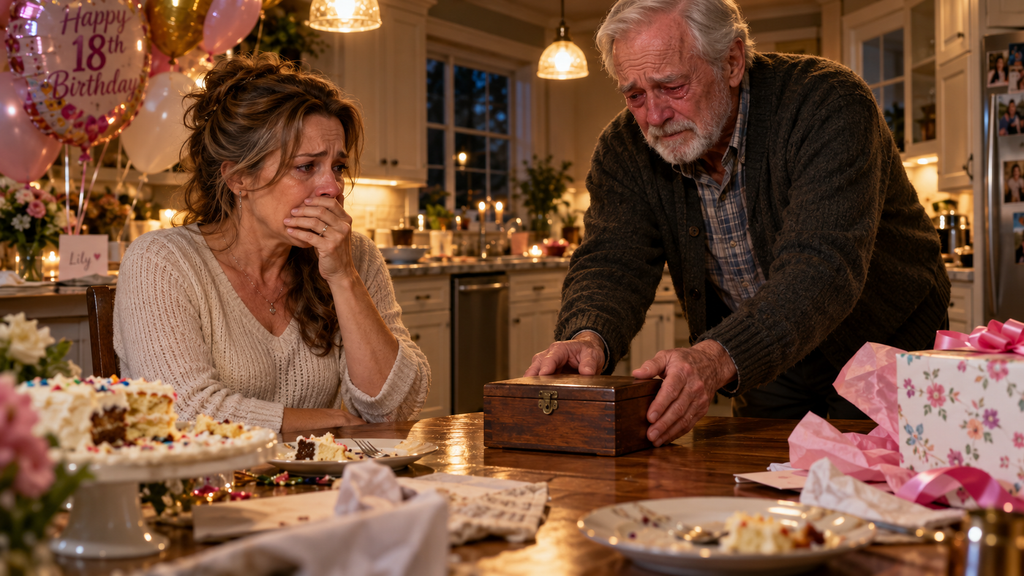
If I could go back to the woman I was on Lily’s eighteenth birthday—the woman washing cake plates at the kitchen sink while her father walked in carrying a box—I would not tell her to be calm.
I would not tell her everything happens for a reason.
I hate that sentence.
I would tell her:
The next few hours are going to destroy the story you have lived inside for thirteen years.
You will learn that one daughter was alive while you mourned her.
You will learn that your husband’s disappearance was both more complicated and more unforgivable than you thought.
You will learn that your father loved you and lied to you at the same time.
You will learn that your surviving daughter has been surviving more than you understood.
And tomorrow you will hear the voice of the child you buried.
You will not know whether to scream, forgive, collapse, or run.
Do none of those permanently.
Just keep listening.
Truth arrives all at once.
Healing does not.
Carl had written:
Before you hate me, look at the birth certificates. Emily and Lily were never the only twins born that night.
He was right.
Another pair of twins had been born hours later.
A second set that gave greedy adults something to compare.
Who was first.
Who qualified.
Who controlled.
Who inherited.
Adults turned four newborn girls into a contest before any of them could lift their own heads.
And thirteen years later, two of those girls did the only sensible thing anyone had done.
They refused to compete.
When the trustees asked how Lily and Emily wanted to vote their shares, they voted together.
The first motion they supported removed every succession rule based on birth order, twin status, or family line.
The second created independent oversight.
The third funded the family hospital program that became the Two Chairs Project.
Lily came home afterward and said:
“We killed Grandma Margaret’s weird twin clause.”
Emily raised a glass.
“To no more inheritance based on uteruses.”
I nearly spit out my drink.
That was my daughters.
Eventually, Turner Holdings stopped being a family monarchy.
Professional leadership.
Independent board.
No child born with a job waiting inside a trust.
No twin required to survive for somebody else’s voting rights.
That may have been the girls’ most important victory.
Not taking the company.
Making sure no child after them had to carry it simply by being born.
When Lily’s twin boys were five, I watched them play in the yard.
Five.
The age everything broke for us.
One fell.
Cried.
The other ran over.
For a second, my chest tightened.
Memory has its own weather.
Emily saw my face.
She came beside me.
“You okay?”
“Yes.”
She knew I was lying.
She took my hand.
We watched the boys.
One had skinned his knee.
That was all.
Just a skinned knee.
Normal.
Beautifully, mercifully normal.
Emily whispered:
“I’m here.”
Three words.
I looked at her.
Forty years old.
Mother.
Daughter.
Alive.
“I know.”
For thirteen years, I had wanted nothing more than to hear that.
I’m here.
It turned out those words were enough.
Not to restore the past.
Not to excuse what had happened.
But enough to make the present real.
My husband left me after we lost one of our twin daughters.
That was the story I lived for thirteen years.
Then my father came to me on Lily’s eighteenth birthday and told me the truth.
Carl had not left because grief broke him.
He left because fear did.
Emily had not died.
She had been hidden.
Lily had not been forgotten.
She had been watched from a distance by a father too frightened to return.
My father had not simply supported me.
He had been carrying a secret so heavy it changed every kindness he gave.
And the funeral I thought had ended my daughter’s life had been the beginning of thirteen years none of us could ever get back.
But that was not where the story ended.
It ended years later with two sisters sitting beside me.
One called Lily.
One called Emily Emma.
Both alive.
Both free.
Both old enough to choose what family meant for themselves.
I spent thirteen years believing death had stolen my child.
In the end, what had stolen our time was fear.
Fear of Victor.
Fear of money.
Fear of telling me.
Fear of trusting me.
Fear of what truth would cost.
And after everything, that became the lesson I refused to pass down.
Love cannot be built safely on information one person is never allowed to know.
Protection without consent can become another kind of prison.
And sometimes the people who save us are also the people we must hold accountable for the way they did it.
I never got those thirteen years back.
Neither did Lily.
Neither did Emily.
But we got the years after.
And perhaps that is the only mercy life ever truly promises.
Not replacement.
Not repayment.
Another morning.
Another birthday.
Another chair at the table.
Another chance to tell the truth before fear tells it for you.
On their last birthday, before I became too old to bake properly, Lily and Emily stood in my kitchen arguing over the cake.
Chocolate.
Vanilla.
Exactly the kind of stupid argument I once thought I would never hear again.
I leaned against the counter and listened.
Emily said:
“I’m older.”
Lily shouted:
“By six minutes!”
“Still older.”
“You were legally dead for thirteen years. I think the clock paused.”
I gasped.
“Lily!”
Emily stared at her.
Then burst out laughing.
So did Lily.
So did I.
We laughed until all three of us cried.
And somewhere between the laughter and the tears, I realized the dead no longer owned the room.
Because nobody at that table was dead.
Not anymore.
THE END STORIES! THANK YOU FOR READING GOOD LUCK !❤️
Related Posts