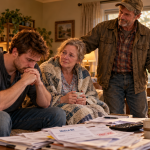
My father stared at the signature until every trace of color disappeared from his face. “That isn’t mine.” Nobody moved. Kayla still had one white flower tangled in her hair from the chapel.
Nate stood beside the front door with his suitcase at his feet. My mother—Diane—had stopped pretending to look offended. Michael Reyes, my attorney, simply folded his hands over the file resting on his lap. I looked at Dad.

“You just said the document was signed after you were legally dead.”
His throat moved.
“Yes.”
“What does that mean?”
Diane snapped immediately.
“It means your father is confused.”
Dad turned toward her.
“No.”
One word.
Quiet.
But something in the room changed.
My mother had spent most of my life speaking over him.
That night, he finally refused to disappear beneath her voice.
Michael leaned forward.
“Mr. Holloway, I need you to be very careful about what you say next.”
Dad gave a hollow laugh.
“I’ve spent four years being careful.”
Then he looked at me.
“I think that’s been the problem.”
My stomach tightened.
“Dad.”
He pulled out a chair.
Sat.
Pressed both hands against his face.
Then he said:
“Four years ago, when everyone thought I died in that boating accident…”
Kayla whispered:
“Oh God.”
My skin went cold.
That accident.
For eight months, my father had been considered missing.
His fishing boat had been found drifting twenty miles offshore with blood on the deck and no sign of him.
The Coast Guard searched.
Police investigated.
We held prayer vigils.
My mother wore black.
I sat on her kitchen floor while she screamed into a dish towel because she said she could not imagine sleeping in their bed without him.
After months of searching, a court eventually declared him dead.
Then, eleven months after the boat was found, Dad appeared alive.
The story he gave us had sounded unbelievable even then.
He said he had been injured.
Disoriented.
That a private fishing vessel had picked him up.
That he spent months in Mexico without identification after suffering memory problems.
There had been questions.
A lot of them.
But I had been so relieved he was alive that I never pushed.
Neither had Kayla.
Mom had called it a miracle.
Dad now looked at me and whispered:
“It wasn’t a miracle.”
The room became perfectly still.
“What?”
“I was never lost.”
I stared at him.
My body seemed to go numb one inch at a time.
Kayla sat down hard.
“Dad.”
He cried.
“I’m sorry.”
I laughed once.
The sound frightened even me.
“No.”
He looked at me.
“No more ‘I’m sorry’ before the explanation.”
He nodded.
Fair.
I pointed at him.
“You were missing for eleven months.”
“Yes.”
“We thought you were dead.”
“Yes.”
“I watched Mom plan a memorial.”
His face collapsed.
“I know.”
“We stood on a beach and threw flowers into the ocean.”
“I know.”
“Why?”
Dad looked at Diane.
She stared back at him with pure hatred.
And suddenly I understood something.
Whatever secret had held my parents together for four years was breaking open in my living room.
Dad whispered:
“Money.”
Of course.
It was almost always money once enough people started lying.
Dad had owned a regional construction-supply company for twenty-seven years.
Not glamorous.
Not enormous.
But successful.
Then, five years before Hawaii, he made a disastrous expansion.
Three new warehouses.
Borrowed money.
Equipment leases.
A partner who promised contracts that never materialized.
Within eighteen months, Dad was personally guaranteeing more than eight hundred thousand dollars in debt.
I had known the business struggled.
I had not known how badly.
“I thought I could fix it.”
he said.
Michael glanced at me.
I almost laughed again.
That phrase.
The anthem of people who decide dishonesty is preferable to embarrassment.
Dad continued.
“Your mother knew about the debt.”
Diane crossed her arms.
“I knew because somebody had to know.”
Dad ignored her.
“There was a life insurance policy connected to the company.”
“How much?”
I asked.
“Six hundred thousand.”
I stared.
Dad’s eyes filled.
“And if you died, Mom got the money?”
“Partly.”
“The company was also a beneficiary.”
Michael asked:
“Key-person coverage?”
Dad nodded.
“And a personal policy.”
Michael’s expression changed.
That was the first moment I knew this was much bigger than an ugly family affair.
Dad looked down.
“The boat wasn’t supposed to be found that quickly.”
My heart stopped.
Kayla whispered:
“You staged it.”
Dad said nothing.
She screamed:
“You staged your death?”
“I panicked.”
She stood.
“Do not call that panic!”
Dad flinched.
Diane finally spoke.
“We had no choice.”
I turned toward her.
That sentence.
No choice.
The favorite costume of people who had made several terrible choices in sequence.
“You let us think he was dead.”
Diane’s jaw tightened.
“The business would have taken everything.”
“So?”
“Our house.”
“So?”
“My retirement.”
“So?”
She stared at me.
I continued.
“You let your daughters bury their father in their minds because you didn’t want to lose your house?”
“That is not what happened.”
“Then help me.”
My voice rose.
“Because so far, that is exactly what happened.”
Dad whispered:
“It started as two weeks.”
I looked at him.
“What?”
“I was supposed to disappear for two weeks.”
“Long enough for some creditors to move.”
“Long enough for a sale to close.”
“I told myself I’d come back.”
“Then Mom found out the policy might pay if I was presumed dead.”
Diane snapped:
“Don’t put that on me.”
Dad turned.
“You filed the claim.”
“You signed the papers.”
“I signed papers you said were for business restructuring.”
“You knew exactly what we were doing.”
“I knew we were hiding assets.”
Dad’s voice broke.
“I did not know you were filing to have me declared dead.”
Diane laughed bitterly.
“You enjoyed staying hidden just fine.”
Dad looked sick.
“Yes.”
That mattered.
He was not innocent.
Maybe less guilty than she was.
Still guilty.
He continued.
“By the time I learned she had filed the petition, I was scared.”
“Coming back meant admitting everything.”
“So you stayed gone.”
“Yes.”
“For eleven months.”
“Yes.”
“And then?”
“The insurance company started asking questions.”
Michael interrupted.
“Which company?”
Dad named it.
Michael wrote something down.
Dad continued.
“A former employee saw me.”
“In Arizona.”
“The story was going to collapse.”
“So I came home.”
Kayla stared.
“And you told everyone you had amnesia.”
Dad covered his face.
“Yes.”
I whispered:
“You let us believe a miracle happened.”
“Yes.”
My mother said:
“It was the only way to keep the family intact.”
I turned toward her.
“Family intact?”
I gestured toward the room.
“My husband just held a commitment ceremony with my sister.”
“You mocked me in a chapel.”
“You’ve been moving money through an LLC.”
“And Dad just admitted the two of you staged his death.”
I laughed bitterly.
“This is your definition of intact?”
She looked away.
Michael tapped the authorization page.
“Then this signature matters.”
Dad nodded.
“Because by the date on that document, a court had already declared me dead.”
“Where were you actually?”
“Arizona.”
“With Diane’s knowledge?”
Dad hesitated.
Then:
“Yes.”
I closed my eyes.
Even after everything, the answer hurt.
Michael continued.
“Did you sign this authorization?”
“No.”
“Did you authorize Mrs. Holloway to sign for you?”
“No.”
“Did you know Holloway Coastal Holdings existed?”
Dad stared at the logo.
“No.”
I looked at Mom.
Her maiden name was Holloway.
Of course.
Michael asked:
“Mrs. Holloway, would you like to explain?”
My mother’s face hardened.
“No.”
He nodded.
“Probably wise.”
Nate finally spoke.
“This is ridiculous.”
Everyone looked at him.
He spread his hands.
“We came home from a vacation and suddenly we’re having some kind of interrogation?”
I stared at my husband.
There was the Nate I knew.
Or thought I knew.
When cornered, he became offended by the corner.
Michael said:
“You are free to leave.”
Nate blinked.
“What?”
“You’re not detained.”
“Nothing requires you to remain in this room.”
Nate glanced at the divorce petition.
Then at me.
“You really filed?”
“Yes.”
His face changed.
“You didn’t even talk to me.”
I almost smiled.
“No.”
“Interesting, isn’t it?”
He flinched.
I continued.
“You planned a ceremony with my sister.”
“You helped move seventy-four thousand dollars through a company I’d never heard of.”
“You stood in a chapel while my mother called me stupid.”
“And your complaint is that I made a legal decision without discussing it with you?”
Nate’s jaw tightened.
“It wasn’t a wedding.”
“Then why was Kayla dressed in white?”
He looked at her.
She looked away.
“It was symbolic.”
“Symbolic of what?”
Silence.
I turned to Kayla.
“You answer.”
Her face crumpled.
“I thought…”
She stopped.
“What?”
“I thought you two were basically over.”
My chest tightened.
“Basically?”
She started crying.
“Nate said you had been talking about separating.”
I looked at him.
He shook his head.
“Kayla—”
“No.”
She pointed at him.
“You told me.”
My sister looked at me.
“He said you stayed because of the house.”
“We don’t have children.”
“He said after the miscarriage…”
She stopped.
My whole body went cold.
Nate closed his eyes.
There are betrayals that hurt because they are surprising.
Then there are betrayals that hurt because someone takes a wound you shared privately and turns it into a tool.
Two years earlier, I had miscarried at eleven weeks.
I bled in our bathroom.
Nate sat on the floor with me.
Held my hand.
Cried.
Told me it was ours together.
Apparently, later, he told my sister a different story.
“What did he say about the miscarriage?”
I asked.
Kayla’s face twisted.
“I don’t want to—”
“Say it.”
She cried harder.
“He said you changed.”
I looked at Nate.
He would not meet my eyes.
Kayla continued.
“He said you became distant.”
“That you didn’t want intimacy.”
“That you stopped talking about having a family.”
“And?”
She wiped her cheeks.
“He said you told him you weren’t sure you wanted to be married anymore.”
I laughed softly.
Not one of those things was true.
I had struggled.
Of course I had.
But I had begged Nate to go to counseling with me.
He refused.
Said we did not need strangers talking about our grief.
Then apparently he took our grief directly to my sister.
I looked at him.
“Did you tell her I asked you for marriage counseling?”
Silence.
“Did you tell her I wanted to try again for a baby?”
His eyes closed.
“Did you tell her you were the one who said you weren’t ready?”
Nothing.
Kayla stared at him.
The color drained from her face.
“Nate?”
He whispered:
“It was complicated.”
My sister laughed through tears.
“No.”
She shook her head.
“That sentence means you lied.”
For once, she was exactly right.
I should have felt vindicated watching Kayla realize she had been manipulated.
I didn’t.
She was still my sister.
She still knew Nate was married.
Whatever story he told her, she knew enough.
I looked at her.
“Did you sleep with him?”
She cried.
“Yes.”
Mom snapped:
“You don’t have to answer that.”
I turned.
“She absolutely does.”
Kayla whispered:
“Seven months.”
My chest hollowed.
“How long?”
“Seven months.”
I looked at Nate.
Our miscarriage had been twenty-three months earlier.
He had been sleeping with my sister for seven months while telling me work travel had increased.
I asked:
“Was Hawaii your idea?”
Kayla looked at Mom.
That answer was worse.
I turned toward Diane.
“You arranged the trip.”
She said nothing.
“You insisted we all come.”
Silence.
“You picked the hotel.”
Still nothing.
Michael said quietly:
“I think we’re getting closer to the real purpose.”
Mom looked at him.
He slid the LLC file across the table.
“The Hawaii trip wasn’t primarily a family vacation.”
Nobody spoke.
Michael continued.
“The company has a pending property transaction on Oahu.”
Nate went white.
I stared.
“What property?”
“A four-unit vacation rental.”
My mother’s shoulders sagged.
There it was.
Another layer.
“How much?”
“The planned purchase price is nine hundred forty thousand dollars.”
I laughed.
“Of course.”
Michael continued.
“The seventy-four thousand dollars transferred from your home-equity line appears to have been used for deposits, legal fees, and due diligence.”
I looked at Nate.
“My house funded your Hawaii property?”
He whispered:
“It was supposed to become an investment for all of us.”
“All of us?”
I pointed around the room.
“Which all?”
No answer.
Michael opened another page.
“The proposed ownership structure lists Diane Holloway at thirty percent.”
Mom stared at the floor.
“Nathan Cole at thirty percent.”
Nate closed his eyes.
“Kayla Mercer at twenty percent.”
My sister’s head snapped up.
“What?”
“And another twenty percent reserved for an entity connected to Mr. Holloway.”
Dad looked as shocked as she did.
“That isn’t mine.”
Michael nodded.
“I suspected that.”
Kayla stepped toward him.
“I’m listed?”
“Yes.”
She looked at Nate.
“You told me the paperwork was for the ceremony.”
Nate went still.
I stared.
“What paperwork?”
Kayla’s breathing became shallow.
“Before the chapel.”
“Mom gave me documents.”
“What documents?”
“She said they were for the future.”
“I didn’t read all of them.”
Michael stood.
“Do you still have copies?”
“My email.”
“Open it.”
Her hands shook so badly she dropped her phone.
Dad picked it up.
Kayla found the message.
Forwarded it.
Michael opened the attachment on his laptop.
Read.
Then his expression hardened.
“What?”
I asked.
He looked at Kayla.
“This is not marriage paperwork.”
She stared.
“What is it?”
“A membership agreement.”
“For Holloway Coastal Holdings.”
My sister looked at Mom.
“Why am I a member?”
Diane finally cracked.
“Because somebody had to be.”
Kayla’s face crumpled.
“What does that mean?”
Michael answered.
“It appears your credit and income were going to be used to support financing.”
Kayla turned toward Nate.
“You told me signing meant we were building our life.”
“We were.”
“No.”
Her voice rose.
“You said these were papers connected to us.”
“They were connected to us.”
“You made me a guarantor?”
Nate did not answer.
My sister stared at the man she had betrayed me for.
And for the first time that night, I saw her understand something deeper than adultery.
She had not been chosen.
She had been recruited.
Dad stood.
“Diane.”
Mom refused to look at him.
“You used our daughters.”
She snapped:
“Don’t you dare.”
“You used both of them.”
“You are not morally qualified to speak to me.”
“No.”
Dad nodded.
“I’m not.”
That answer stopped her.
He continued.
“I helped you lie.”
“I let my daughters think I was dead.”
“I let fear turn me into a coward.”
His voice shook.
“But I did not put their homes, credit, and marriages into a company without telling them.”
Diane stood.
“You think you can suddenly become righteous because you’re scared?”
Dad looked at her.
“No.”
“I’m done becoming anything.”
He pointed at Michael’s file.
“I’m just going to tell the truth.”
My mother’s face transformed.
Not anger.
Terror.
“Don’t.”
I had never heard her say the word that way.
Dad looked at her.
“What else is there?”
Michael’s eyes moved between them.
Mom whispered:
“You know what happens.”
Dad answered:
“I should have thought about that four years ago.”
“What happens?”
I asked.
Dad turned toward me.
“The insurance money.”
My chest tightened.
“What about it?”
“It never got fully returned.”
Michael stopped writing.
“How much remains outstanding?”
Dad gave the number.
“About two hundred sixty thousand.”
The room fell silent.
My mother whispered:
“Because we couldn’t repay it.”
Dad continued.
“So Diane moved money.”
“Borrowed.”
“Shifted accounts.”
“She started the LLC.”
“I didn’t know how much.”
Michael asked:
“Was the Hawaii property intended to generate income to repay the insurance settlement?”
Dad nodded slowly.
“I think so.”
Mom laughed bitterly.
“Think?”
She finally turned.
“Yes.”
“The property was supposed to save us.”
There it was again.
Save.
A word people love using when they mean:
Make the consequences go away.
She pointed at me.
“You have equity.”
“At Kayla.”
“You have perfect credit.”
“At Nate.”
“He knows real estate.”
At Dad.
“You owe me.”
Dad laughed painfully.
“I owe a lot of people.”
“You owe me most.”
Mom’s voice broke.
“I stood beside you while everyone thought you were dead.”
“You asked me to.”
“For two weeks.”
“You stayed gone.”
“You filed the claim.”
“You signed papers.”
“You spent the money.”
“You benefited too!”
Their voices crashed against each other.
I stood between them.
“Stop.”
They stopped.
Not because I was loud.
Because I was done.
“I don’t care which one of you started it.”
They stared.
“I care what was done with my name.”
“My marriage.”
“My house.”
“My sister.”
“My life.”
I looked at Mom.
“You called me stupid.”
She flinched.
I continued.
“You thought I was too stupid to notice because for years I trusted you.”
“That is not stupidity.”
“It is what family is supposed to be able to do.”
I looked at Nate.
“You thought I wouldn’t notice because you mistook grief for weakness.”
Then Kayla.
“You thought I wouldn’t notice because you needed to believe the story that made betraying me easier.”
Finally Dad.
“And you thought silence was protection.”
He lowered his head.
“You were all wrong.”
Michael told everyone to leave.
Not dramatically.
Legally.
The house was jointly titled to Nate and me, but temporary possession would be handled through the divorce process.
That night, though, nobody had the stomach to argue.
Nate picked up his suitcase.
He looked at me.
“Can we talk privately?”
“No.”
“Please.”
“No.”
His face twisted.
“After twelve years?”
“Exactly.”
I looked at him.
“After twelve years, you knew enough about me not to do this.”
He swallowed.
“I loved you.”
I stared.
Past tense.
Maybe accidental.
Maybe honest.
“You may have.”
I said.
“But love that requires me not to know what you’re doing with my life isn’t a marriage.”
He cried.
I did not comfort him.
That was new.
Kayla lingered.
Mom had already gone outside.
Dad remained near the hallway, waiting.
My sister stood in front of me in a white dress that suddenly looked ridiculous.
Cheap chapel lace.
Sandals.
Mascara streaked.
She whispered:
“I didn’t know about the LLC.”
“I believe you.”
She started crying.
“I didn’t know about the insurance.”
“I believe you.”
“Nate told me—”
I raised my hand.
She stopped.
“You knew he was married.”
Her face crumpled.
“Yes.”
“You knew he was my husband.”
“Yes.”
“You knew we had not separated.”
“He said—”
“You knew you had not heard that from me.”
Silence.
“You never called.”
“No.”
“You never asked.”
“No.”
“You let him tell you what I supposedly felt because asking me would have ruined the version you wanted.”
She sobbed.
“Yes.”
I nodded.
Understanding.
Not pardon.
“Then that is yours.”
She looked confused.
“What?”
“That part.”
“The financial scheme is theirs.”
“The lies about our marriage are his.”
“But sleeping with my husband?”
I held her gaze.
“That is yours.”
She nodded.
“I know.”
“Good.”
She reached for me.
Stopped herself.
For once.
Then whispered:
“I’m sorry.”
I said nothing.
She left.
Dad remained.
I looked at him.
He looked older than he had that morning.
“I’m not asking you to forgive me.”
“Good.”
He nodded.
“I’m going to cooperate.”
“With Michael?”
“With everyone.”
“The insurer.”
“The bank.”
“Whoever asks.”
I studied him.
“You could go to prison.”
“Yes.”
“Mom could too.”
“Yes.”
“You’re still going to tell everything?”
He looked at the front door where she had disappeared.
Then back at me.
“For four years I’ve been afraid the truth would destroy the family.”
A sad smile.
“I think the lie already did.”
He walked out.
For the first time that night, I believed him.
The weeks after Hawaii were not satisfying.
That is something people rarely tell you about revenge fantasies.
Real consequences involve paperwork.
Phone calls.
Bank records.
Affidavits.
Hours in offices where fluorescent lights make everyone look guilty.
Michael brought in a forensic accountant.
Her name was Naomi Price.
She was calm, relentless, and seemed personally offended by messy bookkeeping.
Within three weeks, she had mapped nearly every dollar.
The seventy-four thousand from our home-equity line had moved through Holloway Coastal Holdings in six transfers.
Some paid the Hawaii property deposit.
Some covered overdue legal fees connected to my parents’ insurance settlement.
Some went into an account Nate controlled.
Eleven thousand dollars had been used to cover personal credit-card debt I did not know he had.
Another nine thousand went toward airfare, hotel deposits, and chapel arrangements.
I stared at Naomi.
“My own home equity helped pay for my husband’s ceremony with my sister?”
She paused.
Then nodded.
“Yes.”
I laughed.
There are moments when pain becomes so precise it almost becomes comedy.
“Good.”
Michael frowned.
“Good?”
“No.”
I wiped tears from my face.
“Just efficient.”
They had financed the betrayal from my own house.
Hard to beat for symbolism.
Then Naomi found the retirement account.
Nate had opened it two years earlier through a consulting company I had never heard of.
There was forty-three thousand dollars inside.
Not stolen from me directly.
But hidden.
Money he told me we did not have.
Money that existed while I postponed replacing my car.
While I paid most of the household repairs.
While he told me our budget was tight.
“Why hide this?”
I asked during mediation.
Nate looked at the table.
“I wanted something that was mine.”
I almost pitied him.
Almost.
“You had a salary.”
“I know.”
“You had our joint savings.”
“I know.”
“You had equity.”
“I know.”
“You had a marriage.”
He closed his eyes.
“That didn’t feel like mine anymore.”
That sentence hurt.
But I needed to understand.
“Why?”
He looked at me.
“After the miscarriage, everything became yours.”
I stared.
“What does that mean?”
“Your grief.”
“Your schedule.”
“Your need for space.”
“I felt like a guest.”
I sat back.
There it was.
His story.
Maybe even a real feeling.
But feelings do not become facts because they hurt.
I said:
“I asked you to counseling.”
“I know.”
“You said no.”
“I know.”
“I asked you to take a weekend away with me.”
“I know.”
“You went fishing with Mark instead.”
He nodded.
“I know.”
“I tried to talk about another pregnancy.”
“You said you weren’t ready.”
Tears filled his eyes.
“I was scared.”
“So was I.”
Silence.
I continued.
“You were allowed to be unhappy.”
“You were allowed to be scared.”
“You were allowed to tell me you were lonely.”
His eyes closed.
“You were even allowed to leave.”
He cried.
“You were not entitled to rewrite our marriage to my sister while secretly borrowing against our house.”
He nodded.
“No.”
For the first time, he stopped arguing.
The Hawaii ceremony had been Diane’s idea.
I learned that later.
Nate and Kayla had been sleeping together for seven months.
Kayla wanted him to leave me.
Nate kept delaying.
My mother, who had already been using Nate for the property deal, saw an opportunity.
She told Kayla a private commitment ceremony would “prove” Nate was serious.
She told Nate it would keep Kayla emotionally invested long enough to sign the company papers and support the Hawaii financing.
She told Dad it was a “family blessing” before Nate and I formally separated.
She told the chapel coordinator it was a vow-renewal style celebration.
Everyone was told a different story.
That was Diane’s real talent.
Not lying.
Tailoring.
She gave each person the lie they most wanted to believe.
Kayla wanted to believe Nate chose her.
Nate wanted to believe the property would solve his debt.
Dad wanted to believe cooperation would prevent the insurance scheme from exploding.
I wanted to believe Hawaii might help my family reconnect.
Only Diane understood the entire board.
At least at first.
But there was another surprise.
The chapel coordinator called Michael.
Her name was Leilani.
She had become concerned after seeing online photos where Nate was described as “newly married.”
She kept copies of the intake forms.
On Nate’s form, under marital status, he had checked:
Married.
Under spouse:
My name.
Kayla saw that during discovery.
She came to my apartment three months after Hawaii.
I almost did not open the door.
Then I did.
She held a photocopy.
Her hands shook.
“He wrote your name.”
I looked.
“I know.”
“He stood beside me in that chapel after writing that he was married to you.”
“Yes.”
She cried.
“I thought…”
I interrupted.
“You thought what you needed to think.”
She nodded.
That was progress.
She sat on the edge of my couch.
No white dress.
No makeup.
No performance.
Just my younger sister.
“I left the LLC.”
“I know.”
“Michael helped me submit a statement.”
“I know.”
“I gave them everything.”
“I know.”
She looked at me.
“Mom is furious.”
“I imagine.”
“Dad moved out.”
That I did not know.
“What?”
“He’s staying in a motel.”
My chest tightened.
“Why?”
“He told Mom he was cooperating with the insurer.”
“Did she throw him out?”
“He left.”
Kayla wiped her face.
“He said if he stayed, she would talk him into lying again.”
For the first time in months, I felt something toward Dad that was not only anger.
Sadness.
Not absolution.
But sadness.
Kayla continued.
“I’m going to testify if they ask.”
I nodded.
“You should.”
She started crying again.
“I destroyed us.”
“No.”
She looked up.
“You damaged us.”
“That is different.”
Her mouth trembled.
“Is there any chance…”
She stopped.
I knew what she wanted.
I could not give it.
“Not now.”
She nodded.
“Okay.”
No begging.
No accusation.
She stood.
At the door, she turned.
“I really did love him.”
I closed my eyes.
“I know.”
“That doesn’t make it better.”
“No.”
“I think it makes it worse.”
Maybe.
She left.
The divorce took fourteen months.
Nate tried to keep the house at first.
That almost impressed me.
Our attorney conferences became increasingly absurd.
His lawyer argued that selling the house would allow both of us a clean start.
Michael argued that Nate had encumbered the property to fund an undisclosed enterprise and relationship.
The judge was not amused.
In the final settlement, I kept the house.
Nate assumed a substantial portion of the disputed equity debt.
His hidden retirement account was included in the marital accounting.
The Hawaii property deal collapsed before closing.
Most of the deposit was recovered.
Not all.
The recovered funds went toward the home-equity balance and legal costs.
I did not emerge richer.
I emerged clearer.
That mattered more.
The criminal investigation moved slower.
Insurance fraud.
Forgery.
False filings.
Bank records.
Not every ugly action became a criminal charge.
That surprised me.
Immorality and illegality overlap less neatly than people imagine.
Diane eventually entered a plea related to the fraudulent insurance claim and falsified business documents.
She avoided the harshest outcome because she cooperated late.
Very late.
She also had to repay a significant portion of the outstanding insurance money.
The house she had fought so hard to protect four years earlier was sold.
When Kayla told me, I felt nothing.
Then guilt for feeling nothing.
Then I stopped judging myself.
Dad also faced consequences.
He admitted participating in the staged disappearance and concealing information.
He cooperated early.
Returned what assets he could.
Accepted probation and financial penalties.
Most importantly to me, he never blamed Diane publicly.
Not because she was innocent.
Because he finally understood his part.
When a reporter asked him whether his wife had manipulated him, Dad answered:
“She did some things I did not understand until later. But I chose to disappear. That part belongs to me.”
I watched the clip alone.
Cried.
Accountability cannot restore trust.
But it can make rebuilding possible.
Nate was never charged with the insurance scheme itself.
He came into it later.
But the financial transfers, false statements, and misuse of our home-equity funds followed him through civil proceedings.
His real punishment was less cinematic.
Credit destroyed.
Professional reputation damaged.
Debt.
The collapse of his relationship with Kayla.
The end of our marriage.
The realization that Diane had used him almost as efficiently as he had used my sister.
One year after the divorce, he wrote me a letter.
Not asking to reconcile.
Good.
It said:
I kept thinking I was the smartest person in the room because everyone believed different pieces of what I said. What I didn’t understand was that lying to many people doesn’t make you clever. It just means you have more places where the truth can enter.
I read that twice.
Then continued.
I told Kayla you had stopped loving me because that was easier than admitting I was afraid you might stop.
That line hurt.
I used the miscarriage as evidence against you because I was ashamed of the way I withdrew afterward.
I put the letter down.
Cried.
Then finished.
I loved you and still betrayed you. I’m learning those things can coexist, which is worse than pretending I never loved you at all.
That was the most honest thing he ever gave me.
I did not reply.
Not everything honest requires a response.
My relationship with Dad returned first.
Slowly.
Painfully.
For months, we met in public.
Coffee shops.
Parks.
Places where history could not sit too comfortably.
He never asked:
“When will you forgive me?”
He asked:
“What do you need to know?”
So I asked.
Everything.
Where he stayed during the eleven months.
Arizona.
Then New Mexico.
How often Mom visited.
Four times.
Whether he read our messages.
Yes.
Whether he knew I cried every night.
Not every night.
Enough.
Whether he almost came home.
Three times.
“Why didn’t you?”
He stared at his coffee.
“Cowardice.”
No story.
No justification.
Just the word.
I hated how much I respected that answer.
One afternoon I asked:
“Did you ever think about what your death did to me?”
He cried.
“Every day.”
“Then how did you stay gone?”
He looked at me.
“Because each day I told myself one more day would make yesterday worth it.”
That sentence stayed with me.
That is how bad decisions become years.
You keep sacrificing tomorrow to justify yesterday.
I reached across the table.
Touched his hand.
The first time since Hawaii.
He cried harder.
So did I.
Forgiveness was still far away.
But love had found a door.
Mom was different.
She spent the first year furious at everyone except herself.
At Dad for cooperating.
At Kayla for “falling apart.”
At Nate for keeping poor records.
At me for “bringing lawyers into family business.”
Once she called.
I answered because some foolish part of me still hoped she might finally apologize.
Instead she said:
“Do you know how embarrassing it is to sell the house because your own daughter turned against you?”
I went quiet.
Then asked:
“Do you remember what you said in the chapel?”
Silence.
“Do you?”
She sighed.
“I was joking.”
I laughed.
“Of course.”
“You said I was too stupid to notice.”
“You were spying.”
“I followed my husband.”
“Same thing.”
There it was.
No accountability.
Not yet.
I said:
“Mom, I am not available for this version of the conversation.”
“What does that mean?”
“It means if you ever want to talk about what you did, call me.”
“If you want to talk about what happened to you because people found out, call someone else.”
I hung up.
My hands shook for an hour.
Boundaries are not peaceful when you first learn them.
Sometimes they feel like grief with better posture.
Kayla and I took longer.
Three years.
Not because she refused accountability.
Because sister betrayal has its own anatomy.
Nate had been my husband for nine years.
Kayla had been my sister my entire life.
She knew the version of me before him.
Before marriage.
Before miscarriage.
Before mortgages.
She knew which songs made me cry.
Which foods I hated.
Which childhood memories still hurt.
Then she used my trust in her as cover.
That was harder to forgive than the affair itself.
She never pressured me.
She sent birthday cards.
No dramatic letters.
No flowers.
No guilt.
Once a year, she sent a message:
Thinking of you. No need to answer.
For two years, I didn’t.
In the third year, Dad had surgery.
Minor.
Still frightening.
Kayla and I both arrived at the hospital.
We stood across from each other in the waiting room.
Older.
Different.
She whispered:
“Hi.”
“Hi.”
We sat five chairs apart.
For forty minutes, silence.
Then the vending machine ate my dollar.
I muttered:
“Of course.”
Kayla laughed.
The sound was so familiar I almost hated it.
Then she stood.
Hit the machine once.
My chips fell.
I stared.
“You still do that?”
She shrugged.
“It still works.”
I smiled despite myself.
That was the first crack.
Not forgiveness.
A chip bag.
Families rebuild strangely.
Later that night, after Dad was fine, Kayla and I walked to the parking lot.
She stopped beside my car.
“I need to tell you something.”
I waited.
“Nate wasn’t the first reason I was jealous of you.”
My chest tightened.
She continued.
“I spent my whole life thinking Mom liked you more.”
I almost laughed.
“What?”
“I know.”
She wiped her face.
“It sounds ridiculous now.”
“Mom criticized me constantly.”
“Exactly.”
Kayla looked at me.
“She watched you.”
“She cared what you did.”
“With me, she mostly cared whether I agreed.”
I thought about it.
Kayla continued.
“When Nate started talking to me, I felt…”
She struggled.
“Chosen.”
There it was.
The wound beneath the betrayal.
Not an excuse.
An origin.
“He said I understood him better than you.”
“He said you were strong but cold.”
“He said I was warm.”
“I knew it was wrong.”
“But part of me liked finally having something that belonged to you.”
I stared.
“That is ugly.”
She cried.
“I know.”
“But it’s honest.”
“Yes.”
She wiped her cheeks.
“I am so sorry.”
I nodded.
“I believe you.”
Her face changed.
Not relief.
Something softer.
“Does that mean…”
“No.”
She nodded quickly.
“Okay.”
I continued.
“It means I believe your apology.”
“I don’t know what our relationship becomes.”
She cried.
“That’s fair.”
For the first time, I hugged her.
Briefly.
Carefully.
No movie music.
No total restoration.
Just two sisters acknowledging that one of them had broken something and the other was deciding whether pieces still had use.
Mom changed only after Dad filed for divorce.
Yes.
After forty-one years.
He left.
Not because he suddenly stopped loving her.
He told me that was the worst part.
“I still love her.”
he said.
“Then why leave?”
“Because loving her has become the excuse I use to help her avoid herself.”
That sounded like therapy.
It was.
Dad had started going.
I almost laughed when he told me.
The man who once believed counseling was “paying strangers to hear complaints” now attended every Tuesday.
Growth enjoys humiliation.
Mom did not take the divorce well.
She blamed me.
Then Kayla.
Then the lawyers.
Then Dad’s therapist.
Eventually, when there was nobody left to blame who would listen, she went to therapy too.
I did not celebrate.
Therapy is not repentance.
It is an opportunity.
What matters is what someone does with it.
Almost two years later, Mom wrote me a letter.
Six pages.
The first page was terrible.
Explanations.
Childhood poverty.
Fear of losing the house.
Feeling abandoned by Dad’s business failures.
I nearly stopped.
Then page three changed.
None of that explains why I called you stupid.
I kept reading.
I called you stupid because I needed you to be stupid. If you were intelligent and kind and still trusted me, then what I was doing became harder to justify. So I made your trust into a flaw.
I sat down.
She continued.
I encouraged Kayla because if Nate left you for her, then the family property arrangement became easier. I told myself they loved each other, which was partly true and therefore useful.
Painfully honest.
I used your father’s shame to keep him quiet. I used Kayla’s jealousy to keep her cooperative. I used Nate’s resentment to access money. I used your trust because it was the easiest thing to use.
I cried.
Not because it fixed anything.
Because for the first time, my mother was speaking a language reality could understand.
The final line said:
I do not expect you to forgive me. I am trying to become someone for whom forgiveness would not be wasted.
I did not call immediately.
Three months later, we met.
Public park.
One hour.
No hugs.
She looked smaller.
Not physically.
She had lost the armor.
“I’m sorry.”
she said.
I nodded.
“I know.”
“I was cruel to you.”
“Yes.”
“I was cruel to Kayla.”
“Yes.”
“Your father.”
“Yes.”
“Nate too, in a different way.”
“Yes.”
She almost smiled sadly.
“You’re not making this easy.”
“No.”
“Good.”
That surprised me.
She continued.
“I’ve had easy for too long.”
We did not reconcile that afternoon.
But eventually, we developed something.
Limited.
Careful.
No financial entanglement.
No secrets.
No family vacations.
Especially no Hawaii.
Four years after the divorce, I returned to Hawaii.
Alone.
That surprised everyone.
Even me.
A work conference.
I could have declined.
Almost did.
Then I realized I was tired of letting an island belong to people who betrayed me.
So I went.
Same salt air.
Same hibiscus.
Same brightness that once felt insulting while I was breaking.
On the second afternoon, I found myself walking down the street toward the chapel.
I had not planned it.
At least that is what I told myself.
The chapel looked smaller.
That shocked me.
Memory had made it enormous.
In my mind, it had become a cathedral built entirely from betrayal.
In reality, it was a modest white building beside flowering bushes.
A groundskeeper was trimming plants.
He nodded.
“Wedding?”
I laughed.
“No.”
Then:
“Not anymore.”
He had no idea what I meant.
Good.
I stood outside the open door.
Same aisle.
Different chairs.
No Nate.
No Kayla.
No mother laughing.
Just sunlight.
I walked inside.
For years, I had replayed the moment I heard:
She’s too stupid to notice.
I used to imagine what I should have done.
Walked in.
Thrown the bouquet.
Slapped someone.
Screamed.
Exposed them in front of everyone.
But standing there four years later, I realized silence had saved me.
Not because silence is always strength.
It isn’t.
Sometimes silence is fear.
But that day, mine was strategy before I even knew it.
If I had walked inside screaming, they would have argued.
Explained.
Deleted messages.
Moved money.
Prepared.
Instead I walked away.
Called a lawyer.
Changed my flight.
And let them come home smiling.
They mistook silence for stupidity.
That was their final mistake.
I sat in one of the chapel chairs.
Cried a little.
Then laughed.
A woman setting up flowers looked at me.
“You okay?”
“Yes.”
For once, I meant it.
I stepped outside.
Called Kayla.
We were not close the way we had been before.
Maybe we never would be.
But we spoke.
She answered.
“Hey.”
“Guess where I am.”
“Work?”
“Hawaii.”
Silence.
Then:
“Oh.”
“I’m outside the chapel.”
Longer silence.
“Are you okay?”
“Yes.”
She started crying.
I could hear it.
“I’m sorry.”
“I know.”
“I hate that place.”
I looked at the white walls.
“I don’t.”
She went quiet.
“It’s just a building.”
My sister cried harder.
Then whispered:
“I’m glad.”
So was I.
Nate eventually married someone else.
Not Kayla.
A woman named Rachel.
I found out through Dad, who found out through someone else.
I felt almost nothing.
That surprised me.
Years earlier, the thought of Nate choosing another woman had hollowed me out.
Now it sounded like weather in another state.
He sent me one message before the wedding.
I wanted you to hear from me. I’m getting married Saturday.
I stared at the phone.
Then replied:
I hope you are honest with her.
He answered:
I am trying to be.
I almost wrote:
Try harder.
Didn’t.
Some conversations no longer belonged to me.
I built a different life.
Not spectacular.
That mattered.
I started traveling again.
Not to prove anything.
Because I liked it.
I changed jobs.
Sold the house Nate and I had shared.
Bought a smaller townhouse with windows that caught the morning light.
For the first year, I kept almost no furniture.
People thought I was being minimalist.
Really, I needed empty rooms.
Rooms nobody else had plans for.
I adopted a dog.
He destroyed one expensive rug.
I forgave him faster than most relatives.
He earned it by never forging my signature.
Standards.
I dated eventually.
Slowly.
Badly at first.
I interrogated men about debt on second dates.
One finally laughed and said:
“Are we buying a house?”
“No.”
“Then why do you need my credit score?”
Fair.
I got better.
Years later, I met Adrian.
An architect.
Divorced.
Two grown daughters.
On our fifth date, I told him the Hawaii story.
Not every detail.
Enough.
He stared at me.
“Your husband had a commitment ceremony with your sister while your mother helped?”
“Yes.”
“And your father had previously staged his death?”
“Yes.”
“And there was an LLC?”
“Yes.”
He was quiet.
Then said:
“I once forgot my anniversary.”
I laughed until my face hurt.
That was when I knew I liked him.
We dated for years.
No rush.
No secret ceremony.
No symbolic vows.
When he eventually proposed, it was in my kitchen.
No crowd.
No white dress.
He asked:
“Do you want to get married?”
Not:
Will you make me whole.
Not:
Will you save me.
Just:
Do you want this?
I did.
So I said yes.
Kayla attended the wedding.
Mom did too.
Dad walked me halfway down the aisle.
Then stopped.
I had asked him to.
The officiant asked:
“Who gives this woman?”
Dad smiled.
“She gives herself.”
Then he kissed my cheek and sat down.
Some people cried.
I laughed.
Adrian waited at the front.
No secrets.
No LLC documents.
No hidden beneficiaries.
We signed the marriage license before dinner.
I checked it twice.
Kayla caught me.
She whispered:
“Understandable.”
I laughed.
That mattered.
Not because everything was forgiven.
Because some pain had finally become survivable enough to joke beside.
Mom and Dad never remarried each other.
They became oddly friendly years later.
Coffee.
Birthdays.
Occasional dinners.
Distance made them kinder.
Mom once told me:
“I spent forty years thinking keeping a family together was the same as keeping everyone close.”
I asked:
“What’s the difference?”
She looked at me.
“Choice.”
That was good.
I told her.
She smiled.
“Therapy.”
Of course.
Dad died first.
Heart failure.
He had known it was coming.
A week before, I sat beside his hospital bed.
He looked tired.
“Do you forgive me?”
The question I had known would come.
I held his hand.
“I forgave you years ago.”
His eyes filled.
“Everything?”
I thought.
“No.”
He laughed weakly.
“Fair.”
“I forgave you enough.”
He nodded.
“That sounds more honest.”
“It is.”
He squeezed my hand.
“I should have come home.”
“Yes.”
“I should have told you.”
“Yes.”
“I should never have made your mother carry the fear alone.”
I looked at him.
“She made choices too.”
“I know.”
He smiled sadly.
“I spent a long time trying to decide who was worse.”
“What did you decide?”
“That it was a useless competition.”
I laughed.
He did too.
Then he whispered:
“You were never stupid.”
I closed my eyes.
That sentence reached somewhere old.
“I know.”
He smiled.
“Good.”
He died two days later.
Mom lived longer.
Kayla cared for her more than I did.
Not because I punished her.
Because Kayla wanted to.
Their relationship had changed too.
Less worship.
More truth.
Near the end, Mom apologized to Kayla for encouraging the affair.
That surprised me.
Kayla told me afterward.
“She said she used my worst insecurity because it was convenient.”
I nodded.
“That sounds like her later apologies.”
Kayla laughed.
“Efficient even in remorse.”
We both laughed.
Then cried.
Families are strange.
Sometimes healing does not return you to what you were.
It creates a relationship between the people you became afterward.
Kayla and I never became inseparable again.
We became real.
I preferred it.
Years after Hawaii, I found the original chapel photograph.
The one I had taped to the front-door envelope.
Nate beside Kayla.
Mom smiling.
Dad by the aisle.
At first, I almost threw it away.
Then I looked at the woman who wasn’t in the picture.
Me.
Standing outside.
Invisible.
Watching.
Everyone inside believed invisibility meant powerlessness.
They were wrong.
I put the photograph in a drawer.
Not because I wanted the memory.
Because I no longer feared it.
There is a difference.
People sometimes ask what those three things taped to the door accomplished.
The divorce petition ended my marriage.
The account restriction stopped more money from disappearing.
The photograph ended their ability to deny what I saw.
But none of those things changed my life as much as the decision before them.
Walking away.
I had spent years believing confrontation was proof of strength.
That strong people demand answers immediately.
That silence means weakness.
Sometimes.
But not always.
Sometimes strength looks like refusing to perform your heartbreak for the people who caused it.
Sometimes it looks like going back to your hotel.
Packing a suitcase.
Calling an attorney.
Crying only after the door locks behind you.
Sometimes the strongest sentence is no sentence at all.
Not because you have nothing to say.
Because you are finally saving your words for people who deserve the truth.
My husband said he needed time alone.
I followed him.
He walked into a chapel.
My sister was waiting in white.
My mother laughed and called me too stupid to notice.
My father stood nearby carrying a secret almost as ugly as theirs.
They thought they were watching a ceremony.
They were actually standing at the beginning of the end.
Not just of my marriage.
Of the entire system of lies that had been holding our family together.
The affair exposed the money.
The money exposed the company.
The company exposed the forged documents.
The forged documents exposed my father’s staged death.
And that old fraud exposed what each of us had been doing for years:
Choosing fear over truth.
Dad feared failure.
Mom feared losing money and control.
Nate feared admitting he was unhappy and ashamed.
Kayla feared never being chosen.
And I feared conflict so much that I had mistaken a quiet family for a healthy one.
Hawaii did not destroy my family.
It revealed it.
That distinction eventually saved me.
I never got the version of my family back that existed before the chapel.
Good.
That version depended on ignorance.
What I got instead was harder.
A father I loved without pretending he had been innocent.
A mother I kept at a distance until she learned accountability.
A sister I forgave without returning the old access she once had.
An ex-husband whose apology I could accept without wanting his life back.
And myself.
Especially myself.
The woman outside that chapel thought she was walking away because she might shatter if she went inside.
Years later, I understood something else.
She was not running.
She was choosing the first honest door she had seen all day.
The last time I visited Hawaii, Adrian came with me.
We did not go to the chapel.
I did not need to.
We sat on the beach near sunset.
A wedding party passed behind us.
Bride laughing.
Groom carrying his shoes.
Music somewhere in the distance.
Adrian looked at me.
“You okay?”
I smiled.
“Yes.”
“Want to leave?”
“No.”
And I meant that too.
The ocean turned orange.
Tourists took photographs.
Somewhere, bells rang from a chapel.
I thought about Nate’s whisper:
Relax.
Kayla asking:
She doesn’t know, does she?
Mom laughing:
She’s too stupid to notice.
For years, those words had been the ugliest memory of my life.
Now they sounded almost small.
Because they had been wrong.
I noticed.
I noticed everything.
I noticed the chapel.
The lies.
The transfers.
The LLC.
The signatures.
The fear.
The shame.
The people my family really were.
And eventually, I noticed something else.
I had survived them.
Not by screaming louder.
Not by ruining everyone who hurt me.
Not by getting the last word.
I survived by refusing to let their secrets become my future.
Adrian reached for my hand.
I took it.
No performance.
No audience.
No one hiding in a chapel.
Just two people sitting beside the ocean with nothing to conceal.
And for the first time, Hawaii finally looked like what it had always been.
Not the place where my life ended.
Just an island.
Beautiful.
Ordinary.
Far smaller than the woman I had become.
THE END STORIES! THANK YOU FOR READING GOOD LUCK !❤️
Related Posts