The first sentence said: Carly, if your first thought is that you have to pay me back, put this letter down until that foolish idea passes. I laughed through my tears. Mrs. Whitaker smiled. “I knew that would be your first thought.”
I stared at her. “You cannot give my daughter forty-eight thousand dollars.” “I already did.” “And a cottage?” “Yes.” “That is insane.” “Possibly.” She folded her hands on the table.
“But it is also done.” I looked back at the letter. My vision blurred. You have spent eight years entering my home with a key, and somehow you still knock when you know I am here. You have washed dishes you did not dirty, changed sheets you did not sleep in, and noticed when I was lonely without ever embarrassing me by saying so.
I swallowed.
But I need you to understand something before you turn gratitude into debt.
I did not pay you for friendship.
I paid you for cleaning.
The kindness you gave me was separate.
That line broke something inside me.
Because for years I had done exactly the opposite.
I had assumed anything kind Mrs. Whitaker said to me was part of the job.
Her remembering Willa’s birthday.
Her asking whether my car was running properly.
Her leaving soup on the counter when she knew I had a cold.
Her buying the lemon tea I liked even though she never drank it.
I had filed all of it under employer.
Convenience.
Politeness.
Things not to misinterpret.
The letter continued.
You never asked me for money.
You never hinted.
You never borrowed.
Twice I offered to increase your hours when I knew you needed income, and both times you said you would rather find another client than invent work in my house.
I remembered.
The second time had been two winters earlier.
Willa needed braces.
My old Honda needed a transmission.
And my ex-husband had missed three child-support payments in a row.
Mrs. Whitaker had asked whether I wanted to add Mondays.
I told her the house did not get dirty enough to justify it.
She had looked at me strangely.
I had thought she was disappointed.
Apparently she had been remembering.
I kept reading.
People sometimes confuse poverty with an invitation to manage another person’s life.
I will not do that to you.
The tuition money is a gift to Willa.
The cottage is a gift to you.
Neither comes with a schedule of visits, calls, gratitude, holidays, favors, companionship, or future care.
I stopped.
That sentence made me cry harder than the check had.
Mrs. Whitaker reached for a tissue box.
“I told my attorney to put the same thing in writing.”
I looked up.
“You put that in a legal document?”
“Not quite those words.”
“But close.”
I laughed.
“You’re unbelievable.”
“I have been told.”
I looked back at the letter.
If you choose to visit me after I move, come because you want to.
If you do not, I will still be glad I did this.
And if one day you sell the cottage, paint it purple, rent it to college students, or knock it down and plant tomatoes where the kitchen used to be, that will also be your decision.
I glanced at her.
“Purple?”
“I hate purple houses.”
“So naturally you gave me permission.”
“I am trying to be evolved.”
I laughed again.
Then I reached the final paragraph.
You used to think I did not notice what happened after you walked out my front door. I noticed more than you knew.
Not because I was spying on you.
Because after my husband died, Thursdays became the day I knew another human being would walk through my house and say my name.
My hand began shaking.
You thought I was giving you dependable work.
You were giving me a dependable reason to keep participating in the week.
I lowered the letter.
For a moment I could not speak.
Mrs. Whitaker looked toward the nearly empty kitchen.
Her eyes were wet.
“My husband, Arthur, died on a Wednesday.”
I had known he had been dead before I met her.
But she had never said much.
“The next morning, I almost called and canceled your first cleaning.”
I stared at her.
“My first?”
“Yes.”
“You hired me the week he died?”
“The advertisement had been on my refrigerator for several days.”
She smiled faintly.
“I kept thinking I should call you because the house was a disaster.”
“Then Arthur died.”
Her mouth trembled.
“And suddenly the house being a disaster did not matter.”
“So why didn’t you cancel?”
She looked at me.
“Because I woke up Thursday morning and realized if I canceled you, nobody was coming.”
My throat tightened.
“I almost stayed in bed.”
“But at nine-oh-three, you knocked.”
I smiled through tears.
“I was late.”
“Three minutes.”
“You remembered?”
“I was furious.”
I laughed.
“Of course you were.”
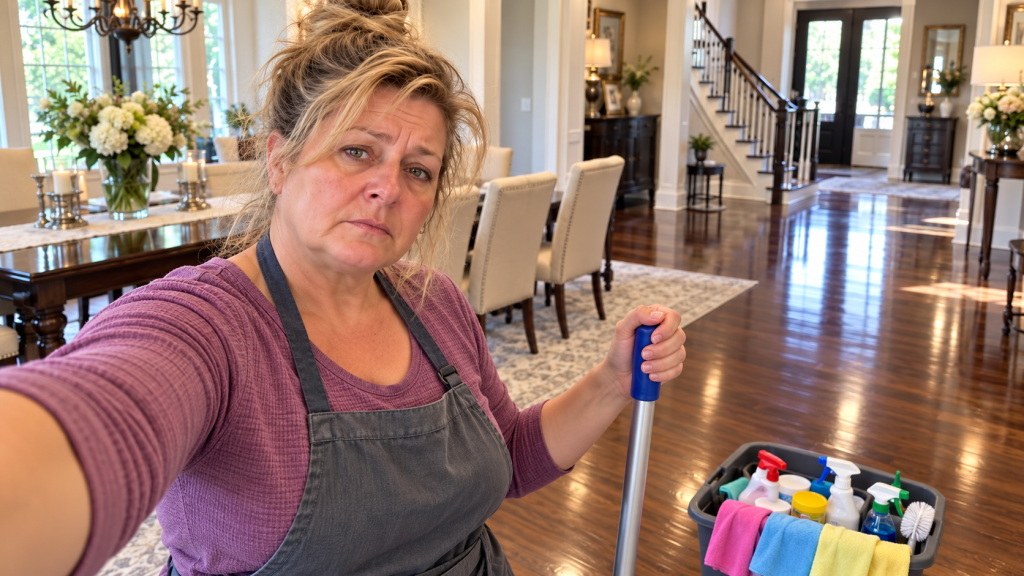
“You came inside carrying that ridiculous blue bucket.”
“It was not ridiculous.”
“It leaked.”
“It did not.”
“It absolutely leaked.”
We were both crying now.
She continued.
“You asked me whether I wanted you to begin upstairs.”
“I said yes.”
“You did not ask why I looked terrible.”
“You did not give me sympathy eyes.”
“You did not tell me everything happened for a reason.”
“You cleaned.”
I remembered almost none of that first day.
To me, she had been another address.
Another kitchen.
Another bathroom.
Another chance to earn enough money to keep the electricity from being shut off.
She remembered every detail.
Mrs. Whitaker said:
“At noon, you asked whether I minded if you heated your lunch.”
I frowned.
“I did?”
“A frozen burrito.”
“Oh God.”
“You ate standing over the sink.”
“I probably had to leave for another job.”
“You did.”
“You told me your daughter was waiting at school.”
She looked at the old kitchen table.
“I realized that day that both of us were trying to survive something without saying so.”
I looked down at the check again.
Forty-eight thousand dollars.
It still looked unreal.
Then I picked up the trust document.
“What exactly is this cottage?”
Mrs. Whitaker became practical immediately.
That was one of the things I loved about her.
Emotion got five minutes.
Then paperwork.
“It is a two-bedroom cottage in Oak Park.”
“You own a cottage in Oak Park?”
“For thirty-one years.”
“I thought you had one house.”
“You never asked for an asset schedule.”
“Apparently I should have.”
She smiled.
“Arthur and I bought it when our daughter went to college.”
“We rented it.”
“It has been paid off for nineteen years.”
My stomach tightened.
“How much is it worth?”
She hesitated.
“Mrs. Whitaker.”
“Roughly two hundred seventy thousand.”
I nearly dropped the papers.
“No.”
“Yes.”
“No.”
“Carly.”
“No.”
“Very persuasive.”
“You cannot give me a quarter-million-dollar house.”
“I can.”
“Why?”
“I just gave you a six-page explanation.”
“This is different!”
“How?”
“Because…”
I stopped.
Because money that large frightened me.
Because gifts that large usually came with hooks.
Because when you have spent most of adulthood measuring groceries against gas, generosity can feel suspicious before it feels kind.
Mrs. Whitaker seemed to understand.
She said:
“The cottage is already in an irrevocable trust.”
“You are beneficiary.”
“My attorney is trustee until transfer.”
“Why not just sign the deed over?”
“Because I wanted everything checked properly.”
“Taxes.”
“Title.”
“The existing tenant.”
“There’s a tenant?”
“Until September.”
My brain tried to organize all of it.
“So I’m becoming a landlord?”
“For four months.”
“I don’t know anything about being a landlord.”
“The property manager does.”
“There’s a property manager?”
“Yes.”
I stared.
She smiled.
“I may be old, but I am not reckless.”
That made me laugh.
Then she became serious.
“When the lease ends, you choose.”
“Move in.”
“Keep renting it.”
“Sell it.”
“Whatever is best for you and Willa.”
I sat back down.
There was one obvious question.
“Does your daughter know?”
Mrs. Whitaker went quiet.
“Yes.”
“And she’s okay with this?”
Another pause.
“She knows.”
“That was not what I asked.”
“No.”
My stomach dropped.
“Mrs. Whitaker.”
“She has feelings.”
“So do I!”
“Yes.”
“And yours are currently louder.”
I stood.
“I’m not taking a house if it destroys your family.”
“It will not destroy my family.”
“She’s angry.”
“She was.”
“Was?”
“She may still be.”
“You don’t know?”
Mrs. Whitaker sighed.
“My daughter’s name is Rebecca.”
“I know.”
Of course I knew.
Rebecca lived in North Carolina.
Two children.
Divorced.
Marketing executive.
Always called Sunday evenings.
Mrs. Whitaker continued.
“Rebecca and I have discussed my estate for years.”
“She is financially comfortable.”
“She will inherit considerably more than this cottage.”
“That’s not the point.”
“I agree.”
“So why give it to me?”
Mrs. Whitaker looked at me.
“Because inheritance and gratitude are not the same thing.”
I said nothing.
She continued.
“Rebecca gets what I want my daughter to have.”
“You get what I want you to have.”
“One does not subtract love from the other.”
I wanted to believe that.
Then the front door opened.
A woman’s voice called:
“Mom?”
Mrs. Whitaker closed her eyes.
I froze.
“You didn’t say she was coming.”
“She changed her flight.”
“Mrs. Whitaker.”
“I did not arrange an ambush.”
Footsteps approached.
Rebecca entered the kitchen.
I had met her twice.
Same elegant posture as her mother.
Dark hair instead of silver.
She stopped when she saw me holding the documents.
Then looked at her mother.
“So you told her.”
Mrs. Whitaker nodded.
Rebecca looked at me.
I wanted the floor to open.
“I can explain.”
She raised one eyebrow.
“That would be impressive, considering my mother made the decision.”
I shut my mouth.
Rebecca set down her purse.
Then looked at the cashier’s check.
“Tuition too?”
“Yes.”
Rebecca exhaled.
“Forty-eight?”
“Yes.”
“Mom.”
“What?”
“You said forty.”
“Tuition increased.”
Rebecca looked at me again.
I saw something complicated in her expression.
Not hatred.
Not even anger exactly.
Pain.
I recognized it.
That was worse.
I said:
“I haven’t agreed to anything.”
Mrs. Whitaker sighed dramatically.
Rebecca almost smiled.
“She told you not to turn gratitude into debt, didn’t she?”
I stared.
“You read the letter?”
“Draft three.”
Mrs. Whitaker muttered:
“Traitor.”
Rebecca sat down.
For a moment nobody spoke.
Then she said:
“I was angry.”
I looked at her.
“When Mom first told me.”
“I thought…”
She hesitated.
“What?”
“That you had asked.”
“I didn’t.”
“I know.”
She nodded.
“I know that now.”
“How?”
“Because Mom showed me eight years of checks.”
I frowned.
“Checks?”
“The payments she made you.”
“She also showed me your rate changes.”
I glanced at Mrs. Whitaker.
She suddenly found the floor fascinating.
Rebecca continued.
“My mother tried to raise your rate three times before you agreed.”
Mrs. Whitaker said:
“Four.”
“Not helping.”
Rebecca almost smiled.
Then looked at me again.
“I also talked to Mom’s attorney.”
“He made it very clear that this was her idea.”
I still felt embarrassed.
“I don’t want you thinking I took advantage of her.”
Rebecca’s face softened.
“I don’t.”
“Not anymore.”
The words mattered.
Not anymore.
“What changed?”
Rebecca looked toward her mother.
“Mom asked me a question.”
Mrs. Whitaker smiled faintly.
Rebecca continued.
“She asked how many Thursdays I had visited her in the last eight years.”
Silence.
I looked down.
Rebecca’s eyes filled.
“I told her that was unfair.”
“It was.”
Mrs. Whitaker said quietly.
“You had work.”
“Children.”
“A divorce.”
“A life.”
“I know.”
Rebecca nodded.
“But I also knew the answer.”
She looked at me.
“Four.”
I swallowed.
Rebecca said:
“You were here almost four hundred Thursdays.”
“That doesn’t mean I’m her daughter.”
“No.”
“Exactly.”
Mrs. Whitaker said.
Rebecca looked at her.
“Mom.”
“What?”
“We’ve done this.”
They had.
Clearly.
Rebecca turned back to me.
“I need you to understand something.”
“I am not giving you my mother.”
“I’m not.”
“I know.”
“She is choosing what to do with one property.”
“One check.”
“She is not replacing me.”
“I’m not replacing her.”
Rebecca nodded.
“Good.”
Then, unexpectedly, she laughed.
“Because if she starts calling you every Sunday at seven and complaining that you don’t answer fast enough, you can have her.”
Mrs. Whitaker gasped.
“I do not complain.”
“You once left me six voicemails in eleven minutes.”
“I thought you were dead.”
“I was in Target.”
“You could have been dead in Target.”
That broke the tension.
I laughed.
Rebecca laughed.
Even Mrs. Whitaker eventually smiled.
Then Rebecca became serious.
“There is one thing I asked Mom to change.”
My stomach tightened again.
“What?”
“The cottage trust.”
I looked at Mrs. Whitaker.
She nodded.
Rebecca continued.
“Originally, Mom wanted the deed transferred immediately.”
“I asked her attorney to leave you a clean exit.”
“A clean exit?”
“If you decide within ninety days that you don’t want it, the trust sells the cottage and pays the proceeds into a managed account for you instead.”
My mouth opened.
“Why?”
“Because a house can be a burden.”
“Taxes.”
“Repairs.”
“Responsibility.”
“And Mom was so focused on giving you security that she wasn’t thinking about whether you wanted to own another building.”
Mrs. Whitaker muttered:
“I thought of it eventually.”
“After I yelled.”
“Constructively.”
Rebecca looked at me.
“So you have a choice.”
That changed everything.
Choice.
Not obligation.
Not gratitude.
Choice.
I looked at Rebecca.
“Thank you.”
She nodded.
Then her eyes filled.
“And there’s another reason I stopped being angry.”
“What?”
“My mother told me what you did the night she fell.”
I stared.
“What night?”
Mrs. Whitaker frowned.
“Rebecca.”
“The bathroom fall.”
I remembered.
Three years earlier.
I had arrived Thursday morning and found Mrs. Whitaker sitting on the bathroom floor.
She had slipped sometime before dawn.
Could not reach her phone.
I called an ambulance.
Stayed at the hospital.
Picked up her prescriptions.
Made soup.
Left at nearly midnight after Rebecca’s flight was delayed.
I had never thought of it as extraordinary.
Mrs. Whitaker would have done the same for someone else.
Rebecca said:
“Mom never told me you lost two cleaning jobs that day.”
I glanced at Mrs. Whitaker.
“How did you know?”
“You complained for weeks that Susan Finch had dropped you.”
“That woman was impossible.”
“Still.”
I shrugged.
“She fell.”
Rebecca nodded.
“Exactly.”
Her voice broke.
“I was eight hundred miles away.”
“You were not.”
“You came.”
The kitchen went quiet.
Then I said the only thing that felt right.
“I wasn’t her daughter that day either.”
“No.”
Rebecca whispered.
“You were Carly.”
Mrs. Whitaker began crying.
“Wonderful.”
she said.
“Now everybody’s emotional.”
We ate the rest of the cookies.
The dishes stayed on the table.
That alone felt illegal.
Before I left, Mrs. Whitaker hugged me.
She was shorter than I realized.
Or perhaps age had been slowly folding her inward.
I held her carefully.
She whispered:
“Take the money.”
I whispered back:
“I’ll think about it.”
She pulled away.
“No.”
“The correct answer was yes.”
I laughed.
Then she pushed the old house key into my palm again.
“Keep it.”
“You’re moving.”
“I know.”
“Then what is this supposed to open?”
“Nothing soon.”
I looked at her.
“Then why keep it?”
She smiled.
“Because you spent eight years thinking it meant permission to enter my house.”
“Maybe one day you’ll understand it meant I trusted you.”
I closed my fingers around the key.
That afternoon I drove home without turning on the radio.
The envelope sat on the passenger seat.
I kept glancing at it at red lights.
Forty-eight thousand dollars.
A cottage.
Eight years of being noticed.
When I reached our apartment, Willa was sitting at the kitchen table surrounded by nursing-school forms.
She looked up.
“How was Mrs. Whitaker?”
I put the envelope down.
“We need to talk.”
Her face immediately changed.
“Oh no.”
“What?”
“Are you sick?”
“No.”
“Is she sick?”
“No.”
“Did I do something?”
“Why is that third?”
“I know my life.”
I sat.
Then told her.
Not beautifully.
I stumbled.
Cried.
Went backward.
Forgot details.
When I finally showed her the cashier’s check, she stared at it.
Then at me.
“No.”
I laughed through my tears.
“That was my reaction.”
“This is fake.”
“It’s not.”
“She gave me forty-eight thousand dollars?”
“For school.”
Willa covered her mouth.
Then began crying.
I had seen my daughter cry from pain.
From anger.
From heartbreak.
Gratitude was different.
Almost frightening.
She whispered:
“Mom.”
“Yes?”
“You don’t have to work nights anymore.”
That was the first thing she said.
Not college.
Not tuition.
Me.
“You don’t have to clean the law office after dinner.”
I looked away.
“I was probably going to stop soon.”
“You always say that.”
She reached across the table.
“You’re tired.”
There it was.
My seventeen-year-old daughter noticing me.
The way Mrs. Whitaker had.
I squeezed her hand.
“Maybe I am.”
Willa looked at the papers.
“What’s the cottage?”
I told her.
Her eyes widened.
“A house?”
“Sort of.”
“We’re rich.”
“No.”
“We have a cottage.”
“We may have a cottage.”
“Same thing.”
“No.”
“Basically.”
I laughed.
Then she became serious.
“Are you going to take it?”
“I don’t know.”
“Why wouldn’t you?”
“Because it’s enormous.”
“So?”
“Because gifts can get complicated.”
Willa thought.
“Did Mrs. Whitaker make it complicated?”
“No.”
“Then maybe you are.”
Children can be extremely irritating when they are right.
Over the next month, I did something unfamiliar.
I asked professionals for help.
A lawyer reviewed the trust.
An accountant explained property taxes.
The property manager showed me rental records.
The cottage was not a magical free house.
It needed a roof within three years.
The furnace was fourteen years old.
Property taxes were real.
Insurance was real.
But so was the rent.
The current tenant paid enough to cover expenses and leave a modest surplus.
If I kept renting it, the property could create income.
If I moved in after the lease ended, my housing costs would drop dramatically compared with our apartment.
If I sold it, even after taxes and fees, I could create a financial cushion I had never had.
Every option was good.
That scared me too.
People who live close to the edge become experts at choosing between bad options.
Good ones require different muscles.
I decided to keep the cottage.
At least for now.
Mrs. Whitaker called from her new apartment the day after the transfer became final.
“Well?”
“I accepted.”
There was silence.
Then:
“About time.”
“I hate you.”
“No, you don’t.”
“No.”
I smiled.
“I don’t.”
Willa’s tuition check went directly to the university.
That mattered to me.
Not because I distrusted her.
Because Mrs. Whitaker wanted the gift to be clean.
Clear purpose.
Clear payment.
No confusion.
Willa started nursing school that fall.
The first day, she sent Mrs. Whitaker a photograph wearing navy scrubs.
Mrs. Whitaker replied:
You look too young to be responsible for anyone’s blood pressure.
Willa adored her.
They started exchanging messages.
At first, I worried.
Then I caught myself.
There it was again.
My instinct to manage everybody’s relationships because I feared owing something.
I stopped.
Mrs. Whitaker was allowed to care about Willa.
Willa was allowed to care back.
No ledger required.
The cottage tenant moved out in September.
I visited the empty place for the first time.
It was smaller than I imagined.
White siding.
Green shutters.
A maple tree leaning toward the driveway.
The kitchen was old.
The bathroom tile was pink.
I loved it immediately.
Willa walked from room to room.
“Mom.”
“What?”
“We should live here.”
I looked at her.
“You’ll be at school.”
“Eventually.”
“This could be yours.”
“No.”
I shook my head.
“This is mine.”
She blinked.
Then smiled.
“Good.”
That mattered.
I had spent seventeen years making almost every decision around Willa.
As mothers do.
But Mrs. Whitaker had given the cottage to me.
Not because I was a mother.
Not because I was struggling.
Not because Willa needed something.
Because I was Carly.
I decided to move in.
We painted the living room ourselves.
Not purple.
Mrs. Whitaker asked.
I told her lavender.
She threatened to revoke the gift.
I reminded her it was irrevocable.
She called me “legally obnoxious.”
I considered it progress.
For the first time since leaving Willa’s father, I had a bedroom where no landlord could raise the rent.
That first night in the cottage, I lay awake staring at the ceiling.
Instead of peace, I felt panic.
What if something broke?
What if I lost the house?
What if I could not maintain it?
What if Mrs. Whitaker changed her mind emotionally even if she could not legally?
What if Rebecca resented me later?
What if accepting help made me weak?
At two in the morning, I called my sister.
She listened for ten minutes.
Then said:
“Carly.”
“What?”
“Go to sleep.”
“That’s your advice?”
“Yes.”
“I called for wisdom.”
“You received it.”
I laughed.
Then she said:
“You spent years believing security had to hurt.”
I went quiet.
“Maybe this one doesn’t.”
That sentence stayed with me.
Security had always hurt.
Overtime.
Bleach burns.
Back pain.
Missed dinners.
Secondhand cars.
Collections notices.
Court arguments over child support.
Somewhere along the way, I had decided anything easy must be dangerous.
Mrs. Whitaker’s gift challenged that.
Not all help is a trap.
Not every kindness creates debt.
Sometimes someone simply decides they have enough and wants you to have more.
That should have been simple.
It took me years to understand.
The first real problem came six months later.
Mrs. Whitaker’s son, Daniel, called.
I had forgotten about Daniel because he lived overseas and rarely came up.
He worked in Singapore.
Had not been part of the conversations with Rebecca.
He sounded polite.
Too polite.
“Carly, I’d like to talk about Mom’s property transfer.”
My stomach tightened.
“Okay.”
“I only learned about it recently.”
I closed my eyes.
Of course.
There it was.
The hook.
“Did Mrs. Whitaker not tell you?”
“She did.”
“Afterward.”
“I see.”
He continued.
“I’m not accusing you of anything.”
People almost never say that unless accusation is nearby.
“But I have concerns.”
“About?”
“Capacity.”
My hands went cold.
“Your mother’s?”
“She’s eighty-one.”
“She was eighty when she transferred the cottage.”
“Yes.”
“And she has made some unusual decisions.”
I stood in the kitchen she had given me.
“What unusual decisions?”
“Giving a substantial asset to an employee.”
There it was.
Employee.
Not Carly.
I said:
“Your sister knew.”
“I’m aware.”
“She reviewed everything with the attorney.”
“She is not neutral.”
“Neither are you.”
Silence.
I regretted it immediately.
But not enough to apologize.
Daniel said:
“I just want to make sure Mom understood what she was doing.”
“She did.”
“How do you know?”
“Because she explained it to me for an hour.”
“That’s not a capacity evaluation.”
“No.”
“It isn’t.”
I swallowed.
“Call her attorney.”
“I have.”
That frightened me more.
“And?”
“He says she was competent.”
“Then why are you calling me?”
Silence.
Finally:
“Because I want to hear your version.”
“My version is your mother gave me a cottage.”
“Why?”
“Because I cleaned her house for eight years.”
“That doesn’t make sense.”
“No.”
I said quietly.
“It doesn’t make sense if all I was to her was the person who cleaned.”
Daniel had no answer.
Two weeks later, I received a letter from his attorney.
Not a lawsuit.
A request.
Preserve records.
Communications.
Documents.
They were considering challenging the transfer.
I sat on my kitchen floor.
The cottage suddenly felt like a crime scene.
Willa found me there.
“What happened?”
I handed her the letter.
She read it.
Her face changed.
“He can’t do this.”
“He can try.”
“Call Mrs. Whitaker.”
“No.”
“Why?”
“Because I do not want to put her between her children.”
“She already made the decision.”
“I know.”
“Mom.”
“No.”
I called the trust attorney instead.
Mr. Leonard.
He sounded almost bored.
That reassured me.
“Yes.”
he said.
“We expected this possibility.”
“You did?”
“Mrs. Whitaker did.”
I closed my eyes.
Of course she did.
“What happens?”
“First, nothing unless Daniel files.”
“Second, your transfer documents include an independent capacity letter.”
My shoulders lowered.
“What?”
“Mrs. Whitaker underwent cognitive evaluation before final execution.”
“Why didn’t anyone tell me?”
“She did not want you to accept based on fear of litigation.”
I almost laughed.
That woman.
“Anything else?”
“Yes.”
“The signing was video recorded.”
My mouth opened.
“She anticipated all of it.”
“She knew her son might misunderstand.”
“Why didn’t she tell him beforehand?”
“Family dynamics.”
Lawyer language for because people are complicated.
Daniel filed anyway.
Not a full attack on me personally.
A petition asking the court to review the transfer and his mother’s capacity.
He claimed possible undue influence.
I cried for two days.
Not because I thought I would lose.
Because the phrase humiliated me.
Undue influence.
It made eight years sound predatory.
As though every toilet I scrubbed had been part of a long con.
Rebecca called.
“I’m sorry.”
“You didn’t do this.”
“He’s scared.”
“Of what?”
“That Mom is giving things away because she’s getting older.”
I laughed bitterly.
“She gave away one cottage.”
“I know.”
“He thinks I manipulated her.”
“He doesn’t know you.”
“That’s the point.”
Rebecca sighed.
“He also doesn’t know Mom very well anymore.”
That was painful.
For everyone.
Mrs. Whitaker called next.
I almost did not answer.
“Carly.”
“Hi.”
“I heard from Leonard.”
“I don’t want to talk about Daniel.”
“I do.”
“It’s your family.”
“And my cottage.”
“Your former cottage.”
“Good correction.”
I smiled despite myself.
She continued.
“Do not give it back to make this easier.”
I closed my eyes.
“How did you know I was thinking that?”
“Because you are exhausting.”
“I could deed it back.”
“No.”
“Then Daniel stops.”
“No.”
“Maybe.”
“And you learn the wrong lesson.”
“What lesson?”
“That the loudest uncomfortable person gets to reverse your decisions.”
I went quiet.
She continued.
“My son is entitled to ask whether I was competent.”
“I am entitled to prove I was.”
“You are entitled to keep what I knowingly gave you.”
“This is not a war.”
“It is paperwork.”
That sounded so much like her that I laughed.
The case lasted five months.
It was less dramatic than television.
Depositions.
Medical records.
Attorney letters.
The video of Mrs. Whitaker signing the trust.
In it, she looked directly into the camera.
The lawyer asked:
“Do you understand the estimated value of the cottage?”
“Yes.”
She gave the range.
“Do you understand that Carly is not related to you?”
“Yes.”
“Do you understand that this gift reduces what may otherwise remain in your estate?”
“Yes.”
“Did Carly ask you for this property?”
“No.”
“Did she suggest it?”
“No.”
“Did she threaten, pressure, or manipulate you?”
Mrs. Whitaker laughed on the recording.
“Carly has trouble accepting leftovers.”
“You think she masterminded a real-estate transfer?”
Even Daniel’s lawyer smiled.
Then the attorney asked:
“Why are you doing this?”
Mrs. Whitaker looked toward the camera.
“Because my husband and I accumulated more than I need.”
“My children will still inherit substantial assets.”
“And because Carly spent eight years being reliable during a period when reliability mattered to me.”
The attorney asked:
“Are you compensating her for unpaid labor?”
“No.”
“I paid her wages.”
“Are you paying for future services?”
“No.”
“If she stops visiting after receiving the property, what happens?”
“Nothing.”
“Will you regret the gift?”
“No.”
That was it.
Daniel withdrew the petition shortly afterward.
No trial.
No dramatic defeat.
Just a son realizing his mother knew exactly what she was doing.
He called me three months later.
“I owe you an apology.”
I said nothing.
“I thought…”
He stopped.
“What?”
“I thought you had become important to Mom because you were physically there.”
I frowned.
“I was physically there.”
“I know.”
“But I thought that meant she was vulnerable.”
“That you benefited because Rebecca and I were far away.”
I leaned against the cottage counter.
“And?”
“I watched the video.”
He exhaled.
“Mom was not confused.”
“No.”
“She was angry that anyone thought she might be.”
“That sounds right.”
He almost laughed.
Then:
“I’m sorry I treated your job like proof you were less trustworthy instead of more.”
That surprised me.
I swallowed.
“Thank you.”
He continued.
“I was also jealous.”
There.
Truth.
“Of me?”
“Yes.”
“Which is absurd.”
“Probably.”
“She talks about Thursdays.”
“I wasn’t there.”
I did not know what to say.
Finally:
“You can still be there.”
Silence.
Then:
“I know.”
After that, he started calling his mother every Wednesday.
Not Thursday.
He joked Thursday was taken.
A year later, he moved back to the United States.
Not because of me.
Because his mother had a small stroke.
She recovered well.
But the event changed priorities.
Rebecca visited more.
Daniel visited more.
I visited when I wanted.
Not every week.
That was deliberate.
At first, guilt screamed whenever I skipped a Thursday.
Then I remembered the letter.
If you choose to visit me, come because you want to.
So I did.
Sometimes Tuesday.
Sometimes Sunday.
Sometimes not for three weeks.
And strangely, our relationship became closer once I stopped being paid to stand in the room.
We argued more.
That was new.
Mrs. Whitaker hated the curtains I bought for the cottage.
I hated the mystery novels she recommended.
She said my coffee was weak.
I told her her meatloaf could be used as construction material.
Friendship, apparently, was less polite than employment.
I loved it.
Willa graduated nursing school.
No debt.
The day she walked across the stage, Mrs. Whitaker attended in a wheelchair.
Not because she needed one full-time.
Because the arena involved too much walking.
She wore a blue hat that blocked the view of everyone behind her.
Rebecca begged her to remove it.
She refused.
When Willa’s name was called, Mrs. Whitaker shouted:
“THAT’S OUR GIRL!”
Half the section turned.
I cried.
Afterward, Willa hugged her.
“Thank you.”
Mrs. Whitaker pointed one finger.
“No debts.”
“I know.”
“Say it correctly.”
Willa smiled.
“I’m glad you helped me.”
“Better.”
Then Willa leaned down.
“I love you.”
Mrs. Whitaker’s face changed.
For all her rules about obligation, love still surprised her.
“I love you too.”
she whispered.
That night, as I drove home, I realized something.
Mrs. Whitaker had insisted that the money create no relationship.
And because it created no obligation, a real relationship had grown anyway.
That was the difference.
A gift that demands love is not a gift.
A gift that leaves love free may discover it.
My cleaning business changed after the cottage.
I did stop night work.
Willa had been right.
My body felt the difference immediately.
My hands stopped cracking as badly.
The pain between my shoulder blades eased.
I reduced my client list.
Raised my rates.
That terrified me.
Three clients left.
Seven stayed.
Then referrals replaced the three.
For the first time, I began charging what the work actually cost me.
Time.
Gas.
Supplies.
Insurance.
Wear on my body.
Experience.
Mrs. Whitaker was delighted.
“Finally.”
“You could have told me years ago.”
“I did.”
“No.”
“You said, ‘Carly, you undercharge.’”
“That was different.”
“How?”
“I assumed you meant slightly.”
“I meant embarrassingly.”
I laughed.
Eventually I hired another cleaner.
Her name was Jasmine.
Single mother.
Two boys.
The first day, she tried eating lunch in her car.
I knocked on the window.
“What are you doing?”
She looked embarrassed.
“Lunch.”
“Inside.”
“I don’t want to make a mess.”
“Inside.”
She came in.
We ate at the cottage table.
I almost told her the story of Mrs. Whitaker.
I stopped.
Not everything needs to become a lesson immediately.
Instead I said:
“Your break is paid.”
She stared.
“What?”
“Lunch.”
“Paid.”
“You don’t have to clock out.”
“Why?”
“Because you are still giving me the middle of your day.”
She looked like she might cry.
I understood.
Over time, my small business grew to four employees.
Not an empire.
No franchise.
No television makeover show.
Four women.
Fair wages.
Paid drive time between clients.
Paid sick days.
Cleaning supplies reimbursed.
And one rule:
Nobody eats lunch in the car because they feel unwelcome in a client’s house.
If a client would not let us sit for twenty minutes somewhere reasonable, we did not keep the client.
That rule cost me money twice.
Worth it.
Mrs. Whitaker loved hearing stories about the business.
She called herself an investor.
“You invested zero dollars.”
“I invested a cottage.”
“That was not the business.”
“Details.”
Eight years after she moved away, Mrs. Whitaker died.
She was eighty-nine.
Not suddenly.
Not painfully.
Her health declined over several months.
Rebecca and Daniel were both with her.
So was I.
Not as a cleaner.
Not as a caregiver.
Not because of a letter.
Because I wanted to be.
The final week, she slept much of the time.
One afternoon she opened her eyes and saw me beside the bed.
“You brought supplies?”
I laughed.
“No.”
“Good.”
“Still bossy.”
“Yes.”
She squeezed my fingers weakly.
“How’s the cottage?”
“Still standing.”
“Purple?”
“Not yet.”
“Good.”
I leaned closer.
“Willa says hello.”
“Tell her not to marry a doctor.”
“Why?”
“Schedules are terrible.”
I laughed through tears.
Then Mrs. Whitaker became quiet.
“Carly.”
“Yes?”
“Was I right?”
“About what?”
“The gift.”
I knew immediately.
I looked at her.
“Yes.”
Her eyes filled.
“Did it make you feel bought?”
“No.”
“Did you feel like you had to come here?”
I thought about lying.
Then chose honesty.
“Sometimes at first.”
Her face fell slightly.
“But I learned.”
I squeezed her hand.
“You taught me the difference.”
“Good.”
She closed her eyes.
Then whispered:
“You were never furniture.”
I frowned.
“What?”
“People who work in houses.”
“We start treating them like the vacuum.”
“Something useful that appears and disappears.”
My throat tightened.
“You always said good morning to me.”
She smiled faintly.
“That sounds like a very low bar.”
“It was enough to matter.”
She opened her eyes again.
“So were you.”
Those were among the last words she spoke clearly to me.
She died two days later.
Her funeral was full.
More people than I expected.
Neighbors.
Family.
Old friends.
Church members.
Former colleagues of Arthur.
Rebecca gave the eulogy.
Daniel read a poem badly.
Willa cried harder than either of them.
I sat in the second row.
Not with family.
Not away from them either.
Exactly where I belonged.
After the service, Rebecca handed me a small envelope.
I laughed immediately.
“No.”
She smiled through tears.
“Yes.”
“She promised no more.”
“This one is not money.”
“Better not be.”
Inside was the old house key.
The one Mrs. Whitaker had given me years earlier.
I stared.
“I already have this.”
“No.”
Rebecca shook her head.
“You have the copy.”
I looked closer.
She was right.
Mine had a small scratch near the top.
This one did not.
Rebecca said:
“Mom kept the original.”
“Why?”
“There’s a note.”
I unfolded the paper.
Mrs. Whitaker’s handwriting had become shakier.
Carly, you gave me back your key when you thought your job was finished.
I kept mine because I never thought knowing you was.
I cried in Rebecca’s arms.
Not employee.
Not daughter.
Not replacement.
Not charity case.
Carly.
That was enough.
Her will was far less dramatic than people expected.
Most of the estate went to Rebecca and Daniel.
Education trusts for grandchildren.
Donations to two charities.
A few personal gifts.
Nothing to me.
I was relieved.
She had already given me what she wanted me to have while she was alive.
That felt important.
No posthumous surprise.
No family war.
No possibility of interpreting our final years as an investment.
Just the cottage.
The tuition.
Two keys.
And eight years of Thursdays.
Years later, after Willa married and had a little girl, she brought my granddaughter to the cottage.
Her name was Claire.
She ran through the living room touching everything.
At one point she found the framed letter from Mrs. Whitaker.
“Who wrote this?”
I said:
“A woman I worked for.”
Willa corrected me from the kitchen.
“A woman Mom loved.”
I smiled.
“Both.”
Claire looked at the photograph beside it.
Mrs. Whitaker at Willa’s graduation.
Blue hat.
Terrible hat.
“Was she Grandma?”
“No.”
“Was she family?”
Children always want categories.
I thought.
“She was Mrs. Whitaker.”
Claire frowned.
“That’s not an answer.”
“It became one.”
She accepted that eventually.
I did too.
People often ask why Mrs. Whitaker gave me the cottage.
They expect one dramatic act.
Something I did.
A life I saved.
A secret I kept.
A sacrifice.
There wasn’t one.
That is what makes people uncomfortable.
We like gifts to have reasons large enough to balance them.
But hers was built from small things.
Arriving.
Remembering.
Noticing.
Calling an ambulance.
Putting photographs back where they belonged.
Learning which drawer stuck.
Knowing which towels were for guests.
Asking whether she wanted the upstairs done first.
Saying good morning.
Eight years of ordinary reliability.
Nothing heroic.
Everything human.
And Mrs. Whitaker gave me something even more valuable than the property.
She changed the way I understood being seen.
Before her, being noticed frightened me.
If someone noticed I was struggling, I assumed pity was coming.
Or advice.
Or control.
Or a favor I would eventually have to repay.
Mrs. Whitaker noticed without trying to own the solution.
She waited.
She thought.
She protected my choice.
Even when she gave me more than I could imagine accepting, she made sure I could still say no.
That is why I finally said yes.
Not because I needed the house.
Though I did.
Not because Willa needed tuition.
Though she did.
Because the gift came with an open door instead of a hook.
I still clean sometimes.
People find that surprising.
“Why?”
they ask.
“You own a house.”
“You have a business.”
“You don’t have to.”
Exactly.
I don’t have to.
That changed the work.
Once or twice a month, I take an old client myself.
Someone elderly.
Someone I have known for years.
I bring my supplies.
I scrub sinks.
Dust shelves.
Complain about vacuum cords.
Then I sit down afterward if they offer coffee.
I did not know how to do that before.
Sit.
Stay.
Accept a glass from the cabinet without asking like I was stealing it.
Mrs. Whitaker taught me that entering a home as a worker does not make you less human inside it.
And receiving kindness does not turn you into property either.
The cottage roof eventually needed replacing.
I paid for it.
The furnace died two winters later.
I paid for that too.
Every repair made the gift feel more mine.
Not because Mrs. Whitaker’s generosity faded.
Because responsibility slowly joined it.
Years later, when property values rose, I could have sold the cottage for much more than it had been worth when she gave it to me.
I did not.
Not from sentiment alone.
I liked living there.
The maple tree got enormous.
The pink bathroom tile stayed.
Willa begged me to replace it.
I refused.
Some ugly things earn tenure.
I did eventually paint the front door purple.
Just the door.
The first photograph I took, I sent to Rebecca and Daniel.
Rebecca replied:
Mom is haunting you.
Daniel wrote:
She deserved this.
I framed the photo.
Beside it, I framed Mrs. Whitaker’s first letter.
The line I look at most is not about the money.
Not the cottage.
Not Willa.
It is this:
Being noticed is not the same thing as owing someone.
I spent much of my life believing otherwise.
Mrs. Whitaker spent eight years quietly proving me wrong.
And all because one Saturday morning, after years of arriving at her door with rubber gloves, sprays, rags, and a leaking blue bucket, she finally asked me to come back with none of it.
No supplies.
No uniform.
No work.
Just me.
It turned out that was who she had been waiting to visit all along.
THE END STORIES! THANK YOU FOR READING GOOD LUCK! ❤️
Related Posts