The nurse’s words hit me harder than the storm. “Your daughter opened her eyes.” For one suspended second, I forgot Liam. I forgot Eleanor. I forgot the mansion, the gasoline, the match crushed beneath my shoe.
I forgot everything except Chloe. I pushed through the ICU doors. She looked impossibly small beneath the blankets. Machines surrounded her. Bandages covered one side of her head. Her face was swollen. Her skin looked almost translucent beneath the fluorescent lights.
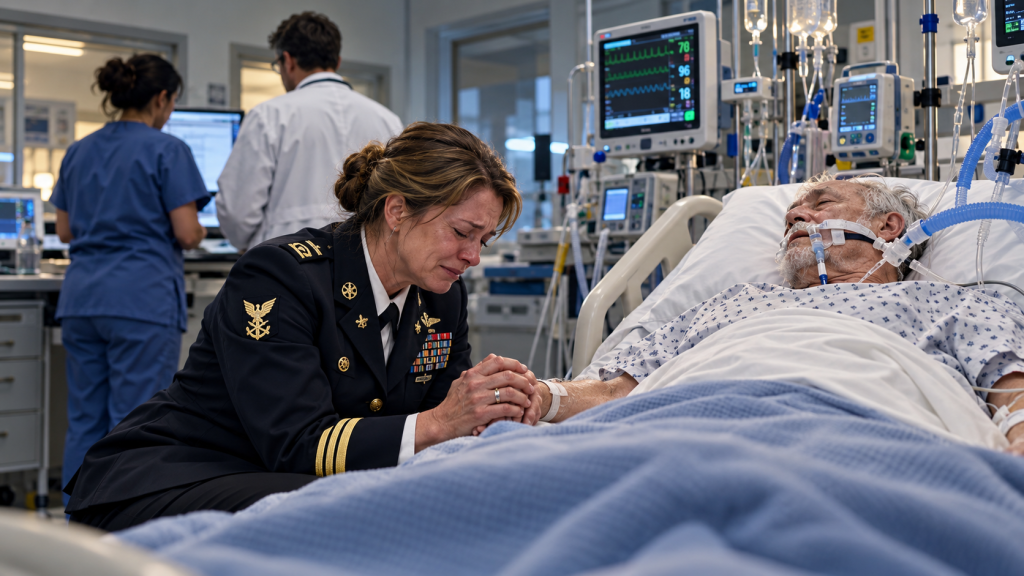
But her eyes— her eyes were open. Barely. Cloudy. Lost. Alive. “Chloe.” I reached her bedside and took her hand. Her fingers did not close around mine. Not yet. But her gaze moved. Slowly. Painfully. Until it found me. “Sweetheart, it’s Mom.” A tear slid from the corner of her eye.
I broke.
All the rage that had held me upright dissolved at once.
I bent over her hand and sobbed.
“I’m here.”
“You’re not alone.”
“You hear me?”
“I’m here.”
Her lips moved.
Nothing came out.
The nurse leaned closer.
“Don’t force yourself, Chloe.”
But Chloe tried again.
One sound escaped.
“Ba…”
I frowned.
“What?”
Her eyes moved downward.
Toward her stomach.
“The baby?”
I whispered.
One slow blink.
“Yes.
She was asking about her child before herself.
I looked toward the nurse.
“The fetal heartbeat is still present,” she said gently. “But everything remains extremely fragile.”
I turned back to Chloe.
“Your baby is still fighting.”
Another tear slid down her cheek.
“So are you.”
Behind me, the ICU doors opened.
Detective Ramirez stepped inside.
His face had changed.
“Mrs. Bennett.”
I looked at him.
“What?”
“Liam Sterling is downstairs.”
Every muscle in my body tightened.
“Keep him away from her.”
“That’s exactly what we’re doing.”
“His mother?”
“Not here yet.”
Yet.
Of course.
Ramirez stepped closer.
“Liam is demanding access as Chloe’s husband.”
I looked at my daughter.
She heard him.
Her heart monitor quickened.
Beep.
Beep.
Beep.
Her fingers twitched.
The nurse immediately noticed.
“No.”
I said.
Then louder:
“No.”
Chloe’s eyes filled with panic.
I leaned over her.
“He is not coming in.”
“I promise.”
Her breathing slowed slightly.
Ramirez watched.
Then said:
“Given the circumstances, we are documenting her response.”
Good.
Document everything.
I had once lived by those words.
Long before Liam Sterling decided I was merely Chloe’s aging mother from the wrong side of town.
Long before Eleanor looked at my thrift-store coat during the wedding rehearsal and asked whether I was “comfortable around formal people.”
They had no idea who I had been before Chloe was born.
I had never told them because I did not believe my past should be used as a threat.
For seventeen years, I had worked as a forensic accountant.
Not the sort who balanced restaurant ledgers.
The sort who followed money that powerful people worked very hard to hide.
Shell companies.
False vendors.
Kickbacks.
Hidden ownership.
Fraudulent invoices.
Political donations routed through relatives.
I had spent years helping prosecutors untangle white-collar cases involving people who believed wealth made paperwork obedient.
Then Chloe’s father died.
She was eleven.
I walked away from the job because she needed a mother who came home before midnight.
Eventually I took quieter accounting work.
Later consulting.
Then almost nothing after my own health scare.
Liam knew only that I “used to do numbers.”
He once laughed at dinner and said:
“So basically bookkeeping.”
I had smiled.
“Yes, Liam.”
Basically.
He never noticed Eleanor watching me when I asked why three Sterling subsidiaries shared the same registered mailing address.
That had been eighteen months earlier.
Now Detective Ramirez said:
“Mrs. Bennett, there’s something else we need to discuss.”
I looked at Chloe.
Then back at him.
“Go ahead.”
He hesitated.
“The recorder contains your daughter saying something approximately seven minutes before the assault.”
“What?”
“She says, ‘If they touch me, everything goes to Mom.’”
My heart stopped.
Ramirez continued.
“Then Eleanor asks what that means.”
“What does Chloe say?”
“She says, ‘It means my mother knows what numbers look like when they’re lying.’”
I closed my eyes.
Even half terrified, my daughter had trusted me.
I squeezed her hand.
“You clever girl.”
Her eyes fluttered.
Ramirez said:
“Do you know what she meant by everything?”
“No.”
Then I remembered.
Three weeks earlier, Chloe had visited me alone.
That itself had been unusual.
Liam normally drove her.
Or their chauffeur did.
That day she arrived in a rideshare.
She carried a blue diaper bag even though the baby was months from being born.
I teased her.
“You planning early?”
She smiled strangely.
“Something like that.”
Then she asked:
“Mom, if somebody owns five companies, but they all keep paying one company nobody has heard of, is that normal?”
I should have understood then.
Instead I answered casually.
“Depends.”
“Why?”
She shrugged.
“Nothing.”
I pushed once.
She changed the subject.
Before leaving, she hugged me too long.
Then whispered:
“Do you still have Dad’s old lockbox?”
I said yes.
She asked whether I still used the same bank.
“Yes.”
“Okay.”
Then she left.
I looked at Ramirez.
“The blue bag.”
“What?”
“Her diaper bag.”
“Do you know where it is?”
“No.”
“Was it at the Sterling residence?”
“I don’t know.”
I turned toward Chloe.
“Sweetheart.”
Her eyes opened again.
“Blue bag?”
A tiny movement.
Her eyelids fluttered once.
“Yes?
Or maybe nothing.
I tried another question.
“Bank?”
This time her fingers moved.
Once.
Then again.
Ramirez noticed.
“Mrs. Bennett, we need to be careful not to lead her.”
He was right.
I hated that he was right.
Chloe was injured.
Barely conscious.
This was not the moment to interrogate my own daughter.
The evidence could wait.
Her brain could not.
I kissed her forehead.
“You don’t have to tell me anything.”
“Just rest.”
The ICU doors opened again.
A security officer appeared.
“Detective.”
Ramirez stepped into the hallway.
I heard raised voices almost immediately.
Liam.
Even through two doors, I recognized that entitled tone.
“This is my wife.”
“You have no authority to keep me from my wife.”
Ramirez answered calmly.
“Given the active criminal investigation, you will not be entering the ICU.”
“This is ridiculous.”
“Sir—”
“My family owns half the medical foundation that funds this hospital.”
There it was.
Power spoken aloud.
As if donations were keys.
I stepped into the hallway.
The moment Liam saw me, his face changed.
“Sarah.”
He looked exhausted.
Rain still darkened his expensive coat.
His hair was wet.
There was a tiny cut across one knuckle.
I stared at it.
My stomach turned.
“What happened to Chloe?”
he asked.
The audacity almost impressed me.
“You tell me.”
His eyes hardened.
“Eleanor said Chloe became hysterical.”
Ramirez immediately looked at him.
Interesting.
He had placed his mother at the scene.
Maybe he realized too late.
Liam continued quickly:
“She attacked us.”
I laughed.
Not loudly.
Just once.
He looked offended.
“She’s pregnant.”
I said.
“She weighs one hundred twenty-eight pounds.”
He stared at me.
“You’re claiming she attacked two adults and then somehow injured herself badly enough to rupture her spleen?”
“She was unstable.”
The word.
Of course.
Women become unstable whenever the truth becomes inconvenient.
I stepped closer.
“Did you hit her with a golf club?”
His face did not change.
But his eyes did.
Ramirez saw it too.
“I want my attorney.”
the detective said calmly.
“That’s an excellent idea.”
Liam glared at me.
Then he noticed something behind my eyes.
“What did she tell you?”
I almost smiled.
“She didn’t have to.”
His face lost color.
Ramirez stepped between us.
“Mr. Sterling, you need to leave this floor.”
Liam raised his voice.
“You don’t understand who you’re dealing with.”
I said:
“That has been your family’s problem for a very long time.”
He looked at me.
“What is that supposed to mean?”
I did not answer.
Because my phone was already in my hand.
And there was one person I needed to call.
Her name was Grace Nolan.
Twenty years earlier, Grace and I had spent eight months reconstructing financial records in a procurement-fraud investigation that eventually exposed more than thirty shell companies.
Back then she had been a junior prosecutor with no patience and terrible coffee.
Now she ran a state financial-crimes unit that frequently coordinated with federal investigators when cases crossed jurisdictions.
We had spoken twice in five years.
Birthdays.
Condolences.
Nothing more.
I walked into the waiting room.
Called.
She answered on the fourth ring.
“Sarah?”
“Grace.”
“Are you okay?”
“No.”
That was enough to change her voice.
“What happened?”
“My daughter may have uncovered a network of shell companies connected to Sterling Meridian Holdings.”
Silence.
Then:
“Start again.”
So I did.
Not dramatically.
Not emotionally.
Facts.
Recorder.
Transfer papers.
Possible offshore accounts.
Possible payments tied to public officials.
Chloe injured.
Family office.
Digital copies somewhere.
Grace did not promise raids.
She did not say she could destroy an empire by breakfast.
Real investigators do not talk like movies.
She asked:
“What evidence do you personally possess?”
“Nothing yet.”
“Then don’t touch accounts.”
“I know.”
“Don’t access anything you aren’t authorized to access.”
“I know.”
“Don’t warn anyone.”
“I know.”
Then her voice softened.
“How is Chloe?”
I looked through the ICU glass.
“Alive.”
“Baby?”
“Alive.”
Grace inhaled.
“Then stay with your daughter.”
“We’ll speak to the local investigators.”
“I’m sending you Ramirez’s contact.”
“Good.”
I paused.
Then:
“Grace?”
“Yes?”
“I almost did something very stupid.”
Silence.
“What?”
I told her.
The gasoline.
The Sterling mansion.
The match.
All of it.
Grace said nothing for a long time.
Then:
“Sarah.”
“I know.”
“No.”
“You do not understand yet how badly that could complicate everything.”
“I know enough.”
“Did anything ignite?”
“No.”
“Did you damage property?”
“I soaked their welcome mat.”
Another silence.
“You need counsel.”
“I know.”
“And you need to tell the detective.”
“I know.”
I closed my eyes.
“I was going to burn their house.”
Grace’s voice softened.
“Your daughter needs you more than she needs revenge.”
Tears filled my eyes.
“I stopped.”
“Yes.”
“That matters.”
Then:
“But stopping does not erase what you did.”
I nodded even though she could not see me.
“I understand.”
For the next two hours, I stayed beside Chloe.
Then I asked Detective Ramirez for a private room.
I told him everything.
He listened without interrupting.
When I finished, he rubbed one hand across his face.
“Mrs. Bennett.”
“I know.”
“Were you trying to destroy evidence?”
“No.”
“Were you aware of any records inside the residence at that point?”
“Only generally.”
“Did anything catch fire?”
“No.”
“Did anyone see you?”
“I don’t know.”
He looked at me.
“You understand I have to report this.”
“Yes.”
“You should contact an attorney.”
“I already have a name.”
He studied me.
Then said:
“For what it’s worth, leaving was the smartest thing you did today.”
I looked through the glass at Chloe.
“No.”
“The smartest thing I did was answer the phone.”
The consequences for what I had done did not vanish.
They came later.
And I accepted them.
That part matters.
Because I had nearly become the story the Sterlings needed.
The furious mother.
The unstable outsider.
The criminal with gasoline.
If I had struck that match, Liam could have pointed at flames while Chloe’s evidence disappeared beneath smoke.
Instead, I let the match die.
And paperwork began doing what fire never could.
By midnight, Chloe’s condition remained critical but stable.
The baby’s heartbeat held.
Doctors warned me repeatedly:
“Hours, then days.”
“No guarantees.”
I stopped asking for guarantees.
I asked only:
“What happens next?”
That question is more useful.
At 2:13 in the morning, a nurse brought Chloe’s personal effects.
One torn earring.
A wedding ring.
Her wet nightgown already documented as evidence.
A tiny key.
I stared.
Not a house key.
A safe-deposit key.
My throat tightened.
Ramirez took custody of it.
By morning, investigators—working with Chloe’s consent once doctors determined she could communicate reliably in limited fashion and later through lawful process—identified the bank.
The box was in Chloe’s name.
Mine was listed for access if she became incapacitated.
I had forgotten.
Years earlier, when Chloe went to college, I had opened a small box for family documents.
After marriage, she transferred it.
Apparently she had never removed me.
Inside were paper copies.
Not thousands.
Enough.
A handwritten index.
Corporate diagrams.
Vendor lists.
Transfers.
Copies of signatures.
Printed emails.
And a flash drive.
At the top sat one note.
My name.
Mom,
If you’re reading this because something happened to me, please don’t do anything reckless. Use what you taught me: follow the money, keep originals safe, and don’t accuse what you can prove.
I had to sit down.
My daughter had known me better than I knew myself.
Ramirez read the note too.
Then looked at me.
“Good advice.”
I almost laughed.
“Apparently I raised a smart woman.”
The contents did not prove every suspicion Chloe had.
But they proved enough to trigger serious scrutiny.
Sterling Meridian Holdings was not one company.
It was a maze.
Hotels.
Real estate.
Construction.
Private lending.
Consulting.
Property management.
A foundation.
Then smaller companies with names designed to sound boring.
Harbor Administrative Services.
North Coast Procurement.
Silver Pine Advisory.
Three of them shared directors who did not appear to perform real work.
One director had died eighteen months earlier.
Yet documents bearing his signature continued appearing.
That was a problem.
Another shell company had paid “consulting fees” to the brother of a zoning-board member shortly before a major Sterling development received approval.
That was another problem.
Several transfers moved through an overseas account connected to a jurisdiction known for corporate secrecy.
Not automatically criminal.
But suspicious when paired with fake vendors and altered invoices.
Chloe had highlighted something else.
Her own name.
Chloe Sterling — Managing Member
on a company called Bellweather Residential.
She had never heard of it.
Then suddenly, six weeks before the attack, Liam began bringing papers home.
“Routine family restructuring.”
“Sign here.”
“Initial here.”
She signed the first packet.
Then something felt wrong.
So she read the second.
Bellweather had guaranteed nearly eight million dollars in debt connected to a failing Sterling project.
They were trying to move liability onto an entity placed partly in Chloe’s name.
My pregnant daughter had been positioned to become the paper owner of debt she had not created.
She stopped signing.
That was when Eleanor changed.
The insults became sharper.
The control became tighter.
Her driver was replaced.
Her credit card stopped working twice.
Liam demanded access to her phone.
Then Chloe began copying documents.
Not because she planned to destroy the company.
Because she was afraid they were preparing to blame her.
One handwritten note in the box said:
If Liam says I handled Bellweather, he is lying. I didn’t even know it existed before March.
I closed my eyes.
She had known.
Maybe not that they would attack her.
But that something was coming.
Grace arrived the following afternoon.
Not as my old friend.
Professionally.
Different suit.
Different posture.
She coordinated with local law enforcement and financial investigators who already had proper authority.
I stayed out of it.
That was harder than any audit I had ever worked.
I wanted to read everything.
Build timelines.
Compare transfers.
Grace looked at me.
“No.”
“I can help.”
“No.”
“I taught you half of what you know.”
“You taught me enough to know why you cannot touch this case.”
I hated that.
She was right.
I was a witness.
Chloe’s mother.
Potentially a suspect in my own reckless act at the mansion.
My place was beside my daughter.
So I stayed.
The next morning, the Sterling empire did not literally vanish.
Buildings did not collapse.
Bank accounts did not all freeze.
That is not how lawful investigations work.
But the first cracks appeared.
Sterling Meridian announced Liam was taking a “temporary leave.”
The board engaged outside counsel.
A lender postponed closing on a major hotel acquisition.
Two banks began internal reviews after receiving lawful requests for records.
The family foundation suspended a planned grant.
A local paper reported that investigators were examining possible financial irregularities involving affiliated entities.
And for the first time in thirty years, the Sterling name was not controlling the headline.
Eleanor came to the hospital that afternoon.
She wore cream wool.
Pearls.
Perfect makeup.
As if she were arriving at a charity luncheon instead of the ICU where her daughter-in-law had nearly died.
Security stopped her.
She demanded to see me.
I agreed.
Public waiting room.
Two officers nearby.
Not because I feared her physically.
Because I had learned that witnesses matter.
Eleanor sat opposite me.
“Sarah.”
I said nothing.
“You have made this much worse than it needed to be.”
I almost smiled.
“Chloe is in intensive care.”
“She’s alive.”
The casualness of it made my skin crawl.
“Yes.”
“Your grandson is still alive too.”
Her mouth tightened.
“I am aware.”
No warmth.
None.
I asked:
“Why did you call the baby a mistake?”
For the first time, her expression shifted.
“I did not.”
“The recording says otherwise.”
Silence.
Then:
“Pregnancy made Chloe emotional.”
There it was.
A new version.
“She misunderstood many things.”
“Did she misunderstand being hit?”
Eleanor stood.
“I will not sit here and be accused by a woman who poured gasoline on my home.”
So she knew.
Of course there were cameras.
I stood too.
“You’re right.”
That surprised her.
“What?”
“What I did was wrong.”
Her expression changed.
“I admitted it.”
“I will answer for it.”
I leaned closer.
“Can you say the same?”
Her eyes hardened.
“Your daughter tried to destroy my family.”
“No.”
I whispered.
“She found out what your family was doing.”
Eleanor’s jaw tightened.
Then she said something I never forgot.
“You have no idea what it takes to preserve a legacy.”
I looked through the glass toward Chloe’s room.
“No.”
“But I know what it costs when you put the legacy ahead of the people inside it.”
Eleanor walked away.
The next day, she retained criminal counsel.
Good.
She needed it.
Chloe improved by inches.
Her Glasgow score rose.
She began following simple commands.
Then saying one-word answers.
Pain.
Water.
Baby.
Mom.
The first complete sentence came nine days later.
I was holding a cup of ice chips.
She looked at me and whispered:
“Did you burn it?”
I froze.
“What?”
“The house.”
Tears filled my eyes.
She remembered.
Maybe pieces.
Maybe the way I used to speak.
Maybe she had always known rage in me.
“No.”
She stared.
“Good.”
That was my daughter.
Barely able to speak.
Still auditing my morality.
I laughed and cried at once.
“I almost did.”
Her eyes closed.
“Mom.”
“I know.”
“Stupid.”
I laughed harder.
“Yes.”
“Very.”
She slept.
The baby remained.
Against the odds.
Doctors warned that trauma had increased every risk.
Chloe required repeated monitoring.
Bed rest.
Surgery recovery.
Neurological rehabilitation.
Nothing became easy.
But week by week, her body stabilized.
The criminal case developed more slowly.
The assault case was clearer.
The recorder captured Eleanor’s voice.
Liam’s.
Chloe refusing to sign.
Then the sounds of violence.
There was no video.
The defense argued context.
Claimed confusion.
Claimed Chloe had fallen during a struggle.
But physical evidence, medical findings, the roadside recovery, vehicle data, and other records supported Chloe’s account.
Then came another twist.
The family driver.
His name was Anthony Reed.
He had worked for the Sterlings fourteen years.
For two days after Chloe was found, nobody could locate him.
Liam’s attorney implied Anthony might have been responsible for abandoning her.
Then Anthony walked into a police station with counsel.
He had not attacked Chloe.
He had driven the car.
And he had kept dash-camera footage.
Not of the assault inside the mansion.
Of what happened afterward.
Liam and Eleanor carrying Chloe outside.
Chloe barely conscious.
Liam ordering Anthony to drive.
Eleanor saying:
“Not the hospital.”
Anthony asking:
“Where?”
Liam answering:
“Somewhere she’ll be found.”
My blood went cold when Ramirez told me.
They had not left her by accident.
They had discussed it.
Anthony drove because he said he was terrified.
Then, at the bus stop, he watched Liam pull Chloe from the back seat.
Anthony testified that he wanted to call an ambulance.
Liam threatened him.
After driving away, Anthony eventually made an anonymous emergency call.
That call saved Chloe.
His delay mattered.
So did his eventual action.
He was not treated like a hero.
He was treated like a witness who had also made cowardly choices under pressure.
That complexity mattered to Chloe later.
When she was strong enough to hear the truth, she asked:
“Did he call?”
“Yes.”
“Immediately?”
“No.”
She closed her eyes.
Then said:
“But he called.”
“Yes.”
That was all.
She never asked me to turn him into a saint.
She understood people too well for that.
The financial investigation expanded.
Investigators found legitimate businesses mixed with illegitimate conduct.
That mattered.
Sterling Meridian employed hundreds of people who had done nothing wrong.
Chloe became furious when reporters wrote:
Sterling Empire Collapsing.
She whispered:
“What about the employees?”
I squeezed her hand.
“I know.”
A company is not only its owners.
Payroll clerks.
Housekeepers.
Engineers.
Receptionists.
Maintenance workers.
People with mortgages.
People whose children needed braces.
Chloe did not want vengeance that burned innocent lives.
That changed how I saw everything.
The board eventually removed Liam from management.
Eleanor resigned from the foundation and later from several corporate positions.
Outside leadership was brought in.
Some divisions were sold.
Others continued.
The legitimate hotels kept operating.
The world did not need every building with the Sterling name to fail.
It needed wrongdoing separated from the people who had not participated.
Grace told me once:
“That is the problem with the word empire.”
“What?”
“It makes people imagine one king.”
“Real companies are ecosystems.”
She was right.
Months later, charges came.
Assault-related charges for Liam.
Conspiracy and other charges tied to the treatment of Chloe.
Eleanor faced charges too.
The financial case was larger and slower.
False records.
Fraud.
Concealment.
Payments requiring further investigation.
Not every suspicious transaction became a charge.
Some had legal explanations.
Some did not.
Several executives cooperated.
One outside accountant admitted falsifying vendor documentation.
A former Sterling vice president produced emails showing Eleanor directing employees to “clean up” ownership structures before an audit.
The phrase sounded almost harmless.
It was not.
Liam eventually faced financial charges separate from the assault case.
The local official Chloe suspected was investigated.
The evidence showed improper payments routed through a relative.
Another official Chloe had circled turned out to have done nothing wrong.
That mattered too.
Suspicion is not guilt.
Evidence gets the final vote.
My own case also reached an outcome.
The Sterling security camera showed me carrying the gasoline.
Approaching the front door.
Pouring it.
Holding the match.
Then stopping.
Leaving.
No fire.
No structural damage beyond the ruined mat and residue.
My attorney negotiated the matter.
I accepted responsibility.
There were consequences.
Court supervision.
Restitution for cleanup.
Required counseling.
A suspended sentence conditioned on compliance.
I did not enjoy admitting that publicly.
But I did.
At one hearing, the judge looked at me.
“Mrs. Bennett, why did you stop?”
I thought about Chloe’s hospital alert.
Then answered:
“Because I realized I was about to become someone my daughter would have to survive too.”
The courtroom went silent.
The judge nodded.
Nothing dramatic.
No applause.
Good.
Courtrooms are not theaters.
I paid for the damaged property.
Every dollar.
People online later called me a hero for “almost burning down the Sterlings.”
I hated that.
I had not been heroic.
I had been traumatized and furious and seconds from making a terrible decision.
The heroic thing was not striking the match.
And even that did not erase bringing gasoline there.
Accountability should not disappear because someone’s anger is understandable.
Chloe agreed.
When I told her the final outcome, she said:
“Good.”
I stared.
“Good?”
“You scared me.”
“I scared myself.”
“Then good.”
I laughed.
“You are very compassionate.”
“I’m pregnant.”
She said weakly.
“I don’t have energy.”
By twenty-eight weeks, the doctors began hoping.
By thirty-one, complications returned.
Chloe’s blood pressure climbed dangerously.
The baby showed signs of distress.
This time, the emergency was medical.
Not violence.
I stood outside surgery again.
Same hospital.
Different nightmare.
Three hours later, a neonatologist came toward me.
“Your grandson is here.”
I stopped breathing.
“He’s small.”
“Three pounds, six ounces.”
“He needs respiratory support.”
“But he’s here.”
I cried so hard the doctor had to repeat everything twice.
Chloe survived the delivery.
Her son did too.
She named him Noah.
Not after anyone.
She simply liked the name.
For six weeks, Noah lived in the NICU.
Tiny.
Fierce.
His entire hand could wrap around one joint of my finger.
Chloe sat beside his incubator with a scar beneath her hair and a cane beside her chair.
One afternoon, she whispered:
“They said he was a mistake.”
I looked at Noah.
“No.”
Chloe smiled.
“They were wrong about a lot.”
Liam requested information about the baby through attorneys.
Chloe did not deny medically appropriate information.
She also did not allow him into the hospital.
Protective orders and the criminal proceedings governed contact.
Eventually, questions of parental rights and custody moved through court.
I will not pretend those questions were emotionally simple.
Liam was Noah’s father.
He was also accused—and later convicted—of serious violence against Noah’s mother while she was pregnant.
The court considered evidence, safety, and expert recommendations.
His access was heavily restricted.
Chloe focused on recovery.
Not revenge.
When reporters asked whether she wanted Liam to “lose everything,” she refused to answer.
Later, at home, I asked why.
She looked at me.
“Because they want a quote.”
“Probably.”
“And because ‘everything’ includes things that aren’t his.”
I understood.
Employees.
His child.
Maybe even parts of himself he had not destroyed yet.
She was wiser than I was.
The criminal assault case went to trial.
Chloe testified.
I thought that would be the day she defeated Liam.
It wasn’t.
It was awful.
She had to describe what happened.
Hear lawyers challenge her memory.
Listen to portions of the recording.
See photographs of herself after the attack.
At one point, the defense asked why she secretly copied financial records if she was supposedly afraid.
Chloe answered:
“Because being afraid is why I copied them.”
That line stayed with everyone.
The jury convicted Liam on the principal violence-related counts.
Not every charge.
Enough.
Eleanor’s case resolved separately.
She accepted a plea on several counts tied to the assault and coercion after prosecutors weighed her age, evidence, and broader cooperation in the financial investigation.
People were angry she did not receive the sentence they imagined.
Chloe said:
“I don’t want my life measured by how many years they suffer.”
I wrote that sentence down.
Liam received a substantial prison sentence.
Not because he was wealthy.
Not despite it.
Because evidence supported what he had done.
The financial cases continued.
Some charges against corporate entities resolved through fines, restitution, monitors, and governance reforms.
Several executives lost licenses or positions.
Money was returned.
Taxes reassessed.
Contracts reviewed.
Sterling Meridian survived in a reduced and reorganized form.
Liam did not control it.
Eleanor did not control it.
The name remained on some buildings.
That bothered me at first.
Then Chloe said:
“Names are cheaper than power.”
She was right.
The empire that had actually collapsed was not the collection of hotels.
It was their certainty that nobody could make them answer questions.
Chloe filed for divorce.
Liam fought parts of it from custody.
Of course.
Money.
Property.
The marriage.
Noah.
The process lasted almost two years.
Chloe did not receive a magical fortune.
She received her lawful share of marital assets after disputed property was sorted.
Bellweather’s liabilities were removed from her where evidence showed she had not knowingly assumed them.
Her forged or coerced signatures became central to several disputes.
Some things settled.
Some required hearings.
Life after abuse involved more paperwork than movies ever show.
Therapy.
Physical rehabilitation.
Neurology appointments.
Trauma nightmares.
Noah’s follow-ups.
Divorce lawyers.
Financial reviews.
New passwords.
New accounts.
New address.
A thousand tiny acts of rebuilding.
The first night Chloe and Noah slept in her new apartment, I offered to stay.
She said:
“No.”
My heart tightened.
Then she smiled.
“Mom.”
“I need one night where I know the locks belong to me.”
I understood.
I kissed them both.
Went home.
Cried in my car.
Then respected her choice.
The next morning, she sent me a photograph.
Noah asleep on her chest.
Caption:
We survived the night. Also your grandson hates 4:12 a.m.
I laughed for five minutes.
Ordinary exhaustion became beautiful.
Chloe never returned to the Sterling social world.
No galas.
No foundation luncheons.
No silver-polishing arguments.
She took accounting classes.
That surprised me.
“You hated math.”
“I hated school math.”
“What changed?”
She looked at me.
“Numbers told the truth when people didn’t.”
My chest hurt in the best way.
Eventually, she worked with a nonprofit helping survivors understand financial abuse.
Not as a forensic accountant.
Not as a lawyer.
As a client advocate.
She helped women read bank statements.
Understand credit reports.
Identify debts.
Gather documents for attorneys.
She never told them:
“Just leave.”
She knew leaving was not one action.
It was transportation.
Housing.
Money.
Childcare.
Legal advice.
Medical care.
Fear.
She asked:
“What would make you safer this week?”
I watched her become someone I admired not because she had survived, but because she refused to turn survival into superiority.
Years later, Anthony Reed—the Sterling driver—wrote Chloe a letter.
He apologized for not calling sooner.
For obeying Liam.
For driving away.
For being afraid of losing a job while she was losing consciousness.
Chloe read it twice.
Then wrote back:
You should have called immediately.
You also did eventually call.
Both things matter.
That was all.
No friendship.
No hatred.
Exact accountability.
Eleanor wrote too.
That letter was different.
Long.
Elegant.
Full of explanations.
Legacy.
Pressure.
Family expectations.
Fear of scandal.
Chloe read two pages.
Then stopped.
“She still thinks understanding her makes hurting me smaller.”
I asked:
“What will you do?”
“Nothing.”
She placed the letter in a drawer.
Years later, she threw it away.
Liam’s first apology came through his attorney.
Chloe refused it.
His second came two years into his sentence.
Shorter.
He wrote:
I blamed the company, my mother, pressure, money, and you. The truth is I hurt you because you would not obey me. Noah was never the mistake. I was.
Chloe stared at that last sentence.
Then crossed it out.
“What are you doing?”
I asked.
She wrote underneath:
A person is not a mistake. A choice can be.
Then she mailed a photocopy back.
No other response.
That was my daughter.
She would not even let the man who nearly killed her reduce himself to something simplistic.
Not for his comfort.
Not for hers.
Noah grew.
At five, he had Liam’s dark eyes.
I hated that at first.
Then felt ashamed.
Eyes are not character.
At seven, Noah asked why his father did not live with them.
Chloe answered:
“Because your father hurt me very badly, and adults had to make rules to keep us safe.”
No lies.
No unnecessary details.
At nine, he asked whether his father loved him.
That was harder.
Chloe said:
“I believe he does.”
Then:
“But loving someone does not automatically mean you know how to treat people safely.”
Noah thought about that.
Then asked for cereal.
Children can carry truth and breakfast in the same morning.
We underestimate them.
My relationship with Chloe changed too.
After the attack, I became overprotective.
Painfully.
I called constantly.
Drove by her apartment.
Asked who she was seeing.
Wanted location sharing.
She eventually said:
“Mom.”
I knew the tone.
“What?”
“You’re doing it.”
“Doing what?”
“Trying to control everything because you’re scared.”
I froze.
She looked gentle.
“That’s how it starts.”
The sentence hurt.
Because she was right.
I had almost burned a house because fear convinced me action was the same as protection.
Now fear was trying to turn me into a guard tower around my adult daughter.
I stopped.
Not perfectly.
But I learned.
I asked:
“Do you want help?”
Instead of:
“I’m coming over.”
I asked:
“Do you want me to know where you are?”
Instead of:
“Share your location.”
That difference seems small until you have had choice taken from you.
Then it feels enormous.
Grace eventually retired.
At her retirement dinner, she told one story from our old forensic-accounting days.
Not Chloe’s case.
Never.
Confidentiality mattered.
Afterward, she hugged me.
“You know what I still think about?”
“What?”
“The match.”
I laughed sadly.
“Me too.”
“You were one second away.”
“I know.”
“What made you stop?”
“The hospital call.”
She shook her head.
“No.”
“The call interrupted you.”
“You still chose.”
I thought about that.
Then said:
“I didn’t feel like I had a choice.”
“You did.”
“That’s why it matters.”
I looked around the room.
“You prosecutors are exhausting.”
“Former prosecutor.”
“Still exhausting.”
We laughed.
She was right.
Choice matters most when emotion says there is none.
By the time Noah turned twelve, Sterling Meridian had become a different company.
New board.
New ownership structure.
Independent compliance oversight.
Several properties sold.
Foundation renamed.
Some people called that insufficient.
Maybe.
Institutions rarely become morally clean through one scandal.
They become less able to hide the same thing the same way.
Sometimes that is the first real improvement.
Chloe never wanted the Sterling name removed from Noah.
That surprised me.
“It’s his name.”
She said.
“It doesn’t belong only to Liam.”
Again.
She refused to let bad people own every symbol they touched.
Noah grew into it differently.
At thirteen, he asked Chloe whether she hated his grandmother Eleanor.
Chloe thought.
“No.”
“Do you forgive her?”
“I don’t know.”
“Then what?”
“I don’t build my days around her anymore.”
That was the answer.
Freedom is not always forgiveness.
Sometimes it is irrelevance.
I reached seventy before I understood that.
The Sterling family once occupied my mind from the second I woke until the second I slept.
What they had done.
What they deserved.
What would happen next.
Then years passed.
Noah had soccer.
Chloe had work.
I had tomatoes that refused to grow.
Life reclaimed territory.
Liam became a person behind walls and legal documents.
Eleanor became an occasional headline.
The companies became background.
Our days got larger than the people who tried to ruin them.
That was justice too.
Not official.
But real.
On the tenth anniversary of the attack, Chloe asked me to drive with her to the old bus stop.
I hated the idea.
Still went.
The shelter had been replaced.
New metal bench.
New advertisement.
Nobody there knew.
Cars passed.
Rain threatened.
Chloe stood beside me.
No cane now.
A faint scar near her temple.
Noah waited in the car because he thought we were being “weird and emotional.”
Correct.
Chloe touched the bench.
“I remember cold.”
I swallowed.
“I remember seeing you there.”
She looked at me.
“Do you remember the gasoline?”
“Yes.”
She smiled faintly.
“You’re never going to let me forget that.”
“You almost made my worst day worse.”
“I know.”
Then she took my hand.
“But you didn’t.”
We stood there.
No speeches.
No revenge.
No mansion burning behind us.
Just two women beside a bus stop.
Alive.
I asked:
“Do you wish you had never looked at the financial records?”
Chloe thought.
“No.”
“Even after everything?”
“Yes.”
“Why?”
“Because not looking wouldn’t have made them innocent.”
That was my daughter.
Then she added:
“I wish I had left earlier.”
My heart tightened.
“I wish I had seen more.”
She shook her head.
“No.”
“Don’t do that.”
“What?”
“Turn my marriage into your failure.”
I looked at her.
She continued:
“I hid things.”
“I defended him.”
“I told you Eleanor was old-fashioned.”
“I told you Liam was stressed.”
“I wasn’t ready.”
“You couldn’t force me to be.”
I nodded.
Hard lesson.
Love cannot drag someone into readiness.
It can stay close enough that there is somewhere to go when readiness arrives.
I squeezed her hand.
She looked toward the road.
“Do you know what I remember most from that night?”
“What?”
“Not Liam.”
That surprised me.
“Not Eleanor?”
“No.”
“The rain.”
She smiled sadly.
“And thinking I didn’t want Noah to die believing nobody wanted him.”
My eyes filled.
“He always had you.”
“I know.”
Then:
“And he had you too.”
I cried.
Of course.
Years earlier, those people had called him a mistake.
But Noah became one of the clearest things in our family.
Not a symbol.
Not a miracle.
A boy who left socks everywhere.
A teenager who complained about vegetables.
A child who once asked me whether forensic accounting meant “detective but boring.”
I told him yes.
He said:
“Cool.”
I loved him for the insult.
Eventually, he learned the full story.
Not all at once.
No child should receive an adult case file as an identity.
At sixteen, Chloe showed him selected documents.
The court findings.
Her statement.
Some financial records.
Not the attack audio.
He asked not to hear it.
Good choice.
He asked:
“Why did Dad do it?”
Chloe answered:
“Because he believed control mattered more than my safety.”
Noah asked:
“Did Grandma help?”
“Yes.”
He looked angry.
Then said:
“Do I have to hate them?”
Chloe shook her head.
“No.”
“Do I have to forgive them?”
“No.”
“Then what do I have to do?”
She smiled.
“Grow up.”
He groaned.
“Terrible answer.”
“It’s free.”
I laughed.
That evening, Noah found me in the kitchen.
“Grandma.”
“Yes?”
“Mom said you almost burned down the house.”
I stopped stirring soup.
“She told you that?”
“She said you’d answer.”
Of course she did.
I sat.
“Yes.”
“Why?”
“Because I was so angry I thought destroying something would make me feel less helpless.”
“Would it?”
“No.”
“How do you know?”
“Because I stopped.”
He thought.
Then:
“Were you scared?”
“Yes.”
“Did you get in trouble?”
“Yes.”
“Good.”
I stared.
He grinned.
“Mom says consequences matter.”
I laughed so hard I nearly cried.
“Yes.”
“They do.”
He looked serious again.
“Are you ashamed?”
That question took longer.
“Yes.”
Then:
“But I’m also proud I stopped.”
“Can both happen?”
“Yes.”
He nodded.
“Okay.”
Then he stole a piece of bread and left.
That conversation meant more than if I had turned my near-arson into family legend.
I did not want Noah growing up believing rage becomes noble when the person is angry for a good reason.
His father had believed too many feelings justified too many choices already.
We would teach him better.
When I think back to that storm now, I remember the match.
Tiny.
Bright.
Shaking between my fingers.
For years, I thought the greatest power I held that afternoon was the ability to burn the Sterling mansion.
I was wrong.
The greatest power was putting the fire out before it started.
Then making the call.
Then telling the truth about my own wrongdoing too.
Then allowing Chloe’s evidence to speak without turning it into revenge.
The Sterlings had spent decades building a system around one belief:
If you have enough money, enough influence, enough lawyers, enough respectable friends, you can control the story.
But stories have enemies.
Records.
Witnesses.
Bank transfers.
Audio.
Medical evidence.
People who finally stop protecting reputation.
And sometimes—
a terrified pregnant woman who knows exactly where to hide a recorder.
Chloe once asked me:
“Mom, if none of the financial crimes had existed, would what they did to me have mattered less?”
“No.”
I answered immediately.
“That was the right answer.”
She smiled.
Because that was another danger.
People became fascinated by the empire.
The money.
The offshore accounts.
The officials.
The corporate scandal.
But Chloe was not important because she exposed wealthy people.
She was important because she was my daughter.
Because she was a human being.
Because no amount of fraud was required to make hurting her wrong.
The financial evidence made a larger case.
It did not make her pain more valuable.
I never forgot that.
The empire did not collapse because I made one phone call.
That would make a good headline.
It would also be a lie.
It cracked because Chloe had preserved evidence.
Because Anthony eventually called.
Because doctors documented injuries.
Because investigators did their jobs.
Because accountants followed records.
Because employees decided cooperation was safer than silence.
Because boards acted when ignoring the problem became impossible.
Because courts weighed evidence.
Because my daughter survived long enough to testify.
My phone call mattered.
It was one link.
Not the chain.
That became important to me.
I had spent years believing motherhood meant I had to be the person who saved Chloe.
I did not save her alone.
No mother can.
What I did was show up.
Stay.
Tell the truth.
Accept my own consequences.
And keep reminding her that surviving did not obligate her to become inspirational every morning.
Sometimes she was angry.
Sometimes exhausted.
Sometimes she hated physical therapy.
Sometimes she cried because Noah’s NICU scar still frightened her.
Sometimes she laughed.
Sometimes she forgot the whole story for three hours because a show was good.
Healing was not one direction.
It was life returning.
Messy.
Unphotogenic.
Real.
The last time we passed the old Sterling estate, Noah was driving.
Learner’s permit.
Terrifying.
He pointed.
“That’s the house?”
Chloe looked out the window.
“Yes.”
It had been sold years earlier.
Different family.
Different curtains.
Children’s bicycles near the garage.
No empire.
Just a house.
Noah slowed.
“Want me to stop?”
Chloe thought.
Then shook her head.
“No.”
He drove on.
I looked back once.
Then stopped myself.
There was nothing there we needed anymore.
The mansion had never been the enemy.
The money had never been the enemy.
The name had never been the enemy.
It had always been choices.
Who gets controlled.
Who gets believed.
Who gets protected.
Who gets sacrificed.
Who decides another person’s pain is acceptable to preserve a family image.
We had made different choices after.
That was our victory.
Not flames.
Not ruin.
Choice.
And when Chloe reached across the car and rested her hand on Noah’s shoulder, I remembered the first time I saw her at that freezing bus stop, both arms wrapped around her unborn child.
She had been trying to protect him before he even had a name.
Years later, he was driving us home.
Too fast.
I said:
“Slow down.”
He groaned.
“Grandma.”
Chloe laughed.
For a moment, nobody was a victim.
Nobody was a defendant.
Nobody was a witness.
Nobody was an heir to an empire.
We were simply family.
And after everything,
that ordinary sound—
my daughter laughing beside her son—
was worth more than watching every Sterling building burn.
THE END STORIES! THANK YOU FOR READING GOOD LUCK! ❤️
Related Posts