The detective did not sit down when he entered my hospital room. That frightened me. People sit when they are bringing comfort. They remain standing when what they are carrying is heavier. Alex stood beside my bed with both hands clenched at his sides.
My brother had changed out of the sweatshirt he had worn into the kitchen, but there was still dried blood on one cuff. Mine. Every time I looked at it, my stomach tightened. The fetal monitor beside me gave another soft, steady beat.
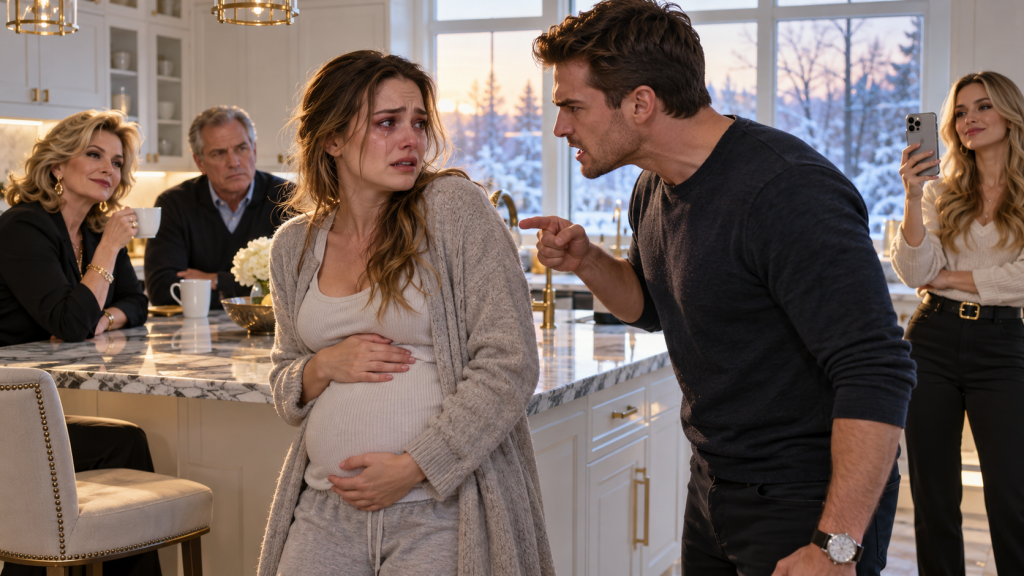
My daughter. Still there. Still fighting. I rested one hand over my stomach. The detective placed Nicole’s phone in a clear evidence bag on the tray table. “Mrs. Carter,” he said, “I need to ask you something difficult.” My throat went dry. “Okay.” “Has your husband ever threatened to take your baby away from you?”
I stared at him.
“No.”
Then I stopped.
Not directly.
Trent had said things.
Little things.
Things I had filed away because admitting what they meant would have forced me to admit something much bigger.
He had once said,
“If you ever left me, nobody would believe you were stable enough to raise a child alone.”
Another time:
“My mother knows judges.”
She did not.
I knew that now.
But he had said it with such confidence that I believed the threat more than the facts.
And then, two months earlier, after I told him I wanted us to try counseling, he had leaned against the kitchen counter and smiled.
“You’re the one who cries all the time, Maya.”
“You really want professionals documenting that?”
At the time, I had thought he was being cruel.
Now I heard strategy.
I swallowed.
“He said people would think I was unstable.”
The detective nodded slowly.
“Did he ever ask you to sign anything involving guardianship?”
“No.”
“Medical authority?”
“No.”
“Temporary care of the baby after delivery?”
“No.”
My heartbeat picked up.
“Why?”
He exchanged a look with Alex.
That look made fear crawl up my spine.
“What did you find?”
The detective pulled a chair closer.
Then he sat.
That scared me even more.
“There are months of cloud backups connected to Nicole’s phone.”
“Raw video.”
“Deleted clips.”
“Voice notes.”
“Group messages.”
I closed my eyes.
The family group chat.
Nicole had laughed about it while I was on the floor.
Lazy Wife Correction.
I felt sick.
The detective continued.
“We found recordings made before today.”
“How far back?”
“About eleven months.”
Alex went still.
“That’s before she was pregnant.”
The detective nodded.
I stared at him.
“What are they saying?”
He hesitated.
Then:
“Your mother-in-law repeatedly discusses creating a record that you are emotionally unstable.”
The room seemed to tilt.
“What?”
“Several videos appear to have been deliberately staged.”
I looked at Alex.
He looked as horrified as I felt.
The detective continued.
“They would provoke arguments.”
“Record your reaction.”
“Then stop recording before the context was visible.”
My mouth went dry.
Memories came rushing back.
Helen walking into the bathroom while I was showering and moving my clothes.
Then recording me when I screamed at her to get out.
Nicole taking my car keys and laughing while I searched for them.
Then filming me crying when I thought I was losing my mind.
Trent unplugging the freezer.
Then recording me yelling when hundreds of dollars of food spoiled.
I covered my mouth.
“Oh my God.”
Alex whispered,
“Maya.”
I shook my head.
“They made me think I was becoming crazy.”
The detective’s face softened.
“That appears to have been intentional.”
Something inside me broke.
Not loudly.
I did not scream.
I simply began crying.
Slow tears.
Silent.
The kind that come when a memory changes shape.
Every argument I had blamed myself for.
Every moment I had thought pregnancy hormones were making me irrational.
Every apology I gave because four people told me I had overreacted.
It had been a system.
Not every argument.
Not every mistake.
I was still human.
But enough.
Enough that I no longer knew which emotions belonged to me and which ones had been engineered.
Alex leaned over me.
“Hey.”
I turned my face away.
“I stayed.”
His expression changed.
“Maya.”
“I stayed.”
“Look at me.”
I did not.
He moved closer.
“Maya.”
I finally looked.
His eyes were wet.
“You survived inside something designed to confuse you.”
“That is not the same thing as choosing it.”
I cried harder.
The detective gave us a moment.
Then I remembered his first question.
The baby.
I wiped my face.
“What were they planning?”
He looked down at his notes.
“According to several conversations, if you tried to leave before delivery, Trent intended to claim you were experiencing a mental-health crisis.”
My whole body went cold.
“Helen discusses telling your doctor that you had become paranoid.”
“I’m not paranoid.”
“I understand.”
“What else?”
He hesitated.
“Helen appears to have prepared a packet.”
“What kind?”
“Printed messages.”
“Selected video clips.”
“Statements from family members.”
My breathing changed.
“For what?”
“To support an emergency custody claim after the baby was born.”
I stared.
“No.”
The word left me automatically.
“No.”
Alex swore under his breath.
The detective continued carefully.
“There is no evidence that any court had approved anything.”
“Nothing had been filed yet.”
“But they were discussing it.”
I could barely hear him.
“They were going to take my daughter?”
“If you left.”
My hand tightened over my stomach.
The monitor accelerated slightly.
A nurse stepped into the room, glanced at the screen, then at me.
“Try to slow your breathing.”
I wanted to laugh.
Slow my breathing.
My husband had beaten me while I was pregnant.
His mother had encouraged him.
His sister had broadcast it.
And now a detective was telling me they had spent months preparing to call me unstable and take my baby if I escaped.
I closed my eyes.
In.
Out.
For my daughter.
Not for them.
Never again for them.
The detective waited.
Then said,
“There’s another recording.”
I opened my eyes.
Alex looked at him.
“What?”
The detective’s jaw tightened.
“It was made four nights ago.”
My stomach dropped.
“What happened four nights ago?”
I remembered.
Dinner.
Helen had complained the chicken was dry.
Trent threw his plate into the sink.
Nicole laughed.
Richard drank beer and pretended nobody was yelling.
I had gone upstairs early.
The detective spoke.
“You had gone to bed.”
“Helen, Trent, Richard, and Nicole remained downstairs.”
I stared.
“What did they say?”
He did not answer immediately.
Then:
“Helen told Trent that if you ever went to the police, he needed to make sure you looked like the aggressor.”
My body went rigid.
“She told Nicole to keep filming.”
“Trent said the bruises would be explained as self-defense.”
Alex turned away.
I had never seen my brother look like he might be physically sick.
“And Richard?” I asked.
The detective looked at me.
“He said very little.”
That somehow hurt almost as much.
Richard had watched.
For months.
He had not needed to swing the stick.
Silence had been his contribution.
Then the detective added:
“At one point, Helen said that if you continued threatening to leave after the baby was born, they would ‘find another way to solve it.’”
My heart stopped.
“What does that mean?”
“We do not know.”
“Did she say they were going to kill me?”
“No.”
The answer came firmly.
“We do not have evidence of a specific murder plan.”
I let out a breath I had not realized I was holding.
“But.”
There was always a but.
“She did discuss an accident.”
Alex turned back.
“What accident?”
The detective shook his head.
“I’m not going to speculate beyond the evidence.”
Good.
Even terrified, I appreciated that.
Facts.
Not horror growing from imagination.
The detective continued.
“What matters is that the material strongly supports a pattern of coercion, intimidation, staged evidence, and planning around your possible departure.”
My eyes closed.
I whispered,
“They really thought nobody would believe me.”
Alex’s voice came from beside me.
“They were wrong.”
I looked at him.
He was crying now.
Not openly.
Just enough that I saw it.
“I should have come sooner.”
I frowned.
“What?”
“I knew something was off.”
“No.”
“Maya, last Thanksgiving—”
“No.”
My voice became stronger.
“You are not doing this.”
He stared.
“I am not going from blaming myself to blaming you.”
The detective looked away politely.
I continued.
“I lied to you.”
Alex’s face broke.
“When you asked if Trent grabbed me, I said no.”
“When you asked why I stopped coming over, I said pregnancy made me tired.”
“When you asked why Helen suddenly moved in, I said she was helping.”
“I lied because I was ashamed.”
Alex shook his head.
“You were scared.”
“Both.”
Silence.
Then he nodded.
“Okay.”
That was my brother.
Not turning my pain into his hero story.
Not rescuing me from responsibility I did not own.
Just staying.
The doctor came in an hour later.
Dr. Patel.
She had the kind of face that never lied.
That day, I loved her for it.
She examined the latest scans.
Then sat near the bed.
“The bleeding has slowed.”
I breathed.
“The baby’s heart rate is stable right now.”
Alex exhaled so loudly the nurse smiled faintly.
Dr. Patel continued.
“But you have significant bruising and trauma.”
“We are keeping you.”
“For how long?”
“At least overnight.”
“Possibly longer.”
I nodded.
“And the baby?”
“We monitor.”
“Could I lose her?”
The room went quiet.
Dr. Patel answered honestly.
“There is risk.”
I started crying again.
“But right now,” she added, “she is here.”
My hand covered my stomach.
Right now.
She was here.
That became my entire world.
Not next month.
Not court.
Not Trent.
Right now.
At 3:17 that afternoon, the baby kicked.
Once.
Then again.
Hard enough to see beneath the thin hospital blanket.
I laughed.
Alex stared.
“Was that her?”
“Yes.”
He smiled.
“Strong kid.”
I whispered,
“She had to be.”
Then something changed in me.
I never wanted my daughter to hear that sentence as a compliment one day.
Strong kid.
Children should be allowed to be soft.
Protected.
Silly.
Weak sometimes.
They should not have to become strong because adults failed them.
I looked at Alex.
“She won’t grow up thinking pain made her better.”
He frowned.
“What?”
“She’ll be strong because she’s loved.”
“Not because she had to survive us.”
He nodded.
“Good.”
That night, the hospital placed security outside my floor.
Trent had been arrested.
Helen too.
Richard and Nicole were questioned separately.
I did not know every charge.
I did not ask.
Not yet.
For the first time in years, I was allowed not to manage everyone else’s crisis.
At 11:40 p.m., a nurse entered quietly.
“You have a visitor requesting to speak with you.”
My whole body tightened.
“Who?”
“Nicole Carter.”
Alex stood immediately.
“No.”
The nurse looked at me.
“Your choice.”
That phrase.
Your choice.
I almost cried.
I asked,
“Is she under arrest?”
“She is not in custody right now.”
Alex stared.
“After what she recorded?”
I looked at the nurse.
“Why?”
“I don’t know.”
Then the detective appeared behind her.
He answered.
“Nicole is cooperating.”
My stomach twisted.
“She filmed me.”
“Yes.”
“She laughed.”
“Yes.”
“She streamed it.”
“Yes.”
He did not soften anything.
Good.
“But she also preserved evidence.”
“She says she wants to give a formal statement.”
I looked toward the door.
“No.”
Nicole would wait.
I had waited long enough for them.
My choices could take time.
The next morning, I agreed to see her.
With Alex present.
With the detective nearby.
Nicole walked into the room wearing sweatpants and a borrowed sweatshirt.
No makeup.
No phone.
She looked seventeen.
She was twenty-two.
For years, I had thought of her as an adult because cruelty made her seem older.
Now she looked like what she was.
Young.
That did not erase anything.
She stood near the door.
“Hi.”
I said nothing.
She swallowed.
“I’m sorry.”
Alex’s jaw tightened.
I raised one hand slightly.
Let her speak.
Nicole looked at my bruised wrist.
Then my stomach.
Her eyes filled.
“I didn’t think he would hit you that hard.”
My stomach turned.
“That is your apology?”
She flinched.
“No.”
“Because there was an acceptable amount?”
“No.”
“An acceptable bruise?”
“No.”
“An acceptable level of terror to livestream?”
She started crying.
“No.”
I looked at her.
“Then start again.”
She wiped her face.
“I am sorry I treated you like entertainment.”
Silence.
“I’m sorry I filmed things that should have made me help you.”
Better.
“I’m sorry I laughed.”
She cried harder.
“I’m sorry I let my mother teach me that humiliating somebody was loyalty.”
Alex looked at me.
I kept listening.
Nicole whispered,
“I knew Mom was trying to make you look unstable.”
My chest tightened.
“How long?”
“About six months.”
I closed my eyes.
She continued quickly.
“I didn’t know all of it.”
“But I knew she wanted clips.”
“She would tell me when to record.”
“Why?”
“I thought…”
She stopped.
“What?”
She looked ashamed.
“I thought you were dramatic.”
Of course.
I almost laughed.
“Why?”
“Because Mom said you were.”
There it was.
Families can pass cruelty down like recipes.
Nicole continued.
“She said you trapped Trent with the baby.”
My hand moved protectively over my stomach.
“I got pregnant after we were married.”
“I know.”
“She said you wanted the house.”
“What house?”
Nicole looked confused.
Then stopped.
My skin prickled.
“What house?”
She looked at Alex.
Then me.
“Your house.”
“I don’t own a house.”
Nicole went pale.
The detective stepped closer.
“What are you talking about?”
She swallowed.
“Grandma’s property.”
“What property?”
Nicole stared at me.
“Trent never told you?”
My heart started pounding.
“Told me what?”
She began crying again.
“Your grandmother left you a house.”
I stared.
“No.”
My grandmother had died three years earlier.
She lived in Vermont.
Small farmhouse.
She had told me she sold it before moving into a nursing facility.
Nicole shook her head.
“She transferred it.”
“To who?”
“You.”
I could not speak.
The detective asked,
“How do you know?”
“Mom talks about it constantly.”
Nicole looked at me.
“She said it was worth almost nine hundred thousand now.”
My mouth went dry.
“That makes no sense.”
Then I remembered Trent handling the paperwork after Grandma died.
He said her estate was small.
A few thousand dollars.
Furniture donated.
No property.
I had been grieving.
I signed forms.
I trusted my husband.
Nicole continued.
“Mom said once the baby was born, Trent needed control of the property.”
Alex swore.
The detective’s expression sharpened.
“What property address?”
Nicole gave it.
I knew the road.
I knew the mailbox.
I knew the white porch.
My grandmother’s house.
My childhood summers.
Blueberries in July.
The upstairs bedroom where the ceiling sloped over the bed.
I had not been there since the funeral.
I whispered,
“She told me she sold it.”
Nicole shook her head.
“Trent told you that.”
Everything inside me went cold.
The detective left the room immediately.
Alex stared at me.
“Maya.”
I began laughing.
Not because it was funny.
Because apparently my marriage contained entire buildings I did not know I owned.
Two hours later, my attorney arrived.
Alex called her.
Her name was Rebecca Flores.
She carried a laptop and an expression that made me sit straighter.
“I pulled the property record.”
My heartbeat climbed.
“The house belongs to you.”
I closed my eyes.
“How?”
“Transfer-on-death deed.”
“Recorded before your grandmother entered care.”
“She retained a life interest.”
“After her death, title passed to you.”
I pressed my fingers against my forehead.
“How did Trent hide that?”
“He could not legally change ownership without you.”
“That isn’t what I asked.”
Rebecca nodded.
“He intercepted notices.”
“Changed mailing addresses on some records.”
“Handled estate correspondence.”
My stomach turned.
“Did he try to sell it?”
“Not successfully.”
“Try?”
She opened another document.
“He applied for a loan against it.”
I stared.
“When?”
“Four months ago.”
The month I told him I wanted counseling.
The month the staged videos became more frequent.
Rebecca continued.
“The application was flagged because you were not present for required verification.”
I breathed.
“So he got nothing?”
“From that attempt.”
That phrase frightened me.
“From that attempt?”
She looked at the detective.
Then back at me.
“We are still reviewing finances.”
I laughed weakly.
“Of course we are.”
Nicole lowered her head.
“I’m sorry.”
I looked at her.
“Your mother knew about the house?”
“Yes.”
“And she wanted me declared unstable?”
“Yes.”
“What did she think would happen?”
Nicole whispered,
“She thought Trent could become your legal decision-maker.”
My entire body went cold.
The detective had mentioned custody.
Now property.
Everything connected.
If they could build a story that I was mentally unstable, they could attack my custody, my credibility, and maybe try to control my finances.
It was not a guaranteed plan.
It was not legally simple.
But abusers do not need good law.
They only need victims who are too frightened or confused to challenge bad paperwork.
I looked at Nicole.
“What was supposed to happen after the baby was born?”
She stared at the floor.
“Mom wanted you to sign something at the hospital.”
My stomach twisted.
“What?”
“She called it a temporary family authorization.”
Rebecca’s expression hardened.
“For what?”
“I don’t know.”
Nicole looked up desperately.
“I swear.”
“She said people sign things when they’re tired.”
Nobody spoke.
That sentence chilled the room more than shouting could.
People sign things when they are tired.
Pregnant.
Hurt.
Overwhelmed.
Trusting.
Exactly the person I had been.
Rebecca leaned toward me.
“From now on, you sign nothing without independent counsel.”
I almost smiled.
“That will not be difficult.”
The criminal investigation expanded.
The property issue became separate.
Financial records were preserved.
Phones seized.
Cloud accounts copied.
It took months to understand the whole picture.
The truth was ugly.
But not cinematic in the way people expect.
There was no single secret master plan.
There were overlapping motives.
Trent wanted money.
Helen wanted control.
Richard wanted peace.
Nicole wanted approval.
And all of them had gradually accepted my humiliation as normal.
That was somehow worse.
Monsters are easier to understand.
Ordinary selfishness repeated long enough can become monstrous without anyone ever announcing the transformation.
Trent’s business had failed almost a year earlier.
I did not know.
He had debt.
I did not know.
He had borrowed from his parents.
I did not know.
Helen knew about my grandmother’s property because Trent told her.
She began referring to it as “the family backup.”
My property.
My inheritance.
My grandmother’s porch.
Their backup.
When I became pregnant, Helen’s obsession increased.
She believed the baby tied me permanently to Trent.
If I stayed, the property remained within reach.
If I left, they needed another strategy.
The videos were part of that.
So were false messages Helen sent to relatives claiming I was “unstable.”
So were calls she made to my doctor’s office expressing “concern.”
My doctor had documented them.
I never knew.
Then there were insurance records.
That was the part Alex could barely tolerate.
Trent had increased a life-insurance policy connected to me.
Legally obtained.
Nothing inherently criminal about having insurance.
But combined with the recordings, the abuse, and Helen’s talk about an “accident,” investigators took it seriously.
So did I.
I asked Rebecca one question.
“Did he take out the policy because he planned to kill me?”
She answered carefully.
“We do not know that.”
I nodded.
Facts.
Always facts.
That became my rule.
I had lived too long in fear built from somebody else’s story.
I would not rebuild my life using speculation.
There was enough truth already.
Trent’s case eventually resolved through a plea agreement after prosecutors presented the recordings, medical evidence, witness statements, and financial conduct.
He faced serious consequences for the assault and related offenses.
He received a multi-year prison sentence.
Not forever.
Long enough that my daughter would be walking and talking before he saw freedom again.
Helen fought everything.
For months, she insisted she had only been “defending her son.”
Then prosecutors played one of Nicole’s recordings during a hearing.
Helen’s own voice filled the courtroom.
Cold.
Amused.
Discussing how I would be easier to control after delivery.
The woman beside me in the gallery whispered,
“Oh my God.”
I did not react.
I had already lived it.
Hearing it in public did something strange, though.
It shrank.
For years, Helen’s voice had filled entire rooms.
In court, it was evidence.
Just sound.
Just words.
Something a clerk could label and store.
Helen eventually accepted responsibility for conduct tied to the coercion, planning, and interference surrounding the abuse.
Her sentence was less severe than Trent’s.
That angered me at first.
Then my therapist asked,
“What would enough punishment look like?”
I had no answer.
Because no sentence could give me back the mornings I had spent afraid.
No prison term could erase the moment I curled around my stomach on the kitchen floor.
So I stopped measuring healing against how miserable they became.
That was their life.
Mine needed attention.
Richard was never charged with attacking me.
He had not struck me.
He had not created the paperwork.
He had simply watched too much and objected too little.
He agreed to testify.
That mattered.
He also wrote me a letter.
I kept it for years.
It said:
I spent my marriage telling myself Helen was difficult but harmless.
Then I spent Trent’s marriage telling myself what happened between husband and wife was private.
Privacy became the excuse I used for cowardice.
That sentence stayed with me.
Privacy.
Families worship that word sometimes.
Private problems.
Private arguments.
Private discipline.
Private bruises.
Privacy can protect dignity.
It can also protect abusers.
Richard ended the letter:
I did not hit you.
I understand now that this is a very low standard for calling myself innocent.
I cried when I read that.
Not because I forgave him.
Because finally, someone named silence accurately.
Nicole cooperated fully.
She gave investigators passwords.
Cloud access.
Names.
Dates.
She admitted what she filmed.
Admitted what she deleted.
Admitted when her mother instructed her to provoke me.
She faced consequences too.
Not the same as Trent.
Not the same as Helen.
She completed probation, counseling, service, and other conditions tied to her conduct.
For nearly two years, I wanted nothing to do with her.
Then, one afternoon, a letter arrived.
No request to meet.
No request for forgiveness.
Just a letter.
Maya,
I used a camera to make you smaller.
I stopped reading.
Then continued.
I thought because I was not the one hitting you, I was not hurting you.
I was wrong.
My throat tightened.
I watched pain through a screen until it stopped looking real.
That scares me more now than anything.
I read that sentence twice.
I do not want Emma to grow up thinking her aunt helped save her. I did not. The phone saved evidence. I helped create the danger. Those are different things.
Emma.
By then, my daughter had a name.
Emma Grace Carter.
Born at thirty-six weeks.
Six pounds, one ounce.
Screaming before the nurse fully lifted her.
Strong lungs.
Dark hair.
Furious little fists.
I cried so hard when they placed her on my chest that the nurse asked whether I could breathe.
“Yes,” I said.
For the first time in months, yes.
Alex stood outside the room because I wanted the first few minutes alone with her.
That was important.
He had rescued me.
He had protected me.
He had driven me to appointments.
Installed a new lock.
Sat through nightmares.
But he understood something Trent never had.
Love does not mean inserting yourself into every moment.
Sometimes love waits outside the door until invited in.
When Alex finally entered, he took one look at Emma and cried.
He had survived combat without crying in front of me once.
Emma destroyed him in three seconds.
“She’s tiny.”
I laughed.
“You were expecting a linebacker?”
He touched one finger to her hand.
She grabbed it.
He froze.
“Oh.”
I smiled.
“Got you.”
He whispered,
“Yeah.”
Then he looked at me.
“You did it.”
I shook my head.
“We did.”
“No.”
He smiled.
“You did.”
That mattered.
People called Alex a hero after the story became public.
The local news wanted interviews.
He refused.
So did I.
For months, strangers tried to turn the worst morning of my life into a dramatic rescue story.
Former Marine brother saves pregnant sister.
Lights out.
Police rush in.
Violent husband arrested.
Clean.
Exciting.
Wrong.
The truth was not clean.
Alex did not save me in one morning.
He answered a signal.
The signal only existed because, months earlier, I had quietly made him my emergency contact.
Why?
Because some part of me already knew.
I hated admitting that.
My body had understood before my mind accepted it.
The silence signal was not evidence that I was helpless.
It was evidence I had been planning a door.
Even before I believed I deserved to use it.
At therapy, I told Dr. Singh:
“I should have left earlier.”
She asked,
“When?”
“The first time he shoved me.”
“Okay.”
“I should have left then.”
“Why didn’t you?”
“I loved him.”
“Anything else?”
“I was embarrassed.”
“Anything else?”
“I had nowhere prepared.”
“Anything else?”
“Helen said marriage takes sacrifice.”
“Anything else?”
I started crying.
“I thought if I could just become easier to live with, he would become the man he was when we met.”
Dr. Singh nodded.
“There.”
“What?”
“That sentence.”
I stared.
She said,
“You were trying to solve his behavior by editing yourself.”
That became one of the hardest lessons of my life.
I had spent years making myself smaller because smaller targets feel safer.
Quieter.
More agreeable.
Less expensive.
Less tired.
Less pregnant.
Less demanding.
But no version of me could transform Trent into someone who believed I had the right to be safe.
That was his work.
He chose not to do it.
After Emma was born, I moved into my grandmother’s house.
Not immediately.
At first, Alex wanted me to stay with him.
I did for four months.
Then the Vermont property became legally and practically mine again.
I considered selling.
Too many lies surrounded it.
Then I visited.
The porch was weathered.
The kitchen smelled closed-up.
Dust lay across the furniture.
But when I opened the back door, I saw the blueberry bushes.
My grandmother’s garden.
The chipped yellow mug still sitting above the sink.
And I cried.
Not because Trent had wanted it.
Because he had almost succeeded in making the house part of his story.
It wasn’t.
It was hers.
Then mine.
One day Emma would crawl across those floors.
So I kept it.
I did not move to Vermont permanently.
My work and family were elsewhere.
Instead, I repaired the property slowly.
Not as an investment.
As reclamation.
Alex helped when asked.
That part mattered.
When he started giving opinions about replacing the porch rail, I pointed at him.
“Careful.”
He raised both hands.
“Your house.”
“Correct.”
We laughed.
The first summer Emma was old enough to walk, she picked a blueberry, crushed it in her fist, and smeared purple across her face.
I took a picture.
Then cried.
Alex sighed.
“You cry a lot now.”
“I was emotionally repressed.”
“Apparently.”
Emma grew.
Not inside fear.
Inside noise.
Music.
Crayons.
Pancakes.
Shoes left everywhere.
She had a temper.
Thank God.
At three, she once screamed because I cut her banana in half.
I sat on the kitchen floor while she cried.
Not because I was a perfect mother.
Because I remembered being told emotion was dangerous.
When she finished, I said,
“You were very angry.”
She sniffed.
“Yes.”
“Are you allowed to be angry?”
She nodded.
“Yes.”
“Are you allowed to hurt people because you’re angry?”
She thought.
“No.”
There.
A lesson I wished Trent had learned at three.
Alex became “Uncle Lex” because Emma could not pronounce Alex at first.
He loved it.
At five, she asked why he had a scar on his arm.
He gave her a boring answer.
Good.
He never built his identity around violence.
That taught me something too.
Strength is not the ability to hurt someone who hurt you.
Strength is the ability to carry power without needing people to fear it.
Years after Trent’s conviction, he wrote me.
The first letters came from prison.
I returned them unopened.
Then one arrived through my attorney.
She asked whether I wanted to read it.
I said no.
A year later, I changed my mind.
The letter was only two pages.
I expected excuses.
His mother.
Stress.
Money.
Pregnancy.
Anything.
Instead, he wrote:
Maya, I used to believe the worst thing I did was lose control.
I kept reading.
I understand now that I did not lose control.
My breath caught.
I used control.
I stopped.
That sentence.
He continued.
I controlled when you slept.
What you ate.
Who you saw.
How long you stayed on the phone.
What you were allowed to call abuse.
Tears filled my eyes.
The morning I attacked you was not a sudden failure. It was the result of hundreds of smaller choices I had already practiced.
I closed my eyes.
Yes.
That was the truth.
The violence had not begun with the walking stick.
It began the first time he said:
“Your brother is a bad influence.”
The first time he checked my phone.
The first time Helen insulted me and Trent said:
“She’s just honest.”
The first time he blocked a doorway during an argument.
The first time he apologized without changing.
The letter continued.
I am not asking you to forgive me.
I am not asking to meet Emma.
My hand tightened.
I understand that being her biological father does not entitle me to access that would make either of you unsafe.
I had to stop reading again.
His parental rights and future contact had been handled through court processes separately.
There were strict protections.
No casual return.
No surprise visitation.
No sentimental shortcut.
Good.
Trent finished:
I am sorry that my daughter’s first months of existence inside you were spent learning my voice as something connected to fear.
That line broke me.
I cried for a long time.
Then I folded the letter.
I did not write back.
Not because he had failed to apologize well.
Because a good apology does not create a debt.
That is another thing people misunderstand.
Someone can become more accountable.
You can recognize it.
And still choose distance.
Forgiveness is not a visitation schedule.
Remorse is not a key.
Years later, when Emma was old enough to ask about him, I told the truth in pieces appropriate for her age.
At six:
“Your dad hurt Mommy, so adults made rules to keep us safe.”
At nine:
“He had trouble controlling anger and also made choices to control people.”
At twelve:
“He was responsible for what he did.”
I never told her:
“He did it because he loved you too much.”
No.
Love does not get blamed for violence.
I never told her:
“Your grandmother made him that way.”
Helen influenced him.
She did not operate his hands.
I never told her:
“You have his temper.”
Children should not be turned into prophecies.
Emma was Emma.
At fourteen, she asked to read some of the court records.
I said no at first.
Then I thought about control.
So we spoke with her therapist.
We chose a limited set.
Not graphic photographs.
Not every recording.
Enough.
She read quietly.
Then asked,
“Grandma Helen told him to hit you?”
“Yes.”
Emma stared at the page.
“Why?”
“I think cruelty had become normal to her.”
“Did she love Dad?”
“Probably.”
Emma frowned.
“That’s weird.”
“Yes.”
Then she said something I never forgot.
“Maybe people should stop using love as proof they’re good.”
I looked at my daughter.
Fourteen.
Smarter than half the adults I once knew.
“That’s a good rule.”
She smiled.
“I have several.”
Of course she did.
Nicole reentered our lives slowly.
Very slowly.
The first meeting happened when Emma was eight.
Public park.
One hour.
My choice.
Emma’s choice.
Nicole sat on a bench holding nothing.
No gifts.
No dramatic apology.
Just herself.
Emma stared.
“You’re Aunt Nicole?”
“Yes.”
“You filmed Mom?”
Nicole swallowed.
“Yes.”
“Why?”
Nicole’s eyes filled.
“Because I wanted my family to like me more than I cared whether your mom was safe.”
Emma considered that.
“That was bad.”
“Yes.”
“Really bad.”
“Yes.”
I almost smiled.
Nicole did not defend herself.
Good.
Emma asked,
“Are you still like that?”
Nicole looked at me.
Then back at her.
“I try very hard not to be.”
Emma nodded.
“Okay.”
That was all.
No hug.
No forgiveness ceremony.
Just okay.
Years later, they became close.
Not because I forced family unity.
Because Nicole showed up differently.
She became a victim advocate.
At first, that made me angry.
I thought she had no right.
Then she called me.
“I’m thinking of quitting.”
“Why?”
“Because I feel like a fraud.”
I was silent.
Then asked,
“Are you using your story to make people forgive you?”
“No.”
“Are you telling victims they should forgive their families?”
“No.”
“Are you centering yourself?”
“I don’t think so.”
“Then maybe your past is exactly why you understand what bystanders can become.”
She cried.
I did too.
People can change.
That truth does not erase the first truth.
They still did what they did.
Change matters precisely because harm was real.
Richard and Helen divorced.
After forty-three years.
He told me once:
“I waited until nearly seventy to discover silence is still a decision.”
I did not know what to say.
So I said,
“Yes.”
Sometimes that is enough.
Helen never truly apologized to me.
Not in a way I trusted.
She wrote several letters.
Most explained.
Explained her childhood.
Her marriage.
Her belief that wives should obey.
Her fear of losing Trent.
Her resentment that I “pulled him away.”
Eventually, I stopped reading.
Understanding is not always necessary.
I had enough context.
No more excavation.
My life deserved more attention than her reasons.
Alex married when Emma was nine.
His wife, Carmen, loved teasing him about being the famous rescuer he refused to discuss.
At their wedding, he pulled me aside.
“You okay?”
I laughed.
“This is your wedding.”
“You still didn’t answer.”
“I’m okay.”
Then I looked at him.
“Are you?”
He smiled.
“Terrified.”
“Good.”
He frowned.
“Good?”
“Means you understand it matters.”
He laughed.
Before the ceremony, Emma straightened his tie.
Then whispered something.
He bent down.
“What?”
She said louder,
“Don’t be bossy to Aunt Carmen.”
I nearly collapsed laughing.
Alex looked at me.
“This is your fault.”
“No.”
I smiled.
“This is intergenerational healing.”
He groaned.
Carmen overheard and kissed Emma’s forehead.
“Keep him accountable.”
Emma nodded seriously.
“I will.”
For years, I hated five o’clock in the morning.
If I woke at 4:58, my heart raced.
Dark kitchen.
Cold tile.
Footsteps.
Even when I knew I was safe.
My body kept an old clock.
Dr. Singh called it a trauma response.
I called it infuriating.
Eventually, we worked through it.
Slowly.
One winter morning, when Emma was eleven, she woke me at 4:52.
“Mom.”
I shot upright.
“What happened?”
“I’m hungry.”
I stared.
“That is the emergency?”
“Yes.”
“What do you want?”
“Pancakes.”
I started laughing.
She looked offended.
“This is serious.”
So we went downstairs.
Dark outside.
Cold floor beneath my feet.
Five o’clock.
The exact hour.
Emma sat on the counter swinging her legs while I mixed pancake batter.
Music played quietly.
No shouting.
No insults.
No one watching to judge how quickly breakfast appeared.
I burned the first pancake.
Emma gasped.
“You ruined it.”
I pointed the spatula at her.
“Careful.”
She laughed.
I laughed.
Then the clock changed to 5:01.
Nothing happened.
No door slammed.
No weapon.
No voice saying I was useless.
Just butter melting in a pan.
My daughter singing badly.
And sunrise beginning somewhere beyond the window.
I had to turn away because tears filled my eyes.
Emma noticed.
“Mom?”
“I’m okay.”
“You’re crying.”
“Happy crying.”
“That’s weird.”
“It is.”
She climbed down.
Hugged me.
The pancake burned again.
We ate it anyway.
That morning became more important to me than every courtroom ruling.
Fear had owned an hour.
I took it back.
When Emma graduated high school, Alex sat beside me.
Nicole sat farther down the row.
Richard came too.
Not Helen.
Emma had decided that.
Her choice.
When Emma’s name was called, she walked across the stage.
Confident.
Loud cheering from our row.
She looked toward us.
Then rolled her eyes because Alex was standing on his chair.
I laughed so hard I almost missed the photograph.
Afterward, she handed me her graduation cap.
Inside she had written:
Nobody gets to teach me love by making me afraid.
I stared at it.
“Where did you get this?”
She shrugged.
“You.”
I started crying.
“Mom.”
“What?”
“You cry constantly.”
“Your uncle says the same thing.”
“Because it’s true.”
She hugged me.
Then whispered,
“You got me here.”
I pulled back.
“No.”
She frowned.
“We got each other here.”
That was the truth.
People often tell stories like mine as if survival is one dramatic moment.
A signal.
A door crashing open.
Police lights.
A rescue.
But survival is mostly what happens after the sirens leave.
It is signing protective paperwork while your hands shake.
It is attending therapy when you would rather forget.
It is learning the difference between privacy and isolation.
It is feeding a baby at three in the morning while realizing nobody is coming down the hall angry.
It is opening your own bank account.
Reading your own property records.
Asking questions without apologizing.
It is saying no to family members who call boundaries unforgiving.
It is saying yes when help is actually help.
It is remembering that being rescued once does not make you helpless forever.
Alex helped me out of the kitchen.
But I built the life after it.
Emma helped too.
So did doctors.
Detectives.
Lawyers.
Therapists.
Nicole, eventually.
Even Richard, eventually.
Healing was not one hero.
It was a network.
That mattered because Trent had spent years convincing me isolation was normal.
The opposite of abuse was not independence so total that nobody could reach me.
The opposite was connection without control.
Love without fear.
Help without ownership.
I am forty-seven now.
Emma is twenty-two.
She is studying law.
Of course she is.
She says she wants to work in family advocacy.
I asked whether my story made her choose it.
She said,
“Partly.”
I worried.
“I don’t want what happened to define your whole life.”
She smiled.
“It doesn’t.”
Then she said,
“It informed me.”
That distinction made me proud.
Alex has two children.
Emma babysits them sometimes.
The first time his daughter threw a tantrum in a grocery store, Alex called me afterward.
“Was I too harsh?”
I laughed.
“You called me about parenting advice?”
“Don’t make this a thing.”
“Oh, it’s a thing.”
He groaned.
Then became serious.
“I just don’t want my voice to become something she fears.”
I stopped smiling.
“That’s a good fear to have.”
“Is it?”
“Yes.”
“Because it means you’re paying attention.”
He was quiet.
Then:
“Okay.”
Our family is not perfect.
Thank God.
Perfect families hide too much.
We argue.
We apologize.
We talk.
We leave rooms when we need to cool down.
Then we come back.
Nobody is punished for needing space.
Nobody is told love means enduring fear.
Nobody gets to laugh while someone else cries and call it discipline.
That rule is permanent.
The house where the kitchen attack happened was sold after the legal process allowed it.
I never went back alone.
Alex came with me once to collect belongings.
The kitchen looked smaller.
That shocked me.
For years, it had existed in my memory like an arena.
Marble island.
Cold tile.
Morning darkness.
When I stood there again, it was just a room.
Sunlight through blinds.
A dent near the baseboard.
Empty cabinets.
I walked to the spot where I had reached for my phone.
My wrist ached even though the injury had healed years earlier.
Bodies remember symbolically too.
Alex stayed near the doorway.
“You ready?”
“Almost.”
I looked at the floor.
Then said,
“I thought nobody was coming.”
He swallowed.
“I know.”
“Trent told me nobody was coming.”
Alex’s eyes filled.
I smiled slightly.
“He was wrong.”
“Yes.”
Then I corrected myself.
“No.”
Alex frowned.
“What?”
“I was coming too.”
He stared.
“I pressed the button.”
“I reached for help.”
“I protected Emma.”
“I didn’t know what would happen.”
“But I acted.”
He smiled.
“Yeah.”
I looked around the kitchen one last time.
“That matters.”
It did.
I had spent years calling that morning the day Alex rescued me.
Now I call it the day I sent the signal.
Words matter.
The story belongs differently depending on where you begin it.
If you begin with the door breaking open, Alex is the hero.
If you begin with my finger reaching the phone, so am I.
If you begin months earlier, when I quietly selected him as my emergency contact because some instinct told me I might need help one day, then perhaps the woman I thought was weak had been preparing all along.
I like that version best.
Not because it makes me fearless.
I was terrified.
But courage does not require confidence.
Sometimes it is one hidden action taken while everyone around you believes you have finally surrendered.
Helen once laughed while I lay on the floor.
Trent told me nobody was coming.
Nicole held up her phone.
Richard looked away.
They thought the story belonged to them because they controlled the room.
They were wrong.
The room went dark.
But my life did not.
That darkness became the last moment they ever owned.
Everything after belonged to me.
And to the daughter whose heartbeat kept sounding beside mine while the whole world changed.
THE END STORIES! THANK YOU FOR READING GOOD LUCK !❤️
Related Posts