My mother’s words reached me before I understood them. “He wasn’t trying to take my house.” Corinne’s swollen eye filled with tears. “He was trying to make me sign yours away.” I stared at her.
For fifteen years, I had trained myself to remain calm under pressure. I had delivered orders while alarms screamed around me. I had sat through casualty briefings without letting my voice shake. I had learned that panic wastes time.
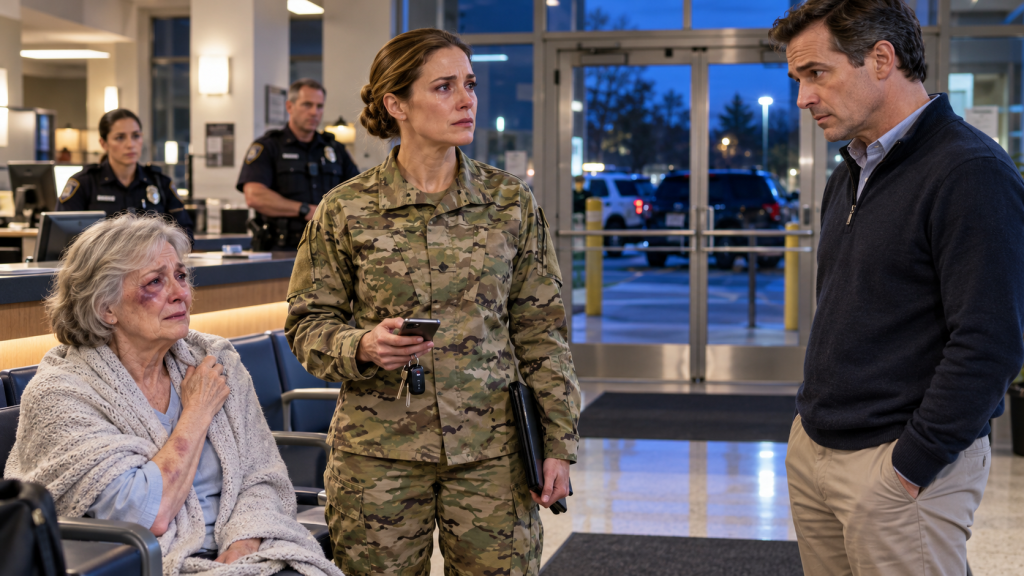
But nothing in my military career had prepared me for sitting beneath the fluorescent lights of a county police station while my seventy-one-year-old mother told me my husband had attacked her over property I did not even know was in danger.
“What house?”
Nolan spoke before Mom could answer.
“Blair, don’t.”
I turned toward him.
Two officers were standing between us now.
His polished expression was gone.
The respectable charity-board husband.
The patient neighbor.
The man who shook hands firmly and remembered every waiter’s name.
Gone.
For one second, the person staring back at me looked furious.
Not frightened.
Furious that my mother had managed to speak before he could control the story.
I asked again.
“What house?”
Mom swallowed.
“Ashford Ridge.”
My heartbeat changed.
Ashford Ridge.
The name belonged to eighteen acres outside Fairfax that had been in my mother’s family for almost a century.
My grandfather built the original brick house there.
My father restored it.
I learned to ride a bicycle on its gravel drive.
After Dad died, Mom kept living there.
Everyone called it her house.
I had never thought of it any other way.
“That’s yours.”
Mom shook her head.
“No.”
Her voice cracked.
“Not entirely.”
Nolan closed his eyes.
That was the moment I knew.
He already knew.
I turned toward him.
“What did you do?”
His lawyer had not arrived yet.
A detective immediately said,
“Mr. Vickers, you do not need to answer.”
Nolan looked at me.
Then he did something worse than deny it.
He smiled faintly.
“Your mother is confused.”
I looked at Mom.
Bruised wrist.
Swollen eye.
Trembling hands.
Then at the laptop showing him on video placing a fireplace poker into her hand after striking her.
“She looks clearer than you do.”
His smile vanished.
The detective asked my mother,
“Mrs. Ashford, can you explain the ownership?”
Mom nodded.
“When Blair’s father died, the property was placed into a family trust.”
I stared.
“What trust?”
Mom looked ashamed.
“The Ashford Family Preservation Trust.”
“Why have I never heard that name?”
“You have.”
“No.”
“You signed documents after your father died.”
My mind searched backward.
Dad’s funeral.
Probate meetings.
Military orders.
Boxes of paperwork.
I had been thirty-two.
Grieving.
Preparing for another overseas assignment.
Mom continued.
“You were made remainder beneficiary.”
I frowned.
“In English, Mom.”
A sad smile touched her mouth.
“I have the right to live there for the rest of my life.”
“After me, it becomes yours.”
My chest tightened.
I turned toward the detective.
“So why did Nolan need her signature?”
Mom answered.
“Because he already had yours.”
The room went silent.
I looked at Nolan.
“No.”
His face went still.
I stepped closer.
“No.”
The officer gently raised an arm between us.
I stopped.
“What do you mean, he had mine?”
Mom’s breathing became uneven.
“Nolan showed me a deed.”
“He said you had agreed to sell the property.”
“I told him you would have called me.”
“He said you were deployed and couldn’t.”
My stomach turned.
“I was at Fort Belvoir.”
“I know.”
“He said everything had to happen quickly.”
“How much?”
Mom looked down.
“The offer was one point eight million.”
I almost laughed.
Ashford Ridge was worth more than that.
Much more.
Developers had called Mom for years.
The land sat in an area where large parcels were disappearing beneath luxury subdivisions.
The last appraisal I had seen, years earlier, already valued it above three million.
“Who was buying it?”
Mom looked toward the detective.
He opened a folder.
“Northstar Residential Holdings.”
The name meant nothing.
But Nolan reacted.
Tiny movement.
His shoulders.
His eyes.
Enough.
The detective noticed too.
I said,
“Who owns Northstar?”
“We’re determining that.”
Nolan finally spoke.
“This is ridiculous.”
I looked at him.
“Then explain it.”
He leaned forward.
“You signed the authorization.”
“I did not.”
“You sign things remotely all the time.”
“That is not an answer.”
“You gave me power of attorney during deployment.”
My blood went cold.
Years earlier.
A limited power of attorney.
Temporary.
For banking and household issues while I was overseas.
It was supposed to have expired.
I stared.
“That ended nine years ago.”
He said nothing.
The detective asked,
“Do you have a current power of attorney?”
“No.”
Nolan muttered,
“There were renewals.”
I turned.
“What renewals?”
He immediately stopped speaking.
His lawyer arrived twelve minutes later.
Perfect suit.
Perfect hair.
Expressionless.
After that, Nolan said almost nothing.
I did not need him to.
The video had already done what truth often does when given enough light.
It made the liar quieter.
Mom was finally taken to the hospital.
I rode with her.
Not Nolan.
Not the detective.
Not anyone else.
Me.
She sat on the gurney with a blanket around her shoulders.
For most of the ride, we said nothing.
Then she whispered,
“I’m sorry.”
I turned.
“For what?”
“For not telling you about the trust sooner.”
“That is not what you should be apologizing for.”
“I thought I was protecting you from one more responsibility.”
I laughed sadly.
“Apparently everyone has been protecting me lately.”
Mom winced.
“I deserved that.”
I immediately regretted it.
“No.”
I took her hand.
“You didn’t deserve tonight.”
Her fingers tightened around mine.
“I knew something was wrong with Nolan.”
My heart hurt.
“How long?”
She stared at the ambulance wall.
“Maybe a year.”
I closed my eyes.
“What did you know?”
“Nothing I could prove.”
“That’s not what I asked.”
She looked at me.
“He started asking about the property.”
“When?”
“Last Christmas.”
I remembered.
Holiday dinner.
Nolan carrying plates.
Pouring wine.
Complimenting Mom’s roses even though they had been dormant for months.
“What did he ask?”
“Whether I had ever considered selling.”
“That isn’t strange.”
“No.”
She paused.
“Then he asked who would have authority if I became incapacitated.”
My skin went cold.
“What?”
“He said he was worried about estate planning.”
“Why didn’t you tell me?”
“Because he made it sound reasonable.”
Of course he did.
Nolan could make almost anything sound reasonable.
That was his gift.
His weapon.
He did not bully people first.
He reassured them.
Mom continued.
“Then he asked whether the trust required your signature.”
“And?”
“I told him yes.”
She looked ashamed.
“I shouldn’t have.”
“No.”
I squeezed her hand.
“You were talking to your son-in-law.”
“You weren’t handing information to a criminal.”
The word hung there.
Criminal.
I had not yet allowed myself to think it.
Not fully.
Husband.
Fifteen years.
Criminal.
Both could be true.
At the hospital, doctors documented Mom’s injuries.
A fractured wrist.
Severe bruising.
A cut near her scalp.
Nothing life-threatening.
Everything horrifying.
I sat beside her bed until sunrise.
At 6:41 a.m., my phone rang.
Unknown number.
I answered.
“Lieutenant Colonel Ashford?”
“Yes.”
“This is Detective Ramirez.”
The same detective from the station.
“We identified Northstar Residential Holdings.”
My heart began pounding.
“And?”
“It is controlled through two LLCs.”
“Who controls them?”
“One is registered to a business associate of your husband.”
“Which associate?”
He paused.
“Gregory Vickers.”
I froze.
Nolan’s older brother.
Gregory.
A real-estate developer in Richmond.
The man who toasted our anniversary three months earlier.
The man who called me “Colonel” as a joke.
The man who once told Mom that Ashford Ridge would make “one hell of a gated community.”
I had laughed.
Apparently he had not been joking.
“Does Nolan own part?”
“We’re still tracing it.”
“Tell me what you know.”
“Northstar was formed fourteen months ago.”
“Three months later, it secured investors for a proposed luxury development project.”
My mouth went dry.
“On my mother’s land?”
“On Ashford Ridge.”
I stood so quickly the chair scraped.
Mom woke.
I held up one hand.
Detective Ramirez continued.
“The investor package represents the property as already under contractual control.”
I stopped breathing.
“What?”
“Nolan and Gregory appear to have represented that acquisition was essentially complete.”
“But they didn’t own it.”
“No.”
“They had no contract.”
“We have not found a valid one.”
My hand began shaking.
“How much money?”
“The project has received approximately two point six million dollars in committed capital.”
The hospital room seemed to narrow.
“They sold investors a development they didn’t own.”
“That is one question investigators will be examining.”
“Why did Nolan attack my mother last night?”
“We believe there was a deadline.”
“What deadline?”
“Northstar had a financing review this morning.”
My stomach turned.
“He needed the deed.”
“Or evidence that title transfer was proceeding.”
I looked at Mom.
She was watching my face.
I whispered,
“So he went there at one forty-eight in the morning because he was out of time.”
“That is our working theory.”
I closed my eyes.
Fifteen years.
I had shared a bed with a man who could walk into my mother’s home in the middle of the night and assault her because a business deal was collapsing.
Then Ramirez said,
“There’s something else.”
Of course there was.
“What?”
“The deed containing your signature was notarized.”
My chest tightened.
“By who?”
“A notary named Melissa Crane.”
I knew the name.
It took me several seconds.
Then I remembered.
Nolan’s executive assistant.
“She works for my husband.”
“Yes.”
“Did she notarize me?”
“That is what the document claims.”
“I have never met her in front of a notary stamp in my life.”
“We need a formal statement from you.”
“You’ll get it.”
I hung up.
Mom whispered,
“Blair.”
I turned.
“I think I know how he got your signature.”
My stomach sank.
“How?”
“Your deployment packet.”
I stared.
Mom continued.
“Years ago, when you were overseas, you mailed legal forms to the house.”
“Nolan handled them.”
I remembered.
Scanned signatures.
Copies of military orders.
Power-of-attorney forms.
Bank instructions.
Identity documents.
Enough paperwork to build a second version of me.
I sat down slowly.
“He kept them.”
Mom nodded.
“I think so.”
I covered my face.
Every security briefing I had attended.
Every lecture about safeguarding information.
Every warning about identity theft.
And the person I trusted enough to hold my documents was the person using them.
I felt stupid.
The thought arrived automatically.
Then I heard my commanding officer’s voice from years earlier.
Trust failure belongs first to the person who violated the trust.
We used that principle professionally.
I had never thought to apply it to marriage.
Mom whispered,
“Don’t blame yourself.”
I looked at her.
“You too.”
She frowned.
“What?”
“You keep apologizing for telling him about the trust.”
I squeezed her fingers.
“We’re not doing that.”
“Not you.”
“Not me.”
“He made choices.”
She nodded.
We sat there until morning light filled the room.
At eight, I called an attorney.
Not a divorce lawyer first.
A real-estate and financial-litigation attorney named Camille Benson who had served in the Army Judge Advocate General’s Corps before private practice.
A friend from my command gave me her number.
Camille listened without interrupting.
Then said,
“Do not confront Nolan about financial records.”
“I won’t.”
“Do not enter shared digital accounts from any device he controls.”
“Understood.”
“Do not destroy or move anything.”
“Understood.”
“Change passwords from a secure device.”
“Already started.”
“Good.”
Then:
“Do you have somewhere else to stay?”
“Yes.”
That answer surprised me.
Mom’s house.
Ashford Ridge.
The property Nolan tried to steal became the place I went after leaving him.
There was poetry in that.
But first, police accompanied me to our house.
I had lived there with Nolan for twelve years.
A beautiful colonial in Alexandria.
White kitchen.
Blue shutters.
Family photographs along the stairs.
The house looked exactly the same.
That angered me.
I wanted betrayal to change architecture.
It doesn’t.
The coffee machine still worked.
The laundry still sat folded.
His shoes remained beside the mudroom door.
Fifteen years of marriage does not evaporate because police stand in your hallway.
You still know which mug belongs to the man who betrayed you.
I packed uniforms.
Civilian clothes.
Medication.
My father’s watch.
A box of photographs.
Then I reached our bedroom.
Nolan’s nightstand.
I did not open it.
The detective did.
Inside was a second phone.
My stomach tightened.
“Do you know this device?”
“No.”
They bagged it.
Then the desk.
Receipts.
Folders.
Nothing obvious.
Until Detective Ramirez opened a locked drawer.
Inside sat a folder marked:
AR
Ashford Ridge.
Camille, who had joined us, looked at me.
“Do you want to step out?”
“No.”
I stayed.
Inside were property maps.
Zoning analyses.
Development projections.
Photographs of Mom’s house.
Investor documents.
And a valuation.
Projected Development Value: $18.4 million.
I laughed.
Not from humor.
Nolan had attacked my mother over land he believed could become an eighteen-million-dollar project.
There were architectural renderings too.
Ashford Estates.
Twenty-two luxury homes.
Private gate.
Clubhouse.
Walking trail.
I stared at one rendering.
The little circle where Mom’s rose garden sat was labeled:
Central landscaped court.
My stomach turned.
Someone had planned landscaping over my mother’s life.
I kept reading.
One page contained a handwritten note.
Nolan’s handwriting.
Need Corinne cleared before closing.
I stared.
“What does ‘cleared’ mean?”
Nobody answered.
Camille said carefully,
“Could mean title clearance.”
Detective Ramirez nodded.
“We do not speculate.”
Good.
Facts.
The next note:
B signature secured. C signature remaining.
B.
Blair.
C.
Corinne.
My hands shook.
Then came the line that destroyed whatever emotional doubt remained.
If C refuses, competency route may still work.
I sat down.
Mom.
Seventy-one.
Sharp.
Independent.
Library volunteer.
Roses.
Crosswords.
They had considered trying to declare her incompetent.
The same mother who called me after being attacked because she remembered exactly what happened.
I whispered,
“He was going to erase her legally if he couldn’t force her physically.”
Camille said nothing.
She did not need to.
The second phone gave investigators much more.
Messages with Gregory.
Messages with Melissa, the notary.
Messages with investors.
Messages about me.
That part hurt differently.
Nolan had written about my deployments like opportunities.
She’s gone again in August. Easier window.
Blair won’t audit household mail while she’s on rotation.
If we can get Corinne done, B won’t challenge until after closing.
I stared at the message.
B.
Not Blair.
Not wife.
Not the woman who had slept beside him for fifteen years.
B.
A signature.
A delay.
An obstacle.
There are betrayals so complete they alter the grammar of your marriage.
I began wondering when I had stopped being a person in Nolan’s private conversations.
Maybe I never was.
Then Camille showed me another message.
From Gregory:
What if Blair notices?
Nolan:
She trusts me. That’s the easiest part.
I stopped reading.
I walked into the backyard.
The police remained inside.
I stood beneath the maple tree we planted the year after our wedding.
For fifteen years, I had thought trust was one of our strengths.
Nolan had viewed it as vulnerability.
That discovery hurt more than the forged signature.
Money could be recovered.
Titles corrected.
Accounts frozen.
But how do you recover the years when your love was listed in someone else’s mind as access?
I called my mother.
She answered immediately.
“Did they find something?”
“Yes.”
“What?”
I looked through the kitchen window.
Our wedding photograph hung on the opposite wall.
“Enough.”
Mom became quiet.
Then asked,
“Are you coming here?”
“Yes.”
“Good.”
I almost cried.
No questions.
No “I told you.”
No judgment.
Just good.
I moved into my childhood bedroom at forty-five years old.
The room had changed.
Mom turned it into a sewing room years earlier.
But the window still faced the oak tree.
The floorboard near the closet still squeaked.
On the third night, I woke at two in the morning convinced I heard Nolan downstairs.
I grabbed my phone.
Heart racing.
Then realized it was the refrigerator cycling.
I sat on the edge of the bed until sunrise.
Military training teaches you to identify threats.
Trauma teaches your body to invent them afterward.
I started therapy.
I did not want to.
I told Camille I was too busy.
She said,
“That’s what every officer says.”
I hated her a little.
Then I went.
Dr. Elaine Porter asked me during the first session,
“What hurts most?”
“My mother was attacked.”
“That is one thing.”
“My husband forged my signature.”
“Another.”
“He lied for years.”
“Another.”
I became irritated.
“What answer are you looking for?”
“Yours.”
I stared at the carpet.
Then the truth came.
“He knew I would believe him.”
My voice broke.
Dr. Porter waited.
“He built the whole plan around the fact that I trusted him.”
I cried.
Not like an officer.
Not like a daughter protecting her mother.
Like a woman whose marriage had become evidence.
“That makes me feel stupid.”
Dr. Porter shook her head.
“No.”
I almost laughed.
“Everyone keeps saying that.”
“Maybe because it is true.”
She leaned forward.
“Trust is not a confession of incompetence.”
“Fraud requires someone willing to violate trust.”
“That is the actor.”
“You were the target.”
I breathed.
Then she added,
“You can become more careful without rewriting your entire capacity to love as a mistake.”
That sentence saved something in me.
The criminal case expanded.
Melissa Crane, the notary, initially denied wrongdoing.
Then investigators showed her login records.
She had notarized my forged signature remotely.
No video verification.
No actual appearance.
She eventually admitted Nolan told her the documents were legitimate and that I had already approved everything.
That did not absolve her.
But it explained part of the chain.
Gregory denied knowing the signature was forged.
Messages suggested otherwise.
The investigation into Northstar became broader than my marriage.
Investors had been shown documents that overstated control over Ashford Ridge.
Money had been raised.
Some spent.
Some transferred.
Some used to cover unrelated debts.
Northstar was not merely a real-estate project.
It had become a financial hole.
Nolan and Gregory kept filling it with new promises.
Ashford Ridge was supposed to save them.
My mother’s home was their final asset.
Except it had never been theirs.
That mattered.
Then came the insurance twist.
I wish I could say it shocked me.
By then, shock had become routine.
Camille discovered Nolan had increased a life-insurance policy on me eighteen months earlier.
Nothing illegal about spouses carrying insurance.
Military families do it constantly.
But he had also changed the beneficiary structure through a trust he controlled.
Again, perhaps explainable.
Except he had not told me.
And some of the Northstar financing documents referenced anticipated “personal liquidity events.”
I stared at Camille.
“Are you saying he planned for me to die?”
She answered immediately.
“No.”
Good.
Facts again.
“We do not have evidence of that.”
“Then why show me?”
“Because hidden financial changes matter.”
I nodded.
That distinction became important.
I refused to turn Nolan into a monster larger than the evidence.
The evidence was already enough.
Forgery.
Assault against my mother.
Fraudulent property documentation.
Financial misrepresentation.
Coercion.
Potential conspiracy with others.
I did not need imagined murder to justify leaving.
Women are too often taught they need the worst possible story before they earn the right to go.
I already had enough.
Mom recovered slowly.
The wrist took months.
The bruises disappeared faster.
The fear stayed.
For weeks, she checked the locks three times each night.
She stopped volunteering at the library temporarily.
Then one Wednesday she dressed carefully.
Blue blouse.
Pearl earrings.
Wrist brace.
I asked,
“Where are you going?”
“The library.”
“Are you sure?”
She gave me a look.
I smiled.
“Right.”
Her choice.
She drove herself.
I followed in my car for two blocks.
Then stopped.
She would have killed me if she noticed.
That afternoon, she came home smiling.
“What?”
I asked.
“One of the children asked why I have a robot wrist.”
I laughed.
“What did you say?”
“That I fought a bear.”
“Mom.”
“He was six.”
She shrugged.
“Let me have some fun.”
That was the first time after the attack that laughter filled Ashford Ridge.
I remember it because healing sometimes announces itself quietly.
Not a court victory.
A ridiculous lie about a bear.
Nolan asked to speak with me through counsel three months later.
I refused.
Then he wrote a letter.
I read it because I wanted to know whether the man I loved existed anywhere inside the man investigators were describing.
The first line disappointed me.
Blair, things got out of control.
I almost stopped.
Things.
Passive.
As if fraud wandered into our marriage without assistance.
He continued.
Gregory was under enormous pressure from investors.
I stopped there.
Folded the letter.
Gave it back to Camille.
“Keep it.”
Two months later, another arrived.
This one began:
I lied to you.
Better.
I read.
I used old copies of your military documents to create signatures you never authorized.
My throat tightened.
I told myself I would fix the situation before you discovered it.
I believed if Ashford Ridge sold, Northstar would recover, investors would be paid, and no one would ultimately lose anything.
There it was.
The mathematics criminals use to forgive themselves in advance.
No harm if everything works.
No victim if the money comes back.
No betrayal if the lie eventually becomes unnecessary.
He continued.
When Corinne refused, I panicked.
I stared.
Panic.
Such a weak word for what he did.
Then:
I went there intending to pressure her into signing.
I did not go there intending to hurt her.
I almost stopped again.
But the next line mattered.
That distinction does not excuse what I did after she said no.
My breathing slowed.
I hurt her because I believed my emergency mattered more than her right to refuse me.
That was closer.
Then I staged the fireplace tool because I was more afraid of consequences than ashamed of causing the injury.
My eyes filled.
For the first time, he named it.
Not self-defense.
Not confusion.
Staging.
I am sorry.
I understand that apology does not obligate you to speak to me.
I folded the letter.
I cried.
That surprised me.
Not because I wanted him back.
Because accountability resurrected one small piece of the man I thought I married.
It did not rebuild the marriage.
It simply confirmed he was capable of seeing what he had done.
That was enough.
The plea negotiations took almost a year.
Gregory’s case separated from Nolan’s.
Melissa cooperated.
Investors sued.
Northstar collapsed.
Some money was recovered.
Some was gone.
Nolan ultimately pleaded guilty to a combination of offenses involving my mother’s assault, forged documents, and financial misconduct.
The exact legal language mattered to lawyers.
The emotional language mattered to me.
He admitted it.
Publicly.
Under oath.
My mother attended the hearing.
She wore red.
I asked why.
“So he can see me.”
“Mom.”
“What?”
“I spent fifteen years trying not to take up too much room around that man.”
“I’m done.”
She sat in the front row.
When Nolan entered, he looked older.
Not dramatically.
Just tired.
He saw me.
Then Mom.
His eyes lowered.
During his statement, he apologized directly to her.
“Mrs. Ashford, I attacked you.”
Mom did not move.
“I then lied about you.”
Still nothing.
“I tried to make your resistance look like instability.”
Mom’s jaw tightened.
“I’m sorry.”
The judge asked if she wanted to speak.
Mom stood.
Seventy-two by then.
Wrist healed.
Voice steady.
She walked to the podium.
“I accept that you are sorry.”
Nolan looked up.
Mom continued.
“That does not mean I trust you.”
His face fell.
“You were my son-in-law for fifteen years.”
“You ate at my table.”
“You carried groceries into my kitchen.”
“You called me Mom when it suited you.”
“And when I would not sign away something that belonged to my daughter, you decided my age made me easy to discredit.”
The courtroom was silent.
Mom looked directly at him.
“You mistook being old for being powerless.”
My eyes filled.
She continued.
“That was your error.”
Then she sat.
No screaming.
No revenge speech.
Just truth.
Nolan received a prison sentence along with restitution and financial consequences tied to the broader case.
Gregory faced his own consequences later.
Northstar disappeared.
Investors recovered portions through insurance, asset sales, and litigation.
Ashford Ridge remained untouched.
Almost.
The development company had filed preliminary zoning inquiries.
We withdrew them.
Then Mom did something that shocked me.
She called a land-conservation attorney.
“What are you doing?”
“Planning.”
“For what?”
“So this never happens again.”
She placed twelve of the eighteen acres under a conservation easement.
No gated subdivision.
No luxury project.
No clubhouse.
The house and surrounding acreage remained available for family decisions later.
I stared at her after signing.
“You just reduced the development value significantly.”
She smiled.
“I know.”
“You could have sold it for millions.”
“I know.”
I laughed.
“Nolan nearly went to prison trying to get development rights, and you just gave them away.”
“Not away.”
She looked toward the rose garden.
“I traded them for certainty.”
That was Mom.
Always clearer after everyone else finished complicating things.
She kept six acres around the house unrestricted.
Then she changed the trust.
Legally.
Openly.
With independent counsel.
She sat me down.
“I want you to know every line this time.”
So we read it together.
No hidden beneficiaries.
No surprise powers.
No automatic authority for spouses.
If I ever became incapacitated, two independent physicians and a court process would be required before control shifted.
My brother-in-law joked that Mom had turned the trust into Fort Knox.
She said,
“Good.”
I agreed.
My divorce from Nolan was finalized sixteen months after the attack.
Fifteen years of marriage became a stack of signed papers.
That part felt strangely small.
I expected thunder.
Instead, Camille handed me a pen.
I signed.
Done.
Outside the courthouse, Nolan’s attorney approached.
“He asked me to give you this.”
An envelope.
I almost refused.
Then took it.
I read it that night.
One page.
Blair,
For years I thought being your husband gave me access to the parts of your life you had worked hardest to build.
I stopped.
Then continued.
Your career.
Your trust.
Your mother’s confidence.
Your identity documents.
I turned closeness into entitlement.
That sentence hurt.
Because it was true beyond the property.
How often had he read my messages because “we’re married”?
How often had he moved money because “it’s ours”?
How often had I accepted intrusion because boundaries seemed too formal inside love?
He continued.
I do not think you were foolish for trusting me.
My eyes filled.
I think I was dishonest for treating trust as permission.
There.
The sentence I needed.
Not to forgive him.
To release myself.
I folded the letter.
Placed it in a box.
Not framed.
Not treasured.
Kept.
Some truths are useful even when they come from people who learned them too late.
I remained in the Army for another four years.
Then retired.
Lieutenant Colonel Blair Ashford.
Twenty-three years of service.
At my retirement ceremony, Mom sat in the front row.
She cried before I did.
Alex—my younger cousin, practically a brother—joked that she cried during restaurant menus too.
Mom threatened him with her cane.
Yes.
She eventually used a cane.
Not because Nolan had broken her.
Because she was seventy-six and arthritis had opinions.
That distinction mattered to her.
After retirement, I moved permanently into Ashford Ridge with Mom.
Not because she needed supervision.
Because I wanted to.
There is a difference.
We converted the old carriage room into my office.
I started consulting on organizational security and fraud prevention.
Irony has a sense of humor.
One of my presentations was about insider trust.
Not how to stop trusting.
How to build systems where trust does not require blindness.
I never mentioned Nolan by name.
I did not need to.
My central slide said:
Access is not ownership.
That became the lesson of my marriage.
A husband having access to my life did not make my life his property.
A child having access to a parent does not own the parent’s future.
A trusted colleague having access to documents does not own the signature.
Love gives proximity.
Not title.
Years passed.
Mom returned fully to the library.
She eventually became president of the volunteer board.
Of course she did.
At seventy-eight, she still tended roses.
Slowly.
Complaining constantly.
One morning, I found her digging beside the porch.
“Stop.”
She glared.
“Don’t start.”
“You’re going to throw out your back.”
“I have a back.”
“That is the concern.”
She pointed a muddy glove at me.
“If you ever use the phrase ‘at your age,’ I am rewriting the trust.”
I laughed.
“Understood.”
We planted six new rose bushes that spring.
One for every year since the attack.
I did not realize that was what she was doing until she said,
“Look.”
“What?”
“Six years.”
I counted.
My throat tightened.
“Mom.”
She shrugged.
“I prefer flowers to anniversaries.”
That was how she survived.
By refusing to let the worst date own the calendar.
I dated eventually.
Very slowly.
A widowed history professor named Jonathan.
Our first date lasted ninety minutes because I had already decided I would not stay longer just to be polite.
At the end, he asked,
“Can I call you?”
“Yes.”
He did.
The next evening.
Not twelve times.
Not demanding an answer.
Once.
I noticed everything.
Too much at first.
Where he put his phone.
Whether he interrupted.
Whether he asked before touching my back in a crowded restaurant.
Trauma can turn courtesy into evidence.
Dr. Porter helped me understand that vigilance had kept me safe once.
It did not need to run my entire future.
After a year, Jonathan asked why I had never given him a key to Ashford Ridge.
I froze.
Then he smiled.
“That came out wrong.”
I waited.
He continued.
“I’m not asking for one.”
“I’m asking whether there’s a reason you look panicked every time the subject of keys comes up.”
I exhaled.
Then told him.
All of it.
He listened for nearly an hour.
When I finished, he said,
“I don’t need a key.”
My eyes filled.
He added,
“If you ever want me to have one, you can hand it to me.”
“That’s all.”
No offense.
No speech about how he was not Nolan.
No demand that trust prove itself by surrender.
Two years later, I gave him one.
Not because he asked.
Because I wanted to.
He put it on his key ring.
Then said,
“For the record, I still plan to knock.”
I laughed.
He usually did.
Mom loved him.
Which worried me more than anything.
Her judgment in sons-in-law had one documented failure.
She did not appreciate that joke.
At eighty, Mom finally chose to move from Ashford Ridge.
Her choice.
She wanted a one-story cottage near me and Jonathan after we married.
I asked three times whether she was sure.
The third time, she pointed her cane at me.
“You are becoming annoying.”
“I learned from you.”
“Apparently badly.”
We converted Ashford Ridge.
Not into luxury housing.
Not sold.
Not preserved like a museum.
We created the Corinne Ashford Legal Independence Center in part of the property.
A nonprofit partner operated it.
It offered temporary legal consultations and document review for older adults and military families dealing with coercion, fraud, questionable powers of attorney, property transfers, and financial exploitation.
Mom hated the name.
“Sounds like I’m dead.”
“You insisted on your name.”
“I was emotional.”
“You signed.”
She narrowed her eyes.
“Very funny.”
The remaining house stayed private.
The roses remained.
The central room where Dad once kept hunting gear became a small legal-resource library.
Mom walked through it after opening day.
She touched the shelves.
Then whispered,
“Your father would like this.”
I nodded.
“Yes.”
She looked around.
“Nolan wanted twenty-two houses.”
“He did.”
“We gave him twenty-two filing cabinets.”
I laughed so hard I had to sit down.
She looked delighted with herself.
That was Mom.
The day she turned eighty-two, we had dinner on the porch.
Jonathan grilled badly.
Mom criticized him professionally.
Halfway through dessert, she looked at me.
“Do you still think about that night?”
I knew which one.
“Yes.”
“Often?”
“Not like before.”
She nodded.
“Me either.”
Then she became quiet.
“There’s something I never told you.”
My stomach tightened automatically.
She saw my face.
“Oh, relax.”
“Mom.”
“No secret trust.”
“No forged deed.”
I laughed.
“What?”
She looked toward the roses.
“When Nolan was standing over me that night, I thought about signing.”
My smile disappeared.
“What?”
“I thought if I signed, he would leave.”
My chest hurt.
“Mom.”
“I had the pen.”
“He put it in my hand.”
“I almost did it.”
She looked at me.
“I thought, Blair has a career.”
“She’ll survive losing the property.”
“I’m seventy-one.”
“Maybe this isn’t worth fighting over.”
My eyes filled.
“What stopped you?”
Mom smiled faintly.
“You.”
I frowned.
“She said what?”
“Not you in the room.”
“You in my head.”
She took my hand.
“I remembered you at sixteen.”
“You came home after a boy at school spread a lie about you.”
“You wanted to stay home the next day.”
“Your father told you to ignore it.”
“I told you to go back and make him look you in the eye.”
I remembered.
Barely.
Mom continued.
“You did.”
“So when Nolan told me to sign, I thought, I taught that girl not to disappear because someone lies about her.”
“How can I disappear now?”
I started crying.
Mom sighed.
“Oh, Blair.”
“You always cry when I’m trying to make a point.”
I laughed through tears.
“You were bleeding.”
“I know.”
“You should have signed if it kept you safe.”
She nodded.
“Maybe.”
Then she squeezed my hand.
“But I didn’t.”
I understood what she meant.
Not that everyone must fight.
Not that property matters more than safety.
Only that in her particular moment, the refusal belonged to her.
I would not rewrite it.
Years after everything, Nolan became eligible for release.
I learned because the victim-notification system contacted us.
Mom was eighty-three.
I asked,
“Do you want to submit a statement?”
She thought.
“No.”
“Are you sure?”
“Yes.”
“I said what I needed to say.”
I submitted one.
Brief.
Not asking for endless punishment.
Not asking for mercy.
I wrote:
I do not seek control over Nolan’s future. I ask only that any conditions continue to protect my mother, me, and our property from unwanted contact or financial interference.
That was enough.
I did not need his life ruined forever.
I needed mine to remain mine.
He was eventually released under supervision and restrictions.
He did not contact us.
Years later, a letter came through Camille.
I almost laughed that Camille was still somehow involved.
She refused to retire.
The letter was from Nolan.
Short.
Blair, I have no request.
Good beginning.
I learned that apology does not restore permission.
Better.
I hope Corinne is well.
She was.
I will not contact either of you again unless invited.
I never invited him.
That was not cruelty.
It was the boundary that allowed the rest of the story to end.
Mom died at eighty-six.
At Ashford Ridge.
Her choice again.
Not in the main house.
In the small cottage we had built near the garden so she could stay close after her mobility declined.
Jonathan and I were with her.
She was awake almost until the end.
At one point, she whispered,
“Did you lock the back door?”
I laughed.
“Yes.”
“Good.”
Then:
“Don’t let lawyers make the funeral expensive.”
“Mom.”
“I’m serious.”
“You have controlled enough from this bed.”
She smiled.
“Apparently not.”
Her last clear words to me were simple.
“The roses need water.”
Of course they did.
She died two hours later.
I cried until my body hurt.
Grief the second time was different.
When Dad died, I thought loss was something that happened all at once.
With Mom, I understood that a person leaves in thousands of pieces.
The chair where she sat.
Her handwriting on grocery lists.
The extra sweater over the banister.
The gardening gloves still damp in the shed.
The jar of peppermints in her purse.
Every ordinary thing becomes evidence of absence.
After the funeral, I stood alone near the rose garden.
The same place she had fought to keep.
The same land Nolan almost turned into renderings and investor projections.
I realized something.
The property was never the important inheritance.
Choice was.
My mother fought because she wanted the right to decide what happened to her home.
My father built the trust because he wanted to preserve that choice.
I fought the fraud because Nolan tried to take choice away.
Years later, I chose conservation.
Mom chose the legal center.
I chose when to marry again.
I chose when to give Jonathan a key.
Choice.
That was the inheritance.
Not acreage.
Not millions.
The right to remain the author of your own life.
The hidden-camera footage stayed in evidence archives for years.
I kept a copy.
For a long time, I thought I needed it.
Proof.
Then, after Mom died, I watched it once more.
I saw Nolan enter.
Saw Mom refuse.
Saw him hurt her.
Saw him place the fireplace tool into her hand.
I expected rage.
Instead, I noticed something I had missed.
After he stepped away for three seconds to call police, Mom looked directly toward the bookshelf.
Toward the hidden camera.
She knew it was there.
I had installed it after the trespassing incident.
She remembered.
Even bruised.
Even terrified.
She looked straight at it.
Then she did the smallest thing.
She nodded.
Once.
I paused the video.
Replayed it.
There.
A tiny nod.
At first, I thought she was simply steadying herself.
Then I remembered something she told me months after the attack.
“When Nolan started lying to the police, I thought about the camera.”
“You did?”
“Yes.”
“I knew he didn’t know.”
“Why didn’t you tell him?”
She had smiled.
“Why would I help him?”
That nod was Mom realizing truth had been watching.
It had been there the entire time.
Quiet.
Unseen.
Waiting.
That became the image I kept.
Not her on the floor.
Not the bruises.
Not Nolan holding the fireplace tool.
The nod.
Corinne Ashford, seventy-one years old, injured and frightened, remembering that somewhere in the room was one thing her attacker did not control.
Evidence.
People sometimes ask me how I stayed so calm when I reached the police station.
I wasn’t calm.
I was trained.
There is a difference.
My hands shook in the car.
I cried at red lights.
I wanted to scream when I saw Mom.
But discipline gave me enough space between feeling and action to open the laptop instead of confronting Nolan.
That space mattered.
It saved us from making the story about my reaction.
The truth remained where it belonged.
On him.
For years, Nolan had relied on appearances.
His reputation.
His smile.
His charity work.
His marriage to a senior military officer.
My silence.
Mom’s age.
He thought those things would outweigh her word.
Then one camera played.
And the entire architecture collapsed.
That taught me something I now tell every group I speak to.
A respected person can still do terrible things.
A frightened person can still tell the truth.
A polished story can still be false.
And evidence does not care who has the better suit.
The most dangerous lie Nolan told was not that Mom attacked him.
It was the belief beneath it.
That people would find him more believable.
Because he was younger.
Male.
Connected.
Calm.
Unbruised.
Because my mother was seventy-one and shaking.
He misunderstood shaking.
Shaking does not mean confused.
Crying does not mean unreliable.
Age does not mean incompetent.
Fear does not erase memory.
Mom remembered everything.
So did the camera.
And eventually, so did the law.
Ashford Ridge still stands.
The roses too.
The conservation land stretches behind the house.
Sometimes deer cross the back field at sunrise.
The legal center occupies the renovated west wing.
There is a photograph of Mom near the entrance.
She hated it.
Said they chose one that made her look “aggressively elderly.”
We refused to replace it.
Underneath is a small plaque.
Not about the attack.
Not about Nolan.
One sentence from Mom:
No one who loves you needs to steal your right to choose.
I read it every time I walk inside.
And sometimes, when the building is quiet, I think about that summer morning at 2:34.
My keys hitting the pavement.
Mom crying on the phone.
The drive to the station.
The moment Nolan saw the laptop.
The moment his face changed because he realized there had been a witness he could not intimidate.
I once thought that was the night my marriage ended.
It wasn’t.
The marriage had been breaking quietly long before I knew.
That was simply the night truth stopped asking permission to enter.
And when it did, I chose it.
Over reputation.
Over fifteen years.
Over embarrassment.
Over the desperate hope that love could somehow make the evidence mean something else.
I chose my mother.
I chose myself.
I chose the truth.
And in the end, that was the one thing Nolan could never sign away.
THE END STORIES! THANK YOU FOR READING GOOD LUCK !❤️
Related Posts



