Attorney Gabriel Robles did not look at Valerie when he said it. He looked at me. “Julian names the person who forged your signature.” My mother stopped breathing. Valerie gripped the edge of the table. Sergio—my brother-in-law—stared at his wife as though he had suddenly realized there were rooms inside his marriage he had never entered.
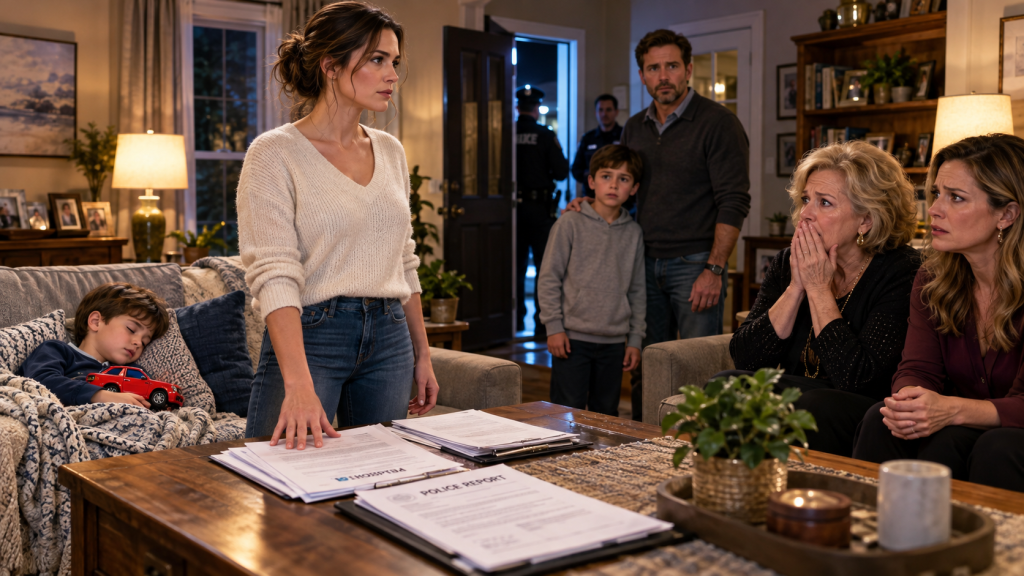
Even Damian stopped looking at the red toy car lying beside his shoe. I swallowed. “Who?” Robles turned the laptop toward us. The USB had already been copied by investigators. The original remained sealed in an evidence bag.
On the screen, Julian appeared. My Julian. Alive. Not the thin, exhausted man I remembered from his final weeks. This recording had been made eight months before his death. His hair was longer. His shoulders broader. He wore the blue mechanic’s shirt with JULIAN stitched above the pocket.
For one second, seeing him hurt more than everything else in the room.
Then he spoke.
“Clara, if you’re watching this, I’m sorry.”
My knees weakened.
“I tried to handle this quietly because I thought I could fix it before it reached you.”
I almost laughed.
Even dead, he was apologizing for trying to carry too much alone.
He continued.
“Your mother approached me about refinancing the house.”
“She said Valerie and Sergio were in trouble.”
Valerie started crying.
Sergio turned toward her.
“What trouble?”
She whispered,
“Not now.”
He stared at her.
Julian’s voice continued.
“I told Teresa no.”
“The house isn’t hers to mortgage alone.”
“She and your father signed the ownership agreement after I put ninety-six thousand dollars into repairs and the mortgage.”
My mother muttered,
“He offered that money.”
Robles looked at her.
“That does not cancel a contract.”
Julian continued.
“Two weeks later, I found copies of Clara’s driver’s license and signature in the desk drawer.”
My stomach turned.
“Then I saw Valerie practicing Clara’s signature.”
Nobody moved.
On the screen, Julian took a breath.
“I confronted her.”
“She admitted Teresa told her they only needed the transfer long enough to qualify for a loan.”
Valerie made a broken sound.
“No.”
Sergio stood.
“Valerie.”
She shook her head.
“That isn’t what happened.”
Julian’s recording continued.
“She said Sergio doesn’t know.”
Sergio sat down again.
Slowly.
Very slowly.
The room changed.
My brother-in-law had not known.
At least not then.
Julian looked directly into the camera.
“Clara, Valerie forged your name.”
My sister covered her face.
My mother shouted,
“She was trying to save her family!”
One of the officers turned toward her.
“Ma’am, sit down.”
Teresa did.
But she kept talking.
“You don’t understand.”
“They were going to lose everything.”
Sergio stared at her.
“Lose what?”
Valerie whispered,
“Please.”
He looked at his wife.
“Lose what?”
The answer did not come from Valerie.
It came from Julian’s video.
“Sergio thinks their debts are around forty thousand.”
“They are not.”
My brother-in-law’s face emptied.
Julian continued.
“Valerie told Teresa they are almost two hundred thousand dollars in debt.”
Sergio stood again.
“What?”
Valerie started sobbing.
Julian said:
“Some of it came from a business investment.”
“Some credit cards.”
“And some gambling.”
Sergio turned toward Valerie.
“You told me you stopped.”
She shook her head.
“I did.”
“When?”
“It wasn’t—”
“When?”
My mother slammed her palm on the table.
“Stop interrogating her!”
Sergio looked at Teresa.
Then at me.
Then back at his wife.
“How much?”
Valerie whispered:
“One hundred eighty-six.”
His face turned gray.
“One hundred eighty-six thousand dollars?”
She nodded.
Damian began crying.
Not loudly.
Just suddenly.
An eight-year-old child sitting in a room full of adults whose secrets had finally become too large for him.
I looked at him.
He still had one hand near the red toy car.
Mateo’s car.
Julian’s last gift.
For the first time that night, I saw Damian differently.
Not as the favorite grandson.
Not as the child who always got everything.
As a little boy who had learned that love in this family meant somebody else lost so he could receive.
That was not his fault.
I walked toward him.
Valerie jumped up.
“Don’t touch my son.”
I stopped.
The hypocrisy was almost unbearable.
“You watched your mother hit mine.”
Silence.
Valerie’s face crumpled.
Damian whispered:
“Mom?”
She looked down.
He asked:
“Are we going to jail?”
That question broke something open.
Valerie dropped to her knees.
“No, baby.”
He stared at her.
“Grandma said Aunt Clara was stealing our house.”
My mother closed her eyes.
There it was.
Another lie given to a child.
I looked at Damian.
“Sweetheart, nobody is taking you to jail.”
He stared at me.
“You’re mad.”
“Yes.”
“Because I took the car?”
I looked at the red toy on the floor.
Then at the blood still faintly visible near Mateo’s ear as he slept on the far sofa.
“I’m upset about a lot of things.”
Damian’s lip trembled.
“Grandma said it was supposed to be mine.”
My chest tightened.
“What?”
“The car.”
He looked toward Teresa.
“She said Uncle Julian bought everything with family money, so Mateo’s stuff belongs to us too.”
I closed my eyes.
Of course.
Even a child’s toy had been made part of the same story.
Nothing was ever simply ours.
My husband’s contribution.
My son’s shoes.
My room.
My work.
My time.
All of it could be absorbed into family whenever someone else wanted it.
But when I needed protection, suddenly I was only the daughter who should be grateful for shelter.
I knelt a few feet from Damian.
“The car belongs to Mateo.”
He nodded.
Tears ran down his face.
“I know.”
Then he pushed it toward me.
“I don’t want it.”
I picked it up.
The paint on one wheel was chipped.
Julian had bought it at a street market two weeks before he died.
Mateo carried it almost everywhere.
I placed it gently beside my sleeping son.
Then the officer said:
“Mrs. Robles, we need to speak with you separately.”
My mother looked at me.
“You did this.”
For the first time, I did not feel guilty.
“No.”
I shook my head.
“You did.”
That night did not end with dramatic arrests.
Not exactly.
The officers separated everyone.
Statements were taken.
Photographs made.
Documents copied.
The medical report was preserved.
The blue folder became evidence.
The forged deed was flagged.
The loan records were requested.
Child protective services became involved because there were now two children inside a house where physical harm and coercive behavior had been disclosed.
Mateo slept through most of it.
That may have been a mercy.
At 1:14 in the morning, a social worker named Denise Harper sat beside me in the kitchen.
Everyone else had been moved into separate rooms.
She spoke quietly.
“Do you have somewhere safe to take your son tonight?”
I looked around.
The house where I had believed I had nowhere else to go.
Then I remembered Julian’s note.
If they ever make you feel like you have nothing, use this before you leave.
I held the blue folder.
“Yes.”
For the first time, I meant it.
Attorney Robles arranged a hotel for two nights while he filed emergency civil papers regarding the house.
Not because I was rich.
Not because Julian had secretly left millions.
Life is usually less theatrical than that.
He had done something better.
He had documented my rights.
And rights become powerful when someone finally uses them.
The forty-percent ownership interest was real.
Recorded.
Enforceable.
My mother and late father had signed the agreement.
Julian had paid $96,000 toward the mortgage balance and major structural repairs after my parents almost lost the property eleven years earlier.
I remembered that period.
The leaking roof.
The foundation crack.
My mother crying at the kitchen table.
Julian saying:
“We’ll figure it out.”
I thought he meant emotional support.
Apparently, he had written checks.
Large ones.
And unlike me, he had insisted on paperwork.
God bless that stubborn man.
The agreement gave Julian and me a forty-percent tenancy interest, with survivorship provisions that transferred his share to me if he died.
It also stated that if both of us died before Mateo reached twenty-one, that interest would be held in trust for him.
My parents retained sixty percent.
After my father died, his interest passed to Teresa under his estate plan.
So my mother controlled sixty percent.
I controlled forty.
Not a guest.
Not a freeloader.
An owner.
I sat in that hotel room at two in the morning and stared at the word.
Owner.
Then looked at my son asleep beside me.
One cheek bruised.
Ear bandaged.
Mr. Chomps—his stuffed dog, not a dinosaur—tucked beneath his chin.
The red toy car on the bedside table.
I whispered:
“I’m sorry.”
He did not wake.
That was good.
Because the apology was not yet for him.
It was for the boy he had been in all the moments I failed to see.
The laundry room.
The stolen shoes.
The bruises.
How long had I been calling harm “family tension”?
How many times had I accepted Teresa saying:
“Boys play rough.”
How many times had I believed Valerie when she said:
“Damian and Mateo were wrestling.”
How often had I come home too tired to ask the second question?
I had been working double shifts because I thought money was the problem.
Money was not the deepest problem.
I had been leaving my son inside a house where people had already decided he mattered less.
At 4:20 a.m., I finally cried.
Quietly.
So Mateo would not wake.
The next morning, the police asked me to bring him to a child advocacy center.
Not a station.
Not a courtroom.
A room with toys.
Soft chairs.
One trained interviewer.
I sat behind glass with Denise Harper and another professional.
I wanted to burst through the wall every five minutes.
But I stayed.
Mateo needed space to speak without watching my face.
The interviewer asked:
“What happens when Damian comes over?”
Mateo looked at the carpet.
“Grandma says I should stay out of the way.”
“What does that mean?”
“Sometimes my room.”
“Sometimes laundry.”
“Does she lock the door?”
He nodded.
“How?”
“Chair.”
My hands turned cold.
Not a lock.
A chair pushed beneath the knob from outside.
That explained why I had never seen hardware.
“How long do you stay there?”
Mateo shrugged.
“Until Damian goes home.”
“Does anyone give you food?”
“Sometimes Aunt Valerie brings crackers.”
I covered my mouth.
Denise touched my arm.
The interviewer continued.
“Has anyone hit you before yesterday?”
Mateo nodded.
“Who?”
“Grandma.”
My stomach dropped.
“Where?”
“Back.”
“Hand.”
“Sometimes spoon.”
I stopped breathing.
Old bruises.
The X-rays had not shown fractures.
Thank God.
But the physician had documented bruising patterns inconsistent with normal play.
I had seen some.
On his back.
His shoulder.
His upper arm.
I had accepted explanations.
Fell from the couch.
Bumped the table.
Damian pushed him.
Except even when Damian had pushed him, the adults had treated it as Mateo’s problem.
The interviewer asked:
“Why didn’t you tell your mom?”
Mateo became very still.
Then whispered:
“Grandma said she would make us leave.”
I stood up behind the glass.
Denise gently said:
“Sit.”
I did.
Barely.
Mateo continued:
“She said Mom doesn’t have money for our own house.”
My heart broke.
“She said if I make trouble, we’ll sleep in the car.”
I began crying.
There are cruelties that bruise skin.
Others train children to protect their parents by accepting harm.
My six-year-old had been swallowing pain because he thought silence kept a roof over my head.
I had believed I was protecting him by enduring.
He had been doing the same for me.
That realization changed everything.
The investigation widened.
Teresa’s assault against Mateo was straightforward.
There had been witnesses.
Visible injury.
Hospital documentation.
And, unexpectedly, video.
Not from security cameras.
From Damian’s tablet.
He had been recording a silly video under the dining table before dinner.
The footage captured sound.
The toy argument.
My mother shouting.
The slap.
Mateo crying.
Valerie saying:
“Oh, my love, did that boy scare you?”
Then Teresa’s voice:
“Teach your son some manners, Clara.”
The family had pretended not to see the blood.
Technology had heard everything.
That recording mattered.
So did the medical history.
The hospital contacted Mateo’s pediatrician.
Old appointment notes showed two previous visits for bruises and headaches.
Each time, I had repeated the explanation given to me at home.
Rough play.
Fall.
Doorframe.
No one accused me of deliberately harming my child.
But social services asked a harder question.
Why had I continued living there?
I had no satisfying answer.
Money.
Grief.
Fear.
Habit.
My mother’s voice living inside my head.
All true.
None erased the consequences.
I entered counseling.
Parenting support.
Not because I had struck Mateo.
Because protecting a child sometimes requires learning why you tolerated a place that hurt both of you.
That was humbling.
Necessary.
Meanwhile, the financial case became uglier.
Valerie had forged my signature.
Julian’s recording confirmed she intended to.
Document examination later supported that she executed the false transfer.
My mother had directed the plan and provided old copies of my signature.
But Sergio’s role remained uncertain.
He swore he had not known.
At first, I believed nothing anyone said.
Then evidence helped.
Sergio’s emails.
Bank records.
Texts with Valerie.
He knew their finances were strained.
He knew she had credit-card debt.
He did not know how deep the debt went.
He did not know about the gambling account.
He did not know about the forged deed when it happened.
But six months after the loan closed, he learned something was wrong.
A bank statement arrived showing the home-equity loan.
He confronted Valerie.
She told him Teresa had refinanced her own share of the house.
He accepted that.
Too easily.
Later, he noticed my name on a document.
He asked one question.
Valerie said:
“Clara signed because Julian had already paid her share.”
He stopped asking.
That did not make him part of the original fraud.
But it exposed something familiar.
He had chosen comfort over verification.
Different from forging.
Still a failure.
The $178,000 loan was the center.
Where did it go?
$121,000 first entered a custodial investment account opened in Damian’s name.
On paper, that looked almost noble.
Grandmother and mother “saving for his future.”
But forensic accountant Lisa Chen traced the money.
It remained in Damian’s account for twenty-six days.
Then Valerie, as custodian, moved $84,000 out through a series of transfers to an LLC she controlled.
Another $19,000 paid credit-card balances.
Approximately $11,000 covered gambling-related withdrawals and fees.
The remainder stayed in Damian’s account.
The favorite grandson had not truly received $121,000.
His name had been used as a bridge.
A clean-looking place to park dirty money before moving it again.
I thought about him dropping the toy car.
Eight years old.
Loved lavishly.
Used quietly.
Even favoritism had been fraudulent.
When Sergio learned that, he filed for legal separation.
People criticized him.
Some said he abandoned Valerie during crisis.
He answered:
“The crisis started when she built a second financial life and put our son’s name inside it.”
I understood.
He sought independent counsel to protect Damian’s remaining funds.
A court-appointed financial custodian replaced Valerie temporarily.
The remaining money became frozen pending resolution.
For the first time, somebody looked at Damian not as the favored child but as a child whose identity had been used by adults.
That mattered.
The criminal cases moved slowly.
Months.
Then more months.
No television courtroom.
No judge pounding a gavel while everyone gasped.
Statements.
Depositions.
Motions.
Evaluations.
Financial records.
The kind of justice that arrives through numbered exhibits.
Teresa faced charges related to assault and child endangerment based on Mateo’s statements and corroborating evidence.
The older incidents were harder to prove individually.
That frustrated me.
But law is not a machine that converts pain directly into punishment.
Evidence matters.
Dates matter.
Corroboration matters.
The dinner slap was clear.
The confinement pattern was supported by messages.
One text from Teresa to Valerie read:
I put Clara’s boy in the laundry again so Damian can play without whining.
I read that sentence once.
Never again.
Clara’s boy.
Not Mateo.
Not grandson.
A problem to store behind a door.
Financially, Teresa faced conspiracy and fraud-related charges connected to the forged deed and home-equity loan.
Valerie faced forgery, fraud, misuse of custodial funds, and other offenses tied to the transfers.
The exact charges shifted during the case.
Some merged.
Some became civil claims.
Some were reduced in exchange for restitution and cooperation.
No one received life in prison.
Teresa was already in her late sixties.
Valerie had no prior record.
Both faced real consequences.
Teresa received a period of incarceration and supervision, plus restitution obligations and a protective order limiting contact with Mateo.
Valerie’s sentence combined incarceration, probationary supervision, restitution, and financial restrictions.
She also entered treatment for gambling addiction.
That did not excuse what she had done.
It explained why one lie had become a staircase.
At first, she borrowed.
Then hid.
Then lost more.
Then borrowed again.
Then involved Mom.
Then forged.
Then used Damian’s account.
Every step made the next one easier because turning back meant admitting the previous one.
I visited Valerie once before sentencing.
Not because I wanted reconciliation.
Because I needed one answer.
We sat across from each other in a monitored room.
She looked tired.
No makeup.
No perfect daughter glow.
Just my sister.
I asked:
“Why Mateo?”
She looked confused.
“What?”
“Why did you let Mom treat him that way?”
Her face crumpled.
“I don’t know.”
“That isn’t enough.”
She wiped her eyes.
“I was jealous.”
Of course.
“Of what?”
“You.”
I almost laughed.
“You had everything.”
I stared.
“I was widowed at thirty-one.”
“You had Julian.”
The room went quiet.
Valerie whispered:
“He loved you.”
“So?”
“Sergio and I were always fighting about money.”
“Julian looked at you like…”
She stopped.
“Like what?”
“Like you were enough.”
My anger shifted.
Not softened.
Shifted.
She continued.
“After he died, everyone felt sorry for you.”
“I hated myself for resenting it.”
“So you let Mom punish my son?”
“No.”
Then she closed her eyes.
“Yes.”
Honesty.
Finally.
“Damian was the one thing I had that Mom celebrated.”
“She called him perfect.”
“She called me a good mother.”
“When Mateo came around, Mom compared them.”
“She always made Damian win.”
“And I liked it.”
My stomach turned.
She whispered:
“I liked having one room where I wasn’t failing.”
There it was.
Her child had become her trophy.
Mine had become the child who needed to lose so hers could remain first.
I said:
“Damian is not your evidence that you matter.”
She cried.
“I know.”
“Do you?”
“I’m trying.”
Then I asked the question I had almost been afraid to ask.
“Did you ever hit Mateo?”
Her head snapped up.
“No.”
“Did Sergio?”
“No.”
“Did Damian?”
She hesitated.
“Sometimes they fought.”
“Did you encourage it?”
Silence.
“Valerie.”
She whispered:
“I told Damian not to let Mateo take things from him.”
My chest tightened.
“Things that belonged to Mateo?”
“Yes.”
I stood.
She started crying harder.
“Clara.”
I looked down at her.
“I hope treatment helps you.”
“You’re leaving?”
“Yes.”
“Do you hate me?”
I thought.
“No.”
She looked surprised.
“I don’t trust you.”
“That is worse.”
For her, maybe.
For me, it was freedom.
Hate demands energy.
Boundaries can stand quietly.
Mateo and I moved into a small apartment two months after the dinner.
Two bedrooms.
Third floor.
No yard.
No dining room large enough for family gatherings.
I loved every inch.
The first night, he slept with his door open.
I thought it was because the apartment was unfamiliar.
Then, around midnight, I heard him get up.
He walked to the laundry closet.
Opened the folding door.
Looked inside.
Then came to my room.
“Mom?”
“Yes?”
“Can we take the door off?”
My throat tightened.
“The laundry door?”
He nodded.
“Sure.”
The next morning, I removed it.
Badly.
I stripped one screw.
Swore under my breath.
Mateo laughed.
But we removed it.
For two years, our laundry closet had no door.
Visitors asked why.
I said:
“We like it that way.”
That was enough.
Therapy helped him.
Slowly.
At first, he panicked when adults raised voices.
He hid snacks under his bed.
That shocked me.
When Dr. Moore—his therapist—asked why, he said:
“Grandma forgot dinner sometimes when I was in laundry.”
Forgot.
Maybe she did.
Maybe not.
The distinction did not matter to a hungry six-year-old.
So we created a snack drawer.
His drawer.
Always available.
Granola bars.
Crackers.
Applesauce.
Not as a reward.
Not permission-based.
Food should not become obedience.
For months, he checked it constantly.
Then less.
By seven, he stopped hiding food.
By eight, he complained that I bought the wrong crackers.
Progress.
The red toy car became complicated.
For a while, Mateo would not play with it.
It stayed on his shelf.
One day I asked:
“Do you want me to put it away?”
“No.”
“You don’t have to keep looking at it.”
He shook his head.
“Dad gave it.”
So it stayed.
Not a trauma symbol.
Not a courtroom exhibit.
A gift from his father that happened to survive a terrible dinner.
When Mateo turned nine, Damian asked to see him.
By then Sergio had primary custody while Valerie was completing part of her sentence and treatment.
Damian had therapy too.
He needed it.
Being favored can damage a child in quieter ways.
He had been taught that other people’s boundaries were negotiable if he wanted something.
That adults would rearrange truth to protect him.
That winning meant love.
He had also watched his mother disappear into legal consequences and learned his own name had been used to move money.
Eight years old.
None of that belonged on his shoulders.
I asked Mateo:
“Do you want to see Damian?”
He shrugged.
“Maybe.”
“Do you want me there?”
“Yes.”
We met at a playground with therapists nearby.
Damian brought something in a paper bag.
The red toy car.
I frowned.
Mateo whispered:
“I already have it.”
Damian shook his head.
“This one is mine.”
He pulled out another red car.
Same model.
Almost.
Cheaper plastic.
He held it toward Mateo.
“I bought it with my allowance.”
Mateo looked confused.
“Why?”
Damian stared at the ground.
“So we can both have one.”
My eyes filled.
Children.
Always trying to repair what adults made impossible.
Mateo took it.
Then said:
“Mine is faster.”
Damian frowned.
“No way.”
Five minutes later, they were racing toy cars down the slide.
Not healed.
Not magically best friends.
Just boys.
That scene meant more to me than every sentencing hearing combined.
Because justice was not supposed to make children inherit our wars.
Sergio and I developed an awkward alliance.
He apologized.
Specifically.
“I should have noticed.”
I said:
“You noticed enough to ask questions.”
He nodded.
“And then I accepted answers because the real ones threatened my marriage.”
Accurate.
He continued:
“I also laughed when Teresa called Mateo dramatic.”
I stared at him.
“Yes.”
“I’m sorry.”
I believed him.
Did belief restore trust?
No.
But belief allowed us to coordinate the boys without pretending.
Eventually, Sergio divorced Valerie.
He did not keep Damian from her forever.
Once treatment progressed and supervision requirements changed, Valerie resumed structured contact.
Damian wanted his mother.
That hurt Sergio.
He allowed it anyway.
Good parenting sometimes means facilitating a child’s love for someone who wounded you.
Within safe limits.
Valerie became different slowly.
Not through one apology.
Through years.
No gambling.
Financial controls.
Restitution payments.
Therapy.
A job where she had no access to client funds.
Honesty when inconvenient.
The first birthday after her release, she gave Damian a book.
He asked:
“That’s it?”
She smiled.
“Yes.”
No giant toy.
No expensive sneakers.
No using gifts as proof.
He sulked for fifteen minutes.
Then read the book.
Growth can be boring.
My mother changed less.
At first.
Teresa wrote me letters from jail.
The first said:
You destroyed this family over one slap.
I returned it unread after the first page.
The second:
You know I never meant to hurt Mateo seriously.
I did not answer.
The third came almost a year later.
It began:
I hit a six-year-old child because I believed my anger mattered more than his safety.
I read the whole thing.
She wrote:
I locked him in the laundry room because I resented that you came home after Julian died.
My hands started shaking.
There.
The real thing.
Not Damian.
Not manners.
Not stress.
Resentment.
She continued.
Your father and I thought we were finished raising children. Then you returned with grief, bills, and a boy who reminded me every day that your life had not followed the plan I wanted.
I cried.
Not because she was right.
Because she finally named what I had always felt.
I had not simply become inconvenient.
I had become evidence that she could not control life.
Julian had been a mechanic.
She hated that.
I married him anyway.
He loved me well.
Then died.
I came home.
Everything she predicted as failure seemed, in her mind, confirmed.
So instead of grieving with me, she made me pay rent emotionally.
The letter continued:
I favored Damian because Valerie lived the life I had wanted for you. I treated him like proof that she had done motherhood correctly. I treated Mateo like proof that you had not.
I put the letter down and cried harder.
There is a strange pain in finally receiving the explanation you spent years needing.
It does not erase anything.
It simply gives the wound edges.
My mother ended:
Nothing Mateo did made him less worthy of being my grandson. I made him carry my disappointment in you. That was cruel.
I did not write back for six months.
Then I sent one sentence.
I believe you understand more than you did before.
Not forgiveness.
Not yet.
When Teresa was released, she asked to see Mateo.
He was ten.
I told him:
“You choose.”
He looked terrified.
“No.”
“Then no.”
That simple.
For two years, every request received the same answer.
No.
My mother complained at first.
Then stopped.
That mattered.
When Mateo was twelve, he asked:
“Is Grandma old now?”
I laughed despite myself.
“She was old when you were six.”
“You know what I mean.”
“Yes.”
He thought.
“Can I see her somewhere that isn’t her house?”
Good boundary.
We arranged a therapist’s office.
Teresa arrived early.
She looked smaller.
Gray hair.
No lipstick.
Hands twisting around a tissue.
When Mateo entered, she stood.
Then stopped herself.
“Can I hug you?”
He shook his head.
“No.”
She sat again.
Good.
No guilt.
No:
But I’m your grandmother.
No tears used as a weapon.
Just:
“Okay.”
Then she said:
“I hurt you.”
Mateo looked at her.
“Yes.”
“I locked you in a room.”
“Yes.”
“I took things from you.”
He nodded.
“I slapped you.”
He looked at the floor.
“Yes.”
“I told you your mother could not take care of you without me.”
His jaw tightened.
“You lied.”
“Yes.”
The word came quickly.
Good.
“I lied.”
She cried.
“I wanted you to be afraid of leaving.”
Mateo asked:
“Why?”
My mother closed her eyes.
“Because if your mother left, I would have to admit she didn’t need me.”
That sentence surprised everyone.
Even me.
Teresa continued.
“I confused being needed with being loved.”
Mateo looked at the therapist.
Then back at her.
“I don’t forgive you.”
My mother nodded.
“I know.”
“I might never.”
“I know.”
“I don’t want to go to your house.”
“You don’t have to.”
“I don’t want presents.”
“Okay.”
He thought.
“Maybe I can see you here again.”
My mother cried harder.
“Okay.”
That was all.
No hug.
No music.
No miraculous reconciliation.
Just a child controlling the door for once.
At thirteen, Mateo asked if we could put the laundry door back.
I stared at him.
“Are you sure?”
He rolled his eyes.
“Mom, our towels look ugly.”
I laughed.
We installed a new door.
Together.
He chose one with slats.
I asked why.
“So air gets through.”
I knew that was not the only reason.
I did not say so.
When he closed it for the first time, he opened it again immediately.
Then shut it.
Then opened it.
He smiled.
“It’s just a door.”
I wanted to hug him.
I didn’t.
Teenagers have limits.
I said:
“Yes.”
Just a door.
The house ownership dispute took almost three years.
My forty-percent interest was ultimately upheld.
The forged deed transfer was voided.
The fraudulent home-equity transaction was resolved through litigation involving the lender, title insurer, restitution orders, and the people who created the false documents.
It was messy.
No magic cancellation.
Some legal fees came from my share.
Some recovery came from insurance.
Some from the sale of assets.
The court placed limits on Teresa’s ability to encumber the property.
Eventually, after everything settled, I made a decision everyone questioned.
I sold my forty-percent interest.
To whom?
My mother.
People thought I was crazy.
Why let her keep the house?
Because I did not want the house.
I wanted freedom from it.
But I did not give my share away.
An independent appraisal set the value.
Teresa refinanced legitimately after legal restrictions were addressed, using her remaining equity and funds from selling another property.
Part of the purchase money paid me.
Part went directly toward restitution obligations.
For the first time, a transaction involving that house had everyone’s real signature.
I remember signing.
Slowly.
Watching my own name appear.
Clara Alvarez.
Mine.
Nobody copied it.
Nobody practiced it in a drawer.
Nobody decided what I would have agreed to.
When I finished, Attorney Robles asked:
“How does that feel?”
I looked at the signature.
“Ordinary.”
He smiled.
“That’s good.”
It was.
Consent should feel ordinary.
The money from my share was not enormous after legal expenses and obligations.
But enough.
Combined with Julian’s modest life-insurance benefit I had never fully used, my savings, and a small wrongful-financial-conduct settlement, I made a down payment on a townhouse.
Two bedrooms.
Tiny patio.
Blue front door.
Mateo picked the color.
Of course.
The first night there, he ran from room to room.
“This is ours?”
“Yes.”
“Like actually ours?”
“Yes.”
“Nobody can make us leave?”
I swallowed.
“As long as I pay the mortgage.”
He laughed.
“Then work harder.”
Little traitor.
I chased him down the hall.
For the first time since Julian died, laughter filled a home that belonged to us by choice.
I kept working at the salon.
People expected some dramatic career transformation.
No.
I liked hair.
I liked my clients.
I liked making someone look in a mirror and smile.
But I stopped taking every extra shift.
Money mattered.
So did time.
Twice a week, I picked Mateo up myself.
We got tacos.
Went to the park.
Sometimes did nothing.
At first, doing nothing felt irresponsible.
Then luxurious.
Grief had taught me life could end early.
My mother had taught me time could also be stolen while you were still alive.
I wanted mine back.
Valerie’s restitution took years.
She paid me.
The lender.
Other affected accounts.
Damian’s custodial funds were reconstructed with court supervision using recovered money and contributions from Valerie and Teresa.
Not all $121,000 magically reappeared.
But a significant portion did.
More importantly, Damian’s account was placed under independent control.
When he turned eighteen, he learned the full story.
Sergio told him with a therapist present.
Not because he was fragile.
Because a child deserves context before discovering his name in fraud records.
Damian was furious.
Mostly at being used.
He told Valerie:
“You kept saying everything was for me.”
She cried.
“I believed it was.”
“No.”
He shook his head.
“It was for you to feel like a good mom.”
That sounded like something a therapist helped him articulate.
Still true.
He did not speak to her for five months.
Then slowly resumed.
His choice.
At eighteen, Mateo and Damian were not brothers.
Not exactly cousins in the emotional way either.
They became something looser.
People who survived the same house from different sides.
Damian attended Mateo’s high-school graduation.
Brought him a red toy car.
A tiny collectible this time.
Mateo laughed.
“You’re obsessed.”
Damian shrugged.
“Tradition.”
I cried behind sunglasses.
They both pretended not to notice.
Mateo grew into a quiet young man.
Not timid.
Quiet.
There is a difference.
He loved fixing things.
Of course he did.
Julian lived in his hands.
At sixteen, he restored an old bicycle.
At seventeen, a motorcycle engine.
At nineteen, he entered a technical engineering program.
My mother hated mechanics once.
Life has humor.
When Mateo received his first job offer, Teresa sent a card.
No money.
No guilt.
Just:
Your father would be proud. I am too, if you are comfortable hearing that from me.
Mateo showed me.
“That’s weird.”
“What part?”
“She asked permission to be proud.”
I smiled.
“That’s growth.”
He kept the card.
My relationship with Teresa never became what it had been.
Good.
What we had before required me to become smaller.
We developed something different.
Coffee once a month.
Public places at first.
Then, years later, her house.
Not the old dining room.
I refused to sit there for a long time.
She did not push.
Eventually, at seventy-nine, she sold the house.
Not because I demanded it.
Too many stairs.
She moved into a small senior apartment.
I helped pack.
In the laundry room, I froze.
Same room.
Same narrow walls.
Different washer.
My mother noticed.
She stopped carrying a box.
“I’m sorry.”
I looked at her.
“I know.”
Then she said:
“I used to hear him knock.”
My chest tightened.
“What?”
“Mateo.”
She looked toward the door.
“He would knock when he wanted out.”
I could barely breathe.
“And you left him there?”
She started crying.
“Yes.”
I wanted to scream.
Years had passed.
Therapy.
Apologies.
Boundaries.
Still, some truths arrive late and hurt fresh.
“Why?”
She whispered:
“Because every minute he stayed in there made me feel in control.”
I put the box down.
Walked outside.
Did not speak to her for three months.
Growth does not mean every new truth is easy to absorb.
When we finally talked again, she did not say:
But I apologized.
She did not say:
I’m old.
She did not say:
How long will you punish me?
She simply said:
“I understand why you needed distance.”
That was why I came back.
Accountability is not demonstrated by demanding forgiveness on schedule.
It is demonstrated by respecting the consequences of what you did.
Sergio remarried eventually.
A teacher named Nadia.
Damian liked her.
Valerie struggled.
Of course.
But she never attacked Nadia publicly.
Never told Damian she was replacing her.
That was growth too.
Valerie dated no one for years.
She focused on work.
Treatment.
Restitution.
I stopped monitoring whether she was “better.”
That was not my job.
One Christmas, almost a decade after the dinner, she asked if I would meet her alone.
I agreed.
Coffee shop.
Daylight.
She brought no folder.
No gifts.
She said:
“I need to tell you something.”
My body still reacted.
Funny how long fear remembers.
“What?”
“When Julian confronted me about practicing your signature…”
I froze.
She continued.
“He offered to pay part of my debt.”
My throat tightened.
“What?”
“He said he would give me twenty thousand if I entered treatment and told Sergio everything.”
I stared at her.
“And?”
“I said no.”
Of course.
She cried.
“I told him twenty thousand wouldn’t fix it.”
“He said, ‘Then stop trying to fix the number before you fix the lying.’”
That sounded exactly like Julian.
My eyes filled.
Valerie continued.
“I hated him for saying it.”
“Then he got sick.”
“And I thought maybe the problem would disappear.”
I looked away.
That hurt.
“But he recorded the video.”
“Yes.”
She nodded.
“And after he died, Mom told me to wait.”
“She said you were too broken to fight.”
My hands clenched.
“Too broken.”
“Yes.”
“We filed the false transfer eight months after his funeral.”
There it was.
Timing.
Not confusion.
Calculation.
They waited until grief had hollowed me out.
Until I returned to the house.
Until I depended on them.
Then they used my exhaustion as cover.
Valerie whispered:
“I am sorry.”
I stared at her.
“Do you know what I hate most?”
She shook her head.
“You knew I was drowning.”
“Yes.”
“And instead of helping me, you checked whether I was weak enough to steal from.”
She cried.
“Yes.”
That was the last apology I needed from her.
Not because it made anything okay.
Because it named the cruelty precisely.
I said:
“I forgive you.”
She looked stunned.
The words surprised me too.
Then I added:
“That does not mean I trust you with my finances, my house, or my son.”
She nodded.
“I know.”
“Forgiveness is not access.”
“I know.”
“And if you ever treat Mateo as less than Damian again, I leave.”
“I know.”
Good.
We finished coffee.
No hug.
Not yet.
Six months later, there was one.
Because I wanted it.
That distinction mattered.
By the time Mateo was twenty-five, the medical report from that night no longer lived in my purse.
For years, I kept a copy everywhere.
Car.
Drawer.
Cloud storage.
Evidence.
Proof.
Then one day Attorney Robles called.
The legal retention period on one part of the case had ended.
He asked whether I wanted originals returned.
I said:
“Which originals?”
“Some certified copies.”
“Photographs.”
“Hospital documentation.”
I thought of the marked cheek.
The dried blood.
The report that finally made everyone stop pretending.
I said:
“Keep what the law requires.”
“And the rest?”
“Shred it.”
He paused.
“You’re sure?”
“Yes.”
I did not need paper to remember.
More importantly, Mateo did not need his childhood preserved forever as evidence.
The red toy car lasted longer.
Much longer.
When Mateo moved into his first apartment, he took it.
I pretended not to notice.
At twenty-nine, he married a woman named Daniela.
Warm.
Funny.
Absolutely unwilling to tolerate nonsense.
I adored her.
Before their wedding, Mateo brought me the toy car.
“Hold this.”
“Why?”
“Suit pocket looks stupid.”
I laughed.
“You brought that to your wedding?”
He shrugged.
“Dad can’t come.”
My eyes filled instantly.
“So this is him?”
“Kind of.”
I kissed the chipped roof.
Then put it in my purse.
During the ceremony, I kept one hand around it.
Not because Julian was trapped inside plastic.
Because grief sometimes needs an object to hold.
My mother attended the wedding.
So did Valerie.
Damian.
Sergio.
Nadia.
Different tables.
No forced portrait pretending nothing happened.
Mateo invited who he wanted.
Seated them where he wanted.
At the reception, Teresa approached him.
“Can I dance with you?”
He smiled.
“One song.”
One.
Not three.
Not whatever she wanted.
She accepted.
I watched them dance.
His six-year-old face flashed in my memory.
Red cheek.
Trembling hands.
Then the man in front of me.
Tall.
Laughing.
Choosing.
I cried.
Daniela found me.
“You okay?”
“Yes.”
“You’re crying pretty aggressively.”
“I’m Hispanic.”
She laughed.
Good.
Years later, Mateo had a son.
They named him Julian.
I tried to talk them out of it.
Not because I disliked it.
Because I cried every time I imagined calling a baby that name.
They ignored me.
Children eventually punish us with sentimentality.
Little Julian grew into a loud, fearless toddler.
At three, he took a toy from another child.
Mateo crouched beside him.
“No.”
The boy frowned.
“Mine.”
“It was in his hand.”
“I want.”
Mateo gently removed the toy.
“Wanting something does not make it yours.”
I stopped breathing.
There it was.
The entire history of our family inside one sentence.
Wanting something does not make it yours.
Not a toy.
Not a pair of shoes.
Not a house share.
Not someone’s signature.
Not their labor.
Not their obedience.
Not their child.
Not their silence.
I went into the kitchen and cried where nobody could see me.
Daniela found me anyway.
“Why are you hiding?”
“I’m not.”
“You’re literally behind the pantry door.”
“Leave me alone.”
She hugged me.
The audacity.
When Teresa died, she was eighty-six.
Mateo was thirty-two.
She had spent almost two decades trying to live differently.
Did that erase what she did?
No.
Did it matter?
Yes.
Both.
Near the end, she became weak.
Confused sometimes.
Mateo visited once a week by his own choice.
He brought groceries.
Never stayed long.
One afternoon, she looked at him and whispered:
“Do you remember the laundry room?”
I froze.
Mateo nodded.
“Yes.”
She cried.
“I wish I didn’t.”
Mateo looked at her.
“I don’t need you to suffer forever.”
She stared.
He continued.
“I needed you to stop hurting me.”
“You did.”
“That matters.”
My mother reached for his hand.
Stopped before touching.
“May I?”
He thought.
Then placed his hand in hers.
I looked away.
Not because I was angry.
Because the moment belonged to them.
Two weeks later, Teresa died.
At the funeral, relatives did what relatives always do.
They simplified.
“She loved her family more than anything.”
“She was such a strong woman.”
“She sacrificed everything.”
All partly true.
Incomplete.
I did not correct them.
Funerals are not courtrooms.
When I spoke, I said:
“My mother was a complicated woman.”
A few people shifted uncomfortably.
Good.
“She taught me some things by example.”
“Others by consequence.”
“She hurt people she loved.”
“She also changed more than I thought she could.”
“I do not honor her by lying about either.”
Then I looked at Mateo.
“He taught her that forgiveness could have boundaries.”
I sat down.
No sainthood.
No public revenge.
Just truth.
Afterward, Damian approached me.
He was thirty-four.
He handed me a small box.
Inside was the second red toy car.
The one he bought with allowance at nine.
“I found it cleaning out Dad’s garage.”
I smiled.
“You kept it?”
“Apparently.”
He looked toward Mateo across the room.
“Do you think he wants it?”
“Ask him.”
He did.
Mateo laughed.
Then put both red cars on a shelf in his office.
Two boys.
Two cars.
One family that had spent too many years confusing possession with love.
Valerie lived long enough to become a grandmother herself.
The first time Damian’s daughter grabbed a toy from another child, Valerie corrected her gently.
I watched from across the room.
No favoritism.
No:
Let her have it.
No:
She’s younger.
Just:
“That belongs to him. Ask first.”
Valerie saw me watching.
Our eyes met.
She knew.
I knew.
Neither said anything.
Some apologies become behavior.
Those are the ones I trust most.
At sixty-eight, I retired from the salon.
My hands had started aching.
My back too.
I thought I would be bored.
I was.
For approximately nine days.
Then Mateo’s son needed pickup twice a week.
I agreed.
Twice.
Not every day.
Boundaries.
I also started teaching haircutting techniques at a community program for young single mothers.
Many reminded me of myself.
Tired.
Proud.
Scared.
I never told them:
Stay because family is family.
I never told them:
Leave immediately.
Life is too complicated for slogans.
I told them:
“Know what belongs to you.”
“Your money.”
“Your documents.”
“Your time.”
“Your body.”
“Your children’s safety.”
“And your right to ask questions.”
That was enough.
One student once said:
“My mom says I owe her because she lets me live there.”
I stopped cutting.
Looked at her through the mirror.
“Maybe you owe rent.”
“Maybe chores.”
“Maybe gratitude.”
“But you do not owe anyone permission to hurt you.”
She started crying.
So did I.
Occupational hazard.
The townhouse became the home I had once thought I could never afford.
Not because it was large.
It wasn’t.
Because nobody could use the door against us.
The laundry door stayed.
The snack drawer eventually became a junk drawer.
Mateo’s hidden granola bars were replaced by batteries and tape.
Ordinary transformation.
One afternoon, years after he moved out, I opened it and found one old applesauce pouch pushed behind scissors.
Expired by six years.
I held it.
Remembered the little boy who hid food because he thought being troublesome could make him homeless.
I almost kept it.
Then laughed at myself.
Threw it away.
Healing sometimes looks like refusing to turn garbage into relics.
The blue folder lasted longest.
Julian’s folder.
Contract.
Receipt.
USB.
His note.
I kept it in a fireproof safe.
Not because I feared Teresa anymore.
Because Julian’s handwriting was inside.
At seventy-two, I finally watched the entire USB again.
Not only the part about the forgery.
There were five videos.
The last one had nothing to do with property.
Julian sat in his truck.
He looked tired.
He knew he was sick by then.
He said:
“Clara, you are going to be angry I kept paperwork from you.”
I laughed through tears.
Correct.
“I thought protecting you meant handling things before you had to worry.”
“I’m starting to think that’s arrogant.”
I nodded at the screen.
Very.
He smiled.
Almost like he could hear me.
“If I don’t get better, don’t let anybody convince you survival means you should accept less.”
My hand covered my mouth.
“You work too hard.”
“You apologize too much.”
“You think loving people means understanding every reason they hurt you.”
He paused.
“That’s not always love.”
“Sometimes that’s fear wearing good manners.”
I started crying.
Then he said:
“And Mateo.”
His face changed.
Softened.
“Tell him his dad bought that red car because he screamed in the market until three strangers hated us.”
I burst out laughing.
I had forgotten that part.
“He’ll remember me better than I deserve.”
“No,” I whispered.
Julian continued.
“But don’t make him responsible for keeping me alive.”
“If the car breaks, throw it out.”
“If he loses it, don’t cry.”
“If he forgets my voice, that’s okay.”
“Let him live forward.”
I paused the video.
Could not breathe.
All those years, I had treated the toy like sacred evidence of Julian.
Mateo had too.
And Julian himself had asked us not to turn memory into duty.
The next day, I called Mateo.
“Come over.”
He arrived with Daniela and little Julian.
I showed him the video.
When it ended, Mateo stared at the red toy car on my shelf.
Then laughed.
“Dad said throw it away.”
“Yes.”
“You going to?”
“No.”
He smiled.
“Me neither.”
Good.
Choice.
Not obligation.
We kept it because we wanted to.
That made all the difference.
Looking back, people sometimes assume the night my mother slapped Mateo was when our family broke.
It wasn’t.
The breaking had happened slowly.
Years earlier.
Every time Teresa decided Valerie deserved more.
Every time I accepted “family” as an excuse.
Every time Valerie let Damian win because his winning made her feel chosen.
Every time Sergio saw something uncomfortable and looked away.
Every time I explained a bruise instead of asking who caused it.
Every signature practiced in secret.
Every transfer justified as temporary.
Every laundry-room door closed.
The slap did not break the family.
It made the sound loud enough that I finally stopped pretending not to hear it.
That is why I no longer regret the hospital.
The police report.
The medical examination.
The blue folder.
The legal case.
I regret the harm.
I regret the years before.
But not the truth.
Truth did not steal my family.
It separated love from entitlement.
Some relationships survived.
Some changed.
Some ended.
That is what truth sometimes does.
Mateo is forty-one now.
A father.
An engineer who still repairs anything with wheels.
Sometimes he brings his son to my house.
Little Julian races both red cars across my coffee table.
One original.
One Damian bought later.
He does not know every detail yet.
He knows enough.
That his grandfather Julian loved cars.
That his father had a difficult childhood.
That Grandma Clara does not allow hitting.
Ever.
One Sunday, the boy grabbed both cars and shouted:
“Mine!”
Mateo raised an eyebrow.
His son froze.
Then sighed dramatically.
“One for me.”
He handed the other to Damian’s daughter.
“One for Sofia.”
I looked at Mateo.
He looked at me.
Neither said anything.
We did not need to.
Outside, laundry turned in the machine.
The door stood open because little Julian kept forgetting to close it.
Nobody was trapped behind it.
Nobody was afraid.
Nobody had to earn the right to come out.
And on the shelf above my desk sat Julian’s blue folder.
Closed.
Not hidden.
Not needed for battle.
Just part of our history.
For years, I thought my greatest failure was returning to my mother’s house after my husband died.
It wasn’t.
Needing help is not failure.
Trusting family is not failure.
Grief is not failure.
My failure was believing that gratitude required silence.
It does not.
The lesson cost too much.
But Mateo learned something better.
So did Damian.
So did Valerie.
So, eventually, did Teresa.
Love is not measured by who receives the biggest room.
The nicest shoes.
The favorite plate.
The inheritance.
The first slice of cake.
Love is what happens when power appears and you choose not to use it against someone smaller.
My mother failed that test.
Then spent years learning why.
I failed Mateo by waiting too long to see.
Then spent the rest of my life making sure he never had to question whether I believed him.
And Mateo?
He grew into the kind of father who kneels when a child cries.
Who asks before touching.
Who says:
“Tell me what happened.”
And waits for the answer.
That is how cycles end.
Not through perfect people.
Through people willing to stop calling harm normal.
Sometimes it starts with a medical report.
Sometimes a police report.
Sometimes an old blue folder.
Sometimes a six-year-old boy finally saying:
“No. This has happened before.”
And sometimes it starts with a mother hearing that sentence and deciding, at last, that peace is no longer worth the price of her child.
THE END STORIES! THANK YOU FOR READING GOOD LUCK !❤️
Related Posts