Dustin did not look frightened when the investigator said Evelyn might be the reason the others finally got justice. He looked offended. That told me everything. Some men fear consequences.
Others are so accustomed to escaping them that consequences feel like persecution. Dustin pointed at me. “This old psycho threatened me. ”The lead investigator, Special Agent Claire Moreno, did not even turn around.
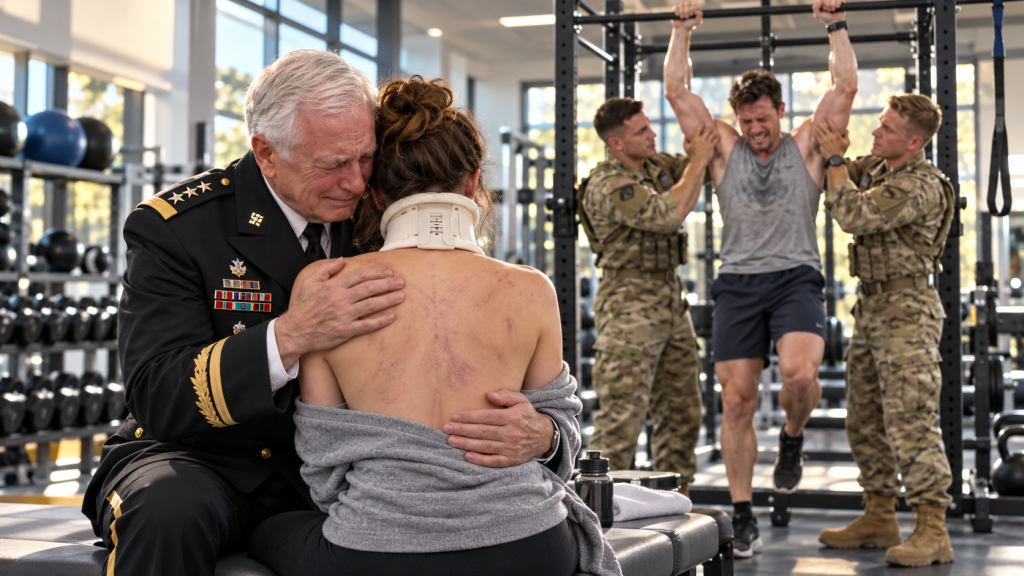
“No, Mr. Vale.” She held up a small body camera clipped beneath her jacket. “He asked you why you assaulted his daughter.” “You responded by surrounding him with four fighters and threatening to have him carried out in a body bag.”
Dustin’s face changed.
Only slightly.
But I saw it.
The first fracture.
His coach, Rick Dalton, backed toward the wall.
One of the heavyweight fighters muttered:
“I’m done.”
Another raised both hands.
“I didn’t touch anybody.”
Good.
No one needed to.
I had walked into that gym believing the only language Dustin respected might be violence.
I was wrong.
What he feared was a room where violence could no longer rewrite the story afterward.
Agent Moreno motioned toward the cage.
“Everyone stays where we can see them.”
Dustin laughed.
“You don’t have jurisdiction.”
A second investigator entered.
Texas Ranger Marcus Bell.
Gray suit.
Cowboy boots.
Expression like stone.
He showed his credentials.
“Try again.”
Dustin stopped laughing.
Then the rear door opened.
Two officers from a neighboring county entered with another investigator from the state public-integrity unit.
Not Dustin’s uncle’s department.
Not anyone whose paycheck or promotion could be touched by his family.
That had been deliberate.
I had not gone to the gym blindly.
Eleanor thought I had.
Evelyn thought I had.
Even Dustin thought I had.
But during the drive from the hospital, I had called the one man I trusted enough to tell me no.
Colonel Aaron Beckett.
Retired.
Former Judge Advocate.
The only man who had ever thrown me out of a training room for losing my temper with a recruit and then bought me coffee afterward.
When I told him what happened, his first words were:
“If you touch that kid, you will spend the next year explaining why the father of an abused woman went looking for a fight.”
I had gripped the steering wheel.
“He broke her ribs.”
“I heard you.”
“He concussed her.”
“I heard you.”
“He threatened my wife.”
“I heard you.”
Then Aaron had said something I hated because it was true.
“Your daughter needs a father more than she needs an avenger.”
That sentence changed the direction of my car.
I still went to the gym.
But not alone.
Not exactly.
Aaron contacted an investigator he knew from an old military-family violence task force.
That led to Agent Moreno.
She already knew Dustin’s name.
That was the first twist I had not expected.
He had been on a state radar for almost eleven months.
Not because of Evelyn.
Because of another woman.
Twenty-six-year-old Hannah Price.
Former amateur kickboxer.
Former girlfriend.
She had filed two domestic violence complaints.
Both disappeared before charges.
A third report was reduced to “mutual combat.”
Then Hannah vanished.
Not completely.
She moved to Oklahoma.
Changed her number.
Stopped fighting.
People assumed she wanted to disappear.
Agent Moreno had eventually found her through a shelter.
Hannah had told investigators:
“He said his uncle could make paper disappear.”
Same words Evelyn used.
Same fear.
But Hannah had refused to testify.
Until three weeks earlier.
What changed?
Another woman contacted her.
A woman named Jasmine Reed.
Another former girlfriend.
Another set of injuries.
Another report that somehow dissolved.
The state began quietly building a pattern.
They needed hard evidence.
Then Evelyn went to the ER.
Then I arrived at the gym.
And Dustin, believing I was nothing more than an angry old father, opened his mouth.
Arrogance did what subpoenas had failed to do.
It made him honest.
Agent Moreno turned toward the storage-room evidence.
“Mr. Dalton.”
Rick’s face was pale.
“Yes?”
“You mentioned the basement.”
He swallowed.
“I said storage.”
“No.”
“You said basement.”
He closed his eyes.
Dustin stared at him.
“Rick.”
The coach flinched.
That single reaction told me Dustin controlled more people than Evelyn.
Rick whispered:
“There’s another door behind the equipment room.”
Dustin stepped forward.
Ranger Bell raised one hand.
“Stay where you are.”
Dustin stopped.
For once.
They found the door behind a rack of heavy bags.
It required a keypad.
Dustin refused to provide the code.
Fine.
They had authority to secure the area while obtaining the necessary search authorization.
Nobody smashed anything.
Nobody played action hero.
The gym remained frozen for nearly an hour.
Then an updated warrant came through.
The door opened.
Inside were shelves.
Hard drives.
Phones.
Pill bottles.
Cash.
Steroids.
A locked filing cabinet.
And a wall covered in photographs.
Women.
Some smiling beside Dustin after fights.
Some at parties.
Some candid.
Evelyn was there.
So was Hannah.
Jasmine.
At least six others.
My stomach turned.
One photo had a black X drawn over the corner.
I stepped toward it.
Agent Moreno blocked me.
“Sir.”
I stopped.
“What is that?”
“We’ll handle it.”
“My daughter’s picture is in there.”
“I know.”
“Why?”
“We don’t know yet.”
I looked at Dustin.
He was staring at the wall.
Not shocked.
Not confused.
Furious.
Agent Moreno saw it too.
She said:
“You recognize the room?”
His lawyer would later claim he said nothing after that.
He didn’t need to.
His face answered.
Then one of the investigators opened the filing cabinet.
Inside were waiver forms.
Medical forms.
Photocopies of identification.
Several unsigned contracts.
And envelopes containing cash.
Agent Moreno flipped through them.
Then stopped.
“What?”
Ranger Bell asked.
She pulled out a page.
A complaint form.
Evelyn’s name.
My chest tightened.
It was already completed.
Not filed.
Prepared.
The document accused Evelyn of assaulting Dustin during a “domestic dispute.”
It claimed he had restrained her in self-defense.
There were photographs attached.
Not of her injuries.
Of scratches on Dustin’s forearm.
Scratches he had received while she tried to protect her face.
The report was dated two days earlier.
Before Evelyn’s hospitalization.
He had been preparing his version before anyone asked.
Agent Moreno looked toward Dustin.
“You were planning to file this?”
Dustin smirked again.
“Maybe she attacked me.”
I took one step.
Then stopped myself.
Open fists.
Breathe.
Eleanor’s voice in my head.
She needs you.
Not him.
Her.
I backed away.
Dustin saw that and smiled wider.
He mistook restraint for fear.
Men like him always do.
Then Ranger Bell removed another document.
A gym membership termination agreement.
Evelyn’s signature at the bottom.
I knew that signature.
Wrong slant.
Wrong E.
Forged.
The agreement included language stating she had sustained injuries during “independent recreational activity” and released the gym from liability.
Dustin’s coach whispered:
“Oh, hell.”
Agent Moreno looked at Rick.
“You knew about this?”
“No.”
He shook his head too quickly.
“I knew Dustin kept files.”
“I didn’t know what was in them.”
Dustin turned.
“You talk too much.”
Rick went white.
There it was again.
Fear.
I had thought the coach was simply another bully.
Maybe he was.
But fear had been living inside that gym under different uniforms.
Agent Moreno separated him immediately.
Within an hour, Rick asked for a lawyer.
Then offered cooperation.
Dustin finally stopped talking.
That was the smartest thing he did all day.
By then, it was too late.
I left the gym without touching him.
That became one of the most important things I ever did.
Not because I lacked the ability.
Because I finally understood ability creates responsibility before it creates power.
I drove to the hospital.
My hands shook only after I parked.
Eleanor met me outside Evelyn’s room.
She looked at my sleeves.
Rolled up.
My knuckles.
Unmarked.
Then my face.
“What did you do?”
I leaned against the wall.
“Nothing.”
Her eyes narrowed.
“Nothing?”
“I scared myself.”
That answer changed her expression.
She stepped closer.
“What happened?”
“I went there wanting to hurt him.”
She closed her eyes.
“I knew it.”
“But I didn’t.”
“Why?”
I almost laughed.
“You.”
Her eyes opened.
“Evelyn.”
“Beckett.”
“Common sense arriving late.”
She slapped my chest lightly.
Then hugged me.
Hard.
For thirty-two years, Eleanor had known every version of me.
Marine.
Instructor.
Husband.
Father.
Idiot.
That night, she held me like a man who had nearly walked off a cliff and finally looked down.
“How is she?”
I asked.
Eleanor stepped back.
“Awake.”
“Scared.”
“Embarrassed.”
That word made me angry.
“At what?”
“You know.”
Yes.
Victims often inherit shame from the person who hurt them.
As if surviving abuse means failing some exam in strength.
I entered the room.
Evelyn looked small beneath the hospital blanket.
My daughter was thirty.
A physical therapist.
Independent.
Funny.
Stubborn.
The child who broke her wrist at eleven and asked the doctor if she could still play soccer that weekend.
Now she could barely meet my eyes.
“Dad.”
I sat beside her.
She looked at my hands immediately.
“You hit him?”
“No.”
She searched my face.
“Really?”
“Really.”
Her shoulders dropped.
Not disappointment.
Relief.
That hurt more than if she had doubted me.
“You thought I would?”
“Yes.”
Fair.
I touched the bedrail.
“Can I hug you?”
Her eyes filled.
She nodded.
I leaned carefully around the ribs.
She cried into my shoulder.
“I’m sorry.”
“No.”
“I should’ve left earlier.”
“No.”
“I lied to you.”
“You were afraid.”
“I defended him.”
“You were afraid.”
“I kept going back.”
I pulled away enough to look at her.
“You were afraid.”
She shook her head.
“You don’t understand.”
“Then help me.”
She stared at me.
Then whispered:
“He didn’t start by hitting.”
I nodded.
“I know.”
“No.”
Her voice broke.
“You don’t.”
So I listened.
At first, Dustin adored her.
Flowers.
Surprises.
Workout plans.
Texting constantly.
Calling her “the only woman who could handle him.”
Then the criticism started.
Her clothes.
Her friends.
Her job.
He hated when male patients requested her.
He said physical therapy was “basically touching guys for money.”
She laughed the first time.
He didn’t.
Then he asked for her passwords.
She refused.
He sulked for two days.
Then apologized with tickets to a concert.
Then he shoved her.
Once.
Not hard.
Not enough to bruise.
Afterward, he cried.
Said he was under pressure.
Fight camp.
Weight cut.
His uncle.
His coach.
Everything but choice.
Evelyn believed him because belief was easier than admitting someone you loved had changed the rules without telling you.
Then came the fingerprints.
Then the turtlenecks.
Then the threats.
Dustin told her his uncle had “friends everywhere.”
He showed her a complaint from Hannah.
Crossed out.
Closed.
“No probable cause.”
Proof, he said.
“You think anybody is going to take your word over mine?”
Evelyn believed him because he showed evidence.
Manipulated evidence.
But enough.
Then he told her:
“If you leave, your dad will come after me.”
“And if he does?”
She whispered.
“I’ll bury him legally.”
That was why she begged me not to confront him.
Not only fear I would get hurt.
Fear I would help him build the story he wanted.
Violent father.
Violent daughter.
Mutual conflict.
No victim.
No abuser.
Just chaos.
I sat quietly.
Then:
“You protected me.”
She looked away.
“I tried.”
My throat closed.
My child had been absorbing violence partly because she was afraid my temper would be weaponized.
That realization changed me more than any fight ever could.
“I’m sorry.”
She stared.
“For what?”
“For teaching you that when I’m angry, I become unpredictable.”
“You never hit us.”
“That isn’t the same thing.”
I swallowed.
“You watched me punch walls when I was younger.”
“Break things.”
“Get loud.”
“Not often.”
“Enough.”
She said nothing.
I continued.
“You should never have had to calculate whether telling me the truth would make things more dangerous.”
Tears ran down her face.
“Dad…”
“No.”
“I need to say it.”
I had spent years telling Marines that self-control was the highest form of combat readiness.
Then at home, I occasionally treated anger like a weather event everyone else had to survive.
Not abuse.
Not the same as Dustin.
But not harmless either.
I owed that truth.
Evelyn whispered:
“I knew you’d protect me.”
I answered:
“I want you to know I can protect you without losing myself.”
That became my work too.
The investigation expanded over the next six weeks.
Dustin remained out pending bond after initial charges.
People were furious about that.
So was I.
The protective order prohibited contact with Evelyn.
Electronic monitoring was imposed.
Travel restrictions.
Weapons surrendered.
His gym access limited.
It did not feel like enough.
The first night he slept outside jail, I checked every window.
Twice.
Then three times.
Eleanor found me at the back door.
“He has a monitor.”
“I know.”
“There’s a patrol note on the address.”
“I know.”
“You put cameras in yesterday.”
“I know.”
She touched my shoulder.
“Then come to bed.”
I stared into the dark backyard.
“I trained people to identify threats before they enter a perimeter.”
“This is our home.”
“Exactly.”
“No.”
Her voice was firm.
“This is our home.”
“Not a perimeter.”
I turned.
She continued.
“If you turn this place into a bunker, he still controls it.”
I hated how right she was.
Again.
Marriage is mostly discovering the person you love has been right in increasingly annoying ways for decades.
I locked the door once.
Then went upstairs.
Evelyn moved back in temporarily.
She hated that.
Not us.
Dependence.
At thirty, sleeping in your childhood room can feel like failure.
The first week, she apologized every time she needed help getting up.
Eleanor finally said:
“If you apologize for having broken ribs one more time, I’m charging you rent.”
Evelyn laughed.
Then cried.
Good.
Both.
Recovery came in ugly increments.
Sleeping two hours.
Then four.
Showering without someone nearby.
Returning calls.
Blocking numbers.
Filling out forms.
Giving statements.
Repeating events she wanted to forget because legal systems require dates.
She hated that part.
“So if I don’t remember whether it was April 17 or 18, suddenly I’m lying?”
Her attorney, Maya Singh, shook her head.
“No.”
“But defense attorneys may test details.”
“That’s awful.”
“Yes.”
Maya never sugarcoated.
I liked her.
She continued.
“Your job is not to perform perfect trauma.”
“Your job is to tell the truth as you remember it.”
Evelyn nodded.
Then asked:
“What if I remember differently later?”
“That happens.”
“We document it.”
“Memory is not a surveillance camera.”
That sentence freed her.
The basement phones became central evidence.
Dustin had not merely saved videos.
He kept them.
Why?
Control.
Insurance.
Humiliation.
Some showed women apologizing.
Some showed arguments.
Some showed injuries afterward.
One showed Hannah crying while Dustin forced her to say:
“I started it.”
Another showed Jasmine sitting on a bathroom floor while he told her she would lose her job if she reported him.
The videos were not all violent.
Some were worse because of how ordinary they looked.
A man explaining to a terrified woman what reality she was required to repeat.
The investigators identified five women.
Then seven.
Three agreed to testify.
Two declined.
One moved overseas.
One had died of an overdose the previous year.
No evidence tied Dustin criminally to her death.
Important.
People wanted to.
Rumors spread online.
I hated him enough to believe anything for a moment.
Agent Moreno stopped me.
“We use what we can prove.”
Good.
That became another family rule.
No imaginary crimes added to real ones.
Dustin had enough truth against him already.
Then came his uncle.
Lieutenant Commander Frank Vale.
Twenty-three years in law enforcement.
Respected.
Decorated.
Charity board.
Youth boxing sponsor.
The kind of man whose photograph appeared beside words like service and leadership.
He had also accessed case files involving Dustin multiple times without legitimate assignment.
One complaint disappeared after being reclassified.
Another had notes modified.
A third was closed after a witness suddenly “declined cooperation.”
Financial records showed payments from a company Frank partially owned to two officers.
But those payments were not immediately proof of bribery.
The company operated a private security business.
Off-duty officers legitimately worked events.
That distinction mattered.
Investigators had to prove which payments were real work and which were not.
Some were legitimate.
Some were suspicious.
One officer eventually admitted Frank had asked him to “clean up a family misunderstanding.”
Not directly:
Delete this crime.
More like:
“My nephew’s girlfriend is unstable.”
“Don’t ruin a kid’s career over relationship drama.”
The language of influence.
Soft enough to deny.
Power rarely introduces itself as corruption.
It calls itself context.
The state charged Frank later with official misconduct, tampering-related offenses, and conspiracy tied to specific case manipulation that investigators could prove.
Not every officer around him was charged.
Two received discipline.
One resigned.
One cooperated.
The department launched an outside review.
That angered Dustin’s supporters.
Yes.
He had supporters.
That shocked me more than it should have.
Fans posted videos.
FREE DUSTIN VALE.
They called Evelyn a liar.
A gold digger.
A jealous girlfriend sabotaging a fighter’s career.
People froze clips of her at ringside smiling months earlier.
As if abused women are required to look miserable in every photograph.
Someone posted an old video of Evelyn celebrating after Dustin won a fight.
The caption said:
LOOK HOW TERRIFIED SHE IS.
I nearly broke my phone.
Evelyn saw it before I could stop her.
She went silent.
Then:
“They’re right.”
I stared.
“What?”
“I look happy.”
“You were happy.”
“Then how can I say he was hurting me?”
I sat beside her.
“Because both things happened.”
She looked confused.
I continued.
“You loved him.”
“He hurt you.”
“You cheered for him.”
“He hurt you.”
“You had good days.”
“He hurt you.”
“Those facts do not cancel each other.”
She cried.
“What if the jury sees those videos?”
“They will.”
“Then what?”
“Then they see your whole life.”
Not just injury photographs.
That mattered.
Maya later used almost the same language.
“Abuse is not twenty-four-hour misery.”
“If it were, almost nobody would stay.”
Evelyn joined a survivor support group.
At first, she hated it.
“I don’t want to sit in a circle and talk about feelings.”
I raised an eyebrow.
She looked at me.
“Okay, I know where I got that.”
I apologized.
Again.
Eventually, she found something there I could not give her.
People who understood why leaving was difficult without asking:
Why didn’t you just go?
One woman said:
“I left seven times.”
Evelyn whispered later:
“I only left twice.”
As if that were an achievement.
Maybe it was.
The criminal case against Dustin lasted almost eighteen months before trial.
His MMA career collapsed before the verdict.
Promoters suspended him.
Sponsors withdrew.
The gym closed when its owner discovered the hidden-room investigation and liability exposure.
Rick Dalton lost his coaching license with one organization but later cooperated fully.
His story surprised me.
He had known Dustin was abusive in relationships.
Not the full extent.
Enough.
He had seen bruises.
He had heard women crying in the office.
Once, he saw Dustin shove Hannah.
He did nothing.
Why?
Because Dustin was his best fighter.
Money.
Reputation.
Future title shot.
The oldest excuse in human history.
I confronted Rick only once.
Not physically.
Outside a pretrial hearing.
He said:
“I should’ve stopped him.”
“Yes.”
“I thought if I kept him focused on training—”
“No.”
He stopped.
I said:
“Don’t clean it up.”
His eyes lowered.
“You’re right.”
“You knew he hurt women.”
“Yes.”
“And you chose the fighter over the women.”
“Yes.”
There.
Simple.
He later testified.
Not because that made him good.
Because cooperation was the first decent thing he did after a long series of cowardly ones.
Evelyn decided whether to forgive him.
She didn’t.
People do not automatically earn forgiveness by finally telling the truth after consequences arrive.
The biggest twist came three weeks before trial.
Agent Moreno asked us to meet privately.
Evelyn.
Eleanor.
Me.
Maya.
No phones.
No speculation.
She placed a small evidence bag on the table.
Inside was a memory card.
I recognized it.
Evelyn did not.
Moreno said:
“We recovered this from the lining of one of Dustin’s old fight bags.”
Evelyn frowned.
“So?”
“It contains audio.”
Maya leaned forward.
“What kind?”
Moreno looked at Evelyn.
“Conversations involving Frank Vale.”
My body went cold.
They played one.
Dustin’s voice first.
Angry.
“She’s gonna leave.”
Frank:
“Then let her.”
Dustin:
“She knows too much.”
Frank:
“About what?”
Dustin:
“Hannah.”
Silence.
Then Frank:
“What did you tell her?”
“Nothing.”
“Then shut up.”
Dustin:
“She saw the folder.”
Frank:
“What folder?”
Dustin:
“The reports.”
Frank cursed.
Then:
“Burn it.”
My hands tightened.
Evelyn looked sick.
Another recording.
Dustin:
“She says she’s going to her dad.”
Frank laughed.
“The old Marine?”
“Yeah.”
“Let her.”
Dustin:
“He’ll come after me.”
Frank:
“Good.”
Everyone in the room froze.
The recording continued.
Dustin:
“What?”
Frank:
“You want custody leverage?”
“Let him threaten you.”
“Let him put hands on you.”
“You’ll have a decorated combat trainer on camera attacking a civilian athlete.”
“Then who do you think a judge believes is dangerous?”
I could not breathe.
Evelyn looked at me.
Everything clicked.
The threats against my family.
The taunting.
The four fighters.
The body-bag line.
The plan was not simply intimidation.
They had expected me.
Wanted me.
Dustin had been trying to provoke a reaction useful later.
Maybe for Evelyn.
Maybe only to destroy my credibility.
Either way, my rage had been part of their strategy.
I whispered:
“He wanted me to hit him.”
Agent Moreno nodded.
“That appears likely.”
Eleanor covered her mouth.
Maya looked at me.
“Which means your restraint at the gym may become relevant.”
I laughed once.
Bitterly.
“Beckett saved me.”
“No.”
Evelyn’s voice surprised everyone.
I looked at her.
She said:
“He warned you.”
“You listened.”
I stared.
She continued.
“Don’t give every good choice away to someone else.”
My daughter.
Still teaching me.
The memory card also explained why Dustin kept so much evidence.
He recorded others because he trusted no one.
Not even his uncle.
Especially his uncle.
Blackmail insurance.
Frank had cleaned up problems.
Dustin wanted proof.
The corruption investigation widened.
Frank eventually negotiated a plea before Dustin’s trial.
He admitted to improperly influencing investigations and altering official processes in several specific instances.
He lost his pension enhancement, law-enforcement certification, and freedom for a finite period.
Not fifty years.
Not life.
Enough.
Two other officers faced lesser consequences.
The department implemented outside review for domestic complaints involving employees or immediate relatives.
People called that reform.
I called it something that should have existed before Evelyn.
Both were true.
Dustin refused every meaningful plea.
Arrogance again.
He believed the videos could be explained.
That witnesses would crumble.
That Evelyn would look unstable.
That MMA fans would create reasonable doubt.
He was wrong.
Trial began on a rainy Monday.
Evelyn wore navy.
No turtleneck.
That mattered to her.
The scars and healed marks were not visible anymore.
She worried that would make the jury forget.
Maya told her:
“You are not required to display injury forever to prove it happened.”
Good.
I sat behind her.
Not beside counsel.
Not in uniform.
Not wearing anything military.
I had spent months deciding whether to testify.
Ultimately I did.
Not as an expert fighter.
Not as an intimidating father.
As a witness to the gym threats.
The prosecutor asked:
“Did you go to the gym intending to confront Mr. Vale?”
“Yes.”
“Were you angry?”
“Yes.”
“Did you intend to assault him?”
I paused.
Truth.
“When I first saw my daughter’s injuries, I imagined it.”
Defense counsel looked up.
The courtroom shifted.
The prosecutor asked:
“Did you?”
“No.”
“Why not?”
“Because my daughter needed evidence more than she needed my anger.”
Silence.
The defense attorney cross-examined aggressively.
“You spent fifteen years teaching combat?”
“Yes.”
“Deadly techniques?”
“I trained military personnel in close-quarters survival and restraint.”
“So yes.”
“In some contexts.”
“You told Mr. Vale four men would not be enough.”
“Yes.”
“That sounds like a threat.”
“It was a stupid sentence.”
The courtroom went very quiet.
The defense attorney blinked.
I continued.
“I said it because I was angry and wanted them to stop believing I was helpless.”
“Were you helpless?”
“In that room?”
He smiled.
“No.”
I looked toward Evelyn.
“Yes.”
His smile disappeared.
I continued.
“Because the problem was not whether I could win a fight.”
“The problem was whether my daughter could safely leave an abusive relationship.”
“My hands could not solve that.”
The prosecutor did not need to repair anything after that.
Truth did enough.
Evelyn testified for nearly six hours across two days.
That was the hardest thing I ever watched.
Harder than combat injuries.
Harder than the ER.
Because I could not intervene.
She described the first shove.
The apologies.
The threats.
The first time he put his hands around her neck without fully choking.
The night he broke her ribs.
Defense counsel showed smiling photographs.
“You appear happy here.”
“I was.”
“So Mr. Vale was not abusive all the time?”
“No.”
“You stayed with him?”
“Yes.”
“You returned after previous incidents?”
“Yes.”
“You lied to your parents?”
“Yes.”
“You told an ER doctor once that you fell?”
“Yes.”
The defense attorney looked almost pleased.
“So you have lied about your injuries before.”
Evelyn looked at the jury.
“Yes.”
My heart stopped.
Then she continued.
“I lied to protect the man who caused them.”
The courtroom changed.
She looked back at the attorney.
“That is what I am ashamed of.”
“Not the fact that they happened.”
No one moved.
The videos did the rest.
Not all were shown.
Enough.
Hannah testified.
Jasmine testified.
Rick testified.
Agent Moreno explained the reports.
A forensic document examiner discussed the false waiver.
Financial experts explained certain transactions involving Frank and Dustin.
The prosecution did not call every woman.
Good.
Victims are not public property because their experiences support a pattern.
The verdict came after eleven hours of deliberation.
Guilty on the major assault count involving Evelyn.
Guilty on witness intimidation.
Guilty on document falsification-related conduct.
Guilty on certain additional counts involving another victim.
Not guilty on one charge the state could not prove beyond a reasonable doubt.
People gasped.
I didn’t.
Law is not supposed to punish everything we suspect.
Only what survives the standard.
At sentencing, Evelyn spoke.
Not me.
I wanted to.
Of course I did.
I had prepared a statement.
Then tore it up.
This was her case.
Her pain.
Her voice.
She stood before the court.
Dustin stared straight ahead.
Evelyn said:
“For a long time, I thought strength meant not being afraid.”
She paused.
“I was afraid every day.”
“So I decided I must be weak.”
She looked at him.
“You liked that.”
Dustin’s jaw tightened.
“You liked watching me measure myself by whether I could endure you.”
The courtroom was silent.
Then:
“I don’t want the maximum sentence because I hate you.”
That surprised me.
“I want the court to consider the danger you created, the threats, the repeated conduct, and the way you used other people’s authority to make victims feel helpless.”
She breathed.
“But my life is not waiting for your punishment.”
There it was.
Freedom.
“You already took enough years.”
“I won’t give you the next ones by making your suffering the center of my recovery.”
I cried.
Eleanor cried.
Even Agent Moreno looked down.
Dustin received a substantial prison sentence.
Years.
Not forever.
Long enough to matter.
Long enough for supervision and restrictions after release.
Restitution obligations.
No-contact orders.
His fighting career effectively ended.
Some fans continued defending him.
The internet never closes a case.
We stopped reading.
That was another form of survival.
Evelyn returned to work gradually.
Three mornings a week.
Then four.
Her first male patient after the trial was a seventy-year-old recovering from shoulder surgery.
She called me afterward.
“I did it.”
I smiled.
“Did what?”
“Nothing dramatic.”
Exactly.
The best milestones rarely are.
She dated no one for almost two years.
Then a man named Noah asked her for coffee.
She refused.
Three months later, he asked again.
She refused again.
Six months after that, she asked him.
I laughed when she told me.
“What?”
she said.
“Nothing.”
“Dad.”
“I like the reversal.”
She glared.
Noah was a high-school science teacher.
No fighting background.
Terrible coordination.
The first time I met him, he dropped a fork.
Evelyn looked at me.
“Perfect, right?”
I nearly choked.
But trauma had not made her stop laughing.
That mattered.
She told Noah everything before their relationship became serious.
Not every detail.
Enough.
He did not say:
I would never do that.
Good.
Anyone can say that.
Instead he asked:
“What makes you feel safe when conflict happens?”
I liked him after that.
Not because he passed some fatherly test.
Because he asked her.
They married four years later.
Small wedding.
At the reception, Evelyn danced with me.
I whispered:
“You okay?”
She smiled.
“I’m getting married, Dad.”
“I know.”
“You’ve asked me if I’m okay six times.”
“I’m conducting ongoing assessment.”
“You’re retired.”
“Skills persist.”
She laughed.
Then became serious.
“Thank you.”
My chest tightened.
“For what?”
“For not hitting him.”
I knew immediately who she meant.
Dustin.
Years later, that remained the thing.
Not my military experience.
Not going to the gym.
Not terrifying four fighters.
Not the investigators.
Restraint.
She continued.
“If you had…”
“I know.”
“No.”
Her eyes filled.
“I don’t mean the case.”
“What then?”
“I would have thought violence really was the language men use when they care enough.”
That sentence hit harder than any punch I had ever taken.
I stopped moving.
She squeezed my hand.
“But you walked away.”
I whispered:
“I almost didn’t.”
“I know.”
The music continued.
Then she smiled.
“That’s why it mattered.”
After the wedding, I went home and opened an old footlocker.
Inside were training manuals.
Unit patches.
Photographs.
Coins.
Letters.
One binder labeled:
USE OF FORCE / CONTROL PRINCIPLES
I flipped through it.
A page I had taught thousands of times:
Capability does not establish necessity.
I sat down.
How had I taught that for fifteen years and almost forgotten it the moment my own heart was involved?
Because principles are easy when pain belongs to someone else.
Character appears when pain knows your address.
Eleanor retired from nursing at sixty-five.
I retired from private training two years later.
People expected me to start a self-defense school.
I didn’t.
Instead, Evelyn asked me to help her nonprofit.
Yes.
Nonprofit.
She and Hannah eventually created a survivor-support program focused on athletes and partners of combat-sport professionals.
Not because fighters are inherently abusive.
They were careful about that.
Most are not.
But certain sports environments can create unique barriers when an abusive partner has physical skills, public popularity, coaching networks, and a reputation built around controlled violence.
Their program helped women find independent medical care.
Legal guidance.
Safe housing.
Digital evidence preservation.
And one service Evelyn insisted on:
Family response coaching.
I laughed when she told me.
“You invented that because of me.”
“Entirely.”
The first line in the family guide said:
Your anger is understandable. Your first job is not retaliation. Your first job is safety.
I stared.
“Subtle.”
She smiled.
“I learned from experts.”
I helped anyway.
Mostly I spoke to fathers.
Brothers.
Sometimes mothers.
People who said:
“Just tell me where he is.”
I knew that sentence.
I would answer:
“I understand.”
Then:
“Now decide whether you want five minutes of revenge or five years of credibility.”
Some listened.
Some didn’t.
One father told me:
“If it were your daughter, you’d kill him.”
I looked at him.
“It was.”
He went silent.
I told him the rest.
Not the dramatic version.
The real one.
I walked into the gym.
I was surrounded.
I wanted violence.
I chose evidence.
My daughter later told me that choice helped restore her belief that protection did not require domination.
The man cried.
So did I.
Age had made me irritatingly emotional.
Eleanor enjoyed pointing that out.
Years passed.
Hannah became a paralegal.
Jasmine moved west and rarely spoke publicly.
Rick Dalton opened a small fitness studio after a long suspension.
He wrote Evelyn once.
Not asking forgiveness.
Just acknowledging:
“I protected a profitable fighter instead of vulnerable people.”
She never replied.
That was her choice.
Frank Vale was eventually released.
Old.
Disgraced.
He attempted no contact.
Dustin appealed.
Some arguments succeeded procedurally.
Most did not.
One count was later modified.
The core convictions remained.
That was justice in the real world.
Messy.
Reviewed.
Imperfect.
Still meaningful.
When Dustin eventually became eligible for release, Evelyn was in her forties.
Married.
Two children.
Career thriving.
She received notice.
She came to our house.
Placed the letter on the table.
“I thought I’d feel something bigger.”
“What do you feel?”
She shrugged.
“Annoyed.”
Eleanor smiled.
“That’s healthy.”
Evelyn laughed.
Then asked:
“Dad, are you scared?”
I wanted to lie.
“Yes.”
She nodded.
“Me too.”
We updated safety plans.
Not panic.
Plans.
Addresses protected where possible.
No contact provisions reviewed.
Workplace notified.
Children given age-appropriate rules about strangers and personal information without being told horror stories.
Then we went out for tacos.
Because a release date did not get to become a family holiday.
Dustin eventually left prison under supervision.
He violated no-contact conditions once indirectly through an acquaintance.
It was documented.
Addressed.
Consequences followed.
Evelyn did not engage.
The second time, years later, he sent an apology through an attorney.
She returned it unopened.
I asked:
“Don’t you want to know what he said?”
She looked at me.
“No.”
That surprised me.
She continued.
“He had years to become someone who understands what he did.”
“If he did, good.”
“But I don’t need to consume the result.”
That was one of the wisest things she ever said.
No-contact can include apologies.
Victims do not owe offenders an audience for their growth.
My grandchildren knew only a simplified version until they were older.
Their mother had once dated someone unsafe.
Grandpa helped.
Police helped.
Courts helped.
She left.
That was enough.
When my oldest granddaughter turned sixteen, she asked:
“Was he the MMA guy online?”
Evelyn froze.
The internet.
Again.
You can raise children carefully.
Search engines do not care.
They sat down.
Evelyn told more.
Not every detail.
Enough.
Her daughter listened.
Then asked:
“Why did you stay?”
The question hurt.
I saw it.
But Evelyn did not flinch.
“Because he wasn’t terrible at first.”
Her daughter frowned.
“He became terrible?”
“Yes.”
“And I kept hoping the first version was the real one.”
The girl thought.
“Which one was real?”
Evelyn smiled sadly.
“Both.”
That answer mattered.
People are not split into authentic kindness and fake cruelty so neatly.
Dustin had probably loved her in whatever damaged way he called love.
He also abused her.
Love is not a defense against harm.
Sometimes it is simply another fact beside it.
My granddaughter asked:
“Could that happen to me?”
Evelyn looked at her.
“Yes.”
I almost interrupted.
Didn’t.
She continued.
“And if it ever does, you tell me.”
“You tell Grandpa if I’m gone.”
“You tell a teacher.”
“You tell ten people.”
“You keep telling until someone helps.”
Her daughter nodded.
Then:
“What if I’m embarrassed?”
Evelyn’s eyes filled.
“Especially then.”
I looked away.
Full circle.
Years later, my beard turned completely white.
My hands developed arthritis.
No more bag work.
No more demonstrations.
My shoulders lost some of the thickness that once made recruits nervous.
At a barbecue, one of Evelyn’s children asked:
“Grandpa, were you really a fighter?”
I laughed.
“No.”
“Mom says you trained Marines.”
“That’s not the same thing.”
“Could you beat Dad?”
Noah shouted from the grill:
“Absolutely not!”
We all laughed.
My granddaughter looked disappointed.
Then Evelyn said:
“Grandpa’s strongest move was not fighting someone.”
The child stared.
“That’s boring.”
Exactly.
The most important victories often are.
Eleanor died before me.
Cancer.
Fast.
Cruel.
Nothing dramatic about it.
No enemy.
No one to blame.
I hated that.
For months after, I woke expecting to hear her moving around the kitchen.
Evelyn came often.
Too often.
I told her to stop.
She ignored me.
Good.
One evening, she found me looking through old hospital photographs.
Her injuries.
Evidence copies I should have destroyed years earlier but couldn’t.
She sat beside me.
“Why do you still have those?”
“I don’t know.”
“Yes, you do.”
I sighed.
“Because I failed to see it before.”
She took the photograph gently.
“You didn’t cause it.”
“I missed it.”
“So did I.”
“That’s different.”
“Why?”
“Because you were inside it.”
She looked at me.
“So were you.”
That stopped me.
She continued.
“He made me hide.”
“I hid.”
“You were deployed for two months during part of it.”
“Mom noticed before you did.”
“We all missed pieces.”
She placed the photo down.
“You don’t have to keep punishing yourself to prove you love me.”
Eleanor would have said exactly that.
I cried.
Evelyn collected the photographs.
“Can I shred these?”
I hesitated.
Then nodded.
We kept legal records where necessary.
Personal copies?
Gone.
My daughter did not need her worst injuries archived in my desk forever.
The next morning, the drawer was empty.
It felt strange.
Then light.
At eighty-one, I was invited to speak at a Marine training symposium.
They wanted a lecture on combatives history.
I gave them ten minutes of that.
Then told them about Evelyn.
Not her name.
Not identifying details.
Just the principle.
I said:
“You will spend careers developing capability.”
“Some of you will become stronger than almost anyone you meet.”
“Some of you will carry authority.”
“Some of you will carry weapons.”
“Some of you will become fathers.”
The room quieted.
“Never confuse capability with permission.”
I paused.
“Never confuse anger with duty.”
“And never make someone you love afraid to tell you the truth because they are worried about what you will do with it.”
No one laughed.
Good.
Afterward, a young staff sergeant approached.
“My sister’s boyfriend scares her.”
I looked at him.
“What are you going to do?”
He clenched his jaw.
“I was going to go see him.”
I nodded.
“Then?”
He looked down.
“I’m going to call my sister.”
Good.
That was enough.
My last conversation with Dustin happened by accident.
Thirty-three years after the gym.
I was eighty-four.
He was in his late fifties.
I was leaving a pharmacy.
He was entering.
Older.
Heavier.
No fighter’s swagger.
For one second, neither of us moved.
Recognition is strange after decades.
The body changes.
The eyes don’t.
He looked at my cane.
Then my white beard.
“You.”
I nodded.
“Me.”
He glanced around.
No cameras that I noticed.
No investigators.
No fighters.
No advantage.
Just two old men standing between automatic doors.
He said:
“You ruined my life.”
I almost laughed.
Not because it was funny.
Because after all those years, that was still his story.
I looked at him.
“No.”
His face tightened.
“You came into my gym.”
“Yes.”
“You set me up.”
“No.”
“Your daughter lied.”
There it was.
I felt the old thing rise.
Cold.
Familiar.
My body remembered violence faster than my joints were capable of delivering it.
Then I thought of Evelyn dancing at her wedding.
Her children.
Her nonprofit.
The shredded photographs.
All the ordinary years Dustin had not controlled.
I smiled.
Not the recruit-breaking smile.
A tired old man’s smile.
“My daughter built a good life.”
He stared.
I continued.
“That is the part you lost.”
Then I walked away.
He called after me.
I did not turn.
No final punch.
No threat.
No speech about what I could still do.
Just distance.
At eighty-four, I finally understood that walking away can be an act of dominance when the person behind you spent years believing they could still command your attention.
Evelyn laughed when I told her.
“You ran into him at CVS?”
“Yes.”
“That’s incredibly anticlimactic.”
“Life is disappointing.”
“What did he look like?”
“Old.”
She raised an eyebrow.
“Dad.”
“Older than me emotionally.”
She laughed.
Then asked:
“Were you scared?”
I thought.
“No.”
“Angry?”
“For a second.”
“What stopped you?”
I looked at her.
“You.”
She smiled.
“Still?”
“Always.”
But this time that word felt healthy.
Not possession.
Not obsession.
Love as orientation.
Years later, when my first great-grandchild was born, Evelyn placed the baby in my arms.
My hands shook.
“Careful.”
she said.
I glared.
“I’ve held children.”
“Not recently.”
The baby opened one eye.
Tiny.
Entirely unimpressed by me.
I whispered:
“You have no idea how much trouble your family is.”
Evelyn sat beside me.
Her hair had silver in it now.
That startled me every time.
In my mind, daughters remain twenty-eight forever.
She asked:
“Do you ever think about that day at the gym?”
“Yes.”
“A lot?”
“Less.”
She nodded.
Then:
“What do you remember most?”
I expected myself to say Dustin’s face.
The threats.
The hidden room.
The investigators.
Instead:
“The doors.”
“What?”
“I locked them.”
She smiled faintly.
“I thought I was trapping them.”
“But really, I was trapping myself inside a decision.”
“To fight or not.”
I looked at the baby.
“And then the investigators came through the other door.”
Evelyn leaned against my shoulder.
“Good metaphor.”
“I hate metaphors.”
“Mom loved them.”
I smiled.
Eleanor.
Always.
I continued.
“The funny thing is, I spent fifteen years teaching Marines how to enter dangerous rooms.”
Evelyn waited.
“It took my daughter to teach me how to leave one.”
Her eyes filled.
“Dad.”
“What?”
“That was disgustingly sentimental.”
“Your mother’s fault.”
We laughed.
The baby slept.
Outside, evening light fell through the windows.
No cage.
No crowd.
No threats.
Just four generations in a quiet room.
When I think back now, I don’t remember Dustin’s smirk first.
I remember Evelyn in that hospital bed asking whether I hit him.
And the relief in her face when I said no.
That was the moment I truly became useful to her again.
Not when I frightened fighters.
Not when I rolled up my sleeves.
Not when people learned my background.
My daughter did not need proof that her father could hurt someone.
She already knew.
She needed proof that a man could be furious and still choose control.
That love did not have to look like domination.
That protection could arrive without creating another person to fear.
Dustin spent years teaching her the opposite.
He taught her strength meant intimidation.
Authority meant silence.
Love meant obedience.
Fear meant respect.
I could not erase those lessons with my fists.
I could only live something different long enough for her to believe it.
So I did.
I stayed.
Through court.
Therapy.
Nightmares.
Bad headlines.
Good days.
Setbacks.
Marriage.
Children.
Ordinary Sundays.
I stayed until the story about the fighter who broke her ribs became one chapter instead of the title of her life.
And if I could return to that gym, standing beneath fluorescent lights with four heavyweights closing around me, I would still roll up my sleeves.
Not because I wanted to fight.
Because the old man I was pretending to be weak had finally understood what his real strength was.
I would look at Dustin exactly as I did then.
And I would smile.
But this time, I would know before anyone entered the room:
The most dangerous thing I brought into that gym was not fifteen years of combat training.
It was the decision not to become the man he expected me to be.
THE END STORIES! THANK YOU FOR READING GOOD LUCK !❤️
Related Posts