Roger went silent on the phone. Not confused. Not shocked. Silent in the way a person becomes silent when the thing they feared has finally happened. I sat on the damp floor beneath my mother’s leaking ceiling with the yellow folder open across my knees.
The savings book lay beside me. $18,742,900. A number too large to belong inside that house. Too large for the kitchen where my mother had stretched one chicken across four meals. Too large for the woman who had worn the same brown sweater until the cuffs unraveled.
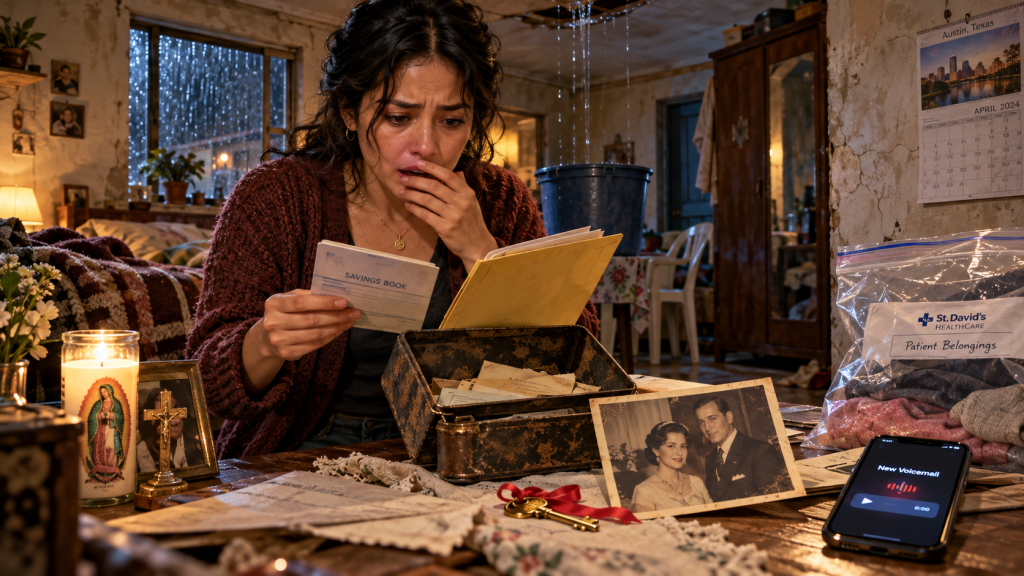
Too large for every afternoon I had stood beside her at a pharmacy counter while she asked whether there was a cheaper generic. Roger finally whispered: “Elena.” I said nothing. “Elena, listen to me.” “No.” His breathing changed.
“What did you find?”
I looked at the old photograph again.
My mother.
Not Theresa Lopez.
Mariana Aranda del Valle.
Pearls.
White dress.
A tall man beside her.
Arturo.
Her father.
My grandfather.
A name attached to buildings I had driven past my entire adult life without knowing they belonged to my blood.
I said:
“You knew who she was.”
Roger exhaled slowly.
“I knew some things.”
“How long?”
Silence.
“Roger.”
“Three years.”
The answer hurt even though I had just read it in Mom’s letter.
Three years.
Three Christmases.
Three birthdays.
Three years of watching our mother count coins.
Three years of him texting me:
If you love her so much, you pay for her.
I whispered:
“You knew she had money.”
“Not like that.”
“What does that mean?”
“I knew there was a trust.”
“I didn’t know the balance.”
“Patricia just said eighteen million.”
Silence.
My stomach tightened.
“Where did she get that number?”
Roger said nothing.
“Where, Roger?”
“It was an estimate.”
“From what?”
“Elena, we need to talk in person.”
“No.”
“You don’t understand what Mom was involved in.”
“Then explain.”
“I can’t over the phone.”
“Convenient.”
“It isn’t safe.”
That word chilled me.
“Safe from whom?”
He lowered his voice.
“The Arandas.”
I looked toward the rain dripping into the bucket.
For sixty years, apparently, my mother had spent her life rearranging herself around that name.
I refused to do the same thing after knowing it for less than an hour.
I asked:
“What did you threaten her with?”
Roger froze.
“I never threatened Mom.”
I looked at the notarized statement.
Her handwriting beneath it.
My son learned the truth three years ago. He told me that if I did not help him financially, he would contact the family I had spent decades avoiding.
I said:
“She wrote it down.”
Roger inhaled sharply.
“What?”
“She wrote down what you did.”
“Elena, she was sick.”
There it was.
The first attempt.
Not:
I didn’t do it.
Not:
That is false.
She was sick.
I felt something inside me harden.
“What was wrong with her memory, Roger?”
“That’s not what I meant.”
“She knew your name?”
“Yes.”
“She knew mine?”
“Yes.”
“She paid her bills?”
“Yes.”
“She still made tamales?”
“Jesus, Elena.”
“So which part of her illness made her invent your blackmail?”
“I did not blackmail her.”
“What did you do?”
Silence.
Then:
“I asked her for money.”
“How much?”
“It doesn’t matter.”
“How much?”
He exhaled.
“Two hundred.”
“Two hundred dollars?”
He said nothing.
My hand tightened around the phone.
“Two hundred thousand?”
“Elena—”
I hung up.
My entire body began shaking.
Not because of the money.
Because for the first time I understood why Roger had never seemed surprised when Mom refused help.
Why he told me she was stubborn.
Why he said:
She has more than she admits.
I thought he meant she had twenty dollars tucked inside a flour tin.
He meant hundreds of thousands.
Maybe millions.
And instead of asking why a frightened old woman lived beneath a leaking roof while money accumulated in her name, my brother had apparently decided the secret meant she owed him.
My phone rang again.
Roger.
I rejected it.
Again.
Rejected.
Then Patricia.
Rejected.
Then a message appeared.
Do not call anyone from the Aranda family until I get there. You could put all of us in danger.
I stared at it.
Then another.
Mom lied to you too. Remember that before you decide I’m the villain.
That sentence stopped me.
Because it was true.
Mom had lied.
For decades.
About her name.
Her family.
Her money.
The source of the strange fear that sometimes crossed her face when expensive cars slowed near our street.
Roger had betrayed her.
But Mom had also built our childhood inside a secret.
Two things could be true.
I hated that already.
Then I looked at the final sealed page bearing my name.
ELENA ONLY.
I opened it.
Inside was a single handwritten letter.
My mother’s handwriting trembled harder with every line.
My Elena,
If you found the box, then I failed to tell you while I was alive.
I stopped.
Tears filled my eyes.
Do not make a saint out of me because I am dead.
That sentence made me sob.
Of course she would begin that way.
My mother hated funeral lies.
Whenever someone cruel died and people suddenly called him generous, she would whisper:
“Death closes a mouth, not a history.”
I kept reading.
I was born Mariana Aranda del Valle. Theresa Lopez Martinez was not a stolen name. It became my legal name after I ran. There are papers proving that with the attorney listed below. You are not the daughter of a criminal identity. Do not carry that fear.
I exhaled.
I had not yet realized I was carrying it until she lifted it.
At the bottom of the page was a name.
Marisol Vega, Attorney at Law.
An Austin number.
Then:
Call her before you call anyone else.
So I did.
At 6:42 that evening, three days after burying my mother, I called a stranger and discovered that Theresa Lopez had been preparing for her death much longer than any of us knew.
Marisol Vega answered on the second ring.
“Vega.”
“My name is Elena Lopez.”
Silence.
Then:
“Where are you?”
My skin prickled.
“At my mother’s house.”
“Are you alone?”
“Yes.”
“Is the box with you?”
I looked down.
“Yes.”
She exhaled.
“Lock the door.”
I almost laughed.
“Why does everybody keep telling me that?”
“Elena.”
Her voice sharpened.
“Lock the door.”
I did.
Front.
Back.
Then I checked the old windows even though half of them could have been defeated by an ambitious squirrel.
“Done.”
“Do not photograph the original documents and send them to anyone.”
“Okay.”
“Do not give the box to your brother.”
“I wasn’t planning to.”
“Good.”
“Do you know Roger?”
Another pause.
“I know of him.”
“Did my mother tell you what he did?”
“Yes.”
My chest tightened.
“How long were you her lawyer?”
“Four years.”
I sat down.
Four years.
Four years Mom had had a lawyer.
Four years I had been calling pharmacies, filling out charity-care forms, and driving her to appointments while she quietly met with counsel.
“Why didn’t she tell me?”
“That is a question she struggled with constantly.”
“That doesn’t answer it.”
“No.”
Marisol’s voice softened.
“It doesn’t.”
I appreciated that.
She did not defend the dead simply because the dead had retained her.
I asked:
“Is the money real?”
“Yes.”
“All eighteen million?”
“The number you are looking at may not be current.”
My stomach dropped.
“So it isn’t.”
“I didn’t say that.”
“What is it?”
Marisol took a breath.
“The book in that box is not an ordinary passbook savings account, despite its appearance.”
I looked again at the cover.
It had the logo of a bank I barely recognized.
“A legacy beneficiary ledger was maintained for your mother’s interest in a private trust and associated custodial investment account.”
“English.”
“The money is real.”
“How much?”
“The last verified valuation I saw was approximately eighteen-point-seven million dollars.”
I closed my eyes.
“Jesus.”
“Some of that value fluctuates.”
“Some assets are not cash.”
“There may be tax obligations and administrative expenses.”
“But yes.”
“The wealth is real.”
I began laughing.
Not happily.
I looked at the ceiling.
A drop of rain hit the metal bucket.
Ping.
Eighteen million dollars.
Ping.
My mother’s bathroom floor had plywood over one broken tile because she said replacing it was wasteful.
Ping.
She had once split one blood-pressure pill because she thought the refill cost too much.
I whispered:
“Why?”
Marisol knew what I meant.
“Because she was afraid.”
“She had eighteen million dollars.”
“Yes.”
“And she lived like this.”
“Yes.”
“That isn’t fear.”
“It can be.”
“No.”
My voice broke.
“That is madness.”
Marisol did not argue.
After a moment, she said:
“Your mother eventually called it that too.”
I became quiet.
“What?”
“She wrote something for you about the money.”
“Another letter?”
“Yes.”
“Where?”
“With me.”
I looked at the box.
“Why isn’t it here?”
“Because she was afraid Roger would find this box before you.”
My chest tightened.
“That almost happened.”
“I know.”
“How?”
“Your mother called me from the hospital four days before she died.”
I covered my mouth.
“She could barely talk.”
“She talked enough.”
“What did she say?”
Marisol hesitated.
Then:
“She said, ‘Roger is looking for the red ribbon.’”
I looked at the tiny gold key lying on the floor.
The red ribbon.
My stomach turned.
“She knew.”
“Yes.”
“Did he go to the hospital?”
“Twice.”
“I know.”
“No.”
Marisol said quietly.
“I mean he went once after you left and asked staff whether your mother had brought personal papers with her.”
I froze.
“How do you know?”
“The nurse called me.”
The older nurse.
The one who told me Mom had warned her not to let Roger touch anything.
Everything connected.
Too late.
I asked:
“What am I supposed to do now?”
“First, get out of that house tonight.”
I looked around.
“No.”
“Elena.”
“This was my mother’s home.”
“And your brother knows the box exists.”
“He doesn’t know I have it.”
“He suspects.”
I thought of his voicemail.
Has she found the box yet?
He knew enough.
Marisol continued.
“Bring the box to my office.”
“Tonight?”
“Yes.”
“Then go somewhere Roger cannot simply walk into.”
I almost laughed.
“I don’t have a secret compound.”
“A hotel.”
“A friend.”
“Anywhere.”
“Do you think he would hurt me?”
Marisol became quiet.
“I have no evidence that Roger has been physically violent with anyone.”
Good.
Important.
“Then why are you frightening me?”
“Because desperate people make unpredictable decisions.”
“And because you have original documents that may matter in civil and regulatory proceedings.”
That was different from saying my brother would attack me.
I appreciated the distinction.
I said:
“I’ll come.”
“Good.”
“One more thing.”
“What?”
“March seventeenth.”
I stared at the old calendar.
“What is it?”
Silence.
Then:
“The day your mother planned to give a sworn statement.”
My heart stopped.
“To whom?”
Marisol answered:
“People who had been waiting thirty-six years to hear it.”
Marisol’s office occupied the second floor of a plain brick building near downtown.
No marble.
No giant law-firm sign.
No black cars.
Just an elevator that smelled faintly of old coffee.
I carried the cookie tin inside a canvas grocery bag because the absurdity felt appropriate.
Eighteen million dollars hidden in a Danish butter-cookie box.
My mother would have appreciated that.
Marisol was fifty-something, with silver threaded through dark hair and the watchful eyes of someone who had spent decades listening to people omit important details.
She locked the office door after me.
Then stared at the tin.
“So she really kept it there.”
“You knew?”
“She told me she hid the ledger ‘where greedy people would expect sewing buttons.’”
I laughed despite myself.
“That sounds like her.”
Marisol smiled.
“Yes.”
That smile made me angry.
“You knew her.”
“I did.”
“Four years.”
“Yes.”
“And I knew nothing about you.”
Her smile disappeared.
“I know.”
“Did she talk about me?”
“Constantly.”
“That does not make me feel better.”
“I didn’t expect it to.”
Good answer.
She put on thin cotton gloves before removing the old photograph and papers.
Not because the documents were ancient artifacts.
Because some were originals that might become evidence.
She examined the birth certificate.
The trust ledger.
The notarized statement.
Then the Aranda del Valle Group folder.
When she reached the newspaper clippings, she sighed.
“She kept these too.”
“What happened in 1989?”
Marisol looked at me.
“Your mother discovered that several land transfers involving the Aranda family companies had been altered.”
“How?”
“She worked in the family accounting department after college.”
I blinked.
“Mom was an accountant?”
“She studied finance.”
I almost laughed.
My mother had spent years pretending not to understand interest rates.
She had once asked me whether a credit card “recharged itself” if you did not use it.
I thought she was financially helpless.
Apparently she had been acting.
Marisol continued.
“Your grandfather, Arturo, founded part of the construction group with two relatives.”
“By the late eighties, the companies were expanding aggressively.”
“Your mother found accounting entries tied to parcels that had been purchased or transferred under questionable authority.”
“What does that mean?”
“Some family-held properties were moved through shell entities.”
“Some signatures were disputed.”
“Some compensation that should have gone to minority owners and relatives was redirected.”
“Was Arturo doing it?”
Marisol hesitated.
“Your mother never claimed he created the scheme.”
“But?”
“She believed he discovered it and chose to contain it rather than expose it.”
That sounded worse in some ways.
“What about the man in the photograph?”
“Arturo.”
“He’s alive?”
“Yes.”
I felt the room tilt.
“How old?”
“Eighty-nine.”
My grandfather was alive.
Somewhere in the same state.
Perhaps watching buildings rise with his name on them.
I asked:
“Does he know Mom died?”
Marisol nodded.
“Yes.”
“How?”
“I told family counsel after her death because certain trust provisions required notice.”
I stared.
“So the Arandas know I exist.”
“They knew your mother had children.”
“Names?”
“Possibly.”
“Possibly?”
“Elena, wealthy families can be very good at keeping records while pretending not to know people.”
I did not like the sentence.
Mostly because it sounded true.
I asked:
“Why did Mom run?”
Marisol opened another document.
A copy of a handwritten memorandum from 1989.
Mom’s handwriting, younger and firmer.
Names.
Parcel numbers.
Payment amounts.
Then a line:
Arturo says give it back. Rafael says I never saw anything.
“Who is Rafael?”
“Your mother’s older brother.”
“My uncle.”
“Yes.”
“He is now executive chairman of Aranda del Valle Group.”
My chest tightened.
“Was he involved?”
“Your mother believed he was.”
“Can anyone prove it?”
“Some things.”
“Not everything.”
“Remember how long ago 1989 was.”
“Records disappear.”
“People die.”
“Statutes expire.”
“Companies change.”
“Do not expect one folder to send a dynasty to prison.”
That sentence was so grounded it calmed me.
“Then what was she going to testify about?”
“Not only 1989.”
Marisol pulled out a new file.
“The trust continued making payments to your mother.”
“Yes.”
“Initially through attorneys.”
“Later through a private trust administrator.”
“For years, the payments accumulated because she refused to take distributions.”
“Then?”
“About six years ago, the trust structure was amended.”
“Rafael wanted releases signed.”
“What kind?”
“Broad settlement and confidentiality releases involving old family claims.”
“Mom signed?”
“She signed one limited agreement under her legal name.”
“Theresa?”
“Mariana Aranda del Valle, legally known as Theresa Lopez Martinez.”
“So they knew exactly where she was.”
“Not exactly.”
“Payments went through counsel.”
“She insisted her residential address remain confidential.”
“Why?”
“Because she still believed someone had followed her after she left Chicago in 1989.”
I swallowed.
“Was she right?”
“We do not know.”
There it was again.
Reality.
No dramatic certainty.
No convenient murderer hiding behind every shadow.
Marisol continued.
“Three years ago, Roger found a trust statement.”
“The timing from Mom’s letter.”
“Yes.”
“He photographed it.”
“Then he searched the name.”
“He learned who she had been.”
“What did he do?”
Marisol’s face tightened.
“He called her.”
“From his own phone?”
“Yes.”
“Not very sophisticated.”
“Most family coercion isn’t.”
That sentence hurt.
She continued.
“He asked why she had let him struggle financially while millions sat untouched.”
That sounded like Roger.
Not yet extortion.
Just anger.
Maybe even understandable anger.
Then:
“Your mother told him the money was not his.”
“He demanded two hundred thousand dollars.”
“She refused.”
“Then he told her if she did not pay him, he would call Rafael’s office and tell them where she lived.”
My hands went cold.
“Did he?”
“No.”
“How do you know?”
“Because your mother paid him sixty thousand dollars first.”
I stared.
“What?”
Marisol opened a ledger.
Not the trust ledger.
Mom’s own.
Transfers.
$20,000.
$15,000.
$25,000.
Three payments.
“He kept asking.”
“How much total?”
“Over three years?”
Marisol looked at me.
“Four hundred eighty-two thousand dollars.”
I stopped breathing.
Not two hundred.
Nearly half a million.
“Roger took that much from her?”
“Not all as direct cash demands.”
“Some he called loans.”
“Some were transfers to cover debts.”
“Some went to Patricia’s business.”
“Some paid their mortgage arrears.”
“But yes.”
“Your mother documented approximately four hundred eighty-two thousand dollars that she believed she gave because Roger had threatened to expose her location or history.”
I covered my face.
Then anger arrived.
Hot.
Clean.
“He let me pay for her medication.”
Marisol said nothing.
“I used my credit card.”
“My insurance barely covered my own expenses.”
“I skipped a vacation for three years.”
“I bought her groceries.”
“I begged Roger to help.”
My voice broke.
“He had almost half a million dollars from her.”
“Yes.”
I stood.
Walked toward the window.
Austin glittered outside.
Glass towers.
Traffic.
A city continuing as if my life had not split open.
I whispered:
“And Patricia knew.”
“Yes.”
“How much?”
“She participated in some of the messages.”
I laughed bitterly.
“Negotiated.”
“That’s what Mom wrote.”
“Yes.”
I turned.
“Why didn’t Mom tell me?”
Marisol looked tired.
“Because she thought you would confront Roger.”
“I would have.”
“She knew.”
“And?”
“She thought you might contact the Arandas in anger.”
“I might have.”
“She knew that too.”
“So she chose for me.”
“Yes.”
That answer startled me.
No defense.
Marisol continued.
“She spent most of her life letting fear make decisions for everyone around her.”
“She became aware of that near the end.”
“Did she regret it?”
“Deeply.”
I looked at the leaking-house woman in the photograph.
Pearls.
White dress.
Sad eyes.
“She should have bought the sweater.”
Marisol’s face changed.
“What?”
“My mother.”
“She spent years saying she couldn’t afford a sweater.”
I felt tears rise.
“She had eighteen million dollars.”
“She should have bought the damn sweater.”
Marisol nodded.
“Yes.”
Not:
She was noble.
Not:
She sacrificed.
Just:
Yes.
That saved something inside me.
My mother had left a will.
Of course Patricia had been wrong.
Not only a will.
A revocable trust.
Health-care directives.
A durable power of attorney that had expired at death.
A written statement explaining her identity.
And an estate memorandum so detailed it made me wonder whether she had secretly been waiting decades to become an accountant again.
Marisol showed me the original documents.
Mom’s legal name appeared as:
Mariana Aranda del Valle, also known as Theresa Lopez Martinez.
The name change had been lawful.
A court order from 1990.
No stolen Social Security number.
No fake dead child.
No fantasy identity.
Mom had disappeared socially, not legally.
That mattered.
I had enough nightmares already.
Marisol explained the trust structure carefully.
The $18.7 million did not sit in a checking account ready for me to withdraw with the little gold key.
It represented Mom’s interest in a privately managed trust and investment account funded through decades of distributions, settlements, reinvestment, and appreciation.
Some assets were cash.
Some securities.
Some partnership interests.
Some restricted.
The exact value moved with markets.
There would be administration.
Taxes where applicable.
Legal review.
Potential claims.
Nothing would turn into a suitcase of eighteen million dollars tomorrow.
Good.
I almost wanted complexity.
Complexity slowed greed down.
Then Marisol showed me Mom’s estate plan.
I expected Roger to be cut out.
He wasn’t.
That shocked me more than the fortune.
“Why?”
Marisol leaned back.
“Because your mother distinguished inheritance from forgiveness.”
I stared.
“Explain.”
“She left you and Roger each a beneficial share.”
“Equal?”
“No.”
I hated that I wanted the answer.
“How much?”
“Forty percent of the net personal estate and trust residue to you.”
“Fifteen percent to Roger through an independent spendthrift trust.”
“Thirty-five percent to a charitable and restitution fund she created.”
“Ten percent divided among specific community causes and personal gifts.”
I did the numbers badly in my head.
Still millions.
Roger could have betrayed her and still receive something enormous.
I whispered:
“Why fifteen?”
“She originally planned equal shares.”
“Then the coercive transfers began.”
“She amended the trust.”
“Why not zero?”
Marisol looked at me.
“Her letter explains.”
Another letter.
Of course.
“She wrote that Roger’s wrongdoing did not erase the fact that he was her son.”
“She also wrote that giving him unrestricted control over a large inheritance after he had tried to force money from her would be irresponsible.”
“So she split the difference.”
“In a way.”
“His trust has an independent trustee.”
“No power for Patricia?”
“None.”
“Can he demand distributions?”
“Subject to defined terms.”
“Is the money he already took deducted?”
“Your mother directed the trustee and personal representative to account for documented advances and coercive transfers to the extent legally supportable.”
“That issue may require negotiation.”
“So not magical punishment.”
“No.”
Good.
I was learning to distrust magical punishment.
Marisol continued.
“The thirty-five percent fund is more important.”
“What is it?”
“She named it the Theresa-Mariana Restitution and Dignity Fund.”
I laughed through tears.
“That is an awful name.”
“She changed it seven times.”
“What does it do?”
“Two things.”
“First, it funds legal and archival work to identify people harmed by the old family land transactions where claims can still be responsibly documented.”
“Second, it provides grants for elderly low-income residents in Central Texas facing medication, housing, or food insecurity.”
That broke me.
I sat down.
Medication.
Food.
The things she denied herself.
“She knew.”
Marisol nodded.
“She knew how contradictory her life looked.”
“She did not want anyone romanticizing it.”
Then Marisol handed me another letter.
This one was sealed.
ELENA — AFTER YOU KNOW THE MONEY IS REAL.
I opened it.
Sweetie,
Please do not tell people I lived poor because I was noble.
I began crying before I reached the second line.
I lived poor because I was afraid.
There is a difference.
I pressed the page to my lips.
At first, I did not touch the money because I thought any use would help them find me.
Later, when lawyers created safer ways for me to receive it, I still could not spend.
By then fear had become habit.
Then habit became punishment.
I told myself the money was dirty.
I told myself using it meant I had accepted the price of silence.
So I worked. I sold tamales. I collected bottles. I counted coins.
I made suffering into proof that they did not own me.
My tears dropped onto the page.
That was foolish.
I should have fixed the roof.
I should have bought the medicine.
I should have bought the sweater.
I covered my face.
Marisol looked away.
I kept reading.
Do not admire me for deprivation.
Fear does not become courage simply because it lasts a long time.
I made you watch me struggle when I had choices.
That was unfair to you.
I sobbed.
There are apologies you wait your whole life to hear without knowing you were waiting.
This was one.
You thought I was poor and tried to save me.
I let you.
I am sorry.
I could barely see.
I did not tell you because I thought ignorance kept you safe.
Maybe it did for a while.
But eventually secrecy became another way of controlling you.
If I taught you anything worth keeping, let it be this: protection without truth can become a cage built by someone who loves you.
I stopped reading.
My mother had been afraid for most of her life.
Yet near the end, she had found language for what fear had done.
That did not return the years.
It gave them shape.
I finished.
March 17 was supposed to be the day I stopped being quiet.
If I did not live long enough, Marisol knows what to do.
You do not have to continue my fight.
That choice is yours.
Not mine.
That final sentence hurt most beautifully.
Choice.
At last.
I did not sleep that night.
I stayed at Marisol’s guest suite above her detached garage because she refused to let me return home with the documents.
The originals remained in her office safe.
Roger called fourteen times.
Patricia nine.
I listened to none of the messages until morning.
Then I played them with Marisol present.
The first four were angry.
Elena, stop acting crazy.
You have no idea what you found.
Mom manipulated everybody.
Call me.
Then fear replaced anger.
Please.
You cannot just give those papers to strangers.
You will destroy the family.
Which family?
Ours?
The Arandas?
The one Mom fled?
The one Roger threatened to expose her to?
By message eleven, Roger was crying.
I never wanted her scared of me.
That sentence did something.
Not enough.
Something.
The final message came at 3:11 a.m.
I know what I did was wrong. But you don’t know what happened when I found out she had millions while I was losing my house. Please let me explain before you decide I’m a monster.
I looked at Marisol.
“She never told me he was losing his house.”
“He hid much of his financial trouble.”
Of course.
Everyone in my family had apparently been participating in an Olympic event called Silent Catastrophe.
I called Roger.
Not alone.
Speakerphone.
Marisol sat across from me.
He answered immediately.
“Elena.”
“I’m with Mom’s lawyer.”
Silence.
“Marisol?”
Interesting.
“You know her.”
“Yes.”
“How?”
“Mom mentioned her.”
“Only mentioned?”
Silence.
Marisol wrote something on a legal pad and turned it toward me.
Let him talk.
I said:
“Tell me your version.”
Roger exhaled.
Then began.
Three years earlier, his contracting business had failed after two clients defaulted.
He owed suppliers.
Back taxes.
Credit cards.
Their mortgage was four months behind.
Patricia’s boutique was barely surviving.
He went to Mom’s house looking for an insurance document because she had told him she once kept copies of family records.
He found a trust statement inside an old grocery bag.
Balance then:
Around fourteen million.
He thought it was fake.
Then he searched Aranda del Valle.
Found photographs.
Found an old society-page image of Mariana Aranda.
Our mother.
He confronted her.
“She lied to my face.”
Roger’s voice broke.
“She said it wasn’t what I thought.”
“I asked how a fourteen-million-dollar account was not what I thought.”
“What did you say next?”
“I asked why she watched me lose everything.”
“Did you ask her for money?”
“Yes.”
“How much?”
“Two hundred thousand.”
“Did she say no?”
“Yes.”
“Then?”
Roger became quiet.
“Then I got angry.”
“What did you say?”
“Elena.”
“Say it.”
“I said if she thought I was going to lose my house while she sat on millions, maybe Rafael Aranda should know where she lived.”
There it was.
His own mouth.
No letter.
No interpretation.
I closed my eyes.
“Did you know she was afraid of them?”
“Yes.”
“So you used fear.”
He started crying.
“Yes.”
Marisol watched me carefully.
I asked:
“Why did she pay you sixty thousand first?”
“I told her it would stop foreclosure.”
“Did it?”
“Yes.”
“Then why did you keep asking?”
Silence.
“Roger.”
“Because once she paid, I knew she would.”
My stomach turned.
That was the ugliest truth yet.
Not desperation.
Opportunity.
He continued.
“I kept telling myself it was my inheritance.”
“She had hidden money from us.”
“I thought she owed us.”
“Us?”
“You too.”
I laughed sharply.
“Did you send me any?”
“No.”
“Did you tell me?”
“No.”
“So do not put my name inside your justification.”
He sobbed.
“You’re right.”
“Patricia?”
“She knew.”
“How involved?”
“She helped me keep records.”
“She talked to Mom.”
“Did she threaten her?”
“Once.”
Marisol’s eyes narrowed.
“What did she say?”
Roger hesitated.
“Patricia said if Mom didn’t help with our mortgage, maybe it was time the Arandas knew their missing daughter was still alive.”
I felt cold.
“Did Mom pay after that?”
“Yes.”
“How much?”
“Eighty.”
Eighty thousand dollars.
I stood and walked away from the phone.
Marisol said:
“Elena.”
I returned.
Not because I wanted to.
Because my mother had left me a choice.
And choices require hearing truths you dislike.
I asked:
“Why did you tell me she had nothing?”
Roger cried harder.
“I was ashamed.”
“No.”
“That explains hiding the money.”
“Why mock her poverty?”
Silence.
Then:
“Because I was angry at her.”
There.
“I hated watching her act poor.”
“She would wear that disgusting blanket and then send me twenty thousand dollars.”
“I thought she was performing.”
“She was.”
I said.
“But not for the reason you thought.”
“I know now.”
“No.”
“You knew she was afraid.”
He whispered:
“Yes.”
I closed my eyes.
That was enough.
I asked:
“Did you know about March seventeenth?”
“Yes.”
My eyes opened.
“How?”
“Patricia heard Mom on the phone.”
“She said she was done paying.”
“She said she was going to tell everything.”
“Did you tell anyone in the Aranda family?”
“No.”
“Did Patricia?”
“No.”
“Can you prove that?”
“No.”
At least he did not lie.
Then I asked the question that frightened me most.
“Did you do anything to stop her from testifying?”
Roger went silent.
My heart hammered.
“Elena, no.”
“Anything.”
“No.”
“Did you touch her medication?”
“No.”
“Interfere with the hospital?”
“No.”
“Did you cause her death?”
His voice broke into something close to a scream.
“No!”
I closed my eyes.
Marisol held up one hand.
Slow down.
Good.
I had jumped from financial coercion to murder because fear loves a vacuum.
I took a breath.
“Okay.”
Roger cried.
“I was awful.”
“I was greedy.”
“I scared her.”
“But I did not hurt her physically.”
“I didn’t kill our mother.”
I believed him.
Not because he deserved belief.
Because nothing I had seen suggested otherwise.
Later, medical records confirmed Mom died from complications of heart failure and kidney disease.
No poison.
No secret injection.
No last-minute murder.
Death was ordinary.
The betrayal was enough without inventing another.
I asked:
“What do you want now?”
Roger whispered:
“To see you.”
“No.”
“To explain.”
“You have.”
“To know what Mom left.”
There it was.
Even after everything.
The inheritance.
I almost laughed.
Instead:
“You will hear from the trustee.”
His breathing stopped.
“Trustee?”
“Yes.”
“She left a trust?”
“Yes.”
“How much?”
I looked at Marisol.
She shook her head once.
Not because I could not tell him.
Because I did not owe him an emotional financial briefing while he was crying about coercing our mother.
I said:
“You’ll receive formal notice.”
“Elena.”
“No.”
“You do not get to move from confession directly into arithmetic.”
Then I hung up.
March 17 arrived six days later.
The red circle on Mom’s hardware-store calendar had haunted me all week.
I considered doing nothing.
Mom had written:
You do not have to continue my fight.
That freedom made the decision harder.
If she had commanded me, I could have resented her.
Instead, she left me choice.
So I met Marisol at a federal office building with no cameras outside and no dramatic convoy.
Two attorneys.
A state financial investigator.
A federal investigator interested in certain ongoing trust and corporate-reporting issues.
And a retired forensic accountant who had been reviewing old Aranda records for another civil matter.
No giant courtroom.
No reporters.
Just fluorescent lights.
Bottled water.
Files.
That felt more serious.
Marisol placed copies of Mom’s documents on the table.
Then said:
“Mariana Aranda del Valle was scheduled to appear today.”
The room became quiet.
“She died on March 11.”
One investigator looked at me.
“You’re her daughter?”
“Yes.”
“Are you here to testify?”
“No.”
“Not about events I didn’t witness.”
That mattered.
I had no intention of becoming my mother’s memory through imagination.
I continued:
“I’m here to authenticate what I found and provide the materials through counsel.”
The investigator nodded.
Good.
Facts.
Not performance.
They asked about the box.
Where I found it.
Who had access.
How I preserved it.
They asked about Roger.
I disclosed the voicemail.
The messages.
The letter.
Marisol had already preserved originals.
Then came the Aranda records.
Some were old.
Too old to support criminal charges by themselves.
Some transactions had been litigated decades earlier.
Some potential claims were barred.
Some people were dead.
Some records lacked provenance.
Reality entered the room and did what reality does.
Reduced fantasy.
But other records were newer.
Trust amendments.
Side letters.
Internal accounting references to old disputed parcels.
Payments coded as “continuity” and “silence.”
One of those entries matched Mom’s $300,000 March deposit.
The investigators cared about that.
Not because “silence money” automatically proved a crime.
Because the payment sat inside a current structure connected to old claims that had never been cleanly resolved.
The retired accountant looked at the ledger.
Then whispered:
“I’ve seen this code.”
The room changed.
Not exploded.
Changed.
He pulled another file.
A separate trust-beneficiary dispute involving a distant Aranda cousin.
Same code.
SILENCE.
Not literal hush money in every case.
Apparently internal shorthand created decades earlier for settlement payments tied to confidentiality.
Still.
Ugly.
Useful.
The investigation widened.
Slowly.
Legally.
Without a single dramatic arrest.
That disappointed Roger when he later asked.
It relieved me.
Real justice should survive scrutiny, not applause.
The first Aranda to contact me personally was not Rafael.
It was Arturo.
My grandfather.
He sent a letter through Marisol.
One page.
No pressure.
No money.
Elena,
I have known of you since you were born.
That sentence made me physically ill.
I had to stop reading.
Known of me.
My entire childhood.
Birthdays.
School.
College.
My mother selling tamales outside church.
He knew.
I continued.
I did not know where Mariana lived for much of her life because she asked that I not know. When lawyers reestablished contact years later, she permitted me to receive limited updates but not her address.
I respected that too late.
I swallowed.
I have no right to ask you for a relationship.
Good.
I would like one opportunity to answer your questions about your mother while I still can.
He was eighty-nine.
I hated that age made everything feel urgent.
Urgency had controlled Mom long enough.
I waited three weeks.
Then agreed.
Neutral office.
Marisol present.
No Aranda mansion.
No private jet.
No room designed to make me feel small.
Arturo arrived using a cane.
Tall even then.
Silver hair.
Expensive suit.
But the thing that destroyed me was his nose.
My mother’s nose.
Mine.
Genetics can be cruelly intimate.
He looked at me and began crying.
I did not.
Not yet.
He whispered:
“You look like Beatrice.”
“My grandmother.”
“Yes.”
“Is she alive?”
His face changed.
“No.”
“She died fifteen years ago.”
I nodded.
Another relative lost before I knew she existed.
Arturo sat.
For a long moment, neither of us spoke.
Then he said:
“I am sorry for your mother.”
I stared.
“For what part?”
He closed his eyes.
Fair question.
He began with 1989.
Mom—Mariana—worked in finance for one branch of the company.
Her older brother Rafael was ambitious.
So were two cousins.
They used shell entities to consolidate land and development rights from extended-family partnerships and smaller stakeholders.
Some transfers had legitimate approvals.
Some apparently did not.
Mom found inconsistencies.
Missing consents.
Payments routed through accounts that did not match closing statements.
She confronted Rafael.
He told her she misunderstood.
She went to Arturo.
“What did you do?”
I asked.
Arturo looked down.
“I told her to give me the records.”
“And?”
“I investigated privately.”
“What did you find?”
“Enough to know she was not imagining it.”
My hands tightened.
“And then?”
“I made settlements.”
“With whom?”
“Several relatives.”
“Quietly?”
“Yes.”
“Did you report Rafael?”
“No.”
There it was.
“Why?”
Arturo’s eyes filled.
“Because I believed exposing him would destroy the company.”
“The company employed more than two thousand people.”
“Banks could have called loans.”
“Projects could have collapsed.”
“I told myself I was protecting workers.”
“And your son.”
He looked at me.
“Yes.”
“And yourself.”
“Yes.”
Good.
No heroic corporate excuse.
He continued.
“Mariana said people had been threatened.”
“Were they?”
“I did not order threats.”
“That was not my question.”
Arturo gripped his cane.
“I learned later that one security contractor had followed a former partner.”
“Did he follow Mom?”
“We never proved it.”
“Did Rafael order it?”
“I don’t know.”
I stared at him.
“Did you ask?”
“Yes.”
“He denied it.”
“And you believed him.”
“I wanted to.”
There.
A family tradition.
Believing what makes love easier.
I asked:
“Why did Mom flee?”
“She believed I had chosen Rafael.”
“Had you?”
Arturo began crying.
“Yes.”
That simple word landed harder than a complicated defense.
“She wanted me to report everything.”
“I asked for time.”
“She said time was how powerful people turned truth into paperwork.”
That sounded like Mom.
Arturo continued.
“She left.”
“First Chicago.”
“Then somewhere else.”
“We lost contact.”
“Years later, lawyers contacted me.”
“She needed proof of her birth records for the name change and certain tax matters.”
“I begged to see her.”
“She refused.”
“So you created the trust.”
He nodded.
“The trust already existed.”
“Her share.”
“I ensured her distributions continued.”
“She refused them.”
“Then why did the balance grow?”
“Because they remained invested.”
“Over decades.”
“Yes.”
“Did you attach silence as a condition?”
Arturo flinched.
“The original trust distributions were hers regardless.”
“But later settlement payments?”
“Yes.”
“That is different.”
“Tell me.”
He looked ashamed.
“Years later, when she threatened to reopen certain claims, counsel negotiated confidentiality provisions.”
“You paid your daughter not to speak.”
“I approved settlements.”
“You paid your daughter not to speak.”
He closed his eyes.
“Yes.”
I finally cried.
Not loudly.
I looked at this old man who had loved my mother and chosen reputation over truth.
Suddenly I understood why Mom could never spend the money.
Every dollar carried a sentence:
Your father chose the company.
Arturo whispered:
“I thought money would give her security.”
“She experienced it as a price.”
“Yes.”
“Did you know she lived poor?”
“Not how poor.”
“How could you not?”
“She would not allow us to know her address.”
“You had lawyers.”
“She refused home visits.”
“You had investigators.”
His face changed.
“I promised I would stop trying to locate her.”
“After she caught us once.”
There it was.
Mom had not imagined being watched.
Arturo continued.
“Early on, I hired someone to find her.”
“She discovered it.”
“She told my attorney that if I did it again, she would disappear completely.”
“I stopped.”
Too late.
Fear had already been confirmed.
I asked:
“Did you know Roger threatened her?”
His expression changed to shock.
“No.”
I watched carefully.
He looked genuinely horrified.
“He threatened Mariana?”
“Yes.”
“With what?”
“Telling your family where she lived.”
Arturo covered his mouth.
I felt something unexpected.
Pity.
Not for the billionaire grandfather.
For the father realizing his own name had become a weapon against his daughter.
He whispered:
“Dear God.”
“She was afraid of you until she died.”
He shook his head.
“Not me.”
I leaned forward.
“Your family.”
“Your company.”
“Your son.”
“Your lawyers.”
“The people you once sent to find her.”
“You do not get to separate yourself from the fear just because you personally never threatened her.”
He bowed his head.
“Yes.”
That was the only acceptable answer.
Arturo asked about Mom’s funeral.
I told him neighbors paid for much of it.
His face crumpled.
“I would have—”
“I know.”
That was the tragedy.
He would have paid for everything.
Hospital.
Roof.
Funeral.
Sweater.
Mom would rather sell tamales than ask.
Love can exist and still become unusable.
That is one of the saddest things I have ever learned.
Arturo asked:
“Where is she buried?”
I hesitated.
Then told him.
He did not go immediately.
He asked my permission.
That mattered.
I said:
“You don’t need my permission to visit a grave.”
He nodded.
“No.”
“But I needed to ask.”
Two weeks later, I found fresh white roses there.
No card.
I knew.
I left them.
The Aranda investigation did not destroy the family empire.
That would make a better headline.
It would also be false.
Several old claims could not be revived.
Some documents supported civil accounting disputes rather than crimes.
A few historic property issues had already been quietly settled.
But Mom’s files prompted an independent review that uncovered current reporting irregularities linked to legacy entities.
Regulators got involved.
Trust beneficiaries demanded accountings.
Several board members resigned.
Rafael stepped down as executive chairman eighteen months later.
Not in handcuffs.
Under pressure.
The company paid substantial civil settlements to resolve multiple beneficiary and property-accounting claims without admitting every allegation.
Some matters remained disputed for years.
That was reality.
Slow.
Expensive.
Imperfect.
Rafael never went to prison for what happened in 1989.
The evidence and legal timelines did not support a clean cinematic outcome.
I hated that at first.
Then Marisol told me:
“Truth is not worthless because punishment arrives smaller than grief wants.”
I wrote that down.
Roger’s consequences were more immediate.
Mom’s records included messages.
Transfers.
Voice notes.
One recording.
She had recorded a conversation with him in her kitchen.
Texas law allowed her to record a conversation she was part of.
I listened once.
Never again.
Roger’s voice:
“You have fourteen million dollars and you’re letting your own son drown.”
Mom:
“That money is not water, Roger.”
Roger:
“Then call it whatever you want and send me fifty.”
Mom:
“No.”
Then Roger said:
“I wonder what Rafael would pay to know exactly where you are.”
Silence.
My mother’s voice changed.
Small.
“Don’t.”
I stopped the recording.
That one word haunted me.
My mother had survived decades.
Changed her name.
Built another life.
Raised children.
And her own son had found the exact fear that could make her voice shrink.
State authorities reviewed the matter as potential elder financial exploitation and coercive conduct.
Not every transfer became part of a criminal case.
Some were genuinely loans.
Some could not be cleanly categorized.
Patricia’s role differed from Roger’s.
The evidence showed she participated in several demands and benefited from transfers, but Roger initiated most contact.
The case took more than a year.
Roger eventually entered a plea to financial exploitation and coercion-related charges.
He was sentenced to a finite period of incarceration followed by probation and ordered to pay restitution from assets and any estate distributions legally available for that purpose.
He served fourteen months.
Patricia pleaded to a lesser offense after cooperating, received probation, financial penalties, and restitution obligations.
Their marriage did not survive.
I did not celebrate.
The day Roger reported to serve his sentence, he called me.
I almost did not answer.
Then I did.
“Elena.”
“Yes.”
“I’m scared.”
I closed my eyes.
“So was Mom.”
Silence.
“I know.”
“No.”
I said.
“You know the sentence.”
“You do not know the years.”
He began crying.
“I’m sorry.”
“I know.”
“Do you hate me?”
I thought.
“No.”
He seemed shocked.
“I should.”
“No.”
“You should live long enough to understand why you became someone who thought fear was a family currency.”
He cried harder.
Then:
“Will you visit?”
“Not yet.”
He whispered:
“Okay.”
That was the beginning.
Not forgiveness.
A boundary.
The estate administration took nearly two years.
Eighteen million dollars did not simply appear in my bank account.
Assets had to be valued.
Trust interests reviewed.
Taxes addressed.
Claims handled.
Roger’s prior transfers accounted for through negotiation and court-approved administration.
The charitable structure established.
Lawyers paid.
Accountants paid.
Everyone disappointed by how unglamorous money becomes once professionals are involved.
By the time distributions stabilized, the numbers had changed.
Markets moved.
Settlements shifted values.
Some assets appreciated.
Some were sold.
I still received more money than I had ever imagined owning.
Millions.
Enough to alter my life completely if I let it.
The first thing I bought was a sweater.
Not for myself.
For Mom.
That sounds ridiculous.
She was dead.
I knew that.
Still, I went to a department store and found the softest brown cashmere sweater I could.
$268.
More than Mom would have allowed anyone to spend on ten sweaters.
I bought it.
Took it to her grave.
Sat on the grass.
Placed it across my lap.
Then started laughing.
“Look at this, Mom.”
Tears came.
“Two hundred sixty-eight dollars.”
“You’d have a stroke.”
Then I cried so hard I could barely breathe.
“You should have bought one.”
“I mean it.”
“You should have fixed the roof.”
“You should have taken the medicine.”
“You should have told me.”
The cemetery remained quiet.
I whispered:
“I love you.”
Then:
“I’m angry with you.”
Both were true.
That became the theme of my inheritance.
I repaired the house.
Not lavishly.
Roof.
Floor.
Plumbing.
Windows.
No more buckets in the living room.
For several months, I considered tearing it down.
Then selling.
Then turning it into a museum of Mom’s suffering.
Marisol stopped me.
“Do not build a shrine to deprivation.”
Right.
Instead, part of the house became an office for the fund.
The rest remained a small community kitchen.
Every Sunday, volunteers made food.
Not only tamales.
Mom would have objected to bad menu planning.
We named the place Casa Tere.
Not Aranda.
Not Mariana.
Tere.
The woman neighbors knew.
A plaque near the entrance said:
Kindness should never require someone to prove they have suffered enough.
The fund paid for prescriptions.
Utility bills.
Emergency home repairs.
Short-term legal help for elderly people dealing with financial coercion.
No one had to be secretly rich.
That mattered to me.
Mom’s story would be dangerous if people took the wrong lesson from it.
The lesson was not:
Do not underestimate poor-looking women because they may have eighteen million dollars.
Most poor-looking women do not.
They deserve dignity anyway.
The lesson was:
Poverty, wealth, fear, age, and family do not erase a person’s right to make choices about their own life.
That was the lesson worth spending money on.
Arturo died three years after Mom.
Before he died, I saw him six times.
Not enough to become a grandfather.
Enough to become a person.
He showed me photographs of Mom as a child.
Mariana at seven with missing teeth.
Mariana at thirteen holding a violin she apparently hated.
Mariana graduating college.
Mom had been beautiful.
Not because of the pearls.
Because she looked furious in half the photographs.
That was the woman I knew.
Arturo gave me a box.
Inside were letters Mom had written him over the years through lawyers.
Most unsent.
Copies he kept.
One said:
Papa, money is the easiest thing you give because it does not require you to admit you chose wrong.
I closed my eyes.
Arturo whispered:
“She was right.”
I asked:
“Why did you keep sending it?”
“Because I did not know what else to do.”
“That is not an answer.”
“It is the truth.”
He looked at me.
“I believed if she had enough money, one day she would understand that I still loved her.”
I thought of Roger.
Money again.
Everyone in this family trying to use dollars to communicate what language could have handled better.
I said:
“She knew you loved her.”
He started crying.
“That may have been worse.”
He looked confused.
I continued.
“If she thought you didn’t love her, she could dismiss you.”
“But she knew you loved her and still chose the company.”
His face collapsed.
“Yes.”
That was the last hard thing I said to him.
Not because I decided he had suffered enough.
Because after that, we mostly had questions left.
What did Mom like at fifteen?
Did she really hate milk?
Why did she never sing around us when she had apparently sung in school?
Arturo laughed.
“She had a terrible voice.”
That sounded right.
When he died, he left me no surprise fortune.
Thank God.
He left me a handwritten letter and Mom’s violin.
The letter said:
You did not owe me forgiveness. Thank you for giving me facts about the daughter I lost and time with the granddaughter I never earned.
That was enough.
Roger came home after fourteen months looking older.
Not transformed.
People do not walk out of prison glowing with wisdom.
He was angry.
Embarrassed.
Defensive.
Then ashamed of being defensive.
He rented a small apartment.
Patricia had filed for divorce.
Their children—my niece and nephew—were adults and furious with both parents.
Roger got a job managing inventory for a construction supplier.
No business.
No title.
No easy access to money.
His trust distribution remained independently managed.
Some of the amount he might otherwise have received was affected by restitution and the accounting of earlier transfers.
He hated the trustee.
Good.
Then he learned to live with it.
For six months, I did not see him.
Then he came to Casa Tere one Sunday.
He stood outside.
Did not enter.
That mattered.
I walked to the door.
“What do you want?”
“To talk.”
“We can talk outside.”
He nodded.
We sat on the concrete steps.
Same neighborhood.
Different roof.
Roger looked at the people carrying food inside.
“You used Mom’s money for this.”
“Some.”
He laughed bitterly.
“She’d hate the sign.”
“Yes.”
“She hated people knowing anything.”
“I know.”
He looked at his hands.
Then said:
“I was angry she let us grow up poor.”
That sentence surprised me.
“We were poor.”
“Yes.”
“Not starving.”
“No.”
“But poor.”
“Yes.”
He swallowed.
“When I found the trust statement, I felt like my whole childhood had been staged.”
I understood that.
I hated that I understood it.
He continued.
“I thought about the shoes I didn’t get.”
“The college I didn’t finish because I was working.”
“The car that died.”
“The time my electricity got cut off when I was twenty-four.”
“I thought…”
He stopped.
“What?”
“That she watched all of it while money sat there.”
I looked toward the repaired roof.
“She did.”
He looked at me.
“She had reasons.”
“Yes.”
“Bad ones?”
“Some.”
He laughed sadly.
“I wish you’d say she was innocent.”
“She wasn’t.”
His eyes filled.
That was the first kindness I could give him.
Not excuse.
Complexity.
I continued.
“Mom’s fear hurt us.”
“She made deprivation into a principle.”
“She should have helped more when she safely could.”
Roger began crying.
“Then why was I wrong to ask?”
“You weren’t.”
He looked up.
“You were wrong to threaten.”
Silence.
“You were wrong to keep taking after you knew fear worked.”
“You were wrong to let me think she had nothing while you benefited.”
“You were wrong to turn her identity into leverage.”
He nodded.
“Yes.”
I continued.
“You can be injured by someone and still become abusive in how you respond.”
That sentence landed between us.
Roger whispered:
“I kept thinking taking money was justice.”
“Was it?”
“No.”
“What was it?”
He closed his eyes.
“Control.”
There.
The word.
I nodded.
He cried.
Then:
“I’m sorry.”
This time I said:
“I know.”
Not forgiveness.
Closer.
Patricia took longer.
For years, I wanted nothing to do with her.
Then one afternoon, she came to a public event at Casa Tere.
Not to see me.
To volunteer.
I almost sent her away.
The program director asked:
“Is she unsafe?”
“No.”
“Is she prohibited from being here?”
“No.”
“Then maybe you don’t need to decide today.”
I hated wise employees.
Patricia spent four hours packing grocery boxes.
Did not approach me.
Returned the next week.
Then the next.
After six weeks, I finally said:
“What are you doing?”
She looked at me.
“Community service ended two years ago.”
“I know.”
“Then why?”
Her eyes filled.
“Because I used to say your mother was a starving beggar.”
My jaw tightened.
“I remember.”
“She was.”
I stared.
Patricia continued quickly.
“I mean—she lived like one.”
“And I mocked her.”
“I used poverty like a character flaw.”
“That was disgusting.”
I said nothing.
She continued.
“Then I learned she had millions and for a while I thought that somehow proved I had been right.”
“That she was ridiculous.”
“Then therapy made me realize how much uglier that was.”
I folded my arms.
“Therapy gets blamed for a lot of conversations I don’t want.”
She almost smiled.
Then:
“I’m sorry.”
I nodded.
No hug.
No invitation to dinner.
She kept volunteering.
Eventually, that became enough.
The Aranda name became public after investigative reporting connected old legal filings, trust disputes, and the corporate review.
My mother’s identity surfaced.
Not every private detail.
But enough.
Headlines called her:
THE MISSING HEIRESS.
I hated that.
She had not been “missing” to us.
She had been Mom.
Doña Tere.
The woman with flour on her hands.
The woman who made too much cinnamon coffee.
The woman who scolded neighbors for wasting plastic bags.
I declined most interviews.
One television producer offered an enormous amount for exclusive rights to tell “the secret millionaire tamale seller story.”
I said no.
They asked why.
Because I could already hear what the story would become.
Poor woman secretly rich.
Greedy son.
Dynasty.
Money.
Mystery.
They would miss the most important part.
Mom’s money did not make her poverty fake.
Fear had real material consequences.
Her roof actually leaked.
Her medicine actually went unpurchased sometimes.
Her body actually paid for decisions rooted in trauma.
And Roger’s wrongdoing did not become less wrong because Mom had hidden resources.
Human beings are complicated enough without editing them into villains and saints.
I did eventually give one interview.
Not about the fortune.
About elder financial coercion.
The reporter asked:
“What should families learn from your mother?”
I said:
“Ask before assuming.”
She looked confused.
So I explained.
“If an older person lives strangely, ask why.”
“If they refuse help, ask what fear is underneath it.”
“If they have money, that does not make it yours.”
“If they don’t have money, that does not make them lesser.”
“And if you love them, do not make their fear useful to you.”
That quote ran.
The eighteen-million-dollar number still got the headline.
Of course.
But at least Mom’s real lesson survived underneath it.
Years passed.
The trust fund grew and spent.
That was what money was supposed to do.
Move.
Help.
Build.
Not sit like a monument to fear.
I used my personal inheritance carefully.
Bought a modest house.
Paid off my own debts.
Created retirement security.
Travelled.
Not extravagantly.
Enough.
The first trip I took was to Chicago.
I brought Mom’s photograph.
Mariana and Arturo. Chicago, 1988.
I found the hotel in the background.
Still standing.
Renovated beyond recognition.
I sat in the lobby with the photograph.
For a few minutes, I imagined my mother there at twenty-three.
Before she ran.
Before Theresa.
Before tamales.
Before me.
I wanted to mourn the woman she might have been.
Then I stopped.
Because Theresa was not fake.
That was another trap.
Mariana had not been the “real” woman and Theresa a disguise.
Both were her.
Mariana knew finance.
Theresa knew how to stretch beans.
Mariana wore pearls.
Theresa wore an apron.
Mariana challenged a dynasty.
Theresa raised children.
One life.
Multiple names.
People become more than the moment they fled.
Roger and I eventually visited Mom’s grave together.
Seven years after her death.
He carried no flowers.
I noticed.
“You forgot?”
“No.”
He reached into his coat and pulled out a folded piece of paper.
“What is it?”
“A receipt.”
I stared.
“For?”
“A sweater.”
I almost laughed.
He looked embarrassed.
“I bought one for the shelter program.”
“Brown?”
“Gray.”
“Mom would complain.”
“I know.”
He placed the receipt under a small stone beside the grave.
Then said:
“I’m sorry I made you afraid of me.”
His voice cracked.
Not:
Sorry I took money.
Not:
Sorry I got caught.
Sorry I made you afraid.
That was the correct wound.
I looked at his face.
Older.
Softer.
Still my brother.
“Do you forgive me?”
I thought.
Then:
“Some days.”
He laughed through tears.
“That’s fair.”
I continued.
“I don’t think forgiveness is one decision.”
“What is it?”
“For me?”
“I stopped needing your life to stay ruined.”
He became quiet.
I continued.
“That doesn’t mean I trust you with everything.”
“I know.”
“You will never be trustee.”
He smiled sadly.
“I know.”
“I will never lend you money without paperwork.”
“That sounds like Marisol.”
“It sounds like experience.”
He nodded.
Then whispered:
“I miss her.”
“Me too.”
That was the simplest thing left between us.
So we stood beside our mother’s grave.
Two children of a woman who had been poor and rich at the same time.
Loved and frightened.
Brave and deeply avoidant.
Honest in some things.
Secretive in enormous ones.
Our mother.
Not a mystery to solve.
A person to understand without flattening.
When Casa Tere celebrated its tenth anniversary, we held a small dinner in the old yard.
No gala.
Mom would have haunted me.
Folding tables.
Tamales.
Coffee.
Children running between chairs.
The fund had paid for thousands of prescriptions, utility bills, emergency repairs, and legal consultations.
Not with the entire fortune.
The investments continued supporting work.
Money became useful.
That was the point.
During dinner, a woman named Mrs. Alvarez approached me.
Eighty-two.
Tiny.
Sharp.
She said:
“You paid for my furnace three winters ago.”
“The fund did.”
“You’re the fund.”
“No.”
She pointed a finger.
“Don’t argue with an old woman.”
I laughed.
“Yes, ma’am.”
She continued.
“My son wanted me to move in with him.”
“I didn’t want to.”
“He said I was stubborn.”
“I was.”
“Your lawyer helped us write an agreement so he could help with bills without taking over my account.”
My throat tightened.
“That’s good.”
She nodded.
Then:
“Your mother would be proud.”
I smiled.
“Maybe.”
Mrs. Alvarez frowned.
“You don’t think?”
“I think she’d complain we spent too much on folding chairs.”
The woman laughed so loudly everyone looked.
That felt like Mom.
I still have the original brown blanket.
I almost threw it away.
It smelled of mildew.
Marisol said:
“Please throw that thing away.”
Roger agreed.
Even Patricia.
Instead, I had it professionally cleaned.
Not restored.
The fabric was too worn.
I keep it folded in a cedar chest.
Not because poverty is sacred.
Because it reminds me what fear can convince a person to tolerate.
Beside it is the cashmere sweater.
The one I bought after Mom died.
I never left it permanently at the cemetery.
Rain would have ruined it.
I brought it home.
Brown.
Soft.
Ridiculously expensive by Mom’s standards.
Sometimes I place them side by side.
Blanket.
Sweater.
Old fear.
Possible comfort.
The distance between them was $268.
And thirty-six years.
I found one last recording from Mom much later.
Not in the box.
On an old phone Marisol had stored with estate property.
A voice memo.
Recorded nine days before Mom died.
She sounded weak.
Breathing harder.
But clear.
Elena, if Marisol gives you this, then I chickened out again.
I laughed immediately.
Then cried.
I have practiced telling you who I am fifty times.
Every time you walk through the door carrying groceries, I lose my nerve.
A pause.
Her breathing.
You look at me like I am your mother.
I am afraid if I tell you Mariana’s story, you will look at me like a stranger.
I whispered:
“Never.”
The recording continued.
That fear is selfish.
You deserve the chance to decide who I am after knowing all of me.
Another pause.
Roger knows enough to be dangerous and not enough to be wise.
That was painfully accurate.
Do not hate him for me.
I frowned.
Mom continued.
Be angry for yourself if you need to.
But do not inherit my fear like it is property.
I started sobbing.
And Elena—
Her voice softened.
Spend some of the money.
I laughed through tears.
I mean it.
Buy something stupid.
Eat somewhere with cloth napkins.
Fix a roof before rain tells you twice.
Do not make suffering your proof that you are good.
The recording ended with a cough.
Then:
I love you, sweetie.
That was the last time I heard her voice.
Not from a memory.
From a machine.
I listened twice.
Then stopped.
Some recordings should not become addictions.
So I spent something stupid.
On my sixtieth birthday, I took Roger, my niece, nephew, and three women from Mom’s old neighborhood to New Orleans.
Why New Orleans?
Mom had once told me she wanted to hear jazz there.
Then immediately said:
“Waste of money.”
Fine.
I wasted it.
Nice hotel.
Good food.
Cloth napkins.
At one restaurant, Roger looked at the menu and whispered:
“Mom would leave.”
“Absolutely.”
We ordered dessert anyway.
Two.
That night, a band played on Frenchmen Street.
I stood under warm lights thinking about a woman who had spent decades believing survival meant denying herself anything unnecessary.
I wished she were there.
Then I understood something.
The point was not to spend because she couldn’t.
The point was to stop using deprivation as morality.
Money is a tool.
Not innocence.
Not guilt.
Not proof of love.
Just a tool.
My family had given it far too much emotional authority.
Rafael Aranda never contacted me directly until eleven years after Mom’s death.
By then he was out of corporate leadership.
Older.
Ill.
His attorney sent a letter asking whether I would meet.
I almost threw it away.
Then curiosity.
Again.
I agreed to a video call.
Marisol, now semi-retired, joined.
Rafael looked like Arturo around the eyes.
That bothered me.
He said:
“I owe you an apology.”
I almost laughed.
“You owe my mother one.”
“Yes.”
“She’s dead.”
“I know.”
Silence.
Then he told me his version.
Some of Mom’s accusations had been right.
Some wrong.
He had participated in aggressive land consolidations.
He claimed lawyers told him the signatures were valid.
Later he learned some were not.
He buried the issue.
He denied ordering anyone to threaten Mom.
He admitted telling a security contractor to “find out who she was talking to.”
That line mattered.
Intent does not always control consequences.
I asked:
“Did you know she believed you might hurt her?”
His eyes filled.
“Yes.”
“And you never contacted her to say otherwise?”
“She would not speak to me.”
“That is not the same as trying.”
He looked down.
“No.”
I asked:
“Why now?”
“Because I’m dying.”
There it was.
Death making honesty urgent again.
I felt tired of dying people finding courage on deadlines.
Still, I listened.
Rafael said:
“I spent years thinking Mariana destroyed the family.”
“What do you think now?”
He closed his eyes.
“She was trying to stop us from destroying ourselves.”
I said nothing.
He continued.
“I hated her for making me afraid.”
“Afraid of what?”
“Exposure.”
“Loss.”
“Father’s disappointment.”
“Prison.”
“Being known.”
I thought of Roger.
Same disease.
Fear turned outward.
He whispered:
“I’m sorry.”
I nodded.
Not forgiveness.
Not absolution.
Recognition.
Before the call ended, he asked:
“Do you think she ever forgave me?”
I looked at him.
“I don’t know.”
He cried.
I let him.
That was the most honest answer I had.
I used to think discovering $18,742,900 would be the biggest moment of my life.
It wasn’t.
The number became ordinary surprisingly fast.
Account statements do that.
After enough meetings, millions become columns.
Percentage allocations.
Projected returns.
Tax lots.
The number that once made me stop breathing eventually became something an accountant highlighted in yellow.
The real shock lasted longer.
My mother had spent her life believing truth was dangerous.
Then my brother proved her right in the worst possible way by turning truth into leverage.
For a while, I thought that meant secrets had protected us.
They hadn’t.
Secrets delayed consequences.
They also distorted love.
Mom could not ask us to understand choices we did not know existed.
Roger could not confront a family history he did not know.
I could not decide whether I wanted connection with Arturo because I did not know he was alive.
Secrecy did not keep life still.
It simply made other people live inside missing information.
That became the inheritance I worked hardest not to repeat.
I told my own children everything when they were old enough.
Not every graphic detail.
Not every legal document.
But the truth.
Their grandmother had been born Mariana Aranda del Valle.
She later legally became Theresa Lopez Martinez.
Her family had wealth.
She discovered wrongdoing.
She left.
She was afraid.
She accumulated money she barely used.
Their uncle Roger learned the secret and used fear to get money.
He faced consequences.
He changed in some ways.
Their great-grandfather loved Mariana and failed her.
Both were true.
One of my sons asked:
“So are we Arandas?”
I thought.
“Biologically.”
“What does that mean?”
“Almost nothing by itself.”
“Are we rich?”
I laughed.
“That question means you are definitely related to Roger.”
He rolled his eyes.
I continued.
“We have resources.”
“That is different from being a kind person.”
“Different from being wise.”
“Different from being safe.”
Money could buy a roof.
It could not tell you what kind of home lived beneath it.
I had learned that from a leaking ceiling.
When Roger turned seventy, he asked me for something unexpected.
Not money.
Mom’s old tamale pot.
I stared.
“The dented one?”
“Yes.”
“Why?”
He smiled.
“I want to learn.”
“You hate cooking.”
“I know.”
“You once burned water.”
“That was exaggerated.”
“It was not.”
He laughed.
Then became serious.
“I remember her hands.”
That broke me.
The kitchen.
Steam.
Corn husks.
Mom’s fingers moving quickly.
Roger stealing filling when she turned around.
Me washing bowls.
Before the secret.
Before the money.
Before any of us knew what was coming.
I gave him the pot.
He learned badly.
Then better.
At the next Casa Tere anniversary, Roger made tamales.
Half split open.
Mom would have insulted him lovingly.
He stood behind the serving table.
A woman tried to pay.
He said:
“No.”
Then stopped.
Looked at me.
I smiled.
“Today they’re free.”
He laughed.
“Love is free?”
“Tamales are funded.”
We both laughed.
There are jokes only healed families can make.
Not healed perfectly.
Enough.
Near the end of Marisol’s life, I visited her at home.
She had retired.
Garden.
Books everywhere.
No legal pads.
I brought coffee.
She said:
“You still hate lawyers?”
“Only the expensive ones.”
She laughed.
Then asked:
“Do you regret opening the box?”
I thought.
“No.”
“Ever wish you hadn’t found it?”
“Sometimes.”
She nodded.
“Truth is heavy.”
“Yes.”
“But lies were heavier.”
She smiled.
“That sounds like something your mother would say.”
I looked at her.
“Did she ever tell you why she trusted you?”
Marisol became quiet.
“Because I told her no.”
I frowned.
“What?”
“The first time she came to me, she wanted me to create a structure that would leave everything to you without telling you the source.”
“I said no.”
“Why?”
“Because the documents would eventually surface.”
“Because Roger existed.”
“Because money that size creates records.”
“Because I told her secrecy had already cost enough.”
I smiled.
“She must have hated you.”
“For six months.”
“That means she loved you.”
Marisol laughed.
Then:
“She came back.”
“Of course.”
“She said, ‘Fine. Help me make the truth less dangerous.’”
That sentence stayed with me.
Not safe.
Less dangerous.
Sometimes that is all adults can do.
I am older now than Mom was when she died.
That fact surprises me every morning.
I have sweaters.
Too many.
Every winter, someone gives me another because the story became family legend.
Roger once gave me a brown one with a note:
For the woman who actually wears the money.
I called him an idiot.
Kept the sweater.
The old house still stands.
Roof dry.
Kitchen warm.
No buckets.
The St. Jude medal from Mom’s keychain hangs beside my desk.
The tiny gold key stays in a drawer.
It no longer opens anything important.
The cookie tin is empty.
I kept that too.
Sometimes children visiting Casa Tere ask:
“What was in it?”
I say:
“Paper.”
They look disappointed.
Good.
Money does not need mythology.
The savings book sits in a bank archive now.
Not because I am afraid Roger will steal it.
Because it became part of the trust’s historical record.
On the first page:
Theresa Lopez Martinez.
On other documents:
Mariana Aranda del Valle.
Two names.
One woman.
For years, I thought the tragedy was that Mom had been an heiress living like a poor woman.
Now I think differently.
The tragedy was that fear taught her comfort could be dangerous.
That love could be conditional.
That money could carry surveillance.
That truth could make people leave.
She survived.
Yes.
But survival took too much from her.
That is why I refuse to tell her story as a fairy tale about hidden wealth.
There was no fairy tale.
There was a woman.
A frightened young accountant.
A powerful family.
Bad choices.
Quiet settlements.
A son who turned discovery into leverage.
A daughter who found the papers too late to ask her mother everything.
And then years of people trying, imperfectly, to tell the truth after silence had already taken its share.
The last thing I placed in Mom’s grave-side box was not money.
Not jewelry.
Not the sweater.
It was a copy of the first annual report from Casa Tere.
Pages listing what the fund had done.
Prescriptions paid.
Roofs repaired.
Wheelchairs purchased.
Legal consultations funded.
Meals delivered.
I sat beside the grave and read some aloud.
“Mrs. Alvarez kept her house.”
“Mr. Greene got his insulin.”
“The Santos family got their furnace.”
“Roger still makes ugly tamales.”
I laughed.
Then:
“You would hate how much money we spent.”
Wind moved through the grass.
I smiled.
“And that’s okay.”
I placed the report beneath a stone.
Then whispered:
“You don’t get to decide anymore.”
That may sound cruel.
It wasn’t.
It was love finally reaching adulthood.
The dead deserve memory.
They do not get permanent control.
Mom left me money.
Documents.
Fear.
Truth.
Apologies.
A name I had never known.
But she also left me the most important sentence in her final letter:
You do not have to continue my fight. That choice is yours.
So I did not continue her fight exactly.
I changed it.
She had fought to remain hidden.
I fought to make truth survivable.
She had used poverty to prove nobody owned her.
I used money without letting it define me.
She had feared family power.
I built structures where power had rules.
She had kept secrets to protect children.
I told mine enough truth that they never had to build their lives around a mystery.
That was how I honored her.
Not by becoming Mariana.
Not by becoming an Aranda.
Not by pretending Theresa had been only an alias.
By accepting all of her.
The woman in pearls.
The woman in the mildew blanket.
The accountant.
The tamale seller.
The frightened daughter.
The stubborn mother.
The millionaire who counted coins.
The woman who should have bought the sweater.
My mother.
And Roger?
He never stopped being my brother.
He also never stopped being the man who once frightened our mother for money.
Both truths remained.
Forgiveness did not erase his history.
His history did not erase every good thing he did afterward.
That was harder than hate.
But more honest.
Years after everything, he asked:
“If you had found the box while Mom was alive, would you have turned me in?”
I thought.
“Yes.”
He nodded.
“Would you have forgiven me?”
“I don’t know.”
“That’s fair.”
Then he smiled sadly.
“Do you think she forgave me?”
I looked toward Casa Tere’s kitchen.
Steam rising.
Tamales being wrapped.
Her life continuing in ways she never planned.
“I think she loved you.”
Roger’s eyes filled.
“That’s not the same thing.”
“No.”
“It isn’t.”
He nodded.
For once, he did not ask for more.
That was how I knew he finally understood.
People still ask me about the money.
They always do.
They lean forward when they hear the amount.
Eighteen million?
Almost nineteen?
And she lived in that house?
Yes.
But the number is the least interesting part now.
Because money can explain what someone could do.
It cannot explain why they didn’t.
Fear can.
Shame can.
Trauma can.
Pride can.
Love twisted into control can.
That was Mom’s real inheritance.
A warning.
Not about rich families.
About silence.
Silence can protect you for one night.
One month.
Maybe years.
But eventually someone else begins making decisions inside the space where truth should have been.
Roger did.
Arturo did.
Mom did.
I nearly did too.
Until a tiny gold key opened a cookie tin beneath a rusty roof and forced all of us to stop pretending poverty, wealth, loyalty, and love were simple things.
I still wish I had opened it while Mom was alive.
I would have held up that savings book and yelled.
I would have asked:
“Why did you let me think you had nothing?”
She would have cried.
I would have been angry.
She would have told me not to raise my voice.
I would have raised it anyway.
Then, eventually, I would have taken her shopping.
For medicine.
For roof shingles.
For groceries.
And one soft brown sweater.
She would have complained about the price.
I would have bought it anyway.
That is the part no inheritance can give me back.
Money can repair a roof.
It cannot repair time.
So now, when someone I love needs to know something difficult, I tell them sooner.
Not perfectly.
Sooner.
Because I learned from the richest poor woman I ever knew that secrecy can keep danger outside for a while—
but if you are not careful, it also locks the people who love you on the other side of the door.
THE END STORIES! THANK YOU FOR READING GOOD LUCK !❤️
Related Posts