The message on Isabelle’s phone was only two lines long. But I read them three times. YOU MAKE ONE CALL TO ETHAN OR THE POLICE AND I FINISH THIS FAMILY THE WAY I FINISHED RACHEL. YOU REMEMBER THE QUARRY. KEEP YOUR MOUTH SHUT. For a moment, the stairwell seemed to lose all sound.
The fluorescent light above us still buzzed. Somewhere below, a cart rattled over tile. A door opened and closed. The hospital continued behaving like a hospital while my wife stood three feet away holding a message that sounded like a confession and a threat wrapped into the same sentence.
I looked at Isabelle. “Who is Rachel?” Her face changed. Not confusion. Recognition. Fear older than our marriage moved through her eyes. “My sister.” I stared at her. “You told me you had two brothers.” “I do.” “Jasper and Kyle.” “Yes.” “You never told me you had a sister.”
Isabelle pressed one hand against the concrete wall as if she needed it to remain upright.
“She disappeared when I was sixteen.”
My anger sharpened.
“How old was she?”
“Nineteen.”
“What happened?”
“My father said she ran away.”
“And what do you believe?”
Isabelle looked at the message again.
“I stopped believing that a long time ago.”
I took one breath.
Then another.
The part of me that had once worked crisis extractions wanted to reduce the room to tasks.
Threat.
Source.
Device.
Witness.
Protective perimeter.
The father in me wanted to walk out of the hospital, drive to Birchwood, and make Harold Whitmore afraid of every shadow for the rest of his life.
I chose the first man.
Not because he was calmer.
Because Maya needed him more.
“Give me the phone.”
Isabelle hesitated.
“Ethan—”
“Not so I can read your marriage messages. Not so I can control you. I need to preserve that exactly as it is.”
Her fingers tightened around the device.
“Your people already got into my phone.”
“No. They pulled lawful metadata from accounts and systems I had authority to access through emergency protective channels. Nobody remotely searched your private device.”
She stared at me.
“Then how did they know I deleted messages?”
“Carrier logs and account synchronization.”
I held out my hand.
“If you give me the phone now, it goes into a preservation bag until state investigators can image it with a warrant or your consent. If you keep it, do not delete one more thing.”
Her eyes filled.
“I’m not trying to hide this anymore.”
“Then hand it to me.”
She did.
I took a clean evidence sleeve from the small emergency kit Owen Reid had delivered to hospital security twenty minutes earlier. Seven years ago, I would have carried three of them without thinking. These days I carried granola bars, tire pressure receipts, and Maya’s spare hair ties.
I slid Isabelle’s phone into the sleeve.
“Now tell me why that message stopped you from helping our daughter.”
Her face folded.
“I don’t know if it did.”
I felt something inside me harden.
“Do not do that.”
“I’m not lying.”
“You stood there for forty-six seconds.”
“I know.”
“Maya was on the ground.”
“I know.”
“Your father was hurting her.”
“I know.”
“Your brothers were holding her.”
“I know.”
“And you watched.”
Isabelle started crying.
“Yes.”
The word came out small enough to make me hate it.
I stepped backward.
“Why?”
“I froze.”
“That is not enough.”
“I know.”
“Then give me more.”
She wiped her face with the back of her hand.
“When I was sixteen, Rachel tried to leave home.”
I said nothing.
“She had been fighting with Dad for months. I thought it was because she wanted to move in with her boyfriend. That’s what Dad told everyone. But she had found documents in his office. Invoices. Property records. Checks.”
“What kind of documents?”
“I didn’t know then.”
“And now?”
“I think they were connected to Whitmore Civil Works.”
I knew the company.
Harold had built it from two dump trucks and a paving crew into one of the largest private road contractors in the county. His trucks resurfaced subdivisions, maintained commercial lots, and won municipal contracts often enough that his company logo appeared all over Birchwood.
“What did Rachel discover?”
“I don’t know all of it.”
“Isabelle.”
“I don’t.”
She took a shaking breath.
“I know she accused Dad of billing for work that wasn’t done. I know she said he was paying someone at the county. I know Jasper told her to shut up. I know Dad called her ungrateful.”
“How do you know?”
“Because I heard them fighting.”
“When?”
“The night she disappeared.”
My stomach tightened.
Isabelle’s voice became distant.
“I was upstairs. Kyle was thirteen. Jasper was eighteen. Rachel was nineteen. Dad had been drinking. Mom was visiting Aunt Teresa in Missoula.”
“Your mother wasn’t there.”
“No.”
“I heard something break in the garage.”
She stopped.
I waited.
“I went down.”
Tears slid down her face.
“Rachel was on the floor.”
I closed my eyes.
Isabelle kept talking because stopping would have been worse.
“She was conscious. Barely. There was blood near her hairline. Dad was standing over her. Jasper was by the workbench. Kyle was crying.”
“What did you do?”
“I ran toward her.”
“And?”
“Dad grabbed me.”
Her breath caught.
“He said if I touched her, I would make everything worse. He said Rachel had attacked him and fallen.”
“Did you believe him?”
“I wanted to.”
“What happened next?”
“He told me to go upstairs.”
“Did you?”
“Yes.”
“You left Rachel on the floor.”
Isabelle’s face crumpled.
“Yes.”
I felt anger rise again, but underneath it something colder appeared.
She had been sixteen.
Maya was eight.
Harold had apparently spent decades teaching daughters what happened when they moved toward someone he was hurting.
That did not erase Isabelle’s forty-six seconds.
It changed the shape of them.
“What happened the next morning?”
“Rachel was gone.”
“Did you ask where?”
“Dad said she took cash and ran.”
“Did police come?”
“Yes.”
“What did you tell them?”
“What Dad told me to say.”
I stared.
“What exactly?”
“That Rachel had been angry. That she talked about leaving. That she stole money. That she went out after midnight.”
“Did you mention the garage?”
“No.”
“Did you mention seeing her injured?”
“No.”
“Why?”
Isabelle pressed both palms over her face.
“Because Dad said Jasper would go to prison if I told anyone.”
“For what?”
“He said Jasper had pushed Rachel and she hit her head.”
“Did you see Jasper push her?”
“No.”
“So your father gave you a story where your brother became the reason you had to stay silent.”
“Yes.”
“And you stayed silent.”
“Yes.”
“For how long?”
She looked at me.
“Until now.”
The stairwell became too small.
I turned away.
I thought about every family dinner I had attended.
Every Christmas at Harold’s house.
Every photograph on the hallway wall.
Jasper at nineteen.
Kyle at fourteen.
Isabelle at seventeen.
No Rachel.
No empty frame.
No story.
Nothing.
A person erased so thoroughly that I had married her sister without knowing she existed.
I looked back.
“What does the quarry mean?”
Isabelle’s lips trembled.
“Three months after Rachel disappeared, I found mud on Dad’s old utility trailer.”
“So?”
“It was red clay.”
“There’s red clay all over Montana.”
“Not like that.”
She swallowed.
“We had a family gravel pit near Black Pine Quarry. The access road had that clay. Dad used to take us there when we were kids.”
“Did you ask him?”
“No.”
“Why?”
“Because he saw me looking at it.”
“And?”
“He said, ‘Your sister went farther than Black Pine. Don’t go looking for her there.’”
My skin went cold.
“That was the sentence?”
“Yes.”
“Exactly?”
“Yes.”
I looked at the sealed phone in my hand.
“And today he writes, ‘You remember the quarry.’”
“Yes.”
For several seconds neither of us spoke.
Then I asked the question I had been avoiding.
“Why was Maya at your father’s house today?”
Isabelle closed her eyes.
“I took her.”
“I know that.”
“I mean I asked her to come with me.”
“Why?”
“Dad called this morning.”
“What did he want?”
“He said Mom had been asking about Rachel.”
I stared.
“Your mother?”
“Yes.”
“Why now?”
“A road project near Black Pine is reopening part of the old quarry access.”
My heartbeat changed.
“What kind of project?”
“Drainage replacement. County crews are cutting through land that used to belong to Dad’s company.”
“And your mother connected that to Rachel.”
“I think so.”
“Where is your mother now?”
“At my aunt’s in Bozeman.”
“Safe?”
“I think so.”
“Think is not enough.”
“I know.”
I took out my own phone.
“What’s your aunt’s name and address?”
Isabelle gave both.
I sent the information to Reid with one instruction.
VERIFY WELFARE. NO CONTACT THROUGH LOCAL FAMILY.
The reply came twenty seconds later.
ON IT.
I put the phone away.
“Continue.”
Isabelle nodded.
“Dad said he wanted the family together before Christmas.”
“It’s October.”
“He uses holidays early when he wants people trapped by guilt.”
Despite everything, the sentence almost sounded ordinary.
“What happened when you got there?”
“Mom wasn’t there. Jasper and Kyle were.”
“Did that surprise you?”
“Yes.”
“Did you leave?”
“No.”
“Why not?”
Isabelle looked ashamed.
“Because Dad said they wanted to apologize for how tense things had been with you.”
I laughed once.
“Apologize to me by meeting without me.”
“I know how it sounds.”
“It sounds like something you wanted to believe.”
“Yes.”
She took another breath.
“Maya was bored. She went outside to play with Dad’s dog.”
“And you?”
“Dad asked me to drive to the pharmacy because he said he forgot Mom’s prescription.”
“You left Maya with them.”
“Yes.”
The anger came back cleanly.
“You knew your father had been violent with Rachel.”
Isabelle flinched.
“I had never seen him touch Maya.”
“That was not my question.”
“No.”
“You knew he was capable of violence.”
“Yes.”
“And you left our daughter there with him and two brothers who helped keep Rachel’s disappearance silent.”
“Yes.”
Her voice broke.
“I have no defense for that.”
“Good.”
I hated the word as soon as I said it.
But I did not take it back.
She continued.
“I got halfway to the pharmacy and realized Dad never gave me the prescription name.”
“So you called?”
“He didn’t answer.”
“I turned around.”
“When I came back, Maya was in the driveway.”
I could hear my heartbeat.
“Your father was holding her by the shoulder. Jasper had her arms. Kyle had her ankles.”
Isabelle started shaking.
“I stopped the car.”
“I opened the door.”
“Dad looked at me and said one sentence.”
I waited.
“He said, ‘Rachel moved too.’”
I shut my eyes.
“And you froze.”
“Yes.”
“For forty-six seconds.”
“Yes.”
“What ended it?”
“Mrs. Jones came out of her house.”
“The elderly neighbor.”
“Yes.”
“She shouted that she was calling somebody.”
“Dad told Jasper to let go.”
“Maya kicked free and ran.”
“Did you go after her?”
“No.”
“Why?”
“Dad grabbed my wrist.”
“Did the camera show that?”
“I don’t know.”
“He told me if I crossed the driveway, he would tell you I helped hide what happened to Rachel.”
“And then?”
“He said if you came after him, he would make sure you lost Maya too.”
“How?”
“He said he had lawyers, friends, people who knew how to make a family look unstable.”
I almost smiled.
Not because it was funny.
Because Harold had spent too long frightening people who did not understand what real evidence looked like.
Then Isabelle said:
“And he told me there was one more thing Maya had taken.”
My attention sharpened.
“What?”
“A bracelet.”
“What bracelet?”
“Rachel’s.”
The stairwell went silent again.
“Where did Maya get it?”
“Dad said she found it in the detached garage.”
“Why was Rachel’s bracelet in his garage twenty years after she supposedly ran away?”
Isabelle shook her head.
“I don’t know.”
“Did Maya still have it when she got to the hospital?”
“I don’t know.”
I was already moving toward the stairwell door.
Isabelle caught my sleeve.
“Ethan.”
I turned.
Her face was terrified.
“What happens to me now?”
I looked at my wife.
The woman I had loved for eleven years.
The mother of my daughter.
The sixteen-year-old girl who had once walked upstairs while her sister lay injured in a garage.
The thirty-seven-year-old woman who had stood still while that same father hurt her child.
I did not know which version I was supposed to answer.
So I told her the truth.
“I don’t know.”
She started crying.
“I need you to believe I love Maya.”
“I believe you love her.”
Hope flickered across her face.
I continued.
“That is not the same as believing she was safe with you today.”
The hope disappeared.
“I know.”
“No.”
I opened the stairwell door.
“You are going to have to learn what that sentence means without asking me to make it easier.”
We returned to Maya’s floor.
Owen Reid was waiting beside the nurses’ station.
Most people would have mistaken him for a tired accountant.
Gray coat. Reading glasses. Receding hairline. No visible weapon. No dramatic posture.
That was one reason he had been good at his old job.
Men who want to be noticed make poor protectors.
He looked at me.
“Your mother-in-law is safe.”
Isabelle stopped.
“You found her?”
“State troopers made discreet contact at your aunt’s residence. She is safe, cooperative, and extremely interested in speaking with investigators.”
Isabelle whispered:
“Mom knows.”
Reid glanced at me.
“Knows what?”
I handed him the sealed phone.
“Apparently, we just reopened a twenty-one-year-old disappearance.”
He looked at the evidence sleeve.
Then at Isabelle.
“Is this voluntary surrender?”
She nodded.
“Yes.”
“Good.”
He did not ask me what Harold deserved.
He asked:
“State bureau or attorney general first?”
“Both,” I said.
“And child protection.”
Isabelle flinched.
I looked at her.
“Maya comes first.”
She whispered:
“I know.”
This time, I believed she understood at least the beginning of it.
The doctor found us ten minutes later.
Her name was Dr. Priya Shah.
She had the careful expression physicians wear when good news comes with conditions.
“Maya’s second scan shows no expanding bleed.”
My knees weakened.
I gripped the counter.
“Brain swelling?”
“Present, but mild and stable right now.”
“Fracture?”
“No skull fracture.”
I exhaled for what felt like the first time since entering the hospital.
Dr. Shah continued.
“She has a moderate concussion, significant soft-tissue injuries, and we want to observe her overnight because of the ear bleeding and the mechanism of injury. Neurology will evaluate her again in the morning.”
“Will she be okay?”
The doctor did not give me the comforting lie I wanted.
“I expect recovery.”
“But concussion symptoms can last days, weeks, occasionally longer.”
“She may have headaches, sleep disturbance, nausea, light sensitivity, emotional changes, concentration problems.”
“We will follow her closely.”
I nodded.
“Can I see her?”
“Yes.”
Dr. Shah’s eyes moved to Isabelle.
“Social work is also here.”
Isabelle looked down.
I said:
“Good.”
No one in that hallway was going to protect my wife from the consequences of being the adult who brought Maya to that house.
Not even me.
Especially not me.
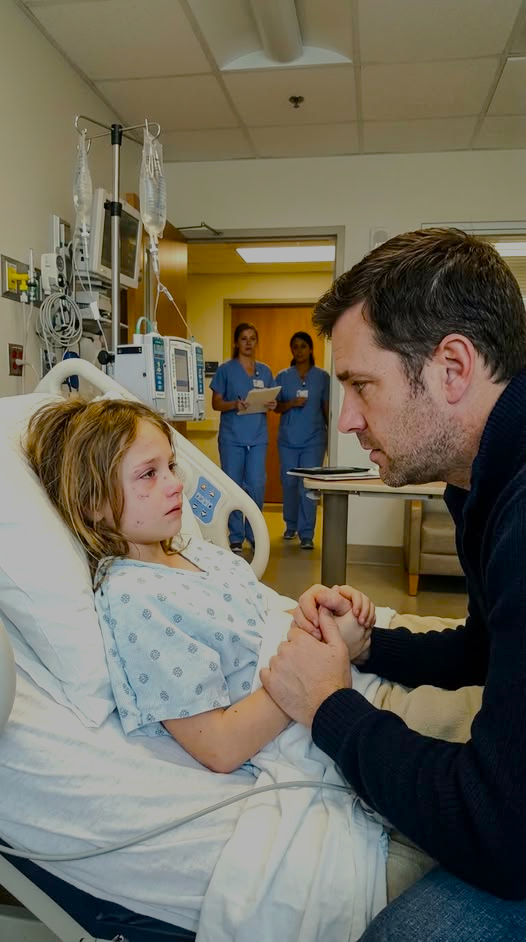
When I returned to Maya’s room, she was awake.
Her eyes found mine immediately.
“Daddy?”
“I’m here.”
She lifted one hand a few inches from the blanket.
I took it.
Her fingers were warm.
That tiny fact nearly made me cry harder than anything else.
Warm meant here.
Warm meant alive.
Warm meant there would be mornings after this one.
Dr. Shah had already warned me not to question her in detail about the assault. A trained forensic interviewer would speak with her later if her medical condition allowed. Repeated questioning could confuse memory, increase distress, and create problems for an investigation.
So I did not ask what happened.
I asked what she needed.
“Water.”
I helped her drink through a straw.
“Anything else?”
She looked toward the door.
“Is Mom here?”
My chest tightened.
“Yes.”
Maya became very still.
“Is Grandpa here?”
“No.”
“Uncle Jasper?”
“No.”
“Kyle?”
“No.”
“Can they come?”
“No.”
“Ever?”
I chose the safest truth.
“Not unless people whose job is to protect you decide it is safe. And I don’t expect that to happen anytime soon.”
She relaxed slightly.
Then her lower lip trembled.
“Mom didn’t help.”
I felt something break quietly inside me.
“I know.”
“She saw.”
“I know.”
“Why?”
That question did not belong to me.
“I think Mom is going to have to explain that when you’re ready to hear it.”
Maya looked away.
“I don’t want her in here.”
“Okay.”
“You won’t make me?”
“No.”
That answer came easily.
Children should not have to protect adults from the consequences of their own fear.
Maya’s eyes filled.
“I’m sorry.”
“For what?”
“I lost Aunt Rachel’s bracelet.”
My heart stopped.
I kept my voice level.
“What bracelet?”
She frowned, concentrating.
“The silver one.”
“Where did you find it?”
“In Grandpa’s garage.”
I did not ask more.
Dr. Shah’s warning echoed in my head.
Instead I said:
“You don’t need to worry about any bracelet right now.”
Maya’s fingers tightened around mine.
“But he wanted it.”
“I know.”
“He said I stole it.”
“Sweetheart, stop there.”
She looked confused.
“Why?”
“Because there are people trained to listen to the whole story in a way that protects you. I want you to tell them once, clearly, when your head feels better.”
She stared at me.
“Am I in trouble?”
“No.”
“Then why are police coming?”
I looked toward the doorway.
“Because adults hurt you.”
Her eyes filled again.
“Grandpa said police listen to him.”
The sentence was soft.
But it explained so much.
“He said that?”
Maya nodded.
I stopped myself from asking when.
“Some people say things because they want children to feel powerless.”
“Are police going to listen to him?”
“They’re going to look at evidence.”
She thought about that.
“What’s evidence?”
“Things that help show what actually happened.”
“Like Mrs. Jones’s camera?”
“Yes.”
“And my watch?”
Every muscle in my body tightened.
“Your watch?”
“I pressed the side button.”
I stared.
Maya wore a child smartwatch with emergency calling and audio note features. I had bought it after she wandered away from us for four terrifying minutes at a county fair two years earlier.
“What side button?”
“The record button.”
I almost asked another question.
Then stopped.
“You did exactly what you thought was right.”
“Did it save it?”
“I don’t know.”
“We can check later.”
Maya closed her eyes.
Within minutes she was asleep.
I stepped into the hallway and called Reid over.
“She may have recorded something on her watch.”
His expression sharpened.
“Where is the device?”
I looked toward the nurse.
A transparent belongings bag sat in the cabinet beside Maya’s bed.
One sneaker.
A torn purple sweatshirt.
Two hair clips.
A child’s smartwatch with a cracked face.
And at the bottom, almost hidden beneath the sweatshirt, a silver bracelet.
I stopped breathing.
A nurse lifted the bag carefully.
“This came with her from triage.”
The bracelet was narrow.
Old.
Tarnished.
A tiny oval charm hung from it.
Even through plastic, I could see an engraved letter.
R.
I did not touch it.
Neither did Reid.
He called the state investigator who was already en route.
Twenty-five minutes later, Special Agent Lena Ortiz from the Montana Department of Justice entered the unit with a child-abuse detective from outside Birchwood jurisdiction named Caleb Monroe.
I knew neither of them.
That was deliberate.
Reid had asked for investigators with no known professional connection to Harold Whitmore, Whitmore Civil Works, Jasper, Kyle, or the county officials who had handled Rachel’s disappearance two decades earlier.
Ortiz was in her forties, compact, calm, and allergic to theatrics.
She showed credentials to me, then to the charge nurse, then asked for the evidence preservation paperwork before she asked a single question about Harold.
I liked her immediately.
Not personally.
Procedurally.
She looked at me.
“Mr. Sinclair, I understand you are a former federal employee.”
“Former protective operations.”
“Are you currently sworn?”
“No.”
“Then from this point forward, you are a parent and witness, not an investigator.”
I almost smiled.
“Understood.”
“I mean it.”
“So do I.”
She nodded once.
“Good.”
That sentence probably prevented me from making several mistakes over the next forty-eight hours.
Ortiz accepted Isabelle’s phone through documented voluntary surrender and arranged a forensic image.
She photographed the belongings bag without opening it.
She requested hospital security video.
She requested Mrs. Jones’s footage through consent and preservation notice.
She contacted the smartwatch provider and instructed them not to alter or delete cloud-stored data linked to Maya’s account.
Nothing dramatic.
Nothing cinematic.
Forms.
Signatures.
Time stamps.
Chain of custody.
The slow architecture of facts.
At 8:12 that evening, Reid received confirmation that Maya’s watch had uploaded a sixty-three-second audio file automatically after the device detected an impact.
Ortiz would not let me listen.
“Not yet.”
“That’s my daughter.”
“Exactly.”
I glared at her.
She did not move.
“If the recording becomes evidence, your first hearing of it should not shape what you later tell investigators you remember independently.”
“I wasn’t there.”
“You may know voices.”
I understood.
I hated understanding.
“Fine.”
She nodded.
“Thank you.”
At 9:03, a hospital social worker named Marina Holt asked to speak with Isabelle alone.
I stayed with Maya.
Twenty minutes later, Isabelle came out crying.
She did not try to enter the room.
She sat in a chair across the hallway.
I watched her through the glass.
She looked at our daughter sleeping.
Then she bent forward and pressed her forehead into both hands.
For one brief moment, I wanted to go to her.
Eleven years of marriage does not disappear because you discover the person beside you failed at the worst possible moment.
Love is inconvenient that way.
It survives facts that should make it simpler.
I stayed beside Maya.
At ten thirty, Ortiz returned.
“We listened to the watch file.”
I stood.
“And?”
“It supports Maya’s account.”
My jaw tightened.
“What else?”
Ortiz looked toward Isabelle.
“It also captures a reference to Rachel.”
Isabelle lifted her head.
“What reference?”
Ortiz did not answer in the hallway.
She led us into a small consultation room.
Monroe joined us.
Ortiz placed a transcript on the table.
Not the audio.
A preliminary written transcription.
She pointed to one line.
A male voice believed to be Harold said:
Your mother learned what happens when girls in this family go looking for things that don’t belong to them. Rachel learned too late.
Then another male voice, believed to be Jasper, said:
Get the bracelet.
Maya could be heard crying.
A third voice said:
Hold still.
Then Isabelle’s voice, farther away:
Dad, stop.
And Harold:
Rachel moved too.
Silence.
Forty-six seconds existed inside that recording.
Forty-six seconds of adult failure.
But the audio also captured what the driveway camera could not.
Isabelle had spoken.
Once.
“Dad, stop.”
Then she froze.
It was not enough.
It was not nothing.
I looked at her.
She was sobbing silently.
Ortiz continued.
“The bracelet is potentially relevant to Rachel Whitmore’s disappearance.”
“Potentially?” Isabelle asked.
“We have not authenticated it.”
“Mom will know it.”
“That helps.”
“Photographs would help more.”
Isabelle nodded quickly.
“There are pictures at Aunt Teresa’s.”
Ortiz wrote that down.
Monroe asked:
“Did Rachel normally wear a bracelet like this?”
“Yes.”
“When was the last time you saw it?”
Isabelle stared at the table.
“The night she disappeared.”
My skin prickled.
“Was she wearing it?” Ortiz asked.
“Yes.”
“Are you certain?”
“I gave it to her.”
Everyone went quiet.
Isabelle touched one wrist unconsciously.
“I saved for it for two months. It was cheap. Sterling silver from a mall jewelry kiosk. It had an R charm.”
She started crying harder.
“She wore it every day.”
Ortiz closed the evidence photograph.
“That is important.”
Then she looked at me.
“Mr. Sinclair, I need to ask you something directly.”
“Okay.”
“Is there any possibility you will go to Harold Whitmore’s residence tonight?”
I stared at her.
“No.”
“Any possibility you will contact Jasper or Kyle?”
“No.”
“Any possibility one of your former colleagues will?”
I looked at Reid through the glass.
“No.”
Ortiz studied me.
“You called for a ‘cleanup team.’”
I almost laughed.
“Who told you that?”
“Your former supervisor did.”
“Of course he did.”
“What did you mean?”
“Evidence preservation. Protective surveillance. Secure transport if Maya needed to move.”
“Not retaliation?”
“No.”
“Why use that phrase?”
“Old jargon.”
“For what?”
“For cleaning up operational exposure after an extraction. Phones, cameras, routes, witness safety, records.”
Ortiz nodded.
“I needed to hear you say it.”
“I understand.”
Then I added:
“I am angry enough to want retaliation.”
Isabelle looked at me.
Ortiz did not flinch.
“I’m not going to do it.”
“Why?”
I looked through the window toward Maya’s room.
“Because she needs a father more than she needs an avenger.”
Ortiz closed her notebook.
“Good answer.”
At 11:18, a judge signed emergency search warrants for Harold’s residence, the detached garage, two company storage buildings, and certain electronic devices connected to Harold, Jasper, and Kyle.
The affidavit did not rely only on Maya’s statement.
It included Mrs. Jones’s video.
The watch audio.
Isabelle’s historical account.
The bracelet.
Harold’s threatening text.
The connection between Black Pine Quarry and the old company property.
The state attorney general’s office authorized a parallel review of Rachel Whitmore’s missing-person file.
I learned all this later.
At the time, nobody gave me a live tactical feed.
That was appropriate.
I was in a hospital chair with my daughter’s hand resting against mine.
At 1:42 in the morning, Maya woke vomiting.
Every investigation in the world disappeared.
I pressed the nurse button so hard I nearly broke it.
Dr. Shah came quickly.
Maya was examined, medicated, and sent for another scan.
I stood outside imaging with fear crawling through every inch of me.
Isabelle remained twenty feet away.
She did not approach.
At one point, she whispered:
“Can I wait here?”
I looked at her.
“Yes.”
“Can I ask how she is?”
“Yes.”
“Can I see her?”
“No.”
Her face broke.
“Okay.”
That was the first boundary she accepted without explaining herself.
The scan remained stable.
Concussion-related nausea, Dr. Shah said.
Terrifying.
Expected.
Treatable.
At 3:10, Maya slept again.
At 3:26, Ortiz called.
I stepped into the hall.
“We located Harold.”
My chest tightened.
“Where?”
“At his residence.”
“Jasper?”
“Also there.”
“Kyle?”
“Not yet.”
“Arrested?”
“Harold and Jasper are detained while warrants are executed. Charging decisions will follow.”
“And Kyle?”
“His vehicle was located at a fuel station south of Laurel about forty minutes ago.”
“Running?”
“We do not know.”
I closed my eyes.
“What did you find in the garage?”
A pause.
“Mr. Sinclair, I cannot give you details while the search is active.”
“Lena.”
It was the first time I used her first name.
She sighed.
“We found a locked steel cabinet behind a false plywood panel.”
My heartbeat changed.
“What was inside?”
“Items that may relate to Rachel.”
“Her things?”
“Possibly.”
“What else?”
Another pause.
“A county topographic map.”
I knew before she finished.
“Black Pine.”
“Yes.”
“Marked?”
“Yes.”
I pressed one hand against the wall.
“Where?”
“I am not giving you coordinates.”
“Fine.”
“Is it near the road project?”
“Close enough that I understand why Harold may have become nervous.”
I looked through the glass at Isabelle.
She saw something in my face.
She stood.
“What?”
I lowered the phone.
“They found a map.”
She went pale.
“Black Pine?”
I nodded.
Her knees gave way.
I caught her before she hit the floor.
For one second, my arms remembered her as my wife.
She clutched my shirt and sobbed.
“She didn’t run.”
I held her because gravity required it.
Nothing more.
“I don’t think she did.”
Behind us, through the hospital glass, our daughter slept under dim lights while twenty-one years of another daughter’s disappearance began to rise from the ground.
By sunrise, the hospital sky had turned the color of dirty glass.
I had not slept.
Neither had Isabelle.
She remained across the hallway because Maya had asked for distance, and because social services had made the temporary arrangement formal before dawn.
Until an emergency safety assessment was completed, Isabelle would not be alone with Maya.
She agreed without contesting it.
That mattered.
It did not erase anything.
At 7:15, Marina Holt handed both of us separate copies of the temporary safety plan.
I read every line.
Maya would discharge to me if medically cleared.
No contact with Harold, Jasper, or Kyle.
No visits to Whitmore property.
Any contact from those men or their representatives would be reported.
Isabelle could have supervised contact only if Maya requested it and a clinician approved.
No one used the word punishment.
This was about safety.
Still, Isabelle cried when she signed.
I did not comfort her.
At eight, Dr. Shah brought better news.
Maya had slept for almost four uninterrupted hours.
Her neurological exam remained stable.
She was still dizzy and sensitive to light, but the immediate danger of worsening swelling appeared to be receding.
“If today goes well, we may discharge late afternoon,” Dr. Shah said.
“Home?”
“Yes, with strict instructions.”
“No school.”
“Limited screens.”
“Quiet activity.”
“Return immediately for worsening symptoms.”
I nodded at every sentence.
Then I asked the question I had been afraid to ask.
“Long-term damage?”
Dr. Shah paused.
“We do not see evidence right now that makes me predict permanent neurological impairment.”
My eyes filled.
“But I want you to hear the full sentence.”
I nodded.
“Recovery from concussion is not always linear. She may look better one day and worse the next. Emotional symptoms can be part of it. Trauma can also produce its own symptoms separate from the brain injury.”
“We’ll need both medical and psychological follow-up.”
“I’ll do whatever she needs.”
“I know.”
She glanced toward Isabelle.
“She may need decisions about family contact to move at her pace too.”
“I know.”
That was becoming the sentence everyone had to earn.
At 9:40, Special Agent Ortiz returned.
This time she brought news about Kyle.
He had not been fleeing the state.
He had driven to a motel outside Laurel and called an attorney.
At 6:22 that morning, accompanied by counsel, he surrendered.
“Did he say anything?” I asked.
Ortiz sat across from me in a small family conference room.
“Enough to change the search.”
Isabelle’s hands began shaking.
“What did he say?”
Ortiz looked at her.
“Kyle says Rachel did not run away.”
Isabelle made a sound like air leaving a punctured lung.
I reached toward her instinctively.
Then stopped.
She folded both arms around herself.
Ortiz continued.
“He says your father struck Rachel in the garage during an argument.”
“Jasper was present.”
“Kyle was thirteen.”
“According to Kyle, Rachel was alive after the first injury.”
Isabelle closed her eyes.
“I saw her.”
“Yes.”
“Kyle remembers you coming downstairs.”
She opened her eyes.
“What did he say I did?”
“He says Harold forced you upstairs.”
“I went.”
“He says you were crying and trying to pull away.”
Isabelle stared at Ortiz.
That detail seemed to matter to her.
Not because it absolved her.
Because memory shaped by twenty-one years of guilt had turned a terrified child into a willing accomplice inside her own mind.
“What happened after I went upstairs?”
Ortiz took a breath.
“Kyle says Rachel tried to stand.”
“Harold hit her again.”
Isabelle covered her mouth.
“Jasper helped move her into the utility trailer.”
“Kyle says he was ordered to clean part of the garage floor.”
“And then?”
“He rode in the truck.”
“Where?”
“Black Pine.”
The word landed like a body.
I looked at Ortiz.
“Did he give a location?”
“Yes.”
“Do you believe him?”
“We are verifying it now.”
Isabelle whispered:
“Was she alive when they left?”
Ortiz’s face tightened.
“Kyle says he does not know.”
She started sobbing.
“I left her.”
Ortiz leaned forward.
“You were sixteen.”
“I left her.”
“You were threatened by an adult who had just seriously injured your sister.”
“I left her.”
I finally spoke.
“And today you were thirty-seven.”
Isabelle froze.
My voice shook.
“Do not combine those two moments until the first one excuses the second.”
Her face crumpled.
“I’m not.”
“You are.”
“I don’t mean to.”
“I know.”
I stood because sitting beside her hurt too much.
“You were a child with Rachel.”
“You were Maya’s mother yesterday.”
“Both things matter.”
Isabelle nodded through tears.
“Yes.”
Ortiz let the silence settle.
Then she continued.
“Kyle also explained why Maya was attacked.”
I sat again.
“What happened?”
According to Kyle, Maya wandered into the detached garage looking for a soccer ball Harold’s dog had pushed through an open side door.
Jasper and Kyle were inside with Harold.
They were sorting boxes from the hidden cabinet because the Black Pine roadwork had terrified Harold.
Among the items was Rachel’s bracelet.
Maya recognized the engraved R because she had once seen a photograph at Isabelle’s mother’s house.
She picked it up.
Harold saw her.
He demanded it back.
Maya asked:
“Was this Aunt Rachel’s?”
Everything stopped.
I could imagine her saying it.
Curious.
Direct.
Eight years old.
No idea she had stepped on a secret older than she was.
Harold told her there was no Aunt Rachel.
Maya said:
“Yes there is. Grandma has a picture.”
Jasper told her to hand over the bracelet.
She refused.
Harold grabbed her wrist.
Maya pulled away and ran toward the driveway.
Kyle followed because Harold shouted at him to stop her.
Jasper caught her first.
What happened next matched the watch audio and the camera.
I stopped Ortiz before she described details I had already seen on Maya’s body.
“Enough.”
She nodded.
“Kyle admits he held her legs.”
My hands curled into fists.
“He says Harold told them Maya would tell you and ‘bring federal people into everything.’”
I stared.
“So Harold knew what I used to do.”
“Yes.”
“How?”
“Isabelle?”
Ortiz looked toward her.
Isabelle wiped her eyes.
“I told Dad years ago you had worked federal protective operations.”
“How much?”
“Almost nothing.”
“He kept asking why you were so private about your old job.”
“I said you helped move endangered witnesses.”
“That was enough.”
I leaned back.
Harold had not been afraid I would arrive with guns.
He was afraid I would understand what evidence meant.
Who to call outside local influence.
How to preserve data.
How to move a witness before intimidation could work.
For years, he had apparently mistaken my ordinary life for weakness.
He had not understood that the most useful thing my old work taught me was patience.
Not how to hurt people.
How to keep them from disappearing.
Ortiz’s phone vibrated.
She checked it.
Her face changed.
“Excuse me.”
She stepped outside.
Isabelle looked at me.
“Ethan.”
I said nothing.
“If they find Rachel…”
Her voice failed.
I looked at her.
“If they find Rachel, your mother gets an answer she should have had twenty-one years ago.”
“And me?”
“You get the truth.”
“What if I can’t live with it?”
I thought about Maya saying Mom didn’t help.
“You learn.”
She stared at me.
“That’s cruel.”
“No.”
I kept my voice quiet.
“Cruel would be telling you guilt is the same as accountability.”
“Guilt can keep you staring at yourself forever.”
“Accountability asks what you do next.”
Tears ran down her face.
“I don’t know what to do next.”
“Start by telling the truth every time somebody asks.”
She nodded.
Ortiz returned three minutes later.
She closed the door.
No one needed to ask.
Her expression had already answered.
“They found human remains.”
Isabelle folded forward.
I caught the back of her chair before it tipped.
“Confirmed Rachel?” I asked.
“Not yet.”
“Location is consistent with Kyle’s statement.”
“Personal effects are present.”
“What kind?”
Ortiz looked at Isabelle.
“A denim jacket.”
Isabelle sobbed.
Rachel had been wearing one that night.
“And a necklace with a small sun pendant.”
Isabelle stopped breathing.
“My mother gave us matching ones.”
Her hand moved to her throat.
“No.”
She stood suddenly.
“I need to call Mom.”
Ortiz shook her head.
“Not yet.”
“She deserves to know.”
“She does.”
“But identification is not complete, and investigators are with her now.”
“I want to tell her.”
“I understand.”
“Please.”
Ortiz softened.
“Let the forensic team confirm first.”
Isabelle collapsed back into the chair.
For the next six hours, two daughters occupied the center of our lives.
One eight years old, sleeping beneath a hospital blanket with swelling slowly receding.
One nineteen forever, waiting beneath Montana earth for someone to speak her name honestly.
Maya met the forensic interviewer just after noon.
Her name was Dana Wu.
I was not in the room.
Neither was Isabelle.
That was intentional.
Dana spent nearly fifteen minutes talking to Maya about school, pets, and the difference between something you know and something you guess before she asked anything about the driveway.
The interview was recorded.
Maya could stop whenever she wanted.
She did once because her head hurt.
They paused.
A nurse checked her.
Then Maya asked to finish.
I waited outside with my hands locked together.
Afterward, Dana did not tell me every detail.
She gave me what I needed as a parent.
“Maya was clear.”
“Consistent.”
“She understands she is not in trouble.”
“Good.”
“She is worried about her mother.”
I looked toward Isabelle.
“In what way?”
“She is afraid Isabelle will be punished if Maya says she did not help.”
My throat tightened.
“Did you tell her that is not her job?”
“Yes.”
“What did she say?”
“That Mom cries when people are angry.”
I closed my eyes.
Children notice the emotional weather adults pretend not to create.
Dana continued.
“She also said something I think you should hear directly when she is ready.”
“What?”
“I would rather not take it from her.”
I hated that answer.
I respected it.
Maya was discharged at 5:35.
Dr. Shah gave me written instructions thick enough to feel like a legal brief.
Dark room if headaches worsened.
No sports.
No rough play.
No school until follow-up.
Gradual return to reading and screens.
Medication schedule.
Emergency symptoms highlighted in red.
I read all of it twice.
When it was time to leave, Isabelle stood at the end of the hallway.
Maya was in a wheelchair because dizziness made walking unsafe.
She saw her mother.
Her entire body tightened.
I crouched beside her.
“Do you want Mom to come closer?”
Maya shook her head.
“No.”
Isabelle heard.
Her face crumpled.
She stayed where she was.
Maya whispered:
“Is she mad?”
“No.”
“Is she sad?”
“Yes.”
“Because of me?”
“No.”
I made my voice firm enough to build a wall around that answer.
“None of this is because of you.”
Maya nodded.
Then she looked at Isabelle again.
“Tell her I’m not ready.”
I almost said she heard you.
Instead, I respected the request.
I walked over.
“Maya says she isn’t ready.”
Isabelle nodded, crying silently.
“Tell her I understand.”
I returned.
“Mom says she understands.”
Maya closed her eyes.
That was their first conversation after the assault.
Carried through me.
Six words each.
Enough.
Reid drove us home because I had not slept and he refused to let exhaustion become another risk.
Two state vehicles watched from a distance.
Not because Harold had magical reach.
Because his threatening message had been explicit, Jasper and Kyle’s legal status was still developing, and nobody intended to gamble with Maya’s safety.
When we reached our house, Maya stopped at the front steps.
“I don’t want Grandpa to know where we are.”
I crouched.
“He already knows where we live.”
Her eyes widened.
I continued quickly.
“But he cannot come here.”
“People are watching.”
“Doors are locked.”
“And if you want, we can stay somewhere else tonight.”
She looked at our windows.
Her bedroom curtains.
The pumpkin she had painted at school sitting crookedly by the porch.
“My bed is here.”
“Yes.”
“I want my bed.”
“Then we stay.”
That night, I slept on the floor beside it.
At 2:07 a.m., Maya woke screaming.
I was on my feet before I knew I had moved.
She was sitting upright, eyes wide, breathing too fast.
“Dad?”
“I’m here.”
“Don’t let them hold me.”
“They’re not here.”
“Don’t let Mom leave.”
That surprised me.
I sat on the edge of the bed.
“Mom isn’t here tonight.”
Maya started crying.
“I know.”
“I’m mad at her.”
“You can be.”
“I miss her.”
“You can do that too.”
She looked at me through tears.
“At the same time?”
“Yes.”
That answer would become important for all of us.
At 9:30 the next morning, DNA identification confirmed the remains recovered at Black Pine belonged to Rachel Whitmore.
She had been nineteen years old for twenty-one years.
By noon, her mother finally knew where her daughter was.
And by sunset, the family that had spent two decades pretending Rachel ran away could no longer pretend anything at all.
Rachel’s identification changed the case overnight.
Not because one discovery magically solved everything.
It did not.
A body tells the truth differently after twenty-one years.
Weather, soil, animals, time, and an old burial site had taken away details investigators would have had if someone had looked there in the first week.
The forensic pathologist could identify healed childhood injuries, dental work, and a major fracture to the skull that was consistent with severe blunt-force trauma.
What could not be established immediately was whether that injury alone caused Rachel’s death, whether there had been another injury, or whether delay in medical care contributed.
Those questions mattered legally.
They also infuriated Isabelle.
“She was alive,” she said during one meeting with Ortiz. “Kyle said she was alive.”
Ortiz nodded.
“That statement matters.”
“Then charge Dad with murder.”
“It is not my decision alone.”
“Everyone keeps saying that.”
“Because murder is a charge we have to prove beyond a reasonable doubt.”
Isabelle looked ready to scream.
I understood.
Truth feels obvious when you have carried it emotionally for decades.
Courtrooms require a different architecture.
Kyle’s account was powerful but complicated.
He had been thirteen when Rachel disappeared.
He was thirty-four when he held an eight-year-old child down in a driveway.
He could be both a coerced child witness in one crime and an accountable adult participant in another.
The prosecutors refused to flatten him into either hero or monster.
That made the case stronger.
Kyle’s attorney negotiated a cooperation agreement.
He pleaded guilty to charges arising from Maya’s assault, including unlawful restraint and child endangerment, and to evidence-tampering conduct connected to Rachel that he committed as an adult years later when Harold ordered him to move stored items from one company building to another.
He agreed to testify truthfully about both cases.
No promise erased what he did to Maya.
No cooperation turned him innocent.
It simply became part of the legal calculation.
Jasper fought everything.
He claimed Maya fell.
The video contradicted him.
He claimed he touched her only to help.
The watch audio contradicted him.
He claimed Rachel’s bracelet had been in the garage because she left property behind before running away.
Photographs, Kyle’s statement, and Rachel’s mother contradicted the broader story.
He claimed the hidden cabinet was for valuable family belongings.
Investigators found old company ledgers, deleted-account printouts, Rachel’s high-school identification card, and a photograph of the utility trailer taken less than a month after she disappeared.
The lies became narrower as the evidence became larger.
Harold said almost nothing.
His attorneys did the talking.
That was his right.
For the first time in Isabelle’s life, silence from her father did not control the room.
Evidence did.
Three weeks after Maya came home, Harold was formally charged with multiple felonies related to her assault, intimidation, and evidence tampering.
Months later, after forensic review and grand-jury proceedings, prosecutors also charged him in connection with Rachel’s death.
The final homicide charge was not the grandest label people on social media demanded.
It was the charge prosecutors believed the evidence could sustain.
I learned to be grateful for that distinction.
Justice is not more just because the headline is louder.
Jasper faced serious charges tied to both Rachel’s concealment and Maya’s assault.
Kyle’s plea remained contingent on cooperation.
Harold’s business went into chaos.
Contracts were suspended.
Banks reviewed lending agreements.
Employees who had nothing to do with the family’s crimes worried about paychecks.
That part bothered me.
Consequences spread badly if people are not careful.
I did not celebrate when Whitmore Civil Works began losing work.
The laborers pouring concrete had not hurt my daughter.
The bookkeeper had not buried Rachel.
A court-appointed receiver eventually helped wind down portions of the company while preserving wages and records.
That boring detail mattered more than the online comments demanding that everything with Harold’s name be burned to the ground.
Maya never saw those comments.
I made sure of it.
People discovered the story anyway.
A child injured.
A prominent local contractor arrested.
A cold case reopened.
Human remains recovered from Black Pine.
Reporters called.
Neighbors whispered.
One television station parked a van near our street until Reid walked out and explained, politely, that filming a recovering child’s bedroom window would be a spectacularly bad idea.
They moved.
We issued one statement through an attorney.
It asked for privacy for Maya and Rachel’s mother.
Nothing more.
I did not tell anyone about my old unit.
That part of the story did not belong in a headline.
Maya’s recovery became our calendar.
Day five: she could tolerate ten minutes of reading.
Day eight: she walked around the block wearing sunglasses even though the sky was cloudy.
Day twelve: she tried half a worksheet and cried because the numbers “moved.”
Day thirteen: she slept fourteen hours.
Day fifteen: she woke angry because she was bored.
I considered anger a milestone.
Her neurologist did too.
“Bored children are often improving children,” he said.
By the third week, headaches were less frequent.
By the sixth, she returned to school for half days.
No sports yet.
No noisy assemblies.
A quiet room available whenever symptoms returned.
Her teacher, Mrs. Ellis, handled it beautifully.
She never told the class details.
She said Maya had been injured and needed help returning slowly.
Children accepted that more easily than adults would have.
One boy brought her a plastic dinosaur because he believed dinosaurs cured headaches.
Maya kept it beside her bed for years.
Trauma recovery moved differently.
Her first therapist was Dr. Renee Park, a child psychologist who refused to make Maya retell the assault every week.
They drew.
Played card games.
Built a “safe map” of people and places.
Talked about body alarms.
Talked about anger.
Talked about the difference between remembering danger and being in danger.
One afternoon, Renee invited me into the last ten minutes of the session.
Maya sat cross-legged on a rug.
She looked at me.
“Dad, do you know what I wanted to tell you in the hospital?”
I remembered Dana Wu saying there was something Maya should tell me herself.
“No.”
Maya twisted a piece of string around one finger.
“Grandpa said you weren’t coming.”
My throat tightened.
“I know you told me that.”
“No.”
She shook her head.
“He said more.”
I waited.
“He said you only pretend to be brave because you used to have people do scary things for you.”
My chest went cold.
“What did you say?”
“I said you don’t hurt people.”
I looked at Renee.
She nodded slightly for me to let Maya continue.
Maya said:
“Grandpa laughed.”
“He said, ‘Your dad thinks he can clean up anything.’”
There it was.
Harold knew the old phrase.
Maybe Isabelle had repeated it years earlier.
Maybe he had asked questions.
Maybe he simply enjoyed turning rumor into intimidation.
Maya looked at me.
“Did you hurt people at your old job?”
I could have given her a simple no.
The truth deserved more care.
“I worked around dangerous situations.”
“Did you have a gun?”
“Yes.”
“Did you shoot people?”
Renee watched me closely.
I chose honesty without detail.
“There were times I had to protect myself or someone else, and people got hurt.”
Maya’s eyes widened.
“Did you like it?”
“No.”
“Ever?”
“No.”
“Then why did Grandpa say cleanup team?”
I almost laughed at the absurdity of explaining federal operational jargon to an eight-year-old in a room full of crayons.
“Because he wanted you to think being strong means making people afraid.”
“Doesn’t it?”
“No.”
I leaned forward.
“The team I called after you were hurt was there to protect you, save videos, make sure nobody deleted things, and help investigators find the truth.”
“Not hurt Grandpa?”
“No.”
Maya looked disappointed for half a second.
Then ashamed of the disappointment.
“I wanted you to.”
My heart broke.
“I know.”
“Is that bad?”
“No.”
“Wanting someone who hurt you to hurt too is a feeling.”
“Feelings are not crimes.”
“What matters is what we do with them.”
She thought.
“What did you do with yours?”
I looked at Renee.
Then back at Maya.
“I stayed with you.”
Her face softened.
That answer became more important to me than anything I had ever done in uniform.
Isabelle began trauma therapy the week after Maya left the hospital.
Not because therapy was a ticket back into our home.
It was not.
She moved into a furnished apartment near her office.
She took an extended leave from work.
She met weekly with child services.
She gave four formal interviews about Rachel.
She provided old photographs, family records, and names.
She sat with her mother while investigators returned Rachel’s personal effects.
And she did not ask Maya for contact beyond what Maya requested.
For the first month, that was none.
Every Sunday, Isabelle wrote a short note.
Not a letter asking forgiveness.
Not a plea.
Usually three or four sentences.
I love you. I am glad your headache was smaller this week. You do not have to answer. Mom.
Or:
I heard you returned to school for half a day. I am proud of how carefully you are taking care of your brain. No reply needed.
She gave the notes to Renee.
Renee gave them to Maya only if Maya wanted them.
Some weeks she did.
Some she did not.
At week five, Maya asked:
“Can Mom send a picture of Noodle?”
Noodle was our ridiculous orange cat.
Isabelle had taken him to her apartment because Maya’s allergies were worse during concussion recovery and because the cat had chosen Isabelle as his servant years earlier.
I texted the request.
Two minutes later, a photograph arrived of Noodle asleep inside a grocery bag.
No message to me.
No emotional ambush.
I showed Maya.
She smiled for the first time that day.
At week seven, she asked to video call her mother for five minutes.
Renee supervised.
I did not sit in.
Afterward, Maya came out crying.
I knelt.
“Too much?”
She shook her head.
“She said sorry.”
“How did that feel?”
“Bad.”
I almost smiled.
“Anything else?”
“Good.”
“Both?”
“Both.”
She had learned the word before any of us.
At week ten, Maya agreed to see Isabelle in Renee’s office.
The meeting lasted twenty-three minutes.
I know because I stared at the clock outside like a man waiting for surgery.
When the door opened, Isabelle came out first.
Her eyes were swollen.
She did not speak to me.
Maya came behind her.
I crouched.
“You okay?”
She nodded.
“Do you want to go home?”
“Yes.”
In the car, she stared out the window.
Then she said:
“Mom said she froze because Grandpa used to scare her.”
I kept my eyes on the road.
“What do you think about that?”
“I believe her.”
A pause.
“I’m still mad.”
“You can be.”
“She said believing her doesn’t mean I have to forgive her fast.”
“That sounds right.”
“She said even if I forgive her, she still did it.”
I swallowed.
“That also sounds right.”
Maya looked at me.
“Are you going to forgive her?”
The traffic light ahead turned red.
I stopped.
“I don’t know yet.”
“Do you still love her?”
Children always find the question adults spend months avoiding.
“Yes.”
“Then why doesn’t she come home?”
I stared at the red light.
“Because love and safety are not the same question.”
Maya became quiet.
The light turned green.
We drove home.
Two months later, I filed for legal separation.
Not divorce.
Not reconciliation.
Separation.
I needed decisions around the house, finances, parenting, and contact to stop floating inside emotion.
My attorney, Grace Han, told me something I did not want to hear.
“Isabelle’s failure in the driveway is serious.”
“Yes.”
“But do not confuse that with an automatic legal conclusion that she should lose her child forever.”
I stared at her.
“I didn’t say forever.”
“You are thinking it loudly.”
I almost laughed.
Grace continued.
“Child welfare will examine what she knew before bringing Maya there, what she did during the incident, what she did afterward, and what she is doing now.”
“She failed.”
“Yes.”
“Badly.”
“Yes.”
“Then why are you making it sound balanced?”
“Because courts are not revenge instruments.”
That sentence irritated me enough to prove I needed it.
The final child-welfare finding reflected both realities.
Isabelle had failed to protect Maya during a dangerous incident and had exercised profoundly poor judgment by leaving her with Harold given Isabelle’s knowledge of his past violence.
That finding stayed.
So did the evidence that Isabelle had not planned, encouraged, or participated in the assault; that her freeze response was linked to documented trauma; that she cooperated immediately once she reached the hospital; and that she complied with every safety requirement afterward.
Supervised contact continued for months.
Then therapeutic visits.
Then brief unsupervised daytime contact when Maya asked for it and clinicians approved.
Nobody gave Isabelle motherhood back as a reward for feeling guilty.
She rebuilt trust through behavior.
One visit at a time.
The criminal case moved more slowly.
Almost a year after the driveway, Harold’s trial began.
I attended only the parts our attorney advised.
Maya did not sit in the courtroom.
Her recorded forensic interview was handled under procedures designed to reduce additional trauma, and later evidentiary decisions meant she did not have to face Harold in open court for every allegation.
When I did see him, he looked smaller than the man in Maya’s story.
That surprised me.
Evil had not made him physically impressive.
He was an aging contractor in a suit that fit poorly after months in custody.
He looked at me once across the courtroom.
I expected satisfaction.
Rage.
Maybe fear.
I felt almost nothing.
The person I cared about was at home drawing a dragon in occupational therapy because fine visual focus still sometimes triggered headaches.
Harold no longer deserved the center of my mind.
The state presented the driveway video.
The watch audio.
Medical records.
The threatening message to Isabelle.
The bracelet.
Kyle’s testimony.
Financial and historical evidence related to Rachel came in through carefully limited channels depending on the charge.
The defense attacked Kyle’s credibility.
Fairly.
He had negotiated a plea.
That was for the jury to weigh.
Then prosecutors introduced records from the old utility trailer.
A maintenance invoice placed Harold’s truck and trailer at Black Pine within hours of Rachel’s disappearance.
A former Whitmore employee, now seventy-six, testified that Harold ordered him to replace damaged flooring in the trailer the following week and told him never to mention a “family accident.”
The employee had stayed silent for twenty-one years.
He cried on the stand.
Silence had victims too.
The trial lasted four weeks.
The jury deliberated two days.
Harold was convicted on the major charges arising from Maya’s assault and witness intimidation.
The Rachel case produced its own later resolution after additional proceedings: facing corroborated testimony, forensic evidence, and the risk of a more severe conviction, Harold entered a plea to a homicide charge prosecutors believed accurately reflected what they could prove after two decades.
He admitted striking Rachel and helping conceal her death.
He did not say he was sorry.
Some people were furious about that.
I stopped needing it.
A confession compelled by evidence would never become the apology Rachel deserved.
Jasper was convicted on charges tied to Maya and later pleaded to evidence tampering connected to Rachel.
Kyle received a substantial sentence for his role in Maya’s assault, reduced from what it might otherwise have been because of his cooperation in recovering Rachel and prosecuting Harold.
No one walked away clean.
No one disappeared into a magical prison sentence that fixed our lives.
Court ended.
Recovery continued.
Rachel’s funeral happened twenty-two years after she should have had one.
Her mother chose a small cemetery outside Bozeman where cottonwood trees leaned over the road and the mountains looked close enough to touch.
There was no open casket.
No attempt to turn recovery of remains into spectacle.
A photograph of Rachel at seventeen stood beside the flowers.
She was laughing at something outside the frame.
That mattered to Isabelle.
“She looks alive,” she whispered.
I stood a few feet away with Maya.
By then, Maya could tolerate crowds for short periods, but she still tired quickly. She held my hand and stared at the photograph.
“That’s Aunt Rachel?”
“Yes.”
“She looks like Mom.”
She did.
Same chin.
Same dark eyes.
Same slight tilt of the head when smiling.
Isabelle approached carefully.
She had asked in advance whether Maya was comfortable seeing her at the service.
Maya had said yes.
That was how nearly everything worked now.
Ask.
Wait.
Accept the answer.
Isabelle crouched in front of her.
“Hi, sweetheart.”
“Hi.”
“You okay?”
Maya shrugged.
“I don’t know her.”
Isabelle’s eyes filled.
“No.”
“But I’m sad.”
“That’s okay.”
“Are you sad because you did know her?”
“Yes.”
Maya thought.
“Then you can be more sad than me.”
Isabelle laughed through tears.
“Thank you.”
Children create rules for grief that adults should sometimes borrow.
At the graveside, Isabelle’s mother, Evelyn Whitmore, spoke for less than two minutes.
She did not describe Rachel’s death.
She described how Rachel hated peas, cheated at Monopoly, and once tried to rescue a wounded crow that destroyed every curtain in the laundry room.
People laughed.
Then Evelyn said:
“My daughter was missing for twenty-one years. I refuse to let the manner of her death take the other nineteen years of her life too.”
That sentence stayed with me.
After the service, Evelyn approached Maya.
In her hand was a small velvet box.
My body tightened automatically.
She noticed.
“This is not for today unless she wants it.”
I looked at Maya.
Evelyn opened the box.
Inside was Rachel’s silver bracelet.
Cleaned, repaired, and released from evidence after the relevant proceedings concluded.
The tiny R charm caught the afternoon light.
Maya stepped backward.
“No.”
Evelyn closed the box immediately.
“Okay.”
No disappointment.
No speech about family history.
Just okay.
Years later, that response would be one of the reasons Maya finally asked for the bracelet.
Not because anyone told her she should carry Rachel.
Because everyone allowed her not to.
My marriage to Isabelle did not survive.
I wish there were a more dramatic sentence for that.
There wasn’t.
Two years after the driveway, after therapy, separation, parenting plans, court proceedings, and countless conversations, we sat in a mediator’s office and admitted what both of us already knew.
I loved her.
She loved me.
I no longer trusted her as my partner.
Not in the way marriage required.
Isabelle did not beg.
That made it harder.
She looked at me across the table and said:
“I understand.”
I cried.
“So do I.”
She reached toward my hand.
Stopped before touching it.
“May I?”
That question broke me.
“Yes.”
She held my hand while we ended our marriage.
Forgiveness and reconciliation are different decisions.
I forgave much of Isabelle long before our divorce was final.
I came to understand the sixteen-year-old girl inside her freeze response.
I came to believe she had not wanted Maya hurt.
I watched her tell the truth when lying might have protected her image.
I watched her accept supervised parenting without blaming me.
I watched her spend years dismantling the fear Harold had taught her.
All of that mattered.
None of it required me to remain her husband.
We built something else.
A co-parenting relationship that began cautiously and became, eventually, kind.
Maya returned to overnight visits with Isabelle almost eighteen months after the assault.
The first one lasted only until ten because Maya called me crying and wanted to come home.
Isabelle did not say, “Give it more time.”
She did not say, “You promised.”
She packed Maya’s bag, drove her to my house, and waited in the driveway until I opened the door.
Maya hugged her before coming inside.
The next overnight lasted until morning.
Then another.
Trust grew like that.
Not through speeches.
Through exits that remained available.
On Maya’s eleventh birthday, she asked Isabelle a question in front of me.
“Mom, if Grandpa scared you so much, why did you keep taking me there before it happened?”
Isabelle went pale.
She could have said family pressure.
She could have blamed Evelyn.
She could have said Harold seemed different with grandchildren.
All were partly true.
Instead she answered:
“Because I wanted him to become the father I wished I had, and I used your visits to test that hope.”
Maya frowned.
“What does that mean?”
“It means I let what I wanted to be true matter more than what I already knew.”
Maya became quiet.
“That was bad.”
“Yes.”
“Really bad.”
“Yes.”
“Do you feel bad?”
“Every day.”
Maya looked at her.
“Dr. Renee says feeling bad doesn’t fix things.”
A sad smile crossed Isabelle’s face.
“Dr. Renee is right.”
“What fixes them?”
“Nothing fixes everything.”
Isabelle took a breath.
“But I can make safer choices now.”
Maya nodded.
Then returned to decorating cupcakes.
That was one of the most important conversations I ever witnessed.
No child was asked to comfort the adult.
No explanation became an excuse.
No apology demanded a hug.
Life continued.
Maya’s concussion symptoms faded over the following year.
For a while, bright lights triggered headaches.
Reading in moving cars made her nauseated.
She tired earlier than before.
At nine, she returned to soccer cautiously.
At ten, she quit because she discovered she preferred ceramics.
I spent years worrying that quitting meant fear had won.
Maya finally told me:
“Dad, I just hate running.”
That was humbling.
Not every choice after trauma is about trauma.
Sometimes a child simply hates running.
She became good at pottery.
Not prodigy good.
Real-person good.
Bowls with uneven rims.
Mugs with handles too small for adult fingers.
A ceramic orange cat that looked nothing like Noodle and somehow exactly like him.
At thirteen, she made a vase for Isabelle.
At fourteen, one for me.
Mine leaned slightly left.
I still have it.
Owen Reid retired fully when Maya was twelve.
He came to dinner and brought a cake that said:
NO MORE CLEANUP TEAMS.
Maya laughed so hard she almost dropped a plate.
By then she knew more about my old career in age-appropriate pieces.
Not classified details.
Not violence packaged as adventure.
She knew I had helped endangered witnesses relocate.
She knew sometimes people had been extracted from homes in the middle of the night.
She knew I had missed birthdays because someone else needed to disappear safely.
One evening she asked:
“Why did you quit?”
“You.”
She rolled her eyes.
“That sounds dramatic.”
“It was practical.”
“I wanted to be home.”
“Were you scared I’d think your job was cooler than being my dad?”
“Constantly.”
She smiled.
Then asked:
“Did you ever want to go back after Grandpa?”
I thought about that hospital stairwell.
The dark place inside me.
The order I almost gave before correcting myself.
“Yes.”
“Why didn’t you?”
“Because part of me wanted the old job for the wrong reason.”
“What reason?”
“I wanted to feel powerful.”
Maya became serious.
“Would you have hurt him?”
“I don’t know what I would have wanted if I had let anger make decisions.”
“That’s scary.”
“Yes.”
“What stopped you?”
“You needed me beside the bed.”
She looked at me for a long time.
Then said:
“I’m glad you stayed.”
So am I.
Harold died in prison when Maya was seventeen.
Heart failure.
No mystery.
No final confession.
No secret map tucked under a mattress.
The prison notified next of kin.
Isabelle called me before telling Maya.
“How do we do this?”
I said:
“We ask Renee.”
Even after all those years, we did not assume adulthood made the answer obvious.
Maya was told directly.
She sat silently.
Then asked:
“Am I supposed to feel something?”
“No,” I said.
Isabelle added:
“Whatever you feel is yours.”
Maya thought.
“I feel relieved.”
Neither of us corrected her.
Then she said:
“And sad for Mom.”
Isabelle’s face crumpled.
“Don’t be sad for me because he died.”
“I’m sad because he was your dad and he was bad.”
That distinction silenced the room.
Isabelle hugged her only after Maya reached first.
Harold’s death did not close the story.
It simply removed one living person from it.
The consequences he created remained in everyone who had survived him.
Jasper served his sentence and later moved out of state after release.
Maya never contacted him.
Kyle wrote one letter to her from prison when she was sixteen.
He apologized.
He did not ask forgiveness.
He said he had spent years telling himself Harold made him hold her down.
Then wrote:
He ordered me. I obeyed. At thirty-four, the second part belongs to me.
Maya showed the letter to Renee.
Then to me.
“Do I have to answer?”
“No.”
“Would it help him if I did?”
“Maybe.”
“Is that my job?”
“No.”
She put the letter away.
She never answered.
I respected her more for not turning mercy into an obligation.
At eighteen, Maya asked Evelyn for Rachel’s bracelet.
Her grandmother had kept it in the same velvet box for ten years.
When Evelyn handed it over, she said:
“You can wear it, store it, melt it, lose it, or throw it in a river. It is yours only if you want it to be.”
Maya fastened it around her wrist.
“Can I add something?”
“What?”
“A little M charm.”
Evelyn cried.
“For you?”
“For Maya.”
Then Maya smiled.
“And maybe a tiny dinosaur.”
I laughed.
The bracelet became hers without requiring Rachel to disappear again.
Maya graduated high school that spring.
She did not become a police officer.
She did not become a lawyer.
She did not devote her life to fighting child abuse because stories often force survivors to turn pain into careers before they are allowed to matter.
She studied industrial design.
She liked objects.
Chairs.
Lamps.
Tools.
Things shaped deliberately for human hands.
Her college essay was about making public spaces less overwhelming for people with sensory sensitivity after brain injuries.
That came from experience.
It was not her whole identity.
She also joined a terrible improv club.
Dated a drummer I disliked on principle.
Dyed one section of her hair blue without warning me.
Failed statistics once.
Recovered.
Lived.
That was the outcome I had wanted more than revenge and been too angry to name in the hospital.
Ordinary life.
At twenty-three, Maya asked me to drive with her to Birchwood.
The Whitmore house had been sold years earlier.
The new owners had repainted it white and replaced the detached garage after a storm damaged the roof.
I had avoided the street.
Maya had too.
“Why now?” I asked.
“I don’t know.”
“That sounds like a therapist answer.”
“It is.”
We parked across from Mrs. Jones’s old house.
She had died several years earlier, but I still thought of her every time I remembered the driveway.
Maya sat quietly.
The concrete where she had been hurt had been replaced.
Fresh paving.
No stain.
No mark.
No sign that one afternoon had changed five lives and reopened a grave.
Maya touched Rachel’s bracelet.
“Grandpa said you weren’t coming.”
My throat tightened.
“You told me.”
“I believed him for a minute.”
“I’m sorry.”
She looked at me.
“Why are you sorry?”
“Because you were scared.”
“That wasn’t your fault.”
The sentence landed differently after fifteen years.
Maya looked back at the house.
“I used to think the important part was that you came.”
“What’s the important part now?”
“That you stayed after.”
I could not answer.
She smiled.
“Are you crying?”
“No.”
“You are.”
“Sunlight.”
“It’s cloudy.”
“Montana is bright.”
She laughed.
We drove away without getting out.
We did not need to conquer the driveway.
Concrete did not owe us anything.
When Maya was twenty-six, she married a woman named Tessa Nguyen, an occupational therapist she met at a design conference.
Isabelle and I sat in the same front row.
Not together exactly.
Beside each other.
Before walking down the aisle, Maya came into the waiting room where we stood.
She looked at both of us.
“I need you not to cry until after pictures.”
Isabelle immediately started crying.
Maya sighed.
“This is why I gave Dad the instruction too.”
I was already crying.
She hugged us.
First together.
Then separately.
That photograph became one of my favorites.
Not because it proved our family was healed.
Families are not broken bones.
There is no final X-ray showing everything perfectly aligned.
The photograph mattered because nobody in it was pretending.
Isabelle and I were divorced.
We cared for each other.
Maya loved us both.
She trusted us differently.
Rachel’s bracelet was on her wrist.
No one was erased.
No one was excused.
Everyone had a place accurate enough to stand in.
Years after the hospital, a young agent once asked Reid about me at a retirement dinner.
I was standing nearby.
He said:
“Sinclair was scary, right?”
Reid looked at me.
Then laughed.
“Only when he thought scary was useful.”
The agent asked:
“What was he best at?”
Reid answered:
“Knowing when not to move.”
At first, I thought he meant tactical patience.
Then he looked at Maya across the room.
I understood.
The hardest order I gave after my daughter was hurt was not to a team.
It was to myself.
Stay here.
Do not become another dangerous man in her story.
Do not make her hospital room the waiting room for your revenge.
Do not let anger convince you that hurting the people who hurt her is the same thing as healing her.
Preserve the evidence.
Protect the child.
Tell the truth.
Stay.
I am older now.
Old enough that my hands ache in cold weather and Maya complains when I climb ladders without telling anyone.
She and Tessa live three states away, which I consider an unreasonable distance and they consider adulthood.
Isabelle lives near Bozeman and teaches part time at a community college after changing careers. We speak often enough to know the shape of each other’s lives without pretending we are still married.
Sometimes people hear pieces of our story and ask whether I regret not going to Harold’s house that night.
The question usually arrives with a certain expectation.
They want me to say I wish I had made him pay personally.
I don’t.
I regret many things.
I regret that I ever trusted a smile across Harold Whitmore’s dinner table more than the tension in Isabelle’s shoulders.
I regret that I did not ask why her family never spoke about childhood beyond a few safe stories.
I regret that Maya learned fear on a driveway before she learned long division.
I regret that Rachel waited in the ground for twenty-one years.
But I do not regret staying at the hospital.
If I had left, Maya would have opened her eyes and found another adult gone because Harold Whitmore had decided what mattered most.
He had already taken enough people away from the places they belonged.
I would not give him me too.
One Christmas, many years after Maya married, she gave me a small framed photograph.
It was not the hospital.
Not the courtroom.
Not the driveway.
It was a picture Tessa had taken without my knowing.
Maya was thirteen. We were sitting at the kitchen table. Her hair was tied badly on one side, a math book was open between us, and I was pointing at something with a pencil while she looked profoundly unimpressed.
On the back, Maya had written:
You stayed for the boring parts. That was the protection I needed most.
I keep it beside my bed.
Not my old federal commendations.
Not photographs from operations whose names I still cannot discuss.
That picture.
A father.
A daughter.
Homework.
Nothing happening.
For years, I thought protection meant preventing the worst moment.
Sometimes it does.
Sometimes you arrive too late for that.
Then protection becomes what happens next.
Believing the child.
Taking her to doctors.
Letting investigators do their work.
Not asking her to forgive anyone on an adult schedule.
Not turning your rage into another emergency she has to survive.
Returning for follow-up appointments.
Remembering medication.
Sitting outside therapy rooms.
Learning that recovery can look like pottery, boredom, bad jokes, and quitting soccer because running is awful.
That kind of protection does not make good headlines.
It makes a life.
The sentence that still visits me at night is the same one Maya whispered in the hospital.
“Daddy… Grandpa said you weren’t coming.”
For a long time, I answered it in my head with anger.
He was wrong.
I came.
Now I hear something else inside it.
A frightened child was not asking whether I could punish three men.
She was asking whether she had been abandoned.
That is why my answer matters more to me than anything that happened in court.
I came.
And when the anger was loud, I stayed.
When Isabelle’s failure complicated everything, I stayed.
When Maya woke screaming, I stayed.
When she became angry with me for hovering, I stayed.
When she stopped needing me in the same ways, I learned how to stay without holding on too tightly.
That was the part Harold never understood.
Power was not the ability to make a family afraid enough to obey.
Power was having every reason to become cruel and choosing not to hand cruelty to the next generation.
Rachel did not get that choice long enough.
Maya did.
Isabelle eventually did.
So did I.
If I could return to that fluorescent hospital stairwell and speak to the man I was when I saw Harold’s message, I would not tell him to calm down.
He had every right to be furious.
I would tell him something harder.
Your anger belongs to you.
Your daughter does not belong to it.
Use the anger to lock doors, preserve evidence, ask questions, and stand beside her bed.
Then let the law carry what it can.
Let therapy carry what law cannot.
Let time carry what neither can fix immediately.
And do not confuse vengeance with love simply because both can make your heart pound.
Maya once asked whether Harold had finally learned that I really did come for her.
I told her I did not know what Harold learned.
His understanding was never the point.
She smiled and said:
“Good. I learned it.”
That was enough.
More than enough.
Because in the end, the most important person in this story was never the man who hurt her, the men who held her, the mother who froze, the father with a secret past, or even the sister whose disappearance waited decades for truth.
It was an eight-year-old girl who ran down a sidewalk with one shoe, found help, told the truth, recovered, grew older, chose what forgiveness meant for herself, and refused to let the worst afternoon of her childhood become the title of her life.
Her name is Maya Sinclair.
She lived.
She healed.
And she was never abandoned again.
Last spring, Maya called me while I was making coffee and asked whether I still remembered the exact sound of the vending machine outside her hospital room.
I told her I did.
She laughed softly.
“Funny what the brain keeps.”
Then she said she and Tessa were expecting a baby.
For several seconds, I could not answer.
Not because I was frightened.
Because joy can steal language too.
“When?” I finally asked.
“October.”
“Are you okay?”
“Yes.”
“Is Tessa okay?”
“Yes.”
“Do you need me there?”
“Eventually.”
I smiled.
Eventually was not rejection.
It was information.
Years earlier, I might have heard distance and rushed to close it.
Now I knew how to wait without disappearing.
Before we hung up, Maya said:
“Dad?”
“Yes?”
“I’m not naming the baby after anybody.”
I laughed.
“Excellent.”
“No Rachel. No Harold, obviously. No symbolic middle name. Nothing tragic.”
“Perfect.”
“I want this kid to start with a blank page.”
I looked at the photograph beside my bed.
“You know blank pages don’t really exist.”
“I know.”
“But we don’t have to write the old story at the top.”
That stopped me.
“No,” I said. “We don’t.”
When their daughter was born, Maya sent me one photograph before posting anything anywhere.
A tiny sleeping face.
Ten fingers.
A knitted yellow cap.
Underneath, one sentence:
Everybody is safe.
I sat alone at my kitchen table and cried.
Not because I believed safety could be permanent.
I knew better.
I cried because my daughter understood that safety was something people built together, choice by choice, boundary by boundary, ordinary day by ordinary day.
And this time, no one had to run to earn it.
I booked a flight for the following weekend after asking first. Maya replied with a heart and three words that made me smile: Come when ready. I did, carrying clean hands and patience.
THE END STORIES! THANK YOU FOR READING GOOD LUCK !❤️
Related Posts