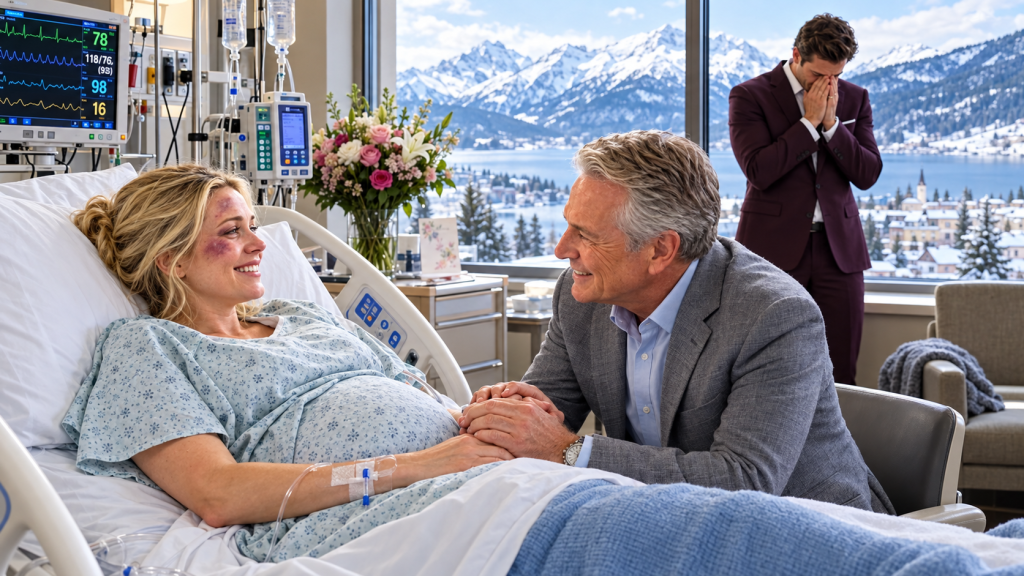
The moment Gabriel told me someone inside the insurance company had helped my husband plan my death, I stopped feeling the cold. That sounds impossible, considering I was lying in a hospital bed with fractured ribs, a broken wrist, severe hypothermia, and bruises that covered almost every part of my body.
But the cold I remembered wasn’t coming from the mountain anymore. It was coming from the realization that Michael had not acted alone. He had planned my death with the patience of a man planning a business transaction. He had studied insurance documents while I decorated our baby’s nursery. He had exchanged secret messages while I attended prenatal appointments.
And somewhere, an employee whose job was supposed to protect policyholders had apparently helped him turn my life into a fifty-million-dollar opportunity. I looked at the documents on Gabriel’s tablet. “Who is she?” Gabriel pulled a chair closer. “Her name is Celeste Rourke.” The photograph showed a woman in her late forties with carefully styled auburn hair and an expression of professional confidence.
I recognized her immediately.
My stomach tightened.
“She’s been to our house.”
Gabriel looked up.
“When?”
“Last summer.”
I swallowed.
“Michael invited her to dinner. He introduced her as a financial consultant who was helping us reorganize our estate planning.”
I remembered that evening with terrible clarity.
Celeste had admired the nursery.
She had congratulated me on my pregnancy.
At dessert, she had asked whether I was concerned about what would happen to my company if I died unexpectedly.
I had laughed.
I was thirty-four, healthy, and pregnant with my first child.
Death had seemed like something belonging to a distant future.
Michael had reached across the table and squeezed my hand.
“That’s why we’re making sure Emma and the baby are protected.”
I had smiled at him.
Now I understood that he had already begun planning how to remove both of us.
“Did she know?” I whispered.
Gabriel hesitated.
“We don’t know how much she knew.”
I stared at him.
“Did she know he was going to push me off a cliff?”
“We have evidence suggesting she helped with unauthorized insurance amendments. Investigators are determining whether she knew about the planned attack.”
I looked at the forged signature again.
It was almost perfect.
Almost.
Someone had copied my handwriting carefully enough to fool an inattentive reviewer.
But they had missed one small detail.
I always made the bottom of my capital E with a tiny upward stroke.
The signature on the document ended flat.
I lifted the tablet closer.
“That’s not mine.”
Gabriel nodded.
“I believe you.”
“No.”
My voice became sharper.
“I need you to understand. I did not sign this.”
He placed his hand over mine.
“Emma, I understand.”
Tears filled my eyes.
“I didn’t sign away my company.”
“I know.”
“I didn’t agree to let Michael take fifty million dollars.”
“I know.”
“And I didn’t fall.”
Gabriel’s expression changed.
I began trembling.
“I didn’t slip, Gabriel. I didn’t lose my balance. My husband put his hands on me and pushed.”
He leaned forward.
“I believe you.”
I started crying.
Not politely.
Not quietly.
I cried until my fractured ribs protested and a nurse hurried into the room.
Because for the first time since the mountain, somebody was listening without telling me to calm down.
Without suggesting I might have misunderstood.
Without reminding me that Michael was a respected businessman.
Without asking whether pregnancy had made me emotional.
Gabriel simply believed me.
And that mattered more than I knew how to explain.
The nurse checked my vital signs, adjusted my pillows, and reminded me that crying was permitted, but I needed to avoid straining my injured ribs.
I tried to laugh.
It hurt.
She smiled.
“Let’s aim for gentle emotions today.”
“If you can find any,” I whispered, “I’d love to borrow them.”
Her smile softened.
“I’ll see what we have.”
After she left, Gabriel turned off the tablet.
“Emma, there’s something else we need to discuss.”
I looked at him.
“My baby?”
His face changed immediately.
“The medical team is watching him closely.”
I pressed my hand against my stomach.
For a moment, I felt nothing.
Panic rushed through me.
Then there was a small movement beneath my palm.
So slight that I might have imagined it.
I closed my eyes.
“Please.”
Gabriel leaned forward.
“What’s wrong?”
“I need to hear him again.”
He pressed the call button.
Within minutes, a nurse brought the fetal monitor.
The room filled with the rapid, rhythmic sound of my son’s heartbeat.
I covered my mouth.
There he was.
Still fighting.
Still alive.
I had spent months imagining his first birthday.
His first steps.
His first word.
I had imagined Michael holding him outside the delivery room, laughing because our son had inherited my stubbornness.
Now I couldn’t bear the idea of Michael ever touching him.
The nurse watched the monitor.
“His heartbeat is reassuring at the moment,” she said. “The doctors will keep monitoring both of you.”
I nodded.
Then whispered toward my stomach:
“It’s just us now, sweetheart.”
Gabriel looked away.
I thought he was giving me privacy.
Later, I realized he was crying too.
The First Lie After My Death
Detective Lena Ortiz arrived shortly after noon.
She was a woman in her forties with tired eyes and the steady voice of someone who had learned not to mistake calmness for indifference.
Beside her stood a park law-enforcement investigator named Daniel Brooks.
Ortiz pulled a chair near my bed.
“Emma, I’m glad you’re awake.”
I stared at her.
“Does Michael know?”
“No.”
“Does Ashley?”
“Not that we have established.”
I exhaled.
“Good.”
Ortiz opened a notebook.
“Your safety is our priority. We also need to understand exactly what happened while your memory is fresh.”
I nodded.
“Ask me anything.”
She didn’t rush.
First she asked how Michael had persuaded me to go hiking.
I explained that he called it a romantic trip before the baby arrived.
He had reserved a beautiful mountain lodge.
He promised we would spend two days relaxing.
He told me the hike would be short, easy, and close to the main trail.
At thirty-five weeks pregnant, I had questioned whether hiking in winter was sensible.
Michael laughed.
“It’s barely a walk, Emma. You’re pregnant, not made of glass.”
I believed him.
That sentence now seemed like part of the trap.
At the lodge, Michael checked the weather repeatedly.
I remembered teasing him for worrying about snow.
He told me he wanted perfect photographs.
The following morning, he insisted we leave early.
He carried a backpack.
I carried almost nothing because he said I shouldn’t overexert myself.
Ortiz looked up.
“What was inside his backpack?”
“I don’t know.”
“Did he allow you to look?”
“I never tried.”
I paused.
“Except once.”
“When?”
“Before we started hiking.”
I remembered Michael opening the bag near our vehicle.
There was a silver thermos.
A folded jacket.
Something black inside a plastic case.
I had asked whether he’d brought a camera.
He quickly closed the bag.
“Just emergency supplies,” he said.
Ortiz wrote it down.
Then she asked about the trail.
I described the snow.
The narrowing path.
The sudden change in Michael’s tone when I insisted on turning around.
I described how he stood in front of me.
How his face lost every trace of warmth.
How he said that some people became useless once they had everything they wanted.
Then the shove.
Both hands.
Hard against my shoulders.
I showed Ortiz where the bruises were.
She listened without interrupting.
When I told her Michael’s words from the cliff, my voice began shaking.
Relax, Emma. You and that brat won’t suffer for very long.
Ortiz stopped writing.
For one moment, her professional expression changed.
She looked at my stomach.
Then back at me.
“I’m sorry he said that.”
I stared at the blanket.
“I heard Ashley too.”
“Tell me.”
I explained how her voice drifted over the cliff.
How she asked whether I was dead.
How Michael laughed.
For fifty million dollars, she’d better have.
Brooks exchanged a glance with Ortiz.
She continued.
“Did either of them attempt to reach you?”
“No.”
“Did you hear anyone calling emergency services?”
“No.”
“Did Michael know you were still alive when he left?”
My throat tightened.
“I was moving. I was making noise. I begged him to help me.”
A tear slipped down my cheek.
“He looked at me.”
Ortiz waited.
“He saw me.”
Then I whispered:
“He wanted the cold to finish what he started.”
The room became silent.
Finally Ortiz said:
“We’re preserving evidence from the mountain, the rescue operation, and the financial records. Your statement is important, and we’ll corroborate what we can.”
I nodded.
“Will he be arrested?”
“We’re building the case.”
“How long?”
“I can’t promise an exact timeline.”
My hands trembled.
“He’s out there.”
“I know.”
“He thinks I’m dead.”
“We’re taking steps to protect your location while investigators determine how and when to contact him.”
I stared at her.
“What happens if he finds out?”
Ortiz leaned forward.
“Then you tell us immediately about any attempt to contact or threaten you. Do not meet him alone.”
I thought of Michael’s expression on the cliff.
The almost cheerful way he had watched me fall.
“I won’t.”
Brooks closed his notebook.
Before leaving, he said:
“Emma, one detail may matter.”
I looked at him.
“A hiker called the park emergency line shortly before the rescue helicopter reached you.”
My heart tightened.
“What did they report?”
“A scream.”
I stared.
“Mine?”
“Possibly. The caller said they heard a woman shouting from somewhere near the ridge. They also saw an SUV parked at a closed service access point.”
I closed my eyes.
Somebody had heard me.
Somewhere on that vast frozen mountain, a stranger had stopped long enough to wonder whether another human being needed help.
I whispered:
“Who was it?”
“A woman named Mara Ellis.”
The name meant nothing to me then.
Later, I would learn that it belonged to someone whose own tragedy had become entangled with mine.
And the truth of what happened to her would nearly break my heart.
The Night My Son Arrived
At eleven seventeen that night, I woke with pain that felt different from my broken ribs.
Deep.
Tight.
Unrelenting.
I pressed the call button.
The nurse entered, took one look at my face, and summoned the obstetric team.
My son’s heartbeat remained audible, but the doctors were concerned about the effects of the fall on my pregnancy.
Dr. Priya Shah, the maternal-fetal medicine specialist, came to my bedside.
“Emma, we’re seeing changes that mean delivery may be safer than waiting.”
I stared at her.
“Now?”
She nodded.
My heart began racing.
“But he’s early.”
“Yes.”
“He isn’t ready.”
“Babies born at this stage often do very well, though some need extra medical support.”
Tears filled my eyes.
“Is he going to live?”
Dr. Shah took my hand.
“We’re doing everything we can for both of you. The neonatal team is ready.”
I wanted Michael.
Not the man who pushed me.
The man I believed I married.
The man who held my hand during our first ultrasound.
The man who smiled when the technician pointed out our son’s tiny feet.
For one terrible second, I missed him.
Then I remembered his voice above the cliff.
That brat.
I closed my eyes.
My son deserved a father who would never have spoken about him that way.
I looked at Dr. Shah.
“Do what you need to do.”
The team prepared me for an urgent cesarean delivery.
Gabriel stood near the doorway.
His face was pale.
“Emma?”
I turned.
He looked like a man watching history threaten to repeat itself.
After years of believing he might never find his daughter, he had finally reached me.
Now I was being wheeled toward surgery.
“Will you stay?” I asked.
He nodded immediately.
“As long as they’ll let me.”
I managed a small smile.
“Then I’ll see you afterward.”
His eyes filled.
“I’ll be here.”
The operating room smelled clean and sharp.
There were bright lights.
Careful voices.
The soft sounds of people preparing equipment.
I remember a nurse telling me to look at her.
I remember asking whether my baby would cry.
She said:
“We’re going to take very good care of him.”
Then, after what felt like forever, I heard a sound.
Small.
Furious.
Beautiful.
A newborn’s cry.
The doctor said:
“It’s a boy.”
I started sobbing.
The nurse leaned closer.
“Emma, he’s here.”
I couldn’t see his face clearly.
But I heard him.
He cried again.
And that sound traveled through every broken part of me.
The cliff had not taken him.
The snow had not taken him.
Michael had not taken him.
My son was alive.
When I woke later in recovery, Gabriel was beside me.
I tried to sit up.
“My baby?”
“He’s alive.”
I began crying.
“Where?”
“The neonatal unit. He’s receiving breathing support and careful monitoring.”
“Can I see him?”
“When you’re stable enough.”
I gripped Gabriel’s hand.
“Did you see him?”
He smiled through tears.
“Yes.”
“What does he look like?”
Gabriel laughed softly.
“Like someone very angry about being interrupted.”
I laughed.
My ribs hurt.
I didn’t care.
“He gets that from me.”
Gabriel nodded.
“Then I think he’ll be all right.”
Hours later, a nurse helped me reach the neonatal unit.
My son lay beneath soft lights.
He was smaller than I had imagined.
His skin was pink.
His dark hair lay damp against his head.
Tiny fingers rested beside his cheek.
I approached him slowly.
The nurse helped me position my arm safely around my injured wrist.
Then I touched his hand.
“Hello, sweetheart.”
His fingers curled.
I started crying.
“I’m Mommy.”
He moved slightly.
I leaned closer.
“You and I have had a very difficult introduction.”
The nurse smiled.
I swallowed.
“But we’re here.”
A tear fell onto my hospital gown.
“We’re both here.”
I named him Noah.
Because my mother once told me that the name made her think of safety after a terrible storm.
I looked at his tiny face.
“Noah Carter,” I whispered.
Then I stopped.
The surname felt wrong.
Not because my son had done anything wrong.
Because the man who had given him that name had tried to prevent him from ever taking his first breath.
I touched Noah’s hand again.
“We’ll decide who we are,” I whispered.
“And nobody gets to decide for us.”
The Woman They Mistook for Me
The next morning, Detective Ortiz returned with an expression I had already learned to fear.
She sat beside my bed and waited until the nurse finished checking my blood pressure.
“Emma, we have an update concerning the body recovered from the ravine.”
I thought of Michael identifying someone as me.
The arrogance of it.
The willingness to take one glance at an injured stranger and declare the problem solved.
“Who was she?” I asked.
Ortiz hesitated.
“Her name was Mara Ellis.”
I stared at her.
“The woman who reported hearing me?”
“Yes.”
I felt the air leave my lungs.
Ortiz explained that Mara had been hiking with a friend when the storm worsened.
They became separated while attempting to return toward a safer route.
Mara had reached a place with enough reception to call for help after hearing a scream from the distant ridge.
She described the location as carefully as she could.
The dispatcher instructed her to avoid attempting a rescue herself and to find shelter while responders were deployed.
But at some point afterward, Mara apparently became disoriented.
She fell into a different section of the ravine.
By the time searchers reached her, she had died.
I stared at Ortiz.
“She was trying to help me.”
“She reported what she heard.”
“And then she died.”
Ortiz nodded.
“The medical examiner is continuing to examine the circumstances. There is currently no evidence that your husband caused her fall.”
I looked down at my hands.
An unbearable thought entered my mind.
“What if she hadn’t stopped to call?”
Ortiz didn’t answer immediately.
“Her report contributed to the search effort.”
My eyes filled.
“If she’d just kept walking, maybe she’d be alive.”
Gabriel, who had been standing beside the window, turned toward me.
“Emma.”
I shook my head.
“She heard me screaming.”
“Emma.”
“And she tried to help.”
He moved closer.
“Listen to me.”
I looked at him.
“She did the right thing by reporting what she heard. Her death was a separate tragedy in dangerous conditions. You did not send her into the storm.”
Tears spilled down my face.
“I was the one who needed help.”
“Yes.”
“You shouldn’t have to apologize for surviving.”
That sentence was easy for him to say.
Much harder for me to believe.
Ortiz continued gently.
“Mara’s family has been notified. Her remains were identified through the medical examiner’s process.”
“And Michael?”
“He’s been informed that his identification was not confirmed and that the body is not yours.”
My stomach tightened.
“Does he know I’m alive?”
“We have not informed him of that.”
I pressed my hand against the blanket.
“Did he recognize her?”
“We don’t have evidence that he knew Mara. Investigators believe his identification of the body as yours was based on his assumption that you had died.”
I closed my eyes.
There was something uniquely cruel about that.
Michael had been so confident that the woman he pushed was dead that he was willing to assign my name to another woman’s body without proper identification.
Mara deserved better.
She deserved her own name.
Her own story.
A funeral where mourners remembered her instead of a stranger’s husband using her death to support a lie.
I whispered:
“Does she have family?”
“A younger sister.”
“Anyone else?”
“Her father is alive.”
I began sobbing.
Gabriel sat beside me.
For a long time, neither of us spoke.
Then I whispered:
“Can you tell them thank you?”
Ortiz looked at me.
“For what?”
“For the call.”
“For stopping.”
“For not ignoring a scream in the mountains.”
Her expression softened.
“I can pass that along through the appropriate channels if the family is comfortable.”
I nodded.
Then she added something that made me look up.
“Mara’s call recording has been preserved.”
I stared.
“What did she say?”
Ortiz glanced at her notes.
“She told the dispatcher she heard a woman screaming from below the ridge.”
I felt my heart pounding.
“And?”
“She also reported seeing a man standing near the edge.”
The room went silent.
I gripped the blanket.
“Michael?”
“She could not identify him by name, but she described his clothing and approximate location.”
“What else?”
Ortiz hesitated.
Then answered:
“She said he appeared to be looking down the slope, but she did not see him attempting to descend or call for help.”
I closed my eyes.
Mara had seen him.
Not the shove.
Not the exact moment I fell.
But Michael standing above me.
Watching.
She had noticed enough to call for help.
And then she had died before anyone could ask her what else she remembered.
I looked toward Noah’s empty bassinet beside my bed.
He was still receiving care in the neonatal unit.
Somewhere in the next corridor, my child was being given another chance at life.
And I knew then that I would spend the rest of mine remembering the woman who made that chance more possible.
The Photograph My Mother Hid
Gabriel waited until evening to tell me the truth about himself.
He brought an old photograph in a clear protective sleeve.
My mother stood in the picture beside him.
She was young.
Laughing.
Her hair blew across her face.
Gabriel had his arm around her shoulders.
And on her left hand was a wedding ring.
I stared.
“You were married?”
He nodded.
“Yes.”
My heart tightened.
“To my mother?”
“Yes.”
“For how long?”
“Three years.”
I looked down at the photograph.
My mother had told me my father died before I was born.
She never discussed him.
Whenever I asked, her expression became sad and frightened.
I learned early that some questions made the people I loved retreat.
Eventually, I stopped asking.
Now that silence stood before me in the shape of a man with silver hair and blue eyes.
“Why did she tell me you died?”
Gabriel sat beside me.
“Because your mother believed there was danger attached to my name.”
“What kind of danger?”
He took a breath.
“I worked in aviation maintenance and safety compliance. Years before you were born, I discovered that executives at my company had falsified inspection records.”
I stared at him.
“Did you report them?”
“Yes.”
“Was that dangerous?”
“More than I understood at the time.”
He looked at his hands.
“I became a witness in a major investigation. Some people involved were charged. Others remained under investigation for years.”
“And Mom?”
“She began receiving threats.”
I closed my eyes.
He continued.
“One night, someone left a photograph of her outside our apartment.”
“What kind of photograph?”
“She was entering a grocery store.”
He paused.
“On the back, somebody wrote that our baby would never be safe if I testified.”
My stomach tightened.
“Me.”
He nodded.
“Your mother was pregnant with you.”
I stared toward the window.
For the second time in my life, someone had used an unborn child as a weapon.
Gabriel continued.
“After a serious threat, we were temporarily relocated under a protection arrangement while the case proceeded.”
“Together?”
“At first.”
“What happened?”
His expression changed.
“Your mother wanted to disappear permanently. I believed we could eventually return to a normal life after the prosecution.”
“You argued.”
“Yes.”
“And?”
“Fear changed both of us.”
He looked ashamed.
“I stayed involved in the proceedings. Your mother moved again. We lost direct contact.”
I stared at him.
“Lost contact?”
“I knew she was leaving the state. I believed we would reconnect through counsel when the danger passed.”
“Did you?”
“No.”
His eyes filled.
“There were delays. Then the legal case dragged on. Your mother changed her address and name. I made attempts through the channels available to me, but I couldn’t find her.”
I looked at the photograph again.
“Why didn’t you keep looking?”
“I did.”
“Then why did it take twenty-eight years?”
He closed his eyes.
For a long moment, he did not speak.
Finally, he answered with a truth I hadn’t expected.
“Because I made mistakes.”
I looked up.
“I trusted people who told me she didn’t want contact.”
“I convinced myself that searching more aggressively might put you both in danger.”
“And sometimes, Emma, I was afraid that if I found you, you’d tell me I had abandoned you.”
His voice broke.
“That fear became its own excuse.”
I stared at him.
For years, I had imagined my father as either a hero or a villain.
Dead.
Absent.
Perhaps cruel.
Perhaps noble.
Now I was looking at an ordinary, flawed man who had made complicated decisions and spent decades living with their consequences.
“You should have found me.”
He nodded.
“I know.”
“You missed everything.”
“I know.”
“My birthdays.”
“Yes.”
“Graduation.”
“Yes.”
“My wedding.”
He flinched.
“Yes.”
I began crying.
He did not ask me to stop.
He simply listened.
Then I whispered:
“How did you finally find me?”
Gabriel wiped his eyes.
“Your company.”
I frowned.
“Hearthline?”
“Yes.”
“I saw an interview with you last year.”
He smiled sadly.
“You were discussing the technology your company developed for recovering patients.”
“I remember.”
“I recognized your mother’s eyes.”
I stared.
“That could have been coincidence.”
“It could.”
“Then what?”
“I researched the company’s founder. Your age, your mother’s name, and the places you’d lived began to fit.”
He paused.
“I contacted a lawyer to help me verify what I could without intruding on your life.”
“Did you know where I lived?”
“Only shortly before your disappearance.”
I looked at him.
“Why didn’t you call?”
He closed his eyes.
“Because I was trying to work out how to approach you honestly after all those years.”
I stared at the photograph.
“And then?”
“I volunteer with a mountain rescue aviation organization.”
I looked up.
“When your name appeared in the information provided to our rescue team, I knew it might be you.”
He began crying.
“I was nearby and qualified to assist.”
“The team was already mobilizing after the emergency reports. I asked to join the extraction because I knew the terrain and the aircraft system.”
My chest tightened.
“So you came.”
He nodded.
“I came.”
“And when you saw me?”
His face crumpled.
“I recognized you.”
I began sobbing.
“For twenty-eight years, I imagined my daughter alive somewhere.”
He reached for my hand.
“Then I found you on a ledge, covered in snow, begging me to save your baby.”
I squeezed his fingers.
“I thought I had arrived too late.”
He lowered his head.
I watched him cry.
There was so much I wanted to say.
So much anger.
So much grief.
So many birthdays that could never be returned.
But beneath it all, there was something else.
I looked at his hand wrapped around mine.
“Gabriel?”
He raised his head.
“Can we start slowly?”
He nodded immediately.
“However you want.”
“I don’t know how to be your daughter.”
His eyes filled.
“I don’t know how to be your father yet.”
I laughed through tears.
“Then we’ll both have to learn.”
He smiled.
For the first time, I realized finding my father was not an answer to every question.
It was the beginning of a relationship.
And beginnings are allowed to be imperfect.
The Funeral Michael Planned Too Early
Michael announced the memorial service two days after the medical examiner refused to confirm my death.
He called it a celebration of my life.
The formal invitation showed a photograph from our wedding.
I was smiling.
Wearing the diamond necklace my mother had given me.
Below the photograph were the words:
EMMA CARTER — FOREVER BELOVED.
I stared at it on Gabriel’s tablet.
My husband had attempted to murder me.
Then used my wedding portrait to invite people to mourn the woman he had tried to erase.
The cruelty was almost too large to understand.
“Will he still hold it?” I asked.
Gabriel nodded.
“He appears determined to.”
“But there’s no confirmed death.”
“No.”
“There’s no body.”
“No body identified as yours.”
I stared.
“So what is in the coffin?”
“A symbolic memorial casket. The funeral home has not been authorized to bury remains identified as yours.”
I looked down.
Even that detail told me how impatient Michael had become.
He couldn’t wait for official confirmation.
He couldn’t wait for the insurance investigation.
He couldn’t wait for the truth.
He needed the world to accept that I was dead.
Because if everyone accepted it, perhaps nobody would look closely at why he was so certain.
The memorial was scheduled for Saturday morning.
I asked Detective Ortiz whether I could appear.
“Physically?”
“Yes.”
She looked at me.
“Emma, you’re recovering from major trauma and delivery.”
“I know.”
“You have a newborn in neonatal care.”
“I know.”
“Why do you want to go?”
I stared.
Because I wanted Michael to see me.
Because I wanted Ashley to lose that smug smile.
Because I wanted to stand in the aisle while every mourner turned and watched my husband’s face collapse.
Because after being pushed from a cliff, I wanted one moment where he felt powerless.
But those weren’t the reasons I gave her.
“I want people to know I’m alive.”
Ortiz nodded.
“They will.”
“I want him to know he failed.”
“That is understandable.”
“Then why can’t I go?”
“Because your safety and your baby’s health matter more than making a public entrance. We’re investigating the attack, and disclosing your location before we’re ready could complicate protection and evidence collection.”
I looked away.
She softened.
“Emma, you don’t need to confront him in a church to prove you survived.”
My eyes filled.
“I know.”
But a part of me still wanted to.
That part would take longer to heal.
On the morning of the memorial, I sat in my hospital room with a tablet.
The ceremony was livestreamed for people who couldn’t attend.
Gabriel sat beside me.
A nurse had offered to remove the tablet if it became overwhelming.
I refused.
I wanted to see how Michael performed grief.
The church was decorated with white roses.
A large photograph stood beside the symbolic casket.
Michael entered wearing the black suit I had bought for our anniversary.
Ashley followed several steps behind.
She wore a dark dress.
My diamond necklace rested against her throat.
I stared at it.
My mother’s gift.
My wedding jewelry.
On another woman’s body at a service pretending to mourn me.
For several seconds, I couldn’t breathe.
Then Michael looked at Ashley.
She looked back.
The smallest smile moved between them.
Not a smile of grief.
Not even nervousness.
The secret satisfaction of two people who believed they had gotten away with something terrible.
I gripped the blanket.
Gabriel reached toward the tablet.
“Emma, you can stop.”
“No.”
Michael stepped to the lectern.
He placed a hand over his heart.
“My beloved wife,” he began.
I closed my eyes.
He spoke about our marriage.
Our dreams.
Our unborn son.
He described me as his greatest blessing.
He claimed he would spend the rest of his life honoring my memory.
Then he said something that made me feel physically ill.
“I would have given anything to save them.”
I turned off the screen.
For a long time, I sat staring at my reflection in the black glass.
Gabriel said nothing.
Finally, I whispered:
“I would have settled for one emergency call.”
My voice broke.
“One call, Gabriel.”
He took my hand.
“I know.”
“I was alive when he left.”
“I know.”
“He could have helped.”
“Yes.”
I began crying.
For all the money in the world, Michael had not been willing to spend one moment trying to save his wife and child.
That was the measure of the man I married.
Not the house.
Not the expensive gifts.
Not the photographs.
The hour he waited before reporting a woman missing.
And the two hours I spent on the ledge wishing the man who put me there would come back.
The Message Ashley Was Never Supposed to Send
That afternoon, investigators obtained an important piece of evidence from Ashley.
She had begun to fear Michael after the disappearance.
At first, she believed the plan had worked.
Then the insurance company began asking questions.
The medical examiner refused to confirm the recovered body was mine.
Michael became increasingly angry.
Ashley sent Celeste Rourke a message.
Why hasn’t the money been approved?
Celeste responded:
Because there is no verified death. A memorial doesn’t satisfy claim requirements.
Ashley showed Michael.
He reportedly became furious.
He accused Celeste of betraying him.
He said she had accepted money and promised results.
Then Ashley asked:
“What happens if Emma survived?”
Michael turned on her.
“Why would you say that?”
“Because they haven’t identified her.”
“She fell.”
“I know.”
“Then she’s dead.”
Ashley began crying.
“We should have called for help.”
Michael stared at her.
Then he said:
“If I’d called for help, they might have found her.”
Ashley froze.
For the first time, she understood that Michael had not merely hoped I would die.
He had deliberately delayed rescue because he wanted my death to become certain.
She reached for her phone.
She had been recording part of their conversation after earlier threats made her afraid he would blame her for everything.
The recording was imperfect.
The first few words were unclear.
There was television noise in the background.
But the final sentence was unmistakable.
If I’d called for help, they might have found her.
Ashley preserved the recording and contacted an attorney.
Her cooperation did not make her innocent.
She had been at the mountain.
She had known Michael intended a confrontation.
She had heard him speak about my death and the money.
She had left without calling for assistance herself.
But she had begun to understand that staying silent could put her in even greater danger.
Through counsel, she agreed to give investigators the recording and her communications with Michael.
She also revealed something the financial investigators had not yet discovered.
Michael owed a private investment group nearly nine million dollars.
The debt had come due months earlier.
He had borrowed against business ventures I knew almost nothing about.
Several investments had failed.
He had concealed the losses.
And the creditors were demanding repayment.
Michael had originally planned to use the anticipated insurance proceeds to cover the debts.
Then he intended to gain influence over Hearthline through the forged succession documents.
Fifty million dollars wasn’t simply a fortune he wanted.
It was the imaginary solution to a financial collapse he had been hiding from everyone.
I listened while Detective Ortiz explained the findings.
“Nine million dollars?”
“Approximately, based on the records reviewed so far.”
I stared.
“He told me his investments were doing well.”
“We found evidence indicating substantial losses.”
I laughed bitterly.
“He bought a new car last month.”
Ortiz looked at me.
“That doesn’t necessarily indicate financial health.”
I closed my eyes.
I remembered Michael arriving home in a silver sports car.
He said he had closed an important deal.
I asked whether it was sensible to spend so much before the baby arrived.
He kissed my forehead.
“Relax, sweetheart. We’re richer than you think.”
Now I understood.
He wasn’t richer than I thought.
He was more desperate.
And when my money stopped being available on his terms, he chose to eliminate the person who could refuse him.
I looked at Ortiz.
“Was he going to take everything?”
“We’re examining how much control he attempted to obtain.”
I pressed my hands together.
“He wasn’t just trying to kill me for insurance.”
Ortiz waited.
“He wanted me gone because I was the only person who could stop him.”
That was the first time I understood the true shape of Michael’s plan.
The money mattered.
But power mattered more.
He wanted a world in which nobody could say no to him again.
And he had chosen my death as the price of creating it.
The Company He Planned to Steal
Five days after the memorial, my chief financial officer called through Rachel Fenwick, the attorney handling my personal and company-related legal affairs.
Her name was Linh Tran.
Linh had worked with me at Hearthline for nine years.
She was meticulous, stubborn, and almost impossible to impress.
When I first interviewed her, she told me that rapid growth frightened her more than declining sales.
“Declining sales are obvious,” she said. “Bad growth hides problems behind applause.”
I hired her immediately.
Now her voice shook when she heard mine.
“Emma?”
“Hi, Linh.”
A long silence.
Then:
“Oh, thank God.”
She began crying.
I had never heard Linh cry before.
Not during the company’s worst financing crisis.
Not when our first major customer canceled.
Not even when we finally won the contract that saved the business.
“I thought you were dead,” she whispered.
“I know.”
“Michael told the board—”
She stopped.
My heart tightened.
“What did Michael tell the board?”
“That you weren’t coming back.”
I stared toward the hospital window.
“Go on.”
Linh took a breath.
“Two days after your disappearance, he requested an emergency executive meeting.”
“Why?”
“He said your death created an immediate succession crisis.”
I swallowed.
“But nobody had confirmed I was dead.”
“Exactly.”
“What did the board do?”
“We refused to make permanent changes.”
Relief washed through me.
Linh continued.
“Then he produced an authorization claiming you had granted him authority to act if you became incapacitated.”
I closed my eyes.
Another forged document.
“What kind of authority?”
“A broad management proxy.”
I almost laughed.
“Michael couldn’t explain the difference between our manufacturing costs and our research budget.”
“I know.”
“And he wanted to run the company?”
“He wanted access.”
That sentence chilled me.
Access.
Not leadership.
Not responsibility.
Access.
Linh continued.
“He also presented a proposed transaction involving a private investment group.”
“What transaction?”
“A transfer of certain intellectual-property rights into a financing arrangement.”
My heart began pounding.
“Which rights?”
She named two of our core monitoring technologies.
I sat upright despite the pain.
“No.”
“Emma—”
“No. Those patents support our primary medical systems.”
“I know.”
“The company can’t simply pledge them without proper approval.”
“We refused.”
I closed my eyes.
“Thank you.”
But Linh wasn’t finished.
“There is a problem.”
“What?”
“Michael says the documentation was approved by you months ago.”
I stared.
“That’s impossible.”
“We believe the authorizations may be false.”
“They are.”
Linh’s voice became very quiet.
“Emma, the proposed investor is called Northbridge Capital Partners.”
I frowned.
The name was familiar.
I had heard Michael mention it during several late-night phone calls.
He told me Northbridge was interested in some of his private investments.
Now I understood something.
The firm he wanted to transfer our patents to was connected to the people demanding repayment.
“Is Northbridge one of his creditors?”
“That’s what we’re trying to verify.”
I pressed my uninjured hand against my forehead.
For years, I had focused on making Hearthline’s technology better.
More reliable.
More useful.
Our devices helped physicians monitor patients recovering at home.
I knew how many families depended on those systems.
I knew the engineers who worked weekends solving failures.
The production technicians who stayed late to verify every component.
The nurses who taught patients how to use our equipment.
Michael saw none of that.
He saw assets.
He saw signatures.
He saw something he could trade to repair his own mistakes.
I whispered:
“He was going to dismantle the company.”
Linh answered carefully.
“He was attempting a transaction that could have transferred valuable rights away from Hearthline. The board blocked it pending verification.”
I closed my eyes.
My people had protected what I built.
While I lay unconscious after childbirth, they had refused to believe that Michael could walk in with papers and become the owner of everything.
“Linh?”
“Yes?”
“Please tell the board I’m alive.”
She began crying again.
“I will, as soon as Rachel confirms how to make the notification securely.”
“And tell the employees?”
“After we coordinate the announcement.”
I swallowed.
“I don’t want a celebration.”
“Emma, nobody is going to throw you a party in the manufacturing plant.”
I laughed.
“Good.”
“Although the engineering team has already threatened to.”
I covered my mouth.
For the first time since the fall, I felt something resembling happiness.
Not because the danger was over.
Because the world had not collapsed while Michael pretended I no longer existed.
Good people had continued doing good work.
That mattered.
The Last Paper in the Nursery
My mother arrived the following afternoon.
When the hospital nurse brought her to my room, I barely recognized her.
She looked older than she had when I last saw her.
Her hair was untidy.
She wore the navy coat she had owned for years.
A small suitcase rested beside her.
For a second, she stood frozen in the doorway.
Then she crossed the room and took me into her arms.
I broke.
Every effort I had made to remain composed disappeared.
I cried into her shoulder.
She held me as carefully as she could around my broken ribs.
“Oh, my girl.”
Her voice shook.
“My beautiful girl.”
For years, I had believed there was no place safer than my mother’s arms.
Then Michael came into my life and slowly convinced me I no longer needed anyone except him.
He criticized how often Mom called.
He complained when she visited.
He said she interfered with our marriage.
Eventually, I began answering her less often.
I told myself I was creating healthy boundaries.
Now I wondered how much of that distance Michael had encouraged because he wanted fewer people close enough to notice his behavior.
“I’m sorry,” I whispered.
Mom pulled back.
“For what?”
“For not calling more.”
She shook her head.
“Emma, no.”
“I should have listened when you said Michael was controlling.”
Her eyes filled.
“You were allowed to make your own decisions.”
“I chose him.”
“Yes.”
She brushed hair away from my face.
“And he chose to hurt you.”
I began crying harder.
She continued.
“Those are not the same kind of choice.”
I held her for a long time.
Then Gabriel appeared at the door.
My mother saw him.
Everything changed.
Her arms loosened.
She stood slowly.
“Gabriel.”
He stopped.
“Catherine.”
They stared at each other.
Two people who had once loved each other.
Two people who had allowed fear, secrecy, and years of silence to reshape everything.
I watched them.
Then I said:
“Mom, I know he’s my father.”
She closed her eyes.
“I know.”
“I know you were married.”
She nodded.
“I know about the threats.”
Tears moved down her cheeks.
“But I need you to explain why you kept telling me he was dead.”
She sat beside the bed.
For several seconds, she couldn’t speak.
Finally she whispered:
“Because when you were born, I was terrified someone would use you to get to him.”
I listened.
“At first, I thought we only needed to hide for a little while.”
“Then the case continued.”
“People connected to the company remained angry.”
“Gabriel and I disagreed about what safety meant.”
She looked at him.
“He wanted us to return when the danger eased.”
“I wanted never to be found again.”
Gabriel lowered his head.
Mom continued.
“I moved. Changed my surname. Took a job in a new city.”
“I told people I was widowed.”
I stared.
“Were you divorced?”
“Eventually.”
“Did you know he was alive?”
Her silence lasted too long.
My heart tightened.
“Mom.”
She began crying.
“For years, I didn’t know for certain.”
“And later?”
She looked down.
“Later, I learned he had survived.”
The room became very still.
I stared at her.
“You knew?”
“I heard through an attorney.”
“When?”
“After you turned twelve.”
My chest tightened so painfully I had to focus on breathing.
“You knew when I was twelve?”
She nodded.
“And you didn’t tell me?”
“No.”
I turned toward the window.
Outside, someone was walking through the hospital courtyard holding a coffee.
Ordinary life continued.
I wanted it to stop.
I wanted the world to pause long enough for me to understand that my father had been alive through every birthday I spent wishing I could meet him.
“Why?”
Mom’s voice broke.
“Because I was afraid.”
“Of him?”
“Of everything that might come back if I reopened that part of our lives.”
I shook my head.
“I was a child.”
“I know.”
“Then I was a teenager.”
“I know.”
“Then I was an adult.”
She began sobbing.
“I know.”
I stared.
“I married Michael because I thought he was the kind of man who would always be there.”
Her face twisted.
I continued.
“Maybe knowing my father was alive wouldn’t have changed that.”
“Maybe it wouldn’t have changed anything.”
“But I should have had the chance to decide.”
Mom nodded through tears.
“You’re right.”
I looked at Gabriel.
His face was pale.
“Did you know Mom had learned you were alive?”
“No.”
He swallowed.
“I had been told she didn’t want contact and that reaching out might put you both at risk.”
“Did you believe that forever?”
He looked down.
“Too long.”
There it was.
Neither parent was a monster.
Neither had deliberately wished me harm.
But both had made decisions that allowed fear to become an excuse for years of absence.
And I had paid for their silence without knowing what had been taken.
I whispered:
“I love you, Mom.”
She began crying harder.
“But I’m angry.”
“I know.”
“I need you to let me be angry.”
She nodded.
“I will.”
I looked at Gabriel.
“And you.”
He met my eyes.
“I need you to stop thinking rescuing me from the cliff erases twenty-eight years.”
His face crumpled.
“I don’t think it does.”
“Good.”
I took a shaky breath.
“Then we start from here.”
Neither spoke.
I looked toward the hallway.
“My son is waiting.”
That was something all three of us could agree on.
We went to the neonatal unit.
Mom stood beside Noah’s incubator.
Gabriel stood on the other side.
They looked at their grandson.
Then at each other.
Their marriage had ended decades ago.
The past could not be restored.
But they could choose how to behave now.
For once, nobody needed to hide the truth to keep me safe.
That evening, my mother told me something else.
Something about Michael.
Two weeks before our mountain trip, she had visited our house while I was attending a prenatal appointment.
Michael had been in his study.
The door was partly open.
She heard him arguing on the phone.
He said:
“I need the amendments finished before the trip.”
Then:
“She won’t sign. I’ve tried.”
Mom stopped in the hallway.
Michael noticed her.
He immediately ended the call.
Then smiled.
“Catherine. I didn’t hear you come in.”
She had asked whether everything was all right.
He told her it was business.
Later, she tried to mention it to me.
I was exhausted.
I said Michael was handling financial matters and that I didn’t want another argument about him.
Mom let the subject drop.
Now she reached into her handbag.
“I took this from your study that afternoon.”
My stomach tightened.
“What?”
She handed me a folded sheet of paper.
A discarded printout.
I stared.
At the top was a title.
CARTER FAMILY LEGACY TRUST — PROPOSED AMENDMENT.
My hands trembled.
Mom whispered:
“I found it in the recycling bin beside the study.”
I looked at her.
“Why did you keep it?”
“Because your name was on it.”
I unfolded the page.
The amendment proposed changing the successor trustee.
Removing certain independent oversight requirements.
And giving Michael expanded authority to direct distributions after my death.
Then I saw something that made my blood run cold.
A handwritten note in the margin.
NO INFANT BENEFICIARY UNTIL AFTER PAYOUT.
I stared.
The handwriting looked like Michael’s.
Underneath was another note.
C.R. TO CONFIRM.
Celeste Rourke.
I looked at my mother.
“Did you know what this meant?”
“No.”
She began crying.
“I thought it was just something I should ask you about.”
I closed my eyes.
Michael had not only been preparing to profit from my death.
He had been trying to control whether our child would receive anything afterward.
The same child he called a brat on the cliff.
The same child whose heartbeat had kept me fighting.
I pressed the paper against the blanket.
This time, I did not scream.
I did not cry.
I looked at my mother and said:
“Thank you for keeping it.”
Then I called Detective Ortiz.
Because my husband had left behind something far more dangerous than a signature.
He had left behind his own plan.
The Recording He Could Not Explain
Investigators examined the paper my mother had kept.
They documented when and how she found it, compared the handwriting with known examples, and checked whether its contents appeared elsewhere in the electronic records.
Within days, they located related communications.
One message from Michael to Celeste read:
She insists the trust has to protect the baby. Find another way to structure it.
Another said:
If the beneficiary review happens too early, this entire thing falls apart.
I stared at the messages.
For months, Michael had talked about wanting to become a father.
He attended the first ultrasound.
He helped choose a crib.
He suggested names.
He smiled in photographs with his hand resting against my pregnant stomach.
I remembered him kneeling beside me one evening when Noah kicked for the first time.
“That’s our boy,” he whispered.
At the time, the tenderness seemed real.
Now I wondered whether he was already calculating what my death might mean for his finances.
I looked at Detective Ortiz.
“Was any of it real?”
She considered the question.
“I can’t know what he felt during those moments.”
I nodded.
“But we can examine what he did.”
“Yes.”
I looked down.
That distinction mattered.
If I spent the rest of my life trying to determine whether Michael ever loved me, he would continue occupying the center of my world.
I needed to focus on what was knowable.
He had lied.
He had forged or arranged false documents.
He had brought me to a remote mountain.
He had pushed me.
He had left me to die.
Those were the facts.
And no beautiful memory could erase them.
Ortiz placed another document before me.
“There’s one more financial connection.”
My pulse quickened.
“What?”
“A private lending agreement.”
It listed Michael as guarantor for a multimillion-dollar investment.
The lender was Northbridge Capital Partners.
The same group interested in Hearthline’s intellectual property.
Ortiz continued.
“Michael had significant debts coming due.”
“How significant?”
“Approximately nine million dollars, based on records obtained so far.”
I stared.
“Nine million?”
She nodded.
I thought of his expensive watch collection.
The sports car.
The weekends in luxury hotels.
His habit of buying champagne for entire tables of people.
The way he treated ordinary financial caution as evidence that someone lacked ambition.
I had married a man who performed wealth so convincingly that I never considered he might be drowning beneath it.
“Did he lose everything?”
“His investment positions were deteriorating.”
I whispered:
“And he planned to use my death to save himself.”
Ortiz nodded.
“That is consistent with the financial evidence we’re examining.”
I closed my eyes.
Suddenly, I remembered a dinner six months earlier.
Michael had been unusually affectionate.
He poured wine for our guests, then kissed my forehead.
He said:
“Emma, you worry too much about keeping everything separate.”
I laughed.
“Separate?”
“Our finances. Your business. The trust.”
I had told him independence protected us both.
He smiled.
“Marriage should mean sharing everything.”
At the time, I thought he was making a romantic argument.
Now I understood that he meant something different.
He didn’t want to share.
He wanted control.
And when I refused to give it to him, he found another way to try to take it.
The Woman Who Chose the Wrong Side
Ashley was interviewed again.
By then, she had retained her own attorney and understood that protecting Michael could destroy her future.
She admitted she knew about his financial desperation.
She knew Celeste had been helping with suspicious insurance documents.
She knew Michael planned to pressure me during the mountain trip.
But she insisted that she believed the confrontation would frighten me into signing the amendments.
That claim did not absolve her.
She had still followed him into the mountains.
Still heard me crying from below the cliff.
Still left.
Still allowed a memorial to proceed while knowing Michael had not made a genuine effort to save me.
During one interview, Ortiz asked her:
“Why didn’t you call emergency services?”
Ashley began crying.
“Because Michael told me Emma was already dead.”
“Did you believe him?”
“I wanted to.”
The words made me feel sick when I heard them later.
I wanted to.
How many terrible things become possible because someone prefers a convenient lie to an inconvenient truth?
Ashley continued.
“He said if I called, investigators would blame us.”
“So you chose not to call?”
“Yes.”
“Even though you hadn’t verified whether Emma was alive?”
She lowered her head.
“Yes.”
Ortiz waited.
Then asked:
“What changed?”
Ashley wiped her eyes.
“Michael threatened me.”
“What did he say?”
“That I knew too much.”
“That if the plan failed, he could tell the police I arranged everything.”
She began trembling.
“He said people would believe him because he was Emma’s husband.”
Ortiz continued.
“And then?”
“I started saving our messages.”
One of those messages contained a detail that made the investigation even more serious.
Michael had written:
The mountain is our final chance. If she comes home refusing, everything collapses.
Ashley replied:
Don’t hurt her. Make her sign.
Michael responded:
Stop telling me what to do.
I stared at those words when they were shown to me.
For the first time, I could see how carefully Michael had hidden his intentions inside ordinary conversations.
His desperation had been growing.
The pressure from Northbridge increased.
The fraudulent amendments were being questioned.
And I had recently told him that I wanted an independent review of our estate arrangements.
He was running out of time.
The mountain wasn’t simply a romantic trip that became violent.
It was his final attempt to force the future he wanted.
When I refused, he pushed.
Ashley eventually agreed to provide truthful testimony under a cooperation arrangement.
Her own criminal responsibility remained subject to the evidence and legal proceedings.
She did not become my friend.
She did not receive my forgiveness as a reward for speaking.
I had no desire to meet her.
But I understood one thing.
The truth could still be useful even when it came from someone who had helped hurt me.
The Day Michael Learned I Was Alive
The confrontation happened at Hearthline’s headquarters.
Not at the funeral.
Not on a mountain.
Not in a private room where Michael could twist the facts and make me doubt myself.
It happened during a formally scheduled board meeting.
Michael had requested the meeting to press his claim that he possessed authority under the disputed documents.
The board’s counsel had informed him that the claimed authority was not accepted.
An independent investigation was underway.
But Michael insisted on presenting his case.
He arrived wearing a navy suit and carrying a leather folder.
He expected to argue that the company needed decisive leadership after my disappearance.
What he did not know was that investigators had obtained warrants based on evidence they considered sufficient to proceed.
I was not inside the building.
My doctors had not cleared me to travel unnecessarily, and I had no desire to create a dangerous public confrontation.
Instead, I participated in a secure board communication from a protected location, with my attorney’s agreement.
The directors had already been privately informed that I was alive.
Michael was not invited to hear that communication before the investigators took action.
Linh later described what happened.
Michael entered the conference room smiling.
He shook hands.
Accepted coffee.
Placed his folder on the table.
Then began:
“Thank you for gathering. I know Emma would want us to move forward.”
One director interrupted.
“Mr. Carter, there are serious questions about the authority you claim.”
Michael smiled.
“My wife trusted me.”
Linh stared at him.
Then said:
“Your wife never authorized these transactions.”
His smile faded.
“You don’t know that.”
“I know the company has received verified information inconsistent with your account.”
He leaned forward.
“Linh, you need to be careful.”
The room became still.
She didn’t move.
“I intend to be.”
At that moment, investigators entered.
Michael stood.
“What is this?”
Detective Ortiz identified herself and informed him he was under arrest.
He stared at her.
Then laughed.
“For what?”
She stated the charges and the legal process.
Michael demanded an attorney.
Then said something that revealed how confidently he had expected the mountain to complete his plan.
“You can’t charge me with killing Emma. She’s dead.”
Ortiz looked at him.
“Your wife survived.”
He went completely still.
Then whispered:
“No.”
The room was silent.
He stared at her.
“What?”
“Emma Carter is alive.”
His face drained.
“That isn’t possible.”
Nobody answered.
He shook his head.
“No. She fell.”
Then he stopped.
The words had escaped before he could think better of them.
He looked toward the people around the table.
His attorney was not present.
He said he wanted counsel, and the interview did not continue there.
But the expression on his face was enough for Linh to remember forever.
Not relief.
Not joy.
Not concern for our son.
Shock.
Anger.
And finally, fear.
The man who planned my funeral had never imagined I would be alive to challenge his paperwork.
Linh called me afterward.
“Emma?”
“Yes?”
“He knows.”
I closed my eyes.
“How did he react?”
She was quiet for a moment.
“Like somebody told him the foundation beneath his house didn’t exist.”
I laughed once.
Then began crying.
Gabriel sat beside me.
“What’s wrong?”
I shook my head.
“I thought I would feel happy.”
He took my hand.
“Maybe part of you does.”
I wiped my face.
“But mostly I feel tired.”
“That makes sense.”
I looked toward the hospital window.
For so long, I had imagined the moment Michael discovered I survived.
I thought I would feel powerful.
Vindicated.
Triumphant.
Instead, I felt the weight of everything that had happened.
The fall.
The hospital.
Noah’s difficult birth.
My mother’s tears.
Mara Ellis.
The life that had almost ended.
Michael’s arrest mattered.
But it could not give me back the days I had spent believing my son would die.
It could not remove the terror from my memories.
It could not restore the marriage I thought I had.
It could only create the possibility of a future in which Michael’s choices were no longer mine to manage.
I took a deep breath.
Then whispered:
“I’m ready to go home.”
The House With No Secrets
Noah came home eleven days later.
I carried him through the front door with my uninjured arm supported carefully by a nurse who had helped teach me safer ways to hold him while my wrist healed.
Gabriel carried the diaper bag.
My mother followed with three blankets, two stuffed animals, and enough groceries to feed a small village.
The house was rented.
I had decided not to return to the estate Michael and I shared.
That home contained too many memories I no longer trusted.
I didn’t want to sleep in the bedroom where he once told me he loved me while planning a future that required my death.
I didn’t want to sit at the kitchen island where Celeste praised my pregnancy and discussed estate planning.
I didn’t want to place Noah in the nursery Michael had helped decorate.
So I chose a smaller house.
A simple home with large windows and a garden.
There was no marble staircase.
No dramatic chandelier.
No room devoted to entertaining people I barely knew.
But there was sunlight.
A comfortable chair.
A warm kitchen.
And a nursery with a small wooden crib beside a pale blue wall.
When I carried Noah inside, my mother began crying.
Gabriel pretended to inspect the windows.
I smiled.
“Everybody’s crying.”
Mom wiped her face.
“We’re old.”
Gabriel nodded solemnly.
“Very old.”
I laughed.
It hurt my healing ribs.
They both looked alarmed.
That made me laugh harder.
Finally, I sat in the nursery chair.
Noah stirred against my chest.
His eyes opened briefly.
Then closed.
I looked down at him.
“Welcome home, sweetheart.”
My voice broke.
“This one is ours.”
For the first time since Michael pushed me, I felt something I hadn’t expected.
Not triumph.
Not revenge.
Peace.
It lasted about twenty minutes.
Then Noah began crying.
I discovered that peace and a newborn don’t always arrive on the same schedule.
Recovery was harder than I expected.
My wrist healed.
My ribs slowly stopped hurting.
The bruises faded from purple to yellow, then disappeared.
But my mind remained on the mountain long after my body came home.
Some nights I woke convinced I was falling.
Other nights I dreamed that Noah was still inside me and I could no longer feel him move.
Sometimes a sudden gust of wind against the windows made my heart race.
Once, while preparing breakfast, I dropped a glass and became so frightened by the shattering sound that I sank to the floor.
My mother found me sitting beside the broken pieces.
“Emma?”
I couldn’t answer.
My breath came too quickly.
She knelt a safe distance away.
“Sweetheart, look at me.”
I stared at her.
“You’re home.”
I tried to breathe.
“No snow,” she whispered.
“No cliff.”
“No Michael.”
“Just a broken glass.”
I closed my eyes.
For several minutes, I couldn’t make my body believe her.
Eventually I began crying.
Mom sat beside me.
Neither of us touched the glass until I could stand safely.
Afterward, I felt ashamed.
I had survived a fall that should have killed me.
I had given birth.
I had helped investigators uncover an attempted murder and financial scheme.
And somehow a broken drinking glass had reduced me to shaking on the kitchen floor.
My therapist, Dr. Miriam Cole, helped me understand.
“You’re not failing because your body still reacts to danger,” she said.
I stared at her.
“But I’m safe.”
“Your mind knows more than your nervous system has learned to trust.”
“How long will that take?”
“Recovery varies.”
I sighed.
“I hate that answer.”
She smiled.
“Most people do.”
I looked toward the window.
“I keep thinking Michael is going to come through the door.”
“Has he contacted you?”
“No. He’s in custody.”
“Then we work with the difference between what you fear and what is happening.”
I nodded.
She continued.
“And Emma, you also experienced a difficult childbirth and the stress of having your baby in neonatal care. You don’t have to pretend those experiences disappeared because the criminal case is progressing.”
I began crying again.
For months, people had called me courageous.
Strong.
Inspirational.
A miracle.
But some days I didn’t feel miraculous.
I felt tired.
I wanted to hold Noah without checking the windows.
I wanted to go outside without imagining snow beneath my feet.
I wanted to work without seeing Michael in every financial document.
Dr. Cole listened.
Then asked:
“What would an ordinary good day look like?”
I thought about it.
“Breakfast.”
“Okay.”
“Noah smiling.”
She nodded.
“A walk.”
“Good.”
“Maybe answering a few emails without being afraid somebody is lying to me.”
I started laughing through tears.
“That sounds pathetic.”
She shook her head.
“No.”
“It sounds like a life.”
I went home thinking about those words.
It sounds like a life.
For so long, surviving had become the most important fact about me.
But I didn’t want to spend the rest of my years being the woman Michael failed to kill.
I wanted to become the woman who lived afterward.
That meant ordinary days.
Ordinary choices.
Ordinary happiness.
Not every chapter needed a villain.
The Trial
Michael’s criminal trial began fourteen months after the cliff.
By then, Noah had learned to stand while holding the furniture.
He could say “Mama.”
He loved bananas.
And he had developed an extraordinary talent for throwing spoons.
I had returned to Hearthline part time.
The company remained stable after independent reviews corrected the unauthorized financial documents and strengthened internal controls.
The legitimate insurance arrangements were reviewed by counsel and the insurer.
No death benefit was paid.
The proposed amendments giving Michael control were disputed and did not become a path for him to obtain the money.
The trust provisions for Noah were protected through proper legal procedures.
When the trial began, I left Noah with my mother.
She kissed my forehead.
“Are you ready?”
“No.”
She smiled sadly.
“Then go tell the truth anyway.”
Gabriel drove me to the courthouse.
Rachel sat beside me while we waited.
I could hear reporters outside.
Their voices were distant.
Indistinct.
For the first time, I understood how strange it was to have the most terrible day of my life turned into something strangers could discuss over coffee.
To them, the story was shocking.
A pregnant wife.
A mountain cliff.
A fifty-million-dollar insurance policy.
A husband.
A mistress.
A secret father.
A funeral for someone who wasn’t dead.
But for me, it was the memory of blood in the snow.
My fingers going numb.
The terrible silence after Michael’s footsteps disappeared.
And the tiny movement beneath my palm.
That was the story.
Everything else came afterward.
When I entered the courtroom, Michael turned.
Our eyes met.
I had not seen him in person since he stood above me on the cliff.
He looked older.
Thinner.
His hair was shorter.
He wore a gray suit.
For one terrible second, my mind returned to the moment before he pushed me.
Then I felt Gabriel’s hand on my shoulder.
I looked toward him.
He nodded.
I took a breath.
And walked to the witness stand.
The prosecutor asked me to describe the hike.
I did.
The snow.
The trail.
My exhaustion.
Michael’s anger when I refused to continue.
The shove.
Both hands.
The fall.
The impact against the ledge.
The pain in my ribs.
The cold.
I spoke slowly.
Sometimes my voice broke.
Sometimes I needed water.
Nobody rushed me.
When the prosecutor asked what I saw immediately before falling, I looked toward Michael.
“He was smiling.”
The courtroom went still.
“Are you certain?”
“Yes.”
“What happened next?”
“He put his hands on my shoulders.”
I swallowed.
“And pushed.”
I described the moments after the fall.
The sound of Ashley’s voice.
The fifty-million-dollar remark.
The way neither of them helped me.
Then the prosecutor asked:
“What were you thinking while you waited for rescue?”
I closed my eyes.
“My baby.”
The room became silent.
I continued.
“I kept trying to feel him move.”
“I thought if I could feel him, then maybe we still had a chance.”
My voice broke.
“I wasn’t thinking about the insurance.”
“I wasn’t thinking about my company.”
“I wasn’t even thinking about Michael anymore.”
I wiped my eyes.
“I was just begging my son to stay alive.”
The prosecutor paused.
Then asked:
“Did you voluntarily jump from the cliff?”
“No.”
“Did you slip without being touched?”
“No.”
“Did your husband attempt to catch you?”
“No.”
I looked directly at Michael.
“He pushed me.”
For the first time, his eyes dropped.
The defense questioned my memory.
The attorney asked whether pain, cold, and fear could affect perception.
I acknowledged that some periods after the fall were confused and fragmented.
He asked whether I could be certain the shove was deliberate.
“Yes.”
He asked whether I was angry with Michael.
“Yes.”
“Would you agree that anger can affect memory?”
I took a breath.
“People should examine all the evidence carefully.”
Then I continued.
“But my anger didn’t create his delayed emergency call.”
“It didn’t create the forged financial documents.”
“It didn’t place Ashley’s vehicle near the mountain.”
“And it didn’t create the recording where he said calling for help might have led rescuers to me.”
The attorney paused.
I looked at the jury.
“I’m not asking anyone to convict him because I’m angry.”
“I’m asking them to consider what happened.”
The prosecutor later told me that was the strongest answer I gave.
I barely remembered saying it.
I remembered only the relief of stepping down.
Gabriel was waiting.
He took my hand.
“You did well.”
I began crying.
“I’m exhausted.”
He nodded.
“Then let’s go home.”
The jury heard from the rescue personnel.
They examined the medical findings.
The preserved emergency call Mara Ellis made.
The timeline of Michael’s movements.
The location evidence.
The insurance documents.
The financial messages.
They heard Ashley’s recording.
They heard investigators explain why Michael’s claim of an immediate accident report did not match the actual call records.
The jury also heard the defense.
Michael chose not to testify.
That was his right.
The jury was instructed to decide the charges according to the evidence, not public outrage or the amount of money involved.
The trial lasted several weeks.
The deliberations lasted two days.
When the verdict was announced, I sat between my mother and Gabriel.
The foreperson stood.
I held my breath.
Guilty.
Attempted murder.
Guilty on the principal conspiracy counts presented in that case.
Other financial charges were resolved through related proceedings.
I heard my mother begin to cry.
Gabriel closed his eyes.
I stared at the floor.
For several seconds, I felt nothing.
Then my entire body began shaking.
Not because I was happy.
Because a terrible fear had finally loosened.
For more than a year, some part of me worried that Michael would convince everyone the fall was an accident.
That my memory couldn’t be trusted.
That a wealthy, charming husband would be believed over the woman he tried to kill.
Now the evidence had been heard.
The truth had survived.
Michael was later sentenced to a lengthy prison term.
Celeste faced consequences for her participation in the fraudulent financial arrangements, while Ashley’s cooperation and wrongdoing were addressed in her own proceedings.
None of them received the future they imagined when they stood above the cliff.
The fifty-million-dollar payout never happened.
Michael’s financial debts did not vanish.
The money he hoped to take from my death remained out of his reach.
But I learned something that surprised me.
His punishment did not make my nightmares disappear.
It did not bring back the husband I once believed I knew.
It did not erase the sound of Noah’s first cry from my memory and replace it with an easier birth.
Justice mattered.
Deeply.
But healing was something else.
And I still had to do that work.
The Letter from Mara’s Sister
Three months after the verdict, a letter arrived.
The return address belonged to Lucia Ellis.
Mara’s younger sister.
The woman whose call helped direct rescuers toward the part of the mountain where I was trapped.
The woman who died before I could thank her.
My hands trembled as I opened it.
Lucia wrote:
Dear Emma,
I hope you and your little boy are well.
I have wanted to write for a long time, but I wasn’t sure whether hearing from our family would make your recovery harder.
My sister loved the mountains.
She was always the person who stopped when somebody needed help.
If a car broke down, Mara stopped.
If somebody dropped groceries, Mara helped.
If a stranger looked lost, she asked whether they were all right.
I know she heard you that day.
And I know she called for help.
Please don’t think her death was the price of your survival.
It wasn’t.
The storm took my sister in a terrible accident.
But the last thing she chose to do was help another person.
That matters to us.
We are grateful you survived.
Please give your son a happy life.
I think Mara would have liked that.
I read the letter three times.
Then I cried until Noah woke from his nap.
I picked him up.
Held him.
Looked at his face.
He reached toward my tears.
“Mama?”
I smiled through the crying.
“I’m okay.”
He touched my cheek.
Then laughed.
That was Noah.
He had no idea why I was crying.
He knew only that his mother was holding him.
I wrote Lucia back.
I told her about Noah.
How he hated peas.
How he loved birds.
How he had recently learned to say “more” even when he didn’t want more of anything in particular.
I thanked her for sharing Mara’s story.
I told her I would always remember her sister’s courage.
Later, when I established a charitable fund supporting mountain-rescue equipment and training, I asked Lucia whether her family would be comfortable with a gift made in Mara’s memory.
They agreed.
We did not turn her death into a publicity campaign.
There were no giant photographs of me beside the mountain.
No speeches claiming Mara died so I could live.
Her family chose how she would be remembered.
I simply contributed because rescue teams had given me and Noah another chance.
And because one woman had refused to ignore a scream.
The Questions My Son Asked
When Noah was four, he asked why his father never visited.
We were sitting at the kitchen table.
He was eating strawberries.
His hair was sticking up in three directions.
“Mommy?”
“Yes?”
“Does everybody have a daddy?”
I put down my mug.
I had prepared for this question.
Spoken with child therapists.
Thought about how to explain terrible adult actions without making a little boy feel responsible for them.
“You have a father,” I said.
“Where?”
“He lives somewhere else and isn’t able to be part of our life.”
“Why?”
I swallowed.
“Because he did something very harmful.”
Noah frowned.
“To you?”
“Yes.”
“Was I there?”
I took his little hand.
“You were still growing inside me.”
His eyes widened.
“Like a baby dinosaur?”
I laughed through tears.
“A little.”
He thought about that.
Then asked:
“Did I do something bad?”
My heart broke.
“No.”
I moved closer.
“Never.”
“Your father’s decisions belong to him.”
“You did nothing wrong.”
Noah nodded.
Then asked for more strawberries.
That was childhood.
Big questions.
Small appetites.
The conversation returned as he grew.
At seven, he wanted to know why his father’s surname was on his birth certificate.
At ten, he asked what prison meant.
At thirteen, he wanted to understand more about the mountain.
I told him the truth carefully.
Not all at once.
Not as a dramatic story designed to make him hate Michael.
I did not ask Noah to comfort me about what happened.
I did not make him a symbol of survival.
He was allowed to have a childhood.
Lose soccer games.
Forget homework.
Fall in love with astronomy.
Argue about bedtime.
Complain that I made vegetables too often.
When he turned fourteen, he asked the hardest question.
“Mom, could I become like him?”
I stared at him.
“Like who?”
He looked down.
“My father.”
I moved beside him.
“Why would you think that?”
He shrugged.
“We have the same eyes.”
My throat tightened.
“Maybe.”
“And everyone says I have his smile.”
I took his hand.
“Noah, having some of your father’s features doesn’t give you his character.”
He looked at me.
“What does?”
“The choices you make.”
He was quiet.
I continued.
“You don’t inherit responsibility for his crimes.”
“You inherit a life of your own.”
He nodded slowly.
Then leaned against my shoulder.
For a long time, we said nothing.
I thought of Michael standing above the cliff.
The contempt in his voice.
The way he called our unborn son a brat.
He had wanted Noah erased before he ever took his first breath.
Now my son was sitting beside me, asking thoughtful questions about the kind of man he wanted to become.
Michael had been wrong about his worth before Noah was even born.
And I wanted my son to know that for the rest of his life.
The Man Who Came Back for Me
Gabriel never tried to replace the childhood we had lost.
At first, he wanted to.
He bought expensive gifts.
Offered to pay for things I didn’t need.
Called every morning.
Then every evening.
He seemed terrified that if he stopped proving his love, I would disappear again.
One Sunday, while Noah was playing in the garden, I finally spoke to him.
“Dad?”
He looked up.
It was still a new word between us.
Even after years.
“Yes, sweetheart?”
“You don’t have to keep rescuing me.”
His expression changed.
I continued.
“You saved my life on the mountain.”
“I’ll always be grateful.”
“But I need you to be my father now.”
He looked confused.
“Isn’t that what I’m doing?”
I took his hand.
“Sometimes being my father means letting me make decisions you don’t like.”
He laughed softly.
“I’m discovering that.”
“Sometimes it means calling because you want to tell me a joke.”
“Or asking whether I want lunch.”
“Or visiting Noah and getting covered in finger paint.”
I smiled.
“It doesn’t always have to be an emergency.”
Gabriel looked down.
For a long time, he didn’t speak.
Then he whispered:
“I spent so many years imagining you needed me.”
I squeezed his hand.
“I did need you.”
His eyes filled.
“But I’m here now.”
He looked at me.
“And you get to know the person I became.”
He began crying.
I hugged him.
For the first time, I didn’t feel like the injured woman he pulled from a cliff.
I felt like his daughter.
Not because the past was repaired.
Because the present was finally ours.
My mother and Gabriel never remarried.
They became something quieter.
Two people who shared responsibility for old mistakes and love for the family that followed.
Sometimes they disagreed.
Sometimes I still felt angry about the years they had kept me apart from the truth.
But no one told me my feelings were inconvenient anymore.
That was progress.
Slow.
Ordinary.
Real.
The Mountains No Longer Owned Me
I returned to Rocky Mountain National Park when Noah was sixteen.
We went with Gabriel.
Not to the exact cliff.
That area was dangerous, and I had no desire to stand where Michael pushed me.
Instead, we followed an established trail to a safe overlook.
It was autumn.
The mountains were covered in gold and green.
The air smelled of pine.
No snow lay beneath our feet.
But I could still feel the memory of it.
Noah stood beside me.
“Mom?”
“Yes?”
“Is that where it happened?”
I looked toward the distant ridge.
“Somewhere beyond there.”
He nodded.
“Are you scared?”
I took a breath.
“A little.”
“Then why did you want to come?”
I looked at Gabriel.
He stood a few steps away, watching the valley.
Then I looked back at my son.
“Because I didn’t want the worst day of my life to be the only memory I had of this place.”
Noah considered that.
Then he looked across the mountains.
“They’re beautiful.”
I smiled.
“They are.”
We stood quietly.
For the first time, I noticed things I hadn’t noticed in the hospital when I remembered the mountain.
The sunlight.
The colors.
The extraordinary size of the sky.
I had spent years imagining the landscape as nothing but snow, violence, and empty air.
Now it held something else.
A grandfather.
A grandson.
A woman who had survived.
Three people standing together because somebody refused to stop searching.
Noah took my hand.
“Mom?”
“Yes?”
“I’m glad you came back.”
I looked at him.
“So am I.”
He smiled.
“Can we get hot chocolate?”
I laughed.
“Absolutely.”
We turned toward the trail.
As we walked, my phone vibrated.
It was a message from Rachel Fenwick.
A notice had arrived concerning another unsuccessful challenge Michael had brought against his conviction.
There were legal details I could review later.
I looked at the screen.
Then put the phone away.
For years, every development in Michael’s case could change my entire day.
Now I was walking beside my son.
The mountains were beautiful.
My father was making a terrible joke about the price of hot chocolate.
And for the first time, I didn’t feel obligated to give Michael another minute of that afternoon.
His life had become his own consequence.
Mine had become mine again.
Twenty Years Later
I am fifty-five now.
Noah is twenty.
He studies biomedical engineering.
He tells people he chose the field because the technology interests him, not because his mother founded a medical-systems company.
I allow him that story.
Children deserve to belong to themselves.
Hearthline is still operating.
We expanded our patient-support programs and established a foundation that helps families access recovery technology when finances would otherwise place it beyond reach.
I stepped away from some daily responsibilities years ago.
Not because I stopped loving the company.
Because I finally learned that something I built could continue without requiring every hour of my life.
Gabriel is older.
His hair is completely white.
He still calls me sweetheart.
My mother complains that he spoils Noah.
Gabriel complains that she gives unnecessary advice.
Noah tells them both to stop behaving like teenagers.
Somehow, that has become our version of family.
Not perfect.
Not untouched by pain.
But honest enough to keep growing.
Michael remains a part of my history.
He does not remain the center of my life.
Ashley once sent an apology through her attorney.
I read it.
I did not answer.
An apology can be sincere without creating an obligation to reopen a relationship.
Celeste’s name appears only in the old legal files.
The insurance policy that Michael tried to exploit never paid the fraudulent claim.
The documents he tried to use were challenged through the proper process.
The company survived.
The money remained where the law and legitimate agreements required it to remain.
But none of those financial outcomes is what I think about when I look back.
I think about Noah.
The first time he laughed.
The way he used to curl his little hand around my finger.
His terrible attempts to bake cookies.
The day he came home after losing a school competition and told me he felt like a failure.
I sat beside him and said:
“One difficult day doesn’t define you.”
He looked at me.
“Did you learn that on the mountain?”
I thought about it.
“No.”
“Where, then?”
I smiled.
“Every day afterward.”
Last week, he brought home a young woman named Sophie.
They met at university.
She is kind, funny, and unafraid to disagree with him.
I liked her immediately.
After dinner, Noah helped me clear the dishes.
Then he asked:
“Mom, do you ever wish things had happened differently?”
I put down a plate.
“Of course.”
He nodded.
“Even though you found Grandpa?”
“Yes.”
“Even though you built everything afterward?”
“Yes.”
He looked confused.
I smiled.
“Something good happening after something terrible doesn’t mean the terrible thing was necessary.”
He thought about that.
I continued.
“I didn’t need Michael to hurt me to become a good mother.”
“I didn’t need to fall off a cliff to discover I wanted to live.”
“And I didn’t need to lose my marriage to deserve a family.”
Noah nodded slowly.
“Then what did you learn?”
I thought of the hospital.
The frozen ledge.
Mara’s emergency call.
Gabriel’s hands reaching for me.
The sound of my son’s heartbeat.
My mother’s voice when she learned I was alive.
I looked at him.
“That my life was always worth protecting.”
He smiled.
Then hugged me.
For a long moment, I held him.
I could still remember when he fit beneath my chin.
When his entire hand could close around one of my fingers.
When the whole world seemed to depend on whether he would take another breath.
Now he was taller than I was.
Alive.
Kind.
Building a future I would never have been able to imagine on that frozen mountain.
And somehow, that was enough.
The Final Gift
That night, after Noah and Sophie left, I stepped onto the porch.
The sky was clear.
Stars shone above the trees.
A cold breeze brushed my face.
For a moment, I remembered the mountain.
I remembered lying on the ledge with snow collecting on my clothes.
The blood.
The pain.
The terrible silence after Michael walked away.
I remembered whispering to my unborn son.
Please, sweetheart. Stay with me.
Then I remembered the helicopter.
The beam of light.
The stranger descending toward me.
The silver hair.
The blue eyes.
Emma. I’ve finally found you.
I had believed rescue meant being lifted away from the cliff.
I was wrong.
That was only the beginning.
Rescue continued through surgeries.
Nightmares.
Courtrooms.
Difficult conversations.
Small victories.
Ordinary mornings.
The first time I slept through the night.
The first day I returned to work without trembling.
The first time Noah called me Mommy.
The first Christmas when I looked around the table and realized nobody was pretending to be someone they weren’t.
Michael thought fifty million dollars would be the greatest reward for my death.
He had arranged a funeral.
Prepared his speech.
Placed my photograph beside an empty casket.
Stood beside his mistress and smiled because he believed the future already belonged to him.
He had planned every detail except one.
I survived.
But I understand now that merely surviving was not the greatest victory.
Living was.
Choosing to build a future without him.
Letting myself love again.
Allowing my son to grow up without carrying his father’s guilt.
Learning that trust could return without becoming blindness.
Learning that grief and joy could exist in the same life.
And discovering that the people who truly loved me never needed fifty million dollars to believe I was worth saving.
I stood beneath the stars and closed my eyes.
For a moment, I could almost hear my younger voice from the frozen cliff.
Please don’t let us die.
I touched the small scar on my wrist.
Then whispered the answer I wished I could have given her twenty years earlier.
“We made it, sweetheart.”
I looked through the window.
Family photographs covered the mantel.
Noah as a baby.
Noah on his first bicycle.
Noah in his graduation gown.
My mother laughing beside Gabriel.
Mara Ellis’s memorial card tucked into a small frame on the bookshelf.
A photograph of the rescue team who brought me home.
And beside them, one picture of me holding Noah on the day we left the hospital.
My face was pale.
My wrist was bandaged.
My eyes were tired.
But I was smiling.
Not because I knew everything would be easy.
Because I finally understood that we had another chance.
Michael tried to make my death the end of the story.
Instead, his plan became a chapter I eventually learned to close.
My life continued.
My son grew up.
My family found its way back to the truth.
And every ordinary morning became something I no longer took for granted.
I went inside.
Closed the door against the cold.
And turned on the kitchen light.
There was no dramatic music.
No audience.
No applause.
Just a warm home and a life that belonged to me.
And after everything that happened, I could not have asked for a greater victory.
THE END STORIES! THANK YOU FOR READING GOOD LUCK !❤️
Related Posts