For fourteen years, I had called Veronica my mother. For fourteen years, I had believed my father died in an ordinary car accident. And for fourteen years, the woman who tucked me into bed, braided my hair, and held me through every nightmare had been carrying a secret about the night he died.
Now she stood halfway up the attic ladder, holding a courthouse notice. And she had just told me that the person who drove my father’s car that night would appear at a hearing tomorrow. I stared at her. “What do you mean, the person who drove his car?” Veronica’s fingers tightened around the wooden railing.
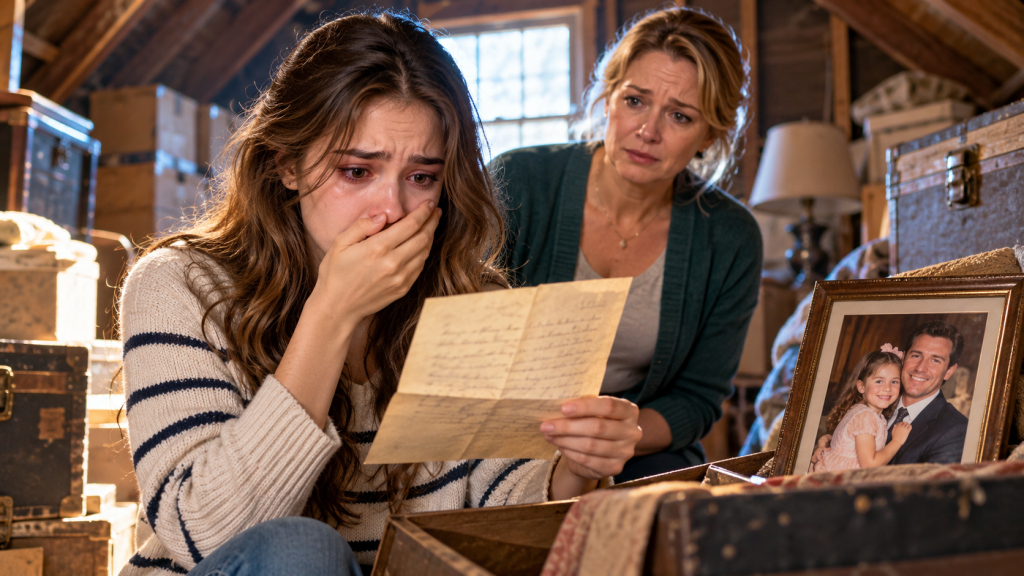
Her eyes filled. “Valentina, please come downstairs.” “No.” My voice sounded unfamiliar. Sharp. Cold. Almost as though it belonged to someone else. I held up my father’s letter. “You told me Dad died driving to Milwaukee.” Veronica swallowed. “I know.” “You said he was alone.” Her face crumpled. “I know.” I stepped backward. The attic floor creaked beneath me.
“Then who was driving?”
For several seconds, she couldn’t answer.
Finally, she whispered, “Someone your grandmother has spent fourteen years protecting.”
The words struck me like a physical blow.
I looked down at the photograph in my hand.
My grandmother.
An unfamiliar lawyer.
And a date stamped across the back.
Two days after my father’s funeral.
I felt my chest tighten.
“Why would Grandma protect someone who was involved in Dad’s death?”
Veronica closed her eyes.
Then said something that made my entire body go cold.
“Because, sweetheart, she was in that car too.”
I couldn’t breathe.
My grandmother, Teresa Morales.
The woman who sent me birthday cards until I was eight.
The woman Veronica claimed couldn’t bear to visit because I reminded her too much of my father.
The woman whose face I barely remembered except for a few photographs.
She had been in the car?
That night?
When Dad died?
I stared at Veronica.
“You lied to me.”
Tears slipped down her cheeks.
“Yes.”
I felt something inside me break.
“All those years.”
She nodded.
“All those years.”
I shook my head.
“You let me believe Grandma abandoned me.”
Veronica covered her mouth.
I continued.
“You let me think Dad died alone.”
My voice cracked.
“And you never told me you knew my biological mother.”
Veronica began crying.
“Valentina…”
“Don’t call me that.”
She stopped.
I wiped my face angrily.
“Not right now.”
For a moment, she looked so devastated that I almost reached for her.
That was the cruelest part.
Even while I was furious, my heart still recognized her as the woman who had raised me.
The one who sat beside my bed when I had pneumonia.
The one who learned to make my father’s cinnamon coffee because she thought the smell might comfort me.
The one who attended every school event, even when she was exhausted from work.
She was my mother in every ordinary way.
And I didn’t know whether I could trust a single extraordinary thing she’d ever told me.
“I need answers,” I whispered.
Veronica nodded.
“You deserve them.”
“Then start talking.”
She looked toward the box.
The photographs.
The letters.
The ledger.
Then slowly climbed into the attic.
She sat on the wooden floor across from me.
And for the first time in fourteen years, the woman who had taught me how to face the truth looked terrified of it herself.
“Your father and Mariana met in college,” she began.
I stared at her.
“Mariana was my best friend.”
Her voice trembled.
“We met when we were thirteen.”
I looked down at the photograph.
The young woman with my eyes.
My biological mother.
For twenty years, she’d existed only as a sentence.
She loved you so much she gave you her whole life.
Now her face smiled up at me from the faded paper.
I swallowed.
“Were you close?”
Veronica gave a broken laugh.
“Closer than sisters.”
She wiped her tears.
“She had terrible handwriting. She loved old movies. She couldn’t cook rice without burning it.”
Despite everything, I almost smiled.
“She laughed so loudly people turned around in restaurants.”
Veronica paused.
Then whispered, “And she was the bravest person I ever knew.”
I looked at her.
“Then why did you never tell me any of that?”
Her face crumpled.
“Because after your father died, every story about Mariana seemed to lead back to the same people.”
“What people?”
“Your grandmother. The lawyer. The trust.”
I frowned.
Veronica continued.
“Julian was trying to find out what happened to the money Mariana left you.”
I stared at the ledger.
“The education fund.”
She nodded.
“Yes.”
“Who stole it?”
Her eyes filled.
“We believe your grandmother’s attorney helped move money out of it.”
I looked at the photograph again.
“The man standing beside her?”
Veronica nodded.
“His name is Martin Kessler.”
I repeated it slowly.
“Martin Kessler.”
She swallowed.
“Your father found irregularities shortly before he died.”
“And Grandma?”
Veronica hesitated.
“She signed documents.”
My chest tightened.
“What documents?”
“Some were authorization forms. Others were amendments to the trust.”
I stared.
“Did she know what she was signing?”
Veronica’s eyes filled.
“That’s one of the questions we still need answered.”
I looked toward the courthouse notice.
“Then why is there a hearing tomorrow?”
Veronica took a breath.
“Because the records your father preserved helped reopen the dispute.”
I frowned.
“After fourteen years?”
She nodded.
“Not easily.”
She explained that some claims had become difficult because of the passage of time.
Records had been lost.
People had died.
Financial institutions had changed ownership.
But certain trust-related issues remained subject to review, and newly discovered documents had raised questions about whether earlier proceedings were based on false information.
I listened.
Trying to follow.
Trying to understand how the little girl who lost her father had become the young woman whose name appeared on a courthouse notice.
Then I asked the question that mattered most.
“Why didn’t you tell me when you started investigating?”
Veronica closed her eyes.
“Because I was afraid.”
“Of what?”
“Losing you.”
I stared at her.
She began crying.
“After Julian died, his family accused me of manipulating him.”
Her voice shook.
“They said I married him for money.”
“They said I wasn’t really your mother.”
“They threatened to challenge the adoption.”
I swallowed.
She continued.
“Your grandmother said she would take you away.”
My heart tightened.
“And Dad?”
“Your father had already legally adopted you into our family with me as your mother. He wanted you to stay with me if anything happened.”
I looked down.
Veronica’s voice broke.
“But I was terrified that someone would use the confusion surrounding the trust to tear us apart.”
I stared at her.
“So you told me Grandma didn’t want to see me.”
Tears streamed down her face.
“Yes.”
I shook my head.
“That wasn’t fair.”
“I know.”
I swallowed.
“You didn’t get to decide that for me.”
She lowered her head.
“No.”
The silence stretched.
Outside, rain tapped against the roof.
I looked around the attic.
At the boxes.
The photographs.
The old shirts.
The stopped watch.
All the things I’d been told were lost.
Then I whispered, “Why keep them?”
Veronica looked up.
“What?”
“If the truth was so dangerous, why didn’t you destroy everything?”
She stared at me.
Then tears filled her eyes.
“Because they were yours.”
My throat tightened.
She continued.
“Your father loved you.”
“Mariana loved you.”
“And I couldn’t bear the thought of erasing them.”
Her voice broke.
“I was afraid to tell you the truth, but I wasn’t willing to throw it away.”
For a moment, I wanted to hug her.
Then I remembered the years of silence.
And the feeling passed.
Or perhaps it didn’t pass.
Perhaps it simply had nowhere safe to go.
I stood.
My knees trembled.
Veronica rose too.
“Valentina?”
I picked up the photograph of Mariana.
Then my father’s letter.
“I need to be alone.”
She nodded slowly.
“Okay.”
I moved toward the ladder.
Then stopped.
Without looking back, I asked, “Did Dad really die in that accident?”
Veronica began crying.
“Yes.”
I swallowed.
“Was it an accident?”
She hesitated.
Then whispered, “The crash was real.”
I closed my eyes.
“That isn’t what I asked.”
Her voice broke.
“I know.”
That night, I locked my bedroom door.
Not because I thought Veronica would hurt me.
Because I couldn’t bear another explanation.
I spread the photographs across my bed.
My father’s college graduation.
His wedding to Mariana.
Their first apartment.
My mother pregnant with me.
Dad holding me as a newborn.
Mariana smiling beside a crib.
And one photograph I stared at for nearly an hour.
It showed Mariana sitting on the floor with me in her lap.
I was tiny.
Still a baby.
Her arms wrapped around me.
Her forehead resting against mine.
On the back, my father had written:
MY TWO FAVORITE GIRLS.
I pressed the photograph against my chest.
And cried.
I had spent twenty years believing my biological mother died giving birth to me.
Yet here she was.
Holding me.
Smiling.
Alive.
I turned the photograph over again.
There was a date.
Six weeks after my birthday.
I stared.
Six weeks.
My mother had lived at least six weeks after I was born.
The lie was suddenly larger than I understood.
I reached for the hospital receipts.
One bore Mariana’s name.
Another was dated four months after my birth.
My hands began shaking.
“No,” I whispered.
I looked at the picture again.
Then at the date.
Then at the records.
My biological mother hadn’t died during childbirth.
She had lived long enough to hold me.
To know me.
To love me.
And someone had rewritten that part of my life.
I opened my father’s letter again.
This time, I read every page.
Slowly.
Carefully.
Until the words began forming a story.
Valentina, my beautiful little girl,
If you are old enough to read this, there are things you deserve to know about your mother.
Mariana did not die the day you were born.
I stopped.
My breath caught.
Then continued.
She survived the delivery.
She held you.
She sang to you.
She spent the first months of your life telling everyone you had my stubborn forehead and her eyes.
A sob escaped me.
I wiped my face.
She became ill afterward.
At first, we thought she would recover.
Then the doctors discovered a serious condition that required prolonged treatment.
I pressed my hand against my mouth.
Mariana fought hard.
She wanted more time with you.
She wanted to see your first birthday.
She wanted to teach you to dance.
She wanted to hear you call her Mama.
The words blurred.
I forced myself to keep reading.
When she realized she might not survive, she asked Veronica to help care for you.
They had been friends since childhood.
Veronica promised Mariana that you would never grow up believing you were unwanted.
My heart ached.
I am telling you this because I never want the difficult circumstances of your mother’s death to become a secret you have to uncover alone.
I covered my face.
My father had wanted me to know.
And somehow, the woman who raised me had hidden the very truth he tried to preserve.
I read the next page.
After Mariana died, her parents and mine disagreed over certain financial arrangements.
Some money had been set aside for you.
I believed those funds would remain protected until you were older.
But recently, I discovered transactions I cannot explain.
My heartbeat quickened.
Veronica has helped me organize the records.
I have asked for an independent review.
I do not know yet whether the discrepancies are mistakes, misuse, or deliberate wrongdoing.
I swallowed.
Then came the sentence that made my hands turn cold.
Tomorrow, I am meeting Martin Kessler and your grandmother to demand an explanation.
The date at the top of the letter was the night before the crash.
I stared at it.
Tomorrow.
The day my father died.
Then I read the final page.
If something happens to me, I want you to know that Veronica did not enter your life by accident.
She came because Mariana trusted her.
And I came to love her because she loved both of us.
Tears streamed down my face.
I know she is not the mother who gave birth to you.
But if she remains in your life, I hope you will see that motherhood can be built through daily love as well as through birth.
I stopped breathing.
Then continued.
Please don’t let anyone turn the women who loved you into enemies.
Mariana was your first mother.
Veronica chose to become your second.
Neither love diminishes the other.
My shoulders shook.
The final lines were almost impossible to read.
And Valentina, if anyone tells you that you must choose between loving me, remembering Mariana, and loving Veronica, remember that your heart is big enough for all of us.
You are my whole world.
Love always,
Dad.
I sat on my bed until dawn.
The letter lay open beside me.
My father’s words had answered one question.
And created a hundred more.
He knew about the financial irregularities.
He intended to confront Kessler and my grandmother.
He died the next day.
Someone had been driving his car.
My grandmother was there.
And Veronica had kept the entire story from me.
I stared at the ceiling.
Then whispered, “Dad, what really happened?”
At six thirty, someone knocked softly.
“Vale?”
Raul.
My stepfather.
The man Veronica married years after Dad’s death.
He had never tried to replace Julian.
He never demanded that I call him Dad.
He simply fixed broken things.
Made pancakes on Sundays.
And taught Diego and Mateo to speak respectfully to their older sister.
I opened the door.
He stood holding two cups of coffee.
“Morning.”
I stared.
“You know?”
His expression softened.
“Some of it.”
My throat tightened.
“How much?”
He sighed.
“Enough to know you deserve answers.”
He handed me a cup.
Then said quietly, “And enough to know Veronica has been frightened for a very long time.”
I looked down.
“Did you know my biological mother lived after I was born?”
He hesitated.
“Yes.”
The answer hurt.
Another adult.
Another person who had watched me believe a story that wasn’t true.
Raul saw my expression.
His face crumpled.
“I’m sorry.”
I shook my head.
“I don’t want apologies right now.”
He nodded.
“Okay.”
I looked at him.
“I want everyone to stop deciding what I’m allowed to know.”
His eyes filled.
Then he said something simple.
“That’s fair.”
We sat in silence.
Then Raul told me that Veronica had spent years consulting attorneys, gathering records, and trying to understand the financial dispute.
She had kept copies of everything she could obtain.
She had made mistakes.
Sometimes serious ones.
But she had not simply been sitting on the truth for fourteen years.
She had been trying to determine what was true.
I listened.
Then asked, “Why is the hearing happening now?”
Raul considered.
“Because you turned twenty.”
I frowned.
“What does that have to do with anything?”
He looked toward the doorway.
“Some of the trust provisions changed when you reached adulthood.”
I stared.
“And now?”
He swallowed.
“Now you’re old enough to make decisions about your own interests.”
I looked down at the letter.
For years, adults had argued about where I belonged.
Who had authority over me.
Who could make decisions.
Who could access money.
Who could tell me stories.
And now, suddenly, I was the person who would have to choose what happened next.
I felt terrified.
But beneath the fear, something else stirred.
Determination.
At eight, I went downstairs.
Veronica stood in the kitchen.
She looked as though she hadn’t slept.
Her hair was tied back.
Her eyes were red.
She wore the same blue sweater she always put on when she was nervous.
She turned when I entered.
“Valentina.”
I looked at her.
For a moment, I couldn’t speak.
Then I placed the letter on the table.
“I read all of it.”
Her face crumpled.
“I know.”
I swallowed.
“My mother didn’t die giving birth to me.”
Tears slipped down her cheeks.
“No.”
“You knew.”
“Yes.”
I closed my eyes.
“And you let me believe it.”
She began crying.
“Yes.”
I took a breath.
“Why?”
She looked toward the window.
For a moment, she seemed unable to answer.
Then she whispered, “Because after Julian died, I was told your father’s family might challenge whether I was fit to raise you.”
I stared.
She continued.
“They claimed Mariana’s final illness and the adoption history were being misrepresented.”
I frowned.
“But you could have told me the truth.”
She nodded.
“I could have.”
Her voice broke.
“I should have.”
I looked down.
She continued.
“I was young.”
“Scared.”
“Grieving.”
“And I convinced myself that keeping the story simple would protect you.”
My eyes filled.
Then she whispered, “I was wrong.”
The words were quiet.
No excuses.
No attempt to blame me.
No insistence that she had done everything perfectly.
Just an admission.
I looked at her.
And felt something in my chest soften slightly.
But only slightly.
“Mom…”
The word escaped before I could stop it.
Veronica’s eyes widened.
I swallowed.
Then corrected myself.
“Veronica.”
Her face crumpled.
The pain in her eyes nearly undid me.
But I wasn’t ready to repair what I hadn’t yet understood.
“I need you to tell me everything.”
She nodded.
“I will.”
We sat at the kitchen table.
Raul stayed nearby.
Diego and Mateo were still sleeping upstairs.
I looked at Veronica.
“Start with Grandma.”
She took a breath.
“Teresa loved Julian deeply.”
I nodded.
“She was proud of him.”
Veronica continued.
“But she also depended on the family business.”
I frowned.
“What business?”
“A small accounting and property-management company your grandfather established.”
My eyebrows rose.
“Dad worked there?”
“For a while.”
I looked down.
Veronica continued.
“Martin Kessler was the family’s attorney.”
“He handled trusts, property transactions, and estate matters.”
I glanced toward the photograph.
The man beside my grandmother.
“Was he close to them?”
Veronica nodded.
“Very.”
She paused.
“Perhaps too close.”
I leaned forward.
“What happened to Mariana’s money?”
Veronica opened a folder.
“She had a life-insurance policy and savings designated for your benefit.”
I stared.
“How much?”
She gave me a figure.
It was substantial.
Enough to help with education.
Housing.
And long-term security.
My throat tightened.
“Where is it?”
Veronica’s eyes filled.
“That’s what we’ve been trying to establish.”
I looked at the records.
Some transactions were clear.
Others weren’t.
Several accounts had been transferred.
Some money appeared to have been used for expenses described as family obligations.
And certain documents bore signatures that raised serious questions.
I stared at my father’s name.
Written at the bottom of a transfer authorization.
My stomach turned.
“That’s not his handwriting.”
Veronica nodded.
“That’s what Julian believed.”
I looked up.
“Can it be proved?”
“We have preserved samples and records for independent examination.”
I swallowed.
“And the hearing?”
“The court will consider the evidence and the issues properly before it.”
For the first time, I understood that the story wasn’t simply about a hidden inheritance.
It was about trust.
The kind held in financial documents.
And the kind families place in one another.
My father had trusted relatives.
My mother had trusted arrangements intended to protect me.
Veronica had trusted people she later believed were acting against us.
And I had trusted Veronica to tell me the truth about my childhood.
Every layer of the story involved someone placing faith in another person.
And someone, somewhere, failing that responsibility.
Then I asked about the accident.
Veronica’s expression changed.
She looked down.
I waited.
Finally, she whispered, “Julian went to meet Kessler.”
I nodded.
“Grandma was there?”
“Yes.”
“Who was driving?”
She closed her eyes.
Then said the name.
“Martin Kessler.”
My stomach dropped.
I stared at her.
“The lawyer?”
She nodded.
“He was driving your father’s car.”
I felt cold.
“Why?”
Veronica swallowed.
“We don’t know every detail.”
I leaned forward.
“Tell me what you do know.”
She explained that my father had arranged to confront Kessler about the trust records.
Teresa had agreed to attend.
The meeting took place outside the city.
Afterward, the three of them traveled together.
For reasons still disputed, Kessler drove Julian’s car.
My father sat in the passenger seat.
My grandmother sat in the back.
During heavy rain, the car struck a barrier after swerving near a truck.
My father died from his injuries.
Teresa survived with serious injuries.
Kessler survived.
And the original accident investigation concluded that road conditions and driving errors contributed to the crash.
I stared.
“Then why did you say Dad was driving?”
Veronica began crying.
“Because that’s what his family told everyone.”
I swallowed.
“And you repeated it?”
She nodded.
“Yes.”
I closed my eyes.
For a moment, I felt a familiar anger rising.
Then I asked carefully, “Was there evidence the crash was intentional?”
Veronica shook her head.
“Not conclusive evidence.”
I looked at her.
She continued.
“There were inconsistencies.”
“In the statements.”
“In the sequence of events.”
“And in what happened to your father’s briefcase afterward.”
My heart tightened.
“What happened to it?”
Her eyes filled.
“It disappeared.”
I looked toward the box from the attic.
The ledger.
The photographs.
The letter.
“All his records?”
“Not all.”
Veronica nodded toward the papers.
“Julian kept copies at home.”
I stared.
“And Kessler didn’t know?”
“Apparently not.”
I swallowed.
My father had preserved evidence.
The night before he died.
Then he took his concerns to the people involved.
And never returned.
I looked down at his handwriting.
For the first time, I felt something beyond grief.
I felt the weight of his final days.
He had been afraid.
Not necessarily of death.
But of what might happen to his daughter if he failed to protect what her mother left.
At ten, we drove to the courthouse.
Veronica sat beside me.
Raul drove.
The morning was gray.
Rain threatened.
The city moved around us as though nothing extraordinary was happening.
People hurried to work.
Buses stopped.
Coffee shops opened.
And I sat in the back seat holding a photograph of my parents.
Every few minutes, I looked at Veronica.
She kept her hands folded tightly in her lap.
Finally, I whispered, “Are you nervous?”
She gave a small laugh.
“Terrified.”
I looked down.
Then asked, “Do you think Grandma will recognize me?”
Veronica’s expression softened.
“Yes.”
I swallowed.
“Do you think she’ll want to talk?”
She hesitated.
“I don’t know.”
I looked out the window.
Then whispered, “I want to hear her side.”
Veronica nodded.
“You should.”
The courthouse was larger than I expected.
Tall doors.
Polished floors.
Security checkpoints.
People carrying folders and briefcases.
Attorneys speaking quietly.
Families waiting with anxious faces.
I had never been in a courthouse before.
My stomach twisted.
Raul placed a hand on my shoulder.
“Take your time.”
I nodded.
Then we walked inside.
Our attorney was named Caroline Mercer.
She was a calm woman in her fifties.
She greeted me warmly.
“Valentina.”
I shook her hand.
“Hello.”
She smiled.
“I know this is a lot.”
I nodded.
“More than a lot.”
Her expression softened.
Then she explained the hearing.
It concerned the trust records.
Prior representations made to the court.
And requests for further review of specific transactions and documents.
The accident itself was a separate matter.
The court would not suddenly declare someone responsible for my father’s death merely because financial irregularities existed.
I appreciated that clarity.
Because although part of me desperately wanted answers, another part knew that grief could make suspicion feel like proof.
And I didn’t want to become someone who confused the two.
We entered the courtroom.
I looked around.
Then saw her.
My grandmother.
Teresa Morales.
She sat in the front row beside an attorney.
Her hair was white.
Her shoulders slightly bent.
Her hands rested on a cane.
For a moment, she looked like any elderly woman waiting for difficult news.
Then she turned.
And our eyes met.
Her face changed.
Her mouth opened.
And tears immediately filled her eyes.
“Valentina?”
I stopped breathing.
She stood too quickly.
The attorney reached toward her.
She ignored him.
“My little girl.”
The words shattered something inside me.
I had imagined this moment for years.
Sometimes I pictured her angry.
Sometimes indifferent.
Sometimes apologetic.
But I had never imagined her looking at me as though she’d just seen someone return from the dead.
She took a step forward.
Then stopped.
Her hands trembled.
“You look just like Julian.”
My eyes filled.
I stared at her.
For a moment, I couldn’t speak.
Then whispered, “Grandma?”
She covered her mouth.
And began sobbing.
Veronica stood beside me.
I felt her stiffen.
Teresa looked at her.
For one brief moment, the tenderness disappeared from her face.
Then she looked back at me.
“Valentina, sweetheart, I tried to reach you.”
My stomach tightened.
I turned toward Veronica.
She lowered her eyes.
I looked back at my grandmother.
“What?”
Teresa began crying.
“I wrote letters.”
I stared.
“I called.”
Her voice broke.
“I sent gifts.”
My heartbeat quickened.
I turned again toward Veronica.
“Is that true?”
She closed her eyes.
Then whispered, “Some of it.”
The room seemed to tilt.
I took a step backward.
My grandmother reached toward me.
“Please.”
I raised my hand.
“Wait.”
She stopped.
I swallowed.
Then looked at Veronica.
“You told me she couldn’t bear to see me.”
Tears streamed down her cheeks.
“I know.”
I felt something break.
Again.
“And she was writing?”
Veronica nodded slowly.
“Yes.”
My voice rose.
“For how long?”
Caroline gently touched my arm.
“Valentina, we can discuss this privately after the hearing.”
I pulled away.
Not violently.
Just enough to stand on my own.
“No.”
My voice trembled.
“I need to know.”
Veronica began sobbing.
“Some letters arrived.”
I stared.
“And you kept them?”
She nodded.
I closed my eyes.
For a moment, I couldn’t hear anything.
Then my grandmother whispered, “I thought you hated me.”
My eyes flew open.
I looked at her.
“What?”
She began crying harder.
“I thought Veronica had told you I didn’t want you.”
My chest tightened.
I looked between them.
Two women.
Both claiming to love me.
Both carrying years of pain.
And both having allowed me to grow up inside a story I never chose.
The court officer asked everyone to settle.
Caroline guided me toward our seats.
I sat down.
My hands were shaking.
Veronica sat beside me.
I couldn’t look at her.
Not yet.
Across the room, Teresa wiped her eyes.
And I realized the hearing had barely begun.
Yet my family had already changed again.
The judge entered.
Everyone stood.
Then sat.
The proceedings began.
I listened as the attorneys outlined the issues.
The trust.
The questionable transactions.
The documents.
The competing accounts.
And the significance of records preserved by my father.
I tried to understand every word.
But my attention kept returning to my grandmother.
Her white hair.
Her trembling hands.
The way she looked toward me whenever she thought I wasn’t watching.
Eventually, Martin Kessler entered.
I recognized him immediately.
Older.
Heavier.
Gray hair.
But unmistakable.
The man from the photograph.
The attorney who had been involved with my family’s financial affairs.
The man who drove my father’s car on the night he died.
He wore a dark suit.
Carried a briefcase.
And looked remarkably composed.
That composure made me angry.
For fourteen years, my life had been shaped by unanswered questions.
And he walked into the courtroom as though this were an ordinary professional inconvenience.
His attorney addressed the court.
Kessler denied wrongdoing.
He disputed allegations concerning the signatures.
He characterized some transactions as authorized expenses.
And he maintained that the accident had been just that.
An accident.
The court listened.
Then turned toward the evidence.
There were account records.
Document copies.
Correspondence.
And expert analyses that would require proper examination.
At one point, Caroline introduced a copy of my father’s ledger.
I felt my heart tighten.
His handwriting.
His notes.
The careful columns of numbers.
The little check marks he used when reconciling accounts.
I remembered watching him work at the kitchen table.
His glasses sliding down his nose.
His coffee growing cold.
And his voice saying, “Vale, numbers tell stories if you know how to listen.”
Now the numbers were speaking.
And I was terrified of what they might say.
Then Caroline asked about an authorization allegedly signed by Julian.
The document bore his name.
But the signature looked different from the handwriting samples I’d seen.
An examiner’s preliminary findings identified significant inconsistencies.
Kessler’s attorney challenged those findings.
The judge made clear that the issue would be evaluated according to the evidence.
I listened.
Trying to remain patient.
Because the truth needed more than my anger.
It needed proof.
During a recess, my grandmother approached.
Caroline remained nearby.
Teresa stopped several feet away.
“Valentina?”
I looked at her.
Her eyes filled.
“May I speak to you?”
I swallowed.
Then nodded.
“Briefly.”
She sat across from me.
For a moment, neither of us spoke.
Then she reached into her handbag.
And removed a small photograph.
It showed my father as a child.
Maybe seven.
Standing beside a bicycle.
Grinning.
I stared.
“He looks happy.”
Teresa smiled through tears.
“He was.”
Her voice broke.
“He was always curious.”
I looked at her.
Then asked quietly, “Did you really write to me?”
She nodded immediately.
“Yes.”
My throat tightened.
“How often?”
Her eyes filled.
“Every birthday.”
I closed my eyes.
She continued.
“Every Christmas.”
“And sometimes when I simply missed you.”
I began crying.
I looked toward Veronica.
She stood several feet away.
Her face was devastated.
Then I turned back to my grandmother.
“Why did you stop coming?”
Teresa swallowed.
“I was told contact needed to go through the lawyers.”
I frowned.
“By whom?”
She hesitated.
“Martin.”
My heart tightened.
I glanced toward Kessler.
He was speaking with another attorney across the room.
Teresa continued.
“He said Veronica would claim I was harassing you.”
I stared.
“And you believed him?”
Her eyes filled.
“I was grieving Julian.”
She looked down.
“I wasn’t thinking clearly.”
I swallowed.
“But you could have tried again.”
She nodded.
“Yes.”
Her voice broke.
“I should have.”
I looked at her.
Then asked the question I’d been carrying since the attic.
“Grandma, what happened the night Dad died?”
Her face changed.
She looked toward the floor.
For a long time, she couldn’t speak.
Then whispered, “Your father was angry.”
I swallowed.
“About the trust?”
She nodded.
“Yes.”
Tears filled her eyes.
“He believed money had been taken improperly.”
I stared.
“Did you take it?”
She shook her head.
“Not knowingly.”
I studied her.
She continued.
“I signed papers Martin told me were necessary.”
Her voice trembled.
“I trusted him.”
I looked toward Kessler.
Teresa swallowed.
“And Julian was furious.”
I leaned forward.
“What happened in the car?”
My grandmother began crying.
“Martin was driving.”
I nodded.
“Why?”
“Julian was upset.”
She wiped her eyes.
“He said he needed time to think.”
I swallowed.
“And then?”
Teresa looked toward the window.
“The rain was terrible.”
Her hands began trembling.
“We were arguing.”
“About the money.”
I stared.
She continued.
“Julian demanded that Martin pull over.”
My heart began pounding.
“And did he?”
She shook her head.
“No.”
I gripped the edge of the chair.
“Why not?”
Her voice broke.
“Martin said we were almost there.”
I swallowed.
Then whispered, “What happened next?”
Teresa closed her eyes.
“The truck came around the curve.”
I held my breath.
“Martin swerved.”
Her voice shook.
“Julian reached toward the dashboard.”
Then she began sobbing.
“And everything went black.”
I stared.
“Did Martin do it on purpose?”
She looked up.
Her face was wet.
“I don’t know.”
The answer hurt.
But it was honest.
At least, it sounded honest.
She continued.
“I have spent fourteen years asking myself that question.”
My eyes filled.
I looked down.
Then whispered, “So have I.”
Teresa reached toward my hand.
I hesitated.
Then allowed her fingers to touch mine.
For a moment, I felt something warm.
Familiar.
Even though I barely remembered her.
Then she whispered, “I loved your father.”
My throat tightened.
“I know.”
She began crying.
“I made mistakes.”
I looked at her.
“Did you know about the missing money?”
She hesitated.
Then said something that changed the expression on Caroline’s face.
“I knew Martin moved funds.”
My heart stopped.
“What?”
Teresa began crying harder.
“I didn’t know how much.”
I stared.
She continued.
“He said it was temporary.”
Caroline moved closer.
“Mrs. Morales, we should discuss any potentially relevant financial admissions through the proper process.”
Teresa nodded.
But she kept looking at me.
“I was afraid Julian would think I betrayed him.”
My voice trembled.
“Did you?”
She closed her eyes.
Then whispered, “I betrayed his trust by refusing to ask questions.”
The words settled between us.
Not a confession to causing the crash.
Not proof of every allegation.
But an admission that she’d chosen silence when my father needed honesty.
I looked at her.
Then whispered, “I wish you’d told him.”
She began crying.
“So do I.”
The hearing resumed.
Caroline addressed the newly raised issues through the appropriate procedures.
The judge ordered further steps concerning the records and the disputed transactions.
Nothing was resolved that afternoon.
There was no dramatic confession.
No sudden arrest in the courtroom.
No declaration that every mystery had been solved.
But the process had moved forward.
And I had heard my grandmother speak about my father for the first time in fourteen years.
When we left the courtroom, I felt exhausted.
Veronica approached carefully.
“Vale?”
I turned.
She looked terrified.
“Can we talk?”
I stared at her.
Then nodded.
“Not here.”
We drove home in silence.
Raul kept his eyes on the road.
Veronica sat beside him.
I sat in the back holding the photograph of my father as a boy.
Every few minutes, I looked down at it.
Then at the courthouse papers.
Then toward the woman who had raised me.
I wanted to scream.
I wanted to cry.
I wanted to hug her.
I wanted to leave.
I wanted everything to go back to the way it had been before I climbed into the attic.
But I knew that wasn’t possible.
Once you learn the truth about something important, you cannot simply return it to the darkness and pretend you never saw it.
That evening, Veronica came to my room.
She knocked.
I opened the door.
She held a small wooden box.
Her eyes were swollen.
“Valentina.”
I stepped aside.
She entered.
Placed the box on my desk.
Then sat down.
For a long time, she didn’t speak.
Finally, she whispered, “These are the letters.”
My heart stopped.
I looked toward the box.
“What letters?”
She swallowed.
“From Teresa.”
I stared.
Then slowly opened the lid.
Inside were envelopes.
Dozens.
Different colors.
Different years.
Some decorated with flowers.
Some plain.
All addressed to me.
MISS VALENTINA MORALES.
My throat tightened.
I picked up the first one.
It was dated shortly after Dad’s funeral.
The handwriting trembled slightly.
My darling Valentina,
I hope you’re eating well.
I hope someone is reading you stories.
I hope you remember how much your daddy loved you.
I covered my mouth.
Tears streamed down my face.
The next letter was dated on my seventh birthday.
Then Christmas.
Then my eighth birthday.
Then Easter.
Then another Christmas.
Year after year.
My grandmother had written.
And Veronica had kept them.
I looked up.
My voice trembled.
“Why?”
Veronica began crying.
“Because I was afraid.”
I shook my head.
“You keep saying that.”
She nodded.
“I know.”
I held up the letters.
“Do you understand what you took from me?”
Her face crumpled.
“Yes.”
I stood.
“No.”
My voice rose.
“I don’t think you do.”
She began sobbing.
I continued.
“You let me believe my grandmother didn’t want me.”
“You let me cry on birthdays because I thought Dad’s family had forgotten me.”
“You watched me defend you when people said stepmothers weren’t real mothers.”
Tears streamed down my face.
“And all the while, you were hiding proof that someone else loved me too.”
Veronica covered her face.
“I know.”
I shook my head.
“You didn’t protect me.”
Her shoulders shook.
“You protected yourself.”
She looked up.
Her face was devastated.
For a moment, she seemed about to argue.
Then she lowered her eyes.
And whispered, “Yes.”
The admission surprised me.
I stared.
She continued.
“I was frightened that if you loved Teresa, you would leave me.”
I swallowed.
She began crying harder.
“I know how selfish that sounds.”
I looked down.
She continued.
“I was afraid of losing the only child I had.”
The room went quiet.
Then she whispered, “And I made you carry the cost of my fear.”
I sat down slowly.
For a long time, neither of us spoke.
Then I asked quietly, “Did you ever think I could love both of you?”
Veronica’s face crumpled.
“Yes.”
She wiped her eyes.
“But I didn’t trust myself to survive if you chose her.”
I looked at her.
Then whispered, “You never gave me the chance.”
She nodded.
“No.”
I looked toward the letters.
Then toward the photograph of Mariana.
Three women.
My biological mother.
My adoptive mother.
My grandmother.
All tied to my life.
All carrying love and mistakes.
And I had grown up believing there was room for only one version of motherhood.
I felt tired.
So terribly tired.
“Veronica,” I whispered, “I need time.”
She nodded.
“Of course.”
I swallowed.
“And I need you to stop keeping things from me.”
She began crying.
“I will.”
I looked at her.
“Even if the truth makes you look bad.”
She nodded again.
“Yes.”
She stood.
Walked toward the door.
Then stopped.
“Valentina?”
I looked up.
Her voice broke.
“I love you.”
My eyes filled.
I swallowed.
“I know.”
She nodded.
Then left.
And for the first time in my life, knowing she loved me wasn’t enough to make everything simple.
Over the following weeks, I read the letters.
One every evening.
Sometimes two.
Sometimes I had to stop.
They contained stories about my father.
His childhood.
His favorite foods.
His school days.
The time he broke his arm falling from a tree.
The way he always tried to rescue stray animals.
The year he wanted to become an astronaut.
I laughed through tears.
I cried.
I learned things about Dad I’d never known.
And slowly, the man I’d lost began becoming more than a collection of memories from early childhood.
He became a person.
With dreams.
Mistakes.
Humor.
And a life before me.
One letter included a photograph of Dad at twelve.
He stood beside his mother holding a blue bicycle.
On the back, Teresa had written:
Julian saved for six months to buy this. He rode it until the tires were almost smooth.
I smiled.
Then touched the photograph.
“Dad.”
My voice broke.
“I wish I could’ve known you longer.”
I began visiting Teresa.
At first, with Caroline’s guidance about keeping legal matters separate from personal conversations.
We met for coffee.
Then lunch.
Sometimes simply sat in her garden.
She showed me photographs.
Old birthday cards.
School projects Dad had made.
A little wooden airplane he’d built when he was nine.
I listened.
Asked questions.
And gradually became acquainted with the woman I’d spent fourteen years believing had forgotten me.
Our relationship wasn’t instantly easy.
There were painful conversations.
Questions about the trust.
About Kessler.
About the accident.
About why she hadn’t found another way to contact me.
Sometimes she cried.
Sometimes I became angry.
Sometimes we ended visits early.
But we kept talking.
And slowly, I learned that rebuilding a relationship doesn’t mean pretending the years apart never happened.
It means making room for the truth about them.
One afternoon, Teresa handed me a photograph.
It showed my father holding me as a toddler.
We were standing beside a lake.
I was wearing a red dress.
Dad was laughing.
I stared.
“I remember this.”
Teresa smiled.
“Do you?”
I nodded.
“Not clearly.”
My eyes filled.
“But I remember the water.”
She touched the photograph.
“Julian loved taking you there.”
I smiled.
Then whispered, “He called me his whole world.”
Teresa began crying.
“Yes.”
She looked at me.
“He said it all the time.”
For a moment, we sat quietly.
Then she reached for my hand.
“Valentina?”
“Yes?”
“I am sorry.”
I looked at her.
She continued.
“For signing papers I didn’t understand.”
“For trusting Martin.”
“For not being honest with Julian.”
Her voice broke.
“And for allowing the years to pass without finding a better way to reach you.”
I swallowed.
“Grandma…”
She shook her head gently.
“I don’t expect forgiveness today.”
I looked down.
She continued.
“But I want you to know I understand that loving you wasn’t enough if I didn’t act responsibly.”
My eyes filled.
I nodded.
And for the first time, I believed she was beginning to understand.
Meanwhile, the legal process continued.
Investigators and financial experts reviewed records.
Some transactions were traced.
Others remained uncertain.
Kessler’s explanations were examined against documents, bank records, and testimony.
The case became complicated.
Years had passed.
Records were incomplete.
Some witnesses were unavailable.
But my father’s ledger provided a starting point.
And the preserved copies helped identify discrepancies that had previously gone unexamined.
Months later, Caroline called.
“Valentina?”
I answered immediately.
“Yes?”
“We’ve received additional findings.”
My heart began pounding.
“What kind?”
“Several questioned transactions appear to have been unauthorized.”
I sat down.
She continued.
“There’s evidence that documents were altered and funds redirected through accounts connected to Kessler’s work.”
My throat tightened.
“Did Grandma know?”
Caroline paused.
“Her exact knowledge and responsibility remain matters that must be evaluated. Some documents she signed were used in ways that may not have been fully explained to her.”
I nodded.
“And Dad?”
Her voice softened.
“Your father had identified several of the same discrepancies before his death.”
I closed my eyes.
Then whispered, “He was right.”
Caroline answered gently.
“Yes. His concerns were justified.”
I began crying.
Not because the money mattered more than anything else.
But because my father had spent his final days trying to protect me.
He had noticed something wrong.
Preserved records.
Asked questions.
And refused to ignore it.
For fourteen years, the truth had been buried beneath conflicting stories.
Now the evidence was beginning to show that he had been right to be concerned.
Eventually, legal findings established wrongdoing concerning certain financial transactions.
Kessler faced serious consequences through the appropriate proceedings.
There were orders addressing misused funds and efforts to restore money where possible.
Not every amount could be recovered.
Not every question could be answered.
But enough had been established to make the central financial deception clear.
The accident remained separate.
I wanted desperately for someone to tell me exactly what happened.
To explain every moment.
To say whether my father’s death had been caused deliberately.
But the available evidence did not establish an intentional killing.
Investigators confirmed the crash circumstances as far as the surviving records permitted.
There were driving errors.
Heavy rain.
Conflicting recollections.
And the reality that time had erased some possibilities for certainty.
It was painful.
But I learned to live with the distinction between what I feared and what could be proved.
One evening, I visited my father’s grave.
I carried white lilies.
His favorite flowers, according to Teresa.
I knelt beside the headstone.
JULIAN MORALES.
Beloved father.
Beloved husband.
The dates.
The familiar name.
I touched the stone.
Then whispered, “Dad.”
My voice trembled.
“They found the money.”
I swallowed.
“Not all of it.”
“But they found enough to prove you were right.”
Tears filled my eyes.
I looked down.
“And I’m sorry it took so long.”
I sat beside his grave for nearly an hour.
Talking.
Crying.
Remembering.
Then I opened the little bag I’d brought.
Inside was the photograph of Mariana.
The one from the attic.
My biological mother holding me.
I placed it beside the flowers.
Then whispered, “I found her too.”
My throat tightened.
“I finally know what she looked like.”
I smiled through tears.
“She had my eyes.”
The wind moved gently through the trees.
I closed my eyes.
For a moment, I imagined my father beside me.
His glasses slipping down his nose.
His shirt perfectly ironed.
His hands smelling faintly of coffee.
And his voice saying, “You are my whole world, Valentina.”
I smiled.
Then whispered, “You were mine too.”
That evening, I returned home.
Veronica was sitting at the kitchen table.
She looked up.
“Vale?”
I stopped.
For a moment, I stared at her.
Then at the kitchen.
The yellow curtains.
The coffee maker.
The family photographs.
Everything that had been part of my childhood.
I had spent months trying to understand whether the woman who raised me could still be my mother after everything she’d hidden.
I had been angry.
Hurt.
Confused.
And sometimes ashamed of how much I still loved her.
But I was beginning to understand something.
Her lies had hurt me.
Her fear had deprived me of important relationships.
And those things deserved accountability.
Yet the years she spent loving me were also real.
One truth did not erase the other.
Veronica stood slowly.
“How was the cemetery?”
I swallowed.
“Hard.”
She nodded.
“I’m sorry.”
I looked at her.
Then whispered, “I took Mariana’s photograph.”
Her eyes filled.
“Good.”
I stared.
She continued.
“She would’ve liked that.”
My throat tightened.
For a moment, neither of us spoke.
Then I asked quietly, “Will you tell me more about her?”
Veronica’s face changed.
Her eyes filled with tears.
“Of course.”
I stepped closer.
“Not the simple version.”
She nodded.
“The real one.”
Veronica began crying.
“Yes.”
We sat at the kitchen table.
She told me about Mariana.
How she loved cinnamon coffee.
How she laughed during serious movies.
How she once got lost while driving only three blocks.
How she sang terribly but enthusiastically.
How she was brave when frightened.
And how she made Veronica promise that I would grow up knowing I was wanted.
I listened.
Sometimes laughing.
Sometimes crying.
Sometimes asking her to repeat details because I wanted to hold on to every word.
Then Veronica said something that made me pause.
“Mariana chose your name.”
I looked up.
“Valentina?”
She smiled through tears.
“Yes.”
“Why?”
Veronica looked down.
“She said it meant you would grow up with a brave heart.”
My throat tightened.
I stared.
Then whispered, “Was she brave?”
Veronica nodded.
“Very.”
Her voice broke.
“Even when she was dying.”
I covered my mouth.
Veronica continued.
“She was frightened of leaving you.”
I began crying.
“But she wasn’t frightened of loving you.”
For a moment, the kitchen blurred through my tears.
Then I reached across the table.
And took Veronica’s hand.
Her eyes widened.
I swallowed.
“I’m still angry.”
She nodded quickly.
“I know.”
“And I don’t know when I’ll trust you completely again.”
Tears streamed down her face.
“I understand.”
I took a breath.
“But I don’t want to lose you.”
Her face crumpled.
“Oh, Vale.”
I squeezed her fingers.
“You’re my mother.”
She covered her mouth.
My eyes filled.
“And Mariana was my mother too.”
Veronica nodded through tears.
“Yes.”
I continued.
“And Grandma is part of my family.”
She swallowed.
“Yes.”
I looked at her.
“I need room for all of them.”
Veronica began sobbing.
Then whispered, “You deserve that.”
For the first time in months, I let her hug me.
Not because everything had been forgiven.
Not because trust had magically returned.
But because I wanted to begin rebuilding.
We held each other.
And cried.
Over the following year, our family changed.
Not dramatically.
Not all at once.
But through ordinary choices.
Veronica began telling me things she’d previously avoided.
She gave me access to photographs.
Letters.
Documents.
And family memories.
She acknowledged when she didn’t know an answer.
And when she made mistakes, she apologized instead of defending them.
That mattered.
Teresa began visiting occasionally.
At first, the visits were awkward.
Veronica was tense.
Teresa guarded.
Raul tried to make conversation.
Diego and Mateo looked confused.
But slowly, the tension softened.
We didn’t pretend the past hadn’t happened.
We simply stopped allowing it to control every moment of the present.
One Sunday, Teresa came for lunch.
Veronica made chilaquiles.
Raul grilled vegetables.
Diego complained about school.
Mateo told an elaborate story about a video game.
And I sat at the table looking around.
My grandmother.
My adoptive mother.
My stepfather.
My brothers.
For years, I’d believed my family was smaller than it actually was.
Now I was learning how much room love could make.
At one point, Teresa looked toward Veronica.
Then said quietly, “Thank you for raising her.”
The room went silent.
Veronica stared.
Tears filled her eyes.
Then she whispered, “She made it easy to love her.”
I laughed.
“That’s generous.”
Everyone smiled.
Teresa began crying.
Veronica reached for a tissue.
And for one extraordinary moment, two women who had spent years divided by fear shared the same table without fighting over who loved me more.
I looked down at my plate.
Then smiled.
Because I realized my father’s letter had been right.
My heart was big enough.
I graduated from college the following spring.
The ceremony was held outdoors.
The sky was bright.
The air warm.
I wore a dark gown and a cap that refused to stay straight.
I looked toward the audience.
And saw them.
Veronica.
Raul.
Diego.
Mateo.
Teresa.
All sitting together.
All smiling.
All crying.
I felt my throat tighten.
For a moment, I imagined Dad sitting beside them.
His glasses.
His proud smile.
Mariana holding his hand.
I swallowed.
Then walked across the stage.
When my name was called, Veronica stood immediately.
She cheered so loudly several people turned around.
I laughed.
Teresa stood beside her.
Raul clapped.
My brothers whistled.
And I realized that after years of confusion, I had not lost my family.
I had finally begun to understand it.
After the ceremony, we gathered for photographs.
Veronica adjusted my cap.
Teresa straightened my gown.
Raul told us to stop moving.
Diego made a ridiculous face.
Mateo complained that nobody was looking at the camera.
I laughed until my eyes watered.
Then I asked for one more photograph.
Just me.
Holding Dad’s picture.
And Mariana’s.
Veronica stood beside me.
Teresa on the other side.
We smiled.
And the camera captured something I will treasure forever.
Not a perfect family.
But a family learning to tell the truth.
Later that evening, I sat alone in my room.
My diploma lay on the desk.
My father’s letter beside it.
I read the final lines again.
Please don’t let anyone turn the women who loved you into enemies.
I smiled through tears.
Then whispered, “I’m trying, Dad.”
In the years that followed, I built a life of my own.
I began working.
Moved into a small apartment.
Made friends.
Fell in love.
Had my heart broken.
Fell in love again.
And slowly became a woman who understood that identity isn’t a single story handed to us by other people.
It is something we build from truth.
Memory.
Experience.
And choice.
I kept visiting Veronica.
Sometimes we cooked together.
Sometimes argued.
Sometimes laughed.
Sometimes talked about the past.
Our relationship wasn’t exactly the same as it had been before I found the attic letter.
But in some ways, it became stronger.
Because I no longer needed to believe she was perfect.
And she no longer needed to pretend she had been.
I visited Teresa too.
We took walks.
Looked through albums.
Talked about Dad.
Sometimes she cried.
Sometimes I did.
We never recovered the fourteen years we’d lost.
But we made memories with the time we had.
One afternoon, Teresa took me to the lake where Dad used to bring me.
The water shimmered beneath the sunlight.
Children ran along the shore.
A little boy fell in the grass and laughed.
I stood beside my grandmother.
Then whispered, “Dad loved this place?”
She smiled.
“Yes.”
I looked toward the water.
Then asked, “Did he bring me here often?”
She nodded.
“Every summer.”
My eyes filled.
I looked down.
Then whispered, “I wish I remembered.”
Teresa took my hand.
“That’s why I’m telling you.”
We sat on a bench.
She told stories.
About Dad’s first bicycle.
His terrible singing.
His love of numbers.
His habit of carrying extra pencils.
And how he cried when I was born.
I laughed through tears.
Then looked toward the lake.
For the first time, the memories didn’t feel like something missing.
They felt like something being returned.
Not completely.
Not perfectly.
But gently.
Piece by piece.
Eventually, I began collecting everything.
Photographs.
Letters.
Stories.
Copies of records.
I organized them into albums.
One for Mariana.
One for Julian.
One for Veronica.
One for Teresa.
And one for the family we became afterward.
I didn’t hide the difficult parts.
But I didn’t allow them to swallow every beautiful memory either.
My father died in an accident surrounded by complicated questions.
My grandmother made mistakes.
Veronica kept secrets that hurt me.
Kessler misused trust and influence.
And the legal process couldn’t repair everything.
Those truths mattered.
But so did the love.
The birthdays.
The bedtime stories.
The graduations.
The meals.
The laughter.
The years of someone showing up.
One evening, I visited Veronica with the finished albums.
She opened the first one.
Mariana.
She stared at the photographs.
Then began crying.
“Oh, Vale.”
I sat beside her.
She touched a picture of Mariana laughing.
“She was beautiful.”
I smiled.
“Yes.”
Veronica looked at me.
“You look so much like her.”
My throat tightened.
Then I opened the second album.
Dad.
She smiled through tears.
“He would’ve been so proud of you.”
I nodded.
“I hope so.”
Veronica touched my cheek.
“I know so.”
Then I opened the third album.
Veronica.
Her wedding to Dad.
My childhood birthdays.
School plays.
The day she adopted me.
The first time I wore a graduation gown.
The hospital visit when I broke my wrist.
The night she helped me study for exams.
She stared.
Then whispered, “You kept all these?”
I smiled.
“Of course.”
Her eyes filled.
“But after everything…”
I took her hand.
“Mom.”
She looked up.
I swallowed.
“The lies were real.”
She nodded.
“Yes.”
I smiled sadly.
“But so was the love.”
She began sobbing.
And I hugged her.
Years later, when I became a mother myself, I understood some parts of the story differently.
Not as excuses.
Never excuses.
But as reminders of how fear can distort love when people refuse to face it honestly.
I held my little daughter in the hospital.
Her tiny fingers wrapped around mine.
Her face warm against my chest.
And I thought about Mariana.
The mother who held me.
Who sang to me.
Who died wishing for more time.
I began crying.
Then I thought about Veronica.
The woman who stepped into a frightened little girl’s life.
Who chose to become her mother.
Who made serious mistakes because she was afraid of losing her.
And who eventually learned that real love does not require controlling someone else’s story.
I looked down at my daughter.
Then whispered, “I promise you something.”
She slept peacefully.
I smiled through tears.
“I’ll tell you the truth.”
“Even when it’s complicated.”
“Even when I’m afraid.”
“Even when I make mistakes.”
I kissed her forehead.
“Because your story belongs to you.”
When Veronica came to the hospital, she cried the moment she saw the baby.
“Oh, my goodness.”
I laughed.
“Mom.”
She approached carefully.
“Can I hold her?”
I nodded.
“Of course.”
She took my daughter in her arms.
Her face softened.
For a moment, I saw the young woman who had once knelt before a four-year-old girl and asked whether she could take care of her forever.
Veronica looked down.
Then whispered, “Hello, sweetheart.”
My eyes filled.
She glanced toward me.
“What’s her name?”
I smiled.
“Mariana.”
Veronica stopped breathing.
Her eyes filled.
“Valentina…”
I nodded.
“After my mother.”
She began crying.
Then I smiled.
“And her middle name is Veronica.”
My mother’s face crumpled.
She covered her mouth.
“Oh, Vale.”
I laughed through tears.
“Two women who loved me.”
She held the baby close.
Then whispered, “Thank you.”
When Teresa visited, she cried too.
She touched the baby’s tiny hand.
Then looked at me.
“She has Julian’s eyes.”
I laughed.
“You think so?”
She nodded.
“Yes.”
Her voice broke.
“And Mariana’s name.”
I smiled.
“Yes.”
Teresa looked toward Veronica.
Then back at me.
For a moment, her expression softened.
“Your father would’ve loved this.”
My eyes filled.
“I think so too.”
As my daughter grew, I told her stories.
About her grandfather Julian.
His coffee.
His crooked braids.
His terrible singing.
About Mariana.
Her laughter.
Her courage.
Her love.
About Grandma Veronica.
Her cinnamon coffee.
Her patience.
Her mistakes.
And the way she taught me that love can be chosen.
About Great-Grandma Teresa.
Her stories.
Her regrets.
And the years we spent learning to know each other again.
I didn’t tell my daughter that our family had always been happy.
It hadn’t.
I didn’t tell her everyone had always made good decisions.
They hadn’t.
But I did tell her that people could love deeply and still need to take responsibility for harm.
That forgiveness wasn’t a command.
That trust required honesty.
And that families became healthier when everyone was allowed to ask questions.
One afternoon, little Mariana found the albums.
She was five.
Curious.
Full of energy.
She sat on the floor turning pages.
Then pointed toward a photograph.
“Mommy?”
I smiled.
“Yes?”
“Who’s that?”
I looked down.
It was my father.
Young.
Holding me as a baby.
I smiled sadly.
“That’s your Grandpa Julian.”
She studied the photograph.
“He looks nice.”
My eyes filled.
“He was.”
She turned the page.
“And who’s that?”
Mariana.
My biological mother.
Smiling beside Dad.
I swallowed.
“That’s the woman you’re named after.”
My daughter looked up.
“Grandma Mariana?”
I nodded.
“Yes.”
She smiled.
“She has my eyes.”
I began crying.
Then laughed.
“Yes, sweetheart.”
“She does.”
My daughter continued turning pages.
Then found a photograph of Veronica holding me on my first day of school.
She looked up.
“That’s Grandma Veronica.”
I smiled.
“Yes.”
Mariana frowned.
“But you said Grandma Mariana was your mommy.”
I nodded.
“She was.”
My daughter looked confused.
“Then Grandma Veronica?”
I smiled gently.
“She became my mother too.”
Mariana considered.
Then asked, “Can people have two moms?”
My throat tightened.
I took her hand.
“Yes, sweetheart.”
“Sometimes they can.”
She thought about that.
Then grinned.
“Lucky you.”
I laughed through tears.
“Very lucky.”
Later that evening, after my daughter fell asleep, I called Veronica.
“Mom?”
“Yes, Vale?”
I smiled.
“Mariana asked about you today.”
Her voice warmed.
“Did she?”
I nodded.
“She was looking through the albums.”
Veronica laughed softly.
“What did she say?”
I smiled through tears.
“She said I was lucky to have two mothers.”
Silence.
Then Veronica began crying.
I closed my eyes.
She whispered, “You are lucky.”
I nodded.
“Yes.”
Then I added something I meant.
“And so am I.”
As the years passed, Teresa grew older.
Her steps slowed.
Her memory became less reliable.
But whenever I visited, she smiled.
“Valentina.”
I would take her hand.
“Hi, Grandma.”
Sometimes she asked about Dad.
Sometimes she repeated stories.
Sometimes she became quiet.
I listened.
Because I knew what it felt like to lose years of memories.
And I didn’t want to waste the time we had left.
One afternoon, she handed me an old envelope.
Her hands trembled.
“Your father wrote this.”
My heart tightened.
I stared.
“What is it?”
She smiled sadly.
“A note from when he was young.”
I opened it.
Inside was a little card.
Dad’s handwriting.
Mom,
Thank you for teaching me that numbers matter, but people matter more.
Love, Julian.
I began crying.
Teresa touched my hand.
“He was a good boy.”
I smiled through tears.
“Yes.”
Then whispered, “He was a good dad too.”
When Teresa died several years later, I attended her funeral.
Veronica came with me.
She sat beside me.
Held my hand.
And didn’t try to tell me how to grieve.
During the service, I thought about the years we’d lost.
The letters hidden in the wooden box.
The anger.
The difficult conversations.
The gradual rebuilding.
And the photographs by the lake.
I cried.
Not because our relationship had been perfect.
But because it had mattered.
After the funeral, Veronica and I stood outside the church.
The sky was gray.
Rain drifted through the trees.
She looked at me.
“Are you okay?”
I nodded.
“Not really.”
She squeezed my hand.
“I know.”
For a while, we stood quietly.
Then I looked at her.
“Mom?”
“Yes?”
“Thank you for coming.”
Her eyes filled.
“Always.”
I smiled sadly.
Then whispered, “I think Dad would’ve liked that we learned how to sit together.”
Veronica began crying.
She nodded.
“I think so too.”
Years later, when I thought about the attic, I realized that the letter hadn’t simply revealed a financial dispute.
It had revealed the cost of silence.
My father had tried to preserve the truth.
My grandmother had allowed fear and trust in the wrong person to influence her decisions.
Veronica had hidden information because she was afraid of losing me.
And I had grown up believing stories that protected adults from difficult conversations.
But the truth eventually came into the light.
Not perfectly.
Not all at once.
And not without pain.
We found the financial discrepancies.
Established wrongdoing concerning certain transactions.
Recovered some of what had been misused.
And learned more about the circumstances of my father’s final journey.
But some questions remained unanswered.
The exact moments before the crash.
The thoughts my father carried.
The conversations nobody recorded.
Those things belonged to the past.
For a long time, the uncertainty frightened me.
Then I realized that closure doesn’t always mean having every answer.
Sometimes it means learning to live honestly with the answers we do have.
And the most important answer was never about money.
It was about who my parents were.
Julian was my father.
A man who loved me fiercely.
Who tried to protect my future.
And whose final letter reminded me that love should never become a competition.
Mariana was my first mother.
A woman who held me.
Sang to me.
And asked her best friend to help care for me when she knew she might not survive.
Veronica was my second mother.
A woman who loved me through ordinary days.
Who made painful mistakes.
And who eventually learned to tell me the truth.
And Teresa was my grandmother.
A woman who had loved my father, failed him in important ways, and spent her final years trying to rebuild what remained of our family.
All of them shaped me.
Not only through the good.
But through the consequences of their choices.
One evening, when I was older, I returned to the house where I grew up.
Veronica still lived there with Raul.
The yellow curtains had been replaced.
The coffee maker was newer.
But the kitchen smelled the same.
Cinnamon.
Coffee.
Warm bread.
I stepped inside.
Veronica turned from the stove.
“Vale!”
I smiled.
“Hi, Mom.”
She hugged me.
Then looked toward my daughter.
“Mariana!”
My little girl ran into her arms.
I watched them.
And felt a warmth that years earlier I’d believed might be lost forever.
After dinner, Veronica and I sat on the porch.
The evening air was cool.
The flowers near the entrance moved gently in the breeze.
She looked toward the garden.
“Do you ever wish you hadn’t found the letter?”
The question surprised me.
I considered.
Then shook my head.
“No.”
Her eyes filled.
“Even after everything?”
I nodded.
“Yes.”
I looked toward the house.
Then whispered, “The truth hurt.”
She nodded.
“I know.”
I continued.
“But it gave me back parts of my life I didn’t know were missing.”
Veronica looked down.
Then whispered, “I wish I’d told you sooner.”
I took her hand.
“I know.”
She swallowed.
“I was so afraid.”
I nodded.
“Me too.”
For a moment, we sat quietly.
Then I smiled.
“But we’re here.”
Her eyes filled.
“Yes.”
I squeezed her hand.
“We’re here.”
The following spring, I visited my father’s grave again.
This time, I brought my daughter.
She carried white lilies.
Her little hands struggled to hold the bouquet.
I smiled.
“Careful, sweetheart.”
She grinned.
“I’ve got it.”
We walked between the headstones.
Then stopped before Dad’s grave.
I knelt beside it.
“Hello, Dad.”
My daughter’s eyes widened.
“Grandpa Julian?”
I nodded.
“Yes.”
She placed the flowers carefully.
Then looked toward the stone.
“Hi, Grandpa.”
My throat tightened.
I smiled through tears.
We sat together for a while.
Then I showed her the photograph of Dad holding me as a baby.
She studied it.
Then smiled.
“He loved you.”
My eyes filled.
“Yes.”
She looked up.
“A lot?”
I nodded.
“Very much.”
She grinned.
Then asked, “Did you love him?”
I smiled through tears.
“With my whole heart.”
My daughter leaned against me.
And for a moment, I felt something extraordinary.
Three generations connected by love.
A father who had died too soon.
A daughter who had spent years searching for the truth.
And a granddaughter who would grow up knowing the stories.
Not the perfect versions.
The real ones.
I looked toward the headstone.
Then whispered, “Dad, I finally understand.”
My daughter glanced at me.
I smiled sadly.
“You wanted me to know that love doesn’t have to be divided.”
I touched the stone.
“And you were right.”
As we walked away, my daughter slipped her hand into mine.
“Mommy?”
“Yes?”
“Can we visit Grandma Veronica now?”
I smiled.
“Of course.”
She grinned.
“And can she make cinnamon cookies?”
I laughed.
“I think we can arrange that.”
We reached the car.
I opened the door for her.
Then looked back once more toward the cemetery.
The sun was shining through the trees.
The lilies rested beside Dad’s name.
For a moment, I imagined him smiling.
Not because every secret had been solved.
Not because every wrong had been repaired.
But because his little girl had grown up.
Had found the truth.
Had learned to love without allowing fear to define her family.
And had carried that lesson into the next generation.
I smiled.
Then whispered, “Love you, Dad.”
Years earlier, in a dusty attic, I’d found a letter that began:
Valentina, if you ever read this, forgive me… Veronica did not come into your life by accident.
At twenty, those words shattered everything I believed.
I thought I had discovered proof that my mother wasn’t really my mother.
But the truth was far more complicated.
And far more beautiful.
Veronica had entered my life because Mariana trusted her.
She stayed because she loved me.
She lied because she was afraid.
And when the truth emerged, we had to rebuild something neither love nor time could repair automatically.
Trust.
My father had left me more than a letter.
He left me the reminder that I was loved by more than one person.
That my biological mother had been real.
That the woman who raised me had been chosen with care.
And that I deserved to know my own history.
The inheritance mattered.
The documents mattered.
The questions surrounding the crash mattered.
But none of them could replace the people I’d lost.
And none of them could erase the love I had received.
In the end, I didn’t stop calling Veronica Mom forever.
I stopped because I was hurt.
Because I needed answers.
Because I had to learn who I was outside the stories adults told me.
And when I began calling her Mom again, it wasn’t because I’d forgotten what happened.
It was because we’d worked toward a relationship where the truth no longer had to hide.
That was the difference.
Before, I loved her because I believed everything she’d told me.
Afterward, I loved her knowing she had been wrong about some of the most important things in my life.
And she loved me enough, finally, to stop asking me to pretend otherwise.
I learned that motherhood isn’t a competition.
That grief doesn’t excuse dishonesty.
That fear can make people controlling.
And that love becomes healthier when everyone has room to tell the truth.
I learned that family isn’t made real by hiding painful history.
It’s made stronger by facing that history responsibly.
And perhaps most importantly, I learned something my father had tried to teach me all along.
You don’t have to erase one person to love another.
Today, the letter is no longer hidden in the attic.
It rests in a wooden box beside photographs of my parents.
Julian.
Mariana.
And Veronica.
Three people whose love shaped my life.
Beside them are the letters Teresa wrote.
The photographs she saved.
The records that helped establish the financial truth.
And the little picture my daughter drew of our family.
It’s messy.
Colorful.
Full of people.
And far too big for the page.
Sometimes I look at it and smile.
Because that’s exactly what my father hoped for.
A life where love could grow.
Where the people who mattered didn’t have to disappear from the story simply because someone else was afraid.
One rainy afternoon, my daughter found the old photograph of Julian, Mariana, and Veronica standing together.
She carried it into the kitchen.
“Mommy?”
I looked up.
“Yes?”
She pointed toward the picture.
“Were they friends?”
I smiled through tears.
“Yes.”
She studied their faces.
“They look happy.”
I nodded.
“For a little while, they were.”
She turned toward me.
“Did they all love you?”
My throat tightened.
I looked at the photograph.
Then at my daughter.
And smiled.
“Yes, sweetheart.”
My eyes filled.
“They did.”
She considered.
Then grinned.
“That’s a lot of love.”
I laughed through tears.
“Yes.”
I pulled her close.
“It is.”
And as I held her, I thought about the little girl I’d once been.
The girl who sat at the kitchen counter while her father struggled to braid her hair.
The girl who watched Veronica become part of their lives.
The girl who lost her father at six.
The girl who grew up defending her stepmother.
And the young woman who climbed into an attic searching for photographs and came down carrying a truth that changed everything.
I wanted to tell that girl something.
Not that the pain would disappear.
Not that every question would be answered.
But that she would survive the truth.
That she would find photographs of her biological mother.
Learn stories about her father.
Reconnect with her grandmother.
And rebuild trust with the woman who raised her.
I would tell her that forgiveness isn’t the same as pretending.
That love doesn’t make lies harmless.
And that family can remain meaningful even when its history is complicated.
Most of all, I would tell her that she wasn’t wrong for loving Veronica.
She wasn’t betraying Mariana.
She wasn’t forgetting Julian.
And she didn’t have to choose which love counted.
Her heart had room.
It always had.
And in the end, that became the most important part of my story.
Not the missing inheritance.
Not the courthouse.
Not Martin Kessler.
Not even the terrifying questions surrounding my father’s final journey.
It was the discovery that the people who loved me had been connected long before I understood how.
And that despite their mistakes, their fears, and their secrets, I could build a future shaped by truth rather than silence.
I placed the photograph back in its frame.
My daughter ran toward the living room.
Veronica called from the kitchen.
“Vale, would you like coffee?”
I smiled.
“Yes, Mom.”
The words felt warm.
Familiar.
Chosen.
I stepped into the kitchen.
Veronica was standing beside the counter.
Her hair had begun turning silver.
There were little lines beside her eyes.
The same hands that once braided my hair were carefully pouring coffee into two cups.
She looked up.
“Cinnamon?”
I smiled.
“Always.”
She laughed softly.
Then handed me the cup.
For a moment, I remembered the attic.
The letter.
The fear.
The anger.
The years of silence.
And the long, imperfect journey that brought us back to this ordinary moment.
I reached for her hand.
She looked surprised.
Then smiled.
“Everything okay?”
I nodded.
“Yes.”
My eyes filled.
“Everything’s okay.”
Not because the past had changed.
Not because the losses had disappeared.
But because the truth had finally become part of our lives.
And we no longer needed to hide from it.
Outside, the rain continued falling gently.
Inside, the kitchen smelled of cinnamon coffee.
My daughter laughed in the next room.
Raul was fixing a loose cabinet hinge.
Diego and Mateo were arguing over whose turn it was to wash the dishes.
And Veronica stood beside me.
My mother.
Not the only woman who had ever loved me.
But one of them.
And now, at last, I could love her without forgetting the others.
I raised my coffee cup.
She smiled.
“To what?”
I considered.
Then looked toward the family photographs on the wall.
My father.
Mariana.
Teresa.
Raul.
My brothers.
My daughter.
And Veronica.
I smiled through tears.
“To the truth.”
Her eyes filled.
She raised her cup.
“To the truth.”
And as our cups touched, I finally understood the meaning of the letter I’d found in the attic.
Veronica didn’t come into my life by accident.
She came because my first mother wanted me loved.
She stayed because she chose to love me.
She made mistakes because she was afraid.
And when the truth finally emerged, we learned that love could survive only if it made room for honesty.
My father had known that.
He’d written it down the night before he died.
And fourteen years later, his words had brought me back to the people I thought I’d lost forever.
I set down the cup.
Then hugged Veronica.
She held me tightly.
Just as she had when I was six.
When I was frightened.
When I didn’t understand why Dad wasn’t coming home.
But this time, I understood something I hadn’t known then.
I was never loved by only one person.
I had been loved by many.
And I no longer needed anyone to hide that from me.
“Love you, Mom,” I whispered.
Veronica began crying.
“Love you too, my little girl.”
And for the first time since I opened my father’s letter, the words didn’t feel like a secret.
They felt like the truth.
THE END STORIES! THANK YOU FOR READING GOOD LUCK !❤️
Related Posts