“The signature here isn’t Nicole’s.” Claire’s voice was so quiet that I almost didn’t hear her. But Brian heard. Across the courtroom, my ex-husband straightened so suddenly that his chair scraped against the floor. His attorney grabbed his sleeve. “Brian,” he whispered sharply, “don’t say anything.”
I stared at the document lying between my father and Claire. There was my name. Nicole Harris. Written in elegant, looping handwriting. Beneath it was a date. And above it were words that made the blood drain from my face. AUTHORIZATION FOR REAL PROPERTY TRANSFER. I blinked. Then looked at Claire. “What is that?”
She didn’t answer immediately. Instead, she turned toward my father. “Mr. Harris, where did you obtain this document?” Dad looked exhausted. Older than his sixty-eight years. But his voice was steady. “From the attorney who handled my mother’s estate.” I froze. My grandmother. Lena. The woman who’d brushed my hair in front of that antique mirror.
The woman whose death had left a hole in my childhood that no amount of time had ever completely filled.
I swallowed.
“Dad, what does Grandma have to do with our house?”
He looked at me.
And for the first time since entering the courtroom, his composure cracked.
“Oh, sweetheart.”
His eyes filled.
“She has a great deal to do with what Brian tried to take from you.”
The judge raised her hand.
“Mr. Harris, please stop there.”
My father fell silent.
The judge looked toward Claire.
“Counsel, I understand that you believe these materials concern disputed property and possible misconduct. But we are not going to decide their authenticity through an unsworn statement from the gallery.”
Claire nodded.
“Understood, Your Honor.”
“Provide copies to opposing counsel. If you’re requesting additional findings or relief, identify the legal basis and follow the proper procedure.”
Brian’s attorney stood.
“We object to any suggestion that my client committed forgery.”
The judge looked at him.
“Then you will have an opportunity to respond through evidence, counsel.”
He sat down.
I glanced toward Brian.
He wasn’t looking at me.
He was staring at my father’s folder.
And his expression terrified me.
Because I recognized it.
I’d seen that face before.
It was the expression Brian wore whenever he realized one of his carefully prepared stories was beginning to collapse.
Claire leaned toward me.
“Nicole, I need you to stay calm.”
I almost laughed.
Stay calm?
My home had been destroyed.
My grandmother’s mirror shattered.
My ex-husband was claiming financial hardship while driving a new truck and arranging to purchase a condominium.
And now someone had apparently placed my signature on a property document I had never seen.
I looked at Claire.
“Tell me what that is.”
She placed a hand over mine.
“It’s a document purporting to authorize the transfer of an interest in property connected to your grandmother’s estate.”
My heart pounded.
“What property?”
Claire glanced at Dad.
He closed his eyes.
Then whispered a name.
“Rosewood Cottage.”
I stared at him.
For a moment, I couldn’t breathe.
Rosewood Cottage.
I hadn’t heard that name in almost twenty years.
It was the little stone house my grandmother owned in the countryside.
A place surrounded by apple trees, climbing roses, and an old wooden fence that always leaned toward the road.
When I was small, Grandma Lena would take me there during summer vacation.
We spent afternoons baking bread.
Picking wildflowers.
And sitting beneath the apple tree while she told me stories about her childhood.
I remembered the smell of lavender drifting through the kitchen windows.
The worn blue curtains.
The brass bell beside the back door.
And the antique mirror that usually hung above the fireplace before Grandma brought it to her main home.
After she died, I’d assumed the cottage was sold to cover estate expenses.
That’s what Dad told me.
Or at least, that’s what I’d understood.
I looked at him.
“Rosewood Cottage?”
He nodded.
Tears slipped down his cheeks.
“Your grandmother wanted you to have it.”
For several seconds, I couldn’t speak.
Then I whispered, “What?”
Dad glanced toward Brian.
His face hardened.
“She left instructions concerning the cottage and other property interests.”
I shook my head.
“But you said it was sold.”
“Some surrounding land was sold years ago.”
His voice trembled.
“The cottage itself was placed into an arrangement intended to benefit you.”
I stared.
“Why didn’t you tell me?”
Dad looked wounded.
“I did, sweetheart.”
I frowned.
He continued.
“Not everything, because you were young when she died. But when you turned twenty-five, I gave you copies of the estate documents.”
My heart began pounding.
I tried to remember.
At twenty-five, I’d just started my first serious job.
My mother had recently died.
Dad and I were barely holding ourselves together.
There had been paperwork.
A visit to an attorney.
A folder.
I remembered signing an acknowledgment that I’d received information.
But I didn’t remember what happened afterward.
Dad swallowed.
“Years later, when you married Brian, you asked me to help organize the old records.”
I nodded slowly.
Then remembered.
Brian had volunteered to handle the paperwork.
He told me I had enough to worry about.
He said he was better at contracts.
Better with banks.
Better with complicated financial matters.
And because I loved him, I believed him.
A cold realization moved through me.
I turned toward Brian.
He was still staring at the folder.
Suddenly, I remembered something he’d said during our second year of marriage.
We’d been eating dinner.
He’d mentioned a beautiful property near the countryside.
I laughed and told him my grandmother once owned a cottage there.
He looked interested.
Too interested.
He began asking questions.
Where was it?
Who inherited it?
Was the land valuable?
I told him I wasn’t certain.
And he smiled.
“Don’t worry, Nicole. I’ll look into it for you.”
At the time, those words sounded loving.
Now they sounded like a warning.
The judge adjourned the hearing for the day after addressing the matters properly before her.
Claire arranged for the new documents to be exchanged and for additional proceedings to be considered.
Nobody received an instant verdict.
No dramatic arrest happened in the courtroom.
But as we stood to leave, Brian turned toward me.
His expression had changed completely.
Gone was the smug smile.
Gone was the relaxed confidence.
Instead, he looked angry.
And frightened.
“Nicole.”
I stopped.
Claire immediately moved beside me.
Brian took a step closer.
“We need to talk.”
I stared at him.
“About what?”
His voice lowered.
“Your father doesn’t understand what he’s doing.”
My heart tightened.
I looked toward Dad.
He stood a few feet away.
Quietly watching.
Then I turned back.
“Brian, if you have something to say about the documents, say it through your attorney.”
His jaw clenched.
“Don’t make this worse.”
I felt a strange calm settle over me.
For eight months, Brian had used that sentence whenever I challenged him.
Don’t make this worse.
As though the problem wasn’t what he had done.
It was my refusal to pretend it hadn’t happened.
I took a breath.
“Brian, you destroyed my home.”
His face hardened.
“You can’t prove I did anything.”
I looked directly into his eyes.
“Then you shouldn’t be afraid of the evidence.”
He stepped backward.
For the first time, he had no answer.
And I walked away.
Outside the courthouse, the air was cool.
The sky was gray.
A light rain had begun falling.
Dad opened the passenger door of his truck.
I didn’t get in.
Instead, I turned toward him.
“Dad.”
He stopped.
I swallowed.
“Tell me everything.”
He looked toward Claire.
She nodded gently.
“I think we should sit somewhere private and review what you have, Mr. Harris.”
We drove to Dad’s house.
The same house where I grew up.
The same kitchen where Grandma Lena used to bake pies with me.
The same old wooden table where my mother once helped me with homework.
I sat down.
Claire opened her laptop.
Dad brought coffee.
Then he placed the folder on the table.
For a long moment, nobody spoke.
Finally, I looked at him.
“Dad, why did Grandma leave me property?”
He smiled sadly.
“Because she loved you.”
My eyes filled.
He continued.
“She knew you were going to have a difficult childhood after your mother became ill.”
I swallowed.
My mother had suffered from a long illness.
There were surgeries.
Hospital visits.
And years of uncertainty.
Grandma Lena had become my second mother during those years.
She brushed my hair.
Packed my lunches.
Sat beside me when I cried.
And promised that no matter what happened, I’d always have a place where I belonged.
Dad looked down.
“She wanted you to have somewhere that was truly yours.”
My throat tightened.
“Rosewood Cottage?”
He nodded.
“She placed it into a trust arrangement when you were young.”
Claire leaned closer.
“Who served as trustee?”
Dad answered.
“Initially, my mother and her attorney. After her death, the successor trustee handled the property.”
Claire began taking notes.
Dad continued.
“The property remained in the trust for a period, and there were later administrative changes.”
I stared.
“What does that mean?”
Claire answered gently.
“It means we need to examine the original trust, any amendments, later deeds, and the current property records. We cannot assume ownership merely because an old document mentions you.”
I nodded.
But my heart was pounding.
“Then why did Brian have a transfer authorization?”
Dad’s expression changed.
“That,” he whispered, “is what frightened me.”
He opened another envelope.
Inside was a copy of a letter.
It was addressed to him.
Dated almost a year earlier.
From the attorney who had handled certain matters connected to Grandma’s estate.
Dad slid it toward me.
I began reading.
The letter explained that documents had been submitted requesting information and possible changes concerning the Rosewood property.
They purported to carry my authorization.
But the attorney had concerns.
The signature looked different from earlier records.
Certain identification details were inconsistent.
And the request had been communicated through someone claiming to act on my behalf.
I stared.
“Brian?”
Dad nodded.
“He was the one who contacted them.”
My throat tightened.
“Why didn’t the attorney contact me?”
Dad sighed.
“According to the correspondence, there were attempts. The contact information supplied wasn’t current.”
I felt cold.
Brian had changed the phone number on some of our shared accounts after we married.
He always said it was easier if banks and companies contacted him directly.
I had never questioned it.
Dad continued.
“When the attorney couldn’t verify the authorization, the request wasn’t completed.”
I looked up.
“So nothing was transferred?”
Claire shook her head gently.
“We don’t know yet whether any other documents or transactions were processed elsewhere. That’s what we’ll investigate.”
I nodded.
Then looked at Dad.
“And you knew about this a year ago?”
His face crumpled.
“Nicole…”
My eyes filled.
“Dad.”
He looked away.
“I wanted to tell you.”
I stared.
“Then why didn’t you?”
For a long moment, he didn’t speak.
Then he whispered, “Because you were still married to him.”
I felt anger rise.
“What does that have to do with anything?”
His eyes filled.
“You were trying so hard to make it work.”
I shook my head.
“Dad, I deserved to know.”
He nodded.
“I know.”
His voice broke.
“I was wrong.”
I stood.
Walked toward the window.
And pressed my hands against the sill.
Outside, the old maple tree moved gently in the wind.
My mother used to hang bird feeders there.
Grandma Lena used to sit beneath it during summer.
I stared at the branches.
Then whispered, “Everyone kept deciding what I could handle.”
Dad began crying.
I turned.
His shoulders were shaking.
“I thought I was protecting you.”
I closed my eyes.
Those words.
The same words Brian used whenever he took control of something that belonged to me.
I looked at my father.
“Dad, protection shouldn’t mean keeping me in the dark.”
He nodded.
“I know that now.”
I returned to the table.
Took his hand.
“I’m angry.”
His eyes filled.
“You have every right.”
I swallowed.
“But I love you.”
He began sobbing.
“I love you too, sweetheart.”
Claire waited quietly.
Then gently said, “We need to concentrate on what we can establish now.”
I nodded.
She opened a fresh notebook.
“Let’s make a complete timeline.”
And we began.
Over the next several hours, Dad told us everything.
Grandma Lena had created a trust containing Rosewood Cottage and an adjoining parcel of land.
There were provisions intended to benefit me.
An independent trustee managed the property.
Years later, certain changes had been made to the surrounding land holdings.
The cottage remained associated with the trust.
But Dad had stopped following every detail after his own health became difficult.
Then Brian entered our family.
At first, Dad liked him.
He was confident.
Charming.
Ambitious.
He remembered birthdays.
Helped with repairs.
And spoke as though he’d do anything for me.
But little things began changing.
Brian started asking questions about Grandma’s property.
He wanted copies of old deeds.
Tax assessments.
Trust documents.
And information about surrounding land.
Dad assumed he was simply curious.
Then Brian began suggesting that the cottage could be useful as collateral.
I stared.
“Collateral?”
Dad nodded.
“For business financing.”
My stomach tightened.
Brian had tried launching a property renovation company during our marriage.
He told me he needed investment capital.
He wanted to buy neglected houses, renovate them, and sell them for profit.
At first, I supported him.
I believed in his ambitions.
But the business never became what he promised.
There were losses.
Unpaid contractors.
And arguments about money.
I remembered one evening when Brian came home furious.
He threw his keys onto the counter.
Then demanded to know why I’d never transferred Grandma’s cottage into our joint names.
I looked at him, confused.
“Because I don’t even know whether I own it.”
He became angrier.
“Your family is hiding assets from me.”
I laughed nervously.
“Brian, why would Dad do that?”
He slammed his hand against the counter.
“Because he never trusted me.”
Now, years later, I understood.
He hadn’t been angry because he needed help understanding paperwork.
He was angry because he couldn’t control something.
Claire looked toward me.
“Nicole, did Brian ever ask you to sign documents connected to the cottage?”
I thought carefully.
Then remembered.
Three years earlier, Brian had brought home a folder.
He said it contained routine paperwork for refinancing.
He wanted me to sign several pages.
I asked to read them.
He became irritated.
“Nicole, I’ve already explained everything.”
I told him I wanted time.
He laughed.
“You don’t trust your own husband?”
My stomach turned.
I remembered feeling guilty.
I remembered picking up the pen.
Then something interrupted us.
My phone rang.
Dad had been taken to the hospital after a fall.
I rushed out before signing everything.
When I came home, Brian said he’d handled the paperwork.
I didn’t ask how.
I simply believed him.
I looked at Claire.
“There was a folder.”
She began writing.
I told her everything.
When I finished, she nodded.
“That may help us locate the relevant records.”
My throat tightened.
“Could he have signed my name?”
She answered carefully.
“We’ll need evidence before reaching a conclusion.”
I nodded.
But deep inside, I already knew something.
The man I’d married had spent years treating my independence as an inconvenience.
And now, perhaps, the papers would show just how far he’d gone.
The following morning, Claire arranged for a property records search.
She contacted the trustee’s counsel.
Requested copies of the relevant documents.
And began reviewing the disputed authorization.
She also arranged to have the damage to my house professionally documented.
A restoration company inspected the water damage.
A contractor evaluated the walls.
And a specialist examined Grandma Lena’s mirror.
The restoration specialist was named Mr. Alvarez.
He was an older man with gentle eyes and careful hands.
When he saw the broken mirror, he went quiet.
He crouched beside the fragments.
Touched the split walnut frame.
And examined the carved roses.
I stood nearby.
My eyes filled.
“Can it be repaired?”
He looked up.
“Parts of it can.”
My throat tightened.
“What about the glass?”
He studied the fragments.
“The original reflective surface is badly damaged. We may be able to preserve some historical pieces, but it won’t return exactly as it was.”
I felt tears rising.
Mr. Alvarez stood.
Then gently said, “But the frame tells a story too.”
I looked at him.
He continued.
“These carvings were done by hand.”
He traced the outline of a rose without touching the damaged edge.
“Someone spent a great deal of time making this.”
I nodded.
“My grandfather carved it.”
Mr. Alvarez smiled softly.
“Then it’s worth preserving.”
I began crying.
Because that mirror had never been about money.
It was about mornings with Grandma Lena.
Her hands moving through my hair.
Her voice counting strokes.
Her laughter when I complained that one hundred was too many.
I whispered, “Brian knew.”
Mr. Alvarez looked toward me.
“Knew what?”
“How much it meant.”
My voice broke.
“He knew.”
The specialist said nothing.
But his expression softened.
He photographed the pieces.
Explained possible restoration options.
And promised to prepare a written assessment.
When he left, I sat on the living room floor.
The holes in the walls were still visible.
The flooring had begun lifting where water soaked beneath it.
Dust gathered in the corners.
And the mirror lay in carefully labeled containers.
I looked around.
Then began crying.
Not because I wanted Brian back.
Not because I missed our marriage.
But because he’d taken a place where I once felt safe and turned it into a message.
You don’t get to leave me without paying.
I wiped my face.
Then stood.
And whispered, “No.”
He wasn’t going to have the final word.
Three days later, Claire called.
“Nicole, are you somewhere private?”
My heart tightened.
“Yes.”
“I’ve received preliminary property records.”
I sat down.
“And?”
She took a breath.
“The cottage is still held within the trust arrangement.”
I closed my eyes.
Relief washed through me.
Then she continued.
“But the adjoining property is more complicated.”
My stomach tightened.
“What do you mean?”
“A development company has been negotiating for land nearby. Certain documents suggest Brian attempted to represent that he could arrange rights or approvals involving property he didn’t personally own.”
I stared.
“What company?”
Claire paused.
“Westbrook Land Partners.”
The name meant nothing to me.
But Dad recognized it immediately.
When I told him, his face changed.
“Westbrook?”
I nodded.
He sat down.
Then whispered, “That’s the company Brian’s friend owns.”
I felt cold.
“What friend?”
Dad looked at me.
“Martin Ellis.”
The name hit me.
Martin.
Brian’s former business partner.
The man who attended our wedding.
Who came to our house for barbecues.
Who once helped Brian install new kitchen cabinets.
I swallowed.
“Martin owns a development company?”
Dad nodded slowly.
“Or at least he’s connected to one.”
My heart began pounding.
I remembered Martin visiting our house during the first year of our marriage.
He and Brian sat at the kitchen table discussing land prices.
I didn’t pay attention.
At the time, they were always planning something.
A renovation.
A business.
A new investment.
Now I wondered how long they’d been discussing Grandma’s property.
Claire arranged to examine the available company and transaction records.
Meanwhile, my father’s phone became important.
Because three days before Brian’s moving deadline, he’d called Dad.
And that conversation had changed everything.
Dad had saved messages.
Voice notes.
And several follow-up texts.
He’d also preserved the original phone.
Claire arranged for the material to be reviewed and authenticated before relying on it.
When I finally read the messages, I felt sick.
Brian had written:
I know Nicole listens to you.
Tell her to stop fighting over Grandma’s mirror.
Dad answered:
The mirror belongs to her. The court has already addressed that.
Brian replied:
Then maybe she should understand what happens when people make things difficult.
I stared at the screen.
Claire watched quietly.
I continued reading.
Then came the message that made my breath catch.
Twenty thousand dollars. Cash. You convince her to let me keep the mirror and sign what I need.
I covered my mouth.
Twenty thousand dollars.
Brian had offered my father money to pressure me.
Dad replied:
Don’t contact me with this again.
But Brian continued.
You have no idea what Nicole is sitting on.
My heart pounded.
That cottage isn’t just some sentimental family property.
I looked toward Dad.
His face was pale.
I kept reading.
If she doesn’t cooperate, she’ll be dealing with a house nobody wants to live in.
My hands began shaking.
I looked toward Claire.
“That’s what Dad meant.”
She nodded.
“It’s certainly relevant to the property damage claim.”
I swallowed.
“He warned Dad.”
Claire took a breath.
“These messages may help establish intent and motive, but we’ll still need to connect the statements to the actual damage through admissible evidence.”
I nodded.
Then looked down at the phone.
And continued.
There was another message.
One Dad hadn’t mentioned.
The walls are the least of her problems.
My heart stopped.
I stared.
Then whispered, “What does that mean?”
Dad lowered his eyes.
“I didn’t know.”
I looked at him.
He continued.
“I thought Brian was threatening to make the house difficult to sell or repair.”
His voice cracked.
“I didn’t understand he meant something else.”
Claire leaned closer.
“Nicole, has anyone inspected the holes in the walls beyond assessing the visible damage?”
I shook my head.
“Not for anything hidden.”
She frowned.
Then looked at the photographs.
The three holes.
Living room.
Hallway.
Guest bedroom.
She studied their positions.
“Nicole, were those walls ever involved in renovations Brian arranged?”
My stomach tightened.
“Yes.”
She looked up.
“When?”
“Two years ago.”
I swallowed.
“Brian hired Martin to help renovate the house.”
For a moment, nobody spoke.
Then Claire whispered, “We need the contractor’s records.”
The following morning, the restoration company returned with a licensed building inspector.
They examined the wall openings.
Photographed the exposed cavities.
Checked plumbing and wiring.
And reviewed the renovation history.
I stood in the kitchen.
Watching.
Feeling as though my home was being opened like a wounded body.
The inspector called me into the hallway.
“Ms. Harris?”
I approached.
“Yes?”
He pointed toward the opening.
“Was this section rebuilt recently?”
I nodded.
“Two years ago.”
He frowned.
“The framing appears newer than the surrounding construction.”
My stomach tightened.
Then he showed me something.
A narrow recessed space behind the drywall.
Not a secret room.
Not a hidden safe.
Just a shallow area that had been enclosed during the renovation.
Inside were fragments of construction material.
Old insulation.
And a small metal bracket.
The inspector stepped back.
“There’s no obvious structural reason for this pocket.”
I stared.
Then Dad came closer.
He looked at the opening.
And went pale.
“Nicole.”
I turned.
He swallowed.
“Your grandmother used to keep documents behind furniture.”
I frowned.
“What?”
Dad’s expression became thoughtful.
“She had a habit of hiding important papers in odd places.”
I shook my head.
“Dad, this wall was built long after Grandma died.”
He nodded.
“I know.”
Then his eyes widened.
“Brian knew that.”
I stared.
Dad continued.
“He knew she used hidden compartments.”
My heart began pounding.
I remembered something.
The mirror.
Brian fighting desperately to keep it.
The contractor estimate showing where to cut the walls.
The holes.
I looked at Dad.
Then whispered, “Maybe he thought something was hidden here.”
Claire, who had joined us, listened carefully.
Then asked, “What would he be looking for?”
Dad looked toward the labeled containers holding Grandma Lena’s mirror.
His voice broke.
“Perhaps something he believed was connected to the mirror.”
For a long moment, I couldn’t speak.
Then I remembered.
Grandma Lena used to say something strange when I was little.
Whenever I asked why she loved that mirror so much, she’d smile.
And say:
“Some treasures aren’t meant to be seen from the front.”
I had always thought she was being poetic.
Now I wasn’t so sure.
That afternoon, I called Mr. Alvarez.
He answered cheerfully.
“Ms. Harris.”
I swallowed.
“Have you examined the back of the mirror frame?”
He paused.
“Yes.”
My heart raced.
“Did you find anything unusual?”
There was a short silence.
Then he said, “Actually, yes.”
I gripped the phone.
“What?”
“The backing appears to have been altered at some point.”
My stomach tightened.
“Altered?”
“There are small fasteners that don’t match the original construction.”
I closed my eyes.
“Did you open it?”
“No. I didn’t want to disturb anything without authorization.”
My heart hammered.
“Please don’t touch it until Claire can arrange for it to be documented.”
He agreed.
When I ended the call, I sat motionless.
Grandma’s mirror.
The cottage.
Brian’s threats.
The holes in the walls.
They were all connected somehow.
But I still didn’t know how.
Claire arranged for the mirror’s backing to be examined with the restoration specialist, appropriate documentation, and a witness.
I stood beside the table as Mr. Alvarez carefully removed the damaged backing.
He worked slowly.
Photographing each step.
Preserving the hardware.
Avoiding unnecessary damage to the carved frame.
Then he stopped.
His expression changed.
“Ms. Harris?”
My heart pounded.
“Yes?”
“There’s something here.”
For a moment, I couldn’t breathe.
He gently lifted a thin piece of wood.
Beneath it was a narrow compartment.
Inside lay a small envelope.
Yellowed.
Folded.
And sealed.
My hands began shaking.
On the front was written:
FOR NICOLE — WHEN YOU’RE READY.
I recognized the handwriting immediately.
Grandma Lena.
I covered my mouth.
“Oh, Grandma.”
For a long moment, nobody moved.
Then Claire carefully documented the envelope and arranged for it to be opened in a way that preserved the record of how it was found.
When I finally held the letter, my hands were trembling so badly I could barely unfold it.
Inside were several pages.
A handwritten note.
Copies of older property documents.
And a tiny photograph.
The photograph showed Grandma Lena standing in front of Rosewood Cottage.
Beside her stood a younger version of my mother.
And between them stood a little girl.
Me.
About six years old.
I began crying.
Then I opened the letter.
My darling Nicole,
If you’re reading this, it means you’ve found the little place I made behind the mirror.
I laughed through tears.
I always knew you were clever enough to discover it eventually.
My voice cracked.
“Oh, Grandma.”
I continued.
I want you to remember that a woman’s security should never depend entirely on someone else’s kindness.
Tears filled my eyes.
I loved your grandfather.
I trusted him.
But I also believed every person should have something of their own.
I swallowed.
Rosewood Cottage has been placed into arrangements intended to protect your future.
The enclosed papers may help you understand those arrangements, but please rely on the actual records and the attorney responsible for them.
My eyes filled.
Do not allow anyone to convince you that asking questions makes you unloving.
I stopped.
That sentence.
It felt as though Grandma Lena had reached through time and placed her hand over mine.
Brian had spent years making me feel guilty for asking questions.
For wanting to read contracts.
For wanting to understand finances.
For wanting to know what belonged to me.
And now the woman who’d brushed my hair every morning was reminding me that I had every right to know.
I continued.
The cottage isn’t simply land.
It is a place where I hope you will always feel welcome.
My shoulders shook.
If life becomes difficult, remember the summer mornings.
The apple tree.
The bread cooling on the windowsill.
The roses beside the gate.
Tears blurred the page.
And remember that you deserve a life filled with peace, not fear.
The last lines were written carefully.
You were loved before you were anyone’s wife.
You will be loved after.
And you are worthy of that love simply because you are Nicole.
I couldn’t read any further.
I pressed the letter against my chest.
And cried.
For a long time, nobody spoke.
Then Dad stepped beside me.
He looked at Grandma’s handwriting.
And tears streamed down his cheeks.
“She always knew what to say.”
I nodded.
“Yes.”
“She did.”
But the envelope contained more than a letter.
It included copies of documents identifying the trust and the property.
There was also a handwritten note listing the name of an attorney and an archive reference.
Claire studied them carefully.
“This could be extremely helpful.”
I looked up.
“Does it prove Brian was trying to take the cottage?”
She shook her head gently.
“Not by itself.”
I nodded.
“But it gives us a clearer route to verify your grandmother’s intentions and compare the authentic records with the disputed documents.”
My eyes filled.
Then Claire added quietly, “And it may help us understand why Brian was so interested in the mirror.”
I looked toward the broken frame.
For months, I’d seen it as a symbol of everything Brian had tried to destroy.
Now I saw something else.
Grandma Lena had hidden a message behind it.
Not a fortune.
Not a secret bank account.
A warning.
And a reminder of my worth.
The following week, Claire received records from the trust administrator.
The original arrangement had been maintained.
The cottage remained held under the trust’s terms.
And the documents supported my beneficial interest.
But there was another development.
Westbrook Land Partners had been trying to acquire property adjoining Rosewood Cottage.
The planned development required access and infrastructure arrangements that could involve the nearby parcels.
Some of those arrangements would require consent from the actual owners or authorized trustees.
Brian had apparently been representing to Martin Ellis that he could obtain those approvals.
I stared at Claire.
“Why would Martin believe him?”
She looked toward me.
“Because Brian told him he was acting with your authority.”
I felt sick.
I remembered the elegant signature on the disputed document.
My name.
Not written by me.
But presented as though I’d agreed.
I closed my eyes.
“Did they transfer anything?”
Claire shook her head.
“Based on the records we’ve reviewed so far, the disputed request did not result in a completed transfer of the trust property.”
Relief washed through me.
Then she continued.
“But there may have been representations to third parties that caused financial consequences.”
I swallowed.
“What consequences?”
She took a breath.
“Martin’s company appears to have entered negotiations and spent money relying on proposed property rights.”
My heart tightened.
“And Brian promised them?”
“That is one of the matters being investigated.”
I sat quietly.
Then whispered, “He tried to turn my grandmother’s gift into his business opportunity.”
Claire didn’t answer.
But she didn’t need to.
The records would have to establish the legal facts.
Yet the pattern was becoming painfully clear.
Brian had never truly believed my property was mine alone.
He believed anything connected to me should be available to him.
My house.
My grandmother’s mirror.
My inheritance.
My name.
My signature.
My peace.
All things he felt entitled to use.
And when I finally walked away, he tried to leave me with nothing but damage.
The next court hearing took place several weeks later.
This time, I arrived early.
Dad sat beside me.
Claire carried carefully organized files.
And I wore the pale blue blouse Grandma Lena once told me brought out my eyes.
Brian entered with his attorney.
He looked tired.
The confident smile was gone.
His face seemed thinner.
He glanced toward me.
Then quickly looked away.
I felt nervous.
But not powerless.
For the first time since the divorce began, I knew something important.
The truth didn’t depend on whether Brian admitted it.
There were records.
Messages.
Photographs.
Professional assessments.
And people willing to explain what they’d seen.
We weren’t asking the judge to believe me simply because I was hurt.
We were presenting evidence.
The hearing addressed the property damage and related requests through the proper procedures.
Claire presented the photographs.
The restoration estimates.
The messages Brian sent my father.
And the relevant information about the disputed documents, subject to the court’s evidentiary rulings.
Brian’s attorney challenged parts of the evidence.
He questioned whether the damage was intentional.
He argued that some photographs did not establish when particular conditions arose.
He disputed the meaning of the messages.
And insisted that Brian’s financial circumstances were genuinely difficult.
I listened.
My stomach twisting.
Then Claire asked the contractor to explain what he’d observed.
The professional described the holes.
The water damage.
And the condition of the walls.
He explained that the damage was not consistent with ordinary moving-related wear.
The restoration specialist also discussed the mirror.
The fractured walnut frame.
The shattered glass.
And the likely cost and limitations of restoring it.
I began crying quietly.
Because hearing strangers describe Grandma Lena’s mirror as damaged property felt unbearable.
It had been so much more.
Then Dad gave testimony concerning Brian’s messages.
He answered questions.
Explained when he received them.
And acknowledged that he hadn’t told me immediately.
Brian’s attorney questioned him carefully.
Dad remained calm.
At one point, the attorney asked, “Mr. Harris, you don’t like my client, do you?”
Dad looked toward Brian.
Then answered quietly.
“I liked him very much when he married my daughter.”
For a moment, the room became silent.
Dad continued.
“I welcomed him into our family.”
His voice trembled.
“But liking someone doesn’t require me to ignore what they say or do.”
My eyes filled.
The attorney continued questioning him.
Dad answered honestly.
And when he stepped down, he looked toward me.
I gave him a small smile.
He returned it.
The judge did not resolve every matter that day.
There were still questions about the property records and the separate allegations concerning signatures and third-party transactions.
Those issues required additional investigation.
But the evidence concerning the damage was substantial.
And Brian’s claim that everything was ordinary moving-related wear had become difficult to sustain.
When we left the courthouse, Claire turned toward me.
“Nicole.”
I looked up.
“You handled that very well.”
I laughed nervously.
“I barely spoke.”
She smiled.
“Sometimes letting the evidence speak is the strongest thing you can do.”
I looked toward Dad.
He nodded.
Then whispered, “Your grandmother would be proud.”
I began crying.
“I hope so.”
The months that followed were difficult.
There were additional legal proceedings.
Negotiations.
Requests for records.
And disputes over responsibility.
The authorities were also given information concerning the questioned signatures and representations connected to the property documents.
I learned quickly that legal accountability rarely arrives as one dramatic moment.
It comes through documents.
Dates.
Witnesses.
Procedures.
And the slow, exhausting work of separating what can be established from what someone merely suspects.
Some days, I wanted to give up.
Not because I thought Brian was right.
Because I was tired.
Tired of hearing his name.
Tired of opening envelopes.
Tired of wondering whether another financial surprise was waiting.
Tired of waking in the morning and remembering that my home had been damaged by someone I’d once trusted.
One evening, I sat on Dad’s porch.
The sun was setting.
He brought me tea.
Then sat beside me.
For a long time, neither of us spoke.
Finally, I whispered, “Dad?”
He looked toward me.
“Yes, sweetheart?”
“Do you think I made a mistake marrying Brian?”
Dad was quiet.
I stared at the garden.
Then continued.
“I keep going over everything.”
“The signs.”
“The arguments.”
“The paperwork.”
“The way he made me feel foolish for asking questions.”
My voice broke.
“I should have noticed.”
Dad reached for my hand.
“Nicole.”
I looked up.
He shook his head gently.
“You married someone you believed loved you.”
Tears filled my eyes.
“That wasn’t foolish.”
I swallowed.
“But I trusted him.”
Dad nodded.
“Trust is part of marriage.”
He looked toward the sunset.
“The person who misuses that trust is responsible for his choices.”
I began crying.
Dad squeezed my hand.
“And you’re responsible for what you choose now.”
I nodded.
He smiled gently.
“Look at what you’re choosing.”
I glanced toward him.
He continued.
“You’re asking questions.”
“Protecting your property.”
“Listening to professionals.”
“And refusing to let bitterness decide the rest of your life.”
My throat tightened.
“Doesn’t feel very strong.”
Dad laughed softly.
“Strength rarely feels impressive when you’re the one doing the hard part.”
I smiled through tears.
Then leaned against his shoulder.
For a moment, I felt like a little girl again.
Safe.
Loved.
And allowed to be tired.
That night, I dreamed of Grandma Lena.
I was seven.
Sitting in front of the mirror.
Her hands moved gently through my hair.
One stroke.
Two.
Three.
I looked at her reflection.
“Grandma?”
She smiled.
“Yes, sweetheart?”
“Why do you brush my hair one hundred times?”
She laughed softly.
“Because one day, you’ll be too big to sit here.”
I frowned.
“Will you stop loving me then?”
Her expression softened.
“Oh, Nicole.”
She kissed the top of my head.
“Love doesn’t stop because life changes.”
I woke crying.
But for the first time in months, the tears felt gentle.
Not sharp.
Not frightening.
Just full of memory.
I looked toward the small envelope containing her letter.
Then whispered, “I miss you.”
And smiled.
The damage to my house was finally repaired over several months.
The plumbing was restored.
The walls rebuilt.
The flooring replaced where necessary.
And the water-damaged areas properly inspected and dried.
Some costs were addressed through insurance where coverage applied.
Other losses became part of the claims being pursued.
I kept records of everything.
Receipts.
Photographs.
Professional reports.
Every expense.
It was exhausting.
But little by little, the house began looking like a home again.
The first room I finished was the kitchen.
I painted the walls a warm cream color.
Installed simple curtains.
And placed a vase of flowers on the windowsill.
One afternoon, Dad arrived carrying a little wooden box.
I smiled.
“What’s that?”
He looked nervous.
“A surprise.”
I laughed.
“Dad, after everything, surprises make me anxious.”
He smiled gently.
“This one’s a good one.”
He placed the box on the table.
Inside was a small brass plaque.
It read:
LENA’S ROSES.
I stared.
Dad smiled.
“I thought you could put it somewhere in the house.”
My eyes filled.
“Why?”
He looked down.
“Because she loved you.”
His voice broke.
“And because I don’t want Brian’s actions to be the last thing you remember about the place.”
I began crying.
I hugged him tightly.
“Thank you.”
He whispered, “You’re welcome, sweetheart.”
We placed the plaque near the living room mantel.
And for the first time since the damage, I felt that the house belonged to me again.
Not simply because of a court order.
Because I was choosing what it would become.
The mirror was more complicated.
Mr. Alvarez worked on it carefully.
He repaired sections of the walnut frame.
Stabilized the carved roses.
Preserved some original materials.
And created a new backing to protect what remained.
But the original glass couldn’t be restored as it had been.
For weeks, I couldn’t decide what to do.
Should I replace the glass?
Leave the frame empty?
Turn it into something else?
Then one afternoon, I visited his workshop.
The mirror frame stood on a padded table.
Its carved roses were visible again.
The walnut had been gently cleaned.
The damage wasn’t invisible.
But the frame was beautiful.
I reached toward it.
My fingers trembled.
Mr. Alvarez stood beside me.
“We can install new mirror glass.”
I stared.
Then asked quietly, “Will it look exactly the same?”
He shook his head.
“No.”
My throat tightened.
He continued.
“But the original frame can remain.”
I looked at the carved roses.
The roses my grandfather had made with his own hands.
The ones Grandma Lena touched every morning.
Then I whispered, “Do it.”
Mr. Alvarez smiled.
“Are you sure?”
I nodded.
“Yes.”
I took a breath.
“I don’t need it to pretend nothing happened.”
My voice broke.
“I just want it to have a future.”
Mr. Alvarez’s eyes softened.
Then he nodded.
“I understand.”
When the mirror finally returned home, Dad came to help me hang it.
We placed it in the living room.
Above a small table.
Beside Lena’s Roses.
I stepped back.
And looked at my reflection.
For a moment, I saw every difficult month.
The court hearings.
The broken walls.
The fear.
The exhaustion.
But I also saw something else.
A woman who had survived.
My eyes filled.
Dad stood beside me.
“What do you think?”
I smiled through tears.
“It’s beautiful.”
He nodded.
“Your grandmother would love it.”
I swallowed.
“I think so too.”
Then Dad placed his arm around my shoulders.
And we stood together.
Looking into the mirror that had once held so many childhood memories.
Now beginning to hold new ones.
The legal matters eventually reached several important resolutions.
The court found sufficient grounds to award relief concerning the damage to my home under the applicable proceedings.
Brian became responsible for documented losses according to the resulting orders and agreements.
His claimed inability to pay was evaluated alongside financial evidence rather than accepted simply because he said it.
The disputed property documents were examined separately.
The records did not support the purported authorization as valid permission from me.
The attempted arrangement involving the trust property was not completed.
And the relevant parties addressed the consequences through the legal processes available to them.
Not every claim ended exactly as I’d hoped.
Some money took time to recover.
Some expenses remained frustrating.
And the emotional harm could never be measured by a repair estimate.
But the most important things were protected.
My home.
My interest in Grandma Lena’s property arrangements.
And my right to make decisions without Brian’s interference.
When Claire called to explain the final terms of one of the settlements, I sat quietly.
Then whispered, “Does that mean it’s over?”
She paused.
“The major disputes are resolved. There may still be administrative steps, but you can begin putting this chapter behind you.”
I closed my eyes.
For a moment, I couldn’t speak.
Then I began crying.
Claire waited.
Finally, I whispered, “Thank you.”
Her voice softened.
“You did the difficult work, Nicole.”
I shook my head.
“I couldn’t have done it alone.”
She smiled through the phone.
“You didn’t have to.”
After the call, I walked into the living room.
The repaired walls were smooth.
The floors shone.
Sunlight moved across the restored mirror.
I stood before it.
Then whispered, “It’s over.”
And for the first time, I believed it.
Several weeks later, Brian contacted me through our attorneys.
He wanted to offer an apology.
At first, I refused.
I wasn’t interested in another performance.
Another excuse.
Another attempt to make me responsible for his feelings.
But eventually, with boundaries in place, I agreed to read a letter.
Claire forwarded it.
I opened it at my kitchen table.
Brian’s handwriting was familiar.
For years, I’d found little notes from him.
On the refrigerator.
Beside my coffee mug.
Inside birthday cards.
Now the same handwriting looked strange.
He wrote that he was ashamed of how he’d handled the divorce.
That he had allowed anger and resentment to control him.
That he’d convinced himself the house and property interests were things he’d earned a right to claim.
He acknowledged the harm he’d caused.
And admitted that he had treated my independence like an insult.
I read the letter slowly.
Then set it down.
For a long time, I sat quietly.
I didn’t feel triumphant.
I didn’t feel the satisfaction I’d once imagined.
I simply felt tired.
Because an apology couldn’t return the months I’d spent frightened.
It couldn’t erase the damage.
It couldn’t bring Grandma Lena’s original mirror glass back.
And it couldn’t turn Brian into the man I once believed I’d married.
But it did mean that, at least in writing, he was no longer pretending nothing had happened.
I folded the letter.
Placed it in a drawer.
And didn’t answer immediately.
Several days later, I sent a brief response through Claire.
I acknowledged receiving his apology.
I said I hoped he would take responsibility for his future choices.
And I made clear that I did not want further personal contact.
There was no dramatic reconciliation.
No tearful embrace.
No second chance.
Some relationships end because too much trust has been broken.
And that ending can still be peaceful.
The following spring, Dad asked whether I wanted to visit Rosewood Cottage.
I froze.
The cottage.
For months, it had existed in my mind as a complicated legal matter.
A trust.
A document.
A disputed authorization.
A place Brian had tried to turn into a financial opportunity.
But before all that, it had been Grandma Lena’s home.
I took a breath.
“Yes.”
Dad smiled.
“Then let’s go.”
We coordinated the visit with the property manager and trustee.
The following Saturday, we drove into the countryside.
The road was narrow.
Trees leaned over the pavement.
Fields stretched beyond old stone walls.
And slowly, memories began returning.
I remembered riding in Grandma’s car.
Eating peppermint candies.
Watching cows through the window.
Asking whether we were nearly there.
Dad smiled.
“You used to ask that every five minutes.”
I laughed.
“I remember.”
Then the road curved.
And there it was.
Rosewood Cottage.
My heart stopped.
The little stone house stood beneath the apple trees.
Its blue shutters were faded.
The garden overgrown.
And the wooden gate leaned toward the road.
But the roses still climbed the walls.
Just as they had when I was a child.
I covered my mouth.
“Oh, Grandma.”
Dad parked.
For a moment, neither of us moved.
Then he whispered, “Ready?”
I nodded.
And stepped out.
The air smelled of wet grass.
Apples.
And the faint sweetness of roses.
I walked toward the gate.
My fingers brushed the old latch.
A memory returned so suddenly that tears filled my eyes.
Grandma Lena standing beside me.
Telling me to lift the latch carefully because it stuck.
I pushed it open.
The familiar creak echoed through the garden.
And I began crying.
Dad placed a hand on my shoulder.
“Take your time.”
I nodded.
Then walked toward the front door.
Inside, the cottage was quiet.
Some furniture had been changed.
The kitchen had been updated.
And the curtains were different.
But the shape of the rooms remained.
The fireplace.
The window overlooking the orchard.
The little staircase.
The alcove where Grandma kept her books.
I stood in the kitchen.
Then whispered, “I remember making bread here.”
Dad smiled.
“She always let you make the biggest mess.”
I laughed through tears.
“She said flour was supposed to get everywhere.”
Dad nodded.
“Your grandmother had very strong opinions about baking.”
I walked toward the window.
Outside, the apple tree stood taller than I remembered.
Its branches stretched across the garden.
I pressed my hand against the glass.
And for a moment, I was eight again.
Safe.
Loved.
Unaware of divorce courts or forged signatures or people who treated family property like a prize to be seized.
I began crying.
Dad stepped beside me.
“Nicole.”
I looked toward him.
He smiled gently.
“She wanted you to have a place where you could breathe.”
My throat tightened.
I nodded.
“She gave me that.”
For a long time, we stood quietly.
Then I turned.
“Dad?”
“Yes?”
“I don’t want Brian to be the reason I remember this place.”
His eyes filled.
“Then don’t let him be.”
I smiled through tears.
And in that moment, I made a decision.
Whatever the trust arrangements allowed, I wanted to be part of preserving Rosewood Cottage.
Not as a symbol of wealth.
Not as a trophy from the divorce.
But as a place where Grandma Lena’s love could continue to mean something.
Over the following year, I worked with the trustee and property manager to understand the cottage’s maintenance needs and future possibilities.
The arrangement didn’t give me unlimited freedom to do whatever I wanted.
There were rules.
Responsibilities.
Costs.
And decisions requiring proper approval.
But I had a voice.
And I used it.
I helped organize family photographs.
Contributed memories about the cottage’s history.
And supported plans to preserve its most meaningful features.
The apple tree.
The garden.
The old stone fireplace.
And the carved wooden details Grandma loved.
One afternoon, while sorting photographs, I found a picture of myself at eight.
Sitting on the front steps.
My hair in two braids.
Grandma Lena beside me.
Both of us laughing.
On the back, she’d written:
NICOLE — SUMMER OF OUR LOVELY LITTLE LIFE.
I stared at the words.
Then began crying.
Because the cottage hadn’t been created to make me rich.
It had been created to give me roots.
A reminder that I belonged somewhere.
And that love could survive even when the people who gave it were gone.
Years passed.
The legal documents were filed away.
The house remained mine.
The damaged walls became part of the past.
And Grandma Lena’s mirror hung in the living room.
Every morning, I passed it on my way to the kitchen.
Sometimes I paused.
Not to admire myself.
But to remember.
The little girl whose hair was brushed one hundred times.
The young woman who fell in love.
The wife who trusted the wrong person.
And the woman who eventually found the courage to leave.
All of them were me.
And all of them deserved compassion.
One afternoon, Dad came over for lunch.
He brought strawberries.
My favorite.
We sat at the kitchen table eating sandwiches.
He looked around.
Then smiled.
“You’ve made this place beautiful.”
I laughed.
“It still needs work.”
He shook his head.
“No.”
His eyes filled.
“It feels like you again.”
I looked toward the living room.
The sunlight.
The flowers.
The restored mirror.
Then I smiled.
“I think it does.”
Dad reached for my hand.
“Your mother would have been proud.”
My throat tightened.
I nodded.
“I miss her.”
He smiled sadly.
“Me too.”
For a moment, we sat quietly.
Then he added, “And Grandma Lena would’ve had a few things to say about Brian.”
I burst out laughing.
“Oh, Dad.”
He grinned.
“She would’ve marched into that courtroom carrying her handbag like a weapon.”
I laughed through tears.
“She absolutely would.”
Then I looked toward the mirror.
And whispered, “Maybe she did, in her own way.”
Dad smiled.
“Maybe.”
That evening, after he left, I sat in the living room.
The house was quiet.
The garden glowed beneath the setting sun.
I looked toward the restored mirror.
Then closed my eyes.
I remembered the first morning I returned after Brian moved out.
The sound of running water.
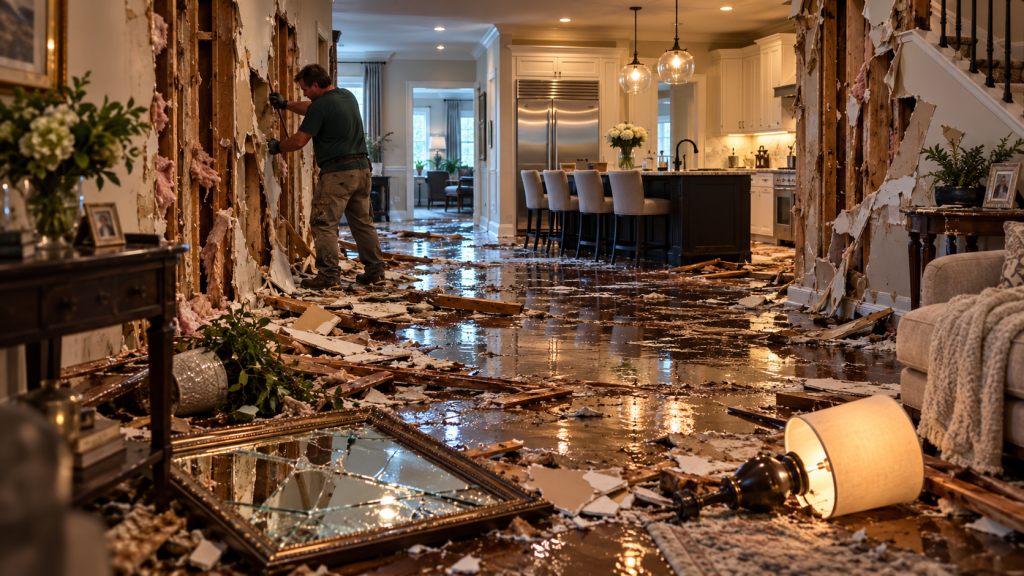
The smell of wet drywall.
The broken walls.
The shattered glass.
And the terrible feeling that he’d destroyed everything I loved.
I had believed my home was ruined.
That my grandmother’s mirror was gone forever.
That the divorce had taken every ounce of peace I possessed.
But I was wrong.
He had damaged the house.
He had broken the mirror.
He had tried to use documents and pressure to gain control over things that were not his to take.
But he had not destroyed me.
And he had not erased the love that built my life before he entered it.
That love remained.
In Dad’s steady presence.
In Grandma Lena’s letter.
In my mother’s memories.
In the cottage beneath the apple trees.
And in the woman reflected in the restored mirror.
I opened my eyes.
Then smiled.
Because for the first time, I understood something.
The mirror wasn’t valuable because it had survived without damage.
It was valuable because it had carried love across generations.
And even after being broken, that meaning remained.
One day, I invited several friends over for dinner.
Nothing elaborate.
Pasta.
Salad.
Fresh bread.
And a chocolate cake.
We sat around the table.
Laughing.
Telling stories.
Enjoying an ordinary evening.
At one point, my friend Sarah looked toward the mirror.
“Nicole, that’s beautiful.”
I smiled.
“Thank you.”
She leaned closer.
“Is it antique?”
I nodded.
“It belonged to my grandmother.”
Sarah studied the carved roses.
“It’s lovely.”
My eyes filled.
Then I smiled.
“It has quite a history.”
She laughed.
“I imagine.”
I looked toward the mirror.
And for the first time, I didn’t feel compelled to begin the story with Brian.
I began with Grandma Lena.
With her hands brushing my hair.
Her laughter.
Her little cottage.
And the way she believed every person deserved a place where they felt safe.
That was the story I wanted to tell.
Not the destruction.
The love.
Not the betrayal.
The people who had stood beside me.
Not the fear.
The life I built afterward.
As the years passed, I became less interested in what happened to Brian.
I heard occasional news.
His business plans had changed.
His financial circumstances were different.
Some relationships had ended.
Others continued.
But I no longer followed every detail.
I didn’t need to know whether he regretted losing me.
I didn’t need him to see how happy I had become.
And I didn’t need to prove anything through photographs or social media.
The peace I’d found belonged to me.
Not to his reaction.
That was perhaps the greatest freedom of all.
One spring morning, I woke early.
The house was quiet.
Sunlight entered through the bedroom curtains.
Birds sang outside.
I made coffee.
Opened the back door.
And stepped into the garden.
The roses were blooming.
Dad had helped me plant them after the repairs.
Pink.
White.
And deep red.
I stood beside them.
Then smiled.
Grandma Lena would have loved them.
I imagined her kneeling beside the flower bed.
Telling me not to plant everything too close together.
Reminding me that beautiful things need room to grow.
I laughed softly.
Then whispered, “You were right, Grandma.”
I looked toward the house.
The windows shone.
The walls were whole.
The mirror stood safely inside.
And the front door was locked with a key that belonged to me.
For a moment, I simply breathed.
I thought about the woman I’d been when the divorce began.
Exhausted.
Frightened.
Trying to prove that leaving a marriage didn’t make me selfish.
Trying to hold on to my home.
Trying to understand why someone who once promised to love me could become so determined to hurt me.
I wished I could reach back and tell her what I knew now.
Nicole, you will survive.
The court hearings will end.
The paperwork will eventually be filed away.
The walls will be repaired.
And the mirror will hang again.
But more importantly, you will learn that your worth was never something Brian had the power to give or take.
You were loved before him.
You are worthy without him.
And you will build a life after him.
I smiled through tears.
Then went inside.
In the living room, I stopped before Grandma Lena’s mirror.
I looked at my reflection.
The woman staring back looked older than the one who’d married Brian.
There were faint lines beside her eyes.
A few strands of silver near her temples.
And a quiet confidence I hadn’t possessed before.
I smiled.
Then reached toward the carved roses.
My fingers rested gently on the restored walnut frame.
For a moment, I imagined Grandma Lena standing behind me.
Her hands brushing through my hair.
Her voice counting.
Ninety-eight.
Ninety-nine.
One hundred.
I closed my eyes.
And whispered, “I’m okay, Grandma.”
A tear slipped down my cheek.
Then I smiled again.
“I’m finally okay.”
Several months later, Dad and I visited Rosewood Cottage once more.
The apple trees were blooming.
The garden had been carefully maintained.
And the roses climbed beautifully along the stone wall.
We sat beneath the old tree.
Drinking lemonade.
Watching clouds drift across the sky.
Dad leaned back in his chair.
Then smiled.
“You know, Nicole…”
I looked toward him.
“Yes?”
“Your grandmother always said this place would be yours in some meaningful way.”
My eyes filled.
I nodded.
“I know.”
He smiled.
“She’d be happy to see you here.”
I looked toward the cottage.
Then whispered, “I think she’s been with me all along.”
Dad reached for my hand.
We sat quietly.
And for a moment, the world felt gentle again.
No courtrooms.
No arguments.
No threatening messages.
No broken glass.
Just an old stone cottage.
An apple tree.
And a father sitting beside his daughter.
The man who had stood up in court when he knew something wasn’t right.
The man who had made mistakes trying to protect me.
And the father who eventually learned to let me face the truth with him rather than shielding me from it.
I squeezed his hand.
“Dad?”
He smiled.
“Yes, sweetheart?”
“Thank you.”
His eyes filled.
“For what?”
“For standing up.”
He looked down.
Then whispered, “I should’ve spoken sooner.”
I nodded.
“Maybe.”
Then I smiled.
“But you stood beside me when it mattered.”
He began crying.
I leaned against his shoulder.
And for a long time, neither of us spoke.
The sun moved slowly across the garden.
The apple blossoms stirred in the breeze.
And I felt the kind of peace I’d once feared I’d never find again.
Later that evening, when we returned home, I looked toward the mirror.
The carved roses caught the last light of the day.
I smiled.
Because I finally understood the secret Grandma Lena had hidden behind it.
It wasn’t simply about property.
It wasn’t simply about trust documents.
It wasn’t even about protecting an inheritance.
It was about making sure I remembered something when life became difficult.
That I had a voice.
That asking questions wasn’t a betrayal.
That love shouldn’t require me to surrender my independence.
And that the people who truly cared about me would never need to destroy my peace to prove their importance.
Brian had tried to leave me with a ruined house.
He’d broken the walls.
Left water running.
And shattered the mirror that held some of my most precious childhood memories.
He believed that if he couldn’t have control, he could at least leave destruction behind.
But he underestimated something.
The walls could be repaired.
The floors could be replaced.
And even the broken frame could be restored with patience and care.
What he couldn’t destroy was the love that existed long before him.
The love of my mother.
My grandmother.
My father.
And the people who helped me stand when I thought I couldn’t.
I looked at my reflection.
Then whispered the words I wanted every woman who had ever felt broken by betrayal to remember.
Someone can damage your home without taking away your right to feel safe again.
Someone can break something precious without erasing the memories it holds.
And someone can try to control your future without having the power to decide it.
I smiled.
Then turned off the living room light.
Outside, the garden rested beneath the stars.
Inside, my home was warm.
Quiet.
Peaceful.
Mine.
For eight months, Brian had fought to take everything he could.
Then he tried to destroy what remained.
But in the end, he couldn’t take the one thing that mattered most.
My ability to begin again.
And that was worth more than any house, any inheritance, or any victory in court.
I walked upstairs.
Closed my bedroom door.
And settled into bed beneath the soft cotton quilt Grandma Lena had made years earlier.
For the first time in a very long time, I wasn’t afraid of what tomorrow might bring.
I was curious.
Hopeful.
Ready.
Because tomorrow belonged to me.
And the woman who once stood crying over a shattered mirror had finally learned that being brokenhearted did not mean she was broken forever.
Sometimes, the most beautiful part of rebuilding isn’t restoring what someone damaged.
It’s discovering how much of yourself was never theirs to destroy.
And as I closed my eyes, I imagined Grandma Lena smiling.
Her gentle voice counting the final strokes of the brush.
Ninety-eight.
Ninety-nine.
One hundred.
Then whispering what she always said when she finished my hair.
“There you are, sweetheart.”
I smiled in the darkness.
“Yes, Grandma.”
“There I am.”
THE END STORIES! THANK YOU FOR READING GOOD LUCK !❤️
Related Posts