Ricardo Mendoza had negotiated billion-dollar contracts without blinking. He had faced investors who threatened to destroy his company, competitors who tried to ruin his reputation, and politicians who demanded favors in exchange for their friendship. But nothing had ever frightened him as much as the six words coming through his telephone.
“Your own mother signed the documents.” For a moment, he forgot the rain. Forgot the cars rushing past. Forgot that his twelve-year-old son was standing beneath a narrow awning, wrapped in a stranger’s soaked jacket. His entire world seemed to tilt. “My mother?” he repeated. “Yes, señor,” the attorney answered. “Doña Beatriz Mendoza has filed an emergency petition concerning Mateo’s care. The accompanying documents claim you’ve acknowledged being unable to provide appropriate supervision.”
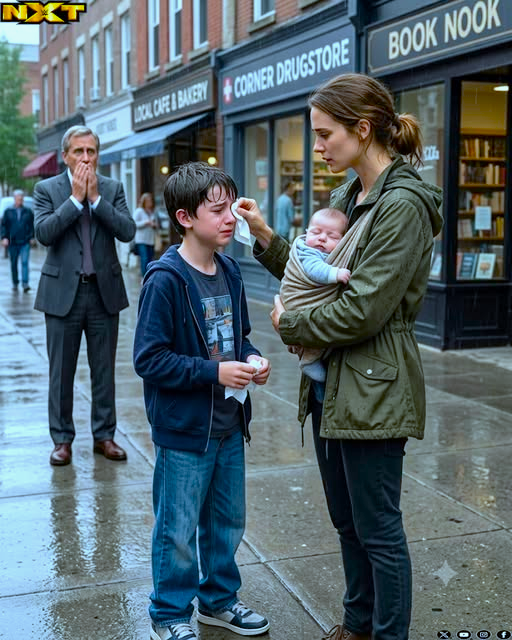
Ricardo tightened his grip on the phone. “I acknowledged no such thing.” The lawyer hesitated. “There’s a declaration bearing your signature.” Ricardo went perfectly still. Then he said, very slowly, “I haven’t signed anything.” Beside him, Mateo began trembling again. Esperanza noticed immediately. She shifted baby Santiago against her shoulder and looked at the boy.
“Mateo, sweetheart, are you cold?”
Mateo shook his head.
But his eyes were fixed on his father.
“Papá?”
Ricardo lowered his phone.
“Yes, son?”
“Are they going to take me away?”
The question struck him harder than anything his attorney had said.
Ricardo crouched in front of the boy.
“Who told you that?”
Mateo swallowed.
“Grandmother.”
Ricardo felt his heart tighten.
“What did she say?”
The boy’s lower lip trembled.
“She said you were tired of me.”
Esperanza’s expression changed.
Ricardo stared at his son.
Mateo continued in a whisper.
“She said you wanted me to live somewhere else because I make everything difficult.”
For several seconds, Ricardo couldn’t breathe.
Then Mateo asked the question that would haunt him for years.
“Papá, did you sign papers because you don’t want me anymore?”
Ricardo’s eyes filled with tears.
He had forgotten meetings.
Missed school performances.
Canceled birthdays.
Promised weekend trips he never arranged.
But he’d never imagined his son believed he was unwanted.
He reached toward Mateo.
The boy stepped backward.
Ricardo froze.
It was such a small movement.
Only one step.
But it told him something no business report ever could.
His son was afraid to trust him.
“Mateo,” he whispered, “I did not sign anything giving you away.”
Mateo looked at him.
“Really?”
“Really.”
The boy swallowed.
“Then why did Grandmother say you did?”
Ricardo had no answer.
Not yet.
But he understood something terrible.
His mother had been making decisions about his son’s life while he was distracted by meetings and negotiations.
And she’d apparently been using his absence to convince Mateo that his father didn’t love him.
Esperanza spoke gently.
“Señor Mendoza, forgive me, but your son is freezing.”
Ricardo looked at her.
She was still holding Santiago, who had begun fussing against her chest.
Her own clothes were soaked.
Her hair was plastered against her cheeks.
Yet her attention remained on Mateo.
Ricardo felt ashamed.
Even now, with all his money, he’d been so overwhelmed by the telephone call that he’d forgotten his son was shivering.
“Yes,” he said. “Of course.”
He turned toward Mateo.
“Let’s get somewhere warm.”
Mateo glanced at Esperanza.
“Can she come?”
Ricardo looked at her.
For a moment, Esperanza seemed frightened.
“Oh, no, señor. I don’t want to cause trouble.”
“You haven’t caused any trouble.”
He paused.
“You helped my son when he needed someone.”
Esperanza lowered her eyes.
“I only did what anyone should do.”
Ricardo looked at Mateo.
Then back at her.
“No,” he said quietly. “You did what many people walked past without doing.”
He opened the car door.
Esperanza hesitated.
Her entire life had taught her to be careful when wealthy men offered favors.
Especially wealthy men whose faces appeared on television.
But Santiago was shivering.
Mateo’s hands were blue with cold.
And Ricardo wasn’t demanding anything.
“Please,” he said. “Let us at least get the children warm and have them checked.”
Esperanza looked at her baby.
Then nodded.
“All right.”
Inside the BMW, warm air moved through the cabin.
Mateo sat close to Esperanza.
Santiago settled against her chest.
Ricardo took the front passenger seat while Joaquín, the driver, stood outside in the rain.
For the first time, Ricardo looked closely at him.
Joaquín’s face was pale.
His hands trembled.
“Señor,” the driver began, “I can explain.”
Ricardo turned slowly.
“Then explain.”
Joaquín swallowed.
“Mateo became upset.”
“Why?”
“He refused to go to his grandmother’s house.”
Mateo’s shoulders stiffened.
Ricardo noticed.
“Why would he refuse?”
Joaquín glanced toward the boy.
Then looked away.
“I don’t know.”
Mateo suddenly spoke.
“That’s not true.”
Everyone went silent.
The boy’s voice trembled.
“You told me Dad had signed the papers.”
Joaquín closed his eyes.
Mateo continued.
“You said Grandmother was sending me to a school where I wouldn’t embarrass the family anymore.”
Esperanza gently touched the boy’s shoulder.
“Mateo, you don’t have to explain everything right now.”
But Mateo kept looking at his father.
“I thought you knew, Papá.”
Ricardo felt sick.
He looked toward Joaquín.
“Did you tell my son that?”
The driver stared at the pavement.
“Señor, I was following instructions.”
“Whose instructions?”
Silence.
Ricardo took a step closer.
“Joaquín.”
The man swallowed.
“Doña Beatriz.”
Ricardo closed his eyes.
His mother.
Again.
He had given Beatriz access to his house because she was family.
He had trusted her to arrange Mateo’s tutors, supervise household staff, and handle school logistics while he worked.
After Isabel died, he’d told himself he was doing the responsible thing.
Mateo needed stability.
His grandmother loved him.
And Ricardo was struggling to keep his businesses afloat while grief hollowed him out.
But somewhere along the way, he’d allowed help to become control.
Ricardo opened his eyes.
“Joaquín, you will provide a complete account of what happened to the appropriate people. Don’t contact my son except through arrangements approved for his safety.”
The driver lowered his head.
“Yes, señor.”
Ricardo turned away.
Then looked toward the woman in the back seat.
Esperanza was quietly rubbing Mateo’s hands between hers to warm them.
The boy watched her as if she were the first person who had noticed how cold he’d become.
Ricardo felt tears rise.
He owned hotels.
Office towers.
Apartment complexes.
And companies employing thousands of people.
Yet a woman who sold empanadas on the street was showing him how little wealth mattered when a frightened child needed comfort.
“Where should we go?” Esperanza asked.
Ricardo took a breath.
“To a nearby medical clinic first. Both children have been out in the cold.”
Mateo looked up.
“And after that?”
Ricardo considered.
Normally, he would have said home.
The mansion in the northern hills.
The house with marble floors, security gates, and servants who moved silently through enormous rooms.
But Mateo’s face changed at the thought.
And Ricardo finally understood that a beautiful house could still be a frightening place.
“We’ll stay somewhere you feel safe tonight,” he said.
Mateo blinked.
“Not Grandmother’s house?”
“No.”
“Promise?”
Ricardo swallowed.
“I promise I won’t send you there without listening to you and making sure you’re safe.”
Mateo stared at him.
Then asked:
“Will you stay too?”
Ricardo’s voice broke.
“Yes, son.”
For the first time that afternoon, Mateo moved closer to his father.
Only slightly.
But Ricardo noticed.
And it felt more valuable than every company he owned.
At the clinic, both children were examined.
Santiago was cold and miserable but recovered with warming and feeding.
Mateo was exhausted, hungry, and deeply distressed.
A doctor explained that he needed rest, proper care, and follow-up attention to the emotional circumstances surrounding his disappearance.
Ricardo listened.
Actually listened.
He didn’t answer business calls.
Didn’t glance at market reports.
Didn’t ask his assistant how long the appointment would take.
For once, his son was the only important meeting on his calendar.
Esperanza sat with Santiago wrapped in a clean blanket.
Ricardo approached quietly.
“How is your baby?”
She smiled faintly.
“Much better, thank God.”
“And you?”
She looked surprised.
“Me?”
“Yes. You were standing in that rain too.”
Esperanza shrugged.
“I’m used to getting wet.”
Ricardo frowned.
“That doesn’t mean you should have to.”
She looked away.
For a moment, he thought he’d offended her.
Then she whispered:
“Sometimes when you’re a mother, you don’t notice how cold you are until your child stops crying.”
Ricardo stared at her.
He had spent years believing parenting was something he could organize.
A nanny.
A driver.
A tutor.
A schedule.
But Esperanza spoke about motherhood as though it lived in the bones.
Something that asked for attention even when your own body was exhausted.
“Señora,” he said quietly, “may I ask your name again?”
“Esperanza.”
He smiled.
“Hope.”
She looked up.
“Yes.”
“It’s a beautiful name.”
She gave a small, embarrassed laugh.
“My mother chose it because she said hope was the only thing our family could afford in unlimited quantities.”
Ricardo smiled sadly.
Then he asked, “And Santiago’s father?”
Her expression changed.
For a moment, the warmth disappeared from her face.
“He left before Santiago was born.”
Ricardo felt ashamed of how casually he’d asked.
“I’m sorry.”
Esperanza looked down at the baby.
“He made his choice.”
Then she gently kissed Santiago’s forehead.
“And I made mine.”
Ricardo watched her.
She was younger than he expected.
Perhaps twenty-seven.
Her hands were rough from work.
There was a small burn mark near her wrist.
Her shoes had been repaired more than once.
Yet she held her son with a tenderness that made the clinic’s harsh fluorescent lights seem softer.
“Esperanza,” Ricardo said, “you helped Mateo today. I’d like to thank you properly.”
She shook her head immediately.
“Please don’t.”
He frowned.
“Why?”
“Because I didn’t help him for money.”
“I know.”
She looked directly into his eyes.
“Then don’t make it feel like I did.”
Ricardo stopped speaking.
For the first time in years, someone had refused his generosity without trying to impress him.
Not because she didn’t need money.
He could see that she did.
But because she wanted her kindness to remain her own.
He nodded.
“I’m sorry.”
Esperanza’s expression softened.
“It’s all right.”
He took a breath.
“Would you at least allow me to cover the medical visit and transportation home?”
She considered.
Then nodded.
“That would help.”
Ricardo smiled.
“Thank you.”
Esperanza laughed softly.
“You’re thanking me for accepting help?”
He looked embarrassed.
“Apparently.”
For a moment, they both smiled.
Then Mateo appeared beside them.
His hair was still damp.
He wore dry clothes provided by the clinic.
“Esperanza?”
She turned.
“Yes, sweetheart?”
He looked down.
“Are you leaving?”
Her heart tightened.
“Soon. Santiago needs to sleep.”
Mateo nodded.
But his face fell.
Ricardo saw it.
He crouched beside his son.
“Mateo, Esperanza has her own family to care for.”
“I know.”
The boy swallowed.
Then looked at her.
“Will I see you again?”
Esperanza hesitated.
She didn’t want to promise something she couldn’t control.
Then she smiled gently.
“Perhaps, if your father and I arrange it properly.”
Mateo looked toward Ricardo.
“Can we?”
Ricardo glanced at Esperanza.
He knew better than to answer for her.
“If she’s comfortable with that,” he said.
Esperanza looked between them.
A frightened boy.
A guilty father.
And a little baby sleeping against her heart.
She nodded.
“We can talk about it.”
Mateo smiled.
A tiny smile.
But it was the first genuine smile Ricardo had seen on his son’s face in months.
That evening, Ricardo checked into a quiet hotel with Mateo.
Not one of his own properties.
Not somewhere his mother could arrive and give orders to the staff.
He contacted his independent attorney, Carolina Valdés, and arranged for immediate advice concerning the disputed guardianship petition.
Carolina arrived carrying a laptop and a thick folder.
She was forty-six, sharp-eyed, and unimpressed by Ricardo’s wealth.
“Ricardo,” she said, “we need to establish exactly what has been filed.”
He nodded.
“Tell me.”
She opened the documents.
“The petition alleges you’ve been absent from Mateo’s daily life, and that your mother has effectively been his primary caregiver since Isabel died.”
Ricardo lowered his eyes.
Carolina continued.
“Some of those factual claims may concern real gaps in your parenting. We shouldn’t pretend otherwise.”
He swallowed.
“I know.”
“But there are also statements claiming you’ve consented to surrender decision-making authority.”
He looked up.
“I haven’t.”
Carolina nodded.
“Then we’ll challenge the authenticity of those documents through the appropriate procedures.”
She turned another page.
“There’s also a supporting statement supposedly made by Mateo.”
Ricardo went still.
“What?”
Carolina read.
“According to the petition, Mateo has repeatedly expressed fear of remaining in your care.”
Ricardo felt cold.
“My son never told me that.”
Carolina looked at him carefully.
“Ricardo, your son may have feelings you haven’t heard. We need to make space for him to express them without pressure.”
He looked down.
She continued.
“But we also need to determine whether anyone coached or misrepresented what he said.”
Ricardo nodded.
Then asked:
“Why would my mother do this?”
Carolina hesitated.
“There’s a financial aspect to the petition that deserves investigation.”
His stomach tightened.
“What financial aspect?”
She opened another document.
“Isabel’s family trust.”
Ricardo stared.
His late wife.
Isabel.
For years, he’d avoided discussing her estate because every document reminded him of the hospital where she’d died.
But before their marriage, Isabel had inherited significant shares in an old family holding company.
Her estate planning left Mateo with a substantial beneficial interest, managed under safeguards until adulthood.
Carolina continued.
“Some proposed changes to the corporate voting arrangements could become easier for certain parties if your mother acquired legal authority over Mateo’s interests.”
Ricardo stared at her.
“Are you saying my mother wants custody of my son for his inheritance?”
Carolina closed the folder.
“I’m saying the timing and documents raise serious questions.”
Ricardo stood.
Walked toward the window.
Bogotá glittered beneath the night sky.
Thousands of lights.
Thousands of families.
Children eating dinner.
Parents helping with homework.
People living ordinary lives in homes they could afford.
He pressed his hands against the glass.
“My mother raised me.”
Carolina said nothing.
“She loved Isabel.”
He swallowed.
“She helped us when Isabel died.”
Carolina’s voice softened.
“That doesn’t mean every choice she’s making now is justified.”
Ricardo closed his eyes.
Then whispered:
“I trusted her with my son.”
At that moment, a small voice came from the doorway.
“Papá?”
Ricardo turned.
Mateo stood there holding a blanket.
His face looked pale.
“Son, you’re supposed to be sleeping.”
Mateo glanced at Carolina.
Then whispered:
“I heard Grandmother’s name.”
Ricardo knelt.
“Come here.”
Mateo hesitated.
Then approached.
Ricardo looked into his son’s eyes.
“Mateo, did anyone ask you to say you were afraid of living with me?”
The boy froze.
For a moment, Ricardo thought he wouldn’t answer.
Then Mateo whispered:
“Grandmother told me to say you never came home.”
Ricardo’s heart tightened.
He swallowed.
“And what did you say?”
Mateo looked down.
“I said you always came home.”
Ricardo felt the smallest rush of relief.
Then the boy continued.
“But I also said that sometimes, even when you’re home, it feels like you’re not here.”
Ricardo closed his eyes.
The truth hurt more than the accusation.
Because Mateo wasn’t lying.
His son continued.
“Grandmother said if I went to the special school, you wouldn’t have to worry about me anymore.”
Ricardo’s hands trembled.
“She said you would be happier.”
Ricardo took a slow breath.
“Mateo.”
The boy’s eyes filled.
“I’m sorry I make you sad.”
Something inside Ricardo broke.
He reached toward his son.
This time, Mateo didn’t move away.
“Listen to me,” Ricardo whispered.
“You do not make me sad.”
Mateo looked up.
“I’ve been sad because I miss your mother.”
Ricardo’s voice broke.
“And instead of letting you see that, I hid inside my work.”
The boy began crying.
Ricardo continued.
“That was my mistake.”
He gently took Mateo’s hands.
“You were never the problem.”
For the first time in four years, Ricardo spoke openly about Isabel.
And for the first time in four years, his son heard his father say her name without immediately changing the subject.
Mateo began sobbing.
“I miss Mamá.”
Ricardo pulled him close.
“I know, hijo.”
His own tears fell into the boy’s hair.
“I miss her too.”
For several minutes, they held each other.
No lawyers.
No money.
No important meetings.
Just a father and son grieving the same woman.
Then Mateo whispered something that made Ricardo’s blood turn cold.
“Papá, Grandmother said Mamá left letters for me.”
Ricardo lifted his head.
“What letters?”
Mateo wiped his cheeks.
“She said they were too upsetting.”
Ricardo stared.
His son continued.
“She said I couldn’t have them until I learned how to behave.”
For a moment, Ricardo couldn’t speak.
Because Isabel had written letters during the final months of her illness.
Letters for birthdays.
For graduations.
For moments she knew she wouldn’t be there to witness.
Ricardo had believed those letters were lost when Isabel’s belongings were packed away.
His mother had told him she’d searched everywhere.
Now Mateo was telling him Beatriz had been using them as a punishment.
Ricardo slowly stood.
Looked toward Carolina.
Then whispered:
“My mother has been hiding my dead wife’s words from our son.”
And suddenly, the guardianship petition was no longer the only betrayal he needed to uncover.
Ricardo didn’t sleep that night.
Mateo eventually drifted off in the adjoining hotel room, curled beneath a blanket with his mother’s photograph resting beside his pillow.
But Ricardo sat awake at the desk, staring at an old picture of Isabel.
It had been taken in Cartagena, the summer before she became ill.
She was laughing.
Her dark hair blew across her face.
Mateo, then seven, sat on her shoulders, pretending to steer her like a horse.
Ricardo stood beside them with one arm around his wife.
All three were smiling.
He remembered that afternoon vividly.
The smell of the ocean.
The warmth of the sand.
The way Isabel kept asking him to put his phone away.
“Ricardo, look at your son.”
“I am looking.”
“No, you’re answering emails.”
He had laughed.
“Just one more.”
She’d taken the phone gently from his hand.
Then she’d said something he hadn’t understood until now.
“Someday he’ll stop asking you to look, cariño. That doesn’t mean he won’t still need you.”
Ricardo covered his face.
For years, he’d believed building a financial empire was his greatest responsibility.
He told himself every missed dinner meant greater security for Mateo.
Every business trip meant another opportunity for his son.
Every late night at the office meant protecting the future Isabel had wanted for their family.
But Mateo hadn’t asked for an empire.
He’d asked his father to attend a football match.
To read a bedtime story.
To eat dinner at the same table.
And somehow, Ricardo had convinced himself those things could wait.
At two in the morning, he opened his calendar.
Dozens of meetings covered the coming week.
Investor calls.
Board presentations.
A property acquisition.
A charity gala.
He studied them.
Then he found Mateo’s school concert.
A small entry near the bottom of Friday’s schedule.
He’d marked it tentative.
Again.
Ricardo stared at the word until his eyes filled with tears.
Then he called his assistant.
Camila Rojas answered sleepily.
“Señor Mendoza?”
“Camila, I’m sorry to wake you.”
“Is everything all right?”
“No.”
He took a breath.
“I need you to cancel my appointments for the next three days, except those that genuinely cannot be delegated.”
There was silence.
“Señor?”
“You heard me.”
“But the investors—”
“They can speak to the executive team.”
Camila hesitated.
“And the gala?”
“Cancel my attendance.”
Another silence.
Then Ricardo asked:
“Camila, did Mateo call my office yesterday?”
Her breathing changed.
“Yes, señor.”
His heart tightened.
“How many times?”
She hesitated.
“Seven.”
Ricardo closed his eyes.
“Why wasn’t I told?”
For several seconds, there was no answer.
Then she whispered:
“Doña Beatriz instructed the staff not to interrupt your negotiations with family matters.”
Ricardo gripped the telephone.
“And you followed that instruction?”
Camila began crying.
“I thought she had your permission.”
He looked toward Mateo’s closed bedroom door.
Then whispered:
“My son thought I didn’t want to answer him.”
Camila was silent.
Ricardo continued.
“From now on, no one decides which messages from my son are important except me.”
“Yes, señor.”
“And Camila?”
“Yes?”
“If anyone asks you to conceal something involving Mateo again, I expect you to tell me.”
Her voice trembled.
“I understand.”
Ricardo took a breath.
Then added:
“You can also tell me when an instruction from someone else appears inconsistent with what I want. I should have made that clear years ago.”
When he ended the call, he stared at the quiet room.
For the first time, he understood that neglect could hide inside good intentions.
He had wanted to provide everything.
And in doing so, he’d allowed someone else to decide what his son was permitted to need.
At nine the next morning, Ricardo returned to the Mendoza estate.
Not with Mateo.
His son remained at the hotel with a trusted caregiver and the support arrangements Carolina had helped organize.
Ricardo had promised he wouldn’t force him back into the place he feared.
This time, he intended to keep that promise.
The mansion stood behind tall iron gates in the hills of northern Bogotá.
White stone columns.
Perfectly trimmed hedges.
An enormous driveway lined with imported palms.
Beatriz Mendoza had lived there since Ricardo’s father died.
She called it the family home.
But to Ricardo, it had always felt more like a museum.
Every painting had a history.
Every room had rules.
Every chair seemed too expensive to sit in comfortably.
A housekeeper opened the door.
“Señor Ricardo.”
“Good morning, Teresa.”
The woman looked surprised.
Ricardo realized he almost never greeted her by name.
He felt a quiet pang of shame.
“Is my mother home?”
“Yes, señor. In the breakfast room.”
Beatriz was sitting beside a large window, drinking coffee from delicate porcelain.
She wore a cream-colored suit and pearls.
Her silver hair was arranged perfectly.
At seventy-one, she still carried herself with the confidence of a woman who believed the world owed her obedience.
“Ricardo.”
She looked up.
“Finally.”
He remained standing.
“Mother.”
She set down her cup.
“Where is Mateo?”
“Safe.”
Her expression tightened.
“That isn’t what I asked.”
Ricardo took a breath.
“He won’t be coming here today.”
Beatriz stared.
Then gave a small laugh.
“Don’t be ridiculous.”
“I’m not.”
“He’s a child. Children don’t decide everything.”
“No,” Ricardo answered. “But they have the right to be heard.”
Beatriz’s eyes narrowed.
“Have you been speaking to that street woman?”
Ricardo went still.
“What?”
“The one who made such a performance of rescuing Mateo in the rain.”
His jaw tightened.
“Her name is Esperanza.”
Beatriz waved one hand dismissively.
“Whatever her name is. Women like that know exactly how to attach themselves to wealthy families.”
For a moment, Ricardo heard his mother’s voice as though for the first time.
Cold.
Confident.
Certain that poverty was evidence of bad character.
“Esperanza gave Mateo her jacket,” he said.
Beatriz shrugged.
“A cheap jacket.”
“She was holding a baby.”
“And?”
Ricardo stared.
“She stayed with a frightened child she didn’t know.”
Beatriz picked up her coffee.
“Kindness is inexpensive when someone expects to be rewarded afterward.”
Ricardo felt something hard settle in his chest.
“Mother, she refused a reward.”
Beatriz smiled thinly.
“That’s usually how the clever ones begin.”
Ricardo looked toward the immense dining table.
Twelve empty chairs.
Polished silverware.
Fresh flowers arranged by an employee who probably earned less in a month than Beatriz spent on one dinner.
Then he asked:
“Why did you file a guardianship petition concerning Mateo?”
Beatriz’s smile vanished.
For several seconds, she said nothing.
Then she sighed.
“Because somebody had to.”
Ricardo stared.
“Without telling me?”
“You’re never available.”
“That’s not an answer.”
She stood.
“Ricardo, your son is unhappy.”
“I know.”
“He runs away.”
“I know.”
“He cries at school.”
Ricardo’s heart tightened.
“He misses his mother.”
Beatriz’s eyes flashed.
“We all miss Isabel.”
Ricardo took a breath.
“Did you prepare a document stating I’d agreed to relinquish parental authority?”
She looked away.
His stomach tightened.
“Mother.”
She turned back.
“Your attorneys prepare documents for you every day. You barely read half of them.”
Ricardo went cold.
“That wasn’t the question.”
Beatriz lifted her chin.
“I was trying to make arrangements before you ruined that boy’s life with your absence.”
Ricardo stared.
Then whispered:
“You used a signature I didn’t authorize.”
She didn’t deny it immediately.
Instead, she looked toward the window.
“Everything I’ve done has been for this family.”
Ricardo felt sick.
His mother had said those words throughout his childhood.
When she dismissed a maid.
When she decided which friends he could see.
When she told Isabel her family wasn’t important enough to influence the Mendoza name.
Everything I’ve done has been for this family.
It had always sounded noble.
Now Ricardo heard the warning beneath it.
He stepped closer.
“Where are Isabel’s letters?”
Beatriz froze.
The silence was immediate.
Complete.
Ricardo watched her face.
“Mother.”
She set down her coffee.
“What letters?”
His voice hardened.
“The letters Isabel wrote for Mateo before she died.”
Beatriz looked toward the door.
“Ricardo, you’re upset.”
“Where are they?”
She sighed.
“Isabel was very emotional during her illness.”
His hands clenched.
“Don’t.”
“Some of the things she wrote were terribly sad.”
“Mother.”
“I only wanted to spare the child unnecessary grief.”
Ricardo looked at her.
Then asked quietly:
“Did Isabel ask you to hide her letters from our son?”
Beatriz said nothing.
For a moment, Ricardo couldn’t breathe.
Then he whispered:
“You told me they were lost.”
She looked away.
“I thought it was best.”
Something broke inside him.
Not anger alone.
Something deeper.
The realization that his mother had taken the last words of a dying woman and decided they belonged to her.
“Where are they?” he repeated.
Beatriz’s face tightened.
“Ricardo, listen to me—”
“No.”
His voice shook.
“You’ve spoken for me.”
“You’ve spoken for Mateo.”
“And apparently you’ve been speaking for Isabel from beyond her grave.”
Beatriz stepped backward.
Ricardo continued.
“You don’t get to do that anymore.”
For a long moment, she stared.
Then she walked toward a tall cabinet beside the window.
Unlocked a drawer.
And removed a blue wooden box.
Ricardo recognized it.
Isabel had painted little white stars on the lid when she was pregnant with Mateo.
He remembered teasing her.
“What is that for?”
She’d smiled.
“For all the things I want him to remember.”
Now Beatriz placed it on the table.
Ricardo couldn’t move.
“Take it,” she said bitterly.
He approached slowly.
His hands trembled as he opened the lid.
Inside lay twelve envelopes.
Each marked with a different occasion.
For Mateo’s eighth birthday.
For Mateo’s tenth birthday.
For his first broken heart.
For the day he thinks nobody understands him.
For when he misses me.
Ricardo covered his mouth.
Then he saw one envelope near the bottom.
Across the front, Isabel had written:
For Ricardo, when he finally remembers to stop working.
His knees weakened.
For years, he’d believed his wife’s last words were gone forever.
Now he was holding a message she’d left specifically for him.
Beatriz watched.
For a moment, something like regret crossed her face.
Then she said:
“I didn’t think he was ready.”
Ricardo looked up.
“Mateo has been waiting for his mother for four years.”
His voice broke.
“And you’ve been keeping her in a drawer.”
Beatriz turned away.
Ricardo carefully closed the box.
Then looked toward his mother.
“Carolina will contact your attorneys about the guardianship petition.”
Her expression hardened.
“You intend to fight me?”
“I intend to protect my son.”
Beatriz laughed sharply.
“Now you decide to be a father?”
The words struck him.
Because they contained a piece of truth.
He had been absent.
He had left far too much to other people.
Ricardo took a slow breath.
“You’re right that I failed him in ways I need to repair.”
Beatriz looked surprised.
Then he continued:
“But that doesn’t give you the right to deceive us.”
He picked up the blue box.
And turned toward the door.
Beatriz called after him.
“Ricardo, do you know what happens to the family company if those shares fall into the wrong hands?”
He stopped.
For a moment, the entire mansion seemed to hold its breath.
Then he turned.
“What shares?”
Beatriz’s face changed.
Too late.
Ricardo stared.
“Mother, is that what this is about?”
She lifted her chin.
“I’m protecting the business Isabel helped build.”
“Isabel inherited those shares from her own family.”
“And she married into ours.”
Ricardo felt cold.
Beatriz continued.
“Mateo’s interest will become more important as he grows older. We cannot allow an unstable father to let outsiders influence him.”
Ricardo looked at the blue box.
Then back at his mother.
“Outsiders?”
He swallowed.
“You mean people who might tell him something you don’t want him to hear?”
Beatriz’s eyes hardened.
“Don’t be naïve.”
Ricardo took a breath.
“I’m beginning to think being naïve is exactly what I’ve been.”
He walked out carrying Isabel’s letters.
And for the first time in his life, he didn’t look back to see whether his mother approved.
That afternoon, Esperanza returned to her tiny apartment in the south of Bogotá.
It was on the third floor of an aging building above a neighborhood bakery.
The stairwell smelled of fresh bread, damp concrete, and laundry detergent.
Her apartment had two small rooms.
A narrow kitchen.
A window overlooking crowded rooftops.
And a ceiling that leaked whenever the rain became heavy.
She laid Santiago on a blanket.
Changed his clothes.
Then hung her wet jacket near the window.
It was the same jacket she’d placed around Mateo’s shoulders.
One pocket was torn.
The zipper barely worked.
But it was warm.
And it was hers.
Her neighbor, Doña Mercedes, knocked on the door.
“Esperanza?”
“Come in.”
Mercedes entered carrying a pot of soup.
She was a widow in her sixties with a laugh that could be heard across the entire building.
She had helped Esperanza after Santiago was born.
Sometimes she’d watched the baby while Esperanza prepared empanadas.
Sometimes she’d left groceries beside the door without mentioning them.
“Niña, you look exhausted.”
Esperanza smiled.
“It’s been a strange day.”
Mercedes placed the pot on the stove.
“Strange?”
She raised an eyebrow.
“Isn’t that the richest man in Colombia I’ve been seeing on the television?”
Esperanza froze.
“What?”
Mercedes held up her phone.
A photograph filled the screen.
Esperanza beneath the awning.
Mateo wrapped in her jacket.
Ricardo standing beside them in the rain.
The caption made Esperanza’s stomach twist.
BILLIONAIRE’S SON FOUND WITH UNKNOWN STREET VENDOR AFTER DISAPPEARING FROM SCHOOL.
Esperanza stared.
“Who took that?”
Mercedes shook her head.
“I don’t know.”
Another headline appeared.
MYSTERY WOMAN COMFORTS HEIR TO MENDOZA FORTUNE.
Then another.
WHO IS THE SINGLE MOTHER SEEN WITH RICARDO MENDOZA?
Esperanza felt sick.
She hadn’t asked for a photograph.
Hadn’t asked for attention.
Hadn’t wanted anyone to know she’d helped the boy.
She looked toward Santiago.
Her little baby slept peacefully.
Unaware that strangers were already discussing his mother on the internet.
Then a new message appeared on her phone.
From an unknown number.
You should have stayed out of rich people’s problems.
Her hands turned cold.
Mercedes noticed.
“What happened?”
Esperanza showed her.
The older woman’s expression darkened.
“Who sent that?”
“I don’t know.”
Mercedes sat beside her.
“Esperanza, this doesn’t look good.”
Esperanza looked toward the window.
Below, a motorcycle stopped near the building entrance.
A man wearing a dark helmet glanced up toward her floor.
For a moment, she felt watched.
Then the motorcycle drove away.
She swallowed.
“Mercedes, I only helped a little boy.”
The older woman took her hand.
“I know.”
Esperanza’s eyes filled.
“I didn’t know who his father was.”
Mercedes squeezed her fingers.
“Kindness sometimes brings trouble, niña.”
Esperanza looked toward Santiago.
Then whispered:
“But what kind of world would we live in if we stopped helping frightened children because their parents might be dangerous?”
Mercedes smiled sadly.
“The kind of world we must never accept.”
That evening, Esperanza’s landlord knocked on her door.
His name was Señor Pardo.
He owned the building.
Normally, he barely spoke to her except to remind her when rent was due.
“Señorita Esperanza.”
She opened the door cautiously.
“Yes?”
He looked uncomfortable.
“I need to speak with you about the apartment.”
Her stomach tightened.
“Is something wrong?”
He shifted his weight.
“The building may be sold.”
Esperanza stared.
“Sold?”
He nodded.
“A development company has made an offer.”
She looked toward Santiago.
“Where would everyone go?”
Pardo avoided her eyes.
“I don’t know yet. Nothing is final.”
Esperanza swallowed.
“Which company?”
He hesitated.
Then answered:
“Mendoza Urban Developments.”
For a moment, the room seemed to spin.
Ricardo Mendoza.
The billionaire who’d thanked her for protecting his son.
The man whose company apparently wanted to buy the building where her own baby slept.
She stared at the landlord.
“Does Señor Mendoza know?”
Pardo shrugged.
“People like him don’t concern themselves with individual apartments.”
Esperanza closed the door slowly.
Her heart pounded.
For years, she’d worked to keep that little home.
Sold empanadas before sunrise.
Cleaned offices in the evening.
Saved coins in an old coffee tin.
Now a company carrying Ricardo’s name might force her to begin again.
She sat beside Santiago.
And whispered:
“I don’t know what to do, mi amor.”
The baby slept.
Esperanza stroked his cheek.
Then her phone rang.
Ricardo.
For a moment, she considered ignoring it.
Then she answered.
“Señor Mendoza.”
“Esperanza.”
His voice was warm.
“How are you and Santiago?”
She swallowed.
“Fine.”
He paused.
“You sound upset.”
Esperanza looked toward the leaking ceiling.
Then asked:
“Señor Mendoza, does your company buy homes?”
Ricardo frowned.
“What?”
“Buildings where ordinary families live.”
He was silent.
Then answered carefully.
“We have a property development division. Why?”
Esperanza’s voice trembled.
“Because my landlord says your company wants to buy this building.”
Ricardo stopped breathing.
She continued.
“I know it’s probably nothing to you.”
“Esperanza—”
“But there are children here.”
Her voice broke.
“Old people.”
“Families who don’t have anywhere else to go.”
Ricardo sat down.
He felt the same shame he’d felt watching Mateo in the rain.
He owned so much property that he’d stopped thinking of addresses as homes.
“Tell me the building’s address,” he said quietly.
Esperanza hesitated.
“Why?”
“So I can find out what’s happening.”
She swallowed.
“Señor Mendoza, I don’t want special treatment.”
“I understand.”
“I don’t want you to save me because I helped your son.”
His expression softened.
“I know.”
For a moment, they were silent.
Then Esperanza whispered:
“I just want the people making these decisions to remember that families live inside the buildings they see on paper.”
Ricardo closed his eyes.
Because in a single day, this woman had shown him two things he hadn’t wanted to see.
A lonely child living inside his mansion.
And a thousand ordinary families living inside the investments he barely understood.
He took a breath.
“Esperanza, I promise to look into it.”
She paused.
Then said quietly:
“Please don’t make a promise just to make me stop worrying.”
Ricardo felt the words land.
Hard.
Because that was exactly what he’d done to Mateo for years.
Promised.
Postponed.
Forgotten.
He swallowed.
“Then I won’t promise an outcome I haven’t investigated.”
Esperanza listened.
“I’ll find out what’s happening and tell you the truth.”
For the first time, her voice softened.
“Thank you.”
When the call ended, Ricardo immediately contacted his company’s compliance director.
Within an hour, he learned something he hadn’t expected.
The redevelopment project was part of a large property transaction being promoted by his mother’s preferred investment adviser.
And several of the properties in the proposal were tied to the same corporate voting arrangements Beatriz had mentioned earlier.
Ricardo stared at the documents.
The guardianship petition.
Isabel’s trust.
The proposed property acquisition.
The families facing displacement.
They were not separate problems.
And when he saw the name of the adviser responsible for coordinating the transactions, his blood turned cold.
Nicolás Salazar.
The man he’d trusted to manage the family’s most sensitive financial arrangements.
The man who had recommended the guardianship strategy to Beatriz.
And the man who stood to receive an enormous fee if the redevelopment transaction succeeded.
Ricardo leaned back in his chair.
Then whispered:
“Mother, what have you done?”
Ricardo stared at the name for almost a full minute.
Nicolás Salazar.
For fifteen years, Nicolás had been more than a financial adviser.
He attended family birthdays.
Played golf with Ricardo’s father before the older man died.
Managed investment portfolios for Beatriz.
And presented himself as the man who could solve problems nobody else knew existed.
He was always impeccably dressed.
Always smiling.
Always ready with a complicated explanation for why some transaction needed to happen immediately.
Ricardo had trusted him because his mother trusted him.
And because Nicolás had never allowed an investment meeting to become longer than necessary.
He made difficult decisions appear simple.
Now Ricardo wondered what else he’d made disappear.
The following morning, Ricardo summoned Nicolás and the company’s compliance director, Mónica Serrano, to his office.
Mónica arrived first.
She was a serious woman in her early forties, known for insisting that every significant transaction have proper documentation.
Ricardo had respected her work.
But he had rarely asked to hear her concerns personally.
That morning, he did.
“Mónica, I want an independent review of the El Prado redevelopment acquisition.”
She looked surprised.
“Señor Mendoza, we’ve already raised several concerns about that proposal.”
Ricardo frowned.
“What concerns?”
She opened her laptop.
“Some property owners have reported receiving inconsistent information about the proposed sales.”
He stared.
“Explain.”
Mónica continued.
“In several buildings, intermediaries appear to have represented the project as already approved when the acquisition and redevelopment plans remain preliminary.”
Ricardo’s stomach tightened.
“And tenants?”
“Some have received notices or pressure from landlords suggesting they may have to leave sooner than the law requires.”
Ricardo closed his eyes.
Esperanza.
Santiago.
Doña Mercedes.
The families she’d described.
“Why wasn’t this escalated to me?”
Mónica hesitated.
“It was.”
Ricardo opened his eyes.
“What?”
She turned her screen toward him.
Three internal memoranda appeared.
Each addressed to senior executives.
His name was included among the recipients.
Ricardo stared at the dates.
He remembered those weeks.
A trip to Miami.
An investment conference.
A meeting that lasted eleven hours.
He’d forwarded the correspondence to Nicolás with a short instruction.
Please handle.
His stomach twisted.
Mónica watched him.
Then said something he deserved to hear.
“Señor Mendoza, people did raise concerns.”
Ricardo nodded slowly.
“Yes.”
His voice was quiet.
“They did.”
He looked at the screen again.
“And I didn’t listen.”
At that moment, Nicolás entered.
He wore a dark suit and an expensive watch.
“Ricardo!”
He smiled broadly.
“I hear we have a little misunderstanding concerning the El Prado development.”
Ricardo didn’t return the smile.
“Sit down, Nicolás.”
The adviser’s expression flickered.
Then he sat.
Ricardo slid a document across the desk.
“Explain why these properties appear in a financing proposal connected to Mateo’s inherited shares.”
Nicolás glanced at Mónica.
Then looked back at Ricardo.
“It’s a routine restructuring.”
“Routine?”
“Yes. Your mother wants to consolidate certain family interests before the next corporate vote.”
Ricardo leaned forward.
“Why does that require a guardianship petition?”
Nicolás went silent.
Mónica slowly looked up.
Ricardo continued.
“My mother has filed documents claiming I authorized her to take over important decisions concerning Mateo.”
Nicolás cleared his throat.
“I advised her to seek independent legal guidance concerning the family situation.”
“And the financial arrangements?”
He shifted.
“Those are separate matters.”
Ricardo studied him.
“Then you won’t mind providing the complete transaction records to the independent reviewers.”
Nicolás’s expression hardened.
“Ricardo, these arrangements are highly sensitive.”
“Exactly.”
He turned toward Mónica.
“Please coordinate preservation of the relevant records and an independent investigation under appropriate legal oversight.”
Nicolás stood.
“This is completely unnecessary.”
Ricardo looked at him.
“Then the review should confirm that.”
For a long moment, neither man moved.
Then Nicolás said quietly:
“Your mother won’t appreciate this.”
Ricardo felt something inside him settle.
For most of his life, that sentence had been enough to make him reconsider.
Your mother won’t appreciate this.
Beatriz won’t approve.
Beatriz won’t forgive you.
Beatriz knows what’s best.
But Ricardo was forty-three years old.
He had built a company.
Lost a wife.
And nearly lost the trust of his only son.
He looked directly at Nicolás.
“My mother’s approval is not a substitute for lawful governance.”
Nicolás’s smile disappeared.
After the meeting, Ricardo called Carolina Valdés.
“I need you to look into Nicolás’s involvement in the guardianship petition.”
Carolina answered immediately.
“I’m already reviewing the relevant connections.”
He paused.
“And Carolina?”
“Yes?”
“Whatever the outcome, I don’t want the company to retaliate against employees who raised concerns.”
Her voice softened.
“Then make sure the independent process has the authority and protections it needs.”
Ricardo looked toward Mónica’s unanswered memoranda.
“I will.”
That evening, Ricardo returned to the hotel carrying Isabel’s blue box.
Mateo was sitting on the floor beside a half-finished puzzle.
He looked up.
“Papá?”
Ricardo smiled gently.
“Hello, hijo.”
Mateo’s gaze fell on the box.
His whole expression changed.
“Is that…?”
Ricardo nodded.
“Yes.”
The boy stood slowly.
“Grandmother had it?”
Ricardo swallowed.
“Yes.”
Mateo stared.
“Did you know?”
“No.”
The boy’s eyes filled.
Ricardo continued.
“I should have asked more questions when her letters went missing.”
Mateo looked down.
“Grandmother said Mamá didn’t want me to read them.”
Ricardo felt pain move through his chest.
He knelt beside his son.
“Your mother wrote them for you.”
Mateo began crying.
“Really?”
Ricardo opened the box.
Inside were the carefully arranged envelopes.
He lifted one.
For Mateo, when you are twelve.
The boy covered his mouth.
His hands trembled.
Ricardo offered him the letter.
“You can choose when you want to read it.”
Mateo stared at the envelope.
Then whispered:
“Will you read it with me?”
Ricardo’s eyes filled.
“Of course.”
They sat beside the window.
The city lights shimmered below.
Mateo leaned against his father’s shoulder.
Ricardo carefully opened the envelope.
My beautiful Mateo,
If you’re reading this, you are twelve years old.
I can hardly imagine how tall you’ve become.
I hope you still laugh with your whole face.
I hope you still ask impossible questions.
And I hope someone remembers that you hate the crusts on your sandwiches.
Mateo laughed through tears.
“I still hate them.”
Ricardo smiled.
“I know.”
He continued.
There may be days when you feel different from other children.
Days when you miss me so much that it hurts to say my name.
That’s all right, sweetheart.
Missing someone isn’t a sign you’re failing to be happy.
Ricardo’s voice trembled.
Your father loves you.
Sometimes he gets lost inside his responsibilities.
When that happens, tell him what you need.
Don’t wait quietly for him to guess.
Ricardo stopped reading.
His eyes filled.
Mateo looked up.
“Papá?”
Ricardo swallowed.
“Your mother knew me very well.”
The boy leaned closer.
Ricardo continued.
And Papá, if you’re reading over Mateo’s shoulder, put your phone away.
Mateo burst out laughing.
Ricardo began laughing too.
Then tears spilled down his cheeks.
The letter continued.
I don’t want my boy to become a man who believes being important means being unavailable.
I want him to grow up knowing how to listen.
How to apologize.
How to love people even when they are frightened or imperfect.
Ricardo’s voice broke.
He stopped.
Mateo squeezed his hand.
“Keep going, Papá.”
Ricardo nodded.
Mateo, remember this most of all.
You are not loved because of your grades, your manners, your surname, or your inheritance.
You are loved because you are you.
Always, Mamá.
For a long time, neither of them spoke.
Then Mateo buried his face in his father’s chest.
Ricardo held him.
And cried.
After a while, Mateo whispered:
“Papá, can I ask something?”
Ricardo kissed his hair.
“Anything.”
“Can we have dinner together tomorrow?”
Ricardo closed his eyes.
Such a small request.
And yet he remembered how many times he’d answered it with maybe.
“Yes.”
Mateo looked up.
“Even if you’re busy?”
Ricardo smiled sadly.
“Then I will make room.”
The boy hesitated.
“Will you promise?”
Ricardo thought carefully.
He had made too many promises he didn’t keep.
Then he answered:
“I’ll put it in my calendar, and I’ll tell you if something truly unavoidable changes. But I intend to be there.”
Mateo nodded.
For the first time, he seemed to trust the answer more because his father hadn’t made it sound magical.
Then he whispered:
“Can we eat empanadas?”
Ricardo smiled.
“Is that your new favorite food?”
Mateo nodded enthusiastically.
“Esperanza makes them better than anyone.”
Ricardo laughed.
“I see.”
Mateo looked down.
Then said:
“Papá, I think she was the first person in a long time who listened to me without asking me to hurry.”
The words struck him.
Ricardo stared at his son.
Then whispered:
“I want to learn how to do that too.”
Mateo smiled.
“Okay.”
That weekend, Ricardo attended his son’s school football practice.
He wore jeans.
A plain shirt.
And shoes that quickly became covered in mud.
Mateo almost didn’t believe it when he saw him standing beside the field.
“Papá?”
Ricardo waved.
“Hola, campeón!”
The boy stared.
Then grinned.
For nearly an hour, Ricardo watched.
He didn’t answer his phone.
Didn’t walk away to take a call.
Didn’t ask how much longer the game would last.
He simply stood beside the other parents and cheered when Mateo made a good pass.
At one point, Mateo looked toward the sidelines.
Ricardo raised both thumbs.
The boy smiled so widely that his coach laughed.
After practice, Mateo ran toward him.
“Did you see?”
Ricardo crouched.
“I saw.”
“Even the pass?”
“Especially the pass.”
Mateo threw his arms around his father.
Ricardo held him.
And realized that no acquisition he’d ever completed had made him feel anything close to this.
Across the city, Esperanza was organizing a meeting in the courtyard of her apartment building.
The threat of redevelopment had frightened everyone.
Doña Mercedes worried about losing the home where she’d lived for thirty years.
A young couple on the second floor feared their children would have to change schools.
An elderly tailor named Don Álvaro had spent most of his life working from a room facing the street.
Esperanza helped gather information.
Not rumors.
Actual documents.
Letters from landlords.
Notices.
Dates.
Contact details for housing advocates.
She didn’t pretend to be an attorney.
She simply knew that frightened people made better decisions when they understood what was happening.
“Do we have to leave next month?” a young mother asked.
Esperanza shook her head.
“We shouldn’t assume that just because someone says it. We need proper advice about our rights.”
Doña Mercedes nodded.
“And we need to stay together.”
The group agreed to speak with a neighborhood legal aid organization and request clear information from the companies involved.
Esperanza looked around.
For years, she’d believed the only thing she could control was whether Santiago had food and clean clothes.
Now she was helping her neighbors ask questions that powerful people preferred not to answer.
Then the courtyard gate opened.
Everyone turned.
A man in a plain dark jacket stood near the entrance.
Ricardo Mendoza.
The courtyard went silent.
Esperanza rose slowly.
“Señor Mendoza?”
Ricardo looked uncomfortable.
“I hope I’m not interrupting.”
Doña Mercedes crossed her arms.
“That depends on why you’re here.”
Ricardo almost smiled.
Then he looked around.
At the peeling paint.
The bicycles beside the wall.
The laundry hanging between balconies.
The children playing near a cracked flowerpot.
He took a breath.
“I wanted to hear your concerns directly.”
Don Álvaro laughed bitterly.
“Now that your company wants the building?”
Ricardo nodded.
“Yes.”
The answer surprised everyone.
He continued.
“My name is attached to the proposal. That makes it my responsibility to understand what has been happening.”
Esperanza looked at him.
He wasn’t carrying flowers.
Or an envelope full of cash.
Or a camera crew.
He had come with a compliance representative and information about the independent review, but he stood quietly while residents spoke.
For nearly two hours, he listened.
A grandmother explained how difficult it would be to find another affordable home.
A young father described the deposit he’d already paid for repairs.
A shopkeeper said he’d been pressured to accept a purchase offer without enough time to review it.
Ricardo wrote down every concern.
He didn’t promise that nothing would ever change.
He couldn’t.
But he explained that the disputed acquisition process was being paused while the company reviewed the complaints and its contractual obligations.
And he provided a formal contact for residents to submit documentation without relying on rumors.
When the meeting ended, Doña Mercedes approached him.
“Señor Mendoza.”
Ricardo looked up.
“Yes?”
She studied him for a long moment.
Then said:
“You are the first man from your company who came here without telling us why we should be grateful.”
Ricardo lowered his eyes.
“Then I should have come sooner.”
Esperanza watched him.
For the first time, she saw something behind the expensive surname.
Not a hero.
Not a savior.
A man beginning to understand how much he hadn’t noticed.
As Ricardo prepared to leave, she approached.
“Thank you for listening.”
He looked toward her.
“I should thank you for insisting.”
She smiled faintly.
He glanced toward Santiago sleeping in his stroller.
“How is he?”
“Growing faster than my clothes budget.”
Ricardo laughed.
Then he hesitated.
“Mateo asks about you.”
Esperanza’s expression softened.
“How is he?”
“Better in some ways. We’re still working through a lot.”
She nodded.
“He’s a sweet boy.”
Ricardo swallowed.
“He is.”
For a moment, they stood beneath the courtyard’s dim yellow light.
Then Ricardo said:
“Esperanza, I want to ask you something, but you can say no.”
She raised an eyebrow.
“What?”
“Mateo would like to see you again. Perhaps we could arrange lunch somewhere comfortable for you, with the children.”
Esperanza looked toward Santiago.
Then back at Ricardo.
“Somewhere public?”
“Of course.”
“And no photographers?”
“Absolutely.”
She considered.
Then smiled.
“All right.”
Ricardo’s expression brightened.
Then Esperanza added:
“But if you arrive wearing a suit that costs more than this building, I’m going to make you wash the dishes.”
Ricardo laughed.
Really laughed.
A sound he hadn’t heard from himself in years.
“Deal.”
The following Sunday, they met at a small family restaurant.
Mateo arrived carrying a folded paper.
Esperanza smiled when she saw him.
“Mateo!”
The boy ran toward her.
Then stopped politely.
“Can I hug you?”
Esperanza’s eyes softened.
“Of course, sweetheart.”
He hugged her carefully.
She noticed how much warmer he looked.
Dry clothes.
Rosy cheeks.
A shy smile.
“You look happy today,” she said.
Mateo glanced toward his father.
Then whispered:
“Papá came to my football practice.”
Esperanza smiled.
“That’s wonderful.”
Mateo looked at Ricardo.
“And he watched the whole thing.”
Ricardo swallowed.
Esperanza met his eyes.
For a moment, neither adult spoke.
Then Santiago reached toward Mateo.
The boy laughed.
“Hello, little man!”
Santiago grabbed his finger.
Mateo grinned.
“He likes me!”
Esperanza smiled.
“Apparently very much.”
Throughout lunch, the children became the center of the table.
Mateo made Santiago laugh by pretending an empanada was a tiny airplane.
Esperanza told stories about selling food at the neighborhood market.
Ricardo tried to help feed the baby and immediately got mashed banana on his shirt.
Mateo laughed so hard he nearly fell off his chair.
“Papá!”
Ricardo stared at the stain.
Then laughed too.
Esperanza offered him a napkin.
He looked at her.
“I’m beginning to suspect Santiago doesn’t respect expensive fabric.”
She smiled.
“He has excellent judgment.”
Mateo burst out laughing again.
For a little while, they were simply four people sharing a meal.
No inheritance.
No guardianship papers.
No threats.
No headlines.
Just laughter.
Later, while Mateo played with Santiago under Esperanza’s watchful eye, Ricardo spoke quietly.
“May I ask you something?”
Esperanza nodded.
“How do you do it?”
She frowned.
“Do what?”
“Make a child feel safe so quickly.”
Esperanza looked toward Mateo.
Then smiled sadly.
“I don’t think there’s a secret.”
Ricardo waited.
“Children notice when you’re paying attention.”
He lowered his eyes.
She continued gently.
“You don’t have to know the perfect words.”
“Sometimes you only need to stay long enough to hear the difficult ones.”
Ricardo looked toward his son.
Mateo was laughing as Santiago tried to grab his hair.
“I wish someone had told me that four years ago,” he whispered.
Esperanza’s expression softened.
“Perhaps somebody did.”
Ricardo looked up.
She smiled gently.
“And perhaps you weren’t ready to listen.”
He thought about Isabel.
Her letters.
Her endless requests for family dinners.
Her insistence that Mateo needed his father more than he needed another expensive toy.
Ricardo nodded.
“Yes.”
Then he whispered:
“Perhaps you’re right.”
That evening, as Esperanza prepared to leave, Mateo reached into his pocket.
“Esperanza?”
She turned.
“Yes?”
He held out a folded piece of paper.
“I made this for you.”
Esperanza opened it.
Inside was a drawing.
Four figures.
A tall man.
A woman.
A little boy.
And a baby.
All standing beneath an enormous yellow sun.
At the bottom, Mateo had written:
THE DAY SOMEBODY STOPPED FOR ME.
Esperanza’s eyes filled.
She looked at the drawing.
Then at Mateo.
“Oh, sweetheart.”
The boy looked embarrassed.
“Do you like it?”
She knelt beside him.
“I love it.”
Mateo smiled.
Then whispered:
“You made me feel like I mattered.”
Esperanza began crying.
She hugged him gently.
“You always mattered, Mateo.”
Ricardo watched.
His throat tightened.
Then Mateo looked toward his father.
“And now Papá is learning too.”
Ricardo began laughing through tears.
“Yes, son.”
He placed a hand on Mateo’s shoulder.
“I am.”
But the happiness of that afternoon would not last uninterrupted.
Because the following morning, a woman from Mateo’s school called Ricardo’s office.
And her voice was trembling.
“Señor Mendoza, we need you to come immediately.”
Ricardo stood.
“What happened?”
The woman swallowed.
“Your mother sent someone to collect Mateo using documents we have never seen before.”
Ricardo felt the blood leave his face.
“Where is my son?”
The woman hesitated.
Then whispered:
“Mateo refused to go. He’s hiding in the counselor’s office.”
And in that instant, Ricardo realized Beatriz had no intention of surrendering control simply because her son had finally begun to act like a father.
Ricardo didn’t remember leaving his office.
One moment, he was holding the telephone.
The next, he was moving toward the elevator with his coat half-buttoned and Carolina speaking beside him.
“Ricardo, slow down.”
“My son is at school.”
“I know.”
“My mother sent someone to take him.”
“And the school has kept him in a supervised room. That’s important.”
Ricardo stopped.
Carolina looked directly at him.
“Mateo is safe right now. We need to keep it that way.”
He drew a shaking breath.
Then nodded.
“Tell me what to do.”
“For once,” she replied gently, “start by listening.”
Twenty-five minutes later, Ricardo entered the school.
The principal, Señora Elena Medina, met him near reception.
She was a small woman with kind eyes and a firm voice.
“Señor Mendoza, thank you for coming.”
Ricardo swallowed.
“Where’s Mateo?”
“With our counselor.”
“Is he all right?”
“He’s frightened, but physically safe.”
Ricardo closed his eyes.
Relief almost made his knees give way.
Señora Medina continued.
“A man arrived claiming to be authorized by the child’s grandmother. He presented paperwork that appeared to relate to the pending family proceedings.”
Carolina stepped forward.
“Did he have a court order authorizing him to remove Mateo?”
The principal shook her head.
“Not one we could verify.”
Ricardo stared.
“So you didn’t let him take Mateo?”
“Of course not.”
She spoke firmly.
“We contacted the authorized parent and kept Mateo supervised while we sought clarification.”
For a moment, Ricardo felt more grateful to this ordinary school administrator than to anyone who had ever worked in his executive office.
“Thank you,” he whispered.
The principal nodded.
“Would you like to see your son?”
“Yes.”
She led him to a small room near the library.
Mateo sat on a blue sofa.
His backpack was beside him.
His eyes were red.
A school counselor sat nearby.
When Ricardo entered, Mateo looked up.
“Papá?”
Ricardo crouched.
“I’m here.”
The boy stared.
Then asked:
“Are you angry?”
Ricardo felt his heart crack.
“No.”
Mateo’s lips trembled.
“Grandmother said you’d be furious because I refused to go.”
Ricardo closed his eyes.
Then took a slow breath.
“Mateo, you did the right thing by staying with the school staff when you felt unsafe.”
The boy began crying.
Ricardo moved closer.
“May I hug you?”
Mateo nodded.
Ricardo wrapped his arms around his son.
And felt the child tremble against him.
“Papá?”
“Yes?”
“Are you really going to keep me?”
The question nearly destroyed him.
Ricardo pulled back just enough to look into the boy’s eyes.
“Mateo, you are my son.”
His voice broke.
“Not a possession to keep or give away.”
Tears spilled down Mateo’s cheeks.
“You belong to yourself,” Ricardo continued.
“And I have a responsibility to care for you.”
The boy stared.
“I’m going to take that responsibility seriously.”
Mateo threw his arms around his father.
Ricardo held him tightly.
At the doorway, Señora Medina quietly wiped her eyes.
Outside, Carolina examined copies of the documents presented to the school.
They appeared to include a receipt showing that a guardianship-related petition had been filed.
But filing a petition wasn’t the same as obtaining authority.
The man who arrived had no verified order authorizing him to take Mateo.
Carolina looked toward Ricardo.
“Your mother is acting as though the outcome has already been decided.”
Ricardo’s jaw tightened.
“Then we’ll correct that through the proper channels.”
Carolina nodded.
“And we need to request appropriate safeguards so no one can misuse the pending proceeding to frighten Mateo.”
Ricardo looked toward his son.
The boy was clutching his backpack.
“I don’t want him questioned over and over again,” Ricardo said quietly.
Carolina’s expression softened.
“Neither do I. We’ll seek child-sensitive procedures and professional support.”
Ricardo nodded.
Because he was finally learning that protecting his son wasn’t about winning an argument with Beatriz.
It was about making sure Mateo didn’t have to keep fighting the adults around him.
That evening, Ricardo returned to the hotel with Mateo.
They ordered dinner.
Ate together.
Then played cards on the floor.
Mateo laughed when his father lost three games in a row.
“Papá, you’re terrible!”
Ricardo grinned.
“I believe the deck is defective.”
Mateo giggled.
For a little while, the boy forgot about school.
Forgot about the man who came to collect him.
Forgot about the documents bearing his grandmother’s name.
Then, while Ricardo shuffled the cards, Mateo spoke quietly.
“Papá?”
“Yes?”
“Why does Grandmother want me so badly?”
Ricardo looked up.
He could have told the boy it was because of money.
Could have explained the trust and the company shares and the proposed redevelopment.
But Mateo was twelve.
And the truth needed to be given with care.
Ricardo took a breath.
“Your grandmother believes she should make many decisions for this family.”
Mateo nodded.
“She always has.”
Ricardo felt a sharp pang.
“Sometimes she has helped us.”
Mateo looked down.
“And sometimes she scares me.”
Ricardo set down the cards.
“Thank you for telling me.”
Mateo hesitated.
Then whispered:
“She says if I don’t obey, she’ll stop telling me things about Mamá.”
Ricardo closed his eyes.
The letters.
The memories.
The photographs.
Beatriz had been using Isabel’s absence to control the son she claimed to protect.
Ricardo moved closer.
“Mateo, nobody should make you earn memories of your mother by obeying them.”
The boy looked up.
“Really?”
“Really.”
Ricardo reached for Isabel’s blue box.
“You can read these letters whenever you’re ready.”
Mateo touched the lid.
Then smiled faintly.
“Can we read another one tonight?”
Ricardo nodded.
“Of course.”
That evening, they read a letter Isabel had written for the day Mateo felt lonely.
It began:
My darling boy, loneliness sometimes makes us believe something untrue.
That because someone is absent, we must be unimportant.
But love isn’t measured by how quickly someone answers a telephone.
And if someone you love keeps forgetting to make time for you, you are allowed to tell them it hurts.
Ricardo’s voice broke.
Mateo leaned against him.
“Papá?”
“Yes?”
“I think Mamá would’ve liked Esperanza.”
Ricardo smiled through tears.
“I think so too.”
Mateo looked toward the window.
“Do you think she could come to my school concert?”
Ricardo’s heart tightened.
He understood what his son was asking.
Not simply whether Esperanza could sit in the audience.
Whether someone who made him feel safe might become a steady part of his life.
Ricardo answered carefully.
“We can ask her. And if she can’t come, we’ll understand.”
Mateo nodded.
Then smiled.
“Okay.”
The following day, Esperanza received another anonymous message.
This one contained a photograph.
Her apartment building.
Taken from across the street.
Beneath it, someone had written:
Your neighbors won’t thank you when the redevelopment falls apart.
Her hands began shaking.
She showed Doña Mercedes.
The older woman’s face hardened.
“This is intimidation.”
Esperanza nodded.
She contacted the appropriate authorities and preserved the messages.
Then she called the neighborhood legal aid office.
She refused to let fear become the only thing her neighbors discussed.
But when Santiago began crying that evening, she held him close and whispered:
“I wish I could promise you the world is kind.”
The baby rested against her shoulder.
Esperanza kissed his hair.
“I can’t.”
Her voice broke.
“But I can promise I’ll keep looking for people who are.”
The next afternoon, Ricardo called.
“Esperanza?”
“Yes?”
“I heard about the messages.”
She sighed.
“Doña Mercedes?”
“Your housing advocate contacted our company’s legal office with your permission, and Mónica informed me that residents had reported intimidation.”
Esperanza was silent.
Then she asked:
“Can you stop it?”
Ricardo took a breath.
“I can help ensure our company preserves relevant records and cooperates with any investigation. We can also review whether anyone acting for us has been involved.”
He paused.
“But I don’t want to promise that I can control people outside my authority.”
Esperanza smiled sadly.
“That’s a better answer than most powerful men give.”
Ricardo looked toward the window.
“Esperanza, I’m sorry this has touched your life.”
She swallowed.
“I helped Mateo because he was a child alone in the rain.”
“I know.”
She continued.
“I would do it again.”
Ricardo’s eyes filled.
“That’s exactly why I want to make sure the consequences don’t fall on you.”
Esperanza looked toward Santiago.
Then whispered:
“I don’t need you to make me rich.”
Ricardo smiled faintly.
“I know.”
“I need my son to be safe.”
His expression became serious.
“I understand.”
“And I need your company to stop treating people’s homes like numbers on a sheet.”
Ricardo nodded.
“Then that’s what the independent review needs to examine.”
For a moment, they were silent.
Then Esperanza said:
“Mateo told me about the letters from his mother.”
Ricardo’s throat tightened.
“Yes.”
“I’m glad he has them.”
Ricardo closed his eyes.
“Me too.”
Esperanza hesitated.
Then spoke gently.
“Ricardo, may I say something?”
“Please.”
“Don’t let this battle with your mother take all the time you’ve finally begun giving Mateo.”
The words struck him.
He thought about the lawyers.
The meetings.
The financial investigation.
The endless telephone calls.
He nodded.
“You’re right.”
Esperanza smiled.
“Children don’t understand why adults are fighting over documents. They understand whether someone sits beside them at dinner.”
Ricardo swallowed.
“Thank you.”
She laughed softly.
“You keep thanking me.”
He smiled.
“I’m beginning to realize I have a great deal to be grateful for.”
Meanwhile, Mónica’s independent review uncovered serious irregularities in the redevelopment project.
The property acquisition process had been presented internally as more advanced than it actually was.
Some valuations were unsupported.
Certain consulting fees lacked adequate documentation.
And companies connected to Nicolás Salazar had been positioned to receive substantial payments.
There were also links to financial obligations held by entities associated with Beatriz.
Ricardo studied the findings beside Carolina.
His face grew pale.
“Nicolás was using this transaction to cover losses?”
Carolina answered carefully.
“The records suggest that companies linked to him and your mother were under financial pressure. The proposed transaction could have provided funds and influence that benefited those interests.”
Ricardo stared.
“And Mateo’s shares?”
“Could have influenced governance decisions if someone obtained valid authority to act concerning them.”
He closed his eyes.
For years, Beatriz had presented herself as the guardian of the family fortune.
The one person who understood how to protect the Mendoza name.
Now she appeared to have been drawn into financial arrangements that endangered the very family she claimed to protect.
Ricardo took a breath.
“Who else knew?”
Carolina turned another page.
“Several people raised questions. Some concerns were ignored or redirected.”
He looked down.
Then whispered:
“Like Mónica’s emails.”
Carolina nodded.
“Yes.”
Ricardo leaned back.
For a moment, he wished he could blame Nicolás for everything.
His mother.
His advisers.
His assistants.
The people who had filled his calendar.
But there was a harder truth.
He had made it easy for other people to act without his attention.
He had signed too many documents without asking enough questions.
Delegated too much responsibility without proper oversight.
And treated warnings as inconveniences.
Ricardo looked toward Carolina.
“I helped create the conditions for this.”
She studied him.
“That doesn’t mean you’re responsible for everyone else’s misconduct.”
“I know.”
He swallowed.
“But I am responsible for correcting what I can.”
Carolina nodded.
“Then start with the facts and the people affected.”
The company suspended the disputed redevelopment approvals while the proper governance process investigated the transactions.
Independent reviewers examined the financial arrangements.
The affected residents received clearer information about the proposals and available complaint procedures.
And the company’s board began addressing the conflicts involving Nicolás and Beatriz.
Ricardo didn’t pretend one announcement solved the problem.
It didn’t.
Some families had already made plans to move because they’d been frightened by misleading information.
Some business owners had spent money they couldn’t easily recover.
And some residents no longer trusted anyone associated with the Mendoza name.
But the process began changing.
Esperanza attended a meeting with the independent review team and neighborhood advocates.
She spoke clearly.
Not as Ricardo’s friend.
Not as the woman who had helped his son.
But as a resident whose home was affected.
“People here aren’t refusing every change,” she said.
“We know buildings need repairs.”
“We know neighborhoods change.”
She looked around the room.
“But we want honest information and a chance to be heard before decisions are made for us.”
Mónica nodded.
“That’s reasonable.”
Esperanza continued.
“And please don’t promise us beautiful apartments someday if you can’t tell us where our children will sleep next month.”
For a moment, nobody spoke.
Then Mónica wrote the sentence down.
Across the room, Ricardo watched quietly.
For the first time, he understood why Esperanza’s kindness had affected him so deeply.
She was gentle with people.
But she wasn’t afraid to tell the truth.
That evening, as the meeting ended, Ricardo approached her.
“Esperanza.”
She smiled.
“Señor Mendoza.”
He laughed.
“Ricardo.”
She raised an eyebrow.
“Only if you stop calling me señora.”
He grinned.
“Agreed.”
For a moment, they stood quietly.
Then Ricardo said:
“Mateo has a school concert next Friday.”
Esperanza’s expression softened.
“He told me.”
“He’d like you to come.”
She hesitated.
“Santiago can get restless.”
Ricardo smiled.
“Mateo said Santiago’s singing would be better than his classmates’.”
Esperanza burst out laughing.
Then her smile faded.
“Ricardo, are you sure?”
He looked at her.
“About what?”
“About having me there.”
He frowned.
“Of course.”
Esperanza looked away.
“People are already talking.”
Ricardo felt a sharp pang.
The headlines.
The photographs.
The rumors.
He took a breath.
“You shouldn’t have to bear that attention because you helped my son.”
She nodded.
“And I won’t ask you to put yourself in an uncomfortable situation.”
Esperanza studied him.
For a moment, she seemed surprised that he wasn’t pressuring her.
Then she smiled.
“I’d like to come.”
Ricardo’s face brightened.
“Really?”
“Yes.”
She laughed.
“But don’t make me sit in some special section.”
He grinned.
“Wouldn’t dream of it.”
The school concert took place in a small auditorium decorated with paper stars.
Parents filled the seats.
Children hurried backstage.
Teachers tried desperately to keep everyone quiet.
Ricardo arrived early.
Very early.
For the first time in years, he wasn’t rushing into a school event after it had already begun.
He was sitting in the third row, holding a program and waiting.
Esperanza arrived with Santiago in a stroller.
Ricardo stood.
“Hello.”
She smiled.
“Hello.”
He helped her find space beside the aisle.
Then returned to his seat.
When Mateo stepped onto the stage, he searched the audience.
His eyes moved across the rows.
Then stopped.
His father.
There.
Waiting.
And beside him, Esperanza.
Holding Santiago.
Smiling.
Mateo’s face lit up.
He raised one hand slightly.
Ricardo smiled and waved back.
Esperanza blew him a tiny kiss.
For the entire performance, Ricardo remained in his seat.
His telephone stayed in his pocket.
He watched every song.
Every awkward movement.
Every nervous smile.
At the end, Mateo stepped forward with his classmates.
The audience applauded.
Ricardo stood.
Clapped until his hands hurt.
And shouted:
“Bravo, hijo!”
Mateo laughed onstage.
Afterward, he ran toward them.
“Did you hear me?”
Ricardo crouched.
“Every note.”
Mateo turned toward Esperanza.
“And you?”
She smiled.
“You were wonderful.”
The boy looked down, embarrassed.
Then whispered:
“Thank you for coming.”
Esperanza touched his shoulder.
“Thank you for inviting me.”
Mateo looked toward his father.
Then toward Santiago.
And for a moment, a quiet hope appeared in his eyes.
Not that Esperanza would replace his mother.
He had Isabel’s letters.
Her photographs.
Her memory.
But perhaps there could be more kindness in his life than he had believed.
More people who cared.
More dinners.
More laughter.
Ricardo watched his son.
And understood that love didn’t have to be scarce.
It didn’t become smaller when someone new offered it.
That night, Mateo fell asleep smiling.
But the following morning, Ricardo received a call from Carolina that changed the family battle.
“Ricardo, we have evidence that someone altered a document submitted with the guardianship petition.”
His heart pounded.
“What document?”
Carolina took a breath.
“A declaration attributed to you.”
He closed his eyes.
“Who prepared it?”
There was a pause.
Then she answered:
“The records point toward Nicolás’s office. But your mother approved the submission.”
Ricardo stood motionless.
The company.
The trust.
The petition.
The letters.
The threats.
Everything was finally coming together.
And this time, he knew exactly what he needed to do.
Not scream.
Not threaten.
Not make another promise he couldn’t keep.
He needed to protect his son with the truth.
Even if that truth destroyed the image of the family he’d spent his entire life trying to preserve.
Ricardo went to the family court hearing wearing a plain navy suit.
He carried no entourage.
No television cameras followed him.
He hadn’t asked his company’s public relations team to prepare a statement.
Beside him walked Carolina Valdés.
In her briefcase were the disputed declarations, the records concerning their preparation, and the evidence her team had organized for the proceedings.
Mateo wasn’t in the public waiting area.
The professionals involved had arranged for his views to be considered in a way intended to minimize further distress.
Ricardo was grateful.
His son had been frightened enough.
Beatriz arrived with her lawyers.
She wore pearls.
Her usual cream-colored suit.
And the expression of a woman attending a meeting she believed she would eventually control.
She stopped when she saw Ricardo.
“Son.”
He nodded.
“Mother.”
For a moment, her face softened.
“You look tired.”
“I am.”
She reached toward him.
Ricardo stepped back gently.
Her expression tightened.
“Ricardo, this has gone far enough.”
He looked at her.
“Yes.”
She smiled faintly, assuming he’d finally come to his senses.
Then he continued.
“It went too far when you began making decisions about Mateo without his father’s consent or proper authority.”
Beatriz’s smile vanished.
“You were absent,” she whispered.
Ricardo nodded.
“I was.”
She stared.
He continued.
“And I’ll spend the rest of my life trying to repair the ways I failed him.”
His voice became firmer.
“But I won’t repair my mistakes by giving you permission to deceive us.”
Beatriz looked away.
For a moment, she seemed older than seventy-one.
Then she whispered:
“I was only trying to protect him.”
Ricardo’s heart tightened.
“From what?”
She said nothing.
He waited.
Finally, Beatriz answered:
“From becoming weak.”
Ricardo stared.
She continued.
“Your father taught you discipline. I taught you ambition. Look what happened when you stopped paying attention.”
Ricardo felt a familiar ache.
His entire childhood had been measured against expectations.
Perfect grades.
Perfect manners.
Perfect public appearances.
Never disappoint the family.
Never let anyone see weakness.
He thought of Mateo.
A boy who had cried beneath an awning because he believed his father didn’t want him.
Then Ricardo said quietly:
“Mother, grief isn’t weakness.”
Beatriz looked at him.
“Neither is fear.”
His voice broke.
“And neither is asking to be loved.”
For the first time, she had no answer.
The court process did not end in a dramatic five-minute declaration.
The documents needed examination.
Evidence had to be considered.
The competing accounts required proper review.
But Beatriz’s position weakened as the irregularities emerged.
The purported authorization bearing Ricardo’s signature was disputed and unsupported by adequate proof.
The school incident raised serious concerns about whether people had tried to exercise authority they did not possess.
And the court received information concerning Mateo’s wishes, his father’s recent involvement, and the support arrangements being put in place.
Ricardo did not pretend he had always been an attentive parent.
When asked about his work schedule, he answered honestly.
He acknowledged the missed events.
The reliance on household staff.
The distance that had grown between him and Mateo after Isabel’s death.
Then he explained what he was doing to change.
He’d begun working with a family counselor.
He had established more reliable arrangements for Mateo’s care.
He was participating directly in school matters.
And he was listening to his son’s needs rather than expecting someone else to interpret them.
When his attorney later asked how he felt about admitting those failures, Ricardo looked toward the courthouse steps.
Then answered:
“Relieved.”
Carolina smiled.
“Relieved?”
He nodded.
“For years, I thought admitting I was failing as a father would make me look weak.”
He swallowed.
“But pretending everything was fine almost cost me my son.”
The proceedings ultimately did not give Beatriz the authority she’d sought.
The disputed documents were referred for appropriate legal scrutiny, and arrangements were established to prevent unauthorized interference with Mateo’s care.
His welfare remained the central concern.
Ricardo walked out of the courthouse without raising his fists in victory.
He wasn’t celebrating his mother’s humiliation.
He was thinking about a boy waiting for him at home.
When Mateo saw him, he ran.
“Papá!”
Ricardo knelt.
Mateo threw his arms around him.
“What happened?”
Ricardo held him.
“We can keep working on our life together, hijo. The court isn’t giving Grandmother the authority she asked for.”
The boy pulled back.
His eyes filled.
“Really?”
Ricardo nodded.
“Yes.”
Mateo looked toward Isabel’s blue box resting on the table.
Then whispered:
“Can we go home?”
Ricardo swallowed.
The mansion.
The marble floors.
The empty dining room.
The place where Mateo had learned to be quiet.
He considered.
Then smiled gently.
“We can choose what home should be for us.”
Mateo frowned.
“What do you mean?”
Ricardo looked at his son.
“I don’t think we need every room in that enormous house.”
For a moment, Mateo stared.
Then he smiled.
“Can we have a smaller one?”
Ricardo laughed softly.
“If that’s what we decide would suit us.”
Mateo’s eyes brightened.
“With a garden?”
“Of course.”
“And a dog?”
Ricardo hesitated.
Mateo grinned.
“Papá…”
Ricardo laughed.
“We can discuss the dog.”
Mateo threw his arms around him again.
And for the first time, the boy was excited about a home that hadn’t been chosen to impress anyone.
The financial investigation produced its own consequences.
Nicolás Salazar’s involvement in the questionable property transactions and disputed documents was examined independently.
The company terminated his advisory relationships as warranted by the findings and pursued recovery and accountability through the appropriate legal channels.
Beatriz’s financial arrangements also faced scrutiny.
It emerged that several investments she’d championed had performed badly.
Rather than admit the losses, she’d relied increasingly on Nicolás’s promises that another transaction could repair everything.
The redevelopment project had offered a chance to move money, generate fees, and preserve an appearance of success.
Mateo’s inherited shares represented a valuable potential source of influence in the family companies.
But he was a child.
His inheritance had safeguards.
And Beatriz’s desire for control could not override those protections.
Ricardo ensured an independent fiduciary review of the relevant arrangements.
He also recognized his own conflicts and limits.
Being a billionaire didn’t make him the appropriate person to personally dictate every outcome.
The company faced uncomfortable questions.
Some employees had followed questionable directions.
Others had raised warnings and been ignored.
Several transactions required correction.
And residents affected by the redevelopment proposals deserved explanations more substantial than carefully worded publicity statements.
Ricardo supported a formal process to address documented losses and improper pressures connected to the acquisition program.
He met with community representatives.
Listened to criticism.
And accepted that trust would take much longer to rebuild than a balance sheet.
Esperanza attended those meetings.
Not to praise him.
Not to defend him.
But to make sure the residents’ concerns weren’t forgotten when the reporters left.
One evening, after a difficult session, she found Ricardo standing alone outside the community center.
He looked exhausted.
“Ricardo?”
He turned.
“Esperanza.”
She approached.
“Long day?”
He smiled tiredly.
“Very.”
For a moment, they stood beneath the streetlights.
Then he said:
“I used to believe being successful meant never allowing anyone to see your mistakes.”
Esperanza looked at him.
“And now?”
Ricardo exhaled.
“Now I think it means taking responsibility when the mistakes become impossible to ignore.”
She smiled faintly.
“That’s a start.”
He laughed.
“Only a start?”
Esperanza raised an eyebrow.
“Did you expect a medal?”
Ricardo began laughing.
Really laughing.
The sound surprised him.
“No,” he said.
“I suppose not.”
Esperanza looked toward the community center.
Then her expression softened.
“Your son must be proud of you.”
Ricardo’s eyes filled.
“I’m trying to become someone he can trust.”
She nodded.
“Keep doing that.”
For a moment, they looked at each other.
The street was quiet.
A distant bus rumbled past.
And somewhere nearby, music drifted from an open window.
Ricardo wanted to tell her how much she’d changed his life.
How often he thought about the rain.
The jacket.
The way she’d comforted Mateo without knowing who he was.
But he didn’t want gratitude to become another burden Esperanza had to carry.
So he simply said:
“Thank you for being honest with me.”
She smiled.
“Someone has to be.”
Months passed.
Beatriz eventually requested a meeting with Ricardo.
This time, she didn’t summon him to the mansion.
She asked.
They met in a quiet office with appropriate boundaries around the ongoing family and legal matters.
Beatriz looked smaller.
Not physically.
But somehow less certain.
“Ricardo,” she said.
He nodded.
“Mother.”
For a long time, she stared at her hands.
Then whispered:
“I thought if I controlled everything, nothing terrible could happen.”
Ricardo said nothing.
“When your father died, I was afraid.”
Her voice trembled.
“When Isabel became ill, I was afraid again.”
She looked up.
“And when you stopped coming home, I thought Mateo would grow up without anyone strong enough to protect him.”
Ricardo took a breath.
“Mother, you could have told me he needed more.”
She laughed bitterly.
“I did.”
He nodded.
“You did.”
Then he continued.
“And you were right about that.”
Beatriz’s eyes filled.
“But you were wrong to use that truth as permission to take control.”
She lowered her head.
Ricardo looked at her.
“You frightened him.”
Her shoulders began shaking.
“You withheld Isabel’s letters.”
Tears slipped down Beatriz’s cheeks.
“And you made him believe my absence meant I didn’t love him.”
She covered her face.
For a long time, neither spoke.
Then she whispered:
“I don’t know whether he’ll ever forgive me.”
Ricardo’s voice softened.
“That’s not something you can demand.”
She nodded slowly.
“Mateo needs time. He may choose to have a relationship with you someday, with safeguards that protect his well-being.”
Beatriz began crying harder.
Ricardo continued.
“But if that happens, it has to be because you can respect him as a person.”
He stood.
His heart ached.
He still loved his mother.
That hadn’t vanished.
But love did not require handing her the power to hurt his son again.
“Goodbye, Mother.”
Beatriz looked up.
“Ricardo?”
He stopped.
She whispered:
“Tell Mateo I loved him.”
Ricardo considered.
Then answered:
“I’ll tell him you said that.”
He paused.
“And if he ever asks what love looks like, I intend to show him something different.”
Then he left.
For Esperanza, life changed too.
But not in the way the newspapers predicted.
She didn’t move into Ricardo’s mansion.
Didn’t accept a diamond necklace.
Didn’t abandon her work to become an ornament in a billionaire’s world.
Instead, she helped organize a small neighborhood food cooperative.
Several women who made empanadas, arepas, tamales, and homemade breads joined together.
They pooled equipment where practical.
Worked with a local business adviser.
And negotiated for an affordable commercial kitchen.
Esperanza had dreamed of owning a bakery since she was sixteen.
For years, that dream had felt impossible.
There were diapers to buy.
Rent to pay.
Food to prepare.
And Santiago needed her.
Now, through her own work and support from the cooperative, she began building something she could call hers.
They named it La Mesa Abierta.
The Open Table.
Its sign was simple.
Yellow letters painted on green wood.
And beneath the name, Esperanza insisted on adding a phrase.
There is always room for one more.
The first morning they opened, she arrived before sunrise.
Santiago sat in a high chair, watching his mother prepare dough.
Doña Mercedes supervised the coffee.
Don Álvaro helped arrange the tables.
And half the neighborhood appeared before nine.
Ricardo came with Mateo.
No security entourage.
No photographers.
Just a father and son carrying a small potted sunflower.
Mateo ran toward Esperanza.
“Congratulations!”
She laughed.
“Thank you, sweetheart.”
He offered her the plant.
“For the window.”
Esperanza smiled.
“It’s beautiful.”
Then Ricardo stepped forward.
He looked around.
The warm kitchen.
The handmade tables.
The shelves of bread.
The women laughing behind the counter.
“Esperanza,” he said softly, “this is wonderful.”
She blushed.
“It’s a beginning.”
He smiled.
“The best things usually are.”
Mateo looked toward the trays.
“Can I have an empanada?”
Esperanza laughed.
“You may have two.”
Ricardo raised an eyebrow.
“He’ll never leave.”
Esperanza smiled.
“Then you’d better get comfortable.”
For a moment, their eyes met.
Something gentle passed between them.
Not a promise.
Not yet.
Just the beginning of a possibility neither had expected.
Later, as Ricardo helped carry chairs back inside, Esperanza watched him.
His expensive watch was missing.
His sleeves were rolled up.
There was flour on his shirt.
“You know,” she said, “you’ve become very good at washing dishes.”
Ricardo grinned.
“It’s my hidden talent.”
She laughed.
He looked at her.
Then his expression softened.
“Esperanza, could I ask you something?”
She raised an eyebrow.
“Another favor?”
“Perhaps.”
He took a breath.
“Would you have dinner with me sometime?”
Esperanza went still.
Ricardo continued quickly.
“Not because of Mateo.”
“Not because of the bakery.”
“Just because I’d like to spend time with you.”
For several seconds, she said nothing.
Then she looked toward Santiago.
Toward the kitchen.
Toward the little business she’d worked so hard to build.
She wasn’t the frightened woman beneath the awning anymore.
She was still poor compared with Ricardo.
Still raising her son.
Still working long hours.
But she had a life.
A voice.
And the right to decide what she wanted.
“Ricardo,” she said gently, “I’m not interested in becoming somebody’s charity project.”
He shook his head immediately.
“I know.”
“And Santiago comes first.”
“Of course.”
“And I don’t want Mateo to believe another adult is making promises that could disappear.”
Ricardo’s eyes softened.
“Neither do I.”
Esperanza studied him.
Then smiled.
“One dinner.”
Ricardo laughed with relief.
“One dinner.”
She raised a finger.
“And somewhere I can afford to buy my own meal.”
He grinned.
“Deal.”
From behind the counter, Doña Mercedes shouted:
“Esperanza, make sure he helps wash the dishes afterward!”
The entire kitchen burst into laughter.
Ricardo put one hand over his heart.
“I see my reputation has been established.”
Esperanza laughed so hard that tears appeared in her eyes.
And for the first time, Ricardo realized how beautiful it was to hear a woman laugh without worrying what she expected from him.
Their first dinner was at a small restaurant overlooking the city.
There were no chandeliers.
No private dining room.
No expensive wine.
Just warm bread, gentle music, and two people who had finally found an evening when they could speak without the world demanding something from them.
Ricardo arrived early.
Esperanza arrived ten minutes later.
She wore a simple blue dress.
Her hair fell loosely around her shoulders.
And she looked more nervous than she wanted to admit.
“Hello,” Ricardo said.
She smiled.
“Hello.”
For a moment, neither spoke.
Then Esperanza laughed.
“This is strange.”
Ricardo grinned.
“Very.”
She sat.
He waited until she was comfortable.
Then he asked about her day.
Not the redevelopment.
Not Mateo.
Not the newspapers.
Her day.
Esperanza told him about a delivery that arrived late.
About Santiago throwing a spoon across the kitchen.
About Doña Mercedes threatening to retire every Monday and changing her mind by Wednesday.
Ricardo laughed.
Then he told her about Mateo’s newest obsession with astronomy.
The boy wanted a telescope.
And a dog.
Preferably both on the same day.
Esperanza smiled.
“You’re going to give in about the dog.”
Ricardo sighed.
“I already have.”
She burst out laughing.
They talked for hours.
About childhood.
Loss.
Family.
Regrets.
Dreams.
Ricardo told her about Isabel.
How they’d met.
How she’d encouraged him when his first business nearly failed.
How frightened he’d been during her illness.
And how he’d buried himself in work because he couldn’t bear the silence she left behind.
Esperanza listened.
Then she said gently:
“You don’t have to stop loving her to love the life you still have.”
Ricardo looked at her.
For a moment, his eyes filled.
“I think she would’ve liked you.”
Esperanza smiled sadly.
“I hope so.”
Then Ricardo asked about Santiago’s father.
Esperanza took a breath.
She told him about the promises.
The pregnancy.
The day the man left.
And the months she’d spent wondering whether she was strong enough to raise a child alone.
Ricardo listened without interrupting.
When she finished, he said quietly:
“You’ve built a beautiful life for Santiago.”
Esperanza smiled.
“An imperfect one.”
He nodded.
“The beautiful ones often are.”
When dinner ended, they walked slowly toward the street.
Bogotá glittered beneath the night sky.
The air was cool.
Ricardo stopped beside her.
“Esperanza?”
“Yes?”
“May I see you again?”
She looked at him.
Then smiled.
“Perhaps.”
He laughed.
“Perhaps?”
She raised an eyebrow.
“I’m a busy woman, Ricardo Mendoza.”
He grinned.
“I’ve noticed.”
Then she said softly:
“But I would like that.”
And for the first time in years, Ricardo walked away from an evening feeling richer than when he’d arrived.
Their relationship grew slowly.
There were misunderstandings.
Difficult conversations.
And days when the difference between their worlds felt enormous.
Esperanza sometimes worried that Ricardo’s wealth would swallow her independence.
Ricardo sometimes tried to solve problems with money before remembering to ask whether she wanted his help.
They argued once over a commercial refrigerator.
Ricardo had noticed the bakery’s old refrigerator was unreliable and ordered a replacement without discussing it with her.
Esperanza was furious.
“Ricardo, you cannot just buy things for my business!”
He looked startled.
“I was trying to help.”
“I know.”
She took a breath.
“But it’s my business.”
He frowned.
“The refrigerator was broken.”
“And I had a plan to replace it.”
He stared.
Then looked down.
For a moment, the old Ricardo wanted to insist he was right.
The cost was trivial to him.
The gift was practical.
Why shouldn’t she be grateful?
Then he remembered the rain.
Her jacket.
The way she’d refused to let kindness become a debt.
He took a breath.
“I’m sorry.”
Esperanza looked surprised.
He continued.
“I should have asked.”
She nodded.
“Yes.”
He smiled faintly.
“Would you like me to cancel the delivery?”
Esperanza considered.
Then laughed.
“Actually, if they haven’t unloaded it yet, yes.”
Ricardo laughed too.
And they arranged for the unwanted purchase to be canceled.
It was a small argument.
But afterward, Esperanza trusted him a little more.
Not because he’d bought her something expensive.
Because he’d listened when she said no.
Mateo continued rebuilding his relationship with his father.
They kept attending counseling.
Some conversations were painful.
Others were unexpectedly funny.
Ricardo learned which teachers Mateo liked.
Which foods he hated.
Which songs he played when he was sad.
And that the boy still slept with an old stuffed elephant Isabel had given him.
He also learned that progress wasn’t permanent.
Sometimes Mateo became frightened when Ricardo traveled.
Sometimes he asked repeatedly whether a dinner plan would be canceled.
Ricardo didn’t tell him to stop worrying.
He tried to become more reliable.
And when unavoidable changes happened, he explained them rather than disappearing behind an assistant’s messages.
Slowly, Mateo began believing his father would return.
One evening, Ricardo found him sitting beside Isabel’s blue box.
The boy was reading a letter.
“Papá?”
Ricardo smiled.
“Yes?”
“Do you think Mamá would be angry if I loved Esperanza?”
Ricardo’s heart tightened.
He sat beside his son.
“Why would she be angry?”
Mateo looked down.
“Because sometimes I wish Esperanza could be my mother too.”
For a moment, Ricardo couldn’t speak.
Then he gently touched the boy’s shoulder.
“Mateo, nobody can replace your mother.”
The boy nodded.
“I know.”
Ricardo continued.
“But loving someone new doesn’t take love away from the person we miss.”
Mateo’s eyes filled.
“Really?”
Ricardo smiled sadly.
“Really.”
The boy looked toward Isabel’s photograph.
Then whispered:
“I think Mamá would’ve liked her.”
Ricardo laughed softly.
“So do I.”
A few months later, Mateo chose to speak with Beatriz in a professionally supported family meeting.
He wanted to ask why she’d hidden his mother’s letters.
Beatriz cried when she saw him.
But Mateo didn’t run into her arms.
He sat beside his counselor.
Looked at his grandmother.
And asked quietly:
“Why did you make me think Papá didn’t want me?”
Beatriz covered her mouth.
For a moment, she couldn’t answer.
Then she whispered:
“I was wrong.”
Mateo’s eyes filled.
She continued.
“I thought I knew what was best for everyone.”
The boy looked down.
Then said something that made Beatriz cry harder.
“I would’ve loved you even if you didn’t control everything.”
For a long time, the room was silent.
Beatriz apologized.
Not with excuses.
Not by demanding forgiveness.
But by acknowledging what she’d done.
Mateo listened.
Then told her he wasn’t ready to return to the old arrangements.
She nodded.
And for the first time, she accepted an answer she didn’t like.
Their relationship remained cautious.
Contact was limited and carefully arranged.
Trust would need to be rebuilt, if Mateo chose to rebuild it.
But Ricardo was proud of his son.
Because the boy had learned something important.
He could care about his grandmother without surrendering his own feelings.
Three years after the rainy afternoon in downtown Bogotá, Ricardo asked Esperanza to marry him.
He didn’t propose at a gala.
Didn’t hire musicians.
Didn’t arrange a television interview.
He asked while helping wash dishes at La Mesa Abierta.
The kitchen was quiet.
The last customer had left.
Santiago, now three, was asleep in a chair with his favorite toy truck.
Mateo, fifteen, was doing homework at a corner table.
Esperanza was wiping down the counter.
Ricardo stood beside the sink.
He looked unusually nervous.
“Esperanza?”
She turned.
“Yes?”
He swallowed.
“I’ve been wanting to ask you something.”
She raised an eyebrow.
“Did you break another plate?”
Ricardo laughed.
“No.”
He dried his hands.
Then reached into his pocket.
Esperanza froze.
“Ricardo…”
He knelt.
Not because he wanted to make a grand performance.
But because suddenly he was too nervous to remain standing.
He opened a small box.
Inside was a simple gold ring.
Beautiful.
Understated.
“Esperanza,” he said, his voice trembling, “when I met you, I thought I had everything a man could want.”
Her eyes filled.
“I had money.”
“A company.”
“A beautiful house.”
He swallowed.
“But my son was lonely.”
“And I had forgotten how to be present in my own life.”
Tears rolled down Esperanza’s cheeks.
“You didn’t solve my problems for me.”
“You showed me what I’d been refusing to see.”
He smiled through tears.
“And you were brave enough to tell me when I was wrong.”
From the corner table, Mateo whispered:
“Very brave.”
Esperanza laughed through her tears.
Ricardo looked toward her.
“I don’t want to rescue you.”
His voice softened.
“I want to stand beside you.”
He took a breath.
“While you raise Santiago.”
“While we care for Mateo.”
“While you build your dreams.”
“And while we face whatever life gives us.”
His eyes filled.
“Will you marry me?”
Esperanza covered her mouth.
For a moment, she thought about the woman she’d been three years earlier.
Wet.
Cold.
Holding a baby beneath a shop awning.
Afraid of the wealthy stranger stepping from a black car.
She remembered the first dinner.
The difficult conversations.
The bakery.
The school concerts.
The laughter.
The small ordinary days when Ricardo kept showing up.
Then she looked at the man kneeling before her.
Not a billionaire offering her a kingdom.
A father who had learned to listen.
A man who had made mistakes and worked to repair them.
A partner who knew that love was not ownership.
She began crying.
Then smiled.
“Yes.”
Ricardo stared.
“Really?”
She laughed.
“Yes, Ricardo.”
He rose and embraced her.
Mateo cheered.
Santiago woke with a start.
“Why everybody shouting?”
Esperanza burst out laughing.
Ricardo lifted the little boy into his arms.
“Because your mamá said yes.”
Santiago frowned thoughtfully.
Then asked:
“Can we have cake?”
Everyone laughed.
And in that little kitchen, surrounded by flour, dirty dishes, and people they loved, Esperanza realized she had found something she’d once believed belonged only to other women.
Not wealth.
Not luxury.
A partner she could trust.
They married six months later.
In a garden.
With yellow flowers.
Simple white chairs.
Family and friends.
Doña Mercedes cried through the entire ceremony.
Mónica attended with her family.
Carolina Valdés smiled from the second row.
And several women from La Mesa Abierta brought enough food to feed everyone twice.
Mateo stood beside Ricardo.
Santiago carried the rings with the solemn concentration of a boy entrusted with the most important job in the universe.
There was one empty chair near the front.
On it rested a photograph of Isabel.
Esperanza had suggested it.
Ricardo had looked at her with tears in his eyes.
“Are you sure?”
She nodded.
“She’ll always be part of Mateo’s story.”
Ricardo kissed her hand.
Before the ceremony, Mateo approached Esperanza.
He was taller now.
His hair was longer.
His face had lost some of the fearful uncertainty she’d seen beneath the rain-soaked awning.
“Esperanza?”
She smiled.
“Yes, sweetheart?”
He looked nervous.
“I wanted to ask you something.”
She took his hand.
“Of course.”
He swallowed.
“When you marry Papá…”
His voice trembled.
“Will I still be allowed to talk about Mamá?”
Esperanza’s heart broke.
She knelt slightly so she could look into his eyes.
“Mateo, you never need anyone’s permission to remember your mother.”
His eyes filled.
“She loved you.”
“She is part of who you are.”
“And I would never want you to forget her.”
A tear rolled down his cheek.
Esperanza smiled gently.
“You don’t have to call me Mamá.”
Mateo swallowed.
“I know.”
“You can call me Esperanza for the rest of your life if that’s what feels right.”
He began crying.
Then whispered:
“But what if sometimes I want to?”
Esperanza covered her mouth.
Tears streamed down her cheeks.
She opened her arms.
Mateo stepped into them.
And they embraced.
After a moment, he whispered:
“Thank you for stopping that day.”
Esperanza closed her eyes.
She remembered his trembling hands.
The wet uniform.
The tears on his cheeks.
She held him tighter.
“I’m glad I found you.”
Mateo pulled back.
Then smiled.
“Me too, Mamá Esperanza.”
She began crying harder.
And from across the garden, Ricardo watched the two people he loved most embrace.
For the first time in years, he didn’t feel the urge to check his phone.
He didn’t think about investors.
Contracts.
Or newspaper headlines.
He simply stood there.
And felt grateful.
The wedding was beautiful.
But the marriage was built in the ordinary days afterward.
School lunches.
Late-night fevers.
Burned toast.
Homework arguments.
Work deadlines.
Family dinners.
Esperanza continued running La Mesa Abierta with her partners.
Ricardo remained involved in his business, but with stronger governance, clearer responsibilities, and limits on how much work he allowed to consume his family’s life.
They disagreed sometimes.
Apologized.
Learned.
And kept choosing each other.
The redevelopment project that once threatened Esperanza’s building was replaced by a revised approach after the disputed transactions were unwound and the affected properties were reviewed.
Residents and independent advisers participated in discussions about repairs, ownership arrangements, and future changes.
Not every problem vanished.
Housing was still expensive.
Buildings still needed maintenance.
Families still struggled.
But the people living there were no longer being treated as obstacles to be removed from a map.
La Mesa Abierta grew.
The cooperative created steady work for more women.
Esperanza began offering paid training placements for young mothers who needed flexible schedules and practical experience.
She never claimed she could rescue everyone.
She simply remembered what it felt like to be tired, frightened, and in need of somebody who would listen.
One day, a young woman entered the bakery carrying a crying baby.
Her shoes were worn.
Her face looked exhausted.
She stood near the entrance, embarrassed.
“Señora, I’m sorry. I don’t have enough for a meal.”
Esperanza looked up.
For a moment, she saw herself.
Standing in the rain.
Holding Santiago.
Counting the last coins in her canvas bag.
She smiled gently.
“Come inside.”
The young woman hesitated.
“I don’t want to bother anyone.”
Esperanza shook her head.
“You aren’t bothering us.”
She brought a chair.
A warm drink.
And something to eat.
Then she sat beside the young mother.
“What’s your name, sweetheart?”
The woman began crying.
And Esperanza remembered Mateo beneath the awning, three years earlier.
How small he had looked.
How frightened.
How desperately he’d needed someone to tell him he was safe.
Esperanza reached for a napkin.
Then whispered:
“It’s all right.”
She smiled.
“There’s room for you here.”
That evening, Ricardo came to collect the children.
Mateo had spent the afternoon helping Santiago build a cardboard spaceship.
Both boys were covered in paint.
Ricardo stared.
“What happened?”
Santiago grinned.
“We went to Mars!”
Mateo laughed.
“And the ship exploded.”
Ricardo looked at Esperanza.
She raised her hands.
“Don’t blame me. I’m only responsible for the food.”
He laughed.
Then kissed her cheek.
For a moment, she leaned against him.
The kitchen smelled of fresh empanadas.
The lights were warm.
The children were laughing.
Outside, rain began falling.
Softly at first.
Then harder.
Esperanza walked toward the window.
She watched people hurry beneath umbrellas.
Cars splashed along the street.
A bus stopped near the corner.
For a moment, she remembered another storm.
The cold.
The trembling boy.
The desperate father stepping from a black BMW.
Ricardo came beside her.
“What are you thinking about?”
She smiled.
“That day.”
He looked out at the rain.
“The day Mateo ran away?”
She nodded.
For a long moment, neither spoke.
Then Ricardo whispered:
“I almost lost him.”
Esperanza looked toward Mateo, who was laughing with Santiago.
“But you didn’t.”
Ricardo shook his head.
“I came close.”
He took her hand.
“And you were there when I wasn’t.”
Esperanza smiled sadly.
“I was simply passing by.”
Ricardo looked at her.
“No.”
His voice broke.
“You stopped.”
He glanced toward their children.
“And that changed everything.”
Esperanza squeezed his hand.
Then whispered:
“Sometimes we think changing a life requires something enormous.”
Ricardo nodded.
“But sometimes…”
She looked toward the rain.
“…it’s only a jacket.”
He smiled through tears.
“An empanada.”
She laughed.
“And someone willing to listen.”
Behind them, Mateo called out:
“Papá! Mamá Esperanza! Come see our spaceship!”
Ricardo turned.
Esperanza smiled.
They walked toward the boys together.
And for the first time in his life, Ricardo understood the difference between owning a beautiful house and belonging to a loving home.
He had once believed that money could provide everything a child needed.
But Mateo had taught him otherwise.
A child needed time.
Patience.
A parent who answered the telephone.
Someone who remembered school concerts.
Someone willing to sit beside him when he cried.
Esperanza had taught him that kindness was not weakness.
That generosity didn’t require wealth.
And that love couldn’t be bought, commanded, or arranged by people who believed they knew best.
As for Esperanza, she’d learned something too.
She hadn’t needed a billionaire to become valuable.
She had been valuable long before Ricardo ever saw her.
When she sold empanadas in the rain.
When she held Santiago through sleepless nights.
When she shared her only jacket with a frightened boy.
Her worth had never depended on being noticed by a wealthy man.
Ricardo hadn’t given her dignity.
He had learned to recognize it.
And together, they had built a life in which neither person’s past had to disappear for their future to begin.
Years later, whenever people asked Mateo how his father had met Esperanza, he always smiled.
Then he told them:
“I was twelve years old.”
“It was raining.”
“I thought nobody wanted me.”
He would pause.
His eyes growing soft.
“Then a woman I had never met wrapped her jacket around me.”
Sometimes his voice would tremble.
“She had almost nothing.”
“But she gave me what I needed most.”
People would ask:
“What was that?”
And Mateo would smile.
“She made me feel like I mattered.”
Then he would look toward his father and Esperanza.
And add:
“And she reminded my father that love is something you have to show.”
On rainy evenings, Esperanza sometimes stood at the bakery window watching strangers hurry along the street.
If she saw someone frightened or alone, she still felt the same instinct she’d felt that day.
To stop.
To ask.
To help when she could.
Because even after everything that had happened, she believed something simple and beautiful.
You never know whose life might change because you refused to look away.
And sometimes, the person you save becomes part of the family you didn’t know you were waiting for.
A poor mother gave a frightened child her only jacket.
A billionaire father discovered what his fortune could never purchase.
And two lonely families found their way toward love beneath the same Bogotá rain.
THE END STORIES! THANK YOU FOR READING GOOD LUCK !❤️
Related Posts