Judith’s hand was still reaching for my phone when Officer Ramirez stepped between us. “That’s enough,” he said. She recoiled as though he had struck her. “I am trying to protect my family. Surely that’s not a crime.” I lay against the hospital pillows, trembling from pain and fury. Across the room, Graham stared at the floor. He had defended his mother for hours, but he couldn’t bring himself to look at the message on my screen. Ramirez turned to me. “Nora, would you like to play the video?”
I nodded, then winced. Even that tiny movement sent a blade of pain along my left side. He asked a nurse to help position the phone where I could see it without moving. The recording opened on an ordinary Sunday scene: silverware clinking, somebody laughing about dessert, the corner of our dining table. Elise had apparently propped her phone on the sideboard to record a birthday greeting for her father, who lived across the country.
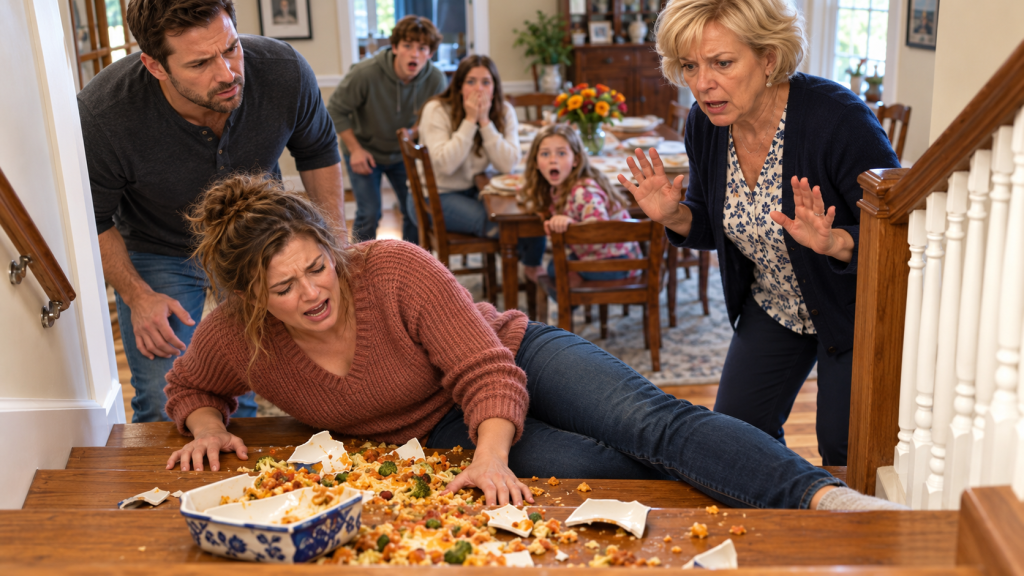
Then I heard Graham. “She won’t sign, Mom. I’ve asked three times.” Judith’s voice followed. “Because you keep letting her think she has a choice.” My blood went cold. On the screen, I appeared carrying the casserole dish toward the basement door. Graham stood beside his mother’s chair, so close that neither realized Elise’s phone was recording their conversation. “The lender wants confirmation Monday,” he muttered. “I can’t keep stalling.”
“Then let me talk to her,” Judith replied.
Graham hesitated. “Don’t make a scene.”
“You should have handled your wife months ago.”
I watched Judith rise and follow me. The recording caught the open stairwell, her hand pressing against the middle of my back, and my sudden disappearance down the steps. The crash sounded worse than I remembered.
Someone screamed. Elise.
Then Graham’s voice, sharp and unmistakable: “Mom, what have you done?”
Judith whispered, “You said she needed convincing.”
The video ended.
Nobody spoke.
For the first time since the fall, the silence felt like it belonged to me rather than to the people trying to erase what happened.
Ramirez turned toward Graham. “What did she need to sign?”
“Nothing,” Graham said too quickly.
Judith laughed bitterly. “Now you’re going to lie to them too?”
His face drained of color. “Mom, stop.”
“You promised you’d take care of the loan!”
Ramirez raised one hand. “We’ll speak with everyone separately.”
Judith pointed at me again. “She provoked me. You didn’t hear what she said on those stairs.”
“I heard enough,” I whispered. “And I felt your hands.”
Security escorted Judith away from the treatment area. Her protests grew fainter down the corridor, until all I could hear was the steady beeping of the monitor beside my bed.
Graham took one step toward me.
“Nora, please.”
I looked at the nurse. “I don’t want him in here.”
He stopped. His expression crumpled, almost convincingly.
“I’m your husband.”
“You were my husband when you told everyone I slipped.”
The nurse opened the door and asked him to leave. This time, he obeyed.
Only after he was gone did I begin to cry.
Not because I’d finally been believed. Because it should never have taken a recording to make my husband’s lies visible.
Dr. Mercer returned with the imaging results shortly afterward.
Three ribs were fractured. I also had significant bruising, but the scans showed no major internal bleeding or collapsed lung. They would monitor me and treat the pain while making sure I could breathe deeply enough to reduce the risk of complications.
“Recovery may take several weeks,” he explained. “Please don’t try to push through severe pain to prove you’re fine.”
I gave a shaky smile. “I don’t think I’ll have much trouble remembering that.”
He pulled up a chair. “Is there someone you trust who can stay with you after discharge?”
I thought of Graham and the way he’d leaned toward the triage nurse, speaking over me. Then I thought of my older sister, Claire, who lived twenty minutes away.
“My sister,” I said. “Can I call her?”
“Of course.”
Claire answered on the first ring. When I told her where I was, she asked only one question.
“Are you safe right now?”
My eyes filled. “I think so.”
“I’m coming.”
She arrived carrying my favorite cardigan and a toothbrush, because Claire had always believed practical things could make frightening moments a little less frightening.
The instant she saw me, her face changed.
“Oh, Nora.”
I tried to sit straighter and gasped.
“Don’t move,” she said, setting her bag down. “You don’t have to be brave for me.”
That was when I told her everything: the stairs, Graham’s story, Judith’s demands, and the video.
Claire listened without interrupting. Then she rested her hand beside mine on the blanket.
“You’re coming home with me,” she said.
“What about my clothes? My work laptop?”
“We’ll work out how to get them safely. Right now, you need to heal.”
I wanted to argue that I couldn’t possibly abandon my own house. Instead, I looked at the purple bruises appearing near my wrist and understood that leaving for a while wasn’t surrender.
It was choosing somewhere I could sleep without listening for footsteps.
Elise came to the hospital that evening.
She was thirty, quiet, and usually the first person to laugh away uncomfortable family conversations. Tonight, she stood beside my bed with swollen eyes and her phone clutched between both hands.
“I should have spoken sooner,” she whispered.
“Why didn’t you?”
She looked down. “Mom saw me holding my phone after you fell. She told me that if I made this into a police matter, Graham would lose everything.”
“What did she mean by everything?”
Elise shook her head. “I didn’t know. But I heard them talking about the bank before dinner.”
She sat down carefully.
“Last month, Mom told me her catering business was behind on payments. I thought Graham was helping her negotiate with creditors. Yesterday, I heard him say he’d already guaranteed a loan and couldn’t tell you.”
A memory surfaced: Judith standing in our kitchen two weeks earlier, suggesting that I borrow against the small lakeside cottage my father had left me.
I’d said no.
Not cruelly. Not angrily. Simply no.
The cottage was the last place where I could still picture Dad sitting at the kitchen table, peeling oranges while he talked about everything and nothing. It was mine before my marriage, and I had never promised it as security for anyone’s debts.
“Graham said the lender wanted confirmation,” I whispered.
Elise nodded. “Mom said you were being selfish. Graham told her not to mention the guarantee because you’d be furious.”
I closed my eyes.
My husband hadn’t merely concealed a disagreement. He had concealed a financial obligation and enlisted his mother to pressure me into covering it.
“There’s another thing,” Elise said.
She opened her messages and showed me one Graham had sent her after the ambulance left.
Delete whatever you recorded. Nora fell. We all need to keep this from getting worse.
My chest tightened.
“I saved the original,” she said quickly. “And I gave the officer a copy.”
I reached for her hand.
“Thank you.”
She started crying. “I watched you fall. I was so frightened, and then everyone just stood there. I should’ve called for help sooner.”
“Elise, the person responsible is the one who pushed me.”
She nodded, but kept crying.
For years, Judith had ruled her family by making disagreement feel like betrayal. Watching Elise struggle to tell the truth, I realized how many people had learned to confuse loyalty with silence.
I wasn’t going to live that way anymore.
The next morning, Claire helped me contact a lawyer.
Her name was Diane Lawson. She listened while I explained the cottage, the alleged loan, and my fear that Graham might have used my personal documents without permission.
“We’ll establish what actually exists before drawing conclusions,” Diane said. “But don’t sign anything Graham sends you, and let’s notify the relevant property and lending parties that you dispute any authorization purportedly made in your name.”
She arranged to check the property records and to help me secure my accounts.
By afternoon, the first answer arrived.
Judith’s business had borrowed ninety-two thousand dollars to expand into event catering. Graham had signed a personal guarantee. The expansion had failed, and payments were overdue.
The loan didn’t automatically give anyone a claim against my cottage. But an application had recently been submitted seeking to use that property as additional security.
I stared at the copy Diane sent.
Beneath the proposed authorization appeared a signature resembling mine.
I hadn’t signed it.
The lender had not completed the transaction because additional identity verification was required. That safeguard had prevented the application from becoming the arrangement Graham and Judith wanted.
But the attempt itself took my breath away.
I remembered Graham asking whether my father’s cottage was “really worth keeping” when we rarely visited during winter. I remembered Judith calling it “sentimental clutter.” I remembered insisting that no one would borrow against it.
They had heard my refusal.
They had simply gone looking for another way around it.
Diane helped me report the suspicious document and preserve the records. I didn’t know whether every part of the paperwork would prove to be deliberate forgery, but I knew one thing with certainty: that signature wasn’t mine.
And Graham had never asked my permission.
That night, while Claire slept in the chair beside my hospital bed, I opened my messages.
The family group chat was overflowing.
Judith is devastated.
Surely there are two sides.
Why involve the police over a terrible accident?
Then I found Graham’s latest message.
Please pray for Nora. We’re grateful Mom tried to catch her, even though everyone is shaken.
I stared at the screen.
Even after seeing the video, he was still repeating the story that protected his mother.
I typed a response, then deleted it.
The recording was evidence, not entertainment for a family argument. I had already given it to the people investigating. I didn’t need to perform my pain for relatives determined to debate it.
I muted the conversation.
And for the first time in years, I let other people’s opinions exist without rushing to correct them.
I was discharged two days later.
Claire brought pillows to support my side during the drive and helped me settle into her guest room. The simple act of lowering myself onto the mattress took so much effort that I burst into tears.
“I can’t even lie down normally,” I whispered.
She sat beside me. “Not yet. That doesn’t mean forever.”
Recovery came in small, uncomfortable measures. I learned to hold a pillow against my ribs when I coughed. I walked slowly down Claire’s hallway. I practiced breathing exercises and celebrated the first morning I could put on a sweater without help.
But the physical pain wasn’t the hardest part.
Sometimes, as I drifted toward sleep, I felt Judith’s hand on my back again. I’d wake with my heart racing, certain I was about to fall.
A hospital social worker had given me information about counseling, and I eventually made an appointment. I didn’t want fear to become another room Judith controlled in my life.
One rainy afternoon, Graham called.
I let it ring, then listened to his voicemail.
“Nora, I know you’re angry. Mom shouldn’t have touched you. But you know she didn’t intend for you to get hurt. Please don’t let this destroy our family.”
I played it twice.
Mom shouldn’t have touched you.
It was the nearest he’d come to admitting what happened, and he still couldn’t say the word pushed.
I saved the message.
Then I called Diane and asked her about beginning a separation.
Graham requested one conversation in the presence of our lawyers. I agreed because I needed answers, not reconciliation.
We met by video while I recovered at Claire’s house. His face looked thinner, and I noticed the dark circles beneath his eyes. Once, seeing him suffer would have made me forget my own hurt.
Not anymore.
“Why did you tell everyone I slipped?” I asked.
He rubbed his forehead. “Because I panicked. I saw you at the bottom of the stairs, and I thought Mom was going to be arrested.”
“I could have died.”
His eyes filled. “I know.”
“Then why were you more worried about her?”
He didn’t answer.
I continued. “And what exactly were you expecting me to sign?”
His lawyer glanced toward him before Graham spoke.
“The bank wanted the cottage as security. I thought if we could get more time, Mom could keep the business.”
“You guaranteed her loan without telling me.”
He nodded.
“You submitted paperwork using a signature I didn’t give.”
He stared at the desk. “I sent documents to the lender.”
“Did you sign my name?”
A long silence followed.
“I thought you’d come around,” he whispered.
My eyes burned.
There it was. Not an explanation, but the belief underneath everything: that my consent could be assumed until I stopped resisting.
“You were willing to risk my father’s home,” I said. “And when your mother hurt me because I said no, you tried to make me responsible for the fall.”
“Nora, I love you.”
I had imagined those words would comfort me forever. Now they sounded painfully incomplete.
“Love doesn’t rewrite what happened to someone,” I replied.
He began crying.
I ended the meeting without promising him another chance.
The investigation continued for months.
Ramirez interviewed everyone who had been at Sunday dinner. Elise provided the original recording and explained why her phone had been running. The hospital supplied documentation of my injuries, and investigators examined the messages Graham had sent afterward.
Judith initially maintained that she had reached out to steady me.
But the video showed a forceful movement at my back before I fell, and her own words afterward contradicted the story she’d demanded I repeat.
Eventually, she pleaded guilty to an assault charge.
At sentencing, the court considered the seriousness of my injuries, the recording, and the circumstances of the attack. Judith received a sentence that included supervised probation, restrictions on contacting me, and restitution for documented expenses.
The court could not give me back the moment before she pushed me.
But it could refuse to call what happened an accident.
The disputed lending document was reviewed separately. Graham ultimately acknowledged submitting an authorization bearing my name without my consent, and the unauthorized application was withdrawn. Through legal proceedings and a financial settlement, responsibility for his guarantee remained his, not mine.
My cottage was safe.
My marriage was not.
I filed for divorce after thirteen years together.
Some relatives were furious. Others apologized once the evidence became impossible to dismiss. A few never said anything at all.
I stopped counting who believed me.
Instead, I counted the things I could do again: climb three steps without stopping, carry a grocery bag, laugh without grabbing my ribs, sleep through a thunderstorm without waking in panic.
And one morning in early spring, I drove to my father’s cottage.
The lake was silver beneath a pale sky. Bare branches stirred against the porch railing, and the old wind chime Dad had hung years ago rang softly over the front steps.
Claire came with me, carrying groceries and refusing to let me lift anything heavy.
“You know I can carry a loaf of bread,” I told her.
“Then consider this my dramatic entrance.”
I laughed. It still pulled faintly at my healing ribs, but for once I didn’t mind.
Inside, the cottage smelled of cedar and cold stone. Dad’s favorite mug stood in the cupboard. The blue blanket he’d insisted was warm enough for every winter lay folded across the sofa.
I touched its edge and began crying.
Claire quietly put the groceries away.
For months, I’d thought healing meant returning to the person I’d been before Sunday dinner. But that woman had spent years smoothing over Judith’s insults, accepting Graham’s excuses, and calling her own discomfort peace.
I didn’t want to become her again.
I wanted to become someone who could love deeply without mistaking silence for kindness.
Someone who understood that a family isn’t made safe by protecting its reputation.
It’s made safe when the truth can be spoken without punishment.
I stepped onto the porch and looked out across the water.
I remembered the concrete basement floor, the taste of fear, and Graham telling the nurse I’d slipped.
Then I remembered Dr. Mercer turning toward him and saying that a woman pushed down a staircase was not a misunderstanding.
Those words had steadied me when almost everything else fell apart.
Claire joined me with two mugs of tea.
“What are you thinking?” she asked.
I accepted a mug and watched the wind ruffle the lake.
“That Dad would have told me to stay here as long as I wanted.”
She smiled. “He would have.”
I breathed in the cold, clean air. It filled my lungs without the sharp pain I’d once feared would never end.
“I think I’d like to come back every spring,” I said.
“Then we will.”
For the first time, the future didn’t look like a staircase I was being forced down.
It looked like a path I could choose.
And I took the first step myself.
THE END STORIES! THANK YOU FOR READING GOOD LUCK !❤️
Related Posts