For a long moment, nobody at the Thanksgiving table spoke. Danny stood beside the little folding table, holding his father’s letter with both hands. His eyes were fixed on the final sentence, and the color had slowly drained from his face. Dolores, before you decide what to give our children, ask Danny why he never sent us the bills.
I looked at my youngest son. “Danny?” He swallowed. “Mom, please. Not today.” His wife, Kayla, stopped rocking their youngest boy. She stared at the letter, then looked away so quickly that I knew she understood exactly what Walt had meant. Michael leaned forward.
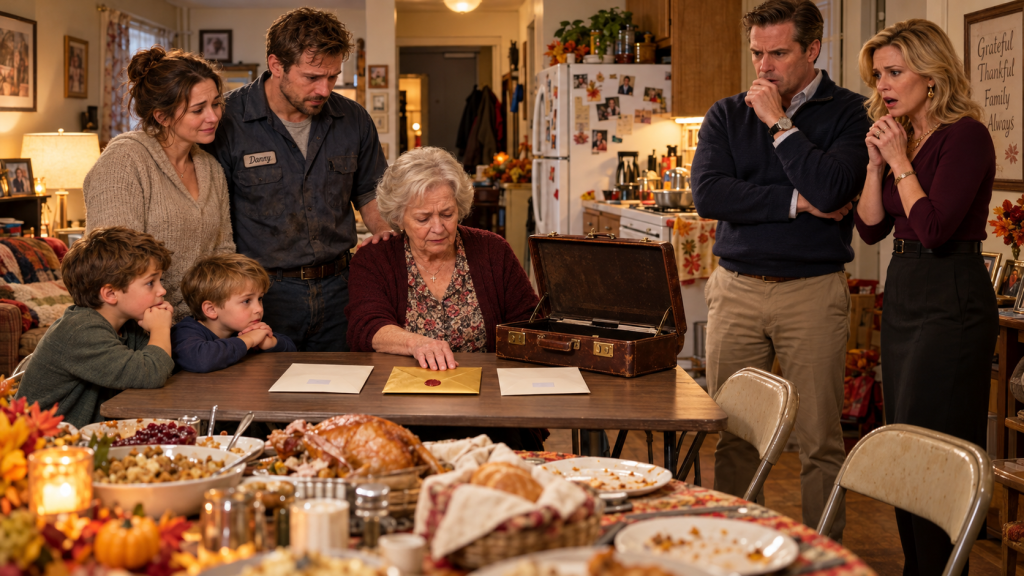
“What bills?” Danny carefully folded the paper. “Nothing important.” Stephanie gave a disbelieving laugh. “Apparently important enough for Dad to write about it before he died.” I turned toward her. “Stephanie, please.” She crossed her arms. “No, Mom. You just told us you’ve been sitting on nearly four million dollars while pretending you were homeless. I think we’re entitled to know what this is about.”
Her words stung because part of them was true.
I’d lied to my children.
I’d invented a foreclosure, claimed medical bills had consumed everything, and allowed Danny’s family to sacrifice their own comfort for three months.
I’d convinced myself I was learning something about their hearts.
Now, looking at Danny, I wondered how much I’d failed to learn about my own.
“Danny,” I said gently, “whatever your father meant, you can tell me.”
He shook his head.
“It wasn’t supposed to come out like this.”
Kayla finally spoke.
“Honey, maybe it should.”
Danny looked at her.
She reached across the table and touched his wrist.
“Your dad knew. He wanted your mom to know too.”
Danny’s eyes filled.
Michael threw up his hands.
“Would someone please explain what’s going on?”
I turned toward him.
“Michael, sit down.”
“I’m already sitting.”
“Then stop making this harder.”
He stared at me, startled.
For thirty years, Michael had been the son who could dominate a room simply by raising his voice. He was successful, articulate, and accustomed to people listening.
But this was Danny’s home.
His table.
And I wasn’t going to let anyone turn his pain into another argument about money.
Danny took a long breath.
“Remember when Dad was still running the transport company?”
I nodded.
“Of course.”
“Those last few years, the trucks kept breaking down.”
I remembered.
Walt had owned seventeen delivery trucks, most of them old enough to have developed personalities of their own. He loved that business, but keeping the fleet operating had become increasingly difficult.
“Your father used to come home complaining about repair bills,” I said.
Danny smiled sadly.
“That’s because he didn’t know what the repairs really cost.”
I frowned.
“What do you mean?”
Danny looked toward Kayla.
She nodded.
Then he said, “I was fixing the trucks after my shifts.”
My heart tightened.
“I knew you helped him sometimes.”
“Not sometimes, Mom.”
He unfolded the letter.
“Every weekend for almost four years. Sometimes until three in the morning.”
I stared at him.
He continued.
“Dad couldn’t afford to pull trucks off the road for days. So I’d go over after work, repair whatever needed fixing, and get them running before Monday.”
“But he paid you.”
Danny shook his head.
“No, Mom.”
My stomach dropped.
“What about the parts?”
“I bought most of them.”
I pressed my hand against my chest.
He went on quietly.
“Alternators. Brake assemblies. Transmission parts. Tires when I could get wholesale prices. Sometimes I’d trade jobs with other mechanics so we could keep the costs down.”
I looked at Kayla.
She was crying silently.
“How much?” I whispered.
Danny shook his head.
“It doesn’t matter anymore.”
“Danny.”
He closed his eyes.
Kayla reached into a drawer behind her chair and pulled out a worn black notebook.
She placed it on the table.
“We kept records,” she said.
Danny looked at her in surprise.
“Kayla.”
She wiped her cheeks.
“You kept telling me someday you’d show your dad. You never did.”
I opened the notebook.
The pages were filled with dates, truck numbers, parts, and carefully recorded expenses.
Danny’s handwriting.
Small and uneven.
Some entries had greasy fingerprints across the corners.
I turned the pages.
Three hundred dollars.
Eight hundred.
One thousand four hundred.
Then hours of labor.
Weekend after weekend.
Year after year.
At the back, Kayla had written a total.
$64,780.
I stared at the number.
For a moment, the little kitchen disappeared.
I saw Walt sitting at our old table, worrying over the transport company’s future.
I remembered Danny arriving for Sunday dinner with dark circles under his eyes.
I remembered asking why he always looked so tired.
He’d laughed and said, “Just working hard, Mom.”
I hadn’t known how hard.
My hands began trembling.
“Why didn’t you tell us?”
Danny looked down.
“Because Dad would’ve insisted on paying me.”
“He could have afforded it eventually.”
“Not back then.”
His voice broke.
“He was trying to keep the business alive. I knew how much it meant to him.”
I covered my mouth.
Then Danny said something that broke my heart.
“When Dad finally sold the company, he found out. The new owners discovered my old maintenance logs and asked why some repairs had no invoices.”
I looked toward the letter.
“He called me.”
Danny nodded.
“He wanted the bills. Said he was going to settle every penny.”
“Why didn’t you send them?”
My son smiled through tears.
“Because I never wanted Dad looking at me like I was another creditor.”
The words struck me harder than any accusation could have.
Michael looked away.
Stephanie lowered her eyes.
Danny continued.
“He was my father. He taught me how to change a tire when I was eight. He gave me my first toolbox. He sat through every terrible school concert I played in.”
His voice trembled.
“I wasn’t going to send him a bill for being his son.”
I began crying.
Then I looked at Kayla.
“And you knew?”
She nodded.
“We talked about it. A lot.”
“You had two little boys to raise.”
“I know.”
Her voice was gentle, but there was something firm beneath it.
“And I supported helping Walt. But I won’t pretend it was easy.”
She looked toward Danny.
“We gave up vacations. We delayed replacing our car. There were nights he came home so exhausted he could barely eat.”
Danny reached for her hand.
She squeezed it.
Then Kayla looked at me.
“Your husband knew what we’d done. And he knew Danny wouldn’t accept repayment if it felt like a wage.”
I stared at Walt’s handwriting.
Suddenly, his final message made sense.
He hadn’t written about unpaid bills because he believed Danny was owed affection in exchange for money.
He’d written it because my youngest son had quietly given our family something none of us fully understood.
Years of his life.
Hours he could never recover.
And the knowledge that his father wouldn’t have to watch everything he’d built fall apart.
I looked at Danny.
“Your dad knew?”
He nodded.
“He found out before he got sick.”
I unfolded the letter again.
Below the handwritten sentence was another paragraph I’d overlooked.
He’ll tell you none of it matters. Susie, don’t let him dismiss what he gave. But don’t mistake gratitude for permission to decide his future. Ask him what he needs. Then listen.
My tears fell onto the page.
Because Walt had understood something I was only beginning to see.
Danny had never asked us for payment.
And I had spent three months treating his willingness to help as something I needed to test.
I closed the notebook and looked around the table.
Michael’s expensive watch glinted beneath the kitchen light. Stephanie sat with her hands folded tightly together, staring at the envelope she had been so eager to open.
Danny was still standing.
He hadn’t touched the documents offering him a house.
He hadn’t even asked how much it was worth.
Instead, he looked at me with an expression I couldn’t bear.
“Mom,” he said, “why did you do this?”
The question was quiet.
That made it worse.
I took a breath.
“After your father died, I was frightened.”
“Of being alone?”
“Yes.”
He nodded slowly.
I continued.
“And I was afraid that if everyone knew about the money, I’d never know whether you were visiting me because you loved me or because you wanted something.”
Michael shook his head.
“So you decided to lie to all of us.”
“Yes.”
Stephanie laughed bitterly.
“And you let us say terrible things because you wanted to see what we’d do.”
I looked at her.
“Yes.”
My voice broke.
“I told myself I was protecting what your father left me. But I turned my grief into a test none of you knew you were taking.”
Danny finally sat down.
He stared at his hands.
“Mom, we moved the boys into one bedroom because you needed ours.”
“I know.”
“Kayla slept on that couch with me every night.”
“I know.”
“The spring kept digging into her back.”
I began crying.
“Sweetheart, I’m sorry.”
He looked up.
“We’d have done it anyway.”
That made me cry harder.
“That’s what hurts,” he whispered. “We didn’t need to be tested.”
Kayla wiped her eyes.
Then she spoke carefully.
“Dolores, I love having you here. The boys adore you.”
I reached for her hand.
She didn’t pull away.
“But we had to make real decisions based on what you told us.”
My stomach tightened.
She continued.
“We postponed getting the car’s brakes replaced because Danny thought we’d need the money if your situation got worse.”
I stared at her.
“What?”
Danny looked toward the window.
“We used my truck instead.”
Kayla gave him a sad smile.
“And he took extra Saturday shifts. Not because we wanted anything from you. Because we thought you had nothing.”
I closed my eyes.
The three months I’d spent feeling grateful had been three months in which my youngest son’s family had stretched an already fragile budget to make room for me.
I’d seen the thin blankets.
The broken couch.
The careful grocery shopping.
But I’d never asked what they were sacrificing beyond the obvious.
Because somewhere deep inside, I’d wanted the proof.
And when they kept giving, I took it.
I looked at Kayla.
“You’re right. I should have told you the truth.”
She nodded.
Then she said something I would never forget.
“Helping family should be a choice, Dolores. We chose to help someone who said she needed us. We deserved to know what was real.”
The little kitchen fell silent.
I thought of Walt’s warning.
Money shows you exactly who people are.
I’d repeated those words to myself for months.
Now I wondered whether I’d misunderstood them.
Money could reveal generosity.
But secrecy could reveal something too.
Fear.
Pride.
And how easily a person could justify hurting someone while telling herself it was for a good reason.
I turned toward Michael.
“You were wrong to tell me there wasn’t room.”
His face reddened.
I continued before he could interrupt.
“But I was wrong to tell you I was losing everything when I wasn’t.”
He looked down.
I turned to Stephanie.
“And you were wrong to suggest a shelter without first asking what help you could give.”
Her eyes filled.
“But my dishonesty doesn’t disappear because your response hurt me.”
For the first time that day, nobody argued.
Then I pushed the envelopes back toward them.
“Your father wrote those letters before he became ill. They aren’t punishments for anything that happened this Thanksgiving.”
Michael looked at me.
“And Danny’s house?”
I swallowed.
“That was my decision, based partly on a wish your father expressed. But I shouldn’t have presented it without talking to Danny and Kayla first.”
Danny stared at the papers.
“Mom, I can’t accept a house because I answered a phone call.”
I nodded.
“I understand.”
“And I don’t want Michael and Stephanie thinking I invited you here to get an inheritance.”
I felt my chest tighten.
“I know.”
He looked at his brother and sister.
“I didn’t know anything about the money.”
Michael stared at him.
Then lowered his eyes.
“I believe you.”
Stephanie nodded slowly.
“So do I.”
Danny seemed to relax a little.
But he still didn’t touch the house documents.
We never finished dessert that Thanksgiving.
Michael said he needed some air. Stephanie went outside to call her husband. The boys fell asleep in front of the television, one with a toy truck tucked beneath his chin.
I stayed at the kitchen table with Kayla.
She poured two cups of tea.
Then sat opposite me.
For a while, we said nothing.
Finally, I asked, “Are you angry with me?”
She looked into her cup.
“Yes.”
I nodded.
“I understand.”
She looked up.
“But I’m also glad you’re here.”
My eyes filled.
She continued.
“The boys have never had so much time with their grandmother. You’ve taught them to make pancakes, and our oldest finally learned how to tie his shoes because you sat with him for an entire afternoon.”
I smiled through tears.
“He’s a determined little fellow.”
“He gets that from Danny.”
We laughed softly.
Then Kayla grew serious.
“I don’t want our good memories to become fake because the reason you came wasn’t true.”
I looked at her.
“But I need time before I can trust you not to make decisions like this again.”
I reached for her hand.
“I’ll give you that time.”
She nodded.
“And Dolores?”
“Yes, honey?”
“Please don’t give us a house tonight.”
I blinked.
“What?”
“Not until Danny and I have talked privately. Not until we know what accepting it would mean for taxes, expenses, and our future.”
I stared at her.
She smiled sadly.
“We’re grateful. But we’ve spent our whole marriage trying to build a life we can manage. We don’t want to make a decision this big because everyone is crying at Thanksgiving.”
I laughed through my tears.
Then nodded.
“Your father-in-law would have liked that answer.”
She squeezed my hand.
“I think he would’ve.”
A few minutes later, Danny returned from taking out the trash.
He saw us sitting together.
“Everything okay?”
Kayla looked at me.
I looked back at her.
Then I smiled.
“Not everything,” I said. “But we’re talking.”
Danny nodded.
For the first time all evening, I saw a little of the tension leave his shoulders.
And I realized that might be the most valuable thing I could give his family that night.
Not a deed.
Not a check.
The truth, followed by the patience to let them decide what happened next.
Michael returned before midnight.
He stood in the doorway holding his envelope.
“Mom, can we talk?”
I followed him onto the narrow balcony overlooking the laundromat parking lot.
The cold air made me pull my sweater tighter.
For a long time, he said nothing.
Then he whispered, “I opened Dad’s letter.”
I nodded.
“What did he say?”
Michael looked toward the street.
“He remembered when I was sixteen and got accepted into that business program in Chicago.”
I smiled faintly.
“You were so excited.”
“Dad couldn’t afford the trip.”
“I remember.”
Michael’s voice broke.
“He drove me there anyway. Slept in the car because we didn’t have money for a hotel.”
Tears filled my eyes.
Walt had been that kind of father.
He wasn’t always good with words.
But he showed up.
Michael unfolded the letter.
“Dad wrote that he was proud of everything I built.”
I smiled.
“He was.”
“Then he wrote, ‘Don’t let the size of your house become the measure of how much room you have in your heart.'”
Michael began crying.
I covered my mouth.
He looked at me.
“I thought you’d eventually find another arrangement. I thought helping you would become permanent, and Jenna would resent me for bringing someone else into the house.”
I nodded slowly.
“Did you ask Jenna?”
He looked away.
“No.”
“Then you made her decision for her.”
He laughed sadly.
“Apparently.”
I stood beside him.
Then he whispered, “I could’ve come to get you. At least for a few nights.”
“Yes.”
“I could’ve called again.”
“Yes.”
Tears rolled down his cheeks.
“I’m sorry, Mom.”
I put my arm around him.
“I love you, Michael.”
He leaned against me.
“But I need you to understand something. Your father’s money isn’t going to make that conversation unnecessary.”
He nodded.
“I know.”
I hoped he did.
For the first time in years, my oldest son wasn’t talking about his career or his responsibilities.
He was talking about the sort of man he wanted to become.
And that was a beginning.
Stephanie came back inside while Michael and I were still on the balcony.
She stood near the living-room doorway, her envelope clutched against her chest.
“Mom, I need to tell you something.”
I stepped inside.
Her mascara had run, and her expensive cream sweater was wrinkled where she’d been twisting the sleeves.
“I called my husband,” she said.
I nodded.
“How is he?”
“Angry.”
“At me?”
“At both of us.”
She gave a shaky laugh.
“He says I should’ve brought you home when you called.”
I waited.
Stephanie looked down.
“I told him you needed somewhere to live. But I didn’t tell him how bad you said it was.”
“Why not?”
She wiped her cheeks.
“Because I was embarrassed.”
I stared at her.
“Embarrassed about what?”
“That you might need help from me.”
Her voice broke.
“I’ve spent years trying to prove I made something of myself. The right neighborhood. The tennis lessons. The vacations. I thought if people saw you living with us because you were broke, they’d assume we were struggling too.”
I felt a painful heaviness in my chest.
“Stephanie, your father’s money never made us better than anyone.”
“I know.”
“Then why would having a mother who needed help make you less successful?”
She began crying.
“Because I was worried about how it would look.”
I reached for her hand.
She hesitated before taking it.
Then she whispered, “Dad’s letter says he was happiest watching me teach my daughter to ride a bike.”
I smiled through tears.
“I remember that afternoon.”
“He wrote three pages about it.”
She laughed sadly.
“Three pages, Mom. And there’s barely a sentence about my job or our house.”
I nodded.
“Your father noticed what mattered to him.”
Stephanie looked at her envelope.
“There’s something else inside.”
She removed a small photograph.
It showed Walt holding her at age six. She wore a crooked paper crown, and he was laughing so hard his eyes were nearly closed.
I remembered taking that picture.
It was Father’s Day.
Stephanie had insisted her father was the king of the whole world.
Walt wore that ridiculous crown until bedtime.
On the back, he’d written:
The best title I’ve ever had is Dad.
Stephanie pressed the photograph to her chest.
Then she whispered, “I asked about his watch because he promised I’d have it someday.”
I looked up.
“His old silver watch?”
She nodded.
“He used to let me wind it. Every Sunday before church.”
A memory returned.
Little Stephanie standing on a kitchen chair beside Walt, carefully turning the tiny crown while he warned her not to twist too hard.
I covered my mouth.
“I remember.”
“After he got sick, he told me he’d have it engraved for my daughter one day.”
Her voice shook.
“When I asked whether you still had it, I wasn’t trying to sell it.”
I stared at her.
“Why didn’t you tell me?”
“Because I thought you’d think I was only calling about money.”
The irony hurt.
I’d assumed the worst about her question because I was already conducting my terrible test.
And she’d been too ashamed of her earlier response to explain.
I reached for her.
“Oh, Stephanie.”
She stepped into my arms and began crying.
“I should’ve helped you,” she whispered. “I know that. But I really did want Dad’s watch because it reminded me of him.”
I held her tightly.
“I believe you.”
Then I pulled back.
“But honey, we need to learn to ask each other what we mean instead of deciding it privately.”
She nodded.
“I know.”
I looked toward the hallway, where Danny’s children were sleeping.
“Your father left us more than a watch, Stephanie. And I don’t mean the money.”
She wiped her eyes.
For a moment, I thought about telling her that everything was forgiven.
But forgiveness wasn’t a switch.
I still remembered sitting at my kitchen table, telling her I had nowhere to sleep.
I still remembered her suggesting shelters before ending the call.
The pain was real.
So was her shame.
And if our family was going to repair itself, we had to allow both truths to exist.
The next morning, I went home.
Danny insisted on driving me, although I told him my sedan was perfectly capable of making the trip.
He grinned.
“Mom, after three months of living together, you’ve forgotten how stubborn I am.”
I laughed.
“Your father used to say the same thing.”
Danny carried my overnight bag inside.
The little house looked exactly as it had when I left.
Walt’s slippers beside the couch.
His reading glasses near the kitchen window.
The old clock above the refrigerator running four minutes fast because he liked to say it kept him ahead of the world.
I walked into our bedroom.
The bed was neatly made.
The curtains were open.
Everything smelled faintly of lavender and furniture polish.
Then I sat down.
And suddenly, I couldn’t stop crying.
Danny came to the doorway.
“Mom?”
I covered my face.
“I’m sorry, sweetheart.”
He sat beside me.
“For what part?”
It was a fair question.
I looked at him.
“For lying.”
He nodded.
“For letting you and Kayla give up your room when I had a perfectly good one here.”
He looked down.
“For not trusting you enough to tell you about the money.”
My voice cracked.
“And for making you feel you had to prove you loved me.”
Danny put his arm around my shoulders.
“I was hurt, Mom.”
“I know.”
“Part of me was angry when you said you had millions while we were trying to figure out how to buy a new mattress.”
Tears rolled down my face.
He continued gently.
“But I don’t regret bringing you home.”
I looked up.
“Not even a little?”
He smiled sadly.
“No.”
Then he grew serious.
“I just need to know that next time you’re scared or lonely, you’ll tell me that instead of inventing a disaster.”
I took his hand.
“I promise.”
He nodded.
For a moment, we sat quietly.
Then he said, “Mom, there’s one thing you haven’t asked me.”
I looked at him.
“What?”
“Why Dad knew about all the truck repairs.”
I frowned.
“You said the buyers found the maintenance records.”
He nodded.
“But Dad didn’t only ask for the bills.”
My heart tightened.
“What else?”
Danny reached into his jacket and removed a folded sheet of paper.
“He offered to make me a partner before he sold the business.”
I stared at him.
“He what?”
Danny nodded.
“A smaller share. He said if I wanted to leave the repair shop and come work with him, he’d make sure I had a stake.”
My eyes filled.
“Why didn’t you accept?”
Danny smiled faintly.
“Because I didn’t want my brother and sister thinking Dad was choosing favorites. And because I wanted to build something myself.”
I looked at the paper.
It was a handwritten proposal in Walt’s familiar script.
The kind of plain, thoughtful offer he always preferred to formal speeches.
Then Danny whispered, “He told me I had a mechanic’s hands and an owner’s heart.”
I began crying.
That sounded exactly like Walt.
“And I told him I’d rather keep fixing things until I knew what kind of business I wanted to run.”
I looked at my son.
“Do you still want your own shop?”
His expression changed.
For the first time, he seemed almost shy.
“Maybe someday.”
I smiled through tears.
“Tell me about it.”
He looked away.
Then slowly began describing the little garage he’d dreamed of opening.
Three service bays.
Honest prices.
A place where young mechanics could learn without being shouted at.
A small office where Kayla could handle the accounts if she wanted.
His eyes brightened as he spoke.
And I realized that in all the years I’d known Danny, I’d spent so much time worrying about how hard he worked that I’d rarely asked what he hoped all that work might become.
I squeezed his hand.
“That sounds like a good dream.”
He laughed softly.
“It’s an expensive one.”
I looked around the room Walt and I had shared.
Then I remembered my husband’s letter.
Ask him what he needs. Then listen.
For once, I decided not to offer an answer before I’d heard the whole question.
Over the next month, I did something I should have done before Thanksgiving.
I asked my children what they wanted from life.
Not what they earned.
Not how large their houses were.
Not what I thought they deserved.
What they wanted.
I met with my estate attorney, Margaret Ellison, and explained the entire situation.
She listened without interrupting.
Then she took off her glasses.
“Dolores, before we discuss gifts, I want to ask whether you’ve thought about your own future.”
I frowned.
“Of course.”
“Have you set aside enough for your retirement, medical care, and whatever support you might need later?”
I looked down.
Walt had left me more money than I’d ever imagined we would have.
But Margaret was right.
I was seventy-one. I could live another twenty years, perhaps longer.
And I had already made one serious mistake by treating money as a test of love.
I didn’t intend to make another by giving it away without thinking.
We reviewed the accounts.
Set aside substantial reserves for my own needs.
Discussed the existing estate plan.
And began preparing appropriate arrangements for any gifts I chose to make.
Margaret also explained why handing Danny an envelope containing property documents at Thanksgiving wasn’t the same as completing a lawful transfer.
A home required proper paperwork, consideration of taxes and ongoing expenses, and the informed agreement of the people receiving it.
I thought of Kayla’s words.
Please don’t give us a house tonight.
She had been right.
So I invited Danny and Kayla to see the property.
It was a modest three-bedroom ranch, ten minutes from their apartment.
There was a little fenced backyard, a kitchen with yellow cabinets, and enough bedrooms that nobody would have to sleep on a broken couch again.
The house was owned through an arrangement my attorney had prepared for a possible gift, but nothing would be transferred unless they decided they wanted it.
Kayla walked into the kitchen and stopped.
“Oh, Dolores.”
I watched her turn slowly.
“Do you like it?”
She smiled.
“It’s lovely.”
Danny went straight to the garage.
Of course he did.
When he came back, his eyes were bright.
“Mom, there’s enough room for my workbench.”
I laughed.
“I noticed.”
Then I grew serious.
“I want you both to understand something. This house isn’t payment for taking me in. It isn’t a reward for passing a test.”
Danny’s expression softened.
“I know, Mom.”
“I want to help you because I can. And because you and Kayla have spent years putting everyone else’s needs before your own.”
Kayla began crying.
I continued.
“But you can say no. And if you accept, it won’t give me the right to make decisions about how you live.”
Danny looked at his wife.
They stood quietly together for a moment.
Then Kayla said, “Can we think about it?”
I smiled.
“Please do.”
Two weeks later, they accepted.
We completed the transfer with professional help, and they made a budget for property taxes, maintenance, and the other expenses that came with owning a home.
The boys each got a bedroom.
Danny built a little wooden shelf for his tools.
Kayla finally bought the comfortable mattress she’d been talking about for years.
On moving day, I stood in the doorway of their apartment and looked at the couch where my son had slept for three months.
The fabric was worn.
The broken spring still pressed against the cushion.
I touched it gently.
Then I whispered, “Thank you.”
Not to the couch.
To the family that had made room for me when they believed I had nothing.
Michael’s apology didn’t end with words.
One Saturday morning, he arrived at my house carrying groceries and a toolbox.
I opened the door in surprise.
“Michael?”
He looked embarrassed.
“Jenna says your porch railing needs fixing.”
I laughed.
“Jenna’s right.”
He shifted.
“And I thought maybe I could help.”
I studied him.
My oldest son, who usually scheduled family visits between business meetings, had shown up in jeans and an old sweatshirt.
For an hour, he worked on the railing.
Then we sat on the porch drinking lemonade.
He looked toward the yard.
“Mom, I don’t want us to become one of those families that only talks through lawyers after somebody dies.”
My eyes filled.
“Neither do I.”
He swallowed.
“I still think what you did was wrong.”
I nodded.
“It was.”
“But what I did wasn’t right either.”
He looked at me.
“I should have made room. Or at least helped you make a plan.”
I squeezed his hand.
“Thank you for saying that.”
He smiled faintly.
Then asked if I wanted to come to dinner the following Sunday.
I accepted.
Not because the invitation erased our past.
Because it was a chance to build something better.
Stephanie took longer.
For several weeks, our conversations remained awkward.
Sometimes she called and spoke about the weather.
Sometimes she asked about the boys.
Neither of us mentioned Thanksgiving.
Then one afternoon, she appeared carrying a small velvet box.
Inside was Walt’s silver watch.
I stared at it.
“Where did you find this?”
“You gave it to me last week, Mom.”
I laughed through my tears.
“I know, sweetheart. I just didn’t expect you to bring it back.”
She opened the lid.
The watch had been cleaned and repaired.
Its second hand moved steadily around the face.
“I wanted you to see it working again.”
I touched the cool metal.
Walt had worn that watch for thirty-five years.
He’d scratched it unloading trucks.
Gotten grease in the clasp.
And refused to replace it even when Michael bought him a much more expensive one.
Stephanie smiled.
“I had the back engraved.”
She turned it over.
The words were small.
TIME WITH FAMILY IS NEVER WASTED.
My eyes filled.
She took my hand.
“I don’t want the watch because it’s worth money.”
“I know that now.”
“I want my daughter to remember Grandpa.”
I hugged her.
“Then tell her his stories.”
Stephanie nodded.
“I will.”
And for the first time since Thanksgiving, I felt us meeting each other without the inheritance standing between us.
By the following Thanksgiving, the boys were living in their new house, and Danny had begun planning the repair shop he’d dreamed about for years.
He wasn’t ready to leave his job.
He wanted to save more money and understand the risks before taking that step.
This time, I didn’t rush to solve the problem for him.
I listened.
When he asked for help reviewing a business proposal, I found someone who could advise him. When he wanted to make decisions on his own, I let him.
I was learning that supporting someone didn’t mean taking control of their future.
That Thanksgiving, we gathered at Danny and Kayla’s new house.
Michael brought the turkey.
Stephanie arrived with sweet potatoes and a photograph of Walt for the mantel.
Kayla prepared the rolls.
And I brought three pies, each labeled with my familiar masking tape.
DOLORES H.
Everyone laughed when they saw them.
“Some things never change,” Michael said.
I smiled.
“Thank goodness.”
After dinner, Danny’s oldest boy climbed into my lap.
“Grandma, are you still poor?”
The table went silent.
I looked at his innocent face.
Then toward Danny.
My son gave me a small, knowing smile.
I took a breath.
“No, sweetheart. Grandma was never as poor as she told you.”
He frowned.
“Then why did you sleep at our house?”
My eyes filled.
“Because I was afraid of being alone, and I made a mistake.”
He considered that.
Then asked, “But you liked staying with us?”
I hugged him.
“More than you can imagine.”
He smiled.
“Good. You can visit anytime.”
I laughed through my tears.
“Thank you, honey.”
Across the table, Danny reached for Kayla’s hand.
Michael was helping clear the dishes.
Stephanie was showing her daughter how to wind Walt’s watch.
And for a moment, I imagined my husband standing beside the kitchen door, watching us with that quiet smile of his.
I wished I could tell him what I’d learned.
That money could reveal people’s priorities, but it couldn’t tell their whole story.
That even loving families sometimes disappointed one another.
That apologies mattered only when people were willing to change.
And that a mother’s love shouldn’t be measured by how cleverly she could test her children.
After everyone left the table, I opened Walt’s old leather briefcase one last time.
Inside was a photograph of the two of us standing beside his first delivery truck.
We were young.
Exhausted.
And smiling as though the world belonged to us.
On the back, Walt had written:
We started with almost nothing, Susie. Look what love helped us build.
I held the picture against my chest.
For months, I’d believed the greatest thing he left me was $3.8 million.
Now I understood.
The money could buy a house.
It could provide security.
It could help my children pursue their dreams.
But it couldn’t replace trust.
It couldn’t purchase forgiveness.
And it couldn’t turn a frightened mother’s lie into something wise.
Those were things I had to repair myself.
That evening, Danny found me sitting on the porch.
“Everything okay, Mom?”
I smiled.
“Better than okay.”
He sat beside me.
For a while, we watched the lights coming on in the neighboring houses.
Then he said, “Dad would’ve loved this place.”
I nodded.
“He would’ve.”
Danny rested his arm around my shoulders.
And I leaned against him.
For the first time since Walt died, I didn’t feel that I was waiting for somebody to prove they loved me.
I already knew I was loved.
Not because everyone had made the right choice.
But because we were finally learning how to choose one another without fear, secrets, or conditions.
My husband left me a fortune, but my youngest son taught me what it meant to be rich.
And the most important inheritance our family received wasn’t money.
It was the chance to become honest with one another before we ran out of time.
THE END STORIES! THANK YOU FOR READING GOOD LUCK !❤️
Related Posts