Marcus held the syringe between two gloved fingers, as casually as another man might hold a pen. Behind him, the hidden door clicked into place. The sound was small. Final. And somehow more terrifying than the sirens rising outside. “Put it down,” I whispered. He tilted his head. “Lucy, you’re frightened. Your nervous system is responding unpredictably because you missed your medication.”
“My name is Lucy.” “I know what you think you remember.” “No.” I tightened my grip on the black notebook. “You know what you made me forget.” Something flickered across his face. For two years, I’d mistaken that expression for concern. I’d seen it when I questioned a bruise, when I woke from a nightmare, when I found notes in my own handwriting that I couldn’t explain.
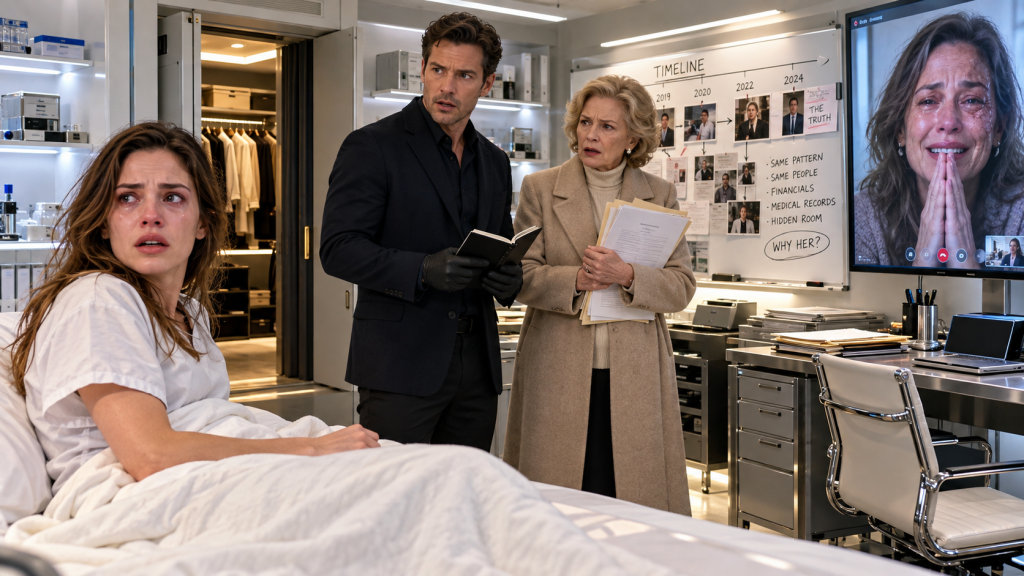
Now I recognized it. Calculation. Marcus wasn’t trying to comfort me. He was deciding how much force he needed to use. On the monitor, Marianne’s scarred face moved closer to the camera. “Lucy, sweetheart, keep looking at me.” Eleanor lunged toward the screen. “Turn that thing off!” Marcus didn’t move.
“Mother, step aside.”
“She’s calling the police!”
“They were already called,” Marianne said.
Her voice shook, but her eyes didn’t.
“And they have the address. They know about the room.”
Marcus’s expression changed.
For the first time that night, I saw genuine fear.
Then he looked at me again.
“Your mother has spent years making up stories about you. She’s not well.”
The old words.
The familiar poison.
You’re imagining things.
You’re anxious.
Your mind isn’t reliable.
I’d heard variations of those sentences so often that they had become the walls of my world.
But now there was an actual wall behind my bedroom closet, hiding a room filled with photographs of me unconscious.
A dead girl’s grave.
A stolen name.
And a mother who had spent twelve years searching.
“Then why did you hide her from me?” I asked.
Marcus’s jaw tightened.
“I was protecting you.”
“From my mother?”
“From a traumatic past you couldn’t handle.”
I stared at him.
“You don’t get to decide what I can handle.”
He stepped forward.
Eleanor caught his sleeve.
“Marcus, wait.”
He shook her off.
“She’s becoming agitated. I need to stabilize her.”
“Don’t you dare!” Marianne shouted.
He reached for my wrist.
I swung the black notebook toward his face.
It struck his cheek.
The syringe flew from his hand and skittered beneath the medical cabinets.
Marcus staggered.
I ran.
Not toward the locked door.
Toward the stainless-steel cart beside it.
I shoved it with everything I had.
The cart crashed into Marcus’s knees. Instruments clattered across the floor.
He fell against the gurney with a cry of pain.
I reached the keypad beside the door.
Four glowing numbers waited beneath my fingers.
I didn’t know the code.
Of course I didn’t.
The room was designed for someone who was never supposed to leave it awake.
I pressed the emergency release button beneath the keypad.
Nothing happened.
Marcus laughed bitterly.
“That doesn’t work when the room is secured.”
I turned.
He was getting up.
Eleanor stood between us, staring at the fallen syringes.
“Marcus,” she whispered, “stop. Please.”
He looked at her.
“After everything we’ve done, you’re going to panic now?”
Her face crumpled.
“We can still explain the money.”
“The money?” he snapped. “You think this is only about the money?”
For a second, the room became completely silent.
Even Marianne stopped speaking.
I looked at him.
“What else is there?”
Marcus realized his mistake.
He straightened slowly.
“Nothing.”
But I had seen the fear.
The inheritance mattered.
The forged documents mattered.
Yet somewhere inside that hidden room was another secret he was even more desperate to protect.
A heavy pounding echoed from the other side of the wall.
“POLICE! OPEN THE DOOR!”
I began crying.
“Here!” I screamed. “I’m in here!”
Marcus rushed toward me.
Eleanor grabbed his arm.
“Let her go!”
He shoved her aside.
She struck the edge of a cabinet and collapsed.
I backed against the keypad.
The pounding grew louder.
A voice shouted from the closet passage.
“Step away from the door!”
Marcus seized my shoulders.
His mouth was close to my ear.
“If you tell them what you think happened, they’ll never believe you. You have twelve years of missing memories, Lucy. Twelve years.”
I felt his breath against my cheek.
“Who do you think they’ll trust? A neurologist or a confused woman who can’t even remember her own name?”
For a moment, I was back in our bedroom.
A white capsule.
A glass of water.
His patient smile.
Trust me.
Then I heard my mother’s voice through the monitor.
“Lucy, listen to me.”
I looked up.
Tears rolled down her scarred cheeks.
“You do not have to remember everything to tell the truth.”
Something inside me broke open.
Not a memory.
Something stronger.
The certainty that I was allowed to speak even when I didn’t have all the answers.
I looked Marcus directly in the eyes.
“I don’t need to remember twelve years.”
His grip tightened.
“I remember tonight.”
The door shook.
A metal fastening snapped.
Marcus released me and stepped backward.
Then the door burst open.
Two officers entered, followed by a woman wearing a dark jacket marked with the insignia of an investigative unit.
“Hands where I can see them!”
Marcus immediately raised his palms.
“Thank God,” he said smoothly. “My wife is having an acute neurological episode.”
I stared at him.
Even now.
Even with the syringes on the floor and the photographs on the wall.
He was still trying to make me disappear inside his diagnosis.
The woman in the dark jacket looked at me.
“Are you Lucy Archer?”
My lips trembled.
I looked toward the photograph of the dead girl.
Then back at the officer.
“I think so.”
The woman’s expression softened.
“My name is Detective Elena Ruiz. We’ve been looking for you.”
Marcus began speaking rapidly.
“Detective, I must insist that you contact her treating physician before—”
“I’d like you to step away from her, Doctor.”
“She’s medically vulnerable.”
“Then she can be evaluated independently.”
He tried to speak again.
Another officer directed him toward the wall.
For the first time in two years, Marcus Reed had to obey someone who wasn’t afraid of him.
Detective Ruiz turned to me.
“Lucy, can you walk?”
I nodded.
Then my knees buckled.
She caught my arm.
“It’s all right. We’ve got you.”
I stared at the notebook still clutched against my chest.
“Don’t let him take this.”
Her eyes moved toward it.
“I won’t.”
“Page forty-two,” I whispered. “There’s a girl in the ground.”
The detective’s expression changed.
“I know.”
I looked at her.
“How?”
She hesitated.
“Because the woman on that screen isn’t the only person who’s been helping us.”
Before I could ask what she meant, she gently guided me toward the open doorway.
I crossed the threshold.
Past the medical equipment.
Through the narrow passage.
Into the bedroom where I had spent two years believing I was loved.
The sheets were still folded back.
A glass of water sat on my nightstand.
And beside it lay the white capsule I had pretended to swallow.
I stopped.
For some reason, that tiny object frightened me more than everything else.
It looked so harmless.
So ordinary.
I pointed toward it.
“He made me take those.”
Detective Ruiz followed my gaze.
“Every night?”
I nodded.
“Sometimes I woke up and couldn’t remember what happened.”
She spoke quietly to another officer, who began documenting the room.
Then she looked at me.
“Lucy, we’re going to take you somewhere safe.”
I looked back toward the closet.
“Will he come after me?”
“No. He’s being detained while we investigate.”
I wanted to believe her.
I wanted to believe that a locked door couldn’t open by itself, that a sleeping woman could wake up without being watched, that a husband didn’t automatically own every explanation of his wife’s life.
But fear didn’t disappear because somebody said I was safe.
My body had spent too long learning otherwise.
As we walked toward the front door, I heard Marcus shouting from the hallway.
“Lucy! Tell them you consented!”
I stopped.
He continued.
“Tell them I saved your life!”
I turned.
For the first time, I saw him without imagining the man who had brought me flowers, kissed my forehead, and told me I was fortunate to have him.
All I saw was the person who had made sure I couldn’t remember who I was.
I looked at him.
“If you saved my life,” I whispered, “why did you have to steal it first?”
He went silent.
And I walked outside.
The morning air struck my face like cold water.
Police vehicles lined the street. Their lights moved silently across the neighboring houses, turning familiar gardens into something strange and unreal.
I’d never been outside at that hour without Marcus.
He said the city was dangerous at night.
He said I became confused when I was tired.
He said the safest place for me was beside him.
Now the house behind me was full of investigators, and the safest place in the world seemed to be anywhere he couldn’t reach.
A paramedic approached.
“Can you tell me your name?”
I opened my mouth.
“Valerie—”
I stopped.
The paramedic waited.
My throat tightened.
“Lucy.”
The name felt unfamiliar and intimate at the same time.
Like finding an old key and realizing it still fit a lock somewhere deep inside me.
“Lucy,” the paramedic repeated gently. “I’m going to check your vital signs.”
I nodded.
She helped me into the ambulance.
When the doors closed, I began shaking so violently that I couldn’t keep my hands still.
I had imagined escaping Marcus a hundred times.
Sometimes I pictured calling the police.
Sometimes running to Columbia.
Sometimes finding a neighbor and begging them to believe me.
But in every imaginary escape, I’d been brave afterward.
I’d stood straight.
I’d known what to say.
I’d remembered everything.
Instead, I was sitting beneath a scratchy blanket, unable to stop crying.
A paramedic named Jonah sat opposite me.
“You’re safe with us right now,” he said.
I stared at him.
“How do you know?”
He considered the question.
“Because Marcus isn’t here, we’re taking you to an independent hospital, and Detective Ruiz has officers securing the house.”
I nodded slowly.
He hadn’t demanded that I trust him.
He’d given me reasons.
Somehow, that mattered.
At the hospital, an emergency physician named Dr. Helen Park examined me.
She was gentle, direct, and careful to explain everything before touching me.
When she needed to shine a light into my eyes, she asked permission.
When she wanted to take blood samples to assess possible medication exposure and other health concerns, she told me why.
When I flinched at the sight of a syringe, she stopped immediately.
“We can take a moment,” she said.
I stared at her.
“You don’t have to?”
She shook her head.
“Not unless something urgently requires it. I want you to understand what we’re doing.”
I began crying again.
Dr. Park pulled up a chair.
“Lucy, we don’t know yet exactly which substances you’ve been given or how they’ve affected you. We’ll assess your immediate health, review the available evidence, and arrange appropriate specialist follow-up.”
I wiped my face.
“Will I remember everything?”
Her expression softened.
“I can’t promise that.”
My stomach tightened.
“Will I ever be normal?”
She looked at me.
“You’re a person who’s been through something extraordinary and frightening. Recovery may be uneven. You deserve care whether memories return or not.”
I stared at the blanket.
“Marcus said I was mentally ill.”
She paused.
“Having memory gaps doesn’t mean everything you’ve experienced is imaginary. And even if someone has a medical condition, that doesn’t give another person permission to harm or control them.”
For some reason, those words made me cry harder than anything else.
Not because they solved my problems.
Because they allowed my problems to be real.
A little later, Detective Ruiz returned.
She stood in the doorway.
“Lucy, there’s someone here who would like to see you.”
My heart began pounding.
“Who?”
The detective’s face softened.
“Your mother.”
I couldn’t breathe.
I looked down at my hands.
For twenty-six years—no, that wasn’t right.
For twelve years?
My thoughts tangled.
How old was I?
Marcus had told me I was twenty-eight.
Was that true?
Was anything?
“Lucy?”
I looked up.
Detective Ruiz waited.
“You don’t have to see anyone until you’re ready.”
I swallowed.
Then whispered, “I want to see her.”
The detective stepped aside.
A woman appeared in the doorway.
She was smaller than she’d looked on the monitor.
Her dark hair was streaked with silver, and she leaned on a cane.
A pale scar ran from her temple toward her jaw.
Another disappeared beneath the collar of her sweater.
She stared at me.
Her mouth trembled.
“Lucy?”
I knew her voice.
Not the way I knew Marcus’s voice.
His had been a command disguised as comfort.
Hers felt like a song I had forgotten the words to.
I tried to stand.
My legs wouldn’t cooperate.
She crossed the room slowly.
Then stopped beside my bed.
For a moment, we only looked at each other.
I searched her face.
I wanted a flood of memories.
I wanted to remember birthdays and Christmas mornings and the smell of her perfume.
Instead, I saw a broken windshield.
Rain.
A hand reaching toward me.
And blood on a cream-colored sleeve.
I covered my mouth.
“You were in the car.”
She began sobbing.
“Yes, baby.”
“You tried to hold me.”
Her face crumpled.
“I did.”
I looked into her eyes.
“I thought you died.”
She shook her head.
“No.”
“Marcus said you had cancer.”
She pressed her hand against her mouth.
“No, sweetheart.”
I began crying.
She reached toward me, then hesitated.
“Can I hug you?”
The question shattered me.
For twelve years, strangers had apparently decided where I would live, what I would swallow, and even what name I would answer to.
My own mother was asking permission to hold me.
I nodded.
She wrapped her arms around me.
And for one impossible moment, I felt sixteen again.
Not because every memory returned.
Because something in the way she held me was familiar.
A gentle hand at the back of my head.
Her cheek against my hair.
The quiet sound she made when she was trying not to cry.
“I’m here,” she whispered.
I held her tightly.
“I thought nobody was looking for me.”
Her whole body shook.
“Oh, Lucy.”
She kissed my hair.
“I never stopped.”
We stayed like that until I had no tears left.
When she finally sat beside my bed, she held my hand as though afraid I might vanish.
“Tell me something,” I whispered.
“Anything.”
“How old am I?”
Her face tightened.
“Twenty-eight.”
I closed my eyes.
At least Marcus had told the truth about that.
“Was Lucy Archer my name when I was born?”
“Yes.”
“Was Valerie Reed ever my name?”
She shook her head.
“No, sweetheart.”
I looked toward the window.
“Then who was she?”
My mother took a slow breath.
“Valerie Reed was a real girl.”
I looked back.
“She died in 2013?”
Marianne nodded.
“She was fourteen.”
A chill went through me.
“Why did Marcus give me her name?”
“We believe people connected to the clinic used her old identity documents to construct a history for you that would be difficult to trace.”
I stared at her.
“A clinic?”
She looked toward Detective Ruiz, who was standing nearby.
The detective spoke carefully.
“Your mother and I can explain what we’ve established so far. There are still things under investigation.”
I nodded.
Detective Ruiz pulled up a chair.
“Lucy, after the accident in 2014, you were taken from the hospital system under documents that falsely identified someone else as your authorized guardian.”
I looked at her.
“Who?”
“Eleanor Reed.”
My stomach dropped.
My mother-in-law.
The woman who brought casseroles when I was supposedly recovering from migraines.
Who kissed my cheek on holidays.
Who once told me I was lucky Marcus had married someone with so few relatives.
She had been there at the beginning.
Before the marriage.
Before the pills.
Before the person I’d believed myself to be.
My mother squeezed my hand.
“Eleanor was our family’s legal adviser.”
I looked at her.
“Our family?”
She nodded.
“She knew your father.”
I swallowed.
“What happened to him?”
Marianne’s face changed.
“Your father died when you were twelve.”
A faint memory moved inside me.
A man laughing beneath bright summer sunlight.
Hands stained with ink.
A blue sweater.
Someone calling me Firefly.
I closed my eyes.
“Did he call me Firefly?”
My mother’s breath caught.
She pressed both hands to her mouth.
Then nodded through tears.
“Because you used to catch them in a jar and insist on letting every single one go before bedtime.”
The image appeared for half a second.
A garden.
Warm grass.
A man’s laughter.
Then vanished.
I sobbed.
“I can’t see his face.”
My mother took my hand.
“That’s all right.”
“What if I never remember him?”
Her eyes filled.
“Then I’ll tell you about him as many times as you want.”
I looked at her.
She smiled through tears.
“And if one day you decide you don’t want to hear another story, that’s all right too.”
It was a small promise.
But it felt enormous.
No pressure.
No demand.
No instruction to become the daughter she remembered.
Only permission to exist as the person I was now.
Over the next several days, the truth emerged in fragments.
Detective Ruiz brought documents to the hospital.
My mother brought photographs.
Dr. Park brought careful explanations about trauma, medication exposure, and the difference between remembering something and feeling pressured to remember it.
Nobody told me I had to understand my entire life immediately.
That kindness gave me room to face facts that would otherwise have crushed me.
My father, Oliver Archer, had founded a medical research company specializing in neurological rehabilitation technology.
He believed advances in medicine could restore independence to people living with severe injuries.
My mother said he loved his work because he believed science should give people more control over their lives, not less.
When he died, he left a substantial trust for me.
It included company shares, investments, and other assets.
Under its terms, I would gain expanded control when I turned twenty-eight.
The estimated value was more than sixty million dollars.
I stared at the documents when Detective Ruiz explained that figure.
“Sixty million?”
My mother nodded.
I almost laughed.
For two years, Marcus had made me feel guilty for buying expensive textbooks.
He monitored our grocery receipts.
He questioned every credit card charge.
He once refused to let me replace a broken laptop because he said I was irresponsible with money.
And all that time, he’d been waiting for access to an inheritance I didn’t know existed.
But money wasn’t the beginning of the story.
The beginning was a woman named Eleanor Reed.
She had been my father’s legal adviser and a trusted friend of the family.
After his death, she retained access to certain financial records through arrangements connected to the company.
My mother eventually discovered suspicious transactions involving research contracts, outside consulting entities, and payments to businesses connected with Eleanor.
She began asking questions.
Then, on a rainy evening in 2014, someone forced our car off the road.
My mother was critically injured.
I survived.
And in the confusion that followed, documents appeared identifying Eleanor as someone authorized to oversee my care.
“They said you needed specialized rehabilitation,” Marianne told me.
Her hands shook as she spoke.
“I was in intensive care. By the time I could ask where you’d gone, someone had already arranged your transfer.”
I stared at her.
“Didn’t anyone question it?”
“Some people did. But records were altered. There were conflicting statements about guardianship, and I wasn’t physically or legally able to challenge everything immediately.”
She paused.
“By the time I recovered enough to pursue you, the facility claimed you’d been transferred again.”
I felt sick.
“What facility?”
“A private neurological rehabilitation center that has since closed.”
I stared at the wall.
And suddenly I remembered a hallway.
Not Marcus’s hallway.
A longer one.
Pale green paint.
A clock above a locked door.
A woman pushing a cart.
The smell of steamed vegetables.
My heart began pounding.
“I was there.”
Marianne leaned forward.
“Lucy?”
“There was a window with bars.”
I closed my eyes.
“And a lady who used to hum when she cleaned the rooms.”
My mother began crying.
Detective Ruiz spoke gently.
“We’ve identified former employees. Some have already given statements. We know the facility used several names over the years.”
I opened my eyes.
“Why did they keep me there?”
The detective considered her answer.
“Initially, the evidence suggests they claimed you needed continuing treatment after the accident. Over time, the records were manipulated to make your confinement and dependency appear medically justified.”
I looked toward the window.
“Twelve years.”
My mother squeezed my hand.
“Not every year was exactly the same, sweetheart. You were moved. Different people cared for you. Some records even suggest you tried to leave.”
I turned sharply.
“I tried?”
She nodded.
“You left written requests. You asked about me. You questioned the treatment.”
My lips trembled.
“What happened?”
Her eyes filled.
“Those records describe your concerns as symptoms.”
I began crying.
Because I suddenly understood why Marcus had sounded so certain whenever he told me my memory was unreliable.
He hadn’t invented that language.
He’d inherited it from a system that had spent years teaching everyone around me to distrust my voice.
The biggest revelation came from a woman named Evelyn Hart.
She arrived at the hospital six days after my rescue.
She was in her early sixties, with tired eyes and hands that never seemed completely still.
Detective Ruiz introduced her as a former nurse who had worked at one of the facilities where I’d been kept.
Evelyn stood at the foot of my bed.
For a moment, she couldn’t speak.
Then she whispered, “Hello, Lucy.”
A strange feeling passed through me.
I knew her face.
Not clearly.
Not as a complete memory.
But I knew her.
“The lady who hummed,” I whispered.
Evelyn covered her mouth.
Tears spilled down her cheeks.
“Yes.”
I stared at her.
“You were there.”
She nodded.
I felt anger rise so suddenly that I almost couldn’t breathe.
“Then why didn’t you help me?”
Evelyn flinched.
She didn’t look away.
“I should have done more.”
My voice shook.
“Did you know I wasn’t Valerie?”
She swallowed.
“Eventually.”
I stared at her.
“And you stayed?”
Her eyes filled.
“For too long.”
Nobody spoke.
Then Evelyn pulled a small envelope from her handbag.
Inside was a photograph.
A teenage girl sat beneath a window, holding an open book.
Her hair was dark and untidy.
There was a fading bruise near her elbow.
On the back, in small handwriting, someone had written:
Lucy Archer. She keeps asking to go home.
I stared at the photograph.
It was me.
Not the smiling Valerie from my Columbia student card.
Not the sleeping woman in Marcus’s files.
Me.
A frightened teenager who had apparently understood that something was wrong long before I could remember it.
Evelyn began crying.
“I copied records before I left the clinic. For years, I was afraid to come forward. I knew the people involved had influence, and I was frightened of losing everything.”
I looked at her.
“And then?”
“Then I learned your mother was still searching.”
Marianne’s hand tightened around mine.
Evelyn continued.
“I contacted the investigator she had hired. I gave him what I had.”
I stared at her.
“That’s how Mom knew about the notebook?”
She nodded.
“I saw an earlier version when Marcus began consulting for the facility. Later, I obtained photographs of some pages from someone still connected with his practice.”
I looked down.
“Page forty-two.”
Evelyn closed her eyes.
“He kept the photograph because the real Valerie’s death certificate was part of the identity records they used.”
My stomach tightened.
“What happened to her?”
“She died after a serious illness. She had no connection to you. Her identity documents were obtained improperly years later.”
I stared at the photograph of myself.
A girl who had lost her life.
Another girl whose name had been stolen after death.
Two people reduced to paperwork by adults who believed they had the right to decide who counted.
Then Evelyn whispered something I hadn’t expected.
“Lucy, you helped us find you.”
I looked up.
“What?”
She smiled through tears.
“You kept trying to remember. Even when they told you not to.”
My breath caught.
She continued.
“Last year, you started leaving messages in your own coursework. A phrase here. A date there. An address from your childhood.”
I remembered my notebook.
Don’t let Marcus know you remember.
Evelyn looked toward my mother.
“One of those messages appeared in a Columbia research presentation. Your mother’s investigator recognized a connection to Oliver Archer’s work.”
Marianne nodded.
“He found your photograph on the university website.”
I stared at her.
“You saw me?”
She began crying.
“Yes.”
“Did you know it was me?”
She pressed her hands against her heart.
“I knew your eyes.”
My lips trembled.
“I was standing in a classroom. I didn’t even know you were alive.”
She reached for me.
“But you were still there, Lucy. You hadn’t disappeared completely.”
I looked down at the photograph of my younger self.
For twelve years, I’d believed that whatever happened inside my mind made me weak.
Now I saw something different.
A girl asking to go home.
A young woman leaving clues in her notebooks.
A person who had been fighting to reach the surface long before anyone opened the locked door.
The investigators discovered the reason Marcus had been so frightened of the black notebook.
It wasn’t simply a record of medication doses.
It was a record of experiments.
Page after page described tests of my memory, awareness, and responsiveness.
There were recordings of me answering questions while visibly impaired.
Videos of Marcus showing me childhood photographs and asking whether I recognized the people in them.
Notes describing what happened when he changed my medication.
And documents suggesting he had shared selected results with potential business partners as part of a proposed memory-suppression research program.
I stared at Detective Ruiz when she explained what they’d found.
“He was studying me?”
She nodded slowly.
“The recordings and records suggest that. We’re investigating how the information was used and who else may have been involved.”
My stomach tightened.
“Was I ever his patient?”
“Some documents describe you as one. Others identify you as a research subject.”
I felt sick.
“And his wife?”
The detective’s expression softened.
“The marriage documents appear to have been falsified. The legal status of everything filed in your name is being reviewed.”
I looked down at my hands.
For two years, I’d called Marcus my husband.
I’d cooked dinner for him.
I’d kissed him goodbye before class.
I’d worried about disappointing him.
And behind the wall of our bedroom, he had been documenting the nights when I couldn’t remember what happened to me.
I swallowed.
“Did he ever love me?”
Detective Ruiz was quiet.
Then she said, “Lucy, I can’t tell you what he felt. I can tell you that what he did was not loving care.”
I began crying.
Because that was the answer I’d been afraid to hear.
Not that every tender moment had been false.
But that no tender moment could excuse what followed.
Eleanor began cooperating with investigators after learning how much evidence had been recovered.
Through her attorney, she admitted participating in the effort to conceal my identity and manage access to the Archer financial holdings.
She also acknowledged helping arrange my placement after the accident.
But she insisted she’d never intended for me to be harmed.
I listened to that statement in Detective Ruiz’s office.
Then I asked, “Did she know about the medication?”
Ruiz hesitated.
“There’s evidence she knew you were being given drugs to impair your awareness. We’re still examining the extent of her knowledge and involvement.”
I looked away.
“She brought me birthday presents.”
The detective said nothing.
“She helped me choose curtains for our apartment. She called me sweetheart.”
My voice cracked.
“And she knew I was somebody else’s missing daughter.”
Ruiz nodded.
I covered my face.
People sometimes imagine evil arriving in obvious ways.
A stranger in a dark alley.
A locked room.
A raised fist.
But sometimes it arrives with flowers.
Sometimes it kisses your cheek.
Sometimes it tells you that you’re fortunate to belong to a family that loves you.
And sometimes, while you sleep, it carefully erases the evidence that you once belonged somewhere else.
When I finally looked up, I asked a question I’d carried since the night of my rescue.
“Did Eleanor cause the accident?”
Ruiz took a breath.
“We’re investigating evidence that someone connected to her arranged for your mother’s car to be followed and forced off the road. We haven’t established every person’s responsibility.”
I nodded slowly.
I wanted certainty.
I wanted a complete explanation that would make twelve stolen years fit into a single sentence.
But the truth was not something anyone could hand me neatly tied with a ribbon.
It would require witnesses.
Records.
Court proceedings.
And time.
The one thing Marcus had already taken too much of.
Months passed.
I left the hospital and began living with my mother in a quiet house near the Hudson River.
At first, I slept with the lights on.
Sometimes I woke at 2:47 in the morning, convinced I could hear Marcus approaching my bedroom.
I would stare at the door until my breathing slowed.
Other nights, I dreamed of the pale green hallway.
A locked door.
A woman humming.
My mother’s voice calling from somewhere I couldn’t reach.
I worked with a trauma therapist who never demanded that I remember more than I could bear.
Dr. Park continued coordinating appropriate medical follow-up as my health was assessed.
Some memories returned in fragments.
Some remained unreachable.
And sometimes I couldn’t tell whether an image came from my past or from the photographs I had spent hours studying.
I learned not to force certainty where I didn’t have it.
I also learned something that surprised me.
I could build a life without remembering every moment of the one I’d lost.
My mother helped with the ordinary things.
Shopping.
Cooking.
Walking along the river.
She taught me a recipe for lemon cake that I’d apparently loved as a child.
The first time I tasted it, I began crying without knowing why.
Marianne immediately put down her fork.
“What’s wrong?”
I shook my head.
“Nothing.”
She looked worried.
Then I laughed through my tears.
“I think I remember the frosting.”
Her face softened.
“You used to eat it straight from the bowl.”
I smiled.
“That sounds like something I’d do.”
She laughed.
And for a moment, neither of us was trying to recover twelve years.
We were simply two women sharing cake in a sunny kitchen.
One afternoon, I found her sitting beside a box of photographs.
She was crying quietly.
I sat beside her.
“Mom?”
She looked up.
“Sorry, sweetheart.”
I shook my head.
“Don’t apologize.”
She wiped her face.
“I was looking at pictures from the summer before the accident.”
I looked inside the box.
There was a photograph of me standing on a wooden dock, holding a fishing rod almost as tall as I was.
My father stood behind me, laughing.
I studied his face.
“I wish I remembered him better.”
Marianne squeezed my hand.
“He’d be so proud of you.”
My throat tightened.
“For what? I didn’t even know who I was.”
She turned toward me.
“Lucy, you survived people who wanted you to forget yourself.”
I began crying.
She continued.
“You found ways to ask questions. You kept learning. You left clues. And when you finally had a chance to escape, you took it.”
I stared at the photograph.
Then whispered, “I was so scared.”
She held me.
“I know.”
“And I still am.”
“I know that too.”
I rested my head against her shoulder.
Then she said something I would never forget.
“Being brave doesn’t mean the fear goes away. Sometimes it means letting someone hold your hand while you face it.”
I closed my eyes.
For the first time, I allowed myself to believe that surviving wasn’t proof I’d never been hurt.
It was proof that the hurt hadn’t ended my story.
Nearly a year after my rescue, Detective Ruiz called with an update.
Marcus was facing serious criminal charges arising from the evidence recovered at the house and the facilities connected to my disappearance. Eleanor and others were also facing legal proceedings related to the concealment of my identity and the financial misconduct.
Investigators had recovered records that strengthened the case against the people involved in the original accident.
The proceedings weren’t finished.
The law would take time.
But for the first time, the people who had controlled my life were being required to answer questions they couldn’t silence with medication.
I asked Ruiz whether Marcus had tried to contact me.
“He sent a letter through his attorney.”
My stomach tightened.
“What did it say?”
She paused.
“Would you like to receive it?”
I looked out the window.
The river moved slowly beneath the afternoon sunlight.
For two years, I’d waited for Marcus to tell me what was real.
I’d searched his face for reassurance.
I’d trusted his explanations even when they made me doubt my own senses.
Now I thought about the woman who had asked permission to hug me.
The nurse who had finally told the truth.
The detective who’d listened when I couldn’t remember my own name.
And the girl in the photograph who had kept asking to go home.
“No,” I said.
The answer surprised me with its steadiness.
“I don’t want his letter.”
Ruiz was quiet.
Then she said, “All right, Lucy.”
I smiled faintly.
For the first time, Marcus Reed was not going to have the last word.
On my twenty-ninth birthday, my mother took me to the old cottage where our family used to spend summers.
It stood beside a stretch of river, painted pale blue, with weathered shutters and a narrow wooden dock.
I recognized almost nothing at first.
Then I stepped onto the porch.
A faint memory stirred.
A summer storm.
My father laughing.
My mother telling us to come inside before the rain.
I stood very still.
Marianne watched me.
“Lucy?”
I smiled through tears.
“I think I remember this place.”
She began crying.
We walked down to the dock.
The river shimmered beneath the late-afternoon sunlight.
For a while, we sat without speaking.
Then my mother reached into her bag.
She handed me a small silver necklace.
A firefly was engraved on the pendant.
“Your father gave you this when you turned twelve,” she said. “I kept it for you.”
My hands trembled.
I opened the clasp.
Inside the pendant was a tiny photograph of the three of us.
My father.
My mother.
And me.
Before the accident.
Before the clinics.
Before Marcus.
Before Valerie Reed became the name on my university records and marriage papers.
I stared at the photograph.
Then I looked at my mother.
“Mom?”
“Yes, sweetheart?”
“Do you think I’ll ever feel like the girl in that picture again?”
She considered the question.
“Maybe parts of her will return. Maybe other parts will always feel distant.”
My eyes filled.
She squeezed my hand.
“But you don’t have to become that girl again to deserve a beautiful life.”
I looked toward the river.
I thought about all the nights I’d lain perfectly still while Marcus measured my breathing.
All the mornings I’d apologized for things I couldn’t remember.
All the years I’d spent believing that my uncertainty made me unworthy of trust.
Then I thought about the woman I’d become since escaping.
I had begun correcting my legal records and reclaiming my name.
I was making plans to finish my degree, with support from the university.
I was learning to make choices without asking permission.
Some nights I still woke frightened.
Some memories still hurt.
But I no longer swallowed a pill because someone demanded it.
Nobody watched me sleep from a hidden camera.
Nobody told me that loving them meant surrendering my mind.
I touched the little firefly pendant.
Then I leaned my head against my mother’s shoulder.
“Can we stay here a little longer?”
She smiled.
“As long as you want.”
We watched the sunlight disappear behind the trees.
And I finally understood something Marcus had never wanted me to know.
He could steal my name.
He could hide my past.
He could make my memories unreliable.
But he couldn’t make me less deserving of freedom, love, or the truth.
For twelve years, my mother had searched for a daughter she feared she’d never hold again.
For twelve years, a part of me had searched for a home I couldn’t remember.
That evening, beside the river, our searches finally felt over.
My name was Lucy Archer.
I had survived.
I was loved.
And at last, I was home.
THE END STORIES! THANK YOU FOR READING GOOD LUCK !❤️
Related Posts