Michael’s face went white. For a moment, nobody moved. The only sound in Danny’s little apartment was the humming refrigerator and the distant rumble of washing machines in the laundromat downstairs. Then Michael laughed. It was a sharp, unpleasant sound. “What are you talking about?”
Danny held up Walt’s letter. “Two years ago. You called Roy Henderson and told him I was dishonest. You said he should fire me before I ruined his business.” Michael’s smile vanished. Stephanie looked between her brothers. “Michael?” He pushed his chair backward.
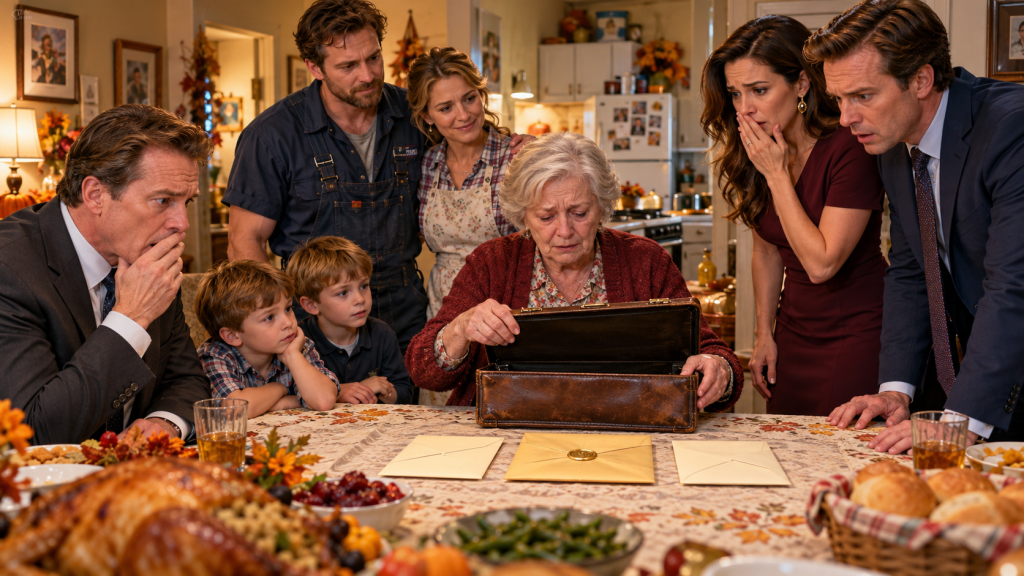
“This is ridiculous.” Danny’s hands began trembling. “Did you do it?” “That was a business matter.” My youngest son’s expression changed. For thirty-six years, Danny had been the one people underestimated. He wasn’t polished like Michael. He didn’t have a university degree like Stephanie.
He worked with his hands, wore old work boots, and came home smelling of engine oil.
But he knew when somebody was avoiding a question.
“Did you try to get me fired?” he repeated.
Michael stared at the letter.
Then at me.
“Mom, what exactly is going on here?”
I looked down at the three envelopes.
The Thanksgiving turkey sat cooling on the counter.
Kayla’s homemade pumpkin pie remained untouched beside the sink.
And my husband’s old leather briefcase rested on the floor between us.
For three months, I’d believed the hardest part of this day would be telling my children that I was wealthy.
I had been wrong.
Because Walter had apparently left behind one more truth.
One he hadn’t even shared with me.
“Danny,” I said quietly, “please read the letter.”
His eyes filled.
He looked down.
Then he began.
“Dear Daniel,
“If your mother has given you this envelope, I hope you’ve already learned something I’ve spent most of my life trying to understand.
“A person’s worth isn’t measured by their title, salary, or address. It’s measured by what they do when somebody else needs help.
“You’ve always understood that better than I have.”
Danny stopped.
His throat worked.
Then he continued.
“Two years ago, Roy Henderson called me about a disagreement involving your brother Michael’s company.
“He told me you’d questioned several invoices connected to fleet maintenance work.
“You believed some repairs had been billed twice. You refused to approve paperwork you knew wasn’t accurate.
“Michael became angry.
“He told Roy that if you remained employed, the company would take its vehicles elsewhere.”
Danny looked up.
Michael was staring at the floor.
I felt a chill.
Walter had sold his transport business around that time.
I’d assumed the sale had simply allowed him to retire.
But he’d still known people throughout the local transportation industry.
Roy Henderson was one of them.
Danny continued reading.
“Roy showed me the emails.
“Michael accused you of being unreliable and requested your termination.
“Roy refused.
“He told Michael that you were the most honest mechanic he’d employed in twenty years.
“I confronted Michael privately. He admitted he’d pressured Roy but insisted he was protecting his professional reputation.
“I told him that protecting a reputation by destroying somebody else’s was the surest way to prove you didn’t deserve one.
“He never apologized.
“I should have told you what happened. I thought keeping the peace between my sons was more important.
“I was wrong.
“Please forgive me for that.”
Danny’s voice broke.
Kayla put her hand over his.
Michael stared at the wall.
But the letter wasn’t finished.
Danny wiped his eyes and continued.
“There’s something else.
“Roy plans to retire.
“He has been looking for somebody capable of taking over Henderson Auto Repair.
“He told me he wanted you to have the first opportunity.
“I began discussing how to help make that possible, but I didn’t want to promise something before the numbers were properly reviewed.
“The documents in this envelope explain the opportunity, not a completed purchase.
“You’ve earned Roy’s trust with your work.
“Whatever happens next, I want you to know you earned mine too.
“Love, Dad.”
Danny lowered the paper.
For several seconds, he didn’t speak.
Then he looked at me.
“Mom, did you know?”
I shook my head.
“No, sweetheart.”
His eyes filled.
“All this time?”
I reached toward him.
He gently pulled his hand away.
Not angrily.
But the movement hurt.
I had spent three months watching my youngest son give up his bed for me.
I’d slept under his roof, eaten food he’d paid for, and let his wife rearrange her entire life because I’d told them I was homeless.
Now I was learning that Walt had also withheld something important from him.
And that my attempt to discover which children truly loved me had uncovered more pain than I’d ever imagined.
Michael suddenly stood.
“This is insane.”
Stephanie flinched.
He looked at Danny.
“Those invoices were questioned. I had every right to contact the garage.”
Danny stared at him.
“Did you have a right to tell Roy I was dishonest?”
Michael’s jaw tightened.
“You were causing problems with an important account.”
“I was doing my job.”
“You don’t understand corporate relationships.”
Danny laughed bitterly.
“No. Apparently I don’t.”
His voice shook.
“Because in my world, if somebody charges for the same repair twice, you correct the invoice. You don’t threaten the guy who notices.”
Michael looked toward Jenna, his wife.
She was sitting silently beside him.
“Say something,” he demanded.
Jenna looked at the letter.
Then at her husband.
“Did you tell me about this?”
Michael stared.
“Jenna—”
“Did you?”
He looked away.
She closed her eyes.
And for the first time that afternoon, my oldest son looked genuinely afraid.
Not because he’d been caught lying to me.
But because the carefully polished image he’d built around himself was beginning to crack in front of his own family.
Kayla stood quietly.
“Boys,” she said, looking toward our two grandsons, “why don’t you take your cousins into your room and show them the new building set?”
The children had been playing near the hallway, more interested in dessert than our conversation.
They hurried away.
Kayla waited until the bedroom door was closed.
Then she turned toward the table.
“Before anybody says another word, I want something understood.”
Her voice was gentle.
But I had learned over the previous three months that my daughter-in-law could be remarkably firm when it mattered.
“Danny and I didn’t invite Dolores here because we thought there would be money.”
She looked at Michael.
Then Stephanie.
“We invited her because we believed she had nowhere to go.”
Stephanie crossed her arms.
“Nobody said otherwise.”
Kayla nodded.
“Good.”
Then she turned toward me.
“Mom, we love you. You know that.”
My eyes filled.
“But I’m hurt.”
The words struck harder than shouting would have.
I looked at her.
“Kayla—”
She shook her head gently.
“Please let me finish.”
I nodded.
She took a breath.
“We were scared about you.”
Her voice trembled.
“When Danny brought you here, I thought you’d lost your home and all your savings. I stayed awake wondering how we’d manage another person in this apartment.”
I covered my mouth.
She continued.
“I made a budget. I called the boys’ school about payment assistance for next year. Danny took extra weekend shifts because he didn’t know how long you’d need us.”
My heart seemed to stop.
I looked at my youngest son.
“Extra shifts?”
He lowered his eyes.
I remembered those Saturdays.
Danny leaving before sunrise.
Coming home so tired that he sometimes fell asleep with his boots still on.
He had told me the garage was busy.
I had believed him.
Kayla’s eyes filled.
“We would do it again if you genuinely needed us.”
She looked directly at me.
“But you have to understand that when you told us you were broke, we believed you.”
I began crying.
“I’m sorry.”
Danny finally spoke.
“Mom, why didn’t you trust me enough to tell me the truth?”
His voice was barely audible.
I looked at my youngest son.
Then at Walt’s old briefcase.
For months, I’d justified my decision by telling myself I needed to know which of my children would welcome me without money.
But now, sitting in that cramped kitchen, I realized how much fear I’d created in the lives of the two people who’d shown me unconditional kindness.
I had tested them.
And they had paid the price of passing.
Michael broke the silence.
“Well, this is wonderful.”
We all turned.
He pointed toward Danny’s envelope.
“So Danny gets a business, and Stephanie and I get a lecture?”
I took a breath.
“Michael, nobody has given Danny a business yet.”
He laughed.
“Come on, Mom. There’s a purchase agreement in his envelope.”
“A preliminary opportunity,” I corrected. “There are inspections, financing, and legal arrangements to complete.”
Stephanie leaned forward.
“But you’re going to pay for it.”
I looked at her.
“I may help, yes.”
She scoffed.
“Of course.”
Something inside me tightened.
For three months, Stephanie had called me only once.
She hadn’t asked whether I was warm enough.
Hadn’t asked whether Danny and Kayla needed groceries.
Hadn’t offered to visit.
She had asked about Walt’s vintage watch.
And now she was looking at the garage documents as though I’d stolen something from her.
“Stephanie,” I said quietly, “what did you think those envelopes were going to contain?”
She hesitated.
Then looked away.
“I don’t know.”
I waited.
Finally, she whispered, “Dad’s will.”
I closed my eyes.
There it was.
The question she’d been asking since the funeral.
Not how I was managing without Walt.
Not whether I was lonely.
But what remained to be divided.
I folded my hands.
“Your father’s estate was handled according to his wishes. I am the beneficiary of the assets we’re discussing. These envelopes are letters and information, not a new will.”
Michael frowned.
“Then the money is yours?”
“Yes.”
“All three point eight million?”
“That is the approximate value Walt left me after settling the sale proceeds and our other financial arrangements.”
Michael leaned back.
He looked astonished.
For a brief moment, I saw the little boy who used to stare at the jars of coins on Walt’s dresser and ask how much treasure was inside.
Then his expression hardened.
“So you’ve been sitting on millions while Danny’s family lives like this?”
I stared at him.
The audacity nearly took my breath away.
“Michael, until today, you believed I had nothing.”
He looked away.
I continued.
“And you didn’t offer to help me.”
He began shaking his head.
“That’s not fair.”
I felt tears rising.
“Neither was sending your seventy-nine-year-old mother three links to senior apartments while she believed she was losing her home.”
His face reddened.
“Jenna and I have obligations.”
“I know.”
“We have a mortgage, tuition payments, investments—”
“I know.”
I leaned forward.
“But you also have five bedrooms.”
He stopped speaking.
I looked at Stephanie.
“And you suggested I look into shelters.”
She lowered her eyes.
I swallowed.
“I wasn’t asking for a luxury vacation. I was asking whether my children had a place for me while I was frightened and grieving.”
Michael pointed toward Danny.
“He barely has room for his own family!”
“Yes,” I whispered.
“And he came to get me in forty minutes.”
The room went silent.
Then Danny spoke.
“Mom, please stop.”
I looked at him.
His eyes were filled with tears.
“I don’t want you using what I did to make them feel ashamed.”
My heart tightened.
He continued.
“I brought you home because you’re my mother. I didn’t do it to win.”
I began crying again.
And in that moment, I realized I had spent three months turning love into a competition none of my children had knowingly entered.
Michael and Stephanie had failed to respond with the compassion I’d hoped for.
But Danny had never been trying to outperform them.
He’d simply opened his door.
The difference mattered.
I stood slowly.
“You’re right, Danny.”
He looked up.
I took a breath.
“I owe all three of you an apology for lying about my circumstances.”
Michael looked surprised.
Stephanie stared at me.
I continued.
“I was hurt and frightened after losing your father. I wanted to know whether I’d still matter if I had nothing to give.”
My voice trembled.
“But that doesn’t excuse deceiving you.”
I looked at Danny and Kayla.
“And it especially doesn’t excuse letting you spend money and lose sleep because you thought I was in trouble.”
Kayla wiped her eyes.
I looked toward the bedroom where the children were playing.
“I will repay the direct expenses you took on because of my deception, if you’ll allow me. Not as payment for loving me, but because those costs should never have been yours.”
Danny shook his head.
“Mom—”
“Please hear me out.”
He stopped.
“I also want us to decide together what happens next. I won’t surprise you with a business you haven’t reviewed, and I won’t make financial help conditional on proving you love me.”
His expression softened slightly.
I looked around the table.
“My savings don’t give me the right to control your lives.”
Then I added the truth that hurt most.
“And being my children doesn’t give you the right to control mine.”
For a long moment, nobody spoke.
Then Jenna stood.
“Michael, we should go.”
He stared at her.
“Jenna—”
She shook her head.
“Not now.”
Stephanie picked up her purse.
Her expression was wounded.
Angry.
Confused.
I could see that she wanted to say something.
But she remained silent.
At the front door, Michael turned toward Danny.
“You’re really going to take Dad’s money?”
Danny looked at him.
Then quietly answered.
“I haven’t decided anything.”
Michael scoffed.
“Sure.”
He left.
Stephanie followed.
Jenna paused long enough to look at me.
“I’m sorry, Dolores.”
I couldn’t tell whether she meant the dinner, the rejection after the funeral, or something about Michael’s behavior that she had only begun to understand.
Perhaps all three.
I nodded.
“Thank you.”
Then the door closed.
And for the first time that Thanksgiving, the apartment was truly quiet.
Danny stared at Walt’s letter.
Kayla sat beside him.
And I realized we still had a great deal to say.
After the others left, Danny folded Walt’s letter and placed it carefully back inside the envelope.
He didn’t look at me.
Kayla began gathering plates, more from habit than necessity.
I reached for a dish towel.
“Let me help.”
She shook her head.
“Mom, sit down.”
I obeyed.
For three months, Kayla had treated me with such tenderness that I’d nearly forgotten how much she and Danny were carrying.
Their apartment was small.
The boys shared a room.
The washing machines downstairs sometimes ran until midnight.
And the broken couch had a spring that pressed against Danny’s back every time he turned over.
I looked at it now.
The faded cushions.
The blanket Kayla kept folded over the arm.
The pillow she’d bought him after he complained of neck pain.
I felt ashamed.
“Danny,” I whispered, “I can leave tomorrow.”
He finally looked up.
“Where would you go?”
“My house.”
His face changed.
“So you still have it.”
“Yes.”
“The bank isn’t taking it.”
“No.”
He stared at me.
“Mom, I spent three months wondering how we were going to find you somewhere permanent.”
I swallowed.
“I know.”
“No, I don’t think you do.”
His voice wasn’t loud.
That made it hurt more.
He pointed toward the couch.
“Kayla and I talked about moving the boys into our room so you could have theirs. We checked larger apartments, but the rents were too high. I even thought about taking a second job.”
I closed my eyes.
“I didn’t know.”
“Because you didn’t ask.”
The words settled heavily between us.
I had called my children to see what they would give up for me.
But I’d never asked what giving it up would cost.
Danny rubbed his forehead.
“Mom, I would’ve helped you even if Dad had left you ten million dollars.”
I stared at him.
He continued.
“You could’ve said you were lonely. You could’ve said you couldn’t stand being in the house after Dad died. You could’ve told me you needed company.”
His voice broke.
“I would’ve picked you up just as fast.”
I began crying.
“I know that now.”
He shook his head.
“I don’t think you do.”
Kayla stopped washing dishes.
She came over and sat beside him.
Danny looked at her.
Then at me.
“I need some time.”
I nodded.
“Of course.”
“And I don’t want to talk about the garage tonight.”
“All right.”
He reached for Walt’s letter.
“But I want to keep this.”
My throat tightened.
“It’s yours.”
He studied his father’s handwriting.
Then whispered, “I just wish Dad had told me while he was alive.”
So did I.
And as I watched my son hold that letter, I began wondering whether Walt and I had spent too much of our lives believing we could protect our children by deciding which truths they were ready to hear.
Perhaps our intentions had been different.
But the result was painfully familiar.
Danny had been kept in the dark.
Again.
The next morning, I returned to my own house.
Danny drove me.
We barely spoke during the forty-minute trip.
When we pulled into the driveway, he stared at the little brick house where he’d grown up.
The porch steps needed painting.
Walt’s old sedan was parked beside the garage.
A row of flowerpots stood empty beneath the kitchen window.
Everything looked exactly as it had when I left.
Only Walt was missing.
Danny carried my suitcase inside.
Then stood near the front door.
“Will you be okay here?”
The question broke my heart.
After everything I’d done, he was still worried about me.
I nodded.
“I think so.”
He looked around.
“I can come back tonight if you need help.”
I smiled sadly.
“You don’t have to.”
“I know.”
For a moment, neither of us moved.
Then I said, “Danny, I’m going to give you space. But please don’t mistake that for me being angry.”
He shook his head.
“I’m not angry that you have money, Mom.”
“I know.”
“I’m angry that you made us afraid for you.”
Tears filled my eyes.
“I understand.”
He picked up his keys.
Then stopped.
“Can I ask you something?”
“Anything.”
“Did Dad know you were going to pretend you were broke?”
I looked toward Walt’s photograph on the mantel.
“No. He died before I made that decision.”
Danny nodded slowly.
“Good.”
The word hurt.
But I understood.
My son was relieved that at least one of his parents hadn’t been involved in the deception.
He opened the door.
Then looked back.
“Mom?”
“Yes?”
“We still love you.”
I pressed a hand against my chest.
“But we’re going to need some time to trust you again.”
I nodded.
“Take whatever time you need.”
He left.
And the silence that settled around me was the loneliest sound I’d ever heard.
That afternoon, I walked through the house.
Walt’s slippers were still beside his recliner.
His glasses rested on the end table.
A half-finished crossword lay open on the kitchen counter.
For months, I’d avoided looking at those things.
Now I sat in his chair and let myself remember.
My husband had worked hard.
He began his transport company with one secondhand truck and a borrowed office above a tire shop.
I kept the books.
He drove the routes.
When the company expanded, I handled payroll and invoices while raising our children.
We worked late, argued over expenses, and celebrated every year the business survived.
Selling it had been a difficult decision.
But Walt was tired.
He wanted to travel.
He wanted to spend mornings in the garden.
He wanted a few years when our lives weren’t controlled by delivery schedules and fuel costs.
We’d expected to have those years.
Then he became sick.
And suddenly, the money we’d saved together felt meaningless.
I had three point eight million dollars.
But I couldn’t buy another morning with him.
I couldn’t hear him complain about the coffee.
Couldn’t watch him fall asleep during the evening news.
Couldn’t ask whether he’d known how lonely I’d feel after he was gone.
I opened his old briefcase.
Inside was a small notebook.
The cover was worn, the corners softened by years of use.
Walt had always carried notebooks.
He wrote down phone numbers, appointments, truck repairs, and ridiculous little reminders like Tell Dolores her roses look better this year.
I opened it.
Near the back was a page titled:
THINGS MONEY CANNOT REPAIR.
Beneath it, in his handwriting, were three lines.
Time wasted being proud.
Words left unsaid.
People made to feel small.
I stared at the page.
Then I began crying.
Because Walt had understood something I was only beginning to learn.
He had seen our children struggling with different versions of pride and fear.
He’d made mistakes trying to guide them.
And I had made my own mistake trying to measure their love.
I closed the notebook.
Then I picked up the telephone.
Not to call my children.
Not yet.
I called our attorney.
“I want to review everything,” I told him.
“Your estate plan?”
“Yes. And my finances.”
He paused.
“Is something wrong?”
I looked toward Walt’s chair.
“Not with the money.”
My voice broke.
“With the way I’ve been thinking about it.”
The following week, I met with our attorney, Harold Price, and a financial planner who had worked with Walt for years.
We reviewed the investments, my living expenses, the remaining assets from the business sale, and the estate arrangements.
For the first time since Walt died, I looked at the numbers without thinking of them as a test my children had passed or failed.
They represented decades of work.
The salaries we’d paid ourselves.
The risks Walt had taken.
The sacrifices our family had made.
And the future I still needed to protect.
Harold listened as I explained Thanksgiving.
Then he said something I didn’t expect.
“Dolores, generosity is a choice. So is restraint.”
I looked at him.
He continued.
“You can help Danny without making him dependent on you. You can refuse additional support to Michael or Stephanie without trying to punish them. And you can preserve enough for your own care.”
I nodded.
“I don’t want anyone thinking my money is a reward for loving me.”
“Then don’t structure it that way.”
He leaned forward.
“Ask what kind of help would actually be useful. Put clear terms in writing. And let the people receiving help decide whether they want it.”
I thought about Danny.
He had worked at the garage for nearly fifteen years.
He knew its customers.
Its equipment.
Its reputation.
But owning a business was different from repairing cars.
I knew that from watching Walt.
“Would buying the garage be a good idea?”
Harold smiled faintly.
“That’s not a question anyone should answer from an emotional Thanksgiving dinner.”
I laughed through tears.
He continued.
“We’d need financial statements, a valuation, information about liabilities, and a realistic operating plan. Danny should have independent advice too.”
I nodded.
“And if it turns out to be a bad investment?”
“Then the best gift you can give him is the freedom not to take it.”
I sat back.
That was a kind of love Walt and I had not always practiced well.
The freedom to make choices without somebody else arranging the outcome.
I left the meeting feeling lighter.
Not because the problems were solved.
But because I’d finally stopped believing that money could solve them for me.
Michael called two weeks later.
I hadn’t heard from him since Thanksgiving.
When his name appeared on my phone, I hesitated.
Then answered.
“Hello, sweetheart.”
“Mom.”
His voice sounded strained.
“Can we talk?”
I took a breath.
“Yes.”
He arrived the following afternoon.
For once, he wasn’t wearing a suit.
Just jeans and a plain sweater.
He looked tired.
I made coffee.
We sat at the kitchen table.
For a while, he simply stared into his cup.
Then he said, “Jenna’s furious with me.”
I waited.
“She didn’t know about Danny.”
I nodded.
“Neither did I.”
He rubbed his forehead.
“She asked what else I’ve been hiding.”
My chest tightened.
“Have you been hiding other things?”
Michael looked away.
“There have been financial problems.”
I closed my eyes.
“What kind?”
He took a breath.
“The house costs more than we expected. The school fees. The cars. The travel.”
He laughed bitterly.
“Every time I get a raise, we find another way to spend it.”
I looked at my oldest son.
He had always been ambitious.
As a boy, he wanted the best bicycle.
The newest shoes.
The highest marks.
Walt used to joke that Michael would someday own a skyscraper simply because somebody else had one.
Now he lived in a beautiful house with five bedrooms.
And somehow, he felt trapped inside it.
“Did you come to ask for money?” I asked.
He flinched.
“No.”
I waited.
He sighed.
“Not exactly.”
I looked at him.
“Michael.”
His eyes filled.
“I wanted to know whether Dad really left you that much.”
I felt sadness settle over me.
Even now.
Even after Thanksgiving.
The amount still occupied more space in his mind than the way he’d treated me.
“Yes,” I answered.
He nodded slowly.
Then whispered, “I keep thinking about the call.”
“What call?”
“The one where you said you’d lost the house.”
I looked at him.
He continued.
“I was sitting in my office when you told me. I’d just approved a renovation to our upstairs bathroom.”
His voice broke.
“Thirty-eight thousand dollars.”
I stared at him.
“I told you we didn’t have room.”
Tears filled his eyes.
“But I was making room for a bigger shower.”
I looked down at my hands.
Michael began crying.
“I’ve been trying to figure out when I became that person.”
For a moment, I saw the boy who used to carry groceries for elderly neighbors.
The teenager who insisted on giving his little sister the front seat when she got carsick.
The young man who cried at Walt’s retirement party.
He was still there.
Somewhere beneath the executive title and expensive house.
But I couldn’t pretend the things he’d done no longer mattered.
“Michael,” I said, “you don’t become a different person because of one bad decision.”
He looked up.
“You become different through the decisions you keep making.”
He nodded.
Then I asked, “Have you apologized to Danny?”
Michael’s face tightened.
“I tried calling him.”
“And?”
“He didn’t answer.”
I took a breath.
“Then write him a letter. Tell him what happened without excuses. And be prepared for him to need time.”
Michael nodded.
He looked toward the window.
Then whispered, “Dad knew.”
“Yes.”
“He never looked at me the same after that.”
I thought about Walt’s notebook.
The line about people made to feel small.
“Your father loved you,” I said.
Michael began crying.
“But he was disappointed in what you did.”
He lowered his head.
I reached across the table.
“Michael, you can’t undo your mistake with Danny. But you can stop making new ones.”
He held my hand.
And for the first time in a long while, my oldest son looked less like a successful executive and more like a frightened man beginning to confront the cost of his choices.
Stephanie came to see me three days before Christmas.
She arrived carrying a small cardboard box.
I met her at the door.
“Hello, sweetheart.”
“Hi, Mom.”
Her voice was quiet.
She looked around the living room as though she hadn’t been here in years.
Then she handed me the box.
Inside were photographs.
Old ones.
Michael on his first bicycle.
Danny grinning beneath the hood of Walt’s truck.
Stephanie wearing a paper crown on her sixth birthday.
And a photograph of the five of us sitting on the front porch, back when the children were young and Walt still came home smelling of diesel.
“I found these while cleaning out a closet,” she said.
I picked up the porch photograph.
“Walt loved this one.”
Stephanie nodded.
“I know.”
She sat beside me on the sofa.
For several minutes, neither of us spoke.
Then she said, “I owe you an apology.”
I turned toward her.
She was crying.
“When you called and said you’d lost everything, I panicked.”
I waited.
“I didn’t want you moving in.”
The admission hurt.
But I appreciated the honesty.
Stephanie wiped her cheeks.
“My house is always busy. The kids have activities. I thought about the extra work, the cost, and how long you might stay.”
She looked down.
“I didn’t think about how frightened you must have been.”
I squeezed the edge of my handkerchief.
“You suggested a shelter.”
She nodded miserably.
“I know.”
“Stephanie, you didn’t even offer to help me find one.”
Tears streamed down her face.
“I know.”
I reached for her hand.
She looked at me.
“I can understand being overwhelmed,” I said. “But you could have told me you didn’t have the space while still making sure I was safe.”
She nodded.
“I should have.”
For a moment, I thought about telling her again that the situation hadn’t been real.
That I hadn’t actually been homeless.
But I remembered Danny’s words.
You made us afraid for you.
So I said something different.
“I’m sorry I lied to you, too.”
Stephanie looked surprised.
I continued.
“I wanted to find out whether you would care for me if I had nothing. But I made you believe your mother was in danger.”
Her eyes filled.
“That’s not the way I should have asked for reassurance.”
She squeezed my hand.
Then whispered, “I thought you were calling to ask for money.”
I smiled sadly.
“Sometimes people call because they need money. Sometimes they call because they need love.”
Stephanie nodded.
“And sometimes they need both.”
“Yes.”
We sat quietly for a while.
Then she glanced toward Walt’s photograph.
“Mom, can I ask about his watch?”
I felt my chest tighten.
“Of course.”
She looked embarrassed.
“At Thanksgiving, I kept asking because I thought it might be valuable.”
I waited.
She swallowed.
“I’d been worried about some expenses, and I wondered whether I could sell it.”
Her voice broke.
“Then I remembered Dad letting me wear it around the house when I was little. I’d pretend I had important meetings just like him.”
I smiled through tears.
“He loved that.”
Stephanie looked at me.
“I don’t want it to sell anymore.”
She took a breath.
“I’d just like to see it.”
I went to my bedroom and retrieved the watch.
It wasn’t particularly expensive.
A sturdy old wristwatch with a scratched face and a brown leather strap.
Walt had worn it through decades of work.
I placed it in Stephanie’s hands.
She touched the glass.
Then began crying.
“I miss him.”
I sat beside her.
“So do I.”
She leaned against my shoulder.
For a long time, we simply sat together.
I didn’t promise her the watch.
I didn’t offer to pay her bills.
And she didn’t ask.
Instead, she told me about the children, the pressure she felt to keep up appearances, and how ashamed she’d been after Thanksgiving.
It wasn’t a perfect conversation.
But it was an honest one.
And for the first time in years, I felt my daughter was talking to me instead of calculating what I could do for her.
Danny called in January.
His name appeared on my phone while I was watering the plants beside the kitchen window.
I answered immediately.
“Hello, sweetheart.”
“Hi, Mom.”
My heart lifted.
“How are the boys?”
“Good. They got the building set they wanted for Christmas.”
I smiled.
“And Kayla?”
“She’s good.”
There was a pause.
Then he said, “Roy wants to talk about the garage.”
I sat down.
“Do you want to?”
Danny took a breath.
“I think so.”
I closed my eyes.
“Then you should.”
He hesitated.
“But I want to do it properly.”
I smiled.
“Good.”
“Not because of Thanksgiving. Not because I gave you our bed. And not because Dad left me that letter.”
His voice grew steadier.
“I want to know whether the business actually makes sense.”
I felt tears rising.
“That’s exactly what your father would have wanted.”
Danny was quiet.
Then he said, “I talked to Kayla.”
“And?”
“We’d like to meet with Roy and review the numbers. If everything checks out, we’d consider it.”
I smiled.
“Then let’s arrange it.”
He paused.
“Mom?”
“Yes?”
“I still love you.”
My eyes filled.
“I love you too.”
Then he added, “But if you ever want to stay with us again, just tell us the truth about why.”
I laughed through tears.
“I promise.”
The process took nearly six months.
Roy provided the garage’s financial statements, equipment inventory, lease documents, and customer records for an appropriate review.
Danny worked with an independent accountant and a small-business attorney.
The property and equipment were assessed.
The business had a loyal customer base and a good reputation, but it also needed improvements.
The equipment was aging.
The waiting area needed repairs.
And the books revealed that Roy had occasionally mixed personal and business expenses in ways that needed to be corrected before a sale.
Danny noticed things I hadn’t.
He knew which lifts needed replacing.
Which tools were worth keeping.
Which customer relationships mattered.
And which services the garage should stop offering because they consumed too much time for too little return.
Watching him work through the details, I felt a pride that had nothing to do with the money I might contribute.
He wasn’t asking me to rescue him.
He was preparing to take responsibility for something he understood.
Eventually, we reached an arrangement.
Danny and Kayla would purchase the garage through a properly structured transaction.
They would contribute their own savings.
A commercial lender would provide part of the financing.
And I would help with a documented family loan under terms we’d reviewed separately, without taking control of the business.
I also made a separate gift toward their family’s housing stability, after discussing what they actually wanted and what I could comfortably afford.
Danny initially resisted.
“Mom, I don’t want the garage if it means you think you own my life.”
I looked at him.
“Then you shouldn’t take it under those conditions.”
He stared.
I smiled.
“Danny, this is your decision.”
He sat quietly.
Then asked, “And if I fail?”
I took a breath.
“Then we’ll face the reality of what happened. But the business will be yours to run, not mine to control.”
His eyes filled.
“You’re really okay with that?”
I nodded.
“Your father built his company by learning from mistakes. You deserve the same chance to build something of your own.”
Danny wiped his eyes.
Then reached across the table.
“Thank you, Mom.”
I squeezed his hand.
“Thank you for letting me help in a way that respects you.”
When the sale finally closed, Roy invited us to the garage.
The old sign had been cleaned.
The floors were freshly painted.
And a small new plaque hung beside the office door.
DANIEL WALKER — OWNER
Beneath it, Danny had added a second line.
HONEST WORK. FAIR PRICES.
I stared at those words.
Roy stood beside me.
“That’s your boy,” he said.
I smiled.
“Yes.”
He looked toward the service bays.
“Walt came by after I told him what happened with Michael. He was furious.”
My heart tightened.
Roy continued.
“But he didn’t ask me to give Danny anything.”
I looked at him.
“What did he say?”
Roy smiled sadly.
“He said, ‘If my son is good enough to run this place, give him a chance to prove it. If he isn’t, don’t do him any favors.'”
Tears filled my eyes.
That sounded like Walt.
Practical.
Stubborn.
And, beneath everything, deeply proud of our youngest son.
Roy placed a hand on my shoulder.
“Danny earned this opportunity. The money helped make it possible, but it didn’t create the man who was ready for it.”
I looked toward the garage.
Danny was showing Kayla the office.
The boys were standing beside him, wearing little shirts with the garage’s name printed across the front.
One was holding a toy wrench.
The other had grease on his cheek from touching something he shouldn’t have.
I laughed.
Then I cried.
Because for the first time since Walt’s death, I could imagine him standing beside me, watching our son begin something new.
Michael eventually wrote Danny a letter.
Not a short apology.
Not a message blaming stress or corporate pressure.
A proper account of what he’d done.
He acknowledged that Danny had raised legitimate questions about invoices.
He admitted he’d used the threat of removing business to pressure Roy.
And he apologized for questioning his brother’s honesty.
Danny didn’t answer immediately.
Weeks passed.
Then months.
Finally, the brothers met for coffee.
Danny later told me they hadn’t magically become close.
There was too much history.
Too much pride.
Too many years of feeling compared to one another.
But Michael had apologized without asking Danny to make him feel better.
And Danny had listened.
That was enough for a beginning.
Stephanie began visiting me more regularly.
Sometimes she brought the children.
Sometimes she brought groceries.
Once, she arrived with a list of repairs she’d noticed around my house.
“Mom, your back steps are loose.”
I smiled.
“I know.”
She frowned.
“Then why haven’t you fixed them?”
I laughed.
“Because I’m stubborn.”
She rolled her eyes.
“I’ll call somebody.”
Then she stopped.
“Would you like me to?”
I looked at her.
“Yes, sweetheart. I would.”
It was such a small thing.
But I remembered Thanksgiving.
The assumptions.
The entitlement.
The way we’d all forgotten to ask instead of deciding.
Now my daughter was asking.
And I was answering honestly.
The following Thanksgiving, I hosted dinner at my own house.
All three children came.
So did their families.
Danny and Kayla arrived early to help prepare the food.
Michael brought dessert.
Stephanie set the table with the good plates Walt and I had received as a wedding gift.
The grandchildren raced through the hallway.
Somebody spilled juice.
Somebody else complained that the turkey was taking too long.
It was noisy.
Messy.
Imperfect.
And wonderful.
Before dinner, I stood beside Walt’s chair.
The old leather briefcase rested on the shelf behind me.
I hadn’t opened it that day.
There were no envelopes waiting on the table.
No financial revelations.
No tests.
Just family.
I looked around the room.
Then said, “Before we eat, I’d like to tell you something.”
The conversations quieted.
Michael looked up.
Stephanie put down her glass.
Danny smiled faintly.
I took a breath.
“Last year, I thought I needed to find out which of my children loved me enough to help when I had nothing.”
My voice trembled.
“I learned a great deal. Some of it was painful.”
I looked at Danny and Kayla.
“But I also learned that I was wrong to put the people I love through fear just to get an answer.”
Kayla reached for Danny’s hand.
I continued.
“Your father and I spent our lives saving money because we wanted our family to be secure.”
I smiled sadly.
“Somewhere along the way, I forgot that security isn’t only about what sits in a bank account.”
I looked toward Walt’s photograph.
“It’s about knowing you can tell the truth and still be loved.”
Michael lowered his eyes.
Stephanie began crying.
Danny looked at me.
I took a breath.
“So this year, I’m grateful for second chances.”
Then I added, “And I’m grateful that we’re learning not to confuse generosity with obligation.”
For a moment, nobody spoke.
Then my youngest grandson raised his hand.
“Grandma?”
I smiled.
“Yes, sweetheart?”
“Can we eat now?”
Everyone burst out laughing.
I wiped my eyes.
“Yes, darling.”
We sat down.
And for the first time in a long while, I felt something I’d almost forgotten.
Peace.
Later that evening, after the last guest had gone home, I sat beside Walt’s old recliner.
The house was quiet.
The dishes were washed.
The leftovers were packed away.
And a little toy truck had been abandoned beneath the coffee table.
I picked it up.
It reminded me of Danny as a boy.
How he used to follow Walt around the yard, asking questions about engines.
How Michael insisted he would someday run the family company.
How Stephanie used to sit at the kitchen table drawing pictures of the houses she wanted to live in when she grew up.
They had all become adults.
Successful in some ways.
Struggling in others.
And still learning, as I was, how to love without hurting one another.
I looked at Walt’s photograph.
“You were right about something,” I whispered.
Money does show people who they are.
But I’d learned that it could also show people who they’d become when fear, pride, and entitlement took over.
And sometimes, if they were willing, it could help them recognize the people they still wanted to be.
I thought about Danny.
The man who had come to get me in forty minutes.
Who had surrendered his bed.
Who had taken extra shifts.
Who had opened his home without knowing whether I could ever repay him.
I would never forget what he and Kayla had done.
But I also would never again turn that kindness into a debt he had to collect.
Then I thought about Michael and Stephanie.
Their failures had hurt me.
Deeply.
And I didn’t pretend a few apologies erased that pain.
But they were still my children.
I could love them without financing every choice they made.
I could forgive gradually without forgetting what needed to change.
And I could protect my own future without using money to force their affection.
When I told my children I had lost everything, two of them turned away, and the one with the least room opened his door without hesitation.
But the most important lesson wasn’t that my youngest son deserved the largest envelope.
It was that love should never have to compete for a prize—and that money should never be mistaken for proof of someone’s worth.
I placed the toy truck on the mantel beside Walt’s photograph.
Then I turned off the lights.
Tomorrow, I would visit Danny’s garage.
Next week, Stephanie and I would have lunch.
And on Sunday, Michael had promised to come by and help me sort through some of Walt’s old tools.
Ordinary plans.
Simple moments.
The kind of things I could have asked for all along.
I smiled toward my husband’s photograph.
“Well, Walt,” I whispered, “I finally understand.”
Then I walked toward my bedroom.
I still had three point eight million dollars when that terrible Thanksgiving began.
But a year later, what comforted me most wasn’t the balance of my accounts.
It was knowing that my family was slowly learning to build relationships that could survive without them.
And if there was one thing I wished I’d understood before making those three phone calls, it was this: you don’t have to pretend to have nothing to discover whether you’re loved. Sometimes you only have to tell the people closest to you what you truly need—and give them the chance to answer honestly.
THE END STORIES! THANK YOU FOR READING GOOD LUCK !❤️
Related Posts



