For several seconds, I couldn’t speak. I stood in the hospital stairwell with my phone pressed against my ear, staring at the gray concrete wall as though the answers might be written there. Outside, rain was falling against the narrow window.
Somewhere below me, a cart rattled along the corridor. A nurse called for assistance. The hospital continued moving around me, full of people who needed help, while I tried to understand why my own family had decided my eight-year-old daughter’s drawing belonged to someone else.
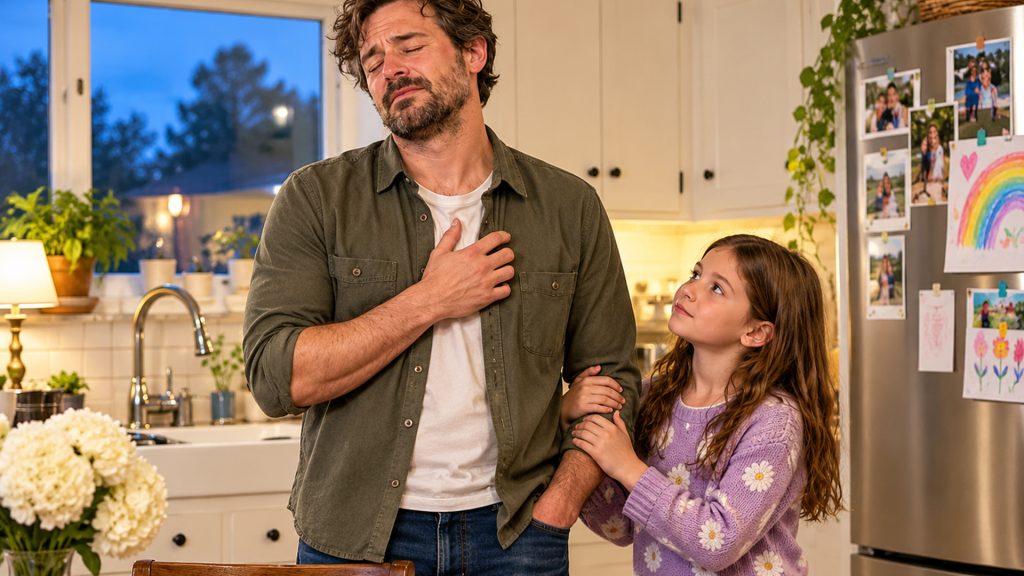
“Graham,” I finally said, “what exactly do you mean, the bidding has started?” He exhaled shakily. “My parents organize a Christmas charity auction every year. It raises money for children’s arts programs in rural communities.” I knew about that auction.
Ainsley had mentioned it at Thanksgiving, describing the expensive decorations and the prominent local families who attended.
She’d spent an entire evening discussing what she intended to wear.
I hadn’t realized my daughter was going to become part of the event.
“Graham, Luna made that drawing at our kitchen table.”
“I know.”
“She spent four evenings working on it.”
His voice softened.
“I’m sorry.”
I pressed my free hand against my forehead.
“She called it The Moon Moth’s Map. She’s been studying nocturnal insects for months. She drew the markings from photographs she borrowed from the library.”
There was silence.
Then Graham said, “Ainsley told my mother she’d created it herself.”
My stomach dropped.
“Your mother believed her?”
“Yes.”
“And now people are bidding on it?”
“It’s listed in the online preview for the auction. The description says it’s an original artwork by Ainsley, with a signed print to be provided to the winning bidder.”
I closed my eyes.
A signed print.
By my sister.
Of a drawing my little girl had made while wearing mismatched socks and explaining how moths navigate at night.
“How much?” I asked.
Graham hesitated.
“Last time I checked, the highest bid was eighteen hundred dollars.”
I leaned against the wall.
Eighteen hundred dollars.
For a piece of artwork my family considered too unimportant to acknowledge.
A drawing made by the same child they didn’t want sitting at their Christmas table.
“Graham, you need to have that listing removed.”
“I agree.”
“Immediately.”
“I’ve already contacted the auction coordinator. They need to speak with you because you’re Luna’s parent.”
I took a slow breath.
“All right.”
Then I asked the question that frightened me most.
“Does Ainsley know you’ve called me?”
“No.”
“Why not?”
His answer came quietly.
“Because when I asked her about the drawing, she told me that Luna wouldn’t understand what was happening anyway.”
I closed my eyes.
For years, I’d heard versions of that sentence.
Luna won’t notice.
Luna doesn’t understand.
Luna prefers being alone.
She doesn’t know the difference.
My daughter noticed everything.
She noticed when the refrigerator motor changed its sound.
She noticed when the library moved the books on butterflies to a different shelf.
She noticed when her grandmother promised to attend her school presentation and didn’t arrive.
And she noticed when people stopped talking whenever she walked into a room.
I looked toward the stairwell door.
“Graham, thank you for telling me.”
His voice broke.
“I should have noticed sooner.”
I didn’t know how to respond.
So I said the only thing that mattered.
“Help me make sure nobody sells something that belongs to my daughter.”
“I will.”
When we ended the call, I remained on the stairs for a long time.
Then I opened my phone and played Dad’s voicemail again.
I listened to Ainsley’s voice.
He’ll pay. He always does.
Then Mom’s.
Last year worked.
And finally, the sentence that had made my blood run cold.
Tell him the breakfast room is a kindness.
I thought about Luna sitting alone with her paper stars.
And I realized that my family hadn’t merely excluded her.
They had become so accustomed to treating her feelings as insignificant that they’d stopped imagining she could have feelings at all.
That was going to end.
Even if ending it meant losing people I’d spent my whole life trying to please.
The auction coordinator called twenty minutes later.
Her name was Caroline Foster.
She sounded brisk, professional, and immediately concerned when I explained the situation.
“Mr. Hayes, are you saying the artwork was created by your daughter?”
“Yes.”
“And she’s eight?”
“Yes.”
“Did you or your daughter authorize Ms. Ainsley Hayes to submit the work?”
“No.”
Caroline paused.
“Then I apologize. We were given a completely different account.”
I felt my jaw tighten.
“What account?”
“That Ainsley created the illustration as part of a personal series celebrating childhood imagination.”
I almost laughed.
Not because anything was funny.
Because the words sounded exactly like my sister.
Beautiful phrases.
Perfectly arranged.
Conveniently detached from the truth.
“Ms. Foster, I can provide photographs of Luna working on the drawing and the original in her journal.”
“Please do. We’ll suspend the listing while we review it.”
My shoulders loosened.
“And the existing bids?”
“The bidders will be notified that the item has been withdrawn pending clarification. No payment has been collected.”
I exhaled.
“Thank you.”
She hesitated.
“Mr. Hayes, I hope you understand that we take authorship seriously.”
“I do.”
Then her voice softened.
“And I am sorry your daughter has been put in this position.”
After we ended the call, I sent her the photographs.
One showed Luna sitting at our kitchen table, carefully shading the moth’s wings.
Another showed the unfinished drawing beside her observation journal.
A third showed the completed piece, with her name written in tiny purple letters at the bottom.
LUNA HAYES. AGE 8.
My daughter had signed it herself.
Ainsley had apparently assumed nobody would look closely enough to notice.
I stared at that little signature.
Then I thought of something Luna had said only days earlier.
“Everybody thinks moths are boring. But that’s because they don’t look carefully.”
I wondered how many times she’d been trying to tell me something larger than a fact about insects.
And how many times I’d been too tired to hear it.
When I arrived home that evening, Luna was sitting at the kitchen table with Mrs. Bell.
Our neighbor had come over while the babysitter attended a family appointment.
Mrs. Bell was seventy-six, a retired elementary school librarian who wore colorful scarves and treated every question Luna asked as an invitation to discover something.
They were examining a book about nocturnal insects.
“Look, Daddy!” Luna exclaimed.
She pointed toward a photograph.
“Some moths have markings that look like eyes. They can surprise predators.”
I hung my coat by the door.
“That’s fascinating.”
She studied me.
Then frowned.
“You look sad.”
I sat beside her.
“Do I?”
“Your eyebrows are doing the thing.”
Mrs. Bell smiled gently.
“What thing, sweetheart?”
“The worried triangle.”
I laughed despite myself.
Luna pointed between my eyebrows.
“That one.”
I reached for her hand.
“You’re right. I’ve had a difficult day.”
She considered that.
“Did somebody get hurt at the hospital?”
“Not exactly.”
She waited.
I glanced at Mrs. Bell.
Our neighbor seemed to understand.
“I think I’ll put the kettle on,” she said.
When she’d moved into the kitchen, I turned back toward my daughter.
“Luna, I need to ask you something.”
“Okay.”
“Do you remember the moth drawing you finished last week?”
Her eyes brightened.
“The one with the golden markings?”
“Yes.”
She nodded.
“I wanted to show it to Grandma. But Aunt Ainsley said she needed to borrow it for a photograph.”
My heart tightened.
“When did she say that?”
“At Thanksgiving.”
I stared.
Thanksgiving.
That meant my sister had been planning this for weeks.
“What happened after she took it?”
Luna looked confused.
“She put it near the window and took pictures.”
“Did she ask you whether she could show those pictures to other people?”
“No.”
I took a breath.
“Would you have wanted her to?”
Luna thought carefully.
“Maybe.”
I nodded.
“That’s okay.”
Then she asked, “Why?”
I looked into her eyes.
“Because Aunt Ainsley used a picture of your drawing in a charity auction. She told people she’d made it.”
Luna became very still.
For several seconds, she didn’t speak.
Then she asked quietly, “But she didn’t.”
“I know.”
“Why did she say she did?”
I swallowed.
“I don’t know exactly.”
Luna looked down at her hands.
Then she whispered, “Did she erase my name?”
My heart broke.
I reached toward her, then stopped.
Luna didn’t always want to be touched when she was upset.
“Would you like a hug?” I asked.
She nodded.
I wrapped my arms around her.
She leaned against my chest.
For a moment, neither of us spoke.
Then she whispered, “I worked really hard on the wings.”
“I know, sweetheart.”
“And the little dots.”
“I know.”
She pulled back.
“Can she just say I made it?”
I looked at her.
“Yes.”
“Then why didn’t she?”
There was no answer I could give that would make sense to an eight-year-old who believed words should mean what they said.
So I told her the truth.
“I think Aunt Ainsley wanted people to admire the drawing and made a bad choice about how to get that admiration.”
Luna frowned.
“But if people liked it, she could tell them about me.”
My eyes filled.
“Yes, sweetheart.”
She looked toward her journal.
Then said something that stayed with me long after Christmas.
“I don’t mind sharing my drawing, Daddy.”
She paused.
“I just want to still be in it.”
I held her for a long time.
And silently promised that no one was going to make my daughter disappear from her own work again.
The next morning, I received a message from Caroline Foster.
The auction listing had been removed.
She attached a copy of the notice sent to registered bidders, explaining that the artwork’s attribution had been disputed and that the organizers would not accept further bids or payment.
I read the notice three times.
It was professional.
Careful.
Fair.
Nobody had publicly accused Ainsley of theft.
Nobody had turned Luna into the subject of gossip.
The organizers had simply stopped the transaction until the truth could be established.
That was exactly what I’d wanted.
Then I noticed another attachment.
It was the original submission form.
Ainsley had written a short description beneath the artwork.
Inspired by my childhood fascination with the natural world, The Moon Moth’s Map celebrates the quiet beauty people often overlook.
I stared at the screen.
Every word sounded like something Luna might have said.
My sister hadn’t simply borrowed the drawing.
She’d borrowed my daughter’s way of seeing the world.
Below the description was a section requesting permission to use the artwork for promotional materials.
Ainsley had checked the box confirming that she owned the necessary rights.
I felt anger rise in my throat.
Before I could decide what to do, my phone rang.
Mom.
I let it go to voicemail.
A minute later, she called again.
Then Dad.
Then Ainsley.
By noon, there were fourteen missed calls.
At one-fifteen, I received a text from my sister.
You embarrassed me in front of Graham’s family. We need to talk.
I stared at it.
Then typed:
You submitted Luna’s artwork under your own name without permission. The organizers have withdrawn it. I won’t discuss this while you’re blaming me for your decision.
I sent the message.
For the first time in years, I didn’t spend the next ten minutes wondering whether I’d been too harsh.
I put my phone away.
And returned to my patients.
That evening, Graham came to see me.
He asked before arriving.
I appreciated that more than he probably understood.
Luna was already asleep when he knocked.
Mrs. Bell had gone home, leaving a tin of oatmeal cookies beside the kettle.
I invited Graham into the kitchen.
He looked exhausted.
His usually neat hair was disheveled, and he kept turning his car keys between his fingers.
“Thank you for seeing me,” he said.
I poured coffee.
“How are your parents?”
He lowered his eyes.
“Upset.”
I nodded.
“About the auction?”
“About everything.”
He placed a folder on the table.
“My mother wanted you to have this.”
Inside was a handwritten note from his mother, Vivienne.
Mr. Hayes, I am deeply sorry that your daughter’s artwork was used without permission or proper credit in connection with our charity event. We have removed the listing and will not reproduce or distribute the image. If Luna ever wishes to share her work, that decision should be hers and yours, not ours. Please accept my apology for the distress this caused.
I read it twice.
Then looked at Graham.
“Your mother didn’t do anything wrong deliberately.”
“I know. But she feels responsible for trusting the submission.”
He paused.
“And for trusting what she was told about your family.”
I felt my stomach tighten.
“What was she told?”
Graham took a breath.
“That you and Luna preferred not to attend family gatherings because she finds large groups overwhelming.”
I closed my eyes.
It was such a convenient lie.
Luna did sometimes find large gatherings difficult.
She preferred to know where she could sit.
She liked having an exit if the noise became too much.
And she was happiest when adults explained what was happening before changing a plan.
But none of that meant she wanted to be excluded.
“Did your parents insist on having the whole dining room?” I asked.
“No.”
He shook his head.
“They specifically asked whether there would be room for everybody.”
My throat tightened.
“And?”
“Ainsley said your family had already worked out the seating.”
I stared.
Graham continued.
“My mother even offered to host Christmas at their rental house if there wasn’t enough space. Ainsley told her it would hurt your parents’ feelings.”
I let out a bitter laugh.
For three days, Mom had claimed there were no seats.
Now I learned the people supposedly taking those seats had offered to find a larger table.
Graham looked miserable.
“I should have questioned it.”
“You couldn’t know what nobody told you.”
He shook his head.
“Maybe not. But I’ve watched Ainsley dismiss things about Luna before.”
I looked up.
“What things?”
He hesitated.
“At Thanksgiving, Luna was explaining the difference between moths and butterflies. Ainsley interrupted and told her she was being too intense.”
I remembered.
Luna had fallen silent immediately.
I’d reassured her later, but I’d been busy serving food and hadn’t challenged my sister in front of everyone.
Graham continued.
“I noticed she stopped talking.”
My throat tightened.
“She’s learned to do that.”
He looked at me.
“What do you mean?”
I took a breath.
“When Luna was five, Mom said she talked too much about things nobody cared about. When she was six, Dad told her to stop arranging her crayons at the table because it looked strange. Last Christmas, Ainsley asked her to eat in the breakfast room so the adults could have a quiet meal.”
Graham stared.
“Last Christmas too?”
I nodded.
“And I allowed it.”
The admission hurt.
I looked down.
“I told myself Luna would be more comfortable away from the noise. Maybe she was. But I never asked whether she wanted to be there.”
Graham was silent.
Then he said quietly, “You can ask her now.”
I looked up.
His expression was gentle.
“Maybe that’s where you start.”
I nodded.
He rose to leave.
At the door, he hesitated.
“There’s something else I should tell you.”
I waited.
“Ainsley and I have postponed the wedding.”
I stared.
“What?”
He looked down.
“My parents are asking questions. I’m asking questions. And Ainsley keeps insisting everybody is overreacting.”
I swallowed.
“Graham, I never intended to interfere with your relationship.”
“I know.”
He gave a tired smile.
“But I need to know whether the person I’m marrying can admit when she’s wrong.”
Then he looked toward Luna’s bedroom.
“Especially when the person she’s hurt is a child.”
After he left, I stood in the quiet kitchen for a long time.
For years, I’d believed that keeping peace meant avoiding difficult conversations.
Now I was discovering that silence hadn’t preserved our family.
It had simply taught the loudest people that their choices would never be questioned.
The next morning, I found another message in the old email thread.
It was from the previous December.
The subject line read:
Christmas photographs — final arrangement.
I opened it.
Ainsley had written to Mom:
Please make sure Luna finishes eating before we take the formal pictures. Graham’s family is very traditional, and I want everything to look polished.
Mom had replied:
I’ll tell him the breakfast room will be easier for her. He always agrees when I say it’s for Luna’s comfort.
My hands went cold.
Beneath that was another message.
If she asks why she’s not in the photographs, tell her the camera doesn’t have enough space for everybody.
I stared.
The camera.
Not the dining table.
Not the noise.
Not the menu.
The photographs.
My family had been arranging Christmas around the image they wanted to present to strangers.
And my daughter didn’t fit that image.
I remembered the previous Christmas.
Luna had worn a green dress with tiny silver stars.
She’d spent an hour choosing it because she thought it resembled the sky.
After dinner, she’d asked whether we could take a photograph together.
Mom had said the adults were busy.
Ainsley had told her the camera battery was low.
Later, I’d seen pictures on social media.
My parents.
My sister.
Relatives.
People I’d barely known.
Standing beside the tree, smiling beneath the lights.
Luna wasn’t in them.
Neither was I.
At the time, I’d been hurt.
But I’d convinced myself it was an oversight.
Now I knew it hadn’t been.
I sat at the kitchen table, rereading the emails.
Then I opened the folder containing every Christmas receipt I’d paid for over the years.
Turkeys.
Desserts.
Flowers.
Decorations.
Special gifts.
Hotel contributions for visiting relatives.
I had spent thousands trying to make the holidays beautiful for people who had quietly decided my daughter wasn’t part of the picture.
And the worst part was that I’d helped them.
Not knowingly.
Not willingly.
But by swallowing my objections whenever someone suggested I was making things difficult.
I pressed my hands against my face.
Then I heard a small voice behind me.
“Daddy?”
I turned.
Luna stood in the doorway holding her observation journal.
“Are you doing the worried triangle again?”
I laughed shakily.
“A little.”
She came closer.
Then placed the journal on the table.
“I have a question.”
“Okay.”
“Are we going to Grandma’s for Christmas?”
I looked into her eyes.
For once, I didn’t search for an answer that would make everybody else comfortable.
“No, sweetheart.”
She considered that.
“Because she doesn’t have chairs?”
I took a breath.
“No. She has chairs.”
Luna frowned.
“Then why?”
“Because Grandma and some other adults made an unfair decision about including us. I’ve told them I don’t agree with it, and we’re going to celebrate somewhere we both feel welcome.”
She was quiet.
Then asked, “Are you going to be sad?”
I looked at her.
“Sometimes.”
She nodded.
“Me too.”
I reached for her hand.
“That’s okay.”
She studied my face.
Then said, “Can we still make the apple stuffing?”
I smiled through tears.
“Absolutely.”
“And can Mrs. Bell come?”
“If she’d like.”
Luna nodded.
Then opened her journal.
“I already made a seating plan.”
I looked down.
She’d drawn a rectangle.
Three chairs on one side.
One at the end.
Each chair had a name.
DADDY. LUNA. MRS. BELL. MR. BUTTONS.
I stared at the final name.
“Who’s Mr. Buttons?”
Luna looked offended.
“My stuffed rabbit.”
I began laughing.
She smiled.
“He’s very polite.”
I pulled her close.
“Then he is absolutely invited.”
And as she settled beside me, explaining why stuffed animals should have place cards too, I made myself another promise.
This Christmas, nobody would have to wonder whether there was room for them.
On Christmas Eve morning, my mother arrived at my house.
She didn’t call first.
I saw her car pull into the driveway while Luna and I were decorating gingerbread stars.
Mrs. Bell was in the kitchen, helping us arrange icing into small bowls.
When Mom knocked, Luna looked up.
“Grandma’s here.”
Her voice held the same hopeful surprise it always did when she saw someone she loved.
And that was what made everything so difficult.
Luna still loved my mother.
She still remembered the good things.
The birthday cards.
The occasional afternoons baking cookies.
The little music box Grandma had given her when she turned six.
Children don’t simply stop loving people because those people disappoint them.
Sometimes they love them even harder, trying to discover what they must do to be welcomed again.
I put down the icing bag.
“Mrs. Bell, would you mind staying with Luna for a few minutes?”
“Of course, dear.”
I stepped onto the porch.
Mom stood holding her handbag.
Her face was tight.
“I’ve been calling you.”
“I know.”
She glanced past me.
“Are you going to invite me in?”
“Not until we talk.”
Her eyes narrowed.
For a moment, I saw the expression she’d used when I was a boy and came home late.
Then she sighed.
“Your sister is devastated.”
I looked at her.
“About the artwork?”
“About Graham.”
I folded my arms.
“He postponed the wedding because he has questions about what Ainsley told his family.”
Mom shook her head.
“Your sister only wanted to make a good impression.”
“By claiming an eight-year-old’s work was hers?”
“She wasn’t thinking.”
“She signed a form saying she owned the artwork.”
Mom looked away.
“That doesn’t mean she intended to hurt Luna.”
I took a breath.
“Mom, you’ve spent years telling me people didn’t intend to hurt her.”
Her expression softened.
“Sweetheart—”
“No. Please listen.”
I looked toward the front window.
Luna was leaning over the table, showing Mrs. Bell where to place a silver icing dot.
“Last Christmas, you and Ainsley arranged for Luna to be out of the formal photographs.”
Mom’s face changed.
“That wasn’t—”
“I read the emails.”
She went quiet.
I continued.
“You knew there was space at the table. You knew there were enough chairs. You simply didn’t want her in the pictures.”
Mom stared at her handbag.
Then said, “Your sister was trying to make everything look beautiful.”
I looked at her.
“And my daughter spoiled that?”
Mom’s eyes filled.
“That’s not what I meant.”
“Then what did you mean?”
She didn’t answer.
I waited.
Finally, she whispered, “Sometimes Luna behaves differently around people.”
I nodded.
“Yes.”
Mom looked relieved, as though I’d agreed with her.
But I continued.
“Sometimes she needs quiet. Sometimes she asks questions adults aren’t prepared to answer. Sometimes she talks about moths for twenty minutes because she’s excited.”
My voice trembled.
“None of those things make her unworthy of sitting with her family.”
Mom began crying.
“You’re making me sound cruel.”
I felt tears gathering.
“Mom, I’m describing what happened.”
She looked toward the door.
Then said something I hadn’t expected.
“When you were little, your father wanted everything to look perfect too.”
I stared.
She wiped her eyes.
“He cared about appearances. He worried what people thought. And I learned to worry about it with him.”
Her voice broke.
“Eventually, I stopped noticing how often I was asking everyone to pretend.”
I looked at her.
There was regret in her face.
But regret alone wasn’t enough.
“Mom, I understand that you grew up believing family appearances mattered.”
I paused.
“But Luna is not going to pay for that lesson.”
She nodded slowly.
Then whispered, “Can I see her?”
I considered.
“Not today.”
Her face crumpled.
“She’s my granddaughter.”
“Yes.”
I looked directly at her.
“And she deserves a grandmother who welcomes her without conditions.”
For a long moment, Mom stood silently.
Then she asked, “What about Christmas dinner?”
I almost laughed.
“The dinner you told us we weren’t invited to?”
Her cheeks reddened.
“The caterer said the order was canceled.”
“Yes.”
“But people are coming.”
“You’ll need to make other arrangements.”
She stared.
“And your father’s present?”
I shook my head.
“Mom, I’m not paying for a Christmas celebration I was told my daughter and I couldn’t attend.”
Her expression hardened again.
“You’ve always helped.”
“I know.”
She looked toward the house.
Then back at me.
“Things are going to be very different now.”
I took a slow breath.
“Yes.”
And for the first time, the possibility didn’t frighten me.
An hour later, Dad called.
I answered because I wanted to tell him directly where things stood.
He didn’t begin with an apology.
He began with the watch.
“Your mother says you haven’t brought my Christmas present.”
I closed my eyes.
“Dad, we’re not exchanging gifts this year.”
He sounded offended.
“You’ve already bought it.”
“Yes.”
“Then what’s the problem?”
I looked toward the living room.
Luna was humming softly while arranging her paper stars.
“The problem is that you’ve all decided Luna and I aren’t welcome at Christmas dinner, but you’re still expecting me to pay for it and bring presents.”
Dad exhaled impatiently.
“Your sister’s future in-laws are important people.”
I felt my chest tighten.
“So is your granddaughter.”
He went silent.
Then said, “Don’t twist my words.”
I took a breath.
“I’m not.”
He continued.
“You’re making a family holiday unnecessarily complicated.”
I looked at the little paper stars hanging above our window.
“No, Dad. I’m making it simple.”
“What does that mean?”
“It means Luna and I will spend Christmas with people who want us there.”
He said nothing.
Then I added, “And please don’t tell her she’s being difficult because she needs something explained clearly. She deserves to feel safe asking questions.”
Dad gave a bitter laugh.
“You’re raising her to think the world revolves around her.”
The words hurt.
But I didn’t shout.
I thought of my daughter sharing her apple slices with Mrs. Bell.
Of the way she always checked whether her classmates had enough pencils.
Of how she noticed when someone seemed sad and quietly placed a drawing beside them.
“Luna doesn’t believe the world revolves around her,” I said.
“Then what does she believe?”
I looked toward her journal.
“She believes people should mean what they say.”
A long silence followed.
Then Dad muttered, “Well, I suppose you’ve made your point.”
“No.”
My voice trembled.
“I think I’ve spent years failing to make it.”
He didn’t answer.
So I ended the call.
And returned to helping my daughter decorate the gingerbread stars.
Christmas morning arrived quietly.
No alarm.
No rushing to my parents’ kitchen before sunrise.
No enormous list of dishes to prepare.
No worrying whether Dad’s favorite coffee had been purchased or whether Ainsley would complain about the table decorations.
I woke to the sound of Luna singing softly in her room.
When I entered, she was sitting cross-legged on her bed, surrounded by paper stars.
“Merry Christmas, Daddy.”
I smiled.
“Merry Christmas, moonbeam.”
She held up a little envelope.
“I made something.”
Inside was a drawing.
It showed two chairs beneath a glowing moon.
One chair was large.
The other was small.
Between them stood a little table with two mugs.
Above the chairs, in Luna’s careful handwriting, were the words:
THE BEST SEAT IS NEXT TO YOU.
I sat on the edge of her bed.
My eyes filled.
“Luna, this is beautiful.”
She looked pleased.
“That’s you and me.”
“I know.”
She pointed toward the moon.
“And there are moths, but you have to look carefully.”
I leaned closer.
Tiny golden shapes floated around the moon.
Each one had delicate wings and little markings.
I smiled through tears.
“I see them.”
Luna nodded seriously.
“Good. Because they’re supposed to be there.”
I pulled her into my arms.
She hugged me tightly.
Then whispered, “Daddy?”
“Yes?”
“Are we still a family if Grandma isn’t at dinner?”
I closed my eyes.
The question nearly broke me.
Then I kissed her hair.
“Of course we are.”
She thought about that.
“Even if we only have three people and a rabbit?”
I laughed.
“Even then.”
She smiled.
“Good.”
Then she climbed off the bed.
“Because Mr. Buttons is already dressed.”
Mrs. Bell arrived at noon carrying a casserole and a bag of handmade crackers.
She wore a bright green sweater decorated with tiny embroidered stars.
Luna greeted her at the door.
“You’re seven minutes early.”
Mrs. Bell smiled.
“Then I’ve given us seven extra minutes together.”
Luna considered that.
Then nodded.
“That’s acceptable.”
We laughed.
For dinner, we had roasted chicken, apple stuffing, mashed potatoes, and the little pies Luna helped decorate the previous evening.
The house smelled of cinnamon and warm bread.
We didn’t have matching china.
We didn’t have imported flowers.
We didn’t have twenty guests or a tablecloth that needed ironing.
But we had enough chairs.
And everyone knew where they belonged.
Before we ate, Luna placed a handwritten card beside each plate.
Mine said DADDY.
Mrs. Bell’s said MRS. BELL.
Hers said LUNA.
And beside a small empty plate, she’d placed one more.
MR. BUTTONS — NO CARROTS REQUIRED.
Mrs. Bell laughed so hard she had to remove her glasses.
We ate slowly.
We talked about the weather.
The hospital.
Mrs. Bell’s childhood Christmases.
And the difference between moth antennae and butterfly antennae.
Nobody told Luna she was talking too much.
Nobody asked her to finish quickly so the adults could take photographs.
When she needed a quiet break after dinner, she went to her room for fifteen minutes and returned when she was ready.
Her chair was still there.
Her place card hadn’t moved.
And nobody suggested that the meal would be nicer if she stayed away.
Later, while we washed dishes, Mrs. Bell said something softly.
“You know, your daughter isn’t asking for the world.”
I looked at her.
“She’s only asking not to be pushed out of it.”
I nodded.
Then I glanced toward the living room.
Luna was sitting on the floor, arranging her paper stars around Mr. Buttons.
For the first time in years, Christmas felt like something I was living rather than something I was managing.
The days after Christmas were quieter than I’d expected.
My parents didn’t call.
Ainsley sent one message accusing me of turning Graham against her.
I didn’t answer.
The auction organizers completed their review and confirmed in writing that Luna’s work would not be reproduced, sold, or attributed to anyone else.
They also corrected the description provided to the people who had already seen the listing.
The money that had been bid was never collected.
And nobody asked my daughter to explain herself.
That mattered.
For once, the adults who made a mistake had taken responsibility without requiring Luna to comfort them.
In January, Graham called to say that he and Ainsley had ended their engagement.
He sounded heartbroken.
I told him I was sorry.
He thanked me, then said his mother wanted to send Luna a small gift.
I hesitated.
“What kind of gift?”
“A book about moths. Nothing to do with the auction.”
I smiled.
“That sounds lovely. Let me ask her.”
When I told Luna, she considered it carefully.
“Does the lady know I made the drawing?”
“Yes.”
“Does she know my name?”
“Yes.”
“Then she can send the book.”
A week later, it arrived.
Inside was a handwritten note from Vivienne thanking Luna for inspiring her to learn more about moths.
Luna read the note three times.
Then carefully placed it inside her observation journal.
She didn’t ask about the auction again.
She simply continued drawing.
And I realized that, for her, the important thing hadn’t been the money or the public apology.
It was knowing that the truth had been restored.
Her picture was hers.
Her name belonged to it.
And nobody could take that away simply because they believed she wouldn’t notice.
In March, my mother called.
This time, she didn’t mention presents, dinner expenses, or Ainsley’s broken engagement.
She asked whether she could apologize to Luna.
I told her that an apology needed to come without excuses or an expectation of immediate forgiveness.
She agreed.
A week later, we met at a quiet park.
Luna chose the place.
Mom sat beside us on a bench beneath a large oak tree.
For a few minutes, nobody spoke.
Then she turned toward my daughter.
“Luna, I owe you an apology.”
Luna looked up from her notebook.
“For what?”
Mom’s eyes filled.
“For not making sure you were included at Christmas. And for allowing people to make decisions about you without asking what you wanted.”
Luna considered her words.
Then asked, “Did you have enough chairs?”
Mom began crying.
“Yes, sweetheart.”
Luna nodded slowly.
“I thought so.”
Those four words seemed to break something inside my mother.
She covered her face.
Luna watched her quietly.
Then asked, “Do you know why I like moths?”
Mom lowered her hands.
“Why?”
“Because they have important jobs even when people don’t notice them.”
My throat tightened.
Luna continued.
“Some help pollinate flowers. Some are food for birds. And some are really beautiful if you look closely.”
Mom nodded through tears.
“That’s true.”
Luna looked back at her journal.
Then said, “You can look at my drawings sometime. But you have to ask first.”
My mother smiled sadly.
“I will.”
It wasn’t a complete reconciliation.
It wasn’t an invitation to return to the old Christmas arrangements.
But it was the first time I’d watched my mother listen to Luna without correcting her.
And for that afternoon, it was enough.
Dad wasn’t ready for the same conversation.
Ainsley still insisted the artwork incident had been exaggerated.
I stopped trying to convince either of them.
They knew what had happened.
The next choice was theirs.
That spring, Luna’s school held a small exhibition featuring artwork by students.
Her teacher asked whether she wanted to submit The Moon Moth’s Map.
Luna thought about it for three days.
Then she said yes.
But she had two conditions.
Her name had to appear beneath the drawing.
And she wanted to stand beside me when people looked at it, rather than answer questions alone.
We agreed.
On exhibition night, Luna wore her favorite purple cardigan.
Mrs. Bell came with us.
We walked through the school hallway until we reached a display near the library.
There, beneath a little lamp, was Luna’s drawing.
The golden markings glowed against the dark blue paper.
Below it was a label.
The Moon Moth’s Map
By Luna Hayes, age 8
Colored pencil and ink
I stared at those words.
They were so ordinary.
So simple.
And yet they meant more to me than every expensive Christmas present I’d ever purchased.
Luna stood beside me, holding her journal.
A little boy from her class approached.
“Did you draw that?”
She nodded.
“Yes.”
“It’s cool.”
Luna smiled.
“Thank you.”
He pointed toward one of the golden shapes.
“What’s that?”
She brightened.
“It’s a moth. Do you want to know how they navigate?”
The boy nodded.
And my daughter began explaining.
She spoke with the excitement I’d heard at our kitchen table so many evenings.
She showed him the tiny markings.
Explained her color choices.
And told him why moths mattered.
Nobody interrupted.
Nobody told her to be quieter.
Nobody suggested her interests were embarrassing.
I stood beside her, listening.
And I finally understood something about my own life.
For years, I’d believed loving my family meant keeping everyone happy.
Paying the bills.
Buying the gifts.
Smoothing over uncomfortable conversations.
Accepting the smaller seat so nobody else had to move.
But love wasn’t supposed to require my daughter to disappear.
And being a good son didn’t mean becoming a father who failed to protect his child.
That evening, as we walked to the car, Luna slipped her hand into mine.
“Daddy?”
“Yes, sweetheart?”
“Did you like my exhibition?”
I smiled.
“I loved it.”
She looked thoughtful.
“Even though I talked about moths for a long time?”
I stopped walking.
Then knelt beside her.
“Luna, I want you to remember something.”
She looked directly at me.
“You never have to make yourself smaller so somebody else can feel important.”
Her eyes widened.
“Never?”
I smiled through tears.
“Never.”
She considered that.
Then nodded.
“Good.”
She reached for my hand again.
“Because I have a lot more moths to draw.”
I laughed.
“I know you do.”
We walked toward the car beneath the spring evening sky.
And I thought about the Christmas dinner we hadn’t attended.
The expensive flowers.
The turkey.
The presents.
The formal photographs that were supposed to show a perfect family.
For years, I’d paid for those celebrations because I thought buying everyone happiness would keep us together.
But the most beautiful Christmas of my life had cost very little.
Three people.
A stuffed rabbit.
Paper stars.
And a little girl who finally knew her place at the table was secure.
My family told me there wasn’t room for my daughter at Christmas.
What they really meant was that they weren’t willing to make room for who she was.
So I stopped paying for their version of a perfect family.
And began building something better.
A home where kindness mattered more than appearances.
Where promises meant something.
Where nobody had to earn a chair by being quiet, convenient, or easy to understand.
And where my daughter’s name would never again be erased from something beautiful she’d created.
Because Luna had been right all along.
Sometimes the most extraordinary things in the world are the ones people overlook because they never bother to look carefully.
And sometimes the greatest gift a father can give his child is not an expensive Christmas dinner.
It’s the certainty that she will always have a place beside him.
THE END STORIES! THANK YOU FOR READING GOOD LUCK !❤️
Related Posts