The photograph of my daughter’s stuffed rabbit made the hospital corridor seem to tilt beneath my feet. For six years, that rabbit had gone everywhere with Lily. She called him Mr. Buttons. His left ear was permanently bent from being washed too many times, and a crooked blue ribbon hung around his neck. My mother had bought him the day Lily was born, placing him beside her hospital bassinet with a little handwritten card.
For all the adventures ahead. Now I was staring at a picture of that same rabbit lying on a wooden floor beside a closed door. A door I recognized. The guesthouse. Behind our home. Where Daniel’s business partner, Eric Mitchell, had been staying for nearly three months.
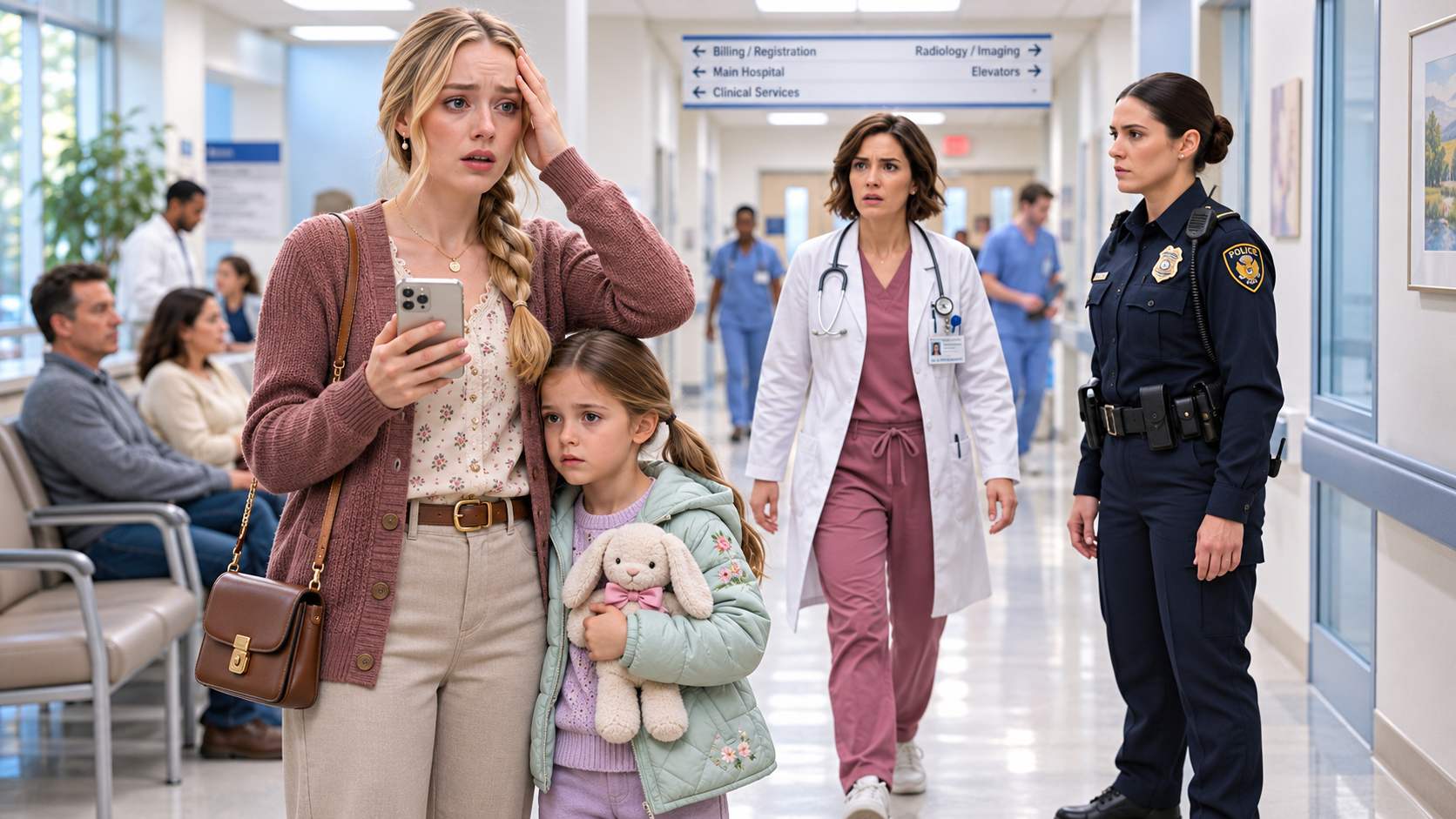
I felt my knees weaken. “Mrs. Carter?” Detective Olivia Bennett reached toward me. I caught the edge of the counter. “That’s Lily’s rabbit.” The detective looked at the photograph. “Are you certain?” I nodded. “The ribbon. The ear. I repaired the stitching on its paw last Christmas.”
My voice broke.
“Why is it there?”
Detective Bennett didn’t pretend to have an answer.
“We need to establish when and where this photograph was taken, and who sent it.”
I looked toward the hallway leading to Lily’s examination room.
“She takes that rabbit everywhere.”
The detective nodded.
“Let’s preserve the message. Please don’t reply to the sender or go to the guesthouse.”
I swallowed.
“Who would send me something like this?”
“We’re going to investigate.”
Then she spoke more gently.
“Right now, your daughter needs you to feel safe enough to stay beside her.”
Those words nearly broke me.
Because at that moment, I didn’t feel safe anywhere.
Not in the hospital.
Not in my own skin.
And certainly not in the house where I’d tucked Lily into bed every night, believing its locked doors could protect her from the world.
Dr. Rebecca Lawson returned a few minutes later.
She took one look at my face and guided me toward a chair.
“Mrs. Carter, sit down.”
I obeyed.
My hands were trembling so badly that I couldn’t hold the paper cup of water she offered.
“I should have known,” I whispered.
The doctor sat across from me.
“What do you mean?”
“She stopped wanting to be alone with Daniel.”
My throat tightened.
“She asked me to leave her bedroom door open. She started crying during bath time. And I kept telling myself she was tired or going through a phase.”
Dr. Lawson listened quietly.
Then she said, “Those behaviors can have different explanations. You acted when Lily told you she was hurting, and that matters.”
I shook my head.
“But what if I missed something?”
The doctor took a breath.
“We can’t change what you knew before tonight. We can make sure she receives appropriate care now.”
I pressed my hands against my face.
The thought of Lily being frightened while I was somewhere else was unbearable.
For years, I’d believed motherhood meant being able to recognize every danger.
But the more I thought about it, the more I understood that I couldn’t protect my daughter by pretending I already knew every answer.
I needed to listen.
I needed to let the specialists do their work.
And above everything else, I needed Lily to understand that she could tell me the truth without being frightened of what I might do.
When I returned to her room, Lily was sitting on the hospital bed with her knees pulled toward her chest.
A nurse had given her a soft white teddy bear.
She held it carefully, but her eyes kept moving toward the door.
“Mommy?”
I hurried to her side.
“I’m here, sweetheart.”
She reached for me.
I wrapped my arms around her as gently as I could.
“Are we going home?”
I felt my heart tighten.
“Not tonight.”
She looked up.
“Why?”
“Because the doctors want to make sure your body feels better, and we’re going to stay somewhere you feel safe.”
Her lower lip trembled.
“Do I have to see Daddy?”
I swallowed.
“Not right now.”
She stared at me for a long moment.
Then whispered:
“Promise?”
I kissed her hair.
“I promise I won’t make you see anyone you’re frightened of tonight.”
She buried her face against my chest.
And I held her until her breathing slowed.
Several minutes passed before Lily spoke again.
“Mommy?”
“Yes, baby?”
“Are you mad?”
I pulled back slightly.
“At you?”
She nodded.
Tears filled my eyes.
“Oh, Lily. No.”
She looked down at the teddy bear.
“Even if I did something bad?”
My throat tightened.
I chose my words carefully.
“Sweetheart, you haven’t done anything wrong by telling me something hurts or by asking for help.”
Her eyes filled.
“Really?”
“Really.”
I brushed a strand of hair from her forehead.
“You can tell me when something scares you. You don’t have to protect anyone from getting upset.”
She stared at me.
Then leaned into my arms again.
I didn’t ask another question.
Not because I wasn’t desperate for answers.
Because I knew my desperation was not something a six-year-old should have to carry.
A specially trained pediatric interviewer spoke with Lily later that evening.
I wasn’t in the room.
The detective explained that it was important for Lily to speak in her own words, without being influenced by frightened adults or repeated questioning.
I hated leaving her.
But the interviewer introduced herself gently, showed Lily a basket of crayons, and explained that she could take breaks whenever she needed.
Lily looked toward me.
I knelt beside her.
“I’ll be right outside.”
She held up the white teddy bear.
“Can he come?”
The interviewer smiled.
“Of course.”
Lily hesitated.
Then walked into the room.
The door closed softly behind her.
And I stood in the hallway wondering how a mother’s heart could keep beating when everything inside it felt shattered.
Detective Bennett waited with me.
She was a woman in her forties with dark hair pulled into a low bun and tired eyes that seemed to have witnessed too many difficult nights.
“Mrs. Carter, I need to ask about the guesthouse.”
I nodded.
“Eric has been staying there.”
“How long?”
“Almost three months.”
“Why?”
I swallowed.
“He and his wife separated. Daniel said Eric needed somewhere quiet while they worked through their divorce.”
“Did Eric spend time with Lily?”
I stared at the floor.
“Yes.”
I remembered Eric bringing her candy after business trips.
Offering to help with her bicycle.
Telling Daniel that Lily was the sweetest little girl he’d ever met.
At the time, those comments seemed harmless.
Now every memory felt poisoned.
“Was Eric ever responsible for her care?” the detective asked.
“Not officially.”
I hesitated.
“But Daniel sometimes took her to the guesthouse when I was busy.”
Detective Bennett wrote something down.
“Did you know what they did there?”
I shook my head.
“Daniel said they watched cartoons or played games.”
I covered my mouth.
“Please tell me I’m wrong.”
The detective’s expression softened.
“We need to establish what happened. Right now, we shouldn’t decide that someone is responsible before the evidence is evaluated.”
I nodded.
It was the answer I needed to hear.
Even though it wasn’t the answer I wanted.
My phone began vibrating again.
Daniel.
I stared at his name.
Detective Bennett looked toward the screen.
“Would you like help deciding how to handle that?”
I nodded.
She advised me to preserve the calls and messages and avoid discussing Lily’s medical details with him while the immediate safety concerns were being addressed.
I let the call go unanswered.
A text appeared moments later.
Anna, what is going on? Why won’t you bring Lily home?
Then another.
Eric says you’re making a terrible mistake.
My stomach dropped.
I showed the detective.
She read both messages.
Then asked:
“Did Daniel tell you he was with Eric tonight?”
I shook my head.
“No.”
She looked at the screen again.
“Have they been communicating frequently?”
“Daniel told me Eric was away on business.”
I swallowed.
“Why would he know what Eric thinks?”
The detective did not answer immediately.
She simply made a note.
And the silence frightened me more than anything she could have said.
An hour later, Detective Bennett returned from speaking with the investigator assigned to the digital evidence.
She sat beside me.
“We’ve identified the number that sent the anonymous messages.”
My heart pounded.
“Who is it?”
“A woman named Melissa Mitchell.”
I stared.
“Eric’s wife?”
She nodded.
My mouth went dry.
“His ex-wife?”
“They’re separated. Their divorce isn’t final.”
I looked toward Lily’s closed door.
“Why would Melissa have a photograph of the guesthouse?”
Detective Bennett took a breath.
“She contacted authorities earlier tonight. She says she has information about Eric’s activities and about a conversation she overheard involving your husband.”
My hands turned cold.
“What conversation?”
“She claims Daniel asked Eric to remove several belongings from the guesthouse before anyone arrived to inspect it.”
For several seconds, I couldn’t breathe.
Then I whispered:
“Before anyone arrived?”
The detective nodded.
“That’s what she reported.”
I stared at her.
“Daniel knew something was wrong.”
“We’re investigating what he knew and when.”
I covered my face.
The words from Daniel’s earlier message returned with sickening clarity.
Tell the doctor she fell off her bicycle. Don’t let anyone examine her again.
He hadn’t asked whether Lily was all right.
He’d instructed me what explanation to give.
An explanation he had no reasonable basis to know was true.
Detective Bennett continued.
“We’re taking steps to secure relevant evidence through the appropriate procedures.”
I nodded.
“Will you go to the guesthouse?”
“Investigators are addressing that location.”
I swallowed.
“Please be careful.”
She gave me a sad smile.
“We will.”
Near midnight, the pediatric interviewer came out.
She spoke first with Dr. Lawson and Detective Bennett.
Then they asked me to join them in a small consultation room.
I felt as though I was walking toward a cliff.
Dr. Lawson invited me to sit.
“Mrs. Carter, Lily has done very well speaking with our specialist.”
I pressed my hands together.
“Is she okay?”
“She’s safe here, and we’re addressing her physical symptoms.”
I swallowed.
“And what did she say?”
The interviewer, whose name was Dr. Naomi Price, leaned forward.
“Anna, we need to be careful about sharing details in a way that might influence future conversations with Lily. But I can tell you that she described experiences that raise serious concerns about inappropriate conduct by an adult.”
My breath caught.
“Who?”
Dr. Price looked toward the detective.
Then answered gently.
“Lily identified Eric.”
The room seemed to disappear.
I heard a strange sound.
A broken, breathless cry.
It took me a moment to realize it had come from me.
I covered my mouth.
“No.”
Tears spilled down my cheeks.
“No, no, no.”
Dr. Lawson moved closer.
“Anna.”
I shook my head.
“He came to her birthday party.”
My voice cracked.
“He gave her a bicycle.”
I stared at them.
“He sat at our dinner table.”
No one interrupted.
I continued.
“He called her his little buddy.”
Then I began sobbing so hard that I couldn’t speak.
Dr. Price waited until I could breathe again.
Then she said quietly:
“Anna, Lily has not been told that she is responsible for anything an adult may have done. It’s important that she continues hearing that from you.”
I nodded.
“She isn’t.”
“No.”
My voice became stronger.
“She isn’t responsible.”
Dr. Price gave a small nod.
“Exactly.”
I wiped my face.
Then asked:
“Does she know whether Daniel was there?”
The specialist answered carefully.
“She described some interactions involving her father. Investigators will need to establish the sequence of events and what each person knew.”
I closed my eyes.
A thousand questions crowded my mind.
Had Daniel been present?
Had he known?
Had he looked away?
Had he believed Eric over Lily?
But I couldn’t answer any of them by interrogating my daughter.
I had to let the evidence speak.
Dr. Lawson reviewed the medical plan with me.
Lily’s discomfort would be treated.
Additional testing would help determine whether infection or another medical condition contributed to her symptoms.
A specialized pediatric team would document any relevant findings carefully.
The doctor explained that medical examinations cannot always establish exactly what happened and that the absence of particular findings would not necessarily resolve the concerns.
I listened.
Asked questions.
And wrote down the answers because I knew I wouldn’t remember everything later.
Then I asked the question that mattered most.
“Can I stay with her?”
Dr. Lawson nodded.
“Yes.”
I returned to Lily’s room.
She was asleep.
Her small hand rested against the white teddy bear’s ear.
I sat beside her bed and watched her breathe.
I wanted to lift her into my arms and carry her somewhere the world couldn’t reach.
Somewhere there were no lies.
No frightening adults.
No closed doors.
But I couldn’t undo what might have happened.
All I could do was make certain that from this moment forward, I listened when she said she was afraid.
I took her hand.
And whispered:
“Mommy is here.”
At three in the morning, my phone rang.
This time, the caller was my mother.
“Anna?”
The moment I heard her voice, I began crying.
“Mom.”
She was silent for a second.
Then asked:
“What’s happened?”
I tried to explain.
The hospital.
Lily’s pain.
The doctors.
The police.
Eric.
But the words came out in broken pieces.
My mother listened without interrupting.
When I finished, she said:
“Where are you?”
“At the hospital.”
“Are you both safe?”
“Yes.”
“Then I’m coming.”
I swallowed.
“Mom, it’s the middle of the night.”
Her voice became firm.
“Anna, I carried you for nine months. I sat beside you through fevers, broken bones, and every heartbreak you thought would end your world.”
I began crying harder.
“And you think I’m going to stay in bed while my daughter and granddaughter need me?”
I closed my eyes.
“Thank you.”
“Don’t thank me. Just tell me which entrance.”
My mother arrived forty minutes later.
She was seventy-one, with silver hair and the same stubborn blue eyes Lily had inherited.
She wore mismatched socks and a cardigan over her nightdress.
I had never loved her more.
The moment she saw me, she opened her arms.
I walked into them.
And for the first time all night, I allowed myself to become somebody’s daughter instead of trying to be brave for everyone else.
She held me for a long time.
Then whispered:
“We’re going to take this one step at a time.”
I shook my head.
“I don’t know how.”
She kissed my hair.
“You don’t have to know every step.”
I looked up.
“Then what do I do?”
She took my hands.
“You take the next one.”
We sat beside Lily until morning.
My mother read quietly.
I watched the heart-shaped shadows from the bedside lamp move across the wall.
And somewhere between midnight and dawn, I realized that my life had divided into two parts.
Before Lily said those words in the bathtub.
And after.
But I also knew something else.
Whatever came next, I would not allow this terrible night to become the only story my daughter ever lived.
She was still Lily.
She loved butterflies.
She adored strawberries.
She believed the moon followed our car because it wanted to come home with us.
And somewhere beyond the fear, there were still birthdays, school plays, scraped knees, summer afternoons, and laughter waiting for her.
I would fight for those ordinary moments.
For as long as it took.
By eight the next morning, Daniel had left twelve messages.
Some were angry.
Others sounded frightened.
The final one was different.
Anna, please call me. Eric isn’t answering. I think something terrible has happened.
I stared at the screen.
Then showed Detective Bennett.
She had returned with another officer and a folder containing information from the investigation.
“Has Eric been located?” I asked.
“Yes. Investigators have spoken with him, and the inquiry is continuing.”
My stomach tightened.
“Did he admit anything?”
“I can’t discuss the details of an active investigation, but we’ve taken steps to protect Lily and preserve relevant evidence.”
I nodded.
Then asked:
“What about Daniel?”
The detective’s expression grew serious.
“We’ve spoken to him as well.”
My heart began pounding.
“And?”
“He acknowledged telling you to report a bicycle accident.”
I covered my mouth.
“He admitted that?”
“Yes.”
“Why?”
She looked toward the notes in her folder.
“He says Eric told him Lily had fallen while playing near the guesthouse. Daniel claims he believed the injury came from that incident.”
I stared at her.
“But Lily hadn’t ridden her bicycle.”
“I understand.”
I swallowed.
“And he told me not to let the doctors examine her again.”
Detective Bennett nodded.
“That message is part of what we’re examining.”
I leaned back.
For one moment, I almost felt relief.
Maybe Daniel hadn’t known.
Maybe he’d simply repeated something Eric told him.
Maybe the truth was less terrible than I’d imagined.
Then I remembered his insistence that I bring Lily home.
His switched-off phone.
His sudden urgency.
And the way he’d never asked whether she was in pain.
I looked at the detective.
“Do you believe him?”
She considered.
“My job is to investigate the evidence, not decide what I want to believe.”
I nodded slowly.
It was a difficult answer.
But a necessary one.
Later that morning, Melissa Mitchell came to the hospital.
I hadn’t asked her to.
Detective Bennett explained that Melissa had requested permission to speak with me, and that I was free to decline.
For several minutes, I couldn’t decide.
Part of me wanted to ask her everything.
Another part wanted to shut the door on every person connected to Eric.
Finally, I agreed to a brief conversation with Detective Bennett nearby.
Melissa was younger than I’d imagined.
Perhaps thirty-five.
She wore jeans, a gray coat, and no makeup.
Her face looked exhausted.
When she saw me, tears filled her eyes.
“Anna.”
I stood.
She stopped several feet away.
“I’m sorry.”
I looked at her.
“For what?”
Her mouth trembled.
“For not coming to you sooner.”
I swallowed.
“Did you know Eric was hurting Lily?”
She shook her head immediately.
“No. I didn’t know that.”
I studied her.
“Then what did you know?”
She took a shaky breath.
“That he was lying about why he’d been staying at your house.”
I stared.
Melissa glanced toward Detective Bennett.
Then continued.
“Eric told Daniel we were getting divorced because I’d become impossible to live with.”
I nodded.
“That’s what Daniel told me.”
Her eyes filled.
“The truth is that I found things on Eric’s computer that frightened me.”
My stomach tightened.
“What things?”
She looked down.
“Records of messages to people much younger than him. Some conversations that seemed inappropriate. I couldn’t establish everything myself, and I didn’t know what they meant.”
I swallowed.
“What did you do?”
“I confronted him.”
Her voice broke.
“He told me I was paranoid.”
I stared.
“He said I’d misunderstood.”
I closed my eyes.
Those words sounded painfully familiar.
Melissa continued.
“I asked him to leave. Afterward, I began trying to work out whether anyone else might be at risk.”
My heart pounded.
“Did you tell Daniel?”
She nodded.
“Yes.”
I felt cold.
“When?”
“Before Eric moved into your guesthouse.”
For several seconds, I couldn’t breathe.
Then I whispered:
“Daniel knew you had concerns about Eric?”
Melissa nodded.
“I told him I was worried about Eric’s behavior.”
My hands began trembling.
“And Daniel still invited him to stay near my daughter?”
Melissa began crying.
“He told me I was angry about the divorce and trying to destroy Eric’s reputation.”
I stared at her.
“He didn’t believe you.”
She shook her head.
“No.”
For a moment, I wanted to scream.
I wanted to ask how Daniel could place his business partnership above our daughter’s safety.
I wanted to demand why Melissa hadn’t called me directly.
But Detective Bennett spoke gently.
“Anna, Melissa has provided her account and relevant records. Investigators are working to verify the timing and details.”
I took a breath.
I looked back at Melissa.
“Why did you send me the photograph?”
She wiped her cheeks.
“Because Eric called me yesterday afternoon.”
I felt sick.
“What did he say?”
“He wanted me to collect some belongings from the guesthouse.”
She swallowed.
“He sounded frightened. He said Daniel was worried you might involve the police.”
I stared.
“So you went there?”
“Only to the outside. I didn’t enter the building.”
She looked toward the detective.
“I saw the rabbit through a glass panel in the door. Eric had mentioned that Lily couldn’t find hers. I took a photograph because it frightened me.”
My throat tightened.
“And the backpack?”
Melissa nodded.
“I’d seen Eric carrying it toward his car earlier that week.”
I looked away.
It was such a small thing.
A child’s backpack.
A stuffed rabbit.
Objects I might have ignored on an ordinary afternoon.
But they had helped someone realize that something needed investigating.
Melissa took a tentative step closer.
“Anna, I should have warned you about my concerns before.”
Her voice broke.
“I’m deeply sorry.”
I stared at her.
For several moments, I couldn’t speak.
Then I said quietly:
“I wish you had.”
She nodded.
“I know.”
I swallowed.
“But thank you for coming forward now.”
Her eyes filled.
Then she left.
When the door closed, I sank into a chair.
My mother sat beside me.
“Anna?”
I covered my face.
“Mom, Daniel knew Melissa was worried about Eric.”
She touched my shoulder.
“He knew there were concerns.”
I shook my head.
“And he still brought him into our home.”
My voice cracked.
“He let him spend time with Lily.”
My mother was silent.
Then she said:
“That is something Daniel will have to answer for.”
I looked at her.
“How am I supposed to explain this to Lily?”
She took my hand.
“You don’t have to explain everything.”
I swallowed.
“You tell her what she needs to know.”
“Which is?”
My mother’s eyes filled.
“That you’re listening. That grown-ups are responsible for their own choices. And that she will not be punished for telling you the truth.”
That afternoon, a hospital child-protection specialist named Andrea Miles met with me.
She explained the next steps.
Lily might need follow-up medical care.
A trauma-informed therapist could help her process frightening experiences without forcing her to repeat them unnecessarily.
Investigators would continue examining the available evidence.
And a safety plan would be developed for her return home.
“What if she never wants to talk about it again?” I asked.
Andrea answered gently.
“Then we don’t force her to tell the story on an adult’s timetable. Healing isn’t measured by how quickly a child can describe something painful.”
I nodded.
“What if she asks whether it’s her fault?”
“You tell her clearly that it isn’t.”
My eyes filled.
“And what if she asks whether I’ll be angry?”
Andrea smiled sadly.
“You tell her she can always come to you.”
I swallowed.
Then whispered:
“What if I start crying?”
Andrea leaned forward.
“It’s okay for children to know adults have feelings. But she shouldn’t feel responsible for comforting you. If you’re overwhelmed, seek support from another adult.”
I looked toward my mother.
She squeezed my hand.
That evening, Lily asked for me while the nurse was helping her settle.
I went into her room.
She was sitting upright, carefully coloring a picture of a purple butterfly.
“Mommy?”
“Yes, sweetheart?”
“Can Grandma stay too?”
I smiled.
“Of course.”
My mother pulled a chair beside the bed.
Lily looked at both of us.
Then asked:
“Are we in trouble?”
My heart broke.
I knelt beside her.
“No, baby.”
She looked uncertain.
“Because the police came?”
I took a breath.
“The police help when grown-ups need to find out whether someone has been hurt.”
She stared at me.
Then whispered:
“Did I do something wrong?”
“No.”
I kept my voice steady.
“You didn’t do anything wrong.”
Her eyes filled.
“Even if I didn’t say something before?”
I swallowed.
“Even then.”
Lily put down the purple crayon.
Then reached for me.
I held her gently.
For a long time, she didn’t speak.
Then she whispered:
“I thought you might be sad.”
Tears burned behind my eyes.
I remembered what Andrea had told me.
I kissed Lily’s forehead.
“Sometimes I feel sad when someone I love is hurting.”
She looked up.
“But that’s a grown-up feeling for me to take care of.”
Her shoulders relaxed slightly.
“You don’t have to fix it.”
She studied me.
Then asked:
“Can we have pancakes tomorrow?”
I laughed softly through tears.
“Absolutely.”
“With strawberries?”
“Extra strawberries.”
She smiled.
And that tiny smile felt like sunlight breaking through a storm.
The next morning, Detective Bennett called me into a private room.
Her expression was serious.
“Anna, we’ve recovered several relevant items from the guesthouse through authorized investigative procedures.”
My stomach tightened.
“Lily’s backpack?”
She nodded.
“And other materials that may help establish what occurred.”
I swallowed.
“Is Eric going to be arrested?”
“The evidence is being evaluated with the appropriate specialists and prosecutors. I don’t want to promise you a particular legal outcome before those decisions are made.”
I nodded.
Then asked:
“Did Daniel help him?”
She hesitated.
“That’s still being examined.”
I sat quietly.
Detective Bennett continued.
“We’ve also reviewed communications between Daniel and Eric.”
My heart pounded.
“What did they say?”
She looked at me carefully.
“One message from Daniel told Eric to remove anything that might be misunderstood before police became involved.”
I felt the blood drain from my face.
“He told Eric to remove things?”
“That’s what the message says.”
My hands trembled.
Then I whispered:
“Was that after he knew Lily was at the hospital?”
“Yes.”
For a moment, I couldn’t breathe.
I stared at the wall.
Daniel had known our daughter was in pain.
He had known I was frightened.
And instead of coming to the hospital to support us, he’d been messaging Eric about removing belongings.
I covered my mouth.
Detective Bennett spoke gently.
“Anna, we’re investigating whether those communications involved an attempt to interfere with evidence.”
I nodded.
Then whispered:
“I don’t understand how someone can be a father and do that.”
The detective’s expression softened.
“I can’t answer for Daniel’s choices.”
She paused.
“But you can make choices now that protect Lily.”
I looked up.
“Then that’s what I’ll do.”
By the time Lily was medically ready to leave the hospital, an immediate safety arrangement had been established.
I would stay temporarily at my mother’s home.
Daniel would not have unsupervised contact with Lily while the relevant authorities and family court addressed the concerns.
Eric would have no access to her.
And the hospital team helped coordinate follow-up appointments and support.
Packing Lily’s little hospital bag felt strangely monumental.
Her socks.
Her coloring book.
The white teddy bear.
Her favorite pajamas.
Every item seemed to represent a small piece of ordinary childhood I was determined to preserve.
Lily sat on the bed watching me.
“Mommy?”
“Yes?”
“Are we going to Grandma’s?”
I smiled.
“Yes.”
Her face brightened.
“Will she make her cinnamon toast?”
My mother laughed from the doorway.
“Only if you help me sprinkle the cinnamon.”
Lily smiled.
“Okay.”
Then her expression changed.
“Is Daddy coming?”
I knelt beside her.
“Not today, sweetheart.”
She looked down.
“Okay.”
I brushed her hair gently.
“You don’t have to worry about arranging grown-up visits. That’s something adults will handle.”
She nodded.
Then reached for her teddy bear.
“Can I bring him?”
“Of course.”
As we walked out of the hospital, Olivia stopped beside the elevator.
She knelt to Lily’s height.
“Goodbye, Lily.”
Lily held up the teddy bear.
“His name is Snowball.”
Olivia smiled.
“That’s a wonderful name.”
Lily looked at her.
“Thank you for helping me.”
Olivia’s eyes filled.
“You’re very welcome.”
When we reached the parking garage, Lily held my hand tightly.
For a moment, she stopped beside the car.
I looked down.
“What’s wrong, sweetheart?”
She stared toward the exit.
“Are we safe?”
I knelt.
I wanted to promise that nothing frightening would ever happen again.
That every person she met would be kind.
That the world would always protect children.
But those were promises no parent could guarantee.
So I gave her one I could keep.
“I’m going to listen to you, make careful decisions, and get help whenever we need it.”
She looked at me.
“Really?”
I kissed her forehead.
“Really.”
At my mother’s house, the kitchen smelled of cinnamon and warm butter.
Lily climbed onto her favorite chair.
Grandma made pancakes shaped like stars.
My mother placed strawberries around the edges of the plate and announced that the restaurant was officially open.
Lily giggled.
For the first time in days, she laughed without looking toward the door.
I stood in the kitchen watching her.
And I began crying.
My mother came beside me.
“Anna?”
I shook my head.
“She’s laughing.”
My mother looked toward Lily.
Then smiled through tears.
“Yes.”
I covered my mouth.
“I was afraid I’d never hear that again.”
My mother slipped an arm around my shoulders.
“She has a lot of childhood left.”
Those words stayed with me.
A lot of childhood left.
Not everything had been taken.
Not every happy memory had been destroyed.
Lily still loved butterflies.
And strawberries.
And silly songs.
She still asked questions about clouds and wanted to know why dogs couldn’t talk.
Her life was not finished.
It was still unfolding.
And I was going to help her fill the coming years with as many safe and ordinary joys as possible.
Three days after we moved into my mother’s house, Daniel finally came face-to-face with the consequences of his decisions.
Not at our front door.
Not in a dramatic confrontation where I shouted accusations and demanded answers.
But in an attorney’s office, where I sat beside a family-law attorney named Rachel Collins.
Daniel was represented separately.
I had filed for temporary protective arrangements concerning Lily, along with the necessary family-court proceedings.
I wasn’t there to fight over furniture or money.
I was there to protect my daughter.
When Daniel entered, I barely recognized him.
His face was drawn.
His hair was uncombed.
The confident businessman who once told me he would take care of everything looked frightened and exhausted.
“Anna.”
I didn’t answer immediately.
Then I nodded.
“Daniel.”
He looked toward Rachel.
“Can we have a minute alone?”
I shook my head.
“No.”
His expression tightened.
“Anna, we’re married.”
I looked at him.
“Yes.”
He swallowed.
“Then why can’t we talk privately?”
I took a slow breath.
“Because Lily’s safety is more important than protecting our marriage from uncomfortable conversations.”
He looked down.
For several moments, nobody spoke.
Then Daniel whispered:
“How is she?”
My throat tightened.
“She’s receiving care.”
He nodded.
“Does she ask about me?”
I hesitated.
“Sometimes.”
His eyes filled.
“Can I see her?”
Rachel answered before I could.
“Any contact will need to follow the safety arrangements and applicable court orders.”
Daniel closed his eyes.
Then whispered:
“I never wanted any of this.”
I looked at him.
“Then why did you tell me to say she fell off her bicycle?”
He covered his face.
For a long moment, he didn’t speak.
Then he lowered his hands.
“Eric told me she had fallen.”
I swallowed.
“And you believed him.”
Daniel nodded.
“At first.”
My heart began pounding.
“At first?”
He looked down.
I leaned forward.
“What changed?”
His voice broke.
“Melissa called me.”
I stared.
“When?”
“About a week before Lily went to the hospital.”
The room seemed to grow colder.
I looked directly at him.
“What did she say?”
He swallowed.
“That she was worried about Eric.”
I waited.
“That she’d found things she didn’t understand. That she thought he might be behaving inappropriately.”
My voice trembled.
“And what did you do?”
Daniel began crying.
“I told her she was overreacting.”
I closed my eyes.
He continued.
“Eric had been my friend for fifteen years.”
I looked at him.
“And Lily has been your daughter for six.”
He flinched.
I swallowed.
“You had a warning.”
His eyes filled.
“You had a chance to ask questions. To take precautions. To make sure she wasn’t left alone with someone whose behavior had raised concerns.”
Daniel covered his face.
“I know.”
For a moment, I couldn’t speak.
Then I whispered:
“Why did you tell Eric to remove things from the guesthouse?”
Daniel’s expression changed.
He looked toward his attorney.
His lawyer spoke carefully.
“That issue is part of an active investigation, and my client has been advised not to discuss potentially relevant details here.”
I nodded.
I wasn’t going to force an answer through a family-law meeting.
The investigators would address it.
But Daniel’s silence told me one thing clearly.
I could no longer rely on him to place Lily’s needs ahead of his own fear.
Daniel looked up.
“Anna, I love you.”
My eyes filled.
For years, those words had comforted me.
I remembered our wedding.
The first time he held Lily.
The evenings he came home carrying flowers.
The life I’d believed we were building.
Then I remembered our daughter hiding behind me in the hospital.
I don’t want to go with Daddy.
I took a breath.
“Daniel, love is not enough when a child isn’t safe.”
He began crying.
I continued.
“I’m not making decisions based on what you promise today.”
He looked at me.
“I’m making them based on Lily’s needs and the evidence that becomes available.”
When the meeting ended, Daniel remained seated.
I stood.
He whispered:
“Are you leaving me?”
I looked at him.
For a moment, I felt grief for the marriage I’d wanted.
Then I answered:
“I’m choosing Lily’s safety. And I need a life where I can trust the people closest to us to do the same.”
I walked out beside Rachel.
And although I cried in the car afterward, I didn’t regret what I’d said.
The investigation continued.
Specialists reviewed Lily’s medical findings, recorded statements, digital evidence, and materials recovered from the guesthouse.
Eric obtained legal representation.
Daniel’s communications were examined separately.
The authorities made decisions based on the evidence rather than on my anger or fear.
Eventually, prosecutors brought charges against Eric related to the alleged abuse of Lily.
The case would take time.
There would be hearings, legal arguments, and difficult questions.
A charge was not the same as a conviction.
But Lily’s account had been taken seriously, and steps were in place to protect her during the process.
The investigation also established that Daniel had been warned about concerns involving Eric before Lily’s hospital visit.
His later messages about removing belongings became part of a separate inquiry into whether he had interfered with the investigation.
I didn’t know everything that would happen to him legally.
But I knew what his choices had done to our marriage.
And I knew I could not pretend that those choices were harmless.
Through the family court, I obtained temporary arrangements keeping Lily with me and restricting contact while the safety concerns were evaluated.
I also began divorce proceedings.
Not because I wanted Lily to grow up without a father.
But because I could no longer treat my marriage as more important than the trust and protection she needed.
Any future relationship between Daniel and Lily would have to depend on her welfare, professional assessments, and lawful decisions.
Not on Daniel’s wishes alone.
The hardest part of the following months wasn’t the paperwork.
It was learning how to live with uncertainty.
Some mornings, Lily woke cheerful and demanded blueberry pancakes.
Other mornings, she didn’t want to leave her room.
Sometimes she talked about school.
Sometimes she wanted silence.
There were nights when she woke frightened.
And days when she laughed so freely that I almost forgot how terrible that hospital night had been.
Her therapist, Dr. Amelia Foster, helped us understand that recovery wasn’t a straight line.
She worked with Lily at a pace appropriate for her age.
Play.
Drawing.
Gentle conversations.
Opportunities for Lily to recognize and express feelings without being pressured.
And whenever I asked how long it would take before everything felt normal again, Dr. Foster reminded me that our goal wasn’t to force Lily back into the person she’d been before.
It was to support the child she was now.
One afternoon, Lily brought home a drawing from therapy.
It showed a small yellow house beneath a enormous blue sky.
Three figures stood in the garden.
A little girl.
A woman.
And an older woman with gray hair.
Beside them was a white rabbit with enormous ears.
I smiled.
“Is that Snowball?”
Lily giggled.
“Yes.”
I pointed toward the house.
“And who’s this?”
“That’s Grandma’s house.”
My eyes filled.
“And the people?”
“Me. You. Grandma.”
I nodded.
She picked up a green crayon.
Then drew a little butterfly above the roof.
“Look, Mommy.”
I smiled.
“That’s beautiful.”
She looked at me.
“Butterflies can fly away when they’re scared.”
My throat tightened.
Then she added:
“But they can come back when it’s safe.”
I sat beside her.
“Yes, sweetheart.”
She studied the picture.
Then whispered:
“I like it when it’s safe.”
I put my arm around her.
“Me too.”
As the months passed, I returned to work part-time.
A former colleague at the shipping company helped me apply for a position coordinating operations remotely.
The first time I opened a spreadsheet again, I laughed.
I’d spent years believing Daniel’s promotion meant I no longer needed a career.
Now earning my own income felt like reclaiming a piece of myself.
My mother helped with Lily.
And I began making plans for a smaller home, somewhere close to her school and the people who could support us.
One evening, while I was reviewing a household budget, my mother came into the kitchen.
She placed a cup of tea beside me.
“Anna?”
I looked up.
“Yes?”
“Are you happy?”
The question surprised me.
I considered it.
Then shook my head slightly.
“Not always.”
She nodded.
“That makes sense.”
I swallowed.
“But sometimes I am.”
My mother smiled.
“When?”
I thought about Lily laughing at breakfast.
The sunlight in the garden.
The way she curled beside me during bedtime stories.
The pleasure of finishing a day’s work.
The quiet relief of knowing the doors around us were secure.
“Little moments,” I whispered.
My mother nodded.
“That’s often how happiness returns.”
A year after the hospital visit, Lily celebrated her seventh birthday.
We held the party in my mother’s backyard.
There were paper butterflies hanging from the trees.
A strawberry cake.
Pink balloons.
And a table covered with crayons and craft supplies.
Lily invited several friends from school.
They played games.
Chased bubbles.
And laughed until their faces turned red.
At one point, I stood near the kitchen window watching her.
She wore a yellow dress.
Her hair was tied in two messy braids.
And she was trying to teach Snowball, her stuffed bear, how to dance.
My mother stepped beside me.
“Look at her.”
I smiled.
“She’s having fun.”
My mother’s eyes filled.
“She deserves to.”
For a moment, I remembered the little girl in the bathtub.
The tears.
The pain.
The frightened whisper.
Please don’t touch me there.
I closed my eyes.
Then opened them again.
Lily was laughing.
Her friends were singing.
And the backyard was filled with sunlight.
My mother touched my arm.
“Anna?”
I looked at her.
“Yes?”
“You’re crying.”
I wiped my cheeks.
“I know.”
She smiled sadly.
“Happy tears?”
I watched Lily blow out the candles.
Then whispered:
“Some of them.”
That evening, after the guests left, Lily curled beside me on the sofa.
Snowball rested in her lap.
She looked up.
“Mommy?”
“Yes, sweetheart?”
“Can I ask you something?”
“Always.”
She hesitated.
“Did you believe me when I said I was scared?”
My heart tightened.
I turned toward her.
“Yes, Lily.”
She looked down.
“Even before you knew why?”
I swallowed.
“Yes.”
She studied my face.
Then whispered:
“Good.”
I brushed her hair gently.
“Why do you ask?”
She shrugged.
“Because sometimes kids think grown-ups won’t listen.”
My eyes filled.
I took her hand.
“Then I want you to remember something.”
She looked up.
“You never have to earn the right to be heard.”
Her expression softened.
“And if something worries you, you can tell me, Grandma, your teacher, or another safe adult.”
She nodded.
“Even if it’s a little thing?”
I smiled.
“Even then.”
She snuggled closer.
For a long time, we sat quietly.
Then she whispered:
“Mommy?”
“Yes?”
“Can we make pancakes tomorrow?”
I laughed.
“With strawberries?”
She giggled.
“Extra strawberries.”
I kissed her forehead.
“Absolutely.”
I used to believe being a good mother meant preventing every bad thing from reaching my child.
I thought love should be powerful enough to recognize every danger before it arrived.
But life taught me a harder truth.
Sometimes someone we trust disappoints us terribly.
Sometimes the people closest to us make choices that leave us frightened and heartbroken.
And sometimes we discover danger only after a child finds the courage to tell us something is wrong.
What matters then isn’t pretending the truth is easier than it is.
It is listening.
Taking appropriate action.
Seeking help.
And reminding the child, again and again, that the responsibility for an adult’s harmful behavior never belongs to them.
My name is Anna Carter.
I’m a mother.
A daughter.
A woman rebuilding her life.
And the person who will always remember the night her six-year-old daughter whispered that something hurt.
That night changed everything.
My marriage.
My home.
My understanding of trust.
But it didn’t take away Lily’s future.
And it didn’t take away our ability to find joy.
I cannot promise my daughter a world without danger.
I cannot promise that every person will be kind.
But I can promise to listen when she tells me she’s frightened.
I can promise to take her feelings seriously.
And I can promise that she will never have to carry the consequences of an adult’s choices alone.
The most important words my daughter spoke that night were not the ones that revealed her pain.
They were the words that told me she trusted me enough to ask for help.
And the most important thing I could do was show her that her trust was well placed.
Today, when Lily laughs, I don’t hear a child pretending nothing happened.
I hear a little girl discovering that her life can hold happiness alongside difficult memories.
When she runs into my arms, I don’t see someone defined by what another person may have done to her.
I see my daughter.
Curious.
Kind.
Brave.
And deserving of every beautiful thing life has to offer.
Because Lily’s story will never belong to the person who frightened her.
It belongs to Lily.
And there are still so many wonderful chapters waiting to be written.