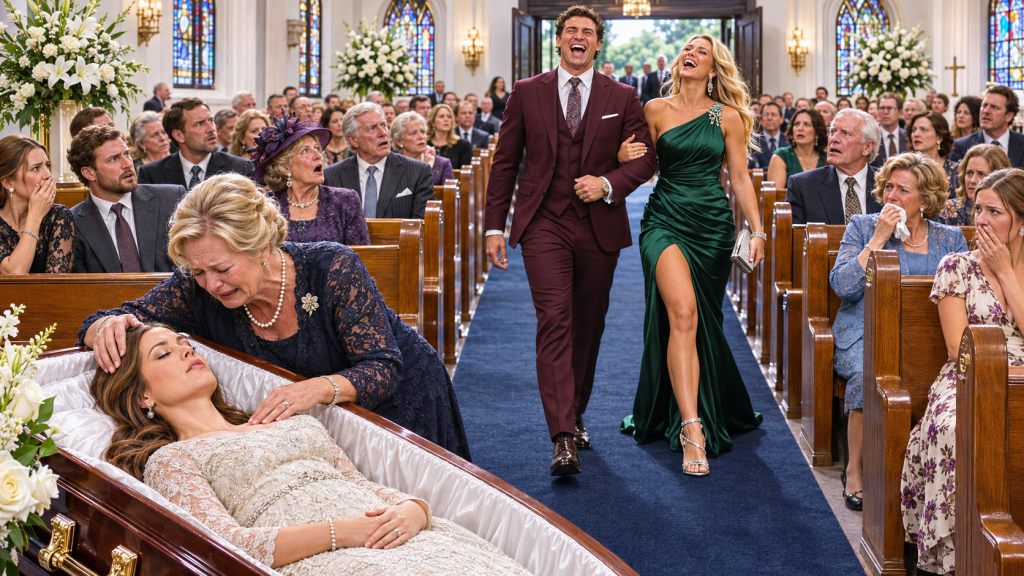
For one impossible moment, I thought I had misunderstood the doctor. There was a surviving child. Those four words hung in the church like a prayer nobody dared finish. My daughter Emma lay in a white coffin beneath an arrangement of lilies. Her husband stood frozen beside his mistress. And somewhere in the world, according to the woman who had just entered the church, a child connected to Emma was alive.
I gripped the edge of the pew. “What did you say?” Dr. Lena Ortiz stepped toward me. She was a slender woman with tired brown eyes. Beneath her navy coat, she wore a pale blouse with a small silver cross at the collar. “Mrs. Ellis, I’m sorry this information is reaching you in such a painful setting.” I shook my head.
“Please don’t apologize. Just tell me.” She looked toward Mr. Halden. The attorney nodded. “Margaret is the person Emma designated to receive information concerning the children’s care. “Children. Plural. My heart seemed to stop. I stared at him.
“Children?”
Mr. Halden lowered his eyes.
And I suddenly understood that everything I believed about my daughter’s final days was incomplete.
“Emma was carrying twins,” Dr. Ortiz said softly.
The room fell silent.
I heard someone gasp behind me.
My sister’s hand tightened around my elbow.
Twins.
Emma had never told me.
For months, she’d spoken about the baby with such tenderness.
She’d shown me photographs of tiny shoes.
Asked whether the nursery should be yellow or green.
Called me one evening just to say she’d felt the baby move.
But she’d never said there were two.
“Twins?” I whispered.
Dr. Ortiz nodded.
“One baby did not survive. The other was delivered prematurely and is receiving specialized care.”
I covered my mouth.
The doctor continued carefully.
“Emma survived the delivery initially. Her death occurred later, following serious complications.”
My knees weakened.
I looked toward the coffin.
My daughter’s hand rested over her belly beneath the white satin.
I had believed both babies were buried in the silence with her.
But one was alive.
A little piece of Emma.
Somewhere beyond these church walls.
Breathing.
Fighting.
Waiting.
“Where?” I whispered.
Dr. Ortiz glanced toward the mourners.
“Mrs. Ellis, we should discuss the child’s care privately.”
Evan suddenly stepped forward.
“That’s my baby.”
Every head turned.
His expression had changed.
The amusement was gone.
So was the confidence.
Now there was something else in his eyes.
Calculation.
“I am Emma’s husband,” he declared. “I have parental rights.”
Mr. Halden raised one hand.
“Mr. Vale, any questions about parentage, custody, and the child’s welfare will be addressed through the appropriate legal channels.”
Evan’s face reddened.
“You can’t keep my child from me.”
I looked at him.
For one terrible second, I remembered how he’d entered the church laughing.
His mistress on his arm.
His expensive watch catching the light.
And how Celeste had leaned toward me.
Looks like I won.
I turned toward her.
She had stepped away from Evan.
Her face was as pale as the lilies.
“Did you know?” I asked.
Celeste stared at me.
“Margaret…”
“Did you know Emma was carrying twins?”
She shook her head.
“No.”
I looked toward Evan.
He didn’t answer.
Mr. Halden stepped beside me.
“Margaret, Emma left instructions concerning the child’s immediate care. We should speak privately before discussing anything further.”
I stared at him.
“She knew one baby had survived?”
He nodded.
“Yes.”
My eyes filled.
“And she thought about me?”
His expression softened.
“Until the end.”
I turned toward the coffin.
The church was filled with whispers now.
People shifting in their seats.
Relatives looking at one another in disbelief.
But all I could see was Emma.
My beautiful daughter.
The little girl who’d once fallen asleep against my shoulder while I read fairy tales.
The teenager who’d cried when she didn’t make the school choir.
The young woman who’d opened her first bakery with trembling hands and a heart full of hope.
And now, even in her final hours, she’d been trying to protect someone else.
I walked toward her.
Placed my hand gently against the polished wood.
And whispered:
“Emma, sweetheart, what were you trying to tell me?”
The funeral service continued, but everything had changed.
The minister spoke about Emma’s kindness.
Her laughter.
The way she remembered birthdays and brought fresh bread to elderly neighbors.
He spoke about her generosity during the winter food drives.
And the children she’d helped through her bakery’s apprenticeship program.
I listened.
Sometimes I cried.
Sometimes I felt nothing at all.
Grief is strange that way.
It can fill your body so completely that there is no room for another feeling.
Then suddenly it steps aside, and you’re left with a terrible emptiness.
Evan remained near the back of the church.
Celeste no longer touched his arm.
When the final hymn began, I glanced toward them.
They were arguing.
Quietly.
Bitterly.
Evan leaned toward her, his jaw tight.
She shook her head.
Then walked away.
For a moment, he looked after her as though he couldn’t believe anyone would leave him on a day like this.
I almost laughed.
But then I looked back at Emma.
And the laughter died inside me.
After the service, Mr. Halden guided me into a small room behind the sanctuary.
My sister Ruth came with me.
Dr. Ortiz sat beside a table holding a pitcher of water and several untouched glasses.
There were no reporters.
No curious mourners.
No Evan.
Just the three people who had been entrusted with the most painful truth of my life.
I sat down.
My hands were shaking.
“Please,” I whispered. “Tell me everything you can.”
Dr. Ortiz took a breath.
“Emma was admitted to the hospital with serious pregnancy complications.”
I nodded.
I knew that much.
Evan had called me that night.
His voice had sounded distant.
He’d said Emma was in surgery.
That things were very bad.
When I arrived, my daughter was already in intensive care.
She never woke while I was there.
Or so I had believed.
Dr. Ortiz continued.
“During the emergency, the medical team delivered both babies. One did not survive.”
Tears rolled down my cheeks.
She waited.
Then said, “The other was born alive and required immediate neonatal intensive care.”
I pressed a hand against my chest.
“Was it a boy or a girl?”
The doctor’s eyes softened.
“A girl.”
A daughter.
My daughter had a daughter.
I began crying harder.
Ruth slipped an arm around my shoulders.
Dr. Ortiz let me compose myself.
Then she continued.
“Emma regained consciousness for a short period after delivery. During that time, she was able to communicate some wishes concerning the surviving baby.”
I looked up.
“She was awake?”
“Briefly.”
My heart shattered all over again.
“Why wasn’t I there?”
The doctor hesitated.
“Margaret, I can’t reconstruct every communication that occurred. But Emma was able to speak with Mr. Halden through arrangements made while she was hospitalized.”
I looked toward the attorney.
He nodded slowly.
“She asked to see me.”
My voice broke.
“She asked for you?”
“Yes.”
I stared at him.
“Why didn’t you call me?”
His eyes filled.
“I attempted to reach you. Your phone went directly to voicemail.”
I remembered.
That night, my battery had died while I sat in the hospital waiting room.
I’d been too frightened to leave and find a charger.
When I finally turned it on, there were messages from friends and relatives.
And one missed call from an unfamiliar number.
I had never returned it.
I covered my face.
“Oh, Emma.”
Mr. Halden leaned forward.
“Margaret, she did not die believing you had abandoned her.”
I looked up.
He continued.
“She knew you were at the hospital. She knew you loved her.”
My throat tightened.
“And what did she say?”
He opened a small envelope.
Inside was a folded piece of paper.
“She asked me to make certain you received this.”
I stared at it.
My daughter’s handwriting.
Weak.
Uneven.
But unmistakably Emma’s.
I unfolded it.
Mom,
If you’re reading this, something has happened that I prayed would not happen.
Please don’t blame yourself for anything.
You have loved me more generously than I deserved and more faithfully than I knew how to thank you for.
There is a baby who needs love, safety, and someone who will tell her about me.
If you can be part of her life, I hope you will.
But please don’t spend the rest of your days forgetting to live because mine ended too soon.
I love you.
Emma.
I pressed the letter against my chest.
For several moments, I couldn’t breathe.
Then I began sobbing.
Not quietly.
Not politely.
I cried the way mothers cry when the world takes something they cannot replace.
Ruth held me.
Dr. Ortiz lowered her eyes.
And Mr. Halden waited without speaking.
Eventually, I looked up.
“Can I see her?”
Dr. Ortiz nodded.
“We can discuss a visit with the neonatal team and the people responsible for her care.”
My hands trembled.
“Is she going to live?”
The doctor answered gently.
“She’s receiving intensive treatment. I don’t want to promise an outcome we cannot guarantee, but the team is caring for her closely.”
I nodded.
“What’s her name?”
Mr. Halden smiled sadly.
“Emma wrote one down.”
I stared at him.
He unfolded another page.
Then read:
Hope.
I covered my mouth.
“Hope?”
He nodded.
“Hope Vale.”
For a moment, I thought about how Emma used to name every stray animal she found.
A kitten called Sunshine.
A limping bird she insisted was a warrior.
A rescued puppy named Miracle.
She had always believed names should remind creatures what they might become.
And now she’d named her daughter Hope.
I closed my eyes.
“That’s perfect.”
But there was another matter.
One that had begun with the will and the astonishing look of fear on Evan’s face.
Mr. Halden placed several documents on the table.
“Margaret, Emma became concerned about certain financial arrangements during the final months of her pregnancy.”
I looked at him.
“The insurance?”
He nodded.
“And the bakery.”
My stomach tightened.
Emma had inherited her grandmother’s small bakery years earlier.
Through hard work and careful planning, she’d expanded it into three thriving locations.
The original building was owned through a trust established before her marriage.
Emma had been proud of that arrangement.
Not because she distrusted marriage.
But because her grandmother had taught her to protect the things she worked to build.
Mr. Halden continued.
“Several months ago, Emma discovered that Evan’s business had fallen behind on rent owed to the trust.”
I nodded.
“He told her it was temporary.”
“Yes.”
I swallowed.
“And?”
“She also discovered that certain business expenses had been charged to accounts connected with her bakery operations.”
My hands tightened.
“Without her permission?”
“Some transactions are disputed. Emma asked for an independent review.”
I stared at him.
“Did she know about Celeste?”
His eyes softened.
“Yes.”
For a moment, I couldn’t speak.
I remembered Emma calling me late one evening.
Her voice had been strained.
“Mom, do you think people can change?”
I’d asked what happened.
She said nothing.
Then whispered, “Sometimes I feel like I’m married to someone I don’t know anymore.”
I’d told her she could come home.
She’d promised she would think about it.
Now I wished I’d driven to her house that very night.
Mr. Halden reached for another document.
“Emma was preparing to separate from Evan.”
I stared.
“She was leaving him?”
He nodded.
“She had sought advice about her property, business, and future arrangements for the children.”
I swallowed.
“Children?”
He corrected himself gently.
“At the time, she was expecting twins.”
A strange sadness washed over me.
Emma had been planning a future.
Not with the husband who humiliated her.
But with her children.
A life beyond the betrayal.
She had been frightened.
But she hadn’t been helpless.
“Did Evan know she was leaving?” I asked.
Mr. Halden hesitated.
“He knew there were serious marital difficulties. We can’t establish exactly what he understood about her plans.”
I nodded.
I wanted answers.
But I didn’t want invented ones.
Emma deserved the truth.
Not a story shaped by my anger.
Then Mr. Halden opened the final folder.
“There is something else.”
My chest tightened.
“What?”
“Emma had instructed her financial advisers to review a substantial life insurance policy.”
I stared.
“The one increased without her knowledge?”
He nodded.
“The records suggest the coverage was changed through documents that require authentication.”
I swallowed.
“And Evan?”
“His name appears in correspondence concerning the change.”
My stomach turned.
For one terrible moment, I imagined the worst.
Evan arranging an insurance payout.
Emma becoming ill.
The timing.
The money.
The mistress.
It was easy for grief to connect every frightening detail into a single terrible conclusion.
But Mr. Halden seemed to understand what I was thinking.
He leaned forward.
“Margaret, I need you to hear me clearly.”
I looked at him.
“The existence of disputed financial documents does not establish that anyone caused Emma’s death.”
I closed my eyes.
He continued.
“Her medical complications must be evaluated on their own evidence. We have requested appropriate reviews and preserved the records.”
I nodded.
My throat ached.
“I don’t want to accuse someone of something terrible just because I’m angry.”
“Then we will continue to follow the facts.”
I looked toward Emma’s letter.
Then whispered:
“What happens to Hope?”
Mr. Halden folded his hands.
“That will depend on the medical situation, legal parentage, and any applicable custody and guardianship proceedings. Emma’s wishes are important, but her will alone cannot remove a parent’s rights.”
I nodded.
I understood.
Evan was her husband.
He was identified as Hope’s father.
And even after everything he’d done, my grief did not give me authority to decide every legal question.
But I also knew something.
A child wasn’t an inheritance.
She wasn’t a building.
Or a bank account.
Or a prize to be claimed after a funeral.
Hope was a living little girl.
And whatever happened next, her welfare had to come before the arguments of the adults around her.
When I finally left the church, the sun was beginning to set.
Most of the mourners had gone.
The flowers were being carried away.
A few relatives remained near the entrance.
Evan stood beside his expensive car, speaking angrily into his phone.
Celeste was nowhere to be seen.
He spotted me.
“Margaret.”
I stopped.
He hurried toward me.
“Where is the baby?”
I studied him.
“She’s receiving care.”
“Which hospital?”
I swallowed.
“Evan, you need to speak with the medical team and the appropriate professionals.”
His face reddened.
“I’m her father.”
“I understand.”
He took another step.
“Emma’s lawyer has no right to interfere.”
I looked at him.
“Then you should follow the legal process.”
His expression hardened.
“You think you’re going to take my daughter from me?”
I took a breath.
“No.”
He looked surprised.
I continued.
“I’m going to do everything I can to make sure she’s safe and loved.”
His jaw tightened.
“And you think I can’t do that?”
I stared at him.
I remembered his laughter in the church.
Celeste’s whispered cruelty.
The unpaid rent.
The insurance questions.
Then I said quietly:
“I think you’ve given people reasons to ask difficult questions.”
He looked away.
For a moment, he seemed almost ashamed.
Then he whispered:
“Emma wouldn’t want us fighting.”
My eyes filled.
I looked back toward the church.
“Emma wanted the people she loved to tell the truth.”
I walked away.
And for the first time since her death, I knew that grieving my daughter and protecting her legacy would require two very different kinds of strength.
The neonatal intensive care unit was on the fourth floor of a hospital across town.
I arrived the following morning with Ruth beside me.
Neither of us spoke much during the drive.
I carried Emma’s letter in my handbag.
Ruth carried a little knitted blanket she’d been making for the baby before we knew there were two.
It was cream-colored, with tiny yellow stars stitched along the edges.
When we’d first learned Emma was pregnant, Ruth had insisted on making something by hand.
“A baby should have something that took time to create,” she said.
Now she held that blanket against her chest as though it were the most precious thing in the world.
At the hospital, a neonatal social worker named Claire Bennett met us near the entrance.
She explained that the visit had been coordinated with the medical team and those responsible for authorizing access.
She also gently prepared us for what we would see.
“Hope is very small,” she said.
I nodded.
“She’s receiving support for breathing and feeding, and there are monitors and equipment around her.”
My throat tightened.
“Will I be able to touch her?”
Claire smiled softly.
“The nurse can show you how, if the team determines it’s appropriate.”
I swallowed.
“Thank you.”
We washed our hands.
Put on the protective garments the nurse provided.
Then followed her through a quiet room filled with soft alarms and the gentle sounds of equipment.
There were other babies.
Other families.
Other grandparents standing beside tiny beds, their faces carrying the same mixture of hope and terror.
Then the nurse stopped.
“Mrs. Ellis?”
I nodded.
“This is Hope.”
I looked down.
And the world changed.
She was smaller than I could have imagined.
Her skin looked delicate beneath the soft hospital light.
A little knitted cap covered her head.
Thin tubes and monitoring leads surrounded her.
Her chest rose and fell with the careful help of the medical equipment.
And one tiny hand rested beside her cheek.
Emma’s daughter.
My granddaughter.
For a moment, I couldn’t breathe.
Then I whispered:
“Oh, sweetheart.”
The nurse stood beside me.
“She’s had a difficult beginning, but she’s receiving close attention.”
Tears filled my eyes.
I looked toward Ruth.
She was crying silently.
I leaned closer.
“Hello, Hope.”
My voice shook.
“I’m your grandma.”
The baby made the smallest movement.
A little curl of her fingers.
I began crying harder.
“I know you don’t understand me yet.”
I swallowed.
“But your mommy loved you.”
I stared at her tiny face.
Then something extraordinary happened.
I recognized Emma.
Not in the shape of her nose.
Not in her hair.
But in the slight crease between her eyebrows.
Emma used to make that exact expression when she was concentrating.
At six, she’d worn it while trying to tie her shoes.
At twelve, while studying for examinations.
At twenty-eight, while learning to decorate elaborate wedding cakes.
I looked at Hope.
And whispered:
“You have your mother’s serious face.”
The nurse smiled gently.
Then asked whether I’d like to rest one finger near Hope’s hand.
I nodded.
She showed me how to do it safely.
Hope’s tiny fingers curled around mine.
And I felt a grief so enormous that it almost swallowed me.
Emma should have been here.
She should have been the one touching that hand.
Whispering those words.
Watching her daughter breathe.
Instead, I stood beside the incubator carrying a love that had nowhere else to go.
I leaned closer.
“Your mommy was brave,” I whispered.
“She was stubborn.”
A tear slipped down my cheek.
“And she made the best cinnamon rolls in the world.”
Ruth laughed through her tears.
I smiled.
“One day, if you want to know about her, I’ll tell you everything.”
That afternoon, I learned more about the other baby.
A little boy.
Emma had written his intended name in a notebook.
Noah.
I sat beside Hope, holding the page, and cried for the grandson I would never meet.
Two names.
Hope and Noah.
One child fighting for her life.
One child whose life had ended before it truly began.
I had gone to the funeral believing I was burying both.
Now I was mourning one more carefully while learning how to love the other.
The next weeks were filled with hospital visits.
I went every morning.
Sometimes Ruth came.
Sometimes Mr. Halden stopped by to speak with the social worker about the legal arrangements.
And sometimes I sat alone, watching Hope sleep.
I learned to recognize the gentle rhythm of her monitors.
The way her tiny fingers moved.
The little expression she made when she was uncomfortable.
The gradual changes the medical team watched so closely.
There were frightening days.
Days when a doctor entered the room with a serious expression.
Days when I was reminded that premature babies can face serious complications and uncertain recoveries.
And days when I drove home gripping the steering wheel so tightly that my hands ached.
But there were also beautiful moments.
Hope gained a little weight.
Then a little more.
She became strong enough for carefully supervised skin-to-skin holding.
The first time the nurse helped place her against my chest, I began crying before she was even settled.
I looked down at her.
Her tiny cheek rested against my skin.
And for one extraordinary moment, I felt that Emma had reached across an impossible distance and placed a piece of her love into my arms.
“Hello, sweetheart,” I whispered.
Hope slept.
I held her carefully.
And allowed myself to feel something other than grief.
Joy.
Small.
Fragile.
But real.
Meanwhile, the investigation into the financial records continued.
The independent accountant retained by Emma’s estate reviewed the bakery’s transactions.
Her name was Natalie Brooks, and she approached the work with a patience that made me trust her.
She didn’t promise dramatic revelations.
She asked for invoices.
Statements.
Contracts.
And explanations.
One afternoon, she met with Mr. Halden and me.
“Margaret, we’ve identified several payments that require further examination.”
I nodded.
“Connected to Evan?”
“Some were made to companies associated with his business interests.”
My stomach tightened.
“How much?”
She opened her folder.
“Across the period we’ve reviewed, the disputed transactions amount to a substantial sum. The exact recoverable amount will depend on what the underlying agreements and authorization records establish.”
I swallowed.
“And the life insurance policy?”
Natalie looked toward Mr. Halden.
He nodded.
She continued.
“The insurer has been notified that certain changes are disputed. The relevant documents are under review.”
I stared at her.
“Did Evan change the beneficiary?”
“We have records suggesting an attempted change, but we need to establish which version, if any, was validly executed.”
My hands trembled.
“And Emma didn’t know?”
“Her correspondence indicates she questioned at least some of the paperwork.”
I closed my eyes.
Then Natalie placed a small notebook on the table.
Emma’s handwriting filled the pages.
Not recipes.
Not bakery orders.
Financial observations.
Dates.
Transfers.
Questions.
A careful record of everything that had begun to worry her.
I opened it.
On one page, she’d written:
Evan says the accounting difference is temporary. Need original invoices.
On another:
Celeste says the apartment is hers, but the payments appear in business reimbursements.
And on a third:
Ask Halden about protecting the bakery and children’s interests.
I stared.
My daughter had been frightened.
But she had also been preparing.
She hadn’t simply accepted every explanation.
She had started asking questions.
I turned another page.
There was one final note.
Mom always says a home should be where you can tell the truth without being afraid.
I covered my mouth.
I remembered saying those words when Emma was little.
She’d broken a vase while playing.
Then hidden the pieces beneath her bed.
When I discovered them, she cried and told me she’d been afraid I wouldn’t love her anymore.
I’d held her close.
And told her that mistakes could be repaired.
But hiding the truth made everything harder.
Now, years later, she’d remembered.
I closed the notebook.
And cried.
The first major financial revelation came several weeks later.
Emma’s bakery had been paying substantial amounts to an event-management company connected to Celeste.
The invoices described catering promotions, marketing consultations, and corporate entertainment.
Some services had been performed.
But other charges lacked sufficient supporting records.
Money that Emma believed was being reinvested in her bakery had helped finance a lifestyle she knew nothing about.
When Natalie explained the findings, I felt sick.
“Celeste?”
She nodded.
“Her company received payments.”
I looked toward the window.
The woman who’d leaned toward me beside Emma’s coffin.
Looks like I won.
I wondered what winning had meant to her.
Evan?
The apartment?
The expensive clothes?
The illusion that she was replacing a woman whose life had never mattered?
Then Natalie showed me another document.
An email from Evan to Celeste.
It had been sent two months before Emma died.
Once the bakery refinancing goes through, we won’t have to worry about the apartment anymore.
Celeste had replied:
And what about Emma?
Evan’s answer was brief.
I’ll handle her.
I stared at the words.
For a moment, fear returned.
A dark, terrible fear.
But Natalie spoke before I could ask the question.
“Margaret, we need to interpret these messages in context. They demonstrate discussions about finances and Emma’s role, but they do not establish involvement in her medical death.”
I nodded.
I understood.
Emma’s death had been medically investigated as a consequence of severe pregnancy-related complications.
The available findings did not support an accusation that Evan had caused them.
His financial conduct was another matter.
And that was where the evidence led.
I looked at Mr. Halden.
“What do we do now?”
He folded his hands.
“We pursue appropriate remedies for the estate and protect the bakery’s operations. If the evidence supports reporting misconduct, we follow that process.”
I swallowed.
“And Hope?”
His expression softened.
“Her needs remain central.”
The next surprise came from Celeste herself.
She requested a meeting through her attorney.
At first, I refused.
I could still hear her words in the church.
Looks like I won.
But Mr. Halden explained that she wanted to provide documents concerning the payments made to her company.
He suggested that her attorney could deliver the records without requiring me to speak with her.
I agreed.
A week later, the documents arrived.
Invoices.
Emails.
Payment confirmations.
And correspondence suggesting Evan had used Celeste’s company to pay expenses that were not properly connected to Emma’s bakery.
Some records supported services legitimately performed.
Others raised serious questions.
But the most painful document wasn’t financial.
It was a message from Celeste.
Margaret,
I know you have every reason to hate me.
What I said at Emma’s funeral was cruel and unforgivable.
I thought Evan was leaving his marriage, and I wanted to feel that he had chosen me.
I was angry that he still spoke about Emma. I was jealous of a woman who had just died.
I am ashamed.
I cannot undo what I said.
But I can tell the truth about what I know.
I read the letter twice.
Then put it down.
For a long time, I stared at the wall.
I wasn’t ready to forgive Celeste.
Perhaps I never would be.
But I had learned something since Emma’s death.
People could do terrible things without being simple creatures who existed only to hurt others.
That didn’t erase responsibility.
It simply meant the truth was usually more complicated than revenge.
I did not write back.
But I allowed Mr. Halden to tell her attorney that I appreciated the cooperation.
That was all I could offer.
And it was enough.
Evan’s reaction to the financial review was very different.
He became angry.
He accused Emma’s estate of attempting to destroy his business.
He insisted the bakery payments had been authorized.
He claimed he had sacrificed years of his life supporting Emma’s ambitions.
And when the matter of Hope’s care arose, he demanded immediate control over decisions concerning her future.
Mr. Halden explained that Evan’s status as her legal parent had to be addressed seriously and fairly.
The existence of financial disputes did not automatically determine custody.
But there were legitimate questions about his ability and willingness to provide appropriate care.
A family-court process began.
Professionals reviewed the baby’s needs and the available arrangements.
I participated where appropriate.
And I made one thing clear.
I would not use Hope to punish Evan.
At a meeting with the court-appointed child-welfare professional, I was asked why I wanted to be involved in Hope’s life.
I stared at the woman across from me.
Then answered:
“Because she’s my granddaughter.”
She nodded.
“And what would you want for her if her father were found capable of providing safe and appropriate care?”
The question hurt.
I thought about Evan.
His laughter at the funeral.
His mistress.
The financial records.
Then I looked down.
“I would want Hope to have safe, loving relationships with the people who can care for her.”
My voice trembled.
“Even when those people have hurt me.”
The woman smiled gently.
“That’s important.”
I swallowed.
Then added:
“But I also want her mother’s wishes respected where the law allows, and I want every decision made with Hope’s welfare in mind.”
She nodded.
“Understood.”
The months that followed were not simple.
There were legal hearings.
Financial disclosures.
Hospital visits.
And nights when I sat alone in Emma’s childhood bedroom holding her old photographs.
Sometimes I became angry.
Sometimes I felt guilty for laughing.
Sometimes I woke from dreams in which Emma was still alive and forgot, for one beautiful second, that she’d died.
Then the truth would return.
And I would grieve her all over again.
But Hope kept growing.
A little stronger.
A little heavier.
A little more alert.
The first time she opened her eyes and seemed to look directly at me, I cried so hard the nurse brought me tissues.
“There you are,” I whispered.
“Hello, my darling girl.”
One afternoon, while I held her, Mr. Halden called.
“Margaret?”
“Yes?”
“I have news concerning the estate.”
My stomach tightened.
“What kind?”
“The court has approved interim arrangements to preserve the relevant business and trust assets while the disputed claims are resolved.”
I exhaled.
“And the bakery?”
“It will continue operating under professional management.”
My eyes filled.
Emma’s bakery.
The place she’d built with flour-covered hands and impossible dreams.
It would survive.
Then Mr. Halden added:
“There’s one more thing.”
I looked down at Hope.
“What?”
“Emma left a separate letter concerning the bakery’s future.”
My throat tightened.
“To whom?”
“To you.”
The letter arrived that evening.
I opened it at my kitchen table.
Emma’s handwriting filled two pages.
Mom,
If the bakery survives everything that’s happening, I don’t want it to become a monument to my mistakes.
I want it to remain a place where people can begin again.
Grandma believed bread could bring people together.
She taught me that everybody deserves a warm meal and a second chance.
If you can, keep that spirit alive.
And please make sure the children who come through our apprenticeship program know that their circumstances don’t determine their future.
I began crying.
Then I read the final lines.
If Hope grows up and wants to work there, teach her what Grandma taught me.
That good things take time.
That mistakes can be corrected.
And that love is something you show through actions, not promises.
I love you, Mom.
I pressed the letter against my chest.
Then looked toward Emma’s photograph.
For the first time since her funeral, I could imagine a future connected to her that wasn’t only filled with sorrow.
The bakery.
The apprentices.
The recipes.
The little girl who might one day learn to knead bread beside the same wooden counter her mother had loved.
I took a breath.
Then whispered:
“I’ll do my best, sweetheart.”
Hope came home from the hospital after several more weeks.
By then, she had grown stronger and no longer required the same level of intensive support.
Her doctors arranged follow-up appointments, developmental monitoring, and a careful care plan.
Under the temporary family-court arrangements, she came to live with me while the remaining legal questions were addressed.
I knew those arrangements might change.
I knew Evan’s rights and responsibilities could not simply be ignored.
But on the morning I carried Hope through my front door, none of the uncertainty mattered for one precious moment.
She was home.
I had prepared a small nursery beside my bedroom.
Yellow curtains.
A white crib.
A rocking chair.
And a little bookshelf filled with the stories I’d once read to Emma.
Ruth had placed the cream-colored blanket over the back of the chair.
I stood in the doorway holding Hope.
Then whispered:
“This is your room, sweetheart.”
She slept peacefully.
I smiled through tears.
“Your mommy would have loved it.”
That evening, I sat in the rocking chair beneath the window.
Hope rested against me.
Outside, the sky turned a deep shade of blue.
The house was quiet.
For the first time in months, the silence didn’t feel entirely empty.
I looked toward Emma’s photograph on the dresser.
Then down at her daughter.
“I wish she were here,” I whispered.
Hope stirred.
I held her closer.
“I wish she could see you.”
I knew that raising a baby at my age would not be easy.
I had less energy than I did when Emma was born.
My knees complained when I stood too quickly.
And I sometimes forgot where I’d placed my glasses.
But I also knew I would not be doing everything alone.
Ruth helped.
Friends brought meals.
A visiting nurse offered guidance.
And the professionals involved in Hope’s care helped me understand what support she might need as she grew.
I learned something unexpected during those first months.
Grief and love do not have to take turns.
They can exist in the same breath.
I could cry because Emma was gone.
Then smile because Hope had wrapped her tiny fingers around mine.
I could miss my daughter so fiercely that it hurt to stand.
Then laugh when her baby made a funny face.
Neither feeling betrayed the other.
The legal matters progressed slowly.
The financial review led to claims concerning unauthorized transactions and disputed business expenses.
Some funds were recovered for Emma’s estate through negotiated settlements.
Other questions continued through the appropriate procedures.
Evan eventually acknowledged serious financial problems and agreed to arrangements that protected certain estate and trust assets while the remaining issues were resolved.
The insurance dispute was addressed separately, with the insurer examining the contested paperwork before determining the proper handling of the policy.
There was no magical moment when every question vanished.
No dramatic confession that explained every painful event.
Just documents, accountability, and the difficult work of putting things right.
The court also considered Hope’s long-term welfare.
Evan’s relationship with her was addressed through supervised contact initially, with professional assessments guiding later decisions.
The arrangements were not made to reward or punish either of us.
They were made for a child who had lost her mother before she could ever know her.
I cooperated.
Not because I trusted Evan.
Because Hope deserved a future that wasn’t built around the anger of adults.
One afternoon, several months after Emma’s death, Evan came to my house for a scheduled conversation concerning Hope’s care.
He stood on the porch looking older than I remembered.
His expensive watch was gone.
His suit was ordinary.
And the confidence that had once made him unbearable had disappeared.
“Margaret.”
I nodded.
“Evan.”
He looked toward the hallway.
“How is she?”
“Growing.”
His eyes filled.
“I’m glad.”
For a moment, neither of us spoke.
Then he whispered:
“I’ve thought about the funeral every day.”
I looked at him.
He swallowed.
“The way I came in. The things I allowed Celeste to say.”
My throat tightened.
“You didn’t merely allow them, Evan. You treated Emma’s funeral as though her death had relieved you of an inconvenience.”
He closed his eyes.
“You’re right.”
I studied him.
“She loved you.”
His face crumpled.
“I know.”
I shook my head.
“No. I don’t think you ever understood how much.”
He began crying.
I continued.
“She was carrying your children. She was frightened. She was discovering things about your finances that she couldn’t explain.”
My voice broke.
“And instead of making her feel safe, you made her feel alone.”
He covered his face.
“I’m sorry.”
I looked down.
For months, I’d imagined those words.
I’d wanted him to say them.
Wanted him to understand.
Wanted him to feel even a fraction of the pain Emma had carried.
But hearing his apology didn’t bring her back.
It didn’t restore Noah’s life.
It didn’t erase the betrayal.
It simply reminded me that he was finally beginning to confront what he’d done.
I took a breath.
“Evan, I hope you become a better man.”
He looked up.
“But I won’t measure my peace by whether you do.”
His eyes filled.
I continued.
“Hope deserves honest people around her. If you want to be part of her life, let your actions show that you can put her needs first.”
He nodded slowly.
“I understand.”
When he left, I closed the door and leaned against it.
Then I cried.
Not because I’d forgiven everything.
But because I had finally stopped carrying responsibility for Evan’s choices.
A year after Emma’s funeral, the bakery held a small gathering in her memory.
We called it Emma’s Table.
The original shop had been renovated.
Its worn wooden counters were polished.
Fresh flowers filled the windows.
And a framed photograph of Emma hung near the entrance.
In it, she was laughing.
Flour covered her cheek.
Her sleeves were rolled up.
And her eyes shone with the happiness she always felt when she was creating something.
Ruth helped me bring Hope.
She was a lively little girl now, with curious eyes and a determined expression.
When she saw the bakery’s display of colorful cakes, she reached toward them with both hands.
I laughed.
“Just like your mother.”
The employees gathered around.
Some had worked with Emma for years.
Others were young apprentices who’d never known her personally.
Mr. Halden stood near the counter.
And several families whose children had benefited from the bakery’s training program came to share their memories.
I stood beside Emma’s photograph.
Then began speaking.
“My daughter believed food could do more than satisfy hunger.”
My voice trembled.
“She believed it could make people feel welcome.”
I smiled through tears.
“She used to say that the best part of baking wasn’t watching people admire a beautiful cake.”
A few employees laughed softly.
“It was watching someone take the first bite.”
I looked toward Hope.
She was sitting in Ruth’s arms, reaching for a yellow ribbon.
I continued.
“Emma’s life ended far too soon.”
My throat tightened.
“And there will never be a day when I stop wishing she were here.”
I paused.
Then took a breath.
“But she left behind more than sadness.”
I looked around the room.
“She left kindness.”
“She left opportunities.”
“She left a business built through patience and hard work.”
“And she left a daughter who will grow up knowing that her mother was so much more than the circumstances of her death.”
The room grew quiet.
I smiled.
“Emma wanted this place to remain a home for people beginning again.”
I looked toward the apprentices.
“And that’s exactly what we’re going to do.”
The applause began gently.
Then grew.
I looked toward the photograph.
And for one beautiful moment, I could almost hear Emma laughing.
That evening, I carried Hope home.
I changed her into soft yellow pajamas.
Read her a story.
And sat beside her crib until she fell asleep.
On the shelf near the window sat two small framed photographs.
One of Emma.
And one of a pair of tiny knitted hats.
A yellow hat for Hope.
A blue hat for Noah.
I touched the blue frame.
I would never forget my grandson.
Though he’d lived only briefly, he had mattered.
He had a name.
He had been loved.
And his sister would grow up knowing that she had once shared a heartbeat’s journey with a little brother.
Then I looked toward Emma’s photograph.
“Goodnight, sweetheart,” I whispered.
I smiled through tears.
“Your little girl is safe tonight.”
I used to believe grief was something a person eventually finished.
That after enough time, enough tears, and enough prayers, the ache would disappear.
But losing Emma taught me otherwise.
Some losses become part of the shape of our lives.
We learn how to walk while carrying them.
We learn how to laugh without feeling guilty.
We learn that loving someone who has died doesn’t prevent us from loving the people still here.
I still remember the day Evan walked into the church with Celeste.
The laughter.
The expensive clothes.
The cruel whisper.
Looks like I won.
For a long time, those words haunted me.
But now, when I remember that day, I think about something else.
Mr. Halden opening the envelope.
My daughter’s name written across the paper.
And the moment I learned that even as her life was ending, Emma had been thinking about her child.
Celeste thought the day was about winning Evan.
Evan thought it was about gaining control of Emma’s estate.
But they had misunderstood the most important thing.
Emma’s life was never a competition.
And her love could not be measured by money, property, or the attention of a man who had failed to appreciate her.
My name is Margaret Ellis.
I am Emma’s mother.
Noah’s grandmother.
And one of the people helping little Hope grow into the life her mother wanted her to have.
I didn’t get the miracle I prayed for.
My daughter didn’t come home.
I couldn’t turn back time.
And no amount of justice could restore the years she should have lived.
But I was given something precious.
The chance to tell Emma’s daughter who her mother really was.
Not merely a woman betrayed by her husband.
Not merely a name in a will.
And certainly not a tragic story whispered at a funeral.
Emma was a woman who built something beautiful.
Who loved fiercely.
Who asked difficult questions when things stopped making sense.
And who, even in her final moments, wanted her daughter surrounded by love.
One day, when Hope is old enough, I’ll tell her about the funeral.
Not to burden her with bitterness.
But to explain why her mother’s letters are kept so carefully.
Why the bakery carries her name.
And why the little brass key to Emma’s old office rests in a velvet box beside her photographs.
I’ll tell her that wealth can disappear.
People can disappoint us.
And promises can break.
But kindness leaves traces that last longer than cruelty.
And when she asks whether her mother loved her, I won’t have to search for words.
I’ll show her Emma’s letter.
I’ll hold her close.
And I’ll tell her the truth.
“Your mother loved you before she knew your face. She loved you through every frightening moment. And she left behind enough love to help us carry you into the future.”
Because the day we buried Emma was not the day her love ended.
It was the day we learned how much of it she had left behind.