The message stayed on my screen for a long time. Mom, don’t embarrass us again. Five words. Five words from the little boy who once stood on our front porch in Anchorage, holding a handmade Mother’s Day card and insisting that I was the prettiest woman in Alaska. Five words from the teenager whose father had died before he could teach him everything a young man needed to know.
Five words from the only son I had traveled fourteen hours to watch get married. I stared at them until the letters blurred. Then I placed my phone facedown on my desk. Outside, the afternoon sky was turning the soft blue-gray that comes before an Alaskan winter evening. Beyond my office window, the mountains stood motionless beneath their white crowns.
My husband, Everett, had loved those mountains. He used to say they reminded him that strength didn’t always need to announce itself. Sometimes it simply stood there. Enduring. I reached into my desk drawer and took out the velvet pouch. Inside were his cufflinks. Small, silver, and engraved with the initials E.W. Everett had worn them on our wedding day.
Twenty-six years later, when cancer began stealing his strength, he’d asked me to keep them for Bryce.
“Give them to him when he becomes a husband,” he’d whispered.
At the time, I thought that meant I would hand them to our son while helping him straighten his wedding tie.
I had imagined Everett’s absence would be the hardest part of that day.
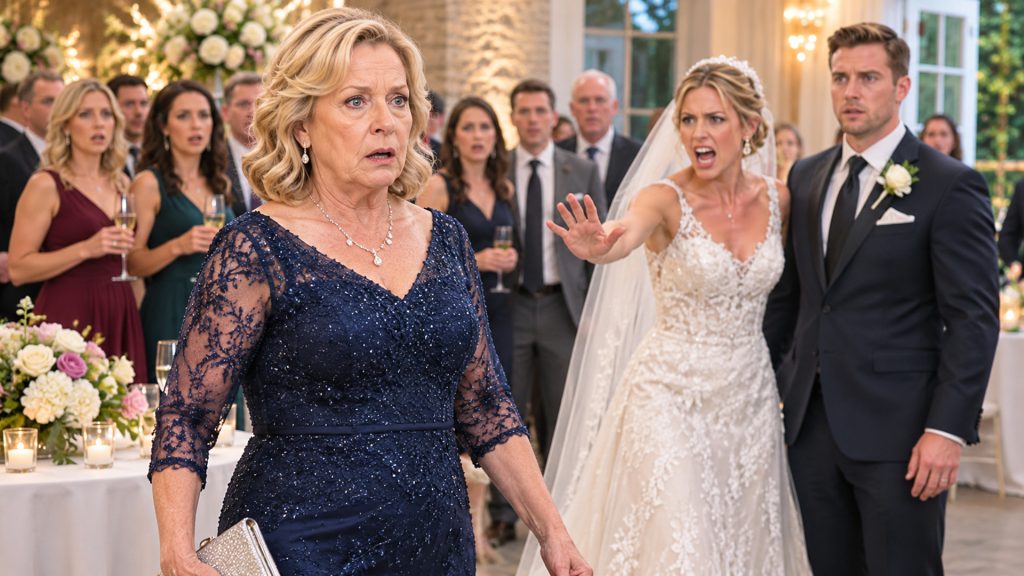
I had never imagined the bride would refuse to let me through the front door.
I opened my laptop again.
Marjorie Hollander had promised to send copies of the additional event authorizations and the suspicious email.
They arrived twenty minutes later.
There were eleven attachments.
I downloaded each one and created a folder.
Then I began reading.
The first document was the original venue agreement.
I recognized it immediately.
Months earlier, Bryce had called me, excited about a magnificent Hudson Valley estate.
“Mom, you should see this place,” he’d said. “There’s this incredible glass reception room overlooking the gardens. Dad would’ve loved it.”
Those last four words had settled the matter for me.
I’d contacted Marjorie privately and arranged to cover the venue package.
It was an expensive gift, but one I could comfortably afford.
Everett and I had built our manufacturing supply company from almost nothing. After his death, I expanded the business, worked long hours, and invested carefully.
I wasn’t wealthy because I’d inherited a fortune.
I was financially secure because I’d spent decades making difficult decisions, keeping promises, and refusing to spend money I didn’t have.
Paying for Bryce’s wedding venue had been a deliberate choice.
A gift.
Not an unlimited commitment.
The agreement included the estate’s reception space, standard catering, basic floral arrangements, and the accommodations originally reserved for the wedding party.
My company had nothing to do with it.
The payment came from my personal account, and the estate had acknowledged receiving it.
I opened the second attachment.
A revised service order.
Then the third.
Imported flowers.
Then another.
Premium champagne.
Additional suites.
Late-night dining.
Specialty lighting.
Extra entertainment.
Guest transportation.
Each document bore an authorization from Bryce or Joselyn.
None bore mine.
And together, the unpaid additions totaled seventy-four thousand dollars.
I opened the suspicious email last.
The sender’s name appeared as:
Desiree Whitmore
My full name.
My stomach tightened.
But Marjorie had been right.
The email address was almost identical to mine.
One letter had been added before the domain.
The message itself was brief.
Please accommodate any additional requests made by Bryce and Joselyn. I will make certain the costs are covered. This wedding is extremely important to our family.
Beneath it was a typed signature.
Desiree Whitmore.
I stared at those words.
The message was written in a voice that sounded vaguely like mine.
Polite.
Confident.
Generous.
But it contained a promise I’d never made.
Someone had used my name to encourage the estate to extend services and credit to my son and his bride.
And now Bryce was trying to make me fulfill that promise.
I printed the email.
Then I printed the invoices.
By the time the last page slid into the tray, my grief had changed.
It hadn’t disappeared.
But it had acquired boundaries.
I could be heartbroken.
I could love my son.
And I could still refuse to accept a debt that wasn’t mine.
The following morning, I called my attorney, Rebecca Shaw.
Rebecca had helped me navigate Everett’s estate, several business acquisitions, and the complicated process of preparing my company for new leadership.
She was calm under pressure, fiercely organized, and unimpressed by people who believed expensive clothing made them more credible.
“Desiree,” she said, “you sound tired.”
“I am.”
“What happened?”
I told her everything.
The trip.
The wedding entrance.
Joselyn’s words.
Bryce’s silence.
The seventy-four-thousand-dollar demand.
And the email that appeared to come from me.
Rebecca listened without interrupting.
When I finished, she asked one question.
“Did you authorize anyone to incur additional wedding expenses on your behalf?”
“No.”
“Did you guarantee payment under any contract?”
“No.”
“Did you tell Bryce or Joselyn you would cover whatever they ordered?”
“Absolutely not.”
“Good. Send me the documents.”
I hesitated.
“Rebecca, I don’t want to destroy my son’s marriage.”
She was silent for a moment.
Then she said gently, “Desiree, reviewing financial documents won’t destroy a marriage. What people choose to do with the truth is their responsibility.”
I looked toward Everett’s photograph.
My throat tightened.
“He lost his father. I don’t want him to feel he’s losing me too.”
Rebecca’s voice softened.
“Setting a financial boundary doesn’t mean withdrawing your love.”
I closed my eyes.
I wanted to believe that.
But for years, I’d confused helping Bryce with making sure he never felt disappointed.
And perhaps that was part of how we’d reached this moment.
Rebecca recommended preserving the suspicious email and asking the estate to retain its original electronic records.
She explained that a displayed sender’s name was not proof of who had sent a message, and an address that resembled mine didn’t establish authorization.
The relevant technical records could help investigators determine where the message originated.
She would also send a written statement making clear that I disputed the purported authorization and had not agreed to pay the additional charges.
We wouldn’t guess who had written the email.
We wouldn’t threaten anybody.
We would establish what could actually be proved.
“And the seventy-four thousand?” I asked.
“The estate can pursue payment from the parties who are responsible under the agreements. Whether Bryce and Joselyn owe every item depends on the contracts and what services were properly authorized and provided.”
“So I don’t need to pay simply because I’m the mother of the groom?”
Rebecca gave a dry laugh.
“Parenthood is not a blank check.”
I smiled for the first time in two days.
“Everett would have liked that.”
“Then perhaps you should remember it.”
After we ended the call, I sat quietly in my office.
My company’s transition plan lay open on the desk.
For the past year, I’d been preparing to reduce my involvement in daily operations.
My operations director, Elena Park, had worked beside me for seventeen years.
She knew every supplier, every production deadline, and every employee by name.
I’d planned to make her chief executive while retaining ownership and serving as chair.
I wanted time to travel.
To volunteer.
To sit beside the ocean without checking my email every ten minutes.
And, more than anything, I’d hoped to spend time with Bryce and the family he was beginning.
I had imagined holidays with grandchildren.
Summer visits to Alaska.
Perhaps even teaching a little boy or girl how to make Everett’s famous blueberry pancakes.
Now I looked at the transition checklist and wondered whether my son saw me as anything more than the person who paid when life became inconvenient.
The thought frightened me.
Not because I believed it was necessarily true.
But because I could no longer dismiss the possibility.
At noon, Bryce called.
I let the phone ring twice before answering.
“Hello, sweetheart.”
“Mom, did you talk to the estate?”
“Yes.”
“Great. So they’re going to stop calling us?”
I looked at the papers.
“No, Bryce.”
Silence.
“What do you mean?”
“I mean I’m not responsible for the additional charges.”
He sighed loudly.
“Mom, come on.”
“I reviewed the documents. Those services were ordered after the original venue package was paid.”
“Yeah, because weddings change.”
“Of course they do.”
“So what’s the problem?”
I took a slow breath.
“The problem is that neither you nor Joselyn asked whether I would pay for those changes.”
He became quiet.
Then said, “We assumed.”
I closed my eyes.
There it was.
The word at the center of so many family misunderstandings.
Assumed.
“You assumed I would pay seventy-four thousand dollars?”
“Mom, you’re making it sound crazy.”
“Bryce, seventy-four thousand dollars is a substantial amount of money.”
“Not for you.”
The answer came so quickly that I almost missed its cruelty.
Not for you.
As though the size of my savings determined whether anyone needed my permission.
I stood and walked toward the window.
“Bryce, do you understand that I already paid for the venue?”
“Yes.”
“That was my wedding gift.”
“I know.”
“Then why are you demanding another payment?”
He was quiet for a moment.
Then I heard a woman’s voice in the background.
Joselyn.
“Tell her it was promised.”
My stomach tightened.
Bryce cleared his throat.
“Mom, Joselyn says you told the coordinator everything would be covered.”
“I didn’t.”
“Well, there’s an email.”
“That email didn’t come from me.”
Silence.
Then Bryce laughed uneasily.
“What?”
“The address isn’t mine.”
I heard rustling.
A muffled conversation.
Then Joselyn’s voice again.
“She’s lying.”
I closed my eyes.
Bryce returned to the phone.
“Mom, are you seriously saying someone faked an email from you?”
“Yes.”
“Who?”
“I don’t know.”
He made a frustrated sound.
“Then why are you acting like this is settled?”
“Because I know what I did and didn’t authorize.”
His voice hardened.
“You’re really going to embarrass us over money?”
I stared at the mountains.
“Bryce, do you remember what happened when I arrived at your wedding?”
There was a long pause.
“Mom, not this again.”
My throat tightened.
“Not this again?”
“Joselyn said there was a misunderstanding.”
“She told me I didn’t matter to you.”
Silence.
“She told me to leave.”
“She was stressed.”
I closed my eyes.
“The wedding was stressful for everyone.”
“She didn’t mean it.”
“Bryce, you haven’t even asked me what happened.”
His voice dropped.
“She told me you got upset and left.”
I swallowed.
“And you believed her?”
“Why wouldn’t I?”
The words landed harder than I expected.
Not because a husband should automatically distrust his wife.
But because my son had never thought to ask his mother why she’d traveled fourteen hours only to leave before the ceremony.
I looked toward Everett’s picture.
Then said quietly, “Bryce, I came to your wedding carrying your father’s cufflinks.”
There was silence.
“I wanted to give them to you before the ceremony.”
His voice changed.
“You brought Dad’s cufflinks?”
“Yes.”
Another pause.
“Why didn’t you tell me?”
I laughed once, without humor.
“Because your bride told me I wasn’t welcome, and you never came looking.”
He didn’t answer.
I continued.
“Six days passed. You didn’t call to see whether I was all right.”
“Mom—”
“Then you called because you wanted money.”
My voice broke.
“I need you to understand how that felt.”
For a moment, I thought he might apologize.
Instead, he whispered, “This is why Joselyn didn’t want a scene.”
Something inside me went terribly still.
“Goodbye, Bryce.”
I ended the call.
Then I sat at my desk and cried.
Not because I had lost the argument.
But because my son still didn’t understand there was one.
Three days later, an envelope arrived at my house.
It contained a handwritten note from Marjorie Hollander.
Dear Desiree,
I’ve reviewed the wedding records, including the entrance footage. What happened to you that evening was deeply unkind. You deserved better.
I’ve preserved the relevant records and will cooperate with your attorney as appropriate.
The venue payment you arranged was a generous gift, and I hope you won’t allow anyone to convince you otherwise.
Warmly, Marjorie.
Beneath the note was a photograph.
Everett and I, many years earlier, standing beneath the oak trees at the Hollander estate.
I had forgotten that photograph existed.
We’d visited the property during a vacation in New York, long before it became a luxury wedding venue.
Marjorie’s late husband had been an old business acquaintance of Everett’s.
He’d invited us for dinner.
In the photograph, Everett had one arm around my waist and the other resting against the trunk of an enormous tree.
We looked young.
Happy.
Certain that life would continue giving us time.
I touched his face.
Then I remembered something he said that evening.
“Desiree, when Bryce grows up, I hope he finds somebody who makes him kinder.”
At the time, I’d laughed.
“Don’t you mean somebody who makes him happy?”
Everett had smiled.
“Both, if he’s lucky. But happiness without kindness can become a very selfish thing.”
I hadn’t understood how important those words would become.
That evening, I opened the photograph on my phone and sent it to Bryce.
Your father and I visited this estate years ago. I thought you’d like to have this picture.
There was no reply.
I hadn’t expected one.
But I wanted him to have a reminder of his father that wasn’t connected to a bill.
The following week, Rebecca called.
“Desiree, we have an update about the email.”
I sat straighter.
“Did they identify who sent it?”
“Marjorie’s records show the original message came from an account registered using a telephone number associated with Joselyn’s wedding planning arrangements.”
I closed my eyes.
“Joselyn?”
“That’s where the available records point, but we still need to establish who controlled the account and sent the message.”
I nodded.
Rebecca continued.
“The estate also has written acknowledgments from Bryce and Joselyn accepting responsibility for the additions they authorized.”
“So they can’t claim I signed the contracts?”
“Not based on the documents we’ve reviewed.”
I rubbed my forehead.
“And what happens now?”
“The estate will address the unpaid charges with them. If the impersonation concerns are substantiated, there may be additional consequences. We’re keeping your disputed authorization separate from their payment obligations.”
I stared toward the window.
“Does Bryce know?”
“His attorney has been informed of the dispute. I can’t tell you how much he’s personally reviewed.”
I thanked her.
Then ended the call.
For a long time, I sat quietly.
I had wanted the facts.
Now I had more of them.
But the facts weren’t making me feel victorious.
They were making me feel tired.
I had known Joselyn for nearly three years.
When Bryce first introduced us, she was charming.
She remembered my favorite tea.
Asked thoughtful questions about Alaska.
And complimented the jewelry Everett had given me.
I liked her.
I wanted to like her.
When Bryce called to say he planned to propose, I was genuinely happy.
“Mom, I think she’s the one.”
I laughed.
“Then I hope you’ll spend your lives making each other happy.”
He was quiet.
Then said, “Dad would’ve liked her.”
I had no reason to question that.
Not then.
But as the wedding approached, Joselyn became increasingly controlling.
At first, the demands seemed small.
She wanted the invitations addressed a particular way.
She preferred her family’s traditions.
She insisted that the guest list remain intimate.
I understood.
Weddings were personal, and it wasn’t my place to dictate their celebration.
But then the invitations arrived.
Mine was missing.
When I asked Bryce, he sounded surprised.
“Mom, of course you’re invited.”
“Then why didn’t I receive one?”
“Joselyn’s handling the list. I’ll check.”
A week later, he assured me everything was fine.
I believed him.
Because I wanted to.
There were other moments.
Joselyn declined my offer to help choose flowers.
She asked me not to arrive early because the wedding party would be busy.
She suggested that it would be easier if I stayed at a hotel rather than the estate.
None of those requests, taken individually, seemed worth a confrontation.
So I accepted them.
I told myself that my role was to support the couple.
Not to insist on attention.
But looking back, I saw how gradually I’d been pushed farther from my son’s wedding.
Until, finally, I stood at the entrance in a pearl-gray dress and was told to leave.
The cruelty had not appeared suddenly.
It had been approaching for months.
And I had been too determined to be agreeable to recognize it.
Elena Park found me sitting alone in my office late one Thursday afternoon.
She knocked lightly.
“Desiree?”
I looked up.
“Come in.”
She entered carrying a folder.
“These are the revised leadership transition documents.”
I smiled faintly.
“Thank you.”
She studied me.
“Are you all right?”
I considered offering the familiar answer.
Of course.
Just tired.
Lots happening.
But Elena had worked with me for seventeen years.
She knew when I was hiding something.
“My son’s wedding was difficult,” I admitted.
She sat down.
“Do you want to talk about it?”
I hesitated.
Then told her enough to explain why I hadn’t been myself.
When I finished, Elena looked stunned.
“Desiree, you built this company while caring for your husband through cancer.”
I stared at her.
“You made payroll when the economy collapsed. You personally visited suppliers when shipments stopped. You never asked employees to sacrifice what you weren’t willing to sacrifice yourself.”
My eyes filled.
She leaned forward.
“Please don’t let anyone make you feel selfish for protecting what you’ve built.”
I swallowed.
“He’s my son.”
“I know.”
“He doesn’t have his father anymore.”
Elena’s expression softened.
“Neither do you have your husband.”
I looked down.
She continued gently.
“And you’ve been carrying both losses for a very long time.”
That night, I went home and opened Everett’s old letters.
He had written them during the final months of his illness.
Some were addressed to Bryce.
Others to me.
One was simply labeled:
For the hard days.
I unfolded it carefully.
Desiree,
If you’re reading this, you’re probably trying to solve a problem that belongs partly to somebody else.
I laughed through tears.
That was Everett.
Even dying, he knew me.
You have always believed that love means finding a way to help. Usually, that’s one of your greatest gifts.
But our boy is going to grow into a man who must make decisions without us.
Let him.
Be there when he falls. Tell him the truth when he’s wrong. Never make him wonder whether you love him.
But don’t teach him that your love means he never has to carry the consequences of his choices.
I love you. I am proud of you.
And I hope you remember that you’re allowed to have a life of your own.
I pressed the letter against my chest.
Then cried until there were no tears left.
The next morning, I called Rebecca.
“I want to make sure my business transition goes ahead as planned.”
“Of course.”
“And I want my estate documents reviewed.”
She paused.
“Because of Bryce?”
“Partly.”
I looked toward the mountains.
“But mostly because I want my affairs organized according to my own wishes.”
We discussed the distinction between my company, my personal assets, and any future gifts I might choose to make.
Rebecca cautioned me against changing legal documents merely to punish someone while emotions were running high.
I agreed.
I wasn’t interested in revenge.
I wanted a plan that reflected my values.
The business had employees whose livelihoods depended on its stability.
My personal estate needed clear administration.
And if I someday decided to help Bryce financially, that help would be voluntary, documented, and discussed honestly.
No assumptions.
No pressure.
No mysterious emails.
Two weeks later, a woman named Caroline Mercer called me.
I didn’t recognize the name.
“Mrs. Whitmore?”
“Speaking.”
“My name is Caroline. I’m Joselyn’s aunt.”
I sat down.
“How can I help you?”
She hesitated.
“I hope this isn’t inappropriate. I received your number from Marjorie Hollander.”
Marjorie had asked permission before sharing my contact details, and I’d agreed because Caroline said she had information relevant to the wedding.
“Go ahead.”
Caroline took a breath.
“I was at the entrance when Joselyn turned you away.”
My heart tightened.
“You were?”
“Yes.”
I remembered the two bridesmaids.
The elegant flowers.
The people pretending not to watch.
Caroline continued.
“I didn’t hear every word. But I saw you leave.”
I swallowed.
“Why are you calling?”
Her voice trembled.
“Because I should have said something.”
I sat quietly.
Caroline explained that she’d been helping coordinate guests on the wedding day.
She had noticed my arrival and started toward the entrance.
But Joselyn stopped her.
“She said it was a private family matter,” Caroline whispered.
I closed my eyes.
“Did you know I was Bryce’s mother?”
“Yes.”
My throat tightened.
“Then why didn’t you help me?”
Caroline began crying.
“I was afraid of upsetting Joselyn.”
I looked toward Everett’s photograph.
There it was again.
Someone had seen something wrong and chosen comfort over courage.
Caroline continued.
“I’m not calling to ask you to excuse me.”
I waited.
“I just want you to know that what happened was wrong.”
For a moment, I couldn’t speak.
Then I whispered, “Thank you.”
Caroline hesitated.
“There’s something else.”
My stomach tightened.
“What?”
“Bryce asked about you before the ceremony.”
I closed my eyes.
“Marjorie told me.”
“No. I mean he asked me directly.”
I sat straighter.
“What did he say?”
“He wanted to know whether you’d arrived. I told him I thought you had.”
My throat tightened.
“And?”
“Joselyn came over and said you had left because you were unhappy with the arrangements.”
I stared at the wall.
Caroline continued.
“Bryce looked upset. He asked whether anyone had tried to stop you.”
I closed my eyes.
“And what did you say?”
Her voice broke.
“I said I wasn’t sure.”
I swallowed.
“Even though you’d seen Joselyn turn me away.”
“Yes.”
The room went silent.
Then Caroline whispered:
“I’ve regretted that every day.”
After the call, I sat for a long time.
I was beginning to understand the wedding had been built around a collection of convenient silences.
Joselyn had told me I didn’t matter.
Bryce had accepted an explanation without calling me.
Caroline had seen enough to question what happened but remained silent.
The coordinator had received an email promising payment and failed to verify the unusual address before relying on it.
Everyone had been trying to keep the celebration moving.
And somewhere in that beautiful, candlelit evening, honesty had become an inconvenience.
A month after the wedding, Bryce arrived at my house.
I hadn’t known he was coming.
I was in the kitchen making tea when the doorbell rang.
I opened the door.
There stood my son.
His hair was uncombed.
There were shadows beneath his eyes.
He wore a dark jacket and held a small carry-on bag.
For a moment, I could only stare.
“Bryce?”
He swallowed.
“Hi, Mom.”
I looked past him.
“Where’s Joselyn?”
His face tightened.
“Back in New York.”
I stepped aside.
“Come in.”
Bryce entered slowly.
He looked around the house where he’d grown up.
The photographs on the wall.
The old wooden staircase.
The coat hooks Everett had installed when Bryce was six.
His eyes stopped on the family portrait above the fireplace.
Then he whispered:
“Everything looks the same.”
I closed the door.
“Some things do.”
He turned toward me.
“Mom, can we talk?”
I nodded.
“Of course.”
We sat at the kitchen table.
For several minutes, Bryce stared at his hands.
Then he said:
“I found out about the email.”
My heart tightened.
“All right.”
He swallowed.
“Joselyn sent it.”
I didn’t speak.
“She admitted it.”
I watched his face.
He looked devastated.
Not merely embarrassed.
Devastated.
“She said she was afraid the venue would refuse the extra services if they knew we couldn’t guarantee payment.”
I took a slow breath.
“And she used my name.”
He nodded.
“Yes.”
I looked down at my tea.
Bryce continued.
“She told me you’d already agreed. She said it was a surprise and that you didn’t want me worrying about the bill.”
I stared at him.
“And you believed her?”
He closed his eyes.
“Yes.”
“Why?”
He looked at me.
“Because I wanted to.”
The honesty surprised me.
He swallowed.
“I wanted that wedding. I wanted everything to be beautiful. And when Joselyn said you were covering it, I didn’t ask questions.”
I nodded slowly.
“That was your choice.”
His eyes filled.
“I know.”
He rubbed his face.
“The estate sent the final account. We’ve been reviewing the charges with an attorney.”
I waited.
“They’re trying to work out payment arrangements for the amounts we legally owe.”
“That’s sensible.”
He looked surprised.
“You’re not angry?”
I studied him.
“Bryce, I’m hurt. I’m disappointed. And I’m concerned about what happened.”
His eyes filled.
“But you taking responsibility for your own expenses is not something I’m angry about.”
He stared at me.
Then whispered:
“Joselyn says you’ve turned everyone against her.”
I shook my head.
“I’ve spoken to the people involved about what actually happened.”
He nodded.
“I know.”
I took a breath.
“Bryce, what happened between you and Joselyn?”
He looked toward the window.
Then said quietly:
“She admitted telling you to leave.”
For a moment, the kitchen seemed completely still.
He continued.
“She said she didn’t want you there because she was worried you’d make the wedding about Dad.”
My throat tightened.
“About your father?”
Bryce nodded.
“She said every time we talked about the wedding, I mentioned him.”
I stared.
He swallowed.
“His cufflinks. His favorite songs. The fact that he never got to meet her.”
My eyes filled.
“Bryce…”
He looked at me.
“She said she wanted the day to be about us, not about someone who’d died years ago.”
I pressed my hand against my mouth.
Everett had been gone for almost eight years.
But he was still Bryce’s father.
He was still part of our family.
And the idea that remembering him would somehow diminish a wedding made my heart ache.
Bryce began crying.
“I didn’t understand why she was so upset.”
I reached for a tissue.
He took it.
“Then she said you were probably going to bring up Dad in front of everyone, and she didn’t want that.”
I looked at him.
“Did you agree?”
He closed his eyes.
“Not exactly.”
“Bryce.”
He swallowed.
“I told her I didn’t want any drama.”
The words hurt.
Not as much as the wedding entrance.
But enough.
I took a slow breath.
“And what did that mean?”
He looked down.
“It meant I let her decide what counted as drama.”
I sat quietly.
For years, I had protected Bryce from discomfort whenever I could.
After Everett died, I made sure he had opportunities.
I helped with college.
Supported his first apartment.
Celebrated his successes.
And listened through every heartbreak.
Perhaps I’d sometimes been so afraid of losing him emotionally that I failed to show him how important it was to face difficult truths.
But he was thirty-one now.
A grown man.
I could acknowledge my parenting mistakes without accepting responsibility for his adult choices.
“Bryce,” I said gently, “your wife didn’t need to love me the way you do.”
He looked up.
“She didn’t need to want me involved in every wedding decision.”
My voice trembled.
“But basic kindness wasn’t optional.”
His eyes filled.
I continued.
“And neither was your responsibility to ask why your mother had vanished.”
He began crying.
“I know.”
I looked at him.
“You didn’t call for six days.”
He covered his face.
“I know.”
“And when you finally called, you asked me for money.”
His shoulders shook.
“I’m sorry.”
I sat quietly.
Then I said something I’d been carrying for weeks.
“You made me feel like your father’s death had left me with no place in your life except as someone who could pay for things.”
Bryce looked up sharply.
“Mom, no.”
I swallowed.
“That’s how it felt.”
He began crying harder.
I didn’t rush to reassure him.
Sometimes a person needs to hear the hurt they caused without immediately being protected from it.
Bryce stayed three days.
Not because I insisted.
Because he asked.
On the second morning, I found him in the garage.
He stood beside Everett’s old workbench, holding a small wooden box.
Inside were screws, nails, and a collection of mismatched tools.
“Dad never threw anything away,” he said.
I smiled sadly.
“He said every piece of hardware had another job waiting for it.”
Bryce laughed.
Then looked toward the doorway.
“Mom, can I ask you something?”
“Of course.”
“Do you think Dad would’ve been ashamed of me?”
My heart tightened.
I walked toward him.
“Your father loved you.”
Bryce nodded.
“But would he have been disappointed?”
I considered the question.
I wouldn’t lie about Everett simply to comfort our son.
“I think he’d have been disappointed by how you treated me.”
Bryce looked down.
I continued.
“And I think he’d have wanted you to take responsibility and do better.”
My son’s eyes filled.
“I wish I could talk to him.”
I placed a hand against his shoulder.
“So do I.”
That afternoon, I gave Bryce a copy of Everett’s letter about the hard days.
He read it silently.
Halfway through, his face crumpled.
When he finished, he sat very still.
Then he whispered:
“He knew.”
I sat beside him.
“Knew what?”
“That I’d need to learn how to stand on my own.”
I smiled sadly.
“He hoped you would.”
Bryce folded the letter carefully.
Then looked at me.
“Mom, I think I’ve been using the fact that Dad died to avoid becoming the kind of man he’d want me to be.”
My throat tightened.
“Bryce, grief isn’t something you simply get over.”
He nodded.
“But I can’t keep treating everyone else’s responsibilities like they’re yours.”
I took his hand.
“No, sweetheart. You can’t.”
Before Bryce returned to New York, we discussed the cufflinks.
I brought the velvet pouch downstairs and placed it on the table.
His face changed immediately.
“Mom.”
I opened the bag.
The silver initials caught the afternoon light.
“E.W.”
Bryce touched them gently.
“These were Dad’s.”
“Yes.”
He swallowed.
“You were going to give them to me before the wedding.”
I nodded.
Tears filled his eyes.
For a moment, he didn’t move.
Then he whispered:
“I don’t deserve them.”
I looked at him.
“Bryce, your father didn’t leave these to you because he believed you would never make mistakes.”
His eyes lifted.
“He left them because he loved you.”
I closed the pouch.
“But I want you to have them when you can accept what they represent.”
He nodded slowly.
“Not an expensive accessory.”
I smiled.
“No.”
“A responsibility.”
I touched his cheek.
“Exactly.”
I didn’t give him the cufflinks that day.
Not to punish him.
But because the moment no longer belonged to a wedding ceremony.
It belonged to a deeper promise he was still learning to keep.
During the following months, Bryce began making changes.
He and Joselyn attended marriage counseling.
Their financial obligations were reviewed with professional guidance.
They sold several luxury items they’d bought for their new life and adjusted their spending.
The estate negotiated payment terms for the charges the couple accepted, while disputed details were handled separately.
The unauthorized email remained part of the formal review.
Nobody simply erased it because Joselyn had apologized.
And I didn’t pay the seventy-four thousand dollars.
I had already given them a wedding venue.
The remaining obligations were theirs to resolve.
Joselyn eventually wrote me a letter.
I almost didn’t open it.
But one rainy afternoon, I sat beside the fireplace and read.
Desiree,
I owe you an apology.
I was cruel to you at the wedding. I sent you away because I wanted everything to look exactly the way I’d imagined, and I was angry that Bryce’s grief and your history together were parts of his life I couldn’t control.
I also used your name in an email without permission. I told myself you would agree afterward. That was dishonest.
You did not deserve what I did.
I understand if you don’t want a relationship with me.
Joselyn.
I read the letter twice.
It wasn’t perfect.
No apology can return a mother to the wedding she missed.
But it contained something her earlier explanations hadn’t.
Responsibility.
I wrote back.
Joselyn,
Thank you for acknowledging what happened. I hope you and Bryce continue working toward a marriage grounded in honesty and mutual respect.
I am willing to be civil and, in time, to see whether trust can be rebuilt. That will depend on consistent actions, not simply words.
I wish you both well.
Desiree.
I didn’t write that everything was forgiven.
It wasn’t.
And I wasn’t going to make a promise my heart wasn’t ready to keep.
By autumn, my business transition was complete.
Elena became chief executive.
I remained chair, attending important meetings and offering guidance when needed.
But for the first time in decades, my days belonged largely to me.
I traveled to the coast.
Spent a week with an old friend in Oregon.
Returned to painting, something I’d abandoned when Everett became ill.
And began volunteering with an organization that helped widowed people adjust to life after loss.
There were afternoons when I missed my husband so intensely that I could barely breathe.
But there were also mornings when I woke excited about something new.
I was learning that grief and joy could inhabit the same life.
Neither needed to erase the other.
One evening, nearly a year after the wedding, Bryce called.
“Mom?”
“Hello, sweetheart.”
His voice sounded nervous.
“Would you come to dinner?”
I smiled.
“Where?”
“At our apartment. Just the three of us.”
I hesitated.
Our relationship had improved.
We spoke regularly.
He asked about my business, my painting, and my travels.
He no longer called only when something needed fixing.
And he had stopped treating my financial decisions as family property.
Still, this invitation meant something different.
“Bryce, are you sure Joselyn wants me there?”
He was quiet.
Then said:
“Mom, I’m asking because I want you there. And Joselyn knows that.”
My eyes filled.
“All right.”
I traveled to New York the following month.
This time, nobody stopped me at the door.
Bryce opened it himself.
He hugged me tightly.
Then stepped aside.
“Come in, Mom.”
Joselyn stood near the dining table.
She looked nervous.
“Desiree.”
“Hello, Joselyn.”
She took a breath.
“Thank you for coming.”
I nodded.
“Thank you for inviting me.”
Dinner was simple.
Roast chicken.
Potatoes.
A salad.
And a chocolate cake Bryce had attempted to bake himself.
It leaned slightly to one side.
I laughed when I saw it.
“Your father would have called that architectural creativity.”
Bryce grinned.
“He would’ve eaten half of it before dinner.”
For a moment, the three of us laughed together.
It was tentative.
Awkward.
But real.
After dinner, Bryce brought out a small album.
Inside were wedding photographs.
He turned the pages slowly.
The estate gardens.
The flowers.
The ceremony.
The first dance.
Then he stopped.
“Mom, there’s something I want to say.”
I looked at him.
His eyes filled.
“I can’t give you back that day.”
I swallowed.
“No.”
He took a breath.
“But I want you to know I understand why it mattered.”
He turned another page.
There was a photograph of Everett that Bryce had placed near the reception entrance.
I hadn’t known it was there.
My throat tightened.
Bryce whispered:
“I wanted Dad with me.”
I touched the picture.
“I know.”
He looked at Joselyn.
Then back at me.
“And I should’ve wanted you there just as much.”
Joselyn lowered her eyes.
“I’m sorry, Desiree.”
I nodded slowly.
“I know.”
Bryce reached across the table and took my hand.
“I love you, Mom.”
Tears filled my eyes.
“I love you too.”
For the first time in a long while, I believed we were speaking about the same kind of love.
Not money.
Not obligation.
Not what one person could demand from another.
Just the connection between a mother and the son she’d raised.
Before I returned to Alaska, Bryce asked whether we could take a walk.
We went to a small park near his apartment.
The trees had turned gold.
Leaves covered the path.
For a while, we walked without speaking.
Then he stopped beside a wooden bench.
“Mom, I’ve been thinking about Dad’s cufflinks.”
I looked at him.
“Have you?”
He nodded.
“I don’t want them because they belonged to a man who always knew the right thing to do.”
I smiled sadly.
“Your father made mistakes too.”
Bryce looked toward me.
“I want them because he understood that loving somebody means being responsible for how you treat them.”
My throat tightened.
He continued.
“I can’t change what I did at the wedding. But I can spend the rest of my life being someone who doesn’t make you feel disposable.”
I began crying.
Bryce stepped closer.
“I’m not asking you to forget.”
He swallowed.
“I’m asking for the chance to keep proving that I’ve learned.”
I put my arms around him.
“Oh, sweetheart.”
He hugged me tightly.
And for a moment, he was my little boy again.
Not because he needed me to rescue him.
But because he finally understood that growing up didn’t require loving his mother less.
That Christmas, Bryce visited Anchorage.
Joselyn came too.
We decorated the tree together.
Cooked Everett’s favorite dinner.
And spent an evening looking through old family photographs.
On Christmas morning, after breakfast, I asked Bryce to sit beside the fireplace.
He looked puzzled.
“Mom?”
I handed him a small velvet pouch.
He stared.
Then looked up.
“Are you sure?”
I smiled through tears.
“Yes.”
He opened it.
Inside were Everett’s cufflinks.
The same ones I’d carried fourteen hours to a wedding I hadn’t been allowed to attend.
Bryce held them carefully.
For a long moment, he couldn’t speak.
Then he whispered:
“I’ll take care of them.”
I touched his cheek.
“I know.”
We didn’t recreate the wedding.
We couldn’t.
And I no longer needed to.
The cufflinks had finally reached their intended owner.
Not at the moment I originally imagined.
But at a moment when their meaning could be understood.
Today, when people ask me whether I regret paying for Bryce’s wedding venue, I tell them no.
The gift was given with love.
I don’t regret loving my son.
I don’t regret wanting him to have a beautiful wedding.
And I don’t regret the years I spent working to give him opportunities his father and I once only dreamed about.
But I am grateful that I finally learned something my husband had understood long before I did.
Love is a gift freely given, not a debt another person has the right to collect.
I also learned that silence can mean very different things.
The silence I chose when Joselyn turned me away was not surrender.
It was the decision not to turn my son’s wedding into a public argument.
But afterward, I had to find my voice.
I had to say no.
I had to explain how deeply I’d been hurt.
And I had to allow my son to face the consequences of decisions I could not make for him.
That was harder than paying a bill.
Far harder.
My name is Desiree Whitmore.
I’m a widow.
A businesswoman.
A mother.
And a woman who once believed that protecting her only son from hardship was the surest way to show him love.
I know better now.
Sometimes loving your child means celebrating his victories.
Sometimes it means holding him through grief.
And sometimes it means refusing to rescue him from a responsibility that belongs to him.
I still have the pearl-gray dress.
For months, it hung at the back of my closet, reminding me of the wedding I missed.
Then one evening, I took it out.
I wore it to a charity dinner in Anchorage.
I put on my favorite earrings, fixed my hair, and walked into a room filled with people who greeted me warmly.
Nobody questioned whether I belonged.
Nobody told me I hadn’t earned a seat.
And as I stood beneath the soft lights, I realized I had finally stopped allowing one cruel evening to define me.
I think Everett would have smiled.
Not because everything turned out perfectly.
It didn’t.
There were broken promises, difficult conversations, financial consequences, and relationships that required careful rebuilding.
But Bryce was learning.
Joselyn was learning.
And so was I.
Fourteen hours of travel brought me to a doorway where I was told I didn’t matter.
Six days later, a seventy-four-thousand-dollar bill forced me to confront a truth I’d avoided for years.
I could be a loving mother without being an unlimited source of money.
I could forgive without pretending nothing happened.
And I could welcome my son back into my life without surrendering the respect I deserved.
The greatest inheritance Everett left our son was never the silver cufflinks. It was the example of a man who understood that love and responsibility must walk together.
And when Bryce finally understood that lesson, I knew his father had given him something no amount of money could ever purchase.
A better way to become a husband.
A better way to become a son.
And a better way to become a man.