My father answered on the second ring. “Ellen?” His voice was steady, but I could hear the television playing softly behind him. He was probably sitting in his familiar leather chair, the one he’d bought the year I received my first military commission. “Dad, I found something.” He didn’t interrupt.
“Something with my name on it. A loan application. It lists this house as collateral.” The television went silent. “Ellie,” he said carefully, “did you sign anything?” “No.” “Are you certain?” “Dad, I would remember offering my house to secure a loan.” There was a pause. Then he said, “Good. First, put that paper somewhere safe. Second, don’t accuse anybody until you know exactly what it is.”
I sank into a kitchen chair. “Russ and I had an argument.” “I gathered that.” “It was worse than I told you.” “Then tell me now.” I looked at the application again. The signature at the bottom resembled mine, but the capital E was wrong. I had developed my handwriting over decades of signing military reports and official correspondence. My signature was hurried, angular, and nearly impossible to imitate without making it look deliberate.
This one was too neat.
Too careful.
I told Dad everything.
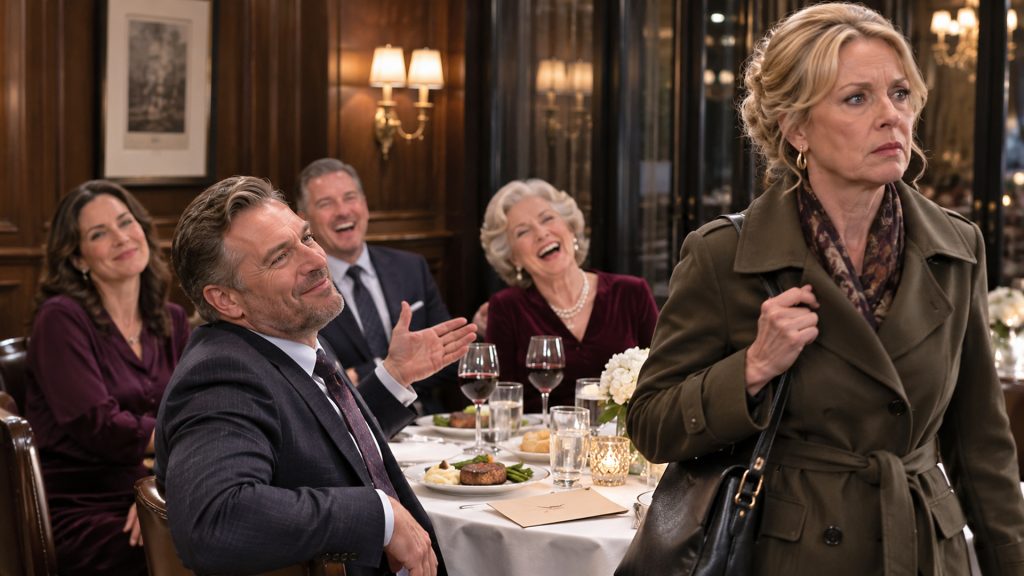
The anniversary dinner.
Russ announcing that he regretted marrying me.
His family laughing.
Dolores handing me the assisted-living statement.
The overdue balance.
Wayne’s business.
And the loan application listing my house as proposed security.
When I finished, Dad was quiet.
Then he said, “Your mother used to tell you something whenever you came home upset from school. Do you remember?”
I swallowed.
“She said not every insult deserves an answer.”
“That’s right.”
His voice softened.
“But she also said silence doesn’t mean you have to surrender.”
My eyes filled.
“I remember.”
“Now, eat something and get some sleep. Tomorrow, call a lawyer. Not because you’ve decided to divorce Russ tonight, but because you need to know what’s happening with your property.”
I looked at the yellow kettle resting on the stove.
“Dad, I’m sixty-four years old. How did I let things get this far?”
He answered without hesitation.
“Because you spent fifteen years trying to make a marriage work. Don’t confuse that with permission for somebody to take advantage of you.”
I covered my eyes.
For the first time that evening, I cried without trying to stop myself.
The following morning, I woke to sunlight entering through the curtains of my childhood bedroom.
For a moment, I forgot where I was.
Then I heard the furnace.
Smelled the faint fragrance of the cedar chest at the foot of the bed.
And remembered.
Fifteen years.
One anniversary dinner.
One sentence that changed everything.
I reached for my phone.
There were fourteen missed calls from Russ.
Three from Dolores.
Two from Wayne.
And one text from Joanne, Russ’s younger sister.
Ellie, I hope you’ve calmed down. Russ was joking. You embarrassed everyone by leaving.
I stared at the message.
Not one person had asked whether I was safe.
Not one person had apologized.
The only concern seemed to be that I’d refused to sit quietly through my own humiliation.
I placed the phone aside.
Then went downstairs and made coffee in my mother’s old percolator.
I had forgotten how loudly it bubbled.
The sound made me smile.
For fifteen years, I’d made coffee according to Russ’s preferences.
Strong.
Black.
Immediately after waking.
He liked it waiting when he came downstairs.
I had continued that habit even after retiring from the Army.
Somewhere along the way, I had begun arranging my mornings around a man who no longer noticed whether I was happy.
Now I sat beside the kitchen window and drank coffee exactly the way I liked it.
With cream.
And a little cinnamon.
At nine, I called my sister, Marianne.
She had retired from accounting three years earlier and lived near Dad in Columbus.
When I told her about the loan application, she became unusually quiet.
“Ellie, please tell me you haven’t signed anything.”
“I haven’t.”
“Good. Can you send me photographs of the documents?”
“I already took them.”
She gave a small laugh.
“Twenty-eight years in uniform. Some habits never leave.”
I smiled.
“Apparently not.”
Then she became serious.
“I want you to call Rebecca Lawson.”
“Who’s that?”
“A property and family-law attorney I’ve worked with before. She’s careful, and she won’t tell you what you want to hear just because you’re upset.”
I looked at the application.
“That’s exactly what I need.”
Marianne paused.
“Ellie?”
“Yes?”
“Are you going back to Russ?”
I stared toward the garden.
“I don’t know.”
She was quiet.
Then she said something that stayed with me.
“That’s all right. You don’t have to know today.”
Rebecca Lawson agreed to see me that afternoon.
Her office occupied the second floor of a brick building in downtown Dayton.
She was a woman in her early fifties with short gray hair, a direct manner, and the kind of patient attention I’d always appreciated in a good military officer.
I placed the envelope on her desk.
She read the assisted-living statement first.
Then the loan application.
Her expression changed.
“Mrs. Mercer, is this house titled solely in your name?”
“Yes.”
“When did you acquire it?”
“My father transferred it to me before Russ and I married.”
“Do you have the deed and transfer records?”
“Yes.”
She nodded.
“And have you granted your husband authority to borrow against it?”
“No.”
She studied the signature.
“Did you sign this?”
“Absolutely not.”
Rebecca set down the paper.
“Then our first priority is verifying what this document represents.”
I frowned.
“What do you mean?”
“A loan application isn’t the same as a completed mortgage. Someone may have proposed the house as collateral without the lender accepting it. We need to determine whether anything was submitted, whether the lender relied on it, and whether any lien or other instrument has actually been recorded.”
I nodded slowly.
“So my house isn’t automatically in danger?”
“Not merely because your address appears on this form. But an unauthorized signature is serious enough that we should investigate promptly.”
I exhaled.
For the first time since discovering the document, I felt my training return.
Don’t panic.
Establish the facts.
Protect the position.
Then make decisions.
Rebecca helped me prepare a written statement that I had not authorized any loan secured by my house.
She recommended contacting the named lender through verified contact information, not simply the telephone number printed on the application.
We would also obtain current property records and preserve the original documents.
If the evidence supported suspected fraud or identity misuse, the appropriate reports could be made.
Nothing about the situation required shouting.
Nothing required threatening Russ over the telephone.
We could move carefully.
And carefully was something I knew how to do.
Before I left, Rebecca asked another question.
“How are your household finances arranged?”
I hesitated.
“We have a joint checking account for household expenses. But my military retirement benefits and investments go into accounts in my name.”
“Does Russ have access to those accounts?”
“Some limited access to information. Not authority to move everything.”
She nodded.
“And you’ve been helping pay his mother’s assisted-living expenses?”
“Yes.”
“For how long?”
“Seven years.”
“Was that assistance part of any written agreement?”
“No. It was a family arrangement.”
Rebecca folded her hands.
“Then we should review what you’ve paid, what you agreed to pay, and whether anyone represented you as responsible for an obligation you didn’t accept.”
My throat tightened.
I thought of Dolores sliding the statement across the anniversary table without even looking at me.
You’ll see to it?
Not a request.
Not gratitude.
An instruction.
That evening, Marianne arrived carrying a small suitcase.
I opened the door and stared.
“What are you doing here?”
She lifted the suitcase.
“Dad said the house needed another person who knows where the good coffee is kept.”
I laughed.
Then hugged her.
We hadn’t lived under the same roof since we were teenagers.
But standing together in our mother’s kitchen, I felt something loosen inside my chest.
Marianne put her bag downstairs.
Then opened her laptop at the dining table.
“Okay, Colonel. Let’s inspect the numbers.”
I rolled my eyes.
“Don’t you start.”
She grinned.
“The difference is that I’m joking with you, not making you the joke.”
I smiled.
And suddenly I realized why Russ’s family’s laughter had hurt so much.
It wasn’t that I couldn’t tolerate humor.
It was that their humor always seemed to require me to become smaller.
We worked for three hours.
I gathered bank statements, check images, assisted-living payments, household expenses, and records of transfers to Russ.
Marianne organized them into a spreadsheet.
At first, I felt almost embarrassed by how many documents I had.
Then I remembered what twenty-eight years in the Army had taught me.
Good records aren’t evidence of mistrust.
They’re a way to keep complicated responsibilities from becoming confused.
As the evening progressed, the picture became clearer.
For seven years, I’d paid a fixed monthly contribution toward Dolores’s residence.
Russ had agreed to cover the remaining amount from his income, with occasional help from Wayne and Joanne.
For the first several years, the payments appeared consistent.
Then, about nine months earlier, Russ’s transfers changed.
Some were smaller.
Others disappeared entirely.
My contributions continued.
But the overall residence account had fallen behind.
Marianne leaned back.
“Ellie, your payments didn’t stop.”
“I know.”
“Russ stopped covering his part.”
I stared at the spreadsheet.
“And nobody told me.”
She nodded.
I thought about Dolores accusing me of sulking while placing her overdue statement beside my plate.
The same woman who’d laughed when Russ said he regretted marrying me had apparently assumed I would solve the financial problem before Friday.
I felt something colder than anger.
Clarity.
Then Marianne found another pattern.
Several transfers had gone from our joint account to an account labeled Wayne Business Services.
The amounts varied.
Eight hundred dollars.
Twelve hundred.
Twenty-five hundred.
Sometimes more.
I stared at the dates.
“Russ told me those were family loans.”
Marianne looked up.
“Did you agree to them?”
“Not specifically.”
“Did you know they were happening?”
“He mentioned helping Wayne with equipment costs. I thought he meant his own money.”
She nodded.
“Then you’ll need to discuss those transfers with Rebecca. We can’t determine ownership or wrongdoing from a spreadsheet alone, especially with a joint account. But you deserve a clear accounting.”
I looked down.
There was enough money involved to make me feel foolish.
Not because I’d failed to notice every transaction.
But because Russ had known I wouldn’t question small transfers from an account we’d used together for years.
I had trusted him.
And I’d mistaken that trust for the absence of anything I needed to verify.
At ten that night, Russ appeared at the house.
I saw his headlights sweep across the front windows.
Marianne looked up from her laptop.
“Expecting someone?”
I shook my head.
A moment later, the doorbell rang.
I walked to the front door and looked through the glass.
Russ stood on the porch wearing the same dark coat he’d worn to our anniversary dinner.
He looked irritated.
Not worried.
Not apologetic.
I opened the door but left the storm door closed.
“Russ.”
He stared at me.
“Are you really doing this?”
I waited.
He gestured toward the house.
“Staying here like some teenager who’s run away from home?”
Behind me, Marianne stepped into the hallway.
Russ noticed her.
“Oh, fantastic. Now you’ve got your sister involved.”
I took a slow breath.
“Russ, what do you need?”
He laughed bitterly.
“What do I need? My wife to come home.”
I looked at him.
“Why?”
He stared.
“What kind of question is that?”
“It’s a simple one.”
His jaw tightened.
“Because we’re married, Ellen.”
I nodded slowly.
“Then why did you tell everyone you regretted marrying me?”
He rolled his eyes.
“Not this again.”
Marianne moved toward the kitchen, giving us space without leaving me entirely alone.
Russ lowered his voice.
“Ellie, you’re being ridiculous. Wayne was teasing me, and I played along.”
I studied him.
“You said you wished you’d never married me.”
“It was a joke.”
“Your mother agreed.”
“Mom’s old-fashioned.”
“Joanne laughed.”
“Everybody laughed.”
“Yes,” I said quietly. “Everybody did.”
For a moment, Russ looked uncomfortable.
Then he reached for the storm door handle.
“Let me in. We can talk like adults.”
I kept my hand on the latch.
“Not tonight.”
He stared.
“Seriously?”
“Yes.”
His expression hardened.
“You’re enjoying this.”
I felt a familiar urge to defend myself.
To explain that I’d cried.
That I’d barely slept.
That I’d spent the previous day meeting with an attorney because I’d found documents bearing a signature that wasn’t mine.
Instead, I said:
“I need some time.”
Russ shook his head.
“You can’t just disappear whenever something upsets you.”
I looked at him.
“I told you where I was.”
“That’s not the point.”
“Then what is?”
He opened his mouth.
Nothing came out.
Finally, he said, “Mom’s bill is due Friday.”
There it was.
Not an apology.
Not concern.
The bill.
I almost laughed.
“Russ, your mother’s account has been falling behind for months.”
He stiffened.
“How do you know that?”
“I read the statements.”
He looked away.
“It’s complicated.”
“Then explain it.”
“Wayne’s business had a rough quarter. I helped him out.”
“With the money you were supposed to contribute toward your mother’s residence?”
He sighed.
“It’s family, Ellie.”
I stared at him.
“So am I.”
He looked irritated.
“Of course you are.”
“Then why does helping your family always seem to mean I have to pay for decisions nobody discusses with me?”
Russ looked toward the driveway.
“You’re turning this into something ugly.”
I took a breath.
“No, Russ. I’m finally asking questions.”
Then I held up a photocopy of the loan application.
His face changed immediately.
“Where did you get that?”
“Your mother’s envelope.”
He stared.
For several seconds, neither of us spoke.
Then he asked, “Did you call the lender?”
I felt my stomach tighten.
“Should I have?”
He rubbed his forehead.
“Ellie, I can explain.”
“Good.”
He looked past me toward Marianne.
“Not with an audience.”
I considered.
“Then you can explain it to Rebecca Lawson, my attorney.”
His eyes widened.
“You hired a lawyer?”
“Yes.”
“For what?”
I looked at the paper.
“Because someone signed my name to a document listing property I owned before our marriage as proposed collateral for a loan I never agreed to.”
Russ stepped backward.
“Jesus, Ellen.”
I waited.
He lowered his voice.
“It’s not what you think.”
I met his eyes.
“Then put the truth in writing.”
He stared at me.
And for the first time in fifteen years, Russ had no joke ready.
Russ left without another word.
I watched his taillights disappear around the corner, then closed the door and stood in the hallway with the photocopy trembling in my hand.
Marianne came out of the kitchen.
“Well?”
“He says he can explain.”
She studied me.
“Did he?”
“No.”
My sister nodded.
“Then I suppose he’ll have to find the words.”
I looked toward the old staircase.
When we were girls, our mother had hung family photographs along that wall. Dad had taken most of them when he bought his smaller house, but one remained.
It showed me at eighteen, standing beside my first car, wearing an expression of fierce determination.
I remembered that girl.
She had wanted to see the world.
She had wanted to serve her country.
She had believed courage meant moving forward even when the destination was uncertain.
Somewhere during fifteen years of marriage, I’d begun using that courage almost exclusively to make life easier for somebody else.
I touched the photograph.
Then whispered, “I think I need to get to know her again.”
Marianne smiled sadly.
“She’s been here the whole time.”
By Friday morning, Rebecca had contacted the lender.
The loan application had indeed been submitted.
But no loan secured by my house had closed, and the lender had not accepted an enforceable mortgage against the property.
There was no recorded lien associated with the application.
I nearly cried with relief.
Rebecca cautioned me that the absence of a completed loan didn’t make the unauthorized signature harmless.
The application contained statements about ownership, consent, and proposed collateral that required explanation.
The lender had begun an internal review and requested the original submission records.
“Do you know who signed my name?” I asked.
“Not conclusively,” Rebecca answered. “But the documents identify Wayne’s company as the proposed borrower. Russ is listed as a supporting party.”
I closed my eyes.
Wayne.
The man who’d spent our anniversary making jokes about me inspecting the dinner table.
The man whose failing business had apparently been receiving money from our household account.
And now his company was connected to an application bearing a signature I hadn’t written.
“Rebecca, I want the truth.”
“I know.”
“Even if it hurts.”
She paused.
“Then we’re going to keep following the documents.”
The unexpected call came that afternoon.
It was Joanne.
I almost ignored it.
She’d spent years smiling quietly while Dolores and Wayne made jokes at my expense.
But something made me answer.
“Hello?”
“Ellie.”
Her voice sounded strained.
“Joanne.”
There was a pause.
Then she whispered, “I owe you an apology.”
I stood beside the kitchen window.
“For what?”
“For dinner.”
I didn’t speak.
She continued.
“When Russ said he regretted marrying you, I laughed.”
“Yes.”
“I thought if I didn’t laugh, Wayne would start teasing me too.”
I stared outside.
The lawn was covered with fallen leaves.
Joanne’s voice trembled.
“That’s not an excuse.”
“No,” I said gently. “It isn’t.”
She swallowed.
“I should’ve said something.”
For a moment, neither of us spoke.
Then she whispered, “Ellie, there’s something else.”
My chest tightened.
“What?”
“Wayne told me he was getting a business loan.”
I closed my eyes.
“Go on.”
“He said you had agreed to help secure it.”
I gripped the telephone.
“When?”
“Last week.”
I looked toward the loan application.
Last Tuesday.
The date beside the signature that looked almost like mine.
“Joanne, did Wayne say he’d spoken to me?”
“Yes.”
“Did you believe him?”
She hesitated.
“I wanted to.”
There was that answer again.
People wanted to believe whatever made the family arrangement easiest.
Joanne continued.
“But when you left dinner, I started thinking about how little anyone had actually asked you.”
I swallowed.
“And?”
“And I called Wayne yesterday.”
My heart pounded.
“What did he say?”
“He said Russ had handled the authorization.”
I closed my eyes.
Joanne’s voice cracked.
“Ellie, I don’t know whether that means Russ signed something or Wayne did. But I’m frightened.”
I sat down.
“Why?”
“Because Wayne has been telling Mom that once the loan comes through, everything will be fixed.”
I stared at the wall.
Everything.
Dolores’s overdue care bills.
Wayne’s failing company.
Russ’s redirected payments.
All apparently waiting for a loan connected to property none of them owned.
I thought of my father’s old house.
The porch where I’d watched summer storms.
The kitchen where Mom taught Marianne and me to bake bread.
The bedroom where I’d slept before leaving for military training.
Wayne had never lived there.
Dolores had never paid its taxes.
Russ had spent years calling it a waste of money.
Yet somehow, the family had begun treating it as the solution to financial problems they hadn’t even discussed with me.
“Joanne,” I said, “I’m working with an attorney. If you have documents or messages relevant to the application, please preserve them.”
She sniffled.
“I will.”
“And don’t destroy anything because somebody tells you it’s a family matter.”
“I won’t.”
There was another pause.
Then she whispered, “Ellie, I hope you know I always admired you.”
I looked down.
“I didn’t.”
Her breath caught.
I continued softly.
“It’s difficult to feel admired when people laugh every time you try to speak.”
Joanne began crying.
“I know.”
Perhaps she did now.
But I was no longer willing to measure my worth by how quickly my husband’s family became comfortable with me again.
The following Monday, Russ asked to meet at Rebecca’s office.
He brought his own attorney.
I was relieved.
Not because I wanted the conversation to become hostile.
Because I wanted everyone to understand that this wasn’t an argument that could be ended with a kiss, an apology, and another promise to behave better.
There were financial records.
Potentially unauthorized documents.
And a marriage that had been deteriorating for years.
We needed to separate the facts from our feelings.
Russ sat across from me.
He looked tired.
His usually neat hair had grown slightly longer, and his shirt collar was wrinkled.
For a moment, I remembered the man I’d married.
The man who danced with me in the kitchen.
Who drove six hours through a snowstorm when I returned early from deployment.
Who once told me that my strength made him feel lucky.
I wondered when we’d stopped seeing one another clearly.
Rebecca began.
“Russ, we’re here to understand the loan application and the household financial arrangements. Ellen has stated that she did not authorize use of her property.”
His attorney nodded.
Russ looked toward me.
Then whispered, “That’s true.”
My breath caught.
Rebecca leaned forward.
“Can you explain?”
He rubbed his hands together.
“Wayne needed financing. His business was falling behind on supplier payments, and his bank wasn’t willing to extend more credit.”
I waited.
“He asked whether I knew anybody with property that could strengthen the application.”
My stomach tightened.
“And you mentioned my house.”
Russ closed his eyes.
“Yes.”
He continued.
“At first, Wayne said it was only a preliminary application. He said the lender would need to speak with you directly before anything could happen.”
Rebecca nodded.
“And what did you understand about the signature?”
Russ looked down.
“Wayne sent me the form. He asked for Ellen’s details.”
I stared at him.
“What did you give him?”
Russ swallowed.
“Your full name. The property address. Information from an old insurance document.”
The room went cold.
I had trusted him with those records.
He’d used them to support his brother’s request.
“Russ,” I whispered, “did you sign my name?”
His eyes filled.
“No.”
I watched him carefully.
“Did you know somebody had?”
He hesitated.
Then answered.
“I knew Wayne sent the application back with your signature on it.”
I sat very still.
“And you didn’t question it?”
He looked at me.
“I asked him how he got it.”
My voice broke.
“What did he say?”
Russ swallowed.
“He said he copied it from the insurance form so the lender would start reviewing the file.”
For several seconds, nobody spoke.
Then Rebecca asked:
“And you allowed that application to proceed without telling Ellen?”
Russ lowered his head.
“Yes.”
I looked at the man I’d shared my life with for fifteen years.
The man who’d stood beside me at family funerals.
Who knew how carefully I’d preserved my parents’ house.
Who knew why that property mattered.
And I understood that the greatest betrayal wasn’t simply the false signature.
It was the calculation behind the silence.
Russ had known I might refuse.
So he had allowed his brother to proceed before asking.
He hadn’t needed to steal my property himself to betray my trust.
He had only needed to decide that my consent was less important than Wayne’s financial problems.
“Why?” I asked.
My voice was barely audible.
Russ looked up.
Tears filled his eyes.
“Because I thought once the lender started processing everything, you’d agree.”
I swallowed.
“You thought I’d be easier to convince if the money was already being arranged.”
He nodded.
I looked toward Rebecca.
Then back at my husband.
“Russ, you know what this house means to me.”
“I know.”
“It was my parents’ home.”
“I know.”
“It’s the one place I’ve always been able to go without asking anybody’s permission.”
His face crumpled.
“I know, Ellie.”
I shook my head.
“No. I don’t think you do.”
Rebecca ended the meeting after the essential points had been documented.
There were still records to obtain and questions for the lender to resolve.
Russ’s attorney advised him regarding his own statements and obligations.
The apparent copying of my signature would be addressed through appropriate channels.
I wasn’t going to decide the legal consequences over a conference table.
That wasn’t my role.
My role was to tell the truth.
Preserve the documents.
And protect myself.
Outside the office, Russ called after me.
“Ellie.”
I stopped.
He stood near the curb.
For the first time since our anniversary dinner, he looked frightened rather than irritated.
“Are you going to divorce me?”
I stared at him.
“I don’t know.”
His eyes filled.
“Fifteen years, Ellen.”
I nodded.
“Yes.”
“Doesn’t that mean anything?”
I looked toward the street.
“It means fifteen years of birthdays, ordinary mornings, good memories, mistakes, and promises.”
My voice trembled.
“It means I took our marriage seriously.”
Russ swallowed.
“Then why are you walking away?”
I met his eyes.
“Because taking a marriage seriously doesn’t mean pretending its promises were never broken.”
He looked down.
I continued.
“I need to understand whether you want me as your wife or as the person who makes everything easier for your family.”
He began crying.
I had never seen Russ cry in public.
The sight hurt.
But I didn’t step forward to comfort him.
Not because I no longer cared.
Because this time, I needed him to carry some of the weight.
That evening, Dad came to visit.
He arrived carrying a grocery bag and a small toolbox.
I stared when I opened the door.
“Dad, what are you doing?”
He lifted the bag.
“Your sister said you were eating soup out of cans.”
I laughed.
“And the toolbox?”
“Back porch step’s loose.”
I shook my head.
“Dad, you’re eighty-seven.”
“Which means I’ve had eighty-seven years to learn how to tighten a screw.”
I stepped aside.
He grinned.
Then walked into the kitchen as though nothing extraordinary had happened.
We ate chicken and rice at the little table.
Marianne had returned home the previous day, but she called while we were eating.
Dad put her on speaker.
For ten minutes, they argued cheerfully about whether he was too old to fix porch steps.
I listened.
And suddenly I understood something.
This was what family sounded like when nobody needed to be humiliated for everyone else to laugh.
They teased.
They disagreed.
They listened.
Nobody used affection as permission to wound.
After dinner, Dad sat beside me on the porch.
The air smelled of damp earth.
He looked toward the garden.
“Your mother loved those roses.”
I smiled.
“She used to make me prune them.”
“Used to make everybody prune them.”
We laughed.
Then he turned toward me.
“Ellie, what do you want?”
I stared at him.
It was such a simple question.
Yet I couldn’t remember the last time anyone had asked it without already having an answer in mind.
“I don’t know.”
Dad nodded.
“Then you’ve got something worth finding out.”
I looked down.
“I’m afraid.”
“Of what?”
“Starting over.”
He reached for my hand.
“Sweetheart, you’ve started over more times than most people ever will.”
I swallowed.
“That’s different.”
“Of course it is.”
He squeezed my fingers.
“But being afraid doesn’t mean you’re incapable.”
For the next several weeks, I focused on practical matters.
The lender confirmed that the proposed collateral arrangement had not been finalized.
My property remained titled to me, and no mortgage arising from Wayne’s application had been recorded.
The lender completed its review of the disputed signature and preserved the relevant materials.
Wayne’s conduct was referred for further assessment.
I didn’t celebrate.
I felt relieved that my home was protected, but I also felt a deep sadness about how close my own family had come to treating my consent as an obstacle to work around.
Rebecca also reviewed the household finances with me.
We documented my payments toward Dolores’s residence, Russ’s transfers to Wayne, and the obligations each person had actually undertaken.
The financial picture was complicated, but one thing became clear.
I had not agreed to guarantee Dolores’s assisted-living fees indefinitely.
Nor had I agreed to reimburse Russ for money he chose to send his brother.
Any changes to payment arrangements needed to respect existing contracts and the needs of a vulnerable older adult.
I wasn’t interested in abandoning Dolores.
But I was no longer going to act as though I alone was responsible for maintaining a lifestyle her own children hadn’t planned to support.
The conversation with Dolores happened on a Tuesday morning.
She called while I was watering the roses.
“Ellen?”
“Hello, Dolores.”
Her voice was sharp.
“I understand you’ve stopped handling my account.”
I set down the watering can.
“I’ve asked for a clear accounting and for your children to work with the residence on an appropriate payment plan.”
She sighed.
“This is absurd.”
I waited.
“After all these years, you’re going to punish me because Russ made a joke?”
I closed my eyes.
“Dolores, the overdue balance isn’t the result of that joke.”
She was silent.
“It happened because contributions stopped without anyone telling you or me.”
Her voice hardened.
“Russ says he’s trying to fix it.”
“I hope he does.”
“And Wayne says you’re making trouble over the loan.”
I looked toward the house.
“Wayne submitted an application using a signature I didn’t write.”
Dolores scoffed.
“He said it was just paperwork.”
I took a slow breath.
“Paperwork matters.”
She sighed.
“You always were so rigid.”
For a moment, I felt the old familiar sting.
Then I answered calmly.
“Dolores, you may see me that way. But I won’t apologize for protecting property I own.”
She was quiet.
Then she said something I hadn’t expected.
“Russ told me you’d always take care of us.”
My heart tightened.
There it was.
The promise I’d never made.
The obligation someone else had assigned to me.
I swallowed.
“Dolores, I helped because I wanted to. That didn’t mean your family could make financial commitments in my name without asking.”
She didn’t answer.
For once, I let the silence remain.
Two months after our anniversary dinner, Wayne’s business closed.
The announcement wasn’t dramatic.
There were no reporters.
No public confrontation.
Just employees receiving notice, equipment being sold, and creditors attempting to recover what they were owed.
Wayne had spent years portraying himself as the successful businessman in the family.
He enjoyed expensive restaurants, polished shoes, and stories about opportunities that were always about to become profitable.
But behind those stories was a business that had been struggling for a long time.
And instead of confronting the problem, he had continued borrowing, hoping the next loan would erase the consequences of the last.
When Joanne told me, I felt sad for the employees.
I felt worried for their families.
But I didn’t feel responsible for saving Wayne.
That was new.
Joanne came to see me one afternoon.
She brought a homemade apple pie.
We sat at the kitchen table.
For a while, we talked about ordinary things.
The weather.
Dad’s garden.
A new restaurant opening downtown.
Then she looked at me.
“Ellie, I used to envy you.”
I stared.
“Me?”
She nodded.
“You had your career. Your own money. Your own house. You always seemed so certain of yourself.”
I looked down.
“I wasn’t always certain.”
She smiled sadly.
“I know that now.”
She paused.
“Wayne and Russ used to make jokes about how you could handle anything.”
I nodded.
“I remember.”
She swallowed.
“I think we all started believing that meant we never had to worry about how much we were asking of you.”
My throat tightened.
Joanne looked toward the window.
“That’s not admiration, is it?”
I thought carefully.
“No. Not when it becomes an excuse to ignore somebody’s limits.”
She nodded.
Then whispered:
“I’m sorry.”
This time, I believed she understood what she was apologizing for.
Russ began individual counseling.
He told me about it during one of our scheduled conversations.
At first, I wasn’t sure what to say.
I had spent fifteen years asking him to discuss difficult things instead of laughing them away.
Now he was finally doing it.
But I had learned not to confuse the beginning of change with its completion.
He also began making arrangements to address the money he’d redirected toward Wayne.
Those arrangements took time and required careful review of our finances.
He contacted Dolores’s residence and worked with his siblings to resolve the overdue account.
I helped provide records of what I’d already paid.
I did not volunteer to cover every remaining bill.
And, for once, nobody could reasonably say I’d refused to cooperate.
I was cooperating.
I was simply no longer absorbing all the consequences myself.
One evening, Russ asked whether we could have dinner together.
I agreed.
We met at a small restaurant near the river.
Not the steakhouse where our anniversary had ended.
Somewhere quiet.
Somewhere neither of us had a history of being made to perform for an audience.
Russ arrived early.
He stood when I approached.
“Ellie.”
“Hello, Russ.”
He pulled out my chair.
For a moment, the gesture felt strangely old-fashioned.
Then I remembered that he’d done it when we were dating.
Before our marriage became crowded with assumptions.
We ordered dinner.
For the first twenty minutes, we talked about ordinary things.
Then Russ placed his fork down.
“Ellie, I’ve been thinking about the anniversary.”
I looked at him.
He swallowed.
“I told you I regretted marrying you.”
“Yes.”
His eyes filled.
“I didn’t mean it.”
I sat quietly.
He continued.
“But I said it because Wayne was laughing, and I wanted to look like I was in control.”
I took a slow breath.
“Russ, you didn’t need to humiliate me to impress your brother.”
He nodded.
“I know.”
He looked down.
“And when you left, I thought you’d come back because you always did.”
My throat tightened.
He continued.
“I never asked myself what it cost you to keep coming back.”
For a long time, neither of us spoke.
Then Russ said:
“I was proud of you when we married.”
I looked up.
“Your career. Your discipline. Everything you’d accomplished.”
He gave a sad smile.
“But over the years, I started feeling as though everybody saw me as the man married to Colonel Mercer.”
My chest tightened.
I waited.
“And instead of being honest about that insecurity, I let Wayne turn it into a joke.”
He shook his head.
“I made you smaller so I could feel bigger.”
Tears filled my eyes.
It was the first time Russ had described the problem without blaming my personality.
Without saying I couldn’t take a joke.
Without insisting I was too sensitive.
He was finally telling the truth.
“Russ,” I whispered, “I never wanted to make you feel less important.”
He nodded.
“I know.”
“I was proud to be your wife.”
His eyes filled.
“And I was proud of the life we built.”
He swallowed.
“I know.”
I looked toward the window.
“But I don’t know how to go back.”
Russ was quiet.
Then he said:
“Maybe we shouldn’t.”
I turned toward him.
He continued.
“Maybe going back would mean repeating everything that made us miserable.”
I stared at him.
For the first time in months, I saw something beyond his shame.
An understanding that repairing a marriage couldn’t mean restoring the arrangement that had damaged it.
We agreed to attend several sessions with a marriage counselor.
Not as a promise that we’d remain together.
As an opportunity to understand whether we could rebuild trust.
The sessions were difficult.
I spoke about the jokes.
The demands.
The money.
The way I’d gradually stopped inviting friends over because Russ’s family made fun of my military stories.
Russ spoke about his insecurity, his need for Wayne’s approval, and the fear that admitting financial problems would make him seem weak.
Sometimes we argued.
Sometimes we cried.
But for once, the conversations weren’t being ended with laughter at my expense.
After several months, I realized something painful.
Russ was making genuine efforts.
He was taking responsibility.
But the affection I felt for him had changed.
I could appreciate his progress without feeling ready to return to the marriage.
I could wish him well without trusting him with my future.
And I could acknowledge fifteen years of shared life without deciding that those years obligated me to surrender the years I had left.
That realization hurt.
I hadn’t wanted my anniversary dinner to become the beginning of a divorce.
But I also hadn’t wanted to spend another anniversary pretending humiliation was love.
One rainy afternoon, I told Russ I wanted us to separate permanently and pursue a divorce.
We were sitting in Rebecca’s conference room.
I had rehearsed the words a hundred times.
Still, my voice trembled.
“Russ, I care about you. I want you to continue becoming the person you’ve been trying to be.”
He looked down.
“But I don’t want to remain married.”
His eyes filled.
For a moment, neither of us spoke.
Then he whispered:
“I thought if I changed enough, you’d come home.”
I swallowed.
“I know.”
He looked toward me.
“Isn’t that what you wanted?”
I thought carefully.
“I wanted you to understand what happened. I wanted you to take responsibility.”
My voice broke.
“And I wanted to feel respected again.”
Russ nodded slowly.
“But respect doesn’t automatically restore trust.”
He closed his eyes.
I continued gently.
“You can become a better man, Russ. That matters. But I can’t promise to become your wife again as a reward.”
He began crying.
So did I.
And for the first time in fifteen years, neither of us tried to make the other stop.
The divorce took time.
There were financial disclosures, property questions, and negotiations about how to divide what we’d built during the marriage.
My father’s house had been transferred to me before the marriage, but Rebecca carefully reviewed the title history, any contributions made during the marriage, and the applicable law rather than treating the word premarital as a magic shield against every possible claim.
The settlement addressed our finances through the proper process.
The disputed loan application remained separate from those discussions.
I didn’t demand everything.
I didn’t try to humiliate Russ.
I wanted a fair resolution that allowed both of us to move forward.
Eventually, we signed the final documents.
Fifteen years of marriage became a chapter in our histories rather than the structure of our futures.
Dad visited the day I received confirmation that the divorce was final.
He brought a small potted rosebush.
I opened the door and laughed.
“Another one?”
He grinned.
“Your mother always said a garden needs something new every year.”
I took the plant.
Then hugged him.
He held me for a long time.
“You all right, Ellie?”
I considered the question.
I was sad.
Relieved.
Frightened.
Hopeful.
And exhausted.
All at once.
“I think so,” I whispered.
He kissed my forehead.
“Good.”
Then he looked toward the garden.
“Come on. Let’s find this little thing a place to grow.”
A year after the anniversary dinner, I hosted a small meal at my father’s old house.
Dad came.
Marianne brought dessert.
Two friends from my military days drove down from Columbus.
We ate roast chicken, potatoes, and apple pie.
Nobody made jokes about me being a colonel.
Nobody handed me a bill before dessert.
Nobody treated my kindness as a contractual obligation.
We talked about our lives.
We laughed.
We remembered people we’d lost.
And when the meal was over, everyone helped clear the table.
I stood beside the kitchen sink, holding a dish towel.
For a moment, I remembered the steakhouse.
My untouched steak.
Russ lifting his bourbon.
Wayne laughing.
Dolores sliding that envelope toward me.
And the certainty in my husband’s voice.
She’ll be back before they clear the plates.
I looked around my kitchen.
The plates were being cleared again.
But this time, nobody was waiting for me to apologize for having feelings.
Russ and I remained civil.
Occasionally, we spoke about practical matters.
He continued counseling.
He took responsibility for his relationship with his family.
I hoped he would keep doing that, whether or not I was there to witness it.
Dolores’s care arrangements were addressed by her children and the residence through appropriate financial planning.
I wished her well.
But I no longer treated her bills as proof of my worth.
Wayne’s financial problems remained his to resolve.
And Joanne and I slowly developed a relationship that didn’t depend on everyone pretending the past had been harmless.
None of those changes were perfect.
But perfection was no longer the standard I used to decide whether I deserved peace.
Sometimes people ask whether I regret leaving that anniversary dinner.
I regret that the evening ended in pain.
I regret how many years I spent dismissing my own discomfort.
And I regret that Russ and I didn’t learn to speak honestly before our marriage became so damaged.
But I don’t regret standing up.
Because that night, something inside me finally refused to cooperate with my own humiliation.
I am sixty-five now.
A retired lieutenant colonel.
A daughter.
A sister.
A woman who served twenty-eight years in uniform and spent fifteen years trying to make a marriage work.
I have known sacrifice.
Discipline.
Duty.
And loyalty.
But I have learned that loyalty without mutual respect can slowly become a form of self-abandonment.
Love should not require that.
Marriage should not require that.
And family certainly should not demand it.
My father’s old house is no longer simply the place I escaped to that night.
It is my home.
The windows are bright.
The garden is growing.
My mother’s yellow kettle still sits beside the stove.
I’ve painted the upstairs bedroom, replaced the worn curtains, and turned the smallest room into a study filled with books and photographs from my years in service.
Sometimes I invite friends for dinner.
Sometimes I travel.
And sometimes I spend an entire quiet evening reading beside the window.
Nobody asks why the house is still mine.
Nobody calls it a waste.
And nobody tells me I’m being dramatic for wanting to be treated with kindness.
Last week, I found the anniversary invitation tucked inside an old notebook.
I’d chosen the cream-colored paper myself.
Across the front, in elegant gold lettering, were the words:
Celebrating Fifteen Years Together.
I held it for a long moment.
Then placed it inside a memory box.
Not because I wanted to pretend those years never happened.
But because I no longer needed to carry them everywhere.
That night, Russ believed I’d return before the restaurant staff cleared our dinner plates.
He was wrong.
I didn’t return that night.
And I never returned to the version of myself who believed keeping peace meant accepting disrespect.
But I did return to something.
The girl in the photograph beside her first car.
The officer who learned to stand firm when circumstances became difficult.
The daughter who knew her parents loved her without demanding she earn it.
And the woman I had almost forgotten I was.
Sometimes walking away isn’t the end of your story. Sometimes it’s the first moment you finally begin living it for yourself.