Judge Patricia Wynn looked over the rim of her glasses at my father. “Mr. Collins, I believe we need to understand why you contacted the estate administrator claiming to represent your son.” Arthur Collins had always been a man who believed he could control a room simply by raising his voice.
When I was a child, he could silence me with a single look. At the Greyhound station, his last words had been an instruction. Stay right here. And I had obeyed him for four hours. Now, twenty-two years later, he sat in a courtroom where his authority meant nothing. His attorney, Robert Fletcher, stood immediately.
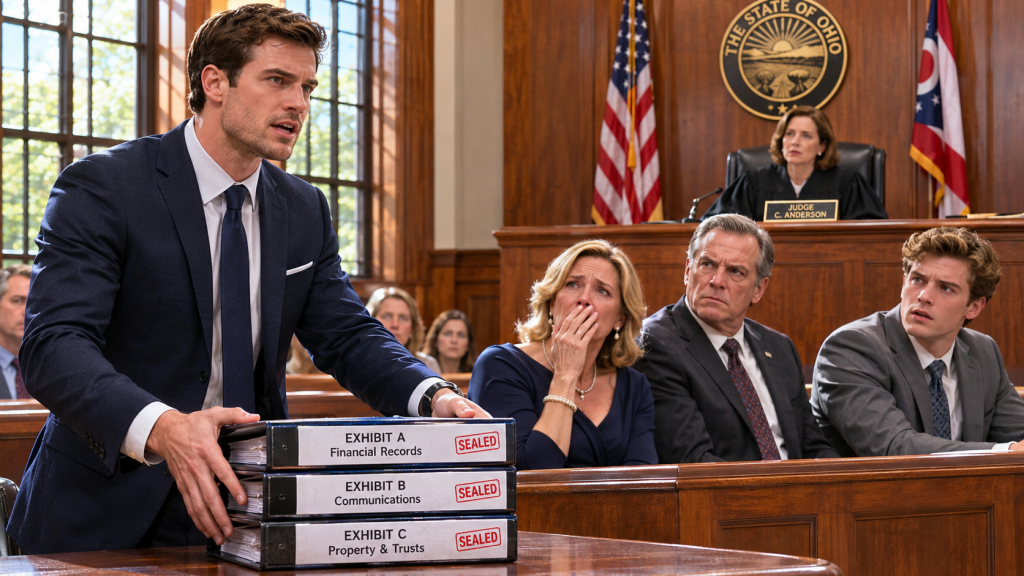
“Your Honor, my client has not been called as a witness. I request a recess so I can confer with him regarding these documents.” Judge Wynn considered the request. “Granted. Twenty minutes. And Mr. Marsh, I want you to understand that evidence of possible wrongdoing in another matter does not automatically resolve this estate dispute.”
“Yes, Your Honor.”
She studied me.
“Your exhibits will be considered according to the applicable rules, and opposing counsel will have the opportunity to challenge them.”
“I understand.”
The judge rose.
“Twenty minutes.”
The bailiff called the courtroom to order.
And suddenly the room began moving again.
Chairs scraped.
Papers rustled.
Attorneys gathered their files.
My mother turned toward my father with an expression of pure panic.
Wyatt, my younger brother, was no longer smiling.
I remained standing beside my table, holding the final page of Elijah’s letter.
For twenty-two years, I had imagined confronting the people who abandoned me.
I had imagined shouting.
Demanding answers.
Asking why.
But standing there, I felt something entirely different.
I felt the weight of the little boy I’d once been.
And I wanted to make sure that whatever happened next, I did not abandon him again.
Arthur approached my table during the recess.
His attorney hurried beside him.
“Matthew,” my father said.
I looked up.
He was older than I remembered.
His hair had turned gray around the temples. His shoulders were heavier. There were deep lines beside his mouth.
But his eyes were the same.
Cold when challenged.
Impatient when he couldn’t control the conversation.
“Son,” he began.
I held up one hand.
“Please don’t call me that.”
His expression hardened.
“I’m your father.”
I looked at him.
“Elijah Marsh was my father.”
My mother appeared behind him.
“Matthew, sweetheart, we need to talk.”
I turned toward her.
The word sweetheart sounded strange in her mouth.
I couldn’t remember her ever calling me that when I was little.
Not even once.
“About what?” I asked.
She glanced around the courtroom.
“Privately.”
I shook my head.
“Anything concerning this case can go through the attorneys.”
Arthur leaned closer.
“You think you’re clever, don’t you?”
His lawyer immediately touched his arm.
“Arthur, that’s enough.”
But my father continued.
“All these documents. All this theater. You think a law degree makes you better than us.”
I stared at him.
“No.”
My voice was quiet.
“I think leaving an eight-year-old child at a bus station makes you responsible for explaining what happened.”
His face flushed.
My mother began crying.
Wyatt stood several feet away, watching.
Then my father said something that made the entire hallway seem to go silent.
“We did what we had to do.”
I looked at him.
“What does that mean?”
He opened his mouth.
But Fletcher stepped between us.
“Mr. Collins, do not discuss the facts of the case with the opposing party.”
My father turned away.
And I was left with five words I’d spent twenty-two years trying to understand.
We did what we had to do.
When the hearing resumed, Judge Wynn addressed the parties directly.
“Counsel, the court is concerned that several allegations have been raised which may fall outside the limited question before us.”
She looked toward Fletcher.
“Your clients are challenging the disposition of Elijah Marsh’s estate. I want a precise explanation of the legal basis for that challenge.”
Fletcher stood.
“Your Honor, my clients maintain that the decedent exercised undue influence over Matthew during his minority and that the estate arrangements should be examined more closely.”
I listened.
It was a different argument from the one they’d presented at the beginning.
Then they had spoken grandly about biological family and rightful inheritance.
Now, confronted with the adoption decree and estate documents, they were searching for another route.
Judge Wynn leaned forward.
“What evidence do you have that Matthew improperly influenced Elijah Marsh’s testamentary decisions?”
Fletcher hesitated.
“My clients believe the relationship was established under circumstances warranting scrutiny.”
“Belief is not evidence, Mr. Fletcher.”
He nodded.
“Understood.”
The judge turned toward me.
“Mr. Marsh, your response?”
I stood.
“Your Honor, Elijah adopted me through a lawful process after my biological parents’ rights were terminated. He raised me for the remainder of my childhood. His estate planning was undertaken with independent legal counsel, years after I became an adult.”
I paused.
“The documents include medical records relevant to his capacity when he signed, witness information, and correspondence establishing his intentions.”
The judge nodded.
“Go on.”
I looked toward the gallery.
My mother was dabbing her eyes with a tissue.
My father stared at the floor.
Wyatt sat rigidly between them.
“Elijah did not leave me his estate because I persuaded him to distrust my biological parents.”
My voice trembled.
“He left it to me because I was his son.”
Fletcher stood again.
“Your Honor, we’d ask that the court not make a final determination today. We may need additional discovery.”
The judge considered the request.
“Any discovery must relate to a legally viable claim. I’m not authorizing an unrestricted inquiry into a family history merely because the plaintiffs dislike the decedent’s decisions.”
She reviewed the filings.
Then she looked at Fletcher.
“Your clients will have an opportunity to address the identified deficiencies within the procedural schedule I set. But the court will not entertain the proposition that biological connection, by itself, entitles them to the estate of a person to whom they have no relevant legal relationship.”
My heart began pounding.
She continued.
“As for the disputed insurance materials and the allegation that someone misrepresented Mr. Marsh’s authority to the estate administrator, those matters may be referred to the appropriate authorities. I will not make criminal findings in this proceeding.”
She set down her pen.
“Today’s hearing is concluded. The court will issue its scheduling order.”
The bailiff called everyone to rise.
I remained still for a moment after the judge left.
I had expected victory to feel like thunder.
Instead, it felt like breathing.
For the first time since the lawsuit arrived, I believed my father’s money grab might fail without requiring me to destroy the memory of the man who raised me.
Outside the courthouse, a cold wind moved through the bare trees.
I stood on the steps with my briefcase in one hand and Elijah’s old pocket chess set in the other.
I’d carried it with me that morning.
Not as evidence.
As courage.
The little magnetic pieces were scratched and faded from years of use.
One of the knights had lost an ear.
Elijah always said that made it easier to recognize.
I opened the case.
The board was smaller than my palm.
And suddenly I was eight years old again.
Sitting in a waiting room.
Afraid to speak.
Watching a stranger place a white pawn on a tiny square.
“Your move, Matthew.”
I closed my eyes.
For a moment, I could almost hear him.
“Matthew?”
I turned.
Wyatt stood several feet behind me.
He had removed his suit jacket and was holding it over one arm.
Without the expensive clothes and courtroom smirk, he looked younger.
Almost nervous.
“Can we talk?” he asked.
I studied him.
My younger brother had been a baby when our parents abandoned me.
I remembered him only as a tiny boy with dark curls who used to reach for my toys.
He had not chosen what happened at the Greyhound station.
But he had chosen to sit beside our parents in court and laugh when he thought I was unprepared.
“About the estate?” I asked.
Wyatt shook his head.
“Not exactly.”
I waited.
He looked toward the courthouse doors.
Then whispered:
“I didn’t know about the insurance money.”
My stomach tightened.
I said nothing.
Wyatt continued.
“Dad told me you ran away.”
I looked at him.
“Did he?”
He nodded.
“He said you were always getting into trouble. That you disappeared and nobody could find you.”
A terrible sadness settled over me.
The lie hadn’t ended at the bus station.
It had grown up alongside the brother I’d lost.
Wyatt looked toward his shoes.
“Mom told me you hated us.”
I swallowed.
“Wyatt, I was eight.”
His face crumpled.
“I know.”
“Eight-year-olds don’t simply decide to disappear from their families.”
He wiped his eyes.
“I know that now.”
I looked toward the street.
Cars moved past us.
People hurried along the sidewalk.
The world continued as though nothing extraordinary had happened.
“Why are you telling me this?” I asked.
Wyatt hesitated.
“Because there’s something I found.”
My chest tightened.
“What?”
He looked around.
“Not here.”
I considered refusing.
I’d spent my life learning that trust wasn’t something a person owed merely because of shared blood.
But Wyatt’s expression had changed.
The smirk was gone.
In its place was genuine fear.
“Then tell me what it is,” I said.
He swallowed.
“There’s a storage box in Dad’s basement.”
I waited.
“It has your name on it.”
For a moment, I couldn’t breathe.
“My name?”
Wyatt nodded.
“And there’s a photograph inside.”
My throat tightened.
“Of what?”
His eyes filled.
“Of you at the bus station.”
I stared at him.
“What?”
Wyatt rubbed his forehead.
“I found it last month. Dad told me not to touch the box.”
I gripped the handle of my briefcase.
“Who took the photograph?”
“I don’t know.”
“What’s in the box besides the picture?”
“Some papers. Old envelopes. A newspaper clipping.”
He looked toward the courthouse.
Then whispered:
“Matthew, I think Dad went back to the station.”
The words struck me harder than anything said during the hearing.
Because for twenty-two years, I’d believed Arthur and Evelyn had driven away and never looked back.
I’d imagined them simply returning home.
Making dinner.
Putting Wyatt to bed.
Going to sleep without wondering where I was.
But if my father had gone back…
If he’d seen me waiting…
If he’d known I was still there…
Then the abandonment hadn’t simply been a terrible decision made once.
It had been a decision he continued making.
Again.
And again.
Even after seeing what it had done to me.
I looked at Wyatt.
“Do you have the photograph?”
He shook his head.
“Not with me.”
I took a slow breath.
“Then don’t remove anything or confront Dad. Preserve whatever you can safely and legally access, and tell your own attorney what you found.”
Wyatt frowned.
“You’re not going to come get it?”
“No.”
I looked toward the courthouse.
“I’m not going into Arthur’s house to search through his belongings.”
He nodded slowly.
“But I can tell the investigator about it. If those documents are relevant, they can be obtained through the proper process.”
Wyatt stared at me.
For a moment, I saw him trying to understand why I wasn’t immediately demanding the box.
Then he whispered:
“You’re really a lawyer.”
I gave a small, sad smile.
“Elijah taught me not to confuse anger with a plan.”
Wyatt looked down.
“Do you hate me?”
The question caught me off guard.
I thought about the child I barely remembered.
The brother who’d grown up hearing lies about me.
The young man who’d sat behind Arthur and Evelyn while their attorney tried to take my inheritance.
“No,” I answered.
His eyes filled.
“But I don’t know you, Wyatt.”
He nodded.
“I know.”
“And I can’t pretend we’re close just because we have the same parents.”
He swallowed.
“Could we start?”
I looked at him for a long moment.
Then I said:
“Maybe.”
And for the first time since the case began, I saw somebody in my biological family smile without wanting something from me.
The photograph reached the investigators eleven days later.
Wyatt hadn’t taken it from the basement himself.
After speaking with an independent attorney, he’d provided a description of the box and the circumstances in which he’d seen it. The relevant materials were obtained through lawful procedures as part of the review into the old insurance claim.
When the investigator asked whether I wanted to see the photograph, I said yes.
I thought I was prepared.
I was wrong.
It showed the interior of the Greyhound station.
A wooden bench stood beneath an enormous departure board.
Beside it sat a little boy in a blue coat.
His feet didn’t reach the floor.
He held something in his hands.
A granola bar.
I recognized the wrapper.
Peanut butter and honey.
I’d hated peanut butter when I was little, but my mother had bought those bars because they were cheap.
I leaned closer.
The boy in the picture was staring toward the entrance.
Waiting.
His face was turned slightly away from the camera, but I knew him immediately.
I knew the way he held his shoulders.
I knew the too-short sleeves.
I knew the dark hair that fell across his forehead.
I had spent twenty-two years trying not to remember that child.
Now he was looking back at me from a photograph.
The investigator, a woman named Sandra Keene, sat across from me.
“Matthew, take your time.”
I swallowed.
“Where did this come from?”
“It appears to be a photograph made from an old print. We’re investigating its origin. The accompanying materials suggest your parents received information about your location after the abandonment.”
I looked up.
“How much information?”
Sandra opened a separate folder.
“There’s a letter dated several months after you entered Elijah Marsh’s care.”
My heart began pounding.
“From whom?”
“A county child-welfare office.”
She handed me a copy.
It concerned the legal proceedings involving my parents’ rights.
Arthur and Evelyn had been notified of developments in my placement and the process that eventually led to adoption.
I stared at the date.
I remembered those months.
Elijah teaching me to tie my shoes properly because I kept pulling the laces into impossible knots.
Elijah making pancakes shaped like stars.
Elijah sitting beside my bed when I woke crying.
And somewhere, my biological parents had been receiving official information about the child they’d left behind.
“They knew I was alive,” I whispered.
Sandra nodded carefully.
“The documents show they had notice of your placement and the proceedings. We’ll need to verify who received which communications and when.”
I looked down.
For years, I’d asked myself whether they ever wondered what happened to me.
Now I was beginning to understand that uncertainty had never been the central problem.
They’d had opportunities to learn.
They’d had opportunities to participate.
They had chosen not to become part of my life.
Then Sandra showed me another document.
It was a copy of a statement connected with the insurance claim.
My father had described me as missing and unreachable.
The materials suggested he and my mother had made representations inconsistent with information they had received through the child-welfare process.
But Sandra was careful about what she said next.
“The payment records show that the insurer issued sixty-two thousand dollars. The stated coverage terms and the circumstances of payment require further review. We cannot assume the claim was lawful or unlawful until the complete policy and claim file are examined.”
I nodded.
“Will there be charges?”
“I can’t promise that. Investigators will consider the evidence, applicable law, and how much time has passed. Some possible legal remedies may be limited by statutes of limitation or other rules.”
I stared at the photograph.
For twenty-two years, I’d imagined that learning why my parents abandoned me would finally make the pain disappear.
Instead, every answer revealed another decision they’d made without considering what it would do to their son.
Sandra leaned forward.
“Matthew, you don’t have to continue looking through this today.”
I closed the folder.
“No.”
My voice trembled.
“I think I’ve seen enough.”
That night, I returned to Elijah’s house.
It was still legally part of his estate, and the estate administrator was handling the property while the challenge remained pending.
But I had permission to visit.
I walked through the rooms slowly.
The living room smelled faintly of cedar.
A blanket lay folded over the back of his favorite armchair.
His chessboard was still sitting beside the window.
He had left a game unfinished.
Or perhaps he’d been waiting for me to visit and finish it with him.
I sat in the chair opposite his.
Then placed my old magnetic chess set on the table.
For a long time, I stared at the pieces.
“Elijah,” I whispered, “why did you choose me?”
The house remained silent.
I remembered the first time I asked him that question.
I was eleven.
We were washing dishes after dinner.
I’d broken a plate.
Not deliberately.
I’d simply dropped it because my hands were wet.
The sound frightened me so badly that I began apologizing before the pieces hit the floor.
Elijah knelt beside me.
“Matthew, it’s a plate.”
I was crying.
“I’m sorry.”
“I know, buddy.”
“I’ll pay for it.”
He looked at me strangely.
“With what?”
“My birthday money.”
Elijah smiled.
“No, you won’t.”
I stared at him.
“Are you mad?”
He shook his head.
“Matthew, you’re allowed to make mistakes in your own home.”
I had never heard those words before.
Not like that.
Not spoken as though they were obvious.
Then, several years later, I asked why he’d adopted me.
He was working in the garden.
I’d been helping him plant tomatoes.
“Why me?” I asked.
Elijah looked up.
“What do you mean?”
“There were other kids.”
He set down his shovel.
“Yes.”
“Kids who didn’t cry so much.”
He studied me.
“Matthew, I didn’t choose you because you were easier than another child.”
I looked down.
“Then why?”
He sat beside me on the grass.
“Because we met, and over time we began to trust each other. And because I wanted to be your dad.”
I remember waiting for him to add a condition.
That I had to get good grades.
That I had to behave.
That I needed to repay him someday.
But Elijah simply picked up his shovel again.
“Now, are you going to help me with these tomatoes, or are we planting them next Christmas?”
I laughed.
And he smiled.
That was how he loved.
Without keeping score.
I stood and walked into his study.
Elijah had been a meticulous record keeper.
There were files for property taxes, insurance, investments, and estate planning.
His executor had already inventoried the important documents, but a small box of personal notebooks remained on the bookshelf.
I opened one.
On the first page, Elijah had written:
Things I don’t want to forget.
There were dates.
Little stories.
Notes about people he’d met through the community center.
Then, several pages in, I found my name.
Matthew stayed for dinner tonight. He ate two helpings of spaghetti and asked three times whether he could have dessert.
I smiled through tears.
He still apologizes whenever he asks for something. I wish he understood he doesn’t have to.
I turned the page.
Matthew laughed today. Really laughed. He spilled orange juice while laughing, and then he laughed harder.
My throat closed.
I kept reading.
There were entries about my first bicycle.
My first school play.
The day I learned to swim.
The time I won a chess tournament and insisted Elijah keep the trophy.
Then I found an entry from the year I turned sixteen.
Matthew asked whether I think his biological parents miss him.
I stopped breathing.
Beneath it, Elijah had written:
I told him I cannot know what they feel. I told him their choices were not his fault. I hope that was enough.
I pressed the notebook against my chest.
It hadn’t been enough to erase the pain.
But it had been enough to help me survive it.
And perhaps that was the greatest thing any parent could offer.
Not a childhood without sorrow.
But someone willing to sit beside you while you learned that sorrow didn’t have to define you.
A week later, the probate case moved forward.
Arthur and Evelyn’s attorney had been given the opportunity to clarify their legal theory and support it with evidence.
Instead, the new filings exposed contradictions.
They suggested Elijah had manipulated my adoption and later influenced my relationship with my biological family.
But the adoption records showed judicial oversight, social-service involvement, and a process spanning months.
There was no evidence Elijah had hidden me from a lawful claim by my parents.
The family-law judgment had addressed their legal relationship to me years earlier.
Their attempt to establish an interest in his estate through biology alone remained unsupported.
The more their argument shifted, the clearer it became that they were searching for a legal right that had never existed.
The next hearing was shorter than the first.
Judge Wynn reviewed the supplemental submissions.
Then she addressed the plaintiffs’ attorney.
“Mr. Fletcher, your clients have had the opportunity to identify a legally sufficient claim to the estate.”
Fletcher stood.
“Yes, Your Honor.”
“The amended filings still do not establish one.”
He nodded reluctantly.
The judge continued.
“Mr. Marsh is the decedent’s legally adopted son and the named beneficiary under the estate documents. The plaintiffs have not shown a basis to invalidate those arrangements.”
My hands tightened beneath the table.
Fletcher began to speak, but the judge raised one hand.
“I understand your objections. The court has reviewed them.”
She looked toward me.
“Mr. Marsh, do you wish to add anything?”
I stood.
“Only briefly, Your Honor.”
She nodded.
I took a breath.
“Elijah Marsh was not a wealthy man in the way people usually imagine wealth.”
Arthur shifted in his seat.
I continued.
“He wore old jackets. He drove a car until its doors barely closed. He saved money, fixed things himself, and taught me that generosity wasn’t measured by how loudly someone announced it.”
My voice trembled.
“He gave me a home when I believed nobody wanted me.”
I looked toward the judge.
“The money he left matters because it represents a lifetime of work. But it isn’t the most valuable thing he gave me.”
The courtroom was silent.
“He taught me that I didn’t have to earn the right to be loved.”
I swallowed.
“And I ask the court to honor the decisions he made about his own estate.”
Judge Wynn looked down at the documents.
Then she delivered her ruling.
The plaintiffs’ challenge was dismissed.
The court’s written order would set out the grounds, and any requests involving costs or sanctions would be addressed under the applicable procedures.
The estate remained subject to ordinary administration.
There would be no immediate transfer of every asset simply because the hearing had ended.
But the central dispute was over.
Arthur and Evelyn had not established a right to Elijah’s estate.
I heard my mother begin crying.
My father sat absolutely still.
Wyatt lowered his head.
And I stood in the courtroom feeling as though a weight I’d carried since childhood had finally begun to lift.
Outside, reporters weren’t waiting.
There were no flashing cameras.
No cheering crowd.
Just an ordinary Ohio afternoon.
A few people crossing the courthouse plaza.
The sound of traffic.
The smell of coffee drifting from a café across the street.
I took a slow breath.
Then another.
I had won.
But I didn’t feel triumphant over my parents.
I felt protective of Elijah.
And grateful that the law had not allowed people who abandoned me to transform their biology into ownership of the man who raised me.
Wyatt caught up with me at the steps.
“Matthew.”
I turned.
His eyes were red.
“Can we get coffee?”
I studied him.
Then nodded.
“All right.”
We went to a little café three blocks away.
Wyatt ordered black coffee.
I ordered tea.
For a while, we sat quietly.
Then he said:
“Dad told me the insurance money was from an old family policy.”
I looked at him.
“What else did he say?”
Wyatt stared at his cup.
“That you were unstable. That you disappeared. That they spent years searching.”
My throat tightened.
“And you believed him.”
He nodded.
“I did.”
I waited.
He continued.
“When the estate lawsuit came up, Dad said you owed the family because you’d been taken in by a rich man.”
I almost laughed.
Elijah’s worn Subaru flashed through my memory.
The patched elbows of his coat.
The coupons clipped beside the kitchen sink.
Rich.
Perhaps he had been.
But not in the way my father meant.
Wyatt rubbed his face.
“I thought we were asking for money that should’ve belonged to the family.”
I looked at him.
“And now?”
His eyes filled.
“Now I realize you were the family.”
I stared.
Wyatt began crying.
“You were my brother.”
I swallowed.
“You still are, biologically.”
He nodded.
“But I don’t know anything about you.”
I smiled sadly.
“Neither do I about you.”
He wiped his eyes.
Then asked:
“Would it be okay if I learned?”
I considered.
Trust wasn’t something I could give him because he looked sorry.
But I also remembered that Wyatt had been a baby when I disappeared.
Whatever lies he’d repeated, he hadn’t invented the original ones.
“We can begin with coffee,” I said.
He smiled through tears.
“I’d like that.”
Before we left, Wyatt reached into his coat.
He took out an old photograph.
It showed two little boys sitting on a carpet.
The older one was holding a toy truck.
The younger had one hand wrapped around his brother’s sleeve.
“That’s us,” Wyatt whispered.
I stared at the photograph.
I remembered the truck.
Bright red.
One wheel missing.
I’d given it to Wyatt because he cried whenever I took it away.
My eyes filled.
“I remember that toy.”
Wyatt smiled.
“Dad kept this picture in the basement.”
I touched the edge.
For twenty-two years, I’d believed every trace of my childhood had vanished with the people who abandoned me.
Now, sitting in an ordinary café, I was holding proof that I had once been a big brother.
A boy who shared his toys.
A child whose entire life had not been defined by a bus station bench.
I looked at Wyatt.
“Can you make a copy for me?”
He smiled.
“I already did.”
The insurance investigation continued after the estate dispute ended.
The investigators reviewed the original policy, claim correspondence, statements made by Arthur and Evelyn, and the records showing that I had entered the child-welfare system.
There were inconsistencies they considered serious.
The claim file contained assertions about my disappearance that did not match the information my parents had received.
But the passage of time complicated the process.
Some witnesses had died.
Other records were incomplete.
And the legal questions could not be resolved simply because the facts offended everyone who heard them.
Sandra kept me informed through the appropriate channels.
I appreciated her honesty.
She never promised that my parents would be prosecuted.
Never told me that one discovery guaranteed punishment.
She simply said the evidence would be evaluated.
Eventually, the insurer pursued its available remedies concerning the old payment, and the matter was addressed through a separate negotiated resolution.
The details were not a spectacular courtroom revelation.
There was no dramatic confession followed by handcuffs.
But the old claim was no longer treated as an unquestioned part of my parents’ history.
The truth had entered the record.
For me, that mattered.
Several weeks later, Evelyn sent me a letter.
I recognized the handwriting immediately.
My mother’s letters had always leaned slightly to the right.
When I was a child, she wrote shopping lists on yellow paper and stuck them to the refrigerator with a magnet shaped like a strawberry.
Seeing her handwriting brought back memories I hadn’t expected.
The smell of laundry detergent.
A red kitchen table.
The sound of Wyatt crying in his crib.
I sat at Elijah’s dining table and opened the envelope.
Matthew,
I know you don’t owe me anything.
I know I have no right to ask you to speak to me.
But I need to tell you something about the day we left you at the station.
My hands began shaking.
I kept reading.
She described the money problems.
The arguments.
Arthur’s growing resentment.
The way he’d begun saying that raising two children was more than they could manage.
She wrote about his plan to leave me somewhere authorities would find me.
And about her decision not to stop him.
Then came the sentence that made me put the letter down.
I knew you would believe I was coming back.
For a long time, I couldn’t move.
I remembered the station doors.
The cold bench.
The granola bar.
The way I’d watched every adult who entered, hoping one of them was my mother.
She had known.
She had known exactly what her promise would mean to an eight-year-old boy.
And she’d said it anyway.
I picked up the letter.
I told myself you would be placed with a good family. I told myself it was better than the life we could give you.
But I also knew we should have asked for help instead of abandoning you.
I was afraid of Arthur. I was afraid of losing our home. I was afraid of what people would think.
None of that excuses what I did.
I have spent years trying not to remember your face.
When you stood in court, I saw the little boy on the bench again.
I am sorry.
Evelyn.
I read the letter twice.
Then placed it beside Elijah’s notebook.
For twenty-two years, I’d wanted an explanation.
Now I had one.
But it didn’t make the abandonment reasonable.
Poverty could explain fear.
Desperation could explain terrible judgment.
Yet countless struggling parents sought help without deliberately leaving their children waiting in public places.
My parents had made choices.
And those choices had changed my life.
I folded the letter carefully.
I didn’t throw it away.
I didn’t answer immediately.
For the first time, I understood that receiving an apology did not obligate me to make the person who offered it feel forgiven.
The estate administration concluded several months later.
After the remaining expenses, obligations, and necessary procedures were addressed, I received the inheritance Elijah had intended for me.
The estate’s value had originally been estimated at approximately $3.8 million.
The final distributions reflected the usual adjustments involved in administering an estate.
I remember the day the attorney called to confirm that the process was complete.
He congratulated me.
I thanked him.
Then I hung up.
For a long time, I sat looking at Elijah’s chessboard.
I had enough money to change my life.
I could buy a larger house.
Travel anywhere.
Leave my job.
Purchase things I’d never imagined owning.
But none of those possibilities made me feel what I wanted most.
I wanted to call Elijah.
I wanted to hear him say, “Well, Matthew, what are you going to do with it?”
I wanted him sitting across from me, making suggestions and laughing when I worried too much.
Instead, I was alone in his living room.
Surrounded by the things he’d left behind.
And I realized that money could preserve his legacy.
But it could never replace his presence.
I kept the house.
Not because it was valuable.
Because it was home.
I repaired the front steps and repainted the porch.
I replaced the aging roof.
But I left Elijah’s study almost exactly as he’d kept it.
The shelves remained filled with books.
His reading chair stayed beside the window.
And the old chessboard remained on the table.
Some evenings, after work, I would sit there with a cup of tea.
I could almost hear him telling me that the most dangerous move in chess wasn’t necessarily the one that took a piece.
Sometimes it was the move that left the rest of the board unprotected.
I understood that differently now.
For years, I’d focused so intensely on the people who abandoned me that I’d almost forgotten the people who stayed.
Elijah.
My teachers.
The friends who supported me through law school.
The colleagues who became family.
The ordinary kindnesses that had helped build a life larger than my worst memory.
Then I made a decision.
I would use part of the inheritance to establish a fund supporting children who had experienced abandonment, foster care, or unstable housing.
I worked with legal and financial professionals to create a sustainable charitable program through established organizations.
The fund would help cover educational expenses, mentoring, emergency necessities, and the practical barriers that often stood between vulnerable young people and their futures.
I named it the Elijah Marsh Opportunity Fund.
When the first students were selected, I attended a small gathering at the community center where Elijah had once volunteered.
One young man wanted to study automotive engineering.
A young woman hoped to become a social worker.
Another student was preparing to enter nursing school.
They were nervous.
Hopeful.
Trying to imagine lives bigger than the difficulties they’d already survived.
I recognized something in each of them.
Not because their experiences were identical to mine.
But because I understood the longing to be seen as more than what had happened to you.
After the event, a boy approached me.
He was fourteen, thin and serious, with a backpack hanging from one shoulder.
“Mr. Marsh?”
“Yes?”
He looked toward the floor.
“Is it true you grew up in foster care?”
I nodded.
“Yes.”
He hesitated.
“Did you ever feel like nobody wanted you?”
My throat tightened.
“Yes.”
He stared at me.
“What did you do?”
For a moment, I considered giving him an impressive answer.
Something about determination.
Hard work.
Perseverance.
But I remembered the waiting room.
The plastic chairs.
The little magnetic chessboard.
And the man in the brown corduroy jacket.
“I let somebody teach me chess,” I said.
The boy looked confused.
I smiled.
“He was a good man. He kept showing up. After a while, I started believing I mattered to him.”
The boy’s eyes filled.
“What if nobody shows up?”
I took a slow breath.
“Then the adults responsible for helping you need to do better. You deserve people who are dependable.”
He nodded slowly.
“And you don’t have to become successful or useful to deserve that.”
His mouth trembled.
I continued.
“You already do.”
Wyatt and I began meeting once a month.
At first, our conversations were awkward.
We knew almost nothing about each other.
He worked in commercial sales.
I practiced family law.
He loved fishing.
I loved chess.
He preferred football.
I could barely remember the rules.
But we learned.
Slowly.
He told me about his childhood.
About the pressure Arthur placed on him.
About Evelyn’s anxious attempts to keep everybody happy.
He admitted that he’d grown up believing success meant earning our father’s approval.
I told him about Elijah.
About college.
About the first time I won a chess tournament.
About the day I passed the bar examination and called Elijah before anyone else.
Wyatt listened carefully.
Sometimes he asked questions that hurt.
Sometimes I did too.
But we were learning how to disagree without disappearing from each other’s lives.
One evening, Wyatt came to Elijah’s house carrying a grocery bag.
“What’s that?” I asked.
“Dinner.”
I looked inside.
Frozen pizza.
Two sodas.
And a box of cookies.
I laughed.
“Very sophisticated.”
He grinned.
“Don’t judge me, Counselor.”
We ate in the kitchen.
Then he noticed the chessboard.
“You play?”
I smiled.
“A little.”
He looked suspicious.
“That means you’re probably amazing.”
I laughed.
“Elijah taught me.”
Wyatt sat down.
“Then teach me.”
I stared at him.
For a moment, I was back in that waiting room.
A frightened child.
A stranger offering a simple game.
The beginning of a life I couldn’t yet imagine.
I opened the magnetic chess set.
Placed the pieces on the board.
Then looked at my brother.
“All right,” I said. “This is how the knight moves.”
I never became close to Arthur.
He continued insisting that our family history was more complicated than I understood.
Perhaps it was.
Most families are complicated.
But complexity did not make abandonment acceptable.
And it didn’t make him entitled to Elijah’s money.
I chose not to maintain contact with him.
That decision wasn’t made out of hatred.
I simply no longer wanted to build my life around the hope that he might become the father I’d needed when I was eight.
Evelyn and I exchanged occasional letters.
I acknowledged her apology.
I told her I wasn’t ready for a relationship.
She eventually replied that she understood.
Whether that understanding would last, I couldn’t know.
But I no longer felt responsible for managing her disappointment.
One February afternoon, twenty-three years after I’d been abandoned, I drove past the old Greyhound station.
The building had changed.
The signs were different.
The parking lot had been resurfaced.
And the wooden bench was gone.
I parked nearby.
For several minutes, I sat inside my car.
Then I stepped out.
The air was cold.
A bus pulled away from the curb, leaving a faint smell of diesel behind it.
I walked toward the entrance.
Through the glass, I could see travelers carrying bags, checking departure times, and looking for their buses.
Ordinary people.
Going ordinary places.
I stood there thinking about the little boy who’d waited four hours for parents who had no intention of returning.
For years, I’d imagined him frozen in that moment.
Still sitting.
Still waiting.
Still believing he must have done something terrible.
Now I saw him differently.
He was frightened.
But he survived.
He accepted help.
He learned to trust.
He grew into a man who spent his working life protecting children from being overlooked.
I closed my eyes.
Then whispered:
“You can stop waiting now.”
That spring, I placed two photographs on Elijah’s mantelpiece.
One showed me at eight years old, sitting beside him with a chessboard between us.
The other showed Wyatt and me as children, holding a broken red toy truck.
Two parts of a story.
One about the family I lost.
The other about the family I found.
I no longer felt compelled to pretend that only one mattered.
Wyatt was my brother.
Elijah was my father.
Arthur and Evelyn were the people who gave me life and then abandoned their responsibilities.
Those truths could exist together.
And I didn’t have to let any of them dictate the value of my future.
Sometimes people ask whether the $3.8 million changed everything.
In practical ways, it certainly changed my circumstances.
It gave me financial security.
Allowed me to support important causes.
And helped preserve the home Elijah had built.
But the greatest change happened long before I knew he had money.
It happened when a man wearing a worn brown jacket sat beside a frightened little boy and opened a tiny chessboard.
It happened when he returned the following week.
And the week after.
When he taught me how to ride a bicycle.
When he attended my graduation.
When he reminded me that breaking a plate didn’t mean I was bad.
And when he told me, without hesitation, that I was his son.
I think about the courtroom sometimes.
My mother’s navy dress.
Arthur’s clenched jaw.
Wyatt’s expensive suit.
The quiet scratching of the clerk’s pen.
And Judge Wynn asking whether I was waiting for my attorney.
I remember standing up.
Buttoning my jacket.
And answering:
“I’ll be representing myself.”
Those words were about a legal hearing.
But they meant something more to me.
For twenty-two years, I’d carried a story other people had written about my worth.
A troubled child.
An unwanted son.
A burden someone had finally gotten rid of.
That day, I stopped allowing those descriptions to speak for me.
My name is Matthew Marsh.
Not because I forgot where I came from.
But because Elijah gave me a name connected to the life we built together.
He left me an inheritance.
But long before he left me money, he gave me something far more important.
The certainty that I deserved a place in the world.
Not because I was successful.
Not because I had a law degree.
Not because I might someday inherit millions.
Because I was a child.
And every child deserves someone who comes back.
Last week, Wyatt visited again.
He brought pizza.
I made tea.
We sat at the chessboard until midnight.
At one point, he moved his queen into a terrible position.
I looked at him.
“Are you sure?”
He grinned.
“Absolutely.”
Three moves later, I captured it.
Wyatt groaned.
“You’re impossible.”
I laughed.
“Elijah used to say the same thing.”
My brother looked toward the photograph on the mantelpiece.
Then smiled.
“I wish I could’ve met him.”
My throat tightened.
“I think he would’ve liked you.”
Wyatt nodded.
Then he reached for another piece.
“Your move, Matt.”
I looked at the board.
For a moment, I could almost see Elijah sitting beside us, smiling over his cup of tea.
And I understood that the man who saved me had left behind much more than money.
He had taught me how to love without keeping score.
How to protect myself without becoming cruel.
And how to move forward even when the past had left pieces of my life scattered across the board.
At eight years old, I was abandoned by the people who were supposed to protect me. At thirty, I finally understood that their decision had never determined my worth.
The people who left taught me how painful love could become when it was withheld.
But the man who stayed taught me what love was supposed to be.
And in the end, that was the inheritance I treasured most.