The courtroom door closed behind my son, and for a moment, I couldn’t hear anything except the beating of my own heart. Nolan’s final words hung in the air. You gave me something better. I stared at the doorway where my mother had taken him. My little boy had just stood before strangers and defended a shirt that had become the centerpiece of his father’s accusations.
A shirt I’d bought with the last valuable thing my grandmother left me. A shirt covered in paint from a school project we’d made together. A shirt that, to Grant’s attorney, supposedly proved I was incapable of being a good mother. But Nolan had shown everyone something the photograph couldn’t capture. Love. Not the expensive kind.
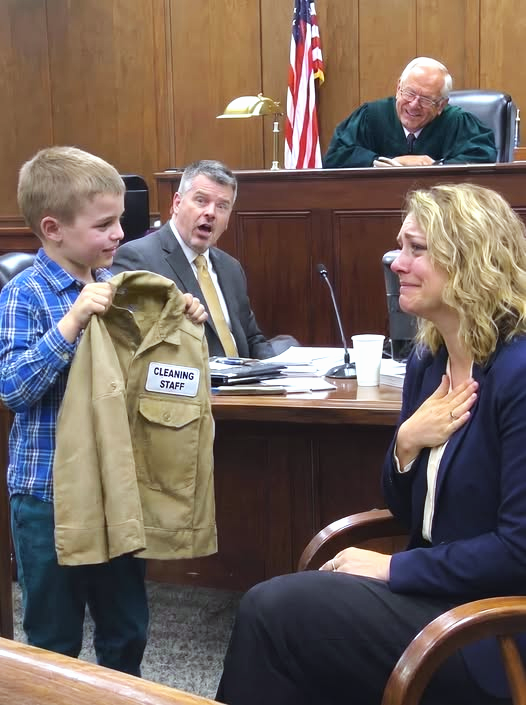
Not the kind you display with polished watches and luxury cars. The quiet kind. The kind that sits beside a child at the kitchen table, helping him paint planets when there isn’t enough money to take him to a science museum. The kind that makes a birthday special with a homemade cake, a secondhand book, and a brand-new shirt from a clearance rack.
I wiped my cheeks as Judge Whitaker turned toward the adults.
“Mr. Carroway,” she said, “I want to understand the basis for your client’s allegations.”
Grant’s attorney straightened.
“Your Honor, our concerns extend beyond a single photograph. Mrs. Bellamy’s financial instability has been documented.”
The judge glanced at my folder.
“Financial difficulties, standing alone, do not establish that a parent is unfit.”
I felt my breath catch.
She continued.
“And photographs can be misleading without context. We will examine any relevant evidence carefully.”
Across the room, Grant shifted in his chair.
His silver watch flashed beneath the courtroom lights.
For the first time that morning, he no longer looked amused.
“Mrs. Bellamy,” Judge Whitaker said, turning toward me, “do you have evidence you wish to present?”
I stood.
My knees trembled.
“Yes, Your Honor.”
“What does it concern?”
“Messages suggesting that my former husband arranged for complaints to be made against my employer and paid our landlord to provide misleading information about our apartment.”
The courtroom became very still.
Grant leaned toward Carroway.
His attorney raised a hand.
“Your Honor, we haven’t had an opportunity to examine these documents.”
The judge nodded.
“Then we’ll address their authenticity and the appropriate procedure for considering them. Mrs. Bellamy, please provide copies through the clerk.”
I stepped forward.
My hands were shaking so badly that I nearly dropped the folder.
The bailiff accepted it.
I returned to my seat.
Grant wouldn’t look at me.
And somehow that frightened me more than his earlier smile.
Because I had been married to that man for eleven years.
I knew the difference between his anger and his fear.
He was afraid.
Not of losing money.
Not even of losing the case.
He was afraid of people discovering how far he’d gone to make me appear incapable of caring for our son.
Judge Whitaker reviewed the preliminary materials.
Then she looked toward both parties.
“Given the new allegations, this matter requires additional examination. I will not make a final custody determination based solely on today’s disputed assertions.”
My heart began pounding.
“The existing parenting arrangements will remain in effect pending further orders, subject to any necessary safeguards. I am setting an expedited follow-up hearing, and both parties must preserve relevant communications and financial records.”
Carroway nodded.
I nearly collapsed with relief.
Grant looked furious.
Then the judge spoke again.
“Mrs. Bellamy, I strongly encourage you to seek legal assistance. The court can provide information about available local resources.”
“Thank you, Your Honor.”
She looked toward the door where Nolan had exited.
“And I want to make something clear. That child should not be placed in the position of proving which parent loves him more.”
My throat closed.
“Yes, Your Honor.”
“Children are not exhibits to be used against their parents.”
I nodded through tears.
The judge continued.
“Any further input from Nolan must be obtained through an appropriate process that protects his emotional well-being.”
I looked down at the silver moon embroidered on the shirt still visible in my memory.
Nolan had tried to protect me.
Now it was my turn to make sure he didn’t have to do it again.
When court adjourned, Grant approached me in the hallway.
He moved quickly, his expensive shoes striking the tile.
“What exactly do you think you’re doing, Hannah?”
I turned.
He was close enough that I could smell his expensive cologne.
The same cologne he’d worn when we were married.
Once, I loved that scent.
Now it made my stomach tighten.
“I’m protecting Nolan,” I answered.
Grant laughed bitterly.
“By dragging him into this circus?”
I stared at him.
“Your lawyer displayed his photograph in court.”
“Because it’s evidence.”
“Of what? That he likes his birthday shirt?”
Grant’s jaw tightened.
“You’re twisting everything.”
I took a slow breath.
“No, Grant. I’m finally telling the truth.”
His eyes narrowed.
“Be careful, Hannah.”
Before I could answer, Carroway appeared beside him.
“Grant. Enough.”
My former husband ignored him.
“You don’t understand what you’re getting yourself into.”
I stepped backward.
For years, statements like that had been enough to silence me.
Grant always sounded so certain.
He had money.
Connections.
Business associates.
And the confidence of a man accustomed to having problems disappear when he paid somebody to handle them.
But I thought of Nolan.
Of his small fingers unfolding that birthday note.
Of the courage it had taken him to speak.
I met Grant’s eyes.
“I understand exactly what I’m doing.”
Then I walked away.
My mother was waiting outside with Nolan.
He sat beside her on a wooden bench, holding the little children’s book about constellations I’d given him for his birthday.
When he saw me, he stood.
“Mom?”
I opened my arms.
He ran toward me.
I held him so tightly that he laughed.
“Mom, you’re squeezing!”
I loosened my grip.
“Sorry, sweetheart.”
He looked up.
“Are we okay?”
My eyes filled.
“We’re going to be okay.”
He studied my face.
“Did I do something wrong?”
My heart broke.
I knelt in front of him.
“No, Nolan. You didn’t do anything wrong.”
He looked relieved.
Then whispered, “Dad looked really mad.”
I brushed his hair away from his forehead.
“That’s something the adults will handle.”
He nodded slowly.
I continued.
“You never have to prove that I’m a good mom. That’s my responsibility, not yours.”
His expression became serious.
“But I wanted the judge to know about the moon.”
I smiled through tears.
“I know, baby.”
He touched the embroidery.
“Because you made my birthday happy.”
I kissed his forehead.
“And you make every day of my life worth fighting for.”
We drove home through the freezing January afternoon.
Mom sat beside me while Nolan slept in the back seat.
The roads were gray.
Bare trees stood along the sidewalks.
And the sky hung low over Knoxville.
For the first time in months, I felt a small opening in the darkness that had surrounded our lives.
Not certainty.
Not victory.
Just the possibility that truth might finally matter.
Mom reached across the console and squeezed my hand.
“Your grandmother would have been proud of that boy.”
My throat tightened.
“She would’ve loved him.”
Mom smiled sadly.
“She did love him, Hannah. She was still with us when he was born.”
I nodded.
Then I remembered the locket.
Grandma’s beautiful antique gold necklace.
The one she’d worn for more than forty years.
The one I’d sold to buy Nolan’s birthday presents and cover necessities during our hardest month.
My heart ached.
Mom noticed.
“You’re thinking about the necklace.”
I swallowed.
“Yes.”
She squeezed my hand.
“Your grandmother would have sold it herself if she thought it would make that child smile.”
I looked toward the sleeping boy in the back seat.
Then whispered, “I hope so.”
That evening, after Nolan had eaten dinner and gone to bed, Mom sat across from me at our little kitchen table.
The bakery downstairs was closing.
The warm smell of bread drifted through the floorboards.
Our apartment was small.
The kitchen cabinets were old.
The living room rug was faded.
And the heater clicked noisily whenever it turned on.
But the windows were clean.
Nolan’s drawings decorated the refrigerator.
His schoolbooks were stacked neatly beside the sofa.
And every night, he went to sleep knowing somebody would be there when he woke.
I looked around.
For months, Grant had convinced me that our home was something to be ashamed of.
Now I saw it differently.
We didn’t have much.
But what we had was ours.
And we had made it work together.
“Mom,” I said quietly, “I think I need a lawyer.”
She nodded.
“I’ve been thinking the same thing.”
“I can’t afford one.”
“Maybe you can get help.”
I looked at the overdue bills beside the refrigerator.
“I don’t even know where to start.”
Mom reached into her purse.
Then slid a folded piece of paper across the table.
I stared at it.
“What’s this?”
“A telephone number.”
“Whose?”
“An attorney named Rebecca Sloan.”
I looked up.
Mom smiled.
“She used to volunteer with a legal clinic near my old church. I called her while you were in court.”
My eyes widened.
“Mom!”
She shrugged.
“Your grandmother raised me to ask for help before the roof falls in.”
I laughed through tears.
Then picked up the paper.
For the first time in a long while, I didn’t feel entirely alone.
Rebecca Sloan called me the following morning.
Her voice was warm but direct.
“Mrs. Bellamy, Ruth told me a little about your situation.”
I closed my eyes.
“I’m sorry she bothered you.”
“She didn’t bother me.”
There was a pause.
“Do you have time to tell me what happened?”
I told her everything.
The divorce.
Grant’s promises.
The missed support payments.
The cleaning contract.
The landlord.
The custody petition.
And Nolan’s shirt.
I tried to remain composed.
But when I described my son standing before the judge, my voice broke.
Rebecca listened quietly.
Then asked, “Hannah, do you have the paperwork from the hearing?”
“Yes.”
“Good. Send me copies.”
I hesitated.
“Rebecca, I don’t know how I can pay you.”
She was silent for a moment.
Then said, “Let’s first determine what representation you need and what resources may be available. I take some reduced-fee and pro bono matters through a legal assistance program.”
I covered my eyes.
“Thank you.”
“Don’t thank me yet,” she replied gently. “We’ve got work to do.”
Two days later, I sat in Rebecca’s office.
It was modest compared with the polished law firm Grant had hired.
There were no marble floors or expensive paintings.
Just bookshelves, a wooden desk, and a small framed photograph of Rebecca with her husband and two daughters.
She offered me coffee.
Then opened my folder.
“You’ve kept excellent records,” she said.
I almost laughed.
“I was afraid nobody would believe me.”
Rebecca looked up.
“That fear is understandable. But records help us separate what happened from what someone claims happened.”
She examined my bank statements.
The messages from Grant.
The notices from my former cleaning employer.
The landlord’s written description of our apartment.
Then she found the messages forwarded by Grant’s former office manager.
Her name was Denise Porter.
She had worked for Grant’s company for eleven years before resigning.
Three days before the custody hearing, she’d contacted me unexpectedly.
At first, I’d been suspicious.
But she explained that she’d recently learned Grant intended to use my unemployment and housing conditions against me in court.
She had preserved communications that raised serious concerns.
Rebecca read them carefully.
Then looked toward me.
“Hannah, did Denise explain why she left the company?”
“She said she could no longer work for Grant.”
“Did she give you specifics?”
“Not yet.”
Rebecca nodded.
“I’d like to speak with her.”
Denise arrived at Rebecca’s office the following afternoon.
She was in her early fifties, with short brown hair and tired eyes.
She carried a canvas bag filled with neatly organized folders.
When she saw me, her expression softened.
“Hannah.”
I stood.
“Thank you for coming.”
She hesitated.
Then said quietly, “I should have contacted you sooner.”
My stomach tightened.
“Why?”
Denise looked toward Rebecca.
“Because I watched Grant do things I knew were wrong.”
The room became very still.
Rebecca gestured toward a chair.
“Please sit down.”
Denise explained that Grant had begun planning the custody case several months earlier.
At first, he’d described it as an effort to spend more time with Nolan.
She’d thought nothing unusual about that.
But then she noticed something strange.
Grant had asked his assistant to compile information about my work schedule.
He wanted to know which cleaning company employed me.
Who managed the office building.
And whether anyone there belonged to his golf club.
Denise had questioned him.
Grant told her it was none of her business.
A week later, an employee from my cleaning company mentioned receiving complaints about me.
Complaints alleging I’d entered restricted offices and behaved improperly.
I remembered the day my supervisor called me into his office.
He looked uncomfortable.
“Hannah, I’m sorry, but we’re ending your contract.”
I had begged him to tell me what I’d done.
He wouldn’t explain.
I went home that evening and cried in the bathroom so Nolan wouldn’t hear.
Now, sitting in Rebecca’s office, I learned how the allegations had started.
Denise opened a folder.
“Grant contacted the building manager, Victor Hale.”
Rebecca studied the documents.
“What do these records show?”
“Emails and internal appointment notes. Grant asked Victor to make sure Hannah was no longer working in that building.”
I felt sick.
Denise continued.
“He offered to direct a lucrative maintenance contract to Victor’s company.”
Rebecca looked up.
“Do you have evidence that the offer was connected to the complaint?”
“There’s an email discussing both matters. The timing is close, and Victor later thanked Grant for the opportunity.”
Rebecca nodded carefully.
“That suggests a possible connection, but we’d need additional evidence before stating as fact that the complaint was fabricated in exchange for business.”
Denise agreed.
“I understand.”
Then she turned toward me.
“But Hannah, I never saw any evidence you did anything wrong.”
Tears filled my eyes.
For months, I’d wondered whether some innocent mistake had cost me my job.
Now I knew there were serious reasons to question the accusations.
Denise opened another folder.
“This concerns your landlord.”
I leaned forward.
She showed Rebecca a copy of a payment record.
Grant’s company had issued a consulting payment to a business associated with my landlord, Raymond Fisk.
The payment was made shortly before Raymond signed a statement describing our apartment as dirty, unsafe, and poorly maintained.
I stared at the amount.
Three thousand dollars.
Grant had paid money to someone associated with our landlord while telling me he couldn’t afford to help buy Nolan winter shoes.
Rebecca asked several questions about the records.
Denise answered carefully.
She didn’t pretend to know everything.
But she had enough information to justify a thorough review.
Then she reached into her bag one last time.
“And there’s something else.”
My stomach tightened.
“What?”
She placed a small envelope on the desk.
“Grant told everybody his company was struggling.”
I nodded.
“That’s what he told me.”
Denise looked at me.
“Hannah, his company had a difficult year, but he wasn’t living on the edge of bankruptcy.”
Rebecca opened the envelope.
Inside were copies of compensation records and corporate distributions available from documents Denise had maintained in her role.
I stared at the numbers.
They were much higher than the income Grant had led me to believe he earned.
My hands began trembling.
For months, I’d chosen between groceries and bills.
I’d worked until my feet hurt.
I’d watched my mother stretch her small retirement income so Nolan could have school supplies.
And Grant had continued wearing luxury watches while claiming he lacked the resources to contribute properly.
I looked toward Denise.
“Why are you helping me?”
She hesitated.
Then her eyes filled.
“Because I have a grandson Nolan’s age.”
Her voice broke.
“And I couldn’t stand the thought of someone teaching that little boy his mother was unfit because she was poor, while deliberately making it harder for her to work.”
Rebecca didn’t rush into court waving Denise’s papers.
She contacted the appropriate parties and gathered additional records through the legal process.
She explained that documents needed to be authenticated and that testimony should be based on what witnesses actually knew.
We requested financial disclosures relevant to support and the custody issues.
We sought records related to the statements about my housing.
And Rebecca contacted the cleaning company to learn what had happened.
The process was slower than I wanted.
There were days when I imagined simply standing in front of Grant and shouting every terrible thing he’d done.
But Rebecca reminded me that anger couldn’t substitute for proof.
“Let the evidence do the talking,” she said.
I nodded.
It became something I repeated to myself whenever fear threatened to overwhelm me.
Meanwhile, life continued.
I still had to get up before sunrise.
Still had to prepare Nolan’s breakfast.
Still had to work at the diner.
Still had to make sure his homework was finished and his school clothes were ready.
The court case didn’t suspend ordinary responsibilities.
If anything, those responsibilities became harder.
One morning, I dropped a plate at the diner.
It shattered across the floor.
I stood staring at the pieces.
My manager, Mrs. Alvarez, hurried over.
“Hannah, honey, are you okay?”
I tried to smile.
“Of course.”
But my hands were shaking.
Mrs. Alvarez studied me.
Then gently took the broom from my fingers.
“Go sit down.”
I hesitated.
“I can’t afford to miss my shift.”
She shook her head.
“You’re not losing your job over one plate. Sit.”
I walked into the little back office.
Then began crying.
Mrs. Alvarez followed a few minutes later carrying a cup of tea.
For a while, she sat beside me without speaking.
Then she said, “You know, Hannah, I’ve watched you work here for three years.”
I wiped my cheeks.
“You’ve never been late without calling. You cover other people’s shifts. You remember customers’ names.”
I looked down.
“And every time your boy comes in after school, he runs straight into your arms.”
My throat tightened.
She smiled gently.
“That tells me more about the mother you are than an expensive lawyer ever could.”
Then Mrs. Alvarez surprised me.
“There’s a position opening here.”
I looked up.
“What position?”
“Assistant manager.”
I stared.
“Hannah, you’ve practically been doing half the job already.”
I swallowed.
“I don’t have management experience.”
She laughed.
“You manage a breakfast rush with three servers and a broken coffee machine. That’s experience.”
For a moment, I couldn’t speak.
The position would mean a more predictable schedule.
Better pay.
And the chance to stop working two exhausting jobs.
My eyes filled.
“Are you serious?”
“Very.”
I covered my mouth.
Mrs. Alvarez smiled.
“Think about it.”
I didn’t need to think long.
I accepted the following morning.
When I told Nolan, he jumped up from the kitchen table.
“Mom! You’re the boss?”
I laughed.
“Assistant boss.”
He considered that.
“That’s almost the boss.”
“Almost.”
He grinned.
“Does that mean you get to eat all the pancakes?”
I shook my head.
“No, sweetheart.”
He sighed dramatically.
“Then I don’t understand the point.”
Mom burst out laughing.
For the first time in weeks, our kitchen filled with joy that had nothing to do with courtrooms or bills.
One Saturday, Nolan brought home a new school project.
His teacher had asked the class to write about someone they admired.
He sat at the table with a pencil, staring at a blank page.
“Mom?”
“Yes, sweetheart?”
“Can I write about you?”
I smiled.
“Of course.”
He looked serious.
“But I don’t know what to say.”
I sat beside him.
“Well, why do you admire me?”
He thought carefully.
“Because you never give up.”
My throat tightened.
He continued.
“And because you know how to make pancakes shaped like rockets.”
I laughed.
“Those are important qualifications.”
Nolan grinned.
Then looked down at the page.
“And because you always come back.”
I stopped smiling.
“What do you mean?”
He shrugged.
“When you go to work. Or the store. Or take Grandma to the doctor.”
I watched his little face.
“You always tell me when you’ll be home, and then you come back.”
Tears filled my eyes.
I thought of how uncertain our lives had become.
Of how often Grant had canceled visits.
Of Nolan waiting beside the window on evenings when his father promised to call and didn’t.
I pulled him into my arms.
“Sweetheart, that’s what parents are supposed to do.”
He nodded.
“I know.”
Then he whispered, “But not everybody does.”
The follow-up custody hearing arrived six weeks later.
This time, Rebecca sat beside me.
She had prepared me carefully.
We had reviewed the documents.
Discussed the questions I might be asked.
And made a plan to keep Nolan out of the adults’ conflict.
He was not sitting at counsel’s table.
An appropriate court-appointed professional had spoken with him privately under the court’s procedures, and the court had information about his needs without requiring him to perform another emotional demonstration in front of us.
I was relieved.
Nolan deserved to be eight years old.
Not our family’s smallest attorney.
Grant entered the courtroom wearing another expensive suit.
His watch was still bright beneath the lights.
But his expression had changed.
There was no easy smile.
No amused glance toward his attorney.
He looked tense.
Carroway carried several thick folders.
I wondered how much Grant had told him.
Whether he’d admitted the payments.
The employment interference.
The misleading description of our apartment.
Or whether his own lawyer was discovering the truth piece by piece.
Judge Whitaker entered.
The bailiff called the room to order.
And the hearing began.
Rebecca presented our evidence methodically.
She began with Nolan’s school records.
Attendance.
Academic progress.
Teacher observations.
Then she addressed his medical care.
Routine appointments.
Vaccination records.
The pediatrician’s notes concerning his general well-being.
She introduced photographs of our apartment showing a clean, orderly living space with adequate sleeping arrangements, food, clothing, and school materials.
Then she called Mrs. Alvarez.
My manager testified about my work.
My reliability.
And my promotion.
She explained that my schedule now allowed me to be home at consistent times.
I listened with tears gathering in my eyes.
For months, Grant had tried to portray my work as evidence that I couldn’t care for Nolan.
Now the very people who’d seen me struggling were explaining how hard I’d worked to provide for him.
Next came Denise Porter.
She testified about records she’d maintained at Grant’s company.
The judge heard about the communications involving the office building manager.
The payment associated with the landlord.
And inconsistencies between Grant’s claims of financial hardship and the documents reflecting his compensation.
Carroway questioned her closely.
He asked whether she personally heard Grant instruct someone to fabricate a complaint.
She answered honestly.
“No.”
He asked whether she could prove every dollar paid to the landlord was intended to influence his statement.
Again, she answered carefully.
“Not from the payment alone.”
But she explained the accompanying communications and circumstances she had directly observed.
Rebecca then introduced additional records obtained from the relevant parties.
The evidence didn’t require Denise to guess.
The documents spoke for themselves.
The most important testimony came from the former building manager, Victor Hale.
He had been served with a subpoena and had retained his own attorney.
When Rebecca questioned him about the complaint against me, he looked deeply uncomfortable.
“Mr. Hale,” she asked, “did you personally observe Mrs. Bellamy entering restricted offices or behaving improperly?”
He swallowed.
“No.”
“Did you receive a complaint from an employee who personally witnessed such conduct?”
He hesitated.
“Not that I can specifically identify.”
Rebecca paused.
“Then what prompted your report?”
Victor looked toward Grant.
Then back at Rebecca.
“Mr. Bellamy contacted me.”
My heart began pounding.
“About his former wife?”
“Yes.”
“And what did he say?”
Victor swallowed.
“He said she was unreliable and that I should review whether she was suitable for the building.”
The room was silent.
Rebecca continued.
“Did you independently verify those accusations?”
Victor looked down.
“No.”
I sat completely still.
For months, I’d carried the shame of losing my cleaning job.
I’d wondered whether I’d made some mistake without realizing it.
Whether a client had misunderstood something I did.
Whether I’d failed at the work that kept food on our table.
Now I was hearing that the report had not been based on an incident Victor could verify.
My eyes filled.
I looked toward Grant.
He was staring at the table.
The man who’d told our son I was too irresponsible to provide a good home had helped undermine the very work I relied upon to maintain that home.
And then he had used the consequences against me.
Rebecca didn’t raise her voice.
She didn’t deliver a dramatic speech.
She simply asked the next question.
“Mr. Hale, do you regret making that report without verifying the allegations?”
Victor swallowed.
“Yes.”
I closed my eyes.
The word didn’t restore my lost wages.
It didn’t erase the nights I’d cried over bills.
But it lifted something I hadn’t realized I was still carrying.
The belief that perhaps I’d somehow deserved what happened.
Then Rebecca addressed the landlord’s statement.
Raymond Fisk had submitted a description of our apartment as unsanitary and unsuitable for a child.
But inspection records from the local housing authority, maintenance requests, and photographs contradicted several of his claims.
His statement had described conditions that didn’t appear in the inspection reports.
When asked about the consulting payment associated with his business, Raymond admitted he had a separate financial relationship with Grant.
He denied being paid specifically to lie.
The court did not treat that payment alone as proof of bribery.
But the contradiction between his account and the independent inspection evidence was significant.
Judge Whitaker took careful notes.
Grant sat motionless.
When it was his turn to testify, Carroway guided him through his business success and the resources he could offer Nolan.
A larger house.
A private bedroom.
A neighborhood with excellent schools.
Extracurricular activities.
Travel opportunities.
Grant spoke confidently at first.
Then Rebecca began her questions.
“Mr. Bellamy, you love your son?”
“Of course.”
“And you believe he deserves stability?”
“Absolutely.”
She nodded.
“Then why did you stop making the financial contributions you had promised toward his care?”
Grant shifted.
“My business was experiencing a difficult period.”
Rebecca referred to the disclosed financial records.
“During that period, did you purchase a luxury watch?”
Grant glanced at his wrist.
Carroway objected to the question’s framing.
The judge permitted relevant inquiry into financial circumstances while cautioning that luxury purchases alone were not proof of parental unfitness.
Rebecca continued.
“Did you maintain substantial discretionary spending while telling Mrs. Bellamy you could not contribute to Nolan’s basic expenses?”
Grant looked down.
“Some expenses had already been planned.”
Rebecca let the answer settle.
Then she asked:
“Did you contact Victor Hale about Mrs. Bellamy’s employment?”
Grant swallowed.
“Yes.”
“Why?”
He looked toward his attorney.
Then answered.
“I was concerned about her schedule.”
Rebecca nodded.
“Did you discuss those concerns directly with her?”
“No.”
“Did you ask whether changing her work hours might better serve your son?”
“No.”
“Instead, you contacted someone in a position to affect her employment?”
Grant looked down.
“Yes.”
Rebecca turned a page.
“Mr. Bellamy, did you understand that losing that income would make it harder for Mrs. Bellamy to pay for Nolan’s needs?”
Silence.
“Mr. Bellamy?”
He looked toward the judge.
Then whispered:
“Yes.”
My hands began trembling.
Rebecca waited.
Then asked the question that seemed to strip the courtroom of its warmth.
“Did you consider the possibility that causing financial hardship could strengthen your custody petition?”
Grant closed his eyes.
For several seconds, he didn’t answer.
Finally, he said:
“I thought Nolan would be better off living with me.”
Rebecca’s voice remained calm.
“That wasn’t my question.”
Grant’s face reddened.
Carroway stood.
After a brief exchange about the form of the question, the judge permitted Rebecca to continue.
She rephrased it.
“Did you believe that Mrs. Bellamy’s loss of income might make her appear less able to care for Nolan?”
Grant stared at the table.
Then nodded.
“Yes.”
I felt as though the air had left the room.
Not because I was surprised.
Some part of me had known for months.
But hearing Grant acknowledge it under oath made the cruelty impossible to excuse.
Rebecca returned to our table.
I wanted to thank her.
To hug her.
To tell her she’d given me back something I’d nearly lost.
My dignity.
But she simply placed a hand over mine and whispered:
“You’re doing fine.”
I looked at the judge.
And waited.
Judge Whitaker did not announce a decision immediately.
She reviewed the testimony, questioned both attorneys, and asked for clarification about the existing support arrangements.
Then she addressed Grant.
“Mr. Bellamy, the court recognizes that you have resources and that you want a meaningful relationship with your son.”
Grant sat straighter.
“But the evidence raises serious concerns about your judgment in attempting to influence circumstances surrounding his mother’s employment and living conditions.”
His expression tightened.
The judge continued.
“Parents are not evaluated according to whose home is larger or whose clothing is more expensive. The court’s responsibility is to consider the child’s best interests.”
I looked down.
She turned toward me.
“Mrs. Bellamy, the evidence demonstrates that you have consistently met Nolan’s needs despite substantial challenges.”
Tears filled my eyes.
“Your circumstances have not been easy. But the record reflects an involved parent who has maintained her child’s education, medical care, routines, and emotional security.”
I pressed my fingers together.
Across the courtroom, Grant stared at his watch.
The same watch that had seemed so important when he walked through the door.
Now it looked almost ridiculous.
A costly object resting on the wrist of a man who’d apparently forgotten that fatherhood couldn’t be purchased.
The judge ruled that Nolan would continue residing primarily with me.
Grant’s request for full custody was denied.
The parenting arrangements would be structured to protect Nolan’s stability while preserving an appropriate relationship with his father, subject to the conditions and review the court found necessary.
Financial support would be addressed according to the relevant guidelines and the evidence of the parties’ income.
The court also ordered measures designed to reduce conflict and prevent Nolan from being caught between us.
Then Judge Whitaker said something I will always remember.
“Mr. Bellamy, your son needs a father, not an adversary in a competition against his mother.”
Grant lowered his eyes.
“And Mrs. Bellamy,” she continued, “Nolan deserves to enjoy his childhood without feeling responsible for your legal or financial struggles.”
I nodded.
“Yes, Your Honor.”
The judge looked at both of us.
“Whatever disagreements remain between you, your son should not be required to carry them.”
When we left the courtroom, I didn’t feel like cheering.
I felt exhausted.
The kind of exhaustion that reaches deeper than muscles.
I had spent months frightened that Grant’s money would outweigh everything I’d done for our son.
Now the central question was settled.
Nolan could stay in the home he knew.
Attend the school he loved.
Sleep in his own bed beneath the glow-in-the-dark stars we’d stuck to the ceiling.
But our lives were not suddenly perfect.
There were still bills.
Still complicated relationships.
Still arrangements to make.
And still a little boy who loved both his parents, even though one had tried to hurt the other.
Grant stopped me outside the courthouse.
“Hannah.”
I turned.
He looked older.
His expensive suit was wrinkled.
His face had lost its practiced confidence.
“Can we talk?”
Rebecca stood nearby.
I hesitated.
Then nodded.
“Briefly.”
Grant looked toward the parking lot.
“I didn’t think it would go this far.”
I stared at him.
“You contacted my employer.”
He swallowed.
“I know.”
“You allowed false assumptions about our apartment to be used against me.”
He nodded.
“And you let Nolan believe his favorite shirt was something shameful.”
His eyes filled.
“I never wanted to hurt him.”
My voice trembled.
“Then why did you?”
He looked away.
For several seconds, he said nothing.
Then he whispered:
“Because I couldn’t stand that he wanted to stay with you.”
I froze.
Grant covered his face.
“After the divorce, I thought he’d be happier at my house. I had space. Money. Everything he could want.”
He swallowed.
“But every time he came over, he asked when he could go home.”
My eyes filled.
Grant continued.
“I took it personally. I thought if I proved you couldn’t take care of him, he’d finally understand he was better off with me.”
I stared at him.
“And instead of becoming the father he needed, you tried to destroy the home where he already felt safe.”
Grant began crying.
I had seen him angry.
Confident.
Controlling.
But rarely ashamed.
He wiped his face.
“I’m sorry, Hannah.”
I nodded slowly.
“I hope you mean that.”
He looked up.
“Can you forgive me?”
I took a careful breath.
“Grant, I don’t know.”
His face fell.
“But whether I forgive you isn’t the most important question right now.”
He stared.
“The most important question is what kind of father you’re going to become after today.”
That evening, Nolan met us at the door carrying a paper model of the solar system.
“Mom! Look!”
He held it up proudly.
The planets swung from colored strings.
Saturn’s ring was slightly crooked.
Mars had fallen off once and been repaired with extra tape.
It was beautiful.
I knelt beside him.
“I love it.”
He grinned.
“Grandma helped.”
Mom appeared behind him, smiling.
“Only with the glue.”
Nolan looked at me.
“Did everything go okay?”
My throat tightened.
I chose my words carefully.
“The judge decided you’ll continue living here with me and Grandma, and you’ll have time with Dad under the new arrangements.”
His shoulders relaxed.
“So I don’t have to change schools?”
“No, sweetheart.”
“Or leave my friends?”
“No.”
He smiled.
Then threw his arms around me.
I held him tightly.
Not because he had won something for me.
Because he finally had an answer to the question that had frightened him for months.
Where would home be?
Over the following weeks, things began to improve.
Mrs. Alvarez helped me settle into my new position at the diner.
The regular customers congratulated me.
I learned inventory management, scheduling, and ordering.
There were difficult days, but my pay was steadier and my evenings were more predictable.
I no longer needed to clean offices late into the night.
For the first time in years, Nolan and I regularly ate dinner together.
Sometimes Mom joined us.
Sometimes we made sandwiches and watched documentaries about space.
Sometimes Nolan insisted on teaching us facts about stars that neither of us could pronounce.
And sometimes we did absolutely nothing special.
Those evenings became my favorites.
Grant began attending the co-parenting program recommended as part of the court process.
At first, our communications were formal and uncomfortable.
We used written messages to discuss Nolan’s schedule.
School activities.
Medical appointments.
Transportation.
I refused to let old arguments intrude.
If Grant wanted to rebuild his relationship with Nolan, he would need to do it through consistent behavior.
Not expensive gifts.
Not promises.
And certainly not by making me the enemy.
Gradually, he began showing up on time.
He attended Nolan’s school science night.
He learned the names of his teachers.
And when Nolan wanted to bring his favorite navy shirt to a weekend visit, Grant didn’t object.
Three months after the hearing, Nolan came home carrying a small cardboard box.
He placed it on the kitchen table.
“Mom, Dad said this is for you.”
I stared.
“What is it?”
Nolan shrugged.
“He said it’s something he should have given you a long time ago.”
My chest tightened.
I opened the box.
Inside was a small velvet pouch.
I recognized it immediately.
Grandma’s antique gold locket.
I stopped breathing.
The familiar floral engraving.
The tiny clasp.
The delicate chain.
The same necklace I’d surrendered at the pawn shop so Nolan could have a birthday cake, a book, and his beloved shirt.
My eyes filled.
“How…?”
Nolan smiled.
“Dad said he found it.”
I reached for my phone.
Then stopped.
I didn’t want to turn the moment into a discussion of Grant.
I wanted to hold the necklace.
To remember my grandmother.
To feel, for a moment, that something precious had found its way home.
Later, after Nolan went to bed, I called Grant.
He answered quietly.
“Hannah?”
“The locket.”
There was a pause.
“I went to the pawn shop.”
My throat tightened.
“Why?”
He swallowed.
“After the hearing, I started thinking about what Nolan said.”
I waited.
“About how you sold it for his birthday.”
His voice broke.
“I wanted to see whether it was still there.”
I looked down at the gold necklace resting in my hand.
“The shop had sold it,” he continued. “But the owner remembered who bought it. I asked him to pass along a message.”
My eyes filled.
“The buyer agreed to sell it back.”
I swallowed.
“Grant, you didn’t have to.”
“I know.”
For a moment, neither of us spoke.
Then he whispered:
“I can’t undo what I did, Hannah. And I know this doesn’t make up for any of it.”
I closed my eyes.
“But your grandmother’s necklace never should have been the price of our son’s birthday.”
Tears rolled down my cheeks.
“Thank you.”
Grant was silent.
Then he said softly:
“Tell Nolan I love him.”
I looked toward the hallway.
“Tell him yourself when you see him Saturday.”
He exhaled.
“You’re right.”
That summer, Nolan turned nine.
We celebrated in the little park near our apartment.
There were cupcakes.
Paper decorations.
A telescope borrowed from the local library’s astronomy program.
And several children from his school.
Grant attended for part of the afternoon.
He helped Nolan assemble the telescope.
Mom handed out lemonade.
Mrs. Alvarez brought cookies from the diner.
And I watched my son laugh beneath a clear blue sky.
At one point, Nolan ran toward me.
“Mom!”
“Yes, sweetheart?”
“Come see Jupiter!”
I followed him to the telescope.
He adjusted the eyepiece with extraordinary seriousness.
Then stepped aside.
I looked through it.
The image was small and slightly blurry.
But Nolan was beside me, practically vibrating with excitement.
“Can you see it?”
I smiled.
“I can.”
He clapped.
“Isn’t it amazing?”
I looked at my son.
At his flushed cheeks.
His shining eyes.
The familiar navy shirt he’d insisted on wearing beneath an open jacket.
“Yes,” I whispered. “It really is.”
That evening, after everyone left, Nolan helped me carry the decorations upstairs.
He was unusually quiet.
I watched him fold a paper banner with great concentration.
“What’s on your mind, sweetheart?”
He looked up.
“Mom, do you remember my old birthday?”
I smiled.
“Of course.”
“When you gave me the moon shirt?”
“Yes.”
He looked down at the embroidery.
“I heard you talking to Grandma that night.”
My heart tightened.
“What did you hear?”
He hesitated.
“That you sold something important because we didn’t have enough money.”
I sat beside him.
“Nolan…”
He looked at me.
“Were you sad?”
My eyes filled.
“A little.”
He touched the silver moon.
“Then why did you do it?”
I thought about the question.
About my grandmother.
About the empty space in my jewelry box.
About the way Nolan had smiled when he opened his birthday present.
“Because I wanted you to have a happy birthday,” I answered.
He frowned.
“But I would’ve been happy without presents.”
My throat closed.
He continued.
“Grandma could’ve made pancakes. And we could’ve looked at the stars.”
I pulled him into my arms.
“Oh, sweetheart.”
He hugged me tightly.
Then whispered:
“You don’t have to buy me things to make me happy.”
I held him for a long time.
How strange that adults could spend their lives measuring security through bank balances, houses, and possessions, while a child could recognize something more valuable so easily.
Grant had believed Nolan needed a bigger house.
More expensive clothing.
Better furniture.
And every luxury money could provide.
I had believed I needed to sacrifice the last treasure my grandmother gave me just to make one birthday special.
But Nolan had never asked us to compete through money.
He wanted parents who loved him.
A home where he felt safe.
And people who kept their promises.
A year after the custody hearing, our lives looked very different.
I was still working at the diner, now managing more of its daily operations.
I had begun setting aside a little money each month.
Not much.
But enough to make me feel hopeful.
Mom remained with us, although she had started spending more time volunteering at the public library.
Nolan was thriving in school.
His fascination with astronomy had only grown.
He dreamed of becoming an astronaut, an engineer, or perhaps a scientist who discovered a new planet.
He changed his mind nearly every week.
I loved listening to every possibility.
Grant continued working to rebuild his relationship with him.
There were still difficult conversations.
Still disagreements.
But we had learned to address those matters without asking Nolan to choose sides.
My son no longer needed to be brave in a courtroom.
He could save his courage for the ordinary adventures of childhood.
One Sunday afternoon, I took Grandma’s gold locket from its velvet pouch.
I opened it carefully.
Inside were two tiny photographs.
One of my grandmother as a young woman.
The other of my grandfather, smiling beside a garden gate.
I looked at their faces.
Then placed the necklace around my neck.
Nolan came into the room.
“Mom, you’re wearing it!”
I smiled.
“Yes.”
He approached and studied the engraving.
“Is that Grandma’s necklace?”
“It was my grandmother’s.”
He nodded.
“Are you going to keep it?”
I touched the gold.
“Yes, sweetheart.”
Then I looked at him.
“And someday, if you want it, it can be yours.”
He considered that.
“Maybe I can give it to my wife.”
I laughed.
“Maybe.”
He grinned.
“But first I need to discover a planet.”
“Naturally.”
He ran toward the living room.
And I stood there smiling, grateful that my son could think about a future filled with ordinary dreams instead of courtrooms and uncertainty.
Sometimes I remember that freezing January morning.
Grant’s expensive watch.
His attorney’s polished arguments.
The enlarged photograph of Nolan in his stained shirt.
And the fear that nearly stopped my heart when I imagined losing my child.
Then I remember the moment Nolan stood.
His small hands shaking.
His fingers reaching for the hidden pocket beneath the embroidered moon.
He didn’t reveal a secret fortune.
He didn’t produce a miraculous document.
He showed the judge a birthday note.
A few words written by a tired mother who wanted her son to know that love existed even when money was scarce.
And somehow, those words exposed the emptiness of everything Grant had tried to prove.
I know now that poverty can make parenting harder, but it doesn’t erase a parent’s devotion.
Wealth can provide comfort, but it cannot substitute for integrity.
And no child should have to stand between two adults, defending the love that ought to surround him without conditions.
My name is Hannah Bellamy.
I’m a mother.
A daughter.
A working woman who nearly lost her confidence while trying to provide a good life for her little boy.
I don’t have a mansion.
I don’t own expensive watches.
And there are still months when I check the grocery total carefully.
But every evening, Nolan comes home to people who are delighted to see him.
Every night, someone listens when he talks about school.
And every morning, he wakes knowing that his future matters more than anyone’s pride.
Last night, Nolan asked me to help him hang a new constellation poster above his bed.
As we worked, he pointed to the little silver moon on his shirt.
“Mom, do you think this shirt is too old now?”
I smiled.
“It’s getting pretty small.”
He looked at it thoughtfully.
“Maybe I should put it somewhere safe.”
“Why?”
He grinned.
“Because it’s important.”
I felt tears gathering.
“Yes, sweetheart. It is.”
We folded it together and placed it in his memory box, beside his birthday note and the photographs from his ninth birthday.
Then Nolan climbed into bed.
I turned out the light.
The glow-in-the-dark stars on his ceiling began shining.
“Goodnight, Mom.”
“Goodnight, sweetheart.”
He hesitated.
“Mom?”
“Yes?”
“Even when we couldn’t afford the stars, we still had them, didn’t we?”
I looked at the tiny lights above his bed.
Then at the little boy who had taught me more about love than any courtroom ever could.
“Yes, Nolan,” I whispered.
“We always did.”
Because the greatest gift a parent can give a child isn’t a life without hardship. It’s the certainty that, whatever hardships come, they will never have to face them without love.