The woman stepping out of the black SUV raised her flashlight toward the cabin. For one terrible moment, I couldn’t move. I stood beside the little wooden altar, clutching my dead son’s letter while Brielle’s warning echoed through the phone. Whatever Warren left there, you must not show anyone.
The person outside approached the porch. Gravel crunched beneath her shoes. Then she called, “Mrs. Theresa Whitmore?” I held my breath. “Who’s there?” “My name is Catherine Ellis. I’m an attorney. Warren asked me to check on you if I received a particular message from his driver.” My knees nearly gave way.
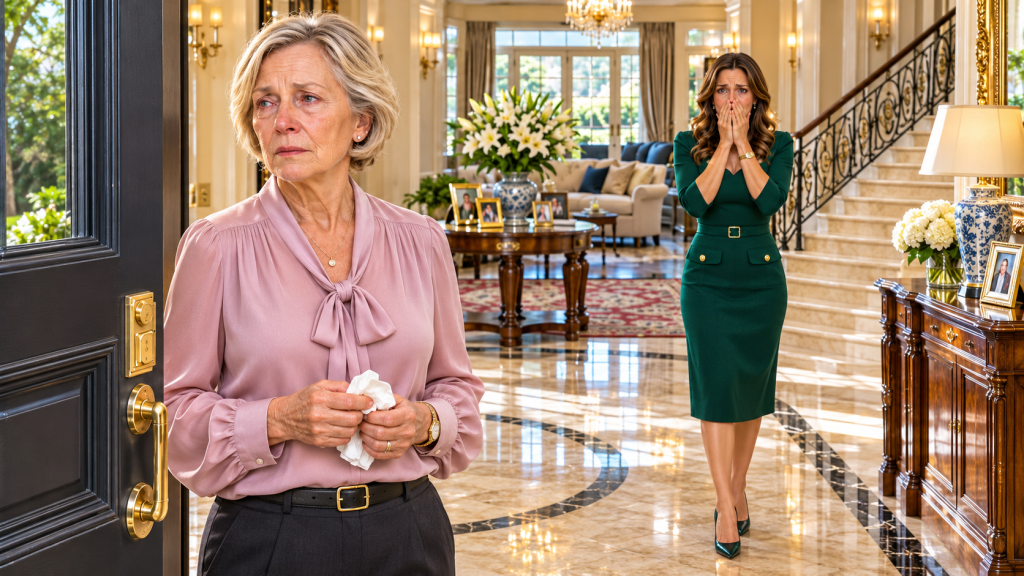
Warren.
Even now, hearing his name spoken by a stranger was enough to make my heart ache. “How do I know you’re telling the truth?” The woman stopped several feet from the door. “Your son called you his mountain rose,” she said gently. “He told me your husband used to call you that because you could make flowers grow in the poorest soil.”
I covered my mouth.
Nobody outside our family knew that.
My husband, Henry, had called me his mountain rose throughout our forty-one years together.
Warren had teased us about it when he was little.
“Mrs. Whitmore,” the woman continued, “I don’t want to frighten you. I can leave my card at the door, and you can independently verify who I am.”
I looked down at the letter.
Beneath the copy of the trust was a business card.
Catherine Ellis, Attorney at Law.
The same name.
The same telephone number.
I glanced toward the dark window.
“Brielle knows you’re here,” I whispered into my phone.
There was silence.
Then my daughter-in-law said something that chilled me.
“Theresa, don’t trust anybody who claims Warren sent them.”
The line went dead.
I opened the door with the chain still fastened.
Catherine stood beneath the porch light, holding a leather briefcase.
She was about fifty, with silver-streaked dark hair and a tired but reassuring expression.
A younger man waited beside the SUV.
“Who is he?” I asked.
“My associate, Daniel Price. He drove because the mountain roads are difficult after dark.”
I studied her.
“Why are you here?”
Catherine’s expression softened.
“Because Warren was afraid you might be left without a safe place to stay.”
Tears filled my eyes.
“He knew Brielle would do this?”
“He believed it was possible.”
I swallowed.
Then whispered, “My son was buried this afternoon.”
Catherine lowered her head.
“I know, Mrs. Whitmore. I’m deeply sorry.”
For a moment, neither of us spoke.
Then she asked, “Are you safe?”
I looked around the cabin.
The broken windows.
The damaged ceiling.
The damp walls.
The powerless light fixtures.
“I don’t know.”
Her expression changed.
“Then before we discuss anything else, we need to make certain you have somewhere warm and secure to sleep.”
Catherine didn’t enter until I invited her.
She asked Daniel to remain outside and telephone a nearby inn about a room.
Then she sat across from me at the dusty kitchen table.
I placed Warren’s metal box between us.
Her eyes filled when she saw it.
“He told me about this.”
I looked up.
“You knew?”
“I knew he’d prepared copies of important documents. He wouldn’t tell me exactly where he intended to keep them.”
I touched the lid.
“Why hide them in an abandoned cabin?”
Catherine considered the question.
“Your son was worried that records kept in the mansion might disappear or be altered.”
I stared.
“Warren was afraid of Brielle?”
She sighed.
“He was concerned about financial transactions he couldn’t explain and about how his wife might handle matters if he became unable to protect his interests.”
My throat tightened.
“Then why didn’t he tell me?”
Catherine looked at me gently.
“I think he was ashamed.”
The word landed heavily.
Ashamed.
My son had spent years encouraging me to tolerate Brielle’s cruelty.
He’d told me to keep the peace.
To remain upstairs when important guests visited.
To overlook the insults.
Perhaps he’d known more than I’d imagined.
And perhaps, by the time he understood how wrong things had become, he no longer knew how to undo them.
Catherine carefully examined the contents of the box without removing anything.
There were copies of trust documents, financial statements, correspondence, photographs, and a small flash drive.
She explained that the documents needed to be compared with official records and that some could contain privileged or confidential material.
“We’ll preserve what you’ve found and establish the proper chain of custody before relying on it,” she said.
I nodded.
Then reached for the letter.
“Catherine, did my son really discover that Brielle was taking money from his company?”
“His accountant identified transactions that required investigation.”
“How much?”
Catherine paused.
“The amount under review was substantial.”
My stomach tightened.
“How substantial?”
“More than one million dollars across several years.”
I gripped the edge of the table.
“One million?”
She nodded.
“Possibly more, depending on what the complete records establish. But I want to be careful. A suspicious transfer isn’t automatically theft. We need to know who authorized it, for what purpose, and whether legitimate services were provided.”
I closed my eyes.
Warren had always been generous.
He’d built his investment and property business from the small company his father left him.
He employed dozens of people.
He donated quietly to local charities.
And whenever someone needed help, he preferred to provide it without drawing attention.
The possibility that his own wife had been diverting money from those businesses was almost impossible to comprehend.
Then I remembered something.
“Catherine, Brielle told me the entire mansion belongs to her.”
The attorney’s expression changed.
“Did she show you a deed or a court order?”
“No.”
“Did she provide a copy of the trust?”
“No.”
“Did you sign anything?”
I shook my head.
“No.”
Catherine exhaled.
“Good.”
I stared at her.
“Why?”
She reached for the document marked with Henry’s signature.
“Because your late husband’s trust gives you a lifetime right to occupy the mansion, subject to the terms of the trust. Warren was never free to disregard that right simply by leaving his property to his wife.”
My heart began pounding.
“You’re saying Brielle can’t just throw me out?”
“Based on the documents I’ve reviewed, she had no apparent authority to order you out that way. But we’ll verify the current title, the trust’s validity, and any amendments before reaching a final legal conclusion.”
I looked toward the window.
For eleven years, I’d walked through that magnificent house feeling like a guest.
I had asked permission before inviting friends.
Kept my possessions confined to my bedroom.
Stayed out of sight when Brielle entertained.
And now I was learning that the home I’d been made to feel unwelcome in was a home my husband had deliberately protected for me.
I covered my face.
“Henry,” I whispered.
Tears slipped between my fingers.
After all these years, he was still looking after me.
Catherine reached across the table.
“Mrs. Whitmore, there’s something else.”
I looked up.
“Warren left a second letter with me.”
My heart tightened.
“Another letter?”
She nodded.
“He instructed me to give it to you only after we’d confirmed you were safe.”
She opened her briefcase and removed a sealed envelope.
Across the front, in handwriting I would have recognized anywhere, were two words.
For Mom.
I took it carefully.
For a moment, I couldn’t bear to open it.
The last time Warren had written me a letter was for my seventy-second birthday.
He’d filled it with jokes about my stubbornness, my gardening, and the way I insisted that grocery-store tomatoes weren’t real tomatoes.
Now every piece of his handwriting felt unbearably precious.
I broke the seal.
Inside was a single page.
Mom,
If you’re reading this, something has happened that I hoped I could prevent.
I owe you an apology that should have been spoken years ago.
You gave me a childhood full of patience and love. When Dad died, you stayed beside me while I learned how to manage the business. You never asked for anything except a place in my life.
And I let Brielle make you feel as though you were an inconvenience.
I stopped reading.
My tears fell onto the page.
Catherine waited silently.
I wiped my eyes and continued.
I thought I was protecting my marriage by avoiding arguments. Instead, I allowed someone I loved to hurt someone else I loved.
There is no excuse for that.
I cannot undo those years, but I can tell you the truth now: Dad wanted you to have that home for as long as you wished. I knew that. I should have reminded you every time you were treated like a guest.
The mountain cabin also matters. Please don’t abandon it. Dad had a reason for buying the surrounding land, and I finally discovered what it was.
Trust Catherine. Let the records speak before making accusations. And please don’t let anyone tell you that grief has made you incapable of deciding your own future.
I love you, Mom.
Warren.
I pressed the letter against my heart.
And sobbed.
Not because I’d found a fortune.
Not because the mansion might be mine to live in.
But because my son had finally spoken the words I’d spent years wishing to hear.
He had seen my pain.
He had understood it.
And he was sorry.
We left the cabin that night.
Daniel drove us to a small mountain inn where Catherine had arranged a room.
Before we departed, he photographed the cabin’s damaged exterior and secured the door.
Catherine advised me not to return alone until we knew who had access to the property.
“Do you think Brielle will send someone?” I asked.
“I don’t know,” she answered. “But she’s already made threats about the documents, and I don’t want to dismiss that.”
At the inn, I sat on the edge of a warm bed and stared at Warren’s photograph.
His smiling face looked back at me.
“Why didn’t you tell me sooner, sweetheart?” I whispered.
There was no answer.
Only the quiet hum of the heater.
I lay down without undressing.
For a long time, I stared at the ceiling.
Then, sometime after midnight, I fell asleep holding my son’s letter.
The next morning, Catherine returned with an unexpected visitor.
He was a tall, silver-haired man carrying a worn brown briefcase.
“Mrs. Whitmore,” Catherine said, “this is Samuel Reed.”
The man looked at me with unmistakable sadness.
“Theresa.”
I stared.
“Samuel?”
He nodded.
I hadn’t seen him in nearly fifteen years.
Samuel had been Henry’s closest friend and business adviser.
He’d attended Warren’s wedding.
Helped us through Henry’s funeral.
And then gradually disappeared from our lives as Warren took control of the family businesses.
I stepped forward.
He embraced me.
“I’m so sorry about Warren.”
I began crying again.
Samuel held me until I could speak.
Then I asked the question that had haunted me all night.
“Why are you here?”
He looked toward Catherine.
Then back at me.
“Because Henry made me promise that if his family ever needed the truth about the mountain property, I would help them find it.”
We sat at a little table beside the inn’s window.
Outside, the Blue Ridge Mountains rose through the morning mist.
Samuel opened his briefcase.
Inside were maps.
Old deeds.
Survey records.
And a photograph of Henry standing beside the cabin when he was a young man.
I touched the picture.
My husband was smiling.
He wore work boots, faded jeans, and the old green jacket he refused to replace.
Behind him stood the same neglected cabin from which I’d been rescued the previous night.
“He loved that place,” I whispered.
Samuel nodded.
“He did.”
“Why?”
Samuel looked at the photograph.
“Because it was where he decided to ask you to marry him.”
I stared.
For a moment, I couldn’t speak.
Then memory returned.
A summer afternoon.
Wildflowers along a mountain path.
Henry carrying a picnic basket.
The two of us sitting beneath an enormous oak tree.
He’d asked whether I wanted to spend the rest of my life with him.
I’d laughed and told him he should probably find a woman who liked camping more than I did.
And he’d answered, “Then I’ll build you a proper kitchen.”
I began crying.
I had forgotten the cabin was near that place.
Years had passed.
Children had grown.
Businesses had changed.
And somehow the mountain where our life together began had disappeared beneath the ordinary demands of living.
Samuel spread a map across the table.
“Henry purchased additional parcels around the cabin over a period of nearly twenty years.”
I stared.
“How much land?”
“Several hundred acres altogether.”
My mouth fell open.
“He never told me.”
Samuel smiled sadly.
“He planned to surprise you when the restoration was complete. But then he became ill.”
I looked toward the old photograph.
Henry’s death had been sudden.
A heart attack.
One ordinary Tuesday morning.
He’d kissed me before leaving for work, and by lunchtime, our lives had changed forever.
I thought Warren had inherited all the unfinished plans that followed.
But apparently my husband had left something more.
Something hidden in old deeds and mountain maps.
“Samuel,” I whispered, “what is this land worth?”
He took a breath.
“The valuation is still being updated. But between the acreage, conservation potential, and recent interest from developers, it could be worth considerably more than the mansion.”
My heart began racing.
“How much more?”
“Possibly several million dollars more.”
I stared at the map.
The abandoned cabin.
The damaged roof.
The weeds.
The broken windows.
Brielle had sent me there as an insult.
But Henry had spent years quietly assembling the surrounding land.
And Warren had apparently discovered something that made it important enough to protect.
Then Samuel said something that changed the meaning of everything.
“The land wasn’t purchased simply as an investment, Theresa.”
I looked up.
“Then why?”
He smiled gently.
“Henry wanted to create a place where families could come when life became too difficult to carry alone.”
I stared.
“What kind of place?”
“A retreat. Somewhere peaceful. He talked about offering respite to people caring for seriously ill relatives, and to older couples who couldn’t afford a quiet vacation.”
My throat tightened.
Henry had watched me care for my mother through the final years of her life.
He knew the exhaustion.
The sleepless nights.
The guilt that came from needing rest while someone you loved needed care.
He had once told me, “People who spend their lives looking after everybody else deserve somewhere they can put their burdens down.”
I remembered laughing and asking where he intended to find such a place.
Apparently he’d been building it.
Piece by piece.
Without telling me.
“Warren knew?” I asked.
Samuel nodded.
“He found the plans among Henry’s business records last year.”
My heart tightened.
“And Brielle?”
Samuel’s expression darkened.
“She knew about the property. But I’m not certain she knew the full ownership structure or Henry’s intended use.”
Catherine opened another folder.
“That’s one of the things we need to establish.”
I stared at the maps.
“Why would she want my signature?”
Catherine looked toward Samuel.
Then said carefully:
“Because some recent documents suggest that someone was trying to obtain your consent to release or modify rights connected to the trust and the mountain property.”
My stomach dropped.
“Someone?”
“The proposed transactions involve entities associated with Brielle. We need to determine who authorized them and whether the documents are genuine.”
I thought of Brielle’s voice.
Just your acknowledgment that you have no claim on the estate.
The hurried suitcases.
The twenty-minute deadline.
The insistence that I sign whatever her lawyer brought.
I looked down at Henry’s smiling face.
Then whispered:
“She wasn’t simply throwing me out.”
Catherine shook her head.
“We can’t yet know everything she intended.”
But her expression told me something else.
The timing was becoming impossible to ignore.
Three days later, I learned how much Brielle wanted my signature.
She arrived at Catherine’s office with her attorney, a man named Victor Harlan.
I hadn’t planned to see her.
I was sitting in a separate conference room, reviewing photographs of the cabin with Samuel, when I heard her voice in the hallway.
“This is ridiculous. Theresa is confused. She just buried her son.”
I froze.
Victor answered quietly, but Brielle spoke over him.
“She doesn’t understand financial documents. Warren handled everything.”
I felt my hands begin to shake.
For eleven years, that had been her favorite explanation whenever I expressed an opinion.
I didn’t understand.
I was old-fashioned.
I should leave complicated matters to people who knew better.
But I had managed our family finances beside Henry for four decades.
I had helped Warren prepare his first business plan.
And long before Brielle entered our lives, I had been the person keeping our household together when Henry’s work required him to travel.
I stood.
Samuel looked up.
“Theresa?”
“I’m tired of people discussing me as though I’m not in the room.”
He rose slowly.
“Then perhaps it’s time they heard you.”
Catherine met us in the hallway.
“Mrs. Whitmore, you don’t have to speak with them.”
“I know.”
I looked toward the conference room.
“But I want Brielle to understand something.”
Catherine studied my face.
Then nodded.
We entered together.
Brielle was seated beside her attorney, wearing an ivory suit and a pearl necklace I’d given her one Christmas.
She looked up.
For a moment, her expression changed.
Surprise.
Then irritation.
“Theresa.”
“Brielle.”
She glanced at Catherine.
“I thought we were discussing estate matters.”
“We are,” I answered.
Brielle folded her arms.
“Then surely you understand that Warren’s wishes need to be respected.”
I looked directly at her.
“Yes. They do.”
Her mouth tightened.
“Good.”
I took the chair across from her.
“That’s why I won’t sign anything without understanding it.”
Victor Harlan cleared his throat.
“Mrs. Whitmore, the papers at issue are intended to simplify administration and prevent unnecessary disputes.”
Catherine requested copies.
Victor slid several documents across the table.
I watched her read.
Her expression remained neutral, but I saw her mark several paragraphs.
After a few minutes, she spoke.
“These papers go substantially beyond an acknowledgment of receipt.”
Victor shifted.
“They’re part of an overall proposal.”
Catherine looked at him.
“They purport to release Mrs. Whitmore’s occupancy rights in the residence and consent to certain transfers involving the mountain parcels.”
My stomach tightened.
Brielle reached for her water glass.
Catherine continued.
“They also contain broad waivers of potential claims connected with trust administration and prior transactions.”
I turned toward Brielle.
“That’s what you wanted me to sign?”
She sighed.
“Theresa, you don’t need a mansion. You’d be much happier somewhere smaller.”
I stared at her.
“And you decided that for me?”
“Someone has to be practical.”
I looked toward the documents.
“Practical for whom?”
Brielle’s face reddened.
“You’re making this unnecessarily difficult.”
I sat back.
“No, Brielle. I’m asking you to explain why I should give up rights Henry specifically arranged for me.”
She opened her mouth.
Nothing came out.
Victor intervened.
“My client is willing to discuss a reasonable settlement.”
Catherine nodded.
“Any proposal can be presented through counsel. But Mrs. Whitmore will not be signing these documents today.”
Brielle pushed back her chair.
“Then she can stay in that cabin until she changes her mind.”
Catherine looked at her.
“Mrs. Whitmore is not staying at the cabin.”
Brielle froze.
“What?”
“We’ve arranged safe temporary accommodations while we examine her rights concerning the residence.”
My daughter-in-law stared at me.
For the first time since Warren’s funeral, she appeared to understand that I wasn’t simply waiting for someone to tell me what to do.
I held her gaze.
“Brielle, that cabin was where Henry asked me to marry him.”
Her expression faltered.
“And the mansion,” I continued, “was the home he intended me to enjoy for the rest of my life.”
I swallowed.
“You may have convinced yourself that I was an inconvenience. But I was Warren’s mother long before you became his wife.”
Her face hardened.
“And Warren chose me.”
Tears gathered in my eyes.
“Yes,” I whispered. “He did.”
I took a breath.
“But he didn’t stop loving me when he married you.”
After they left, I sat alone for several minutes.
Catherine brought me tea.
“You handled that well.”
I gave a weak laugh.
“My hands are still shaking.”
She smiled.
“Being frightened doesn’t mean you weren’t clear.”
I looked down at my wedding ring.
Henry had placed it on my finger forty-eight years earlier.
It had become thin with age.
The engraving inside was nearly worn away.
I turned it gently.
“I wish Warren had been here.”
Catherine sat beside me.
“I know.”
“To hear me stand up for myself.”
She took a breath.
“Theresa, I think your son was hoping you would.”
A week later, Catherine called with another discovery.
The current property records confirmed that the mansion remained titled under the trust arrangements Henry had established.
Warren had succeeded Henry in the trust administration, subject to the governing documents.
Brielle’s assertion that Warren’s will automatically transferred the mansion to her had ignored my protected occupancy rights.
But the more troubling discovery involved a document recorded several months before Warren died.
Someone had submitted a proposed amendment purporting to change certain beneficial interests and authorizations connected to the mountain property.
The document bore my name.
And a signature that resembled mine.
I stared at the copy Catherine placed before me.
“That’s not my signature.”
She nodded.
“I suspected you would say that.”
The writing was close.
But the T was too carefully formed.
The final letters were crowded together.
And the date corresponded to a week when I had been visiting my sister in Asheville.
“I wasn’t even here,” I whispered.
Catherine folded her hands.
“We’ll establish that through independent records if necessary.”
I looked up.
“Who submitted it?”
“An office associated with one of the entities involved in the proposed transaction. We’re tracing the instructions and determining whether the document was properly executed. Recording a paper doesn’t necessarily make it valid.”
My stomach tightened.
“Does Brielle know?”
“Her attorney has been notified that the signature is disputed.”
I looked at the document again.
There it was.
My name.
My supposed consent.
A counterfeit version of me.
For years, I’d quietly accommodated Brielle’s demands.
Now someone had apparently tried to make my silence permanent.
But the discovery that frightened me most concerned Warren’s death.
It began with a telephone call from his longtime nurse, Angela Porter.
Angela had helped coordinate his care during the final months.
She had been gentle with him.
Patient.
The kind of person who remembered how he liked his pillows arranged and how he preferred the curtains partly open in the morning.
When she called, her voice sounded uneasy.
“Mrs. Whitmore, I’m sorry to disturb you.”
“You’re not disturbing me, dear.”
There was a pause.
“Did Warren tell you he was concerned about his medication records?”
I gripped the telephone.
“No.”
Angela exhaled.
“He asked several questions about who had access to his prescriptions and whether changes were being documented.”
My heart began pounding.
“Why?”
“He said he was feeling unusually drowsy at times. His care team was investigating possible causes, including his illness and medications.”
I sat down.
“Angela, are you telling me somebody harmed my son?”
She answered immediately.
“No, Mrs. Whitmore. I’m telling you he had concerns that deserve proper review. I have no evidence that anyone deliberately harmed him.”
I pressed a hand against my chest.
For a moment, I couldn’t speak.
Angela continued.
“Warren’s medical condition was serious. His doctors had explained that his heart was becoming weaker. But because the records raised questions, I believed his family and legal representatives should know.”
I closed my eyes.
My son had suffered from a progressive cardiac illness.
We had watched him become exhausted by ordinary tasks.
Some days he couldn’t climb the stairs.
Other days he could barely finish a meal.
His death had not come without warning.
But now, in the middle of financial deception and forged documents, even the circumstances of his final illness felt newly uncertain.
Catherine helped arrange an independent review of the available medical records by appropriate specialists.
There were no immediate accusations.
No dramatic police raid.
No suggestion that suspicion itself proved murder.
The review included his diagnoses, prescriptions, hospital records, and the circumstances recorded around his death.
I was grateful for the careful approach.
I wanted answers.
But I could not bear the thought of allowing my grief to become another weapon in a fight about money.
Several weeks later, the reviewing physician explained the findings.
Warren had suffered from advanced heart disease.
His clinical deterioration was documented over time and was consistent with the fatal cardiac event reported by his treating team.
There were medication changes and some imperfect record-keeping, but the available evidence did not establish intentional poisoning or another deliberate act.
I sat very still.
“Then nobody killed him?”
The doctor answered carefully.
“We can’t speak with absolute certainty about every circumstance. But the records reviewed support death from his underlying disease. We found no medical basis to conclude that a crime caused his death.”
I closed my eyes.
Relief and sorrow swept through me together.
Warren had not been stolen from me by a hidden murderer, as my frightened imagination had begun to fear.
He had died from the illness that had been taking him away for months.
That truth was painful enough.
Later, Catherine asked whether I wanted to discuss the findings with Brielle.
I shook my head.
“Not now.”
I looked toward Warren’s photograph.
“I don’t want his death turned into a story somebody uses to win an argument.”
Catherine nodded.
“Then we keep the medical conclusion separate from the financial issues.”
I was grateful.
Brielle had treated me cruelly.
There were serious questions about company funds and documents.
But cruelty wasn’t proof of murder.
And I refused to accuse her of something the evidence didn’t support.
The financial investigation, however, began revealing far more than I’d imagined.
Warren’s accountant, a quiet man named Peter Lowell, had spent months reviewing payments to consulting companies connected with Brielle.
Some invoices were legitimate.
Others lacked evidence that any services had been provided.
Several transfers had been approved using electronic credentials associated with Warren’s office during periods when he was hospitalized.
The company began reviewing access logs, authorization procedures, and bank records.
The disputed amounts grew.
Not because someone had discovered a secret vault of gold.
But because years of questionable transactions, when examined together, formed a troubling pattern.
Peter met with Catherine, Samuel, and me one afternoon.
He spread the records across the table.
“Warren became concerned when the same vendor was paid repeatedly for reports nobody could locate,” he explained.
I looked down.
“What vendor?”
“Bluecrest Advisory.”
I recognized the name.
Brielle had mentioned it at dinner parties.
She’d described Bluecrest as a sophisticated consulting company helping Warren expand his business.
Peter continued.
“The company was connected to business entities controlled by Brielle and one of her associates.”
My stomach tightened.
“Did Warren know?”
“He learned about the connection during his investigation.”
Peter swallowed.
“That’s when he instructed us to preserve records and seek independent legal advice.”
I looked toward Catherine.
“And then he died.”
She nodded sadly.
“Before the review was finished.”
I sat back.
The $4 million mansion had once seemed like the center of the dispute.
Then came the mountain land.
The forged signature.
The company transfers.
And now I was beginning to understand why Warren had warned me not to sign anything.
He hadn’t left me a puzzle for the pleasure of solving it.
He’d left me a way to protect myself while the professionals completed work he no longer could.
One evening, Samuel came to see me carrying a folder of old photographs.
We were sitting in a small rented cottage not far from the estate.
It was warm and comfortable, with a little garden outside the kitchen window.
Far better than the neglected mountain cabin.
Samuel placed the photographs on the table.
“Theresa, I want to show you something.”
I looked up.
He handed me a photograph of Henry standing beside a young Warren.
My son was about twelve.
They were holding fishing rods.
Behind them was a stretch of mountain stream.
I smiled through tears.
“They went fishing there every summer.”
Samuel nodded.
“Henry loved those trips.”
I turned the photograph over.
On the back, Henry had written:
Warren’s first trout. Released unharmed. He insisted.
I began laughing and crying at the same time.
Warren had always hated the idea of hurting anything.
As a little boy, he’d rescued worms from puddles.
Moved spiders outside instead of killing them.
Once, he spent an afternoon making a tiny shelter for an injured bird, then cried when the veterinarian told us it couldn’t be saved.
Somewhere along the years of managing a company and navigating a difficult marriage, I had almost forgotten that gentle child.
Samuel watched me.
Then said quietly:
“Theresa, that’s why the mountain property matters.”
I looked up.
“What do you mean?”
“Henry wanted the land protected from careless development. Warren discovered a proposal to sell major portions of it to a company planning luxury construction.”
My smile faded.
“And Brielle?”
“Entities associated with her had been involved in preliminary discussions.”
I stared toward the window.
Henry’s land.
The place where he’d asked me to marry him.
The streams Warren had loved as a child.
The forest my husband hoped would become a peaceful retreat for exhausted families.
Someone had seen it only as another opportunity to profit.
“Can we stop the sale?” I asked.
Samuel nodded carefully.
“The title and trust restrictions must be honored. Any proposed transaction requires proper authority and any consents legally necessary. The disputed documents cannot simply be treated as valid because somebody filed them.”
I gripped the photograph.
“Then let’s protect it.”
Samuel smiled faintly.
“You sound like Henry.”
I looked down.
“He used to say I was the stubborn one.”
Samuel laughed.
“He was right.”
For the first time in weeks, I laughed without immediately feeling guilty.
The legal proceedings took nearly a year.
There were hearings about the trust, investigations into disputed signatures, and negotiations concerning the business assets.
Brielle’s attorneys challenged some of the evidence.
They argued that several payments had been authorized and that Warren had intended to provide generously for his wife.
Some of those arguments had merit.
Warren had indeed left Brielle property and financial benefits under his estate plan.
I never disputed her right to receive what he had lawfully chosen to give her.
But that was different from allowing her to take what belonged to somebody else.
Catherine and the other professionals worked carefully.
They separated legitimate inheritance rights from the disputed trust documents.
They examined the questionable company transactions without treating every payment as wrongdoing.
And they pursued the issue of my purported signature through the appropriate procedures.
Eventually, the court confirmed that my lifetime occupancy rights in the mansion remained enforceable under Henry’s trust.
The disputed document purporting to release those rights was not accepted as a valid expression of my consent.
The trust arrangements involving the mountain land also remained protected.
Brielle could not simply transfer those properties by declaring that Warren’s entire fortune belonged to her.
The business review established that substantial payments had been made without adequate authorization or supporting services.
A negotiated resolution required the return of significant funds to the affected business entities, while other issues were addressed through the applicable legal processes.
I didn’t stand in the courtroom smiling when the decisions were announced.
I was too tired for triumph.
I simply closed my eyes.
And whispered:
“Henry. Warren. We did it.”
Brielle requested a meeting afterward.
I nearly refused.
But Catherine reminded me that listening didn’t mean agreeing, forgiving, or surrendering any rights.
So one afternoon, we met in a quiet conference room.
Brielle looked different.
The expensive jewelry was gone.
Her clothes were simple.
And there were shadows beneath her eyes.
She sat across from me without speaking for several minutes.
Finally, she whispered:
“I never thought you’d fight me.”
I looked at her.
“I didn’t want to fight you.”
She swallowed.
“Then why did you?”
My eyes filled.
“Because you threw me out of my home on the day we buried my son.”
Brielle looked away.
I continued.
“Because you treated eleven years of my life as though they meant nothing.”
My voice trembled.
“And because Warren left documents showing me that he wanted his father’s wishes respected.”
She covered her face.
“I was angry,” she whispered.
“At me?”
She nodded.
“At you. At Warren. At everything.”
I waited.
“He was dying, Theresa. Our marriage was falling apart. The business was under pressure. I was terrified of losing the life I’d built.”
I looked toward the window.
“Then why didn’t you ask for help?”
Her voice broke.
“Because I didn’t want anybody to know.”
For a moment, I saw something familiar.
The fear of losing control.
The desperation to preserve appearances.
The conviction that admitting weakness would be worse than doing something cruel.
But understanding another person’s fear did not erase the harm they’d caused.
“Brielle,” I said quietly, “I loved Warren.”
She began crying.
“I know.”
“And whatever problems you had with him, he was still my only child.”
Her shoulders shook.
I took a breath.
“You could have let me stay one more night.”
She looked up.
Tears streamed down her cheeks.
“I know.”
“You could have let me keep his photograph without making me hide it.”
She covered her mouth.
“I know.”
I sat quietly.
Then I said something I’d been carrying since the funeral.
“I don’t need you to pretend you loved me. But I needed you to remember that I was a mother burying her son.”
Brielle lowered her head.
For a long time, she cried.
Eventually, she whispered:
“I’m sorry, Theresa.”
I nodded.
“I hear you.”
It wasn’t forgiveness.
Not yet.
But it was the truth.
And after everything we’d been through, that was enough for one afternoon.
I didn’t immediately return to the mansion.
That surprised everyone.
Once my rights were confirmed, Catherine assumed I would want to move back as quickly as possible.
But standing on the estate’s enormous front steps, I realized something.
The house had been filled with beautiful things.
Marble floors.
Expensive paintings.
Crystal chandeliers.
A garden that stretched across several acres.
Yet for years, I’d felt lonely inside it.
I had spent too much time keeping quiet, staying out of sight, and pretending my feelings didn’t matter.
Now the law had confirmed that I belonged there.
But I wanted more than the right to occupy a building.
I wanted the freedom to decide what home should mean.
So I made a different choice.
With Catherine’s assistance, I arranged appropriate management of the mansion while I considered my future.
I returned to collect personal belongings and family photographs.
I visited Henry’s old study.
Sat beside Warren’s favorite window.
And walked through the garden we’d tended together.
I cried in nearly every room.
But the tears felt different now.
I wasn’t crying because somebody had told me to leave.
I was crying because the people who had made that house meaningful were gone.
And that was a grief no court could remedy.
Then I went back to the mountains.
This time, I didn’t arrive with two suitcases and nowhere else to go.
I came with Samuel, Catherine, an architect, and a team of contractors.
The cabin looked as neglected as ever.
The roof still sagged.
Weeds covered the path.
But the forest surrounding it was magnificent.
Tall trees reached toward the sky.
A stream ran beyond the property.
And wildflowers grew near the old oak where Henry had asked me to marry him.
I stood beneath its branches for a long time.
Then whispered:
“You remembered, Henry.”
Over the following months, I worked with the trust’s authorized administrators and professional advisers to develop a plan for the property.
We had the land surveyed.
Reviewed conservation options.
Established a sustainable budget.
And began restoring the cabin and nearby buildings.
The goal wasn’t to create a luxury resort.
It was to honor Henry’s original dream.
A peaceful place where family caregivers and people facing difficult seasons of life could rest, with programs operated by qualified partners.
We called it Mountain Rose Haven.
The name made me cry the first time I saw it written on the plans.
Henry’s nickname for me.
A promise he’d carried quietly for decades.
And a new purpose for land Warren had helped protect.
The first guests arrived the following spring.
A woman caring for her husband after a serious illness.
An exhausted daughter who had spent years looking after her elderly mother.
And a couple who had endured more hospital waiting rooms than they cared to count.
We welcomed them with warm meals, comfortable rooms, and quiet spaces to enjoy the mountain views.
There were no grand speeches.
No photographers.
No extravagant opening ceremony.
Just people who needed rest.
And people willing to offer it.
I stood outside the restored cabin watching sunlight move through the trees.
Samuel came to stand beside me.
“Henry would’ve loved this.”
I smiled through tears.
“So would Warren.”
He nodded.
“Yes. He would.”
Inside the cabin, we restored the little wooden altar.
The one Warren had instructed me to clean.
The one bearing the letter T.
I placed Henry’s photograph beside Warren’s.
Then added a small framed copy of the first page of my son’s final letter.
Not the financial warnings.
Not the disputed documents.
Just the words that mattered most.
You gave me a childhood full of patience and love.
Beneath the photographs, I placed a small brass key.
The same key that had opened the hidden box beneath the floor.
People sometimes asked why I kept it there.
I would smile.
Then tell them:
“Because someone I loved left me a reminder that a locked door isn’t always the end of a story.”
One evening, almost two years after Warren’s death, I sat on the porch of the restored cabin.
The mountains glowed gold beneath the setting sun.
The air smelled of pine and fresh earth.
In the distance, I could hear guests laughing around a fire.
I held Warren’s photograph on my lap.
For a long time, I studied his face.
The familiar smile.
The eyes he’d inherited from Henry.
The little crease beside his mouth that appeared whenever he was trying not to laugh.
I touched the glass.
“Oh, sweetheart,” I whispered.
“I wish you could see what we did.”
Tears rolled down my cheeks.
“I wish I could tell you how proud I am.”
The breeze moved through the trees.
I closed my eyes.
And remembered Warren as a little boy, running toward me with muddy shoes and an armful of wildflowers.
“These are for you, Mom!”
I’d laughed and asked where he’d found them.
“Everywhere!”
That was my boy.
Before the businesses.
Before the mansion.
Before the difficult marriage.
Before illness took him away.
Just a child who believed his mother deserved flowers.
I never found a way to make losing Warren less painful.
I don’t think such a way exists.
There are mornings when I still reach for my phone, wanting to call him.
There are birthdays when I stare at his photograph and remember the baby I once held against my chest.
There are evenings when the mountains turn the exact shade of blue he loved, and I have to sit down because missing him becomes almost unbearable.
But I have learned that grief doesn’t have to mean surrendering the rest of your life.
I can love my son.
Miss him.
Mourn the things we’ll never do together.
And still find purpose in the days I have left.
The day Brielle sent me away, she thought she was leaving me with nothing.
An old cabin.
Two suitcases.
A photograph.
And a grieving heart.
But she didn’t know what my husband had protected.
She didn’t know what Warren had discovered.
And she didn’t know what years of being underestimated had taught me.
I had learned to endure.
To begin again.
And, eventually, to stop asking permission to belong.
The mansion was worth millions.
The mountain property carried a value I had never imagined.
But neither was the greatest treasure I found beneath that loose floorboard.
The real treasure was the knowledge that my husband had remembered our dreams.
That my son had recognized his mistakes.
And that, even after years of silence, I still had the right to speak for myself.
Money can purchase a magnificent house, but only love, dignity, and belonging can make it a home.
My name is Theresa Whitmore.
I’m a widow.
A mother who buried her only son.
And a woman who was once told to leave the home where she’d spent eleven years caring for the people she loved.
Today, when I stand beneath the old oak tree, I don’t think about Brielle ordering me out.
I think about Henry asking me to marry him.
I think about Warren laughing beside the mountain stream.
And I think about the tired families who arrive at Mountain Rose Haven and discover that someone has prepared a place for them.
Because the greatest inheritance my husband and son left me was never measured in dollars.
It was the courage to remember that I mattered.
And the opportunity to make sure other people felt that they mattered too.
Last Sunday, a little girl visiting with her grandmother handed me a handful of wildflowers.
“These are for you,” she said shyly.
I looked down at the tiny bouquet.
Purple.
Yellow.
White.
For a moment, I couldn’t speak.
Then I knelt beside her.
“Thank you, sweetheart.”
She smiled.
“Grandma says flowers make people happy.”
I laughed through tears.
“Your grandmother is a very wise woman.”
The little girl ran back toward the garden.
I stood holding the flowers.
Then carried them into the cabin.
I placed them in a small vase beside Warren’s photograph.
And whispered:
“Look, sweetheart.”
“Someone brought your mother flowers.”
For the first time in a very long while, the memory made me smile before it made me cry.
And as evening light filled the room, I understood that while death had changed my family forever, it had not erased the love we’d shared.
That love was still here.
In the mountains.
In the garden.
In the home we’d created for strangers who needed kindness.
And in every new life that found a little peace beneath the trees Henry had loved.