The photograph on my phone showed a form I had never seen before. At the top, beneath our company’s logo, were three words: Employee Transportation Reimbursement. Below them, Isaac Sullivan had entered dates, distances, and dollar amounts for the mornings I’d driven him to work. Every entry listed him as the claimant. And beside the words Transportation Provided By, someone had typed my name.
Gabriel Adams. At the bottom, Isaac’s signature appeared beneath a declaration that the information was accurate. I stared at the screen. For eleven months, I’d picked Isaac up in my old Honda before sunrise. I’d waited when he overslept. Taken longer routes when traffic blocked the highway. Driven him home during thunderstorms.
And occasionally bought gas with money I’d intended to spend on groceries. All because I believed he was my friend. Now I was looking at evidence suggesting he had turned those favors into something profitable. My mother’s hand tightened around mine. “Gabriel?” I looked up. She was lying in a hospital bed with monitoring leads beneath her gown.
Her face was pale, and the lines around her eyes seemed deeper than they had that morning. “Yes, Mom?” “Something’s troubling you.” I slipped the phone into my pocket. “Nothing you need to worry about.” She gave me the familiar look she’d used when I was a boy and tried to hide a broken lamp behind my back. “That’s what I say when I don’t want you to worry.” I tried to smile. “And you know how much I dislike it.” She squeezed my fingers.
“Then don’t do it to me.”
For a moment, I couldn’t speak.
My mother had spent my entire childhood trying to protect me from burdens that should never have belonged to a little boy.
After my father died, she worked two jobs to keep our home.
She repaired our clothes, prepared meals from whatever was left in the kitchen, and somehow made every birthday feel special.
Even when we had almost nothing, she always found a way to make me believe we had enough.
And now, at sixty-eight, she was lying in a hospital bed, apologizing for needing medical care.
I leaned forward and kissed her forehead.
“I’m handling something at work,” I whispered. “But Donovan knows I’m here. He told me to stay with you.”
Her eyes softened.
“That sounds like a decent man.”
“He is.”
“Then listen to him.”
I nodded.
For once, that seemed like excellent advice.
A nurse entered a few minutes later.
She checked Mom’s blood pressure, examined the monitor, and explained that the doctors were continuing their evaluation.
They were concerned about a problem involving blood flow to her heart.
Additional tests would help determine the appropriate treatment.
Mom listened quietly.
Then asked, “Will I be able to go home today?”
The nurse smiled gently.
“Let’s let the doctors finish assessing you first.”
My mother sighed.
“I’m causing everyone so much trouble.”
I looked at her.
“Mom, please.”
She turned toward me.
“Gabriel, you have a job. You can’t sit here all day.”
I took her hand.
“Yes, I can.”
“But—”
“No.”
She blinked.
I softened my voice.
“You spent years staying beside me whenever I was sick. You never once told me I was inconvenient.”
Her eyes filled.
“That’s different.”
“Why?”
“Because you’re my son.”
I smiled sadly.
“And you’re my mother.”
Her lips trembled.
For the first time that morning, she stopped arguing.
While Mom rested, I forwarded Isaac’s message to Donovan and the human resources department.
I included the original screenshots, the audio message demanding I abandon my mother, and the photograph of the reimbursement claim.
I wrote only what I knew.
I had provided Isaac with rides for almost eleven months.
I had never requested payment.
I had never received money from him for fuel.
And I had never authorized him to represent our private carpool arrangement as a reimbursable company expense on my behalf.
Then I added:
I am available to clarify these facts, but my mother is hospitalized, and I cannot participate in an extended investigation today.
I sent it.
Then turned off the sound on my phone.
For years, I had believed that being dependable meant remaining available for everybody, even when doing so hurt me.
Now, for the first time, I understood that reliability wasn’t the same thing as surrendering every boundary.
Donovan replied twenty minutes later.
Received. Stay with your mother. HR and finance will review the records independently. You do not need to communicate with Isaac about this.
Then another message arrived.
And Gabriel, I hope Amanda gets good news.
I stared at those words.
My boss had remembered my mother’s name.
Isaac, who had sat in my passenger seat for almost a year, hadn’t once asked how she was feeling.
It was a small distinction.
But I was beginning to understand how much it revealed.
Around noon, my younger sister, Hannah, arrived at the hospital.
She hurried into the room still wearing her pharmacy uniform.
When she saw Mom, her expression crumpled.
“Oh, Mom.”
Amanda attempted a reassuring smile.
“I’m fine, sweetheart.”
Hannah looked at the monitors.
“You’re in a cardiac unit.”
Mom sighed.
“Everyone’s so dramatic.”
Hannah laughed through tears.
“That’s because you taught us to be stubborn.”
I stepped aside so she could embrace our mother.
Then Hannah turned toward me.
“You look terrible.”
“Thank you.”
“Have you eaten?”
“Coffee.”
“Gabriel.”
“What?”
“Coffee isn’t lunch.”
She reached into her bag and produced a sandwich.
I stared at it.
“You brought me food?”
She rolled her eyes.
“Obviously.”
I almost laughed.
For eleven months, I’d gone out of my way to make sure Isaac never missed work.
Yet the people who genuinely cared about me didn’t need to be begged for basic kindness.
They simply showed up.
Hannah and I sat in the hospital cafeteria while Mom slept.
She studied my face.
“There’s something else going on.”
I sighed.
“You’re starting to sound like Mom.”
“Good. Tell me.”
So I did.
I explained the rides.
The messages.
The demand that I leave our mother alone.
The complaint to Donovan.
And the reimbursement form.
By the time I finished, Hannah’s sandwich sat untouched.
“Gabriel, are you serious?”
I nodded.
“Eleven months?”
“Almost.”
“And he never paid for gas?”
“No.”
She stared at me.
“Did he at least buy you breakfast?”
I thought about all those mornings at 7-Eleven.
“No.”
Hannah shook her head.
“Why did you keep doing it?”
I looked down.
“Because I thought we were friends.”
Her expression softened.
Then she reached across the table.
“Gabriel, being generous isn’t foolish.”
I swallowed.
“But people taking advantage of your generosity doesn’t mean you have to keep letting them.”
I stared at her.
She squeezed my hand.
“You can be a good person and still say no.”
That afternoon, the cardiologist spoke with us.
Mom’s blood tests and other findings suggested that she had experienced a non-ST-elevation myocardial infarction, a type of heart attack.
The doctors had begun appropriate treatment and recommended further investigation of her coronary arteries.
I listened carefully.
Asked questions.
Wrote down what I didn’t understand.
Hannah sat beside me, holding Mom’s hand.
When the doctor finished explaining the likely next steps, my mother looked frightened.
“Is this my fault?” she asked.
The doctor paused.
“What makes you ask that?”
Mom swallowed.
“I’ve worked hard all my life. Sometimes I don’t eat properly. I worry too much.”
The doctor answered gently.
“Heart disease can involve several risk factors, and it’s rarely useful to blame yourself. Right now, our priority is identifying the problem and treating it.”
I watched my mother’s shoulders relax slightly.
Then she asked the question I knew was coming.
“Can I go back to work afterward?”
Hannah covered her face.
“Mom!”
The doctor smiled.
“We’ll discuss your recovery and activity recommendations after we understand what treatment you need.”
I looked at Mom.
For the first time, I saw how much alike we were.
Both of us believed being needed was proof of being valuable.
And both of us had difficulty imagining a world where we could rest without apologizing.
That evening, Isaac sent another message.
Bro, why did you involve HR?
Then:
You could’ve just told Donovan we had an arrangement.
I stared at the screen.
He continued:
Now finance is asking questions about expenses from last year.
A minute later:
If I lose my job over this, it’s on you.
I didn’t respond.
Instead, I preserved the messages and forwarded them to the appropriate contact, as Donovan had instructed.
Then I returned to my mother’s room.
She was sleeping.
Hannah had gone home to collect clothes and medications from Mom’s apartment.
I sat beside the bed and watched the monitor rise and fall with every heartbeat.
For a long time, I thought about the phrase Isaac had used.
It’s on you.
I had heard variations of those words all my life.
When somebody needed a favor.
When a shift needed covering.
When a relative forgot an appointment.
When a friend had no money for gas.
Somehow, other people’s poor planning had repeatedly become my responsibility.
But sitting beside my mother, I made myself a promise.
I would help people because I chose to.
Not because they had learned how to make me feel guilty.
The next morning, Donovan called.
“Gabriel, do you have a moment?”
Mom was being examined by the medical team.
I stepped into the hallway.
“Yes.”
“First, how is Amanda?”
I took a breath.
“The doctors confirmed she had a heart attack. They’re arranging a procedure to examine her arteries.”
Donovan was quiet for a moment.
“I’m sorry. That must be frightening.”
“It is.”
“Take the time you need under your approved leave arrangement. HR can explain any paperwork later.”
“Thank you.”
He paused.
“Now, about Isaac. We found several transportation reimbursement claims.”
My stomach tightened.
“How many?”
“Enough that we’re expanding the review.”
I leaned against the wall.
“Did the company actually pay him?”
“Finance has confirmed payments associated with some of the claims. We’re reconciling the total and verifying the supporting information.”
I closed my eyes.
Donovan continued.
“Here’s something I want to be clear about. We are not assuming that every payment was improper solely because Isaac was your passenger. The applicable policy, what he represented, and what was authorized all matter.”
I nodded.
“But you never agreed to any paid arrangement?”
“No.”
“And he never gave you money?”
“Not a cent.”
There was a pause.
“All right.”
Then Donovan said something unexpected.
“Gabriel, did anyone at work ever ask you to drive Isaac as part of your duties?”
I frowned.
“No. He asked me personally when his motorcycle was in the shop.”
“Did a supervisor ever tell you that you were responsible for getting him to work?”
“No.”
Donovan exhaled.
“That’s important. Isaac’s complaint describes you as someone assigned to provide transportation.”
I stared.
“Assigned?”
“Yes.”
My mouth fell open.
“Donovan, I work in inventory control. I’m not a driver.”
“I know.”
For a moment, neither of us spoke.
Then he said, “We’re going to establish how that description entered the records.”
After the call, I stood in the hallway staring at a vending machine.
I remembered the first day Isaac climbed into my Honda.
It had been raining.
He wore a gray hoodie and carried a travel mug.
“Bro, you’re a lifesaver,” he’d said.
I laughed and told him it was no trouble.
Over the following weeks, he’d started leaving his house later.
Sometimes I waited ten minutes outside.
Once, after his alarm failed to wake him, I stayed almost half an hour.
When I told him I needed to leave earlier, he accused me of making a big deal out of nothing.
I’d apologized.
I actually apologized.
Now I understood that the favor had changed somewhere along the way.
Not because I agreed to anything different.
But because Isaac had begun treating my kindness as an obligation.
And apparently, he’d found a way to describe that obligation to the company in financial terms.
That afternoon, Mom underwent coronary angiography.
Hannah and I waited together.
We’d been told what the procedure involved and why the doctors recommended it, but the waiting remained agonizing.
Hannah sat beside me, twisting a tissue between her fingers.
“Remember when Mom used to drive us to school in that terrible green car?” she asked.
I smiled faintly.
“The one with the broken heater?”
She laughed.
“Every winter, she made us bring blankets.”
“And she’d tell us the car was building character.”
Hannah smiled.
“She was so proud of that thing.”
I leaned back.
“She drove it until the doors wouldn’t close properly.”
My sister looked at me.
“Remember when it finally died?”
“Of course.”
“Mom walked to work for almost two months.”
I nodded.
Then I remembered something I’d forgotten for years.
She’d worked an extra cleaning job at night so she could save enough money to buy another used car.
At the time, I was fourteen.
I thought she was simply busy.
Now I understood how exhausted she must have been.
My eyes filled.
Hannah reached for my hand.
“She’s stronger than we realize.”
I swallowed.
“She shouldn’t have had to be strong all the time.”
The cardiologist returned later with encouraging news.
The angiography had identified a significant narrowing in one coronary artery, and the treating team had performed an intervention to improve blood flow.
Mom was being monitored closely.
The doctor explained that her recovery would require medication, follow-up care, and cardiac rehabilitation as appropriate.
There were still risks.
Still instructions to follow.
Still reasons to be cautious.
But she had received treatment, and the team was pleased with her immediate response.
I felt my knees weaken.
Hannah began crying.
I put my arms around her.
And for several minutes, we stood together in the corridor, holding one another.
When Mom was awake enough to see us, she gave a sleepy smile.
“Did I miss anything?”
Hannah laughed through tears.
“Only the longest afternoon of our lives.”
Mom looked at me.
“Gabriel, you should go home and sleep.”
I shook my head.
“Not yet.”
She sighed.
“You’re just as stubborn as your father.”
I smiled.
“Funny. Hannah says I get it from you.”
Mom chuckled.
Then grew serious.
“Son?”
“Yes?”
“Thank you for bringing me here.”
My throat tightened.
“Of course.”
She looked down at her hands.
“If you hadn’t insisted…”
Her voice broke.
I leaned forward.
“Mom, you don’t have to finish that sentence.”
Tears gathered in her eyes.
“I just don’t want to be a burden.”
I held her hand.
“You have never been a burden to me.”
And for once, I meant it without a trace of exhaustion or obligation.
I was choosing to be there.
That made all the difference.
Three days later, I returned to work for a short meeting with HR.
Mom was still in the hospital but improving, and Hannah had arranged her schedule so she could stay with her that afternoon.
I didn’t need to work my regular shift.
Donovan had made that clear.
But the investigation required a formal statement, and I wanted to provide it while the details were fresh.
When I entered the warehouse, everything looked painfully ordinary.
Forklifts moved between rows of pallets.
The loading dock doors stood open.
A delivery driver argued cheerfully with someone from dispatch.
The smell of cardboard and machine oil filled the air.
For almost a year, I’d arrived at this building with Isaac sitting beside me.
I wondered how many coworkers had assumed we were close friends.
How many had seen him climb out of my car without thanking me.
And how many had known about the reimbursement claims.
I walked toward the administration offices.
Several people greeted me.
One asked about Mom.
Another told me to let them know if I needed anything.
The concern felt genuine.
Still, I was nervous.
Isaac had already demonstrated how easily a favor could become an accusation.
I didn’t know what version of the story he’d told everyone.
Donovan met me outside the conference room.
“Gabriel.”
He shook my hand.
“How’s Amanda?”
“Doing better. The doctors treated a blocked artery.”
Relief crossed his face.
“I’m glad.”
Then he lowered his voice.
“Before we go in, I want you to understand something. You’re here as a witness to the facts surrounding the transportation claims and the complaint. Nobody expects you to settle anything with Isaac.”
I nodded.
“Is he here?”
“Not in this meeting.”
I exhaled.
Inside were two HR representatives and a member of the finance compliance team.
They asked about the first ride.
The frequency of the arrangement.
Whether I had received payment.
Whether Isaac had ever discussed reimbursement.
And whether any supervisor had assigned me transportation duties.
I answered honestly.
At one point, the HR representative asked, “Did Isaac ever offer you money?”
I thought carefully.
“He once mentioned buying gas.”
“When?”
“About three months after I started giving him rides.”
“Did he pay?”
“No.”
“Did you ask him to?”
I lowered my eyes.
“No.”
“Why not?”
I hesitated.
Then said quietly, “I didn’t want to make it awkward.”
She nodded.
I almost laughed.
I had spent so long avoiding awkwardness that I’d allowed an increasingly unfair arrangement to become normal.
The finance representative then showed me several redacted examples from the expense records.
The amounts varied.
Some claims listed transportation assistance.
Others described private-driver services.
Several included round-trip distances that didn’t match the route I’d driven.
I stared at one entry.
“That date is wrong.”
The representative looked up.
“How so?”
“My car was in the shop that day. I borrowed Hannah’s car to get to work, but I didn’t pick Isaac up.”
“Are you certain?”
“Yes. I remember because he sent me six angry messages about having to take the bus.”
The representative made a note.
Another claim involved a Friday when I’d been on approved vacation.
I recognized the date immediately.
I’d taken Mom to visit her sister in Richmond.
“I wasn’t even in town,” I said.
The room became quiet.
The HR representative asked whether I could provide supporting records if needed.
“Yes.”
I had messages, calendar entries, and receipts.
More importantly, the company’s own attendance records confirmed I hadn’t been working those days.
The pattern was becoming clearer.
Isaac hadn’t merely misunderstood whether his transportation costs were reimbursable.
Some claims described rides that had never happened.
Then Donovan asked a question I hadn’t expected.
“Gabriel, did Isaac ever mention a special arrangement with the previous warehouse supervisor?”
I frowned.
“Mr. Benson?”
Donovan nodded.
I thought about it.
Isaac occasionally mentioned Benson.
He seemed to enjoy boasting that he knew people who could make company policies bend.
But I’d assumed it was ordinary workplace exaggeration.
“Not directly,” I answered.
“Did he ever say his travel expenses were covered?”
I remembered something.
A rainy morning in October.
Isaac had been complaining about fuel prices.
I’d joked that he was lucky I didn’t charge him.
He’d laughed.
Then said, “Don’t worry, bro. I know how to make the company take care of me.”
At the time, I thought he meant his paycheck.
Now the memory made my stomach tighten.
I repeated the conversation.
Donovan’s expression changed.
Then he thanked me.
After the meeting, I stepped into the hallway.
A familiar voice called my name.
“Gabriel.”
I turned.
It was Rosa Martinez, one of the warehouse supervisors.
She’d worked there longer than I had and had always treated me kindly.
She approached slowly.
“How’s your mother?”
“Better, thank you.”
Rosa nodded.
Then lowered her voice.
“I heard there’s been trouble with Isaac.”
I felt uncomfortable.
“I’m not really supposed to discuss the investigation.”
She nodded immediately.
“Of course.”
Then she hesitated.
“I just wanted to tell you something.”
I waited.
“Last winter, my car broke down during a storm. You stayed after your shift and helped me jump-start it.”
I smiled faintly.
“I remember.”
“You refused the money I offered.”
“It wasn’t a big deal.”
Rosa shook her head.
“It was to me.”
My throat tightened.
She continued.
“My husband was working nights, and my daughter was waiting at daycare. You helped me get home.”
I looked down.
Rosa touched my arm gently.
“Don’t let one person convince you that kindness was a mistake.”
For a moment, I couldn’t answer.
Then I whispered, “Thank you.”
She smiled.
“And next time someone asks for a ride every morning, tell them the bus schedule is available online.”
I laughed.
A real laugh.
The first one I’d managed since Mom entered the emergency room.
The investigation continued for several weeks.
Isaac was placed on administrative leave while the company reviewed the reimbursement claims and the allegations he’d made against me.
HR gathered records from finance, relevant managers, and employees with direct knowledge.
They compared expense entries with work schedules and the applicable reimbursement policy.
They also examined how the claims had been approved.
That last question proved important.
The claims hadn’t simply appeared in the payment system without anyone reviewing them.
Several had been approved by our former warehouse supervisor, Daniel Benson, who had transferred to another facility earlier that year.
The company discovered that Benson and Isaac had communicated about the reimbursements.
Some messages suggested Benson knew the transportation arrangement was informal.
Other records raised questions about why claims had been approved despite missing supporting information.
The evidence didn’t establish that Benson had received a share of the money.
But it showed enough weaknesses in the process that the company expanded its review of the approvals.
I found that surprising.
Not because I thought Isaac was innocent.
But because I’d assumed dishonesty always looked dramatic.
A stolen envelope.
A forged signature.
A secret bank account.
Sometimes it looked like a supervisor clicking approve without asking enough questions.
Sometimes it looked like somebody submitting a familiar form month after month, confident no one would notice.
One afternoon, Donovan called.
“Gabriel, do you have a minute?”
I was at Mom’s apartment, assembling a pill organizer according to her discharge medication list.
She had come home two days earlier.
Hannah and I were helping with appointments, meals, and the practical parts of recovery.
“Sure,” I answered.
Donovan sounded tired.
“The investigation has reached a preliminary conclusion concerning Isaac’s expense claims.”
I sat down.
“And?”
“We found that multiple claims contained material inaccuracies, including entries for days you didn’t provide transportation.”
I closed my eyes.
He continued.
“Isaac had an opportunity to respond to the findings. His explanations didn’t reconcile the discrepancies.”
I waited.
“The company has decided to terminate his employment for serious violations of our reimbursement and honesty policies.”
For several seconds, I couldn’t speak.
I’d imagined that news might make me feel victorious.
Instead, I felt a strange heaviness.
Almost a year earlier, Isaac had been a coworker asking for one ride.
Now he had lost his job.
Not because I’d refused to abandon my mother.
But because the company had examined conduct that existed long before that morning.
Still, the situation was sad.
It didn’t have to end this way.
“Are you all right?” Donovan asked.
I swallowed.
“I think so.”
He paused.
“Gabriel, I want to be clear. You didn’t cause the outcome by staying at the hospital.”
I stared toward the kitchen.
“Then why does it feel like I did?”
“Because you were involved.”
He took a breath.
“But Isaac was responsible for the information he submitted. The company made its decision based on the findings of the investigation.”
I nodded slowly.
Donovan continued.
“We’re also addressing the failures in our approval process. The finance team is reviewing the amount improperly paid and the appropriate steps for recovery. Any further action will follow company policy and the applicable law.”
I exhaled.
“Thank you for telling me.”
“There’s one more thing.”
I looked up.
“The complaint Isaac submitted against you was not substantiated. We’ll document that conclusion in the appropriate personnel records.”
Relief washed through me.
I hadn’t realized how much I needed to hear those words.
For weeks, I’d feared that one angry message could undo years of honest work.
Now the company had examined the facts.
And I could finally breathe.
When I ended the call, Mom was watching me from her recliner.
She wore a soft cardigan and had a blanket over her knees.
“Good news?”
I hesitated.
“Some of it.”
She studied my face.
“Tell me.”
I explained the outcome.
She listened carefully.
Then asked, “Do you feel bad for him?”
I nodded.
“A little.”
Mom looked toward the window.
“That’s because you have a kind heart.”
I smiled sadly.
“Sometimes I wonder whether that’s a good thing.”
Her expression changed.
“Gabriel.”
I looked up.
“Kindness wasn’t your problem.”
She reached for my hand.
“Your problem was thinking you had to keep giving even after someone stopped treating you kindly.”
I sat beside her.
For a moment, neither of us spoke.
Then she smiled.
“I think we both have some learning to do.”
I laughed.
“You’re telling me.”
Mom’s recovery became its own quiet journey.
She had days when she felt almost like herself.
Other days, fatigue seemed to settle over her before breakfast.
The cardiology team helped us understand her medications, follow-up appointments, and the importance of attending cardiac rehabilitation.
Hannah created a calendar.
I arranged transportation when needed.
And Mom practiced something she’d never been particularly good at.
Accepting help.
One Tuesday afternoon, she stood in the kitchen preparing to clean the cabinets.
I walked in.
“Mom.”
She froze.
“What?”
“What are you doing?”
“Nothing.”
I stared at the cleaning cloth in her hand.
She looked down.
“Oh.”
I smiled.
“The doctor said to follow the activity guidance, remember?”
She sighed.
“I can’t just sit around forever.”
“I know.”
I took the cloth.
“But maybe today you could let me do the cabinets.”
She looked offended.
“You don’t clean them properly.”
I laughed.
“Then you’ll have something to criticize while you sit down.”
She started smiling.
Then laughed too.
It was a small moment.
But after the hospital, small moments felt enormous.
Two months later, Isaac contacted me.
I was leaving work when his name appeared on my phone.
For a moment, I considered ignoring it.
Then I noticed the message was different from his earlier demands.
Gabriel, I know I don’t deserve a reply. I just want to apologize.
I stood beside my car.
The same Honda I’d used to pick him up hundreds of times.
Then I read the rest.
I blamed you for something I brought on myself. I shouldn’t have spoken to you that way, especially when your mother was sick. And I shouldn’t have used those rides to claim money I wasn’t entitled to.
I stared at the screen.
For the first time, Isaac had acknowledged what he’d done without immediately explaining why it was somebody else’s fault.
Then another message arrived.
I started claiming transportation costs because I was behind on bills. Benson told me there was a category that might cover it. I knew I was stretching the truth. Then I kept doing it because nobody questioned me.
I leaned against my car.
Isaac continued.
When you couldn’t pick me up, I panicked because I thought somebody would ask why I suddenly needed another way to work. Instead of admitting that, I got angry at you.
I read that sentence twice.
It explained something I’d been unable to understand.
Isaac hadn’t merely depended on my rides for convenience.
The arrangement had become part of a dishonest financial routine.
If I stopped driving him, it might expose the fact that he’d been making claims tied to transportation I provided for free.
So he’d tried to pressure me into continuing.
And when that failed, he’d attacked my reputation.
I closed my eyes.
I didn’t reply immediately.
I went home.
Made dinner.
Called Hannah.
Checked on Mom.
Then sat by the window with my phone.
Finally, I wrote:
Isaac, I appreciate the apology. What happened hurt me, especially your demand that I leave my mother at the hospital.
I paused.
Then continued.
I hope you take responsibility for the financial consequences and find a way to rebuild your life. But I won’t be resuming our friendship or the rides.
I read it carefully.
Then pressed send.
There was no insult.
No revenge.
No invitation for another argument.
Just the truth.
Isaac replied the following morning.
I understand. I hope your mom is okay.
I stared at the message.
Eleven months.
Hundreds of rides.
A hospital emergency.
An HR investigation.
And finally, those five simple words.
I hope your mom is okay.
They were words I had wanted from him on the first morning.
Back then, they might have been enough to reassure me that our friendship meant something.
Now they arrived too late to restore what he’d broken.
I answered:
She’s recovering. Thank you.
Then I put the phone away.
And let the conversation end.
About six months after Mom’s heart attack, Donovan asked me to stop by his office.
I was immediately nervous.
Even after everything had been resolved, an unexpected meeting with the boss still made my stomach tighten.
He smiled when I entered.
“Relax, Gabriel. You’re not in trouble.”
I laughed.
“Good to know.”
He gestured toward the chair.
“I’ve been reviewing some operational changes.”
I nodded.
“We’re improving several procedures for new employees, including orientation, scheduling, and reporting concerns about workplace pressure.”
“That sounds good.”
Donovan leaned forward.
“Rosa suggested you might be interested in helping with our employee mentoring program.”
I stared.
“Me?”
He smiled.
“Yes, you.”
I looked down.
“After everything with Isaac, I’m not sure I’m the best person to teach anyone about boundaries.”
Donovan laughed softly.
“Actually, I think you might be exactly the right person.”
I studied him.
He continued.
“You’ve always been dependable. People trust you. But you’ve also learned that helping somebody and becoming responsible for their entire life aren’t the same thing.”
I thought about the mornings spent waiting outside Isaac’s house.
The extra gasoline.
The missed breakfasts.
The resentment I’d swallowed because I feared disappointing a friend.
Then I smiled.
“I suppose I have learned a few things.”
Donovan nodded.
“We don’t need you to rescue anybody. We need somebody who can explain company procedures, answer questions, and encourage new employees to ask for help through the proper channels.”
I considered the offer.
Then answered.
“I’d like that.”
The mentoring program began the following month.
I worked with three new employees, helping them understand warehouse operations and find the resources they needed.
One young man, Tyler, approached me after his first week.
“Gabriel, can I ask you something?”
“Sure.”
“My car broke down. Would you be able to drive me for a few days?”
For a moment, I almost laughed.
Life had an interesting sense of humor.
I looked at Tyler.
“Where do you live?”
He named a neighborhood nearly twenty minutes in the opposite direction from mine.
The old Gabriel would have immediately said yes.
He would have rearranged his mornings.
Spent extra money.
And convinced himself that refusing would make him selfish.
Instead, I took a breath.
“I can’t commit to driving you, Tyler. But I can help you check the bus routes, and HR has information about available transportation options.”
Tyler smiled.
“That would be great.”
I stared.
That was it.
No accusation.
No guilt.
No suggestion that I was a bad person.
Just a reasonable request followed by a reasonable answer.
We spent ten minutes finding a route that worked.
When Tyler left, I sat at my desk and smiled.
I had helped somebody.
Without abandoning myself.
That autumn, Mom completed a phase of her cardiac rehabilitation program.
Hannah and I attended a small family education event at the center.
There were no awards.
No dramatic speeches.
Just patients and their families talking about recovery, changing routines, and learning to trust their bodies again.
Mom stood beside me wearing a pale blue sweater.
She looked stronger than she had in the hospital.
Her cheeks had regained their color.
And although she still needed medical follow-up and had to be mindful of her heart health, she had become more confident about managing her recovery.
At one point, she squeezed my arm.
“Gabriel?”
“Yes?”
“Remember that morning at the hospital?”
I nodded.
“Of course.”
She looked down.
“I remember telling you to go home.”
I smiled sadly.
“You told me that several times.”
She laughed.
Then her eyes filled.
“I was so frightened.”
I turned toward her.
“Mom…”
“I thought if I admitted how scared I was, you’d be scared too.”
My throat tightened.
“I was scared anyway.”
She nodded.
“I know.”
For a moment, we stood silently.
Then she whispered, “Thank you for not listening when I told you to leave.”
I wrapped my arms around her carefully.
“Always, Mom.”
She pulled back.
Then shook her head.
“Not always.”
I frowned.
She smiled.
“You’re allowed to have a life too, Gabriel.”
My eyes filled.
She continued.
“I want you to visit because you love me, not because you think you must sacrifice everything to prove it.”
I laughed through tears.
“Look at us. Both finally learning.”
She nodded.
“Better late than never.”
A few weeks later, something unexpected happened.
I received a letter from Isaac.
Not a text.
Not an angry voicemail.
An actual handwritten letter.
The envelope was plain, and my address had been written carefully.
I opened it at my kitchen table.
Inside was a money order for two hundred dollars.
And a note.
Gabriel,
I know this doesn’t cover eleven months of gas. I also know you never asked me to pay.
But I’ve been thinking about all those mornings when you went out of your way to help me. I took advantage of you, and I treated your kindness like something I was owed.
I’m working again. The financial matter with the company has been addressed through a repayment arrangement, and I’m trying to rebuild.
I wanted to send you something because I should have offered long before any of this happened.
You don’t have to reply.
Isaac.
I sat staring at the letter.
For a moment, I remembered the man who used to climb into my passenger seat carrying a coffee he’d bought only for himself.
I remembered the jokes.
The conversations.
The times I genuinely enjoyed his company.
There had been good mornings.
That was part of what made the betrayal painful.
Not every moment had been false.
But the good moments hadn’t excused the way he’d treated me when I needed compassion.
I looked at the money order.
Then placed it in a drawer until I could decide what to do.
The next day, I called Hannah.
“What would you do?”
She listened to the story.
Then asked, “Do you want to return it?”
“I don’t know.”
“Do you feel like accepting it means forgiving him?”
I considered that.
“Maybe.”
She shook her head, although I couldn’t see her.
“Gabriel, you can accept repayment without restoring the relationship. Those are separate decisions.”
I smiled.
“When did you get so wise?”
She laughed.
“Years ago. You were just busy driving Isaac around.”
I burst out laughing.
She joined me.
And for a moment, the whole experience felt less like a wound and more like a lesson I could finally carry without pain.
I accepted the money order.
Not because two hundred dollars erased eleven months of selfishness.
Not because I believed Isaac had earned another chance to sit in my passenger seat.
But because I could acknowledge his effort without surrendering the boundary I’d established.
I sent him a brief message.
I received your letter and the repayment. Thank you. I wish you well.
He answered:
You too, Gabriel.
That was our final exchange.
And it was enough.
One Sunday morning, Mom invited Hannah and me over for breakfast.
She had become more careful about what she cooked, following the advice she’d received from her healthcare team.
But she remained convinced that no family gathering was complete without enough food to feed an entire neighborhood.
When I arrived, I found her standing in the kitchen.
“Mom,” I said, “you’re not supposed to exhaust yourself.”
She laughed.
“I’m making breakfast, not climbing a mountain.”
Hannah appeared behind me carrying fruit.
“We told you we’d help.”
Mom raised both hands.
“Fine. You two cook. I’ll supervise.”
We laughed.
For the next hour, the kitchen filled with familiar sounds.
Dishes.
Conversation.
A little argument over whether I’d burned the toast.
And Mom’s delighted laughter when Hannah accused me of being incapable of following a simple recipe.
After breakfast, we sat near the window.
Sunlight spilled across the table.
Mom leaned back in her chair.
Then said quietly:
“This is nice.”
I looked at her.
“What is?”
“Having both my children here without an emergency.”
Hannah smiled.
“We should do it more often.”
I nodded.
“Definitely.”
Mom looked from one of us to the other.
Then whispered, “I think I’ve spent too much of my life believing rest had to be earned.”
My heart tightened.
She continued.
“But I’m beginning to understand that happiness can be as simple as sitting at the table with the people you love.”
I reached for her hand.
“That’s something worth remembering.”
Today, nearly a year after that terrible morning, my life looks different.
Not dramatically.
I still drive the same Honda.
I still work at the warehouse.
I still wake early and drink coffee before the sun comes up.
But I no longer begin every morning wondering whether someone else needs me to rearrange my life.
I leave home at a time that works for me.
I arrive at work without rushing.
And some mornings, I stop at 7-Eleven and buy myself a coffee.
Just one.
For myself.
The first time I did that, I laughed all the way to the parking lot.
It felt like such a small thing.
But it represented something I’d spent years overlooking.
My time mattered.
My needs mattered.
And I didn’t have to apologize for remembering that.
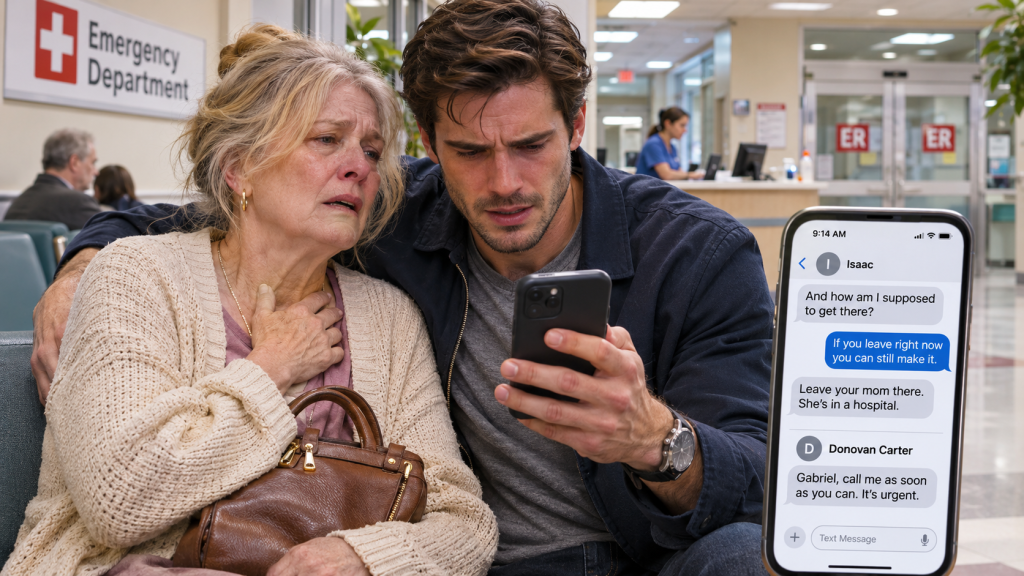
Sometimes I think about the message Isaac sent while I waited outside the emergency room.
Leave your mom there. She’s in a hospital, she’s not alone.
I remember how angry I felt.
How selfish his words seemed.
How desperately I wanted him to understand what I was going through.
But now I realize something.
I didn’t need Isaac to understand.
I needed to understand that someone who demanded I abandon my frightened mother for his convenience wasn’t behaving like a friend.
I had mistaken familiarity for loyalty.
I had mistaken repeated favors for closeness.
And I had mistaken my willingness to help for proof that the relationship mattered equally to both of us.
It didn’t.
At least not when it counted.
Yet the experience also revealed something beautiful.
My boss cared enough to ask about Mom.
My coworkers offered support.
Hannah rearranged her schedule without complaint.
And my mother, even while recovering from a heart attack, worried about whether I was taking care of myself.
Those were the people who taught me what genuine love looked like.
Not grand gestures.
Not expensive presents.
Not dramatic promises.
Just consideration.
Respect.
And the willingness to show up when life became difficult.
Last Friday, I drove Mom to a routine cardiology follow-up.
She climbed into the passenger seat, buckled herself in, and smiled.
“Ready, chauffeur?”
I laughed.
“That’ll be twenty dollars.”
She gasped dramatically.
“Twenty dollars? After everything I’ve done for you?”
I grinned.
“Family discount.”
She reached over and patted my hand.
“Thank you, sweetheart.”
I started the engine.
As we pulled onto the road, I glanced at her.
The morning sunlight illuminated her face.
She looked peaceful.
And suddenly, I remembered that frightening day at the hospital.
The cold bench.
The endless phone calls.
The double doors closing behind her.
The terror that I might lose the woman who had loved me through every difficult year of my life.
I swallowed.
“Mom?”
“Yes?”
“I’m really glad you’re here.”
She turned toward me.
Her eyes filled.
“Oh, Gabriel.”
Then she smiled.
“I’m glad too.”
My name is Gabriel Adams.
For almost a year, I believed a coworker was my friend because I drove him to work every morning.
The day my mother needed me most, he demanded I abandon her and then tried to damage my reputation when I refused.
I could have spent the rest of my life being bitter.
Instead, I chose to learn something from it.
Kindness is a gift we offer freely, but it should never become a debt someone else believes they’re entitled to collect.
I will still help people.
I’ll still stop when I see someone struggling.
I’ll still believe that generosity matters.
But I won’t confuse being needed with being appreciated.
And I will never again allow somebody else’s convenience to become more important than the people and responsibilities I truly cherish.
That afternoon, after Mom’s appointment, we stopped at a little park near her apartment.
We sat on a bench beneath an old oak tree.
She watched children playing nearby.
Then rested her head against my shoulder.
For a while, neither of us spoke.
There was no emergency.
No angry message.
No supervisor demanding an explanation.
Just the warmth of the sun and the sound of leaves moving in the breeze.
Mom squeezed my hand.
“Gabriel, are you happy?”
I thought about the question.
Then smiled.
“Yes, Mom.”
I looked at the woman who had spent her life giving me everything she could.
And answered again.
“I really am.”
Because I’d finally learned that a good heart doesn’t require an empty life.
And being a good person doesn’t mean letting everyone else decide what matters most.


