I stood in the middle of the church aisle with my mother’s last letter pressed against my heart and a daughter I’d buried fifty-five years ago holding my hand. The funeral director had stopped beside the casket. Somebody coughed. The organist was still sitting at her instrument, waiting for everyone to leave. And I could hear the little clock above the church office ticking as plainly as if it were right beside my ear.
Ruth looked at me. “You don’t have to open it now.” I studied her face. My chin. Mama’s nose. That dimple on the left side. For fifty-five years, I’d wondered what my baby might have looked like if she’d lived. I’d imagined dark curls. Brown eyes. Maybe a little gap between her front teeth like mine had when I was a child. But I had never imagined she would be standing in front of me wearing a navy-blue suit, with silver beginning to show at her temples. “Can I ask you something?” I whispered.
“Anything.” “Did you have a good life?” Her face changed. It was the first thing I could think to ask. Not who had signed the papers. Not how she’d found me. Not why Mama had lied. Just whether the little girl I’d spent half a century mourning had been happy. Ruth’s eyes filled. “Yes,” she said. “Mostly, I did.” I nodded. “Good.” Then my knees gave out. She caught me before I hit the floor. And the first time my daughter ever held me, she was fifty-five years old.
My name is Ona Mercer, though almost everybody calls me Doll.
My daddy started that when I was little because I never grew much past four feet eleven inches.
He’d say, “Where’s my little Doll?” whenever he came through the door.
I’m seventy-two now.
My knees ache when rain is coming, my hands are stiff in the morning, and I work the early shift at a gas station in Deer Park because my Social Security check doesn’t cover everything.
I’ve been a daughter.
A wife.
A widow.
And for most of my life, I believed I was the mother of a baby who’d lived only a few hours.
But that Tuesday morning, standing in the church where I’d cried over her every birthday, I discovered I had been a mother in a different way all along.
My little girl had grown up.
She’d learned to walk.
Lost her baby teeth.
Gone to school.
Fallen in love.
Had children of her own.
And I hadn’t been there for a single moment.
Ruth helped me sit in the back pew.
My cousin Edith appeared beside us.
“Doll, honey, what’s happened?”
I looked at her.
Then looked at Ruth.
“This is my daughter.”
Edith blinked.
“What?”
I couldn’t say it again.
Ruth spoke gently.
“I’m Ruth Rountree. I believe Ona is my birth mother.”
Edith’s hand flew to her mouth.
“Oh, sweet Jesus.”
Across the church, the funeral director approached.
“Mrs. Mercer, would you like a moment before we proceed?”
I looked toward Mama’s casket.
For the first time in my life, I didn’t know what I felt when I looked at her.
Love was there.
So was grief.
But something else had opened beneath them.
Something deep and dark.
“I need a minute,” I said.
He nodded and stepped away.
Ruth sat beside me.
She didn’t rush me.
She simply kept holding my hand.
And for that, I loved her a little already.
My phone began vibrating inside my purse.
I pulled it out.
Three messages from my manager.
The first said I was late.
The second reminded me that the district manager was coming.
The third said:
Doll, if you aren’t here in fifteen minutes, I’ll have to mark you absent.
I stared at the screen.
For thirty years, I’d punched clocks and worked shifts.
At the chicken plant, I’d stood until my ankles swelled.
At the gas station, I’d smiled at customers who wouldn’t look me in the eye.
I’d covered holidays, weekends, and other people’s emergencies because I needed the money.
I still needed it.
But something in me had changed.
I typed back:
I’m at my mother’s funeral. I’ve just learned my daughter, who I was told died in 1971, is alive. I won’t be coming in today. Please record my absence as you need to.
I read it twice.
Then pressed send.
Ruth watched quietly.
“Will you lose your job?”
“Maybe.”
She looked distressed.
“I’m sorry.”
I turned toward her.
“Don’t you ever apologize for finding me.”
My voice surprised me.
It was stronger than it had been all morning.
I put the phone away.
For once, the rest of the world could wait.
The funeral director gave us a little privacy before the burial.
Ruth asked whether I’d like her to leave.
I shook my head.
“No, ma’am.”
She smiled faintly.
“You don’t have to call me ma’am.”
I almost laughed.
“Well, I don’t know what to call you yet.”
“Ruth is fine.”
I nodded.
“Ruth.”
Her name felt strange in my mouth.
For fifty-five years, whenever I spoke to the little stone behind the church, I called my baby Little Bird.
I’d never given her an official name.
Mama told me the baby hadn’t lived long enough for that.
Sometimes I’d imagined calling her Elizabeth.
Sometimes Rose.
But mostly she was just my baby.
Now she had a name.
Ruth.
I said it again.
She squeezed my hand.
And I felt a terrible ache for all the times I should have been able to say it.
“How did you find me?” I asked.
Ruth looked down at the letter in my hands.
“After my father died last month, I was helping sort through his papers. I found a box in the back of his closet.”
I listened.
“Inside were adoption documents, old letters, and a photograph of my mother holding me as a baby.”
“Your adoptive mother?”
She nodded.
“Her name was Helen. She died twelve years ago.”
I felt an unexpected sadness.
A woman I’d never met had raised my child.
Held her when she cried.
Bandaged her knees.
Watched her grow.
I wondered whether Helen had loved her the way I would have.
Then I realized I hoped she had.
“I always knew I was adopted,” Ruth continued. “My parents didn’t hide that part.”
She hesitated.
“But they told me my birth mother couldn’t care for me and had chosen a different life.”
My throat tightened.
“I didn’t.”
Ruth’s eyes filled.
“I know that now.”
“No, sweetheart. I didn’t choose to give you away.”
My voice broke.
“I begged to see you.”
She moved closer.
“I believe you.”
I covered my mouth.
Those three words were almost more than I could bear.
Ruth told me she’d spent weeks reading through the old documents.
Some papers came from the Louisiana hospital.
Others referred to an attorney who had handled a private adoption arrangement.
There were letters from Mama to the Rountrees.
And there were records of money sent every September.
Ruth had searched for my name.
She found an old church announcement about Mama’s ninetieth birthday.
Then the obituary.
It listed me as her surviving daughter.
Ruth said she’d stared at that one word for hours.
Surviving.
It meant I was alive.
A woman she’d been told had relinquished her was still living.
She’d called the church office to ask about the funeral.
Then she drove from San Antonio to be there.
“I nearly turned around three times,” she admitted.
“Why?”
She looked at me.
“Because I didn’t know whether you wanted to see me.”
I made a sound somewhere between a sob and a laugh.
“Oh, honey.”
I took her face between my hands.
“I’ve been waiting to see you since the day you were born.”
The burial service took place under a cloudless sky.
The preacher said a prayer.
The funeral director lowered his head.
A few of Mama’s old friends sang softly.
Ruth stood beside me.
I didn’t introduce her to everyone.
I couldn’t bear the questions yet.
When they began lowering Mama’s casket, I felt grief rise so suddenly that I nearly lost my breath.
Despite everything, she was still my mother.
She’d taught me to make biscuits.
Sat beside me when I had the measles.
Told me to keep my shoulders straight even when people were unkind.
And for the last eight years of her life, I’d helped her bathe, cooked her meals, and made her root beer floats every Sunday.
I had loved her.
I still did.
But now that love was tangled around a lie so enormous I couldn’t see where it ended.
I watched the casket disappear.
Then whispered, “Mama, what did you do?”
Ruth heard me.
She didn’t answer.
She simply slipped her hand into mine.
After the burial, Edith offered to take us to her house.
I shook my head.
“Not yet.”
Ruth looked at me.
“Is there somewhere you’d rather go?”
I glanced toward the back of the churchyard.
“There’s somewhere I need to show you.”
We walked slowly past the flower beds.
The grass was damp from the morning sprinklers.
A few bees moved around the crepe myrtle.
And there, beneath its branches, stood the little stone I’d visited for fifty-five years.
No name.
No dates.
Just a carved angel with folded wings.
I stopped in front of it.
Ruth stood beside me.
For a long moment, neither of us spoke.
Then I whispered, “This is where I came to see you.”
Her eyes filled.
I knelt as far as my knees allowed and touched the stone.
“Every birthday.”
I swallowed.
“I brought you flowers.”
Ruth crouched beside me.
Her hands trembled as she touched the carved angel.
“My grandmother told me there had been no burial,” she whispered.
I nodded.
“I know that now.”
She began crying.
“I’m so sorry.”
I shook my head.
“Don’t be sorry.”
I looked at her.
“For years, I thought this stone was all I had left of you.”
The words broke apart in my throat.
“Turns out I was wrong.”
Ruth reached for me.
I held her.
And we cried beneath the crepe myrtle while the church bells rang noon.
That afternoon, we went to my house.
It wasn’t much.
A two-bedroom place with a sagging porch and a kitchen linoleum floor I’d been meaning to replace for years.
The front screen door stuck when the weather turned damp.
My husband, Walter, had fixed it three times before he died.
I still hadn’t figured out how to make it close properly.
Ruth stood in the doorway.
I suddenly felt ashamed.
She was wearing a lovely navy suit.
Her shoes looked expensive.
She had a nice handbag.
I was still in the black dress I’d worn to more funerals than I cared to count.
“Well,” I said, “it’s not fancy.”
Ruth looked around.
Then smiled.
“It feels like a home.”
I swallowed.
“Would you like some coffee?”
“Please.”
I started toward the kitchen.
Then remembered Mama.
For eight years, she’d sat at that same table while I made her breakfast.
I looked at the empty chair.
And the weight of everything we’d discovered nearly knocked me down.
Ruth noticed.
“We don’t have to talk about the letter today.”
I looked at the envelope in my hand.
Mama’s handwriting stared back at me.
Forgive me if you can.
I took a breath.
“No,” I said. “I’ve waited long enough.”
We sat at the kitchen table.
I made coffee.
Neither of us drank much.
I turned the envelope over.
The paper had yellowed.
Mama had sealed it carefully.
There was a faint scent of the lavender sachets she’d kept in her drawers.
My hands shook as I opened it.
Inside were six handwritten pages.
And a small photograph.
I recognized the photograph immediately.
It showed me at seventeen, standing beside Aunt Lydia’s porch in Louisiana.
I was pregnant.
My hands rested on my belly.
I wore a pale blue dress.
I remembered the day Aunt Lydia took it.
She’d told me to smile.
I’d refused because I thought I looked enormous.
Now I stared at that young girl’s face.
She looked frightened.
And terribly young.
I unfolded the first page.
At the top, Mama had written:
My darling Ona,
Then I began to read.
If Ruth has found you, then the truth has finally reached the person I should have told first.
I do not know whether these words will help you. I suspect they will only make you angrier.
You have every right.
I stopped.
My eyes filled.
Ruth waited.
I forced myself to continue.
Your baby did not die.
She was born alive in Louisiana on the evening of September 18, 1971.
You were unconscious after the delivery. The doctor told us you would recover, though you had lost a great deal of blood.
I was frightened. I was ashamed of being frightened. And I made a choice no mother should ever make for her daughter.
I pressed my hand against my mouth.
I remembered the hospital.
The smell of disinfectant.
The pale curtains.
Mama sitting beside the bed.
Her purse in her lap.
The way she told me my baby was gone.
I remembered asking to see her.
And Mama saying it was best not to.
I had trusted her.
God help me, I’d trusted her.
I read on.
The Rountrees had wanted a child for years. Helen had lost several pregnancies. They were decent people, and they believed they could give your baby a secure home.
They had been speaking with an attorney about adoption. I told them you wanted the child placed with a family.
That was not true.
I told myself you were too young. I told myself the boy was overseas and would never return. I told myself people in town would make your life unbearable.
But the truth is that I was afraid of gossip.
I was more afraid of what the ladies at church would say than of what losing your baby would do to you.
I stopped reading.
My hands had gone numb.
For years, I’d heard Mama say, “People will talk, Doll.”
She said it when I wore trousers to church.
When I took a job at the chicken plant.
When I stayed out late with Walter before we married.
But I’d never imagined those words had been powerful enough to make her take my child away.
Ruth reached across the table.
“Ona?”
I stared at her.
“She cared more about what people thought than whether I got to hold you.”
My daughter began crying.
And I felt an anger so deep and cold that I couldn’t speak for several minutes.
I don’t know how long we sat there.
The refrigerator hummed.
A car passed outside.
Somewhere down the street, a dog barked at a delivery truck.
Ordinary things kept happening.
That seemed almost insulting.
The world should have stopped when Mama told me my baby had died.
It hadn’t.
And now it refused to stop when I learned she’d lied.
I looked at Ruth.
“Did Helen know?”
She lowered her eyes.
“I don’t know how much she knew.”
I swallowed.
“Did she know I wanted you?”
Ruth hesitated.
“Some of the letters suggest my parents believed you had agreed to the adoption. But there are things in the paperwork that don’t make sense.”
I looked toward Mama’s letter.
“What things?”
“The consent form.”
My chest tightened.
Ruth reached into her handbag and removed a folder.
She opened it carefully.
Inside was a photocopy of an old document.
At the bottom appeared a name.
Ona Mae Cole.
My maiden name.
Beneath it was a signature.
I stared.
Then shook my head.
“That’s not how I wrote my name.”
Ruth looked at me.
“Are you sure?”
I almost laughed.
“Child, I know my own handwriting.”
I pointed to the last letter.
“I never made my e like that.”
Then I looked at the date.
Three days after Ruth’s birth.
I remembered those days.
I remembered crying until my throat hurt.
I remembered Aunt Lydia trying to persuade me to eat.
And I remembered Mama bringing me a little Bible and telling me the Lord would help me accept His will.
I never remembered signing an adoption paper.
Because I’d never known there was an adoption.
“I didn’t sign this,” I whispered.
Ruth’s eyes filled.
“I believe you.”
I looked at her.
“I need you to understand something.”
She leaned forward.
“I never gave you away.”
Her face crumpled.
“I know, Ona.”
I took her hand.
“No. I need you to hear it from me. Whatever those papers say, I wanted you.”
Ruth began crying.
And for the second time that day, I held the little girl I’d spent fifty-five years trying to mourn.
When I could bear it, I picked up Mama’s letter again.
I told the attorney you were willing. I let Lydia believe you had agreed. When questions were asked about your signature, I said you were still weak and that arrangements had already been made.
I will not pretend I remember every paper or conversation clearly after so many years. But I know I was responsible for the lie that made it possible.
I did not correct anyone who believed you had consented.
And when you woke up, I told you your daughter was dead.
The page shook in my hands.
I read the next sentence twice.
I thought you would forget.
I put the letter down.
There it was.
The part I couldn’t forgive.
Not yet.
Not perhaps ever.
Mama hadn’t believed I would heal.
She’d believed I would forget.
As though a daughter could be misplaced like a glove.
As though the child I’d carried beneath my heart was something I’d grow out of wanting.
I began to laugh.
Not because anything was funny.
Because I couldn’t find another sound.
“She thought I’d forget,” I said.
Ruth watched me.
“I don’t think she understood what she’d done.”
I shook my head.
“No, honey. I think she understood enough.”
I looked at Mama’s handwriting.
“She just thought she could live with it.”
The letter told the rest in pieces.
The Rountrees moved away shortly after Ruth’s birth.
Mama kept their address.
At first, she asked for photographs.
Then she began sending money.
Every September.
Sometimes fifty dollars.
Sometimes a hundred.
Later, larger amounts.
She described it as a contribution toward Ruth’s education.
There were receipts for money orders and checks.
But Mama’s letter admitted something I hadn’t expected.
The Rountrees never demanded the money.
They told me several times they did not need it.
I sent it because I could not bear the thought of doing nothing for the child I had taken from you.
I stared at the page.
Mama had money for Ruth.
Yet I had worked extra shifts at the chicken plant to keep the electricity on after Walter injured his back.
She’d watched me struggle.
She’d helped sometimes.
But every September, she’d gone to the bank and sent money to a granddaughter she never admitted was alive.
I wanted to be furious about that too.
I was.
But I also felt something I couldn’t name.
Mama had remembered Ruth’s birthday.
Every year.
Just as I had.
The difference was that Mama knew she was remembering a living child.
I hadn’t.
Near the bottom of the fourth page, Mama wrote about the little stone.
I had the marker placed in the church garden because you asked where your baby was buried.
I could not tell you there was no grave.
I believed giving you a place to mourn would be kinder than telling you what I had done.
I pressed my fingers against the paper.
For fifty-five years, I’d knelt beside that stone.
When Walter and I learned we couldn’t have children, I went there and cried.
When Daddy died, I went there and told my little girl her granddaddy was coming to heaven.
When Walter passed, I bought two bouquets.
One for his grave.
One for hers.
And through all those years, Mama sometimes rode with me to the churchyard.
She stayed in the car.
I had thought she couldn’t bear to approach the grave.
Now I understood.
She couldn’t bear to stand beside a stone she’d invented.
The last page was the hardest.
You looked after me when I was old.
You washed my clothes and brought me meals. You made me root beer floats and sat beside me when I could no longer remember the names of the women at church.
Every kindness made me want to tell you.
Every kindness made me more afraid.
I have been a coward for most of my life, Ona.
I cannot ask you to understand.
I cannot ask you to forgive me.
But I have arranged for Ruth to receive the records after my death, because I could not bear to carry this lie into another generation.
You were a good girl.
You became a good woman.
You would have been a good mother.
I am sorry I stole the chance for you to know that.
Love, Mama.
I read those final words.
Then folded the letter.
Very carefully.
Along the old creases.
Ruth was crying.
I wasn’t.
Not anymore.
I felt empty.
And tired.
And so angry I didn’t know where to put my hands.
Finally, I whispered, “She waited until she couldn’t hear my answer.”
Ruth looked at me.
I stared at the envelope.
“She got to tell the truth after she was safely gone.”
That night, Ruth stayed in my guest room.
It was the room Mama had used during her final years.
I stood in the doorway, looking at the quilt folded across the bed.
Mama had made it when I got married.
Tiny blue flowers.
White squares.
Little crooked stitches.
I almost offered Ruth another room.
Then I remembered there wasn’t one.
She noticed my hesitation.
“Are you all right with me sleeping here?”
I nodded.
“Of course.”
But I knew I wasn’t all right.
Not because of Ruth.
Because my house had suddenly become full of things that meant something different.
Mama’s favorite chair.
Her Bible on the bedside table.
The little china dish where she kept her hairpins.
For years, I’d believed those objects belonged to an imperfect but loving mother who had done her best.
Now I was trying to make room for another truth.
She had loved me.
And she had betrayed me.
Both things were real.
I didn’t know how to carry them together.
At two in the morning, I heard footsteps.
I came into the hallway and found Ruth standing near the kitchen.
She looked embarrassed.
“I’m sorry. I couldn’t sleep.”
I smiled faintly.
“Me neither.”
I made tea.
We sat at the table in our nightclothes, like two women who’d known each other for years.
Then Ruth asked something that startled me.
“What was my father’s name?”
I looked up.
For a moment, I was seventeen again.
Sitting on a porch swing beside a boy with sandy hair and a crooked smile.
“Thomas,” I whispered. “Thomas Bennett.”
Ruth repeated the name softly.
“Did you love him?”
I considered it.
“At seventeen, I believed I did.”
She smiled.
“Was he kind?”
“Mostly. He was young and scared, same as me.”
I looked toward the window.
“When he shipped out with the Army, I hadn’t told him I was pregnant yet.”
Ruth’s expression changed.
“Did you ever tell him?”
I nodded.
“I wrote letters. Aunt Lydia helped me address them.”
“Did he answer?”
“Not those.”
I swallowed.
“After Mama told me you died, I wrote him again. I said the baby hadn’t lived.”
Ruth lowered her eyes.
“I’m sorry.”
I shook my head.
“No, sweetheart. That’s another thing you don’t have to be sorry about.”
She hesitated.
“Do you know where he is?”
I stared into my tea.
“No.”
Then I looked at her.
“But maybe we can find out.”
The next morning, my manager called.
I almost didn’t answer.
Then I decided I’d spent enough years avoiding unpleasant things.
“Hello, Raymond.”
“Doll.”
His voice was gentler than usual.
“I got your message.”
I swallowed.
“Yes, sir.”
There was a pause.
“Are you all right?”
That simple question nearly undid me.
“No,” I said. “Not really.”
He sighed.
“I talked to the district manager.”
I braced myself.
Raymond continued.
“We’re short, and your absence caused problems. But you’ve worked here six years, and you’ve hardly missed a day.”
I sat very still.
“We can cover the next two shifts. After that, we need to discuss your schedule.”
My eyes filled.
“Thank you.”
“Don’t thank me yet. I can’t promise everything will be easy.”
“I understand.”
He hesitated.
Then said, “Doll, whatever happened, I hope it’s good news.”
I looked toward the living room.
Ruth was sitting on the couch, studying an old photograph of me and Walter.
“It is,” I whispered.
Then my voice broke.
“And it isn’t.”
Later that morning, Ruth showed me photographs of her life.
She’d brought several albums in the car.
I sat beside her on the couch while she turned the pages.
There she was as a baby, lying on a yellow blanket.
As a little girl with ribbons in her hair.
At eight years old, holding a bicycle.
At sixteen, standing beside a boy at a school dance.
At twenty-three, wearing a college graduation gown.
At twenty-seven, smiling in a wedding dress.
I touched the corner of each photograph.
“Look at you.”
Ruth laughed softly.
“I had terrible bangs in high school.”
I shook my head.
“You were beautiful.”
She looked down.
I turned another page.
There was Ruth holding a newborn baby.
A little girl wrapped in a pink blanket.
“That’s my daughter Rebecca,” she said.
I stared.
“My granddaughter.”
Ruth smiled through tears.
“Yes.”
I looked at the next photograph.
Another baby.
A little girl with dark curls.
“And that’s Hannah. She’s three years younger.”
My breath caught.
Two granddaughters.
For years, I’d imagined dying without leaving anybody behind.
Now there were two women in the world who carried something of me.
And a little boy besides.
Ruth turned another page.
A recent photograph showed a young couple holding a toddler.
“Rebecca and her husband, James. Their son is Oliver.”
I leaned closer.
Oliver had a round face.
Dark eyes.
And a dimple in his left cheek.
I began crying.
“Well, would you look at that.”
Ruth laughed through her tears.
“He got it from us.”
I touched the photograph.
“From us,” I repeated.
Two little words.
But I don’t think I’ve ever heard anything sweeter.
Then Ruth showed me a photograph of Helen Rountree.
She was standing in a garden, holding a basket of tomatoes.
A pleasant-looking woman with short brown hair and a broad smile.
I studied her carefully.
“She looks kind.”
Ruth nodded.
“She was.”
I swallowed.
“Did she love you?”
Ruth looked directly at me.
“Very much.”
I closed my eyes.
Relief moved through me so strongly I felt dizzy.
For fifty-five years, I’d wondered whether my baby had suffered before she died.
Now I was learning that she’d been loved.
Not by me.
But loved.
I opened my eyes.
“Then I’m glad.”
Ruth began crying.
She wiped her cheeks.
“I was afraid you might hate her.”
I shook my head.
“Why would I hate a woman for loving my child?”
She looked down.
“Because she got to be my mother.”
I took her hand.
“Honey, that’s exactly why I’m grateful to her.”
I swallowed.
“It hurts that I wasn’t there.”
My voice broke.
“But I wouldn’t wish you an unhappy childhood just so my sorrow could feel justified.”
Ruth squeezed my fingers.
And I knew we had begun something important.
We were learning how to tell the truth without making either of us deny the life we’d already lived.
A week later, Ruth and I met with an attorney in Houston.
His name was Benjamin Ellis.
He’d spent years handling family records, estate matters, and questions involving historical adoptions.
He listened while we explained what we’d found.
Then he examined the photocopied consent form.
He didn’t make dramatic promises.
He explained that adoption procedures in the early 1970s differed from those used now, and that the surviving records might be incomplete.
The alleged signature raised a serious question.
So did Mama’s written admission that she’d misrepresented my wishes.
But an investigation of a fifty-five-year-old event faced obvious difficulties.
Some witnesses had died.
The hospital had changed ownership.
The attorney who handled the original arrangement was long gone.
And the applicable law, deadlines, and record-access rules would need careful review.
“Can you prove I never consented?” I asked.
Benjamin looked at me kindly.
“We can document your account, examine the surviving records, and seek whatever additional information is available through lawful procedures. But I don’t want to promise that every question will have a definitive answer.”
I nodded.
I’d lived seventy-two years.
I knew some questions never did.
Ruth leaned forward.
“What about a DNA test?”
Benjamin smiled.
“That’s a practical way to establish your biological relationship, if you both want to proceed. It won’t explain what happened in the hospital, but it can answer an important question.”
I looked at Ruth.
She looked at me.
And we both nodded.
We chose to have the test.
Not because I doubted her face.
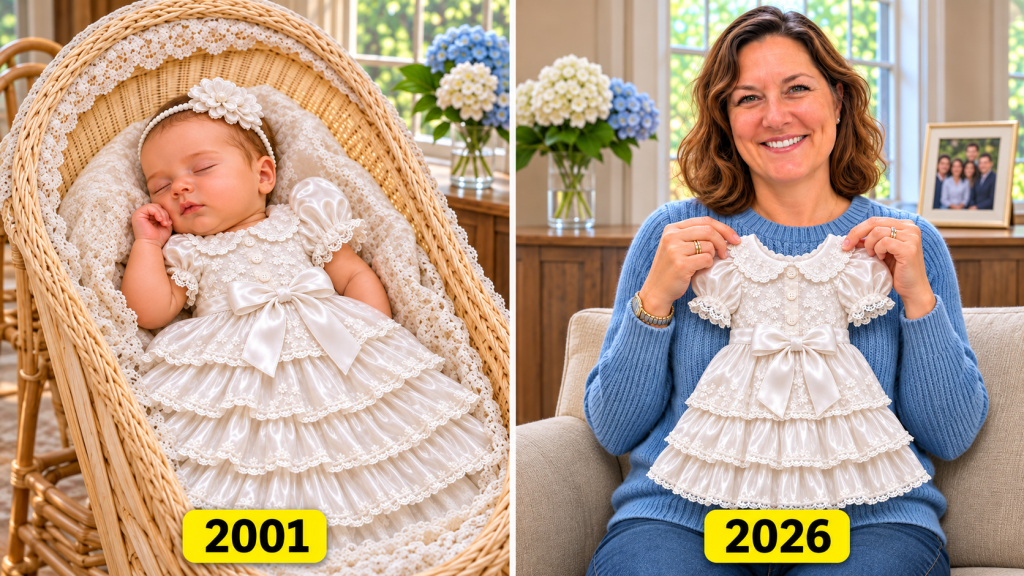
Or the little blue stitches on the christening gown.
Or the way she held her coffee mug with both hands, exactly as I did.
But because we’d spent too many years living under someone else’s version of the truth.
We wanted something that belonged to us.
The results arrived weeks later.
They supported a biological mother-daughter relationship.
I sat at the table staring at the report.
Then I called Ruth.
She answered on the second ring.
“Ona?”
I started crying.
“It’s true.”
She went quiet.
Then whispered, “I know.”
I laughed through tears.
“No, honey. I mean it’s written down. On paper. For anybody who ever says we’re imagining things.”
Ruth began crying too.
And for a few minutes, we simply listened to each other breathe.
The next question was harder.
What should we do with the stone?
For fifty-five years, I’d placed flowers there every September.
I’d whispered prayers beside it.
Told my baby about Walter.
About Daddy.
About the summers that grew too hot and the winters that made my knees ache.
I’d cried there when I believed nobody else in the world understood what I’d lost.
Now I knew it wasn’t a grave.
There was no child beneath it.
Just dirt and roots and the bones of old flowers.
I thought about asking the church to remove it.
Then I thought about all the years I’d spent kneeling there.
Those tears had been real.
The love had been real.
And the girl I’d mourned had existed.
She simply hadn’t died.
I called Ruth.
“I need to ask you something.”
“Of course.”
“Would you mind if I kept the stone?”
There was silence.
Then she said, “Why would I mind?”
I swallowed.
“Because it isn’t your grave.”
“No,” she answered gently. “But it marks the place where you loved me when you thought I was gone.”
My eyes filled.
She continued.
“You don’t have to erase those years just because we know something different now.”
I closed my eyes.
And I realized my daughter understood something I’d been struggling to explain even to myself.
The truth could change the meaning of the past.
It couldn’t make the past disappear.
That September, Ruth came to Deer Park for her birthday.
It was the first one we’d ever spent together.
She brought her daughters, Rebecca and Hannah.
And little Oliver, who had just turned four.
I’d cleaned the house three times.
Bought new towels.
Borrowed folding chairs from Edith.
And made enough chicken and dumplings to feed half the church.
When Ruth arrived, I stood on the porch with my hands shaking.
Her family climbed out of the car.
Rebecca approached first.
She was a lovely woman with her grandmother Helen’s warm smile and Ruth’s dark eyes.
“Are you Ona?”
I nodded.
She hesitated.
“Would it be all right if I hugged you?”
I began crying.
“Oh, honey, yes.”
She put her arms around me.
Then Hannah hugged me.
Then little Oliver looked up and asked, “Are you my new grandma?”
Everybody went quiet.
I knelt carefully.
“Well,” I said, “I suppose I’m a grandma you didn’t know you had.”
He considered that.
Then asked, “Do you have cookies?”
We all burst out laughing.
“Yes, sir,” I said. “I certainly do.”
He took my hand.
And just like that, a little boy led me into my own house.
That afternoon, we looked through my old photographs.
I showed the girls pictures of Walter.
Of Daddy.
Of Aunt Lydia.
And of Mama when she was young.
Ruth studied one photograph for a long time.
It showed Mama standing beside a rosebush.
Her expression was serious.
“She looks like someone who worried a lot,” Ruth said.
I nodded.
“She did.”
“Do you hate her?”
I thought about it.
“No.”
Ruth looked surprised.
I continued.
“But I’m angry with her.”
I swallowed.
“And sometimes I don’t know what to do with the fact that I still miss her.”
Ruth took my hand.
“You can miss someone and still know they did something terrible.”
I smiled sadly.
“You’re a wise woman.”
She laughed.
“I’ve had fifty-five years to practice.”
I looked at her.
“And I missed all of them.”
Her smile faded.
She moved closer.
“You missed the years. But you don’t have to miss what comes next.”
I closed my eyes.
For the first time, I believed that might be enough to keep me going.
We never found every answer about the hospital.
The surviving records confirmed Ruth’s birth and the adoption that followed.
They supported the story that she had been placed with the Rountrees, but they could not explain every step by which my consent had supposedly been obtained.
The hospital administrator from those days had died.
Aunt Lydia was gone.
The lawyer was gone.
Mama was gone.
Benjamin helped us document what we knew and preserve the records without pretending the unanswered questions had somehow disappeared.
The old forms and Mama’s letter remained painful evidence of a decision I hadn’t made.
But Ruth and I didn’t need a perfect reconstruction of 1971 to know what mattered most.
She was my daughter.
I had wanted her.
And we had found each other.
I also tried to locate Thomas Bennett.
We found that he’d returned from military service, married years later, and died before Ruth began searching for me.
The news saddened me more than I expected.
I’d wondered whether he might still be alive somewhere, perhaps sitting in a kitchen like mine, unaware he had a daughter.
Ruth asked whether I regretted trying to find him.
I shook my head.
“No.”
She looked at me.
“Why?”
“Because now I know.”
I touched her hand.
“And because every truth we find belongs to you too.”
She nodded.
We placed the information in the folder with the adoption records.
Not every discovery brought joy.
Some simply closed a door we’d never known was there.
As winter approached, I made another decision.
I cut back my hours at the gas station.
Not because Ruth asked me to.
She offered to help financially, but I didn’t want our relationship to begin with her taking responsibility for me.
I wanted to be her mother.
Not another obligation.
Instead, we talked about my budget, my health, and what I wanted for the years ahead.
I kept working part-time.
I liked the regular customers.
I liked having somewhere to go in the morning.
And I liked the independence I’d worked so hard to maintain.
But I no longer accepted every available shift.
Some afternoons were for calling my daughter.
Some weekends were for visiting San Antonio.
And every now and then, I bought a train or bus ticket simply because I wanted to see my family.
At seventy-two, I was finally learning that my time belonged to me too.
One Sunday evening, Ruth called while I was making a root beer float.
The habit had stayed with me after Mama died.
Sometimes I’d prepare one without thinking, set it on the kitchen table, and remember she wasn’t there to drink it.
That evening, I stood holding the glass when Ruth’s name appeared on the screen.
“Hello, sweetheart.”
“Hi, Ona.”
I smiled.
“How’s everybody?”
She told me about the girls.
About Oliver learning to ride his bicycle.
About a neighbor who’d adopted a noisy little dog.
We talked for nearly an hour.
Then Ruth grew quiet.
“Ona?”
“Yes?”
“Can I ask you something?”
“Anything.”
She hesitated.
“Would it be all right if I called you Mom sometimes?”
I gripped the counter.
For a moment, I couldn’t speak.
She rushed to explain.
“I don’t mean instead of Helen. She’ll always be my mother too. I just—”
“Oh, honey.”
My voice broke.
“Of course you can.”
There was silence.
Then Ruth whispered, “I love you, Mom.”
I began crying.
“I love you too, sweetheart.”
After we hung up, I sat at the kitchen table with my root beer float melting beside me.
And I cried for the seventeen-year-old girl who’d gone to sleep after giving birth and awakened believing her baby had died.
I cried for the woman who’d placed flowers beside an empty stone.
I cried for Helen, who had loved Ruth through all the years I couldn’t.
And I cried because, after fifty-five years, someone had finally called me Mom.
On Ruth’s next birthday, we returned to the church together.
The crepe myrtle was blooming.
The little stone stood beneath it, just as it always had.
But this time, I wasn’t carrying flowers alone.
Ruth had brought a bouquet of yellow roses.
I brought white carnations.
We placed them together.
Then I reached into my purse and removed a small brass plaque.
I’d asked the church for permission to place it near the original marker.
The plaque didn’t pretend there had been a burial.
It simply said:
For the years we were apart, and the love that never died.
Ruth read it.
Then covered her mouth.
“Mom.”
I looked at her.
She was crying.
I put my arm around her waist.
“I thought we could leave the old stone,” I whispered. “But tell the truth beside it.”
She nodded.
“I’d like that.”
We stood there for a long time.
Then she asked, “What would you say to Grandma if she were here?”
I looked toward the churchyard.
I thought about Mama’s hands.
Her Sunday dresses.
The root beer floats.
And the lie she’d carried until death.
“I’d tell her I loved her,” I answered.
My voice trembled.
“Then I’d tell her she had no right.”
Ruth squeezed my hand.
“And would you forgive her?”
I looked down at the flowers.
“I don’t know.”
I took a breath.
“Maybe someday. But finding you doesn’t make what she did all right.”
Ruth nodded.
“It doesn’t have to.”
For fifty-five years, I thought the greatest tragedy of my life was losing my daughter the night she was born.
Then I learned something harder.
I hadn’t lost her to death.
I’d lost her to somebody else’s fear.
I cannot get those years back.
I cannot watch Ruth take her first steps or hear her first words.
I cannot sit beside her at school plays, braid her childhood hair, or kiss her forehead before her first date.
Those things are gone.
And there are days when that knowledge hurts so deeply I have to sit down.
But now I can hear her laugh.
I can hold her hand.
I can meet the family she raised.
I can learn which books she loves, how she takes her coffee, and why she wrinkles her nose when she’s trying not to cry.
I can be there for the life still ahead of us.
And I’ve learned that a heart can mourn what was stolen while rejoicing in what has been returned.
Last Sunday, Ruth came over with Oliver.
He ran straight through my screen door, nearly knocking it off its hinges.
“Grandma Doll!”
I laughed.
“There’s my boy!”
He climbed into my lap with a picture he’d drawn.
It showed three women standing beneath a big yellow sun.
One was very small.
One wore a blue dress.
And one had long brown hair.
“Who’s this?” I asked.
He pointed.
“That’s Grandma Helen in heaven. That’s Grandma Ruth. And that’s you.”
I looked at the drawing.
Three women.
Three different lives.
All connected by one little girl born in Louisiana in 1971.
Oliver leaned against me.
“Are you crying, Grandma?”
I kissed his hair.
“Just a little.”
“Why?”
I smiled through my tears.
“Because sometimes people get more love than they ever expected.”
He considered that seriously.
Then offered me a cookie from his pocket.
It was broken in half and covered with lint.
I took it anyway.
Because after fifty-five years of putting flowers on a stone, I finally had someone sitting in my lap who wanted to share his cookies with me.
And there isn’t a thing in this world I’d trade for that.


