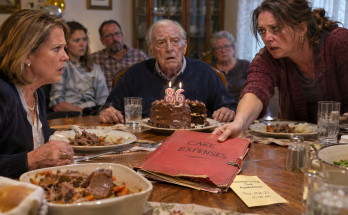
For nearly three minutes after Kentin hung up, I sat motionless in my apartment, staring at the envelope my parents had handed me at Romano’s. Three days earlier, I’d graduated at the top of my class from Stanford Law School. The previous evening, my family had celebrated that accomplishment by publicly removing me from their inheritance. And now I was discovering that my father might have been using my name to secure debts I knew nothing about.
I reached for the envelope. The thick cream-colored paper still smelled faintly of my mother’s perfume. I’d noticed that scent at dinner, when Claudia had smiled beneath the chandeliers and announced, “From all of us.” I’d thought she was simply being cruel. Now I wondered whether the cruelty had been a distraction. I spread the documents across my desk. There were amendments to family estate plans, notices concerning certain trust interests, and acknowledgments that I would receive no further voluntary financial support.

Then I reached the fourth page. A paragraph halfway down contained language that made my stomach tighten. The undersigned acknowledges and releases any claims arising from prior transactions, distributions, representations, or obligations associated with the Sterling Family Trust and related entities. I read it twice. Then a third time. I’d spent years studying agreements designed to transfer risk from one person to another. This paragraph was doing exactly that.
It wasn’t merely saying I wouldn’t receive an inheritance.
It was asking me to surrender rights concerning transactions I hadn’t been told existed.
I looked at the signature line.
Blank.
My parents’ signatures appeared on other pages, but mine was required for this particular release.
They hadn’t asked me to sign at the restaurant.
They’d simply handed me the envelope in front of everyone, expecting me to be too devastated to examine it carefully.
Then I remembered Mom’s expression when I thanked them.
Her smile had faltered.
And Dad had asked whether I was going to make a scene.
I suddenly understood.
The humiliation wasn’t the entire plan.
It was the opening move.
My name is Yasmin Sterling.
Until that evening, I believed the hardest thing I’d ever done was earn my law degree while coming to terms with the fact that my parents didn’t respect me.
I was wrong.
The hardest thing was learning to separate two truths that seemed impossible to hold at the same time.
My parents had given me opportunities.
And my parents had also treated me as though those opportunities made me their property.
I’d grown up in a family where money was never discussed plainly.
It appeared in conversations as an invisible measure of worth.
A successful person had money.
A respectable person married money.
A valuable child increased the family’s wealth, influence, or reputation.
Miranda, my older sister, understood those rules instinctively.
She was beautiful, socially confident, and married to Kentin, whose family controlled a successful technology company in Austin.
At parties, she could identify the wealthiest person in a room before anyone introduced themselves.
I preferred books.
Numbers.
Contracts.
The quiet satisfaction of understanding a difficult problem.
My parents considered those interests disappointing.
“You need to meet the right people,” Mom told me throughout high school.
“I’d rather learn something useful,” I answered once.
She sighed.
“Darling, knowing people is useful.”
At the time, I thought we were simply different.
It took me years to understand that Mom measured my future by the number of powerful people willing to stand beside me.
She never considered that I might become someone capable of standing on my own.
I called my attorney, Rebecca Sloane, at seven thirty the next morning.
Rebecca had graduated from Stanford several years before me and worked with Professor Sara Jenins on a complicated corporate restructuring.
Professor Jenins had introduced us when I began negotiating my equity arrangement with DataStream.
Rebecca was brilliant, meticulous, and almost impossible to impress.
She also knew something my parents didn’t.
My agreement with DataStream had been negotiated with independent legal advice, appropriate professional oversight, and properly documented services.
The arrangement wasn’t a vague promise scribbled on a napkin.
It was a carefully structured ownership interest, subject to vesting, dilution, company restrictions, and the other realities of a growing private business.
When Rebecca answered, I didn’t bother with greetings.
“I need you to review something immediately.”
“Good morning to you too, Yasmin.”
“Rebecca, my parents tried to get me to release claims involving a family trust.”
She went quiet.
“Did you sign anything?”
“No.”
“Good. Send me everything.”
I forwarded the documents.
Then explained Kentin’s call.
When I finished, Rebecca said, “First, don’t contact your father about this. Second, preserve the original papers. Third, we need the actual trust instruments, amendments, and relevant financial records before drawing conclusions.”
I rubbed my forehead.
“Kentin thinks Dad has been using a trust bearing my name to secure loans.”
“That may be true. But your name appearing in trust documents doesn’t automatically mean you’re personally responsible for its debts.”
“I know.”
“And the family cannot necessarily erase an irrevocable beneficiary interest simply by handing you a document at dinner.”
I looked at the envelope.
“Then what exactly did they give me?”
“We’re going to find out.”
I closed my eyes.
For three years, I’d been preparing to become financially independent.
I hadn’t imagined I’d need that independence to defend myself against my own family.
At ten that morning, Marcus Chen asked me to meet him at DataStream’s office.
The startup had grown dramatically since I’d first encountered its founders.
When we met, they were three exhausted young men sharing a cramped workspace and arguing about whether they could afford a second monitor.
Their cybersecurity software was impressive.
Their business structure was not.
I had helped them organize agreements, protect intellectual property, and prepare for investment under the supervision and arrangements appropriate to my role at the time.
Rather than simply taking conventional compensation for all my work, I’d negotiated a documented equity package.
It was a gamble.
At the beginning, the shares were worth very little.
There was no guarantee the company would survive.
But I believed in Marcus.
More importantly, I believed in what the company was building.
Now DataStream occupied two floors of a modern office building.
Its software helped businesses identify vulnerabilities in complex digital systems.
It had employees across several states.
And several larger companies were interested in acquiring it.
Marcus met me near the conference room.
He wore jeans, a wrinkled black shirt, and the expression of someone who hadn’t slept properly in three days.
“Tell me you brought coffee,” he said.
I handed him a cup.
He looked relieved.
“You’re officially my favorite shareholder.”
I almost laughed.
Then he noticed my face.
“What happened?”
I followed him into the conference room.
“There’s a problem with the acquisition.”
He closed the door.
“How big?”
“My father may be connected to the buyer.”
Marcus stared at me.
“The same father who skipped your graduation?”
“Yes.”
He set down his coffee.
“Well, that’s an unpleasant coincidence.”
“It gets worse.”
I explained the inheritance dinner.
The release documents.
The suspicious trust obligations.
And the conversation with Kentin.
Marcus listened without interrupting.
When I finished, he leaned back.
“So your parents publicly disowned a woman who owns a substantial piece of the company their associates want to acquire?”
I nodded.
He stared at the ceiling.
Then said, “Yasmin, I don’t know whether to be furious or impressed by how spectacularly they’ve misunderstood the situation.”
Despite everything, I laughed.
It felt good.
For about three seconds.
Then Marcus turned serious.
“We need to protect the company from your family dispute.”
“I agree.”
“And you need to protect yourself.”
“I know.”
He folded his arms.
“Whatever happens, don’t let them pressure you into approving a transaction just because they discover how much your shares might be worth.”
I stared at him.
“You’re assuming they’ll find out.”
Marcus gave me a tired smile.
“Yasmin, an acquisition process involving sophisticated investors is not going to keep your identity secret forever.”
He was right.
I looked toward the glass windows overlooking Silicon Valley.
The world I’d worked so hard to enter was about to collide with the family I’d spent years trying to escape.
Rebecca called that afternoon.
“I have some preliminary information.”
I sat straighter.
“Tell me.”
“Your father has been involved in several borrowing arrangements involving family-controlled entities. One set of documents references the Sterling Family Trust.”
My stomach tightened.
“How much?”
“We don’t have a verified total yet.”
“Does my name appear?”
“Yes. But there are several different capacities being discussed. Beneficiary, possible signatory, and individual associated with certain representations.”
I closed my eyes.
“Was I ever asked to approve these transactions?”
“According to you, no.”
“Correct.”
Rebecca paused.
“Then we need to determine whether the documents accurately represent your involvement.”
I stared at the desk.
“Rebecca, what if Dad forged my signature?”
“We don’t know that he did.”
“I understand.”
“But if your signature appears on a document you didn’t authorize, we’ll examine it carefully and take the appropriate steps.”
I swallowed.
Then asked the question that had been forming since Kentin’s call.
“Can my father legally remove me from everything?”
Rebecca took a breath.
“He can change certain plans involving assets he controls, depending on the governing documents and applicable law. But he can’t necessarily revoke rights that already vested under an irrevocable trust or erase transactions through a blanket release you haven’t signed.”
I looked at my parents’ envelope.
“So their announcement might have been misleading.”
“Very.”
I laughed bitterly.
“They spent thousands of dollars humiliating me with papers that may not even accomplish what they claimed.”
“That appears possible.”
I rubbed my temples.
“And the release?”
“Don’t sign it.”
“I wasn’t planning to.”
“Good.”
Then her voice changed.
“Yasmin, there’s another name in the records.”
I went still.
“Whose?”
“Preston Sterling.”
My uncle.
The same man who’d laughed at Thanksgiving when Dad predicted I’d amount to nothing.
Uncle Preston had spent most of his adult life explaining how wealthy people should behave.
He rarely explained how much money he’d actually earned.
He wore expensive watches.
Drove leased luxury cars.
And introduced himself at parties as a private investment consultant.
At Thanksgiving three years earlier, I’d overheard him mocking my future career.
“Why keep investing in someone who isn’t going anywhere?” he’d asked my parents.
They’d laughed.
Now Rebecca was telling me that Preston had been involved in financial arrangements connected to the trust bearing my name.
I stared at the notes I’d taken.
“What exactly was his role?”
“He appears to have acted as a representative or adviser in certain transactions. We’re obtaining the underlying agreements.”
I swallowed.
“Does Kentin know?”
“Possibly. But we shouldn’t rely exclusively on him.”
I nodded.
That was sensible.
Kentin had sounded genuinely disturbed by what he knew.
But he was still married to Miranda.
And his family had business interests potentially connected to DataStream’s acquisition.
I couldn’t assume his concerns made him neutral.
Rebecca continued.
“There’s something else I want you to remember.”
“What?”
“Your equity in DataStream may have a substantial estimated value, but an offer isn’t money in your account.”
I smiled faintly.
“You’re starting to sound like Professor Jenins.”
“That’s because she taught us both.”
I laughed.
Rebecca continued.
“A transaction might close. It might not. Terms may change. Taxes, restrictions, dilution, and other obligations matter. Don’t let the headline valuation make you reckless.”
I glanced at my calculator.
Eighteen point seven million dollars.
That was the approximate paper value I’d calculated from the revised ownership agreement and the latest working valuation.
A breathtaking number.
But Rebecca was right.
It wasn’t a suitcase full of cash.
It was an interest in a company whose future still carried risk.
And unlike my parents, I wasn’t going to confuse an impressive number with actual security.
Two days later, I received a letter from my father.
Not a text.
Not an email.
A letter delivered to my apartment by courier.
The envelope carried the Sterling family crest.
I almost laughed when I saw it.
Dad used that crest whenever he wanted an ordinary demand to look official.
Inside was a single page.
Yasmin,
Your behavior at dinner was disappointing and unnecessarily hostile. Your mother has been deeply hurt by your remarks.
We are prepared to discuss reconciliation, provided you acknowledge the importance of family unity and cooperate with the administrative completion of the estate documents.
Please attend a meeting at our attorney’s office on Friday.
Your father,
Raymond Sterling.
I read it twice.
Not once did he congratulate me on graduating.
Not once did he ask whether I was well.
He didn’t apologize for presenting the documents in front of our relatives.
Instead, he wanted me to apologize for refusing to react the way he’d expected.
I forwarded the letter to Rebecca.
She called almost immediately.
“Do you want to attend?”
“Yes.”
“Why?”
I looked toward the window.
“Because I want to hear him explain the release.”
Rebecca was quiet for a moment.
“Then I’ll attend with you.”
I smiled.
“That’s exactly what I hoped you’d say.”
Friday morning, I walked into the law office wearing the same navy dress I’d worn to graduation dinner.
Not because I wanted to make a statement.
It was simply comfortable.
And after a week of complicated meetings, I wanted something familiar.
Rebecca walked beside me carrying a slim leather folder.
Mom was already seated in the conference room.
Dad sat beside her.
Uncle Preston occupied the chair nearest the window.
Their attorney, a silver-haired man named Gregory Walsh, stood when we entered.
“Ms. Sterling.”
I shook his hand.
“Mr. Walsh.”
Dad looked at Rebecca.
“Who’s this?”
“My attorney.”
His expression tightened.
“Yasmin, this is a family conversation.”
I sat down.
“Then you shouldn’t have needed lawyers to prepare the first conversation.”
Mom inhaled sharply.
“There’s no need to be unpleasant.”
Rebecca opened her folder.
“Shall we begin?”
Dad glanced toward Preston.
Then cleared his throat.
“The matter is straightforward. Yasmin is being removed from the family inheritance arrangements, and we need her acknowledgment to complete the process.”
Rebecca looked at Walsh.
“Which interests are revocable?”
Walsh hesitated.
“We’ll need to distinguish among the instruments.”
I almost smiled.
That wasn’t the confident answer Dad had expected.
Rebecca continued.
“And which documents require Yasmin to release claims involving prior trust transactions?”
Preston shifted in his chair.
Dad frowned.
“That’s routine legal housekeeping.”
Rebecca placed a copy of the fourth page on the table.
“Then please explain why the release extends to transactions and obligations not identified in the packet.”
Nobody spoke.
I watched my father.
For the first time in my life, he looked at me as though I was someone whose questions might matter.
Not because he’d suddenly respected me.
Because he could no longer ignore what I knew.
Uncle Preston was the first to break the silence.
“Yasmin, you’re making this far more complicated than it needs to be.”
I looked at him.
“Then it should be easy to explain.”
He adjusted his tie.
“Your father has always managed the family’s financial affairs responsibly.”
Rebecca turned toward him.
“Are you representing Mr. Sterling in these transactions?”
Preston blinked.
“I’m his brother.”
“That wasn’t my question.”
His expression hardened.
“I’ve advised the family for years.”
“In what formal capacity?”
He looked toward Walsh.
Walsh cleared his throat.
“Perhaps we should confine this meeting to the documents at hand.”
I leaned forward.
“Gladly. I’d like a full accounting of the trust bearing my name.”
Dad’s face changed.
“What for?”
“Because my name appears in financial arrangements I never approved.”
Mom set down her handbag.
“Your father has provided for you your entire life.”
I turned toward her.
“That doesn’t answer my question.”
Her cheeks flushed.
“Yasmin, we paid for your education.”
“Some of it,” I answered.
She looked offended.
I continued calmly.
“I received scholarships, worked during school, and covered substantial expenses myself. I’m grateful for legitimate help. But financial support doesn’t entitle anyone to use my identity without authorization.”
Dad struck the table with his palm.
“Enough.”
I flinched.
Not visibly, I hoped.
But something inside me remembered being fifteen years old, sitting at the dining table while Dad shouted because I’d questioned a decision.
Back then, his anger always ended the conversation.
This time, Rebecca simply folded her hands.
“Mr. Sterling, my client is entitled to ask questions about documents affecting her rights.”
Dad stared at her.
Then looked back at me.
“You’re enjoying this.”
I felt a strange sadness.
“No, Dad.”
He laughed bitterly.
“You’ve always wanted to prove you’re smarter than everyone.”
I took a breath.
“I wanted you to be proud of me.”
The room went quiet.
For one fleeting second, I saw surprise in his face.
Then it vanished.
“Well,” he said, “this certainly isn’t helping.”
And just like that, I understood how little the conversation had changed.
The meeting ended without my signing anything.
Rebecca formally requested the relevant trust documents, accounting records, and information about any transactions in which my identity had been used.
Walsh agreed to review the requests with his clients.
Dad stood before we finished gathering our papers.
“You’re going to regret this, Yasmin.”
I looked at him.
“Regret asking questions?”
“Regret turning against your family.”
I rose slowly.
“Dad, you invited everyone to dinner to announce I no longer belonged in your plans.”
He looked away.
“I’m simply taking you seriously.”
Mom began crying.
Not loudly.
Just enough for Preston to reach across the table and offer her a tissue.
She looked at me as though I had injured her.
“How can you be so cold?”
My throat tightened.
I remembered every Christmas when she’d criticized my appearance.
Every birthday when she’d praised Miranda’s social connections and asked why I couldn’t be more like her.
Every time I’d called home excited about a research project and heard Mom ask whether I was dating anyone important.
“I learned to keep my feelings private,” I whispered.
Then I walked out beside Rebecca.
Outside, Rebecca stopped near the elevators.
“Are you okay?”
I nodded automatically.
Then shook my head.
“No.”
She waited.
I stared at the floor.
“I keep thinking that if I explain things correctly, they’ll understand.”
Rebecca’s expression softened.
“Understand what?”
“That I’m not trying to hurt them.”
She considered that.
“Yasmin, understanding and agreeing are different things. Your parents may understand perfectly well that you’re protecting yourself. They may simply dislike the consequences.”
I looked at her.
She continued.
“You can’t make someone respect a boundary by explaining it beautifully enough.”
Those words stayed with me.
I’d spent years preparing arguments.
Learning how to use evidence.
Identifying weak assumptions.
But I’d been treating my parents’ approval as though it were a legal dispute I could finally win with the perfect presentation.
Maybe there was no winning argument.
Maybe there was only the decision to stop submitting my life for their judgment.
A week later, the first substantial trust records arrived.
Rebecca and I reviewed them together.
The Sterling Family Trust had been created years earlier by my paternal grandfather, Arthur Sterling.
Grandpa Arthur had died when I was seventeen.
He’d been a quiet man who owned a manufacturing business and believed children should understand how work created value.
He’d taught me to balance a checkbook when I was twelve.
At fifteen, he’d given me a stack of old business invoices and asked whether I could identify why the accounts didn’t reconcile.
I’d found a duplicated payment.
He’d laughed so hard that Grandma had come into the room to see what was happening.
“Raymond’s daughter has the eyes of an auditor,” he’d announced proudly.
I remembered the warmth in his voice.
He was one of the few people in my childhood who never treated my curiosity as a social defect.
When he died, I knew he’d established arrangements for his family.
I didn’t know their details.
Dad always said the inheritance was handled.
I never questioned him.
Now, with the original documents in front of me, I discovered something astonishing.
Grandpa had established separate beneficial interests for his grandchildren.
Certain provisions were irrevocable after his death.
And although Dad had administrative involvement in some arrangements, he did not possess unlimited authority to erase every interest Grandpa had created.
I sat staring at the page.
“Rebecca?”
She looked up.
“What is it?”
I pointed to the distribution provisions.
“Grandpa wanted us to have independent resources.”
Rebecca studied the language.
“That’s certainly consistent with the structure.”
My eyes filled.
“He never told me.”
“Perhaps he expected the trustees to follow the documents.”
I stared at the signature.
Arthur Sterling.
For years, I’d believed everyone in my family considered me a disappointment.
Now I was learning that my grandfather had deliberately provided for a future in which I might need financial independence.
But the discovery came with a darker complication.
The trust accounting showed transactions involving loans to family-controlled businesses.
Some were documented as investments.
Others were recorded as advances or guarantees.
Several carried authorization questions.
More troubling, certain documents represented that I had acknowledged or consented to matters I knew nothing about.
My purported signature appeared on two acknowledgments.
I stared at the first one.
It looked like mine.
Almost.
But whoever had reproduced it had made a mistake.
My capital Y always began with a slight downward stroke.
This signature didn’t.
The final flourish was wrong too.
Rebecca compared it with independently verified examples.
“We’ll need an appropriate examination,” she said.
I nodded.
“But I didn’t sign it.”
“I believe you. We’ll establish that through the records.”
I leaned back.
“Who benefited?”
She opened another schedule.
“Sterling Development Partners and an affiliated investment entity.”
I frowned.
“Preston?”
“He’s listed among the managers.”
My heart sank.
Then I saw another transaction.
A payment made to a company whose name I recognized.
Kentin’s family investment network.
I looked up sharply.
“Rebecca.”
She followed my finger.
Her expression changed.
“That’s significant.”
I closed my eyes.
My family had mocked my interest in financial law.
Now that same knowledge was helping me identify transactions they hadn’t expected me to examine.
Kentin called that night.
“Did you get the records?”
I stared at the phone.
“How did you know they’d arrived?”
He sighed.
“My father called.”
I sat down.
“What did he say?”
“That Raymond and Preston were getting nervous.”
I looked toward my desk.
“Kentin, how much do you know?”
He was silent.
Then he said, “More than I should’ve kept to myself.”
My stomach tightened.
“Explain.”
He took a breath.
“My family’s investment group participated in financing one of Sterling Development’s projects. Raymond introduced the opportunity. Preston handled some of the paperwork.”
I listened.
“At the time, I believed the trust-related representations were legitimate.”
“And now?”
“Now I’m not sure.”
I stared at the ceiling.
“Why are you telling me this?”
His voice softened.
“Because I saw what happened at Romano’s.”
I said nothing.
“Miranda wanted to post that video.”
My throat tightened.
“She didn’t, did she?”
“She tried.”
I closed my eyes.
Kentin continued.
“I asked her not to. I told her humiliating you publicly was cruel.”
I swallowed.
“What did she say?”
“That you deserved to be taught a lesson.”
I looked away.
He sighed.
“Yasmin, I should’ve spoken up at dinner. I didn’t. I’m sorry.”
I took a breath.
“Thank you.”
He continued.
“But there’s something else.”
I waited.
“The financing agreement includes a representation that certain beneficiaries had consented.”
My hand tightened around the phone.
“Did you see my name?”
“Yes.”
I closed my eyes.
He whispered, “And I now know you didn’t consent.”
The next morning, Kentin provided information through counsel rather than sending me confidential records directly.
It mattered that the information be handled properly.
His family company had its own obligations.
DataStream’s potential acquisition involved sensitive commercial information.
And I wasn’t going to jeopardize my position by accepting documents someone had no right to disclose.
Rebecca coordinated the appropriate requests.
DataStream’s independent legal advisers reviewed the buyer relationship and potential conflicts.
The company’s board considered whether any interested parties needed to be excluded from particular decisions.
And I made clear that I would not use my personal dispute to force a business outcome.
Marcus supported that decision.
One afternoon, he found me standing outside the office with a cup of cold coffee.
“You look exhausted.”
“I am.”
He leaned against the railing.
“Want to know something?”
“What?”
“When we first met, you were the only person who told us our company wasn’t ready for investors.”
I laughed softly.
“Because it wasn’t.”
“You could’ve told us what we wanted to hear.”
I looked at him.
“But then you would’ve been vulnerable.”
Marcus nodded.
“Exactly.”
He paused.
“So don’t start telling your own family what they want to hear just because they’re louder than everyone else.”
I smiled.
“That’s an unexpectedly thoughtful speech.”
He grinned.
“I occasionally have one.”
Then he handed me another coffee.
“Drink this one before it freezes.”
The acquisition negotiations grew complicated.
The investment group connected to Kentin’s family wasn’t the only interested party.
A larger cybersecurity company had also submitted an offer.
DataStream’s board retained independent advisers to evaluate the proposals.
Conflicts were disclosed.
Appropriate safeguards were established.
And after considerable discussion, the board chose to pursue negotiations with the stronger bidder.
The decision wasn’t mine alone.
I held a meaningful ownership stake, but I wasn’t the entire company.
There were founders.
Employees.
Other investors.
And obligations that couldn’t simply be swept aside for a personal victory.
For the first time, I understood something important about the fortune my parents had so badly wanted to control.
Money could create choices.
But it also created responsibilities.
My family had taught me to see wealth as proof of superiority.
DataStream taught me to see it as something that needed careful stewardship.
Then Miranda appeared at my apartment.
She arrived on a rainy Tuesday evening wearing an expensive cream-colored coat and carrying a handbag that cost more than my monthly rent.
When I opened the door, she looked disgusted.
“You’re still living here?”
I stared at her.
“Hello to you too.”
She stepped inside without waiting for an invitation.
Her eyes moved over the small kitchen and secondhand furniture.
“Unbelievable.”
I crossed my arms.
“What do you want, Miranda?”
She turned.
“Kentin’s been acting strange.”
I said nothing.
“He keeps talking about conflicts of interest and financial records.”
I waited.
“And Mom says you’ve been harassing Dad’s lawyers.”
I took a breath.
“I’m asking for information about documents involving my rights.”
Miranda rolled her eyes.
“Here we go.”
I looked at her.
“Did you come here to insult me?”
“No. I came because you’re embarrassing the family.”
I almost laughed.
“That seems to be everyone’s favorite accusation.”
Her expression hardened.
“You’re making Dad look dishonest.”
I studied her.
“Did he tell you why I’m asking questions?”
She hesitated.
“Because you’re angry about the inheritance.”
“That’s not the reason.”
I walked to my desk and picked up a copy of the disputed acknowledgment.
“Do you recognize this?”
She glanced at it.
“Some trust paperwork.”
“That’s supposed to be my signature.”
Miranda frowned.
“So?”
“I didn’t sign it.”
She looked up.
For the first time, she stopped looking bored.
“What?”
“I didn’t sign it, and the document was used in connection with a financial transaction.”
She stared.
“You’re saying Dad forged your name?”
“I’m saying someone produced a document representing that I’d signed when I hadn’t.”
Miranda looked shaken.
Then her face tightened again.
“Maybe you’ve forgotten.”
I stared at her.
She looked away.
And in that moment, I realized how instinctively she’d reached for the easiest explanation.
If the evidence contradicted our father’s story, then the problem must be me.
I put down the paper.
“Miranda, I don’t expect you to take my word for everything. But I do expect you to stop treating me as though I don’t know my own signature.”
She swallowed.
For a moment, she seemed younger.
Then she whispered, “Dad said the trust was running out of money.”
I went still.
“When?”
She hesitated.
“Last year.”
I stared.
“He said there’d been some bad investments and that everyone needed to make sacrifices.”
My heart began pounding.
“What sacrifices?”
Miranda lowered her eyes.
“He asked me to approve a restructuring.”
I took a breath.
“Did you?”
She nodded.
“Yes.”
“Did you read it?”
She looked offended.
“Of course.”
I waited.
Then her expression crumpled.
“Not all of it.”
I closed my eyes.
Miranda sat down heavily.
“Kentin told me to get independent advice, but Dad said that would be insulting.”
I looked at her.
“And you listened to Dad.”
She nodded.
For once, she didn’t have an insult ready.
Her voice broke.
“Yasmin, what did I sign?”
I looked at my sister.
The woman who had held up her phone to record my humiliation.
The woman who’d told me I’d come crawling back without Dad’s money.
And for the first time, I saw fear beneath the arrogance.
“I don’t know,” I answered gently.
“But you should find out.”
Miranda began crying.
I didn’t rush to comfort her.
Not because I wanted her to suffer.
But because the truth mattered more than making the moment pleasant.
I sat across from her.
“You need your own lawyer.”
She looked up.
“Can’t Rebecca help me?”
“Rebecca represents me. You need someone whose responsibility is to protect your interests.”
Miranda wiped her cheeks.
“Dad will be furious.”
I took a breath.
“Maybe.”
She looked frightened.
I continued.
“But his anger isn’t a reason to stay uninformed.”
For a long time, we sat quietly.
Then Miranda whispered, “I thought he knew everything.”
I looked at her.
“About money?”
She nodded.
I shook my head.
“Nobody knows everything.”
She stared at the floor.
“And nobody should be trusted so completely that you’re afraid to ask a question.”
Miranda began crying again.
This time, I passed her a tissue.
It wasn’t forgiveness.
But it was the first honest conversation we’d had in years.
The trust investigation took several months.
By the time the accounting was complete, the family story had changed dramatically.
Sterling Development Partners had suffered substantial losses on two commercial real estate projects.
Rather than acknowledge those losses promptly, Preston had supported additional borrowing and optimistic valuations that disguised how serious the situation had become.
Dad had approved transactions without obtaining all the authorizations the documents claimed existed.
The review uncovered inaccurate representations concerning beneficiary consent, including the documents bearing my purported signature.
My father and uncle had treated family-controlled assets as though their authority over the paperwork entitled them to ignore the rights of everyone named in it.
It didn’t.
Formal disputes followed.
Independent professionals reviewed the records.
Some transactions required correction, and certain losses became the subject of negotiated recovery and legal proceedings.
I refused to sign a blanket release.
But I also refused to turn the investigation into a private campaign of revenge.
I wanted accurate records.
Protection of my rights.
Accountability for unauthorized actions.
And a resolution based on evidence.
The final outcomes were not instantaneous.
Nor did every dollar come back.
But the family could no longer pretend that the trust problems were imaginary.
Dad called when the findings became impossible to dismiss.
I hadn’t heard his voice in months.
“Yasmin.”
“Hello, Dad.”
For several seconds, he was silent.
Then he said, “I suppose you’re satisfied.”
I closed my eyes.
“No.”
He sounded surprised.
“What?”
“I’m not satisfied, Dad.”
I looked toward the documents on my desk.
“Nobody wins when a family reaches this point.”
He sighed.
“Preston made mistakes.”
I took a breath.
“And you?”
Silence.
I waited.
Finally, he whispered, “I trusted him.”
I looked out the window.
“So did I trust you.”
His breathing changed.
The sentence seemed to reach him in a way the financial records hadn’t.
After a long pause, he said, “I should have handled things differently.”
I swallowed.
“Yes.”
“I didn’t think it would become this serious.”
I closed my eyes.
“Dad, it was serious when you used my name without asking me.”
He didn’t answer.
I continued.
“And it was serious when you handed me that envelope at graduation dinner.”
His voice trembled.
“Your mother thought it would motivate you.”
I almost laughed.
“Motivate me to do what?”
He was silent.
“To become someone you’d approve of?”
No answer.
I wiped my eyes.
“Dad, I already graduated at the top of my class. I had work I believed in. I was building a future.”
My voice broke.
“And none of that was enough for you.”
For the first time in my life, my father didn’t argue.
He simply whispered, “I’m sorry.”
I wanted to believe him.
Part of me did.
But one apology couldn’t repair years of contempt.
“I hear you,” I said.
“Can we have dinner?”
I closed my eyes.
“Not yet.”
He exhaled.
“All right.”
It was the first time I remembered him accepting my refusal without trying to punish me for it.
DataStream’s acquisition closed the following spring.
The final transaction differed from the preliminary proposals.
There had been negotiations, revised terms, legal reviews, and adjustments to the company’s capital structure.
My financial outcome was substantial, although the amount I ultimately received and retained was different from the eighteen-point-seven-million-dollar figure I’d once calculated on my laptop.
Taxes, transaction arrangements, and retained interests all mattered.
I worked with independent advisers to organize my finances responsibly.
I paid off my remaining student debt.
Established appropriate reserves.
Helped support a scholarship program for students pursuing legal education without substantial family resources.
And bought myself something I’d wanted for years.
A small house near the coast.
Nothing enormous.
Nothing designed to impress strangers.
It had a garden, a bright study, and windows that opened toward the ocean.
I kept my apartment for a while, then moved when the timing felt right.
On my first evening there, I stood barefoot in the kitchen holding a cup of tea.
My phone was quiet.
There were no angry messages.
No demands to explain myself.
No relatives reminding me what I owed them.
I looked around the house.
Then smiled.
For years, I’d imagined financial independence would feel like triumph.
Instead, it felt like peace.
Professor Jenins visited a month later.
We sat on the patio watching the sun disappear over the water.
She looked around.
“You’ve done well, Yasmin.”
I smiled.
“Thank you.”
She studied me.
“Are you happy?”
I considered the question.
“Yes.”
Then I laughed softly.
“Though I don’t think money is what made me happy.”
She nodded.
“What did?”
I thought about the family dinner.
The envelope.
The disputed signatures.
The long nights reviewing documents.
And the people who’d supported me without asking whether my success would benefit them.
“Being able to make my own decisions,” I said.
Professor Jenins smiled.
“That’s a valuable thing.”
I looked at her.
“You know, when I came to your office three years ago, I thought I needed to become wealthy enough that my parents couldn’t hurt me anymore.”
She waited.
“But I was wrong.”
“How?”
I took a breath.
“They could still hurt me. Even after everything I’d achieved.”
My eyes filled.
“What changed was that I stopped letting their opinion decide who I was.”
She reached across the table and squeezed my hand.
“That’s an education worth having.”
Miranda and I began speaking occasionally.
Our relationship didn’t magically become warm.
She still had habits that made me want to end conversations.
And I still remembered the phone she’d pointed at me during graduation dinner.
But she apologized.
Not once.
Several times.
Eventually, she told me she’d deleted the video without posting it.
I believed her.
Kentin and Miranda sought independent advice about their own financial affairs and began rebuilding trust in their marriage.
I hoped they would find a healthier way forward.
As for Mom, she sent a letter.
It wasn’t perfect.
She spent too much time explaining why she’d believed public embarrassment would encourage me to reconsider my priorities.
But near the end, she’d written something I’d waited my whole life to hear.
I should have come to your graduation.
I cried when I read it.
Not because it erased the hurt.
Because she had finally named one small part of what she’d done.
I wrote back.
I told her I appreciated the acknowledgment.
I also explained that rebuilding our relationship would require respect, honesty, and time.
I didn’t promise more than I could give.
A year after the dinner at Romano’s, I returned to Stanford for an alumni event.
I stood near the campus courtyard while graduates and students gathered around the fountain.
A young woman approached me afterward.
“Are you Yasmin Sterling?”
I smiled.
“Yes.”
She looked nervous.
“I heard about your work with DataStream.”
I nodded.
She continued.
“I’m the first person in my family to attend law school. Sometimes I feel like everyone expects me to fail.”
I studied her.
She reminded me of the girl who’d once stood outside Dad’s study, listening to relatives laugh about her future.
“What’s your name?”
“Leah.”
I smiled.
“Leah, can I tell you something?”
She nodded.
“Other people’s expectations aren’t evidence of your limitations.”
Her eyes filled.
I continued.
“Find people who take your ambitions seriously. Learn your craft. Ask questions. Protect your integrity.”
She smiled.
“And don’t confuse somebody’s inability to recognize your worth with proof that you don’t have any.”
Leah began crying.
I handed her a tissue.
Then we both laughed.
That evening, I returned home and opened the small wooden drawer beside my desk.
Inside was the manila envelope from Romano’s.
I’d kept it.
Not because I wanted to relive the humiliation.
But because it reminded me how differently one moment could be understood.
My parents had believed they were taking away my future.
In reality, they had revealed how little they knew about the future I’d already begun building.
I took out the documents I’d prepared before graduation.
The ones formally proposing that I relinquish any future claim to family wealth, subject to proper review of my existing rights.
I’d never signed away unknown claims or valid interests created by my grandfather.
But I’d achieved the separation I actually wanted.
My career was independent.
My finances were protected.
My relationships were mine to choose.
And no family member could purchase my silence with the possibility of an inheritance.
I placed the papers back in the drawer.
Then looked toward the ocean.
For the first time, I wasn’t wondering whether my parents would ever be proud of me.
I was proud of the person I’d become.
My name is Yasmin Sterling.
At my graduation dinner, my parents handed me an envelope removing me from their inheritance.
My sister recorded my reaction.
My relatives waited for tears.
They expected me to beg.
Instead, I thanked them and walked away.
I had no idea that a year later, the truth about their financial dealings would expose far more than their contempt for my ambitions.
But the greatest revelation wasn’t the value of my stake in DataStream.
It wasn’t the trust documents.
Or the acquisition.
Or the money that eventually reached my accounts.
It was something I wish I’d understood much earlier.
An inheritance can give you resources, but it cannot give you self-respect. And the people who measure your worth by what you can offer them should never be allowed to determine what you believe about yourself.
I still love my family.
In complicated ways.
With boundaries.
With sadness for what we lost.
And cautious hope for what might someday be repaired.
But I no longer confuse their approval with my identity.
That night at Romano’s, I walked away carrying an envelope they believed represented my failure.
Looking back, it marked the moment I finally stopped asking permission to succeed.
And that was worth far more than anything they could have left me.