The signature looked like mine. That was what frightened me most. Not the nursing facility’s letterhead. Not the application listing me as my mother-in-law’s primary caregiver. Not even the proposed date suggesting Harriet would move into our house before my C-section incision had properly healed. It was my name. Vivien Simmons-Walker. Written in dark blue ink beside an authorization to redirect my maternity benefits into an account I had never seen. Except I hadn’t signed it. I hadn’t agreed to become Harriet’s caregiver.
And I certainly hadn’t agreed to give anyone control over the money that was supposed to support my newborn daughter and me while I recovered from surgery. I stared at the paper until the letters began swimming. “Vivien?” My father’s voice sounded distant. I could hear Clover making tiny noises against my chest. Somewhere behind me, my brother Felix was asking Owen a question. But I couldn’t take my eyes off that signature. Then I looked at my husband. “Owen.” He didn’t answer.
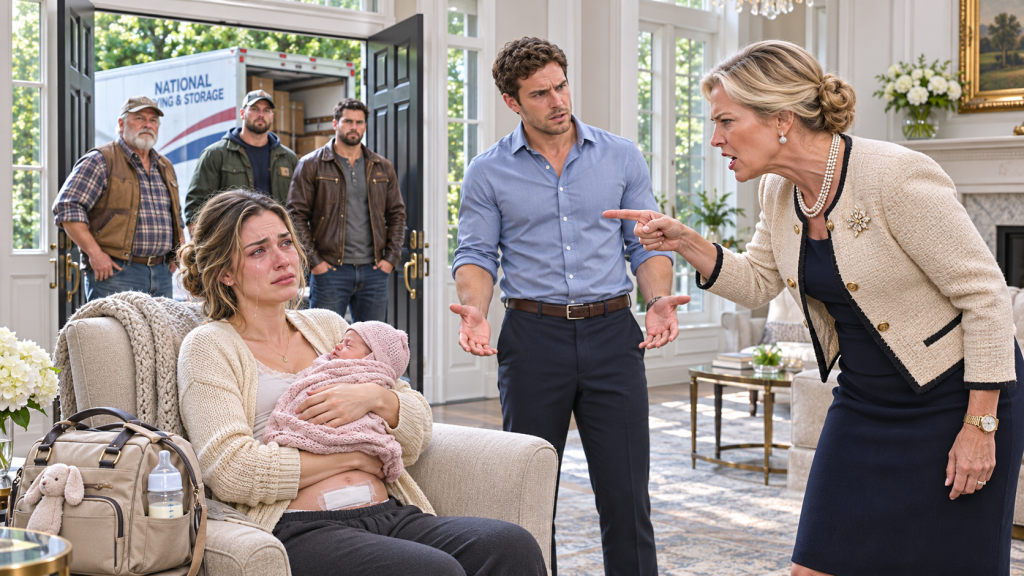
“Did you sign my name?” Harriet stepped forward. “Don’t be ridiculous. We were only trying to arrange some assistance.” I turned toward her. “Assistance for whom?” Her expression hardened. “For this family.” I looked down at the paperwork. At the unfamiliar account number. At the documents someone had prepared without asking me a single question. Then I whispered, “This isn’t assistance. This is a plan for my money and my time that nobody bothered to tell me about.” Owen rubbed his forehead. “Viv, you’re exhausted. We can discuss this when you’ve rested.” Something inside me went very still. For three years, I’d been trying to convince myself that my husband simply struggled to stand up to his mother.
Now I was beginning to wonder whether he’d been hiding behind her all along.
I looked at my father.
“Dad, please take Clover for a minute.”
He stepped closer.
“Of course, sweetheart.”
I carefully settled my daughter into his arms.
He held her against his chest, his broad, weathered hands supporting her tiny body with extraordinary tenderness.
Then I turned back toward Owen.
“Tell me the truth.”
My voice trembled.
“All of it.”
My name is Vivien Walker.
I’m thirty-eight years old, and until that afternoon, I believed the hardest part of my daughter’s arrival would be recovering from an emergency C-section.
Clover was three days old.
Three beautiful, terrifying days.
She’d entered the world after complications during labor made surgery the safest option.
I still remembered the bright operating room lights.
The pressure of the surgical drapes.
My trembling hands.
And the sound of Clover crying for the first time.
I remembered Owen squeezing my fingers.
“She’s here, Viv.”
He’d been crying.
So had I.
For one shining moment, everything else disappeared.
We had our daughter.
She was alive.
I was alive.
And after years of hoping to become parents, we’d finally made it.
I never imagined that less than four days later, I’d be standing in my own living room discovering that the people who should have been protecting my recovery had been quietly making plans to control it.
My father, Raymond Simmons, had spent forty years working as a master plumber.
He was sixty-eight now.
He’d retired from full-time work, but he still owned more tools than most hardware stores.
He had two sons from his first marriage, Stuart and Felix, who were both older than me.
Stuart was forty-six, broad-shouldered and quiet, with the patient manner of someone who preferred thinking before speaking.
Felix was forty-three, equally tall and considerably less patient when someone mistreated a person he loved.
People sometimes found my brothers intimidating.
They were big men.
They drove heavy trucks.
They worked with machinery and could lift things I couldn’t budge an inch.
But I knew them differently.
Stuart cried at my wedding.
Felix once drove forty miles to rescue an injured stray dog.
And Dad still called me his little girl even though I was almost forty.
When I phoned him from the couch that afternoon and said, “Come take us home,” I didn’t need to explain much.
He’d heard something in my voice.
And he came.
Not to threaten anybody.
Not to start a fight.
To make sure his daughter and granddaughter had somewhere safe to recover.
Dad carefully lowered himself onto the chair beside me with Clover in his arms.
Stuart stood near the doorway.
Felix held the diaper bag.
And Owen looked as though he wished all three men would disappear.
Harriet snatched the envelope from the table.
“This is private.”
Stuart didn’t reach for it.
He simply said, “It’s got Vivien’s name on it.”
Harriet stiffened.
“That doesn’t mean you have any right to interfere.”
Dad looked at her.
“Harriet, my daughter is recovering from major surgery. She asked for help, and I’m here to give it.”
Then he looked toward Owen.
“Now I’d like to understand why paperwork involving Vivien was prepared without her knowledge.”
My husband’s face reddened.
“Mom was trying to make arrangements for when Viv returns to work.”
I stared at him.
“Arrangements for what?”
He hesitated.
“Her health.”
I turned toward Harriet.
She folded her arms.
“I’ve been having some difficulty.”
My stomach tightened.
“What kind of difficulty?”
She looked away.
“With my mobility.”
I knew Harriet complained about her knees.
She’d had arthritis for years.
Sometimes she used a cane.
But during my pregnancy, she’d continued shopping, attending church events, and taking regular weekend trips with friends.
I hadn’t heard anything about her needing substantial daily care.
“Have you seen a doctor?” I asked.
She lifted her chin.
“Of course.”
“And what did the doctor recommend?”
Her expression changed.
“That’s between me and my physician.”
I nodded.
“You’re entitled to privacy.”
Then I held up the application.
“But you’re not entitled to sign me up as your caregiver without asking.”
Felix moved closer to the table.
“Viv, I think you need to sit down.”
I looked at him.
“I’m fine.”
He glanced at my pale face.
“Your stitches are hurting.”
I wanted to argue.
Then a sharp pulling sensation crossed my abdomen.
I caught the back of a chair.
Stuart immediately stepped forward.
“Easy.”
He helped me lower myself onto the couch.
My father looked alarmed.
“Sweetheart, we can deal with the paperwork later.”
I shook my head.
“I need to know what they’ve done.”
Dad nodded.
“Then we’ll help you find out. But you don’t have to stand up to do it.”
I closed my eyes.
For a moment, I wanted to cry.
Not because he was treating me like a child.
Because he was acknowledging something nobody else in that house seemed willing to recognize.
I was injured.
I was recovering.
I needed care.
Not demands.
Owen finally sat across from me.
“Mom had an assessment at a rehabilitation and nursing facility last month.”
I looked up.
“Last month?”
He nodded.
“She’s been having more trouble with her knees.”
“Why didn’t you tell me?”
He rubbed his face.
“You were heavily pregnant.”
I stared at him.
“So?”
He sighed.
“We didn’t want to upset you.”
That sentence sounded strangely familiar.
It was the same explanation Owen used whenever I discovered something he’d concealed.
A bill.
A loan.
An expensive purchase.
A decision he’d already made with Harriet.
I took a slow breath.
“What did the facility recommend?”
He looked toward his mother.
Harriet said nothing.
Finally, Owen answered.
“They discussed short-term rehabilitation and what support she’d need afterward.”
I looked down at the form.
It appeared to be a discharge-planning and home-care assessment packet.
There was a proposed family care arrangement, an anticipated home address, and a section asking who would help Harriet with meals, transportation, personal care, and medications.
My name appeared beside nearly every responsibility.
I stared.
“You’re expecting me to do all this?”
Owen swallowed.
“Not forever.”
I looked at him.
“When?”
He shifted in his chair.
“Once you’re feeling better.”
I nearly laughed.
“Owen, I just had a baby.”
“I know.”
“Two days from now, I’ll still be recovering from surgery. Two weeks from now, I’ll still have a newborn.”
He looked down.
I continued.
“And when I return to work, I’ll be balancing my job with childcare.”
Harriet interrupted.
“Women have managed households for generations.”
I turned toward her.
“Then why can’t Owen manage dinner?”
She froze.
Nobody spoke.
I looked at my husband.
“You expect me to recover from surgery, care for Clover, return to work, and become your mother’s caregiver.”
Owen’s face reddened.
“That’s not exactly what we discussed.”
I stared at him.
“Then explain exactly what you discussed.”
He looked toward Harriet.
And in that small movement, I understood that my husband had been making decisions with his mother that affected every part of my life.
Without me.
The bank authorization was worse.
It wasn’t merely a handwritten note.
It was a form requesting that my maternity-related payments be sent to a different account.
The account holder was listed as Harriet Walker Household Care.
I had never heard of it.
I looked at Owen.
“Where did this account come from?”
He swallowed.
“Mom opened it.”
I stared.
“Why?”
Harriet stepped forward.
“Because somebody has to organize the household expenses.”
I felt my hands go cold.
“Which expenses?”
“Groceries. Utilities. My care. The baby’s supplies.”
I looked toward Clover.
My daughter slept peacefully in Dad’s arms.
Then I turned back.
“You opened an account to receive my benefits so you could manage the money?”
Harriet lifted her chin.
“Yes. Someone has to be responsible.”
I took a breath.
“Harriet, I am responsible for my finances.”
She scoffed.
“You’re in no condition to handle complicated matters.”
I stared at her.
“I had surgery. I didn’t lose my ability to think.”
She opened her mouth.
Then shut it.
I looked at Owen.
“Did you know about this?”
His silence was answer enough.
But I waited.
Finally, he whispered, “Yes.”
My chest tightened.
“Did you sign my name?”
He shook his head.
Then stopped.
I watched him carefully.
“Owen.”
His eyes filled.
“Mom filled it out.”
I turned toward Harriet.
She stared at the window.
“Did you write my name?”
Her jaw tightened.
“We needed to get the application started.”
I felt sick.
“You forged my signature?”
She snapped, “Don’t use such ugly words!”
I stared at her.
“Then what word would you prefer?”
She said nothing.
My father’s voice was quiet.
“Harriet, if Vivien didn’t authorize the signature, this needs to be addressed properly.”
She looked toward Owen.
But my husband had no defense left.
Stuart took photographs of the documents with my permission while I kept the originals.
Felix contacted the hospital’s discharge team to confirm the safest way to transport me and whether there were any urgent concerns about my increasing pain.
The nurse advised us to follow the discharge instructions, avoid lifting and exertion, and contact my treating team if the symptoms worsened.
We made arrangements to leave without unnecessary delay.
Dad carried Clover’s car seat.
Stuart gathered the medical supplies, blankets, and diaper bag.
Felix went upstairs to collect enough of my clothing for the next several days.
Owen stood in the hallway.
“Viv, please.”
I looked at him.
“What?”
“Don’t leave like this.”
I glanced toward the couch where I’d spent less than half an hour before Harriet ordered me into the kitchen.
Then I looked at my husband.
“How would you prefer I leave?”
He looked confused.
I continued.
“Smiling? Thanking your mother for telling me to cook while my incision burns? Pretending I agreed to become her caregiver?”
His eyes filled.
“That’s not fair.”
I stared.
“No, Owen.”
My voice broke.
“None of this is fair.”
He stepped closer.
“Give me a chance to explain.”
I looked at him.
“You’ve had an entire afternoon.”
He swallowed.
“And every explanation has made things worse.”
For a moment, he said nothing.
Then whispered, “Are you taking Clover away from me?”
My throat tightened.
“I’m taking her somewhere I can recover safely.”
He shook his head.
“She’s my daughter too.”
“I know.”
I took a breath.
“Being her father means helping provide a safe, stable environment for her. It doesn’t mean demanding that I stay here while you and your mother make decisions behind my back.”
Owen began crying.
But I had nothing left to say.
When Felix returned with my bag, Harriet stood beside the stairs.
“You’ll come crawling back.”
Her voice was bitter.
I looked at her.
For three years, I’d tried to win her approval.
I’d cooked her favorite meals.
Remembered her birthday.
Driven her to appointments.
Included her in celebrations.
And when she criticized me, I told myself that perhaps she was lonely.
Perhaps she struggled to accept that her son was married.
Perhaps she needed time.
Now I realized that no amount of kindness would create respect where someone believed they were entitled to control me.
I adjusted my sweater carefully.
“No, Harriet.”
She stared.
“If I return, it will be because Owen and I have made honest, respectful decisions about our marriage.”
I looked toward the envelope.
“Not because you need someone to cook for you.”
Her cheeks reddened.
Felix opened the front door.
Dad waited beside the truck.
And slowly, carefully, I walked out of the house carrying the knowledge that everything had changed.
Dad’s house was only twenty minutes away.
He lived in a single-story brick home surrounded by maple trees, with a long driveway and a vegetable garden that he’d tended since retirement.
My mother had died six years earlier.
Dad still kept her favorite flowers blooming near the front steps.
Every spring, he planted yellow marigolds because she loved them.
When we arrived, Stuart helped me out of the truck while Felix carried Clover inside.
Dad had prepared the spare bedroom.
A comfortable bed.
Fresh sheets.
A bassinet positioned close enough for me to reach without stretching.
Clean towels.
Bottled water.
And a little basket filled with diapers, wipes, and feeding supplies.
On the bedside table sat a framed photograph of my mother holding me as a newborn.
I stared at it.
Then began crying.
Dad stepped closer.
“What’s wrong, sweetheart?”
I shook my head.
“Nothing.”
He looked worried.
I wiped my cheeks.
“Nothing’s wrong with this room.”
His face softened.
I looked around.
“You prepared everything.”
He nodded.
“We knew you’d need somewhere comfortable after surgery.”
Tears streamed down my face.
“Even before I called?”
Dad smiled sadly.
“Of course.”
I looked at him.
He continued.
“I hoped you’d recover at home with Owen. But I wanted you to know you always had another place to come.”
I began sobbing.
Dad wrapped an arm around me.
“Your mother would’ve done the same.”
For a moment, I could almost feel her beside us.
Then he whispered something I’ll never forget.
“Vivien, you don’t stop being my daughter because you’ve become somebody’s wife or mother.”
I held him tightly.
And for the first time since Clover’s birth, I felt safe enough to let myself cry.
The first week was difficult.
My body hurt.
Clover needed feeding, changing, and comforting throughout the night.
I struggled to find a comfortable sleeping position.
Sometimes I woke frightened because I’d dreamed about the operating room.
Other times, I cried without knowing exactly why.
But Dad and my brothers made sure I wasn’t handling everything alone.
Stuart brought groceries.
Felix assembled the crib.
Dad cooked soup, scrambled eggs, and the occasional disastrous attempt at pasta.
The first night he made spaghetti, the noodles were so soft they nearly dissolved.
He stared at the saucepan.
“Well.”
I laughed weakly.
“What’s wrong?”
He shrugged.
“Apparently, I’ve invented spaghetti soup.”
I laughed harder.
Then winced because it pulled at my incision.
Dad looked alarmed.
“Oh, sweetheart, I’m sorry.”
I shook my head.
“I’m fine.”
He smiled.
“Then next time I’ll make something less entertaining.”
It was such an ordinary moment.
A poorly cooked meal.
A little laughter.
A father trying his best.
But after what happened at Owen’s house, it felt extraordinary.
Nobody expected me to cook.
Nobody complained when I slept.
Nobody treated my pain as an inconvenience.
And when Clover cried at three in the morning, Dad sometimes appeared in the doorway wearing his old slippers.
“Need a hand?”
I would nod.
And he’d gently take his granddaughter while I adjusted my pillows or took a few minutes to settle myself.
He never called it babysitting.
He simply called it being Grandpa.
On the fifth day, my sister-in-law Dana came over.
She was Stuart’s wife and worked as a nurse practitioner.
She didn’t try to replace my own medical team, but she encouraged me to be honest about my symptoms and attend all my postpartum follow-up appointments.
She also asked something nobody had mentioned.
“Viv, how are you doing emotionally?”
I looked at her.
“Exhausted.”
She nodded.
“That makes sense.”
I swallowed.
“Sometimes I feel like I’m going to cry for no reason.”
She sat beside me.
“You’ve been through surgery, childbirth, sleep deprivation, and a frightening family conflict. That’s a lot.”
My eyes filled.
She squeezed my hand.
“Please tell your healthcare team how you’re feeling. They can help determine whether you need additional postpartum mental health support.”
I nodded.
Then whispered, “Does it make me a bad mother that I can’t stop thinking about what Owen did?”
Dana looked surprised.
“Why would it?”
I stared at Clover.
“Because I should just be happy she’s here.”
Dana’s expression softened.
“Vivien, you can love your baby and still be hurt, frightened, or angry about what happened to you.”
I began crying.
She wrapped an arm around me.
“Those feelings can exist together.”
For the first time, I stopped judging myself for not experiencing every moment of motherhood as pure joy.
I loved Clover more than I could explain.
But I was also recovering from a betrayal.
Both things were true.
A week later, I met with an attorney named Rachel Morgan.
Dad had helped me find her.
She specialized in family law and worked with other professionals when financial or identity concerns arose.
I brought the envelope.
The caregiving application.
The bank authorization.
Copies of the communications I’d received from Owen.
Rachel examined the documents carefully.
Then she looked at me.
“Vivien, did you authorize anyone to sign these on your behalf?”
“No.”
“Did you agree to redirect maternity payments?”
“No.”
“Have you received confirmation that your payment instructions were changed?”
I shook my head.
“Not yet.”
She nodded.
“Then we need to verify the status of the request directly with the paying organization and the relevant financial institution.”
I took a breath.
“Can they really take my money because my signature appears on a form?”
She shook her head.
“A signature alone doesn’t make an unauthorized request legitimate. But we need to determine whether anything was processed and take appropriate steps to protect your accounts and benefits.”
I nodded.
Rachel continued.
“We should also document the caregiving arrangements and whether anyone presented you as having consented.”
I looked down.
“Am I legally required to take care of Harriet because I’m married to Owen?”
“Not simply because someone listed your name on an application.”
My shoulders relaxed.
Rachel continued.
“Care obligations and benefits arrangements depend on the circumstances and applicable law. We shouldn’t assume the paperwork creates duties you never agreed to.”
I nodded.
Then asked the question I’d been avoiding.
“What about Clover?”
Rachel folded her hands.
“Her father has parental rights and responsibilities. If you and Owen remain separated, we should discuss temporary parenting and support arrangements that reflect Clover’s age and needs.”
I swallowed.
“I don’t want to keep her from him.”
Rachel nodded.
“That’s important. We can work toward appropriate arrangements while protecting your recovery and the child’s well-being.”
I looked down at my hands.
For days, I’d been afraid that leaving Owen’s house meant I was destroying my family.
But slowly, I was beginning to understand something.
Taking a newborn somewhere safe to recover wasn’t the same as refusing to allow her father a relationship with her.
And protecting my financial identity wasn’t revenge.
It was responsibility.
The first unexpected discovery came from the benefits administrator.
My maternity leave payments were still scheduled for my regular bank account.
The suspicious redirection request had not been completed.
The administrator confirmed that additional verification had been required and advised me on steps to secure my details.
I was relieved.
But Rachel encouraged me to keep the confirmation and ensure that any further unauthorized requests were reported properly.
I also changed passwords, reviewed my bank accounts, and contacted the relevant institutions to protect my financial information.
For the first time, I began examining every transaction instead of assuming Owen and I had been handling money together honestly.
That’s when I noticed something else.
A series of transfers.
Not enormous individually.
Four hundred dollars.
Six hundred.
Eight hundred.
Sometimes a thousand.
All moving from our joint household account into an account I didn’t recognize.
The transfers began eight months earlier.
While I was pregnant.
While we were discussing how much maternity leave we could afford.
While Owen was telling me we needed to be careful about unnecessary spending.
I stared at the screen.
Then called him.
He answered immediately.
“Viv?”
I took a breath.
“What are these transfers?”
He went quiet.
I read him the dates.
Then the amounts.
Finally, he whispered, “They’re for Mom.”
My stomach tightened.
“How much have you given her?”
He hesitated.
“Owen.”
“About fourteen thousand.”
I closed my eyes.
Fourteen thousand dollars.
Money we’d been saving for Clover.
For unexpected medical costs.
For household expenses while I wasn’t working.
And he’d been transferring it to Harriet without telling me.
My voice shook.
“Why?”
Owen sighed.
“She was having financial problems.”
I stared at the wall.
“What kind?”
He hesitated.
Then whispered, “Her house.”
My chest tightened.
“What about her house?”
And my husband finally told me the truth.
Harriet was at risk of losing it.
For years, Harriet had lived in a large two-story home on the edge of town.
It had belonged to her and Owen’s late father.
She liked to talk about it.
The beautiful staircase.
The large dining room.
The expensive curtains.
The landscaped backyard.
But after her husband’s death, the financial situation had changed.
She had refinanced the house several years earlier.
Then accumulated debts.
Home repairs.
Credit cards.
Expenses she’d never properly adjusted to match her income.
And now, the payments had become more than she could manage.
Owen had been helping quietly.
At first, he thought a few transfers would be enough.
Then the bills kept coming.
The fourteen thousand dollars he’d transferred had delayed the problem.
It hadn’t solved it.
I sat on Dad’s bed while Clover slept beside me.
“Owen, why didn’t you tell me?”
He sighed.
“Because you’d say we couldn’t afford it.”
I closed my eyes.
“Could we?”
He was silent.
I continued.
“We were saving for our daughter. We were preparing for my maternity leave. I was worried about medical expenses.”
My voice broke.
“And you were secretly giving your mother thousands of dollars.”
Owen whispered, “I thought I could replace it.”
I wiped my eyes.
“With what?”
He had no answer.
Then I asked, “Was Harriet planning to move into our house permanently?”
Silence.
“Owen?”
He exhaled.
“Yes.”
I stared at the wall.
“And the caregiving application?”
He hesitated.
“Mom thought if she moved in, you could help with her daily needs while she recovered.”
My stomach tightened.
“While I recovered from having Clover?”
Owen’s voice broke.
“I know how it sounds.”
I shook my head.
“No.”
My voice was steady now.
“I don’t think you do.”
The next day, Rachel helped me organize the financial records and plan what to request from Owen.
She explained that the legal treatment of transfers from a joint account and any marital property questions would depend on the circumstances.
I didn’t assume every dollar could simply be returned.
But the secrecy mattered.
And so did the attempted redirection of my benefits.
As we reviewed everything, a painful picture began to emerge.
Harriet had been struggling financially for a long time.
Owen had been trying to rescue her.
Neither wanted to admit the house was unaffordable.
And rather than discuss a responsible plan, they’d decided Harriet would move into our home.
I would take over much of her daily care.
My maternity payments would help cover the household expenses.
And Owen would continue working without having to confront the full cost of his mother’s needs.
All of it had been arranged around my expected compliance.
As though I were simply another resource they could assign wherever needed.
I remembered Harriet standing over me twenty-seven minutes after I arrived home.
Put that baby down and cook dinner.
Suddenly, those words made terrible sense.
She wasn’t merely impatient.
She’d already decided that my recovery didn’t matter as much as her plans.
And Owen had allowed it.
Two weeks after I left, Owen asked to see me.
We arranged to meet at Dad’s house while Stuart stayed nearby.
Clover was asleep in her bassinet.
Dad made coffee.
Then he stepped into the garden to give us privacy.
Owen looked exhausted.
His eyes were red.
He sat across from me at the kitchen table.
“Viv, I miss you.”
I looked at him.
“I miss the marriage I thought we had.”
He lowered his eyes.
For a long time, neither of us spoke.
Then he whispered, “I’m sorry.”
I took a breath.
“For what?”
He looked up.
I continued.
“I need you to tell me what you’re apologizing for.”
His expression changed.
He stared at his hands.
Then said, “For not defending you when Mom told you to cook.”
I nodded.
“And?”
He swallowed.
“For hiding the money.”
“And?”
His voice broke.
“For letting Mom make plans without asking you.”
I looked at him.
“And the signature?”
He began crying.
“I knew she’d written your name.”
I closed my eyes.
He continued.
“I didn’t think the authorization would go through without you confirming it.”
I stared at him.
“Owen, that doesn’t make it acceptable.”
He nodded.
“I know.”
I took a slow breath.
“You watched your mother prepare paperwork claiming I’d agreed to manage her care and redirect my maternity benefits.”
His shoulders shook.
“And you knew I hadn’t.”
He covered his face.
“I’m sorry.”
I looked toward Clover.
She was sleeping peacefully.
Unaware of the conversation.
Unaware that the adults responsible for protecting her future had been making choices that could affect it.
I turned back.
“Owen, do you understand why I left?”
He nodded.
“Because Mom was cruel.”
I shook my head.
“No.”
He looked startled.
I continued.
“Harriet was cruel. But I left because you agreed with her.”
His eyes filled.
“You’re my husband. You were there when the doctors told me what recovery would involve. You saw how much pain I was in.”
My voice trembled.
“And when your mother told me to put down our newborn and cook, you sided with her.”
Owen looked down.
I swallowed.
“That was the moment I realized I couldn’t depend on you to protect me when I was vulnerable.”
He began sobbing.
I waited.
Then I said quietly, “If our marriage has a future, that has to change.”
Owen began individual counseling.
He also arranged to review his finances with a qualified professional.
He acknowledged that he’d spent years feeling responsible for his mother.
His father had died when Owen was twenty.
Harriet often reminded him that she’d sacrificed everything to raise him.
Whenever he disagreed with her, she accused him of abandoning her.
For years, he’d responded by trying harder.
Giving money.
Making promises.
Avoiding arguments.
And eventually, expecting me to absorb the consequences.
During one conversation, Owen admitted something painful.
“I thought if I kept Mom happy, she’d stop making things difficult.”
I looked at him.
“Did it work?”
He shook his head.
“No.”
I nodded.
“Then why did you keep doing it?”
He stared at the table.
“Because saying no felt worse.”
My chest tightened.
I understood that fear.
But I also understood something Owen still needed to learn.
His discomfort with disappointing Harriet didn’t justify betraying his wife.
He could care about his mother without surrendering our savings.
He could help her find appropriate services without assigning me caregiving responsibilities.
And he could be a loving son without demanding that I become an unpaid solution to every problem she refused to face.
Harriet’s situation eventually reached a turning point.
After professional assessment, it became clear that she needed some assistance, but not the arrangement she’d attempted to impose on me.
She also needed a realistic financial plan.
Her large home had become too expensive to maintain.
Rather than continuing to rely on Owen’s transfers, she worked with advisers to review her debts, housing options, and care needs.
Eventually, she decided to sell the house.
The process was difficult.
She’d lived there for decades.
Every room carried memories.
Her wedding photographs.
Owen’s childhood drawings.
The dining table where the family celebrated birthdays.
But a house can hold memories without being financially sustainable.
The sale allowed her to address the mortgage and some outstanding obligations.
She moved into a smaller, accessible apartment near appropriate services.
It wasn’t the life she’d imagined.
But it was a life she could begin managing more realistically.
And for the first time, Owen wasn’t expected to solve every financial problem by writing another check.
Harriet did not apologize immediately.
At first, she blamed me.
She told relatives I’d exaggerated my pain.
She claimed Dad and my brothers had intimidated her.
She insisted I was deliberately keeping her granddaughter away.
I found those accusations exhausting.
But I didn’t respond by arguing with every person she contacted.
I preserved relevant messages.
Discussed concerns with Rachel.
And focused on my recovery and Clover’s needs.
Several relatives eventually called to ask what happened.
I explained the facts.
I’d returned home from emergency surgery.
Harriet demanded I cook.
Owen supported her.
Then I discovered paperwork I’d never authorized.
Most people were shocked.
A few defended Harriet.
I stopped trying to convince them.
I had medical instructions to follow.
A newborn to care for.
And a future to rebuild.
I couldn’t spend every day proving that I deserved basic respect.
When Clover was six weeks old, something unexpected happened.
I was sitting on Dad’s porch when Harriet called.
I almost ignored the number.
Then I answered.
“Hello?”
“Vivien.”
Her voice sounded smaller than usual.
“Hello, Harriet.”
There was a pause.
“May I speak with you?”
I looked toward Clover, sleeping in her stroller.
“Go ahead.”
Harriet cleared her throat.
“I received a letter from my sister.”
I frowned.
“Your sister?”
“Margaret.”
I’d met Margaret only twice.
She lived in another state and rarely involved herself in family arguments.
Harriet continued.
“I told her what happened.”
I waited.
“She wasn’t sympathetic.”
I almost smiled.
Harriet sighed.
“She said I’d spent years expecting other people to solve my problems.”
I looked toward the garden.
“That must have been difficult to hear.”
“It was.”
She hesitated.
Then said, “She also told me something about when she had her first child.”
I remained silent.
Harriet’s voice trembled.
“She had a difficult delivery. She couldn’t get out of bed for several days.”
My stomach tightened.
“And?”
“Our mother came to help.”
Harriet paused.
“But instead of helping, she criticized Margaret for not keeping the house clean.”
I stared at the flowers.
Harriet continued.
“Margaret said she never forgot how helpless that made her feel.”
Her voice broke.
“Then she asked why I’d done the same thing to you.”
For several seconds, nobody spoke.
Then Harriet whispered, “I didn’t know what to say.”
I looked down.
Neither did I.
She took a shaky breath.
“Vivien, I’m sorry I demanded you cook dinner.”
I closed my eyes.
She continued.
“And I’m sorry I treated your recovery as though it was inconvenient.”
Tears filled my eyes.
Then I asked, “What about the paperwork?”
Harriet went quiet.
I waited.
Finally, she whispered, “I had no right to sign your name.”
My throat tightened.
“No, you didn’t.”
She began crying.
“I convinced myself I was arranging help.”
I took a breath.
“But you were arranging my life without asking me.”
Her voice broke.
“I know.”
I looked toward Clover.
My daughter stretched one tiny hand.
For a moment, I felt both relief and sadness.
I’d wanted Harriet to acknowledge what she’d done.
But hearing an apology didn’t make the consequences disappear.
“Thank you for saying that,” I whispered.
She sniffled.
“Do you think you’ll ever forgive me?”
I considered the question.
Then answered honestly.
“I don’t know yet.”
There was a pause.
“But I need you to understand that any relationship we have from now on must be based on respect and clear boundaries.”
Harriet whispered, “I understand.”
For once, she didn’t argue.
Clover was three months old when I returned to work part-time.
My recovery had progressed under medical guidance, and I gradually resumed a routine I could manage.
Dad and my brothers helped with practical things.
Dana occasionally brought meals.
And I arranged reliable childcare rather than depending on someone who believed caring for a baby entitled them to control the mother’s life.
Owen began spending regular, agreed periods with Clover and contributing to her expenses.
We worked through temporary arrangements with professional guidance.
He learned how to prepare bottles when appropriate, change diapers, soothe Clover, and recognize her routines.
He had always wanted to be a father.
But now he was beginning to understand that fatherhood required more than holding a baby for photographs.
It meant showing up when the work was difficult.
When the baby cried.
When nobody had slept.
When dinner needed making.
And when the person beside you needed care instead of criticism.
One evening, Owen came to Dad’s house after work.
He’d brought groceries.
Not flowers.
Not jewelry.
Groceries.
Milk.
Fresh vegetables.
Chicken.
Bread.
Things we’d actually use.
I looked at the bags.
“What’s all this?”
He smiled nervously.
“I thought I’d make dinner.”
I stared at him.
“For everyone?”
He nodded.
“If that’s okay.”
I stepped aside.
“Go ahead.”
For the next hour, my husband stood in my father’s kitchen preparing a meal.
He chopped vegetables.
Washed dishes.
Checked the oven.
And when Clover began crying, he paused to help settle her before returning to the stove.
Dad sat at the table pretending to read the newspaper.
But I saw him watching.
Eventually, Owen placed dinner in front of us.
Roasted chicken.
Potatoes.
Green beans.
Nothing elaborate.
But it smelled wonderful.
Dad took a bite.
Then nodded.
“Good chicken.”
Owen smiled.
“Thank you, sir.”
Felix, who had stopped by after work, raised an eyebrow.
“Not bad.”
Stuart laughed.
“Careful, Felix. He’ll start charging.”
Everyone chuckled.
And for a moment, the room felt almost like a family again.
Not because the past had disappeared.
Because someone had finally begun doing the work required to change the future.
But rebuilding trust was not as simple as cooking one good dinner.
Owen knew that.
I made sure he understood it.
For months, we attended counseling and discussed the things we’d avoided during our marriage.
His relationship with Harriet.
The money he’d transferred without telling me.
His tendency to agree with whichever person was standing in front of him.
And my own habit of staying silent until resentment became unbearable.
Our counselor asked Owen a question during one session.
“When your mother told Vivien to cook dinner after surgery, what were you afraid would happen if you disagreed?”
Owen stared at his hands.
Then whispered, “Mom would get angry.”
The counselor nodded.
“And what happened when you agreed with her?”
He looked at me.
His eyes filled.
“My wife left.”
For a long time, nobody spoke.
Then Owen said quietly, “I was so afraid of making Mom uncomfortable that I let Vivien suffer.”
I swallowed.
He continued.
“I thought keeping the peace meant avoiding arguments.”
The counselor looked at him.
“Was there peace?”
Owen shook his head.
“No.”
I looked down at my wedding ring.
I’d stopped wearing it after leaving the house.
It rested in a small wooden box beside my bed.
I still loved Owen.
That was the painful truth.
But I was learning that love couldn’t be the only consideration.
Trust mattered.
Respect mattered.
And the ability to depend on one another during frightening moments mattered enormously.
When Clover was five months old, Owen asked whether I would consider returning home.
We sat on Dad’s porch.
The evening air was cool.
Clover slept in her stroller beside us.
Owen looked nervous.
“Viv, I miss having you there.”
I nodded.
“I know.”
He took a breath.
“I’ve been thinking about everything we’ve discussed.”
I waited.
“I know I can’t ask you to come back just because I miss you.”
My expression softened.
He continued.
“I need to show you that things would be different.”
I looked at him.
“How?”
He unfolded a sheet of paper.
Not an application.
Not a form with my name written by someone else.
A list.
He’d written down the changes he’d been making.
The accounts he’d reviewed.
The boundaries he’d established with Harriet.
The household responsibilities he’d begun handling independently.
The parenting arrangements he’d followed.
And the counseling sessions he intended to continue.
I read the page slowly.
Then looked up.
“Owen, this is a beginning.”
He nodded.
“I know.”
“But I need consistency.”
“I understand.”
I glanced toward Clover.
“And I need to know you’ll put our daughter’s needs ahead of your fear of disappointing your mother.”
His eyes filled.
“I will.”
I took a breath.
“Then keep showing me.”
He nodded.
“I will.”
I didn’t move home that evening.
Or the following week.
I waited.
Not to punish him.
To give myself time to see whether his changes would last.
Eventually, after months of consistent effort, honest conversations, and careful consideration, Owen and I agreed to resume living together.
We made that decision ourselves.
Not because Harriet wanted it.
Not because Dad encouraged it.
Not because relatives were tired of hearing about our separation.
Because we believed there was enough evidence of genuine change to try rebuilding our marriage.
We also agreed that if old patterns returned, I would not pretend they were harmless.
Harriet would not move into our house.
Any assistance she needed would be discussed openly and arranged appropriately.
Neither of us would sign documents for the other without authorization.
And financial decisions affecting our family would be made together.
Those boundaries weren’t romantic.
They didn’t sound like wedding vows.
But they were essential.
Because a marriage cannot survive on affection alone when trust has been damaged.
The first evening I returned home, Owen carried Clover’s things inside.
Dad came with us.
So did Stuart and Felix.
Not because anyone expected trouble.
They wanted to make sure I had the help I needed and that everything was arranged comfortably.
Dad placed Clover’s bassinet beside our bed.
Stuart assembled a shelf in the nursery.
Felix carried the heavier boxes upstairs.
Then Dad stood in the hallway looking around.
“Everything all right, sweetheart?”
I smiled.
“Yes.”
He studied my face.
“You’re sure?”
I nodded.
“I’m sure about giving this another chance.”
He smiled gently.
“That’s enough.”
I hugged him.
“Thank you for coming when I called.”
His expression softened.
“Always.”
I began crying.
He brushed a tear from my cheek.
“Your mother and I raised you to know you deserved kindness, Vivien.”
I nodded.
“And sometimes,” he continued, “knowing that means walking away long enough for people to understand what they’ve been taking for granted.”
I held him tightly.
Then he whispered, “But remember, sweetheart. You can always come home.”
I smiled through my tears.
“I know, Dad.”
And that knowledge made me stronger than any promise Owen could have offered.
Clover’s first birthday arrived on a sunny Saturday.
We held a small celebration in the backyard.
There were yellow balloons.
A strawberry cake.
And a little white dress with embroidered flowers that my mother had bought years before she died, hoping one day to see me become a mother.
Dad carried Clover around the garden, showing her the flowers.
Stuart took photographs.
Felix made everyone laugh by wearing a ridiculous pink party hat.
And Owen handled most of the cooking.
Not because I refused to help.
Because he’d finally learned that hosting a family celebration didn’t automatically make the kitchen my responsibility.
At one point, I found him standing beside the grill.
He looked at me.
“Everything okay?”
I smiled.
“Yes.”
He glanced toward the food.
“Want me to make you a plate?”
I laughed softly.
“That would be lovely.”
He smiled.
Then said, “Go sit down. I’ve got this.”
For a moment, those words brought tears to my eyes.
A year earlier, he’d told me to get into the kitchen while I was barely able to stand.
Now he was asking me to rest while he prepared dinner.
It wasn’t a grand gesture.
It was the ordinary care I’d needed all along.
Harriet did not attend that birthday celebration.
She sent Clover a beautiful children’s book and a short card.
Happy first birthday, little Clover. I hope you grow surrounded by love.
Owen and I had agreed that rebuilding Harriet’s relationship with our daughter would happen gradually, within boundaries we both supported.
Harriet had made progress.
She was managing her smaller apartment.
Following the care recommendations she and her clinicians had agreed upon.
And learning to ask for help without assuming someone else was obligated to provide it.
But rebuilding trust takes time.
We didn’t pretend otherwise.
A few weeks after Clover’s birthday, Harriet visited for a short afternoon.
She brought a small stuffed rabbit.
When I opened the door, she looked nervous.
“Hello, Vivien.”
“Hello, Harriet.”
She hesitated.
“May I come in?”
I stepped aside.
“Yes.”
She looked toward the living room, where Clover sat on the rug playing with wooden blocks.
Her expression softened.
“Oh, she’s grown.”
I smiled.
“She has.”
Harriet sat carefully on the couch.
For a while, she watched Clover play.
Then she looked at me.
“Vivien?”
“Yes?”
Her eyes filled.
“I want you to know I haven’t forgotten what happened.”
I remained quiet.
She continued.
“I was wrong to treat your recovery as something inconvenient.”
Her voice trembled.
“And I was wrong to assume I could make plans for your life because I was frightened about my own.”
I nodded slowly.
“Thank you.”
She looked toward Clover.
“I hope someday she’ll know me as someone who loves her.”
I took a breath.
“That depends on how we treat one another from now on.”
Harriet nodded.
“I understand.”
And for once, she didn’t try to negotiate.
Today, Clover is almost two.
She has my eyes and Owen’s smile.
She loves strawberries, picture books, and taking every sock out of the laundry basket.
Her favorite person in the world might be Grandpa Raymond.
Whenever Dad visits, she runs toward him shouting, “Papa!”
He pretends to be surprised every time.
Then scoops her into his arms with the same careful tenderness he showed when she was three days old.
Sometimes, watching them together, I remember the afternoon Dad arrived in his green diesel truck.
The sound of the engine.
The three heavy doors slamming.
The way Harriet’s face changed.
And the moment I realized I didn’t have to remain in a house where my needs were treated as unimportant.
I used to think strength meant enduring.
Keeping quiet.
Pushing through pain.
Making everyone comfortable.
Now I understand that strength can also mean asking for help.
Saying no.
Recognizing when something is wrong.
And refusing to let another person’s expectations determine your worth.
Last Sunday, I was standing in the kitchen preparing breakfast when Owen walked in.
Clover was sitting in her high chair, happily eating sliced banana.
Owen kissed the top of her head.
Then looked at me.
“Viv, why don’t you sit down? I’ll finish breakfast.”
I smiled.
“Are you sure?”
He laughed.
“Pretty sure I can handle eggs.”
I handed him the spatula.
Then sat beside Clover.
She offered me a piece of banana.
I accepted it with exaggerated delight.
“Thank you, sweetheart.”
She giggled.
Owen turned toward us.
For a moment, he simply watched.
Then he smiled.
“What?”
I shook my head.
“Nothing.”
He looked amused.
“You’re smiling at me.”
I nodded.
“I know.”
He came closer.
“Good thoughts, I hope?”
I took his hand.
“Better ones than I had a year ago.”
His expression softened.
“I know I hurt you, Viv.”
I nodded.
“You did.”
He swallowed.
“And I’m grateful you gave us the chance to work toward something better.”
I looked at Clover.
Then back at him.
“Keep choosing better.”
He nodded.
“Every day.”
And when the eggs began burning, we both laughed.
That evening, after Clover fell asleep, I called Dad.
He answered immediately.
“Simmons here.”
I smiled.
“Hi, Dad.”
“How’s my girl?”
I looked around our living room.
At Clover’s toys scattered across the carpet.
At the family photographs.
At the warm light coming from the kitchen.
And at the life I’d nearly lost myself trying to keep together.
“I’m good, Dad.”
He sounded pleased.
“And my little Clover?”
“Sleeping.”
He laughed.
“That’s what I like to hear.”
We talked for a few minutes.
Then, before hanging up, I whispered, “Dad?”
“Yes, sweetheart?”
“Thank you for coming that day.”
There was a pause.
Then he said, “Vivien, you never have to thank me for being your father.”
My eyes filled.
I smiled.
“I know.”
He continued.
“But I’m glad you called.”
I looked toward the window.
The evening sky was turning gold.
“So am I.”
I will never forget what happened twenty-seven minutes after I brought my daughter home from the hospital.
I’ll never forget Harriet demanding dinner.
Or Owen agreeing with her.
Or the paperwork that revealed how little consideration they’d given my wishes.
But I also won’t forget the diesel engine rumbling into our driveway.
My father’s face when he saw how much pain I was in.
My brothers quietly collecting what Clover and I needed.
And the feeling of stepping into a room where someone had prepared a bed, fresh towels, and a safe place for me to rest.
That afternoon taught me something I hope Clover understands when she’s older.
Love should never require you to ignore your pain, surrender your dignity, or prove your worth by serving people who refuse to care for you.
Marriage is a partnership.
Parenthood is a responsibility.
And family should be a source of support, not an excuse for control.
Sometimes the people who love us need to change.
Sometimes relationships can be repaired.
Sometimes they cannot.
But none of us should have to sacrifice our health or our identity to keep someone else comfortable.
I looked down the hallway toward Clover’s room.
Then smiled.
Because the day I called my father, I thought I was asking him to rescue me from one terrible afternoon.
Instead, that call reminded me that I had choices.
That I deserved respect.
And that my daughter deserved to grow up watching her mother receive the same care she gave to others.
I switched off the living room lamp.
Then walked toward my sleeping child.
For the first time in a long while, I wasn’t afraid of what tomorrow might bring.
I knew I could face it.
And I knew exactly whom to call if I ever needed help again.