The signature on the second page looked almost perfect. Almost. The letters slanted the way mine did. The long tail of the g in Margaret curled beneath the next letter, and the final stroke of Hayes extended into a familiar little flourish. But there was one detail that made my blood run cold. I hadn’t signed that document. I hadn’t even seen it. Yet there it was, beneath a promise that I would personally guarantee the financial obligations of my son’s failing catering company.
I sat in the hotel lobby, staring at the paper while Daniel stood in front of me. “Mom?” His voice sounded very far away. “Did you sign this?” I looked up. “No.” He swallowed. “Are you sure?” For a moment, I couldn’t believe he’d asked. Then I looked into his frightened face and realized that he wasn’t questioning my memory. He was desperately hoping there was an explanation that wouldn’t destroy the last thing he had left. “Daniel,” I said quietly, “I have never agreed to guarantee your business lease.”
He closed his eyes. His hands began trembling. “Then Vanessa…” He couldn’t finish. I studied the signature again. Someone had taken the time to reproduce my handwriting. Someone had attached my name to an obligation without my consent. And someone had been counting on my money to keep an already troubled business operating. I looked at the date. Yesterday. Less than twenty-four hours before Vanessa canceled my flight and abandoned me outside Phoenix Sky Harbor Airport. The timing was too deliberate to ignore. I placed the document on the table.
“Daniel, sit down.”
He obeyed.
For a moment, I remembered him at eight years old, sitting at our kitchen table after breaking a neighbor’s window with a baseball.
Back then, he’d been more frightened of disappointing me than of paying for the glass.
I’d told him something I hoped he’d always remember.
When you’ve made a mistake, tell the truth before the mistake becomes a lie.
Now my son was forty.
And I was about to discover whether he remembered any of it.
“Tell me exactly what you know about this guarantee.”
He stared at his hands.
Then whispered, “I think Vanessa has been lying to both of us.”
I took a slow breath.
“That may be true.”
He looked at me.
“But before we talk about Vanessa, we’re going to talk about what you’ve done.”
My name is Margaret Hayes.
I’m sixty-seven years old, and until that afternoon, I believed the hardest part of visiting my son in Arizona would be telling him I couldn’t invest in his business.
I was wrong.
The hardest part was recognizing the man he’d become.
Daniel was my only child.
I raised him with his father, Robert, in Portland, Oregon.
Robert died nine years earlier after a long illness.
He’d been a patient, thoughtful man who believed that every financial decision should be made twice: once with a calculator and once with a clear conscience.
For thirty years, we built a business together.
We started with a small commercial cleaning company.
Three employees.
Two secondhand vans.
And an office so tiny that the filing cabinet blocked half the doorway.
Over time, the company grew.
We expanded into facilities management, signed contracts with hospitals and office buildings, and eventually employed more than eighty people.
It wasn’t glamorous.
But it was honest work.
Our employees depended on us.
We took that responsibility seriously.
When Robert became ill, I assumed more of the day-to-day leadership.
After he died, I continued running the business until I found a suitable buyer and retired.
I was financially comfortable.
Not because money had arrived easily.
Because for decades, I’d learned the difference between profit and cash flow, between confidence and evidence, and between helping someone and financing a disaster.
Daniel knew that.
Or at least, I thought he did.
When he and Vanessa asked whether I’d invest two hundred and forty thousand dollars in their catering company, I didn’t immediately refuse.
I asked for the financial records.
A business plan.
Outstanding debts.
Supplier agreements.
A realistic cash-flow forecast.
Daniel seemed nervous.
Vanessa became angry.
She accused me of treating family like strangers.
And on the morning I was supposed to fly home, she canceled my ticket and told me to walk.
That single message had ended the investment discussion.
But the forged guarantee suggested something far more serious had already begun.
Daniel sat across from me in the hotel lobby.
His face was pale.
I looked at him.
“Did you know Vanessa planned to use my name?”
He shook his head quickly.
“No.”
I waited.
He swallowed.
“She said she’d spoken to you about helping with the lease.”
My stomach tightened.
“When?”
“Yesterday morning.”
I stared at him.
“Daniel, I spent yesterday morning asking for your company’s financial statements.”
He nodded.
“I know.”
“Did I say anything about guaranteeing the lease?”
“No.”
“Then why did you believe her?”
He looked away.
For a long moment, neither of us spoke.
Finally, he whispered, “Because I wanted to.”
That answer hurt more than an elaborate excuse would have.
I leaned back.
Daniel rubbed his face.
“Mom, I knew things were bad.”
“How bad?”
He stared at the carpet.
“The landlord’s been threatening action. We owe two suppliers money. Our booking numbers are down.”
I nodded.
“And your employees?”
His face changed.
I thought of Elena’s warning.
Three weeks of unpaid wages.
Workers depending on promises about an investment I’d never approved.
“Daniel, how many employees are waiting to be paid?”
He swallowed.
“Eleven.”
I closed my eyes.
Eleven people.
Eleven families.
Eleven sets of rent payments, grocery bills, and obligations.
I thought about the employees who’d worked for Robert and me.
The young father who used to take extra shifts before Christmas.
The woman who asked for flexible hours while caring for her mother.
The dishwasher who saved for four years to send his daughter to college.
Business owners liked to talk about passion.
Growth.
Opportunity.
But when payroll came due, none of those words paid for a gallon of milk.
I opened my eyes.
“How much do you owe them?”
Daniel’s voice was barely audible.
“Approximately twenty-seven thousand dollars.”
My throat tightened.
“Twenty-seven thousand in wages?”
He nodded.
I stared at him.
“And you were going to accept another two hundred and forty thousand dollars from me without telling me that?”
He began crying.
“I thought I could fix it.”
I looked away.
There it was.
The sentence that had buried more businesses than any recession.
I thought I could fix it.
“Daniel, I need to know whether you’ve been involved in falsifying the books.”
He looked up sharply.
“No!”
“Then explain the sixty-three thousand eight hundred dollars in questionable transfers.”
His eyes widened.
“What transfers?”
I took out my phone and opened Elena’s spreadsheet.
He leaned closer.
I showed him the entries.
Consulting fees.
Equipment deposits.
Event expenses.
Payments made to an account associated with Vanessa’s maiden name.
Daniel stared.
Then shook his head.
“That can’t be right.”
I studied him.
“Why?”
“Those were business expenses.”
“What business expenses?”
He pointed toward one entry.
“That’s the deposit on refrigeration equipment.”
I opened the supporting record Elena had supplied.
The description didn’t match the supposed equipment vendor.
Daniel frowned.
“I don’t understand.”
I moved to another transaction.
He swallowed.
“That was a wedding event.”
“Which wedding?”
He searched his memory.
“Maybe the Chandler event?”
I showed him the corresponding invoice.
The event date was months earlier.
The client’s name was unfamiliar.
Daniel stared at it.
Then whispered, “I’ve never catered a wedding for those people.”
I watched his expression.
Shock.
Confusion.
Fear.
All of it might have been genuine.
But I had spent too many years running a company to confuse ignorance with innocence.
Even if Daniel hadn’t approved the transfers knowingly, he was still responsible for overseeing his business.
He’d signed documents.
Authorized accounts.
Allowed Vanessa to control financial records he never reviewed.
And continued making promises to employees when the money wasn’t there.
I looked at him.
“Daniel, you cannot keep telling me you didn’t know.”
His eyes filled.
“Mom—”
“Maybe you didn’t know about every transaction. But you knew your company was in trouble.”
He lowered his head.
I continued.
“You knew people weren’t getting paid.”
He began crying.
“And instead of telling me the truth, you tried to pressure me into investing.”
He covered his face.
I waited.
For once, I wasn’t going to make his discomfort disappear.
The hotel receptionist approached.
“Ma’am, is everything all right?”
I realized we’d been sitting in the lobby for almost an hour.
I looked up.
“Yes, thank you.”
She nodded and returned to the desk.
Daniel wiped his eyes.
“Mom, can I come upstairs with you?”
I considered the question.
Then shook my head.
“Not right now.”
His face fell.
“I need time to think, and I need to speak with my attorney.”
He nodded slowly.
Then whispered, “Are you going to report Vanessa?”
I looked at him.
“I’m going to report any unauthorized use of my identity through the appropriate channels. What happens afterward will depend on the evidence.”
Daniel stared at the guarantee.
Then asked, “What about the business?”
I took a breath.
“That depends on whether you can face the truth about its finances.”
He closed his eyes.
I continued.
“You need independent legal and accounting advice immediately. You also need to stop making promises you cannot keep.”
He looked up.
“Will you help me?”
For a moment, I saw the little boy who’d broken the neighbor’s window.
The boy who believed his mother could solve anything.
I loved him.
That hadn’t changed.
But love didn’t mean I could rescue him from every consequence.
“I’ll help you understand your options,” I said.
His shoulders relaxed.
“But I will not sign a blank check.”
His expression changed.
“And I will not invest in a company whose owners have concealed financial information from me.”
He swallowed.
“I understand.”
I wasn’t sure he did.
Not yet.
But it was a beginning.
That evening, I called my attorney in Portland.
Her name was Susan Whitaker.
She’d represented my business for nearly fifteen years and had helped Robert and me prepare our estate plans.
Susan was direct.
Practical.
And impossible to impress with emotional arguments that lacked supporting documents.
I explained what had happened.
The airport.
The canceled flight.
The spreadsheet.
The unpaid wages.
The lease guarantee carrying my signature.
She listened without interrupting.
When I finished, she asked, “Margaret, do you have a copy of the entire document?”
“Yes.”
“Good. Preserve it. Don’t write on the original.”
I looked at the papers on the hotel desk.
“Can the landlord hold me responsible?”
“An unauthorized signature is not a valid expression of your consent, but we need to establish what was submitted, whether anyone relied on it, and what records support your position. Don’t assume the issue will resolve itself.”
I nodded.
Susan continued.
“We’ll arrange local counsel in Arizona to review the lease and communicate with the landlord. You should also secure your financial accounts and review your credit reports.”
I wrote everything down.
Then I asked, “What about the employees?”
Susan paused.
“That’s a separate and urgent issue. Daniel’s company needs employment-law and insolvency advice, including how to address any unpaid wages and required notices.”
I swallowed.
“Vanessa told them my investment was guaranteed.”
“Then the company must correct that representation.”
I closed my eyes.
Susan’s voice softened slightly.
“Margaret, I know you want to protect your son.”
Tears gathered.
“Yes.”
“But you cannot protect him by financing a false story.”
I pressed my fingers against my forehead.
“I know.”
She paused.
“Then let’s establish the facts before anybody moves another dollar.”
The next morning, Elena called.
Her voice was cautious.
“Mrs. Hayes?”
“Margaret, please.”
“Margaret, I found something else.”
My stomach tightened.
“What?”
She hesitated.
“An email chain from last month.”
I moved to the desk.
“Go on.”
“Vanessa was communicating with someone named Adrian Cole.”
I frowned.
“Who’s that?”
“He was supposed to be an outside consultant.”
“Supposed to be?”
Elena exhaled.
“I couldn’t find evidence of the services he billed us for.”
I looked toward the window.
“How much?”
“Just over nineteen thousand dollars.”
My chest tightened.
Elena continued.
“Some of the transfers in the spreadsheet went to an account associated with his consulting business.”
I took a breath.
“Did you know him?”
“Only by email. Vanessa handled all his invoices.”
I stared at the traffic below.
“Why are you telling me?”
Elena was quiet.
Then whispered, “Because I warned Daniel six weeks ago that I couldn’t reconcile several expenses.”
I went still.
“What did he say?”
“He told me Vanessa was handling it.”
My heart sank.
Elena continued.
“I asked him to review the records himself. He said he trusted his wife.”
I closed my eyes.
There it was.
The warning Daniel had ignored.
He hadn’t necessarily known where the money went.
But he had known someone was questioning the records.
And he’d decided not to investigate.
Elena’s voice trembled.
“Two weeks later, Vanessa told me my services were no longer needed.”
I looked down.
She continued.
“I’ve been worried about the employees ever since.”
I took a breath.
“Elena, preserve whatever records you lawfully retained. Send the information to the appropriate professionals through secure channels. Don’t access company systems you no longer have permission to use.”
She nodded.
“Understood.”
Before hanging up, she whispered, “Margaret, I don’t think Daniel understands how bad this is.”
I looked toward the unsigned investment agreement on my laptop.
“Neither do I.”
And for the first time, I wondered whether the missing money was only the beginning.
The next revelation came from someone I had never met.
Adrian Cole.
He called my hotel room that afternoon.
I almost didn’t answer.
Then I saw the name Elena had mentioned and picked up.
“Margaret Hayes?”
“Speaking.”
His voice was smooth.
Confident.
The kind of voice that often made people believe difficult things were already under control.
“My name is Adrian Cole. I’ve been consulting for Daniel and Vanessa’s catering company.”
“I understand.”
He paused.
“Vanessa told me there was a misunderstanding concerning your investment.”
I stared at the wall.
“What misunderstanding?”
“She said you had committed the funds but were now considering withdrawing them because of a family disagreement.”
I felt something cold settle in my stomach.
“Mr. Cole, I never committed those funds.”
Silence.
Then he said, “I was told the investment agreement had been approved.”
“Who told you that?”
“Vanessa.”
I took a breath.
“And did you see a signed agreement?”
He hesitated.
“No.”
“Then I suggest you stop describing it as an approved investment.”
His tone changed.
“Mrs. Hayes, there are significant obligations involved. People made decisions based on the expectation that your financing was coming.”
I looked toward the documents on my desk.
“That was a mistake.”
He sighed.
“You may want to consider the consequences of suddenly withdrawing.”
I felt my jaw tighten.
“Mr. Cole, someone placed my name on a lease guarantee without my permission. My proposed investment was conditional. I had not approved it, and no money was transferred.”
He went quiet.
I continued.
“If you believe you’ve been misled, you should seek independent professional advice.”
His voice became colder.
“I was simply trying to resolve the situation.”
“Then please communicate in writing with the appropriate representatives.”
I ended the call.
My hands were trembling.
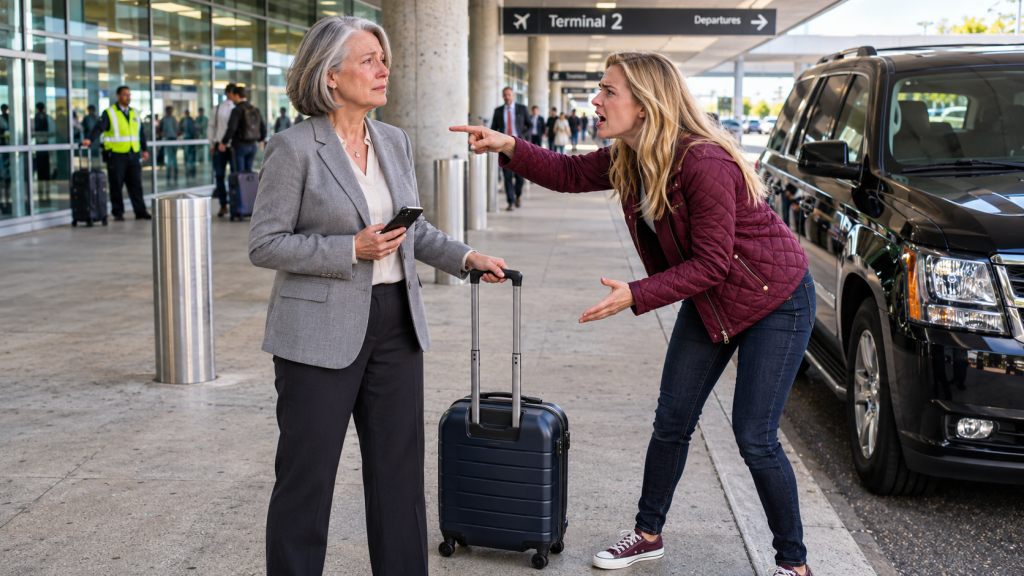
For a moment, I remembered standing outside the airport, watching the black SUV disappear.
Vanessa had believed that leaving me stranded would frighten or humiliate me into agreeing to her demands.
Now someone associated with the company was suggesting I had a moral obligation to honor promises I’d never made.
It was the same pressure dressed in different clothes.
I was supposed to feel guilty.
Supposed to pay.
Supposed to protect everyone from the consequences of choices they had made without me.
I picked up my phone and called Susan.
“There’s someone else you need to know about.”
By Friday, the situation had begun unraveling.
The Arizona attorney Susan had contacted, Michael Reeves, reviewed the lease documents and helped me notify the landlord that I disputed the signature attributed to me.
He also advised me about documenting potential identity misuse and what information investigators might need.
The landlord, a man named Peter Lawson, agreed to preserve the records associated with the proposed guarantee.
That was important.
The copy Daniel handed me didn’t tell the whole story.
There were questions about when the document had been created, how the signature was entered, who submitted it, and whether anyone had represented that I had personally approved it.
I didn’t expect immediate answers.
But I no longer felt helpless.
The facts were being examined.
Meanwhile, Daniel finally hired an independent accountant to review the company’s books.
The results were worse than he expected.
There were overdue supplier invoices.
A substantial lease obligation.
Unpaid wages.
Misclassified expenses.
And payments that couldn’t be supported by valid business documentation.
Some appeared connected to Vanessa’s personal spending.
Others involved Adrian’s consulting company.
Not every questionable transaction was necessarily unlawful.
But the accounting was a mess.
A dangerous mess.
One that had been hidden beneath optimistic projections and increasingly desperate promises.
On Friday afternoon, Daniel called me.
His voice sounded hollow.
“Mom, we’re going to have to stop taking new bookings.”
I closed my eyes.
“Has your accountant recommended that?”
“Yes.”
“Then follow the professional advice.”
He swallowed.
“We can’t responsibly promise events we may not be able to deliver.”
I nodded.
“That’s the first honest thing I’ve heard about this business in a week.”
He began crying.
“Mom, I’ve ruined everything.”
I looked toward the sunlight falling across my hotel carpet.
“No, Daniel. You’ve made serious mistakes. Now you need to decide how you’ll respond to them.”
He was quiet.
I continued.
“Your customers need accurate information. Your employees need clear communication about the wages they’re owed. And your creditors need to deal with facts rather than promises based on money that doesn’t exist.”
His breathing shook.
“I don’t know how to fix all of it.”
“Then stop pretending you can fix it alone.”
That afternoon, I did something that surprised even me.
I called Elena and asked whether she’d meet me for coffee.
She agreed.
We met at a small café near the hotel.
She was in her early fifties, with dark hair streaked with gray and the tired eyes of someone who’d spent too many nights worrying.
She carried a simple canvas handbag and held her coffee cup with both hands.
“Thank you for meeting me,” I said.
She shook her head.
“I should be thanking you for listening.”
I studied her.
“Tell me what happened when you first became concerned.”
Elena took a breath.
“I worked for the company for almost four years.”
She looked down.
“When Daniel and Vanessa started, it was a good little business.”
I nodded.
“Daniel loved the food. Vanessa was excellent at sales. They worked hard.”
Her expression saddened.
“Then they began expanding too quickly.”
I listened.
“They rented a bigger kitchen. Bought expensive equipment. Took events that required more staff and supplies than they could comfortably manage.”
She stirred her coffee.
“Revenue grew for a while, but costs grew faster.”
I nodded.
I’d seen that pattern dozens of times.
A business appeared successful because customers kept coming.
But cash disappeared faster than invoices could be collected.
Elena continued.
“Whenever I raised concerns, Vanessa said I was being negative.”
I looked at her.
“What about Daniel?”
She sighed.
“He wanted to believe things would work out.”
I closed my eyes.
She continued.
“Then the unusual expenses started.”
I asked about the transfers.
Elena explained that several invoices lacked sufficient supporting records.
Some vendors were unfamiliar.
Other transactions were entered under categories that didn’t seem appropriate.
“I asked for explanations,” she said.
“And?”
“Vanessa told me she had everything under control.”
I looked down.
Elena’s voice broke.
“I wish I’d pushed harder.”
I reached across the table.
“Elena, you raised concerns. You documented what you could. You didn’t control the business.”
She wiped a tear away.
“I know.”
Then she whispered, “But I kept thinking about the staff.”
I nodded.
“So do I.”
Before leaving, Elena told me about a young employee named Rosa.
She worked as an event coordinator.
Twenty-six years old.
Two small children.
Her husband worked construction, and the family depended on both incomes to pay rent.
Rosa had continued reporting to work even after the first missed paycheck because Vanessa promised everything would be resolved when my investment arrived.
I stared at Elena.
“Did Vanessa actually tell employees the money was guaranteed?”
She nodded.
“Yes.”
“Did Daniel hear that?”
Elena hesitated.
“I don’t know what he heard.”
I took a slow breath.
I wanted to help Rosa.
I wanted to help every employee.
But I also knew the danger of stepping in without understanding the obligations.
If I simply handed Daniel a check, I couldn’t be certain the money would reach the workers.
And I had no intention of allowing Vanessa or Adrian to use another dollar of mine.
I looked at Elena.
“Do you know whether the employees have received advice about unpaid wages?”
She shook her head.
“Not all of them.”
I nodded.
“Then please encourage them to contact the appropriate labor agency or qualified adviser. They deserve accurate information about their rights.”
Elena thanked me.
Then she reached into her bag and pulled out an old photograph.
It showed the catering staff standing outside their kitchen.
Everyone wore matching black aprons.
Daniel was in the middle, smiling.
Vanessa stood beside him.
Rosa was near the front holding a cake.
Elena looked at it.
“This was taken the first year I worked there.”
I stared at my son.
He looked hopeful.
Proud.
So much younger than the frightened man who’d stood in my hotel lobby.
Elena whispered, “It wasn’t always like this.”
I felt tears gather.
“I know.”
Then she added something I wouldn’t forget.
“The business might fail, Margaret. But the people who worked there still deserve to be treated with dignity.”
I nodded.
“Yes.”
And that became the thought that guided everything I did next.
Daniel came to see me the following morning.
He looked as though he hadn’t slept.
I invited him into the hotel lounge.
He sat across from me.
For a while, neither of us spoke.
Then he said, “Vanessa left.”
I looked up.
“What do you mean?”
“She packed a suitcase and went to stay with a friend.”
I studied him.
“Did she say why?”
He laughed bitterly.
“She said I was turning everyone against her.”
I waited.
He continued.
“When I asked about the transfers, she told me I was being manipulated by you.”
My jaw tightened.
“And the invoices?”
“She said Adrian handled them.”
I looked at Daniel.
“Has she provided supporting records?”
He shook his head.
“Not yet.”
I took a breath.
“And Adrian?”
Daniel stared at his hands.
“He’s stopped answering me.”
I wasn’t surprised.
Then my son whispered, “Mom, I think she used me.”
I looked at him for a long moment.
Finally, I said, “Daniel, Vanessa may have deceived you.”
He nodded.
“But you also need to examine the decisions you made.”
His expression tightened.
I continued.
“You signed a personal guarantee without understanding your company’s financial condition.”
He looked down.
“You ignored warnings from your bookkeeper.”
His eyes filled.
“You continued taking bookings while wages went unpaid.”
He covered his face.
“And when I refused to invest without reviewing the numbers, you left me at an airport.”
His shoulders shook.
For several seconds, I said nothing.
Then he whispered, “I know.”
I took a breath.
“Vanessa didn’t force you to drive away, Daniel.”
He began sobbing.
“I know, Mom.”
I felt my own eyes burn.
Because I loved him.
And because I had to say it anyway.
Daniel looked up.
“I thought if you felt bad enough, you’d give us the money.”
The confession struck harder than I expected.
For a moment, I couldn’t speak.
Then I whispered, “You knew what she was doing?”
He nodded slowly.
“Not the guarantee. Not the missing money.”
He swallowed.
“But I knew she was angry that you wouldn’t invest.”
I stared at him.
“And when she canceled the ticket?”
He began crying again.
“I saw her do it.”
My chest tightened.
“You watched her cancel a flight I’d paid for?”
He nodded.
“I thought she’d calm down.”
I looked away.
He continued.
“Then she told me to drive.”
My throat tightened.
“And you did.”
“Yes.”
A long silence followed.
Then he whispered, “I kept thinking you’d call. That you’d ask us to come back. That you’d agree to help if we apologized.”
I closed my eyes.
The cruelty of it wasn’t merely being abandoned outside an airport.
It was knowing my son had treated my vulnerability as something he could use to negotiate.
I took a slow breath.
“Daniel, do you remember when you were ten and broke Mrs. Walsh’s window?”
He looked startled.
“Yes.”
“What did I tell you?”
His eyes filled.
He whispered, “Tell the truth before the mistake becomes a lie.”
I nodded.
“And what happened afterward?”
He wiped his cheeks.
“I apologized. I helped pay for the window.”
“Did I stop loving you?”
He shook his head.
“No.”
I leaned forward.
“I don’t stop loving you because you’ve made mistakes.”
His face crumpled.
“But loving you doesn’t mean pretending those mistakes didn’t happen.”
He began sobbing.
I reached across the table and took his hand.
For one brief moment, he was my little boy again.
Then I squeezed his fingers.
“You need to become somebody who takes responsibility before the consequences force him to.”
The following week was painful.
The company suspended operations while Daniel and his professional advisers assessed its obligations and the appropriate next steps.
Customers were contacted.
Some received refunds where funds were available and legally appropriate.
Others were informed of the situation and given information about claims and outstanding payments.
The employees were told the truth about the wage arrears.
It was not an easy meeting.
Daniel called me afterward.
“I’ve never been so ashamed.”
I was sitting beside the window in my hotel room.
“What happened?”
He swallowed.
“Rosa cried.”
My chest tightened.
He continued.
“She said she kept coming to work because Vanessa told her the money would arrive.”
I closed my eyes.
“Did you tell them the investment wasn’t guaranteed?”
“Yes.”
“And the wages?”
“We’re working with counsel and the accountant to determine what can be paid immediately and what procedures apply to the rest.”
I nodded.
“Good.”
Daniel’s voice shook.
“One of the cooks asked why I didn’t warn them sooner.”
I waited.
“What did you say?”
He began crying.
“I told him I should have.”
For several moments, I couldn’t speak.
Then I whispered, “That’s where you start.”
The investigation into the suspicious transfers produced another surprise.
The account associated with Vanessa’s maiden name wasn’t simply a personal savings account.
It belonged to a small event-planning business she’d registered two years earlier.
The business had little independently documented activity.
Yet it had received payments from Daniel’s catering company for purported coordination services.
The amount wasn’t the entire sixty-three thousand eight hundred dollars Elena had flagged.
But it was substantial.
Further review also uncovered payments to Adrian’s consulting company for work that lacked convincing records of completion.
The professionals examining the books cautioned against assuming every questionable entry represented theft.
Some might have been improperly documented.
Some could involve legitimate services billed incorrectly.
Others warranted closer investigation.
I appreciated their care.
I wanted facts.
Not accusations that would later fall apart.
But as the records came together, it became increasingly difficult to believe that Vanessa had merely made innocent bookkeeping mistakes.
Daniel was devastated.
He’d trusted his wife.
He’d allowed her to manage the financial side of the business because he believed she was better at it.
And now he was facing the possibility that the company he’d spent years building had been weakened by transactions he never properly examined.
I felt sorry for him.
But I didn’t forget that he’d ignored the warnings.
Trusting a spouse was one thing.
Abandoning oversight of a business that employed eleven people was another.
One evening, Susan called with an update about the lease guarantee.
The initial records suggested that the document bearing my signature had been uploaded from an account associated with Vanessa’s business email.
That didn’t settle every question about who had created the signature or submitted the file.
But it strengthened the need for a formal review.
The landlord had agreed not to treat my liability as established while the matter was being examined, although the dispute itself remained unresolved.
I felt relief.
Not victory.
I still had expenses.
Legal advice.
Travel.
Time spent untangling something I’d never consented to.
And the knowledge that someone had believed my identity was theirs to use.
Susan asked whether I wanted to return to Portland.
I looked toward the city.
“Not yet.”
There was a pause.
“Margaret, you don’t have to stay in Arizona to supervise all of this.”
“I know.”
“Your son has advisers now.”
I nodded.
“I know.”
She waited.
Then I admitted the truth.
“I’m having trouble leaving when the employees haven’t been paid.”
Susan’s voice softened.
“That makes sense.”
I looked down.
“But you need to separate what you can do from what you’re responsible for.”
I closed my eyes.
She continued.
“You can decide whether to support a lawful, transparent effort to address some of their immediate needs. You cannot assume every obligation of a failed company simply because your son owns it.”
I stared at the photograph of Robert on my phone.
He’d always believed people deserved honesty.
Especially when the news was bad.
And I knew what he would ask.
Margaret, what can you do that actually helps without making the problem worse?
I took a breath.
Then I began considering an option that hadn’t been part of the original investment proposal.
I wasn’t going to invest two hundred and forty thousand dollars in Daniel’s company.
That decision was final.
But I couldn’t stop thinking about Rosa.
And the other employees who’d worked shifts, carried trays, loaded vans, and prepared meals under the promise that they’d be paid.
They hadn’t asked me for an investment.
They hadn’t forged my signature.
They hadn’t left me stranded at an airport.
They had simply gone to work.
So I called Susan and asked whether we could explore a separate, limited way to help people facing immediate hardship.
Not through Daniel.
Not through Vanessa.
And not by sending money into the catering company’s accounts.
Susan helped me speak with a local attorney and a community organization experienced in emergency financial assistance.
We discussed how voluntary assistance could be offered transparently without misrepresenting it as payment of the employer’s legal obligations or interfering with the workers’ claims.
After reviewing the options, I decided to fund a modest, independently administered emergency assistance program.
It wasn’t a solution to every employee’s losses.
It wasn’t a substitute for the wages the company owed.
And I made sure nobody was told that accepting help meant giving up any rights.
The assistance was intended to help with immediate essentials while the appropriate processes continued.
Rent.
Groceries.
Utilities.
Urgent necessities.
When Elena learned what I was doing, she began crying.
“Margaret, you don’t have to do that.”
I looked toward the window.
“I know.”
She sniffled.
“Then why?”
I thought about Robert.
About the little company we’d built together.
About the years when I worried whether we could afford another delivery van.
And about every employee who trusted us to treat them fairly.
“Because I remember what it means to have people depending on a paycheck,” I said.
Elena was quiet.
Then whispered, “Thank you.”
I took a breath.
“Please don’t thank me as though this fixes what happened.”
Her voice trembled.
“It doesn’t.”
“No.”
I looked down.
“But perhaps it can make the next few weeks a little less frightening.”
The next time I saw Rosa, she was standing outside a community center.
She held a little boy’s hand.
He was wearing a red baseball cap and carrying a stuffed dinosaur.
Elena introduced us.
“Rosa, this is Margaret.”
Rosa looked startled.
Then her eyes filled.
“Oh.”
I smiled gently.
“Hello.”
She looked at her son.
“Mateo, sweetheart, go sit beside Aunt Elena for a minute.”
He nodded and hurried away.
Rosa turned back toward me.
For several seconds, she couldn’t speak.
Then she whispered, “I heard what you did.”
I took a breath.
“I hope the assistance is useful.”
Tears streamed down her cheeks.
“I was afraid we’d lose our apartment.”
My throat tightened.
She continued.
“I kept telling my husband the company would pay us.”
I nodded.
“That’s what you were promised.”
Rosa looked down.
“I feel so foolish.”
I shook my head.
“You trusted your employer to pay for work you’d already done.”
Her voice broke.
“I just wanted to do my job.”
I reached for her hand.
“And you did.”
She began sobbing.
I held her hand for a moment.
Then I said something I hoped she’d remember.
“Whatever happens with Daniel’s business, please don’t let this convince you that hard work has no value.”
Rosa wiped her face.
“I won’t.”
She took a breath.
“And thank you for not making us beg.”
I felt tears gather.
Because that sentence mattered.
More than she knew.
The catering business eventually entered a formal winding-down process under professional guidance.
Equipment was inventoried.
Outstanding obligations were documented.
Creditors were notified as required.
The workers pursued the wages they were owed through the available procedures.
There were no miracles.
The business wasn’t saved by one dramatic check.
Daniel’s personal guarantee created serious financial exposure, and he had to work with advisers to understand what he owed and what options were available.
Vanessa’s role in the financial irregularities remained the subject of separate legal and financial review.
She and Daniel began divorce proceedings.
I didn’t celebrate.
The end of a marriage is painful, even when the marriage has become deeply troubled.
But I was relieved that my son had stopped pretending the situation could be repaired by hiding the truth.
One afternoon, Daniel came to my hotel carrying a cardboard box.
Inside were old photographs from the catering company’s first events.
He placed the box on the table.
“I wanted to show you something.”
I looked at him.
He handed me a photograph.
Daniel stood beside a small folding buffet table, wearing a white chef’s jacket.
He was smiling proudly.
Vanessa stood beside him holding a serving tray.
Behind them was a handwritten sign.
HAYES FAMILY CATERING — LET US MAKE YOUR DAY SPECIAL.
I stared at the picture.
“I remember this.”
Daniel smiled sadly.
“You came to that event.”
“Of course.”
He nodded.
“You helped us wash dishes afterward.”
I laughed softly.
“Your dishwasher quit halfway through the evening.”
Daniel smiled.
“I thought we’d never get everything cleaned.”
For a moment, we both remembered a happier time.
Then his expression changed.
“Mom, I loved this business.”
My throat tightened.
“I know you did.”
He looked down.
“I thought if I worked hard enough, it would become something big.”
I studied him.
“Daniel, building something worthwhile doesn’t always mean making it bigger.”
He looked up.
I continued.
“Sometimes it means knowing what you can sustain.”
His eyes filled.
He nodded slowly.
“I forgot that.”
I took his hand.
“Then remember it next time.”
A month later, I finally returned to Portland.
I booked my own flight.
Paid for it myself.
And confirmed the reservation directly with the airline.
Daniel offered to drive me to the airport.
I hesitated.
Then agreed.
Not because everything between us had been repaired.
Because I wanted to see whether we could share one honest journey without pretending the past hadn’t happened.
He arrived at the hotel on time.
He carried my suitcase to the car.
And during the drive, neither of us mentioned money.
For a while, we talked about ordinary things.
The weather.
My garden.
A neighbor’s new puppy.
Then Daniel grew quiet.
As we approached the airport, he pulled into the designated drop-off area.
He put the car in park.
And looked at me.
“Mom?”
“Yes?”
His eyes filled.
“I keep thinking about that day.”
I nodded.
“So do I.”
He swallowed.
“I was sitting right here when Vanessa canceled your flight.”
I looked toward the terminal.
Daniel continued.
“I watched you stand on the curb with your suitcase.”
His voice cracked.
“And I drove away.”
I felt tears gather.
He looked at me.
“Every time I come to this airport now, I remember your face.”
I took a slow breath.
“Daniel, that day hurt me.”
He nodded.
“I know.”
“It wasn’t about the canceled ticket.”
His eyes filled.
“It was about knowing my own son was willing to abandon me because I wouldn’t give him money.”
He began crying.
I waited.
Then he whispered, “I was wrong.”
I nodded.
“Yes.”
He looked at me.
“Can you ever forgive me?”
For a moment, I stared at the airport doors.
Then I looked back.
“I believe I can.”
His face crumpled.
“But forgiveness isn’t the same as returning to the relationship we had before.”
He nodded.
“I understand.”
I took his hand.
“We have to build something more honest.”
He squeezed my fingers.
“I want that.”
Then he stepped out of the car, carried my suitcase to the curb, and waited while I confirmed I had everything.
He didn’t ask for money.
Didn’t complain about Vanessa.
Didn’t make promises about how quickly he’d recover financially.
He simply hugged me.
“Have a safe flight, Mom.”
I held him tightly.
“Take care of yourself, Daniel.”
Then I walked into the terminal.
This time, nobody had to come searching for me.
Back in Portland, I returned to the rhythms of the life I’d built.
Morning coffee beside the kitchen window.
Walks through the neighborhood.
Lunch with old friends.
Afternoons volunteering at a community business mentoring program.
I began spending more time helping first-time entrepreneurs understand budgeting, cash flow, and the importance of honest financial records.
Some were young.
Some were older people starting second careers.
Many had wonderful ideas.
But almost all needed to learn that enthusiasm was not a substitute for planning.
I thought of Daniel often.
And sometimes, during those sessions, I heard myself saying things I wished I’d told him more firmly years earlier.
“Never mistake revenue for profit.”
“Never let one person control every financial record without oversight.”
“Don’t promise money you don’t have.”
“And if you discover something is wrong, address it immediately.”
The last lesson was the hardest.
Because people often think a problem will become smaller if they avoid looking at it.
In my experience, the opposite is usually true.
Daniel’s recovery was slow.
He found work managing kitchen operations for an established hospitality company.
The salary was modest compared with what he’d once imagined earning as a successful business owner.
But the work was steady.
He paid his bills.
Continued following the advice of the professionals helping him resolve his obligations.
And began learning how to live within a realistic budget.
We spoke once a week.
At first, the calls were awkward.
He asked about my health.
I asked about his work.
Neither of us knew how to discuss the months in Arizona without reopening painful memories.
But gradually, the conversations became easier.
One evening, Daniel said, “Mom, I got my paycheck today.”
I smiled.
“Good.”
He laughed softly.
“I know that doesn’t sound exciting.”
“It sounds dependable.”
He was quiet.
Then said, “I used to think owning a business meant I was more successful than somebody who worked for one.”
I waited.
“Now I think success has more to do with whether you can meet your responsibilities.”
My throat tightened.
“That’s a lesson worth keeping.”
He nodded.
Then whispered, “I wish I’d learned it before everything fell apart.”
I looked toward Robert’s photograph on the mantel.
“Sometimes we learn too late to save what we built.”
I paused.
“But not too late to build differently.”
The questions surrounding my forged signature and the suspicious transfers continued through appropriate professional and legal processes.
I cooperated when information was requested.
I kept my records.
And I refused to treat speculation as fact.
The investigation identified serious irregularities in the company’s financial documentation, including transactions Vanessa had authorized and records connected to Adrian’s purported consulting services.
The relevant parties dealt with the findings through the applicable civil, regulatory, and legal procedures.
I didn’t need to invent a dramatic punishment in my mind.
I needed accurate records, protection of my identity, and a fair resolution.
Eventually, I received confirmation that the disputed guarantee would not be enforced against me.
My attorney explained the outcome and helped me close the remaining matters that concerned my personal liability.
I sat at my kitchen table with the letter in my hands.
For a long time, I simply stared at it.
Then I began crying.
Not because I’d won something.
Because I could finally stop worrying that a stranger might demand payment for a commitment I’d never made.
A year after the airport incident, Daniel came to Portland for my birthday.
He stayed in a hotel.
Not because I didn’t love him.
Because we’d both agreed it was healthy to rebuild our relationship with some boundaries.
He arrived at my house carrying flowers and a small wrapped package.
We had lunch in the garden.
The roses were blooming.
The sky was bright.
For a while, we talked about his work.
Then he handed me the gift.
“Happy birthday, Mom.”
I smiled.
“You didn’t have to bring anything.”
“I know.”
Inside was a framed photograph.
It had been taken when Daniel was about six.
Robert stood beside him in our first company van.
Both were wearing oversized work gloves.
Daniel grinned at the camera while his father pretended to inspect a wrench.
I burst out laughing.
“Where did you find this?”
Daniel smiled.
“In an old box.”
I touched Robert’s face.
“He loved that van.”
Daniel nodded.
“He loved working with you.”
My eyes filled.
“Yes.”
My son looked down.
Then said, “There’s something else.”
I turned toward him.
He took a folded letter from his pocket.
For a moment, my stomach tightened.
Then he smiled sadly.
“It’s not a financial document, Mom.”
I laughed through my tears.
He handed it to me.
It was an apology.
Not a short message.
Not a request for forgiveness attached to another favor.
A letter describing what he’d done.
The warnings he’d ignored.
The choices he’d made.
The hurt he’d caused when he left me at the airport.
And the ways he intended to act differently.
Near the end, he wrote:
I used to think being your son meant you would always rescue me. Now I understand that being your son means I was fortunate enough to have someone teach me how to take responsibility.
I pressed the letter against my chest.
Daniel’s eyes filled.
“Mom, I’m sorry I treated your love like money I could withdraw whenever I wanted.”
I began crying.
He reached for my hand.
“I know I can’t undo it.”
I nodded.
“No.”
“But I want to spend the rest of my life being someone you can trust.”
I looked at him.
For a moment, he was six again.
Standing beside Robert in a pair of oversized gloves.
Smiling because he believed he could help build something important.
I squeezed his hand.
“Then keep becoming that person.”
He smiled through his tears.
“I will.”
Today, I still live in Portland.
I still enjoy my retirement.
And I still believe family matters.
But I no longer confuse love with the obligation to rescue someone from every consequence of their decisions.
Daniel and I have rebuilt much of our relationship.
We speak honestly.
We respect boundaries.
And when a difficult subject arises, we discuss it instead of hiding behind excuses.
He hasn’t asked me for another investment.
I haven’t offered one.
Sometimes he tells me about ideas for businesses he might start someday.
I listen.
I ask questions.
And I encourage him to remember what he’s learned.
But I don’t reach for my checkbook.
He needs to build his future through choices he can sustain.
And I need to trust him enough to let him try.
Last Sunday, I was sitting in my garden when Daniel called.
“Hi, Mom.”
“Hello, sweetheart.”
He sounded cheerful.
“Guess what?”
“What?”
“I finished paying off one of the smaller debts from the business.”
I smiled.
“That’s wonderful.”
He laughed.
“It’s not much compared with everything else.”
“Daniel, progress doesn’t have to be dramatic to matter.”
He was quiet.
Then said, “Dad used to say that.”
My throat tightened.
“Yes, he did.”
We talked for a while.
Then, before hanging up, Daniel asked something unexpected.
“Mom?”
“Yes?”
“Do you ever think about that day at the airport?”
I looked toward the roses moving gently in the afternoon breeze.
“Sometimes.”
He swallowed.
“I wish I could change it.”
I took a breath.
“So do I.”
There was a pause.
Then I continued.
“But I don’t wish I’d handed you the money.”
Daniel was quiet.
Finally, he whispered, “Neither do I.”
Tears filled my eyes.
He continued.
“If you’d given us the investment, we would’ve kept pretending everything was fine.”
I nodded.
“And more people might have been hurt.”
“Yes.”
He sighed.
“I hated that you said no.”
I smiled sadly.
“I know.”
“But it was the first time in a long while somebody refused to help me avoid the truth.”
I closed my eyes.
For years, I’d believed the best gift I could give my son was security.
Money.
Opportunity.
A safety net.
Now I understood that sometimes the greatest gift is refusing to finance a lie.
I think about the employees often.
About Elena, who was brave enough to raise concerns.
About Rosa, who simply wanted the wages she’d earned.
About the people whose lives were disrupted by a business they trusted.
I know my assistance didn’t erase their hardship.
It couldn’t.
But I hope it reminded them that their work mattered and that the failure of their employer did not diminish their worth.
And I hope Daniel never forgets them.
Because a business is never merely a balance sheet.
Behind every invoice is a person.
Behind every paycheck is a household.
Behind every promise is somebody who may be depending on it.
When I look back at the airport now, I don’t remember the humiliation first.
I remember the moment I read Vanessa’s message.
Walk home.
I remember standing beside my suitcase, watching the SUV disappear.
And I remember asking one simple question.
You sure?
At the time, I was giving them one final opportunity to reconsider.
They didn’t take it.
So I chose a different way forward.
I didn’t chase the car.
Didn’t beg.
Didn’t offer money in exchange for kindness.
I found transportation, secured a hotel, withdrew an investment I no longer trusted, and began uncovering the truth.
That choice set everything else in motion.
It exposed the company’s financial problems.
It revealed a document signed without my consent.
It forced Daniel to confront responsibilities he’d been avoiding.
And it gave me something I hadn’t realized I needed.
The certainty that I could love my son without surrendering my judgment.
Family loyalty should never require dishonesty, and generosity should never be mistaken for permission to take what someone hasn’t agreed to give.
I still love Daniel.
I always will.
But I no longer believe love means protecting him from the truth.
Sometimes love means standing firmly beside someone.
Sometimes it means offering a hand.
And sometimes it means stepping away so they can finally learn to stand on their own.
I looked toward the photograph of Robert and Daniel in the old company van.
Then smiled.
The little boy in that picture had grown into a man who’d made terrible mistakes.
But he was still capable of learning.
Still capable of changing.
Still capable of building something better.
And for now, that was enough.
Outside, the afternoon sun warmed the garden.
My roses were blooming.
The house was peaceful.
And my life belonged to me.