The moment my sister mentioned the bank, Marlee stopped moving. It wasn’t the kind of stillness that comes from surprise. It was the stillness of somebody who has been caught standing in the wrong place with the wrong thing in her hands. My son Hugh looked from his wife to my sister. “What application?” Nobody answered immediately. The October breeze rattled the dry leaves along my porch steps. Across the street, Mrs. Bell was watering her chrysanthemums, pretending she couldn’t hear us.
My sister, Darlene, stood beside her car holding a blue folder against her chest. She was seventy-one, three years younger than me, and she’d spent most of those years telling people exactly what she thought whether they wanted to hear it or not. But that morning, even Darlene looked frightened. “Tressie,” she said quietly, “I need you to sit down.” I straightened my cardigan. “Honey, I’ve spent forty years working hospital floors with swollen ankles and a bad back. I believe I can stand long enough to hear bad news.”
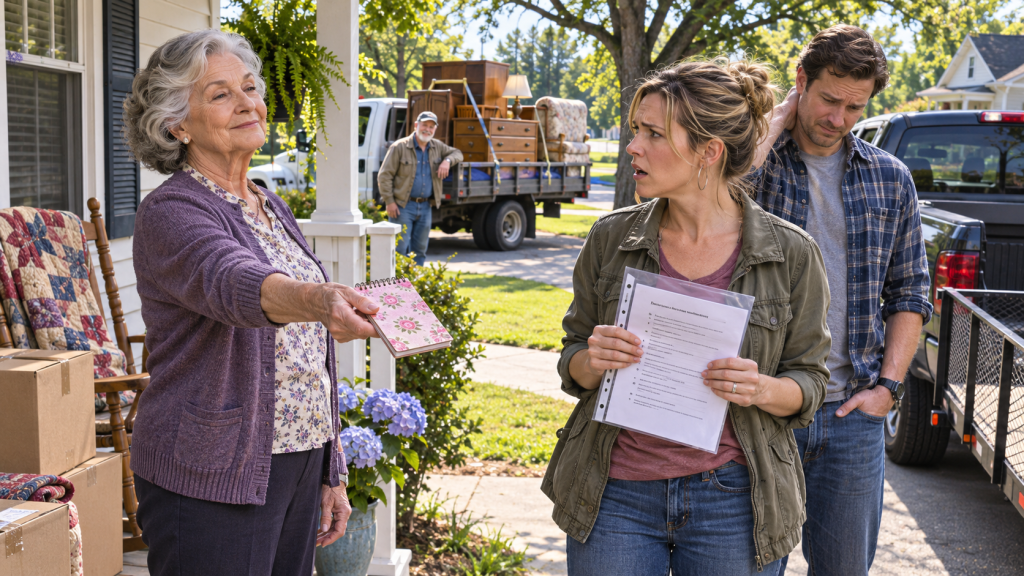
She gave me a sad little smile. Then she opened the folder. “The bank called because your name appeared on an application for a home-equity loan.” I frowned. “What home?” Darlene glanced toward Marlee. “That’s what I asked.” Hugh stepped forward. “Mom doesn’t own a house. She’s been renting for twenty-two years.” “Exactly,” Darlene replied. Marlee suddenly began talking. “Oh, for heaven’s sake. It’s a clerical error. I was looking into some financing options, and somebody entered the wrong information.” My sister didn’t look at her. Instead, she handed me a photocopy. There was my name. Theresa Mae Ellis. My old address.
My Social Security number, with most of the digits masked on the copy.
And beneath a paragraph authorizing a credit inquiry, a signature that looked like mine.
Except it wasn’t.
I stared at the paper.
For a moment, the world became very quiet.
Then I said, “I didn’t sign this.”
Marlee folded her arms.
“Nobody said you did.”
Darlene looked at her.
“The application says otherwise.”
Hugh took the page.
His eyes moved down the printed information.
Then he stopped.
“Marlee.”
She looked away.
“What’s this?”
“It’s nothing.”
“Why is Mama listed as a borrower?”
Marlee’s face flushed.
“I was trying to find a way to help everybody.”
I felt something cold settle beneath my ribs.
For months, I’d been frightened of losing my home.
I’d worried about where I would sleep.
Whether my pension and Social Security would stretch far enough.
Whether I could manage stairs as I grew older.
And while I was worrying, my son’s wife had apparently been using my personal information for a financial application.
I looked at Marlee.
“Did you put my name on those papers?”
She opened her mouth.
Then closed it.
Hugh looked at her.
“Answer Mama.”
Her voice rose.
“You don’t understand how much pressure I’ve been under!”
I took a slow breath.
“That wasn’t my question.”
For several seconds, she stared at me.
Then whispered, “I didn’t think it would actually go through.”
My son went white.
And I knew that whatever happened next, our family would never be quite the same.
My name is Theresa Ellis, though nearly everybody calls me Tressie.
I was seventy-four years old that autumn.
I had been a nurse for forty years, a wife for forty-six, and a mother for longer than I could remember being anything else.
My husband, Walter, had been gone eight years.
He was the sort of man who repaired things before they broke, carried peppermints in his coat pocket, and believed the best place to discuss a problem was at the kitchen table.
Walter wasn’t rich.
Neither was I.
We rented our little duplex because buying a house had never quite worked out for us.
There was always something else.
A medical bill.
A car repair.
A child who needed new shoes.
A family emergency.
But Walter used to say, “Tressie, a home isn’t something you own. It’s somewhere you can close the door and know you’re loved.”
I believed that for most of my life.
Then the duplex was sold.
Our landlord had died, and his children decided to sell the property to a developer.
The new owner intended to demolish the building.
I had to leave by the first of the month.
At seventy-four, the thought of finding somewhere new frightened me more than I admitted.
I could still cook.
Still drive.
Still manage my medications.
Still carry groceries if I didn’t try to bring every bag inside at once.
But I wasn’t twenty-five anymore.
My knees hurt.
My back reminded me of every hospital shift I’d ever worked.
And moving an entire household alone seemed almost impossible.
That’s when Hugh suggested I stay with him and Marlee.
At first, I cried with gratitude.
My son wanted his mama nearby.
After years of living separately, perhaps we’d finally have time together.
Perhaps I’d see my grandchildren every afternoon.
Perhaps I’d have a warm place where somebody would notice if I was lonely.
Then Marlee began explaining the conditions.
Seven hundred dollars every month.
Childcare five weekdays.
Housekeeping when needed.
Quiet after eight.
No cooking that produced strong smells.
No visitors without permission.
And, according to the printed rules, restrictions on when I could use my own car.
The room was above their garage.
It smelled of lawn equipment and gasoline.
Its outside stairs were steep enough to make me nervous even in daylight.
The window was tiny.
The bathroom was downstairs.
And the air conditioner rattled like a coffee can full of screws.
Still, I nearly agreed.
Because the alternative seemed like facing old age alone.
I didn’t understand then that being alone and being free are not the same thing.
“Marlee,” Hugh said, holding the application, “what did you do?”
His wife looked toward the driveway.
“Can we please not do this in front of the neighborhood?”
I glanced at Mrs. Bell.
She was still watering the same flowerpot.
“Well,” I said, “we can certainly stop discussing it on the porch.”
Marlee looked relieved.
Until I continued.
“But you are not coming inside my house.”
Her expression hardened.
“Tressie, that’s ridiculous.”
I folded my hands.
“Perhaps. But the movers are coming for the remaining boxes, and I’m not spending my last morning here arguing with somebody who signed my name to a bank document.”
Hugh looked stricken.
“Mama, please.”
I turned toward him.
“Son, I love you. But you came here with a trailer because you believed I had agreed to pay you for a room over the garage and provide childcare five days a week.”
He swallowed.
I continued.
“You didn’t ask whether those stairs were safe for me. You didn’t ask whether I could afford the rent. You didn’t even ask what I wanted.”
His eyes filled.
“Mama—”
“And when Marlee handed me those rules, you stood there.”
He lowered his head.
I looked toward Darlene.
“Let’s take these papers to somebody who understands them.”
She nodded.
Then Marlee made her mistake.
She said, “You can’t afford a lawyer.”
The words came out sharply.
Confidently.
Like she’d already counted every dollar in my purse.
I looked at her.
Then smiled.
“You’re right about one thing, honey.”
She blinked.
“I can’t afford to be careless.”
I tucked the bank document into my folder.
“And that’s why I’m not signing anything until I’ve spoken to somebody whose job is to protect me.”
Mr. Crenshaw came around the corner just as I finished speaking.
His old flatbed truck rumbled slowly toward the house.
He parked behind Hugh’s pickup and climbed down from the cab.
He wore his usual khaki work pants, a faded blue shirt, and a baseball cap advertising a feed store that had closed fifteen years earlier.
His name was Arthur Crenshaw.
He was seventy-six, widowed like me, and had operated the downtown hardware store for more than forty years.
I’d known him since I was in nursing school.
When Walter broke his wrist repairing our porch railing, Arthur delivered groceries.
When Arthur’s wife, Louise, went through cancer treatments, I drove her to appointments whenever my hospital schedule allowed.
We weren’t strangers.
We were people who’d watched each other grow older.
And when he saw the expression on my face that morning, his own face changed.
“Tressie?”
I took a breath.
“Morning, Arthur.”
He looked toward Hugh and Marlee.
“Everything all right?”
I considered lying.
I’ve always been good at telling people I’m fine.
It’s practically a nursing skill.
But that morning, I was tired of it.
“No,” I said. “Not especially.”
Arthur nodded.
Then asked, “Do you still want to move?”
I looked at him.
“More than ever.”
He smiled gently.
“Then let’s get your things loaded.”
Hugh helped carry the remaining boxes.
Marlee stayed near the truck, talking angrily into her phone.
I didn’t ask whom she was calling.
Augie, my eight-year-old grandson, sat on the porch steps holding his stuffed rabbit.
His younger sisters, Lila and June, waited inside their parents’ truck.
They were six and three.
I watched Augie for a moment.
Then sat carefully beside him.
“Grandma?”
“Yes, sweetheart?”
“Are you moving away?”
I shook my head.
“No, honey. Just across town.”
He looked relieved.
“Will you still make pancakes?”
I smiled.
“Of course.”
“The ones with the little crispy edges?”
“The very same.”
He considered that.
Then whispered, “Mama said you were going to live with us so she’d have help.”
I felt my chest tighten.
“Did she?”
He nodded.
“She said you wouldn’t have anything else to do.”
For a moment, I couldn’t speak.
Then I looked at my grandson.
“Augie, do you remember when Grandpa Walter used to take you fishing?”
He smiled.
“Yeah.”
“Did he stop being Grandpa when he wasn’t fishing with you?”
Augie frowned.
“No.”
“Well, I don’t stop being Grandma when I’m not babysitting.”
He thought about that.
Then smiled.
“Okay.”
I kissed the top of his head.
“And I love you whether I’m watching you or not.”
He wrapped his little arms around my neck.
“Love you too, Grandma.”
Across the driveway, I saw Hugh watching us.
His face crumpled.
And for one painful moment, I wished he were still the little boy who used to climb into my lap when the world frightened him.
Because I knew how to comfort that boy.
I wasn’t sure how to reach the grown man who’d forgotten that his mother was a person.
We finished loading just before eleven.
My furniture fit into Arthur’s truck and Darlene’s borrowed utility trailer.
Hugh stood beside his empty trailer, looking utterly lost.
“Mama,” he said, “can I come see the apartment?”
I hesitated.
Part of me wanted to say yes.
He was my son.
I loved him.
I’d loved him since the first moment the nurse placed him in my arms, red-faced and furious about being born.
But another part of me remembered the seven hundred dollars.
The printed house rules.
The unsigned financial application.
And the fear I’d felt every time Marlee mentioned how much trouble I’d be if I tried to live alone.
“Not today, Hugh.”
His eyes filled.
“Mama, please.”
I stepped closer.
“When you come to see me, I want it to be because you’re visiting your mother. Not because you’re checking whether I’ve made a mistake.”
He looked down.
“I understand.”
I wasn’t sure he did.
But it was a beginning.
My new apartment was above Arthur’s hardware store.
It wasn’t fancy.
There was a little sitting room, a bedroom with two windows, and a kitchen that overlooked the street.
The floors creaked.
The bathroom tiles were old.
And the front door had a stubborn lock that required a little upward pressure on the handle.
But it was clean.
Warm.
And mine for as long as I met the lease terms.
The rent was five hundred and seventy-five dollars a month.
Less than Marlee wanted.
There was no requirement to watch children.
No list of quiet hours imposed by relatives.
No one threatening to take my car keys.
The stairs were indoors, with a sturdy railing and a landing halfway up. I knew I’d need to think about longer-term accessibility, but for now they were manageable.
Arthur showed me where the smoke detectors were.
He explained the heating system.
Then he handed me a small envelope containing the written lease and his contact information.
“Anything breaks,” he said, “you call the store.”
I nodded.
“And if I can’t reach you?”
“Then you call the property maintenance number on the paper.”
I smiled.
“Look at you, all professional.”
He grinned.
“Well, Tressie, I am a landlord.”
Then his expression softened.
“You’re welcome here.”
Four little words.
And suddenly I was crying.
Arthur looked alarmed.
“Did I say something wrong?”
I laughed through my tears.
“No.”
I wiped my face.
“You said exactly the right thing.”
That night, I sat on my own couch beneath Walter’s quilt.
The boxes weren’t unpacked.
My dishes were stacked on the counter.
My old Chevy was parked outside beneath a streetlamp.
And there was a bowl of chicken soup on the table.
Darlene had made it.
Arthur had carried it upstairs.
For the first time in weeks, nobody had told me I was a burden.
Nobody had explained how grateful I ought to be.
Nobody had demanded a payment in exchange for ordinary consideration.
I looked around the little apartment.
Then whispered, “Well, Walter. We made it.”
For a moment, I could almost hear his laugh.
Of course we did, Tressie.
I smiled.
Then cried a little more.
Because relief can hurt almost as much as grief when you’ve been frightened for long enough.
The next morning, Darlene took me to the bank.
I wore my good navy cardigan and carried a folder containing my identification, account statements, and the copy of the disputed application.
The branch manager’s name was Celia Martin.
She was a woman in her fifties with short silver hair and the sort of patient expression I’d always appreciated in a nurse.
She listened carefully.
Then asked whether I’d authorized anyone to apply for credit using my information.
“No, ma’am.”
“Did you sign the application?”
“No.”
“Did you give your daughter-in-law permission to use your information?”
I shook my head.
“Absolutely not.”
Celia nodded.
Then explained that the bank would need to review the application and determine what had been submitted.
She couldn’t share another person’s private account information simply because I suspected Marlee was involved.
But she could help me dispute the use of my identity, preserve the relevant records, and understand the procedures for protecting my accounts.
When I asked whether money had been borrowed in my name, she reviewed what she was authorized to discuss.
“The application was not approved,” she said.
My knees nearly gave way.
I gripped the chair.
“Thank the Lord.”
Celia looked at me.
“That doesn’t mean you should ignore it. We’ll document your dispute, and I recommend checking your credit reports and considering a credit freeze.”
I nodded.
She also advised me to report the suspected identity misuse through the appropriate channels.
I wrote everything down.
Forty years of nursing had taught me that when you receive important instructions, you don’t rely entirely on memory.
You write them down.
Then you ask questions.
And if you still don’t understand, you ask again.
By the time we left, I had a plan.
For the first time since Marlee’s notepad appeared, I felt my breathing return to normal.
But I hadn’t yet heard the strangest part of the story.
That came two days later.
On Tuesday afternoon, Hugh arrived at the hardware store.
I was downstairs buying lightbulbs.
Arthur was explaining the difference between two brands when the bell above the door jingled.
I turned.
There stood my son.
He looked as though he hadn’t slept.
His work shirt was wrinkled.
There were dark circles beneath his eyes.
“Mama?”
I set the lightbulbs down.
“Hello, Hugh.”
He glanced toward Arthur.
“Could we talk?”
Arthur quietly returned to the paint counter.
I looked at my son.
“Of course. But I have one condition.”
He swallowed.
“What’s that?”
“No shouting. No blaming me for leaving. And no asking me to sign anything.”
His face crumpled.
“Okay.”
We sat at a little table near the front window, where Arthur sometimes ate his lunch.
For a moment, Hugh stared at his hands.
Then he whispered, “I didn’t know about the bank application.”
I nodded.
“That’s what you said Saturday.”
He looked up.
“I swear it, Mama.”
I studied his face.
I believed that he hadn’t known every detail.
But believing that wasn’t the same as excusing his behavior.
“Hugh, you knew about the garage.”
His eyes filled.
“I know.”
“You knew about the rent.”
He nodded.
“And you knew Marlee wanted me to watch three children every weekday.”
He stared at the table.
“Yes.”
I leaned forward.
“Then there’s something I need to understand.”
He looked up.
“Why did you think that was fair?”
His mouth opened.
Then closed.
Finally, he whispered, “Because Marlee said it was.”
I sat back.
There it was.
Not a grand conspiracy.
Not some complicated explanation.
My son had allowed someone else to decide what his mother deserved.
I took a slow breath.
“Son, I’ve lived long enough to know that marriage takes compromise.”
He nodded.
“But compromise doesn’t mean letting your wife make every decision while you pretend you had no part in it.”
Tears slid down his cheeks.
“I know.”
I shook my head.
“I don’t think you do yet.”
He looked at me.
“Because when I asked whether the stairs were safe, you didn’t answer. When I mentioned my income, you looked at your coffee. And when Marlee called childcare my contribution, you didn’t say a word.”
Hugh began crying.
I felt my heart ache.
He was still my son.
No matter how old he became, some part of me would always want to wipe his tears.
But I remembered what Walter used to say about raising children.
If you protect them from every uncomfortable truth, Tressie, how will they ever learn to stand upright?
So I stayed where I was.
And let Hugh hear what I had to say.
After a long silence, Hugh pulled a folded paper from his pocket.
It was the list of house rules.
Marlee had printed it on white paper and slipped it into a clear plastic sleeve.
I recognized her neat handwriting beside several items.
He laid it on the table.
“Did you read all of these?”
I shook my head.
“Not every word.”
His eyes filled.
“I didn’t either.”
I looked at him.
He swallowed.
“I knew about the rent and helping with the kids. I didn’t know she’d added rules about visitors, your car, or your money.”
I stared at the paper.
“Your name was on it.”
He nodded.
“I know.”
“And you brought it to my house.”
He covered his face.
“I know.”
I waited.
Then he whispered, “I should’ve read it.”
“Yes.”
His shoulders shook.
“I should’ve asked questions.”
“Yes.”
“And I should’ve told her it was wrong.”
I took his hand.
“That’s where we can start.”
He looked up.
I continued.
“You don’t become a better man by pretending you weren’t involved. You become one by admitting where you failed and doing differently next time.”
He squeezed my fingers.
Then whispered, “I’m sorry, Mama.”
I believed he meant it.
But I also knew that one apology couldn’t repair months of treating me like unpaid help.
So I answered carefully.
“Thank you for saying that.”
He looked disappointed.
I squeezed his hand.
“And now I need to see what you do.”
Before leaving, Hugh told me something I hadn’t known.
Marlee had quit her part-time job six months earlier.
She’d told Hugh that managing the household and the children had become too much.
He hadn’t argued.
But the loss of her income had strained their finances.
They were behind on two credit card accounts.
Their minivan needed repairs.
And Hugh had been taking overtime shifts to cover expenses.
I frowned.
“Why didn’t you tell me?”
He looked ashamed.
“I didn’t want you worrying.”
I sighed.
There it was again.
The family habit of hiding difficult truths until they became bigger problems.
Hugh continued.
“Marlee said if you moved in, we could use your rent to catch up.”
I stared at him.
“And the childcare?”
He swallowed.
“She wanted to go back to work.”
I nodded slowly.
“That part I understand. Three children are expensive, and childcare can cost a fortune.”
His eyes filled.
“But you wanted me to provide it for free.”
He lowered his head.
“Yes.”
“And pay you rent.”
He nodded.
I leaned back.
“Hugh, if you’d come to me and said you needed help watching the children two afternoons a week while Marlee looked for work, I might have agreed.”
He stared at me.
“But you didn’t ask.”
My voice trembled.
“You made plans for my time, my money, my car, and my old age as though I wasn’t sitting right there.”
Tears slipped down his cheeks.
I squeezed his hand.
“I’m still willing to be your mama.”
He looked up hopefully.
“But I won’t be your retirement plan, your childcare budget, or your emergency credit account.”
He nodded.
“I understand.”
I hoped he did.
That evening, I received a phone call from a woman named Susan Bell.
She worked at the bank’s lending center.
She explained that my dispute had triggered a closer review of the application submitted under my name.
Because I was the person whose identity had been used, she could tell me certain details about the disputed submission.
The application had not actually been for a home-equity loan secured by a property I owned.
That description had appeared in an initial internal summary.
The underlying records showed that someone had started an online inquiry involving Hugh and Marlee’s house, then listed me as a proposed additional borrower and provided information suggesting I could help support the application.
When the system requested verification, additional documents had been uploaded.
Among them was a consent form bearing my supposed signature.
I closed my eyes.
“What does that mean?”
Susan answered carefully.
“It means the bank did not have sufficient verified authorization to proceed with you as an applicant.”
I swallowed.
“Was a loan approved?”
“No.”
I exhaled.
She continued.
“But because the documents appear to have been submitted without your knowledge, we are preserving the records and reviewing the matter.”
I took a breath.
“Can you tell who submitted them?”
She paused.
“That is part of the review, and we cannot disclose all details at this point.”
I nodded.
Then asked whether they needed anything further from me.
She explained the formal dispute process and the records I should keep.
Before ending the call, she said something I’ll always remember.
“Mrs. Ellis, being related to someone doesn’t mean they can use your identity without permission.”
I stared at the wall.
For seventy-four years, I had been taught that family helped family.
Now I was learning that some people used those words to excuse things no stranger would dare ask.
Two weeks later, I met with an attorney named Nora Whitcomb.
Darlene came with me.
Nora was younger than I expected, perhaps in her early forties, with curly brown hair and a warm but no-nonsense manner.
She reviewed the bank paperwork.
Then the pink notepad.
Then the house rules.
When she reached the line about taking my car keys, she looked up.
“Mrs. Ellis, had you agreed to surrender your keys?”
“No.”
“Had anyone raised a documented concern about your ability to drive?”
“No.”
“Had you authorized your son or daughter-in-law to control your finances?”
I shook my head.
“Absolutely not.”
Nora nodded.
“Then we need to make sure your documents accurately reflect your wishes.”
She helped me arrange a proper review of my financial and estate planning.
We discussed the possibility of naming a trusted agent for limited circumstances, the safeguards I wanted, and the importance of making decisions while I was capable of understanding them.
She also explained that any suspected misuse of my identity should be handled through the appropriate reporting and investigation processes.
I listened.
Then asked a question that had been bothering me.
“Miss Whitcomb, do you think Marlee wanted to take all my money?”
Nora considered her answer.
“I can’t know what she intended beyond the evidence.”
I nodded.
“But the notepad shows she was planning to pressure you, and the application raises serious questions about unauthorized use of your information.”
I looked down.
She continued.
“What’s important is that you protect yourself without feeling obligated to prove every possible motive.”
That was a relief.
Because for days, I’d been trying to understand Marlee’s thoughts.
Why she believed I owed them.
Why she thought my money was available.
Why she could write down instructions about frightening me with nursing homes.
But perhaps I didn’t need to understand every thought inside her head.
Perhaps it was enough to recognize what she had done.
And decide I wouldn’t allow it again.
My new life developed in small, unexpected ways.
Every morning, I made coffee in my little kitchen and opened the curtains.
From the window, I could see people walking along Main Street.
The bakery opened at six.
The barber arrived shortly after seven.
By eight, Arthur usually stood outside the hardware store sweeping the sidewalk.
He waved if he noticed me.
I waved back.
For the first time in years, I lived somewhere that made me feel connected to the world.
I hadn’t realized how lonely I’d become in the old duplex.
After Walter died, the rooms felt enormous.
Some evenings, I’d turn on the television just to hear another voice.
Now there were footsteps on the stairs.
Customers talking downstairs.
Church bells from two blocks away.
Life happening around me.
And nobody demanding that I make myself useful before I was allowed to enjoy it.
One Saturday, Arthur knocked on my door carrying a small box.
“Morning, Tressie.”
I smiled.
“Morning, Arthur.”
He handed me the box.
“Found something while cleaning out the storage room.”
Inside was an old brass door knocker shaped like a sunflower.
I laughed.
“Arthur, this is beautiful.”
He smiled.
“Louise bought it years ago. We never got around to using it.”
I touched the worn brass.
“Are you sure you want me to have it?”
He nodded.
“Thought it’d look nice on your door.”
My eyes filled.
Arthur looked alarmed.
“Now, don’t start crying over a door knocker.”
I laughed.
“I’ve been doing a lot of crying lately.”
He smiled gently.
“Well, maybe we’ll get you doing more laughing.”
I looked at him.
Something about that simple kindness settled warmly in my chest.
Not romance.
Not yet.
Just the comfort of knowing someone could care about me without asking for anything in return.
The children visited for the first time three weeks after my move.
Hugh brought them on a Sunday afternoon.
Marlee didn’t come.
I was relieved.
Augie ran up the stairs ahead of his father.
“Grandma!”
He burst through the doorway.
Then stopped.
His eyes widened.
“You got a real apartment!”
I laughed.
“Indeed I did.”
He looked around.
“There’s windows!”
“Two of them.”
“And a kitchen!”
“That too.”
Lila hurried inside behind him.
She ran straight toward my quilt.
“Grandma, can we have pancakes?”
I smiled.
“It’s three in the afternoon, sweetheart.”
She considered that.
Then said, “So?”
I laughed until my sides hurt.
We made pancakes.
Hugh helped wash the dishes.
The children played a board game on the living room floor.
And for two wonderful hours, nobody mentioned rent, work, or house rules.
When it was time to leave, Augie hugged me.
“Grandma, I like this place.”
I kissed his cheek.
“Me too.”
Then he whispered, “Mama says you don’t want to help us anymore.”
I froze.
Hugh heard him.
His face changed.
I knelt carefully.
“Augie, grown-ups sometimes say things when they’re upset.”
He looked confused.
I continued.
“I love you and your sisters very much.”
He nodded.
“But Grandma has a home of her own, and that doesn’t mean she loves you any less.”
He smiled.
“Okay.”
Then he kissed my cheek.
When the children went downstairs, Hugh stayed behind.
His eyes were wet.
“I’m going to talk to Marlee.”
I nodded.
“That’s your responsibility, son.”
He looked ashamed.
“I know.”
The next month brought an unpleasant surprise.
Marlee came to the apartment without calling.
Arthur was downstairs when she arrived.
He later told me he saw her come through the front door carrying a large envelope.
By the time he realized where she was headed, she was already climbing the stairs.
I opened my apartment door after hearing the knock.
Marlee stood outside.
Her hair was pulled into a tight ponytail.
She looked tired.
“Tressie.”
I took a breath.
“Hello, Marlee.”
She glanced past me.
“Can I come in?”
I hesitated.
Then shook my head.
“I’d rather talk here.”
Her expression hardened.
“Really?”
“Really.”
She looked toward the envelope.
“I came to apologize.”
I folded my hands.
“All right.”
She swallowed.
“I shouldn’t have written those things in the notebook.”
I nodded.
“No, you shouldn’t.”
“And I shouldn’t have made you feel unwelcome.”
I waited.
She shifted her weight.
Then continued.
“But you need to understand how hard things have been for us.”
My stomach tightened.
“Marlee, I know raising three children is expensive.”
She nodded quickly.
“Exactly.”
“And I know Hugh has been working long hours.”
Her eyes filled.
“Yes.”
I took a slow breath.
“But none of that gives you permission to sign my name to a financial application.”
She went still.
For a moment, I thought she might deny it again.
Instead, she whispered, “I was desperate.”
I looked at her.
“Then you needed help with your finances.”
She looked down.
“Not somebody else’s identity.”
Her lips trembled.
I continued.
“And you needed to speak honestly with your husband.”
She began crying.
“I thought if I could get the loan approved, I could fix everything before anybody found out.”
I shook my head.
“That’s not fixing something, honey.”
She wiped her face.
“Then what is it?”
I answered quietly.
“Making another problem and hoping it stays hidden.”
Marlee handed me the envelope.
Inside were copies of household bills.
Credit card balances.
A late payment notice.
And a written apology.
I looked at the papers.
“Why are you giving me these?”
She took a shaky breath.
“Because Hugh says I have to be honest about what happened.”
I nodded slowly.
“That’s good.”
Then she said, “I thought maybe if you saw how bad things were, you’d understand.”
I closed the envelope.
“Marlee, I do understand that you’re in trouble.”
She looked relieved.
Until I continued.
“But I am not going to pay these bills.”
Her face changed.
“Tressie—”
“No.”
I spoke gently.
Not angrily.
But firmly.
“I’ve looked at my own budget. I can afford my apartment, my groceries, my medicine, and a little money for emergencies.”
She stared at me.
“I cannot afford to support your household.”
She began crying again.
I took a breath.
“And even if I could, I wouldn’t hand over money while you were still treating my time and independence like things you were entitled to.”
For a long moment, she said nothing.
Then she whispered, “I don’t know what we’re going to do.”
I looked at her.
“Start with the truth.”
She closed her eyes.
“Talk to Hugh. Talk to your creditors. Find out what help is available. Make a plan you can both live with.”
She nodded.
“And stop calling your problems somebody else’s responsibility.”
Marlee began crying harder.
I felt sorry for her.
I truly did.
But pity wasn’t permission to surrender my future.
I waited until she’d gathered herself.
Then said, “I hope you get through this.”
She looked at me.
“Do you forgive me?”
The question caught me off guard.
I considered it carefully.
“I hope someday we can have a better relationship.”
Her eyes filled.
“But forgiveness isn’t the same as trust.”
She nodded.
“And trust takes time.”
After Marlee left, I closed the door.
Then leaned against it.
My knees were shaking.
Standing up for myself hadn’t been easy.
I’d spent a lifetime trying to keep peace in my family.
I knew how to smooth over hurt feelings.
How to cook somebody’s favorite meal after an argument.
How to pretend a cruel remark hadn’t landed.
But the older I became, the more I understood something.
Peace built on one person’s silence isn’t peace.
It’s merely quiet.
And I was done mistaking the two.
Winter arrived early that year.
By the second week of December, frost covered the hardware store windows each morning.
Arthur put an electric candle in the front display, and the bakery across the street decorated its windows with paper snowflakes.
I bought a little artificial Christmas tree from the discount store.
It stood on a table beside my sitting room window.
I decorated it with ornaments Walter and I had collected over the years.
A wooden rocking horse Hugh made in elementary school.
A tiny glass angel from our twenty-fifth wedding anniversary.
And a faded paper star Augie had made for me in kindergarten.
When I finished, I sat back and looked at the tree.
For the first time in eight Christmases, I didn’t feel overwhelmed by the thought of decorating.
I missed Walter.
I always would.
But the apartment felt warm and cheerful.
And for the first time in months, I was looking forward to the holidays.
The bank’s review concluded shortly before Christmas.
The disputed application had been stopped before any funds were disbursed.
My identity dispute was documented, and the financial institution confirmed that I wasn’t responsible for a loan arising from that rejected application.
The matter concerning the unauthorized information and signature was handled through the appropriate reporting and review procedures.
Marlee had to answer questions about what she’d submitted.
She also faced consequences for the false representations associated with the application.
I cooperated when necessary.
I didn’t ask anyone to excuse her conduct.
But neither did I spend my days imagining punishments.
I wanted my financial information protected.
I wanted my independence respected.
And I wanted the freedom to live without worrying that another family member was making plans in my name.
Those things mattered more to me than winning an argument.
Hugh and Marlee eventually began working with a nonprofit financial counseling service.
They reviewed their debts.
Changed parts of their household budget.
And made difficult decisions about expenses they’d previously treated as unavoidable.
Marlee returned to part-time employment.
Hugh continued working, but they began discussing their finances openly instead of hiding problems from each other.
It wasn’t an instant transformation.
There were setbacks.
Arguments.
Uncomfortable conversations.
But slowly, they began taking responsibility for their household.
Hugh called me one evening after the children were asleep.
“Mama?”
“Hello, son.”
His voice was quiet.
“I wanted to tell you something.”
I settled into my armchair.
“All right.”
“We’ve arranged childcare for the days Marlee works.”
I smiled.
“That’s good.”
He hesitated.
“We had to change some things to afford it.”
I nodded.
“Most families do.”
Then he whispered, “I didn’t understand how much I was asking you to do.”
My eyes filled.
I listened.
“Three children, five days a week. And you would’ve been paying us rent.”
I took a slow breath.
“Yes.”
He was quiet for a moment.
Then said, “Mama, I wouldn’t ask a stranger to do that.”
My throat tightened.
He continued.
“And I don’t know why I thought it was acceptable to ask you.”
I smiled sadly.
“Sometimes we expect the people who love us to give more than we would ever expect from anyone else.”
He swallowed.
“I don’t want to be that kind of son anymore.”
I wiped my eyes.
“Then don’t be, sweetheart.”
Christmas morning, Hugh brought the children to my apartment.
This time, Marlee came too.
She stood in the doorway holding a homemade apple pie.
“Tressie?”
I looked at her.
“Good morning, Marlee.”
She swallowed.
“May we come in?”
I smiled.
“Yes.”
Augie hurried inside.
Lila followed carrying a small wrapped present.
June toddled behind them, clutching a stuffed bear.
The apartment filled with laughter.
We exchanged gifts.
Ate breakfast.
And watched the children argue over who got to sit closest to me.
Marlee helped wash the dishes without being asked.
She didn’t mention money.
Didn’t make jokes about old people.
Didn’t suggest that I owed anyone childcare.
When it was time to leave, she approached me quietly.
“Tressie, thank you for having us.”
I nodded.
“You’re welcome.”
She hesitated.
“I know I haven’t earned your trust back.”
I looked at her.
“No, honey. Not yet.”
Tears gathered in her eyes.
“But I hope I can.”
I took a breath.
“Then keep showing me.”
She nodded.
And for the first time, I believed she understood that words weren’t enough.
That winter, Arthur began joining me for coffee on Sunday afternoons.
At first, we talked about the hardware store.
The weather.
The strange things customers asked for.
Once, he told me about a man who wanted to return a paintbrush he’d used for three years.
I laughed so hard that tea came out of my nose.
Arthur looked delighted.
“There she is!”
I wiped my eyes.
“Who?”
“The Tressie I remember.”
I smiled.
“What do you mean?”
He looked at me gently.
“The one who laughed at everything when we were young.”
My throat tightened.
I hadn’t realized how long it had been since somebody remembered me that way.
Not as Grandma.
Not as Hugh’s mother.
Not as an aging widow who needed somewhere to live.
Just Tressie.
The woman who used to dance with Walter in the kitchen.
Who loved terrible jokes.
Who sang old hymns while washing dishes.
And who still had a little mischief left in her.
Arthur smiled.
“You know, Louise used to say Walter and you were the happiest couple she knew.”
My eyes filled.
“We were lucky.”
He nodded.
“So were we.”
For a moment, we sat quietly, remembering the people we’d loved.
Then Arthur said, “Maybe being lucky once doesn’t mean all the good days are used up.”
I looked at him.
He smiled shyly.
And I realized that at seventy-four, my heart was still capable of surprising me.
Spring arrived with daffodils in the little planters outside the hardware store.
I started volunteering twice a week at the community health center.
Nothing strenuous.
I helped organize patient education materials and spoke with older adults about preparing questions for their medical appointments.
I loved it.
After forty years of nursing, I had missed feeling connected to the work.
But volunteering was different from being ordered to work.
I chose my hours.
I chose my responsibilities.
And if I was tired, I went home.
One afternoon, a woman about my age came to the center looking frightened.
Her daughter wanted her to move into a crowded house and provide childcare in exchange for room and board.
She wasn’t sure whether she could say no.
I listened.
Then told her something I’d recently learned myself.
“Helping your family can be wonderful. But you are allowed to ask whether the arrangement is safe, fair, and something you actually want.”
Her eyes filled.
“I thought I was being selfish.”
I shook my head.
“Honey, wanting a little peace after a lifetime of work isn’t selfish.”
She began crying.
I handed her a tissue.
And for a moment, I thought about that cold room above Hugh’s garage.
The hot plate.
The rattling window unit.
The steep stairs.
I wondered how many people agreed to arrangements that frightened them because they were afraid saying no meant losing their families.
I wished I could tell every one of them that love shouldn’t require surrender.
By summer, my relationship with Hugh had improved.
He called regularly.
Sometimes to ask advice.
Sometimes to tell me about the children.
And sometimes simply to see how I was doing.
That last kind of call became my favorite.
One afternoon, he asked whether he could take me to lunch.
We went to a small restaurant near the park.
After ordering, he reached across the table and took my hand.
“Mama, I need to say something.”
I looked at him.
“All right.”
His eyes filled.
“I’ve been thinking about Dad.”
My throat tightened.
“Have you?”
He nodded.
“He always told me that a man wasn’t measured by what he could get from people.”
I smiled sadly.
“He did say that.”
Hugh swallowed.
“He said a man was measured by how he treated the people who couldn’t do anything for him.”
I nodded.
“Your father believed that.”
Tears slipped down Hugh’s cheeks.
“And when you needed help, I treated you like you had to earn it.”
I squeezed his hand.
“I know.”
His voice broke.
“I’m sorry, Mama.”
I looked at him for a long moment.
Then said quietly, “I forgive you for failing me, Hugh. But I don’t want us to go back to how things were.”
He nodded.
“I don’t either.”
I smiled.
“Good.”
He wiped his eyes.
Then laughed softly.
“You know what Augie said yesterday?”
“What?”
“He said Grandma’s apartment has the best pancakes in town.”
I laughed.
“That boy has excellent taste.”
Hugh smiled.
“And he said when he’s old, he wants a place just like yours.”
My eyes filled again.
Because perhaps my little grandson was learning something important.
That growing older didn’t mean becoming somebody else’s responsibility to control.
That independence could look like a small apartment above a hardware store.
And that a grandmother could love her family while having a life of her own.
One year after I moved, Arthur invited me to dinner.
Not coffee.
Dinner.
At a little restaurant with white tablecloths and candles.
I wore my favorite blue dress.
He arrived wearing a bow tie.
When I opened the door, he stared for a moment.
“Tressie, you look lovely.”
I laughed.
“Arthur Crenshaw, you’re going to make me blush.”
He grinned.
“Well, that’s the idea.”
We had a wonderful evening.
We talked about Walter and Louise.
About our children.
About the years we’d spent working.
About how strange it felt to imagine something new at our age.
Toward the end of dinner, Arthur reached across the table.
“Tressie, I don’t want to rush anything.”
I smiled.
“At our age, Arthur, rushing would probably hurt our knees.”
He laughed.
Then grew serious.
“But I’d like to keep spending time with you.”
My eyes filled.
“I’d like that too.”
He squeezed my hand.
“And whatever happens, your apartment is your apartment. Your lease doesn’t depend on whether you have dinner with me.”
I laughed softly.
“Well, that’s the most romantic thing anybody’s said to me in years.”
He smiled.
But I meant it.
After everything I’d experienced, the knowledge that affection came without strings attached was more precious than flowers.
Now I’m seventy-five.
I still live above the hardware store.
My rent is manageable.
My bills are paid.
I have a small emergency fund again.
And my old Chevy still starts most mornings, though Arthur keeps telling me it’s time to consider something newer.
I tell him the Chevy and I have a lot in common.
We both make strange noises when the weather changes.
And neither of us intends to quit just because we’re getting older.
He laughs every time.
The grandchildren visit regularly.
Sometimes I babysit.
When I want to.
When I’m feeling well.
When it fits my schedule.
And I never pay for the privilege.
Marlee and I are civil now.
Sometimes even warm.
But she knows I won’t sign documents without reviewing them independently.
She knows my car keys remain mine.
And she knows that when I say no, I mean no.
Hugh has become more attentive.
He asks about my health without making decisions for me.
He calls because he wants to talk.
And when he visits, he brings groceries sometimes, not because I’m helpless, but because he knows I appreciate the gesture.
It isn’t a perfect family.
But it’s an improving one.
And that’s enough for me.
Last Saturday, I sat on my little porch landing with a cup of coffee.
The morning sun fell across the brick buildings downtown.
Arthur was opening the hardware store.
A few birds hopped along the railing.
And the air smelled faintly of fresh bread from the bakery.
My phone rang.
It was Hugh.
“Morning, Mama.”
“Morning, son.”
He sounded cheerful.
“Just checking in.”
I smiled.
“That’s nice.”
He hesitated.
“Are you doing okay?”
I looked around.
At the sunflower door knocker.
The clean windows.
The little table where I kept my flowers.
At the keys resting beside my coffee.
And I thought about the woman I’d been a year earlier.
Frightened.
Uncertain.
Sitting in an old Chevy outside the duplex she’d been forced to leave.
Wondering whether she had become a burden.
Then I thought about the little pink notepad.
The house rules.
The bank application.
And the morning I finally decided that loving my family didn’t mean giving them control over my life.
I smiled.
“I’m doing just fine, sweetheart.”
Hugh laughed.
“Good. Augie wants to know if you’ll make pancakes Sunday.”
I considered my plans.
Arthur and I were attending church in the morning.
I had a book club meeting that afternoon.
And I wanted a little time to myself.
“Tell him next Sunday would be better.”
There was a brief pause.
Then Hugh said, “Of course, Mama.”
No guilt.
No argument.
No complaint.
Just respect.
I smiled.
“Love you, son.”
“Love you too.”
After we hung up, I sat quietly for a moment.
Then I looked toward the sky.
“Walter,” I whispered, “I think you’d be proud.”
A breeze moved through the trees.
And for an instant, I could almost feel him beside me.
Not telling me what to do.
Not deciding where I ought to live.
Just smiling that familiar smile and reminding me that I’d always been stronger than I believed.
I used to think the hardest part of growing old would be learning to ask for help.
Now I know there can be something even harder.
Learning to recognize when an offer of help comes with a price you should never have to pay.
My son and his wife offered me a room.
But what they really wanted was my money, my labor, and the right to decide how I lived.
They called it family.
I nearly believed them.
Then a little pink notepad showed me what they had planned.
And a kind widower with a hardware store reminded me that there were still doors in this world that opened without demanding my dignity in return.
I didn’t become rich.
I didn’t win the lottery.
I didn’t inherit a mansion.
I found something more important.
A home where I could sleep peacefully.
A family learning to love me without using me.
And the freedom to decide what to do with the years I have left.
Being a mother is part of who I am. Being a grandmother is one of my greatest joys. But neither role means the rest of my life belongs to somebody else.
That evening, Arthur knocked on my door.
“Ready for supper, Tressie?”
I opened it.
He smiled and offered his arm.
I took it.
Then glanced back at my little apartment.
The warm lights.
The flowers on the table.
Walter’s photograph beside the window.
Everything exactly where I wanted it.
“Ready,” I said.
And together, we walked down the stairs.
Not because I had nowhere else to go.
But because I had somewhere wonderful to come home to.