The photograph remained on my phone long after my granddaughter’s message disappeared from the screen. After Christmas, convince Helena to transfer the house. Seven words. Seven ordinary words written in the familiar sloping handwriting of my only son. I knew that handwriting better than my own. I’d watched Caleb learn to write at our kitchen table, his little tongue sticking out whenever he struggled with a difficult letter. I’d signed his homework, admired his birthday cards, and saved the notes he’d slipped beneath my bedroom door after childhood arguments.
Now those same letters were arranged into a sentence that made me feel like a stranger inside my own family. I enlarged the photograph. Above that final instruction were reminders about ski boots, children’s medications, resort check-in times, and gift bags. Then, beneath a line that read Confirm dinner reservations, came the instruction about my house. The words were underlined twice. My hands began shaking. For three years, I’d allowed my son, his wife, and their children to live beneath my roof without paying rent.
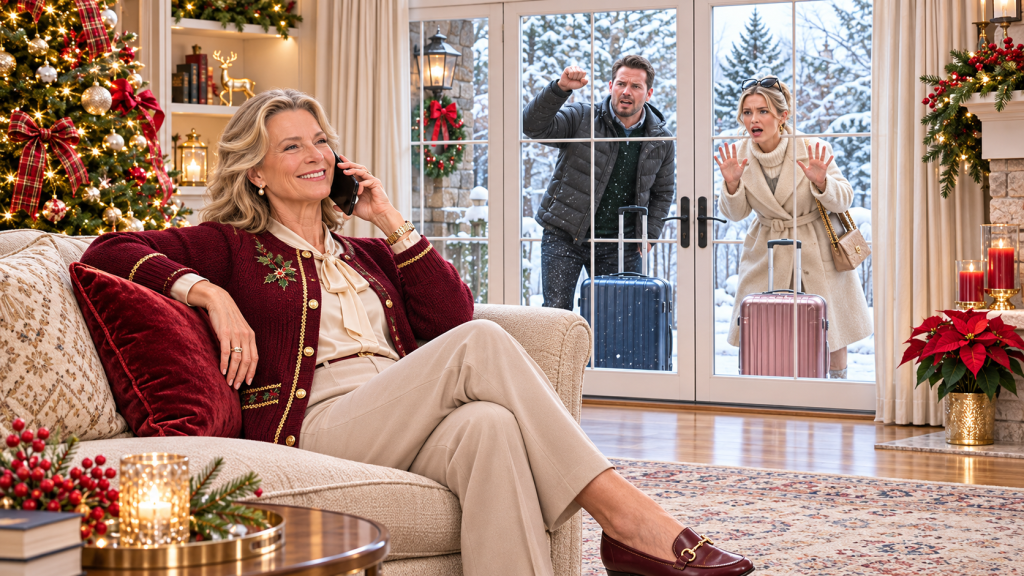
I’d believed I was giving them breathing room. A chance to save money. A chance to build a future. Now I wondered whether they’d been waiting for me to hand over the only substantial thing I owned. My granddaughter’s next message arrived. Grandma, are you really sick? I stared at it. Then I typed carefully. No, sweetheart. I’m fine. I’m sorry the grown-ups have gotten their plans mixed up. None of this is your fault. Three little dots appeared. Then another message. Mommy said you didn’t want to come. I closed my eyes.
I had spent twelve thousand five hundred dollars because I wanted to spend Christmas with them.
I’d imagined wrapping presents beside a fireplace, watching the children build snowmen, and having breakfast with the family I loved.
And somehow, my grandchildren had been told that I didn’t want to be there.
I typed another message.
I wanted very much to celebrate with you. I love you, and we can have our own Christmas together when you get home.
Then I added:
You don’t need to worry about any of this. Please enjoy your time with your brother.
I placed the phone on the table.
The house was silent.
For the first time that morning, I felt something more painful than anger.
I felt the full weight of how long I’d been allowing myself to disappear.
My name is Helena Whitmore.
I was sixty-eight years old that Christmas.
My husband, Thomas, had died six years earlier after a long illness.
We had been married for thirty-nine years.
Thomas was a quiet man with large hands, a patient smile, and an extraordinary ability to repair almost anything.
He worked as an electrician for most of his life.
I taught elementary school until retirement.
We weren’t wealthy.
But we lived carefully.
We saved what we could.
We paid our bills on time.
And after twenty-seven years of mortgage payments, we finally owned our home outright.
I still remembered the afternoon Thomas came home holding the final statement.
He stood in the kitchen, waving the paper.
“Helena,” he announced, “we own every brick.”
I laughed.
“Even the ones you keep threatening to replace?”
“Especially those.”
He pulled me into his arms.
Then whispered, “Whatever happens, you’ll always have somewhere to come home to.”
At the time, I thought he was simply celebrating.
I didn’t realize how much those words would mean after he was gone.
The house was a two-story brick home on a quiet street lined with maple trees.
There was a white porch swing.
A small vegetable garden.
A fireplace Thomas had installed himself.
And a dining-room table we’d bought secondhand when Caleb was six.
It wasn’t glamorous.
But every corner held a memory.
Caleb’s height marks were still penciled inside the pantry door.
His high school graduation photographs hung beside the staircase.
And in the garden, a rosebush Thomas planted for our thirtieth anniversary continued blooming every spring.
When Caleb asked whether he and Sloan could move in temporarily, I said yes.
They’d been having money problems.
Sloan had recently left her job.
The children’s daycare expenses were high.
Caleb said they needed six months to get back on their feet.
Six months became a year.
Then two.
Then three.
I didn’t mind at first.
I loved hearing my grandchildren in the house.
I loved making pancakes on Saturday mornings and helping with homework.
I loved being called Grandma from the bottom of the stairs.
But gradually, kindness became expectation.
My grocery bills doubled.
I began paying for household repairs that weren’t mine alone.
Sloan complained if I invited friends over without telling her.
Caleb borrowed money for car repairs and forgot to repay it.
And whenever I tried to discuss the arrangement, someone reminded me that family was supposed to help family.
I believed that.
I still do.
But I was beginning to understand the difference between helping someone stand and allowing them to use you as the ground beneath their feet.
The envelope the courier delivered that Christmas Eve contained preliminary documents from my attorney, Rebecca Lawson.
Rebecca had helped me update my will after Thomas died.
She was practical, patient, and never afraid to tell me something I didn’t want to hear.
Earlier that morning, after canceling the resort reservation, I’d sent her an urgent message.
I’d explained that I needed advice about ending Caleb and Sloan’s rent-free living arrangement and protecting my house.
Her office had been preparing documents for another matter nearby, and an assistant arranged delivery of a packet containing information and forms for me to review.
There was no magical eviction order.
No document that could throw a family out onto the street that afternoon.
Rebecca had been very clear.
Because Caleb and Sloan had lived in my home for three years, they could have legal protections even without a written lease.
Any termination of their occupancy had to follow the applicable notice and court procedures.
I understood.
I wasn’t trying to make two children homeless.
I simply needed to stop pretending the arrangement could continue indefinitely.
Inside the envelope were draft notices, a summary of the process, and instructions not to change locks, remove belongings, or interfere with utilities.
There was also a handwritten note.
Helena, don’t sign anything concerning the property until we’ve reviewed it together. Call me if anyone presents documents or pressures you.
I read that sentence three times.
Then looked at my granddaughter’s photograph again.
Convince Helena to transfer the house.
I felt a chill.
Rebecca had written her warning before she’d seen the checklist.
Perhaps she’d simply anticipated trouble.
Or perhaps she’d understood something I was only beginning to see.
The resort wasn’t the real danger.
The resort had simply exposed it.
Caleb called again shortly after noon.
This time, I answered.
“Mom!”
His voice sounded strained.
Behind him, I could hear raised voices, a child crying, and someone insisting that the reservation must be a mistake.
“Caleb,” I said calmly, “please lower your voice.”
He ignored me.
“They’re telling us the booking was canceled by the account holder.”
“That’s correct.”
“Mom, we’ve driven six hours!”
“I know.”
“Everyone’s standing here with luggage!”
I looked around my empty kitchen.
“And I was standing here this morning with Christmas stockings for people who left without me.”
He went quiet.
Only for a second.
Then he said, “We were going to explain.”
“When?”
He sighed.
“Don’t start.”
I closed my eyes.
“Caleb, when were you going to explain that you’d invited Sloan’s entire family and left me behind?”
He didn’t answer.
I continued.
“When were you going to explain that you’d removed me from the group chat?”
Silence.
“And when were you planning to tell me that the vacation I’d paid for no longer included me?”
His voice hardened.
“Sloan thought you’d be more comfortable at home.”
I gave a sad little laugh.
“Then Sloan could have asked me.”
“Mom—”
“No, Caleb. Listen to me.”
He fell silent.
“I paid for that trip because I believed we were sharing Christmas as a family. When you changed the arrangements and deliberately excluded me, you changed the agreement.”
He exhaled sharply.
“So you decided to punish the kids?”
I felt the words strike.
My grandchildren.
He knew exactly where to aim.
I took a breath.
“I haven’t punished the children. I’m sorry their holiday plans have been disrupted. But you’re their parents, and it’s your responsibility to arrange a vacation you can afford.”
He made an angry sound.
“You know we can’t afford this resort.”
“Then you should have discussed that before taking everyone there.”
His voice rose.
“How could you do this?”
I looked toward Thomas’s photograph.
Then answered quietly.
“Caleb, how could you?”
He stopped speaking.
For several seconds, all I heard was the commotion behind him.
Then a man’s voice interrupted.
“Give me the phone.”
I frowned.
A moment later, someone else spoke.
“Helena? This is Martin.”
Sloan’s father.
We had met at birthdays and school events.
He was a retired building inspector, a broad-shouldered man who rarely spoke unless he believed he had something important to say.
“Hello, Martin.”
He sounded uncomfortable.
“I’m sorry to bother you, but we’re trying to understand what’s happened.”
I took a slow breath.
“Your daughter and my son took a Christmas vacation I’d paid for and left me out of the arrangements.”
There was silence.
Then Martin said, “What do you mean, left you out?”
I frowned.
“Caleb told me this morning they didn’t want me there.”
A long pause.
Then he whispered, “They told us you weren’t coming because you were unwell.”
My heart sank.
Martin continued.
“They said you insisted on paying because you wanted everyone to enjoy Christmas while you rested.”
I closed my eyes.
There it was.
Another lie.
And another person who’d believed it.
Martin didn’t raise his voice.
He asked a few questions.
Then apologized.
Not for the cancellation.
For what he’d unknowingly participated in.
“Helena, if we’d known you were being excluded from your own vacation, we wouldn’t have agreed to this.”
My throat tightened.
“Thank you.”
He paused.
“We’ll make arrangements to get everyone somewhere suitable for tonight.”
I nodded.
“That sounds sensible.”
Then he said something I hadn’t expected.
“And when we get home, I think we need to have a conversation.”
I glanced at the checklist.
“Yes, Martin.”
My voice trembled.
“I think we do.”
By late afternoon, I learned that Martin had arranged a modest hotel for the family to use while they decided what to do.
The luxury resort had not permitted check-in under the canceled reservation.
A refund, subject to the booking terms and payment processing, was expected to return to my card.
I hadn’t deprived anyone of money that belonged to them.
I had canceled a reservation I’d purchased in my own name while cancellation was still permitted.
That distinction mattered.
So did the fact that Caleb and Sloan were still responsible for the promises they’d made to their guests.
I didn’t enjoy knowing that my grandchildren were disappointed.
But I also knew I couldn’t keep paying for other adults’ decisions simply because the consequences were unpleasant.
As evening approached, I made myself a cup of tea.
Then I began taking down the extra Christmas stockings.
I stopped when I reached the two smaller ones.
My grandchildren’s.
I left them hanging.
They hadn’t chosen any of this.
I wouldn’t make their place in my home dependent on their parents’ behavior.
At seven that evening, my granddaughter called me.
Her name was Ruby.
She was nine years old, with curly dark hair and the serious expression of a child who noticed more than adults realized.
Her younger brother, Mason, was six.
“Grandma?”
“Hello, sweetheart.”
She sounded worried.
“Are you mad at us?”
My heart broke.
“Oh, Ruby. No.”
She was quiet.
“Mommy says you canceled Christmas.”
I closed my eyes.
“Sweetheart, Christmas isn’t canceled. Some grown-up plans changed, and I’m sorry they’ve been upsetting.”
She sniffled.
“Are we still going to open presents?”
I smiled through tears.
“Of course. Your presents are waiting here.”
Her voice brightened slightly.
“Even Mason’s dinosaur?”
I laughed softly.
“Especially Mason’s dinosaur.”
She hesitated.
Then whispered, “Grandma, did I do something wrong by sending you the picture?”
I went still.
For a moment, I wanted to ask what her mother had said.
But I stopped myself.
Ruby was nine.
She didn’t need to become a witness in a dispute between adults.
“No, honey. You didn’t do anything wrong. And you don’t need to send me anything else about what the grown-ups are doing.”
She sounded relieved.
“Okay.”
I took a breath.
“Your job is to be a little girl. My job is to love you. And your parents’ job is to work out grown-up problems.”
She was quiet for a moment.
Then said, “I love you, Grandma.”
I pressed my hand against my chest.
“I love you too, sweetheart.”
After we hung up, I sat alone beneath the Christmas lights.
And cried.
Not because I regretted standing up for myself.
Because boundaries are sometimes painful even when they’re necessary.
Christmas morning arrived beneath a sky the color of pearl.
I woke early, as I always did.
For three years, I’d been responsible for preparing breakfast while everyone else slept.
I knew which child liked cinnamon on French toast.
Which child refused orange juice with pulp.
How Sloan liked her coffee.
How Caleb preferred his eggs.
That morning, I made one piece of toast.
One cup of coffee.
And sat beside the living-room window.
At first, the silence hurt.
Then I noticed something.
I wasn’t listening for footsteps.
I wasn’t waiting for someone to ask me to make another plate.
I wasn’t calculating how much longer I had before the children needed entertaining.
For the first time in years, Christmas morning belonged to me.
I looked toward the framed photograph of Thomas on the mantel.
He was standing beside the rosebush he’d planted.
Smiling.
I touched the edge of the frame.
“Merry Christmas, sweetheart.”
Then I whispered, “I think I’ve let things go too far.”
The room remained quiet.
But I remembered something Thomas had said when Caleb was a teenager.
You can love someone with your whole heart, Helena, and still tell them no.
I’d forgotten that.
Or perhaps I’d never fully believed it.
Until now.
At eleven, the doorbell rang.
I wasn’t expecting anyone.
I opened the door to find my neighbor, Patricia Bell, standing on the porch carrying a covered dish.
Patricia was seventy-two, a retired music teacher who lived three houses down.
She’d been my friend for twenty years.
Her late husband and Thomas used to play chess on Friday evenings.
She looked at me.
Then at the empty driveway.
“Helena?”
I smiled weakly.
“Good morning.”
She held up the dish.
“I brought breakfast casserole.”
I laughed.
“You always make too much.”
“Of course I do.”
She looked over my shoulder.
“Where is everybody?”
I hesitated.
Then said, “At a hotel in the mountains.”
Patricia frowned.
“Without you?”
I nodded.
Her face changed.
“Oh, Helena.”
And just like that, I began crying.
She stepped inside.
Set the casserole on the counter.
And wrapped her arms around me.
I cried against her shoulder like a child.
I told her everything.
The vacation.
The group chat.
The room assignment list.
The cancellation.
The phone calls.
And finally, the photograph of the checklist.
When I reached the sentence about transferring the house, Patricia pulled back.
“Helena, you need to tell Rebecca about that immediately.”
I nodded.
“I will.”
She held my hands.
“And you need to stop blaming yourself for trusting your son.”
I wiped my eyes.
“I feel foolish.”
Patricia shook her head.
“Trusting someone you love isn’t foolish.”
She looked toward the stairs.
“But ignoring what they’ve shown you would be.”
That afternoon, Patricia took me to her house for Christmas dinner.
There were six people at the table.
Her daughter.
Two grandchildren.
A widowed cousin.
And a neighbor whose family lived overseas.
Nobody asked why my son wasn’t there.
Nobody told me I ought to be grateful for whatever attention my family offered.
Nobody treated me like an inconvenience.
When Patricia’s granddaughter passed me the potatoes, she smiled.
“Would you like some more, Mrs. Whitmore?”
I laughed.
“Just a little.”
Later, when dessert was served, Patricia leaned toward me.
“See?”
I looked at her.
“What?”
She smiled.
“You don’t have to pay twelve thousand dollars to have someone save you a seat.”
My eyes filled.
And for the first time in two days, I laughed until I cried.
The day after Christmas, Rebecca called.
Her tone was calm.
But when I told her about the checklist, she became very serious.
“Helena, have Caleb or Sloan ever asked you to sign documents concerning the house?”
I considered that.
“They’ve talked about putting Caleb’s name on the deed.”
“When?”
“Several times over the past year.”
Rebecca paused.
“What did they say?”
I took a breath.
“That it would simplify things if I became ill. That he could handle repairs and insurance. That estate planning would be easier.”
Rebecca was quiet.
Then asked, “Did you sign anything?”
“No.”
“Are you certain?”
I hesitated.
“Rebecca, I sign things all the time. School forms for the children. Delivery receipts. Household paperwork.”
She answered carefully.
“That’s why I want to review the property records.”
My stomach tightened.
“Do you think they did something?”
“I don’t know. But I don’t want to guess.”
She gave me instructions for obtaining the relevant records through the proper channels.
Then she said, “And Helena?”
“Yes?”
“Please don’t confront anyone about a possible property transaction until we know what we’re looking at.”
I swallowed.
“All right.”
She paused.
“One more thing. You are not obligated to transfer your house to anyone simply because they are related to you.”
I looked toward Thomas’s photograph.
“I know.”
But as I ended the call, I realized I hadn’t always believed that.
Not truly.
For three years, I’d allowed my house to become everyone else’s home while gradually treating myself like a guest.
Now I was going to find out whether my son had begun seeing himself as the owner.
Caleb and Sloan returned home three days after Christmas.
I was in the kitchen when I heard the SUV pull into the driveway.
For a moment, instinct took over.
I nearly reached for the coffee pot.
For three years, whenever they came home from a trip, I’d made sure there was food ready, the children’s beds were clean, and everything was comfortable.
Then I remembered.
I was no longer responsible for making the consequences of their choices disappear.
I stayed seated.
The front door opened.
Suitcases rolled across the hallway.
Mason shouted, “Grandma!”
I rose immediately.
He came running toward me, his little cheeks pink from the cold.
I knelt and hugged him.
“Hello, my darling boy.”
Ruby followed more cautiously.
She looked at me.
I opened my arms.
She hurried into them.
“I missed you.”
“I missed you too.”
I kissed the top of her head.
Then I looked up.
Caleb stood in the doorway.
Sloan was behind him.
Neither looked happy.
Caleb’s expression was tight.
Sloan’s eyes were cold.
For a moment, nobody spoke.
Then Mason asked, “Grandma, can we open our Christmas presents?”
I smiled.
“Of course, sweetheart.”
I took the children into the living room and handed them the gifts I’d wrapped weeks earlier.
Mason shrieked with delight when he opened the dinosaur.
Ruby hugged the art set I’d bought her.
For half an hour, the house filled with the sound of children laughing.
I let myself enjoy it.
Because whatever came next, my grandchildren deserved that moment.
After the children went downstairs to play, Caleb approached me.
“Mom, we need to talk.”
I nodded.
“Yes. We do.”
Sloan folded her arms.
“Can we please do it somewhere private?”
I looked toward the dining room.
“Let’s sit at the table.”
We sat where Caleb had done his homework as a child.
The familiar room suddenly felt very different.
Caleb placed the resort’s printed cancellation notice in front of me.
“We lost money because of what you did.”
I glanced at the paper.
“Did you pay for anything that wasn’t refundable?”
He hesitated.
“We had to pay for another hotel.”
I nodded.
“That was your choice after you decided to travel without the person who booked and paid for the original accommodation.”
Sloan laughed bitterly.
“You ruined everyone’s Christmas.”
I looked at her.
“Did you tell Ruby I was sick?”
Her expression changed.
“We didn’t want to upset the children.”
“Did you tell Martin and his wife that I chose not to come?”
She looked away.
Caleb interrupted.
“Mom, it was supposed to be a relaxing vacation.”
I stared at him.
“Relaxing for whom?”
He sighed.
“Everyone.”
“Except me.”
He said nothing.
I leaned forward.
“Caleb, this isn’t about skiing. It’s about deliberately excluding me from something I paid for and then lying to people about why I wasn’t there.”
Sloan began tapping her fingers against the table.
“We just wanted some space.”
I nodded.
“Then you should have paid for a vacation that gave you space.”
She opened her mouth.
I continued.
“You can’t demand someone else’s money and then resent their presence.”
For once, Sloan had no immediate answer.
I placed the photograph of the checklist on the table.
Caleb looked down.
His expression changed.
Sloan leaned forward.
“Where did you get that?”
I didn’t answer her.
I looked at my son.
“Is this your handwriting?”
Caleb stared at the paper.
“Mom—”
“Is it?”
He swallowed.
“Yes.”
The room grew quiet.
I pointed to the final line.
“Explain this.”
He rubbed his forehead.
“It’s not what you think.”
A familiar phrase.
I had heard it from him when he was fifteen and crashed his bicycle into the neighbor’s fence.
When he was nineteen and borrowed my car without permission.
When he was twenty-six and forgot to pay a bill he’d promised to handle.
But the stakes had never been this high.
“What do you think I think?” I asked.
He looked away.
Sloan spoke sharply.
“We were just discussing estate planning.”
I turned toward her.
“Then why was it on a holiday checklist?”
She hesitated.
“Because we wanted to bring it up after Christmas.”
I stared at her.
“Why?”
She folded her arms.
“Because this house is eventually going to Caleb anyway.”
The words settled across the table.
I felt something cold move through my chest.
“Eventually?”
Sloan looked impatient.
“He’s your only child, Helena.”
I nodded slowly.
“And?”
She stared at me.
“What do you mean, and?”
“I mean that being my only child doesn’t make him the current owner of my home.”
Caleb looked embarrassed.
“Mom, nobody said that.”
I turned toward him.
“Your wife just did.”
He said nothing.
I continued.
“Your father and I worked for decades to pay for this house. It is where I live. It is part of my financial security.”
My voice trembled.
“And while I am alive and capable of making my own decisions, it belongs to me.”
Sloan rolled her eyes.
“Nobody’s trying to throw you out.”
I stared at her.
“Then why were you discussing transferring it?”
Silence.
Caleb looked down.
For the first time, I began to understand how far their expectations had gone.
Rebecca met with me the following Monday.
She had reviewed the available property records.
There was no completed deed transfer.
No recorded mortgage that I hadn’t authorized.
No evidence that ownership had legally changed.
I nearly cried with relief.
But then Rebecca placed another document in front of me.
“This came from a title-company inquiry made recently,” she explained. “Your son had asked about the process for transferring property from a parent to an adult child.”
I stared at the paper.
“Can he do that without me?”
“No. Not through a valid voluntary transfer. Your informed authorization and the required legal formalities matter.”
I exhaled.
Rebecca continued.
“The inquiry itself isn’t proof of wrongdoing. People ask about transfers all the time.”
I nodded.
“But combined with what you’ve shown me, I think we need to be cautious.”
Then she placed a second document on the table.
It was a copy of an unsigned draft deed.
My name appeared as the current owner.
Caleb’s name appeared as the proposed recipient.
And beside a blank signature line was a handwritten notation.
Have Helena sign after holiday. Present as protection against probate.
I stared at it.
The handwriting looked like Sloan’s.
For a moment, I couldn’t speak.
Rebecca watched me carefully.
“Helena?”
I looked up.
“They were going to ask me to sign away my house.”
She answered gently.
“That appears to have been the proposal. It doesn’t mean the transfer would necessarily have been valid or that you’ve lost anything.”
Tears filled my eyes.
“But they were preparing for it.”
Rebecca nodded.
“Yes.”
I looked toward the window.
Outside, a mother was pushing a stroller along the sidewalk.
A little child walked beside her holding a red balloon.
I wondered when my own son had begun seeing the house his father built a life in as something he could claim before I was gone.
Then I asked, “Why would they need it now?”
Rebecca considered my question.
“That’s something Caleb needs to explain.”
The explanation came from Martin.
He called that afternoon.
His voice sounded strained.
“Helena, I’d like to apologize again for the vacation.”
I sighed.
“Martin, you didn’t know.”
“I know. But there’s something else.”
My stomach tightened.
“What?”
He hesitated.
“About two months ago, Caleb asked me to look at some plans for your house.”
I sat upright.
“What plans?”
“A renovation.”
I frowned.
“What renovation?”
Martin cleared his throat.
“He said he and Sloan expected to take ownership next year, and they wanted to convert the upstairs into a separate apartment.”
For several seconds, I couldn’t speak.
My upstairs.
My bedroom.
My sewing room.
The small guest room where Thomas had spent his final weeks because the afternoon light was so beautiful.
I gripped the phone.
“Did he tell you where I would live?”
Martin was silent.
Then he whispered, “He said you’d be moving downstairs.”
I closed my eyes.
Downstairs.
Into the smaller bedroom near the laundry room.
The one Caleb and Sloan had originally occupied when they moved in.
I thought about all the times Sloan had complained that I used too much space.
How she’d suggested that my upstairs sitting room would be perfect for a home office.
How Caleb had mentioned that the main bathroom needed remodeling.
Suddenly, those conversations looked different.
Martin continued.
“He said it was something you’d agreed to.”
Tears slipped down my cheeks.
“I didn’t.”
A long silence followed.
Then Martin said, “I’m sorry, Helena.”
I looked toward the staircase.
“Did he show you anything?”
“Some sketches. Nothing finalized.”
I took a breath.
“Would you be willing to share them with Rebecca?”
“Of course.”
His voice softened.
“And Helena, there’s something I need to say.”
I waited.
“Even if Caleb believes he’ll inherit the house someday, that doesn’t give him the right to redesign your life while you’re still living it.”
I began crying.
“Thank you, Martin.”
After we hung up, I sat alone for a long time.
Then I walked upstairs.
I entered my bedroom and stood beside the window.
Thomas’s old armchair was still there.
His books remained on the shelf.
The rosebush was visible in the garden below.
I imagined somebody moving me out of that room without ever asking what I wanted.
And for the first time, I wasn’t merely disappointed in my son.
I was frightened by how casually he had begun making plans around my absence.
That evening, I called Caleb into the dining room.
Sloan followed.
I asked her to give us a few minutes alone.
She looked offended.
But Caleb nodded.
“It’s okay.”
She left.
I placed Martin’s renovation sketches on the table.
Caleb went pale.
“Where did you get those?”
I looked at him.
“Why were you planning to move me downstairs?”
He stared at the papers.
Then sat heavily.
For several seconds, he didn’t speak.
Finally, he whispered, “We thought it made sense.”
I felt tears gathering.
“For whom?”
He rubbed his face.
“Mom, you’ve been struggling with the stairs.”
I stared at him.
“I’ve mentioned that my knees ache sometimes. That isn’t permission to relocate me.”
He looked ashamed.
I continued.
“Did you ask whether I wanted to leave my bedroom?”
“No.”
“Did you ask whether I wanted you to renovate the upstairs?”
“No.”
“Did you ask whether I wanted to give you ownership of the house?”
His eyes filled.
“No.”
I sat back.
“Then whose home were you making plans for?”
He began crying.
And for the first time since Christmas Eve, my son didn’t try to blame his wife.
He didn’t mention the resort.
He didn’t tell me I was overreacting.
He stared at his hands and whispered, “I got scared.”
I waited.
He continued.
“We have debt, Mom.”
I felt my stomach tighten.
“How much?”
He looked up.
“More than I told you.”
I took a slow breath.
“How much, Caleb?”
He swallowed.
“Almost ninety thousand dollars.”
I closed my eyes.
For a moment, the room seemed to tilt.
Ninety thousand dollars.
And they’d been living rent-free in my house for three years.
The debts had accumulated gradually.
Credit cards.
A personal loan.
A failed online business Caleb had started without discussing the risks with me.
And an expensive vehicle payment he and Sloan had struggled to maintain.
Some of the borrowing predated their move into my house.
Other debts had come later.
Caleb explained that he believed transferring the house into his name might allow him to use its equity to obtain financing.
He said he’d planned to pay everything back.
I looked at him.
“With what income?”
He began crying.
“I thought we could consolidate everything.”
I shook my head.
“Caleb, putting my house at risk doesn’t make your debt disappear.”
He lowered his head.
“I know.”
I leaned forward.
“Did you intend to borrow against the property?”
He nodded slowly.
My heart sank.
“Without telling me the full reason for the transfer?”
Tears slid down his face.
“Yes.”
For a moment, I felt as though I couldn’t breathe.
Thomas and I had worked for twenty-seven years to pay off that house.
We’d gone without vacations.
Driven old cars.
Saved small amounts from every paycheck.
And my son had been willing to put the property at risk to solve financial problems he’d hidden from me.
I wiped my eyes.
“Caleb, do you know what could have happened?”
He nodded.
“I do now.”
“No,” I whispered. “I don’t think you do.”
He looked up.
“If you had borrowed against this house and failed to repay the loan, my home could have been at risk.”
He began crying harder.
I continued.
“And all this time, you allowed me to believe you were saving money.”
He covered his face.
“I was ashamed.”
I looked at him.
“Then you should have told me the truth.”
He shook his head.
“I couldn’t.”
My voice cracked.
“You could ask me to surrender my home, but you couldn’t tell me you needed financial counseling?”
He began sobbing.
I stood.
Not because I wanted to punish him.
Because I was afraid that if I remained in the chair, I would reach across the table and comfort him before he’d fully understood what he was admitting.
“Caleb,” I said quietly, “I love you more than I can explain.”
He looked up.
“But I am not going to lose the home your father and I worked for because you were afraid to admit you’d made financial mistakes.”
His shoulders shook.
“I know, Mom.”
I took a breath.
“And you and Sloan cannot continue living here indefinitely.”
He began crying again.
This time, I didn’t change my mind.
Rebecca helped me serve the appropriate written notice after we reviewed the applicable legal requirements.
Caleb and Sloan were given a reasonable period to make other housing arrangements.
There was no midnight lock change.
No utility shutoff.
No throwing belongings onto the lawn.
I wasn’t interested in humiliating them.
I wanted a lawful, orderly end to the arrangement.
I also arranged for my important documents to be stored securely.
I reviewed my accounts.
Updated passwords.
And made sure my estate-planning documents reflected my wishes.
Rebecca helped me understand alternatives to casually transferring property, including how I could plan for future incapacity or death while maintaining control during my lifetime.
I didn’t remove Caleb from my will in a fit of anger.
Nor did I promise him the house simply because he expected it.
I took the time to make decisions that protected my security and reflected the relationships I actually had.
For the first time in years, my financial affairs were no longer treated as a family resource awaiting distribution.
They were mine to manage.
Sloan reacted badly.
When Caleb told her they would need to move, she came upstairs and knocked sharply on my bedroom door.
“Helena, we need to talk.”
I opened it.
She stood with her arms folded.
“You’re really doing this?”
I nodded.
“Yes.”
She shook her head.
“Where are we supposed to go?”
I looked at her.
“I understand moving is difficult. That’s why you’ve been given notice rather than being told to leave immediately.”
Her face flushed.
“We have children.”
“I know.”
She stared at me.
“You’re their grandmother.”
“I know that too.”
She took a step closer.
“Then how can you do this?”
I felt my throat tighten.
But I answered calmly.
“Because loving my grandchildren doesn’t require giving their parents permanent control of my house.”
She looked away.
For a moment, I thought she’d begin shouting.
Instead, she whispered, “We thought this would be our home someday.”
I nodded sadly.
“That’s the problem, Sloan.”
She looked at me.
“You started living as though someday had already arrived.”
Her eyes filled.
I continued.
“I have been generous with you because I wanted to help your family. But generosity isn’t consent to take more.”
She began crying.
“Caleb told me you’d agree.”
I stared at her.
“Then he was wrong.”
She wiped her face.
“And you never asked me.”
For several seconds, neither of us spoke.
Then Sloan whispered, “I’m sorry.”
It wasn’t a complete apology.
Not yet.
But it was the first time she’d spoken to me without trying to convince me that my feelings were unreasonable.
I nodded.
“Thank you.”
She looked hopeful.
Then I added, “The move still needs to happen.”
Her expression fell.
I continued gently.
“An apology can be the beginning of rebuilding trust. It doesn’t erase the need for change.”
The hardest conversation wasn’t with Caleb.
Or Sloan.
It was with Ruby.
She found me in the garden one Saturday afternoon.
I was pruning the rosebush Thomas had planted.
She stood beside me, holding a pink watering can.
“Grandma?”
I smiled.
“Hello, sweetheart.”
She hesitated.
“Daddy says we’re moving.”
I nodded.
“Yes.”
She looked down.
“Did we make you mad?”
My heart broke.
I set down the pruning shears.
Then knelt carefully beside her.
“No, Ruby. You and Mason haven’t done anything wrong.”
Her eyes filled.
“But we’re leaving.”
I took her hand.
“Sweetheart, families can love one another very much and still live in different houses.”
She stared at me.
“Like Grandpa Martin?”
I smiled.
“Exactly.”
She considered that.
“Will I still come here?”
I nodded.
“Of course. You’ll always be welcome to visit me.”
Her lower lip trembled.
“Even after we move?”
I pulled her into my arms.
“Especially after you move.”
She hugged me tightly.
Then whispered, “I thought you didn’t want us anymore.”
I closed my eyes.
There it was again.
The terrible damage caused when adults allow children to believe that boundaries mean rejection.
I held her close.
“Ruby, I love you because you’re you. Not because you live here.”
She sniffled.
“And Mason?”
I smiled.
“Mason too.”
She leaned back.
“And Daddy?”
The question caught me off guard.
I looked toward the house.
My son was standing near the kitchen window.
Watching us.
I took a breath.
“Yes, sweetheart. I love Daddy too.”
Ruby smiled.
“Then everything’s okay?”
I thought about the debt.
The deception.
The broken trust.
And the difficult months ahead.
Then I answered honestly.
“Everything isn’t sorted out yet. But the grown-ups are working on it, and you don’t have to fix any of it.”
She nodded.
Then poured water onto the roses.
And for a moment, the world felt simple again.
Caleb and Sloan moved out in early spring.
They rented a smaller house twenty minutes away.
It wasn’t luxurious.
There was no grand entrance.
No enormous kitchen.
No spare room for exercise equipment or a private office.
But it had two bedrooms, a small garden, and enough space for the family.
Martin helped them move.
I stayed out of the way.
Not because I was angry.
Because I’d spent three years solving their problems before they had an opportunity to solve them themselves.
This was something they needed to do.
On moving day, Caleb came upstairs while I was folding laundry.
“Mom?”
I looked up.
“Yes?”
He stood in the doorway.
For a moment, he looked like the little boy who used to come to me after breaking something.
Then he said, “I found something.”
He held out a small wooden box.
My heart tightened.
It was Thomas’s old toolbox for small household repairs.
I hadn’t opened it since he died.
“Where was it?”
“In the garage.”
Caleb stepped closer.
“I was packing my things, and I found it behind some boxes.”
I took the toolbox.
The wood was worn.
One corner had a small scratch from the time Thomas dropped it while repairing the porch railing.
I smiled through tears.
“Your father loved this thing.”
Caleb nodded.
“He did.”
Then he said, “There’s something inside.”
I opened the lid.
Beneath a handful of old screws and measuring tape was a folded envelope.
My name was written on the front.
For Helena.
I recognized Thomas’s handwriting immediately.
My hands began shaking.
I opened it carefully.
Inside was a short letter.
My darling Helena,
If you’re reading this, you probably found another one of my forgotten projects.
I laughed through tears.
That sounded exactly like him.
I don’t know what life will look like when we’re old, but I hope our home will always be a place of warmth.
Just remember something, sweetheart.
We’ve worked hard to build this life. Don’t ever feel guilty for enjoying what we’ve earned.
Love Caleb with your whole heart. Love his children when they come along. Help them when you can.
But don’t forget yourself.
You deserve comfort too.
Always yours,
Thomas.
I pressed the paper against my chest.
For a moment, I couldn’t speak.
Caleb stood quietly.
Then he whispered, “I read it.”
I looked up.
His eyes were filled with tears.
“I know I shouldn’t have.”
I shook my head gently.
“That’s all right.”
He swallowed.
“Dad would be ashamed of me.”
My heart broke.
I took a breath.
“Caleb, your father loved you.”
Tears slid down his cheeks.
“But he taught me better than this.”
I nodded.
“Yes.”
He covered his face.
“I started thinking the house was something I was owed.”
I said nothing.
He continued.
“I told myself we were only planning ahead. That putting it in my name would be easier for everybody.”
His voice cracked.
“But I knew you hadn’t agreed.”
I looked at him.
“And I kept telling myself you’d understand after everything was settled.”
He began sobbing.
“I wasn’t thinking about what would happen to you.”
I took his hand.
“Then start thinking about it now.”
He looked up.
I continued.
“Not by promising me things. By changing how you live.”
He nodded.
“I will.”
I wanted to believe him.
But I had learned that trust isn’t restored by one emotional conversation.
It’s restored by what happens after the tears have dried.
The months that followed were not easy for Caleb and Sloan.
They sold their expensive SUV and bought a reliable used car.
They worked with a nonprofit financial counselor to create a repayment plan.
Sloan returned to full-time employment.
Caleb stopped trying to rescue his failed business with more borrowing.
They began making payments toward their debts.
There were setbacks.
Unexpected expenses.
Arguments.
And moments when they called asking for advice.
Sometimes I gave it.
Sometimes I said, “That’s something you and Sloan need to work out together.”
At first, Caleb sounded disappointed.
Then, gradually, he stopped expecting me to solve every problem.
One evening, he called.
“Mom?”
“Hello, sweetheart.”
“I wanted to tell you something.”
I set down my book.
“All right.”
“We made another debt payment today.”
I smiled.
“That’s good.”
He hesitated.
“And we did it without borrowing from anybody.”
My eyes filled.
“Well done.”
He laughed softly.
“I never thought I’d be proud of paying a bill.”
I smiled.
“Your father was proud every time he paid one.”
Caleb grew quiet.
Then whispered, “I remember.”
Meanwhile, my house began feeling like mine again.
I didn’t rush to change anything.
For weeks, I simply enjoyed the quiet.
I drank coffee in my upstairs sitting room.
Read books without being interrupted.
Invited Patricia over for lunch.
And spent afternoons tending Thomas’s roses.
Eventually, I converted one downstairs bedroom into a guest room for my grandchildren.
I painted the walls pale yellow.
Bought two small beds.
Placed a bookshelf between them.
And hung photographs of Ruby and Mason above the dresser.
The room wasn’t for their parents.
It wasn’t part of an agreement involving rent or money.
It was simply somewhere my grandchildren could sleep when they visited.
The first time they stayed overnight, Ruby walked into the room and gasped.
“Grandma!”
I smiled.
“Do you like it?”
She nodded enthusiastically.
“It’s ours?”
I laughed.
“When you visit, yes.”
Mason jumped onto one of the beds.
“Can we stay forever?”
I smiled gently.
“No, sweetheart. You have a home with Mommy and Daddy.”
He considered that.
Then grinned.
“But we can come back?”
“As often as we arrange.”
Ruby hugged me.
And I realized that my relationship with my grandchildren had become sweeter now that it was no longer tangled up in their parents’ expectations.
I could simply be Grandma.
Not the household manager.
Not the unpaid babysitter.
Not the person responsible for everyone’s comfort.
Just Grandma.
And that was more than enough.
By the following autumn, something unexpected happened.
Sloan invited me to lunch.
Just the two of us.
At first, I was suspicious.
Our relationship had improved, but the memories of Christmas still hurt.
Still, I agreed.
We met at a small café near the library.
Sloan arrived early.
When I sat down, she looked nervous.
“Helena, thank you for coming.”
I nodded.
“You’re welcome.”
For several minutes, we talked about the children.
Their school.
Mason’s missing front tooth.
Ruby’s enthusiasm for art.
Then Sloan put down her coffee.
“I owe you a proper apology.”
I looked at her.
She swallowed.
“I treated your home like it already belonged to us.”
I stayed quiet.
She continued.
“I treated your retirement like something you were supposed to spend making our lives easier.”
Her eyes filled.
“And I treated your generosity like an obligation.”
I felt my throat tighten.
Sloan looked down.
“That was wrong.”
I nodded.
“Yes.”
She wiped her eyes.
“And the Christmas trip…”
Her voice broke.
“I wanted a vacation with my parents and my sister. I knew we couldn’t afford it.”
I waited.
“So I convinced Caleb that you’d enjoy staying home.”
I looked at her.
She began crying.
“I knew you wanted to come.”
For a moment, I felt the old pain return.
The empty house.
The missing suitcases.
The room assignment list in the trash.
I took a breath.
“Why didn’t you simply ask whether we could change the plans?”
She stared at the table.
“Because I knew you’d say no.”
I nodded slowly.
“Then you already knew it wasn’t fair.”
Tears slipped down her cheeks.
“Yes.”
For a long time, neither of us spoke.
Then she whispered, “I’m sorry, Helena.”
I looked at her.
I didn’t feel the need to punish her.
But I didn’t feel the need to make her comfortable either.
“Thank you for saying that.”
She nodded.
“I know things won’t go back to how they were.”
I smiled sadly.
“I hope they don’t.”
She looked surprised.
I continued.
“Things weren’t healthy for any of us.”
Her expression softened.
“No.”
I reached for my cup.
“But we can build something better.”
She began crying again.
“I’d like that.”
For the first time, I believed she meant it.
Christmas came around again.
One year after the vacation that changed everything.
This time, I didn’t book a luxury resort.
I didn’t plan an expensive getaway.
I didn’t pay thousands of dollars trying to create the perfect family memory.
Instead, I invited Caleb, Sloan, Ruby, and Mason to my house for Christmas dinner.
I also invited Martin and his wife, along with Patricia.
Everyone brought something.
Caleb made the mashed potatoes.
Sloan brought a casserole.
Martin arrived with a homemade pie.
Patricia brought rolls.
I prepared the turkey.
And for the first time in years, I wasn’t exhausted before the meal even began.
We worked together.
Set the table together.
And cleaned the kitchen together.
It wasn’t a perfect Christmas.
There were awkward moments.
Old memories.
A few conversations that stopped when someone remembered the previous year.
But there was honesty.
And gratitude.
And something that had been missing for a long time.
Respect.
After dinner, Caleb stood beside the fireplace.
He looked nervous.
“Mom?”
I turned.
“Yes?”
He held a small wrapped package.
“I got you something.”
I smiled.
“You didn’t have to.”
He shook his head.
“I wanted to.”
I opened the package.
Inside was a framed photograph.
It showed Thomas and me standing on the porch the summer we paid off the mortgage.
I remembered the day.
Thomas had wrapped his arm around my shoulders.
I was laughing.
The house stood behind us, its windows shining in the afternoon sun.
Beneath the photograph, Caleb had placed a small engraved plate.
The home you built. The life you earned. Always yours.
My eyes filled.
I looked at my son.
He was crying.
“Mom, I’m sorry I forgot.”
I couldn’t speak.
He continued.
“Dad and you worked your whole lives for this house.”
His voice broke.
“And I acted like it was mine before you’d even finished living in it.”
Tears slipped down my cheeks.
Caleb took a breath.
“I want you to enjoy every day you have here.”
I stepped forward.
He opened his arms.
And I hugged my son.
Not because everything had been forgotten.
But because he’d finally begun understanding something I’d needed him to learn.
I was his mother.
Not his inheritance.
Later that evening, after everyone had gone home, I sat beside the Christmas tree.
The house smelled of cinnamon and roasted turkey.
There were crumbs on the dining-room table.
Wrapping paper beneath the chairs.
And children’s laughter still seemed to linger in the hallways.
I looked toward the photograph Caleb had given me.
Thomas and I stood together, smiling in front of the home we’d worked so hard to build.
I touched the frame.
“Well, sweetheart,” I whispered, “I think we finally got Christmas right.”
Then I laughed softly.
Because the previous year, I’d spent twelve thousand five hundred dollars trying to give my family a beautiful holiday.
And they’d left me behind.
This year, I’d spent a fraction of that amount.
And everyone had made room for me at the table.
I used to believe that being a good mother meant making sacrifices without complaint.
I thought generosity proved love.
That saying yes kept families close.
That if I gave enough, eventually the people I loved would recognize how much they meant to me.
But I’ve learned something important.
Love that requires you to surrender your dignity isn’t love being returned fairly.
Helping your children doesn’t mean financing every decision they make.
Welcoming family into your home doesn’t mean giving up ownership of your life.
And growing older doesn’t mean your dreams, comfort, and independence become less important than everyone else’s.
I still love Caleb.
I still love Sloan.
And Ruby and Mason remain two of the greatest joys of my life.
But I no longer believe I must purchase my place in their hearts.
I have a home.
A life.
Friends.
Memories.
And years ahead that belong to me.
As I turned off the Christmas lights that night, I looked toward the little silver H stitched onto my stocking.
The same stocking I’d planned to take to the luxury resort.
Last Christmas, there hadn’t been a place for it.
This Christmas, it hung right in the center of my fireplace.
Exactly where I wanted it.
I smiled.
Then whispered the words I wished I’d understood years earlier.
“There’s nothing selfish about saving a place for yourself.”
And for the first time in a very long time, I went to bed knowing that my family could love me without owning my time, my money, or my home.


