I stared at the message until the words seemed to rearrange themselves on the screen. “Dad, whatever Noah told you, don’t let the police see the basement.” Ryan had called me Dad since the day he married Diane. I had once considered it a sign of affection, proof that my daughter had found someone who wanted to belong to our family. Now those three letters felt like an insult. I looked toward the kitchen. Noah sat beside Hector, holding the photograph of my late wife with both hands. His bare feet dangled above the floor, and every few seconds he glanced toward the staircase.
Whatever was in that basement, I knew one thing with absolute certainty. I wasn’t going to protect it. My phone rang again. Diane. I let it ring. A second later, another message appeared. “Please answer. Ryan is freaking out. What happened?” I typed only four words. “Noah is safe now.” The phone rang immediately. I answered. For a moment, neither of us spoke. Then Diane whispered, “Dad?” I had heard that voice in dozens of different forms over the years.
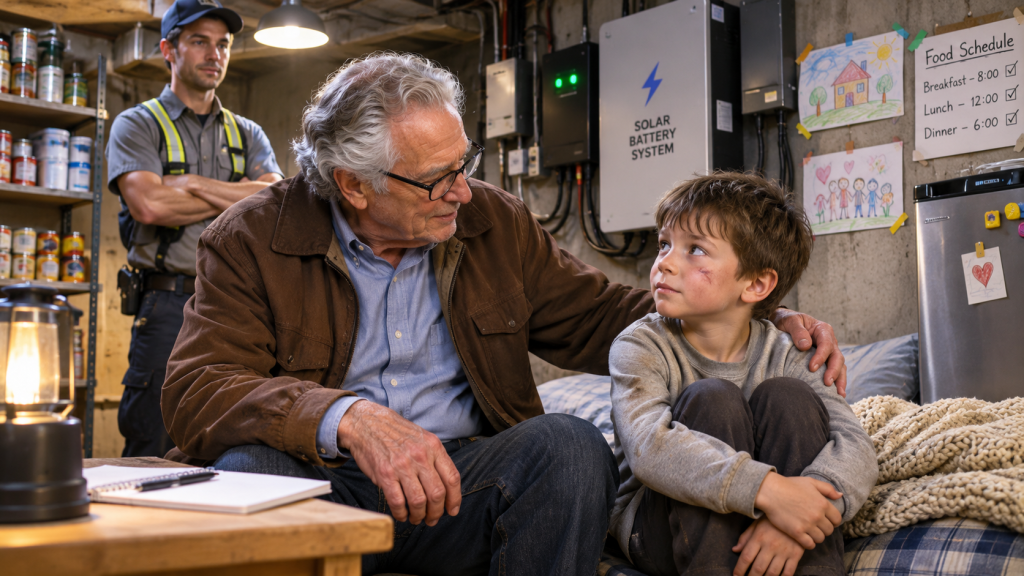
As a little girl asking for another bedtime story. As a teenager crying after her first heartbreak. As a young woman telling me she was pregnant. But I had never heard this particular sound before. It was the voice of someone who had just watched a carefully constructed lie collapse. “Where are you?” she asked. “At your house.” “Where’s Noah?” “Downstairs. Eating.” A sharp breath came through the receiver. “You weren’t supposed to—” She stopped. I waited. “Dad, you don’t understand.” “You’re right,” I said. “I don’t understand why my grandson has been living behind a battery system.”
“It’s not what you think.”
“Then tell me what it is.”
Silence.
I could hear a television in the background and the faint sound of someone speaking.
Ryan.
Diane covered the microphone, but not quickly enough.
I heard him say, “Tell him to get out of the basement.”
My stomach tightened.
“Diane, is Ryan there?”
“Yes.”
“Put him on.”
“Dad, please—”
“Put him on.”
There was a rustling sound.
Then Ryan’s voice came through, clipped and impatient.
“Frank, listen carefully. There’s sensitive equipment downstairs. Some of it belongs to clients. You can’t let strangers go through it.”
“Who are these clients?”
“That’s not important.”
“It became important when you warned me not to let the police see it.”
He paused.
“You called the police?”
“I called for help for a child who was locked in an upstairs room.”
“Jesus, Frank. You have no idea what you’ve done.”
I looked toward the kitchen again.
Noah had carefully arranged his birthday cards in a row. He was studying each envelope as though the dates were treasures.
“No,” I said quietly. “I think I’m beginning to understand exactly what I’ve done.”
“Frank—”
“This conversation is over.”
I ended the call.
For the first time in my life, I felt frightened of what my own daughter might have helped conceal.
The first patrol car arrived four minutes later.
A paramedic unit followed.
The officers approached without sirens, as I had requested. I met them on the porch and explained what Hector and I had found.
I showed them the messages from Ryan.
I showed them the photographs Hector had taken of the utility-room door before he opened it.
I explained that the house belonged to me, but that Diane and Ryan had been living there with my permission.
Most importantly, I told them about Noah.
“He’s six,” I said. “He’s frightened, and he thinks he’s in trouble. Please don’t question him in front of everyone.”
One of the officers, a woman named Officer Ramirez, nodded.
“We’ll keep that in mind, sir.”
The paramedics entered first.
Noah watched them from his chair.
I knelt beside him.
“These people are here to make sure you’re healthy.”
He gripped his photograph.
“Are they going to give me a shot?”
“Not unless there’s a medical reason, and they’ll explain what they’re doing.”
He looked at the woman carrying the medical bag.
“Can Grandpa stay?”
The room went silent.
It was the first time he had called me that.
My throat tightened.
“Of course,” I whispered.
Officer Ramirez looked at me, then at Noah.
“We’ll take this slowly.”
The paramedic introduced herself as Sarah.
She asked Noah simple questions, offered him a blanket, and checked his condition without crowding him.
He was visibly thin.
There were bruises on his knees and a healing scrape along one elbow.
But it was the way he reacted when someone moved too quickly that troubled me most.
Every sudden motion made him flinch.
Every question sounded, to him, like an examination he might fail.
When Sarah asked whether he had been drinking enough water, he glanced at me before answering.
I told him gently, “You can tell the truth. Nobody’s going to punish you for it.”
He whispered, “Sometimes the bottles run out.”
Sarah’s expression changed.
“How often, sweetheart?”
Noah shrugged.
“When Mama forgets the blue bag.”
The paramedic looked toward her colleague.
They exchanged the kind of glance professionals use when there is something serious they cannot discuss in front of a child.
I knew that look.
And I hated it.
While Noah was being examined, Officer Ramirez and another officer went upstairs with Hector.
I remained in the kitchen.
I could hear their footsteps moving through the hall.
Then the metallic sound of the deadbolt.
Then silence.
A few minutes later, Ramirez returned.
“Mr. Carter, we need to ask you something.”
“Anything.”
“Did you authorize anyone to install that exterior lock?”
“No.”
“Did you know the room was being used as a sleeping area?”
“No.”
“Have you ever seen the child in this house before today?”
I swallowed.
“Not since he was a baby.”
She studied me.
“You’re his grandfather?”
“Yes.”
“Are you certain?”
I nodded.
“His father was Daniel Carter. Daniel was my daughter’s first partner. He died when Noah was very young.”
Ramirez made a note.
“Do you know who has legal custody?”
I hesitated.
“I was told Daniel’s parents were raising him in California.”
“Do you have contact information for them?”
“I have an old address.”
“We’ll need it.”
I nodded.
She looked toward the kitchen.
“Child protective services are being contacted. We need to establish Noah’s legal situation and make sure he receives appropriate care.”
My chest tightened.
“Are they going to take him away?”
“I can’t promise you what the next steps will be. But your relationship with him matters, and you’ll have an opportunity to provide information.”
I appreciated that she didn’t offer false reassurance.
Still, the thought of Noah being carried into another unfamiliar place after everything he’d endured made my stomach twist.
“Can I stay with him until someone tells me otherwise?”
“Yes.”
I returned to the kitchen.
Noah looked up.
“Grandpa?”
“Yes, buddy?”
“Did I do good?”
The question nearly brought me to my knees.
“You did something very brave,” I told him.
He looked relieved.
Then he held out the oldest birthday card.
“Can you read this one again?”
I sat beside him.
And while police officers searched for answers in the house above us, I read a six-year-old birthday card to a boy who had never been allowed to open it.
The basement was discovered less than an hour later.
More precisely, the officers discovered what had been concealed behind its newly installed interior wall.
I wasn’t there when they entered.
The police had secured the area and requested additional investigators after observing equipment and documents that raised questions beyond Noah’s immediate welfare.
Hector was asked to remain available because his observations about the electrical system might be relevant.
I stayed with Noah.
But I knew something had changed when Officer Ramirez returned from downstairs.
Her expression was controlled, yet there was a new seriousness in her voice.
“Mr. Carter, do you know what your son-in-law does for work?”
“Financial consulting.”
“What kind?”
“He said he helped small businesses manage investments and payment systems.”
“Have you ever been involved in any of his business accounts?”
“No.”
“Has he ever asked to use your name or identification documents?”
I thought about the past three years.
Ryan had asked me to sign utility authorizations.
Insurance renewals.
Solar maintenance paperwork.
He had also asked whether I would consider transferring the house to Diane as an early inheritance.
I refused.
Not because I didn’t love my daughter, but because my wife, Margaret, had made me promise that I would never give away our largest asset while I was still alive.
“Why?” I asked.
Ramirez hesitated.
“We’ve found materials that require further investigation. I can’t discuss everything yet.”
My phone buzzed again.
Ryan.
This time, the message was shorter.
“Don’t let them touch the black cabinet.”
I showed it to Ramirez.
She read it twice.
Then she asked me to forward the message through the official evidence process.
“Did you know there was a black cabinet in the basement?” she asked.
“No.”
Her expression darkened.
“Thank you, Mr. Carter.”
She walked away.
I looked back at Noah.
He had fallen asleep sitting upright, the photograph of Margaret tucked beneath his hand.
I gently adjusted the blanket around his shoulders.
For a moment, I wanted to believe that whatever lay downstairs had nothing to do with the little boy.
But a terrible suspicion had already begun forming.
The house had not merely been hiding Noah.
It had been hiding an entire life from me.
Diane arrived that evening.
Not from Hawaii.
From the airport in Portland.
I had been told to remain available for questioning, and Noah was receiving medical care at a nearby hospital, with me accompanying him as permitted.
Eleanor, my sister, had driven over to stay with me.
When my phone rang, Diane was standing outside the hospital entrance.
“Dad,” she whispered. “Please come outside.”
I looked at Noah.
He was sleeping peacefully in a hospital bed, a stuffed dinosaur tucked beneath his arm.
A nurse had given him the toy after discovering his love of prehistoric animals.
Eleanor sat beside him.
“I’ll stay,” she said.
I went downstairs.
Diane stood near the entrance with a small suitcase.
She looked exhausted.
Her hair was tangled, her eyes swollen, and she wore the same blue sweater she had worn in the photograph she sent me from Maui two days earlier.
When she saw me, she rushed forward.
“Dad!”
I stepped back.
She stopped.
The pain in her expression was immediate.
But I couldn’t pretend things were normal.
“Where’s Ryan?” I asked.
Her mouth trembled.
“He didn’t come.”
“Why?”
“He said he needed to make some calls.”
I stared at her.
“Your son is in a hospital, and your husband needed to make calls?”
She looked away.
“Dad, please. I know how bad this looks.”
“How bad it looks?”
My voice rose before I could control it.
“Diane, there was a deadbolt on the outside of the room where Noah was sleeping.”
She began crying.
“I didn’t want him there.”
“Then why was he there?”
She covered her face.
I waited.
Finally, she whispered, “Because Ryan said we didn’t have a choice.”
I felt something cold settle in my chest.
“Start talking.”
Diane told me that Noah had never lived with Daniel’s parents in California.
Not for six years.
Not for six months.
Not for a single day.
After Daniel died, she had been overwhelmed by grief.
Noah was an infant.
She was twenty-four.
She struggled with bills, sleepless nights, and the crushing loneliness of raising a child while mourning the man she loved.
I remembered those months.
I remembered offering to help.
I remembered asking Diane to move home.
But she had refused.
“I’m not a child anymore, Dad,” she’d said.
I had believed she needed space.
Now she told me the truth.
Daniel’s parents had offered to help care for Noah temporarily while she recovered.
But Diane had been terrified they might try to gain custody.
So she refused.
Instead, she accepted help from a woman she knew through a local support group.
The woman offered affordable childcare in a private home.
For almost a year, Noah spent most weekdays there.
Then Diane met Ryan.
“He was wonderful at first,” she whispered.
I stood motionless.
“He bought groceries. He fixed things around the apartment. He took me to dinner. He said Noah deserved a father.”
“What happened?”
“Ryan said we needed a fresh start.”
She looked at me.
“He told me that if people knew how much I had struggled after Daniel died, they might think I was an unfit mother.”
“Did anyone threaten you with that?”
“No.”
“Then why did you believe him?”
She started crying harder.
“Because I was ashamed.”
I stared at my daughter.
The girl I had once carried on my shoulders was standing before me, admitting that shame had made her vulnerable to someone else’s control.
But shame alone did not explain a child locked upstairs.
“Diane,” I said, “we’re not finished.”
She nodded miserably.
“I know.”
Ryan’s business had begun to unravel nearly two years earlier.
According to Diane, he had borrowed money from investors to fund a technology company that promised automated payment processing for small businesses.
The company failed.
Instead of telling investors the truth, Ryan began moving money between accounts, creating the appearance that business activity remained strong.
He told Diane it was temporary.
Then he began asking her to help.
At first, she handled paperwork.
Later, she signed documents.
Eventually, Ryan persuaded her to let him use the Harlow Street house as a mailing address for several business entities.
“Did he use my name?” I asked.
Diane lowered her head.
“I don’t know everything he did.”
“That’s not an answer.”
“Dad, I signed some things.”
My heart sank.
“What things?”
“Authorization forms. Account applications. He said they were for solar incentives and tax credits.”
“Were they?”
She shook her head.
“I don’t think so.”
The implications were staggering.
My name.
My property.
My utility accounts.
All potentially connected to transactions I knew nothing about.
But there was still a more important question.
“What does any of that have to do with Noah?”
Diane began trembling.
“Ryan said investigators were looking into the company. He said if anyone knew Noah was living with us, they’d ask questions about our finances and childcare arrangements.”
“So you hid him?”
“At first, we just told people he was with relatives.”
“At first?”
She looked toward the hospital doors.
“He wasn’t always upstairs.”
I stared at her.
She swallowed.
“He had a room downstairs. Toys. A bed. Everything.”
“Then why did Hector find him behind a battery?”
Diane began to sob.
“Because Ryan said we needed to make the house look empty before we left.”
The words took a moment to register.
“Before you left for Hawaii?”
She nodded.
“Ryan said someone might come by while we were gone. He told me Noah would be safer where nobody could see him.”
I felt physically ill.
“You left a six-year-old child alone in a locked room while you flew across the Pacific Ocean?”
“He said he’d arranged someone to check on him.”
“Who?”
Diane shook her head.
“I never met the person.”
“And you believed him?”
She covered her mouth.
I stepped back.
There are moments in a parent’s life when love and horror occupy the same space.
I loved Diane.
I always would.
But standing outside that hospital, I could not soften what she had done.
“You had a choice,” I said.
She cried harder.
“Dad—”
“You had many choices. You could have called me. You could have asked for help. You could have refused to leave.”
“I was scared.”
“So was Noah.”
She looked at me.
I continued quietly.
“But he was six years old. You were the adult.”
Diane asked to see Noah.
I told her the decision would have to be handled through the hospital staff and the child protection professionals overseeing his care.
She looked wounded.
“I’m his mother.”
“Yes,” I said. “And that means something. It also means you were responsible for protecting him.”
She sank onto a bench.
For several minutes, she cried without speaking.
Then she whispered something I hadn’t expected.
“Dad, there’s another reason Ryan doesn’t want anyone in the basement.”
I stood still.
“What reason?”
She looked up.
“Daniel.”
My stomach tightened.
“What about Daniel?”
Diane stared at her hands.
“Ryan found some of his old records.”
“Financial records?”
“No.”
Her voice became almost inaudible.
“Records about how he died.”
For a moment, the hospital entrance seemed to disappear around me.
Daniel Carter had died in a highway collision six years earlier.
He was twenty-six years old.
A delivery truck had struck his car during heavy rain.
The police investigated.
The death was ruled an accident.
I had attended his funeral.
I had watched Diane collapse beside his coffin.
“What records?” I asked.
She hesitated.
“Ryan said Daniel had been involved with the same people who later invested in his company.”
I stared at her.
“That doesn’t make sense.”
“I know.”
“Why would Ryan have Daniel’s records?”
“Because he knew Daniel.”
The world went very quiet.
I looked at my daughter.
“You told me you met Ryan after Daniel died.”
She closed her eyes.
“I did.”
“But Ryan knew him before that?”
She nodded.
“They worked together.”
I felt the air leave my lungs.
“And you never thought to mention it?”
“Ryan asked me not to.”
For the first time that day, I understood that the basement might contain a secret older than Ryan’s marriage to my daughter.
Older than Noah’s confinement.
A secret connected to the death that had shattered our family six years earlier.
I did not question Diane further.
I called Officer Ramirez and told her what Diane had said.
She arranged for the appropriate investigators to speak with my daughter.
Diane went voluntarily.
I returned to Noah’s room.
He was awake.
Eleanor was reading him a book about dinosaurs.
When he saw me, he smiled.
“Grandpa Frank!”
I sat beside him.
“Hey, buddy.”
“Did you see Mama?”
I felt Eleanor glance at me.
“Yes.”
“Is she mad?”
“No.”
He considered that.
“Is Ryan mad?”
I paused.
“Ryan’s dealing with some serious adult problems.”
Noah pulled the blanket toward his chin.
“Will he come here?”
I looked at his face.
Fear had returned to his eyes.
I leaned forward.
“People are making sure you’re safe.”
He looked at the doorway.
“Ryan said if I told anyone about downstairs, everybody would disappear.”
My heart tightened.
“What downstairs?”
He whispered, “The room with the red light.”
Eleanor stopped reading.
I kept my voice calm.
“You don’t have to tell me anything you’re uncomfortable telling me.”
Noah studied my face.
Then he reached beneath his pillow and pulled out a folded piece of paper.
It was a drawing.
A house.
A staircase.
A black square beneath it.
And beside the black square, a figure with long arms.
Above the drawing, in uneven letters, he had written:
“DADDY IS IN THE WALL.”
I stared at the paper.
Then I looked at Noah.
“Buddy,” I whispered, “what does that mean?”
He pointed toward the black square.
“Ryan said Daddy’s secrets live down there.”
A terrible chill traveled along my spine.
But before I could ask anything else, Noah took the paper back.
“Please don’t tell Mama I showed you.”
I nodded.
“I’ll make sure the people helping you know there’s something important here.”
He reached for my hand.
And I sat beside him until he fell asleep.
By Wednesday morning, the investigation had expanded.
Detectives obtained judicial authorization to examine the locked basement storage area and the electronic equipment associated with Ryan’s business.
I learned only what investigators were able to share.
They found several computers, financial documents, and storage drives inside a concealed cabinet.
They also discovered a collection of surveillance recordings.
Some showed the interior of the house.
Others showed the upstairs hallway.
A camera had been positioned to monitor the door to Noah’s room.
Ryan had been able to see whether Noah remained inside.
The discovery made me sick.
For months, perhaps longer, someone had treated my grandson not as a child but as something to be contained and watched.
When Officer Ramirez visited the hospital that afternoon, I asked the question that had been tormenting me.
“Why would he do this?”
She looked tired.
“That’s part of what investigators are trying to establish.”
“Has Ryan been found?”
“Detectives are attempting to locate him.”
I looked away.
“Diane told me he stayed behind in Hawaii.”
“We’re verifying his movements.”
I pressed my hands together.
“And Daniel?”
Ramirez hesitated.
“His death is being reviewed in light of new information. But I don’t want you to assume the original findings were incorrect.”
I nodded.
The last thing I wanted was another tragedy manufactured from suspicion.
Still, I couldn’t forget Noah’s drawing.
Daddy is in the wall.
That evening, Ruth, a child protection caseworker, visited Noah.
Her name was Ruth Alvarez, and she had a gentle voice and the patience of someone who understood that frightened children rarely tell their stories in a straight line.
She asked me to remain nearby while she introduced herself.
Noah sat on the bed with his dinosaur.
“Do you like drawing?” Ruth asked.
He nodded.
“What do you like to draw?”
“Dinosaurs.”
“What’s your favorite?”
“Triceratops.”
“Why?”
“Because they have three horns. They’re strong.”
Ruth smiled.
“That’s a good reason.”
Then Noah surprised us both.
“Can strong dinosaurs still be scared?”
Ruth’s expression softened.
“Of course. Being brave doesn’t mean you never feel scared.”
He looked down.
“Ryan says scared boys are useless.”
I closed my eyes.
Ruth remained calm.
“Well, Ryan was wrong about that.”
Noah studied her.
Then he whispered, “Grandpa says people can be wrong.”
I opened my eyes.
Ruth smiled.
“Your grandpa is right.”
For the first time, Noah laughed.
It was a tiny sound.
But it filled the hospital room like sunlight.
The next morning, my attorney, Martin Shaw, came to see me.
Martin and I had known each other for almost twenty years.
He had helped settle Margaret’s estate after she died, and he knew how carefully I had protected the house on Harlow Street.
We met in the hospital cafeteria.
He placed a folder on the table.
“Frank, I’ve reviewed the documents you sent.”
“And?”
“Your name appears on several authorization forms connected to Ryan’s businesses.”
I felt a knot tighten in my stomach.
“I didn’t sign them.”
“I know that’s your position, and the signatures need to be examined.”
He opened the folder.
“One document appears to be an application for a credit facility using information associated with the property.”
“Can he do that?”
“Not legitimately using your authorization if you never gave it.”
I stared at the page.
My name was typed beneath a signature that looked disturbingly similar to mine.
The handwriting slanted slightly to the right.
The final letter of my surname had the same distinctive flourish I had developed decades earlier.
“Someone copied my signature.”
“That’s a possibility. We need proper verification.”
Martin turned another page.
“Frank, has Diane ever had access to your personal files?”
“Of course. She’s my daughter.”
“Bank statements? Tax records? Identification?”
I thought about the years after Margaret died.
Diane had helped me organize paperwork when grief made ordinary responsibilities feel impossible.
She knew where I kept important documents.
And Ryan had spent weekends at my house repairing things, organizing the garage, and making himself useful.
I had trusted him.
I thought of the Thanksgiving photograph on Diane’s mantel.
Ryan standing beside me.
His arm around my shoulders.
Smiling as though he belonged.
“Martin,” I whispered, “how much trouble am I in?”
He closed the folder.
“We’ll work through the records carefully. If someone used your identity without permission, there are steps we can take to dispute unauthorized obligations and protect your accounts.”
I looked at him.
“Can they take the house?”
“I’m not going to speculate before we know exactly what was filed. But we need to act promptly.”
Then he said something that surprised me.
“Frank, there’s another document you should see.”
He slid a copy across the table.
It was a proposed property-transfer agreement.
The recipient was a company associated with Ryan.
And listed as a witness was my daughter.
Diane Carter.
I stared at the name.
The signature beneath it looked real.
For the second time that week, I felt something inside me fracture.
I confronted Diane that afternoon.
Not in anger.
Not with shouting.
I asked her to meet me in Martin’s office.
She arrived pale and exhausted.
When she saw the document, she began trembling.
“Dad, I can explain.”
“Then explain.”
She stared at the page.
“Ryan said it was part of a refinancing application.”
“Did you read it?”
“No.”
“Did you witness my signature?”
She shook her head.
“No.”
“Then why did you sign as a witness?”
Tears gathered in her eyes.
“Because he told me you’d already agreed.”
I felt a sadness deeper than anger.
“Diane, why didn’t you call me?”
She covered her face.
“Because every time I questioned him, he told me I was ruining everything.”
Martin waited silently.
Diane continued.
“He said the company was going to collapse. He said investors would sue us. He said we’d lose the house and Noah would be taken away.”
I leaned forward.
“So you believed helping him use my property would protect your son?”
She stared at the floor.
“I wasn’t thinking clearly.”
“No,” I said. “You weren’t.”
For a moment, I remembered Diane at six years old, sitting on the kitchen floor while Margaret taught her to tie her shoes.
She had become frustrated and thrown the laces aside.
Margaret knelt beside her.
“Sweetheart,” she’d said, “you can’t make a knot disappear by pretending it isn’t there.”
My wife had been talking about shoelaces.
But the lesson had never been more important.
“Diane,” I said quietly, “you have to tell the investigators everything.”
She looked terrified.
“What if they charge me?”
“Then you’ll need your own lawyer, and you’ll have to face whatever responsibility is yours.”
She began crying.
I reached across the table.
“I love you. That hasn’t changed.”
Her face crumpled.
“But loving you doesn’t mean I can protect you from the truth.”
She nodded.
And for once, she didn’t ask me to make the problem disappear.
The most painful revelation came from a document found among Daniel’s old files.
It wasn’t proof of murder.
It wasn’t a secret confession.
It was an email exchange between Daniel and Ryan, dated several weeks before Daniel’s fatal accident.
Daniel had discovered discrepancies in business accounts he helped maintain.
He believed Ryan was transferring funds without proper authorization.
He had written:
“I’m done covering for you. If the records aren’t corrected, I’m taking everything to the accountant.”
Ryan’s reply was brief.
“You don’t understand what you’re risking.”
Daniel answered:
“I understand perfectly. And I’m not letting Diane or Noah get caught in this.”
I read the exchange in Martin’s office after investigators released the relevant information to the family through appropriate channels.
My hands shook.
Daniel had been trying to protect them.
He had known Ryan was involved in something dangerous.
And then he died.
For years, I had believed Daniel’s death was simply a terrible accident on a rain-soaked highway.
Now I understood there had been conflict in his life that none of us knew about.
The authorities reopened aspects of the investigation.
But the traffic evidence still supported a collision involving a delivery truck in dangerous weather conditions.
No reliable evidence established that Ryan caused the crash.
That uncertainty was painful.
Part of me wanted a villain who could explain everything.
But another part understood that not every tragedy conceals a deliberate crime.
Sometimes a death is an accident.
And sometimes the people left behind use that accident to create a thousand new lies.
Ryan was located three days later.
He had left Maui, traveled through another state, and attempted to access accounts associated with his business.
Investigators detained him after establishing grounds connected to the financial case.
The investigation into Noah’s confinement continued separately.
When Diane learned he had been arrested, she called me.
“Dad, he says this is all a misunderstanding.”
I closed my eyes.
“Diane, do you believe that?”
She was silent.
Then she whispered, “I don’t know what I believe anymore.”
“Start with what you saw.”
I heard her breathing.
“The lock.”
“Yes.”
“The food schedule.”
“Yes.”
“The fact that we left him alone.”
Her voice broke.
“God, Dad. We left him alone.”
I let her cry.
Then I said, “You can’t change that day. But you can stop lying about it.”
She whispered, “I will.”
And this time, I believed she wanted to.
Whether she would succeed was another question.
Noah was discharged from the hospital after several days of observation and assessment.
The medical team recommended follow-up care, including nutritional support and evaluation by professionals experienced in childhood trauma.
Child protection authorities arranged a temporary placement while they assessed the family situation.
I applied immediately to care for him.
There were interviews.
Background checks.
A home assessment.
Questions about my age, health, finances, and support network.
I answered every one.
I was seventy-one.
My knees hurt in cold weather.
I took medication for blood pressure.
I had not raised a six-year-old in decades.
But I had a spare bedroom.
A stable home.
A sister who lived nearby.
And enough love to fill every room.
Still, love wasn’t the only requirement.
The people responsible for Noah’s safety needed to be certain I could meet his needs.
I understood that.
The waiting was difficult.
Each evening, I sat at my kitchen table looking at the bedroom Margaret had once used for sewing.
I imagined turning it into Noah’s room.
A bed.
Books.
A lamp shaped like a dinosaur.
But I refused to tell him he would live there until a decision was made.
He had already been given too many promises adults failed to keep.
Then, on a rainy Thursday afternoon, the caseworker called.
“Mr. Carter, we’d like to discuss a kinship placement with you.”
I sat down.
“Does that mean—”
“It means you’ve met the initial requirements, and we’re able to move forward under the temporary care arrangements.”
My eyes filled.
“When can I see him?”
She gave me the details.
I hung up and looked toward Margaret’s photograph.
“Well, Maggie,” I whispered, “looks like we’re raising another one.”
For a moment, I could almost hear her laugh.
When Noah arrived, he carried a small backpack.
Inside were his coloring book, three crayons, the photograph of Margaret, and the birthday cards I had mailed over the years.
He stood in my doorway, looking uncertain.
“Can I come in?”
I knelt carefully.
“Of course.”
He stepped inside.
Then he looked toward the staircase.
“Where do I sleep?”
“Come see.”
I led him to the bedroom.
Eleanor had helped me prepare it.
There was a blue bedspread, a bookshelf, a soft rug, and a little wooden desk beneath the window.
A green dinosaur lamp stood beside the bed.
Noah stared.
“Whose room is this?”
“Yours, while you’re staying here.”
He looked at me.
“All of it?”
“All of it.”
“Where’s the lock?”
My throat tightened.
“There isn’t one on the outside.”
He walked toward the door.
He opened it.
Closed it.
Opened it again.
Then he looked at the window.
“Can people see me?”
“Yes.”
“Is that okay?”
I knelt beside him.
“It’s more than okay.”
He stood quietly.
Then he whispered, “What if I make noise?”
I smiled through tears.
“Noah, I hope you make lots of noise.”
He considered that.
Then he climbed onto the bed and bounced once.
I laughed.
He bounced again.
A little higher.
Then he burst into laughter.
It was the most beautiful sound I had heard since Margaret was alive.
Healing did not happen overnight.
The first week, Noah woke screaming almost every evening.
Sometimes he dreamed that the utility-room door had locked again.
Sometimes he cried because he thought he had forgotten to complete a food schedule.
He hoarded crackers beneath his pillow.
He hid water bottles behind the curtains.
When I discovered them, I didn’t scold him.
I explained that food would be available tomorrow, and the day after that.
He listened.
But trust takes longer than explanation.
One afternoon, I found him standing beside the refrigerator.
He looked frightened.
“What’s wrong, buddy?”
“I ate the last yogurt.”
“Okay.”
“I’m sorry.”
I opened the refrigerator.
“We’ll buy more.”
He stared.
“That’s it?”
“That’s it.”
He looked suspicious.
“You’re not mad?”
“No.”
His eyes filled.
“Ryan got mad when things ran out.”
I knelt beside him.
“People are allowed to make mistakes. They’re allowed to be hungry. They’re even allowed to eat the last yogurt.”
He began crying.
I held out my arms.
He stepped into them.
And I remained on the kitchen floor holding my grandson until his breathing settled.
That evening, Eleanor came over with groceries.
She placed six containers of yogurt in the refrigerator.
Noah counted them.
Then he smiled.
Diane began receiving supervised visits.
The arrangements were made by the professionals handling Noah’s case, with attention to his safety and readiness.
At first, Noah refused to see her.
Diane was devastated.
She called me afterward.
“He hates me.”
I closed my eyes.
“Diane, he is frightened and hurt.”
“What do I do?”
“You let him have his feelings.”
“But I’m his mother.”
“Then act like his mother. Put what he needs ahead of what makes you feel better.”
She went quiet.
A few weeks later, Noah agreed to a short visit.
I wasn’t present, but the caseworker later shared that he had remained cautious.
Diane brought him a small dinosaur puzzle.
He accepted it.
Then he asked the question she had been dreading.
“Why did you leave me upstairs?”
Diane began crying.
She told him she had made a terrible mistake.
She told him he had done nothing wrong.
She apologized without asking him to forgive her.
According to the caseworker, Noah listened quietly.
Then he asked, “Will you do it again?”
Diane answered, “No.”
The caseworker later helped her understand that Noah needed more than that promise.
He needed adults whose actions could be trusted over time.
Diane began attending counseling and parenting education as part of addressing the concerns identified in the case.
She also cooperated with the financial investigation.
I hoped she would change.
But I had stopped confusing hope with proof.
Months passed.
The investigation into Ryan’s financial activities eventually led to criminal charges involving fraudulent transactions and unauthorized use of financial information.
The proceedings took time.
Some allegations were contested.
Other conduct was established through records, testimony, and agreements reached in court.
Ryan was also held accountable through the legal process for his role in Noah’s confinement and neglect.
Diane faced consequences for her own actions.
She was not simply a helpless bystander, and she eventually stopped presenting herself as one.
Through her attorney, she acknowledged that she had known Noah was being confined and that she had left him without appropriate care.
Her cooperation did not erase the harm.
But it was the beginning of accepting responsibility.
The financial records involving my property were examined, and Martin helped me dispute the unauthorized documents.
The house remained mine.
I replaced the locks at Harlow Street, secured my records, and made arrangements to sell the property once the legal and practical issues permitted.
I no longer wanted to live with the memory of what had happened there.
But I saved one thing.
Noah’s coloring book.
Not to remind him of his suffering.
To preserve, if he ever wanted it, evidence of how hard he had worked to endure something no child should experience.
One Saturday, nearly a year after Hector’s phone call, Noah and I were planting tomatoes in the backyard.
He wore bright yellow rain boots even though the sun was shining.
His hands were covered in soil.
“Grandpa?”
“Yes, buddy?”
“Do you think Grandma Margaret can see our garden?”
I smiled.
“I don’t know exactly how those things work.”
He considered that.
“Maybe she can.”
“Maybe.”
He pushed another seed into the earth.
“I think she’d like it.”
“She would have loved it.”
Noah looked toward the house.
“Did she like dinosaurs?”
I laughed.
“She liked just about anything children were excited about.”
He nodded seriously.
“Then she would have liked me.”
My throat tightened.
“Oh, Noah.”
I drew him close.
“She would have loved you more than you can imagine.”
He hugged me.
Then he looked up.
“Grandpa, can I ask something?”
“Always.”
“Why didn’t you come find me before?”
The question struck harder than anything the investigators had asked.
I put down my gardening tool.
“Because I was told you were living somewhere else, and that your family there wanted privacy.”
He stared at me.
“Did you believe them?”
“Yes.”
“Why?”
I thought carefully.
“Because I trusted someone I loved, and I didn’t check whether what I was told was true.”
His face softened.
“Are you sorry?”
“Very.”
He looked at the tomato plants.
Then he whispered, “I thought nobody was coming.”
I pulled him into my arms.
“I know, buddy.”
He pressed his face against my shirt.
“I’m here now,” I whispered.
And I promised myself that I would spend the rest of my life proving those words through actions.
On the anniversary of the day Hector discovered Noah, I invited him to dinner.
Eleanor came too.
We ate roast chicken, mashed potatoes, and chocolate cake.
Noah insisted on setting the table himself.
When Hector arrived, Noah ran toward him.
“Mr. Hector!”
Hector smiled.
“Hey, dinosaur man!”
Noah hugged him.
Then he asked a question that made every adult in the room fall silent.
“Did you know you were going to find me that day?”
Hector knelt.
“No, buddy.”
“Then why did you open the door?”
“Because I heard something and wanted to make sure everything was okay.”
Noah thought about that.
Then he smiled.
“I’m glad you listened.”
Hector’s eyes filled.
“So am I.”
After dinner, Noah gave Hector a drawing.
It showed three people standing outside a house.
One was Hector.
One was me.
And between us stood a little boy holding both our hands.
Above the picture, Noah had written:
“THE DAY SOMEBODY CAME.”
Hector stared at it for a long time.
Then he hugged Noah again.
Today, Noah is learning to ride a bicycle.
He attends school, makes friends, and complains about bedtime like any other child.
He still has difficult nights.
He still needs reassurance.
And his relationship with Diane remains a careful, professionally supported process rather than an easy reconciliation.
The temporary arrangements have evolved through legal reviews into a more stable plan for his care.
Noah knows he is allowed to love his mother and still be angry with her.
He knows he can ask difficult questions.
He knows that adults are responsible for the choices they make.
Most importantly, he knows that a closed door does not have to mean punishment.
Sometimes it simply means someone wants privacy.
And if he needs help, he can open it.
Last Sunday, I found him sitting at the kitchen table writing something in a new notebook.
I noticed the old marble notebook beside him.
The one filled with rules about staying quiet, apologizing, and not making anyone angry.
For a moment, I felt that familiar ache.
“What are you writing?” I asked.
He covered the page.
“It’s a surprise.”
I smiled.
“Okay.”
A few minutes later, he pushed the notebook toward me.
“Now you can read it.”
At the top, in careful handwriting, he had written:
“RULES AT GRANDPA’S HOUSE.”
My chest tightened.
Beneath it were five sentences.
I can eat when I’m hungry.
I can ask for help.
I can laugh loud.
I can tell the truth.
I am allowed to be loved.
I read them twice.
Then I looked at Noah.
“Are these good rules?” he asked.
I swallowed the lump in my throat.
“They’re the best rules I’ve ever seen.”
He smiled.
“Can we put them on the refrigerator?”
I nodded.
“Right in the middle.”
We attached the page with one of Margaret’s old refrigerator magnets.
Noah stepped back to admire it.
Then he ran into the living room to finish building his dinosaur castle.
I stood alone in the kitchen for several minutes.
I thought about the day my phone rang.
About Hector’s frightened voice.
About the little boy hidden behind a battery housing.
About six unopened birthday cards.
About a daughter I loved but could no longer protect from accountability.
And about how close I had come to dismissing an electrical warning as a minor inconvenience.
I had called a technician to fix a battery.
Instead, he found a child whose life desperately needed someone to notice him.
I cannot undo the years Noah spent afraid.
I cannot make the memories disappear.
But I can give him mornings that begin with breakfast instead of fear.
I can give him birthdays with candles, presents, and laughter.
I can give him a home where the windows are uncovered, the doors are safe, and no one has to earn the right to be treated with kindness.
That afternoon, Noah came running into the kitchen.
“Grandpa! Come outside!”
“What happened?”
“There’s a rainbow!”
I followed him into the backyard.
The rain had stopped, and sunlight stretched across the grass.
Above the neighborhood, a beautiful rainbow arched between the clouds.
Noah took my hand.
“Do you think it was always there?” he asked.
I looked at the fading colors.
“Maybe the sunlight just had to reach it.”
He smiled.
Then he wrapped both arms around my waist.
“I love you, Grandpa.”
I held him close.
“I love you too, buddy.”
And as we stood beneath that quiet sky, I finally understood something Margaret used to tell me.
A house is not made safe by strong locks, expensive equipment, or high walls.
It becomes a home when the people inside know they are protected, respected, and loved.
For Noah, that journey had begun with one unlocked door.
For me, it began with one terrible phone call.
And for both of us, it became the beginning of a life where nobody needed to hide anymore.


