➡️ PART 3 ➡️
I sat in the bank’s private consultation room, holding my telephone against my ear while my son calmly discussed selling the house where his father and I had spent forty-six years building a life. “Mom, are you listening?” Colin asked. I looked down at Martin’s photograph. He was standing in front of the little lakeside cottage, smiling beneath the afternoon sunshine.
“Yes, Colin. I’m listening.” He sounded relieved. “Good. Kara thinks the housing market is strong right now. If we list your place before spring, we could probably get a wonderful price.” I stared at the wall. “We?” He hesitated. “Well, obviously it’s your house, Mom. But we’re family.” I closed my eyes. There it was again. That word. Family.
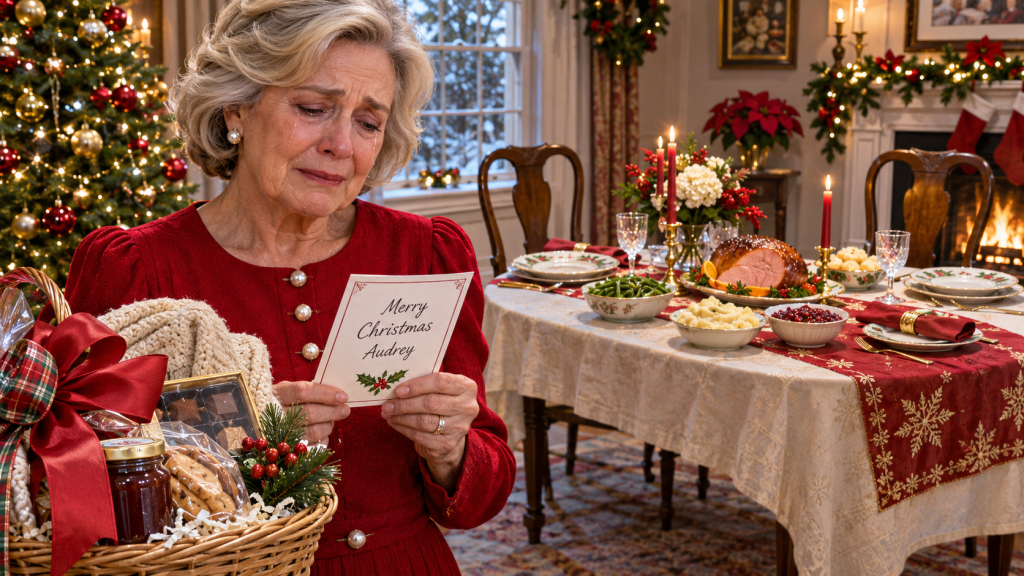
The same word that apparently hadn’t included me at Christmas dinner. I took a careful breath. “Colin, why would I sell my home?” He sighed. “Because it’s too much house for one person. You’re sixty-seven, Mom. You shouldn’t be living alone in a place that size.” I looked toward Evelyn, the bank manager, who was quietly organizing the documents.
“Your father and I managed perfectly well here.”
“Dad isn’t here anymore.”
The words struck harder than he intended.
Or perhaps exactly as hard as he intended.
For a moment, I couldn’t speak.
Then I whispered, “I know that, son. I wake up knowing it every morning.”
Colin was silent.
I continued.
“Your father died nine months ago. Yesterday was my first Christmas without him. You promised to come, and instead you sent a stranger to tell me I’d be eating alone.”
He sighed impatiently.
“Mom, we already apologized.”
“No, Colin. Kara sent a card.”
“It’s the same thing.”
I looked at Martin’s handwriting.
“No, sweetheart. It isn’t.”
Then I said something I’d never said to him before.
“I’m not discussing selling my home. And I’m not making any decisions about my future because your wife thinks they’re convenient.”
Colin went quiet.
Then he whispered, “Mom, you’re being difficult.”
I swallowed.
“Perhaps I’m finally being honest.”
And I ended the call.
For several minutes, I sat motionless.
My hands were trembling.
Not because I’d raised my voice.
I hadn’t.
Not because I’d insulted my son.
I hadn’t done that either.
I was shaking because I’d spent forty years avoiding the word no, and now I’d finally spoken it without apologizing.
Evelyn placed a glass of water beside me.
“Mrs. Weller, would you like a few minutes?”
I nodded.
“Thank you, honey.”
She smiled gently.
Then she looked toward Martin’s photograph.
“Your husband came here several times during his final year.”
My heart tightened.
“He did?”
“Yes, ma’am.”
I stared at her.
“He was very particular about organizing these documents.”
I looked down at the photograph.
That sounded like Martin.
He used to label everything.
The Christmas decorations.
The garage tools.
Even the extra batteries in the kitchen drawer.
Sometimes I’d teased him about it.
He’d simply smiled and said, “One day you’ll thank me.”
I brushed tears from my cheeks.
“I suppose that day has come.”
Evelyn’s expression softened.
“He wanted everything to be clear for you.”
I looked toward the sealed letter addressed to Colin.
“Did he tell you about this?”
She shook her head.
“Only that it was important.”
I turned the envelope over.
Martin’s handwriting filled the front.
Only give him this when he understands what he has lost.
My throat tightened.
For years, I’d believed the greatest loss our family would ever endure was Martin’s death.
Now I wondered whether he’d been afraid of losing our son in a different way.
I drove home slowly.
The day after Christmas had always been peaceful in our house.
Martin and I used to spend it eating leftovers, reading the newspaper, and laughing about the things that had gone wrong during the holiday.
One year, the dog stole half the ham.
Another year, Colin knocked over the Christmas tree while trying out his new bicycle.
Martin would tell those stories every December as though they were the funniest things he’d ever witnessed.
Now the house was silent.
The dining table still stood beneath the chandelier.
Three places.
Three folded napkins.
Three water glasses.
I hadn’t been able to clear them after Christmas.
I looked at the empty chairs.
Then I walked into the kitchen and began putting everything away.
Not because I wanted to forget what happened.
But because I no longer wanted to sit inside the disappointment.
When I finished, I took Martin’s photograph from the bank and placed it beside his favorite chair.
Then I sat down.
“Oh, sweetheart,” I whispered, “you’ve left me quite a surprise.”
I looked at the cottage.
The little white building.
The blue shutters.
The wooden dock extending toward the water.
I remembered our twentieth anniversary there.
Martin had rented the place for three nights.
We’d eaten breakfast on the porch.
Watched ducks swimming along the shoreline.
And spent one entire afternoon doing absolutely nothing.
I’d told him it was the happiest I’d felt in years.
He’d smiled and said, “One day, Audrey, we’re going to have a place like this.”
I thought he’d forgotten.
But apparently, he never had.
Two days later, my sister Lorraine came over.
She was seventy, three years older than me, and had never been particularly interested in pretending everything was wonderful.
She brought chicken soup and a bag of cinnamon rolls.
The moment she saw my face, she put the food down.
“What happened?”
I told her everything.
Christmas.
The gift basket.
The photograph Kara posted.
The secret compartment in the bird feeder.
Martin’s letters.
The cottage.
And Colin’s sudden interest in selling my house.
By the time I finished, Lorraine was staring at me.
“Audrey, your husband bought you a cottage?”
I nodded.
“Fully paid for.”
She covered her mouth.
Then began crying.
“Oh, that Martin.”
I smiled through my tears.
“He always did know how to surprise me.”
Lorraine reached across the table.
“Are you going to visit it?”
“I think so.”
“When?”
I looked toward the window.
“Soon.”
She nodded firmly.
“Good.”
Then she asked, “Does Colin know?”
I shook my head.
“Not yet.”
Lorraine leaned back.
“Keep it that way until you’ve spoken with somebody who understands the legal paperwork.”
I looked at her.
“Martin already made arrangements.”
“Then make sure you understand them.”
I nodded.
She was right.
For the first time since Martin died, I needed to make decisions based on what was best for me.
Not what would keep everybody else happy.
The following week, I met with Martin’s longtime attorney, Mr. Whitaker.
He was a gentle man with silver hair and a habit of polishing his glasses whenever he needed time to think.
I brought the documents from the bank.
He reviewed everything carefully.
Then he looked at me.
“Audrey, your husband was thoughtful about protecting your future.”
My eyes filled.
“I know.”
He explained that the cottage had been purchased in my name and that Martin had arranged the related financial records so I could manage the property independently.
He also reviewed our existing estate documents.
Then he asked a question that made my stomach tighten.
“Has Colin approached you about selling your primary residence?”
I stared at him.
“Yes.”
Mr. Whitaker sighed.
“I was afraid he might.”
My heart began pounding.
“Why?”
He opened a file.
“Martin discussed some concerns with me before he died.”
I looked down.
“About Colin?”
He nodded.
My throat tightened.
“What concerns?”
Mr. Whitaker hesitated.
“Your husband worried that Colin had begun relying on your financial resources as though they were guaranteed.”
I swallowed.
Martin had warned me.
Many times.
But hearing it from another person made the truth feel heavier.
“He wasn’t angry with Colin,” Mr. Whitaker continued. “He simply wanted to make sure you weren’t pressured into decisions after his death.”
I looked toward the cottage photograph.
“And that’s why he bought the property?”
“Partly.”
I frowned.
“What do you mean?”
Mr. Whitaker opened another folder.
“There’s something else you should know about.”
My stomach tightened.
“What?”
He looked directly at me.
“Martin had been receiving requests from Colin concerning an advance against his expected inheritance.”
I stared.
“An advance?”
Mr. Whitaker nodded.
“Colin wanted access to funds he believed would eventually come to him.”
I felt cold.
“How much?”
There was a pause.
“One hundred thousand dollars.”
I sat perfectly still.
My son had been asking his dying father for money.
And neither of them had told me.
I stared at Mr. Whitaker.
“When?”
He looked down at his notes.
“Approximately four months before Martin passed.”
My chest tightened.
Four months.
Martin had been weak by then.
The chemotherapy had left him exhausted.
Some days, he could barely walk from the bedroom to the living room without stopping to rest.
And Colin had been asking him for a hundred thousand dollars.
“For what?” I whispered.
Mr. Whitaker hesitated.
“Colin mentioned a business opportunity.”
I closed my eyes.
Of course.
There had always been opportunities.
A restaurant investment.
A landscaping company.
A property partnership.
Every few years, Colin discovered something that would supposedly change his life.
And every time, Martin and I were expected to help him begin.
“Did Martin give him anything?”
Mr. Whitaker shook his head.
“Not through the arrangements I handled.”
I let out a breath.
Then he continued.
“Martin refused the request and made it clear that his first priority was your financial security.”
My eyes filled.
I looked toward the window.
My husband had been fighting for his life.
And even then, he’d been protecting mine.
That evening, Colin called again.
I almost let the telephone ring.
Then I answered.
“Hello, son.”
He sounded irritated.
“Mom, why haven’t you been returning my messages?”
I sat down.
“Because I’ve needed some quiet.”
He sighed.
“Kara thinks you’re upset about Christmas.”
“I am.”
He paused.
“Mom, you can’t stay angry forever.”
I looked at Martin’s photograph.
“Colin, I’m not angry because you spent Christmas with Kara’s family.”
“Then what’s the problem?”
“You promised to spend it with me. You knew it was my first Christmas without your father. And instead of calling me yourself, you sent a card with a courier.”
He was quiet.
I continued.
“Your decision wasn’t the cruelest part. It was the way you made it seem as though my feelings didn’t deserve a conversation.”
He sighed.
“Mom, you’re making this bigger than it was.”
I closed my eyes.
For years, he’d used those words whenever I explained that something hurt.
You’re making this bigger.
You’re too sensitive.
You know I didn’t mean it.
And I’d always accepted the explanation.
Not this time.
“Colin,” I said, “I need to ask you something.”
“What?”
“Did you ask your father for a hundred thousand dollars before he died?”
Silence.
Then he whispered, “Who told you that?”
My heart sank.
“Answer the question.”
He rubbed his forehead.
“Mom, Dad misunderstood.”
I stared at the wall.
“What did he misunderstand?”
“I was asking about an investment.”
“While he was receiving chemotherapy?”
He didn’t answer.
My voice trembled.
“Colin, your father was dying.”
He snapped, “I knew that!”
The words rang in my ear.
Then there was a long silence.
Finally, he whispered, “I thought he wanted me to be successful.”
I closed my eyes.
“He did, sweetheart. But he also wanted you to become responsible.”
Colin said nothing.
Then I asked the question that had been troubling me.
“Why are you so determined to sell my house?”
His breathing changed.
“Because it makes sense.”
“For whom?”
He hesitated.
“Mom, it’s a valuable property. You don’t need all that space.”
I looked toward the family photographs hanging in the hallway.
“Colin, are you having financial trouble?”
He went silent.
And suddenly, I knew.
Three days later, Kara appeared at my door.
She wore an expensive wool coat and carried a leather handbag.
For once, she didn’t look perfectly composed.
Her eyes were swollen.
“Audrey, can we talk?”
I stepped aside.
We sat at the kitchen table.
I offered tea.
She declined.
Then she folded her hands.
“Colin doesn’t know I’m here.”
My stomach tightened.
“What happened?”
She looked down.
“We’re having problems.”
I waited.
Kara continued.
“His business isn’t doing well.”
I nodded slowly.
“How badly?”
She swallowed.
“We’re behind on our mortgage.”
My heart tightened.
“How far?”
“Four months.”
I stared at her.
“And the house?”
She began crying.
“We could lose it.”
For a moment, I felt sorry for her.
Then I remembered the Christmas card.
The matching sweaters.
The photograph captioned with words that made me feel like an outsider.
“What does that have to do with selling my house?” I asked.
She wiped her cheeks.
Kara hesitated.
Then whispered, “Colin thought if you moved somewhere smaller, you might give us part of the proceeds.”
I looked at her.
“How much?”
She lowered her head.
“Enough to pay off our debts.”
I sat back.
There it was.
The reason my son had suddenly become concerned about my living alone.
He wasn’t worried about the stairs.
Or the yard.
Or the quiet rooms.
He was looking at my home as money waiting to be released.
I folded my hands.
“Kara, I won’t sell my house to rescue yours.”
She began crying harder.
“I understand.”
I studied her.
For the first time, I thought she might.
Then Kara reached into her handbag.
“There’s something else you should see.”
My stomach tightened.
She placed a folded document on the table.
It was a preliminary property listing agreement.
My address appeared at the top.
The estimated sale price was written beneath it.
And near the bottom was a signature line.
Audrey Weller.
My name.
Except someone had already signed it.
I stared.
“That isn’t my signature.”
Kara covered her mouth.
“I know.”
My hands began trembling.
“Who signed this?”
She began crying.
“Colin told the realtor you’d already agreed.”
I looked at her.
“Did you believe him?”
She hesitated.
“At first.”
I closed my eyes.
“Then why are you here?”
She swallowed.
“Because the realtor called yesterday asking when you were available for photographs.”
My heart pounded.
“Photographs?”
Kara nodded.
“He wanted to schedule the house for listing.”
I stared at the paper.
My son hadn’t simply suggested selling my home.
He’d already started arranging it without my permission.
I felt something inside me grow painfully quiet.
For years, I’d made excuses for Colin.
Now he was making decisions about my future as though I had no voice.
I looked at Kara.
“Please leave the document with me.”
She nodded.
“And don’t tell Colin I agreed to anything.”
“I won’t.”
After she left, I sat alone at the table.
Then I reached for my phone.
I called Mr. Whitaker.
The next morning, I met with him again.
He examined the listing agreement.
Then looked up.
“Audrey, did you authorize anyone to sign your name?”
“No.”
He nodded.
“Then we need to notify the real estate company that you dispute the document and that no sale has been authorized.”
I swallowed.
“Could Colin sell my house?”
“Not simply because he handed someone a form bearing your name. But we’ll verify the property’s title and make sure no other documents have been submitted.”
I nodded.
Then he asked something unexpected.
“Audrey, does Colin know about the lakeside cottage?”
I shook my head.
“No.”
Mr. Whitaker was quiet.
Then said, “I’d advise you to keep that information private until we’ve completed our review.”
My stomach tightened.
“Why?”
He hesitated.
“Because there may be another issue involving the property records.”
I stared at him.
“What issue?”
He opened Martin’s estate file.
“Your husband left instructions concerning the cottage, but there’s a separate document I want to examine.”
I leaned forward.
“What document?”
“A letter Martin received from Colin shortly before his death.”
My heart tightened.
“What did it say?”
Mr. Whitaker looked concerned.
“Colin claimed your father-in-law had once promised him a future interest in certain family assets.”
I frowned.
“Martin’s father died twenty years ago.”
“Yes.”
“And he never owned the cottage.”
“Correct.”
I stared at him.
“Then what was Colin talking about?”
Mr. Whitaker hesitated.
“That’s what we need to establish.”
That evening, I sat in Martin’s study.
His desk lamp cast a warm circle of light across the papers.
Outside, winter rain tapped against the windows.
I opened the sealed letter he’d left for Colin.
Not to read it.
Just to look at the handwriting.
Only give him this when he understands what he has lost.
I wondered what Martin meant.
Had he known our son would try to pressure me?
Had he suspected Colin would begin treating my home like an inheritance waiting to happen?
Or had he simply hoped that one day Colin would recognize the value of his parents while there was still time?
I placed the envelope beside Martin’s photograph.
Then I opened another drawer.
Inside were old insurance policies.
Tax records.
And a small notebook where Martin had kept personal reminders.
I turned the pages.
Doctor appointments.
Medication schedules.
Lists of repairs.
Then I found an entry dated six weeks before he died.
“Spoke with Colin again. He doesn’t understand why Audrey must come first. Worried about what happens after I’m gone.”
My eyes filled.
I continued reading.
“Called Whitaker. Need to make sure cottage remains protected. Colin has been asking questions about property transfers.”
I closed my eyes.
My husband had been worried.
Not just about dying.
About what our son might do afterward.
Then I turned another page.
And found something that made my heart stop.
A notation written in red ink.
“Colin mentioned the second mortgage. Audrey doesn’t know. Must investigate.”
I stared at the words.
Second mortgage?
We didn’t have a second mortgage.
Our house had been paid off years earlier.
My hands began trembling.
I reached for the telephone.
But before I could call Mr. Whitaker, my doorbell rang.
I looked toward the hallway.
Through the front window, I could see Colin’s car.
He stood on the porch.
But he wasn’t alone.
Beside him was a man wearing a dark suit and carrying a briefcase.
I felt my stomach tighten.
Then my phone buzzed.
A message from Kara.
“Audrey, please don’t sign anything. Colin found out about the cottage.”
I stared at the screen.
How?
Nobody had told him.
Then another message arrived.
“His lender says the cottage was listed as possible collateral for a loan.”
My heart seemed to stop.
I looked down at Martin’s notebook.
Second mortgage.
Property transfers.
Colin asking questions.
And now a lender standing on my porch.
I walked slowly toward the door.
Through the glass, Colin raised his hand to knock again.
Then I heard him call:
“Mom, open up. We need to talk about Dad’s property.”
I gripped the doorknob.
And suddenly, I understood why Martin had hidden those letters where only I would think to look.
He hadn’t simply left me a cottage.
He’d left me a warning.
And the secret behind that warning was standing on my front porch.


