➡️ PART 3 ➡️
For eighty-one years, I had believed there were certain things a mother should never have to fear. I knew children could disappoint you. I knew they could become selfish, make mistakes, and forget the sacrifices that brought them into the world. But I had never imagined my only son would try to convince strangers that I was incapable of making decisions simply because I refused to give him my home.
I stared at Greg across my kitchen table. “The doctor died eighteen months ago?” I whispered. Mr. Bennett nodded. “According to the records we’ve reviewed, yes.” Dana folded her arms. “This is ridiculous. We were just trying to find somewhere safe for her.” Emily turned toward her. “Then why does the admission paperwork contain a medical certificate from someone who couldn’t possibly have examined Grandma?”
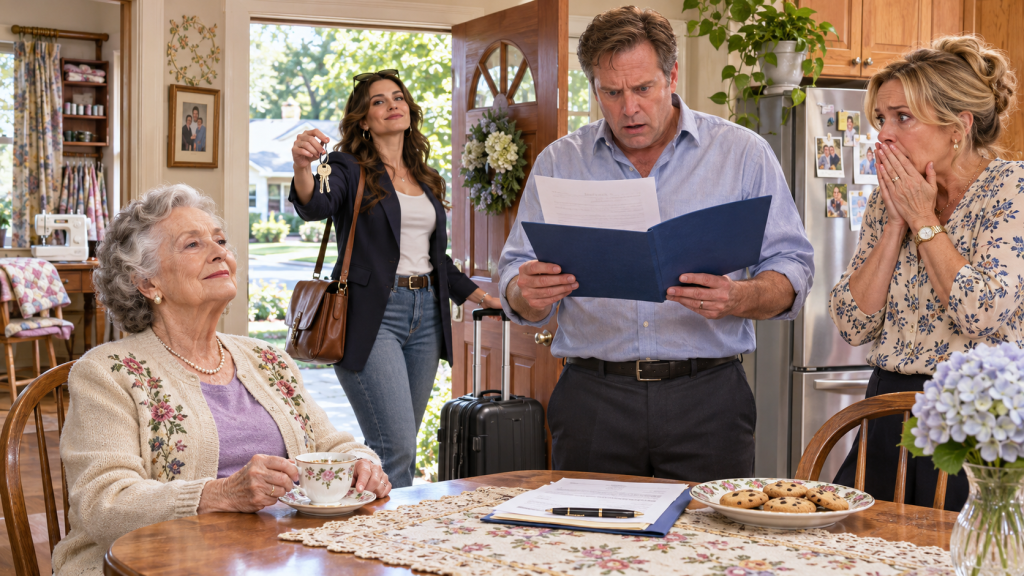
Dana opened her mouth. But no words came. Greg looked down at the floor. I watched him carefully. I remembered the little boy who used to sit on Walter’s shoulders while we planted tomatoes in the backyard. The teenager who cried when his first girlfriend broke his heart. The young man whose wedding we paid for because he promised he’d repay us when he found steady work.
Now he stood in the kitchen his father had built, unable to look me in the eyes. “Greg,” I said softly, “did you know about that document?” He swallowed. “Mom, you don’t understand.” My heart sank. I had heard those words too many times. Whenever he took money. Whenever he made decisions without asking. Whenever he treated my feelings like an inconvenience.
I looked at him.
“Then help me understand.”
He rubbed his forehead.
“Dana was handling the nursing home arrangements.”
Dana spun toward him.
“Don’t you dare put this on me!”
The room went silent.
And suddenly, I understood something important.
Their plan had worked beautifully while they believed I was powerless.
But now that someone was asking questions, they were beginning to turn against each other.
Mr. Bennett quietly gathered the documents.
“Mrs. Harper, may I suggest we continue this conversation in a calmer setting?”
I shook my head.
“No, Mr. Bennett. I’ve been told to keep quiet in my own house for two years. I’d like to hear what my son has to say.”
Emily moved beside me.
Her hand rested gently on my shoulder.
“Grandma, you don’t have to listen to them hurt you anymore.”
I looked up at her.
“I know, sweetheart.”
And that was what made the moment different.
For the first time since Walter died, I wasn’t standing alone.
Greg pulled out a chair.
“Mom, I was worried about you.”
I almost laughed.
“Were you?”
He nodded quickly.
“You’re getting older. The house is too much for you.”
I looked around my kitchen.
The yellow curtains I’d sewn myself.
The oak cabinets Walter had installed.
The little blue clock above the stove.
“Greg, I lived here for forty-eight years before you decided it was too much.”
He sighed.
“You don’t understand how expensive everything has become.”
I folded my hands.
“Then perhaps you shouldn’t have bought that new truck.”
His cheeks reddened.
Dana stepped forward.
“Your son works hard!”
I looked at her.
“And I raised him to work hard. I didn’t raise him to take three hundred dollars from his mother’s pension while she slept on a folding bed.”
Emily lowered her eyes.
I could feel her anger.
But I also felt something else.
Relief.
Because someone had finally said the truth aloud.
Chuck, the realtor, stood near the doorway looking deeply uncomfortable.
“Greg,” he said, “you told me the property would be transferred into your name.”
Greg avoided his eyes.
“It was supposed to be.”
Chuck looked at Emily.
“Are you the recorded owner?”
She nodded.
“Yes.”
He turned toward Mr. Bennett.
“Then I haven’t been authorized to list this property.”
“Correct,” the attorney answered.
Chuck closed his notebook.
“I’ll need to withdraw from any proposed listing.”
Dana threw up her hands.
“This is unbelievable!”
I watched Chuck gather his papers.
For months, he had walked through my house discussing improvements for buyers.
He’d suggested removing Walter’s old workshop because it was outdated.
He’d recommended replacing the kitchen cabinets.
He’d even described my sewing room as a potential luxury bathroom.
Not once had he asked whether I wanted to sell.
Before he left, he turned toward me.
“Mrs. Harper, I owe you an apology.”
I nodded.
“Thank you.”
He looked ashamed.
“I should have verified ownership before proceeding.”
“Yes,” I answered quietly. “You should have.”
Then he left.
And with him went the imaginary sale Greg and Dana had been celebrating for months.
Emily sat beside me.
“Grandma, Mr. Bennett has prepared everything concerning your right to remain here.”
I smiled.
“I know, sweetheart.”
Greg stared at us.
“What do you mean, remain here?”
Emily looked directly at him.
“Grandma’s lease gives her the right to occupy the home for the rest of her life, subject to its terms.”
Greg laughed bitterly.
“So she gets to live here forever while I get thrown out?”
I looked at my son.
“Greg, you have a house.”
His expression changed.
I continued.
“The house you and Dana rented out after moving in here.”
Dana suddenly became interested in the floor.
Emily turned toward me.
“Grandma, what house?”
I looked at Greg.
“Why don’t you tell her?”
He swallowed.
“Mom, that’s private.”
I almost smiled.
“Apparently, privacy matters when the property belongs to you.”
Mr. Bennett looked up.
“Are you referring to the residence on Willow Lane?”
Greg’s face drained of color.
I nodded.
“Yes.”
Emily stared at her father.
“You still own that place?”
He didn’t answer.
I looked toward my granddaughter.
“They moved into my house because they said they wanted to take care of me. Then they rented their own home to somebody else.”
Emily shook her head.
“And made Grandma pay rent here?”
I nodded.
“Every month.”
For the first time, Dana seemed genuinely frightened.
Mr. Bennett explained that Greg and Dana’s occupancy would need to be addressed through proper legal procedures.
Emily couldn’t simply throw their belongings onto the lawn.
There were notices to serve, agreements to review, and applicable rules to follow.
I appreciated that.
I’d spent too many years watching Greg ignore other people’s rights.
I wasn’t going to answer wrongdoing with more wrongdoing.
Then Mr. Bennett turned toward my son.
“Greg, you and Dana will receive formal notice concerning the occupancy arrangement. We expect you to cooperate.”
Greg stared at him.
“And if we don’t?”
The attorney answered calmly.
“Then the matter will be handled through the appropriate legal process.”
Dana looked furious.
“You can’t treat family this way.”
I slowly stood.
My knees ached, but I straightened my back.
“Dana, family is exactly why I let you stay here.”
She stared at me.
“I gave up my bedroom because I believed my son wanted to look after me.”
My throat tightened.
“I handed over part of my pension because I believed we were sharing expenses.”
I looked toward the suitcase.
“And yesterday, you packed my clothes and told me I had until Friday to leave.”
Nobody spoke.
I wiped my cheeks.
“Don’t tell me about how family should be treated when I’ve spent two years learning how little you think that word means.”
After Mr. Bennett and Chuck left, Greg followed me into the kitchen.
Emily stayed close.
Dana had gone upstairs, slamming the bedroom door behind her.
“Mom,” Greg whispered, “can we talk alone?”
I looked at him.
“We can talk here.”
He glanced toward Emily.
“This isn’t her business.”
Emily folded her arms.
“It became my business when Grandma asked me to help protect her home.”
Greg’s expression hardened.
“You’ve always enjoyed turning people against me.”
I stared at my son.
“Emily hasn’t turned anyone against you.”
He looked at me.
“She bought this house to embarrass me!”
I shook my head.
“No, Greg. She bought it because I asked her to.”
His mouth fell open.
I continued.
“I wanted someone I trusted to own the property while I kept the right to live here.”
He looked toward the hallway.
“You should’ve come to me.”
I felt tears rising.
“I did come to you, son.”
He frowned.
“When?”
“Every time I asked for my bedroom back.”
He looked down.
“Every time I told you the folding bed hurt my back.”
His eyes filled.
“Every time I asked why my pension money was disappearing.”
I swallowed.
“And every time, you told me I was being difficult.”
For a moment, Greg looked like the boy I’d once known.
Then he whispered, “I didn’t think it was that bad.”
I looked at him sadly.
“That may be the cruelest part.”
That afternoon, Emily helped me move my suitcase away from the front door.
We carried it into the sewing room.
My little folding bed stood beneath the window.
Beside it was my old sewing machine.
Walter had bought it for our twentieth anniversary.
I ran my hand across the wooden cabinet.
Emily looked around.
“Grandma, why didn’t you tell me you were living like this?”
I smiled sadly.
“I didn’t want to worry you.”
She shook her head.
“Grandma.”
I sighed.
“I know.”
She sat beside me.
“You always say I should ask for help when I need it.”
I nodded.
“Then why didn’t you?”
My throat tightened.
Because the truth was embarrassing.
I’d raised Greg.
I’d taught him manners.
I’d kissed his scraped knees.
I’d sat through school concerts and baseball games.
I’d helped him buy his first car.
And somewhere along the way, he’d become a man who could watch his elderly mother sleep on a folding bed without feeling ashamed.
I looked at Emily.
“I think I was afraid you’d believe I’d raised him badly.”
Her eyes filled.
“Oh, Grandma.”
She wrapped her arms around me.
“Dad’s choices aren’t your fault.”
I began crying.
For the first time in months, I cried without trying to stop myself.
Later that evening, Emily took me out for supper.
We went to a little diner Walter and I used to visit on Friday nights.
The waitress brought coffee in thick white mugs.
Emily ordered chicken pot pie.
I ordered meatloaf and mashed potatoes.
For a while, we talked about ordinary things.
Her job.
Her garden.
The neighbor’s cat that kept sleeping on her porch.
Then Emily reached for my hand.
“Grandma, there’s something I need to tell you.”
I looked at her.
“What is it, sweetheart?”
She hesitated.
“Dad didn’t just stop calling me after he married Dana.”
My stomach tightened.
“What do you mean?”
Emily looked down.
“He told me you didn’t want me around anymore.”
I stared at her.
“What?”
She nodded.
“He said you were upset with me because I didn’t support his marriage.”
My heart broke.
“Emily, I never said that.”
“I know that now.”
Tears filled her eyes.
She continued.
“He told me not to come to Thanksgiving because you were overwhelmed.”
I shook my head.
“I always set a place for you.”
Emily began crying.
“I thought you were just being polite.”
I reached across the table.
“Oh, sweetheart.”
She squeezed my hand.
“For years, I thought you were choosing him over me.”
I closed my eyes.
Greg hadn’t simply taken money.
He’d taken time.
Holidays.
Conversations.
Years when my granddaughter and I could have been together.
And he’d done it by making each of us believe the other didn’t care.
When we returned home, Dana was waiting in the living room.
Her arms were folded.
Greg stood beside the fireplace.
“We need to discuss the sale money,” she announced.
I stopped.
“What sale money?”
Dana looked at me as though I’d insulted her.
“The money you received when you sold the house.”
Emily’s expression hardened.
I looked toward my daughter-in-law.
“Why would that be your concern?”
Dana laughed bitterly.
“Because we’ve spent two years taking care of you.”
I stared at her.
“Taking care of me?”
She gestured toward the house.
“We’ve cooked, cleaned, and maintained this place.”
I looked toward the kitchen.
The one where I’d prepared nearly every meal.
The laundry room where I’d washed their clothes.
The garden I’d watered.
Then I looked at Dana.
“You’re welcome to keep records of any genuine expenses you believe you’re owed. My attorney can review them.”
She looked startled.
I continued.
“But you don’t get to decide that my savings belong to you.”
Greg stepped forward.
“Mom, we need that money.”
I felt something cold settle inside me.
“Why?”
He looked away.
Dana suddenly began crying.
And for the first time, I realized there was another problem beneath all their demands.
Something they hadn’t told me.
Greg sat heavily on the couch.
“Mom, we’re in trouble.”
I folded my hands.
“What kind of trouble?”
He rubbed his forehead.
“The truck payments are behind.”
I nodded.
“And?”
“The rental house needs repairs.”
I waited.
Dana began crying harder.
“And we owe money on some other things.”
I looked at them.
“How much?”
Greg swallowed.
“Almost eighty thousand dollars.”
My heart tightened.
Eighty thousand.
I thought about my three hundred dollars each month.
The money I handed over while carefully counting coins at the grocery store.
The way Dana complained when I used too much hot water.
And all along, they were living beyond their means.
“Greg,” I whispered, “what happened?”
He looked toward the floor.
“We thought we’d sell this house and settle everything.”
I felt tears burn behind my eyes.
“Without asking me?”
He nodded miserably.
“We thought you’d be better off in assisted living.”
I looked at him.
“Did you visit the place you chose?”
He hesitated.
“No.”
“Did you ask whether I wanted to go?”
“No.”
“Did you even ask whether I needed that level of care?”
He covered his face.
I swallowed.
“You weren’t planning my retirement, Greg.”
My voice broke.
“You were planning how to use my home to pay your debts.”
The next morning, I called Mr. Bennett again.
I told him what Greg had admitted.
He listened carefully.
Then said, “Mrs. Harper, we should also review what happened to your pension payments.”
I nodded.
“Greg collected three hundred dollars every month.”
“Did you agree to a written arrangement?”
“No.”
“Do you have records?”
I looked toward Walter’s old leather folder.
“Yes.”
For two years, I’d written down every payment.
Every date.
Every amount.
At first, I’d done it because Walter taught me to keep careful accounts.
Later, I’d done it because I was afraid somebody might tell me I’d imagined what happened.
Mr. Bennett asked me to bring the records.
Then he said something unexpected.
“Mrs. Harper, have you ever authorized Greg to manage your bank accounts or financial decisions?”
I frowned.
“No.”
He paused.
“Then I want to examine the nursing home documents more closely.”
My stomach tightened.
“Why?”
“Because the admission paperwork includes a statement suggesting your son has authority to act on your behalf.”
I felt cold.
“He doesn’t.”
“I understand.”
There was a pause.
“Mrs. Harper, we’re going to verify exactly what was submitted and whether any signatures or authority documents were improperly represented.”
I swallowed.
Then asked, “Could he really have sent me away?”
Mr. Bennett answered carefully.
“Not simply by telling you to leave or presenting a questionable form. Your rights and capacity matter, and there are procedures that must be followed.”
I closed my eyes.
For the first time, I understood how close I’d come to allowing fear to make decisions for me.
Three days later, Mr. Bennett called.
His voice was serious.
“Mrs. Harper, we’ve obtained additional paperwork from the proposed care facility.”
I sat at the kitchen table.
“What did you find?”
He hesitated.
“Someone submitted a document claiming you had authorized Greg to manage certain property and placement decisions.”
My hands trembled.
“I never did.”
“I understand.”
He continued.
“The signature on the document is being disputed, and we’re arranging for further review.”
I swallowed.
Then he said something that made my heart pound.
“There’s an attached letter that appears to have been written by your late husband.”
I froze.
“Walter?”
“Yes.”
I stared toward the photograph above the fireplace.
Walter had been dead for two years.
“What does it say?”
Mr. Bennett hesitated.
“It claims Walter wanted Greg to control the property if your health declined.”
I felt my stomach tighten.
“Walter never told me that.”
“I understand.”
Then he added, “Mrs. Harper, the letter bears a date from several months before Walter’s death.”
I closed my eyes.
The final months of Walter’s life had been difficult.
His heart had grown weak.
Some days, he couldn’t walk from the bedroom to the kitchen without stopping.
But he remained clearheaded.
He still told stories.
Still corrected the newspaper’s crossword answers.
Still reminded me to water the roses.
If he’d written something so important, I couldn’t imagine him hiding it from me.
“Mr. Bennett,” I whispered, “can you send me a copy?”
“Of course.”
When the document arrived, I printed it.
Then I sat beside Walter’s photograph.
The letter began with his name.
Walter Harper.
The handwriting looked similar to his.
But something felt wrong.
I read the first paragraph.
Then the second.
And suddenly, I noticed it.
Walter had always written my name as “Millie.”
Even on official notes, he’d call me Mildred only when he was teasing.
But this letter referred to me throughout as “Mrs. Mildred Harper.”
Not once did it call me Millie.
I stared at the page.
Then I noticed something else.
The signature included a flourish Walter had stopped using years earlier because arthritis made it painful.
My hands began trembling.
I reached for the telephone.
“Emily?”
She answered immediately.
“Grandma?”
“Sweetheart, I need you to come over.”
Her voice changed.
“What’s wrong?”
I looked at the letter.
“Someone has been writing things in your grandfather’s name.”
Emily arrived twenty minutes later.
She examined the paper carefully.
Then looked at me.
“Grandma, this doesn’t sound like Grandpa.”
I nodded.
“He’d never write about me as though I were a stranger.”
She turned the page.
Then frowned.
“Grandma, look at the bottom.”
I leaned closer.
Beside the date was a small notation.
A reference number.
Emily stared at it.
Then whispered, “I’ve seen this before.”
My stomach tightened.
“Where?”
She hesitated.
“On documents Dad showed me last year.”
I looked at her.
“What documents?”
Emily swallowed.
“He wanted me to help him find a lender.”
My heart began pounding.
“A lender?”
She nodded.
“He said the house would eventually be his, and he wanted to borrow against his expected inheritance.”
I closed my eyes.
Greg had been planning to use my home long before he packed my suitcase.
Emily continued.
“I refused. I told him he couldn’t borrow against property he didn’t own.”
My eyes filled.
Then she whispered, “Grandma, there’s something else.”
I looked up.
“What?”
“Dad sent me a draft of a document back then. He said it was something Grandpa had prepared.”
My stomach tightened.
“Do you still have it?”
She nodded slowly.
“Yes.”
“Can you show me?”
Emily reached for her phone.
She searched through an old email folder.
Then stopped.
Her face went pale.
“Grandma.”
I leaned closer.
“What is it?”
She turned the screen toward me.
There was an attachment.
A document dated nearly a year after Walter died.
Its filename included the words:
WALTER LETTER — FINAL VERSION.
For a moment, I couldn’t breathe.
Someone had apparently been editing a letter in my dead husband’s name long after he was gone.
And the email had come from Greg.
I stared at my granddaughter.
She looked as frightened as I felt.
Then she whispered, “Grandma, Dad didn’t just try to take your house.”
My hands began shaking.
Emily opened another attachment.
It was a financial worksheet.
At the top was my name.
Beneath it were columns listing my pension, bank accounts, and the estimated value of the property.
And beside the words “Projected available funds” was a figure that made my stomach turn.
Four hundred and eighty-seven thousand dollars.
I stared at the screen.
My son hadn’t simply planned to sell the house.
He’d been calculating everything I had.
Then Emily scrolled to the bottom of the document.
There was one final note.
“Transfer remaining assets after placement. Avoid direct discussion with Mildred.”
I felt the room grow cold.
My own son had prepared a plan to remove me from my home and take control of my finances.
And now I understood why he’d been so determined to have me declared incapable.
I looked toward Walter’s photograph.
Then whispered, “Oh, sweetheart, what has our boy become?”
Emily wrapped her arms around me.
“Grandma, we’re not letting him do this.”
I held her tightly.
And for the first time, I realized that the greatest danger hadn’t been losing the house.
It had been losing my right to decide how the rest of my life would be lived.


