➡️ PART 3 ➡️
My mother’s hand slipped from the edge of the kitchen table. For one extraordinary moment, nobody moved. The Christmas lights across Maple Drive glittered through the windows, illuminating the faces of neighbors who had come expecting entertainment and were now witnessing something entirely different.
Attorney Margaret Ellis stood beside me, holding the documents that had taken eight months to uncover. Ruth Kellerman remained near the doorway. And my younger sister, Addison, stared at the telephone she’d dropped onto the floor. My mother finally spoke. “This is ridiculous. Her voice sounded unfamiliar.
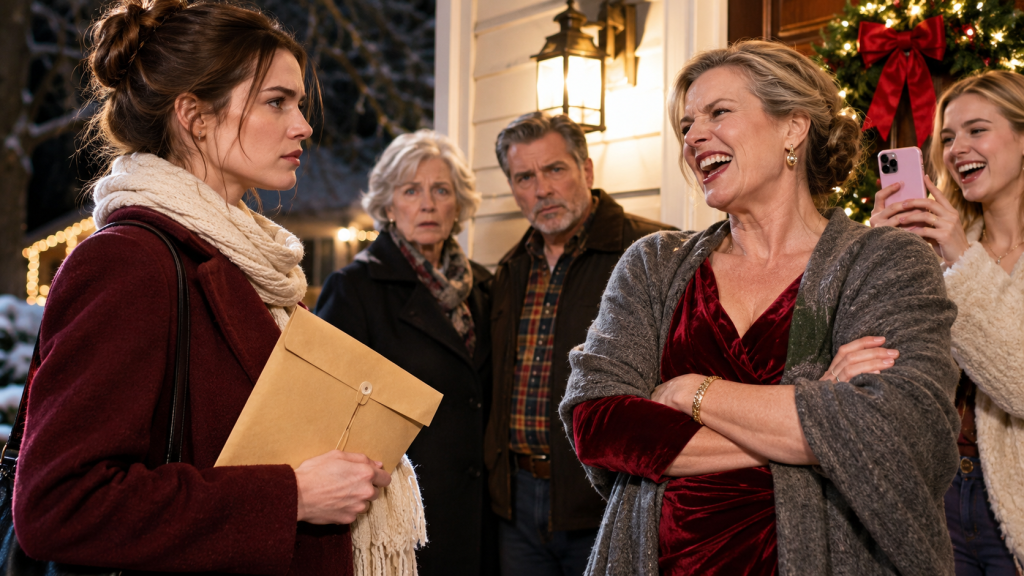
Not because it was louder than usual. But because, for the first time in my life, she wasn’t certain anyone would believe her. I folded my hands on the table. “Which part, Mom?” She looked at me. “The will? The bank account? Or the signature someone put on a document pretending to be mine?” Sylvia’s eyes narrowed. “You don’t understand what you’re talking about.”
I felt the old instinct rise. The instinct to apologize. To soften my words. To reassure her that I wasn’t angry, only confused. For thirty-four years, I’d been taught that keeping my mother comfortable mattered more than asking difficult questions. But that evening, I remained seated. “Then explain it to me.” She opened her mouth. Nothing came out. And somehow, that silence was louder than all the laughter that had greeted me on the porch.
Margaret Ellis placed the documents on the table.
“Before anyone draws conclusions,” she said calmly, “these records require proper legal review. The estate documents raise questions about the administration of Evelyn’s property, and the financial records include transactions that Ren disputes authorizing.”
My mother seized on the qualification.
“Exactly. Questions. Nothing has been proven.”
Margaret nodded.
“That’s correct. Which is why it’s important that nobody destroy, alter, or conceal relevant records.”
Addison bent down to retrieve her phone.
Her fingers were shaking.
“Mom,” she whispered, “what account is she talking about?”
Sylvia looked sharply at her.
“Don’t involve yourself.”
Addison stared.
“You involved me when you asked me to record Ren being humiliated.”
A strange quiet settled over the kitchen.
One of the neighbors cleared his throat.
Another looked toward the front door.
I could almost see them remembering how willingly they’d gathered outside to watch my mother embarrass me.
I wasn’t interested in humiliating them in return.
But I wasn’t going to protect their comfort by pretending nothing had happened.
“Everyone is free to leave,” I said.
Nobody moved.
Then Ruth stepped forward.
“Perhaps you should stay long enough to hear why Evelyn spent her final years worrying about this family.”
My mother’s face changed.
“Ruth.”
Ruth looked directly at her.
“No, Sylvia. Not tonight.”
Grandma Evelyn had been gone almost six years.
I still remembered the smell of lavender in her bedroom.
The crocheted blankets folded across the back of her sofa.
The ceramic bowl where she kept peppermints.
When I was little, I used to sit beside her at the kitchen table while she rolled piecrust.
She would hand me a small piece of dough and let me shape it into something almost recognizable.
Sometimes a star.
Sometimes a heart.
Usually a lopsided lump.
Grandma always baked it anyway.
“Nothing made with love is wasted,” she’d tell me.
When she became ill, I visited whenever I could.
I drove from North Carolina on weekends.
Picked up groceries.
Sat beside her bed.
Read aloud when her eyes grew tired.
My mother rarely acknowledged those visits.
But Grandma did.
She would hold my hand and whisper, “Ren, don’t spend your whole life asking people to choose you.”
At the time, I thought she was talking about romance.
Only now did I understand how much more she meant.
Ruth reached into her handbag and removed a small photograph.
It showed Grandma Evelyn standing on the front porch of the house where we now sat.
Her white hair was pinned neatly behind her ears.
A blue cardigan hung around her shoulders.
She was smiling.
Ruth placed the photograph beside the estate documents.
“Evelyn asked me to keep this,” she said.
My mother looked away.
Ruth continued.
“She was worried that Ren would never know what she’d tried to leave her.”
I swallowed.
“Why didn’t you tell me sooner?”
Ruth’s expression softened.
“Because I didn’t have proof of what had happened. And because, after the funeral, Sylvia told me you wanted no contact with anyone connected to the family.”
I stared at my mother.
“That’s not true.”
“I was trying to give you space,” Sylvia snapped.
Ruth shook her head.
“You told me Ren blamed Evelyn for everything and didn’t want to hear from us.”
My chest tightened.
For years, I’d believed the people in my hometown had simply forgotten me.
I’d stopped receiving invitations.
Stopped hearing from distant relatives.
Stopped learning about the family gatherings that took place without me.
Now I wondered how many of those silences had been arranged.
I looked toward Ruth.
“Why did you contact me eight months ago?”
She hesitated.
“Because I saw someone taking photographs of this house for a real estate listing.”
My heart began pounding.
I turned toward my mother.
“You were planning to sell Grandma’s house?”
Sylvia folded her arms.
“It’s a large property. Maintenance isn’t cheap.”
Margaret looked down at her documents.
“The title and estate records require additional review before anyone can determine who has authority to sell.”
Ruth nodded.
“That was my concern.”
I looked around the kitchen.
The familiar cabinets.
The worn wooden floor.
The narrow hallway where Grandma used to hang our coats.
My mother had moved into the house shortly after Grandma’s death.
She told everyone she’d inherited it.
I believed her.
After all, Grandma was her mother.
I never imagined there might be a will naming me.
And because I believed the house belonged to Sylvia, I’d sent money whenever she said something needed repairing.
A new furnace.
A leaking roof.
Insurance.
Property taxes.
I had paid because I thought my mother was struggling.
Now I was beginning to understand that I’d helped maintain an asset whose ownership had never been properly explained to me.
I looked at Margaret.
“Do we know whether Mom had legal authority to live here?”
Margaret answered carefully.
“We know Sylvia occupied the property. The administration of the estate and the effect of the will need to be examined through the appropriate legal process.”
I nodded.
It wasn’t the dramatic answer I wanted.
But it was an honest one.
And that mattered more.
Addison finally spoke.
“Ren, how much money are we talking about?”
I turned toward her.
“What money?”
“The inheritance.”
I stared at my sister.
She looked frightened.
But the question still hurt.
Not Why didn’t anyone tell you?
Not Did Grandma really want you to have the house?
Not even Are you okay?
Just how much.
Margaret opened another document.
“The property was appraised several years ago, but its current value would require an updated assessment.”
Addison shook her head.
“I mean the missing money.”
I looked at Sylvia.
She was staring at the photograph of Grandma.
Margaret continued.
“The preliminary review identified approximately sixty-two thousand dollars in transfers that warrant further investigation.”
A neighbor gasped.
Denny slowly sat down.
My mother’s eyes filled.
“Those were family expenses.”
Margaret nodded.
“Some may have been legitimate. The question is whether they were properly authorized and accounted for.”
Sylvia looked relieved.
Then Margaret continued.
“However, the account bearing Ren’s disputed signature raises a separate concern.”
My mother went still.
I leaned forward.
“Mom, why was my name used?”
She looked toward the doorway.
Then whispered, “I needed someone I could trust.”
The words struck me harder than I expected.
Trust.
For years, I’d been begging my mother to trust me enough to love me.
Now she was apparently claiming she’d trusted me while using my name without my knowledge.
Margaret placed the account application on the table.
“The records show that the account was opened several years ago using Ren’s identifying information.”
I stared at the document.
The address listed was my old apartment in North Carolina.
The telephone number was no longer mine.
The signature looked close enough to be convincing at first glance.
But it wasn’t mine.
I knew my own handwriting.
I knew how the R curved.
How the final letters leaned slightly upward.
Whoever had signed this had copied the overall shape but missed the details.
I looked at Addison.
“Did you know about this?”
She shook her head.
“No.”
Sylvia scoffed.
“Don’t act innocent, Addison.”
My sister turned.
“What?”
“You helped me organize the paperwork.”
Addison’s eyes widened.
“I helped you scan old documents!”
The room fell silent.
She continued.
“You said the bank needed copies for estate records.”
My chest tightened.
My mother stared at her.
Addison took a step backward.
“Mom, what did you do?”
Sylvia looked at me.
And for one brief moment, I saw something underneath her anger.
Fear.
Not of losing me.
But of losing control.
Denny stood.
“Sylvia, I think you need to tell the truth.”
My mother turned toward him.
“Stay out of this.”
He shook his head.
“No.”
The word seemed to surprise everyone.
Denny had been dating my mother for nearly three years.
He’d always seemed quiet.
The kind of man who preferred smiling politely to joining an argument.
But now his expression was serious.
“You told me the house belonged to you.”
Sylvia folded her arms.
“It does.”
“Then why did the realtor ask me whether the estate was settled?”
My stomach tightened.
I turned toward him.
“When?”
Denny hesitated.
“Last spring.”
Ruth looked up sharply.
He continued.
“I was helping Sylvia clean the garage. A man came to take measurements. He asked whether there were any unresolved ownership questions.”
My mother closed her eyes.
Denny swallowed.
“Sylvia told him everything had been handled.”
I looked toward Margaret.
She made a note.
Then Denny said something unexpected.
“He also asked why Ren’s name appeared in some old property paperwork.”
I stared at him.
“What did Mom say?”
Denny looked miserable.
“She said you’d signed everything over years ago.”
For a moment, I couldn’t speak.
I’d signed nothing.
No deed.
No inheritance disclaimer.
No transfer.
Nothing.
My mother began crying.
“You don’t understand what it was like!”
I looked toward her.
“Then tell me.”
She sank into a chair.
For the first time that evening, she seemed smaller.
Older.
Exhausted.
“After your grandmother died, everything was complicated.”
I nodded.
“I believe that.”
“She had debts.”
Margaret made another note.
“Those can be documented.”
Sylvia looked irritated.
“Not every family keeps perfect records!”
I took a breath.
“Mom, I work in financial compliance. I understand complicated records.”
She stared at me.
“What I don’t understand,” I continued, “is why nobody told me Grandma left a will naming me.”
My mother’s eyes filled.
Then she whispered, “Because you’d already left.”
The room went silent.
I stared at her.
“What?”
“You moved away. You built your own life. You didn’t need that house.”
My throat tightened.
“So you decided I shouldn’t have it?”
She looked down.
“Addison was still here.”
There it was.
The old explanation.
The one I’d heard my entire childhood.
Addison needed more.
Addison deserved more.
Addison was younger.
Addison was struggling.
I was strong.
I could manage.
I could go without.
My eyes filled.
“Mom, Grandma didn’t leave me the house because I needed it more than Addison.”
Sylvia looked up.
“She left it because she wanted me to have it.”
My voice broke.
“And you decided her wishes didn’t matter because you’d already decided mine didn’t.”
For a while, nobody spoke.
Then Addison looked at me.
“Ren, I didn’t know.”
I studied her face.
She looked genuinely shaken.
But I remembered her standing upstairs with her phone aimed at me.
Laughing.
Waiting to capture my humiliation.
I took a breath.
“Addison, you may not have known about the account.”
She nodded quickly.
“But you knew what tonight was.”
Her expression changed.
I continued.
“You knew there wasn’t any Christmas dinner.”
She looked down.
“You knew Mom invited me here to embarrass me.”
Her eyes filled.
“I thought it was just a joke.”
I stared at her.
“After five years?”
She couldn’t answer.
I swallowed.
“After five years without speaking, you thought inviting me home under false pretenses and recording my disappointment was funny?”
Addison began crying.
“I didn’t think you’d take it so seriously.”
I shook my head.
“That’s because you never had to wonder whether there would be a place for you at this table.”
One by one, the neighbors began leaving.
Some apologized.
Others avoided my eyes.
I didn’t ask them to stay.
Their presence had served its purpose.
They’d witnessed my mother’s attempt to humiliate me.
And now they’d witnessed her being asked questions she couldn’t dismiss with a joke.
But I hadn’t come to win an audience.
I’d come because a small part of me still hoped the letter was sincere.
That there would be a warm kitchen.
A Christmas dinner.
A family willing to begin again.
The realization that none of it had been real hurt more than the financial documents.
I looked toward the empty table.
“Do you know what I brought?”
My mother said nothing.
“Wine. Cookies. A gift for Addison.”
My sister looked up.
I swallowed.
“I spent forty minutes choosing that gift because I wanted our first Christmas together in five years to mean something.”
Tears rolled down my face.
“But you wanted a video.”
Addison began sobbing.
I looked toward Sylvia.
“And you wanted proof that I would still come running.”
My voice trembled.
“Well, Mom, you were right about one thing.”
She looked up.
“I came.”
Then I stood.
“But I won’t keep coming.”
Outside, the cold night air felt sharp against my face.
Ruth followed me onto the porch.
Margaret remained inside long enough to gather the relevant copies and conclude the conversation.
I stood beside my car, trying to steady my breathing.
Ruth touched my shoulder.
“Ren?”
I looked at her.
“I’m sorry.”
She shook her head.
“You have nothing to apologize for.”
I almost laughed.
My entire childhood had been built around apologizing.
For taking up space.
For needing help.
For asking questions.
For being disappointed when promises were broken.
Now someone was telling me I didn’t have to apologize for being hurt.
I looked toward the house.
“Did Grandma really want me to have it?”
Ruth’s eyes filled.
“Yes.”
“Why?”
She smiled sadly.
“Because you loved it.”
My throat tightened.
Ruth continued.
“She told me you were the only grandchild who remembered where everything belonged.”
I laughed through tears.
“She hated when anyone moved her measuring cups.”
Ruth smiled.
“She said you’d know how to keep the house feeling like home.”
I closed my eyes.
Then whispered, “I wish she’d told me.”
Ruth squeezed my hand.
“She tried, sweetheart. In the ways she knew how.”
Christmas morning arrived quietly.
I stayed at Ruth’s house instead of driving immediately back to North Carolina.
She insisted.
“It’s Christmas, Ren. Nobody should have to spend the morning alone after a night like that.”
Her kitchen smelled of cinnamon rolls.
A small tree glowed beside the window.
There were two stockings hanging above the fireplace.
Ruth had added a third sometime during the night.
My name was written across it in careful red letters.
When I saw it, I began crying.
Ruth looked embarrassed.
“I hope that’s all right.”
I covered my mouth.
“It’s beautiful.”
She smiled.
“I didn’t have much time.”
I looked around her modest kitchen.
There were no expensive decorations.
No elaborate presents.
No performance.
Just a woman who had opened her home because she didn’t want me to spend Christmas alone.
I hugged her.
Then whispered, “Thank you for making a place for me.”
Ruth held me tightly.
“Sweetheart, you should never have had to earn one.”
After breakfast, Margaret called.
“Ren, I’ve reviewed the documents we collected last night.”
I sat down.
“And?”
“There are several matters that need formal examination, including the estate’s administration, the disputed account, and the property records.”
I nodded.
“What happens next?”
“We’ll pursue the appropriate procedures to establish the estate’s legal position and determine whether unauthorized transactions occurred.”
I looked toward Ruth.
She was washing dishes.
I could hear Christmas music playing softly from the radio.
Then I asked, “Will I have to see my mother again?”
Margaret hesitated.
“Some proceedings may require communication or participation, but we can arrange for much of that to occur through counsel.”
I closed my eyes.
“Good.”
She continued.
“There’s another document I want to discuss.”
My stomach tightened.
“What?”
“We located a copy of a letter Evelyn wrote shortly before her death.”
I sat straighter.
“Grandma wrote another letter?”
“Yes.”
“Who was it addressed to?”
Margaret paused.
“You.”
My eyes filled.
“Can you send it?”
“I can arrange for you to review the verified copy.”
Then her voice softened.
“Ren, I think you should know that your grandmother was concerned about how your mother treated you.”
I stared at the Christmas tree.
Somehow, hearing that hurt more than anything else.
Because it meant somebody had noticed.
Somebody had seen the little girl who tried so hard to be good enough.
And somebody had wanted to protect her.
Three days later, I sat in Margaret’s office reading Grandma’s letter.
My darling Ren,
I’ve watched you spend your whole life trying to become small enough that other people will feel comfortable loving you.
My throat closed.
You work harder than anyone asks. You give more than anyone deserves. And when people disappoint you, you find ways to blame yourself.
Tears fell onto the page.
I wish I could teach you that love isn’t something you earn by exhausting yourself.
I pressed my hand against my mouth.
I am leaving you my home because I want you to have a place that belongs to you without conditions.
I began crying.
You may live there. Sell it. Rent it. Fill it with laughter. Or leave it empty while you build another life.
The decision should be yours.
I could barely see the words.
Then came the final paragraph.
Whatever you choose, promise me one thing. Never confuse being needed with being loved.
I lowered the letter.
And sobbed.
Because Grandma had understood something I’d spent thirty-four years trying to learn.
My family didn’t need me to be happy.
They needed me to remain available.
Available to pay.
Available to forgive.
Available to accept whatever place they assigned me.
And when I finally stopped, they called me selfish.
That afternoon, Margaret explained that the will and property records would require further proceedings.
The estate had not been administered as straightforwardly as my mother claimed.
There were unresolved questions concerning the property’s ownership and the transfers made after Grandma’s death.
I listened carefully.
Then asked, “Do you think I’ll get the house?”
Margaret answered honestly.
“The will is significant evidence of your grandmother’s intentions. But the legal outcome depends on the validity of the documents, the estate’s history, and the findings of the court.”
I nodded.
I appreciated that she didn’t promise a miracle.
Then she continued.
“There is also a financial matter we should discuss.”
My stomach tightened.
“The sixty-two thousand?”
“Partly.”
She opened another folder.
“We’ve obtained preliminary records indicating that an additional loan application was submitted using the account opened in your name.”
I stared at her.
“A loan?”
“Yes.”
“How much?”
Margaret hesitated.
“Forty-eight thousand dollars.”
My heart pounded.
“Was it approved?”
“We’re still verifying the final disposition.”
I closed my eyes.
Then she added something that made my stomach drop.
“The application described the funds as necessary for renovations to the Maple Drive property.”
I stared at her.
Renovations.
The same excuse my mother had used whenever she asked me for money.
The furnace.
The roof.
The insurance.
I looked at Margaret.
“Did Mom tell the lender I owned the house?”
She hesitated.
“The application identifies you as a property beneficiary and lists the residence among the supporting financial information.”
I stared at the documents.
Then whispered, “So she wasn’t just hiding Grandma’s inheritance.”
Margaret looked at me.
“She may have been using representations about that inheritance to support financial transactions. We need to establish exactly what occurred.”
My hands began trembling.
Then Margaret turned another page.
“Ren, there’s one more name on this application.”
I looked up.
“Whose?”
She paused.
“Addison’s.”
For a moment, the room went silent.
I stared at her.
“My sister?”
Margaret nodded.
“Her signature appears as a witness to the submission.”
I closed my eyes.
I remembered Addison crying in the kitchen.
Insisting she knew nothing about the account.
I remembered wanting to believe her.
Then Margaret continued.
“Ren, there’s something else. The application includes an attachment that appears to be a letter of authorization from you.”
My heart tightened.
“I never authorized anything.”
“I understand.”
Then she slid the page toward me.
At the bottom was my name.
But beneath it was a sentence that made my blood run cold.
I, Ren, voluntarily relinquish my interest in the property at 214 Maple Drive and authorize its use to secure family financial obligations.
I stared at the page.
My mother’s house.
Grandma’s house.
A property I’d been told had never belonged to me.
And somebody had prepared a document claiming I’d willingly given up my rights to it.
I looked toward Margaret.
Then whispered, “What happens if someone used that document to borrow money?”
Margaret leaned forward.
“We’ll need to determine whether any lender relied on it and whether the authorization was genuine.”
I swallowed.
Then asked the question that frightened me most.
“Could they have put Grandma’s house at risk?”
Margaret hesitated.
“Potentially. That’s why we need to examine the property records and the loan documentation immediately.”
I looked down at Grandma’s letter.
The decision should be yours.
For the first time, I understood just how much had been taken from me.
Not merely money.
Not merely an inheritance.
But the right to choose what happened to something Grandma had wanted me to have.
I reached for my telephone.
Then stopped.
Because another message had appeared.
From Addison.
Ren, I need to tell you something about the loan. Mom doesn’t know I’m contacting you.
My heart pounded.
A second message followed.
I didn’t just witness the paperwork. I know who signed your name.
I stared at the screen.
Then a third message appeared.
And if you think Mom is the only person who benefited, you need to see what Denny has been hiding.
I looked up at Margaret.
She was watching my face.
“What is it?”
I handed her the phone.
She read the messages.
Then slowly closed the folder.
“Ren,” she said, “I think the next conversation needs to happen with your attorney present.”
I looked toward Grandma’s letter.
Then toward the photograph of the little house on Maple Drive.
For years, I’d believed the most painful truth was that my mother didn’t love me the way I needed.
Now I was beginning to understand that the truth went much deeper.
Someone had been building financial arrangements around my silence.
And someone else had finally decided to break it.


