➡️ PART 3 ➡️
For thirty years, I had wondered whether my mother ever regretted leaving me behind. As a child, I imagined her returning to Saint Jude’s Group Home with tears in her eyes, explaining that she’d made a terrible mistake. I imagined her wrapping her arms around me and whispering that she’d never stopped loving me.
When Michael and Olivia Kingsley adopted me, I eventually stopped waiting for that impossible reunion. But some questions remained buried inside me. Why had she chosen Victoria? Why hadn’t she come back? And how could a mother drive away from a five-year-old child without looking through the rearview mirror?
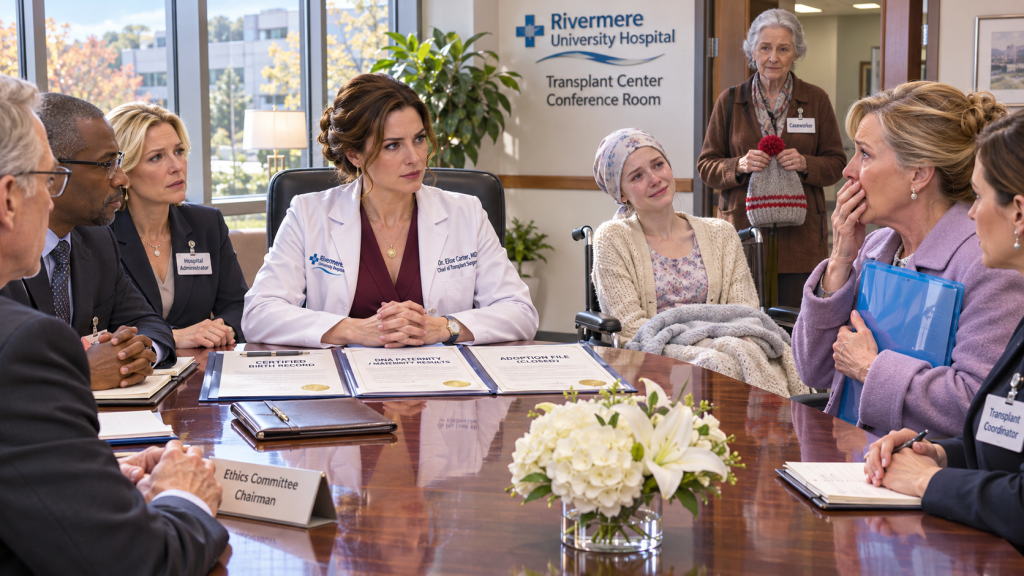
Now, standing inside the hospital conference room, I was closer to those answers than I’d ever expected. My mother sat across from me, staring at the sealed envelope Lorraine Miller had preserved for thirty years. Her face had turned almost gray. Tori looked between us. “Mom, what did you write?”
Gail Saunders opened her mouth. Nothing came out. Then Lorraine spoke. “Perhaps it’s time Annie heard the truth.” My mother reached for the envelope. “That belongs to me.” Lorraine gently moved it away. “No, Gail. It was addressed to the agency regarding Annie, and a copy was retained in her case file.” Vince leaned forward.
“This is ridiculous. We’re here because Victoria needs a transplant.”
Dr. Vance, chairman of the hospital’s ethics committee, raised his hand.
“Mr. Saunders, this meeting will remain orderly. And no medical decision will be made under pressure.”
Vince leaned back, muttering something beneath his breath.
I stared at the envelope.
My mother’s handwriting appeared across the front.
Neat.
Careful.
Almost elegant.
The same handwriting that had once labeled my lunchbox and written my name inside my winter coat.
I swallowed.
“Lorraine, may I read it?”
She looked at me gently.
“That’s your decision, Annie.”
I opened the envelope.
Inside was a single sheet of yellowed paper.
The ink had faded slightly.
But the words remained painfully clear.
To the director of Saint Jude’s,
Regarding Annie Saunders, age five.
I am voluntarily surrendering my parental rights because our household cannot provide for both daughters.
I paused.
My throat tightened.
I remembered that day.
The cold hallway.
The smell of disinfectant.
The plastic grocery bag.
The apple.
I forced myself to continue.
Victoria is younger and requires more attention. Annie is independent and will adapt more easily to another family.
My hands began trembling.
Independent.
That was what she’d called me.
At five years old.
Because I could button my own coat.
Because I could tie my shoes.
Because I knew how to comfort my little sister when she cried.
I looked toward my mother.
“You thought I could manage being abandoned because I was independent?”
Gail looked away.
I read the next sentence.
I request that the agency not contact us for reunification purposes. We wish to make a clean break and move forward with our remaining child.
For several seconds, I couldn’t breathe.
A clean break.
My mother had described the destruction of my childhood as though she were canceling a subscription.
I placed the letter on the table.
Tori stared at it.
Then whispered, “Remaining child?”
Her voice cracked.
“Mom, you called me your remaining child?”
Gail straightened in her chair.
“You don’t understand how difficult things were.”
Tori shook her head.
“No.”
Tears streamed down her face.
“I don’t understand how you could pretend Annie never existed.”
Vince rubbed his forehead.
“Everybody’s being emotional.”
I looked toward him.
“Emotional?”
He sighed.
“Annie, it happened thirty years ago.”
I stared at him.
Then said quietly, “I was five.”
He looked away.
“I know.”
“No, Vince.”
My voice trembled.
“You don’t know.”
I remembered the nights at Saint Jude’s when I listened for footsteps outside my bedroom.
Every time a car stopped near the building, I wondered whether it was my parents returning.
For months, I’d slept wearing the knitted hat my mother had left on my head.
The other children laughed because it was too small and smelled faintly of old laundry soap.
But I refused to take it off.
Because it was the last thing she’d touched before she walked away.
Lorraine stepped closer.
“Annie, there’s something else.”
I looked toward her.
She held the faded gray-and-red hat carefully between her hands.
My chest tightened.
For thirty years, I’d remembered its scratchy wool against my forehead.
Now it looked impossibly small.
Lorraine placed it beside the letter.
“You wore this every day during your first winter with us.”
I smiled through tears.
“I remember.”
She nodded.
“You kept asking whether your mother would recognize you without it.”
My throat closed.
I had forgotten that.
Or perhaps I’d buried it because the memory hurt too much.
Lorraine continued.
“When your adoptive parents came to meet you, you asked Olivia whether she’d make you throw it away.”
I looked down.
“And she said no.”
Lorraine smiled.
“She told you that loving a new family didn’t require forgetting the old one.”
At the mention of Olivia, I felt tears gather.
My adoptive mother had died four years earlier.
Cancer.
By then, I’d completed my medical training, and she’d lived long enough to watch me become a transplant surgeon.
She had been proud of everything I accomplished.
But her greatest gift had nothing to do with medicine.
She’d taught me that I didn’t have to earn the right to be loved.
I looked at the hat.
Then whispered, “I wish Mom could’ve been here.”
Lorraine squeezed my shoulder.
“She would be very proud of you.”
Across the table, Gail stiffened.
“I am her mother.”
The words fell into the silence.
I turned toward her.
“You’re the woman who gave birth to me.”
My voice trembled.
“But Olivia was the mother who raised me.”
Gail’s face reddened.
“You have no idea what sacrifices I made.”
I looked at her.
“Then tell me.”
She hesitated.
I continued.
“Tell me what happened after you left me.”
Vince shifted in his seat.
Gail looked toward him.
Then whispered, “We were struggling financially.”
I nodded.
“I understand that you had financial problems.”
Her shoulders relaxed slightly.
But I wasn’t finished.
“I also understand that hardship doesn’t explain why you told the agency never to contact you again.”
She stared at me.
I continued.
“Or why you told Victoria I’d run away.”
Tori lowered her head.
I looked toward her.
“Or why you appeared on national television claiming someone had taken me without your permission.”
Gail’s mouth tightened.
“I wanted people to help us find you.”
I shook my head.
“You wanted people to find a kidney.”
The words hung between us.
Gail’s expression hardened.
“Victoria is sick.”
“I know.”
“She could die.”
My heart tightened.
“I know that too.”
Gail leaned forward.
“Then why are you making this about something that happened decades ago?”
For a moment, I couldn’t speak.
Then I answered quietly.
“Because you never asked whether I survived those decades.”
She stared at me.
I continued.
“You didn’t ask whether I was loved.”
My voice broke.
“Whether I went to school. Whether I got sick. Whether somebody held me when I cried.”
Tears ran down my cheeks.
“You only came looking when there was something inside my body that you wanted.”
Tori began sobbing.
“Please stop.”
I turned toward her immediately.
She wiped her face.
“Annie, I didn’t know.”
My heart broke.
She continued.
“They told me you left.”
I nodded.
“I believe you.”
Her shoulders trembled.
“I thought you didn’t want me.”
I stood slowly.
For a moment, I forgot about the committee members.
The hospital attorney.
The medical records.
I walked around the conference table and knelt beside my sister’s wheelchair.
“Tori.”
She looked at me through tears.
“I was five years old.”
Her face crumpled.
“I didn’t leave you.”
I reached for her hand.
“They took me away.”
Tori leaned forward and wrapped her arms around my neck.
I held her carefully.
She was thinner than I remembered.
Her shoulders felt fragile beneath the gray sweater.
But somewhere inside that exhausted woman was the little girl who used to call me Nia.
The little girl who cried whenever she couldn’t find her favorite blanket.
The little girl I’d once promised to protect.
“I’m sorry,” she whispered.
I held her tighter.
“You don’t have anything to apologize for.”
She shook her head.
“I should’ve looked for you sooner.”
I closed my eyes.
“You were a child, Tori.”
My voice trembled.
“None of this was your responsibility.”
Dr. Vance gently cleared his throat.
“Annie, Victoria, I think we should pause the meeting.”
I nodded.
He looked toward Gail and Vince.
“The medical portion of this discussion is concluded for today.”
Gail immediately stood.
“What about the transplant?”
The transplant coordinator answered.
“Any potential living donation must proceed through independent assessment, and no donor can be pressured into surgery.”
Gail pointed toward me.
“But she’s compatible.”
Dr. Vance’s expression remained calm.
“Compatibility is only one part of the evaluation.”
Vince crossed his arms.
“So you’re refusing to help Victoria?”
I looked toward him.
“No.”
Then I took a breath.
“I’m refusing to let you decide what happens to my body.”
After the meeting, I walked into the hallway.
Dad was waiting beside the vending machines.
Michael Kingsley.
The man who’d adopted me when I was seven.
He stood when he saw me.
“Annie?”
For a moment, I tried to speak.
Then everything I’d held together inside the conference room came apart.
I walked into his arms.
He held me.
Just as he’d done when I was a frightened little girl who woke from nightmares.
“I read the letter,” I whispered.
His arms tightened around me.
“I know.”
“She told them not to contact her.”
Dad kissed the top of my head.
“I’m sorry, sweetheart.”
I began crying harder.
He didn’t tell me to stop.
Didn’t remind me that thirty years had passed.
Didn’t suggest I should be grateful for what I’d become.
He simply stayed.
Eventually, Dad stepped back and looked into my eyes.
“Did you see the hat?”
I nodded.
He smiled sadly.
“Olivia kept asking Lorraine about it when we first adopted you.”
I looked up.
“She did?”
“She wanted to make sure you had it.”
My throat tightened.
He continued.
“You used to sleep with it under your pillow.”
I wiped my face.
“I remember.”
Dad smiled.
“One night, you asked Olivia whether she’d ever leave you.”
My heart tightened.
“She told you something I’ve never forgotten.”
I looked at him.
“What?”
He smiled through tears.
“She said, ‘Annie, families don’t become smaller because someone needs more love. They become stronger when everyone gets enough.'”
I began crying again.
That evening, I returned to my apartment.
I sat beside the window holding the little knitted hat.
For a long time, I simply stared at it.
The stitches were uneven.
The red stripe had faded.
And one corner was unraveling.
It looked like something that should’ve been thrown away years ago.
But to me, it represented the five-year-old girl I’d once been.
The child who’d believed she was extra.
Unnecessary.
Too expensive to keep.
I held the hat against my chest.
Then whispered, “You were never extra.”
My voice broke.
“Not for one second.”
The next morning, I received a message from Tori.
Can we meet without Mom and Vince?
I stared at the screen.
Then replied.
Of course.
We met at a quiet café near the hospital.
She arrived wearing a pale blue scarf.
Her face looked tired.
But when she saw me, she smiled.
For the first time in thirty years, I saw the little girl I remembered.
“Nia.”
I smiled through tears.
“Tory Bear.”
She laughed softly.
“I can’t believe you remember that.”
I nodded.
“How could I forget?”
We sat together for nearly three hours.
She told me about her childhood.
Her school years.
Her love of music.
Her marriage, which had ended two years earlier.
And the dialysis treatments that had gradually taken over her life.
I told her about Michael and Olivia.
About medical school.
About the first transplant surgery I’d assisted with.
And the day I was appointed chief.
Tori stared at me.
“You’re incredible.”
I shook my head.
“I had help.”
She smiled.
“Still.”
For a moment, we simply looked at each other.
Two sisters separated for thirty years.
Trying to fit an entire childhood into a single afternoon.
Eventually, Tori lowered her eyes.
“Can I ask you something?”
I nodded.
“Anything.”
She hesitated.
“Are you really considering donating?”
My chest tightened.
I took a breath.
“Yes.”
Her eyes filled.
“Annie, you don’t have to.”
“I know.”
She shook her head.
“I don’t want you to feel responsible for me.”
I reached for her hand.
“Tori, I don’t.”
She looked up.
I continued.
“I want you to understand something.”
My voice softened.
“I’m not considering this because Mom demanded it.”
She nodded.
“And I’m not doing it because I owe anybody a debt.”
Tears filled her eyes.
“I’m considering it because you’re my sister.”
For several seconds, Tori couldn’t speak.
Then whispered, “What if something happens to you?”
I smiled sadly.
“That’s exactly why there’s a thorough medical evaluation.”
She swallowed.
“What if they say it’s too risky?”
“Then I won’t donate.”
Her eyes widened slightly.
I continued.
“And we’ll keep looking at other options.”
She stared at me.
I squeezed her hand.
“Your life matters, Tori.”
My throat tightened.
“But mine does too.”
She began crying.
Then nodded.
“Yes.”
In the weeks that followed, I stepped away from all clinical decision-making involving Tori’s transplant.
Another transplant team took responsibility for her care.
An independent living-donor advocate was assigned to support me.
I underwent further medical testing.
Bloodwork.
Imaging.
Psychological assessment.
And conversations about the risks of donating a kidney.
The doctors were careful.
They asked about my motivations.
About my childhood.
About the sudden reunion with my biological family.
And whether I felt pressured.
I answered honestly.
I told them about the group home.
The apple.
The surrender letter.
And my mother’s demand that I give Victoria a kidney because I supposedly owed the family.
The advocate listened carefully.
Then asked, “Do you feel free to change your mind?”
I considered the question.
Then nodded.
“Yes.”
She smiled gently.
“That’s important.”
One afternoon, I received a call from Lorraine.
“Annie, there’s something I need to tell you.”
My stomach tightened.
“What is it?”
She hesitated.
“I’ve been reviewing the old agency correspondence.”
I sat down.
“Why?”
“Because there was something about your case I remembered but couldn’t explain.”
My heart began pounding.
“What?”
Lorraine took a breath.
“Your mother wasn’t the only person who contacted Saint Jude’s after you were placed there.”
I stared at the wall.
“What do you mean?”
She continued.
“Someone called asking about you.”
My hands began trembling.
“Who?”
There was a pause.
Then Lorraine whispered.
“Your biological father.”
For several seconds, I couldn’t speak.
My biological father had been a shadow throughout my life.
I knew very little about him.
Gail had married Vince when I was young.
And I’d grown up believing Vince was the only father I’d ever known.
At Saint Jude’s, nobody had been able to tell me much about the man listed on my original birth certificate.
I swallowed.
“Are you sure?”
Lorraine answered carefully.
“The correspondence identifies him by name, but we would need to verify the details.”
My heart tightened.
“What did he want?”
Her voice softened.
“He asked whether you were safe.”
I closed my eyes.
Then whispered, “Did he want to see me?”
Lorraine hesitated.
“Annie, there’s a letter.”
My hands began trembling.
“What letter?”
She took a breath.
“A letter from him, dated eight months after you were placed at Saint Jude’s.”
I gripped the telephone.
“What does it say?”
Lorraine was silent for a moment.
Then answered.
“He wrote that he’d only recently learned you were in care.”
My heart pounded.
“He didn’t know?”
“According to the letter, no.”
I closed my eyes.
For thirty years, I’d believed both my biological parents had willingly disappeared from my life.
Now another possibility was opening before me.
I swallowed.
“What happened to him?”
Lorraine paused.
“That’s what I wanted to discuss.”
My chest tightened.
She continued.
“The agency records suggest he attempted to establish contact.”
I stared at the wall.
“And?”
Her voice trembled slightly.
“The response in the file says he was told you had already been adopted and that further contact wasn’t possible.”
I froze.
“But I wasn’t adopted until I was seven.”
Lorraine was silent.
Then whispered.
“I know.”
That evening, I drove to Dad’s apartment.
Michael was sitting beside the fireplace reading.
He looked up when I entered.
“Annie?”
I closed the door.
For a moment, I couldn’t speak.
Then whispered, “Dad, what do you know about my biological father?”
His expression changed.
He placed the book aside.
“Why?”
I sat down.
“Lorraine found a letter.”
Dad’s face softened.
He listened as I explained.
When I finished, he was quiet for a long time.
Then said, “Your mother and I knew there had been some uncertainty about the information in your original case file.”
My heart tightened.
“What uncertainty?”
He swallowed.
“Some relatives had been difficult to locate. The agency assured us the adoption was legally cleared.”
I nodded slowly.
Then whispered, “Did anyone tell you my biological father had tried to find me?”
Dad shook his head.
“No.”
His eyes filled.
“Annie, if we’d known someone was searching for you, we would’ve wanted the matter handled properly.”
I believed him.
Because Michael and Olivia had never taught me that love required someone else to disappear.
The following morning, I contacted Lorraine again.
“Can I see the letter?”
“Of course.”
My heart pounded.
Then I asked.
“What’s his name?”
There was a pause.
Lorraine answered.
“Thomas Mercer.”
I repeated it softly.
Thomas Mercer.
A name I’d barely known.
A man who might have wanted to find me.
A father whose story had never been told.
Then Lorraine said something that made my breath catch.
“Annie, I found a recent address associated with him.”
I stood.
“Recent?”
“Yes.”
My hands began trembling.
“Does that mean he’s alive?”
Lorraine answered carefully.
“We believe he may be.”
For the rest of the day, I could barely concentrate.
I walked through the hospital corridors.
Reviewed schedules.
Answered routine questions.
But my thoughts kept returning to the same possibility.
Somewhere in the world, there might be a man who’d spent thirty years believing I was unreachable.
A man who’d written letters.
Asked questions.
And perhaps wondered whether I was alive.
I didn’t know what kind of father he’d been.
I didn’t know whether the records told the full story.
And I refused to replace one painful assumption with another.
But I wanted answers.
That evening, Tori called.
“Nia?”
“Hi, sweetheart.”
She hesitated.
“Mom’s been asking about you.”
I closed my eyes.
“What does she want?”
Tori sighed.
“She wants to know whether the donor evaluation is finished.”
My stomach tightened.
“Of course she does.”
Tori was quiet.
Then said, “I told her to stop.”
I smiled sadly.
“Thank you.”
She continued.
“She got angry.”
I nodded.
“That sounds familiar.”
Then Tori whispered.
“Annie, there’s something else.”
My chest tightened.
“What?”
She hesitated.
“I heard Mom and Vince arguing last night.”
I sat down.
“About what?”
Her voice trembled.
“About your father.”
I closed my eyes.
“Thomas Mercer?”
Tori gasped.
“You know his name?”
My heart pounded.
“Yes.”
For several seconds, neither spoke.
Then she whispered.
“Mom said he wasn’t supposed to find out.”
I gripped the phone.
“Find out what?”
Tori swallowed.
“That you were still at Saint Jude’s when he started looking.”
My chest tightened.
“What else did she say?”
There was a long pause.
Then Tori whispered.
“Vince told her she’d promised to make sure Thomas never found you.”
I sat completely still.
For thirty years, I’d believed I was the child nobody wanted.
The extra daughter.
The little girl who could be left behind because her parents couldn’t afford two children.
But now, there was evidence that someone might have tried to find me.
Someone who’d been kept away.
Someone whose absence might not have been a choice at all.
I looked toward the faded little hat resting on my desk.
Then whispered.
“Tori, I need to know everything.”
Her voice broke.
“I know.”
I closed my eyes.
Because suddenly, my mother’s old letter wasn’t the only secret I needed to confront.
And the truth I was about to uncover might change everything I believed about the family I’d lost.
For thirty years, I’d asked why nobody came back for me.
Now I was beginning to wonder whether someone had tried—and whether my mother had made sure he never reached me.