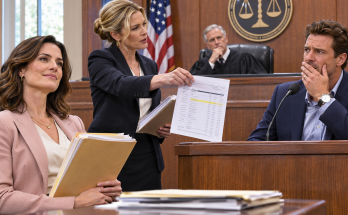
➡️ PART 3 ➡️
For thirty-eight years, I’d made my living understanding numbers. Numbers didn’t care whether you were wearing diamonds or a dress bought on clearance. They didn’t care whether your husband had a private airplane or a pickup truck with a cracked windshield. Numbers simply told the truth, provided you knew where to look. And on that October afternoon in Lubbock, sitting across from my younger sister in a lawyer’s conference room, I watched the truth drain every bit of color from her carefully made-up face.
Mr. Haskins had just revealed that royalty payments belonging to Clay Dobbs’s business interests had been redirected into an account opened in Tammy’s name. My sister’s mouth opened. Then closed. Her Dallas attorney, Mr. Fletcher, leaned toward her. “Tammy, don’t say anything until we’ve reviewed those documents.”
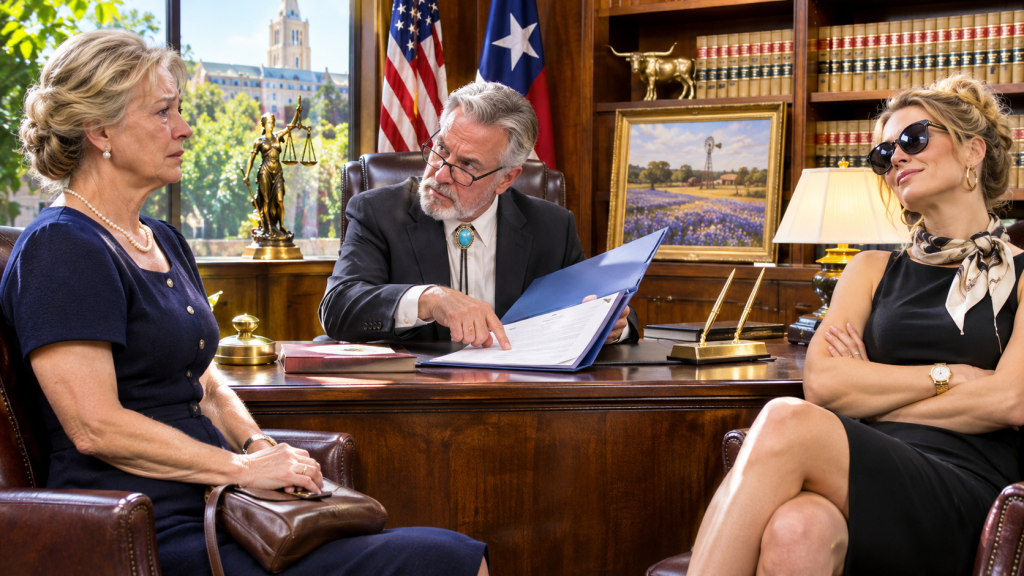
But Tammy had never been particularly good at following advice when she believed somebody was challenging her. “That’s my husband’s money,” she snapped. “He gave me access to everything.” Mr. Haskins calmly adjusted his reading glasses. “Access to an account and authorization to divert payments are two different things.” I looked down at the old partnership agreement lying before me.
August 1994. The year our lives changed. The year Clay returned home covered in drilling mud, lifted me off the kitchen floor, and announced that our little well had finally started producing. I’d believed that was the beginning of our future. I hadn’t known then how much money could change a man. Or how much greed could change a sister. “How much money are we talking about?” I asked.
My voice sounded surprisingly steady.
Mr. Haskins opened another folder.
“The preliminary accounting identifies approximately two million, four hundred thousand dollars in disputed royalty distributions.”
I stared at him.
Two million.
Four hundred thousand.
Across the table, Tammy reached for her water glass.
Her fingers were shaking.
“That’s impossible,” she whispered.
Mr. Haskins looked toward her.
“The transactions occurred over several months. We’re still determining which payments were properly authorized and which were not.”
Tammy turned toward her lawyer.
“Tell him Clay gave me permission.”
Mr. Fletcher didn’t answer.
Instead, he studied the statements.
Then quietly asked, “Mrs. Dobbs, do you have documentation supporting that permission?”
Tammy’s expression changed.
“Clay was my husband.”
Mr. Fletcher lowered his voice.
“That’s not what I asked.”
For the first time since I entered the conference room, I felt something other than sadness.
I felt clarity.
Tammy had spent nearly a year reminding everyone she was Clay’s wife.
She said it at church.
At family dinners.
At the grocery store when she ran into women who’d known us for decades.
She treated marriage like a deed of ownership.
But now, confronted with actual deeds, agreements, and bank records, that word wasn’t enough.
Wife.
It was a relationship.
Not an explanation for every transaction.
Mr. Haskins looked toward me.
“Marlene, there’s something I need to clarify about the partnership agreement.”
I nodded.
“Go ahead.”
“Clay assigned you a thirty percent overriding royalty interest in specified production revenues in 1994. We’ve located the original agreement and related supporting records.”
I touched the yellowed paper.
“I remember signing it.”
“Do you remember why?”
I smiled sadly.
“Because the bank wouldn’t finance the completion costs unless we put up additional security.”
Mr. Haskins nodded.
“And you contributed funds from an account you maintained before the marriage.”
I looked up.
“That was my mother’s inheritance.”
A memory returned so vividly that I could almost smell the dust inside our old trailer.
Clay sitting at the kitchen table.
An unpaid invoice.
His hands shaking as he admitted we might lose everything.
I’d gone to the bank the next morning and withdrawn the money Mama left me.
Forty-six thousand dollars.
Everything she’d saved from thirty years working at a school cafeteria.
I’d handed Clay the cashier’s check.
He’d cried.
Then he’d promised I’d never regret believing in him.
Mr. Haskins turned another page.
“The agreement described the interest as compensation for that contribution and your bookkeeping services. Its continuing legal effect needs careful examination alongside the divorce decree, recorded instruments, and subsequent conveyances.”
Tammy leaned forward.
“But Clay sold the wells.”
“Some company assets were sold,” he replied. “We need to establish exactly which interests transferred and which remained outstanding.”
I nodded slowly.
I’d spent years assuming our divorce had settled everything.
I hadn’t thought about that yellowed agreement since 2011.
The monthly payments had arrived regularly.
My house was mine.
My life had become peaceful.
And I’d stopped looking backward.
Now I wondered how many years I’d spent misunderstanding something I’d once helped create.
“Why didn’t Clay tell me?” I whispered.
Mr. Haskins glanced toward the sealed letter.
“I believe that’s part of what he hoped to explain.”
I unfolded the next page.
Clay’s handwriting was shakier than I remembered.
Marlene,
I have spent more years than I deserve pretending that what happened between us erased what you contributed.
I let people call me a self-made man.
I let them believe I started with nothing.
But I never started with nothing.
I started with you.
My eyes filled.
Across the table, Tammy gave an impatient sigh.
I ignored her.
You worked while I drilled.
You kept our bills paid.
You believed in me when every bank in West Texas believed I was a fool.
And when I betrayed you, you left with more grace than I deserved.
I pressed the paper against my chest.
For years, I had told myself Clay’s opinion no longer mattered.
But hearing him acknowledge what I’d given was like discovering a door inside my heart that had never fully closed.
The meeting ended without any final distribution.
Mr. Haskins explained that the estate would require formal administration, outstanding ownership questions needed investigation, and Tammy’s rights as surviving spouse would have to be addressed under Texas law.
No one could simply announce who owned everything.
Not Tammy.
Not me.
Not even the attorney.
The documents would have to speak.
And where they disagreed, the courts might have to decide.
I appreciated that.
After thirty-eight years of bookkeeping, I had no interest in replacing one person’s arrogance with another person’s assumptions.
Outside, the October wind swept across the parking lot.
Tammy followed me toward my Buick.
“Marlene!”
I stopped.
She marched toward me, her heels striking the pavement.
“You knew about this.”
I turned.
“About what?”
“That agreement.”
“I remembered signing something thirty years ago. I didn’t know Clay still had it.”
She folded her arms.
“Don’t play innocent.”
I looked at my sister.
Nine years younger.
Same brown eyes as our mother.
Same stubborn chin.
But somewhere along the way, we’d become strangers.
“Tammy, you married Clay knowing what happened between us.”
She gave a humorless laugh.
“You divorced him.”
“Yes.”
“And now you’re trying to take what belongs to me.”
I shook my head.
“No, honey.”
My voice was quiet.
“I’m trying to understand what belonged to me all along.”
Her face hardened.
“Clay loved me.”
For a moment, I felt an unexpected sadness.
Maybe he had.
Maybe he’d loved us both at different times.
Maybe he’d spent his whole life confusing affection with possession.
I no longer needed to settle that question.
“I hope he did,” I answered.
Tammy stared at me.
Then whispered something cruel.
“He never talked about you.”
I looked toward the letter in my purse.
“Apparently, there were some things he didn’t talk about with either of us.”
I got into my car.
And drove away before she could answer.
That evening, I stopped at First Baptist.
Wednesday prayer meeting had just ended.
Mrs. Peabody stood near the fellowship hall carrying a covered casserole dish.
She spotted me immediately.
“Marlene, honey!”
I smiled.
“Evening, Ruth.”
She looked carefully at my face.
“How’d the lawyer meeting go?”
I hesitated.
“Complicated.”
She nodded as though I’d confirmed something she’d known all along.
“Well, life’s generally complicated when money gets involved.”
I laughed softly.
“That it is.”
She touched my arm.
“Are you alright?”
I thought about the letter.
The old partnership agreement.
The look on Tammy’s face.
Then answered honestly.
“I think I’m going to be.”
When I got home, I made tea and sat at my dining table.
The house was quiet.
I’d lived there alone for years.
The silence had become something I valued.
I liked choosing what music played.
I liked leaving a book open beside my chair.
I liked knowing the money in my accounts came from work I understood.
But that evening, the house felt full of memories.
I could almost see Clay coming through the door in his muddy boots.
Hear him asking whether we could afford another drilling invoice.
Remember the nights I’d sat with a calculator while he slept, trying to keep our little company alive.
Money had arrived eventually.
Then comfort.
Then expensive trucks.
Then a downtown office.
Then Krystal at the front desk.
And finally, the moment I realized Clay had begun treating loyalty like something he could purchase somewhere else.
I opened his letter again.
At the bottom, beneath his signature, he’d written one final paragraph.
There is something else you deserve to know.
My stomach tightened.
I found irregularities in the royalty accounts shortly before my death. I asked Haskins to investigate because I could no longer trust the explanations I was receiving.
Please don’t assume every person who says they love me has acted in my interests.
I read the words three times.
Then noticed a handwritten reference beneath them.
Ledger 17B.
I frowned.
Clay had always used numbered ledgers.
Even after the business adopted computerized accounting, he insisted on keeping certain summaries in hard copy.
I’d teased him about it.
“One day, you’ll have enough paper to insulate the whole trailer.”
He’d laughed.
Now, thirty years later, a ledger number might hold the answer to where millions of dollars had gone.
The next morning, I called Mr. Haskins.
“Do you have Ledger 17B?”
There was a pause.
“Why do you ask?”
“Clay referenced it in his letter.”
Mr. Haskins exhaled.
“I wondered whether you’d notice that.”
My heart tightened.
“You have it?”
“Not yet.”
I sat straighter.
“What do you mean?”
“Clay told me he’d placed certain documents in a secure location. We’ve identified where he maintained records, but we’re still arranging access through the estate administration.”
I looked toward the window.
“Where?”
A moment passed.
Then he answered.
“His old office near the original drilling yard.”
I nearly laughed.
The little brick building outside Snyder.
Clay’s first real office.
The place we’d used after moving out of the single-wide.
“Is that building still standing?”
“Apparently.”
I closed my eyes.
I knew exactly where it was.
Two days later, I accompanied Mr. Haskins and an authorized estate representative to the property.
The building looked smaller than I remembered.
Its paint had faded.
Weeds grew along the fence.
And the old Dobbs Oil sign hung crooked above the entrance.
I stood beside my Buick for a moment.
The last time I’d visited, Clay and I were still married.
He’d been planning to expand.
I’d been trying to reconcile three months of unpaid invoices.
I remembered standing outside that door and arguing because he wanted to purchase a new truck before paying our suppliers.
He’d called me overly cautious.
I’d called him reckless.
We’d both been right.
Inside, dust covered the furniture.
The office smelled of old paper and machine oil.
Mr. Haskins examined the inventory prepared for the estate.
Then we approached the metal filing cabinets against the rear wall.
One drawer was labeled:
PRODUCTION RECORDS — 1994–2008.
My heart tightened.
I remembered making those labels.
I used a little handheld label maker Clay bought me for Christmas.
He’d joked that I loved it more than jewelry.
He wasn’t entirely wrong.
The estate representative opened the cabinet.
Inside were neatly arranged folders.
Lease agreements.
Production statements.
Old tax records.
Then, near the back, a blue binder.
LEDGER 17B.
I stared at it.
Mr. Haskins carefully removed it and placed it on the desk.
“Let’s document this before examining it.”
I nodded.
For the first time that morning, my hands began shaking.
The ledger contained copies of royalty statements and handwritten notes.
Some pages were familiar.
Others covered transactions made long after our divorce.
Mr. Haskins turned to a section dated several months before Clay’s death.
There were transfers.
Account numbers.
And repeated entries bearing a notation:
TRD — HOLD FOR REVIEW.
I frowned.
“TRD?”
Mr. Haskins nodded.
“Tammy R. Dobbs.”
My stomach tightened.
Clay had apparently been tracking payments associated with my sister.
But what caught my attention was something else.
Several transfers had been divided into amounts just below the threshold Clay’s internal accounting procedures required for additional review.
I pointed toward them.
“That’s unusual.”
Mr. Haskins leaned closer.
“What do you see?”
“Look at the dates.”
I turned another page.
“These were made in clusters.”
I swallowed.
“And each cluster was followed by an adjustment entry that made the account appear balanced.”
He studied the figures.
Then looked toward me.
“Marlene, can you explain that?”
I nodded.
“Someone may have been using offsetting entries to conceal the movement of money.”
Mr. Haskins sat back.
For several seconds, he said nothing.
Then whispered.
“Clay suspected that.”
I looked up.
“He told you?”
“Yes.”
My chest tightened.
“What exactly did he say?”
The attorney looked toward the ledger.
“He said the reports didn’t smell right.”
I smiled sadly.
That was Clay.
He’d never understood why accountants spoke in precise terminology when, as he liked to say, a crooked deal usually smelled crooked before anyone could prove it.
I looked down at the figures.
“Well,” I whispered, “he wasn’t imagining things.”
We arranged for the ledger and supporting documents to be copied and examined by an independent forensic accountant.
I didn’t take the originals.
I didn’t alter anything.
The records belonged in the proper hands.
But before leaving, Mr. Haskins asked me a question.
“Marlene, would you be willing to help us understand the historical records?”
I hesitated.
“I haven’t worked for Clay’s company in years.”
“I know.”
“And I won’t do anything that creates a conflict with my own financial interests.”
He nodded.
“That’s appropriate.”
I thought for a moment.
Then answered.
“I can explain the systems I created. But an independent professional needs to draw the conclusions.”
Mr. Haskins smiled.
“That sounds exactly like you.”
A week later, the forensic accountant, Nina Delgado, invited me to review several old entries with her.
She was a sharp-eyed woman in her forties who asked excellent questions.
Within an hour, we’d found inconsistencies in the way certain royalty distributions were recorded.
Not every discrepancy was fraud.
Some were coding errors.
Some reflected legitimate adjustments.
But several couldn’t be explained by the supporting documents.
Nina leaned back.
“Who had authority to initiate these transfers?”
I examined the authorization list.
“Clay.”
“And?”
I looked toward another name.
“Tammy.”
Nina nodded.
“Anyone else?”
I hesitated.
Then noticed a third signature.
A name I hadn’t expected.
Harold Vance.
My stomach tightened.
“Well, I’ll be.”
Nina looked up.
“Do you know him?”
I nodded.
“Harold was Clay’s field operations manager.”
“Was?”
“He retired about five years ago.”
I swallowed.
“But he still attended Clay’s hunting weekends.”
Harold Vance.
One of the men reportedly present when Clay suffered his stroke.
I remembered him from our early drilling days.
He was always quiet.
Always dependable.
The sort of man who could repair anything with a wrench and a length of wire.
But his name appeared repeatedly on authorization records tied to the disputed transfers.
I pointed toward the dates.
“Harold signed off on these.”
Nina nodded.
“That’s what the records show.”
I stared at the page.
Then another memory returned.
At Clay’s funeral, Harold had avoided looking at me.
I’d assumed he was uncomfortable because Tammy was nearby.
Now I wondered whether his discomfort had another explanation.
That evening, I received a phone call from Tammy.
I almost let it ring.
But eventually, I answered.
“Hello, Tammy.”
Her voice sounded strained.
“Marlene, we need to talk.”
I sat down.
“About what?”
“The investigation.”
I closed my eyes.
“Your attorney should speak with Mr. Haskins.”
She exhaled sharply.
“That’s exactly the problem.”
I frowned.
“What?”
“Everybody’s treating me like a criminal.”
I took a slow breath.
“Tammy, people are asking questions about missing money.”
She began crying.
“You don’t understand.”
My heart tightened.
“Then help me understand.”
There was a long silence.
Finally, she whispered.
“Clay knew about some of those transfers.”
I stared at the wall.
“Then you should provide the records showing his authorization.”
Tammy sniffed.
“I don’t have everything.”
“Why not?”
Her voice trembled.
“Because Harold handled the paperwork.”
My stomach tightened.
“Harold Vance?”
She went silent.
I leaned forward.
“Tammy, what did Harold do?”
For several seconds, I heard only her breathing.
Then she whispered.
“He said he could help us protect the money.”
My heart pounded.
“Protect it from what?”
Tammy hesitated.
“From people who might make claims against the estate.”
I closed my eyes.
“Tammy, Clay wasn’t dead yet.”
“I know.”
My voice became very quiet.
“Then why were you discussing protecting money from his estate?”
Tammy began sobbing.
“I didn’t think anything would happen to him.”
I gripped the telephone.
“What do you mean?”
She swallowed.
“He’d been having headaches.”
My stomach tightened.
“And?”
“He was exhausted. His blood pressure was high.”
I stared at the wall.
“Did he see a doctor?”
“He said he’d make an appointment.”
I closed my eyes.
Then Tammy whispered.
“Harold told me Clay was making changes to his will.”
My heart pounded.
“How did Harold know?”
“I don’t know.”
I took a slow breath.
“Tammy, did you try to stop Clay from changing it?”
She hesitated.
Then whispered.
“I tried to convince him to wait.”
For several seconds, I couldn’t speak.
The sister who’d married my ex-husband after his company sold its acreage for an estimated four hundred million dollars was now telling me she’d known he was reconsidering his estate plans.
And someone else had been helping move money.
I looked toward Clay’s letter.
The words seemed to glow beneath the lamp.
Please don’t assume every person who says they love me has acted in my interests.
I swallowed.
“Tammy, did you know Clay intended to acknowledge my royalty interest?”
There was silence.
Then she whispered.
“Yes.”
My heart sank.
“And you didn’t tell me.”
Her voice cracked.
“Why would I?”
I closed my eyes.
Because there it was.
After all these years, my little sister still believed that anything given to me was something taken away from her.
The following morning, Mr. Haskins called.
His voice was serious.
“Marlene, we’ve found another document.”
I sat down.
“What kind?”
“A memorandum Clay prepared shortly before his death.”
My stomach tightened.
“About the royalties?”
“Partly.”
I swallowed.
“What else?”
“His concerns about the transfers.”
I looked toward the window.
Then he continued.
“Clay requested an independent audit and instructed that certain records be preserved.”
I nodded.
“That’s good.”
But Mr. Haskins wasn’t finished.
“Marlene, there’s something else you should know.”
My heart pounded.
“What?”
“He also asked me to review an amendment affecting Tammy’s expected inheritance.”
I froze.
“Why?”
The attorney hesitated.
“Because he believed someone had been misleading him.”
I sat motionless.
Then whispered.
“Who?”
Mr. Haskins took a slow breath.
“That’s what the audit may help establish.”
I closed my eyes.
I didn’t want revenge against Tammy.
I didn’t want to see her humiliated.
But I couldn’t ignore the possibility that she had been involved in something far more serious than an ordinary financial dispute.
That afternoon, I visited Mama.
She was eighty-eight and lived in an assisted living apartment near Slide Road.
Her memory wasn’t perfect anymore.
But she still recognized both her daughters.
And she still had a remarkable talent for telling the truth nobody wanted to hear.
I sat beside her while she worked on a crossword puzzle.
“Mama?”
She looked up.
“Yes, honey?”
“Did you ever think Tammy and I would end up like this?”
Mama placed down her pencil.
For a long time, she studied my face.
Then said quietly.
“Your sister always thought love was something she had to win.”
My eyes filled.
“What do you mean?”
Mama sighed.
“When you were little, people praised you for being responsible.”
I nodded.
“And Tammy thought that meant there wasn’t enough praise left for her.”
I swallowed.
“I never wanted her to feel that way.”
Mama reached for my hand.
“I know.”
Then she whispered.
“But you can’t spend your whole life making yourself smaller so somebody else can feel important.”
I began crying.
Mama patted my hand.
“You didn’t steal Clay from Tammy.”
I looked up.
“She married him after we divorced.”
Mama nodded.
“And that was her choice.”
Her eyes softened.
“But what she did afterward was her responsibility.”
I sat quietly.
Then whispered.
“I don’t want to hate her.”
Mama smiled sadly.
“Then don’t.”
She squeezed my hand.
“But don’t confuse refusing to hate somebody with giving them permission to hurt you.”
Two days later, Nina Delgado called with an urgent request.
“Marlene, can you come by the office?”
I frowned.
“Has something happened?”
“We’ve identified a series of transactions that require closer examination.”
My stomach tightened.
“More payments to Tammy?”
“Not exactly.”
I sat down.
“What do you mean?”
Nina hesitated.
“Some funds were transferred into an account controlled by a company called Mesa Creek Resources.”
The name sounded familiar.
I closed my eyes.
I’d heard it somewhere.
Then I remembered.
Harold Vance had mentioned Mesa Creek years earlier.
A small company involved in acquiring mineral interests.
I looked toward the telephone.
“Is Harold connected to that business?”
Nina answered carefully.
“His name appears in the corporate records.”
My heart pounded.
“And Tammy?”
“There’s evidence of transactions involving accounts associated with her.”
I gripped the edge of the table.
For months, I’d assumed Tammy had simply been helping herself to Clay’s wealth.
Now the picture was changing.
Harold Vance.
The old field manager.
The trusted hunting companion.
The man who’d reportedly been with Clay when he suffered his fatal stroke.
His name was appearing repeatedly in records involving unexplained transfers.
I swallowed.
“Nina, do you think Harold was taking money?”
She answered carefully.
“We have evidence of transfers. Whether they were authorized and for what purpose still needs investigation.”
I nodded.
But my stomach wouldn’t stop tightening.
That evening, I received an unexpected visitor.
A pickup truck pulled into my driveway shortly after sunset.
I looked through the window.
Harold Vance stepped out.
He looked older than I remembered.
His shoulders were hunched.
His face was lined with exhaustion.
I didn’t open the door immediately.
Instead, I called Mr. Haskins and told him Harold was outside.
He advised me not to discuss disputed financial matters without appropriate representation.
I agreed.
Then I stepped onto the porch.
“Evening, Harold.”
He removed his hat.
“Marlene.”
I folded my arms.
“What can I do for you?”
He looked toward the street.
Then back at me.
“I heard you’ve been asking questions.”
I nodded.
“That’s true.”
He swallowed.
“Some things are better left alone.”
My heart tightened.
I studied his face.
“Harold, are you threatening me?”
His eyes widened.
“No, ma’am.”
“Then what are you saying?”
He rubbed his forehead.
“Clay was under a lot of pressure before he died.”
I nodded.
“I’ve heard.”
Harold’s voice lowered.
“He was planning to make changes.”
“What changes?”
He hesitated.
“To the business. To his estate.”
I stared at him.
“Then why are you here?”
For several seconds, he said nothing.
Finally, he whispered.
“Because Tammy doesn’t know everything.”
My stomach tightened.
“What doesn’t she know?”
Harold looked toward his pickup.
Then back at me.
“Clay had another set of records.”
I frowned.
“Where?”
He swallowed.
“I can’t say here.”
I shook my head.
“Then speak with Mr. Haskins.”
Harold’s eyes filled.
“Marlene, you need to understand something.”
I remained silent.
He took a shaky breath.
“Clay discovered that money was being moved.”
I nodded.
“We know that.”
Harold looked devastated.
Then whispered.
“But he also discovered who had been signing his name.”
For several seconds, I couldn’t breathe.
“Who?”
Harold lowered his head.
Then said something that made my blood run cold.
“It wasn’t Tammy.”
I stared at him.
“Then who?”
His hands began trembling.
He looked toward the darkening sky.
Then whispered.
“Marlene, I made a terrible mistake.”
I felt my knees weaken.
Harold Vance.
The quiet man who’d worked beside Clay for decades.
The man whose signatures appeared on disputed transactions.
The man who’d helped coordinate his hunting trips.
Now stood on my porch admitting he’d done something wrong.
I swallowed.
“Harold, what did you do?”
His eyes filled.
He opened his mouth.
Then closed it.
For a moment, I thought he might leave.
But instead, he whispered.
“I let somebody use Clay’s signature.”
I stared at him.
“Who?”
Harold began crying.
He took a shaky breath.
Then answered.
“Somebody Clay trusted more than anyone.”
My heart pounded.
I looked toward the papers inside my house.
The old partnership agreement.
The royalty statements.
The letter written in Clay’s familiar handwriting.
Then I whispered.
“Harold, tell me who it was.”
He looked at me with an expression I would remember for the rest of my life.
And said quietly.
“Before I tell you, there’s something you need to know about the morning Clay died.”
I stood motionless.
The October wind moved across the porch.
Harold gripped his hat.
Then whispered.
“Clay wasn’t alone in that hunting blind when he collapsed.”
My stomach tightened.
“Who was with him?”
Harold looked toward the driveway.
Then back at me.
His voice broke.
“The person who’d been moving the money.”
For thirty-eight years, I’d believed numbers were the most reliable way to uncover the truth.
But standing there, listening to Harold Vance, I realized the greatest secret might not be hidden in a ledger.
It might be hidden in the final hours of Clay Dobbs’s life.
And whatever Harold had come to confess, it threatened to change everything I believed about my former husband, my sister, and the fortune that had torn our family apart.